Introduction Streamline Approach Heuristics Validation Summary End
Interpretation of local oriented microstructures by a
streamline approach to obtain manufact. structures
F. Wein, J. Greifenstein, Th. Guess, M. Stingl
Applied Mathematics, University Erlangen-Nuremberg, Germany
OPT-i
June 4-6, 2014
Fabian Wein Streamline interpretation of microstructures
Introduction Streamline Approach Heuristics Validation Summary End
The Founding Papers in Topology Optimization
Bendsøe & Kikuchi; 1988; Generating optimal topologies in
optimal design using a homogenization method (3281 cites)
homogenized material [c] = H(s1,s2,θ)
two-scale approach
see also talk by Th. Guess, M. Stingl, F. Wein
s2
s1
Bendsøe; 1989; Optimal shape design as a material distribution
problem (1375 cites)
single variable ρ scales homogeneous material
→ Solid Isotropic Material with Penalization
Fabian Wein Streamline interpretation of microstructures
Introduction Streamline Approach Heuristics Validation Summary End
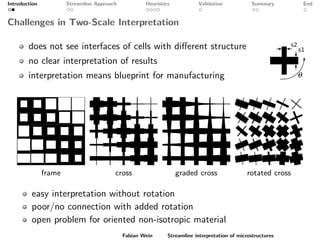
Challenges in Two-Scale Interpretation
does not see interfaces of cells with different structure
no clear interpretation of results
interpretation means blueprint for manufacturing
s2
s1
frame cross graded cross rotated cross
easy interpretation without rotation
poor/no connection with added rotation
open problem for oriented non-isotropic material
Fabian Wein Streamline interpretation of microstructures
Introduction Streamline Approach Heuristics Validation Summary End
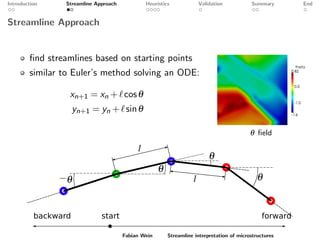
Streamline Approach
find streamlines based on starting points
similar to Euler’s method solving an ODE:
xn+1 = xn + cosθ
yn+1 = yn + sinθ
θ field
start forwardbackward
Fabian Wein Streamline interpretation of microstructures
Introduction Streamline Approach Heuristics Validation Summary End
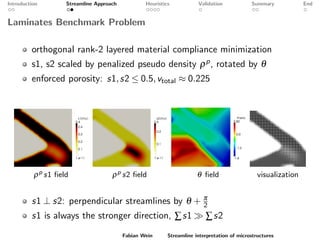
Laminates Benchmark Problem
orthogonal rank-2 layered material compliance minimization
s1, s2 scaled by penalized pseudo density ρp, rotated by θ
enforced porosity: s1,s2 ≤ 0.5,vtotal ≈ 0.225
ρp s1 field ρp s2 field θ field visualization
s1 ⊥ s2: perpendicular streamlines by θ + π
2
s1 is always the stronger direction, ∑s1 ∑s2
Fabian Wein Streamline interpretation of microstructures
Introduction Streamline Approach Heuristics Validation Summary End
Applying the Streamline Approach
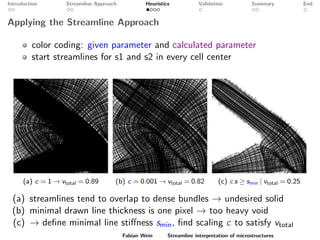
color coding: given parameter and calculated parameter
start streamlines for s1 and s2 in every cell center
(a) c = 1 → vtotal = 0.89 (b) c = 0.001 → vtotal = 0.82 (c) c s ≥ smin | vtotal = 0.25
(a) streamlines tend to overlap to dense bundles → undesired solid
(b) minimal drawn line thickness is one pixel → too heavy void
(c) → define minimal line stiffness smin, find scaling c to satisfy vtotal
Fabian Wein Streamline interpretation of microstructures
Introduction Streamline Approach Heuristics Validation Summary End
Indirect Control of Line Thickness
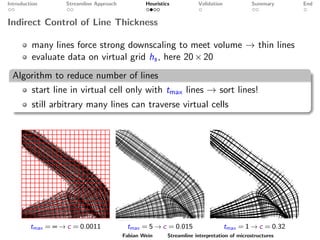
many lines force strong downscaling to meet volume → thin lines
evaluate data on virtual grid hs, here 20×20
Algorithm to reduce number of lines
start line in virtual cell only with tmax lines → sort lines!
still arbitrary many lines can traverse virtual cells
tmax = ∞ → c = 0.0011 tmax = 5 → c = 0.015 tmax = 1 → c = 0.32
Fabian Wein Streamline interpretation of microstructures
Introduction Streamline Approach Heuristics Validation Summary End
Increasing Minimal Line Thickness
s1 s2 in given example → s2 only expressed by thin lines
assume we do not want too thin lines for manufacturing
too restrictive minimal thickness smin eliminates s2
→ separate virtual grid spacing hs1 and hs2
hs1,hs2 = 40,smin = 0.05 hs1,hs2 = 40,smin = 0.2 hs1 = 40,hs2 = 10,smin = 0.2
Fabian Wein Streamline interpretation of microstructures
Introduction Streamline Approach Heuristics Validation Summary End
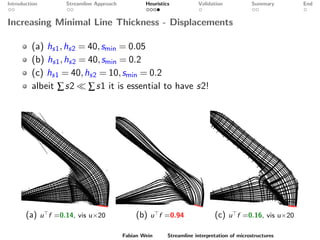
Increasing Minimal Line Thickness - Displacements
(a) hs1,hs2 = 40,smin = 0.05
(b) hs1,hs2 = 40,smin = 0.2
(c) hs1 = 40,hs2 = 10,smin = 0.2
albeit ∑s2 ∑s1 it is essential to have s2!
(a) u f =0.14, vis u×20 (b) u f =0.94 (c) u f =0.16, vis u×20
Fabian Wein Streamline interpretation of microstructures
Introduction Streamline Approach Heuristics Validation Summary End
Numerical Validation - Parameter Study
vary hs2 ∈ [10,40] and smin ∈ [0.01,0.2] → image → mesh → FEM
fixed hs1 = 40 and tmax = 2
10
20
30
40 0.0
0.1
0.2
0.210
0.215
0.220
0.225
0.230
vtotal
hs2
smin
vtotal
10
20
30
40 0.0
0.1
0.2
1.0
2.0
3.0
4.0
5.0 u
T
f
hs2
smin
u
T
f
minimal too low: many thin lines → vtotal cannot be reached
minimal too high: loose information → poor compliance
u f : homogenized=1.51, streamline ≈ 1.55 . . . 2.0, SIMP=1.13
Fabian Wein Streamline interpretation of microstructures
Introduction Streamline Approach Heuristics Validation Summary End
Summary
Pros
the streamline approach can interpret oriented 2D two-scale results!
performance of interpretation is “close” to homogenized performance
full control of local line thickness
correct orientation of lines (including relative angle)
Cons
poor control of local line density/ local porosity
interpretation is relatively far away from optimized design
problem specific hand tuned heuristics (hs1, hs2, smin, tmax, c)
Fabian Wein Streamline interpretation of microstructures
Introduction Streamline Approach Heuristics Validation Summary End
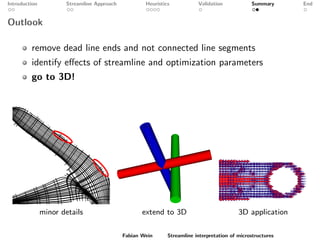
Outlook
remove dead line ends and not connected line segments
identify effects of streamline and optimization parameters
go to 3D!
minor details extend to 3D 3D application
Fabian Wein Streamline interpretation of microstructures
Introduction Streamline Approach Heuristics Validation Summary End
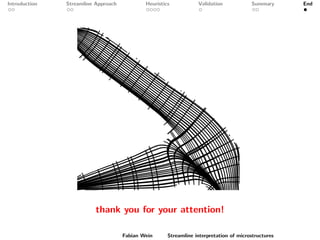
thank you for your attention!
Fabian Wein Streamline interpretation of microstructures
Introduction Streamline Approach Heuristics Validation Summary End
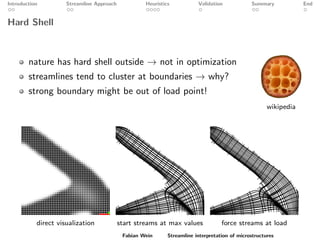
Hard Shell
nature has hard shell outside → not in optimization
streamlines tend to cluster at boundaries → why?
strong boundary might be out of load point!
wikipedia
direct visualization start streams at max values force streams at load
Fabian Wein Streamline interpretation of microstructures
Introduction Streamline Approach Heuristics Validation Summary End
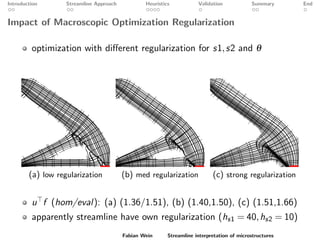
Impact of Macroscopic Optimization Regularization
optimization with different regularization for s1,s2 and θ
(a) low regularization (b) med regularization (c) strong regularization
u f (hom/eval): (a) (1.36/1.51), (b) (1.40,1.50), (c) (1.51,1.66)
apparently streamline have own regularization (hs1 = 40,hs2 = 10)
Fabian Wein Streamline interpretation of microstructures

Interpretation of local oriented microstructures by a streamline approach to obtain manufacturable structures

  • 1.
    Introduction Streamline ApproachHeuristics Validation Summary End Interpretation of local oriented microstructures by a streamline approach to obtain manufact. structures F. Wein, J. Greifenstein, Th. Guess, M. Stingl Applied Mathematics, University Erlangen-Nuremberg, Germany OPT-i June 4-6, 2014 Fabian Wein Streamline interpretation of microstructures
  • 2.
    Introduction Streamline ApproachHeuristics Validation Summary End The Founding Papers in Topology Optimization Bendsøe & Kikuchi; 1988; Generating optimal topologies in optimal design using a homogenization method (3281 cites) homogenized material [c] = H(s1,s2,θ) two-scale approach see also talk by Th. Guess, M. Stingl, F. Wein s2 s1 Bendsøe; 1989; Optimal shape design as a material distribution problem (1375 cites) single variable ρ scales homogeneous material → Solid Isotropic Material with Penalization Fabian Wein Streamline interpretation of microstructures
  • 3.
    Introduction Streamline ApproachHeuristics Validation Summary End Challenges in Two-Scale Interpretation does not see interfaces of cells with different structure no clear interpretation of results interpretation means blueprint for manufacturing s2 s1 frame cross graded cross rotated cross easy interpretation without rotation poor/no connection with added rotation open problem for oriented non-isotropic material Fabian Wein Streamline interpretation of microstructures
  • 4.
    Introduction Streamline ApproachHeuristics Validation Summary End Streamline Approach find streamlines based on starting points similar to Euler’s method solving an ODE: xn+1 = xn + cosθ yn+1 = yn + sinθ θ field start forwardbackward Fabian Wein Streamline interpretation of microstructures
  • 5.
    Introduction Streamline ApproachHeuristics Validation Summary End Laminates Benchmark Problem orthogonal rank-2 layered material compliance minimization s1, s2 scaled by penalized pseudo density ρp, rotated by θ enforced porosity: s1,s2 ≤ 0.5,vtotal ≈ 0.225 ρp s1 field ρp s2 field θ field visualization s1 ⊥ s2: perpendicular streamlines by θ + π 2 s1 is always the stronger direction, ∑s1 ∑s2 Fabian Wein Streamline interpretation of microstructures
  • 6.
    Introduction Streamline ApproachHeuristics Validation Summary End Applying the Streamline Approach color coding: given parameter and calculated parameter start streamlines for s1 and s2 in every cell center (a) c = 1 → vtotal = 0.89 (b) c = 0.001 → vtotal = 0.82 (c) c s ≥ smin | vtotal = 0.25 (a) streamlines tend to overlap to dense bundles → undesired solid (b) minimal drawn line thickness is one pixel → too heavy void (c) → define minimal line stiffness smin, find scaling c to satisfy vtotal Fabian Wein Streamline interpretation of microstructures
  • 7.
    Introduction Streamline ApproachHeuristics Validation Summary End Indirect Control of Line Thickness many lines force strong downscaling to meet volume → thin lines evaluate data on virtual grid hs, here 20×20 Algorithm to reduce number of lines start line in virtual cell only with tmax lines → sort lines! still arbitrary many lines can traverse virtual cells tmax = ∞ → c = 0.0011 tmax = 5 → c = 0.015 tmax = 1 → c = 0.32 Fabian Wein Streamline interpretation of microstructures
  • 8.
    Introduction Streamline ApproachHeuristics Validation Summary End Increasing Minimal Line Thickness s1 s2 in given example → s2 only expressed by thin lines assume we do not want too thin lines for manufacturing too restrictive minimal thickness smin eliminates s2 → separate virtual grid spacing hs1 and hs2 hs1,hs2 = 40,smin = 0.05 hs1,hs2 = 40,smin = 0.2 hs1 = 40,hs2 = 10,smin = 0.2 Fabian Wein Streamline interpretation of microstructures
  • 9.
    Introduction Streamline ApproachHeuristics Validation Summary End Increasing Minimal Line Thickness - Displacements (a) hs1,hs2 = 40,smin = 0.05 (b) hs1,hs2 = 40,smin = 0.2 (c) hs1 = 40,hs2 = 10,smin = 0.2 albeit ∑s2 ∑s1 it is essential to have s2! (a) u f =0.14, vis u×20 (b) u f =0.94 (c) u f =0.16, vis u×20 Fabian Wein Streamline interpretation of microstructures
  • 10.
    Introduction Streamline ApproachHeuristics Validation Summary End Numerical Validation - Parameter Study vary hs2 ∈ [10,40] and smin ∈ [0.01,0.2] → image → mesh → FEM fixed hs1 = 40 and tmax = 2 10 20 30 40 0.0 0.1 0.2 0.210 0.215 0.220 0.225 0.230 vtotal hs2 smin vtotal 10 20 30 40 0.0 0.1 0.2 1.0 2.0 3.0 4.0 5.0 u T f hs2 smin u T f minimal too low: many thin lines → vtotal cannot be reached minimal too high: loose information → poor compliance u f : homogenized=1.51, streamline ≈ 1.55 . . . 2.0, SIMP=1.13 Fabian Wein Streamline interpretation of microstructures
  • 11.
    Introduction Streamline ApproachHeuristics Validation Summary End Summary Pros the streamline approach can interpret oriented 2D two-scale results! performance of interpretation is “close” to homogenized performance full control of local line thickness correct orientation of lines (including relative angle) Cons poor control of local line density/ local porosity interpretation is relatively far away from optimized design problem specific hand tuned heuristics (hs1, hs2, smin, tmax, c) Fabian Wein Streamline interpretation of microstructures
  • 12.
    Introduction Streamline ApproachHeuristics Validation Summary End Outlook remove dead line ends and not connected line segments identify effects of streamline and optimization parameters go to 3D! minor details extend to 3D 3D application Fabian Wein Streamline interpretation of microstructures
  • 13.
    Introduction Streamline ApproachHeuristics Validation Summary End thank you for your attention! Fabian Wein Streamline interpretation of microstructures
  • 14.
    Introduction Streamline ApproachHeuristics Validation Summary End Hard Shell nature has hard shell outside → not in optimization streamlines tend to cluster at boundaries → why? strong boundary might be out of load point! wikipedia direct visualization start streams at max values force streams at load Fabian Wein Streamline interpretation of microstructures
  • 15.
    Introduction Streamline ApproachHeuristics Validation Summary End Impact of Macroscopic Optimization Regularization optimization with different regularization for s1,s2 and θ (a) low regularization (b) med regularization (c) strong regularization u f (hom/eval): (a) (1.36/1.51), (b) (1.40,1.50), (c) (1.51,1.66) apparently streamline have own regularization (hs1 = 40,hs2 = 10) Fabian Wein Streamline interpretation of microstructures