Venue Group Facility
Dubai 3 McDonald’s (Media City
Home Centre Student Number Name
Dubai 9345159 Stuart Lunn
Dubai 9301826 James Munson
UK 9258114 Oluyemisi Ehikioya
Dubai 9320490 Oluyemisi Ayodeji Megbope
Brief background
Established May 15, 1940 by Maurice and Richard McDonald, McDonald
Corporation currently has the largest chain of restaurants serving fast food in
119 countries to over 68 million customers daily.
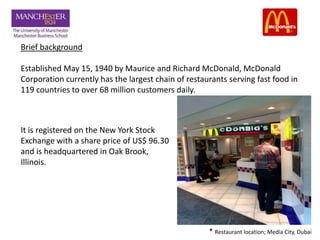
* Restaurant location; Media City, Dubai
It is registered on the New York Stock
Exchange with a share price of US$ 96.30
and is headquartered in Oak Brook,
Illinois.
Mission Statement
“To be our customers favourite place and way to eat and drink”
Values
At McDonald’s we…
• place the customer experience at the core of all we do
• are committed to our people
• believe in the McDonald’s system
• operate our business ethically
• give back to our communities
• grow our business profitably
• strive continually to improve
McDonald (2013) Company Information. Available at: http://www.aboutmcdonalds.com/mcd/our_company/mission_and_values.html
(Accessed: 25 March 2014).
Strategy
Over the last 3 years, McDonald strives to provide process standardization
across all its global operations.
In 2013, McDonald embarked on a global strategy called “Plan to Win”, which
center on an exceptional customer experience focusing on quick and fast
service. This initiative is around 5 pillars;
1. People
2. Products
3. Place
4. Price
5. Promotion
Zaidan (2013)
THE FOUR Vs of PROCESSES
• Volume: This is high. 105 customers place 53 orders attended to within one hour (an order
was placed every 67 seconds)
• Variety: Low variety. Menu is made up of burgers, fries, salads, McWraps, drinks and ice
cream
• Variation: Low. Because of predictably constant demand
• Visibility: is relatively high when compared to overall process
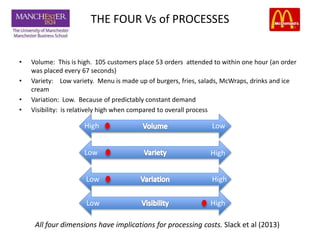
High
Low
Low
Low
Low
High
High
High
All four dimensions have implications for processing costs. Slack et al (2013)
Layout
- Slack et al (2013) refer to 4 basic layouts that can be observed when considering
the impact of the ‘4 V’s’ on processes.
- McDonald’s has relatively low variety, considering the set times it operates its
breakfast menu / main menu respectively
- Many examples of similar companies attempting to create classic flow line under
these circumstances (Starbuck’s, Subway etc)
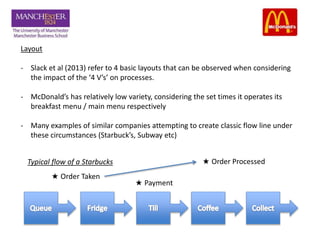
Typical flow of a Starbucks
★ Order Taken
★ Order Processed
★ Payment
Layout
- McDonald’s in Media
City has a successful
‘product layout’ for it’s
goods.
- clear flow for fries,
sandwiches and drinks
from point of purchase.
Production is geared to
efficient throughput,
however….
www.mcdonalds.com/inside_our_kitchens
Layout
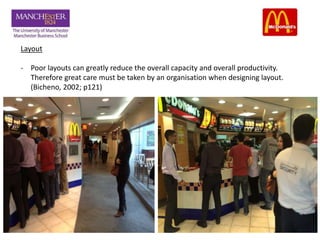
- Poor layouts can greatly reduce the overall capacity and overall productivity.
Therefore great care must be taken by an organisation when designing layout.
(Bicheno, 2002; p121)
Layout
- A product layout, with standardised requirements
- Insufficient consideration of the impact of queuing
- Reducing capacity of the outlet, and a problem that will worsen…
S
t
o
r
e
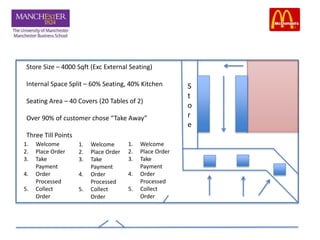
Store Size – 4000 Sqft (Exc External Seating)
Internal Space Split – 60% Seating, 40% Kitchen
Seating Area – 40 Covers (20 Tables of 2)
Over 90% of customer chose “Take Away”
Three Till Points
1. Welcome
2. Place Order
3. Take
Payment
4. Order
Processed
5. Collect
Order
1. Welcome
2. Place Order
3. Take
Payment
4. Order
Processed
5. Collect
Order
1. Welcome
2. Place Order
3. Take
Payment
4. Order
Processed
5. Collect
Order
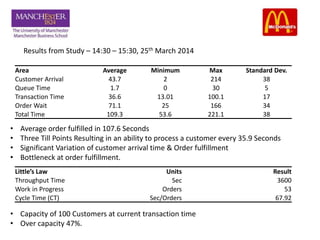
Little’s Law Units Result
Throughput Time Sec 3600
Work in Progress Orders 53
Cycle Time (CT) Sec/Orders 67.92
Area Average Minimum Max Standard Dev.
Customer Arrival 43.7 2 214 38
Queue Time 1.7 0 30 5
Transaction Time 36.6 13.01 100.1 17
Order Wait 71.1 25 166 34
Total Time 109.3 53.6 221.1 38
Results from Study – 14:30 – 15:30, 25th March 2014
• Average order fulfilled in 107.6 Seconds
• Three Till Points Resulting in an ability to process a customer every 35.9 Seconds
• Significant Variation of customer arrival time & Order fulfillment
• Bottleneck at order fulfillment.
• Capacity of 100 Customers at current transaction time
• Over capacity 47%.
Observations
• Evident process training in place.
• Production process of food was efficient – Pull Control, minimum inventory
• Till Utilization = Processing Rate / (Arrival Rate * Number of Stations)
• 107.6 / (43.7*3) = 82%
• “Inventory” of customers waiting for their order
• Lack of customer flow preventing faster transaction times
• Confusion with customers understanding the queue system resulting in slower
processing times.
• Queue manager in place, but not always perceived as effective (Durrande-Moreau, 1998)
• Insufficient space for processing of orders, resulting in blocked till points
Recommendation
• Create a flow order process which;
• Create a leaner process
• Will improve customer navigation and understanding
• Will reduce bottleneck increasing speed
• Potentially could lead to a reduction of headcount
• Could reduce system robustness
• Incentivise customers to use the delivery service during peak hours
• Decreasing pressure on front of house space
S
t
o
r
e
Recommended customer service flow
1. Welcome
2. Place Order
3. Process Order
4. Take Payment
5. Collect Order
Appendix
Restrictions
• Based upon 1 hour of observation
• Unable to understand operation behind the line of visibility
• Unable to determine the level of trade from McDelivery
References
Bichenoj J (2012) The Service Systems Toolbox: Integrating lean thinking, systems thinking
and design thinking. Buckingham, PICSIE Books
McDonald (2013) Company Information. Available at:
http://www.aboutmcdonalds.com/mcd/our_company/mission_and_values.html
(Accessed: 25 March 2014).
Slack N., Brandon-Jones, A., Johnston, R., Betts, A. (2013) Operations and Process
Management. 3rd edition, Harlow, UK. Pearsons
Interview with Zeidan R, (2013) Strategy Director for McDonalds MENA (Middle East &
North Africa) region
Durrande-Moreau, A (1999) Waiting for service: ten years of empirical research. Available
at http://www.imi.aau.dk (Accessed: 26th March 2014)
McDonalds (2013) Company Information. Available at:
www.mcdonalds.com/inside_our_kitchens (Accessed: 25th March 2014)

Operations Management

  • 1.
    Venue Group Facility Dubai3 McDonald’s (Media City Home Centre Student Number Name Dubai 9345159 Stuart Lunn Dubai 9301826 James Munson UK 9258114 Oluyemisi Ehikioya Dubai 9320490 Oluyemisi Ayodeji Megbope
  • 2.
    Brief background Established May15, 1940 by Maurice and Richard McDonald, McDonald Corporation currently has the largest chain of restaurants serving fast food in 119 countries to over 68 million customers daily. * Restaurant location; Media City, Dubai It is registered on the New York Stock Exchange with a share price of US$ 96.30 and is headquartered in Oak Brook, Illinois.
  • 3.
    Mission Statement “To beour customers favourite place and way to eat and drink” Values At McDonald’s we… • place the customer experience at the core of all we do • are committed to our people • believe in the McDonald’s system • operate our business ethically • give back to our communities • grow our business profitably • strive continually to improve McDonald (2013) Company Information. Available at: http://www.aboutmcdonalds.com/mcd/our_company/mission_and_values.html (Accessed: 25 March 2014).
  • 4.
    Strategy Over the last3 years, McDonald strives to provide process standardization across all its global operations. In 2013, McDonald embarked on a global strategy called “Plan to Win”, which center on an exceptional customer experience focusing on quick and fast service. This initiative is around 5 pillars; 1. People 2. Products 3. Place 4. Price 5. Promotion Zaidan (2013)
  • 5.
    THE FOUR Vsof PROCESSES • Volume: This is high. 105 customers place 53 orders attended to within one hour (an order was placed every 67 seconds) • Variety: Low variety. Menu is made up of burgers, fries, salads, McWraps, drinks and ice cream • Variation: Low. Because of predictably constant demand • Visibility: is relatively high when compared to overall process High Low Low Low Low High High High All four dimensions have implications for processing costs. Slack et al (2013)
  • 6.
    Layout - Slack etal (2013) refer to 4 basic layouts that can be observed when considering the impact of the ‘4 V’s’ on processes. - McDonald’s has relatively low variety, considering the set times it operates its breakfast menu / main menu respectively - Many examples of similar companies attempting to create classic flow line under these circumstances (Starbuck’s, Subway etc) Typical flow of a Starbucks ★ Order Taken ★ Order Processed ★ Payment
  • 7.
    Layout - McDonald’s inMedia City has a successful ‘product layout’ for it’s goods. - clear flow for fries, sandwiches and drinks from point of purchase. Production is geared to efficient throughput, however…. www.mcdonalds.com/inside_our_kitchens
  • 8.
    Layout - Poor layoutscan greatly reduce the overall capacity and overall productivity. Therefore great care must be taken by an organisation when designing layout. (Bicheno, 2002; p121)
  • 9.
    Layout - A productlayout, with standardised requirements - Insufficient consideration of the impact of queuing - Reducing capacity of the outlet, and a problem that will worsen…
  • 10.
    S t o r e Store Size –4000 Sqft (Exc External Seating) Internal Space Split – 60% Seating, 40% Kitchen Seating Area – 40 Covers (20 Tables of 2) Over 90% of customer chose “Take Away” Three Till Points 1. Welcome 2. Place Order 3. Take Payment 4. Order Processed 5. Collect Order 1. Welcome 2. Place Order 3. Take Payment 4. Order Processed 5. Collect Order 1. Welcome 2. Place Order 3. Take Payment 4. Order Processed 5. Collect Order
  • 11.
    Little’s Law UnitsResult Throughput Time Sec 3600 Work in Progress Orders 53 Cycle Time (CT) Sec/Orders 67.92 Area Average Minimum Max Standard Dev. Customer Arrival 43.7 2 214 38 Queue Time 1.7 0 30 5 Transaction Time 36.6 13.01 100.1 17 Order Wait 71.1 25 166 34 Total Time 109.3 53.6 221.1 38 Results from Study – 14:30 – 15:30, 25th March 2014 • Average order fulfilled in 107.6 Seconds • Three Till Points Resulting in an ability to process a customer every 35.9 Seconds • Significant Variation of customer arrival time & Order fulfillment • Bottleneck at order fulfillment. • Capacity of 100 Customers at current transaction time • Over capacity 47%.
  • 12.
    Observations • Evident processtraining in place. • Production process of food was efficient – Pull Control, minimum inventory • Till Utilization = Processing Rate / (Arrival Rate * Number of Stations) • 107.6 / (43.7*3) = 82% • “Inventory” of customers waiting for their order • Lack of customer flow preventing faster transaction times • Confusion with customers understanding the queue system resulting in slower processing times. • Queue manager in place, but not always perceived as effective (Durrande-Moreau, 1998) • Insufficient space for processing of orders, resulting in blocked till points
  • 13.
    Recommendation • Create aflow order process which; • Create a leaner process • Will improve customer navigation and understanding • Will reduce bottleneck increasing speed • Potentially could lead to a reduction of headcount • Could reduce system robustness • Incentivise customers to use the delivery service during peak hours • Decreasing pressure on front of house space
  • 14.
    S t o r e Recommended customer serviceflow 1. Welcome 2. Place Order 3. Process Order 4. Take Payment 5. Collect Order
  • 15.
    Appendix Restrictions • Based upon1 hour of observation • Unable to understand operation behind the line of visibility • Unable to determine the level of trade from McDelivery
  • 16.
    References Bichenoj J (2012)The Service Systems Toolbox: Integrating lean thinking, systems thinking and design thinking. Buckingham, PICSIE Books McDonald (2013) Company Information. Available at: http://www.aboutmcdonalds.com/mcd/our_company/mission_and_values.html (Accessed: 25 March 2014). Slack N., Brandon-Jones, A., Johnston, R., Betts, A. (2013) Operations and Process Management. 3rd edition, Harlow, UK. Pearsons Interview with Zeidan R, (2013) Strategy Director for McDonalds MENA (Middle East & North Africa) region Durrande-Moreau, A (1999) Waiting for service: ten years of empirical research. Available at http://www.imi.aau.dk (Accessed: 26th March 2014) McDonalds (2013) Company Information. Available at: www.mcdonalds.com/inside_our_kitchens (Accessed: 25th March 2014)

Editor's Notes

  • #2 Position:
  • #3 Position:
  • #4 Position: mission statement relevance, and relevance of values (namely customer experience)
  • #5 Position:
  • #6 All four Vs of processes impact directly on their overall costs. Even though visibility is relatively high, high volume and low variety and variation helps to keep their processing cost down and this explains why they have been able to keep their prices low over the decades.
  • #7 Position: We have considered the 4 basic types of layout (1)….and although seasonal variance, and changing consumption habits (salad introduction is apparent) (2) ….when a company has high volume (3)
  • #8 Position: that this branch has the right processes in the most part, but the lack of a pre-arranged route for customers causes problems at peak times
  • #9 Position: the range of shops, lack of space, poor consideration for queuing issues
  • #10 Reference the actual layout. The impact/lack of consideration to queuing. The fact indoor seating is limited – and outdoor seating will soon be unavailable (summer and Ramadan). This will see the impact worsen, if not addressed, over the summer months – observations and recommendations for improvement are validated by the information gathered….
  • #11 Process Flow – Welcome offered to Customer Customer places order Assistant enters order into till and requests payment Payment taken and processed Order is processed whilst customer stands aside Order is delivered to customer Located in busy walkway Red area not visible to the customer
  • #13 Inventory of customers can lead to; Cost – Wastes customers time Space – Needs waiting area Quality – Give negative perception Utilisation – Servers kept busy by waiting customers Co-ord – Avoids having to match supply & Demand Source: Slack et al (2013) Table 11.1 Pg 355
  • #14 Position:
  • #15 Located in busy walkway Red area not visible to the customer
  • #17 Position: