Operating Systems -
Device Drivers,
Translators, Linkers,
and Utility Software
In this presentation, we will explore the various components of an
operating system, including device drivers, translators, linkers, and utility
software, and understand their importance in ensuring smooth system
operations.
Device Drivers
1 Definition
Device drivers are software
components that allow the
operating system to communicate
and interact with hardware devices
such as printers, keyboards, and
graphic cards.
2 Function
Device drivers enable the operating
system to control and manage the
hardware devices, ensuring
seamless data transfer and efficient
utilization of resources.
3 Examples
Some examples of device drivers
include network drivers, audio
drivers, and display drivers.
4 Impact
Device drivers play a critical role in
enabling hardware compatibility,
improving system performance,
and enhancing user experience.
Importance of Device Drivers
Hardware
Compatibility
Device drivers ensure
that the operating
system can
communicate
seamlessly with a wide
range of hardware
devices, allowing users
to connect and use their
preferred peripherals.
Optimal
Performance
Well-designed device
drivers optimize the
utilization of hardware
resources, resulting in
improved performance
and faster data transfer
rates.
User Experience
Device drivers enable
users to access
advanced features,
settings, and
functionalities specific to
their hardware devices,
enhancing the overall
user experience.
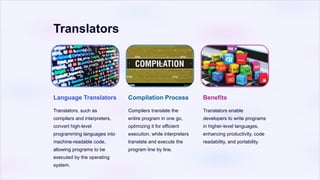
Translators
Language Translators
Translators, such as
compilers and interpreters,
convert high-level
programming languages into
machine-readable code,
allowing programs to be
executed by the operating
system.
Compilation Process
Compilers translate the
entire program in one go,
optimizing it for efficient
execution, while interpreters
translate and execute the
program line by line.
Benefits
Translators enable
developers to write programs
in higher-level languages,
enhancing productivity, code
readability, and portability.
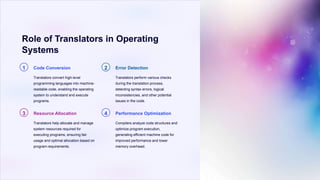
Role of Translators in Operating
Systems
1 Code Conversion
Translators convert high-level
programming languages into machine-
readable code, enabling the operating
system to understand and execute
programs.
2 Error Detection
Translators perform various checks
during the translation process,
detecting syntax errors, logical
inconsistencies, and other potential
issues in the code.
3 Resource Allocation
Translators help allocate and manage
system resources required for
executing programs, ensuring fair
usage and optimal allocation based on
program requirements.
4 Performance Optimization
Compilers analyze code structures and
optimize program execution,
generating efficient machine code for
improved performance and lower
memory overhead.
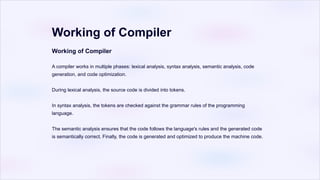
Working of Compiler
Working of Compiler
A compiler works in multiple phases: lexical analysis, syntax analysis, semantic analysis, code
generation, and code optimization.
During lexical analysis, the source code is divided into tokens.
In syntax analysis, the tokens are checked against the grammar rules of the programming
language.
The semantic analysis ensures that the code follows the language's rules and the generated code
is semantically correct. Finally, the code is generated and optimized to produce the machine code.
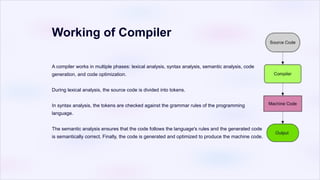
Working of Compiler
A compiler works in multiple phases: lexical analysis, syntax analysis, semantic analysis, code
generation, and code optimization.
During lexical analysis, the source code is divided into tokens.
In syntax analysis, the tokens are checked against the grammar rules of the programming
language.
The semantic analysis ensures that the code follows the language's rules and the generated code
is semantically correct. Finally, the code is generated and optimized to produce the machine code.
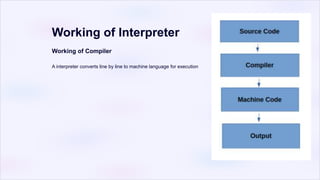
Working of Interpreter
Working of Compiler
A interpreter converts line by line to machine language for execution
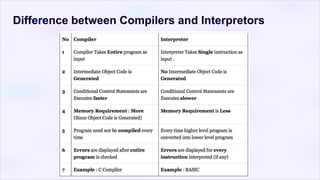
Difference between Compilers and Interpretors
Difference between Compilers and
Interpretors
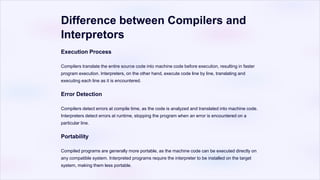
Execution Process
Compilers translate the entire source code into machine code before execution, resulting in faster
program execution. Interpreters, on the other hand, execute code line by line, translating and
executing each line as it is encountered.
Error Detection
Compilers detect errors at compile time, as the code is analyzed and translated into machine code.
Interpreters detect errors at runtime, stopping the program when an error is encountered on a
particular line.
Portability
Compiled programs are generally more portable, as the machine code can be executed directly on
any compatible system. Interpreted programs require the interpreter to be installed on the target
system, making them less portable.
Linkers
Definition
Linkers are software
programs that combine
multiple modules or object
files created during the
compilation process,
producing an executable
program.
Symbol Resolution
Linkers resolve symbols
and addresses, ensuring
that all function calls and
variable references are
linked correctly, aiding in
the successful execution of
the program.
Dependency
Management
Linkers handle
dependencies between
different modules, libraries,
and frameworks, facilitating
the integration of various
components into a cohesive
whole.
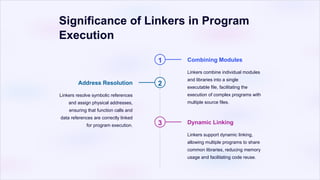
Significance of Linkers in Program
Execution
1 Combining Modules
Linkers combine individual modules
and libraries into a single
executable file, facilitating the
execution of complex programs with
multiple source files.
2
Address Resolution
Linkers resolve symbolic references
and assign physical addresses,
ensuring that function calls and
data references are correctly linked
for program execution. 3 Dynamic Linking
Linkers support dynamic linking,
allowing multiple programs to share
common libraries, reducing memory
usage and facilitating code reuse.
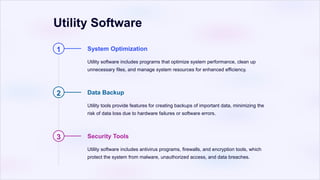
Utility Software
1 System Optimization
Utility software includes programs that optimize system performance, clean up
unnecessary files, and manage system resources for enhanced efficiency.
2 Data Backup
Utility tools provide features for creating backups of important data, minimizing the
risk of data loss due to hardware failures or software errors.
3 Security Tools
Utility software includes antivirus programs, firewalls, and encryption tools, which
protect the system from malware, unauthorized access, and data breaches.

Operating-Systems-Device-Drivers-Translators-Linkers-and-Utility-Software.pptx

  • 1.
    Operating Systems - DeviceDrivers, Translators, Linkers, and Utility Software In this presentation, we will explore the various components of an operating system, including device drivers, translators, linkers, and utility software, and understand their importance in ensuring smooth system operations.
  • 2.
    Device Drivers 1 Definition Devicedrivers are software components that allow the operating system to communicate and interact with hardware devices such as printers, keyboards, and graphic cards. 2 Function Device drivers enable the operating system to control and manage the hardware devices, ensuring seamless data transfer and efficient utilization of resources. 3 Examples Some examples of device drivers include network drivers, audio drivers, and display drivers. 4 Impact Device drivers play a critical role in enabling hardware compatibility, improving system performance, and enhancing user experience.
  • 3.
    Importance of DeviceDrivers Hardware Compatibility Device drivers ensure that the operating system can communicate seamlessly with a wide range of hardware devices, allowing users to connect and use their preferred peripherals. Optimal Performance Well-designed device drivers optimize the utilization of hardware resources, resulting in improved performance and faster data transfer rates. User Experience Device drivers enable users to access advanced features, settings, and functionalities specific to their hardware devices, enhancing the overall user experience.
  • 4.
    Translators Language Translators Translators, suchas compilers and interpreters, convert high-level programming languages into machine-readable code, allowing programs to be executed by the operating system. Compilation Process Compilers translate the entire program in one go, optimizing it for efficient execution, while interpreters translate and execute the program line by line. Benefits Translators enable developers to write programs in higher-level languages, enhancing productivity, code readability, and portability.
  • 5.
    Role of Translatorsin Operating Systems 1 Code Conversion Translators convert high-level programming languages into machine- readable code, enabling the operating system to understand and execute programs. 2 Error Detection Translators perform various checks during the translation process, detecting syntax errors, logical inconsistencies, and other potential issues in the code. 3 Resource Allocation Translators help allocate and manage system resources required for executing programs, ensuring fair usage and optimal allocation based on program requirements. 4 Performance Optimization Compilers analyze code structures and optimize program execution, generating efficient machine code for improved performance and lower memory overhead.
  • 6.
    Working of Compiler Workingof Compiler A compiler works in multiple phases: lexical analysis, syntax analysis, semantic analysis, code generation, and code optimization. During lexical analysis, the source code is divided into tokens. In syntax analysis, the tokens are checked against the grammar rules of the programming language. The semantic analysis ensures that the code follows the language's rules and the generated code is semantically correct. Finally, the code is generated and optimized to produce the machine code.
  • 7.
    Working of Compiler Acompiler works in multiple phases: lexical analysis, syntax analysis, semantic analysis, code generation, and code optimization. During lexical analysis, the source code is divided into tokens. In syntax analysis, the tokens are checked against the grammar rules of the programming language. The semantic analysis ensures that the code follows the language's rules and the generated code is semantically correct. Finally, the code is generated and optimized to produce the machine code.
  • 8.
    Working of Interpreter Workingof Compiler A interpreter converts line by line to machine language for execution
  • 9.
  • 10.
    Difference between Compilersand Interpretors Execution Process Compilers translate the entire source code into machine code before execution, resulting in faster program execution. Interpreters, on the other hand, execute code line by line, translating and executing each line as it is encountered. Error Detection Compilers detect errors at compile time, as the code is analyzed and translated into machine code. Interpreters detect errors at runtime, stopping the program when an error is encountered on a particular line. Portability Compiled programs are generally more portable, as the machine code can be executed directly on any compatible system. Interpreted programs require the interpreter to be installed on the target system, making them less portable.
  • 11.
    Linkers Definition Linkers are software programsthat combine multiple modules or object files created during the compilation process, producing an executable program. Symbol Resolution Linkers resolve symbols and addresses, ensuring that all function calls and variable references are linked correctly, aiding in the successful execution of the program. Dependency Management Linkers handle dependencies between different modules, libraries, and frameworks, facilitating the integration of various components into a cohesive whole.
  • 12.
    Significance of Linkersin Program Execution 1 Combining Modules Linkers combine individual modules and libraries into a single executable file, facilitating the execution of complex programs with multiple source files. 2 Address Resolution Linkers resolve symbolic references and assign physical addresses, ensuring that function calls and data references are correctly linked for program execution. 3 Dynamic Linking Linkers support dynamic linking, allowing multiple programs to share common libraries, reducing memory usage and facilitating code reuse.
  • 13.
    Utility Software 1 SystemOptimization Utility software includes programs that optimize system performance, clean up unnecessary files, and manage system resources for enhanced efficiency. 2 Data Backup Utility tools provide features for creating backups of important data, minimizing the risk of data loss due to hardware failures or software errors. 3 Security Tools Utility software includes antivirus programs, firewalls, and encryption tools, which protect the system from malware, unauthorized access, and data breaches.