Chapter-1: Introduction
Md. Umor Faruk Jahangir
Student of Dept. of CSE
Sylhet International University
Operating System
 What is an Operating System ?
• An Operating System is a software which maintains the
computer hardware and makes the relationship between
an user and a Computer
• Operating system goals:
– Execute user programs and make solving user problems
easier
– Make the computer system convenient to use
– Use the computer hardware in an efficient manner
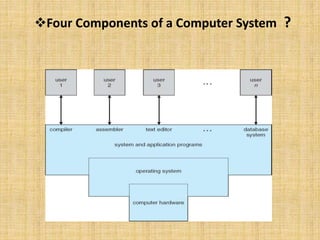
Four Components of a Computer System ?
Role of operating system ?
• They are two types:
From user view
From system view
From User view
1.The goal of the Operating System is to maximize the work and
minimize the effort of the user.
2.Most of the systems are designed to be operated by single user,
however in some systems multiple users can share resources, memory.
In these cases Operating System is designed to handle available
resources among multiple users and CPU efficiently.
3.Operating System must be designed by taking both usability and
efficient resource utilization into view.
4.In embedded systems(Automated systems) user view is not present.
5.Operating System gives an effect to the user as if the processor is
dealing only with the current task, but in background processor is
dealing with several processes.
From System view
1.From the system point of view Operating System is a program involved with the hardware.
2.Operating System is allocator, which allocate memory, resources among various processes.It
controls the sharing of resources among programs.
3.It prevents improper usage, error and handle deadlock conditions.
4.It is a program that runs all the time in the system in the form of Kernel.
5.It controls application programs that are not part of Kernel.
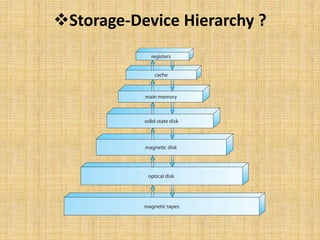
Storage-Device Hierarchy ?
Storage Structure ?
• Main memory – only large storage media that the CPU can access directly
– Random access
– Typically volatile
• Secondary storage – extension of main memory that provides large
nonvolatile storage capacity
• Magnetic disks – rigid metal or glass platters covered with magnetic
recording material
– Disk surface is logically divided into tracks, which are subdivided into
sectors
– The disk controller determines the logical interaction between the
device and the computer
• Solid-state disks – faster than magnetic disks, nonvolatile
– Various technologies
– Becoming more popular
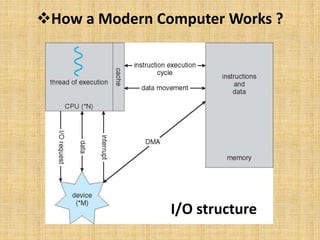
How a Modern Computer Works ?
I/O structure
To start an I/O operation, the device driver
loads the appropriate registers
within the device controller.
The device controller examines the registers to
determine what action to take.
 The controller starts the transfer of data from
the device to its local buffer.
 Once the transfer of data is complete, the
device controller informs the device driver via an
interrupt that it has finished its operation.
The device driver then returns control to the
operating system , possibly returning the data or
a pointer to the data if the operation was a read.
Computer-System Architecture ?
• Most systems use a single general-purpose processor (PDAs through
mainframes)
– Most systems have special-purpose processors as well
• Multiprocessors systems growing in use and importance
– Also known as parallel systems, tightly-coupled systems
– Advantages include:
1. Increased throughput
2. Economy of scale
3. Increased reliability – graceful degradation or fault tolerance
– Two types:
1. Asymmetric Multiprocessing
2. Symmetric Multiprocessing
Process Management ?
• Creating and deleting both user and system
processes
• Suspending and resuming processes
• Providing mechanisms for process synchronization
• Providing mechanisms for process communication
• Providing mechanisms for deadlock handling
Memory Management ?
 Keeping track of which parts of
memory are currently being used and by
whom
Deciding which processes (or parts
thereof) and data to move into and out
of memory
Allocating and deallocating memory
space as needed
Storage Management ?
 File system management
 Mass storage management
 Caching
I/O systems
File system management ?
 Creating and deleting files and
directories
 Primitives to manipulate files and dirs
 Mapping files onto secondary storage
Backup files onto stable (non-volatile)
storage media
Mess storage management ?
 Free-space management
 Storage allocation
 Disk scheduling
I/O System ?
• I/O system responsible for
– Memory management of I/O including buffering ,
caching , spooling
– General device-driver interface
– Drivers for specific hardware devices

Operating system Chapter One

  • 1.
    Chapter-1: Introduction Md. UmorFaruk Jahangir Student of Dept. of CSE Sylhet International University
  • 2.
  • 3.
     What isan Operating System ? • An Operating System is a software which maintains the computer hardware and makes the relationship between an user and a Computer • Operating system goals: – Execute user programs and make solving user problems easier – Make the computer system convenient to use – Use the computer hardware in an efficient manner
  • 4.
    Four Components ofa Computer System ?
  • 5.
    Role of operatingsystem ? • They are two types: From user view From system view
  • 6.
    From User view 1.Thegoal of the Operating System is to maximize the work and minimize the effort of the user. 2.Most of the systems are designed to be operated by single user, however in some systems multiple users can share resources, memory. In these cases Operating System is designed to handle available resources among multiple users and CPU efficiently. 3.Operating System must be designed by taking both usability and efficient resource utilization into view. 4.In embedded systems(Automated systems) user view is not present. 5.Operating System gives an effect to the user as if the processor is dealing only with the current task, but in background processor is dealing with several processes.
  • 7.
    From System view 1.Fromthe system point of view Operating System is a program involved with the hardware. 2.Operating System is allocator, which allocate memory, resources among various processes.It controls the sharing of resources among programs. 3.It prevents improper usage, error and handle deadlock conditions. 4.It is a program that runs all the time in the system in the form of Kernel. 5.It controls application programs that are not part of Kernel.
  • 8.
  • 9.
    Storage Structure ? •Main memory – only large storage media that the CPU can access directly – Random access – Typically volatile • Secondary storage – extension of main memory that provides large nonvolatile storage capacity • Magnetic disks – rigid metal or glass platters covered with magnetic recording material – Disk surface is logically divided into tracks, which are subdivided into sectors – The disk controller determines the logical interaction between the device and the computer • Solid-state disks – faster than magnetic disks, nonvolatile – Various technologies – Becoming more popular
  • 10.
    How a ModernComputer Works ? I/O structure
  • 11.
    To start anI/O operation, the device driver loads the appropriate registers within the device controller. The device controller examines the registers to determine what action to take.  The controller starts the transfer of data from the device to its local buffer.  Once the transfer of data is complete, the device controller informs the device driver via an interrupt that it has finished its operation. The device driver then returns control to the operating system , possibly returning the data or a pointer to the data if the operation was a read.
  • 12.
    Computer-System Architecture ? •Most systems use a single general-purpose processor (PDAs through mainframes) – Most systems have special-purpose processors as well • Multiprocessors systems growing in use and importance – Also known as parallel systems, tightly-coupled systems – Advantages include: 1. Increased throughput 2. Economy of scale 3. Increased reliability – graceful degradation or fault tolerance – Two types: 1. Asymmetric Multiprocessing 2. Symmetric Multiprocessing
  • 13.
    Process Management ? •Creating and deleting both user and system processes • Suspending and resuming processes • Providing mechanisms for process synchronization • Providing mechanisms for process communication • Providing mechanisms for deadlock handling
  • 14.
    Memory Management ? Keeping track of which parts of memory are currently being used and by whom Deciding which processes (or parts thereof) and data to move into and out of memory Allocating and deallocating memory space as needed
  • 15.
    Storage Management ? File system management  Mass storage management  Caching I/O systems
  • 16.
    File system management?  Creating and deleting files and directories  Primitives to manipulate files and dirs  Mapping files onto secondary storage Backup files onto stable (non-volatile) storage media
  • 17.
    Mess storage management?  Free-space management  Storage allocation  Disk scheduling
  • 18.
    I/O System ? •I/O system responsible for – Memory management of I/O including buffering , caching , spooling – General device-driver interface – Drivers for specific hardware devices