Forming Partnerships with ParentsFORMINGPARTNERSHIPS WITH PARENTS
Forming Partnerships with ParentsJames D. MorrowUNCCMAED 5040 – 090Dr. Adam HarbaughApril, 2010
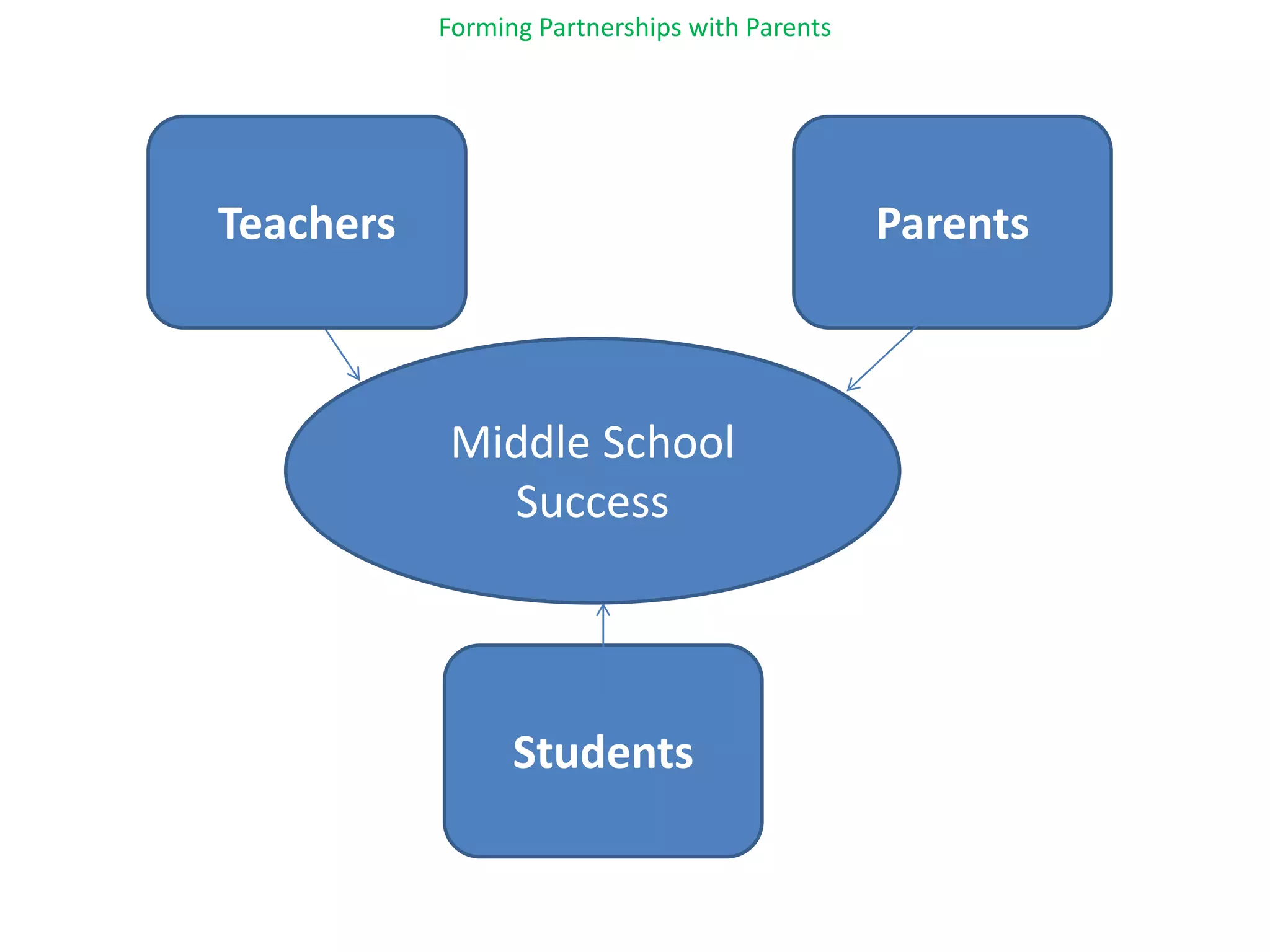
Forming Partnerships with ParentsParentsTeachersMiddle School SuccessStudents
Forming Partnerships with ParentsHow can Teachers get Parents engaged in their Child’s Education?Initial Letter to ParentsBack to School NightOpen HouseParent Teacher ConferenceSchool and Community Mathematic ClubsMathematic ContestsCommunity Outreach
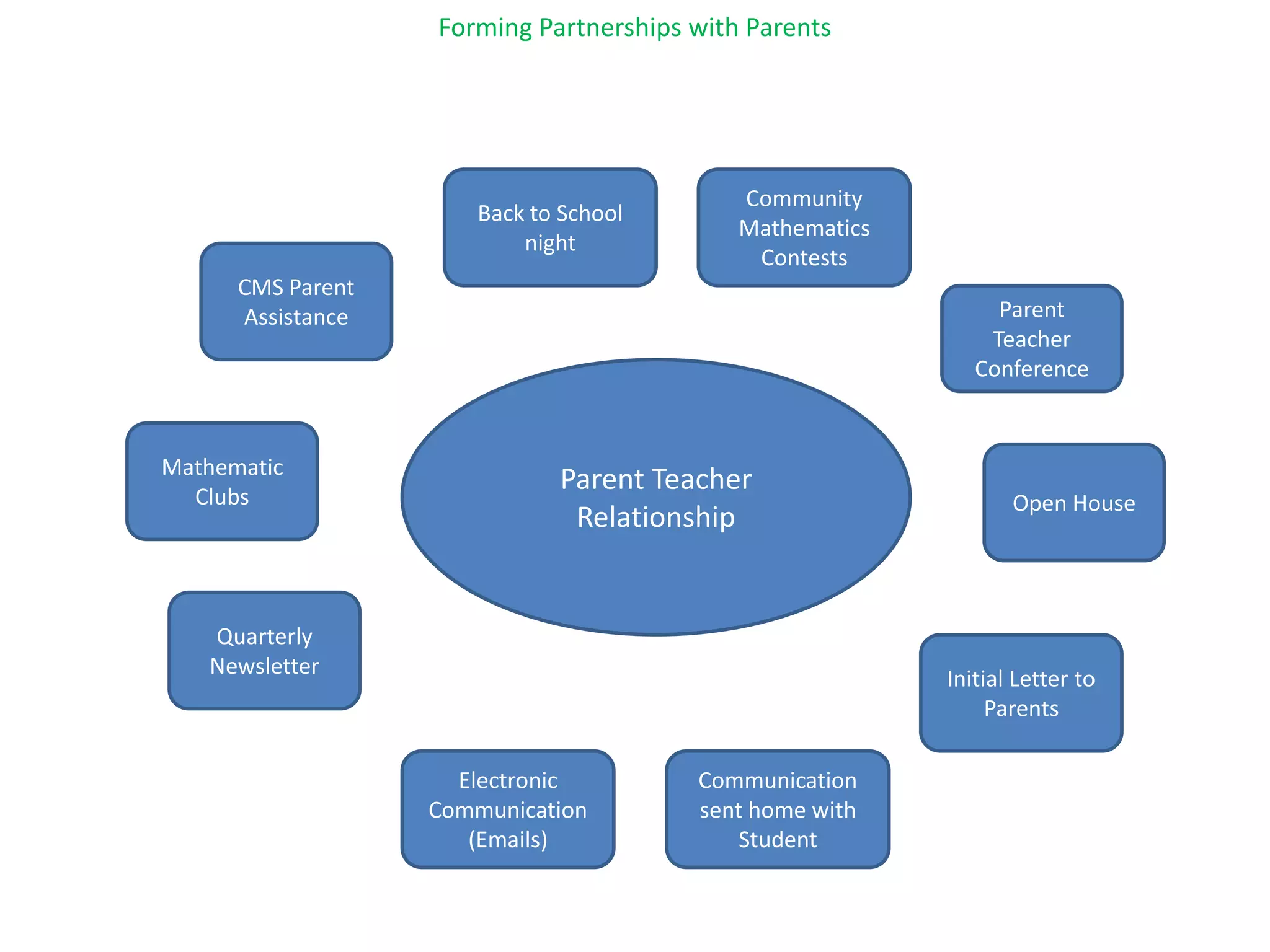
Forming Partnerships with ParentsCommunity Mathematics ContestsBack to School nightCMS Parent AssistanceParent Teacher ConferenceParent Teacher RelationshipMathematic ClubsOpen HouseQuarterly NewsletterInitial Letter to ParentsElectronic Communication (Emails)Communication sent home with Student
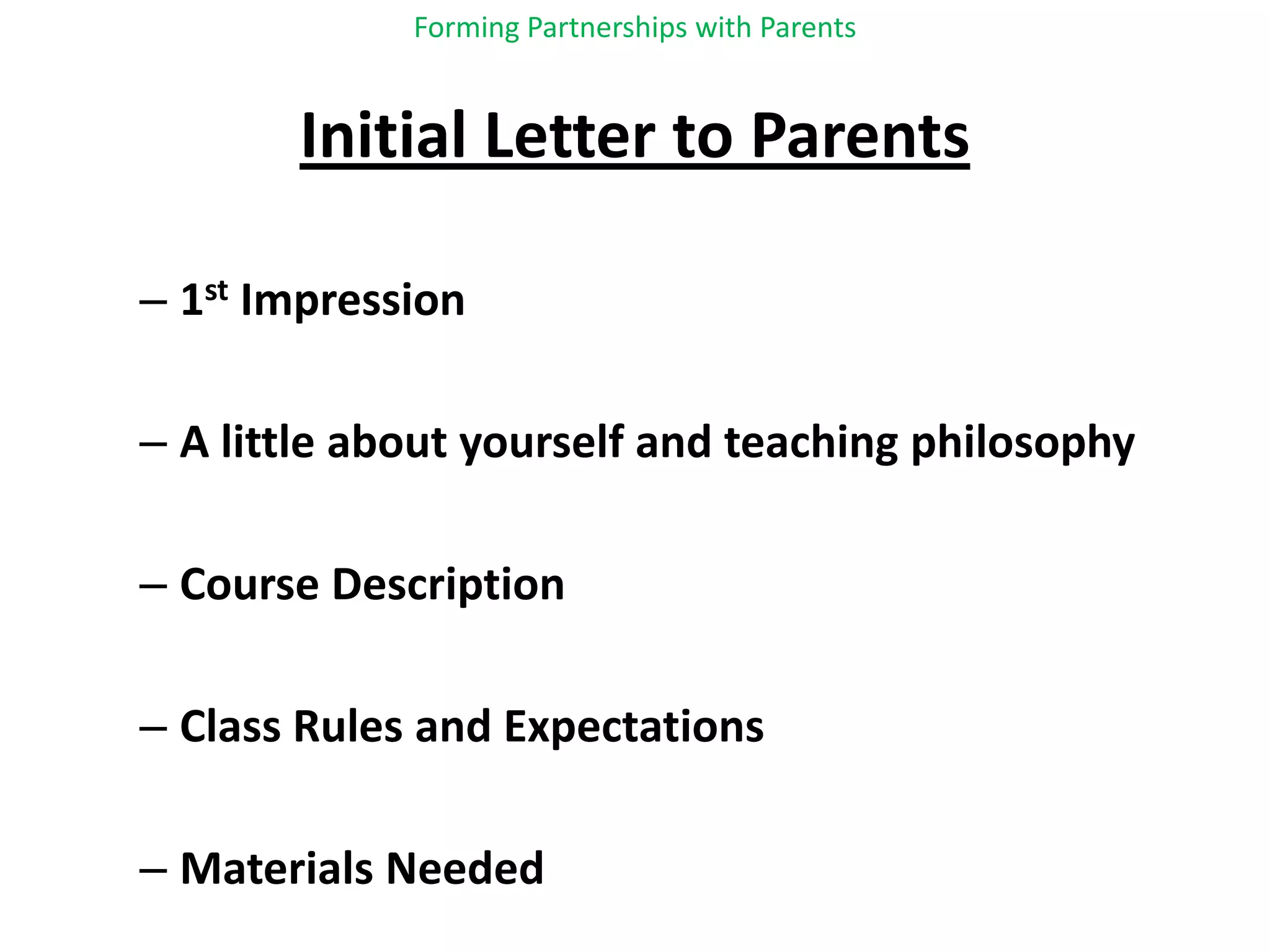
Forming Partnerships with ParentsInitial Letter to Parents1st ImpressionA little about yourself and teaching philosophyCourse DescriptionClass Rules and ExpectationsMaterials Needed
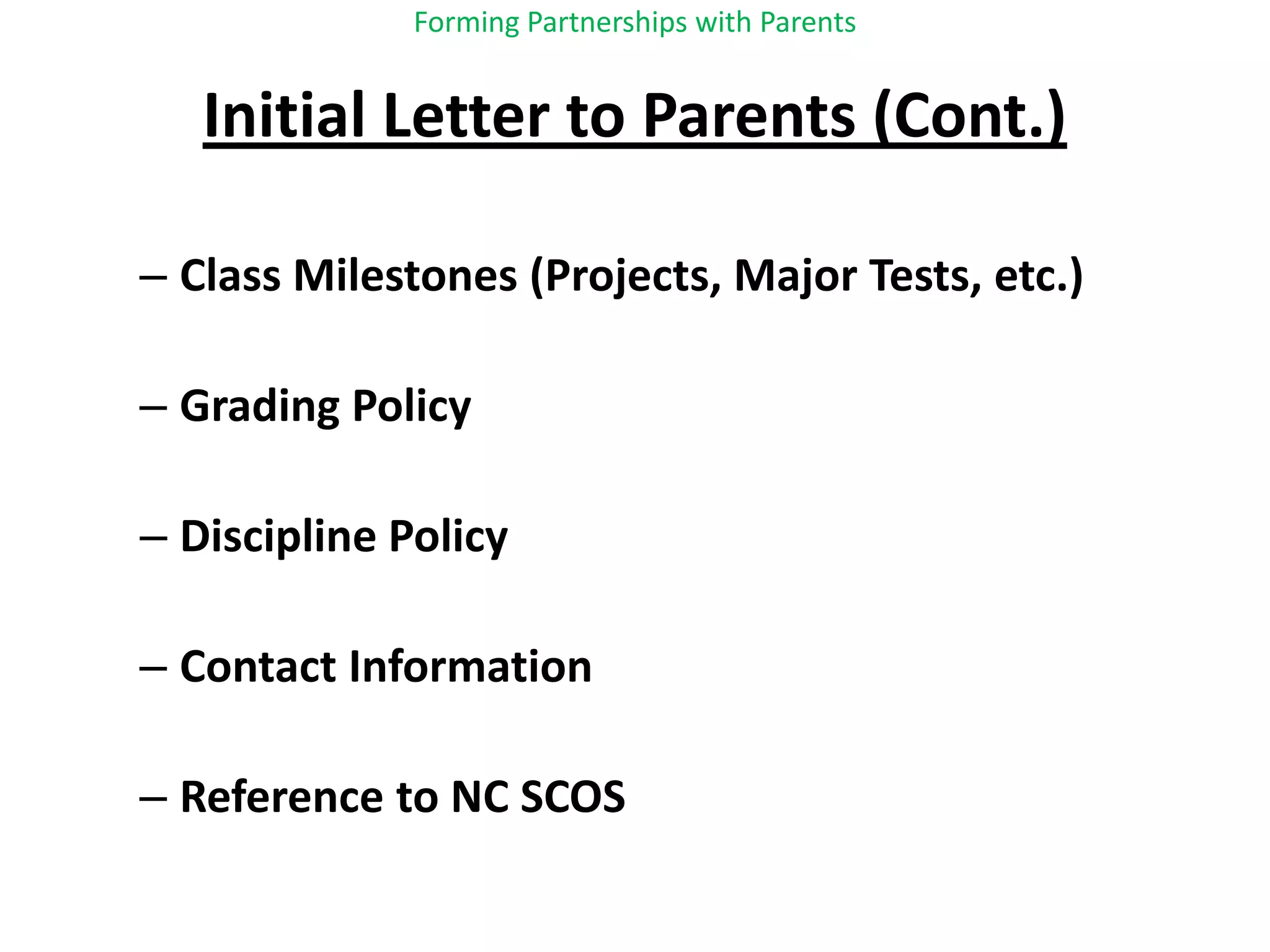
Forming Partnerships with ParentsInitial Letter to Parents (Cont.)Class Milestones (Projects, Major Tests, etc.)Grading PolicyDiscipline PolicyContact InformationReference to NC SCOS
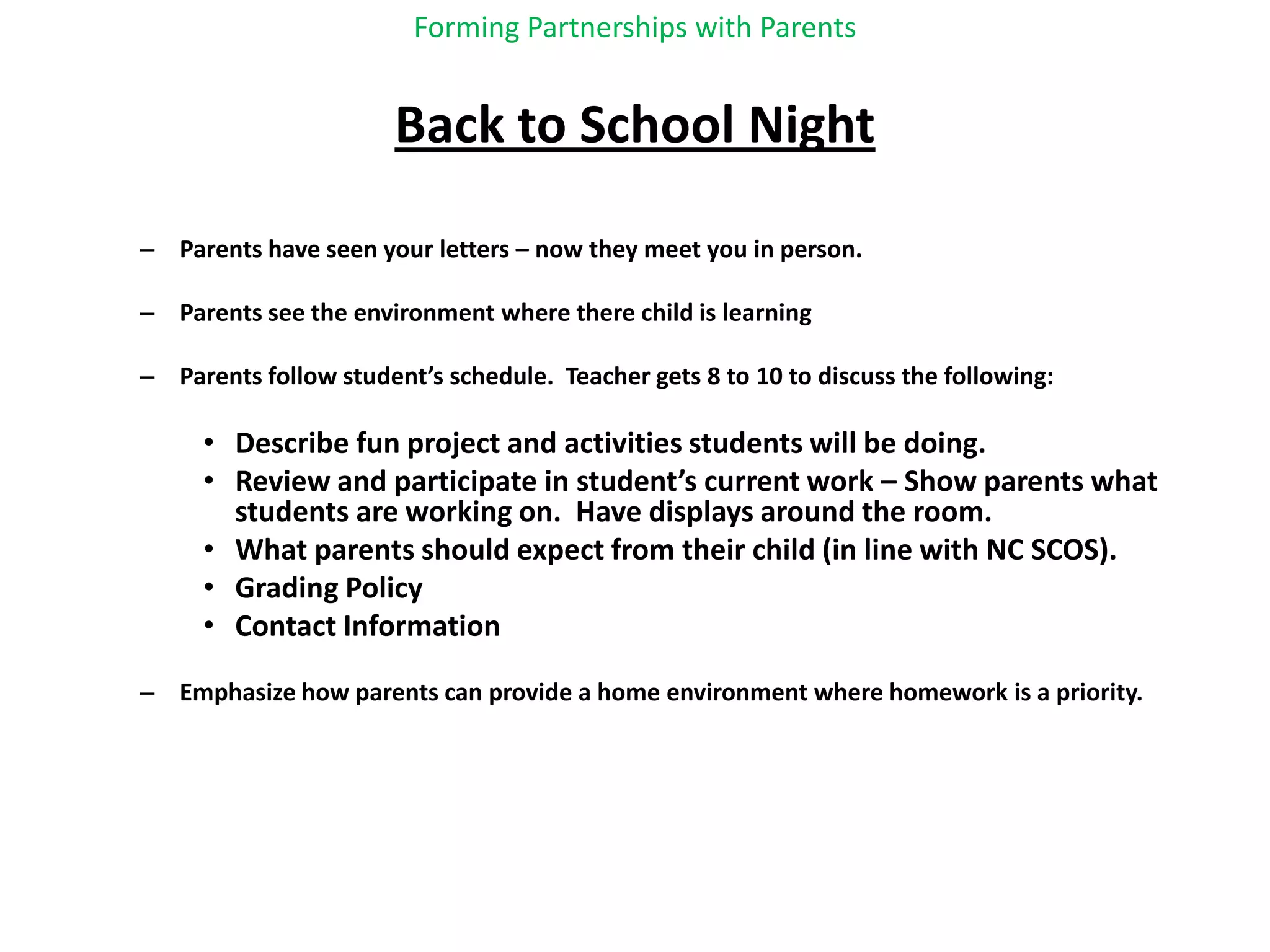
Forming Partnerships with ParentsBack to School NightParents have seen your letters – now they meet you in person.Parents see the environment where there child is learningParents follow student’s schedule.  Teacher gets 8 to 10 to discuss the following:Describe fun project and activities students will be doing.Review and participate in student’s current work – Show parents what students are working on.  Have displays around the room.What parents should expect from their child (in line with NC SCOS).Grading PolicyContact InformationEmphasize how parents can provide a home environment where homework is a priority.
Forming Partnerships with ParentsOpen HouseConsider Student-Led Open house where student presents their work to their parents.Have students maintain a math portfolio of all their assignments in including projects.Display student work including posters, physical models, multimedia presentations, etc.Make sure classroom is neat and organized.Will have limited one-on-one with parents.
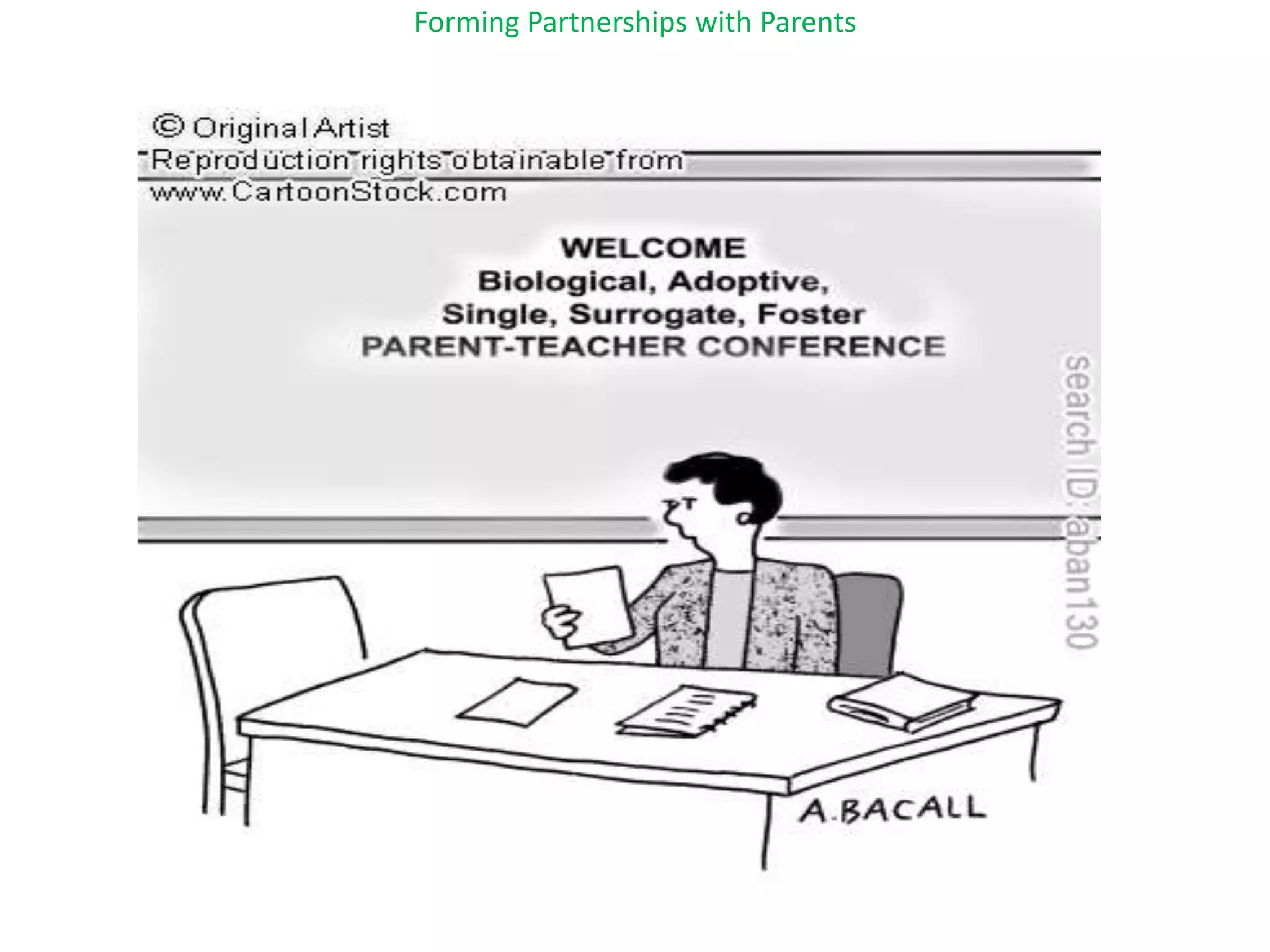
Forming Partnerships with Parents
Forming Partnerships with ParentsParent Teacher Conference:Questions to be asked by ParentsIs my child performing on grade level?How well is my child performing on tests?Is my child behaving in class?Is my child adjusting socially?What are the most important assignments     coming up in class?What is the best way for me to communicate     with you?
Forming Partnerships with ParentsParent Teacher Conference:Information Teachers need from ParentsAny changes in the home that could affect school performanceAny difficulties your child may be experiencing in schoolYour child’s special medical needsYour child’s after school activitiesYour child’s hopes and dreamsThe best way for the school to communicate with you
Forming Partnerships with ParentsTips when preparing for Parent Conferences:Post a conferences schedule by the door to help parents be aware of time. Keep some chairs outside the door so parents have a place to sit outside the door if conferences are running behind.Put a desk outside the classroom door by the chairs.  On the desk we keep copies of the how to help letters and also testing information. It might be a good idea to keep a basket of books underneath the desk to keep the kids entertained while they wait. Bonus points if the books are class made.
Forming Partnerships with ParentsPreparing for Conferences  (cont):Keep a large digital clock in view of both yourself and the parents.  It is easier to stay on schedule and on time!When you are conferencing try you best to face the door so you can see if your next appointment arrives.Keep all my information for each child parent clipped together.  This includes required district paper work, a writing sample, individualized reading list and any other important information.
Forming Partnerships with ParentsCompliment the child and parent.  Praise goes a long way too setting the tone for a conferenceAlways stand up and greet the parent.  Go up to them, not the other way around. If the parent looks open to it, stick out your my hand for a handshake.  Some of the parents may not be comfortable at school and it is area effort for them.  Make them comfortable.Always start out with a compliment or a cute anecdote about their child.  Regardless of how involved, every parent loves their child and will be appreciative if they know you appreciate their child.
Forming Partnerships with ParentsShow Parents the Documentation  Go over your checklist like district benchmark paperwork on reading and writing levels and a writing sample.Use oral explanations for progress. Have a running record ready, however, most parents tend to glaze over when explained what all the checks mean on a running record.  State everything in layman terms.Keep examples of the student’s math work to show the parents.
Forming Partnerships with ParentsIf you have Academic concerns with a student's progressIf a child is doing math work at below grade level, have an example of work their child is doing and compare it against the work students at grade level are doing so parents can see the difference.  This usually floors most parents and is a pretty good way to illustrate your concern without being negative.  If done in a correct tone, it can really demonstrate in a caring way your concern.
Forming Partnerships with ParentsIf you have Attention concerns with a student...Is attention issues related to student’s age?  Is the student disruptive in class?Is the student finishing their in-class work or taking a long time to finish.  Time the assignment and document the time it takes a student to finish a problem.If you do this on a few assignments, this can be a real eye opener.   Use a positive tone.  Have a caring tone.   Try the line  “I wonder how successful he can be when he is focused….”Do not insinuate any medical issues like ADD and ADHD.  Be careful what you say.  You and the school system might be held financially responsible for indicating a child may have medical issues.
Forming Partnerships with Parents
Forming Partnerships with ParentsIf you have Behavioral concerns with a student:Try to feel out a parent to see why their child can be disruptive sometimes.  Give specific examples of behaviors and ask, "Do you notice these behaviors at home?" If they answer yes ask," How do you handle this at home?"  Parents need to be a part of this and feel like they are a part of this.Maybe ask parents what they say to their child and then try to mimic (if it is appropriate, some parents are a little more rough around the edges than I am comfortable being) it when the child does this at school.  If the parents answer no, then I usually give them prompts like "Does he have a hard time getting homework done?  What makes it a battle?  How long does homework take?  Does he sit at the table to eat or is he moving around a lot?"  This can sometimes give you a good lead in.
Forming Partnerships with ParentsThank the ParentsAlways end with a Thank You and a handshake. Try to walk the parent to the door (like I would a guest in my house).  This is a good way to get rid of the very talkative parent.  It also allows you to be ready to greet the next family.
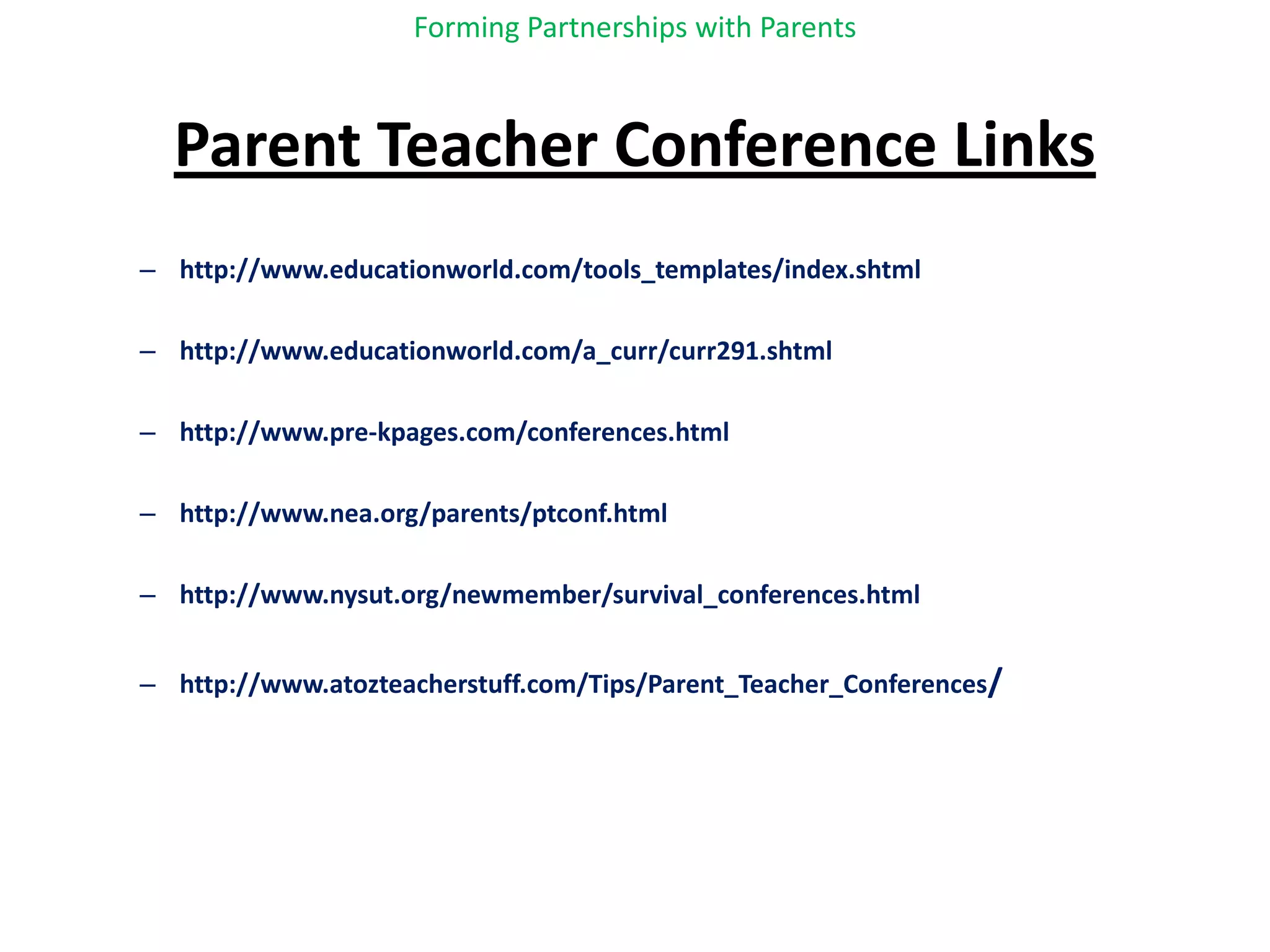
Forming Partnerships with ParentsParent Teacher Conference Linkshttp://www.educationworld.com/tools_templates/index.shtmlhttp://www.educationworld.com/a_curr/curr291.shtmlhttp://www.pre-kpages.com/conferences.htmlhttp://www.nea.org/parents/ptconf.htmlhttp://www.nysut.org/newmember/survival_conferences.htmlhttp://www.atozteacherstuff.com/Tips/Parent_Teacher_Conferences/
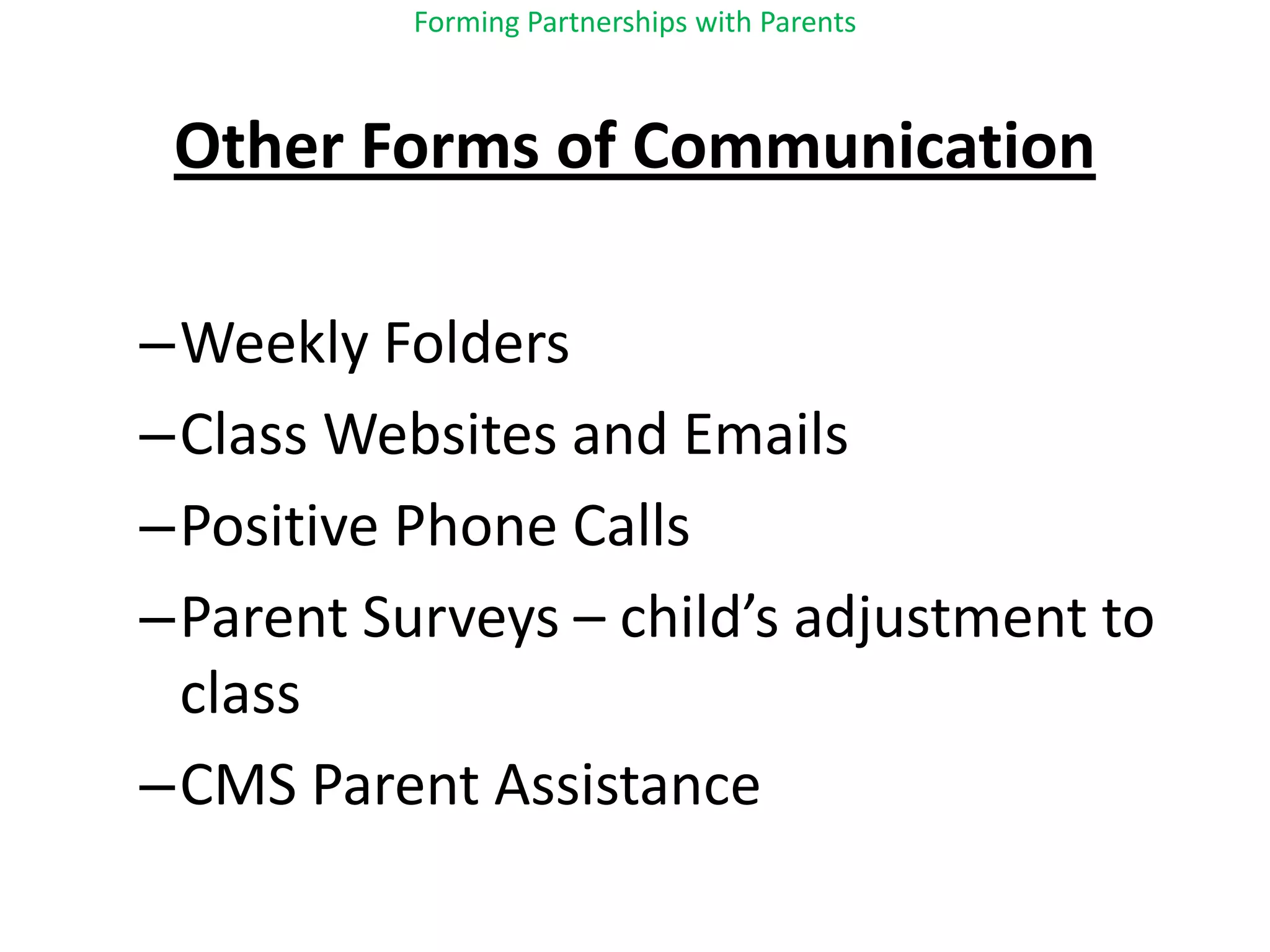
Forming Partnerships with ParentsOther Forms of CommunicationWeekly FoldersClass Websites and EmailsPositive Phone CallsParent Surveys – child’s adjustment to classCMS Parent Assistance
Forming Partnerships with ParentsVideo:  Parent Teacher Home Visit Project        http://video.google.com/videoplay?docid=7752830435959282528#
Forming Partnerships with ParentsQuestions and Answers
Forming Partnerships with ParentsReferenceshttp://www.mandygregory.com/Conferences.htm#Forms and Noticeshttp://www.educationworld.com/tools_templates/index.shtmlTeaching Mathematics for the 21st Century - Methods and Activities for Grades 6-12, Linda Huetinck and Sara N Munshin, 2008 Pearson Education Inc.http://www.cartoonstock.com/directory/p/parent_teacher_conference.asphttp://newteachersupport.suite101.com/article.cfm/communicating_with_parentshttp://video.google.com/videoplay?docid=7752830435959282528#        (Google on “Parent Teacher Home Visit Project” and select video)

A pres99 without borders

  • 1.
    Forming Partnerships withParentsFORMINGPARTNERSHIPS WITH PARENTS
  • 2.
    Forming Partnerships withParentsJames D. MorrowUNCCMAED 5040 – 090Dr. Adam HarbaughApril, 2010
  • 3.
    Forming Partnerships withParentsParentsTeachersMiddle School SuccessStudents
  • 4.
    Forming Partnerships withParentsHow can Teachers get Parents engaged in their Child’s Education?Initial Letter to ParentsBack to School NightOpen HouseParent Teacher ConferenceSchool and Community Mathematic ClubsMathematic ContestsCommunity Outreach
  • 5.
    Forming Partnerships withParentsCommunity Mathematics ContestsBack to School nightCMS Parent AssistanceParent Teacher ConferenceParent Teacher RelationshipMathematic ClubsOpen HouseQuarterly NewsletterInitial Letter to ParentsElectronic Communication (Emails)Communication sent home with Student
  • 6.
    Forming Partnerships withParentsInitial Letter to Parents1st ImpressionA little about yourself and teaching philosophyCourse DescriptionClass Rules and ExpectationsMaterials Needed
  • 7.
    Forming Partnerships withParentsInitial Letter to Parents (Cont.)Class Milestones (Projects, Major Tests, etc.)Grading PolicyDiscipline PolicyContact InformationReference to NC SCOS
  • 8.
    Forming Partnerships withParentsBack to School NightParents have seen your letters – now they meet you in person.Parents see the environment where there child is learningParents follow student’s schedule. Teacher gets 8 to 10 to discuss the following:Describe fun project and activities students will be doing.Review and participate in student’s current work – Show parents what students are working on. Have displays around the room.What parents should expect from their child (in line with NC SCOS).Grading PolicyContact InformationEmphasize how parents can provide a home environment where homework is a priority.
  • 9.
    Forming Partnerships withParentsOpen HouseConsider Student-Led Open house where student presents their work to their parents.Have students maintain a math portfolio of all their assignments in including projects.Display student work including posters, physical models, multimedia presentations, etc.Make sure classroom is neat and organized.Will have limited one-on-one with parents.
  • 10.
  • 11.
    Forming Partnerships withParentsParent Teacher Conference:Questions to be asked by ParentsIs my child performing on grade level?How well is my child performing on tests?Is my child behaving in class?Is my child adjusting socially?What are the most important assignments coming up in class?What is the best way for me to communicate with you?
  • 12.
    Forming Partnerships withParentsParent Teacher Conference:Information Teachers need from ParentsAny changes in the home that could affect school performanceAny difficulties your child may be experiencing in schoolYour child’s special medical needsYour child’s after school activitiesYour child’s hopes and dreamsThe best way for the school to communicate with you
  • 13.
    Forming Partnerships withParentsTips when preparing for Parent Conferences:Post a conferences schedule by the door to help parents be aware of time. Keep some chairs outside the door so parents have a place to sit outside the door if conferences are running behind.Put a desk outside the classroom door by the chairs.  On the desk we keep copies of the how to help letters and also testing information. It might be a good idea to keep a basket of books underneath the desk to keep the kids entertained while they wait. Bonus points if the books are class made.
  • 14.
    Forming Partnerships withParentsPreparing for Conferences (cont):Keep a large digital clock in view of both yourself and the parents.  It is easier to stay on schedule and on time!When you are conferencing try you best to face the door so you can see if your next appointment arrives.Keep all my information for each child parent clipped together.  This includes required district paper work, a writing sample, individualized reading list and any other important information.
  • 15.
    Forming Partnerships withParentsCompliment the child and parent. Praise goes a long way too setting the tone for a conferenceAlways stand up and greet the parent.  Go up to them, not the other way around. If the parent looks open to it, stick out your my hand for a handshake.  Some of the parents may not be comfortable at school and it is area effort for them.  Make them comfortable.Always start out with a compliment or a cute anecdote about their child.  Regardless of how involved, every parent loves their child and will be appreciative if they know you appreciate their child.
  • 16.
    Forming Partnerships withParentsShow Parents the Documentation Go over your checklist like district benchmark paperwork on reading and writing levels and a writing sample.Use oral explanations for progress. Have a running record ready, however, most parents tend to glaze over when explained what all the checks mean on a running record. State everything in layman terms.Keep examples of the student’s math work to show the parents.
  • 17.
    Forming Partnerships withParentsIf you have Academic concerns with a student's progressIf a child is doing math work at below grade level, have an example of work their child is doing and compare it against the work students at grade level are doing so parents can see the difference.  This usually floors most parents and is a pretty good way to illustrate your concern without being negative.  If done in a correct tone, it can really demonstrate in a caring way your concern.
  • 18.
    Forming Partnerships withParentsIf you have Attention concerns with a student...Is attention issues related to student’s age? Is the student disruptive in class?Is the student finishing their in-class work or taking a long time to finish.  Time the assignment and document the time it takes a student to finish a problem.If you do this on a few assignments, this can be a real eye opener.  Use a positive tone. Have a caring tone. Try the line “I wonder how successful he can be when he is focused….”Do not insinuate any medical issues like ADD and ADHD. Be careful what you say. You and the school system might be held financially responsible for indicating a child may have medical issues.
  • 19.
  • 20.
    Forming Partnerships withParentsIf you have Behavioral concerns with a student:Try to feel out a parent to see why their child can be disruptive sometimes.  Give specific examples of behaviors and ask, "Do you notice these behaviors at home?" If they answer yes ask," How do you handle this at home?"  Parents need to be a part of this and feel like they are a part of this.Maybe ask parents what they say to their child and then try to mimic (if it is appropriate, some parents are a little more rough around the edges than I am comfortable being) it when the child does this at school.  If the parents answer no, then I usually give them prompts like "Does he have a hard time getting homework done?  What makes it a battle?  How long does homework take?  Does he sit at the table to eat or is he moving around a lot?"  This can sometimes give you a good lead in.
  • 21.
    Forming Partnerships withParentsThank the ParentsAlways end with a Thank You and a handshake. Try to walk the parent to the door (like I would a guest in my house).  This is a good way to get rid of the very talkative parent. It also allows you to be ready to greet the next family.
  • 22.
    Forming Partnerships withParentsParent Teacher Conference Linkshttp://www.educationworld.com/tools_templates/index.shtmlhttp://www.educationworld.com/a_curr/curr291.shtmlhttp://www.pre-kpages.com/conferences.htmlhttp://www.nea.org/parents/ptconf.htmlhttp://www.nysut.org/newmember/survival_conferences.htmlhttp://www.atozteacherstuff.com/Tips/Parent_Teacher_Conferences/
  • 23.
    Forming Partnerships withParentsOther Forms of CommunicationWeekly FoldersClass Websites and EmailsPositive Phone CallsParent Surveys – child’s adjustment to classCMS Parent Assistance
  • 24.
    Forming Partnerships withParentsVideo: Parent Teacher Home Visit Project http://video.google.com/videoplay?docid=7752830435959282528#
  • 25.
    Forming Partnerships withParentsQuestions and Answers
  • 26.
    Forming Partnerships withParentsReferenceshttp://www.mandygregory.com/Conferences.htm#Forms and Noticeshttp://www.educationworld.com/tools_templates/index.shtmlTeaching Mathematics for the 21st Century - Methods and Activities for Grades 6-12, Linda Huetinck and Sara N Munshin, 2008 Pearson Education Inc.http://www.cartoonstock.com/directory/p/parent_teacher_conference.asphttp://newteachersupport.suite101.com/article.cfm/communicating_with_parentshttp://video.google.com/videoplay?docid=7752830435959282528# (Google on “Parent Teacher Home Visit Project” and select video)