Advanced Networking Services:
Load-Balancing as a Service
(LBaaS)
Praveen Yalagandula & Anant Patil
Avi Networks
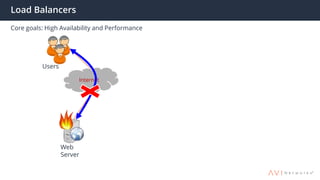
Load Balancers
Core goals: High Availability and Performance
Internet
Web
Server
Users
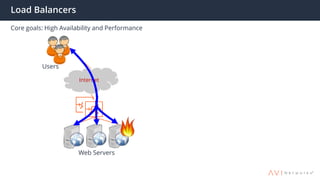
Load Balancers
Core goals: High Availability and Performance
Internet
Web Servers
Users
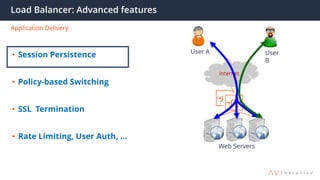
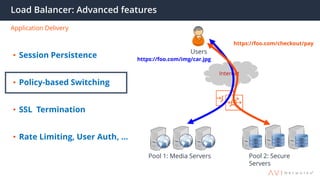
Load Balancer: Advanced features
Application Delivery
• Session Persistence
• Policy-based Switching
• SSL Termination
• Rate Limiting, User Auth, …
Internet
Web Servers
User A User
B
Load Balancer: Advanced features
Application Delivery
Internet
Pool 1: Media Servers
Users
Pool 2: Secure
Servers
https://foo.com/img/car.jpg
https://foo.com/checkout/pay
• Session Persistence
• Policy-based Switching
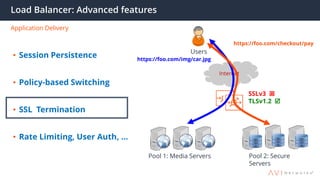
• SSL Termination
• Rate Limiting, User Auth, …
Load Balancer: Advanced features
Application Delivery
Internet
Pool 1: Media Servers
Users
Pool 2: Secure
Servers
https://foo.com/img/car.jpg
https://foo.com/checkout/pay
SSLv3 
TLSv1.2 
• Session Persistence
• Policy-based Switching
• SSL Termination
• Rate Limiting, User Auth, …
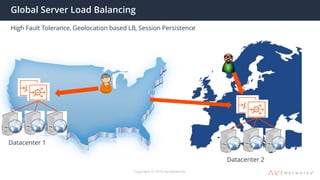
Global Server Load Balancing
High Fault Tolerance, Geolocation based LB, Session Persistence
Copyright © 2018 Avi Networks
Datacenter 1
Datacenter 2
OpenStack LBaaS APIs
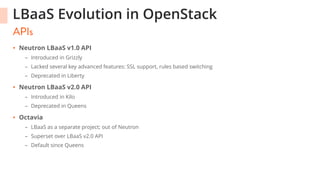
LBaaS Evolution in OpenStack
• Neutron LBaaS v1.0 API
– Introduced in Grizzly
– Lacked several key advanced features: SSL support, rules based switching
– Deprecated in Liberty
• Neutron LBaaS v2.0 API
– Introduced in Kilo
– Deprecated in Queens
• Octavia
– LBaaS as a separate project; out of Neutron
– Superset over LBaaS v2.0 API
– Default since Queens
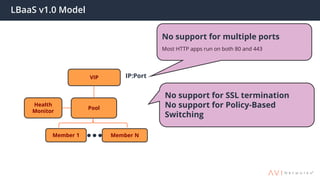
LBaaS v1.0 Model
VIP
Pool
Health
Monitor
Member 1 Member N…
IP:Port
No support for multiple ports
Most HTTP apps run on both 80 and 443
No support for SSL termination
No support for Policy-Based
Switching
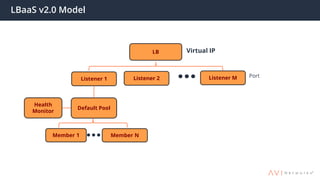
LBaaS v2.0 Model
LB
Listener 1 Listener MListener 2 …
Default Pool
Health
Monitor
Member 1 Member N…
Virtual IP
Port
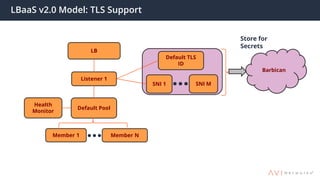
LBaaS v2.0 Model: TLS Support
LB
Listener 1
Default Pool
Health
Monitor
Member 1 Member N…
Default TLS
ID
SNI 1 SNI M…
Barbican
Store for
Secrets
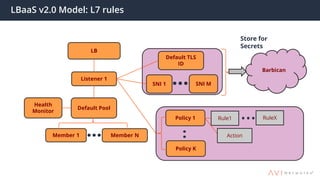
LBaaS v2.0 Model: L7 rules
LB
Listener 1
Default Pool
Health
Monitor
Member 1 Member N…
Default TLS
ID
SNI 1 SNI M…
Barbican
Store for
Secrets
Policy 1
Policy K
Rule1 … RuleX
..
Action
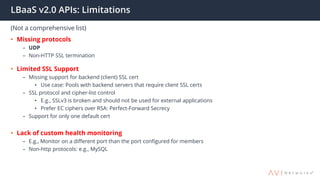
LBaaS v2.0 APIs: Limitations
(Not a comprehensive list)
• Missing protocols
– UDP
– Non-HTTP SSL termination
• Limited SSL Support
– Missing support for backend (client) SSL cert
• Use case: Pools with backend servers that require client SSL certs
– SSL protocol and cipher-list control
• E.g., SSLv3 is broken and should not be used for external applications
• Prefer EC ciphers over RSA: Perfect-Forward Secrecy
– Support for only one default cert
• Lack of custom health monitoring
– E.g., Monitor on a different port than the port configured for members
– Non-http protocols: e.g., MySQL
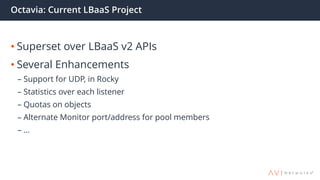
Octavia: Current LBaaS Project
• Superset over LBaaS v2 APIs
• Several Enhancements
– Support for UDP, in Rocky
– Statistics over each listener
– Quotas on objects
– Alternate Monitor port/address for pool members
– …
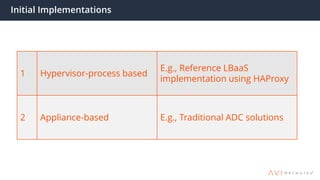
Initial Implementations
1 Hypervisor-process based
E.g., Reference LBaaS
implementation using HAProxy
2 Appliance-based E.g., Traditional ADC solutions
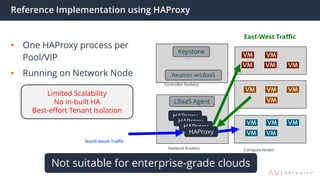
Reference Implementation using HAProxy
• One HAProxy process per
Pool/VIP
• Running on Network Node
Compute NodesNetwork Node(s)
Keystone
Controller Node(s)
Neutron w/LBaaS
……
LBaaS Agent
HAProxy
HAProxy
HAProxy
HAProxy
North-South Traffic
East-West Traffic
Limited Scalability
No in-built HA
Best-effort Tenant Isolation
Not suitable for enterprise-grade clouds
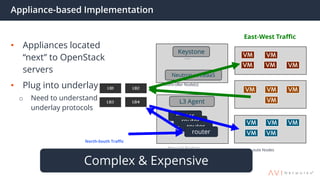
Appliance-based Implementation
• Appliances located
“next” to OpenStack
servers
• Plug into underlay
o Need to understand
underlay protocols
Compute NodesNetwork Node(s)
Keystone
Controller Node(s)
Neutron w/LBaaS
……
L3 Agent
router
router
router
router
North-South Traffic
East-West Traffic
Complex & Expensive
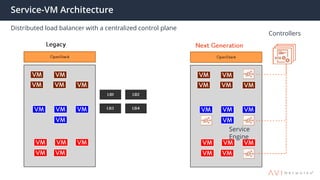
Service-VM Architecture
Distributed load balancer with a centralized control plane
Controllers
Service
Engine
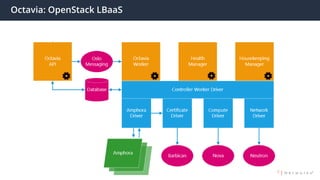
Octavia: OpenStack LBaaS
Software Defined Application Services
Elastic Load Balancing | Application Security | Application Analytics
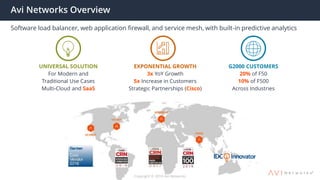
Avi Networks Overview
Software load balancer, web application firewall, and service mesh, with built-in predictive analytics
UNIVERSAL SOLUTION
For Modern and
Traditional Use Cases
Multi-Cloud and SaaS
G2000 CUSTOMERS
20% of F50
10% of F500
Across Industries
EXPONENTIAL GROWTH
3x YoY Growth
5x Increase in Customers
Strategic Partnerships (Cisco)
Copyright © 2018 Avi Networks
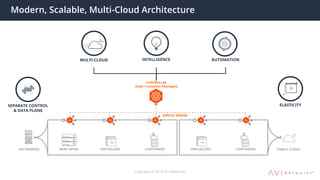
BARE METAL VIRTUALIZED CONTAINERSON PREMISES PUBLIC CLOUDVIRTUALIZED CONTAINERS
Modern, Scalable, Multi-Cloud Architecture
CONTROLLER
(SaaS / Customer-Managed)
SERVICE ENGINE
SEPARATE CONTROL
& DATA PLANE
ELASTICITY
INTELLIGENCE AUTOMATION
Copyright © 2018 Avi Networks
MULTI-CLOUD
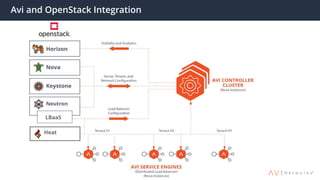
Avi and OpenStack Integration
H Heat
LBaaS
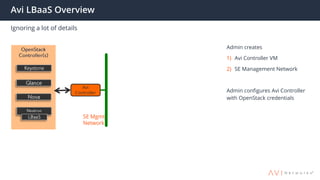
Avi LBaaS Overview
Ignoring a lot of details
Admin creates
1) Avi Controller VM
2) SE Management Network
Admin configures Avi Controller
with OpenStack credentials
Avi
Controller
SE Mgmt
Network
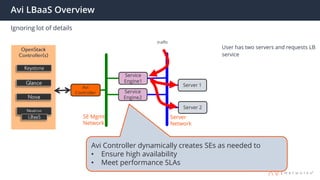
Avi LBaaS Overview
Ignoring lot of details
User has two servers and requests LB
service
Avi
Controller
Server 1
Server 2
SE Mgmt
Network
Server
Network
Service
Engine2
Service
Engine1
Avi Controller dynamically creates SEs as needed to
• Ensure high availability
• Meet performance SLAs
traffic
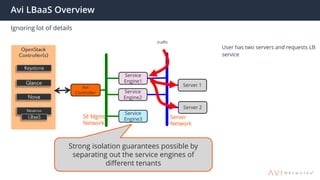
Avi LBaaS Overview
Ignoring lot of details
User has two servers and requests LB
service
Avi
Controller
Server 1
Server 2
SE Mgmt
Network
Server
Network
Service
Engine2
Service
Engine1
traffic
Service
Engine3
Strong isolation guarantees possible by
separating out the service engines of
different tenants
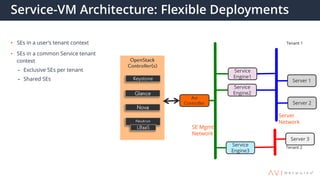
Service-VM Architecture: Flexible Deployments
• SEs in a user’s tenant context
• SEs in a common Service tenant
context
– Exclusive SEs per tenant
– Shared SEs
Avi
Controller
Server 1
Server 2
SE Mgmt
Network
Server
Network
Service
Engine2
Service
Engine1
Service
Engine3
Tenant 1
Tenant 2
Server 3
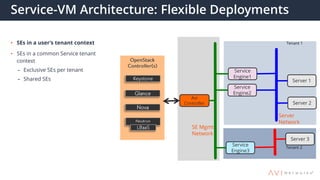
Service-VM Architecture: Flexible Deployments
• SEs in a user’s tenant context
• SEs in a common Service tenant
context
– Exclusive SEs per tenant
– Shared SEs
Avi
Controller
Server 1
Server 2
SE Mgmt
Network
Server
Network
Service
Engine2
Service
Engine1
Service
Engine3
Tenant 1
Tenant 2
Server 3
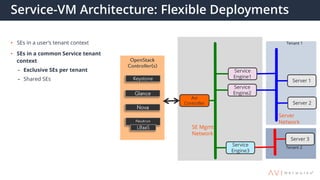
Service-VM Architecture: Flexible Deployments
• SEs in a user’s tenant context
• SEs in a common Service tenant
context
– Exclusive SEs per tenant
– Shared SEs
Avi
Controller
Server 1
Server 2
SE Mgmt
Network
Server
Network
Service
Engine2
Service
Engine1
Service
Engine3
Tenant 1
Tenant 2
Server 3
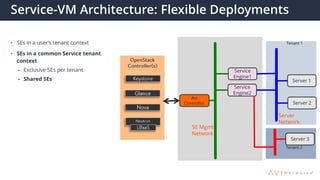
Service-VM Architecture: Flexible Deployments
• SEs in a user’s tenant context
• SEs in a common Service tenant
context
– Exclusive SEs per tenant
– Shared SEs
Avi
Controller
Server 1
Server 2
SE Mgmt
Network
Server
Network
Service
Engine2
Service
Engine1
Tenant 1
Tenant 2
Server 3
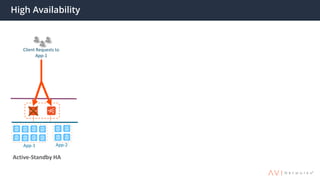
High Availability
Active-Standby HA
App-1 App-2
Client Requests to
App-1
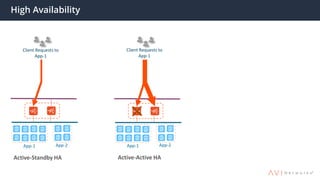
High Availability
Active-Standby HA
App-1 App-2
Client Requests to
App-1
Active-Active HA
App-1 App-2
Client Requests to
App-1
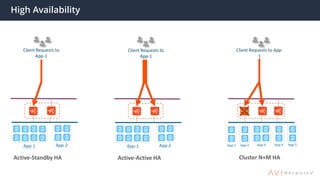
High Availability
Active-Standby HA
App-1 App-2
Client Requests to
App-1
Active-Active HA
App-1 App-2
Client Requests to
App-1
Cluster N+M HA
App-1 App-2 App-3 App-4 App-5
Client Requests to App-
1
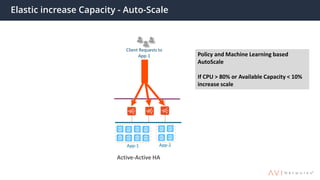
Elastic increase Capacity - Auto-Scale
Active-Active HA
App-1 App-2
Client Requests to
App-1 Policy and Machine Learning based
AutoScale
If CPU > 80% or Available Capacity < 10%
increase scale
Active-Active
HA
App-1 App-2
Client Requests to
App-1
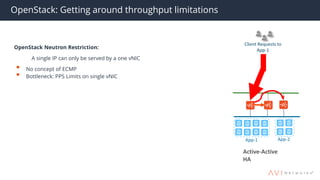
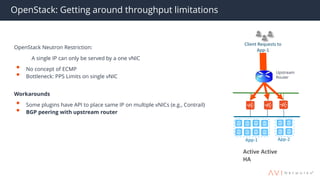
OpenStack: Getting around throughput limitations
OpenStack Neutron Restriction:
A single IP can only be served by a one vNIC
• No concept of ECMP
• Bottleneck: PPS Limits on single vNIC
Active Active
HA
App-1 App-2
Client Requests to
App-1
OpenStack: Getting around throughput limitations
Upstream
Router
OpenStack Neutron Restriction:
A single IP can only be served by a one vNIC
• No concept of ECMP
• Bottleneck: PPS Limits on single vNIC
Workarounds
• Some plugins have API to place same IP on multiple vNICs (e.g., Contrail)
• BGP peering with upstream router
DC 1
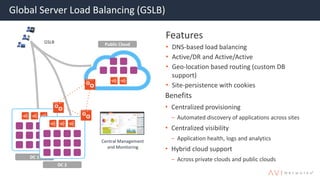
Global Server Load Balancing (GSLB)
Benefits
• Centralized provisioning
– Automated discovery of applications across sites
• Centralized visibility
– Application health, logs and analytics
• Hybrid cloud support
– Across private clouds and public clouds
Public Cloud
DC 2
Central Management
and Monitoring
GSLB
Features
• DNS-based load balancing
• Active/DR and Active/Active
• Geo-location based routing (custom DB
support)
• Site-persistence with cookies
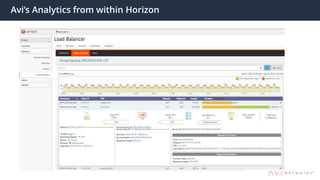
Avi’s Analytics from within Horizon
Demo
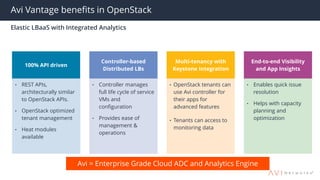
100% API driven
• REST APIs,
architecturally similar
to OpenStack APIs.
• OpenStack optimized
tenant management
• Heat modules
available
Controller-based
Distributed LBs
• Controller manages
full life cycle of service
VMs and
configuration
• Provides ease of
management &
operations
Multi-tenancy with
Keystone Integration
• OpenStack tenants can
use Avi controller for
their apps for
advanced features
• Tenants can access to
monitoring data
End-to-end Visibility
and App Insights
• Enables quick issue
resolution
• Helps with capacity
planning and
optimization
Avi = Enterprise Grade Cloud ADC and Analytics Engine
Avi Vantage benefits in OpenStack
Elastic LBaaS with Integrated Analytics
Thanks!
https://avinetworks.com/
Please visit us at our Booth in Market
Place Expo

OpenStack Summit Fall 2018: LBaaS

  • 1.
    Advanced Networking Services: Load-Balancingas a Service (LBaaS) Praveen Yalagandula & Anant Patil Avi Networks
  • 2.
    Load Balancers Core goals:High Availability and Performance Internet Web Server Users
  • 3.
    Load Balancers Core goals:High Availability and Performance Internet Web Servers Users
  • 4.
    Load Balancer: Advancedfeatures Application Delivery • Session Persistence • Policy-based Switching • SSL Termination • Rate Limiting, User Auth, … Internet Web Servers User A User B
  • 5.
    Load Balancer: Advancedfeatures Application Delivery Internet Pool 1: Media Servers Users Pool 2: Secure Servers https://foo.com/img/car.jpg https://foo.com/checkout/pay • Session Persistence • Policy-based Switching • SSL Termination • Rate Limiting, User Auth, …
  • 6.
    Load Balancer: Advancedfeatures Application Delivery Internet Pool 1: Media Servers Users Pool 2: Secure Servers https://foo.com/img/car.jpg https://foo.com/checkout/pay SSLv3  TLSv1.2  • Session Persistence • Policy-based Switching • SSL Termination • Rate Limiting, User Auth, …
  • 7.
    Global Server LoadBalancing High Fault Tolerance, Geolocation based LB, Session Persistence Copyright © 2018 Avi Networks Datacenter 1 Datacenter 2
  • 8.
  • 9.
    LBaaS Evolution inOpenStack • Neutron LBaaS v1.0 API – Introduced in Grizzly – Lacked several key advanced features: SSL support, rules based switching – Deprecated in Liberty • Neutron LBaaS v2.0 API – Introduced in Kilo – Deprecated in Queens • Octavia – LBaaS as a separate project; out of Neutron – Superset over LBaaS v2.0 API – Default since Queens
  • 10.
    LBaaS v1.0 Model VIP Pool Health Monitor Member1 Member N… IP:Port No support for multiple ports Most HTTP apps run on both 80 and 443 No support for SSL termination No support for Policy-Based Switching
  • 11.
    LBaaS v2.0 Model LB Listener1 Listener MListener 2 … Default Pool Health Monitor Member 1 Member N… Virtual IP Port
  • 12.
    LBaaS v2.0 Model:TLS Support LB Listener 1 Default Pool Health Monitor Member 1 Member N… Default TLS ID SNI 1 SNI M… Barbican Store for Secrets
  • 13.
    LBaaS v2.0 Model:L7 rules LB Listener 1 Default Pool Health Monitor Member 1 Member N… Default TLS ID SNI 1 SNI M… Barbican Store for Secrets Policy 1 Policy K Rule1 … RuleX .. Action
  • 14.
    LBaaS v2.0 APIs:Limitations (Not a comprehensive list) • Missing protocols – UDP – Non-HTTP SSL termination • Limited SSL Support – Missing support for backend (client) SSL cert • Use case: Pools with backend servers that require client SSL certs – SSL protocol and cipher-list control • E.g., SSLv3 is broken and should not be used for external applications • Prefer EC ciphers over RSA: Perfect-Forward Secrecy – Support for only one default cert • Lack of custom health monitoring – E.g., Monitor on a different port than the port configured for members – Non-http protocols: e.g., MySQL
  • 15.
    Octavia: Current LBaaSProject • Superset over LBaaS v2 APIs • Several Enhancements – Support for UDP, in Rocky – Statistics over each listener – Quotas on objects – Alternate Monitor port/address for pool members – …
  • 16.
    Initial Implementations 1 Hypervisor-processbased E.g., Reference LBaaS implementation using HAProxy 2 Appliance-based E.g., Traditional ADC solutions
  • 17.
    Reference Implementation usingHAProxy • One HAProxy process per Pool/VIP • Running on Network Node Compute NodesNetwork Node(s) Keystone Controller Node(s) Neutron w/LBaaS …… LBaaS Agent HAProxy HAProxy HAProxy HAProxy North-South Traffic East-West Traffic Limited Scalability No in-built HA Best-effort Tenant Isolation Not suitable for enterprise-grade clouds
  • 18.
    Appliance-based Implementation • Applianceslocated “next” to OpenStack servers • Plug into underlay o Need to understand underlay protocols Compute NodesNetwork Node(s) Keystone Controller Node(s) Neutron w/LBaaS …… L3 Agent router router router router North-South Traffic East-West Traffic Complex & Expensive
  • 19.
  • 20.
    Service-VM Architecture Distributed loadbalancer with a centralized control plane Controllers Service Engine
  • 21.
  • 22.
    Software Defined ApplicationServices Elastic Load Balancing | Application Security | Application Analytics
  • 23.
    Avi Networks Overview Softwareload balancer, web application firewall, and service mesh, with built-in predictive analytics UNIVERSAL SOLUTION For Modern and Traditional Use Cases Multi-Cloud and SaaS G2000 CUSTOMERS 20% of F50 10% of F500 Across Industries EXPONENTIAL GROWTH 3x YoY Growth 5x Increase in Customers Strategic Partnerships (Cisco) Copyright © 2018 Avi Networks
  • 24.
    BARE METAL VIRTUALIZEDCONTAINERSON PREMISES PUBLIC CLOUDVIRTUALIZED CONTAINERS Modern, Scalable, Multi-Cloud Architecture CONTROLLER (SaaS / Customer-Managed) SERVICE ENGINE SEPARATE CONTROL & DATA PLANE ELASTICITY INTELLIGENCE AUTOMATION Copyright © 2018 Avi Networks MULTI-CLOUD
  • 25.
    Avi and OpenStackIntegration H Heat LBaaS
  • 26.
    Avi LBaaS Overview Ignoringa lot of details Admin creates 1) Avi Controller VM 2) SE Management Network Admin configures Avi Controller with OpenStack credentials Avi Controller SE Mgmt Network
  • 27.
    Avi LBaaS Overview Ignoringlot of details User has two servers and requests LB service Avi Controller Server 1 Server 2 SE Mgmt Network Server Network Service Engine2 Service Engine1 Avi Controller dynamically creates SEs as needed to • Ensure high availability • Meet performance SLAs traffic
  • 28.
    Avi LBaaS Overview Ignoringlot of details User has two servers and requests LB service Avi Controller Server 1 Server 2 SE Mgmt Network Server Network Service Engine2 Service Engine1 traffic Service Engine3 Strong isolation guarantees possible by separating out the service engines of different tenants
  • 29.
    Service-VM Architecture: FlexibleDeployments • SEs in a user’s tenant context • SEs in a common Service tenant context – Exclusive SEs per tenant – Shared SEs Avi Controller Server 1 Server 2 SE Mgmt Network Server Network Service Engine2 Service Engine1 Service Engine3 Tenant 1 Tenant 2 Server 3
  • 30.
    Service-VM Architecture: FlexibleDeployments • SEs in a user’s tenant context • SEs in a common Service tenant context – Exclusive SEs per tenant – Shared SEs Avi Controller Server 1 Server 2 SE Mgmt Network Server Network Service Engine2 Service Engine1 Service Engine3 Tenant 1 Tenant 2 Server 3
  • 31.
    Service-VM Architecture: FlexibleDeployments • SEs in a user’s tenant context • SEs in a common Service tenant context – Exclusive SEs per tenant – Shared SEs Avi Controller Server 1 Server 2 SE Mgmt Network Server Network Service Engine2 Service Engine1 Service Engine3 Tenant 1 Tenant 2 Server 3
  • 32.
    Service-VM Architecture: FlexibleDeployments • SEs in a user’s tenant context • SEs in a common Service tenant context – Exclusive SEs per tenant – Shared SEs Avi Controller Server 1 Server 2 SE Mgmt Network Server Network Service Engine2 Service Engine1 Tenant 1 Tenant 2 Server 3
  • 33.
    High Availability Active-Standby HA App-1App-2 Client Requests to App-1
  • 34.
    High Availability Active-Standby HA App-1App-2 Client Requests to App-1 Active-Active HA App-1 App-2 Client Requests to App-1
  • 35.
    High Availability Active-Standby HA App-1App-2 Client Requests to App-1 Active-Active HA App-1 App-2 Client Requests to App-1 Cluster N+M HA App-1 App-2 App-3 App-4 App-5 Client Requests to App- 1
  • 36.
    Elastic increase Capacity- Auto-Scale Active-Active HA App-1 App-2 Client Requests to App-1 Policy and Machine Learning based AutoScale If CPU > 80% or Available Capacity < 10% increase scale
  • 37.
    Active-Active HA App-1 App-2 Client Requeststo App-1 OpenStack: Getting around throughput limitations OpenStack Neutron Restriction: A single IP can only be served by a one vNIC • No concept of ECMP • Bottleneck: PPS Limits on single vNIC
  • 38.
    Active Active HA App-1 App-2 ClientRequests to App-1 OpenStack: Getting around throughput limitations Upstream Router OpenStack Neutron Restriction: A single IP can only be served by a one vNIC • No concept of ECMP • Bottleneck: PPS Limits on single vNIC Workarounds • Some plugins have API to place same IP on multiple vNICs (e.g., Contrail) • BGP peering with upstream router
  • 39.
    DC 1 Global ServerLoad Balancing (GSLB) Benefits • Centralized provisioning – Automated discovery of applications across sites • Centralized visibility – Application health, logs and analytics • Hybrid cloud support – Across private clouds and public clouds Public Cloud DC 2 Central Management and Monitoring GSLB Features • DNS-based load balancing • Active/DR and Active/Active • Geo-location based routing (custom DB support) • Site-persistence with cookies
  • 40.
    Avi’s Analytics fromwithin Horizon
  • 41.
  • 42.
    100% API driven •REST APIs, architecturally similar to OpenStack APIs. • OpenStack optimized tenant management • Heat modules available Controller-based Distributed LBs • Controller manages full life cycle of service VMs and configuration • Provides ease of management & operations Multi-tenancy with Keystone Integration • OpenStack tenants can use Avi controller for their apps for advanced features • Tenants can access to monitoring data End-to-end Visibility and App Insights • Enables quick issue resolution • Helps with capacity planning and optimization Avi = Enterprise Grade Cloud ADC and Analytics Engine Avi Vantage benefits in OpenStack Elastic LBaaS with Integrated Analytics
  • 43.
    Thanks! https://avinetworks.com/ Please visit usat our Booth in Market Place Expo