OPENING TITLES ANALYSIS:
CEMETERY JUNCTION
The film “Cemetery Junction” is a Drama/Comedy
that was released in 2010, written/directed by Ricky
Gervais and Stephen Merchant.
The film centres around three friends of working class
in the early 1970‟s.

By Chloe Killin
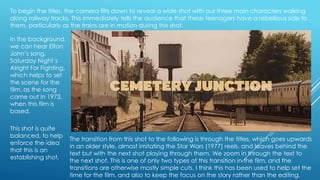
To begin the titles, the camera tilts down to reveal a wide shot with our three main characters walking
along railway tracks. This immediately tells the audience that these teenagers have a rebellious side to
them, particularly as the trains are in motion during this shot.
In the background,
we can hear Elton
John‟s song,
Saturday Night‟s
Alright For Fighting,
which helps to set
the scene for the
film, as the song
came out in 1973,
when this film is
based.
This shot is quite
balanced, to help
enforce the idea
that this is an
establishing shot.

The transition from this shot to the following is through the titles, which goes upwards
in an older style, almost imitating the Star Wars (1977) reels, and leaves behind the
text but with the next shot playing through them. We zoom in through the text to
the next shot. This is one of only two types of this transition in the film, and the
transitions are otherwise mostly simple cuts. I think this has been used to help set the
time for the film, and also to keep the focus on the story rather than the editing.
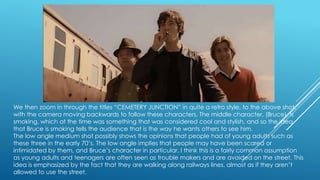
We then zoom in through the titles “CEMETERY JUNCTION” in quite a retro style, to the above shot,
with the camera moving backwards to follow these characters. The middle character, (Bruce), is
smoking, which at the time was something that was considered cool and stylish, and so the idea
that Bruce is smoking tells the audience that is the way he wants others to see him.
The low angle medium shot possibly shows the opinions that people had of young adults such as
these three in the early 70‟s. The low angle implies that people may have been scared or
intimidated by them, and Bruce‟s character in particular. I think this is a fairly common assumption
as young adults and teenagers are often seen as trouble makers and are avoided on the street. This
idea is emphasized by the fact that they are walking along railways lines, almost as if they aren‟t
allowed to use the street.
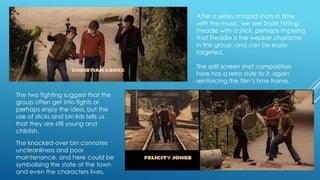
After a series of rapid shots in time
with the music, we see Snork hitting
Freddie with a stick, perhaps implying
that Freddie is the weaker character
in the group, and can be easily
targeted.
The split screen shot composition
here has a retro style to it, again
reinforcing the film‟s time frame.
The two fighting suggest that the
group often get into fights or
perhaps enjoy the idea, but the
use of sticks and bin lids tells us
that they are still young and
childish.

The knocked-over bin connotes
uncleanliness and poor
maintenance, and here could be
symbolising the state of the town
and even the characters lives.


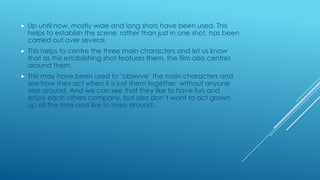
Up until now, mostly wide and long shots have been used. This
helps to establish the scene, rather than just in one shot, has been
carried out over several.



This helps to centre the three main characters and let us know
that as this establishing shot features them, the film also centres
around them.



This may have been used to „observe‟ the main characters and
see how they act when it is just them together without anyone
else around. And we can see that they like to have fun and
enjoy each others company, but also don‟t want to act grown
up all the time and like to mess around.
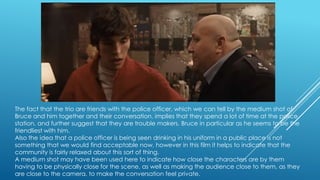
The fact that the trio are friends with the police officer, which we can tell by the medium shot of
Bruce and him together and their conversation, implies that they spend a lot of time at the police
station, and further suggest that they are trouble makers. Bruce in particular as he seems to be the
friendliest with him.
Also the idea that a police officer is being seen drinking in his uniform in a public place is not
something that we would find acceptable now, however in this film it helps to indicate that the
community is fairly relaxed about this sort of thing.
A medium shot may have been used here to indicate how close the characters are by them
having to be physically close for the scene, as well as making the audience close to them, as they
are close to the camera, to make the conversation feel private.
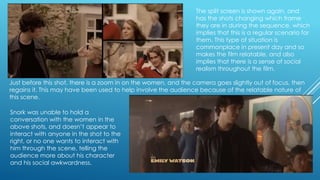
The split screen is shown again, and
has the shots changing which frame
they are in during the sequence, which
implies that this is a regular scenario for
them. This type of situation is
commonplace in present day and so
makes the film relatable, and also
implies that there is a sense of social
realism throughout the film.
Just before this shot, there is a zoom in on the women, and the camera goes slightly out of focus, then
regains it. This may have been used to help involve the audience because of the relatable nature of
this scene.
Snork was unable to hold a
conversation with the women in the
above shots, and doesn‟t appear to
interact with anyone in the shot to the
right, or no one wants to interact with
him through the scene, telling the
audience more about his character
and his social awkwardness.
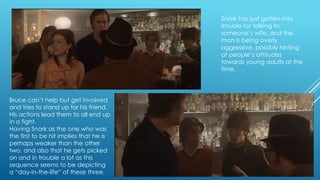
Snork has just gotten into
trouble for talking to
someone‟s wife, and the
man is being overly
aggressive, possibly hinting
at people‟s attitudes
towards young adults at the
time.

Bruce can‟t help but get involved
and tries to stand up for his friend.
His actions lead them to all end up
in a fight.
Having Snork as the one who was
the first to be hit implies that he is
perhaps weaker than the other
two, and also that he gets picked
on and in trouble a lot as this
sequence seems to be depicting
a “day-in-the-life” of these three.
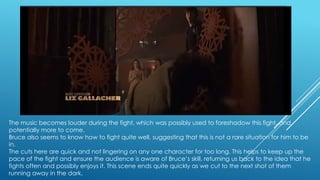
The music becomes louder during the fight, which was possibly used to foreshadow this fight, and
potentially more to come.
Bruce also seems to know how to fight quite well, suggesting that this is not a rare situation for him to be
in.
The cuts here are quick and not lingering on any one character for too long. This helps to keep up the
pace of the fight and ensure the audience is aware of Bruce‟s skill, returning us back to the idea that he
fights often and possibly enjoys it. This scene ends quite quickly as we cut to the next shot of them
running away in the dark.
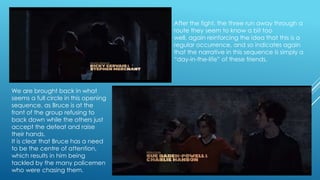
After the fight, the three run away through a
route they seem to know a bit too
well, again reinforcing the idea that this is a
regular occurrence, and so indicates again
that the narrative in this sequence is simply a
“day-in-the-life” of these friends.

We are brought back in what
seems a full circle in this opening
sequence, as Bruce is at the
front of the group refusing to
back down while the others just
accept the defeat and raise
their hands.
It is clear that Bruce has a need
to be the centre of attention,
which results in him being
tackled by the many policemen
who were chasing them.
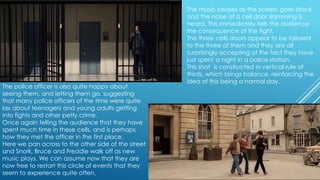
The police officer is also quite happy about
seeing them, and letting them go, suggesting
that many police officers of the time were quite
lax about teenagers and young adults getting
into fights and other petty crime.
Once again telling the audience that they have
spent much time in these cells, and is perhaps
how they met the officer in the first place.
Here we pan across to the other side of the street
and Snork, Bruce and Freddie walk off as new
music plays. We can assume now that they are
now free to restart this circle of events that they
seem to experience quite often.

The music ceases as the screen goes black
and the noise of a cell door slamming is
heard. This immediately tells the audience
the consequence of the fight.
The three cells doors appear to be tailored
to the three of them and they are all
surprisingly accepting of the fact they have
just spent a night in a police station.
This shot is constructed in vertical rule of
thirds, which brings balance, reinforcing the
idea of this being a normal day.


Throughout the sequence, mostly natural lighting is used, with the
exception of the few interior shots. This gives the film a realistic
feel and helps to make it seem less „Hollywoodised‟. The interior
shots tend to have quite low level lighting, often from above and
behind, seemingly only from visible light sources such as lamps
again to not make the scene look over-lit and like a Hollywood
film.



The sound consists mainly of diegetic sounds as well as the song
“Saturday Night‟s Alright for Fighting” by Elton John, and a few
sounds effects, such as the punches in the fight scene, and the
cell door slamming at the end of the title sequence.

LIGHTING AND SOUND


We have now been introduced to what Bruce, Freddie and Snork wear on a
regular day, and they do not appear to be modern clothes. Bruce‟s leather
jacket is the least modern of all their clothing, as we would normally associate this
with the 70‟s and so has obviously been used intentionally to remind us of the 70‟s
setting.



Bruce wearing all black which connotes negativity but also mystery, and perhaps
implies that there is a deeper meaning to the things he does than you can see.



Snork is wearing earthy colours. Brown is quite a neutral colour, and so tells the
audience that he is in the middle of the other two characters as he does not have
a particularly strong connection to any emotion or mood of any kind.



Freddie is dressed in red, which is very commonly associate with love, and so is
possibly foreshadowing the story of the film. It is also seen as a colour of courage,
possibly indicating that he will try and break out of the norm that is presented in
this film and try and achieve more.



The use of black and red for Bruce and Freddie could hint at them being
opposites of one another and at opposite ends of the spectrum. With Freddie
being more realistic and hopeful, and Bruce being more violent and pessimistic.

COSTUME


The majority of shot types through this sequence are medium and
long shots, with the exception of the wide shots near the beginning.



These shots help to let the audience get to know the main
characters before we dive into the story, and so this opening has
been used to help us understand as much as we can about them
before we go into further detail.



There are very few stationary shots, as most either pan across to
follow the characters, or actually moves with them. The only static
shots are the interior shots in the bar and at the police station. I think
that this has been done to imply that the lives of these three are in
constant motion, (as the cameras need to move to keep up with
them in most shots) and there are many more days like this to follow.

SHOT TYPES


The editing techniques used in this sequence are relatively simple.



There are very insignificant transitions, apart from the zooming
through the titles “CEMETERY JUNCTION” at the start. I think the
editor decided to have cuts throughout was to keep the focus on
the short story depicted in these few minutes, introducing us to the
characters as best as they can.



There are a few split-screen edits during the opening. This gives it a
retro feel and reinforces our belief of the film being set in the 70‟s.
This shot has been used cleverly to help remind the audience of this
time frame and to try and make it look as if it was even made then.

EDITING


The setting isn‟t shown directly during this sequence, but is shown in
most scenes as the background.



The setting is important, as it tells us about the area in which our main
characters live, and also the time period. The time period is hinted at
throughout, mostly by the characters clothing and also the scene in
which the three leave the police station and an old fashioned
double decker bus drives past.



The older style trains seen on the tracks are our first indication of the
film being set in the past. And it also hints at the location, which is a
small town that we can gather from the scene when they are
walking with women, a police officer on the street and as they leave
the police station.

SETTING


There are a few props in this sequence. They include things that can be
associated with young adults, such as pint glasses, but also things that have
younger connotations, such as the sticks and bin lids for pretend weapons at
the start. The use of these type of props hint at the way these three see the
world. They are physically old enough to be capable of many things,
although they are still able to see sticks as swords and so indicates a childish
streak in them. Although as Freddie didn‟t have any of the props that relate
to children, he could be considered the most mature of the group.



Bruce has a cigarette throughout the sequence which appears to be his
way of making himself feel more important and cool than he actually sees
himself. This is something of a childish trait to have, the need to make yourself
appear more important than you are, and could be telling us that he is less
„grown-up‟ and unable to deal with more adult situations than he lets on.

PROPS

Opening Titles Analysis Cemetery Junction

  • 1.
    OPENING TITLES ANALYSIS: CEMETERYJUNCTION The film “Cemetery Junction” is a Drama/Comedy that was released in 2010, written/directed by Ricky Gervais and Stephen Merchant. The film centres around three friends of working class in the early 1970‟s. By Chloe Killin
  • 2.
    To begin thetitles, the camera tilts down to reveal a wide shot with our three main characters walking along railway tracks. This immediately tells the audience that these teenagers have a rebellious side to them, particularly as the trains are in motion during this shot. In the background, we can hear Elton John‟s song, Saturday Night‟s Alright For Fighting, which helps to set the scene for the film, as the song came out in 1973, when this film is based. This shot is quite balanced, to help enforce the idea that this is an establishing shot. The transition from this shot to the following is through the titles, which goes upwards in an older style, almost imitating the Star Wars (1977) reels, and leaves behind the text but with the next shot playing through them. We zoom in through the text to the next shot. This is one of only two types of this transition in the film, and the transitions are otherwise mostly simple cuts. I think this has been used to help set the time for the film, and also to keep the focus on the story rather than the editing.
  • 3.
    We then zoomin through the titles “CEMETERY JUNCTION” in quite a retro style, to the above shot, with the camera moving backwards to follow these characters. The middle character, (Bruce), is smoking, which at the time was something that was considered cool and stylish, and so the idea that Bruce is smoking tells the audience that is the way he wants others to see him. The low angle medium shot possibly shows the opinions that people had of young adults such as these three in the early 70‟s. The low angle implies that people may have been scared or intimidated by them, and Bruce‟s character in particular. I think this is a fairly common assumption as young adults and teenagers are often seen as trouble makers and are avoided on the street. This idea is emphasized by the fact that they are walking along railways lines, almost as if they aren‟t allowed to use the street.
  • 4.
    After a seriesof rapid shots in time with the music, we see Snork hitting Freddie with a stick, perhaps implying that Freddie is the weaker character in the group, and can be easily targeted. The split screen shot composition here has a retro style to it, again reinforcing the film‟s time frame. The two fighting suggest that the group often get into fights or perhaps enjoy the idea, but the use of sticks and bin lids tells us that they are still young and childish. The knocked-over bin connotes uncleanliness and poor maintenance, and here could be symbolising the state of the town and even the characters lives.
  • 5.
     Up until now,mostly wide and long shots have been used. This helps to establish the scene, rather than just in one shot, has been carried out over several.  This helps to centre the three main characters and let us know that as this establishing shot features them, the film also centres around them.  This may have been used to „observe‟ the main characters and see how they act when it is just them together without anyone else around. And we can see that they like to have fun and enjoy each others company, but also don‟t want to act grown up all the time and like to mess around.
  • 6.
    The fact thatthe trio are friends with the police officer, which we can tell by the medium shot of Bruce and him together and their conversation, implies that they spend a lot of time at the police station, and further suggest that they are trouble makers. Bruce in particular as he seems to be the friendliest with him. Also the idea that a police officer is being seen drinking in his uniform in a public place is not something that we would find acceptable now, however in this film it helps to indicate that the community is fairly relaxed about this sort of thing. A medium shot may have been used here to indicate how close the characters are by them having to be physically close for the scene, as well as making the audience close to them, as they are close to the camera, to make the conversation feel private.
  • 7.
    The split screenis shown again, and has the shots changing which frame they are in during the sequence, which implies that this is a regular scenario for them. This type of situation is commonplace in present day and so makes the film relatable, and also implies that there is a sense of social realism throughout the film. Just before this shot, there is a zoom in on the women, and the camera goes slightly out of focus, then regains it. This may have been used to help involve the audience because of the relatable nature of this scene. Snork was unable to hold a conversation with the women in the above shots, and doesn‟t appear to interact with anyone in the shot to the right, or no one wants to interact with him through the scene, telling the audience more about his character and his social awkwardness.
  • 8.
    Snork has justgotten into trouble for talking to someone‟s wife, and the man is being overly aggressive, possibly hinting at people‟s attitudes towards young adults at the time. Bruce can‟t help but get involved and tries to stand up for his friend. His actions lead them to all end up in a fight. Having Snork as the one who was the first to be hit implies that he is perhaps weaker than the other two, and also that he gets picked on and in trouble a lot as this sequence seems to be depicting a “day-in-the-life” of these three.
  • 9.
    The music becomeslouder during the fight, which was possibly used to foreshadow this fight, and potentially more to come. Bruce also seems to know how to fight quite well, suggesting that this is not a rare situation for him to be in. The cuts here are quick and not lingering on any one character for too long. This helps to keep up the pace of the fight and ensure the audience is aware of Bruce‟s skill, returning us back to the idea that he fights often and possibly enjoys it. This scene ends quite quickly as we cut to the next shot of them running away in the dark.
  • 10.
    After the fight,the three run away through a route they seem to know a bit too well, again reinforcing the idea that this is a regular occurrence, and so indicates again that the narrative in this sequence is simply a “day-in-the-life” of these friends. We are brought back in what seems a full circle in this opening sequence, as Bruce is at the front of the group refusing to back down while the others just accept the defeat and raise their hands. It is clear that Bruce has a need to be the centre of attention, which results in him being tackled by the many policemen who were chasing them.
  • 11.
    The police officeris also quite happy about seeing them, and letting them go, suggesting that many police officers of the time were quite lax about teenagers and young adults getting into fights and other petty crime. Once again telling the audience that they have spent much time in these cells, and is perhaps how they met the officer in the first place. Here we pan across to the other side of the street and Snork, Bruce and Freddie walk off as new music plays. We can assume now that they are now free to restart this circle of events that they seem to experience quite often. The music ceases as the screen goes black and the noise of a cell door slamming is heard. This immediately tells the audience the consequence of the fight. The three cells doors appear to be tailored to the three of them and they are all surprisingly accepting of the fact they have just spent a night in a police station. This shot is constructed in vertical rule of thirds, which brings balance, reinforcing the idea of this being a normal day.
  • 12.
     Throughout the sequence,mostly natural lighting is used, with the exception of the few interior shots. This gives the film a realistic feel and helps to make it seem less „Hollywoodised‟. The interior shots tend to have quite low level lighting, often from above and behind, seemingly only from visible light sources such as lamps again to not make the scene look over-lit and like a Hollywood film.  The sound consists mainly of diegetic sounds as well as the song “Saturday Night‟s Alright for Fighting” by Elton John, and a few sounds effects, such as the punches in the fight scene, and the cell door slamming at the end of the title sequence. LIGHTING AND SOUND
  • 13.
     We have nowbeen introduced to what Bruce, Freddie and Snork wear on a regular day, and they do not appear to be modern clothes. Bruce‟s leather jacket is the least modern of all their clothing, as we would normally associate this with the 70‟s and so has obviously been used intentionally to remind us of the 70‟s setting.  Bruce wearing all black which connotes negativity but also mystery, and perhaps implies that there is a deeper meaning to the things he does than you can see.  Snork is wearing earthy colours. Brown is quite a neutral colour, and so tells the audience that he is in the middle of the other two characters as he does not have a particularly strong connection to any emotion or mood of any kind.  Freddie is dressed in red, which is very commonly associate with love, and so is possibly foreshadowing the story of the film. It is also seen as a colour of courage, possibly indicating that he will try and break out of the norm that is presented in this film and try and achieve more.  The use of black and red for Bruce and Freddie could hint at them being opposites of one another and at opposite ends of the spectrum. With Freddie being more realistic and hopeful, and Bruce being more violent and pessimistic. COSTUME
  • 14.
     The majority ofshot types through this sequence are medium and long shots, with the exception of the wide shots near the beginning.  These shots help to let the audience get to know the main characters before we dive into the story, and so this opening has been used to help us understand as much as we can about them before we go into further detail.  There are very few stationary shots, as most either pan across to follow the characters, or actually moves with them. The only static shots are the interior shots in the bar and at the police station. I think that this has been done to imply that the lives of these three are in constant motion, (as the cameras need to move to keep up with them in most shots) and there are many more days like this to follow. SHOT TYPES
  • 15.
     The editing techniquesused in this sequence are relatively simple.  There are very insignificant transitions, apart from the zooming through the titles “CEMETERY JUNCTION” at the start. I think the editor decided to have cuts throughout was to keep the focus on the short story depicted in these few minutes, introducing us to the characters as best as they can.  There are a few split-screen edits during the opening. This gives it a retro feel and reinforces our belief of the film being set in the 70‟s. This shot has been used cleverly to help remind the audience of this time frame and to try and make it look as if it was even made then. EDITING
  • 16.
     The setting isn‟tshown directly during this sequence, but is shown in most scenes as the background.  The setting is important, as it tells us about the area in which our main characters live, and also the time period. The time period is hinted at throughout, mostly by the characters clothing and also the scene in which the three leave the police station and an old fashioned double decker bus drives past.  The older style trains seen on the tracks are our first indication of the film being set in the past. And it also hints at the location, which is a small town that we can gather from the scene when they are walking with women, a police officer on the street and as they leave the police station. SETTING
  • 17.
     There are afew props in this sequence. They include things that can be associated with young adults, such as pint glasses, but also things that have younger connotations, such as the sticks and bin lids for pretend weapons at the start. The use of these type of props hint at the way these three see the world. They are physically old enough to be capable of many things, although they are still able to see sticks as swords and so indicates a childish streak in them. Although as Freddie didn‟t have any of the props that relate to children, he could be considered the most mature of the group.  Bruce has a cigarette throughout the sequence which appears to be his way of making himself feel more important and cool than he actually sees himself. This is something of a childish trait to have, the need to make yourself appear more important than you are, and could be telling us that he is less „grown-up‟ and unable to deal with more adult situations than he lets on. PROPS