D4Science:
An e-Infrastructure for Facilitating Fisheries
and Aquaculture Resource Management
Pasquale Pagano
National Research Council of Italy
pasquale.pagano@isti.cnr.it
22nd International CODATA
24-27 October 2010
Cape Town (South Africa)
www.d4science.eu
2
www.d4science.euD4Science
22nd
International CODATA, Cape Town 24-27 October 2010
Assumptions
onsolidated facts:
 Very rich applications and data collections are currently maintained by a
multitude of authoritative providers
 Different problems require different execution paradigms: batch, map-
reduce, synchronous call, message-queue, …
 Key distributed computation technologies exist: grid (gLite and Globus),
distributed resource management (Condor), clusters (Hadoop), …
 Several standards are adopted in the same domain
ocietal observations
• A rich variety of protocols, models, and formats
• Create barriers in the usage of resources
• Delay dramatically new exploitation patterns
echnical observations
 Protocols, models, and formats heterogeneity increases load,
 Load increases failures
3
www.d4science.euD4Science
22nd
International CODATA, Cape Town 24-27 October 2010
D4Science Vision
4Science objectives:
hide heterogeneity, i.e. abstract over differences in location,
protocol, and model;
embrace heterogeneity, i.e. allow for multiple locations,
protocols, and models;
echnical goals
 no bottlenecks: scale no less than the interfaced resources
 no outages: keep failures partial and temporary
 autonomicity: system reacts and recovers
4
www.d4science.euD4Science
22nd
International CODATA, Cape Town 24-27 October 2010
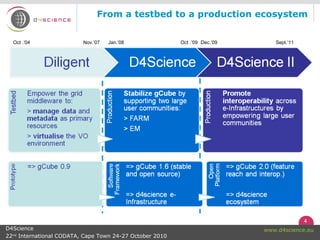
From a testbed to a production ecosystem
Oct .’04 Nov.’07 Jan.’08 Dec.’09Oct .’09 Sept.’11
5
www.d4science.euD4Science
22nd
International CODATA, Cape Town 24-27 October 2010
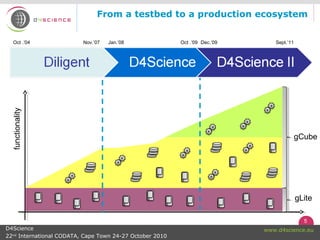
From a testbed to a production ecosystemfunctionality
gLite
gCube
Oct .’04 Nov.’07 Jan.’08 Dec.’09Oct .’09 Sept.’11
6
www.d4science.euD4Science
22nd
International CODATA, Cape Town 24-27 October 2010
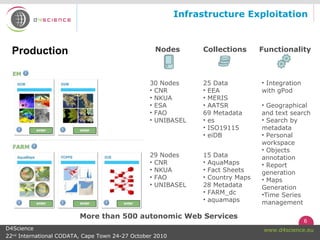
Infrastructure Exploitation
30 Nodes
• CNR
• NKUA
• ESA
• FAO
• UNIBASEL
25 Data
• EEA
• MERIS
• AATSR
69 Metadata
• es
• ISO19115
• eiDB
15 Data
• AquaMaps
• Fact Sheets
• Country Maps
28 Metadata
• FARM_dc
• aquamaps
Nodes Collections Functionality
29 Nodes
• CNR
• NKUA
• FAO
• UNIBASEL
• Integration
with gPod
• Geographical
and text search
• Search by
metadata
• Personal
workspace
• Objects
annotation
• Report
generation
• Maps
Generation
•Time Series
management
Production
More than 500 autonomic Web Services
7
www.d4science.euD4Science
22nd
International CODATA, Cape Town 24-27 October 2010
Digital Library System is a possibly distributed system that
collects, manages and preserves for the long term rich digital
content, and offers to its user communities specialised
functionality on that content, of measurable quality and according
to codified policies
The Digital Library Reference Model]
he gCube data infrastructure enabling framework provides DL
functionality by:
gCube as a Digital Library System
Federating exiting digital
content
Supporting the generation of
new digital content
Providing discovery and
access capabilities
maintained in a variety of
tailored repository systems
by exploiting heterogeneous
computational platforms
on diversely described and
modeled digital content
8
www.d4science.euD4Science
22nd
International CODATA, Cape Town 24-27 October 2010
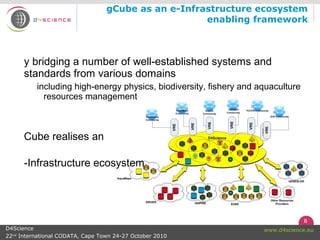
gCube as an e-Infrastructure ecosystem
enabling framework
y bridging a number of well-established systems and
standards from various domains
including high-energy physics, biodiversity, fishery and aquaculture
resources management
Cube realises an
-Infrastructure ecosystem
9
www.d4science.euD4Science
22nd
International CODATA, Cape Town 24-27 October 2010
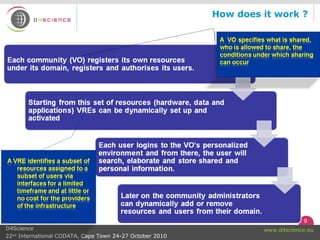
How does it work ?
10
www.d4science.euD4Science
22nd
International CODATA, Cape Town 24-27 October 2010
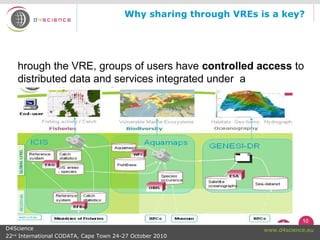
Why sharing through VREs is a key?
T
hrough the VRE, groups of users have controlled access to
distributed data and services integrated under a
personalised interface.
11
www.d4science.euD4Science
22nd
International CODATA, Cape Town 24-27 October 2010
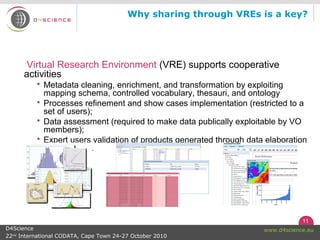
Why sharing through VREs is a key?
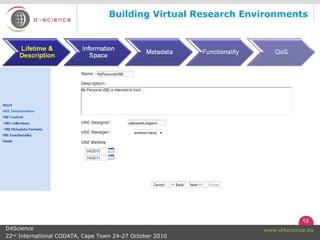
Virtual Research Environment (VRE) supports cooperative
activities
 Metadata cleaning, enrichment, and transformation by exploiting
mapping schema, controlled vocabulary, thesauri, and ontology
 Processes refinement and show cases implementation (restricted to a
set of users);
 Data assessment (required to make data publically exploitable by VO
members);
 Expert users validation of products generated through data elaboration
or simulation.
12
www.d4science.euD4Science
22nd
International CODATA, Cape Town 24-27 October 2010
Why sharing through VREs is a key?
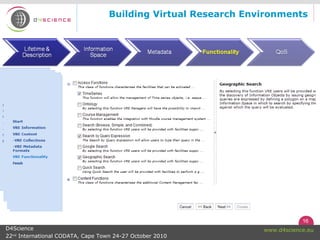
REs integrated environment put at disposal a functionality
set to support and perform research activities:
 the ability to integrate heterogeneous data and services
 the ability to process information on-demand ingesting the
results,
 to share data and process with other users,
 to customize collection of information,
 to store user actions and exploit them for further use,
 to aggregate relevant information into ad-hoc information
sources and keeping them updated.
VREs integrated environment put at disposal a functionality
set to support and perform research activities:
 the ability to integrate heterogeneous data and services
 the ability to process information on-demand ingesting the
results,
 to share data and process with other users,
 to customize collection of information,
 to store user actions and exploit them for further use,
 to aggregate relevant information into ad-hoc information
sources and keeping them updated.
13
www.d4science.euD4Science
22nd
International CODATA, Cape Town 24-27 October 2010
Building Virtual Research Environments
14
www.d4science.euD4Science
22nd
International CODATA, Cape Town 24-27 October 2010
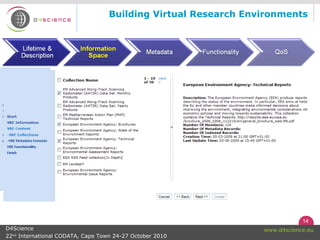
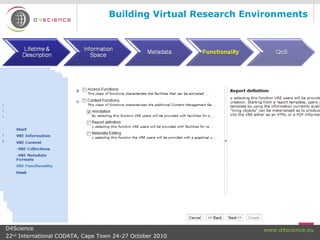
Building Virtual Research Environments
15
www.d4science.euD4Science
22nd
International CODATA, Cape Town 24-27 October 2010
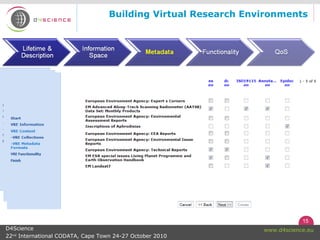
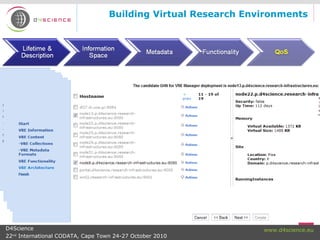
Building Virtual Research Environments
16
www.d4science.euD4Science
22nd
International CODATA, Cape Town 24-27 October 2010
Building Virtual Research Environments
17
www.d4science.euD4Science
22nd
International CODATA, Cape Town 24-27 October 2010
Building Virtual Research Environments
18
www.d4science.euD4Science
22nd
International CODATA, Cape Town 24-27 October 2010
Building Virtual Research Environments
19
www.d4science.euD4Science
22nd
International CODATA, Cape Town 24-27 October 2010
…
Transformatio
n
Storage
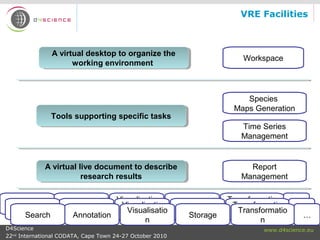
VRE Facilities
Tools supporting specific tasksTools supporting specific tasks
A virtual live document to describe
research results
A virtual live document to describe
research results
A virtual desktop to organize the
working environment
A virtual desktop to organize the
working environment
Workspace
Species
Maps Generation
Time Series
Management
Report
Management
Search Annotation
Visualisatio
nSearch Annotation
Visualisatio
nAnnotationSearch
StorageVisualisatio
n
Transformatio
n
Transformatio
n
Storage
20
www.d4science.euD4Science
22nd
International CODATA, Cape Town 24-27 October 2010
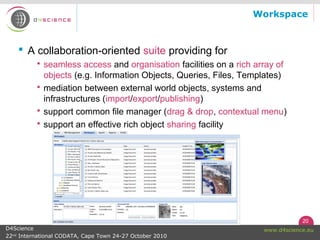
Workspace
 A collaboration-oriented suite providing for
 seamless access and organisation facilities on a rich array of
objects (e.g. Information Objects, Queries, Files, Templates)
 mediation between external world objects, systems and
infrastructures (import/export/publishing)
 support common file manager (drag & drop, contextual menu)
 support an effective rich object sharing facility
21
www.d4science.euD4Science
22nd
International CODATA, Cape Town 24-27 October 2010
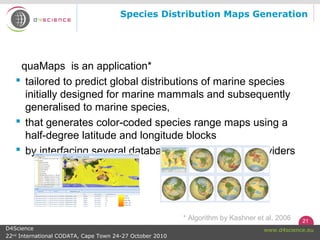
quaMaps is an application*
 tailored to predict global distributions of marine species
initially designed for marine mammals and subsequently
generalised to marine species,
 that generates color-coded species range maps using a
half-degree latitude and longitude blocks
 by interfacing several databases and repository providers
Species Distribution Maps Generation
* Algorithm by Kashner et al. 2006
22
www.d4science.euD4Science
22nd
International CODATA, Cape Town 24-27 October 2010
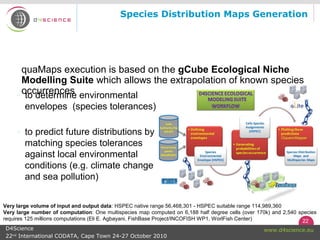
quaMaps execution is based on the gCube Ecological Niche
Modelling Suite which allows the extrapolation of known species
occurrences
Species Distribution Maps Generation
◦ to determine environmental
envelopes (species tolerances)
◦ to predict future distributions by
matching species tolerances
against local environmental
conditions (e.g. climate change
and sea pollution)
Very large volume of input and output data: HSPEC native range 56,468,301 - HSPEC suitable range 114,989,360
Very large number of computation: One multispecies map computed on 6,188 half degree cells (over 170k) and 2,540 species
requires 125 millions computations (Eli E. Agbayani, FishBase Project/INCOFISH WP1, WorlFish Center)
23
www.d4science.euD4Science
22nd
International CODATA, Cape Town 24-27 October 2010
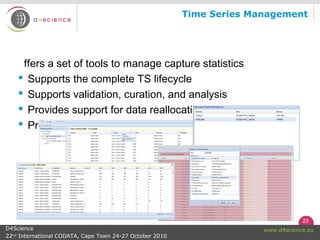
Time Series Management
ffers a set of tools to manage capture statistics
 Supports the complete TS lifecycle
 Supports validation, curation, and analysis
 Provides support for data reallocation
 Produces uniform data-set
24
www.d4science.euD4Science
22nd
International CODATA, Cape Town 24-27 October 2010
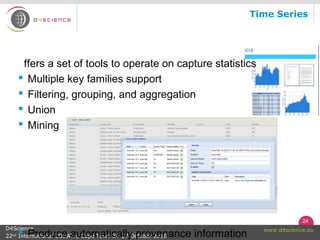
Time Series
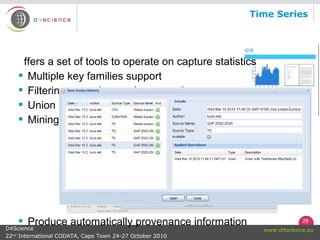
ffers a set of tools to operate on capture statistics
 Multiple key families support
 Filtering, grouping, and aggregation
 Union
 Mining
 Produce automatically provenance information
25
www.d4science.euD4Science
22nd
International CODATA, Cape Town 24-27 October 2010
Time Series
ffers a set of tools to operate on capture statistics
 Multiple key families support
 Filtering, grouping, and aggregation
 Union
 Mining
 Produce automatically provenance information
26
www.d4science.euD4Science
22nd
International CODATA, Cape Town 24-27 October 2010
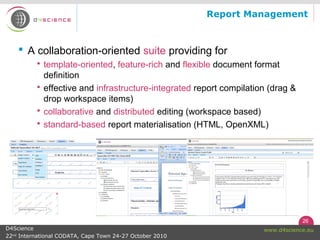
Report Management
 A collaboration-oriented suite providing for
 template-oriented, feature-rich and flexible document format
definition
 effective and infrastructure-integrated report compilation (drag &
drop workspace items)
 collaborative and distributed editing (workspace based)
 standard-based report materialisation (HTML, OpenXML)
27
www.d4science.euD4Science
22nd
International CODATA, Cape Town 24-27 October 2010
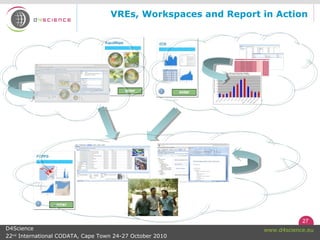
VREs, Workspaces and Report in Action
28
www.d4science.euD4Science
22nd
International CODATA, Cape Town 24-27 October 2010
gCube and Humanities: the gMan case
 JISC - King’s College London
 Look at new ways of integrating existing data resources for Classics and
add services so that research work based on integrated resources can be
published
 Data sources
 The Heidelberger Gesamtverzeichnis (HGV) der griechischen Papyrusurkunden
Aegyptens, a collection of metadata records for 55,000 Greek papyri from Egypt.
 Projet Volterra, a database of Roman legal texts, and associated metadata, from
various sources (epigraphic, papyrological, or literary) currently in the low tens of
thousands but very much in progress.
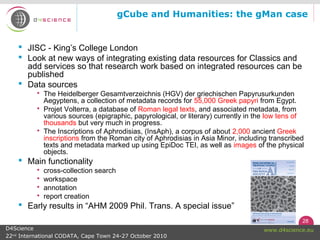
 The Inscriptions of Aphrodisias, (InsAph), a corpus of about 2,000 ancient Greek
inscriptions from the Roman city of Aphrodisias in Asia Minor, including transcribed
texts and metadata marked up using EpiDoc TEI, as well as images of the physical
objects.
 Main functionality
 cross-collection search
 workspace
 annotation
 report creation
 Early results in “AHM 2009 Phil. Trans. A special issue”
29
www.d4science.euD4Science
22nd
International CODATA, Cape Town 24-27 October 2010
VRE Sumamry
4Science approach:
• Heterogeneous resources are accessible in a common
ecosystem of resources
• despite their locations, technologies, and protocol
• Different communities have access to different views
• according to the conditions under which the sharing can occur
• Each community can define its own virtual research
environment to satisfy specific needs
• for a limited timeframe and at no cost for the providers of the
resource
• Several virtual research environments can coexist
• without interfering each other even by competing for the same
resources
30
www.d4science.euD4Science
22nd
International CODATA, Cape Town 24-27 October 2010
Conclusions
acts
 Very rich services and data collections are currently maintained by a
multitude of authoritative providers
 Several standards are adopted in the same domain
nteroperability approaches are key to exploit such richness
4Science offers a variety of patterns, tools, and solutions
 to interconnect
 Heterogeneous digital content
 Heterogeneous repository systems
 Heterogeneous computation platforms
with a rich set of free-to-use tailored services
 to decrease the cost of adoption
 to reduce the time to market of new ideas
 to deal with plethora of standards
31
www.d4science.euD4Science
22nd
International CODATA, Cape Town 24-27 October 2010
Supported Standards
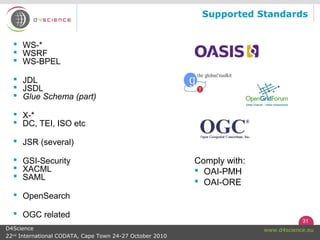
 WS-*
 WSRF
 WS-BPEL
 JDL
 JSDL
 Glue Schema (part)
 X-*
 DC, TEI, ISO etc
 JSR (several)
 GSI-Security
 XACML
 SAML
 OpenSearch
 OGC related
Comply with:
 OAI-PMH
 OAI-ORE
32
www.d4science.euD4Science
22nd
International CODATA, Cape Town 24-27 October 2010
Supported Standards
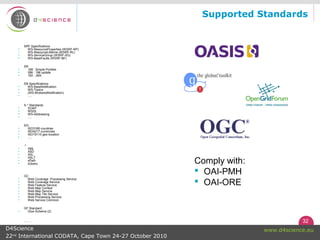
SRF Specifications
• WS-ResourceProperties (WSRF-RP)
• WS-ResourceLifetime (WSRF-RL)
• WS-ServiceGroup (WSRF-SG)
• WS-BaseFaults (WSRF-BF)
SR
• 168 : Simple Portlets
• 286 : 186 update
• 160 : JMX
SN Specifications:
• WS-BaseNotification
• WS-Topics
• (WS-BrokeredNotification)
• ….
S-* Standards
• SOAP
• WSDL
• WS-Addressing
• ….
SO:
• ISO3166 countries
• ISO4217 currencies
• ISO19115 geo-location
• ….
-*
• XML
• XSD
• XSL
• XSLT
• xPath
• xQuery
GC
• Web Coverage Processing Service
• Web Coverage Service
• Web Feature Service
• Web Map Context
• Web Map Service
• Web Map Tile Service
• Web Processing Service
• Web Service Common
GF Standard:
• Glue Schema (2)
…….
Comply with:
 OAI-PMH
 OAI-ORE
33
www.d4science.euD4Science
22nd
International CODATA, Cape Town 24-27 October 2010
Find us
www.d4science.eu
Donatella Castelli
D4Science-II Project Director
donatella.castelli@isti.cnr.it
Pasquale Pagano
D4Science-II Technical Director
pasquale.pagano@isti.cnr.it
Thank You For
Your Attention

D4science-II Codata

  • 1.
    D4Science: An e-Infrastructure forFacilitating Fisheries and Aquaculture Resource Management Pasquale Pagano National Research Council of Italy pasquale.pagano@isti.cnr.it 22nd International CODATA 24-27 October 2010 Cape Town (South Africa) www.d4science.eu
  • 2.
    2 www.d4science.euD4Science 22nd International CODATA, CapeTown 24-27 October 2010 Assumptions onsolidated facts:  Very rich applications and data collections are currently maintained by a multitude of authoritative providers  Different problems require different execution paradigms: batch, map- reduce, synchronous call, message-queue, …  Key distributed computation technologies exist: grid (gLite and Globus), distributed resource management (Condor), clusters (Hadoop), …  Several standards are adopted in the same domain ocietal observations • A rich variety of protocols, models, and formats • Create barriers in the usage of resources • Delay dramatically new exploitation patterns echnical observations  Protocols, models, and formats heterogeneity increases load,  Load increases failures
  • 3.
    3 www.d4science.euD4Science 22nd International CODATA, CapeTown 24-27 October 2010 D4Science Vision 4Science objectives: hide heterogeneity, i.e. abstract over differences in location, protocol, and model; embrace heterogeneity, i.e. allow for multiple locations, protocols, and models; echnical goals  no bottlenecks: scale no less than the interfaced resources  no outages: keep failures partial and temporary  autonomicity: system reacts and recovers
  • 4.
    4 www.d4science.euD4Science 22nd International CODATA, CapeTown 24-27 October 2010 From a testbed to a production ecosystem Oct .’04 Nov.’07 Jan.’08 Dec.’09Oct .’09 Sept.’11
  • 5.
    5 www.d4science.euD4Science 22nd International CODATA, CapeTown 24-27 October 2010 From a testbed to a production ecosystemfunctionality gLite gCube Oct .’04 Nov.’07 Jan.’08 Dec.’09Oct .’09 Sept.’11
  • 6.
    6 www.d4science.euD4Science 22nd International CODATA, CapeTown 24-27 October 2010 Infrastructure Exploitation 30 Nodes • CNR • NKUA • ESA • FAO • UNIBASEL 25 Data • EEA • MERIS • AATSR 69 Metadata • es • ISO19115 • eiDB 15 Data • AquaMaps • Fact Sheets • Country Maps 28 Metadata • FARM_dc • aquamaps Nodes Collections Functionality 29 Nodes • CNR • NKUA • FAO • UNIBASEL • Integration with gPod • Geographical and text search • Search by metadata • Personal workspace • Objects annotation • Report generation • Maps Generation •Time Series management Production More than 500 autonomic Web Services
  • 7.
    7 www.d4science.euD4Science 22nd International CODATA, CapeTown 24-27 October 2010 Digital Library System is a possibly distributed system that collects, manages and preserves for the long term rich digital content, and offers to its user communities specialised functionality on that content, of measurable quality and according to codified policies The Digital Library Reference Model] he gCube data infrastructure enabling framework provides DL functionality by: gCube as a Digital Library System Federating exiting digital content Supporting the generation of new digital content Providing discovery and access capabilities maintained in a variety of tailored repository systems by exploiting heterogeneous computational platforms on diversely described and modeled digital content
  • 8.
    8 www.d4science.euD4Science 22nd International CODATA, CapeTown 24-27 October 2010 gCube as an e-Infrastructure ecosystem enabling framework y bridging a number of well-established systems and standards from various domains including high-energy physics, biodiversity, fishery and aquaculture resources management Cube realises an -Infrastructure ecosystem
  • 9.
    9 www.d4science.euD4Science 22nd International CODATA, CapeTown 24-27 October 2010 How does it work ?
  • 10.
    10 www.d4science.euD4Science 22nd International CODATA, CapeTown 24-27 October 2010 Why sharing through VREs is a key? T hrough the VRE, groups of users have controlled access to distributed data and services integrated under a personalised interface.
  • 11.
    11 www.d4science.euD4Science 22nd International CODATA, CapeTown 24-27 October 2010 Why sharing through VREs is a key? Virtual Research Environment (VRE) supports cooperative activities  Metadata cleaning, enrichment, and transformation by exploiting mapping schema, controlled vocabulary, thesauri, and ontology  Processes refinement and show cases implementation (restricted to a set of users);  Data assessment (required to make data publically exploitable by VO members);  Expert users validation of products generated through data elaboration or simulation.
  • 12.
    12 www.d4science.euD4Science 22nd International CODATA, CapeTown 24-27 October 2010 Why sharing through VREs is a key? REs integrated environment put at disposal a functionality set to support and perform research activities:  the ability to integrate heterogeneous data and services  the ability to process information on-demand ingesting the results,  to share data and process with other users,  to customize collection of information,  to store user actions and exploit them for further use,  to aggregate relevant information into ad-hoc information sources and keeping them updated. VREs integrated environment put at disposal a functionality set to support and perform research activities:  the ability to integrate heterogeneous data and services  the ability to process information on-demand ingesting the results,  to share data and process with other users,  to customize collection of information,  to store user actions and exploit them for further use,  to aggregate relevant information into ad-hoc information sources and keeping them updated.
  • 13.
    13 www.d4science.euD4Science 22nd International CODATA, CapeTown 24-27 October 2010 Building Virtual Research Environments
  • 14.
    14 www.d4science.euD4Science 22nd International CODATA, CapeTown 24-27 October 2010 Building Virtual Research Environments
  • 15.
    15 www.d4science.euD4Science 22nd International CODATA, CapeTown 24-27 October 2010 Building Virtual Research Environments
  • 16.
    16 www.d4science.euD4Science 22nd International CODATA, CapeTown 24-27 October 2010 Building Virtual Research Environments
  • 17.
    17 www.d4science.euD4Science 22nd International CODATA, CapeTown 24-27 October 2010 Building Virtual Research Environments
  • 18.
    18 www.d4science.euD4Science 22nd International CODATA, CapeTown 24-27 October 2010 Building Virtual Research Environments
  • 19.
    19 www.d4science.euD4Science 22nd International CODATA, CapeTown 24-27 October 2010 … Transformatio n Storage VRE Facilities Tools supporting specific tasksTools supporting specific tasks A virtual live document to describe research results A virtual live document to describe research results A virtual desktop to organize the working environment A virtual desktop to organize the working environment Workspace Species Maps Generation Time Series Management Report Management Search Annotation Visualisatio nSearch Annotation Visualisatio nAnnotationSearch StorageVisualisatio n Transformatio n Transformatio n Storage
  • 20.
    20 www.d4science.euD4Science 22nd International CODATA, CapeTown 24-27 October 2010 Workspace  A collaboration-oriented suite providing for  seamless access and organisation facilities on a rich array of objects (e.g. Information Objects, Queries, Files, Templates)  mediation between external world objects, systems and infrastructures (import/export/publishing)  support common file manager (drag & drop, contextual menu)  support an effective rich object sharing facility
  • 21.
    21 www.d4science.euD4Science 22nd International CODATA, CapeTown 24-27 October 2010 quaMaps is an application*  tailored to predict global distributions of marine species initially designed for marine mammals and subsequently generalised to marine species,  that generates color-coded species range maps using a half-degree latitude and longitude blocks  by interfacing several databases and repository providers Species Distribution Maps Generation * Algorithm by Kashner et al. 2006
  • 22.
    22 www.d4science.euD4Science 22nd International CODATA, CapeTown 24-27 October 2010 quaMaps execution is based on the gCube Ecological Niche Modelling Suite which allows the extrapolation of known species occurrences Species Distribution Maps Generation ◦ to determine environmental envelopes (species tolerances) ◦ to predict future distributions by matching species tolerances against local environmental conditions (e.g. climate change and sea pollution) Very large volume of input and output data: HSPEC native range 56,468,301 - HSPEC suitable range 114,989,360 Very large number of computation: One multispecies map computed on 6,188 half degree cells (over 170k) and 2,540 species requires 125 millions computations (Eli E. Agbayani, FishBase Project/INCOFISH WP1, WorlFish Center)
  • 23.
    23 www.d4science.euD4Science 22nd International CODATA, CapeTown 24-27 October 2010 Time Series Management ffers a set of tools to manage capture statistics  Supports the complete TS lifecycle  Supports validation, curation, and analysis  Provides support for data reallocation  Produces uniform data-set
  • 24.
    24 www.d4science.euD4Science 22nd International CODATA, CapeTown 24-27 October 2010 Time Series ffers a set of tools to operate on capture statistics  Multiple key families support  Filtering, grouping, and aggregation  Union  Mining  Produce automatically provenance information
  • 25.
    25 www.d4science.euD4Science 22nd International CODATA, CapeTown 24-27 October 2010 Time Series ffers a set of tools to operate on capture statistics  Multiple key families support  Filtering, grouping, and aggregation  Union  Mining  Produce automatically provenance information
  • 26.
    26 www.d4science.euD4Science 22nd International CODATA, CapeTown 24-27 October 2010 Report Management  A collaboration-oriented suite providing for  template-oriented, feature-rich and flexible document format definition  effective and infrastructure-integrated report compilation (drag & drop workspace items)  collaborative and distributed editing (workspace based)  standard-based report materialisation (HTML, OpenXML)
  • 27.
    27 www.d4science.euD4Science 22nd International CODATA, CapeTown 24-27 October 2010 VREs, Workspaces and Report in Action
  • 28.
    28 www.d4science.euD4Science 22nd International CODATA, CapeTown 24-27 October 2010 gCube and Humanities: the gMan case  JISC - King’s College London  Look at new ways of integrating existing data resources for Classics and add services so that research work based on integrated resources can be published  Data sources  The Heidelberger Gesamtverzeichnis (HGV) der griechischen Papyrusurkunden Aegyptens, a collection of metadata records for 55,000 Greek papyri from Egypt.  Projet Volterra, a database of Roman legal texts, and associated metadata, from various sources (epigraphic, papyrological, or literary) currently in the low tens of thousands but very much in progress.  The Inscriptions of Aphrodisias, (InsAph), a corpus of about 2,000 ancient Greek inscriptions from the Roman city of Aphrodisias in Asia Minor, including transcribed texts and metadata marked up using EpiDoc TEI, as well as images of the physical objects.  Main functionality  cross-collection search  workspace  annotation  report creation  Early results in “AHM 2009 Phil. Trans. A special issue”
  • 29.
    29 www.d4science.euD4Science 22nd International CODATA, CapeTown 24-27 October 2010 VRE Sumamry 4Science approach: • Heterogeneous resources are accessible in a common ecosystem of resources • despite their locations, technologies, and protocol • Different communities have access to different views • according to the conditions under which the sharing can occur • Each community can define its own virtual research environment to satisfy specific needs • for a limited timeframe and at no cost for the providers of the resource • Several virtual research environments can coexist • without interfering each other even by competing for the same resources
  • 30.
    30 www.d4science.euD4Science 22nd International CODATA, CapeTown 24-27 October 2010 Conclusions acts  Very rich services and data collections are currently maintained by a multitude of authoritative providers  Several standards are adopted in the same domain nteroperability approaches are key to exploit such richness 4Science offers a variety of patterns, tools, and solutions  to interconnect  Heterogeneous digital content  Heterogeneous repository systems  Heterogeneous computation platforms with a rich set of free-to-use tailored services  to decrease the cost of adoption  to reduce the time to market of new ideas  to deal with plethora of standards
  • 31.
    31 www.d4science.euD4Science 22nd International CODATA, CapeTown 24-27 October 2010 Supported Standards  WS-*  WSRF  WS-BPEL  JDL  JSDL  Glue Schema (part)  X-*  DC, TEI, ISO etc  JSR (several)  GSI-Security  XACML  SAML  OpenSearch  OGC related Comply with:  OAI-PMH  OAI-ORE
  • 32.
    32 www.d4science.euD4Science 22nd International CODATA, CapeTown 24-27 October 2010 Supported Standards SRF Specifications • WS-ResourceProperties (WSRF-RP) • WS-ResourceLifetime (WSRF-RL) • WS-ServiceGroup (WSRF-SG) • WS-BaseFaults (WSRF-BF) SR • 168 : Simple Portlets • 286 : 186 update • 160 : JMX SN Specifications: • WS-BaseNotification • WS-Topics • (WS-BrokeredNotification) • …. S-* Standards • SOAP • WSDL • WS-Addressing • …. SO: • ISO3166 countries • ISO4217 currencies • ISO19115 geo-location • …. -* • XML • XSD • XSL • XSLT • xPath • xQuery GC • Web Coverage Processing Service • Web Coverage Service • Web Feature Service • Web Map Context • Web Map Service • Web Map Tile Service • Web Processing Service • Web Service Common GF Standard: • Glue Schema (2) ……. Comply with:  OAI-PMH  OAI-ORE
  • 33.
    33 www.d4science.euD4Science 22nd International CODATA, CapeTown 24-27 October 2010 Find us www.d4science.eu Donatella Castelli D4Science-II Project Director donatella.castelli@isti.cnr.it Pasquale Pagano D4Science-II Technical Director pasquale.pagano@isti.cnr.it Thank You For Your Attention

Editor's Notes

  • #32 WSRF Specifications WS-ResourceProperties (WSRF-RP) WS-ResourceLifetime (WSRF-RL) WS-ServiceGroup (WSRF-SG) WS-BaseFaults (WSRF-BF) JSR 168 : Simple Portlets 286 : 186 update 160 : JMX WSN Specifications: WS-BaseNotification WS-Topics (WS-BrokeredNotification) WS-* Standards SOAP WSDL WS-Addressing ISO: ISO3166 countries ISO4217 currencies ISO9115 geo-location X-* XML XSD XSL XSLT xPath xQuery Other WSRP OpenGIS KML OGF Standard: Glue Schema (2) eXtensible Access Control Markup Language(XACML) is a specification in XML for writing access control policies in XML and how to interpret them Security Assertion Markup Language(SAML) is a XML specification, defining syntax and processing semantics about security assertions