CHIS: Open Data e Linked Open Data
3: How to make successful Open Data?
Vittorio Scarano
vitsca@dia.unisa.it
Dipartimento di Informatica
Università di Salerno (Italy)
1	CHIS:	Open	Data	and	Linked	Open	Data
•  Success in Open Data Initiatives
•  Open Data Barometer
•  readiness, implementation, impact
•  Sustainability
•  Conclusions
•  Reading list, credits and acknowledgements

CHIS:	Open	Data	and	Linked	Open	Data	 2	
Outline of the talk
•  Success in Open Data Initiatives
•  Open Data Barometer
•  readiness, implementation, impact
•  Sustainability
•  Conclusions
•  Reading list, credits and acknowledgements

CHIS:	Open	Data	and	Linked	Open	Data	 3	
Outline of the talk
•  Actually this is not the principal issue
•  Issues:
•  readiness (capacity to delivery it)
•  implementation (choice of the key dataset)
•  impact in the real world
•  Need for prioritising user needs
•  over producer needs
•  Focus on the demand of data
CHIS:	Open	Data	and	Linked	Open	Data	 4	
Not only quantity..
•  A demand-focused approach prioritises the needs
of the data user over the data publisher.
•  Demand-focussed open data also enables a range
of additional benefits such as:
•  open data as an educator: increasing data literacy,
crucial to understand our world
•  open data as key enabler of open innovation
•  encourage people to communicate and innovate
•  open data enhancing business
CHIS:	Open	Data	and	Linked	Open	Data	 5	
Focussing on demand for open data
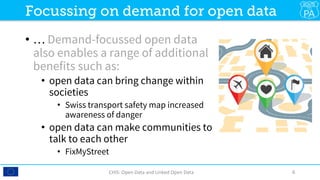
•  … Demand-focussed open data
also enables a range of additional
benefits such as:
•  open data can bring change within
societies
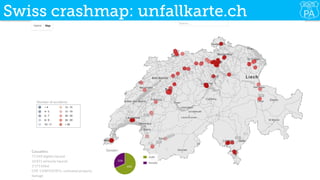
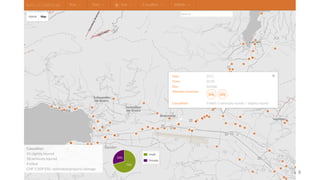
•  Swiss transport safety map increased
awareness of danger
•  open data can make communities to
talk to each other
•  FixMyStreet
CHIS:	Open	Data	and	Linked	Open	Data	 6	
Focussing on demand for open data
7	
Swiss crashmap: unfallkarte.ch
CHIS:	Open	Data	and	Linked	Open	Data	 8
CHIS:	Open	Data	and	Linked	Open	Data	 9	
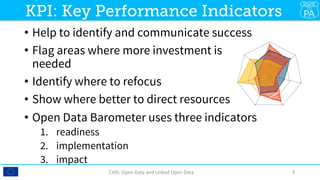
KPI: Key Performance Indicators
•  Help to identify and communicate success
•  Flag areas where more investment is
needed
•  Identify where to refocus 
•  Show where better to direct resources 
•  Open Data Barometer uses three indicators
1.  readiness
2.  implementation 
3.  impact
•  Success in Open Data Initiatives
•  Open Data Barometer
•  readiness, implementation, impact
•  Sustainability
•  Conclusions
•  Reading list, credits and acknowledgements

CHIS:	Open	Data	and	Linked	Open	Data	 10	
Outline of the talk
•  W3 Consortium (released 2015)
•  92 countries analyzed
•  Previous versions: 2013, 2014
•  Methods:
•  Peer reviewed expert survey
•  Government self-assessment
•  Secondary data by the World Economic Forum, World
Bank, UN offices, Freedom House
CHIS:	Open	Data	and	Linked	Open	Data	 11	
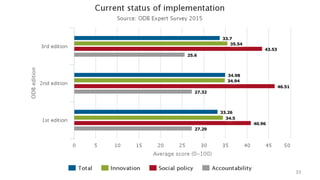
Open Data Barometer 3rd report
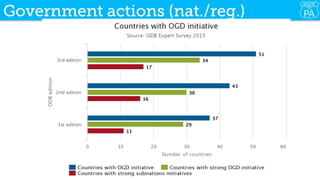
•  The majority of countries (55%) have an open
Data initiative in place
•  New countries are promising with planned new
initiatives
•  Demand is high: civil society and the tech
community are using government data in 93% of
the countries
CHIS:	Open	Data	and	Linked	Open	Data	 12	
Some key findings - 1
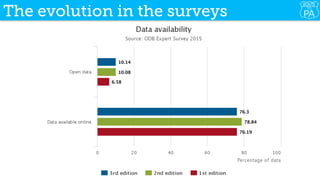
The evolution in the surveys
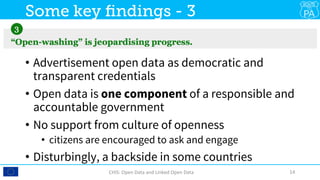
•  Advertisement open data as democratic and
transparent credentials
•  Open data is one component of a responsible and
accountable government
•  No support from culture of openness
•  citizens are encouraged to ask and engage
•  Disturbingly, a backside in some countries
CHIS:	Open	Data	and	Linked	Open	Data	 14	
Some key findings - 3
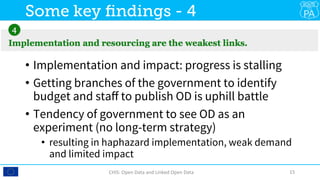
•  Implementation and impact: progress is stalling
•  Getting branches of the government to identify
budget and staff to publish OD is uphill battle
•  Tendency of government to see OD as an
experiment (no long-term strategy)
•  resulting in haphazard implementation, weak demand
and limited impact
CHIS:	Open	Data	and	Linked	Open	Data	 15	
Some key findings - 4
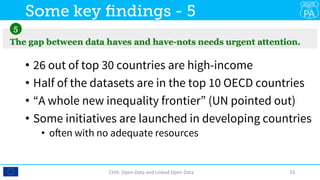
•  26 out of top 30 countries are high-income
•  Half of the datasets are in the top 10 OECD countries
•  “A whole new inequality frontier” (UN pointed out)
•  Some initiatives are launched in developing countries
•  often with no adequate resources
CHIS:	Open	Data	and	Linked	Open	Data	 16	
Some key findings - 5
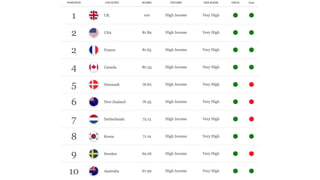
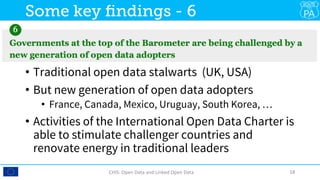
•  Traditional open data stalwarts (UK, USA)
•  But new generation of open data adopters
•  France, Canada, Mexico, Uruguay, South Korea, …
•  Activities of the International Open Data Charter is
able to stimulate challenger countries and
renovate energy in traditional leaders
CHIS:	Open	Data	and	Linked	Open	Data	 18	
Some key findings - 6
CHIS:	Open	Data	and	Linked	Open	Data	 19
•  Success	in	Open	Data	Ini?a?ves	
•  Open	Data	Barometer	
– readiness,	implementa?on,	impact	
•  Sustainability	
•  Conclusions	
•  Reading	list,	credits	and	acknowledgements	
CHIS:	Open	Data	and	Linked	Open	Data	 20	
Outline	of	the	talk
•  Policies and data management approaches
•  do governments have policies/protocols to ensure
open data are available on the long term?
•  Government actions (national/regional)
•  groundwork so that OD are used at all levels
•  Civil rights and the role of citizens
•  citizens/society empowered to participate, via OD
•  Business and entrepreneurship
•  are they able to take advantage? 
CHIS:	Open	Data	and	Linked	Open	Data	 21	
1. Readiness: some questions
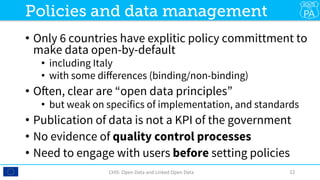
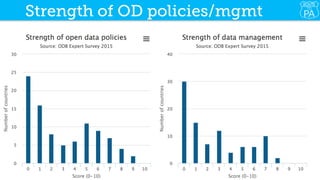
•  Only 6 countries have explitic policy committment to
make data open-by-default
•  including Italy
•  with some differences (binding/non-binding)
•  Often, clear are “open data principles”
•  but weak on specifics of implementation, and standards
•  Publication of data is not a KPI of the government
•  No evidence of quality control processes
•  Need to engage with users before setting policies
CHIS:	Open	Data	and	Linked	Open	Data	 22	
Policies and data management
CHIS:	Open	Data	and	Linked	Open	Data	 23	
Strength of OD policies/mgmt
24	
Government actions (nat./reg.)
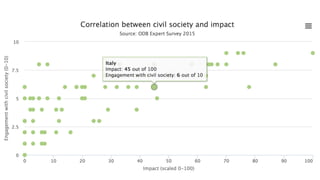
•  Open Data puts information (power) in the hands
of citizens
•  How does it change the accountability of
government?
•  Some foundations needed: 
•  strong privacy laws, freedom of information act, right
to access data
•  Without foundation: only “open washing”
CHIS:	Open	Data	and	Linked	Open	Data	 25	
Civil rights and the role of citizens
CHIS:	Open	Data	and	Linked	Open	Data	 26
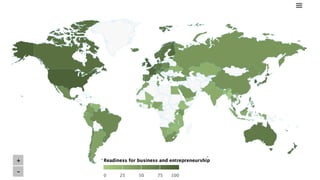
•  Benefits from unlocking OD: training and
promotion of innovation
•  Training: still not enough
•  no full range of advanced training on data/open-data
•  no courses on specific, sectoral approach (e.g. health)
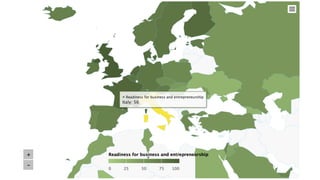
•  Only 20% of countries have an established
program for supporting innovation (designed to
use OD)
CHIS:	Open	Data	and	Linked	Open	Data	 27	
Business and entrepreneurship
29
•  Success in Open Data Initiatives
•  Open Data Barometer
•  readiness, implementation, impact
•  Sustainability
•  Conclusions
•  Reading list, credits and acknowledgements

CHIS:	Open	Data	and	Linked	Open	Data	 30	
Outline of the talk
•  Often, governments are publishing only selected
data sets
•  The implementation looks at the: 
•  extent of publishing (which data)
•  openness of data published and if timely accessible
•  Some problems to find high-quality government
data
CHIS:	Open	Data	and	Linked	Open	Data	 31	
2. Implementation
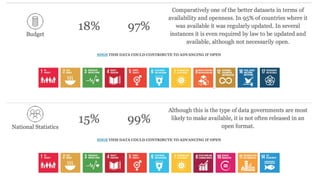
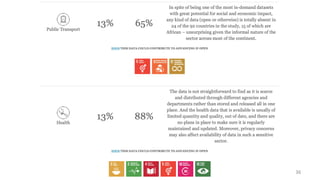
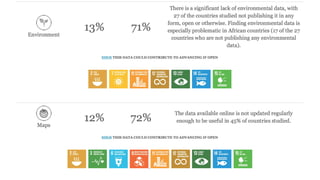
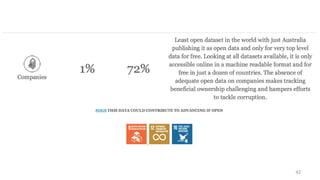
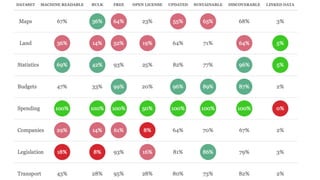
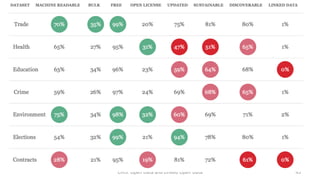
•  Government budget is most likely to be open 
•  18% of the countries
•  Some critical data are unlikely to be found: 
•  company register (only in Australia)
•  Government spending (only Brasil and UK)
•  Legislation (only Brazil, France, Korea and UK)
•  Land ownership (only Australia, Canada, Estonia, UK,
Uruguay)
CHIS:	Open	Data	and	Linked	Open	Data	 32	
Data availability
CHIS:	Open	Data	and	Linked	Open	Data	 33
CHIS:	Open	Data	and	Linked	Open	Data	 34	
(from	United	Na?ons,	to	be	reached	by	2030)
35
CHIS:	Open	Data	and	Linked	Open	Data	 36
CHIS:	Open	Data	and	Linked	Open	Data	 37
CHIS:	Open	Data	and	Linked	Open	Data	 38
CHIS:	Open	Data	and	Linked	Open	Data	 39
CHIS:	Open	Data	and	Linked	Open	Data	 40
CHIS:	Open	Data	and	Linked	Open	Data	 41
42
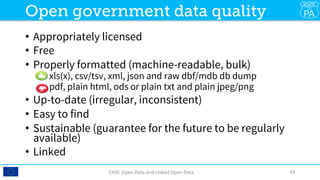
•  Appropriately licensed
•  Free
•  Properly formatted (machine-readable, bulk)
•  xls(x), csv/tsv, xml, json and raw dbf/mdb db dump
•  pdf, plain html, ods or plain txt and plain jpeg/png
•  Up-to-date (irregular, inconsistent)
•  Easy to find
•  Sustainable (guarantee for the future to be regularly
available)
•  Linked
CHIS:	Open	Data	and	Linked	Open	Data	 43	
Open government data quality
CHIS:	Open	Data	and	Linked	Open	Data
CHIS:	Open	Data	and	Linked	Open	Data	 45
•  Success in Open Data Initiatives
•  Open Data Barometer
•  readiness, implementation, impact
•  Sustainability
•  Conclusions
•  Reading list, credits and acknowledgements

CHIS:	Open	Data	and	Linked	Open	Data	 46	
Outline of the talk
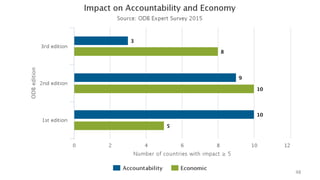
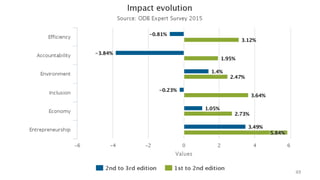
•  Difficult to measure: evidence is limited
•  Assessment of countries for: 
•  transparency & accountability, and improved
government efficiency and effectiveness
•  environmental impacts
•  greater inclusion for marginalised groups
•  contribution to economy
•  support to startups, enterpreneurs and existing business
•  Warning! Political impact is declining 
•  not enough resources/staff
CHIS:	Open	Data	and	Linked	Open	Data	 47	
3. Impact
CHIS:	Open	Data	and	Linked	Open	Data	 48
CHIS:	Open	Data	and	Linked	Open	Data	 49
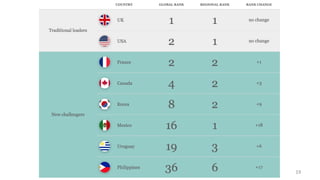
•  The long-standing leaders (UK, USA) still remain
top of the rankings
•  A new generation is challenging their leadership
•  France, Canada
•  Korea, Japa, Singapore, Philippines
•  Mexico, Uruguay
•  Africa is the exception (no clear new challenger)
•  Rwanda stable, Kenya and Ghana holding
CHIS:	Open	Data	and	Linked	Open	Data	 50	
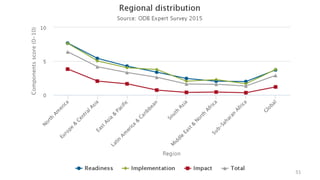
Rankings.. (at least!)
CHIS:	Open	Data	and	Linked	Open	Data	 51
CHIS:	Open	Data	and	Linked	Open	Data	 52
53
CHIS:	Open	Data	and	Linked	Open	Data	 54	
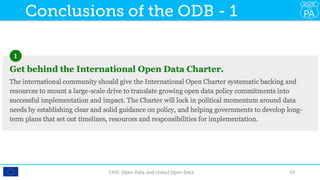
Conclusions of the ODB - 1
CHIS:	Open	Data	and	Linked	Open	Data	 55	
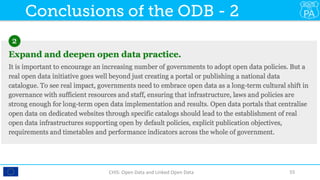
Conclusions of the ODB - 2
CHIS:	Open	Data	and	Linked	Open	Data	 56	
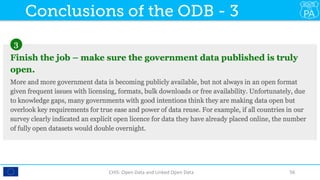
Conclusions of the ODB - 3
CHIS:	Open	Data	and	Linked	Open	Data	 57	
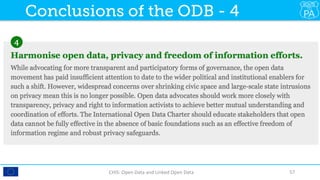
Conclusions of the ODB - 4
CHIS:	Open	Data	and	Linked	Open	Data	 58	
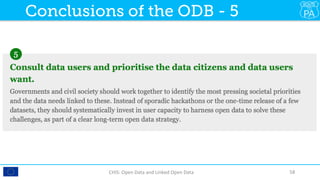
Conclusions of the ODB - 5
CHIS:	Open	Data	and	Linked	Open	Data	 59	
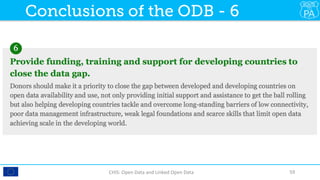
Conclusions of the ODB - 6
•  Success in Open Data Initiatives
•  Open Data Barometer
•  readiness, implementation, impact
•  Sustainability
•  Conclusions
•  Reading list, credits and acknowledgements

CHIS:	Open	Data	and	Linked	Open	Data	 60	
Outline of the talk
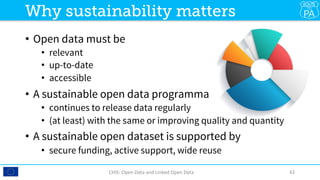
•  Open data must be 
•  relevant
•  up-to-date
•  accessible
•  A sustainable open data programma
•  continues to release data regularly
•  (at least) with the same or improving quality and quantity
•  A sustainable open dataset is supported by
•  secure funding, active support, wide reuse
CHIS:	Open	Data	and	Linked	Open	Data	 61	
Why sustainability matters
•  “Freely used” does not mean there is no cost to
collecting or releasing the data. 
•  Funding can be secured by:
•  Charging for access or enhanced services
•  Funding from another source who supports open data
publication
•  Demonstrating the ongoing value of open data to the
organisation
CHIS:	Open	Data	and	Linked	Open	Data	 62	
Secure funding
•  Making open data sustainable for an organisation
usually requires 
•  the backing of its management, to make it a priority,
•  the support of staff responsible for maintaining
quality.
•  Active support is most commonly achieved by a
company committing to maintaining open data as
part of its daily operations.
CHIS:	Open	Data	and	Linked	Open	Data	 63	
Active support for open data
•  When the services created with that data become
critical to the success of the publisher’s business.
•  Example
•  Datasets of the Berlin transport system are used by
millions when they access transport apps (Citymapper)
•  These apps drive usage of VBB services 
•  VBB commits to regularly update the data.
CHIS:	Open	Data	and	Linked	Open	Data	 64	
Wide reuse of open data
•  Not good only for the users.. but also for the publisher
•  Effects: Enhancing the trust of the community in the
publisher’s organisation.
•  allows a large community to build and analyse data in order
to draw their own conclusions, often in support of a
publisher's view.
•  Effect: Supporting the creation of new products and
services 
•  build business connections that bring direct feedback to the
publisher
•  Simplifying the publishers reuse of their own data.
CHIS:	Open	Data	and	Linked	Open	Data	 65	
Why? Solid foundations
•  Improves data usability
•  Often, the publisher is using the
Open Data that it is publishing for
internal purposes
•  Why separate the public release of
data from the internal data usage?
•  Data of increasing quality enhances
efficiency from the inside!
CHIS:	Open	Data	and	Linked	Open	Data	 66	
Effect: publishers reuse of OD
•  What is the source? 
•  confidence in its commitment
•  can a change in politics affect the priority of OD?
•  Who is funding the release?
•  is the organization subject to transparency pressures
or is there a beneficial use, that drives the demand?
•  What does the license say?
•  some suggestions on the future of the dataset
CHIS:	Open	Data	and	Linked	Open	Data	 67	
The questions to sustainability -1
•  Who is already using the data?
•  wide pressure to keep it active and updated
•  is it used internally? 
•  What is the publishing history?
•  How long is the dataset been published?
•  Is there a project term?
•  How can I contribute? (to sustainability)
•  by using it increases dataset’s demand
•  join communities
CHIS:	Open	Data	and	Linked	Open	Data	 68	
The questions to sustainability -2
•  Success in Open Data Initiatives
•  Open Data Barometer
•  readiness, implementation, impact
•  Sustainability
•  Conclusions
•  Reading list, credits and acknowledgements

CHIS:	Open	Data	and	Linked	Open	Data	 69	
Outline of the talk
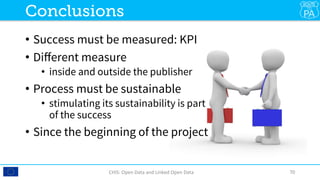
•  Success must be measured: KPI
•  Different measure 
•  inside and outside the publisher
•  Process must be sustainable
•  stimulating its sustainability is part
of the success
•  Since the beginning of the project
CHIS:	Open	Data	and	Linked	Open	Data	 70	
Conclusions
•  Success in Open Data Initiatives
•  Open Data Barometer
•  readiness, implementation, impact
•  Sustainability
•  Conclusions
•  Reading list, credits and acknowledgements

CHIS:	Open	Data	and	Linked	Open	Data	 71	
Outline of the talk
•  European Data Portal: Measuring success for Open
Data.
http://www.europeandataportal.eu/elearning/en/
module6/#/id/co-01 
•  Open Data Barometer: http://opendatabarometer.org
•  European Data Portal: Why should we worry about
sustainability?
http://www.europeandataportal.eu/elearning/en/
module7/#/id/co-01 
CHIS:	Open	Data	and	Linked	Open	Data	 72	
Reading list
•  Part of the material comes with license CC-BY or CC-
SA
•  from the European Data Portal Library 
•  http://www.europeandataportal.eu/en/training-library
•  from the Open Data Barometer Report
CHIS:	Open	Data	and	Linked	Open	Data	 73	
Credits
•  Part of the work was funded by the
ROUTE-TO-PA H2020 project
•  www.routetopa.eu for more info
CHIS:	Open	Data	and	Linked	Open	Data	 74	
Acknowledgments
The	project	has	received	funding	from	the	
European	 Union’s	 Horizon	 2020	 research	
and	 innova<on	 programme	 under	 grant	
agreement	No	645860.
•  Author: Vittorio Scarano,
ROUTE-TO-PA project
•  vitsca@dia.unisa.it
•  License: This Work is licensed
with Creative Commons
Attribution-ShareAlike 4.0
International (CC BY-SA 4.0)
•  https://creativecommons.org/
licenses/by-sa/4.0/ 
•  Available onSlideShare
CHIS:	Open	Data	and	Linked	Open	Data	 75	
License

OpenDataCourse-03-HowToMakeSuccessfulOpenData

  • 1.
    CHIS: Open Datae Linked Open Data 3: How to make successful Open Data? Vittorio Scarano vitsca@dia.unisa.it Dipartimento di Informatica Università di Salerno (Italy) 1 CHIS: Open Data and Linked Open Data
  • 2.
    •  Success inOpen Data Initiatives •  Open Data Barometer •  readiness, implementation, impact •  Sustainability •  Conclusions •  Reading list, credits and acknowledgements CHIS: Open Data and Linked Open Data 2 Outline of the talk
  • 3.
    •  Success inOpen Data Initiatives •  Open Data Barometer •  readiness, implementation, impact •  Sustainability •  Conclusions •  Reading list, credits and acknowledgements CHIS: Open Data and Linked Open Data 3 Outline of the talk
  • 4.
    •  Actually thisis not the principal issue •  Issues: •  readiness (capacity to delivery it) •  implementation (choice of the key dataset) •  impact in the real world •  Need for prioritising user needs •  over producer needs •  Focus on the demand of data CHIS: Open Data and Linked Open Data 4 Not only quantity..
  • 5.
    •  A demand-focusedapproach prioritises the needs of the data user over the data publisher. •  Demand-focussed open data also enables a range of additional benefits such as: •  open data as an educator: increasing data literacy, crucial to understand our world •  open data as key enabler of open innovation •  encourage people to communicate and innovate •  open data enhancing business CHIS: Open Data and Linked Open Data 5 Focussing on demand for open data
  • 6.
    •  … Demand-focussedopen data also enables a range of additional benefits such as: •  open data can bring change within societies •  Swiss transport safety map increased awareness of danger •  open data can make communities to talk to each other •  FixMyStreet CHIS: Open Data and Linked Open Data 6 Focussing on demand for open data
  • 7.
  • 8.
  • 9.
    CHIS: Open Data and Linked Open Data 9 KPI: KeyPerformance Indicators •  Help to identify and communicate success •  Flag areas where more investment is needed •  Identify where to refocus •  Show where better to direct resources •  Open Data Barometer uses three indicators 1.  readiness 2.  implementation 3.  impact
  • 10.
    •  Success inOpen Data Initiatives •  Open Data Barometer •  readiness, implementation, impact •  Sustainability •  Conclusions •  Reading list, credits and acknowledgements CHIS: Open Data and Linked Open Data 10 Outline of the talk
  • 11.
    •  W3 Consortium(released 2015) •  92 countries analyzed •  Previous versions: 2013, 2014 •  Methods: •  Peer reviewed expert survey •  Government self-assessment •  Secondary data by the World Economic Forum, World Bank, UN offices, Freedom House CHIS: Open Data and Linked Open Data 11 Open Data Barometer 3rd report
  • 12.
    •  The majorityof countries (55%) have an open Data initiative in place •  New countries are promising with planned new initiatives •  Demand is high: civil society and the tech community are using government data in 93% of the countries CHIS: Open Data and Linked Open Data 12 Some key findings - 1
  • 13.
    The evolution inthe surveys
  • 14.
    •  Advertisement opendata as democratic and transparent credentials •  Open data is one component of a responsible and accountable government •  No support from culture of openness •  citizens are encouraged to ask and engage •  Disturbingly, a backside in some countries CHIS: Open Data and Linked Open Data 14 Some key findings - 3
  • 15.
    •  Implementation andimpact: progress is stalling •  Getting branches of the government to identify budget and staff to publish OD is uphill battle •  Tendency of government to see OD as an experiment (no long-term strategy) •  resulting in haphazard implementation, weak demand and limited impact CHIS: Open Data and Linked Open Data 15 Some key findings - 4
  • 16.
    •  26 outof top 30 countries are high-income •  Half of the datasets are in the top 10 OECD countries •  “A whole new inequality frontier” (UN pointed out) •  Some initiatives are launched in developing countries •  often with no adequate resources CHIS: Open Data and Linked Open Data 16 Some key findings - 5
  • 18.
    •  Traditional opendata stalwarts (UK, USA) •  But new generation of open data adopters •  France, Canada, Mexico, Uruguay, South Korea, … •  Activities of the International Open Data Charter is able to stimulate challenger countries and renovate energy in traditional leaders CHIS: Open Data and Linked Open Data 18 Some key findings - 6
  • 19.
  • 20.
    •  Success in Open Data Ini?a?ves •  Open Data Barometer – readiness, implementa?on, impact • Sustainability •  Conclusions •  Reading list, credits and acknowledgements CHIS: Open Data and Linked Open Data 20 Outline of the talk
  • 21.
    •  Policies anddata management approaches •  do governments have policies/protocols to ensure open data are available on the long term? •  Government actions (national/regional) •  groundwork so that OD are used at all levels •  Civil rights and the role of citizens •  citizens/society empowered to participate, via OD •  Business and entrepreneurship •  are they able to take advantage? CHIS: Open Data and Linked Open Data 21 1. Readiness: some questions
  • 22.
    •  Only 6countries have explitic policy committment to make data open-by-default •  including Italy •  with some differences (binding/non-binding) •  Often, clear are “open data principles” •  but weak on specifics of implementation, and standards •  Publication of data is not a KPI of the government •  No evidence of quality control processes •  Need to engage with users before setting policies CHIS: Open Data and Linked Open Data 22 Policies and data management
  • 23.
  • 24.
  • 25.
    •  Open Dataputs information (power) in the hands of citizens •  How does it change the accountability of government? •  Some foundations needed: •  strong privacy laws, freedom of information act, right to access data •  Without foundation: only “open washing” CHIS: Open Data and Linked Open Data 25 Civil rights and the role of citizens
  • 26.
  • 27.
    •  Benefits fromunlocking OD: training and promotion of innovation •  Training: still not enough •  no full range of advanced training on data/open-data •  no courses on specific, sectoral approach (e.g. health) •  Only 20% of countries have an established program for supporting innovation (designed to use OD) CHIS: Open Data and Linked Open Data 27 Business and entrepreneurship
  • 29.
  • 30.
    •  Success inOpen Data Initiatives •  Open Data Barometer •  readiness, implementation, impact •  Sustainability •  Conclusions •  Reading list, credits and acknowledgements CHIS: Open Data and Linked Open Data 30 Outline of the talk
  • 31.
    •  Often, governmentsare publishing only selected data sets •  The implementation looks at the: •  extent of publishing (which data) •  openness of data published and if timely accessible •  Some problems to find high-quality government data CHIS: Open Data and Linked Open Data 31 2. Implementation
  • 32.
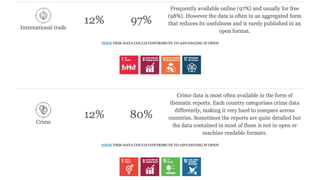
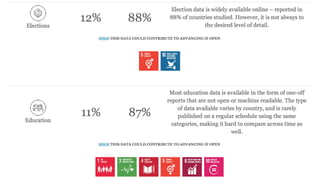
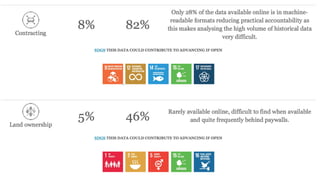
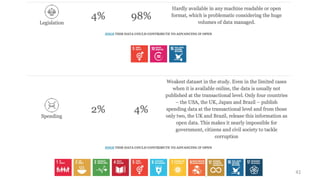
    •  Government budgetis most likely to be open •  18% of the countries •  Some critical data are unlikely to be found: •  company register (only in Australia) •  Government spending (only Brasil and UK) •  Legislation (only Brazil, France, Korea and UK) •  Land ownership (only Australia, Canada, Estonia, UK, Uruguay) CHIS: Open Data and Linked Open Data 32 Data availability
  • 33.
  • 34.
  • 35.
  • 36.
  • 37.
  • 38.
  • 39.
  • 40.
  • 41.
  • 42.
  • 43.
    •  Appropriately licensed • Free •  Properly formatted (machine-readable, bulk) •  xls(x), csv/tsv, xml, json and raw dbf/mdb db dump •  pdf, plain html, ods or plain txt and plain jpeg/png •  Up-to-date (irregular, inconsistent) •  Easy to find •  Sustainable (guarantee for the future to be regularly available) •  Linked CHIS: Open Data and Linked Open Data 43 Open government data quality
  • 44.
  • 45.
  • 46.
    •  Success inOpen Data Initiatives •  Open Data Barometer •  readiness, implementation, impact •  Sustainability •  Conclusions •  Reading list, credits and acknowledgements CHIS: Open Data and Linked Open Data 46 Outline of the talk
  • 47.
    •  Difficult tomeasure: evidence is limited •  Assessment of countries for: •  transparency & accountability, and improved government efficiency and effectiveness •  environmental impacts •  greater inclusion for marginalised groups •  contribution to economy •  support to startups, enterpreneurs and existing business •  Warning! Political impact is declining •  not enough resources/staff CHIS: Open Data and Linked Open Data 47 3. Impact
  • 48.
  • 49.
  • 50.
    •  The long-standingleaders (UK, USA) still remain top of the rankings •  A new generation is challenging their leadership •  France, Canada •  Korea, Japa, Singapore, Philippines •  Mexico, Uruguay •  Africa is the exception (no clear new challenger) •  Rwanda stable, Kenya and Ghana holding CHIS: Open Data and Linked Open Data 50 Rankings.. (at least!)
  • 51.
  • 52.
  • 53.
  • 54.
  • 55.
  • 56.
  • 57.
  • 58.
  • 59.
  • 60.
    •  Success inOpen Data Initiatives •  Open Data Barometer •  readiness, implementation, impact •  Sustainability •  Conclusions •  Reading list, credits and acknowledgements CHIS: Open Data and Linked Open Data 60 Outline of the talk
  • 61.
    •  Open datamust be •  relevant •  up-to-date •  accessible •  A sustainable open data programma •  continues to release data regularly •  (at least) with the same or improving quality and quantity •  A sustainable open dataset is supported by •  secure funding, active support, wide reuse CHIS: Open Data and Linked Open Data 61 Why sustainability matters
  • 62.
    •  “Freely used”does not mean there is no cost to collecting or releasing the data. •  Funding can be secured by: •  Charging for access or enhanced services •  Funding from another source who supports open data publication •  Demonstrating the ongoing value of open data to the organisation CHIS: Open Data and Linked Open Data 62 Secure funding
  • 63.
    •  Making opendata sustainable for an organisation usually requires •  the backing of its management, to make it a priority, •  the support of staff responsible for maintaining quality. •  Active support is most commonly achieved by a company committing to maintaining open data as part of its daily operations. CHIS: Open Data and Linked Open Data 63 Active support for open data
  • 64.
    •  When theservices created with that data become critical to the success of the publisher’s business. •  Example •  Datasets of the Berlin transport system are used by millions when they access transport apps (Citymapper) •  These apps drive usage of VBB services •  VBB commits to regularly update the data. CHIS: Open Data and Linked Open Data 64 Wide reuse of open data
  • 65.
    •  Not goodonly for the users.. but also for the publisher •  Effects: Enhancing the trust of the community in the publisher’s organisation. •  allows a large community to build and analyse data in order to draw their own conclusions, often in support of a publisher's view. •  Effect: Supporting the creation of new products and services •  build business connections that bring direct feedback to the publisher •  Simplifying the publishers reuse of their own data. CHIS: Open Data and Linked Open Data 65 Why? Solid foundations
  • 66.
    •  Improves datausability •  Often, the publisher is using the Open Data that it is publishing for internal purposes •  Why separate the public release of data from the internal data usage? •  Data of increasing quality enhances efficiency from the inside! CHIS: Open Data and Linked Open Data 66 Effect: publishers reuse of OD
  • 67.
    •  What isthe source? •  confidence in its commitment •  can a change in politics affect the priority of OD? •  Who is funding the release? •  is the organization subject to transparency pressures or is there a beneficial use, that drives the demand? •  What does the license say? •  some suggestions on the future of the dataset CHIS: Open Data and Linked Open Data 67 The questions to sustainability -1
  • 68.
    •  Who isalready using the data? •  wide pressure to keep it active and updated •  is it used internally? •  What is the publishing history? •  How long is the dataset been published? •  Is there a project term? •  How can I contribute? (to sustainability) •  by using it increases dataset’s demand •  join communities CHIS: Open Data and Linked Open Data 68 The questions to sustainability -2
  • 69.
    •  Success inOpen Data Initiatives •  Open Data Barometer •  readiness, implementation, impact •  Sustainability •  Conclusions •  Reading list, credits and acknowledgements CHIS: Open Data and Linked Open Data 69 Outline of the talk
  • 70.
    •  Success mustbe measured: KPI •  Different measure •  inside and outside the publisher •  Process must be sustainable •  stimulating its sustainability is part of the success •  Since the beginning of the project CHIS: Open Data and Linked Open Data 70 Conclusions
  • 71.
    •  Success inOpen Data Initiatives •  Open Data Barometer •  readiness, implementation, impact •  Sustainability •  Conclusions •  Reading list, credits and acknowledgements CHIS: Open Data and Linked Open Data 71 Outline of the talk
  • 72.
    •  European DataPortal: Measuring success for Open Data. http://www.europeandataportal.eu/elearning/en/ module6/#/id/co-01 •  Open Data Barometer: http://opendatabarometer.org •  European Data Portal: Why should we worry about sustainability? http://www.europeandataportal.eu/elearning/en/ module7/#/id/co-01 CHIS: Open Data and Linked Open Data 72 Reading list
  • 73.
    •  Part ofthe material comes with license CC-BY or CC- SA •  from the European Data Portal Library •  http://www.europeandataportal.eu/en/training-library •  from the Open Data Barometer Report CHIS: Open Data and Linked Open Data 73 Credits
  • 74.
    •  Part ofthe work was funded by the ROUTE-TO-PA H2020 project •  www.routetopa.eu for more info CHIS: Open Data and Linked Open Data 74 Acknowledgments The project has received funding from the European Union’s Horizon 2020 research and innova<on programme under grant agreement No 645860.
  • 75.
    •  Author: VittorioScarano, ROUTE-TO-PA project •  vitsca@dia.unisa.it •  License: This Work is licensed with Creative Commons Attribution-ShareAlike 4.0 International (CC BY-SA 4.0) •  https://creativecommons.org/ licenses/by-sa/4.0/ •  Available onSlideShare CHIS: Open Data and Linked Open Data 75 License