Scholar-led Publishing:
Scaling Small
Janneke Adema
Centre for Postdigital Cultures
Coventry University
OpenAIRE Beyond APCs Workshop
The Hague April 5th
What is
sustainability?
• Single model or entire system?
• Commercially viable?
• Short or long term?
• Self-sustaining?
• Sustainability for who?
• For the Sciences of for the
Humanities too?
• Sustainable ecology?
Hence when the OA discussion shifts to sustainable business
models, it invariably becomes a discussion about the publishing
business. The implication is that what needs sustaining are the
publishers themselves. (…) From the scholarly perspective, what
needs sustaining is not publishers, but rather a communication
system that supports its culture of inquiry. That is to say, what
needs to be sustained ultimately is the culture of free critical
inquiry certified by the rigors of open collaboration.
David Ottina, 2013
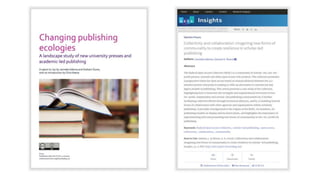
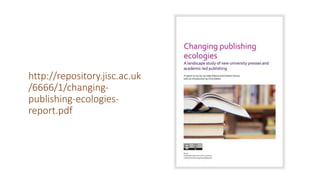
http://repository.jisc.ac.uk
/6666/1/changing-
publishing-ecologies-
report.pdf
Characteristics
of Academic-
Led Presses
• Community-based and led
• Open Access
• Commercialisation of Scholarship
• Not-for-Profit
• Experimental and Multimodal Scholarship
• Extension of Critical Work & Ethics of Care
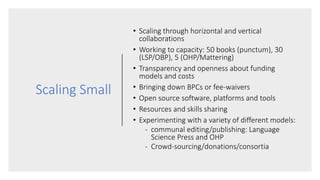
Scaling Small
• Scaling through horizontal and vertical
collaborations
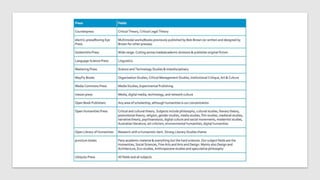
• Working to capacity: 50 books (punctum), 30
(LSP/OBP), 5 (OHP/Mattering)
• Transparency and openness about funding
models and costs
• Bringing down BPCs or fee-waivers
• Open source software, platforms and tools
• Resources and skills sharing
• Experimenting with a variety of different models:
- communal editing/publishing: Language
Science Press and OHP
- Crowd-sourcing/donations/consortia
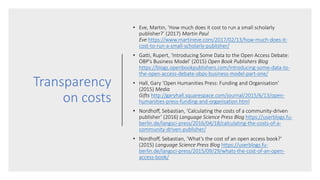
Transparency
on costs
• Eve, Martin, ‘How much does it cost to run a small scholarly
publisher?’ (2017) Martin Paul
Eve https://www.martineve.com/2017/02/13/how-much-does-it-
cost-to-run-a-small-scholarly-publisher/
• Gatti, Rupert, ‘Introducing Some Data to the Open Access Debate:
OBP’s Business Model’ (2015) Open Book Publishers Blog
https://blogs.openbookpublishers.com/introducing-some-data-to-
the-open-access-debate-obps-business-model-part-one/
• Hall, Gary ‘Open Humanities Press: Funding and Organisation’
(2015) Media
Gifts http://garyhall.squarespace.com/journal/2015/6/13/open-
humanities-press-funding-and-organisation.html
• Nordhoff, Sebastian, ‘Calculating the costs of a community-driven
publisher’ (2016) Language Science Press Blog https://userblogs.fu-
berlin.de/langsci-press/2016/04/18/calculating-the-costs-of-a-
community-driven-publisher/
• Nordhoff, Sebastian, ‘What’s the cost of an open access book?’
(2015) Language Science Press Blog https://userblogs.fu-
berlin.de/langsci-press/2015/09/29/whats-the-cost-of-an-open-
access-book/
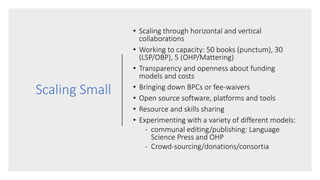
Scaling Small
• Scaling through horizontal and vertical
collaborations
• Working to capacity: 50 books (punctum), 30
(LSP/OBP), 5 (OHP/Mattering)
• Transparency and openness about funding
models and costs
• Bringing down BPCs or fee-waivers
• Open source software, platforms and tools
• Resource and skills sharing
• Experimenting with a variety of different models:
- communal editing/publishing: Language
Science Press and OHP
- Crowd-sourcing/donations/consortia
The outcome of a collaboration is rampant,
unforeseeable, and always unexpected.
Sometimes it may not turn out nicely, it may
even be harsh, but one thing is for sure: it
cannot be calculated, it has to be imagined
Florian Schneider

OpenAIRE workshop: Beyond APCs - Janneke Adema (Centre for Postdigital Cultures, Coventry University, UK)

  • 1.
    Scholar-led Publishing: Scaling Small JannekeAdema Centre for Postdigital Cultures Coventry University OpenAIRE Beyond APCs Workshop The Hague April 5th
  • 3.
    What is sustainability? • Singlemodel or entire system? • Commercially viable? • Short or long term? • Self-sustaining? • Sustainability for who? • For the Sciences of for the Humanities too? • Sustainable ecology?
  • 4.
    Hence when theOA discussion shifts to sustainable business models, it invariably becomes a discussion about the publishing business. The implication is that what needs sustaining are the publishers themselves. (…) From the scholarly perspective, what needs sustaining is not publishers, but rather a communication system that supports its culture of inquiry. That is to say, what needs to be sustained ultimately is the culture of free critical inquiry certified by the rigors of open collaboration. David Ottina, 2013
  • 5.
  • 7.
    Characteristics of Academic- Led Presses •Community-based and led • Open Access • Commercialisation of Scholarship • Not-for-Profit • Experimental and Multimodal Scholarship • Extension of Critical Work & Ethics of Care
  • 8.
    Scaling Small • Scalingthrough horizontal and vertical collaborations • Working to capacity: 50 books (punctum), 30 (LSP/OBP), 5 (OHP/Mattering) • Transparency and openness about funding models and costs • Bringing down BPCs or fee-waivers • Open source software, platforms and tools • Resources and skills sharing • Experimenting with a variety of different models: - communal editing/publishing: Language Science Press and OHP - Crowd-sourcing/donations/consortia
  • 9.
    Transparency on costs • Eve,Martin, ‘How much does it cost to run a small scholarly publisher?’ (2017) Martin Paul Eve https://www.martineve.com/2017/02/13/how-much-does-it- cost-to-run-a-small-scholarly-publisher/ • Gatti, Rupert, ‘Introducing Some Data to the Open Access Debate: OBP’s Business Model’ (2015) Open Book Publishers Blog https://blogs.openbookpublishers.com/introducing-some-data-to- the-open-access-debate-obps-business-model-part-one/ • Hall, Gary ‘Open Humanities Press: Funding and Organisation’ (2015) Media Gifts http://garyhall.squarespace.com/journal/2015/6/13/open- humanities-press-funding-and-organisation.html • Nordhoff, Sebastian, ‘Calculating the costs of a community-driven publisher’ (2016) Language Science Press Blog https://userblogs.fu- berlin.de/langsci-press/2016/04/18/calculating-the-costs-of-a- community-driven-publisher/ • Nordhoff, Sebastian, ‘What’s the cost of an open access book?’ (2015) Language Science Press Blog https://userblogs.fu- berlin.de/langsci-press/2015/09/29/whats-the-cost-of-an-open- access-book/
  • 10.
    Scaling Small • Scalingthrough horizontal and vertical collaborations • Working to capacity: 50 books (punctum), 30 (LSP/OBP), 5 (OHP/Mattering) • Transparency and openness about funding models and costs • Bringing down BPCs or fee-waivers • Open source software, platforms and tools • Resource and skills sharing • Experimenting with a variety of different models: - communal editing/publishing: Language Science Press and OHP - Crowd-sourcing/donations/consortia
  • 15.
    The outcome ofa collaboration is rampant, unforeseeable, and always unexpected. Sometimes it may not turn out nicely, it may even be harsh, but one thing is for sure: it cannot be calculated, it has to be imagined Florian Schneider