
Prof. Carolina Horta Andrade, Ph.D.
carolina@ufg.br
http://openzika.ufg.br
Alexander Perryman, Ph.D.
Alex.L.Perryman@njms.rutgers.edu
Sean Ekins, Ph.D.
collaborationspharma@gmail.com
How it started
• SE discussion with Antony
Williams and others
• Blogged about Zika in Jan
• Took hashtag #ZikaOpen in Jan
• ‘Asked’ for tropical disease
voucher for Zika
• Initially was not sure what could
be done – Jan 26th Email
discussion with Priscilla L. Yang
suggested glycoprotein E– Jan
27th
• Analysis of sequence
• Swiss Model
Communication
• Reached out on Twitter and blog
to enlist ideas and help
• Emailed program officers at NIH
NIAID
• Also proposed that open
repositories be created and
journals waive charges for papers
• Several scientists responded
• Connected to collaborators
• Started writing up a white paper
• Used GoogleDocs to collaborate
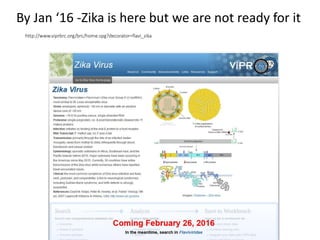
http://www.viprbrc.org/brc/home.spg?decorator=flavi_zika
By Jan ‘16 -Zika is here but we are not ready for it
• Common responses:
• Concern for effects of drug on pregnant women
• Zika virus is mild
• Will wait for a vaccine
• But:
• It is sexually transmitted
• There are severe neurological issues for some
• We are still waiting for vaccines for HIV, malaria, TB etc
Little visibility for antiviral efforts against Zika
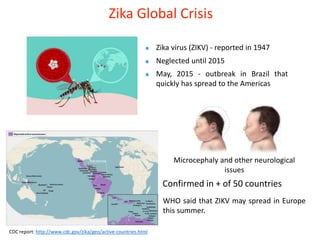
CDC report: http://www.cdc.gov/zika/geo/active-countries.html
Zika Global Crisis
Confirmed in + of 50 countries
WHO said that ZIKV may spread in Europe
this summer.
Microcephaly and other neurological
issues
Zika virus (ZIKV) - reported in 1947
Neglected until 2015
May, 2015 - outbreak in Brazil that
quickly has spread to the Americas
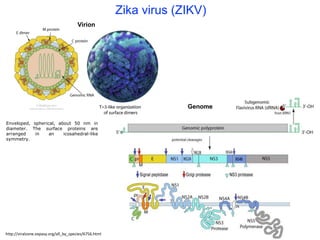
Zika virus (ZIKV)
http://viralzone.expasy.org/all_by_species/6756.html
Virion
Enveloped, spherical, about 50 nm in
diameter. The surface proteins are
arranged in an icosahedral-like
symmetry.
Genome
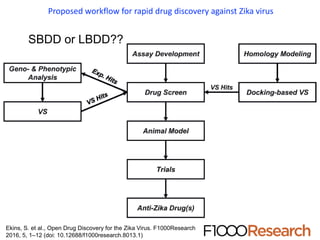
Proposed workflow for rapid drug discovery against Zika virus
Ekins, S. et al., Open Drug Discovery for the Zika Virus. F1000Research
2016, 5, 1–12 (doi: 10.12688/f1000research.8013.1)
SBDD or LBDD??
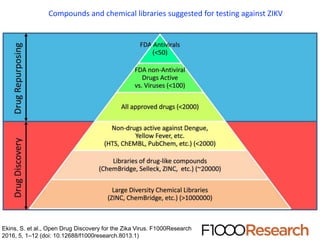
Compounds and chemical libraries suggested for testing against ZIKV
Ekins, S. et al., Open Drug Discovery for the Zika Virus. F1000Research
2016, 5, 1–12 (doi: 10.12688/f1000research.8013.1)
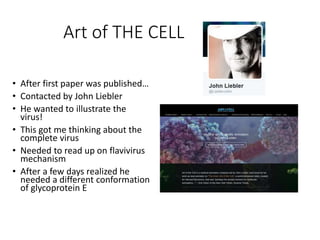
Art of THE CELL
• After first paper was published…
• Contacted by John Liebler
• He wanted to illustrate the
virus!
• This got me thinking about the
complete virus
• Needed to read up on flavivirus
mechanism
• After a few days realized he
needed a different conformation
of glycoprotein E
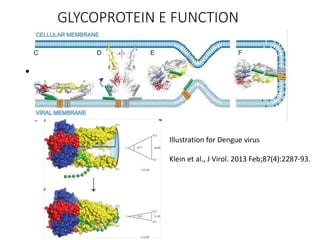
• Klein et al.,
Illustration for Dengue virus
Klein et al., J Virol. 2013 Feb;87(4):2287-93.
GLYCOPROTEIN E FUNCTION
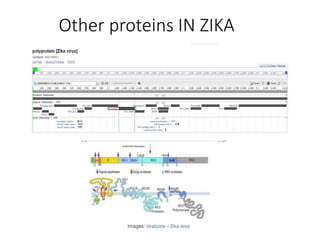
Other proteins IN ZIKA
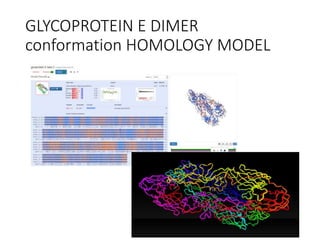
GLYCOPROTEIN E DIMER
conformation HOMOLOGY MODEL
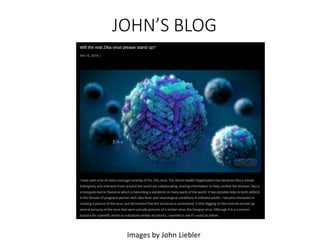
JOHN’S BLOG
Images by John Liebler
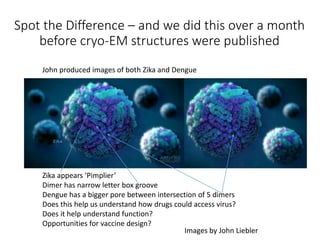
Spot the Difference – and we did this over a month
before cryo-EM structures were published
John produced images of both Zika and Dengue
Zika appears ‘Pimplier’
Dimer has narrow letter box groove
Dengue has a bigger pore between intersection of 5 dimers
Does this help us understand how drugs could access virus?
Does it help understand function?
Opportunities for vaccine design?
Images by John Liebler
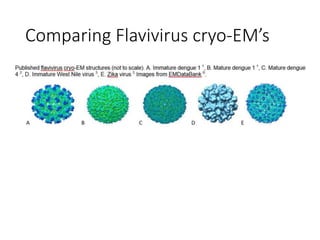
Comparing Flavivirus cryo-EM’s
Then why not model every protein
• Used Swissmodel
• Took a few hours over weekend.
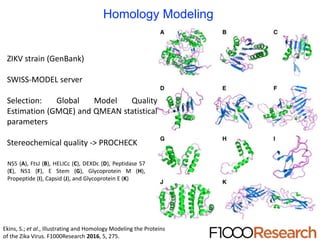
ZIKV strain (GenBank)
SWISS-MODEL server
Selection: Global Model Quality
Estimation (GMQE) and QMEAN statistical
parameters
Stereochemical quality -> PROCHECK
NS5 (A), FtsJ (B), HELICc (C), DEXDc (D), Peptidase S7
(E), NS1 (F), E Stem (G), Glycoprotein M (H),
Propeptide (I), Capsid (J), and Glycoprotein E (K)
Ekins, S.; et al., Illustrating and Homology Modeling the Proteins
of the Zika Virus. F1000Research 2016, 5, 275.
Homology Modeling
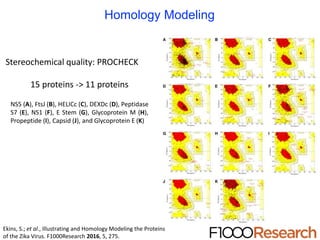
Stereochemical quality: PROCHECK
15 proteins -> 11 proteins
NS5 (A), FtsJ (B), HELICc (C), DEXDc (D), Peptidase
S7 (E), NS1 (F), E Stem (G), Glycoprotein M (H),
Propeptide (I), Capsid (J), and Glycoprotein E (K)
Homology Modeling
Ekins, S.; et al., Illustrating and Homology Modeling the Proteins
of the Zika Virus. F1000Research 2016, 5, 275.
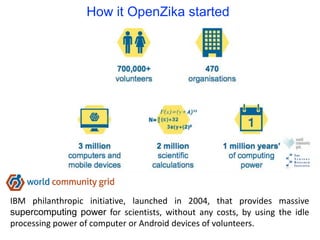
How it OpenZika started
Dr. Sean Ekins Dr. Alex Perryman
IBM philanthropic initiative, launched in 2004, that provides massive
supercomputing power for scientists, without any costs, by using the idle
processing power of computer or Android devices of volunteers.
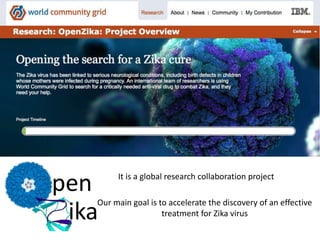
It is a global research collaboration project
Our main goal is to accelerate the discovery of an effective
treatment for Zika virus
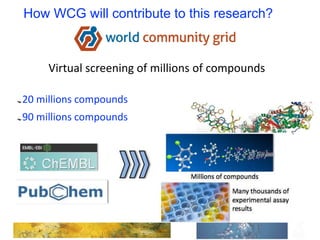
Virtual screening of millions of compounds
20 millions compounds
90 millions compounds
How WCG will contribute to this research?
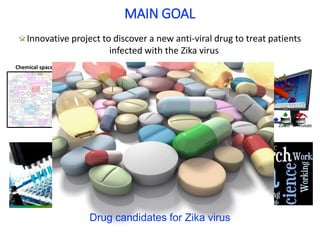
MAIN GOAL
Innovative project to discover a new anti-viral drug to treat patients
infected with the Zika virus
Genes or targets involved in a diseaseChemical space (library)
Drug candidates for Zika virus
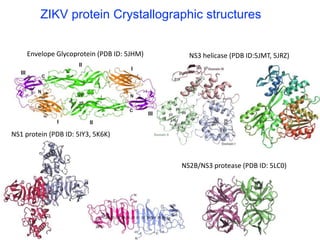
Envelope Glycoprotein (PDB ID: 5JHM)
NS1 protein (PDB ID: 5IY3, 5K6K)
NS3 helicase (PDB ID:5JMT, 5JRZ)
NS2B/NS3 protease (PDB ID: 5LC0)
ZIKV protein Crystallographic structures
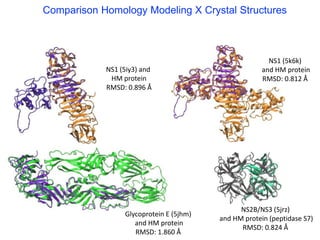
NS1 (5iy3) and
HM protein
RMSD: 0.896 Å
NS1 (5k6k)
and HM protein
RMSD: 0.812 Å
Glycoprotein E (5jhm)
and HM protein
RMSD: 1.860 Å
NS2B/NS3 (5jrz)
and HM protein (peptidase S7)
RMSD: 0.824 Å
Comparison Homology Modeling X Crystal Structures
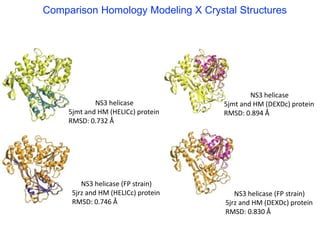
NS3 helicase
5jmt and HM (HELICc) protein
RMSD: 0.732 Å
NS3 helicase (FP strain)
5jrz and HM (HELICc) protein
RMSD: 0.746 Å
NS3 helicase
5jmt and HM (DEXDc) protein
RMSD: 0.894 Å
NS3 helicase (FP strain)
5jrz and HM (DEXDc) protein
RMSD: 0.830 Å
Comparison Homology Modeling X Crystal Structures
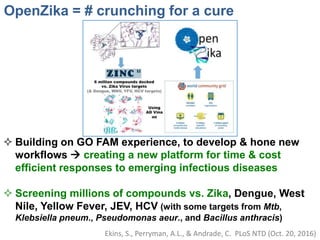
OpenZika = # crunching for a cure
 Building on GO FAM experience, to develop & hone new
workflows  creating a new platform for time & cost
efficient responses to emerging infectious diseases
 Screening millions of compounds vs. Zika, Dengue, West
Nile, Yellow Fever, JEV, HCV (with some targets from Mtb,
Klebsiella pneum., Pseudomonas aeur., and Bacillus anthracis)
Ekins, S., Perryman, A.L., & Andrade, C. PLoS NTD (Oct. 20, 2016)
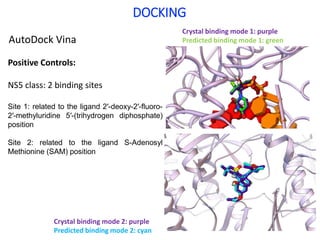
Positive Controls:
NS5 class: 2 binding sites
Site 1: related to the ligand 2′-deoxy-2′-fluoro-
2′-methyluridine 5′-(trihydrogen diphosphate)
position
Site 2: related to the ligand S-Adenosyl
Methionine (SAM) position
DOCKING
Crystal binding mode 2: purple
Predicted binding mode 2: cyan
Crystal binding mode 1: purple
Predicted binding mode 1: greenAutoDock Vina
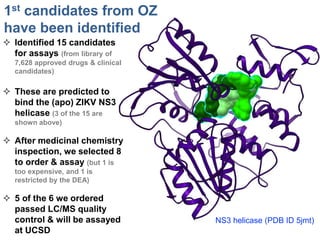
 Identified 15 candidates
for assays (from library of
7,628 approved drugs & clinical
candidates)
 These are predicted to
bind the (apo) ZIKV NS3
helicase (3 of the 15 are
shown above)
 After medicinal chemistry
inspection, we selected 8
to order & assay (but 1 is
too expensive, and 1 is
restricted by the DEA)
 5 of the 6 we ordered
passed LC/MS quality
control & will be assayed
at UCSD
1st candidates from OZ
have been identified
NS3 helicase (PDB ID 5jmt)
Timeline
Mid-May – Oct. 6, 2016:
 60,000 volunteers donated CPU time from ~ 240,000 devices
 >11,000 CPU years have been donated to OpenZika
 1.242 billion different docking jobs have been submitted
 207 binding sites on 138 different protein targets are involved
 2-5 different binding sites are targeted / protein
 6 million compounds are docked against each site
 11 million out of a new library of 38 million compounds have been prepared
for future docking experiments
 739 million docking results have been sent back to our server
 Currently visually inspecting the docking results against the
NS3 helicase:RNA complex  13 new candidates identified
press
• This work has not been funded
• Please contact any of us to contribute time, effort,
molecules
• ekinssean@yahoo.com
• Twitter: @collabchem
#ZikaOpen
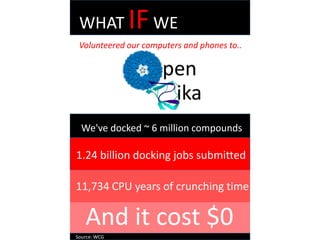
WHAT IFWE
Volunteered our computers and phones to..
1.24 billion docking jobs submitted
11,734 CPU years of crunching time
And it cost $0
Source: WCG
We've docked ~ 6 million compounds
OPENZIKA
https://www.worldcommunitygrid
.org/
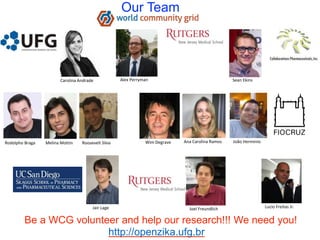
Our Team
Be a WCG volunteer and help our research!!! We need you!
http://openzika.ufg.br
Carolina Andrade Sean EkinsAlex Perryman
Rodolpho Braga Melina Mottin Roosevelt Silva Wim Degrave Ana Carolina Ramos João Herminio
Lucio Freitas Jr.Jair Lage Joel Freundlich
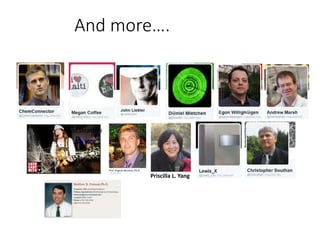
And more….
Tom Stratton
Priscilla L. Yang

Open zika presentation

  • 1.
    Prof. Carolina HortaAndrade, Ph.D. carolina@ufg.br http://openzika.ufg.br Alexander Perryman, Ph.D. Alex.L.Perryman@njms.rutgers.edu Sean Ekins, Ph.D. collaborationspharma@gmail.com
  • 2.
    How it started •SE discussion with Antony Williams and others • Blogged about Zika in Jan • Took hashtag #ZikaOpen in Jan • ‘Asked’ for tropical disease voucher for Zika • Initially was not sure what could be done – Jan 26th Email discussion with Priscilla L. Yang suggested glycoprotein E– Jan 27th • Analysis of sequence • Swiss Model
  • 3.
    Communication • Reached outon Twitter and blog to enlist ideas and help • Emailed program officers at NIH NIAID • Also proposed that open repositories be created and journals waive charges for papers • Several scientists responded • Connected to collaborators • Started writing up a white paper • Used GoogleDocs to collaborate
  • 4.
  • 5.
    • Common responses: •Concern for effects of drug on pregnant women • Zika virus is mild • Will wait for a vaccine • But: • It is sexually transmitted • There are severe neurological issues for some • We are still waiting for vaccines for HIV, malaria, TB etc Little visibility for antiviral efforts against Zika
  • 6.
    CDC report: http://www.cdc.gov/zika/geo/active-countries.html ZikaGlobal Crisis Confirmed in + of 50 countries WHO said that ZIKV may spread in Europe this summer. Microcephaly and other neurological issues Zika virus (ZIKV) - reported in 1947 Neglected until 2015 May, 2015 - outbreak in Brazil that quickly has spread to the Americas
  • 7.
    Zika virus (ZIKV) http://viralzone.expasy.org/all_by_species/6756.html Virion Enveloped,spherical, about 50 nm in diameter. The surface proteins are arranged in an icosahedral-like symmetry. Genome
  • 8.
    Proposed workflow forrapid drug discovery against Zika virus Ekins, S. et al., Open Drug Discovery for the Zika Virus. F1000Research 2016, 5, 1–12 (doi: 10.12688/f1000research.8013.1) SBDD or LBDD??
  • 9.
    Compounds and chemicallibraries suggested for testing against ZIKV Ekins, S. et al., Open Drug Discovery for the Zika Virus. F1000Research 2016, 5, 1–12 (doi: 10.12688/f1000research.8013.1)
  • 10.
    Art of THECELL • After first paper was published… • Contacted by John Liebler • He wanted to illustrate the virus! • This got me thinking about the complete virus • Needed to read up on flavivirus mechanism • After a few days realized he needed a different conformation of glycoprotein E
  • 11.
    • Klein etal., Illustration for Dengue virus Klein et al., J Virol. 2013 Feb;87(4):2287-93. GLYCOPROTEIN E FUNCTION
  • 12.
  • 13.
  • 14.
  • 15.
    Spot the Difference– and we did this over a month before cryo-EM structures were published John produced images of both Zika and Dengue Zika appears ‘Pimplier’ Dimer has narrow letter box groove Dengue has a bigger pore between intersection of 5 dimers Does this help us understand how drugs could access virus? Does it help understand function? Opportunities for vaccine design? Images by John Liebler
  • 16.
  • 17.
    Then why notmodel every protein • Used Swissmodel • Took a few hours over weekend.
  • 18.
    ZIKV strain (GenBank) SWISS-MODELserver Selection: Global Model Quality Estimation (GMQE) and QMEAN statistical parameters Stereochemical quality -> PROCHECK NS5 (A), FtsJ (B), HELICc (C), DEXDc (D), Peptidase S7 (E), NS1 (F), E Stem (G), Glycoprotein M (H), Propeptide (I), Capsid (J), and Glycoprotein E (K) Ekins, S.; et al., Illustrating and Homology Modeling the Proteins of the Zika Virus. F1000Research 2016, 5, 275. Homology Modeling
  • 19.
    Stereochemical quality: PROCHECK 15proteins -> 11 proteins NS5 (A), FtsJ (B), HELICc (C), DEXDc (D), Peptidase S7 (E), NS1 (F), E Stem (G), Glycoprotein M (H), Propeptide (I), Capsid (J), and Glycoprotein E (K) Homology Modeling Ekins, S.; et al., Illustrating and Homology Modeling the Proteins of the Zika Virus. F1000Research 2016, 5, 275.
  • 20.
    How it OpenZikastarted Dr. Sean Ekins Dr. Alex Perryman IBM philanthropic initiative, launched in 2004, that provides massive supercomputing power for scientists, without any costs, by using the idle processing power of computer or Android devices of volunteers.
  • 21.
    It is aglobal research collaboration project Our main goal is to accelerate the discovery of an effective treatment for Zika virus
  • 22.
    Virtual screening ofmillions of compounds 20 millions compounds 90 millions compounds How WCG will contribute to this research?
  • 23.
    MAIN GOAL Innovative projectto discover a new anti-viral drug to treat patients infected with the Zika virus Genes or targets involved in a diseaseChemical space (library) Drug candidates for Zika virus
  • 24.
    Envelope Glycoprotein (PDBID: 5JHM) NS1 protein (PDB ID: 5IY3, 5K6K) NS3 helicase (PDB ID:5JMT, 5JRZ) NS2B/NS3 protease (PDB ID: 5LC0) ZIKV protein Crystallographic structures
  • 25.
    NS1 (5iy3) and HMprotein RMSD: 0.896 Å NS1 (5k6k) and HM protein RMSD: 0.812 Å Glycoprotein E (5jhm) and HM protein RMSD: 1.860 Å NS2B/NS3 (5jrz) and HM protein (peptidase S7) RMSD: 0.824 Å Comparison Homology Modeling X Crystal Structures
  • 26.
    NS3 helicase 5jmt andHM (HELICc) protein RMSD: 0.732 Å NS3 helicase (FP strain) 5jrz and HM (HELICc) protein RMSD: 0.746 Å NS3 helicase 5jmt and HM (DEXDc) protein RMSD: 0.894 Å NS3 helicase (FP strain) 5jrz and HM (DEXDc) protein RMSD: 0.830 Å Comparison Homology Modeling X Crystal Structures
  • 27.
    OpenZika = #crunching for a cure  Building on GO FAM experience, to develop & hone new workflows  creating a new platform for time & cost efficient responses to emerging infectious diseases  Screening millions of compounds vs. Zika, Dengue, West Nile, Yellow Fever, JEV, HCV (with some targets from Mtb, Klebsiella pneum., Pseudomonas aeur., and Bacillus anthracis) Ekins, S., Perryman, A.L., & Andrade, C. PLoS NTD (Oct. 20, 2016)
  • 28.
    Positive Controls: NS5 class:2 binding sites Site 1: related to the ligand 2′-deoxy-2′-fluoro- 2′-methyluridine 5′-(trihydrogen diphosphate) position Site 2: related to the ligand S-Adenosyl Methionine (SAM) position DOCKING Crystal binding mode 2: purple Predicted binding mode 2: cyan Crystal binding mode 1: purple Predicted binding mode 1: greenAutoDock Vina
  • 29.
     Identified 15candidates for assays (from library of 7,628 approved drugs & clinical candidates)  These are predicted to bind the (apo) ZIKV NS3 helicase (3 of the 15 are shown above)  After medicinal chemistry inspection, we selected 8 to order & assay (but 1 is too expensive, and 1 is restricted by the DEA)  5 of the 6 we ordered passed LC/MS quality control & will be assayed at UCSD 1st candidates from OZ have been identified NS3 helicase (PDB ID 5jmt)
  • 30.
    Timeline Mid-May – Oct.6, 2016:  60,000 volunteers donated CPU time from ~ 240,000 devices  >11,000 CPU years have been donated to OpenZika  1.242 billion different docking jobs have been submitted  207 binding sites on 138 different protein targets are involved  2-5 different binding sites are targeted / protein  6 million compounds are docked against each site  11 million out of a new library of 38 million compounds have been prepared for future docking experiments  739 million docking results have been sent back to our server  Currently visually inspecting the docking results against the NS3 helicase:RNA complex  13 new candidates identified
  • 31.
  • 32.
    • This workhas not been funded • Please contact any of us to contribute time, effort, molecules • ekinssean@yahoo.com • Twitter: @collabchem #ZikaOpen
  • 33.
    WHAT IFWE Volunteered ourcomputers and phones to.. 1.24 billion docking jobs submitted 11,734 CPU years of crunching time And it cost $0 Source: WCG We've docked ~ 6 million compounds
  • 34.
  • 35.
    Our Team Be aWCG volunteer and help our research!!! We need you! http://openzika.ufg.br Carolina Andrade Sean EkinsAlex Perryman Rodolpho Braga Melina Mottin Roosevelt Silva Wim Degrave Ana Carolina Ramos João Herminio Lucio Freitas Jr.Jair Lage Joel Freundlich
  • 36.

Editor's Notes

  • #7 Contextualizar a crise mundial
  • #19 As proteínas DEXDc e HELICc são partes da proteína NS3 helicase (bom alinhamento) A peptidase S7 é parte da proteína NS2B/NS3 (bom alinhamento)
  • #21 como a IBM entrou na história e como a parceria vai contribuir
  • #24 qual é o retorno que a pesquisa pode dar para a população
  • #28 Average = 76 CPU years / day for OZ calculations ~ 240,000 devices from ~ 60,000 members are giving CPU time to OpenZika (~ 15% are Android devices) **at least a dozen classes of ZIKV targets will be part of OpenZika (homology models and the crystal structures when they become available) **currently preparing a new library of ~ 38 million compounds, to dock against the ZIKV and other targets as part of a 2nd phase experiment 1 = 1st site of NS5 we now have all but 312,000 results; 125.7 million out of ~ 126 million = 99.75% of the results are now on Carolin'a server experiment 2 = 2nd site of NS5 (and the Refined model of ZIKV NS5 site 1) ~ 42 million of the 48 million results are now on Carolina's server = ~ 87% of the results are in hand experiment 3 = 1st site of NS3 helicase class ~ 86 million results out of 330 million are now on Carolina's server = 26% of the results are in hand approximate total # of results we now have in hand = 254 million different docking results (in ~ 2 months) (it takes a while for the IBM team to get all 10,000 results / batch, organize and package them, and send them to the server) These results from the first 3 experiments involve 84 different target sites (74 unique targets, mostly from Dengue Virus, HCV, Yellow Fever Virus, Japanese Encephalitis Virus, and, of course Zika Virus).
  • #29 Positive control: target and homologous proteins
  • #31 2nd set of docking results we are inspecting = library of ~7,600 approved drugs (U.S. and E.U.) & NIH_clinical_collection docked versus the new RNA-bound structure of ZIKV NS3 helicase interaction-based and energetic filters narrowed those 7,600 down to 232 compounds; we are half-way done inspecting those 232 docked compounds; 13 new candidates have been identified thus far for this 2nd set of candidates Targets = NS5_RNAPolymerase domain; NS5_Methyltransferase domain NS3_Helicase_Nucleic Acid Site; NS3_Helicase_ATP binding site NS1 = 5 different sites (it’s a massive domain; the ribbon diagram of it was used to make the Z in the OZ logo) *under preparation = NS2B / NS3 protease ~ 15% of the devices donated to OZ are Android-based smart phones or tablets Average of 76 CPU years / day are donated to OpenZika calculations Human LTBI is characterized by tuberculin test positivity without clinical or radiographic findings [3]. LTBI apparently comprises a paucibacillary population of dormant organisms with reduced replication and metabolism [4] within host granulomas [5]. MDR-TBis resistant to at least isoniazid andrifampicin, the twomost important first-line drugs used in the treatment of TB. Thismay result from either primary infection with drug-resistant bacteria or may develop in the course of a patient’s treatment when non-optimal treatment durations or regimens are used. Cure rates for MDR-TB are lower, typically ranging from 50% to 70%. XDR-TB is resistant to isoniazid and rifampicin as well as any fluoroquinolone and any of the second-line anti-TB injectable drugs (amikacin, kanamycinor capreomycin). It has veryhighmortality rates.