





Mark T. Voelker, Technical Leader @ Cisco 
OpenStack ATC/StackForge Puppet Core/Foundation Member #54 
All Things Open 2014 
© 2010 Cisco and/or its affiliates. All rights reserved. Cisco Confidential 1
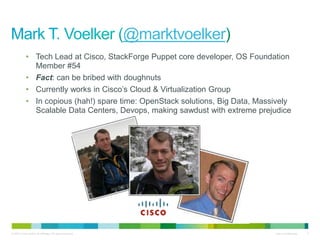
@marktvoelker 
• Tech Lead at Cisco, StackForge Puppet core developer, OS Foundation 
Member #54 
• Fact: can be bribed with doughnuts 
• Currently works in Cisco’s Cloud & Virtualization Group 
• In copious (hah!) spare time: OpenStack solutions, Big Data, Massively 
Scalable Data Centers, Devops, making sawdust with extreme prejudice 
© 2010 Cisco and/or its affiliates. All rights reserved. Cisco Confidential 2
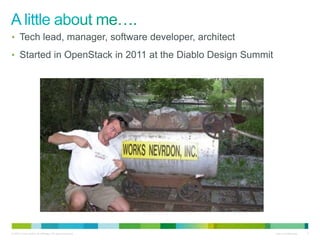
• Tech lead, manager, software developer, architect 
• Started in OpenStack in 2011 at the Diablo Design Summit 
© 2010 Cisco and/or its affiliates. All rights reserved. Cisco Confidential 3
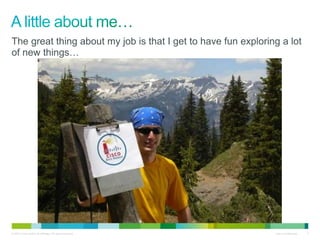
The great thing about my job is that I get to have fun exploring a lot 
of new things… 
© 2010 Cisco and/or its affiliates. All rights reserved. Cisco Confidential 4
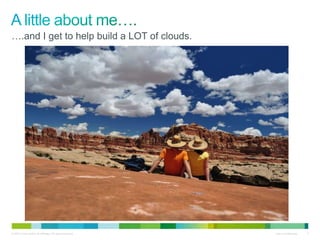
….and I get to help build a LOT of clouds. 
© 2010 Cisco and/or its affiliates. All rights reserved. Cisco Confidential 5
Today’s talk won’t be overly formal…. 
© 2010 Cisco and/or its affiliates. All rights reserved. Cisco Confidential 6
…because I tend to get excited by this stuff. 
© 2010 Cisco and/or its affiliates. All rights reserved. Cisco Confidential 7
© 2010 Cisco and/or its affiliates. All rights reserved. Cisco Confidential 8
© 2010 Cisco and/or its affiliates. All rights reserved. Cisco Confidential 9
……then you know how to get to Day 1. 
Now let’s talk about getting to Day 30… 
© 2010 Cisco and/or its affiliates. All rights reserved. Cisco Confidential 10
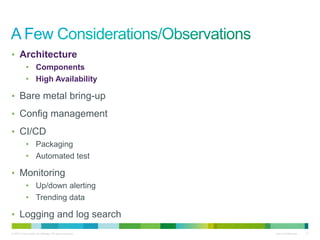
• Architecture 
• Components 
• High Availability 
• Bare metal bring-up 
• Config management 
• CI/CD 
• Packaging 
• Automated test 
• Monitoring 
• Up/down alerting 
• Trending data 
• Logging and log search 
© 2010 Cisco and/or its affiliates. All rights reserved. Cisco Confidential 11
High 
Availability? 
Sounds 
great--I’ll 
take two! 
© 2010 Cisco and/or its affiliates. All rights reserved. Cisco Confidential 12
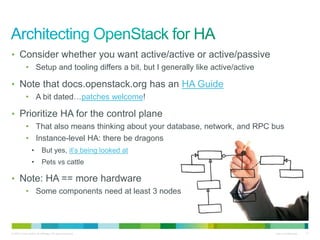
• Consider whether you want active/active or active/passive 
• Setup and tooling differs a bit, but I generally like active/active 
• Note that docs.openstack.org has an HA Guide 
• A bit dated…patches welcome! 
• Prioritize HA for the control plane 
• That also means thinking about your database, network, and RPC bus 
• Instance-level HA: there be dragons 
• But yes, it’s being looked at 
• Pets vs cattle 
• Note: HA == more hardware 
• Some components need at least 3 nodes 
© 2010 Cisco and/or its affiliates. All rights reserved. Cisco Confidential 13
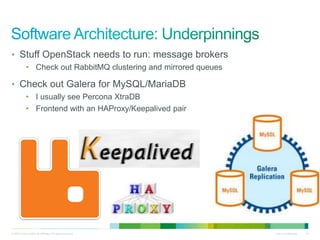
• Stuff OpenStack needs to run: message brokers 
• Check out RabbitMQ clustering and mirrored queues 
• Check out Galera for MySQL/MariaDB 
• I usually see Percona XtraDB 
• Frontend with an HAProxy/Keepalived pair 
© 2010 Cisco and/or its affiliates. All rights reserved. Cisco Confidential 14
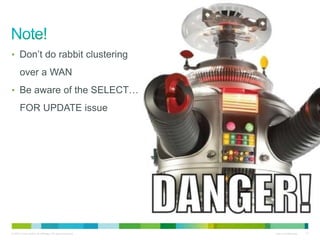
• Don’t do rabbit clustering 
over a WAN 
• Be aware of the SELECT… 
FOR UPDATE issue 
© 2010 Cisco and/or its affiliates. All rights reserved. Cisco Confidential 15
• Long story short: Neutron and some parts of Nova invoke an SQL 
pattern known as “SELECT…FOR UPDATE” which Galera 
doesn’t support due to issues with cross-node locking. 
• Can cause deadlocks symptoms. 
• Neutron/nova code being refactored to remove, but will likely not 
be done until at least Kilo. 
• Meanwhile: use HAProxy to send writes to a single Galera node 
and you should be fine 
• With the obvious scalability bottleneck 
• More info here. 
• Thank Jay Pipes & Peter Boros for 
the find! 
© 2010 Cisco and/or its affiliates. All rights reserved. Cisco Confidential 16
• Use Swift, Ceph, or other highly available storage to back Glance 
• Pick a highly available storage backend for Cinder too 
• Use Keepalived/HAProxy to front-end multiple API servers 
• Or another load balancer technology of your choice 
• Can be deployed as dedicated nodes for scale, or cohabitate 
• Network: DVR vs Provider Network Extensions 
• Distributed Virtual Routers are a new experimental feature in Juno (not yet 
ready for production) 
• Please go test it and report/fix bugs! 
• Provider networks essentially punt the availability issue to your physical 
network 
• Allows you to use standard tools like virtual port channels and VRRP 
• Also highly performant 
© 2010 Cisco and/or its affiliates. All rights reserved. Cisco Confidential 17
• Architecture 
• Components 
• High Availability 
• Bare metal bring-up 
• Config management 
• CI/CD 
• Packaging 
• Automated test 
• Monitoring 
• Up/down alerting 
• Trending data 
• Logging and log search 
© 2010 Cisco and/or its affiliates. All rights reserved. Cisco Confidential 18
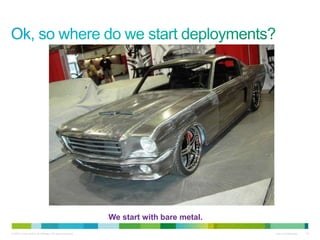
We start with bare metal. 
© 2010 Cisco and/or its affiliates. All rights reserved. Cisco Confidential 19
• For a cloud of any real size, you don’t want to be installing 
operating systems by hand 
• Remember that baremetal bringup actually isn’t something that 
just happens once…often recurs for upgrades, capacity 
expansion, etc. 
• Baremetal bringup tools can also have other uses, like inventory 
or bootstrapping configuration management agents. 
© 2010 Cisco and/or its affiliates. All rights reserved. Cisco Confidential 20
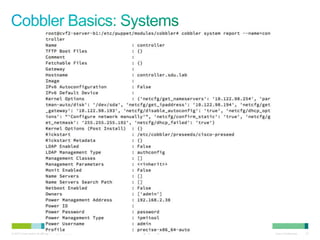
• A simple (~15k lines of Python code) tool for managing baremetal 
deployments 
• Flexible usage (API, CLI, GUI) 
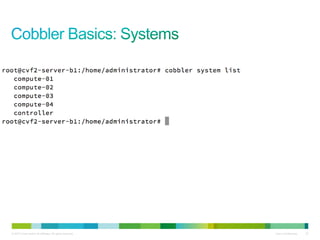
• Allows you to define systems (actual machines) and profiles (what 
you want to do with them) 
• Provides hooks for Puppet so you can then do further automation 
once the OS is up and running 
• Provides control for power (via IPMI or other means), DHCP/PXE 
(for netbooting machines), and more. 
© 2010 Cisco and/or its affiliates. All rights reserved. Cisco Confidential 21
© 2010 Cisco and/or its affiliates. All rights reserved. Cisco Confidential 22
© 2010 Cisco and/or its affiliates. All rights reserved. Cisco Confidential 23
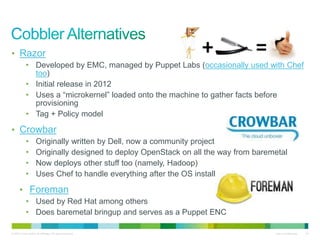
• Razor 
• Developed by EMC, managed by Puppet Labs (occasionally used with Chef 
too) 
• Initial release in 2012 
• Uses a “microkernel” loaded onto the machine to gather facts before 
provisioning 
• Tag + Policy model 
• Crowbar 
• Originally written by Dell, now a community project 
• Originally designed to deploy OpenStack on all the way from baremetal 
• Now deploys other stuff too (namely, Hadoop) 
• Uses Chef to handle everything after the OS install 
• Foreman 
• Used by Red Hat among others 
• Does baremetal bringup and serves as a Puppet ENC 
© 2010 Cisco and/or its affiliates. All rights reserved. Cisco Confidential 24
• Architecture 
• Components 
• High Availability 
• Bare metal bring-up 
• Config management 
• CI/CD 
• Packaging 
• Automated test 
• Monitoring 
• Up/down alerting 
• Trending data 
• Logging and log search 
© 2010 Cisco and/or its affiliates. All rights reserved. Cisco Confidential 25
© 2010 Cisco and/or its affiliates. All rights reserved. Cisco Confidential 26
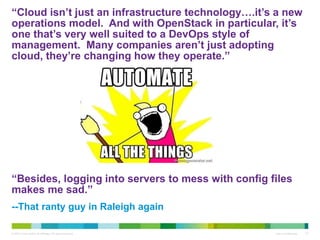
“Cloud isn’t just an infrastructure technology….it’s a new 
operations model. And with OpenStack in particular, it’s 
one that’s very well suited to a DevOps style of 
management. Many companies aren’t just adopting 
cloud, they’re changing how they operate.” 
“Besides, logging into servers to mess with config files 
makes me sad.” 
--That ranty guy in Raleigh again 
© 2010 Cisco and/or its affiliates. All rights reserved. Cisco Confidential 27
• Remember, OpenStack is a set of interoperating distributed 
systems 
• That means you’re going to have a lot of software to configure on 
a lot of machines 
• You’re probably going to want to make changes over time 
• You’re probably going to have more than one person touching 
your cloud 
• CM tools help you treat configuration as code, so you can 
collaborate more easily 
© 2010 Cisco and/or its affiliates. All rights reserved. Cisco Confidential 28
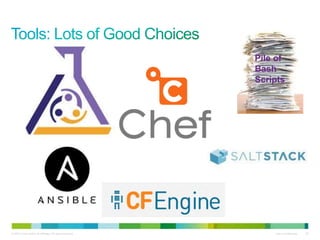
Pile of 
Bash 
Scripts 
© 2010 Cisco and/or its affiliates. All rights reserved. Cisco Confidential 29
© 2010 Cisco and/or its affiliates. All rights reserved. Cisco Confidential 30
• An increasingly common pattern: 
• Puppet or Chef for configuration management, PLUS 
• Ansible or Salt for cross-node orchestration 
• Recommendation: use the tools that work for you! 
• But remember: you don’t have to do it alone. 
• Several CM tools have thriving collaborators in the OpenStack community 
• Links for later: 
• Puppet for OpenStack 
• Chef for OpenStack 
• Ansible for OpenStack 
• SaltStack for OpenStack 
• Pile of bash scripts for OpenStack 
© 2010 Cisco and/or its affiliates. All rights reserved. Cisco Confidential 31
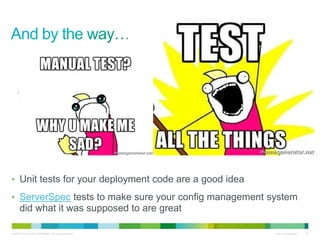
• Unit tests for your deployment code are a good idea 
• ServerSpec tests to make sure your config management system 
did what it was supposed to are great 
© 2010 Cisco and/or its affiliates. All rights reserved. Cisco Confidential 32
• Architecture 
• Components 
• High Availability 
• Bare metal bring-up 
• Config management 
• CI/CD 
• Packaging 
• Automated test 
• Monitoring 
• Up/down alerting 
• Trending data 
• Logging and log search 
© 2010 Cisco and/or its affiliates. All rights reserved. Cisco Confidential 33
…well, haven’t you always wanted a butler? 
© 2010 Cisco and/or its affiliates. All rights reserved. Cisco Confidential 34
• DevOps: actually pretty handy 
• OpenStack change velocity (community’s and yours) 
• Anecdote: the majority of deployments I work with have some 
customizations or backports from future releases 
• It’s not just OpenStack, it’s all the underpinning components and 
your CM code too! 
© 2010 Cisco and/or its affiliates. All rights reserved. Cisco Confidential 35
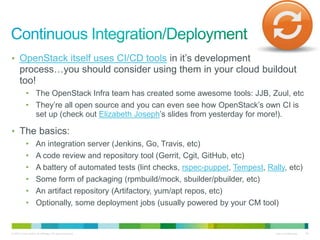
• OpenStack itself uses CI/CD tools in it’s development 
process…you should consider using them in your cloud buildout 
too! 
• The OpenStack Infra team has created some awesome tools: JJB, Zuul, etc 
• They’re all open source and you can even see how OpenStack’s own CI is 
set up (check out Elizabeth Joseph’s slides from yesterday for more!). 
• The basics: 
• An integration server (Jenkins, Go, Travis, etc) 
• A code review and repository tool (Gerrit, Cgit, GitHub, etc) 
• A battery of automated tests (lint checks, rspec-puppet, Tempest, Rally, etc) 
• Some form of packaging (rpmbuild/mock, sbuilder/pbuilder, etc) 
• An artifact repository (Artifactory, yum/apt repos, etc) 
• Optionally, some deployment jobs (usually powered by your CM tool) 
© 2010 Cisco and/or its affiliates. All rights reserved. Cisco Confidential 36
• …you never intend to change the code yourself 
• …building your own packages would violate a support contract 
with your distribution 
• …you’ve never used a CI/CD pipeline before (but really: you 
should start learning) 
• …you have a static environment that absolutely will not change, 
need to add capacity, etc. 
© 2010 Cisco and/or its affiliates. All rights reserved. Cisco Confidential 37
• Architecture 
• Components 
• High Availability 
• Bare metal bring-up 
• Config management 
• CI/CD 
• Packaging 
• Automated test 
• Monitoring 
• Up/down alerting 
• Trending data 
• Logging and log search 
© 2010 Cisco and/or its affiliates. All rights reserved. Cisco Confidential 38
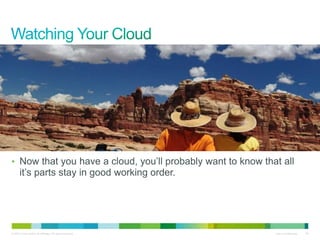
• Now that you have a cloud, you’ll probably want to know that all 
it’s parts stay in good working order. 
© 2010 Cisco and/or its affiliates. All rights reserved. Cisco Confidential 39
© 2010 Cisco and/or its affiliates. All rights reserved. Cisco Confidential 40
© 2010 Cisco and/or its affiliates. All rights reserved. Cisco Confidential 41
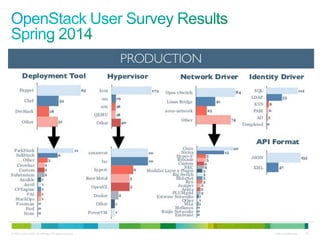
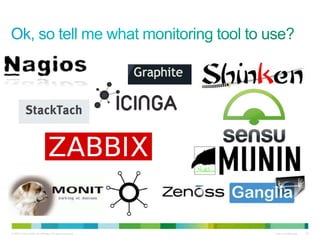
• I’ve worked on a lot of OpenStack clouds and almost everyone 
has their own preferred monitoring toolset. 
• One possible exception: almost everybody seems to love Graphite. 
• The golden rule is: use the tools that work for you! 
• Very often this will be whatever you’re using in the rest of your 
infrastructure. 
• Break it down into at least two buckets: 
• Up/down and alerting (ex: Nagios or it’s derivatives…yes, there are 
OpenStack plugins out there on NagiosExchange) 
• Trending data collection/plotting (ex: collectd/statsd feeding graphite) 
• Also: use your peers! 
• Check out Tong Li’s Monitoring as a Service talk later today! 
• Operators often willing to share, so ask on the openstack-operators list. 
© 2010 Cisco and/or its affiliates. All rights reserved. Cisco Confidential 42
• Architecture 
• Components 
• High Availability 
• Bare metal bring-up 
• Config management 
• CI/CD 
• Packaging 
• Automated test 
• Monitoring 
• Up/down alerting 
• Trending data 
• Logging and log search 
© 2010 Cisco and/or its affiliates. All rights reserved. Cisco Confidential 43
© 2010 Cisco and/or its affiliates. All rights reserved. Cisco Confidential 44
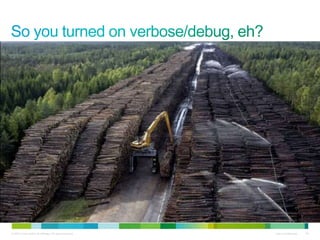
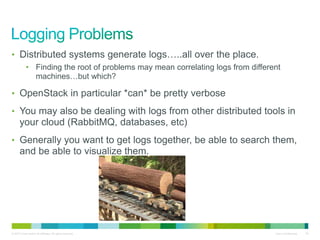
• Distributed systems generate logs…..all over the place. 
• Finding the root of problems may mean correlating logs from different 
machines…but which? 
• OpenStack in particular *can* be pretty verbose 
• You may also be dealing with logs from other distributed tools in 
your cloud (RabbitMQ, databases, etc) 
• Generally you want to get logs together, be able to search them, 
and be able to visualize them. 
© 2010 Cisco and/or its affiliates. All rights reserved. Cisco Confidential 45
Unlike monitoring tools, there seems to be pretty broad consensus 
on good tools here in deployments I’ve worked with…. 
© 2010 Cisco and/or its affiliates. All rights reserved. Cisco Confidential 46
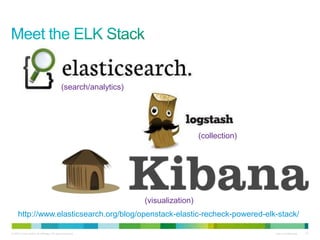
(visualization) 
(collection) 
(search/analytics) 
http://www.elasticsearch.org/blog/openstack-elastic-recheck-powered-elk-stack/ 
© 2010 Cisco and/or its affiliates. All rights reserved. Cisco Confidential 47
Questions? 
@marktvoelker 
http://openstack.org/ 
http://cisco.com/go/openstack/ 
(yes, we’re hiring!) 
© 2010 Cisco and/or its affiliates. All rights reserved. Cisco Confidential 48
Considerations for Operating An OpenStack Cloud

Considerations for Operating An OpenStack Cloud

  • 1.
    Mark T. Voelker,Technical Leader @ Cisco OpenStack ATC/StackForge Puppet Core/Foundation Member #54 All Things Open 2014 © 2010 Cisco and/or its affiliates. All rights reserved. Cisco Confidential 1
  • 2.
    @marktvoelker • TechLead at Cisco, StackForge Puppet core developer, OS Foundation Member #54 • Fact: can be bribed with doughnuts • Currently works in Cisco’s Cloud & Virtualization Group • In copious (hah!) spare time: OpenStack solutions, Big Data, Massively Scalable Data Centers, Devops, making sawdust with extreme prejudice © 2010 Cisco and/or its affiliates. All rights reserved. Cisco Confidential 2
  • 3.
    • Tech lead,manager, software developer, architect • Started in OpenStack in 2011 at the Diablo Design Summit © 2010 Cisco and/or its affiliates. All rights reserved. Cisco Confidential 3
  • 4.
    The great thingabout my job is that I get to have fun exploring a lot of new things… © 2010 Cisco and/or its affiliates. All rights reserved. Cisco Confidential 4
  • 5.
    ….and I getto help build a LOT of clouds. © 2010 Cisco and/or its affiliates. All rights reserved. Cisco Confidential 5
  • 6.
    Today’s talk won’tbe overly formal…. © 2010 Cisco and/or its affiliates. All rights reserved. Cisco Confidential 6
  • 7.
    …because I tendto get excited by this stuff. © 2010 Cisco and/or its affiliates. All rights reserved. Cisco Confidential 7
  • 8.
    © 2010 Ciscoand/or its affiliates. All rights reserved. Cisco Confidential 8
  • 9.
    © 2010 Ciscoand/or its affiliates. All rights reserved. Cisco Confidential 9
  • 10.
    ……then you knowhow to get to Day 1. Now let’s talk about getting to Day 30… © 2010 Cisco and/or its affiliates. All rights reserved. Cisco Confidential 10
  • 11.
    • Architecture •Components • High Availability • Bare metal bring-up • Config management • CI/CD • Packaging • Automated test • Monitoring • Up/down alerting • Trending data • Logging and log search © 2010 Cisco and/or its affiliates. All rights reserved. Cisco Confidential 11
  • 12.
    High Availability? Sounds great--I’ll take two! © 2010 Cisco and/or its affiliates. All rights reserved. Cisco Confidential 12
  • 13.
    • Consider whetheryou want active/active or active/passive • Setup and tooling differs a bit, but I generally like active/active • Note that docs.openstack.org has an HA Guide • A bit dated…patches welcome! • Prioritize HA for the control plane • That also means thinking about your database, network, and RPC bus • Instance-level HA: there be dragons • But yes, it’s being looked at • Pets vs cattle • Note: HA == more hardware • Some components need at least 3 nodes © 2010 Cisco and/or its affiliates. All rights reserved. Cisco Confidential 13
  • 14.
    • Stuff OpenStackneeds to run: message brokers • Check out RabbitMQ clustering and mirrored queues • Check out Galera for MySQL/MariaDB • I usually see Percona XtraDB • Frontend with an HAProxy/Keepalived pair © 2010 Cisco and/or its affiliates. All rights reserved. Cisco Confidential 14
  • 15.
    • Don’t dorabbit clustering over a WAN • Be aware of the SELECT… FOR UPDATE issue © 2010 Cisco and/or its affiliates. All rights reserved. Cisco Confidential 15
  • 16.
    • Long storyshort: Neutron and some parts of Nova invoke an SQL pattern known as “SELECT…FOR UPDATE” which Galera doesn’t support due to issues with cross-node locking. • Can cause deadlocks symptoms. • Neutron/nova code being refactored to remove, but will likely not be done until at least Kilo. • Meanwhile: use HAProxy to send writes to a single Galera node and you should be fine • With the obvious scalability bottleneck • More info here. • Thank Jay Pipes & Peter Boros for the find! © 2010 Cisco and/or its affiliates. All rights reserved. Cisco Confidential 16
  • 17.
    • Use Swift,Ceph, or other highly available storage to back Glance • Pick a highly available storage backend for Cinder too • Use Keepalived/HAProxy to front-end multiple API servers • Or another load balancer technology of your choice • Can be deployed as dedicated nodes for scale, or cohabitate • Network: DVR vs Provider Network Extensions • Distributed Virtual Routers are a new experimental feature in Juno (not yet ready for production) • Please go test it and report/fix bugs! • Provider networks essentially punt the availability issue to your physical network • Allows you to use standard tools like virtual port channels and VRRP • Also highly performant © 2010 Cisco and/or its affiliates. All rights reserved. Cisco Confidential 17
  • 18.
    • Architecture •Components • High Availability • Bare metal bring-up • Config management • CI/CD • Packaging • Automated test • Monitoring • Up/down alerting • Trending data • Logging and log search © 2010 Cisco and/or its affiliates. All rights reserved. Cisco Confidential 18
  • 19.
    We start withbare metal. © 2010 Cisco and/or its affiliates. All rights reserved. Cisco Confidential 19
  • 20.
    • For acloud of any real size, you don’t want to be installing operating systems by hand • Remember that baremetal bringup actually isn’t something that just happens once…often recurs for upgrades, capacity expansion, etc. • Baremetal bringup tools can also have other uses, like inventory or bootstrapping configuration management agents. © 2010 Cisco and/or its affiliates. All rights reserved. Cisco Confidential 20
  • 21.
    • A simple(~15k lines of Python code) tool for managing baremetal deployments • Flexible usage (API, CLI, GUI) • Allows you to define systems (actual machines) and profiles (what you want to do with them) • Provides hooks for Puppet so you can then do further automation once the OS is up and running • Provides control for power (via IPMI or other means), DHCP/PXE (for netbooting machines), and more. © 2010 Cisco and/or its affiliates. All rights reserved. Cisco Confidential 21
  • 22.
    © 2010 Ciscoand/or its affiliates. All rights reserved. Cisco Confidential 22
  • 23.
    © 2010 Ciscoand/or its affiliates. All rights reserved. Cisco Confidential 23
  • 24.
    • Razor •Developed by EMC, managed by Puppet Labs (occasionally used with Chef too) • Initial release in 2012 • Uses a “microkernel” loaded onto the machine to gather facts before provisioning • Tag + Policy model • Crowbar • Originally written by Dell, now a community project • Originally designed to deploy OpenStack on all the way from baremetal • Now deploys other stuff too (namely, Hadoop) • Uses Chef to handle everything after the OS install • Foreman • Used by Red Hat among others • Does baremetal bringup and serves as a Puppet ENC © 2010 Cisco and/or its affiliates. All rights reserved. Cisco Confidential 24
  • 25.
    • Architecture •Components • High Availability • Bare metal bring-up • Config management • CI/CD • Packaging • Automated test • Monitoring • Up/down alerting • Trending data • Logging and log search © 2010 Cisco and/or its affiliates. All rights reserved. Cisco Confidential 25
  • 26.
    © 2010 Ciscoand/or its affiliates. All rights reserved. Cisco Confidential 26
  • 27.
    “Cloud isn’t justan infrastructure technology….it’s a new operations model. And with OpenStack in particular, it’s one that’s very well suited to a DevOps style of management. Many companies aren’t just adopting cloud, they’re changing how they operate.” “Besides, logging into servers to mess with config files makes me sad.” --That ranty guy in Raleigh again © 2010 Cisco and/or its affiliates. All rights reserved. Cisco Confidential 27
  • 28.
    • Remember, OpenStackis a set of interoperating distributed systems • That means you’re going to have a lot of software to configure on a lot of machines • You’re probably going to want to make changes over time • You’re probably going to have more than one person touching your cloud • CM tools help you treat configuration as code, so you can collaborate more easily © 2010 Cisco and/or its affiliates. All rights reserved. Cisco Confidential 28
  • 29.
    Pile of Bash Scripts © 2010 Cisco and/or its affiliates. All rights reserved. Cisco Confidential 29
  • 30.
    © 2010 Ciscoand/or its affiliates. All rights reserved. Cisco Confidential 30
  • 31.
    • An increasinglycommon pattern: • Puppet or Chef for configuration management, PLUS • Ansible or Salt for cross-node orchestration • Recommendation: use the tools that work for you! • But remember: you don’t have to do it alone. • Several CM tools have thriving collaborators in the OpenStack community • Links for later: • Puppet for OpenStack • Chef for OpenStack • Ansible for OpenStack • SaltStack for OpenStack • Pile of bash scripts for OpenStack © 2010 Cisco and/or its affiliates. All rights reserved. Cisco Confidential 31
  • 32.
    • Unit testsfor your deployment code are a good idea • ServerSpec tests to make sure your config management system did what it was supposed to are great © 2010 Cisco and/or its affiliates. All rights reserved. Cisco Confidential 32
  • 33.
    • Architecture •Components • High Availability • Bare metal bring-up • Config management • CI/CD • Packaging • Automated test • Monitoring • Up/down alerting • Trending data • Logging and log search © 2010 Cisco and/or its affiliates. All rights reserved. Cisco Confidential 33
  • 34.
    …well, haven’t youalways wanted a butler? © 2010 Cisco and/or its affiliates. All rights reserved. Cisco Confidential 34
  • 35.
    • DevOps: actuallypretty handy • OpenStack change velocity (community’s and yours) • Anecdote: the majority of deployments I work with have some customizations or backports from future releases • It’s not just OpenStack, it’s all the underpinning components and your CM code too! © 2010 Cisco and/or its affiliates. All rights reserved. Cisco Confidential 35
  • 36.
    • OpenStack itselfuses CI/CD tools in it’s development process…you should consider using them in your cloud buildout too! • The OpenStack Infra team has created some awesome tools: JJB, Zuul, etc • They’re all open source and you can even see how OpenStack’s own CI is set up (check out Elizabeth Joseph’s slides from yesterday for more!). • The basics: • An integration server (Jenkins, Go, Travis, etc) • A code review and repository tool (Gerrit, Cgit, GitHub, etc) • A battery of automated tests (lint checks, rspec-puppet, Tempest, Rally, etc) • Some form of packaging (rpmbuild/mock, sbuilder/pbuilder, etc) • An artifact repository (Artifactory, yum/apt repos, etc) • Optionally, some deployment jobs (usually powered by your CM tool) © 2010 Cisco and/or its affiliates. All rights reserved. Cisco Confidential 36
  • 37.
    • …you neverintend to change the code yourself • …building your own packages would violate a support contract with your distribution • …you’ve never used a CI/CD pipeline before (but really: you should start learning) • …you have a static environment that absolutely will not change, need to add capacity, etc. © 2010 Cisco and/or its affiliates. All rights reserved. Cisco Confidential 37
  • 38.
    • Architecture •Components • High Availability • Bare metal bring-up • Config management • CI/CD • Packaging • Automated test • Monitoring • Up/down alerting • Trending data • Logging and log search © 2010 Cisco and/or its affiliates. All rights reserved. Cisco Confidential 38
  • 39.
    • Now thatyou have a cloud, you’ll probably want to know that all it’s parts stay in good working order. © 2010 Cisco and/or its affiliates. All rights reserved. Cisco Confidential 39
  • 40.
    © 2010 Ciscoand/or its affiliates. All rights reserved. Cisco Confidential 40
  • 41.
    © 2010 Ciscoand/or its affiliates. All rights reserved. Cisco Confidential 41
  • 42.
    • I’ve workedon a lot of OpenStack clouds and almost everyone has their own preferred monitoring toolset. • One possible exception: almost everybody seems to love Graphite. • The golden rule is: use the tools that work for you! • Very often this will be whatever you’re using in the rest of your infrastructure. • Break it down into at least two buckets: • Up/down and alerting (ex: Nagios or it’s derivatives…yes, there are OpenStack plugins out there on NagiosExchange) • Trending data collection/plotting (ex: collectd/statsd feeding graphite) • Also: use your peers! • Check out Tong Li’s Monitoring as a Service talk later today! • Operators often willing to share, so ask on the openstack-operators list. © 2010 Cisco and/or its affiliates. All rights reserved. Cisco Confidential 42
  • 43.
    • Architecture •Components • High Availability • Bare metal bring-up • Config management • CI/CD • Packaging • Automated test • Monitoring • Up/down alerting • Trending data • Logging and log search © 2010 Cisco and/or its affiliates. All rights reserved. Cisco Confidential 43
  • 44.
    © 2010 Ciscoand/or its affiliates. All rights reserved. Cisco Confidential 44
  • 45.
    • Distributed systemsgenerate logs…..all over the place. • Finding the root of problems may mean correlating logs from different machines…but which? • OpenStack in particular *can* be pretty verbose • You may also be dealing with logs from other distributed tools in your cloud (RabbitMQ, databases, etc) • Generally you want to get logs together, be able to search them, and be able to visualize them. © 2010 Cisco and/or its affiliates. All rights reserved. Cisco Confidential 45
  • 46.
    Unlike monitoring tools,there seems to be pretty broad consensus on good tools here in deployments I’ve worked with…. © 2010 Cisco and/or its affiliates. All rights reserved. Cisco Confidential 46
  • 47.
    (visualization) (collection) (search/analytics) http://www.elasticsearch.org/blog/openstack-elastic-recheck-powered-elk-stack/ © 2010 Cisco and/or its affiliates. All rights reserved. Cisco Confidential 47
  • 48.
    Questions? @marktvoelker http://openstack.org/ http://cisco.com/go/openstack/ (yes, we’re hiring!) © 2010 Cisco and/or its affiliates. All rights reserved. Cisco Confidential 48