Open Procurement
https://quintagroup.com
https://openprocurement.io
https://github.com/openprocurement
AUCTION MODULE
Toolkit
Open Procurement -
is an open source software toolkit
developed for procurement automation and
optimization.
The toolkit can be used for:
● public procurements
● commercial solutions
Open Procurement consists of:
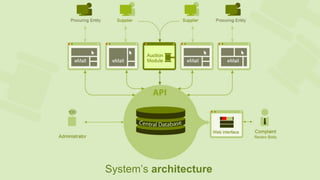
● Central database (CDB)
● API - REST-ful interface that provides programmatic access
to the CDB.
● Auction module
03
System’s architecture
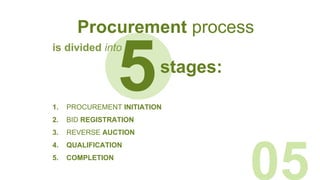
5
05
is divided into
1. PROCUREMENT INITIATION
2. BID REGISTRATION
3. REVERSE AUCTION
4. QUALIFICATION
5. COMPLETION
stages:
Procurement process
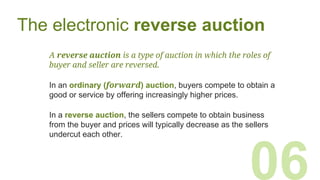
The electronic reverse auction
A reverse auction is a type of auction in which the roles of
buyer and seller are reversed.
06
In an ordinary (forward) auction, buyers compete to obtain a
good or service by offering increasingly higher prices.
In a reverse auction, the sellers compete to obtain business
from the buyer and prices will typically decrease as the sellers
undercut each other.
The main benefits of reverse auction:
● The buyer is the primary beneficiary
● Reduction of purchasing costs
● Increased efficiency in the market
● Enhancement of the procurement process
07
$
Why the reverse auction?
Suppliers compete to sell goods to the procuring entity at the lowest
price. This mechanism significantly reduces the cost of
product/service and allows buyer to compare prices, qualifications,
and other factors at a glance.
08
When Auction module is initiated, auction page where users can
monitor the auction progress is created.
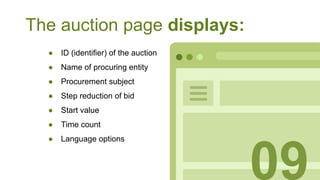
The auction page displays:
● ID (identifier) of the auction
● Name of procuring entity
● Procurement subject
● Step reduction of bid
● Start value
● Time count
● Language options
09
The auction page
10
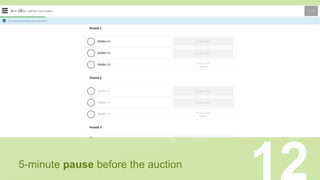
● Upon the auction start there is a pause for 5 minutes to let the bidders learn
the bid values of their competitors.
The auction START
● Once the period for procurement initiation and bid proposals registration
ends, auction starts automatically on the pre-announced date and time.
● The system discloses initial bid values of participants
(anonymously displayed).
● Once the 5-minute pause ends the system automatically
announces the first round.
5-minute pause before the auction
12
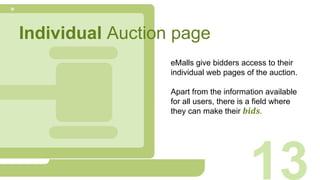
Individual Auction page
13
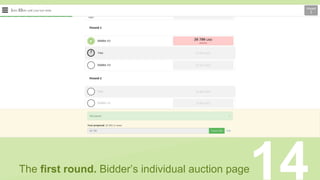
eMalls give bidders access to their
individual web pages of the auction.
Apart from the information available
for all users, there is a field where
they can make their bids.
The first round. Bidder’s individual auction page
14
t
1
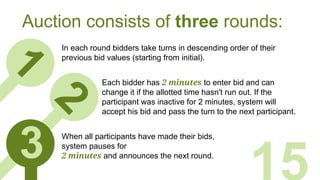
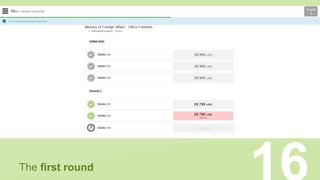
In each round bidders take turns in descending order of their
previous bid values (starting from initial).
15
Auction consists of three rounds:
Each bidder has 2 minutes to enter bid and can
change it if the allotted time hasn't run out. If the
participant was inactive for 2 minutes, system will
accept his bid and pass the turn to the next participant.
When all participants have made their bids,
system pauses for
2 minutes and announces the next round.
2
3
The first round
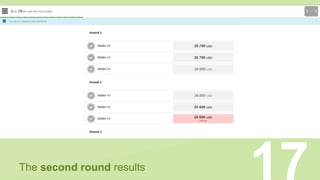
The second round results
17
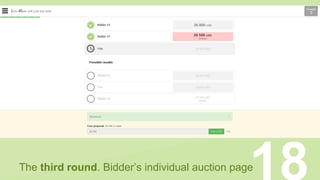
The third round. Bidder’s individual auction page
18
Ranking
1
System ranks all submitted bids automatically by price, forming rating
of bidders positions.
After the third round system discloses complete
information about bid proposals and participants who
submitted them.
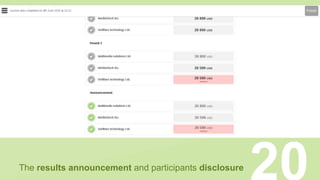
20The results announcement and participants disclosure
● Free and open source toolkit
● Reliable technology
● Based on Open Contracting standards
● Easy-to-use transparent procedures
● For both free and proprietary solutions
Advantages of
Open Procurement System
21
Find more information at:
Project website: https://openprocurement.io
API Documentation: http://api-docs.openprocurement.org
Code repository: https://github.com/openprocurement
Open Procurement case:
https://quintagroup.com/cms/cases/openprocurement

Open procurement - Auction module

  • 1.
  • 2.
    Open Procurement - isan open source software toolkit developed for procurement automation and optimization. The toolkit can be used for: ● public procurements ● commercial solutions
  • 3.
    Open Procurement consistsof: ● Central database (CDB) ● API - REST-ful interface that provides programmatic access to the CDB. ● Auction module 03
  • 4.
  • 5.
    5 05 is divided into 1.PROCUREMENT INITIATION 2. BID REGISTRATION 3. REVERSE AUCTION 4. QUALIFICATION 5. COMPLETION stages: Procurement process
  • 6.
    The electronic reverseauction A reverse auction is a type of auction in which the roles of buyer and seller are reversed. 06 In an ordinary (forward) auction, buyers compete to obtain a good or service by offering increasingly higher prices. In a reverse auction, the sellers compete to obtain business from the buyer and prices will typically decrease as the sellers undercut each other.
  • 7.
    The main benefitsof reverse auction: ● The buyer is the primary beneficiary ● Reduction of purchasing costs ● Increased efficiency in the market ● Enhancement of the procurement process 07
  • 8.
    $ Why the reverseauction? Suppliers compete to sell goods to the procuring entity at the lowest price. This mechanism significantly reduces the cost of product/service and allows buyer to compare prices, qualifications, and other factors at a glance. 08 When Auction module is initiated, auction page where users can monitor the auction progress is created.
  • 9.
    The auction pagedisplays: ● ID (identifier) of the auction ● Name of procuring entity ● Procurement subject ● Step reduction of bid ● Start value ● Time count ● Language options 09
  • 10.
  • 11.
    ● Upon theauction start there is a pause for 5 minutes to let the bidders learn the bid values of their competitors. The auction START ● Once the period for procurement initiation and bid proposals registration ends, auction starts automatically on the pre-announced date and time. ● The system discloses initial bid values of participants (anonymously displayed). ● Once the 5-minute pause ends the system automatically announces the first round.
  • 12.
    5-minute pause beforethe auction 12
  • 13.
    Individual Auction page 13 eMallsgive bidders access to their individual web pages of the auction. Apart from the information available for all users, there is a field where they can make their bids.
  • 14.
    The first round.Bidder’s individual auction page 14
  • 15.
    t 1 In each roundbidders take turns in descending order of their previous bid values (starting from initial). 15 Auction consists of three rounds: Each bidder has 2 minutes to enter bid and can change it if the allotted time hasn't run out. If the participant was inactive for 2 minutes, system will accept his bid and pass the turn to the next participant. When all participants have made their bids, system pauses for 2 minutes and announces the next round. 2 3
  • 16.
  • 17.
    The second roundresults 17
  • 18.
    The third round.Bidder’s individual auction page 18
  • 19.
    Ranking 1 System ranks allsubmitted bids automatically by price, forming rating of bidders positions. After the third round system discloses complete information about bid proposals and participants who submitted them.
  • 20.
    20The results announcementand participants disclosure
  • 21.
    ● Free andopen source toolkit ● Reliable technology ● Based on Open Contracting standards ● Easy-to-use transparent procedures ● For both free and proprietary solutions Advantages of Open Procurement System 21
  • 22.
    Find more informationat: Project website: https://openprocurement.io API Documentation: http://api-docs.openprocurement.org Code repository: https://github.com/openprocurement Open Procurement case: https://quintagroup.com/cms/cases/openprocurement