e-Procurement
ANAND PAL SINGH NIMBADIA
PGPPM-2013
MDI,GURGAON
Contents



Objective



Key stakeholders



Technical architecture



New processes



Governance issue



Current status



Issues and Challenges



Global best practices



Suggestions and Improvements
Objectives of e-Procurement

Objectives of automating procurement processes are
to:•Reduce cycle times of procurement

•Increase
supplier
participation

access

to

ensure

wider

•Reduce costs of procurement through competitive
bidding and Reverse Auctioning

•Remove cartelisation by supplier groups (Reverse
Auctioning)
•Increase visibility of procurement spend, for effective
decision making

•Increase transparency in the procurement process
•Almost complete elimination
speedy and efficient functioning

of

paperwork,

for
Aim of G.O.I.
I.

To tackle corruption.

II. To provide fair and equitable treatment to

suppliers/bidders.

III. To improve transparency.

IV. To promote competition.
V.

To enhance public confidence in procurement
policy.
4
e -procurement
e-Procurement means procurement of goods and
services online using the internet. Ideally, it
covers the full ‘life cycle of procurement’.
• The intention is to automate, possibly, the
entire procurement process, along with tender
bid submission and payments by suppliers, in
an online web-based real-time environment.

• e-Procurement could resolve many of the
constraints/ delays of traditional procurement.
MoF,

G.O.I. & M.O.F IMPORTANT
INSTRUCTIONS.

GOI , in November 2011, ordered to set up a
C.P.P. Portal , issued instructions that e-publishing
made mandatory for all Ministries, Central Govt.
Departments in a phased manner w.e.f.1st January,2012

 MoF, GOI decided that all

Ministries and Central
Govt. Department may commence e-Procurement in
respect of all procurements with estimated value of
Rs.10 lakhs or above in a phased manner.

MHA letter has decided that all tenders for

procurement with estimated value of Rs.10 lakhs and
above will be invited through e-tendering only
w.e.f.15th October 2012.
6
What is c.p.p.portal

7

?
 CPP Portal

stands for Central Public

Procurement Portal of Government of

India which is basically designed by
NIC(National Informatics Centre) and
facilitates all the Central Government
Organizations to publish their Tender
Enquiries ,its Corrigendum and Award of

contract details .
8
 The primary objective of this portal is to
provide a single point access to the

information on procurements made
across various Ministries / Departments
and all the Central Government

organizations under them. All user
departments and agencies would be
required to link up their individual portals

with this centralized procurement portal.
9
What is e-Publishing module ?

10
 The

process of uploading the details of

tender enquiry, its corrigendum and

award

of contract details on to the C.P.P. portal
after logging in to the portal with login
ID

and

Certificate
Publishing

password.
is

not

at this

Digital

Signature

mandatory
stage.

11

for

e-
Steps of e-Publishing module

12
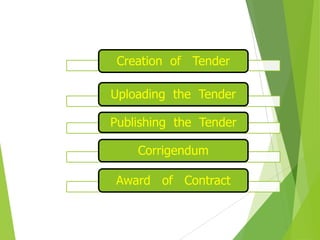
Creation of Tender

Uploading the Tender
Publishing the Tender
Corrigendum

Award of Contract
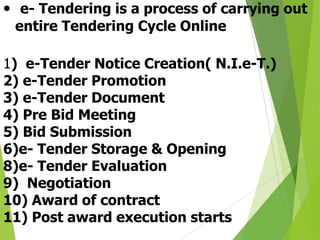
• e- Tendering is a process of carrying out
entire Tendering Cycle Online

1) e-Tender Notice Creation( N.I.e-T.)
2) e-Tender Promotion
3) e-Tender Document
4) Pre Bid Meeting
5) Bid Submission
6)e- Tender Storage & Opening
8)e- Tender Evaluation
9) Negotiation
10) Award of contract
11) Post award execution starts
Manual

Vs
System

Manual Tendering System
•
•
•
•
•
•
•
•
•

e-Tendering

Electronic tendering

Longer Procurement Cycle
Shorter Procurement Cycle
Expensive
Economical – Fixed Cost
Paper Based Procurementeconomical friendly
Restricted Mobility
anytime , anywhere
No work on Holidays
any time
Prone to Human errors
very less chance of error
Physical Security
Foolproof Security
Wastage of space to store bids Lifelong storage on CD
Not retrievable
Retrievable, one click access

• Above all it is the demand of time to adopt on line process.

.
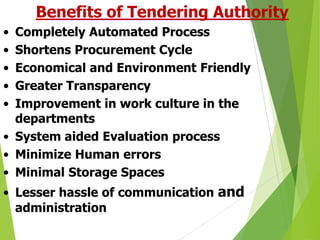
Benefits of Tendering Authority
•
•
•
•
•

Completely Automated Process
Shortens Procurement Cycle
Economical and Environment Friendly
Greater Transparency
Improvement in work culture in the
departments
• System aided Evaluation process
• Minimize Human errors
• Minimal Storage Spaces
• Lesser hassle of communication and
administration
Benefits to Suppliers/Contractors
• Anytime & Anywhere Bidding
• Fair, Free and Fearless participation for vendors.

• No dependence on Newspaper, Courier
• Zero Administrative hassles
• Can carry out all activities from any computer

• Economical – saving on Traveling cost
• Reduces efforts & cost of bidding
• No tenders can be missed because of distance

• Can submit bid on last minute
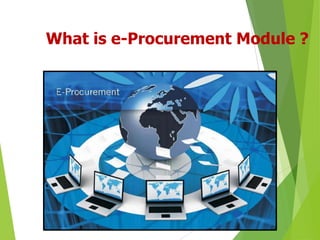
What is e-Procurement Module ?

18
 e-Procurement is the complete e-tendering
process starting from online publishing of
Tender Enquiries, Online bid submission by the
bidders, online bid opening, Online bid
evaluation and publication of award of contract
on the CPP Portal. Digital Signature
Certificate is mandatory for e-Procurement
module.
 More details about
e-Procurement
and e-Publishing initiative are available
at http://eprocure.gov.in/cppp/. Active tenders
of ITBP are also available at
http://eprocure.gov.in/cppp/.
 For demo & trg purpose, NIC has also designed
the demo website ,
http://eprocdemo.nic.in/cppp/.
19
Complete Cycle
Of
e-Procurement Module

20
CREATING
THE TENDER

AWARD

PUBISHING

OF

THE TENDER

CONTRACT
FINANCIAL

BID

BID

SUBMISSION

EVALUATION
TECHNICAL

FINANCIAL

BID

BID
OPENING

OPENING

TECHNICAL
BID
EVALUATION

21
Modes of e-Procurement
Electronic procurement activities being
done
using
modes
given
below,
combination of these could also be used
as per need:  e-publishing of tender
tender)

(publication of

 e-procurement (proc Process online)
Challenges in e-Procurement

› Knowledge

: important for beneficiary to know
the procedure prepare their DSC
› Authentication : How do you verify the identity of the
users ?
› Confidentiality : How do you ensure that the
information sent is read only
by intended users and nobody
else?
› Integrity
:
How do you prevent tampering
information ?
› Non Repudiation: How do you prove the origin of the
information ?
How can we secure e-Procurement
The security features incorporated in an eProcurement Application ensures that all
activities are logged, no unauthorized person
has access to data, all sensitive data is
encrypted and system can be restored in a
minimal possible time in case of a disaster or
system crash, with the help of:

› Audit Trail
› Data Encryption
› Secure User and Administrator access
› Process Validation
e-Procurement Application – Prime Features
Functional Features
 Workflows based & Access Control (financial & procurement
category)
 Indigenous & Global Procurement (Multi Currency)
 Multi Part Bidding
 Notifications & Alerts

 Clarifications


Good authentication – Role based access



Security, Secrecy (of bids) - Signing, Encryption



Ease of Use

 Good Archival & Retrieval features/ policy - Safe and secure
e-Procurement solution Functionalities
 Online Supplier Registration (Portal Registration)
 Creation of Tender
 Approval of Tender

 Publishing of Tender
 Corrigendum
 Online Bid submission by suppliers/contractors

 Online payment of Tender Fees & EMD
 Online Bid opening
 Evaluation of bids (Technical and Financial)

 Generation of Comparative Statement (Technical &
Financial)
Different Types of Tenders
Open / Limited
Global
Single Bid / Two-Bid
Approval Workflow
RFQ ( Rqst. For Quotation) Creation

1)RFQs play an important role in the procurement process.
2) The first step taken by buyers, the responses offer a
wealth of data that can help them later on when need to
begin taking formal bids. For example, if Buyer A sends out
an RFQ to three companies and only two respond to his
inquiry, Buyer A automatically knows that the third person
is either not interested in doing business with him or is not
a reliable vendor. Either way, he has narrowed down his
pool of potential suppliers, thus making less work for
himself later on.
Bid Opening
Bid Evaluation
Note sheet Movement

Security
Two-factor Authentication
Digital Signing of documents
Encryption of Bids
Implementation - Success Factors
Major factors which could be crucial to transformation from simple
traditional procurement to e-Procurement are: Strong will and focused thrust from the top management
Building in-house champions/ enthusiasts for adoption of eProcurement
Buyer’s dedicated project team to drive the Mission
Aiming for realistic implementable goals/ objectives and time lines
Well defined/ standardized procurement processes and forms

Extreme care to aspects like Tender-security, Supplier-enablement/
Training & Ease of use
Well integrated back end systems, standards, policies & practices to
link and leverage upon

Strong will & above all determination

.
1. E-Procurement can provide significant ,benefits,
but requires important conditions for success.
2. Situate e-procurement reforms within a broader
framework of governance: focus on supply and
demand for reform
3. Important to understand and manage ,political
economy of reform
4. E-procurement ,can deliver substantial, benefits
but requires important conditions for success
5. Increased efficiency due to competition,
transparency and lower transaction costs
6. Reduced opportunity for fraud & corruption due
to automated procedures
7. Public procurement monitoring
Internationaliy
Impact of e-Procurement
• Savings (Examples)
• . KOREA :-Total volume of US$ 44 bn in 2006
with
• transaction cost savings of US$ 4.5 bn
(http://www.pps.gokr/english/ )
• BRAZIL:-From 2000 to 2006, 51% savings in
transaction costs and 25.5% in price,reductions
• (http://www.relogiodaeconomia.sp.gov.br/br/h
ome_results.asp)
• INDIA:-US$ 3.6 bn of transactions in 2005 with
savings of US$ 238.2 mn
• due to tender discountsin the same year
• (http://ccaharyana.gov.in/e-procurement.htm)
Conditions for
Successful Implementation
•Strong government leadership (e.g. Korea, Mexico at
•presidential level)
•Appropriate implementation framework (e.g.
•procurement policy, legislation, capacity building,
•standards)
•Infrastructure development (connectivity)
•Complaints mechanism & resolution
•Oversight over collusion & bid rigging
•Managing political economy of reform
•(http://ec.europa.eu/internal_market/publicprocurement/docs/eprocur
ement/conferences/speeches/robert-hunja_en.pdf)
Thanks!!!
e-Procurement in Indian Government

e-Procurement in Indian Government

  • 1.
    e-Procurement ANAND PAL SINGHNIMBADIA PGPPM-2013 MDI,GURGAON
  • 2.
    Contents  Objective  Key stakeholders  Technical architecture  Newprocesses  Governance issue  Current status  Issues and Challenges  Global best practices  Suggestions and Improvements
  • 3.
    Objectives of e-Procurement Objectivesof automating procurement processes are to:•Reduce cycle times of procurement •Increase supplier participation access to ensure wider •Reduce costs of procurement through competitive bidding and Reverse Auctioning •Remove cartelisation by supplier groups (Reverse Auctioning) •Increase visibility of procurement spend, for effective decision making •Increase transparency in the procurement process •Almost complete elimination speedy and efficient functioning of paperwork, for
  • 4.
    Aim of G.O.I. I. Totackle corruption. II. To provide fair and equitable treatment to suppliers/bidders. III. To improve transparency. IV. To promote competition. V. To enhance public confidence in procurement policy. 4
  • 5.
    e -procurement e-Procurement meansprocurement of goods and services online using the internet. Ideally, it covers the full ‘life cycle of procurement’. • The intention is to automate, possibly, the entire procurement process, along with tender bid submission and payments by suppliers, in an online web-based real-time environment. • e-Procurement could resolve many of the constraints/ delays of traditional procurement.
  • 6.
    MoF, G.O.I. & M.O.FIMPORTANT INSTRUCTIONS. GOI , in November 2011, ordered to set up a C.P.P. Portal , issued instructions that e-publishing made mandatory for all Ministries, Central Govt. Departments in a phased manner w.e.f.1st January,2012  MoF, GOI decided that all Ministries and Central Govt. Department may commence e-Procurement in respect of all procurements with estimated value of Rs.10 lakhs or above in a phased manner. MHA letter has decided that all tenders for procurement with estimated value of Rs.10 lakhs and above will be invited through e-tendering only w.e.f.15th October 2012. 6
  • 7.
  • 8.
     CPP Portal standsfor Central Public Procurement Portal of Government of India which is basically designed by NIC(National Informatics Centre) and facilitates all the Central Government Organizations to publish their Tender Enquiries ,its Corrigendum and Award of contract details . 8
  • 9.
     The primaryobjective of this portal is to provide a single point access to the information on procurements made across various Ministries / Departments and all the Central Government organizations under them. All user departments and agencies would be required to link up their individual portals with this centralized procurement portal. 9
  • 10.
  • 11.
     The process ofuploading the details of tender enquiry, its corrigendum and award of contract details on to the C.P.P. portal after logging in to the portal with login ID and Certificate Publishing password. is not at this Digital Signature mandatory stage. 11 for e-
  • 12.
  • 13.
    Creation of Tender Uploadingthe Tender Publishing the Tender Corrigendum Award of Contract
  • 14.
    • e- Tenderingis a process of carrying out entire Tendering Cycle Online 1) e-Tender Notice Creation( N.I.e-T.) 2) e-Tender Promotion 3) e-Tender Document 4) Pre Bid Meeting 5) Bid Submission 6)e- Tender Storage & Opening 8)e- Tender Evaluation 9) Negotiation 10) Award of contract 11) Post award execution starts
  • 15.
    Manual Vs System Manual Tendering System • • • • • • • • • e-Tendering Electronictendering Longer Procurement Cycle Shorter Procurement Cycle Expensive Economical – Fixed Cost Paper Based Procurementeconomical friendly Restricted Mobility anytime , anywhere No work on Holidays any time Prone to Human errors very less chance of error Physical Security Foolproof Security Wastage of space to store bids Lifelong storage on CD Not retrievable Retrievable, one click access • Above all it is the demand of time to adopt on line process. .
  • 16.
    Benefits of TenderingAuthority • • • • • Completely Automated Process Shortens Procurement Cycle Economical and Environment Friendly Greater Transparency Improvement in work culture in the departments • System aided Evaluation process • Minimize Human errors • Minimal Storage Spaces • Lesser hassle of communication and administration
  • 17.
    Benefits to Suppliers/Contractors •Anytime & Anywhere Bidding • Fair, Free and Fearless participation for vendors. • No dependence on Newspaper, Courier • Zero Administrative hassles • Can carry out all activities from any computer • Economical – saving on Traveling cost • Reduces efforts & cost of bidding • No tenders can be missed because of distance • Can submit bid on last minute
  • 18.
  • 19.
     e-Procurement isthe complete e-tendering process starting from online publishing of Tender Enquiries, Online bid submission by the bidders, online bid opening, Online bid evaluation and publication of award of contract on the CPP Portal. Digital Signature Certificate is mandatory for e-Procurement module.  More details about e-Procurement and e-Publishing initiative are available at http://eprocure.gov.in/cppp/. Active tenders of ITBP are also available at http://eprocure.gov.in/cppp/.  For demo & trg purpose, NIC has also designed the demo website , http://eprocdemo.nic.in/cppp/. 19
  • 20.
  • 21.
  • 22.
    Modes of e-Procurement Electronicprocurement activities being done using modes given below, combination of these could also be used as per need:  e-publishing of tender tender) (publication of  e-procurement (proc Process online)
  • 23.
    Challenges in e-Procurement ›Knowledge : important for beneficiary to know the procedure prepare their DSC › Authentication : How do you verify the identity of the users ? › Confidentiality : How do you ensure that the information sent is read only by intended users and nobody else? › Integrity : How do you prevent tampering information ? › Non Repudiation: How do you prove the origin of the information ?
  • 24.
    How can wesecure e-Procurement The security features incorporated in an eProcurement Application ensures that all activities are logged, no unauthorized person has access to data, all sensitive data is encrypted and system can be restored in a minimal possible time in case of a disaster or system crash, with the help of: › Audit Trail › Data Encryption › Secure User and Administrator access › Process Validation
  • 25.
    e-Procurement Application –Prime Features Functional Features  Workflows based & Access Control (financial & procurement category)  Indigenous & Global Procurement (Multi Currency)  Multi Part Bidding  Notifications & Alerts  Clarifications  Good authentication – Role based access  Security, Secrecy (of bids) - Signing, Encryption  Ease of Use  Good Archival & Retrieval features/ policy - Safe and secure
  • 26.
    e-Procurement solution Functionalities Online Supplier Registration (Portal Registration)  Creation of Tender  Approval of Tender  Publishing of Tender  Corrigendum  Online Bid submission by suppliers/contractors  Online payment of Tender Fees & EMD  Online Bid opening  Evaluation of bids (Technical and Financial)  Generation of Comparative Statement (Technical & Financial)
  • 27.
    Different Types ofTenders Open / Limited Global Single Bid / Two-Bid Approval Workflow RFQ ( Rqst. For Quotation) Creation 1)RFQs play an important role in the procurement process. 2) The first step taken by buyers, the responses offer a wealth of data that can help them later on when need to begin taking formal bids. For example, if Buyer A sends out an RFQ to three companies and only two respond to his inquiry, Buyer A automatically knows that the third person is either not interested in doing business with him or is not a reliable vendor. Either way, he has narrowed down his pool of potential suppliers, thus making less work for himself later on.
  • 28.
    Bid Opening Bid Evaluation Notesheet Movement Security Two-factor Authentication Digital Signing of documents Encryption of Bids
  • 29.
    Implementation - SuccessFactors Major factors which could be crucial to transformation from simple traditional procurement to e-Procurement are: Strong will and focused thrust from the top management Building in-house champions/ enthusiasts for adoption of eProcurement Buyer’s dedicated project team to drive the Mission Aiming for realistic implementable goals/ objectives and time lines Well defined/ standardized procurement processes and forms Extreme care to aspects like Tender-security, Supplier-enablement/ Training & Ease of use Well integrated back end systems, standards, policies & practices to link and leverage upon Strong will & above all determination .
  • 30.
    1. E-Procurement canprovide significant ,benefits, but requires important conditions for success. 2. Situate e-procurement reforms within a broader framework of governance: focus on supply and demand for reform 3. Important to understand and manage ,political economy of reform 4. E-procurement ,can deliver substantial, benefits but requires important conditions for success 5. Increased efficiency due to competition, transparency and lower transaction costs 6. Reduced opportunity for fraud & corruption due to automated procedures 7. Public procurement monitoring
  • 31.
  • 32.
    • Savings (Examples) •. KOREA :-Total volume of US$ 44 bn in 2006 with • transaction cost savings of US$ 4.5 bn (http://www.pps.gokr/english/ ) • BRAZIL:-From 2000 to 2006, 51% savings in transaction costs and 25.5% in price,reductions • (http://www.relogiodaeconomia.sp.gov.br/br/h ome_results.asp) • INDIA:-US$ 3.6 bn of transactions in 2005 with savings of US$ 238.2 mn • due to tender discountsin the same year • (http://ccaharyana.gov.in/e-procurement.htm)
  • 33.
    Conditions for Successful Implementation •Stronggovernment leadership (e.g. Korea, Mexico at •presidential level) •Appropriate implementation framework (e.g. •procurement policy, legislation, capacity building, •standards) •Infrastructure development (connectivity) •Complaints mechanism & resolution •Oversight over collusion & bid rigging •Managing political economy of reform •(http://ec.europa.eu/internal_market/publicprocurement/docs/eprocur ement/conferences/speeches/robert-hunja_en.pdf)
  • 34.