Libraries = books
Libraries = digital information
Libraries = data?
Libraries are
about organizing
and describing
things.
Why not data?
Libraries = expertise
Libraries = access
Librarians have the skills to help
researches plan, organize, describe
and share research data
Adelaide State Library of South Australia
Questions
• Why open data?
• What is the role of libraries?
• How can CSU libraries help?
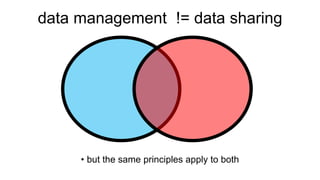
data management != data sharing
• but the same principles apply to both
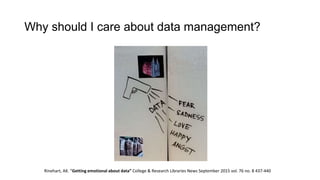
Why should I care about data management?
Rinehart, AK. “Getting emotional about data” College & Research Libraries News September 2015 vol. 76 no. 8 437-440
What is data
management?
The policies, practices and procedures needed to
manage the storage, access and preservation of data
produced from a research project
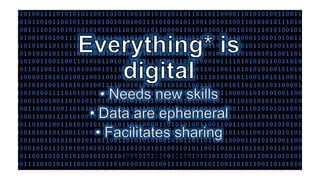
*ok not everything, but most things
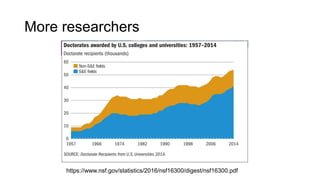
More researchers
https://www.nsf.gov/statistics/2016/nsf16300/digest/nsf16300.pdf
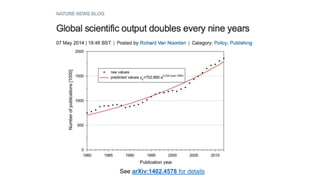
See arXiv:1402.4578 for details
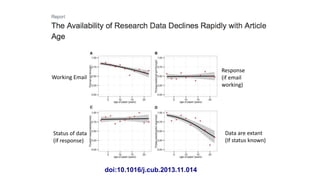
Working Email
Data are extant
(If status known)
Status of data
(if response)
Response
(if email
working)
doi:10.1016/j.cub.2013.11.014
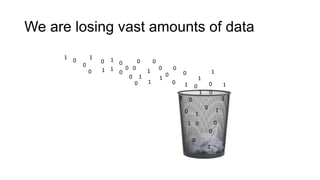
We are losing vast amounts of data
0
0
0
0
0
0
0
0
0
0
0
0
0
1
1
1
1
1
1
11
1
1
1
1
1
1
1
0
0
0
0
0
0
0
00
0
00 0
1
1
1 1
1
0
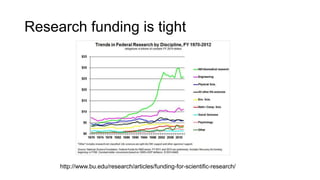
Research funding is tight
http://www.bu.edu/research/articles/funding-for-scientific-research/
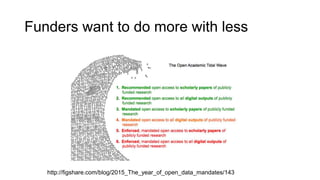
Funders want to do more with less
http://figshare.com/blog/2015_The_year_of_open_data_mandates/143
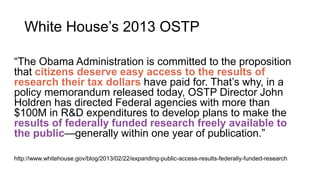
White House’s 2013 OSTP
“The Obama Administration is committed to the proposition
that citizens deserve easy access to the results of
research their tax dollars have paid for. That’s why, in a
policy memorandum released today, OSTP Director John
Holdren has directed Federal agencies with more than
$100M in R&D expenditures to develop plans to make the
results of federally funded research freely available to
the public—generally within one year of publication.”
http://www.whitehouse.gov/blog/2013/02/22/expanding-public-access-results-federally-funded-research
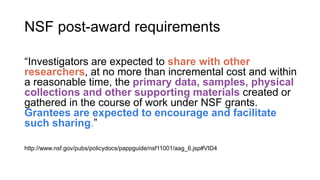
NSF post-award requirements
“Investigators are expected to share with other
researchers, at no more than incremental cost and within
a reasonable time, the primary data, samples, physical
collections and other supporting materials created or
gathered in the course of work under NSF grants.
Grantees are expected to encourage and facilitate
such sharing.”
http://www.nsf.gov/pubs/policydocs/pappguide/nsf11001/aag_6.jsp#VID4
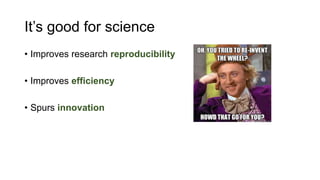
It’s good for science
• Improves research reproducibility
• Improves efficiency
• Spurs innovation
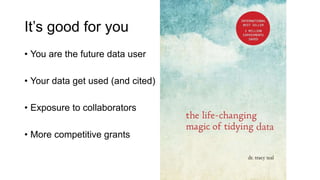
It’s good for you
• You are the future data user
• Your data get used (and cited)
• Exposure to collaborators
• More competitive grants
Where does data
management fit into
research?
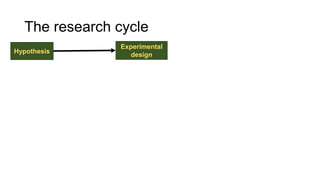
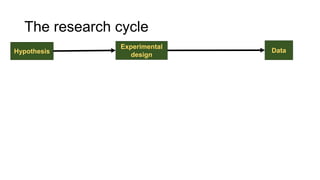
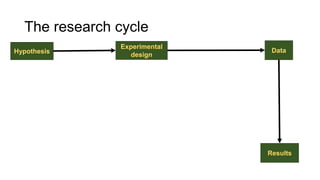
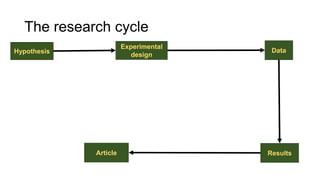
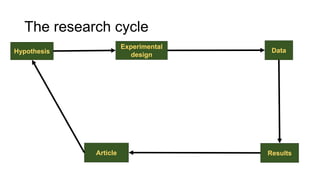
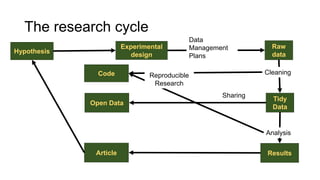
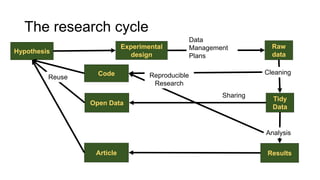
Throughout the whole research cycle
Hypothesis
The research cycle
Hypothesis
Experimental
design
The research cycle
Hypothesis Data
Experimental
design
The research cycle
Hypothesis Data
Experimental
design
Results
The research cycle
Hypothesis Data
Experimental
design
ResultsArticle
The research cycle
Hypothesis Data
Experimental
design
ResultsArticle
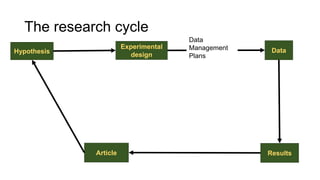
The research cycle
Hypothesis Data
Experimental
design
ResultsArticle
Data
Management
Plans
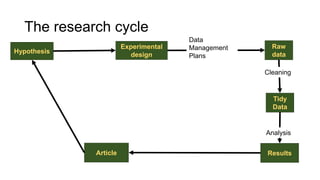
The research cycle
Hypothesis
Raw
data
Experimental
design
Tidy
Data
ResultsArticle
Data
Management
Plans
Cleaning
Analysis
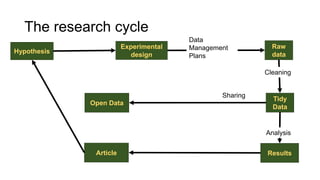
The research cycle
Hypothesis
Raw
data
Experimental
design
Tidy
Data
ResultsArticle
Data
Management
Plans
Cleaning
Sharing
Analysis
Open Data
The research cycle
Hypothesis
Raw
data
Experimental
design
Tidy
Data
ResultsArticle
Data
Management
Plans
Cleaning
Sharing
Analysis
Open Data
Code Reproducible
Research
The research cycle
Hypothesis
Raw
data
Experimental
design
Tidy
Data
ResultsArticle
Data
Management
Plans
Cleaning
Sharing
Analysis
Open Data
Code Reproducible
Research
Reuse
The research cycle
How are libraries getting involved?
•We’re NOT the data police
•We want to help!
•We provide services
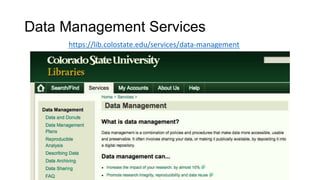
Data Management Services
https://lib.colostate.edu/services/data-management
Workshops
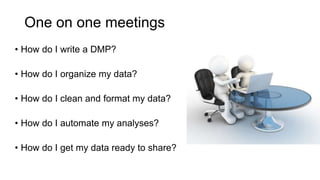
One on one meetings
• How do I write a DMP?
• How do I organize my data?
• How do I clean and format my data?
• How do I automate my analyses?
• How do I get my data ready to share?
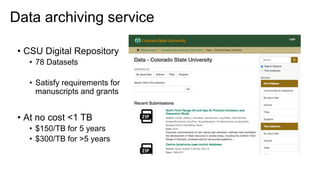
Data archiving service
• CSU Digital Repository
• 78 Datasets
• Satisfy requirements for
manuscripts and grants
• At no cost <1 TB
• $150/TB for 5 years
• $300/TB for >5 years
Large Projects
• Shortgrass Steppe – LTER (32)
http://hdl.handle.net/10217/100254
• Yellowstone Willows LTREB (21)
http://hdl.handle.net/10217/173646
• RAPID: Characterizing the Response of
a Burned Landscape to an Unusual and
Extreme Rain Event (4)
http://hdl.handle.net/10217/100371
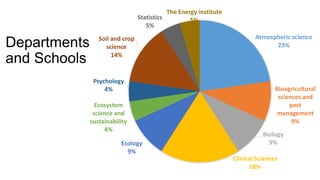
Departments
and Schools
Atmospheric science
23%
Bioagricultural
sciences and
pest
management
9%
Biology
9%
Clinical Sciences
18%
Ecology
9%
Ecosystem
science and
sustainability
4%
Psychology
4%
Soil and crop
science
14%
Statistics
5%
The Energy institute
5%
Take home points
• Data management requires new skills
• Library staff have those skills
• CSU Libraries can help
• Education
• One on one meetings
• Digital Repository
Thanks!
Data Management Services
http://lib.colostate.edu/services/data-management
Need help?
Email library_data@colostate.edu
Contact Tobin
Tobin.magle@colostate.edu
Twitter: @tobinmagle
http://orcid.org/0000-0003-3185-7034

Open access day

Editor's Notes

  • #11 You already care deeply about your data It’s your IP But… There are external pressures that make thinking about how to preserve research data more pressing
  • #14 The number of PhDs is growing, hence….
  • #18 Despite a steady increase in the number of PhDs, research funding is more or less flat
  • #20 Stronger data sharing requirements are coming down the road, all the way from the whitehouse. More is coming in response to this mandate.
  • #21 One of the strongest, but no enforcement (yet)