Object Oriented Thinking
Objectives : What is object orientation ? What are object ? Why are objects needed ? Interaction among objects ? What are classes ? Class hierarchy ? OO key concepts ? Functional v/s object decomposition ? OO Methodologies Reuse
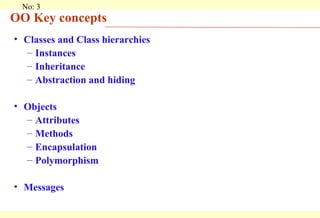
OO Key concepts Classes and Class hierarchies Instances Inheritance Abstraction and hiding Objects Attributes Methods Encapsulation Polymorphism Messages
What is object orientation ? OO is a way of thinking to understand the given problem by identifying various objects and their associations, interaction among the objects, to model and solve the problem. Why Object technologies ? Object technologies lead to number of  inherent benefits that provide advantages at both the management and technical level Benefits ? reuse & faster development consequently high-quality program easy maintenance due to decoupled  nature of the structure easier to adopt and easily scalable
What are objects ? Defined as a tangible(Possible to understand or realize)  entity that exhibits some well-defined behavior : Objects are  real world entities They contains  attributes  and  operations They represent a “State” (Att. Values ) ex :   objects e- Mail-message
Why are objects needed ? It is easy to model real world objects They hide the internal representation They expose only required functionality Generalized objects can help in reduced maintenance less dependent and reusable they have related functionality
How do objects interact ? Message: [sender, return value] Message: [receiver, operation, parameter] Adv.: low coupling and highly reusable and easy maintainable Sender object Receiver object
What is a class ? Building block of object- oriented system Class is a template for an object Class specifies the object’s structures and operations AnimalClass Employee
No. of wheels Color of car Year of manufacture Car Drive the car Accelerate Break Class Representation
What are class hierarchies ? Generalization of real world classes  lead to class hierarchy Hierarchies can be expanded by further specialization
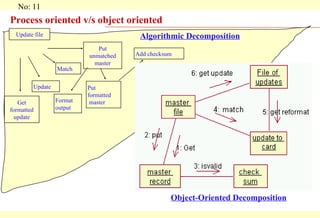
Process oriented v/s object oriented   Algorithmic Decomposition Object-Oriented Decomposition Update file Match Update Put unmatched master Get formatted update Put formatted master Format output Add checksum
OO Methods : Booch ( OOD ) Rambaugh (OO Modeling & Design ) Coad & Yourdan ( OOA ) Embley ( OO system analysis ) Shlaor & Meller ( OO system analysis ) Wirfs - Brock (Designing OO Software  ) Ivar Jacobson (OOSE) - Use Cases
Reuse : why? Better Quality Better maintenance - due to decoupled  nature of the structure High productivity Consequently quick development Easier to adopt and easily scalable

Oot

  • 1.
  • 2.
    Objectives : Whatis object orientation ? What are object ? Why are objects needed ? Interaction among objects ? What are classes ? Class hierarchy ? OO key concepts ? Functional v/s object decomposition ? OO Methodologies Reuse
  • 3.
    OO Key conceptsClasses and Class hierarchies Instances Inheritance Abstraction and hiding Objects Attributes Methods Encapsulation Polymorphism Messages
  • 4.
    What is objectorientation ? OO is a way of thinking to understand the given problem by identifying various objects and their associations, interaction among the objects, to model and solve the problem. Why Object technologies ? Object technologies lead to number of inherent benefits that provide advantages at both the management and technical level Benefits ? reuse & faster development consequently high-quality program easy maintenance due to decoupled nature of the structure easier to adopt and easily scalable
  • 5.
    What are objects? Defined as a tangible(Possible to understand or realize) entity that exhibits some well-defined behavior : Objects are real world entities They contains attributes and operations They represent a “State” (Att. Values ) ex : objects e- Mail-message
  • 6.
    Why are objectsneeded ? It is easy to model real world objects They hide the internal representation They expose only required functionality Generalized objects can help in reduced maintenance less dependent and reusable they have related functionality
  • 7.
    How do objectsinteract ? Message: [sender, return value] Message: [receiver, operation, parameter] Adv.: low coupling and highly reusable and easy maintainable Sender object Receiver object
  • 8.
    What is aclass ? Building block of object- oriented system Class is a template for an object Class specifies the object’s structures and operations AnimalClass Employee
  • 9.
    No. of wheelsColor of car Year of manufacture Car Drive the car Accelerate Break Class Representation
  • 10.
    What are classhierarchies ? Generalization of real world classes lead to class hierarchy Hierarchies can be expanded by further specialization
  • 11.
    Process oriented v/sobject oriented Algorithmic Decomposition Object-Oriented Decomposition Update file Match Update Put unmatched master Get formatted update Put formatted master Format output Add checksum
  • 12.
    OO Methods :Booch ( OOD ) Rambaugh (OO Modeling & Design ) Coad & Yourdan ( OOA ) Embley ( OO system analysis ) Shlaor & Meller ( OO system analysis ) Wirfs - Brock (Designing OO Software ) Ivar Jacobson (OOSE) - Use Cases
  • 13.
    Reuse : why?Better Quality Better maintenance - due to decoupled nature of the structure High productivity Consequently quick development Easier to adopt and easily scalable