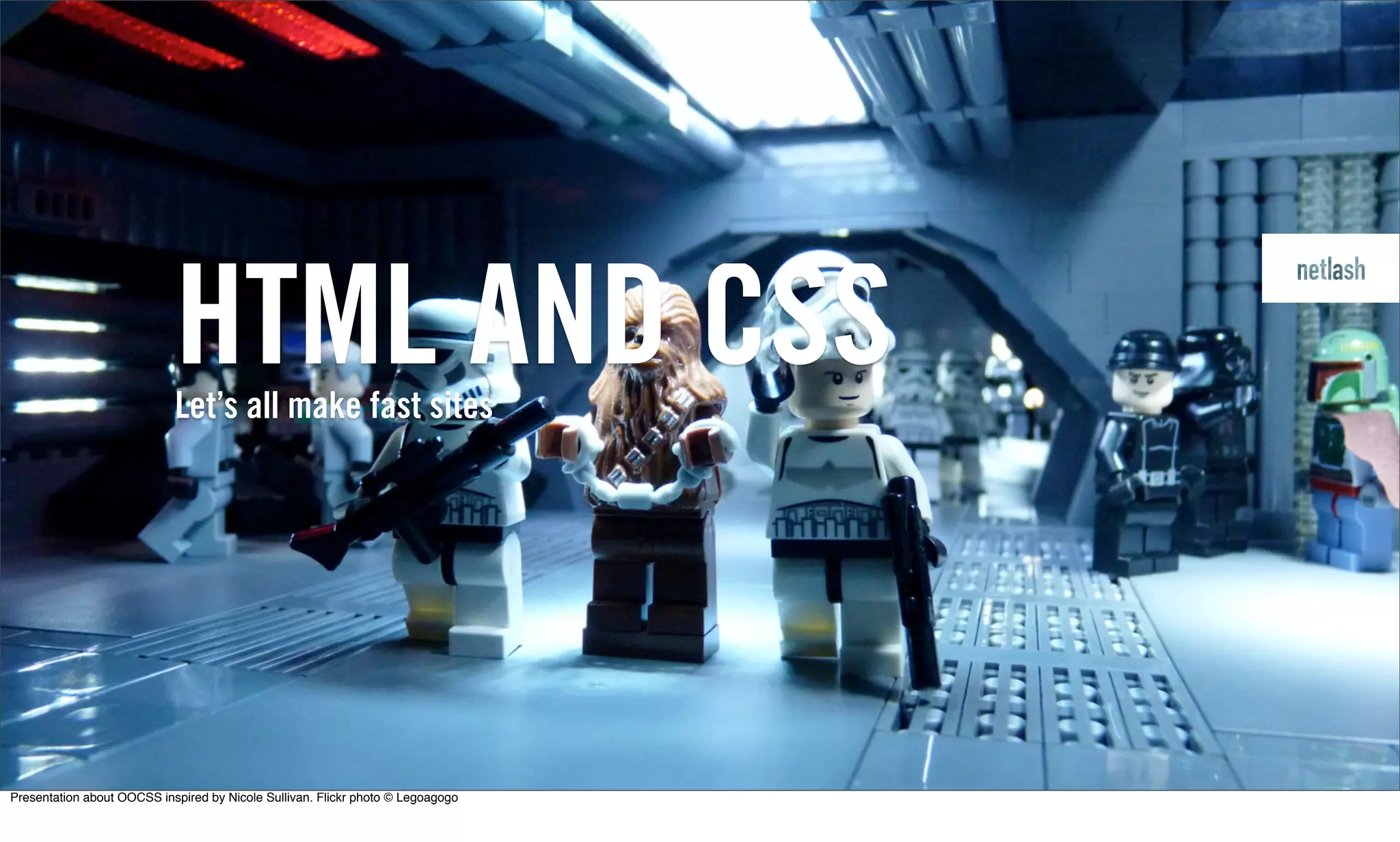
HTML AND CSS
                            Let’s all make fast sites


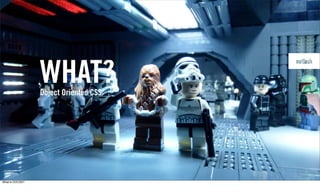
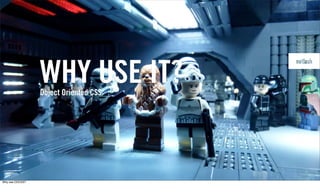
Presentation about OOCSS inspired by Nicole Sullivan. Flickr photo © Legoagogo

O Hai! I’m Yoni


Yoni De Beule, http://www.yonidebeule.be, @yoniweb
I work at Netlash
                             among others.


http://www.netlash.com http://www.minify.be http://www.vlmbuzz.be http://www.wrappp.it
I love building websites that are beautiful,
                               accessible, easy to use and fast.


I love building websites that are beautiful, accessible, easy to use and fast.
Beautiful


Beautiful sites
Accessible


Accessible sites (http://www.slideshare.net/YoniWeb/anysurfer)
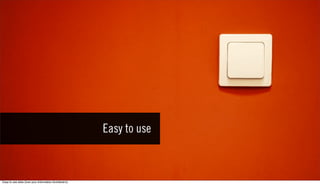
Easy to use


Easy to use sites (love your Information Architectsʼs)
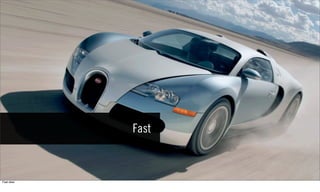
Fast


Fast sites
I also love using pictures in my
                               presentations...


I also love using pictures in my presentations...
It’s a designer thing


Itʼs a designer thing
I’m here today to make you happy.


Iʼm here today to make you happy.
I’ll be making users happy


Iʼll be making users happy
I’ll be making developers happy


Iʼll be making developers happy
I’ll be making clients happy


Iʼll be making clients happy
I’ll even be making myself happy


Iʼll even be making myself happy
I’m here to make you happy by telling you
                             about Object Oriented CSS.


Iʼm here to make you happy by telling you about Object Oriented CSS.
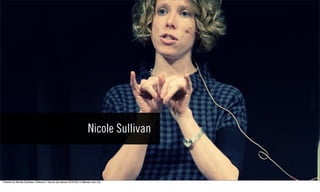
Nicole Sullivan


Thanks to Nicole Sullivan (Yahoo!) I found out about OOCSS © Marien van Os
She’s awesome.


Sheʼs awesome.
Pure WIN.


Pure WIN.
WHAT?
                 Object Oriented CSS


What is OOCSS?
OOCSS is all about building big websites
                               that are fast.


OOCSS is all about building big websites that are fast. Thereʼs a framework, but Iʼm all for the “concept”, the “idea”, the brilliance.
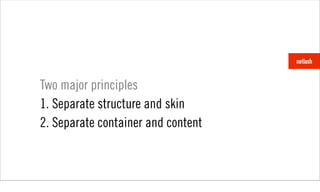
Two major principles


Two major principles
                              1. Separate structure and skin


Separate structure and skin
Two major principles
                            1. Separate structure and skin
                            2. Separate container and content


Separate container and content
Two major principles
1. Separate structure and skin
2. Separate container and content
Doesn’t that kind of sounds like ...


Doesnʼt that kind of sounds like ...
Fork?
Fork
Yeah, that’s what I thought.


Yeah, thatʼs what I thought.
WHY USE IT?
                 Object Oriented CSS


Why use OOCSS?
Lego’s.


Legoʼs.
That’s right.


Thatʼs right.
Lego’s.


Legoʼs are modular blocks of html, css, images and javascript that can be used all across a site.
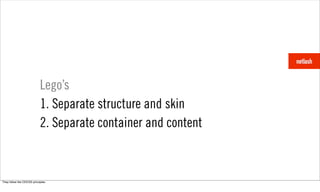
Lego’s
                            1. Separate structure and skin
                            2. Separate container and content


They follow the OOCSS principles.
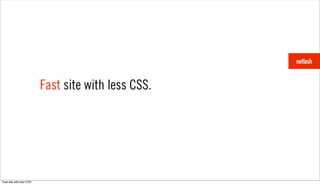
Fast site with less CSS.


Fast site with less CSS.
Users happy


Users happy
Developers can use these lego’s virtually
                              anywhere without the help of a designer.


Developers can use these legoʼs virtually anywhere without the help of a designer.
Developers happy


Developers happy
Less design time needed and faster new
                            features.


Less design time needed and faster new features.
Clients happy


Clients happy
Consistent design = clean code = fast site


And last but not least consistent design = clean code = fast site.
Yoni happy


Yoni and all the other designers Happy
Designers happy


Happy times.
HOW?
                        Object Oriented CSS


How do you use OOCSS?
Lego’s?


How do you use these Legoʼs?
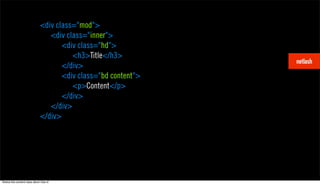
<div class="mod">
                                 <div class="inner">
                                     <div class="hd">
                                        <h3>Title</h3>
                                     </div>
                                     <div class="bd content">
                                        <p>Content</p>
                                     </div>
                                 </div>
                              </div>


Notice the content class devs! Use it!
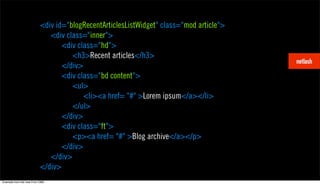
<div id="blogRecentArticlesListWidget" class="mod article">
                             <div class="inner">
                                 <div class="hd">
                                    <h3>Recent articles</h3>
                                 </div>
                                 <div class="bd content">
                                    <ul>
                                        <li><a href= "#" >Lorem ipsum</a></li>
                                    </ul>
                                 </div>
                                 <div class="ft">
                                    <p><a href= "#" >Blog archive</a></p>
                                 </div>
                             </div>
                          </div>
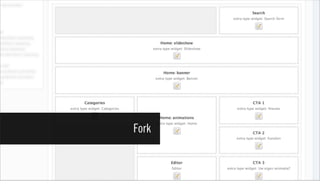
Example from the new Fork CMS.
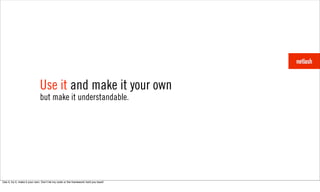
Use it and make it your own
                              but make it understandable.


Use it, try it, make it your own. Donʼt let my code or the framework hold you back!
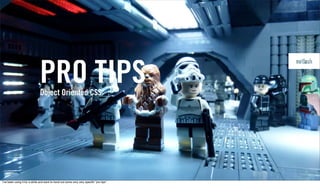
PRO TIPS
                              Object Oriented CSS


Iʼve been using it for a while and want to hand out some very very specific “pro tips”.
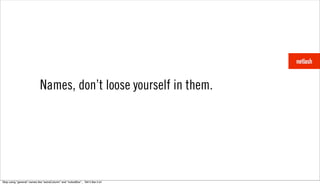
Names, don’t loose yourself in them.


Stop using “general” names like “extraColumn” and “noticeBox”... Tell it like it is!
Respect the design, don’t worship it.


Respect the design, donʼt worship it.
Sprites rule, but are a bitch to maintain
                              so beware!


Sprites help, but are a bitch to maintain. I might do a presentation about this later (like why the new Ruby feature is a bad idea). {OFF TOPIC}
Progressive enhancement (PNG8).


Fireworks! *pew* *pew* {OFF TOPIC}
Questions?


Questions?
http://www.yonidebeule.be


Yoni De Beule, http://www.yonidebeule.be, @yoniweb

OOCSS