CLASS DIAGRAM
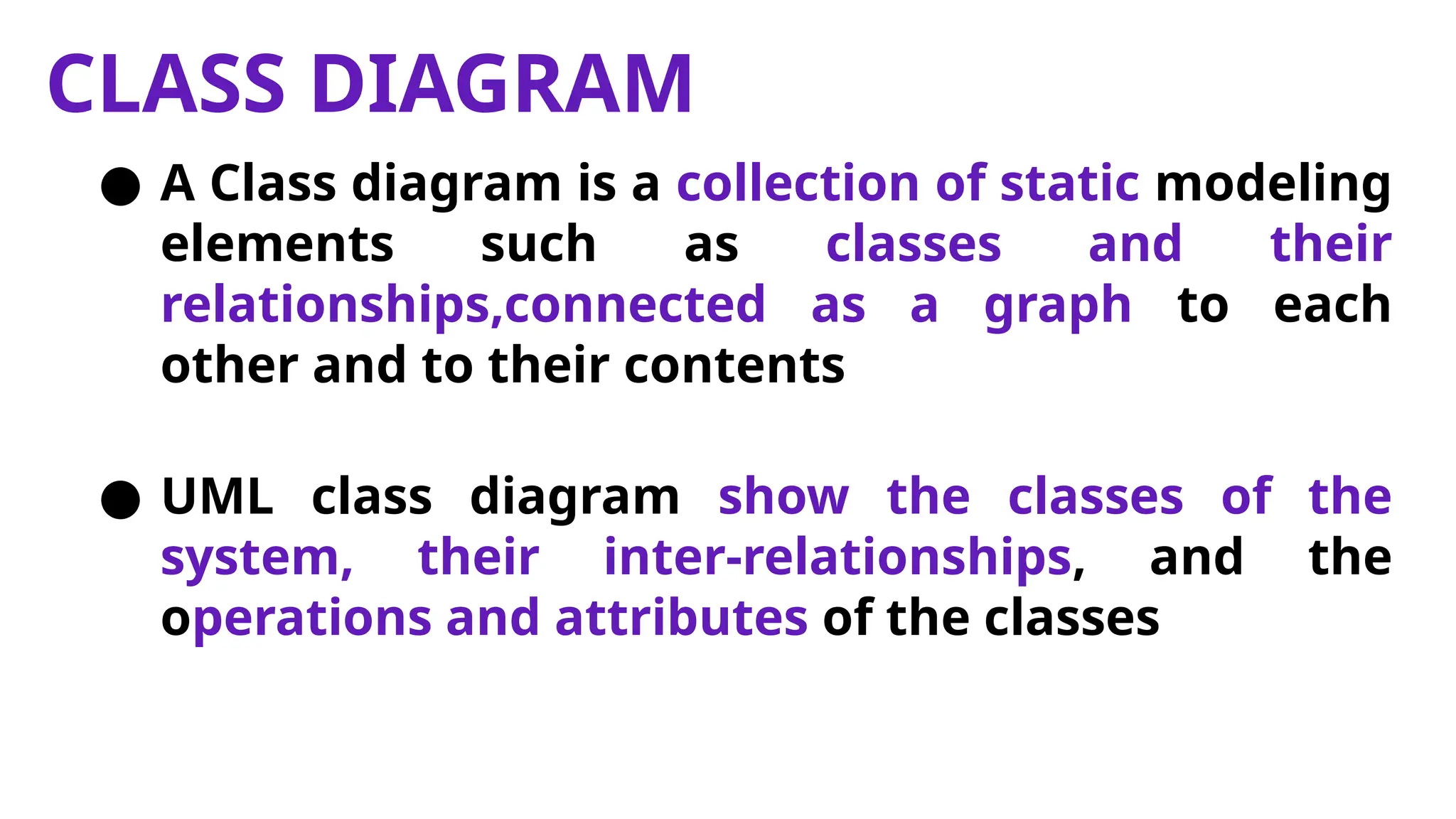
● AClass diagram is a collection of static modeling
elements such as classes and their
relationships,connected as a graph to each
other and to their contents
● UML class diagram show the classes of the
system, their inter-relationships, and the
operations and attributes of the classes
3.
CLASS DIAGRAM
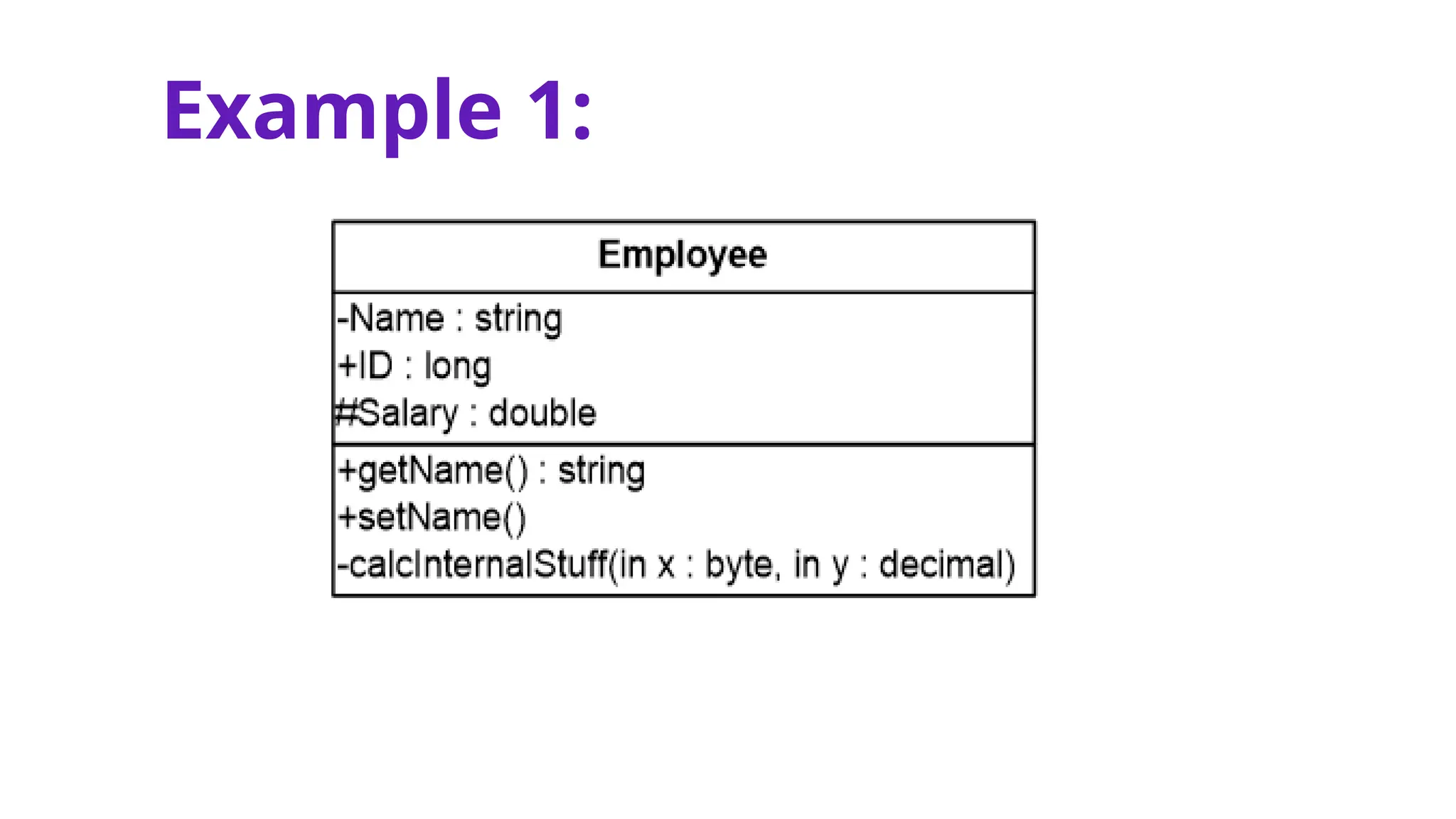
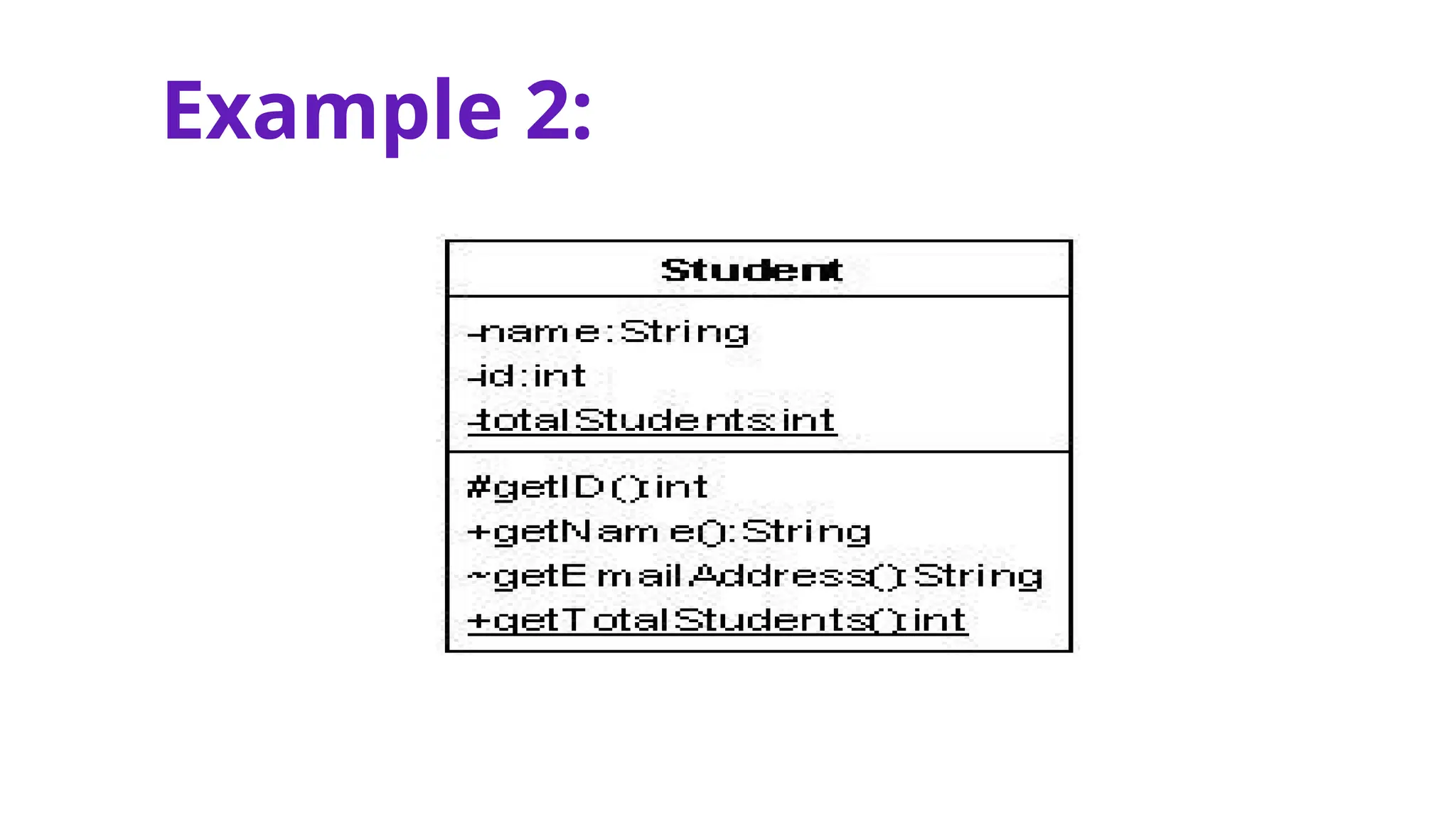
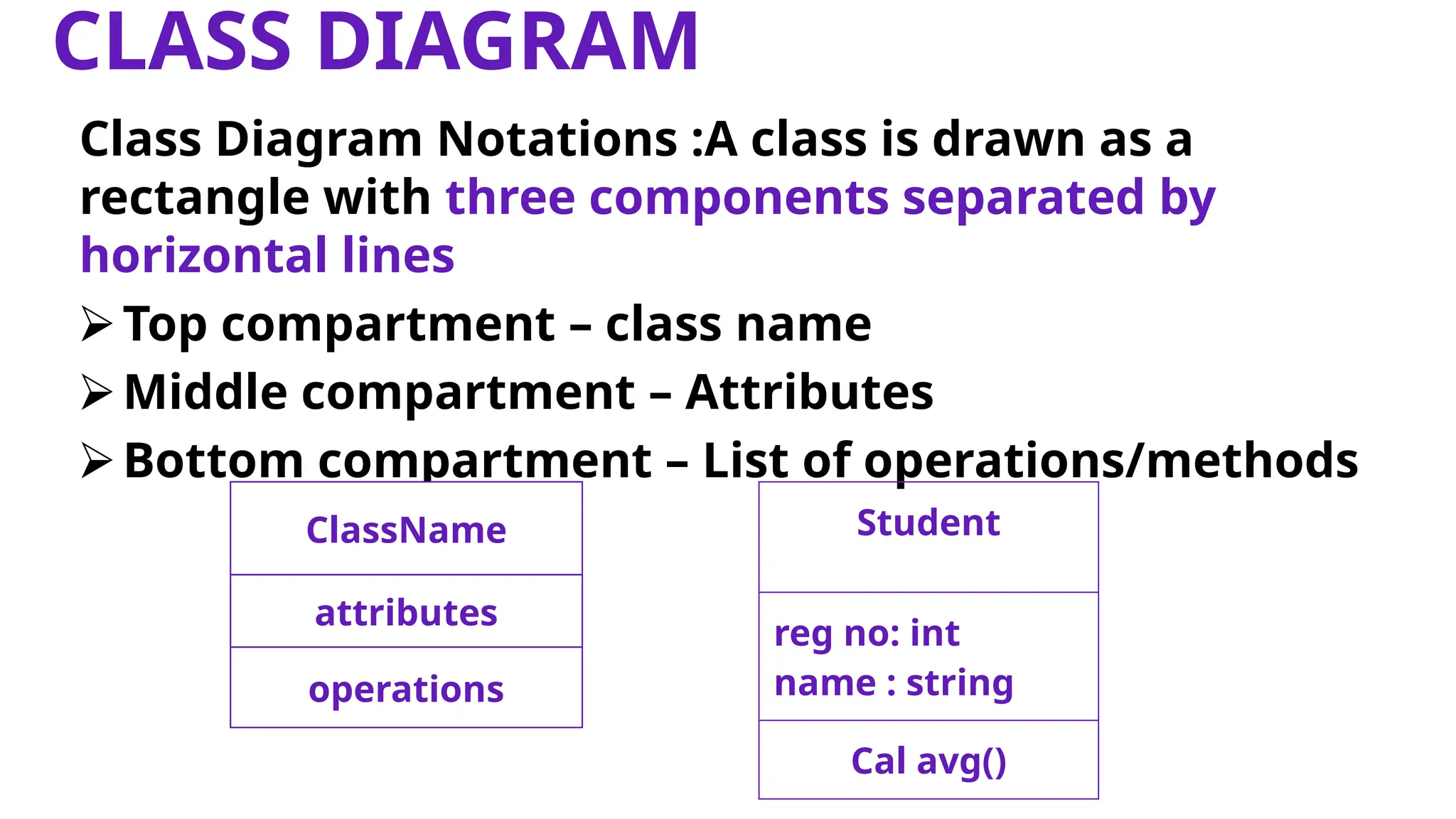
Class DiagramNotations :A class is drawn as a
rectangle with three components separated by
horizontal lines
⮚ Top compartment – class name
⮚ Middle compartment – Attributes
⮚ Bottom compartment – List of operations/methods
ClassName
attributes
operations
Student
reg no: int
name : string
Cal avg()
4.
Attributes in aClass
● Properties of the class about which
we want to capture information
● Represents a piece of information
that is relevant to the description of
the class within the application
domain
5.
Attributes in aClass
Only add attributes that are primitive or
atomic types
Derived attribute
● attributes that are calculated or derived from
other attributes
● denoted by placing slash (/) before name
Examples: age (subtracting birth date from current
date), GPA (calculated from grades and credit
hours)
6.
Attributes in aClass
attributes (fields, instance variables)
Syntax: visibility name : type [count] = default_value
visibility: + public
# protected
- private
/ derived
underline static attributes
derived attribute: not stored, but can be computed
from other attribute values
attribute example:
- balance : double = 0.00
Operations in aClass
● Represents the actions or functions that a
class can perform
● Can be classified as a constructor, query,
or update operation
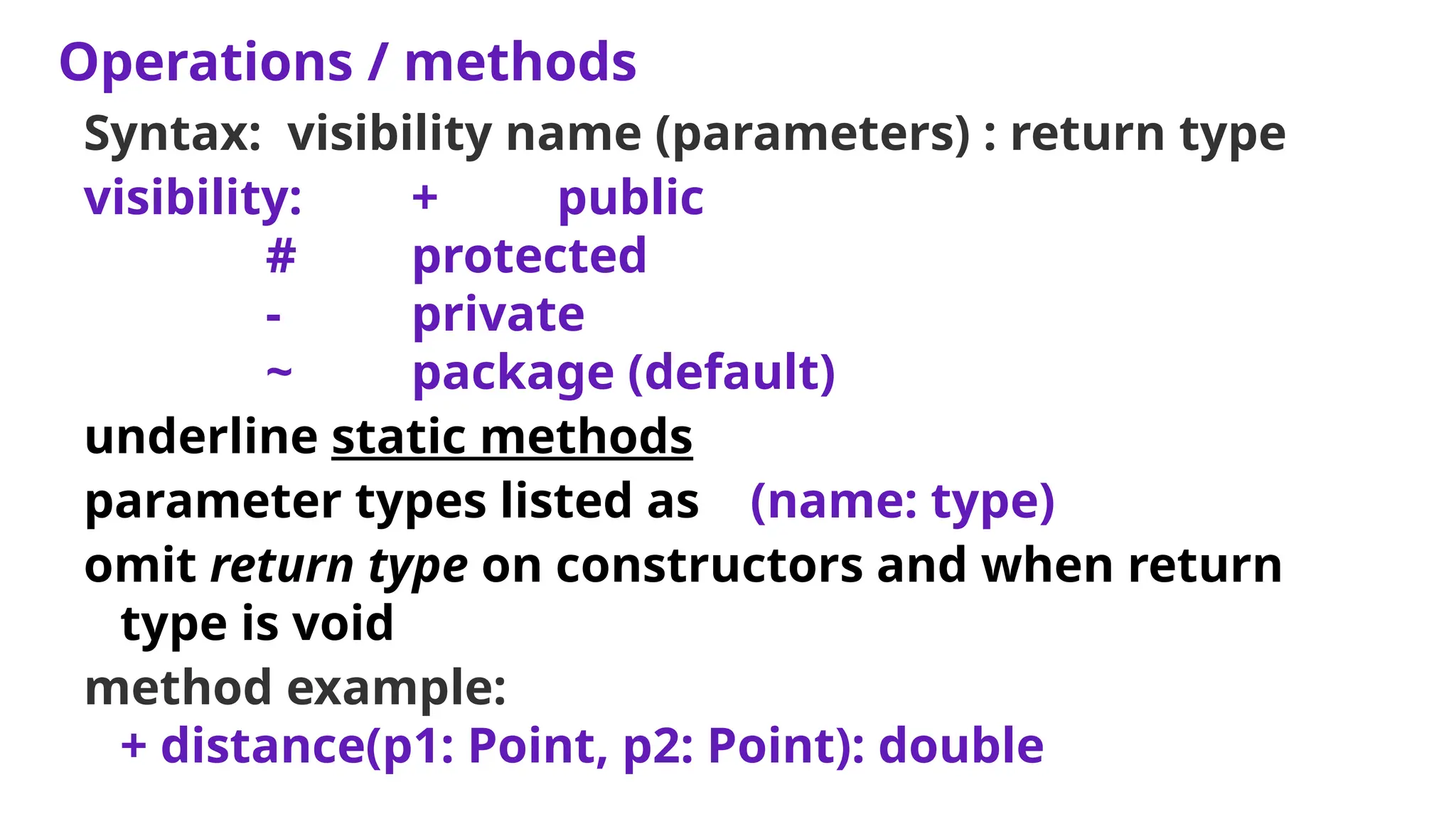
10.
Operations / methods
Syntax:visibility name (parameters) : return type
visibility: + public
# protected
- private
~ package (default)
underline static methods
parameter types listed as (name: type)
omit return type on constructors and when return
type is void
method example:
+ distance(p1: Point, p2: Point): double
11.
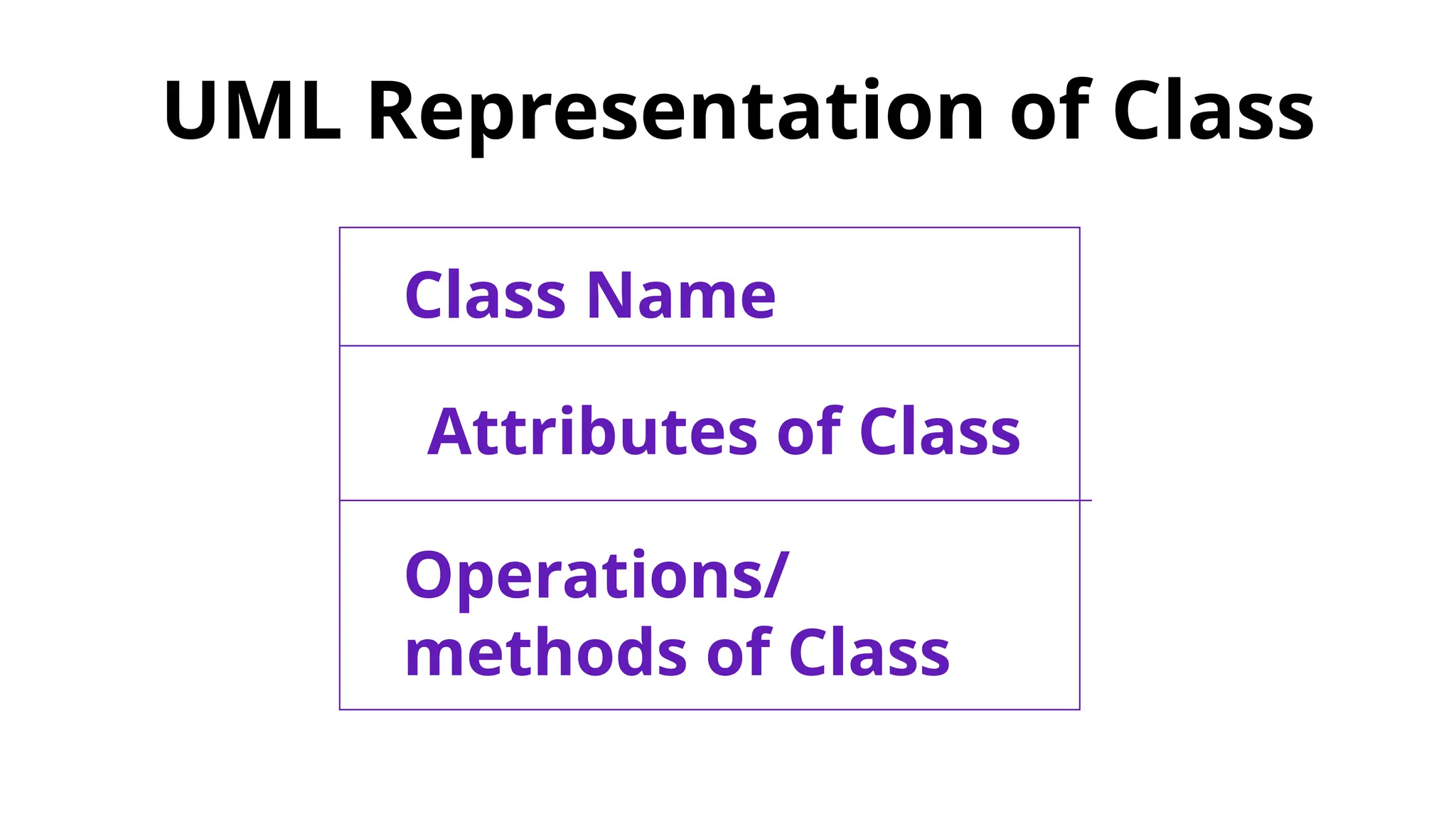
UML Representation ofClass
Class Name
Attributes of Class
Operations/
methods of Class
12.
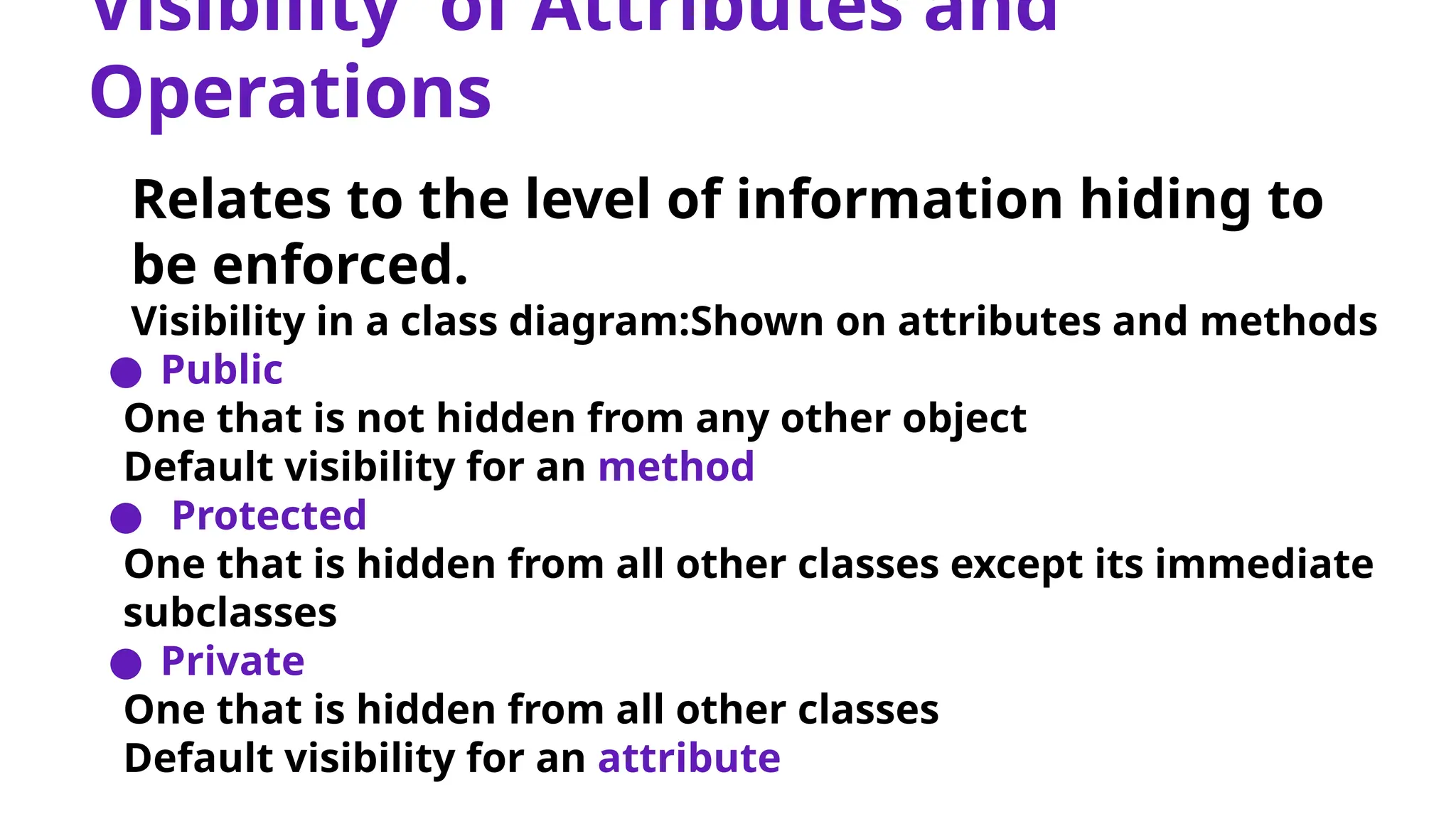
Visibility of Attributesand
Operations
Relates to the level of information hiding to
be enforced.
Visibility in a class diagram:Shown on attributes and methods
● Public
One that is not hidden from any other object
Default visibility for an method
● Protected
One that is hidden from all other classes except its immediate
subclasses
● Private
One that is hidden from all other classes
Default visibility for an attribute
13.
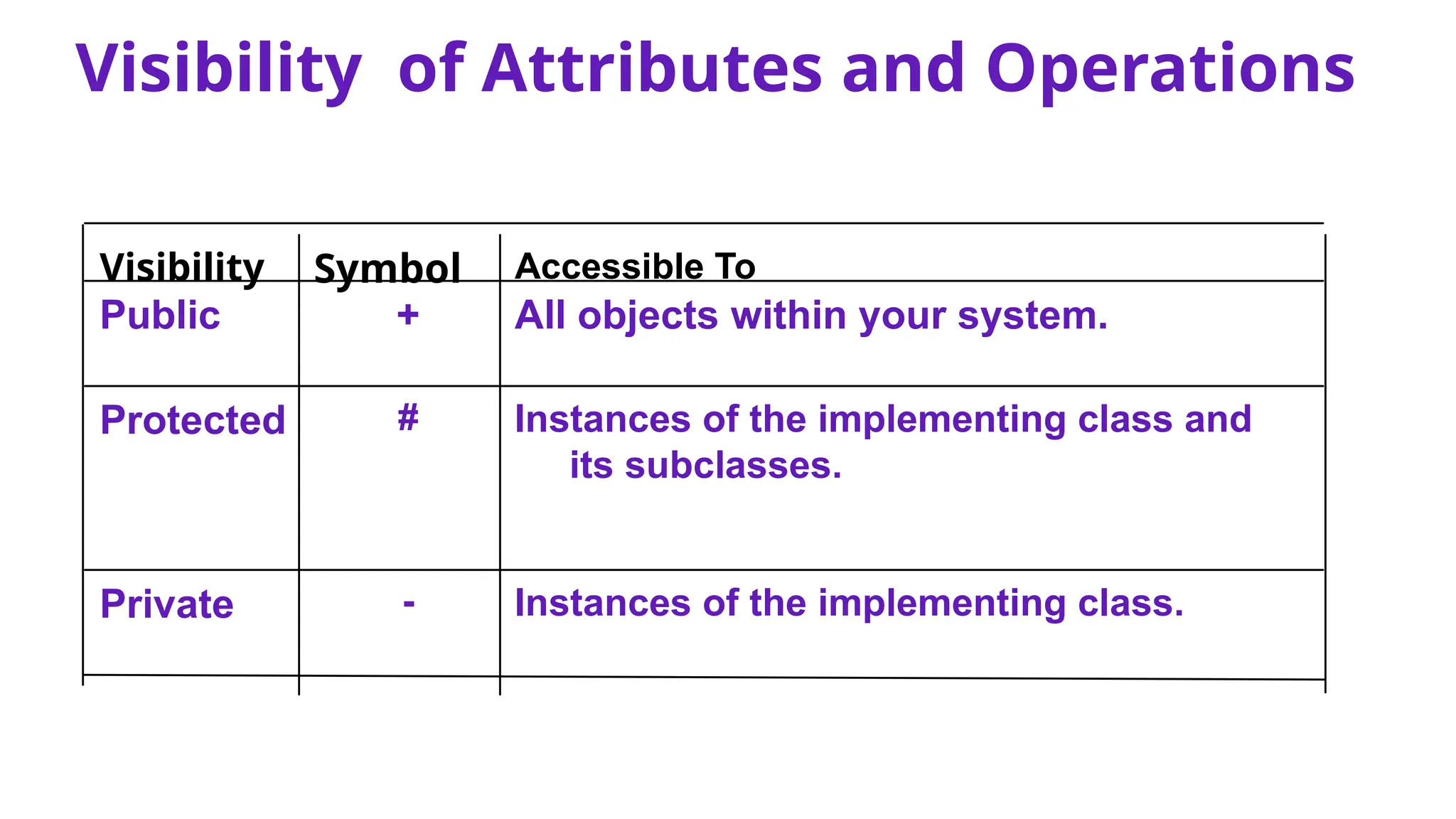
Visibility of Attributesand Operations
Instances of the implementing class.
-
Private
Instances of the implementing class and
its subclasses.
#
Protected
All objects within your system.
+
Public
Accessible To
Symbol
Visibility
14.
Relationships among Classes
▪One of primary purposes of a class diagram is
to show the relationships that classes have
with other another
▪ All systems are made up of many
classes/objects; system behavior is achieved
through the collaborations of the objects of
the system
15.
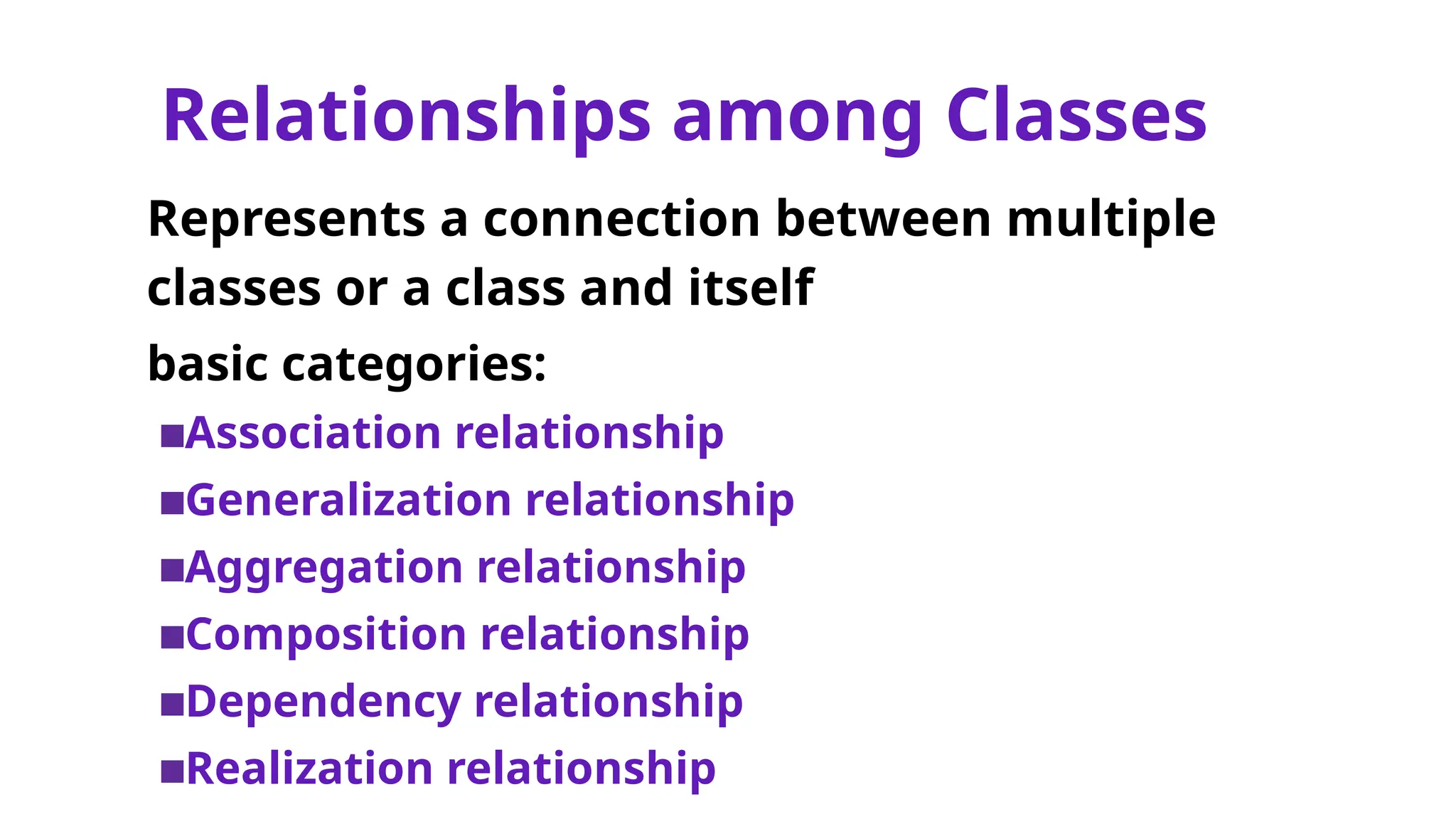
Relationships among Classes
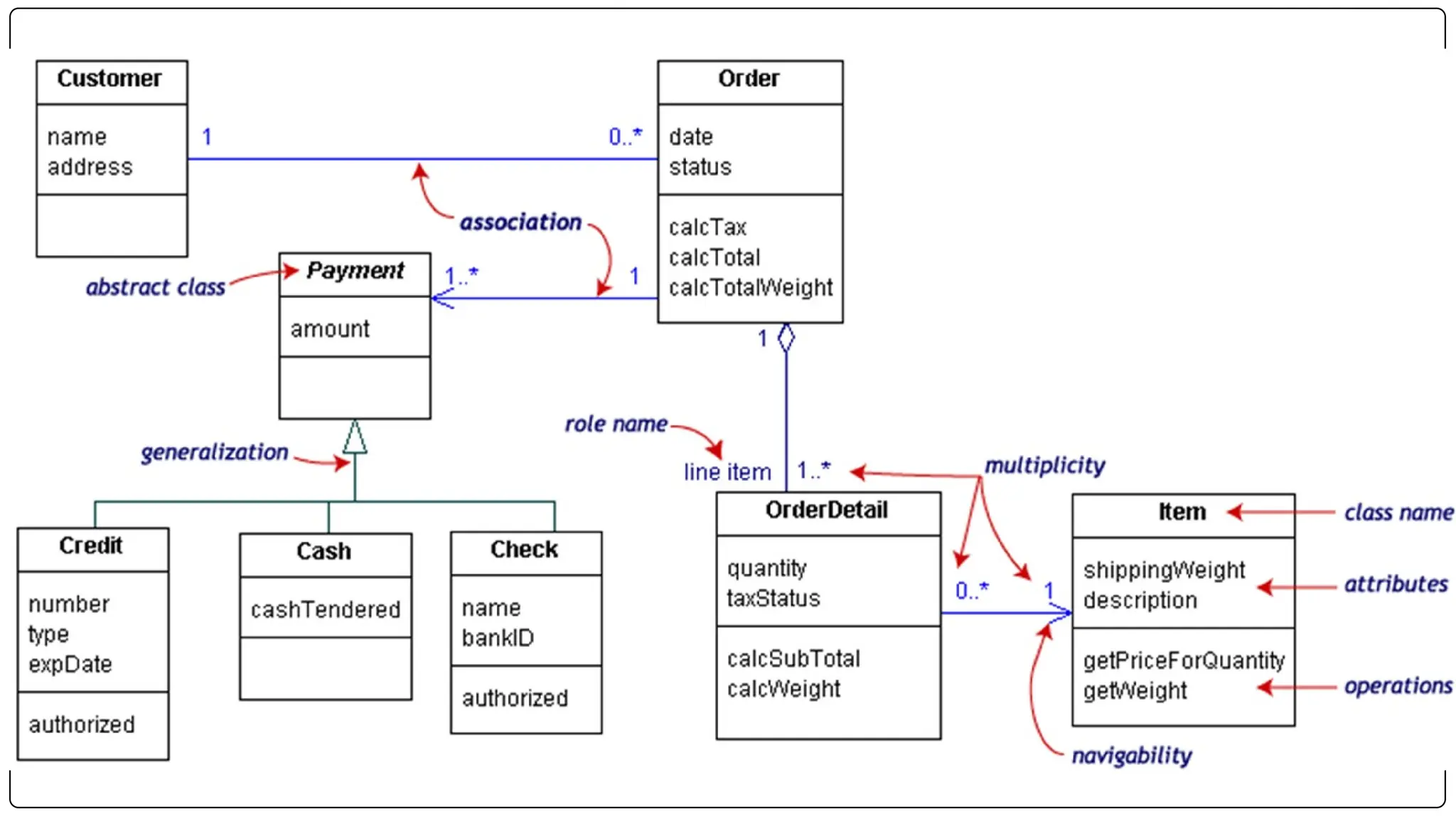
Representsa connection between multiple
classes or a class and itself
basic categories:
▪Association relationship
▪Generalization relationship
▪Aggregation relationship
▪Composition relationship
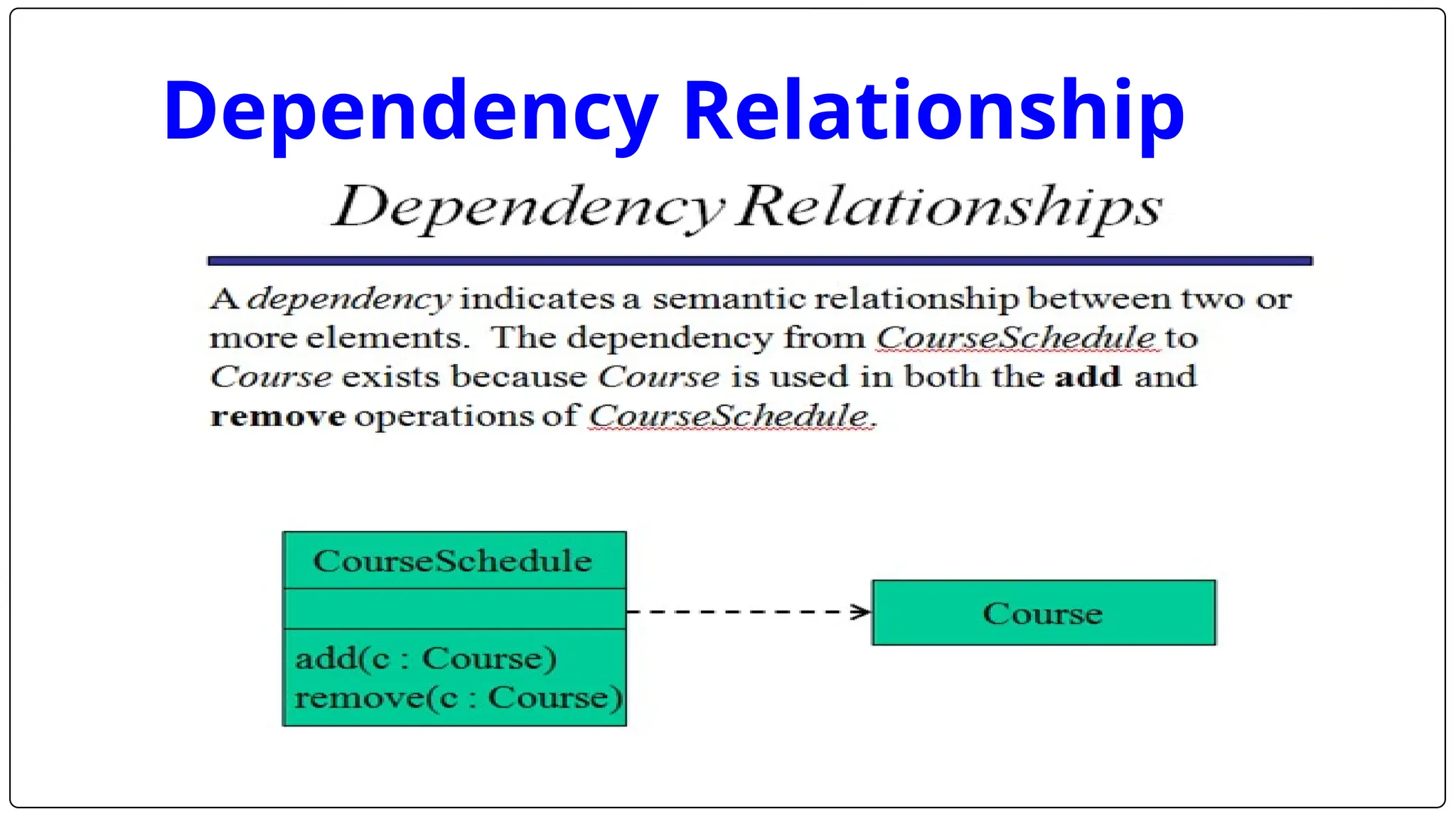
▪Dependency relationship
▪Realization relationship
16.
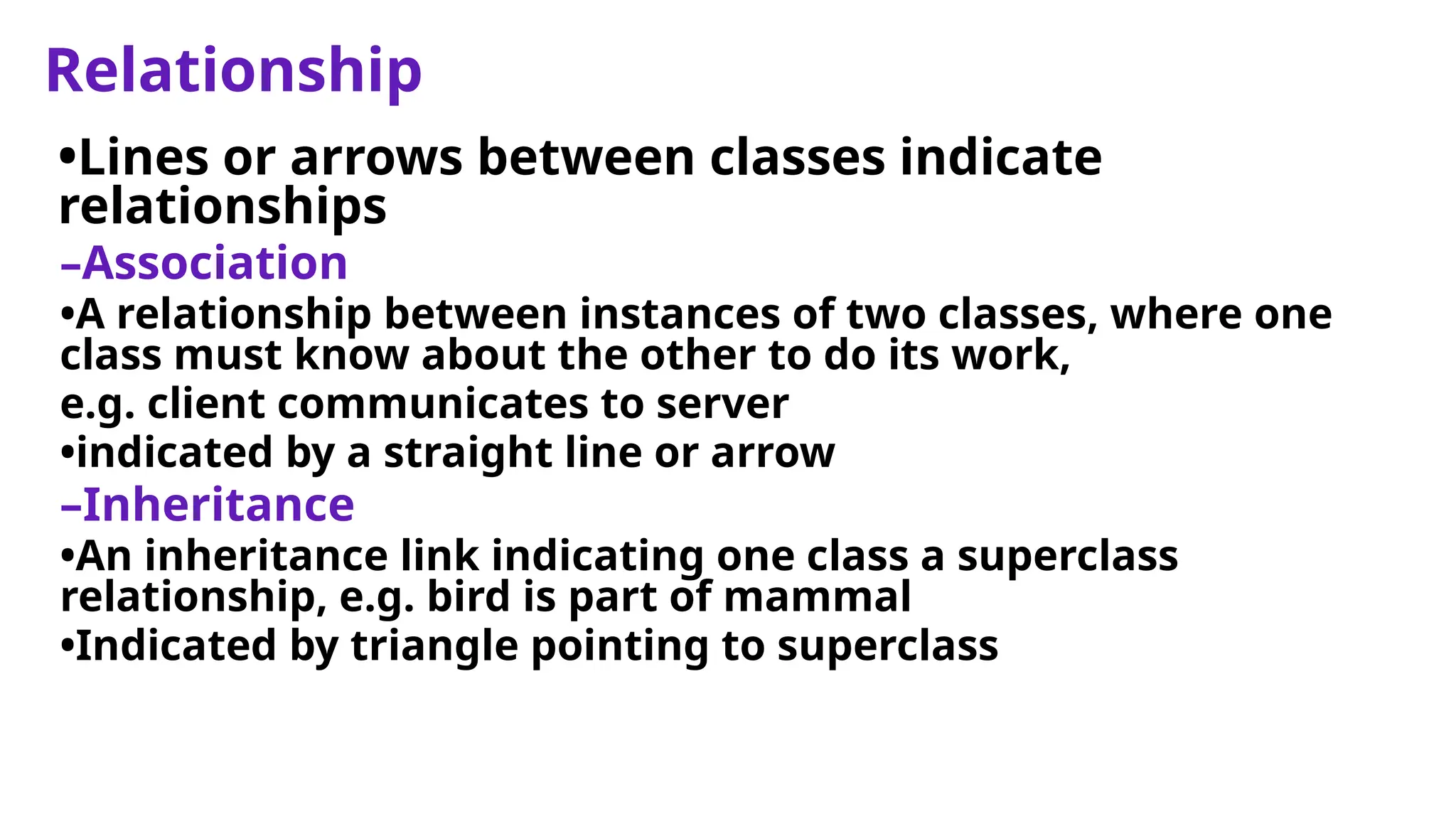
Relationship
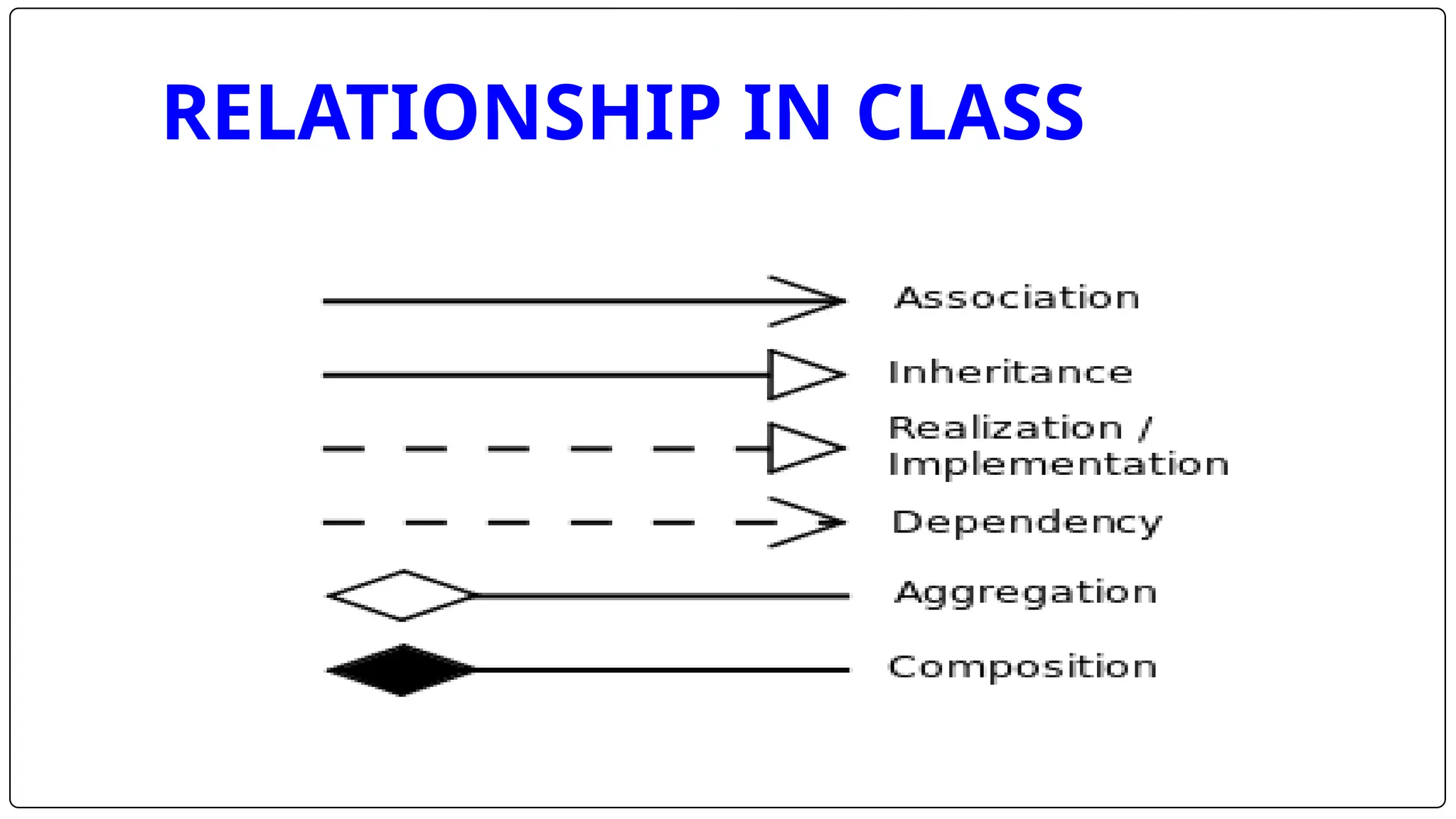
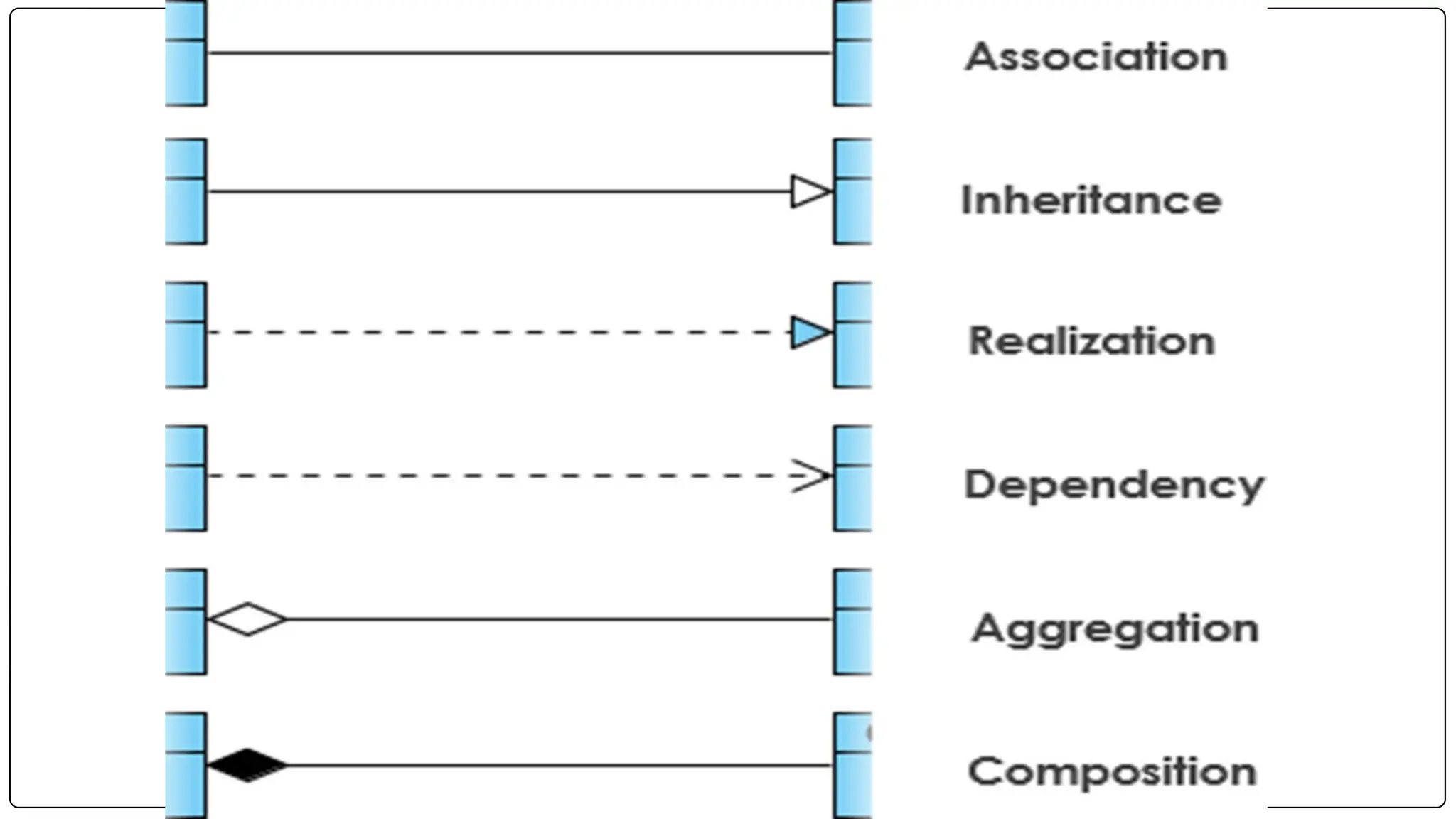
•Lines or arrowsbetween classes indicate
relationships
–Association
•A relationship between instances of two classes, where one
class must know about the other to do its work,
e.g. client communicates to server
•indicated by a straight line or arrow
–Inheritance
•An inheritance link indicating one class a superclass
relationship, e.g. bird is part of mammal
•Indicated by triangle pointing to superclass
17.
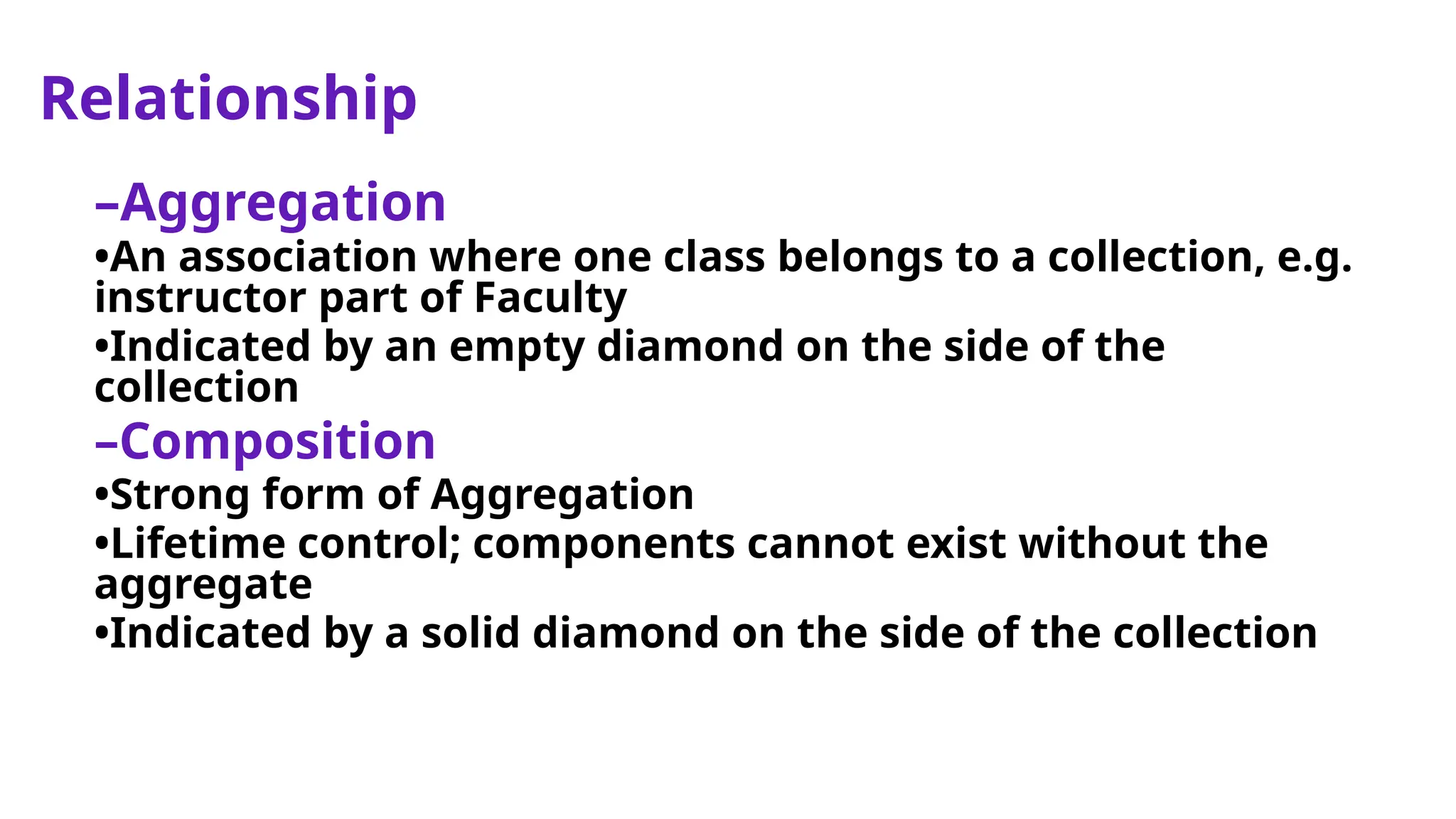
Relationship
–Aggregation
•An association whereone class belongs to a collection, e.g.
instructor part of Faculty
•Indicated by an empty diamond on the side of the
collection
–Composition
•Strong form of Aggregation
•Lifetime control; components cannot exist without the
aggregate
•Indicated by a solid diamond on the side of the collection
18.
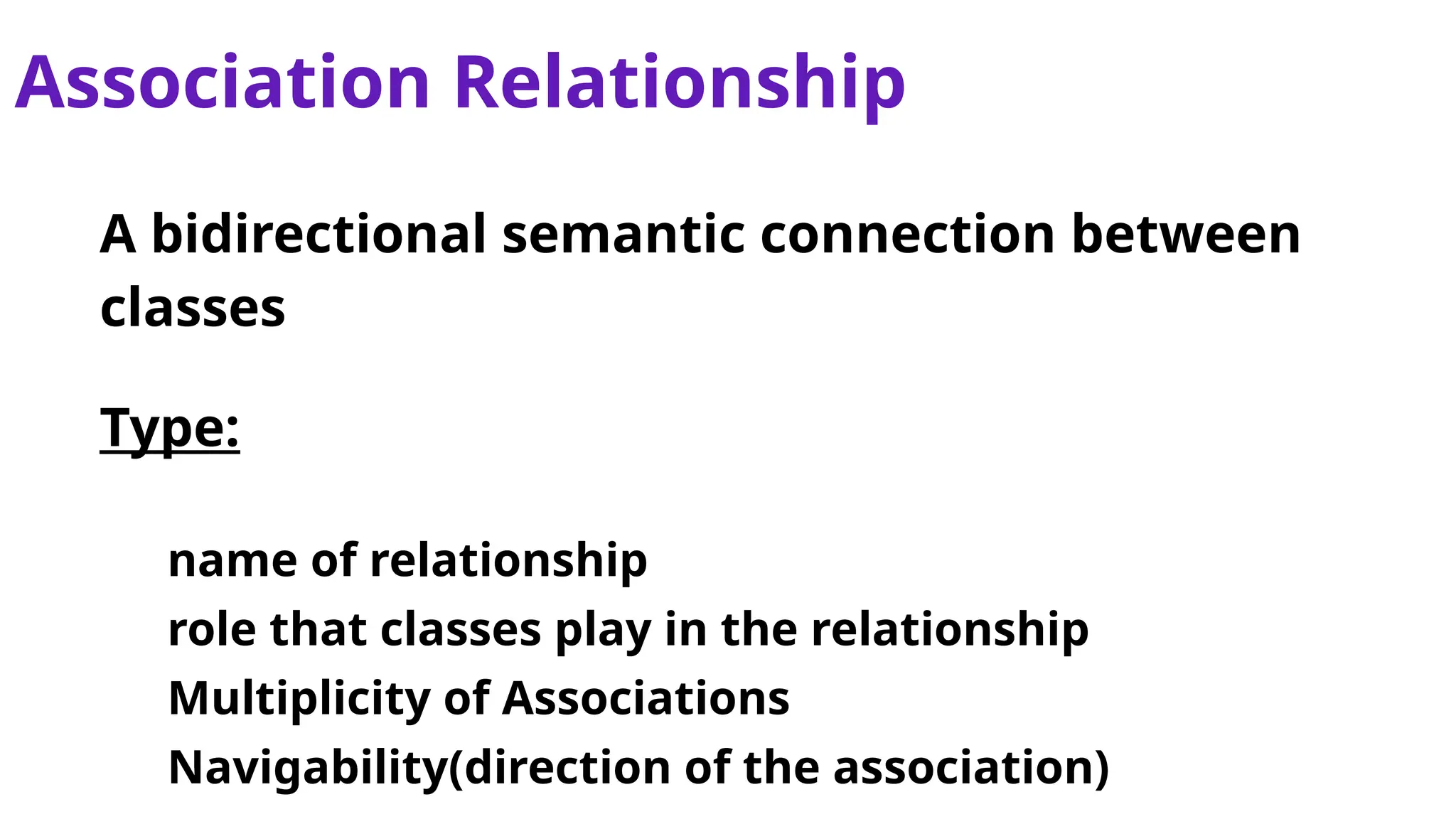
Association Relationship
A bidirectionalsemantic connection between
classes
Type:
name of relationship
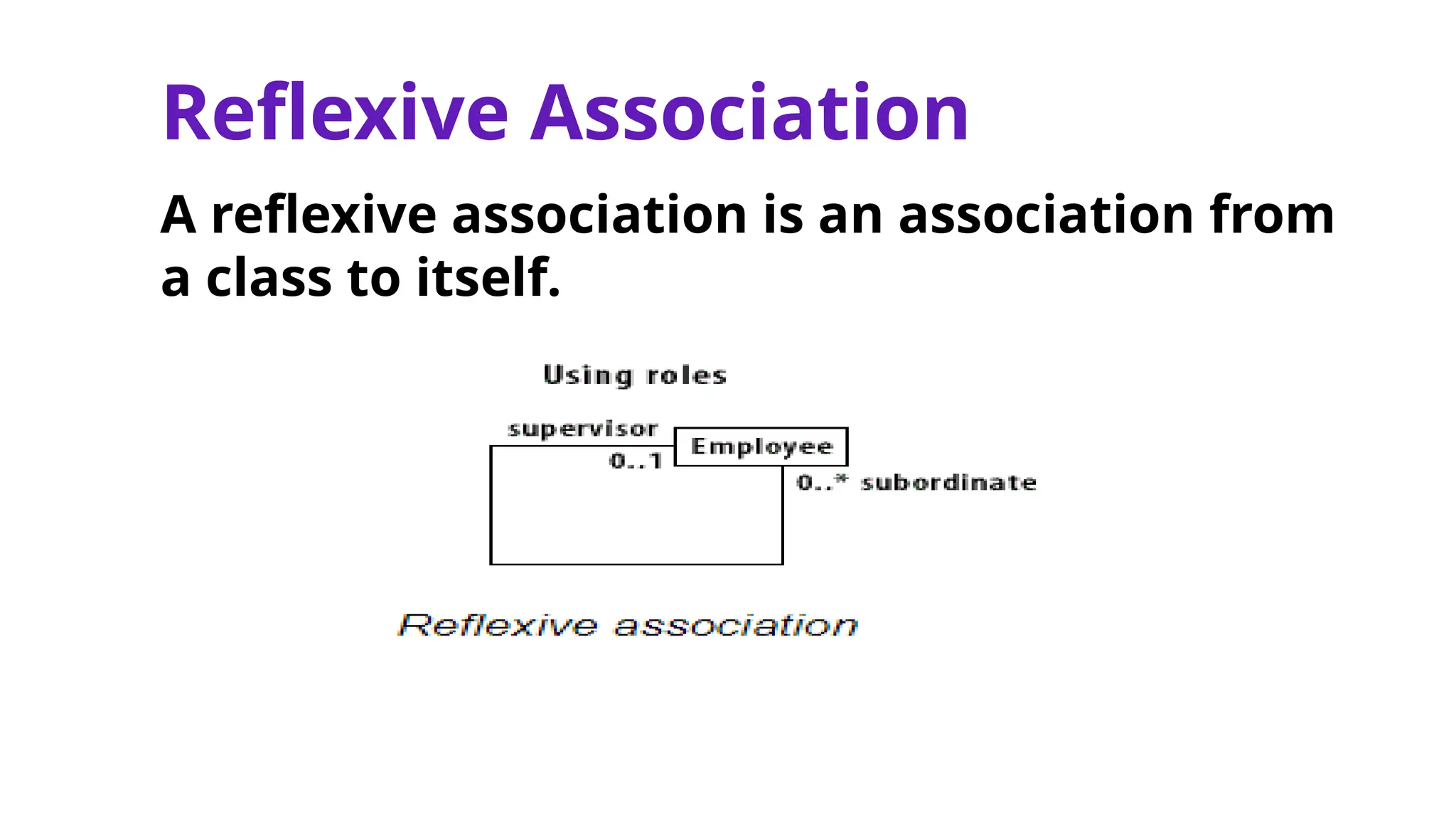
role that classes play in the relationship
Multiplicity of Associations
Navigability(direction of the association)
19.
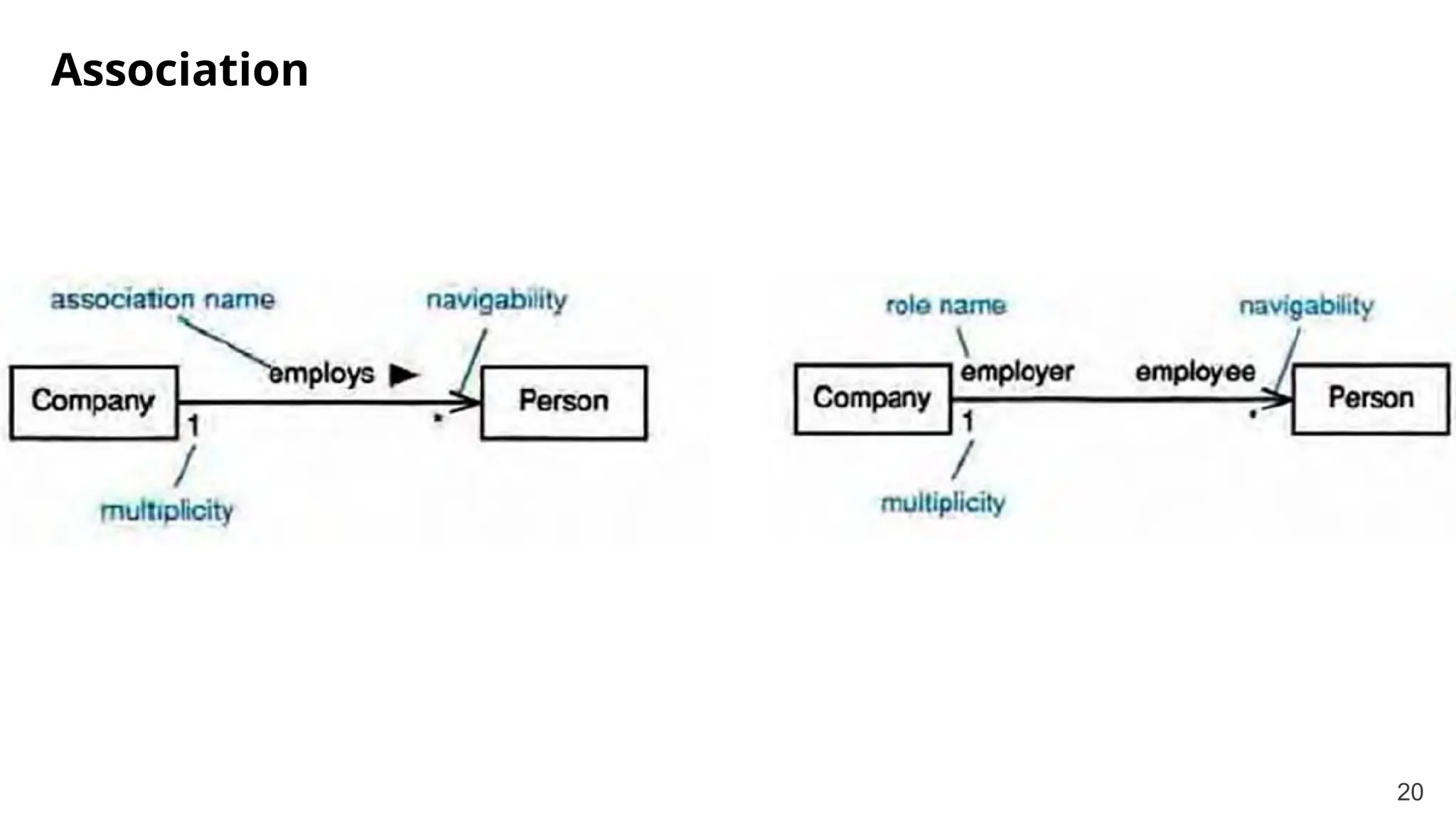
Association
19
◼Associations may optionallyhave the
following:
▪ Association name
◻ may be prefixed or postfixed with a small black arrowhead to indicate
the direction in which the name should be read, should be a verb or
verb phrase;
▪ Role names
◻ on one or both association ends;
◻ should be a noun or noun phrase describing the semantics of the role;
▪ Multiplicity
▪ The number of objects that can participate in an instantiated relation
▪ Navigability
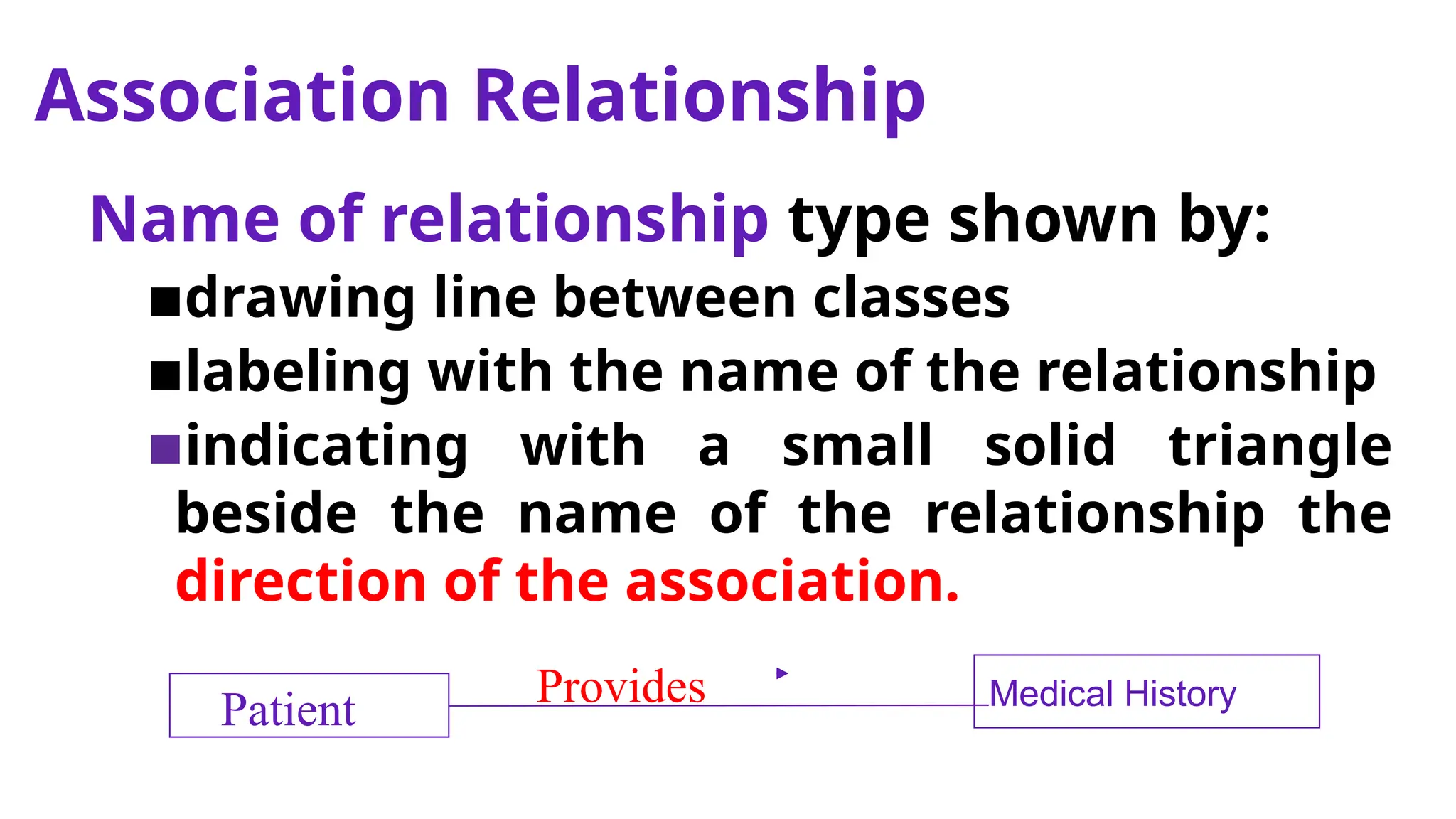
Association Relationship
Name ofrelationship type shown by:
▪drawing line between classes
▪labeling with the name of the relationship
▪indicating with a small solid triangle
beside the name of the relationship the
direction of the association.
Medical History
Provides
Patient
22.
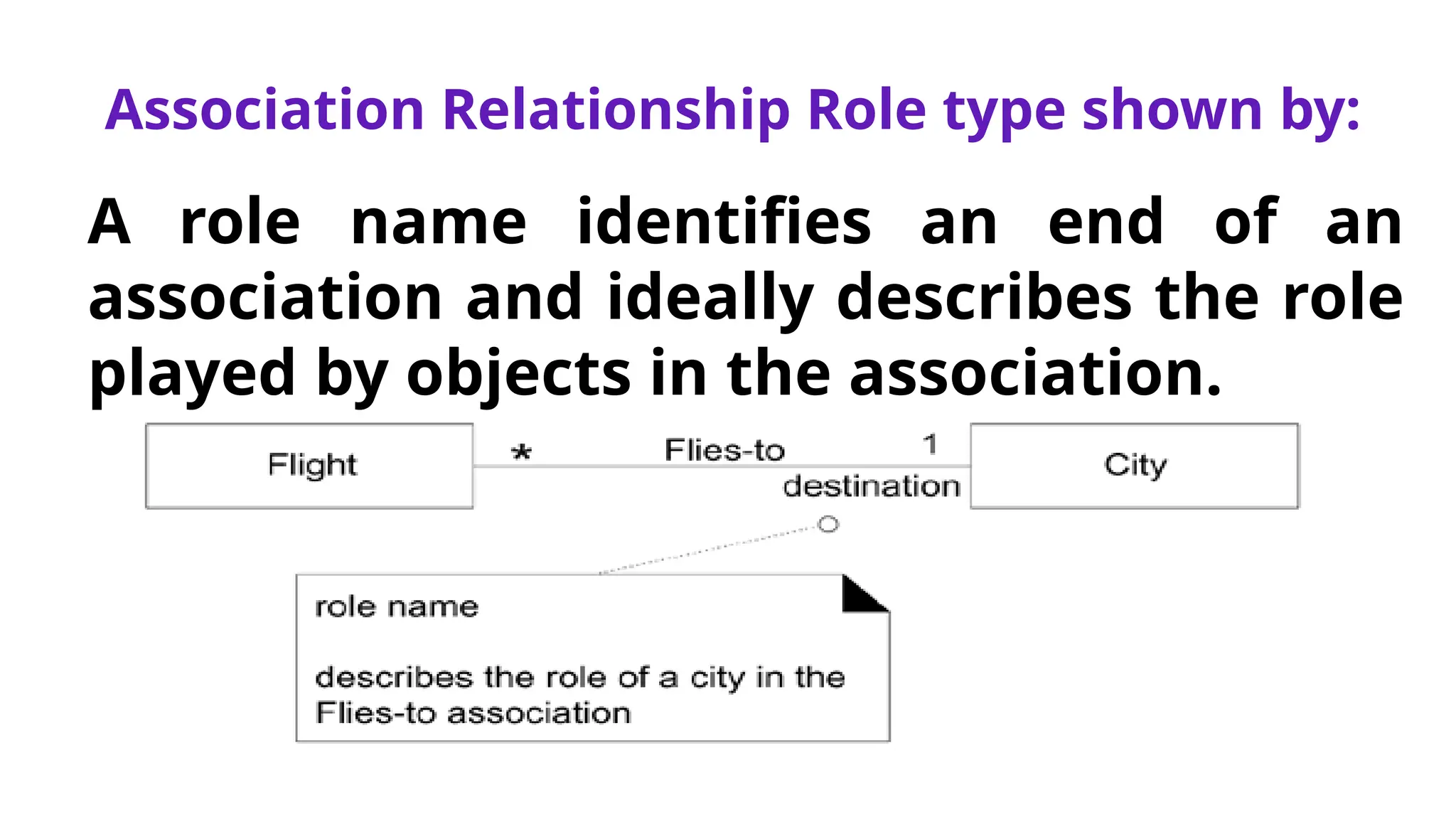
Association Relationship Roletype shown by:
A role name identifies an end of an
association and ideally describes the role
played by objects in the association.
23.
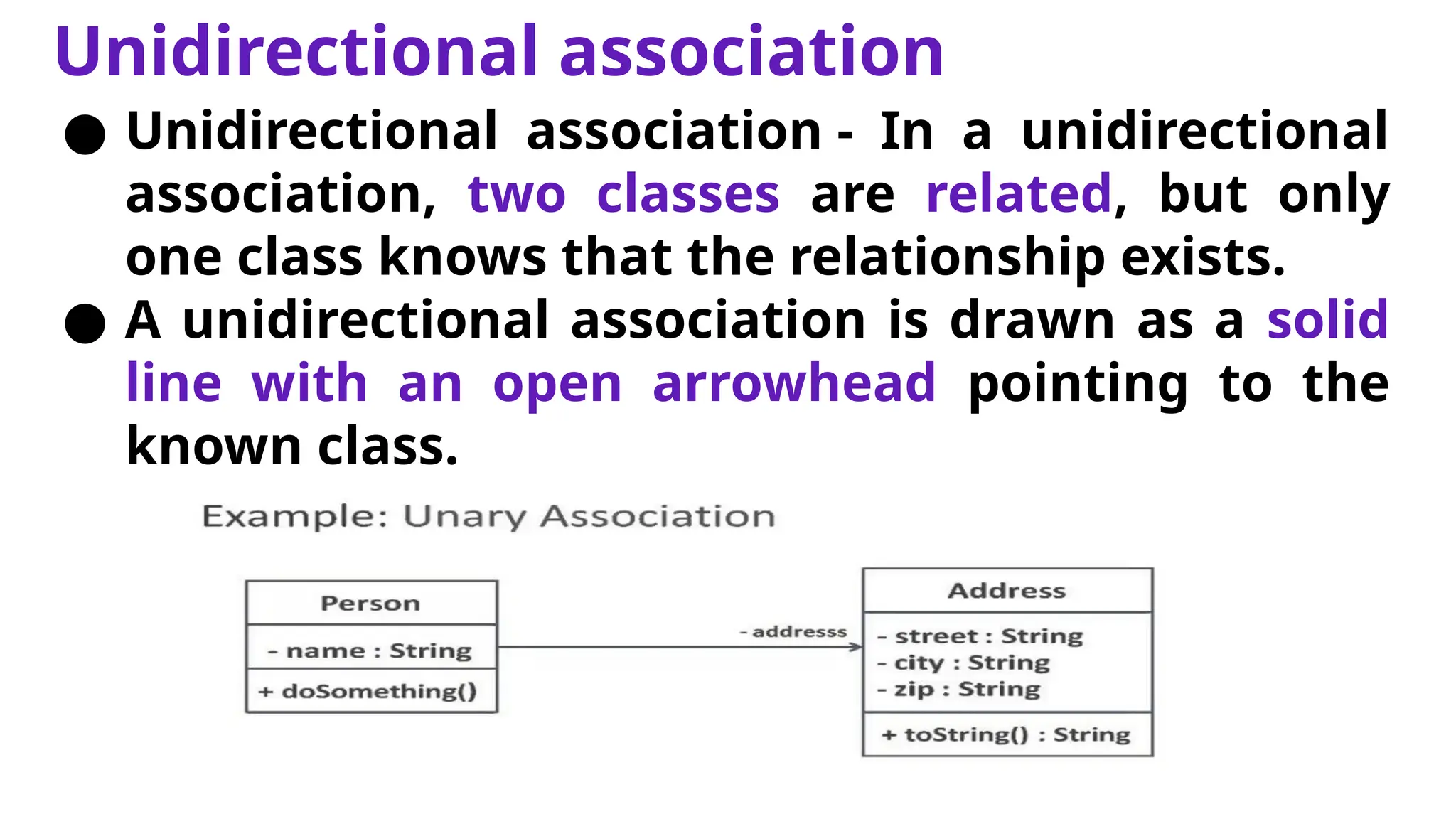
Unidirectional association
● Unidirectionalassociation - In a unidirectional
association, two classes are related, but only
one class knows that the relationship exists.
● A unidirectional association is drawn as a solid
line with an open arrowhead pointing to the
known class.
24.
Bidirectional (standard) association
●Bidirectional (standard) association - An
association is a linkage between two
classes.
● Associations are always assumed to be bi-
directional; this means that both classes
are aware of each other and their
relationship.
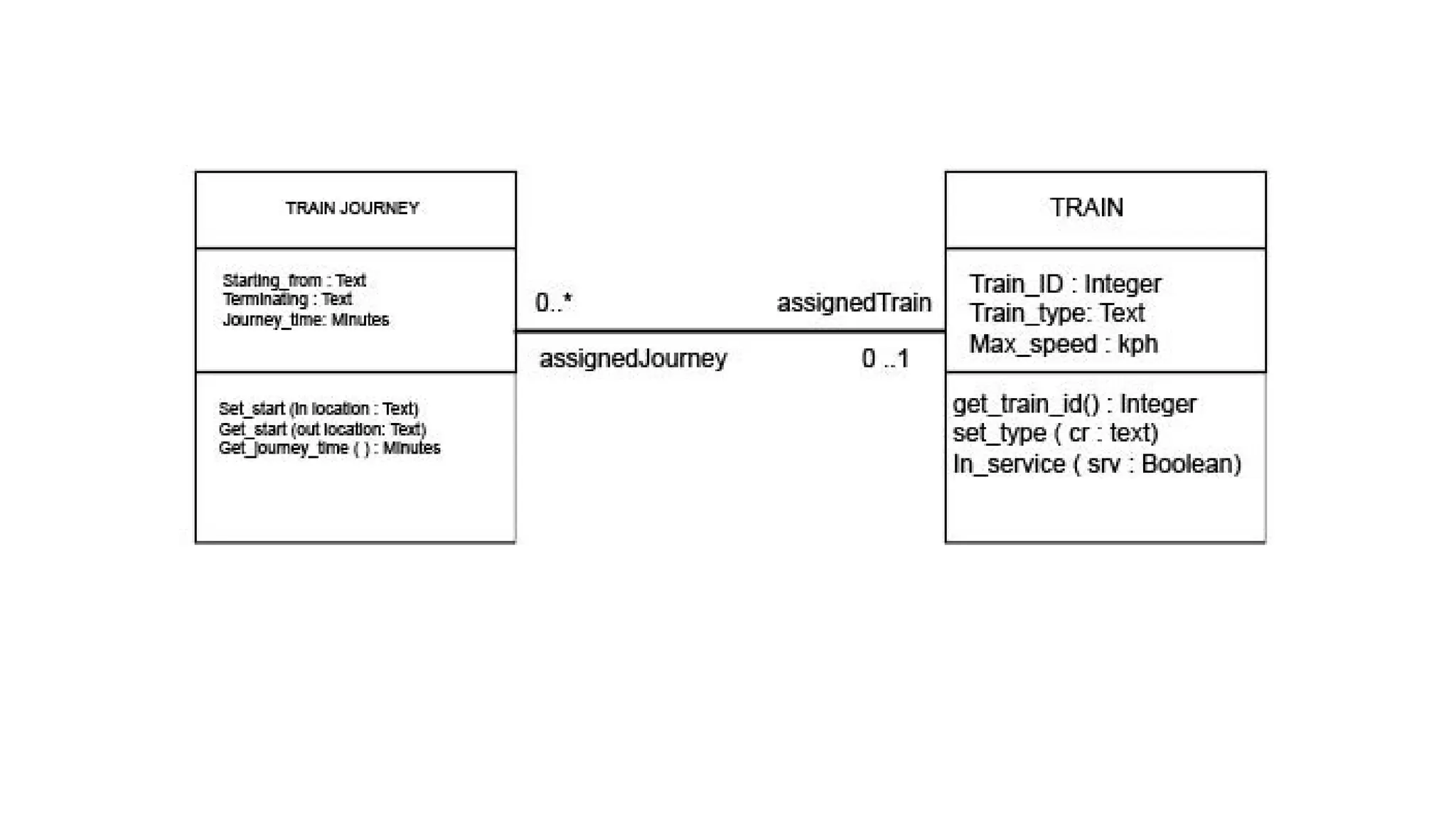
● A bi-directional association is indicated by
a solid line between the two classes.
26.
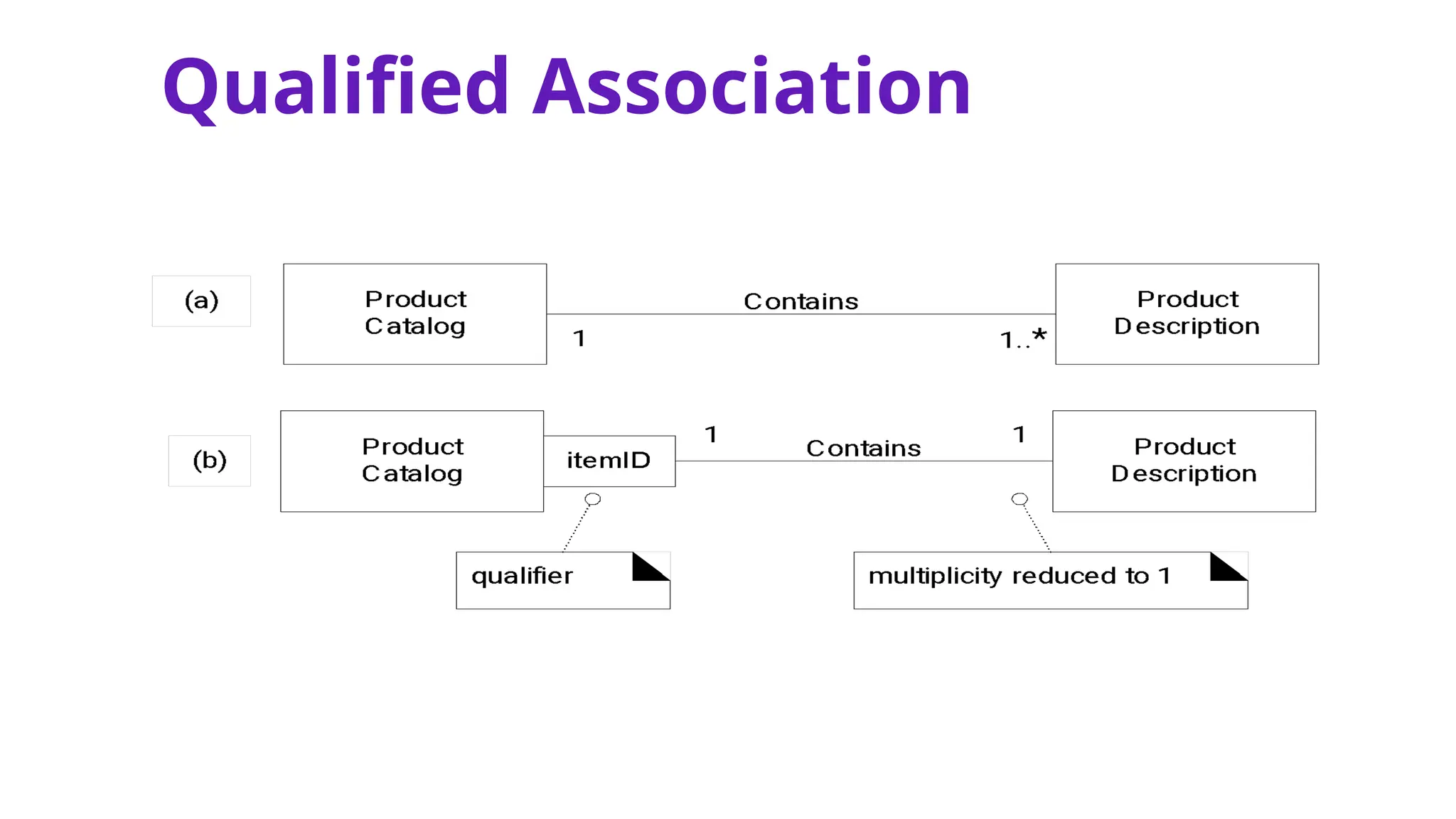
Qualified Association
A qualifiedassociation has a qualifier that is
used to select an object (or objects) from a
larger set of related objects, based upon the
qualifier key.
For example, if a ProductCatalog contains many
ProductDescriptions, and each one can be
selected by an itemID
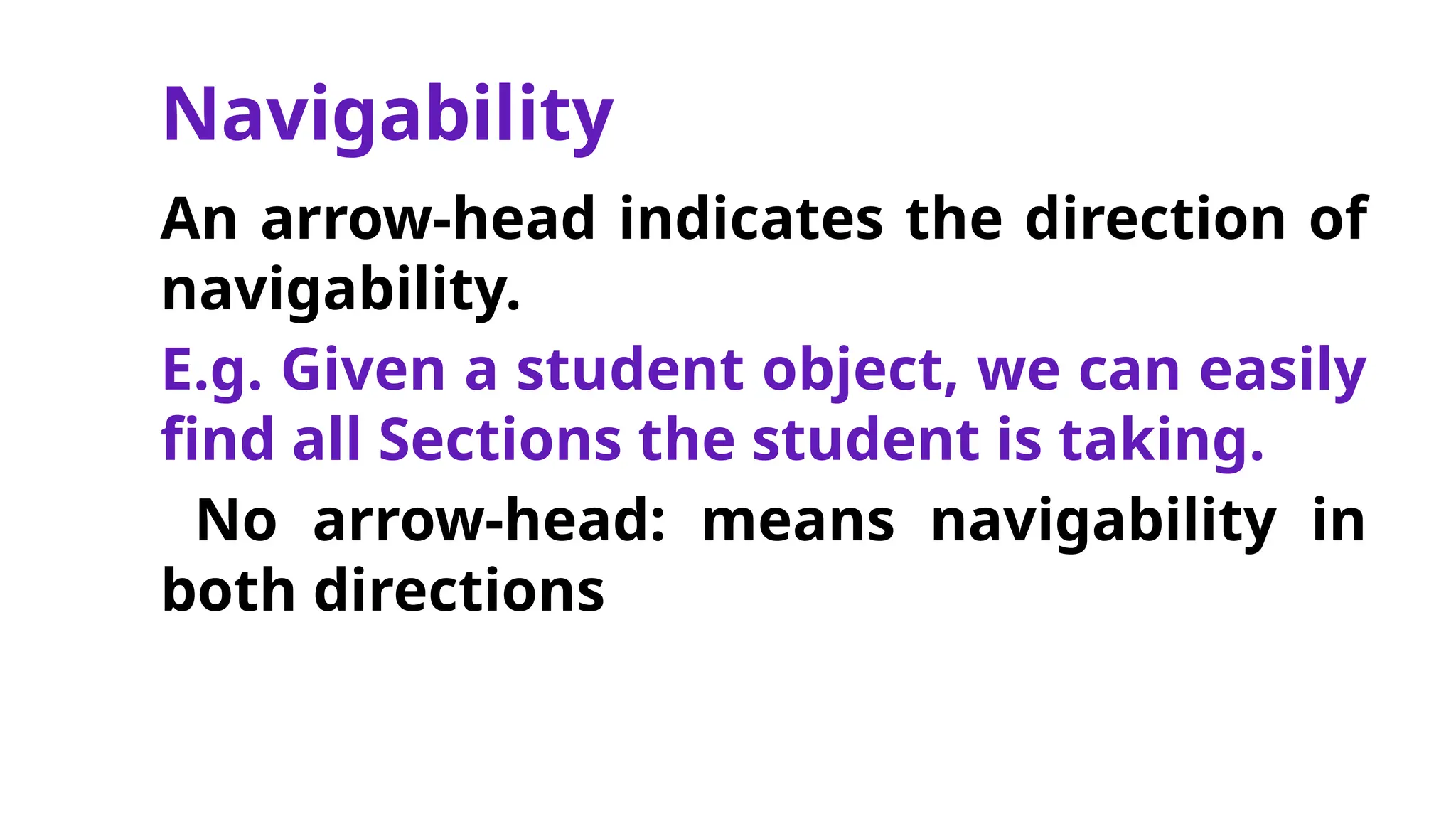
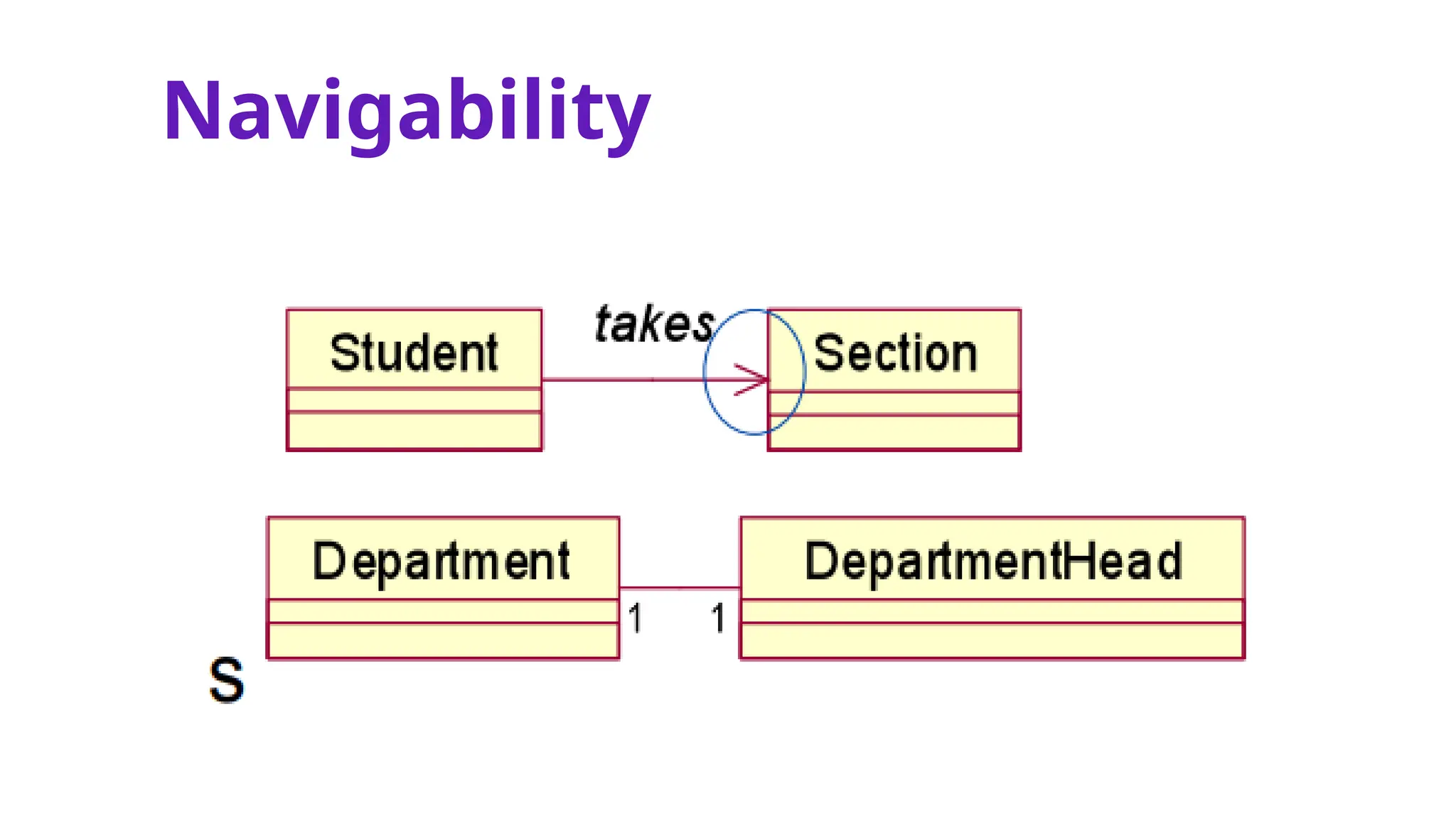
Navigability
An arrow-head indicatesthe direction of
navigability.
E.g. Given a student object, we can easily
find all Sections the student is taking.
No arrow-head: means navigability in
both directions
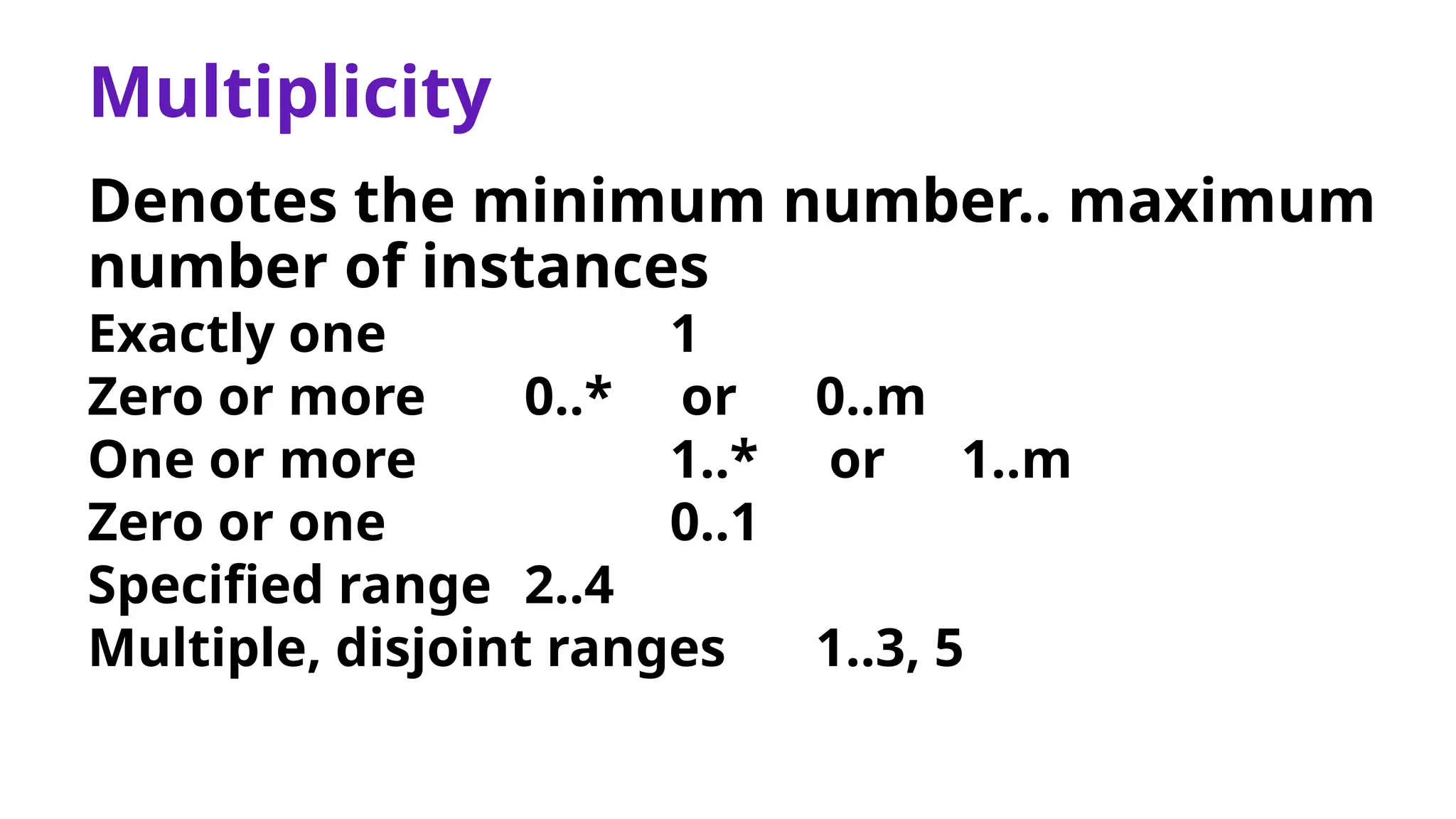
Multiplicity
Denotes the minimumnumber.. maximum
number of instances
Exactly one 1
Zero or more 0..* or 0..m
One or more 1..* or 1..m
Zero or one 0..1
Specified range 2..4
Multiple, disjoint ranges 1..3, 5
32.
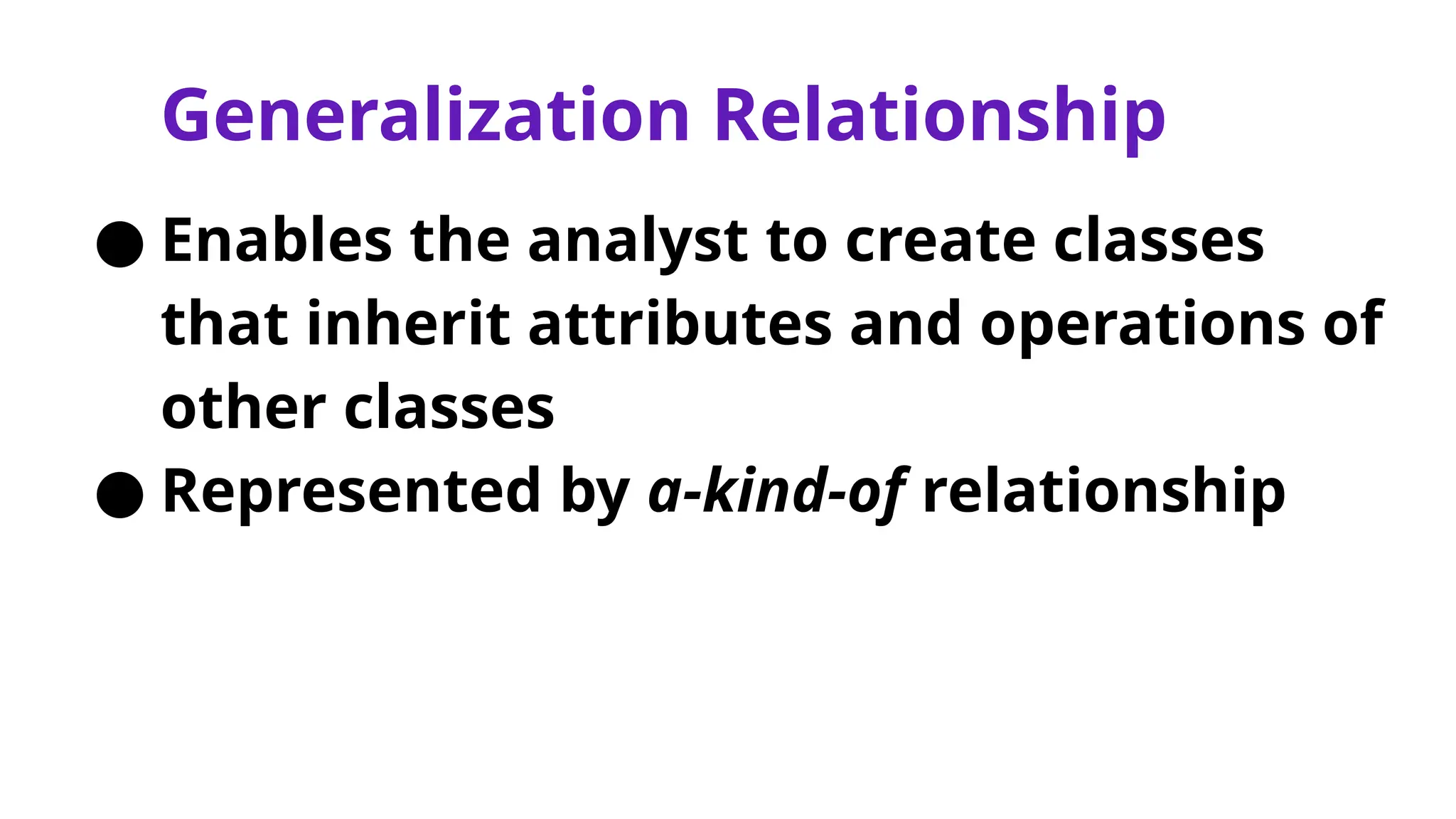
Generalization Relationship
● Enablesthe analyst to create classes
that inherit attributes and operations of
other classes
● Represented by a-kind-of relationship
33.
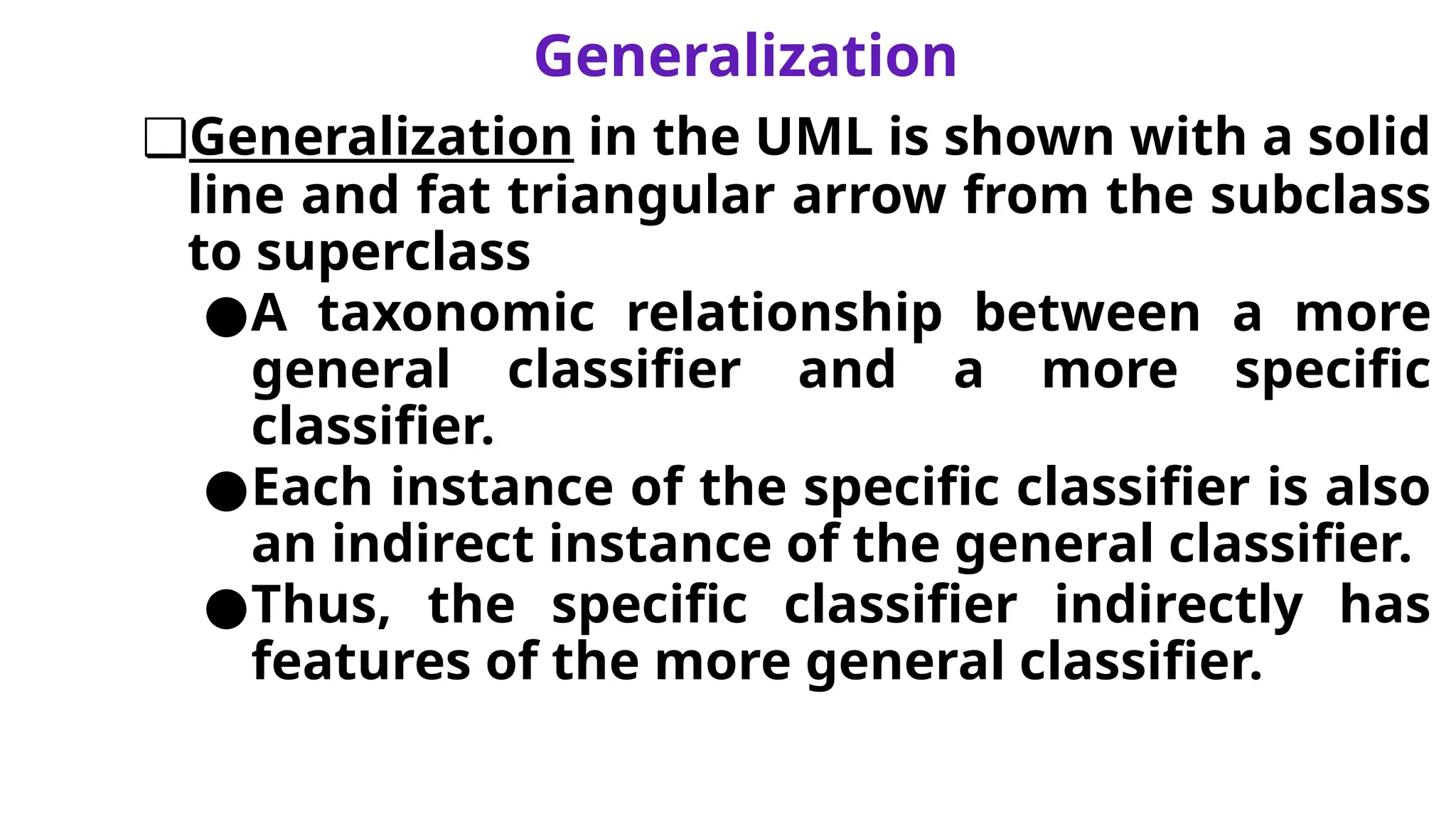
Generalization
❑Generalization in theUML is shown with a solid
line and fat triangular arrow from the subclass
to superclass
●A taxonomic relationship between a more
general classifier and a more specific
classifier.
●Each instance of the specific classifier is also
an indirect instance of the general classifier.
●Thus, the specific classifier indirectly has
features of the more general classifier.
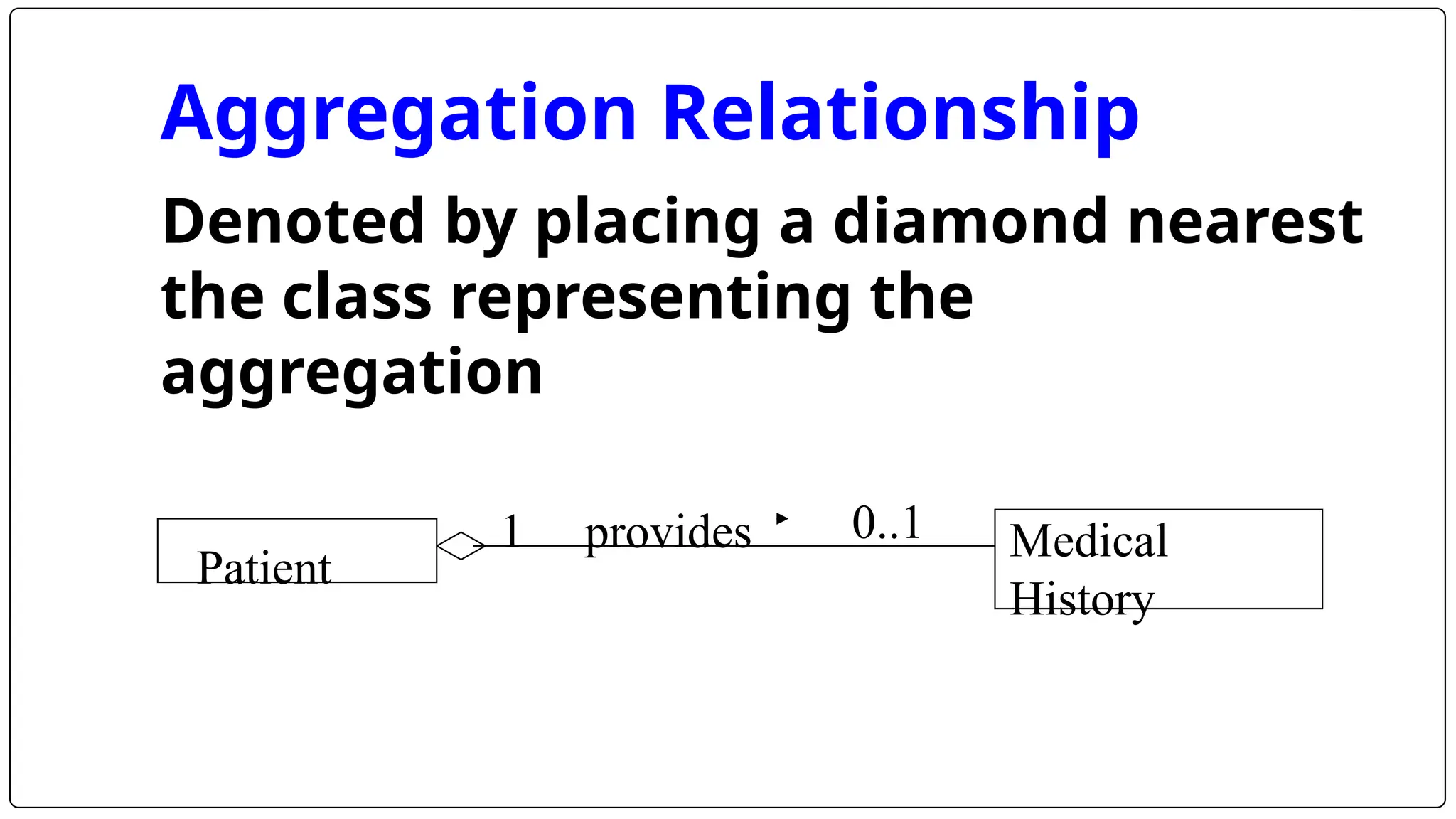
Aggregation Relationship
⚫ Specializedform of association in which a
whole is related to its part(s)
⚫ Represented by a-part-of relationship
⚫ Aggregation is a special case of
association.
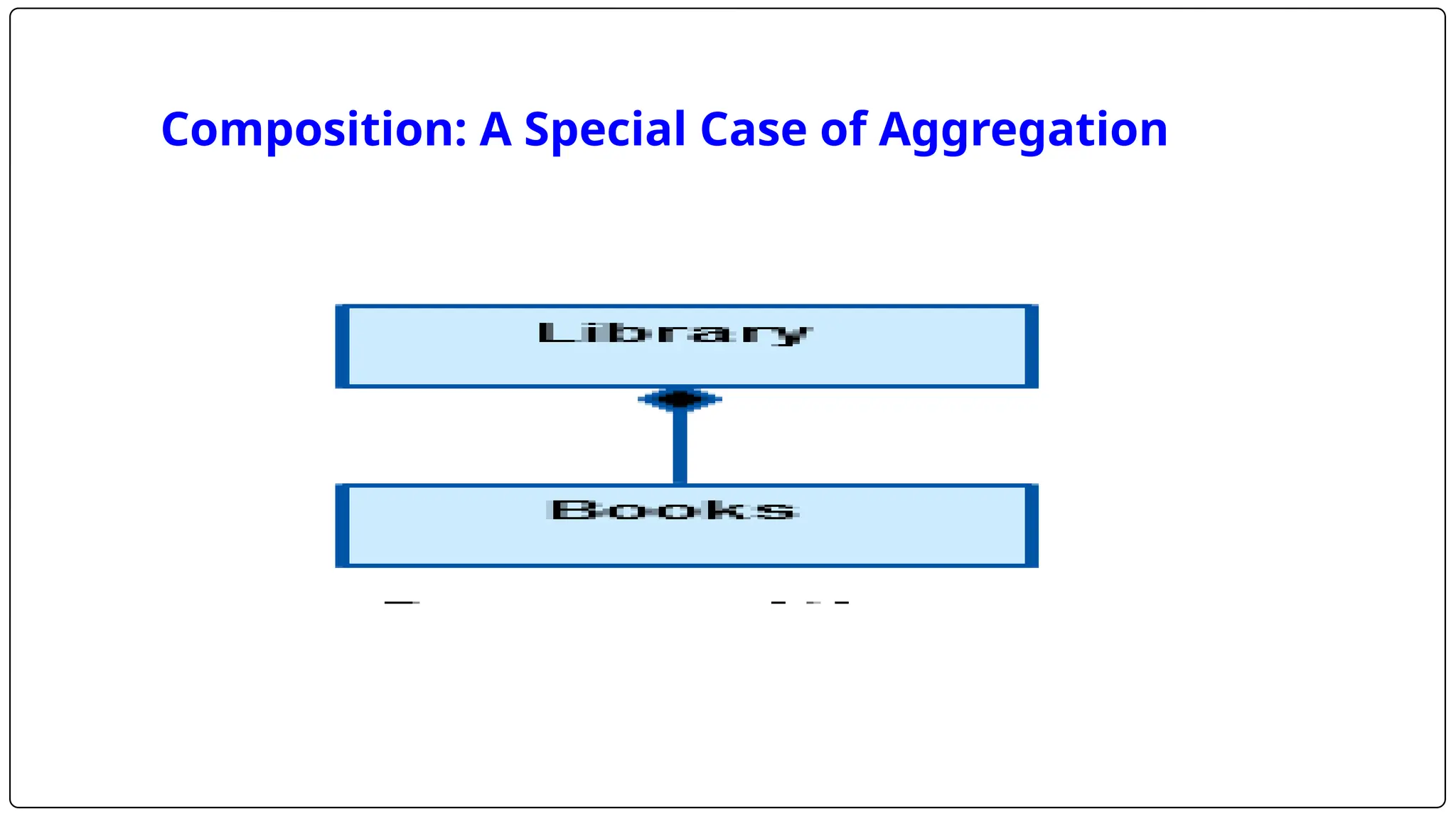
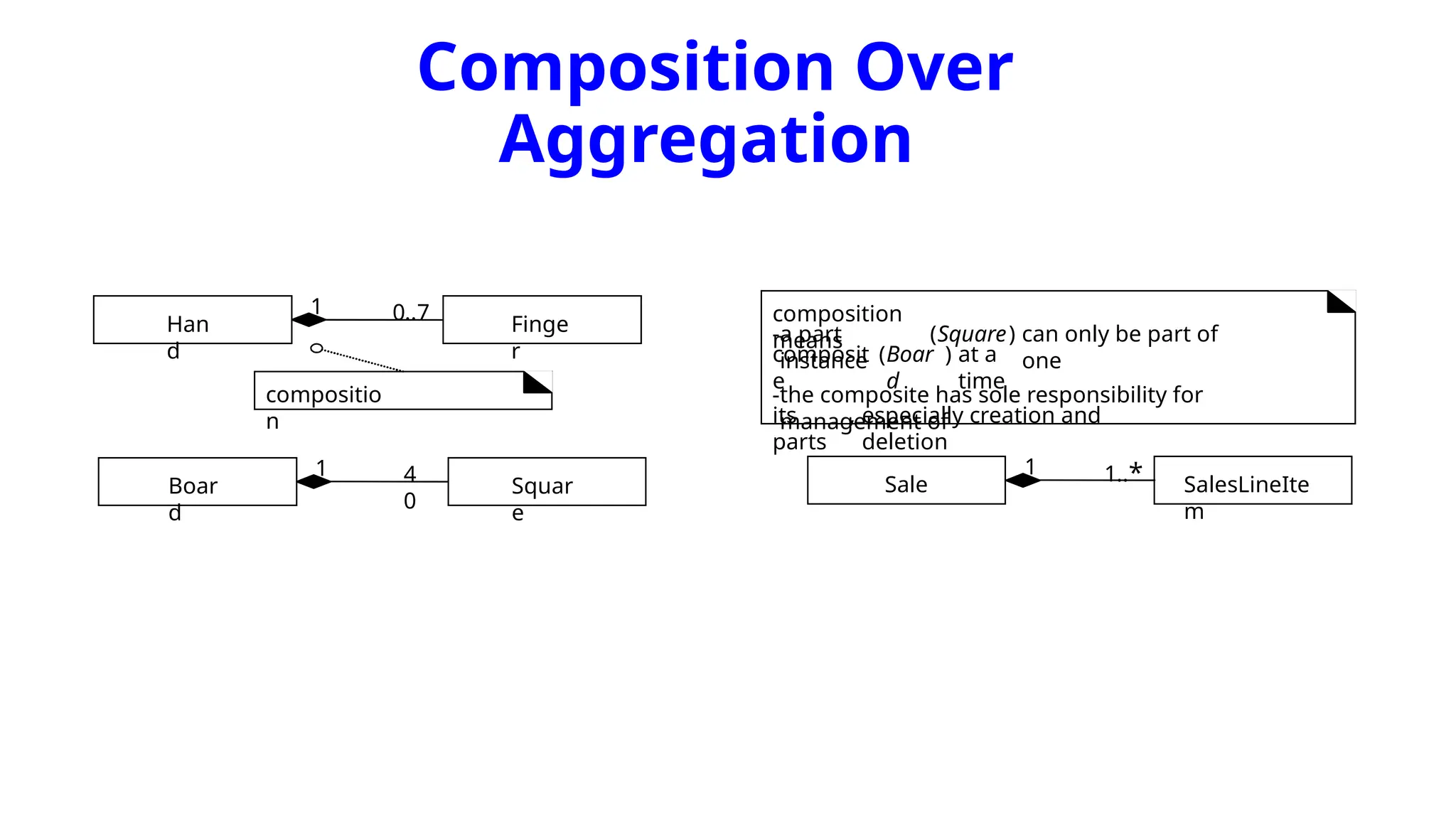
Composition: A SpecialCase of Aggregation
⚫ Composition is shown as a solid filled
diamond, with the diamond attached to
the class that is the composite.
⚫ Composition is a form of aggregation that
requires coincident lifetime of the part
with the whole and singular ownership; i.e.
the part is owned by only one whole and is
deleted when the whole is deleted
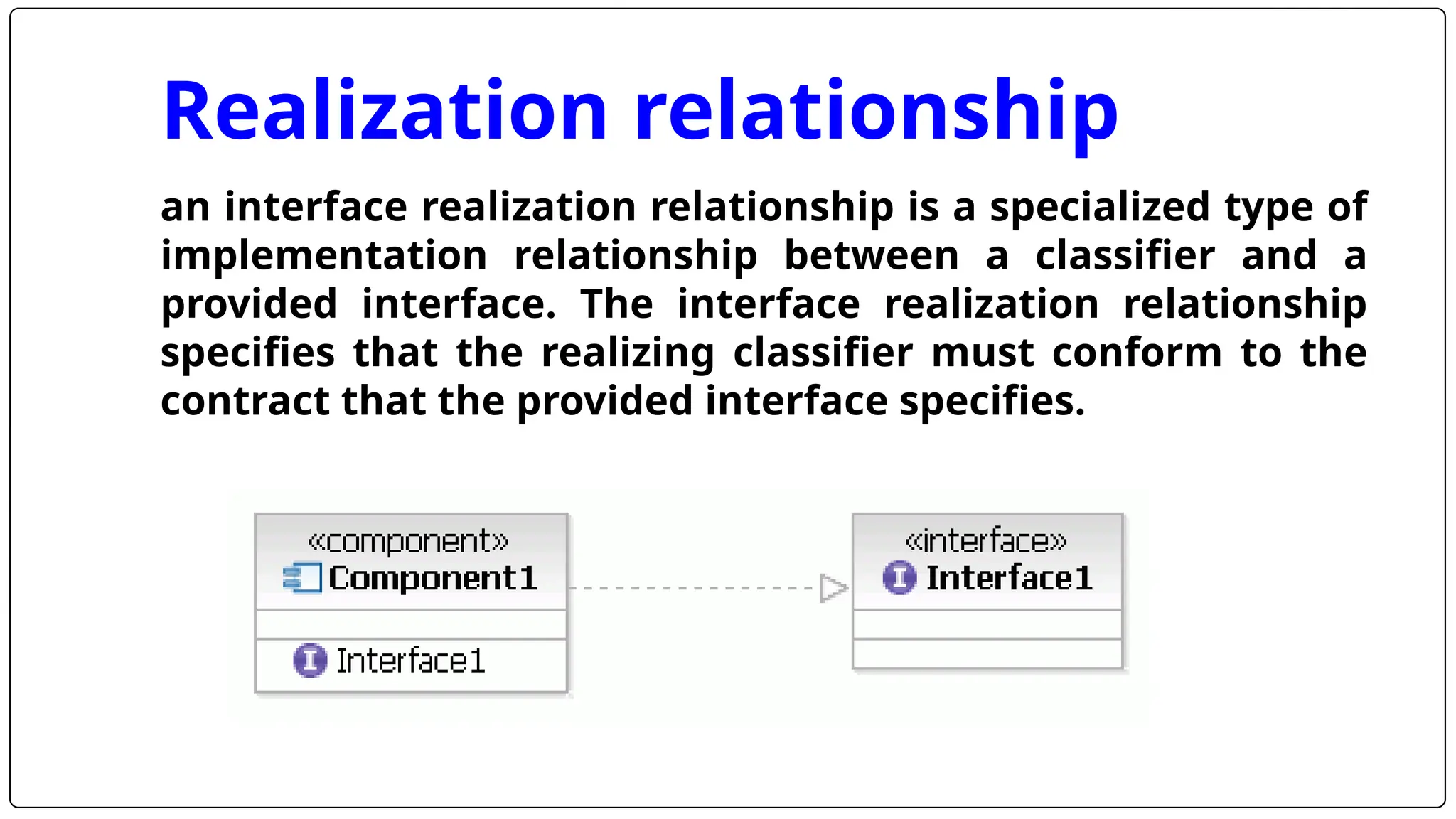
Realization relationship
an interfacerealization relationship is a specialized type of
implementation relationship between a classifier and a
provided interface. The interface realization relationship
specifies that the realizing classifier must conform to the
contract that the provided interface specifies.
#4 Attributes in a Class
Contains information that the analyst or user feels that the system should store
Represents properties that describe the state of the object
Only attributes important to the task should be included in the class
For example, for employee, employee name is a good attribute; employee hair color is not (not relevant in the business application)
Primitive or atomic types
Such as integer, string, double, date, time, boolean, …
Generally complex or compound attributes are really placeholders for relationships between classes
#5 Attributes in a class diagram
Typed in middle compartment
Derived attributes
Examples: age (subtracting birthdate from current date), GPA (calculated from grades and credit hours)
#9 Operations in a Class
Represents the actions or functions that a class can perform
In later phases, the operations are converted to methods (functions in C++)
Only problem domain-specific operations that are relevant to the problem should be considered
Classes normally are required to provide the means to create instances, delete instances, access individual attribute values, set individual attribute values, and other basic types of operations
At this point in development, don’t clutter up the definition of the class with these basic types of operations
Focus only on relevant problem domain-specific operations
1)Constructor operation
Creates a new instance of a class
Since creation is normally available to all classes, typically will not see constructor methods at this point in the development of the class diagram
2)Query operation
Makes information about the state of an object available to other objects but will not alter the object in any way
3)Update operation
Changes the value of some or all of the object’s attributes which may result in a change in the object’s state
#11 Class representation
Compartmentalized rectangles
Top compartment: name of class
Middle compartment: structure of the class (attributes)
Bottom compartment: behavior of the class (operations)
#13 Operations in a Class
Also can be shown on attributes
Put in front of the name of the attribute or operation on the class diagram
Visibility of the attribute/operation in the system
Public – not hidden from any object
Protected – hidden from all other classes except its immediate subclasses
Private – default; hidden from all other classes
#15 Relationships between Classes
One of primary purposes of a class diagram is to show the relationships that classes have with other another
All systems are made up of many classes/objects; system behavior is achieved through the collaborations of the objects of the system
#18 Association Relationship
An association between classes means there is a link between the objects in the associated classes
Not a data flow (though data may flow in either direction across the association)
#21 Relationships in a class diagram
Primary purpose of the class diagram is to show the relationships or associations that classes have with one another
Shown by drawing lines between classes
Triangle
Increases the readability of the diagram
Is read as “The patients provides medical history”
#22 Relationships in a class diagram
Notice no triangle needed on a role
#31 Relationships in a class diagram
Used because you may want to restrict the number of instances a class may have
Zero/one or more use m or some other variable name when there is a specific number in the problem
Specified range 2 to 4 instances
Multiple, disjoint ranges 1..3, 5 == 1 to 3 or 5 instances
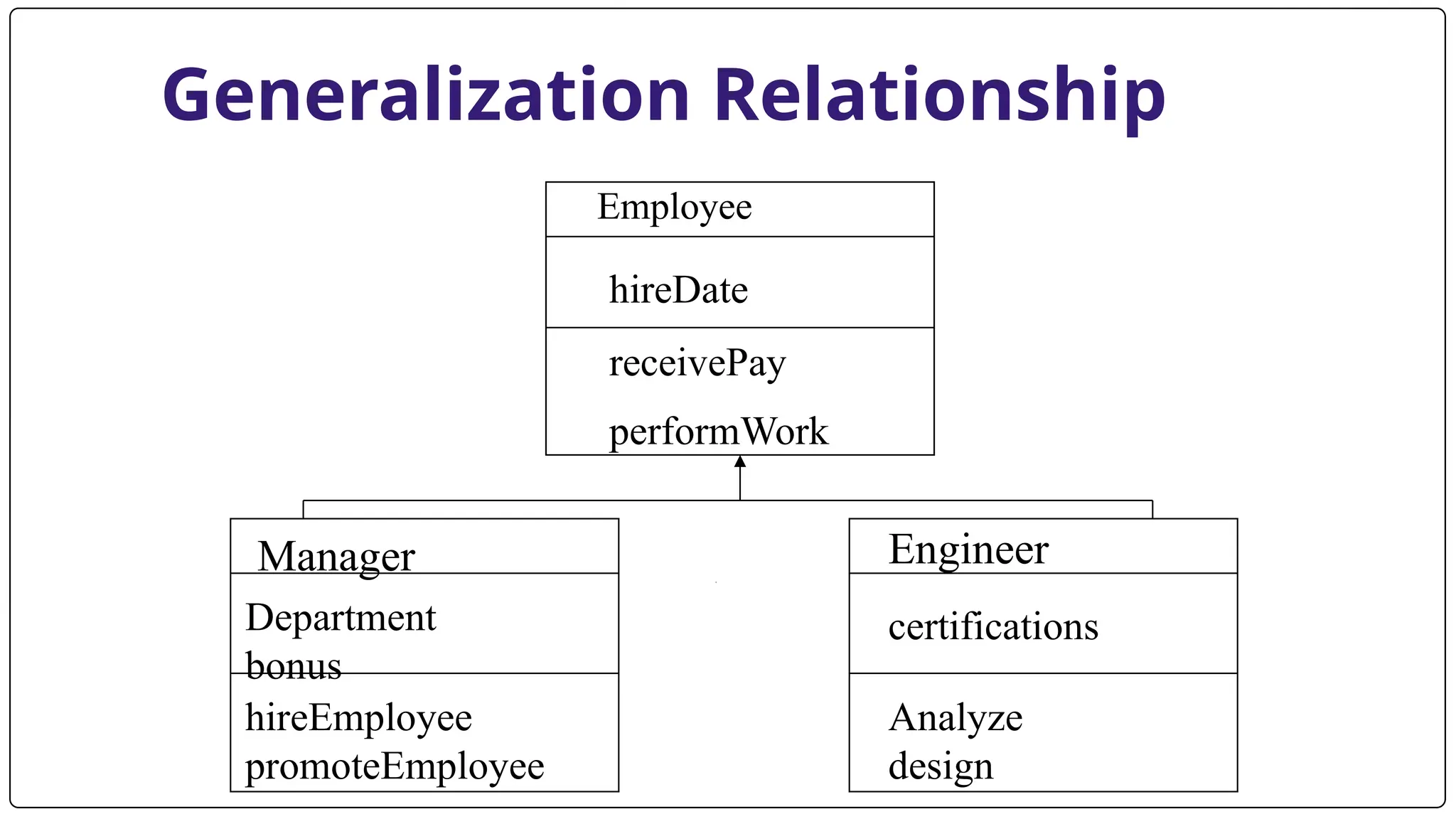
#32 Generalization Relationship
The analyst creates a superclass that contains the basic attributes and operations that will be used in several subclasses.
Subclasses inherit the attributes and operations of their superclass and can also contain attributes and operations that are unique just to them
For example, a customer class and an employee class can be generalized into a person class by extracting the attributes and operations they have in common and placing them into a new superclass, Person
Subclasses (with no children) must be concrete classes
Superclasses may be abstract or concrete
Encourages analyst to focus on the properties that make each class unique by allowing the similarities to be factored into superclasses
Advantage: reduces redundancy in the class definitions
Is represented with the a-kind-of relationship
Employee is a-kind-of person
Specialization relationship
Flip side of generalization relationship
For example, an employee class can be specialized into a manager class and an engineer class
#34 Point out:
Attributes and operations/behavior of each class
Superclass
Employee class
Generalization that contains attributes and operations common to all subclasses
Subclass
Manger and Engineer classes
Specializations of a superclass
hireDate, receivePay and performWork are also part of Manager and Engineer
In addition to having hireDate, receivePay and performWork the class Manager also has department, bonus, hireEmployee, promoteEmployee
In addition to having hireDate, receivePay and performWork the class Engineer also has certifications, analyze, and design
#35 Aggregation Relationship
You can identify these kinds of associations when you need to use words like “is a part of” or “is made up of” to describe a relationship between classes
When classes actually comprise other classes
For example, CourseOffering class is a-part-of the Course class
One way to recognize: are some operations on the whole automatically applied to its parts? For example, deleting a course will also delete all of its course offerings
One way to recognize: is there an intrinsic asymmetry to the relationship where one class is subordinate to the other?
UML notation for an aggregation relationship is an association with a diamond next to the class denoting the aggregate (whole)
#36 Relationships in a class diagram
The medical history is “part of” the patient; it cannot exist without the patient
![Attributes in a Class
attributes (fields, instance variables)
Syntax: visibility name : type [count] = default_value
visibility: + public
# protected
- private
/ derived
underline static attributes
derived attribute: not stored, but can be computed
from other attribute values
attribute example:
- balance : double = 0.00](https://image.slidesharecdn.com/unitii-staticumldiagrams-250906130746-932e62ee/75/OOAD-UNIT-II-STATIC-UML-DIAGRAMS-pptx-6-2048.jpg)