TOPIC: LABORATORY RULES, DISCIPLINE
AND FIRST AID
PAPER:
EDU 09.8 -Theoretical base of physical
science
Education-2
ONLINE ASSIGNMENT
SUBMITTED TO SUBMITTED BY
SMITHA MISS AJI.G
LECTURER IN B.ED STUDENT
PHYSICAL SCIENCE PHYSICAL SCIENCE
SUBMITTED ON:5-8-2015
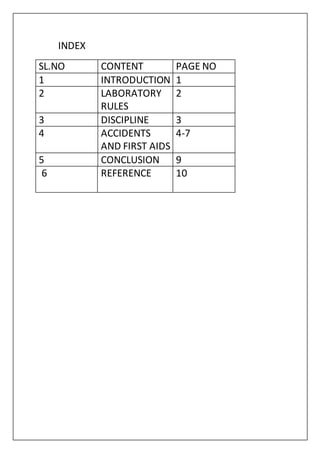
INDEX
SL.NO CONTENT PAGE NO
1 INTRODUCTION 1
2 LABORATORY
RULES
2
3 DISCIPLINE 3
4 ACCIDENTS
AND FIRST AIDS
4-7
5 CONCLUSION 9
6 REFERENCE 10
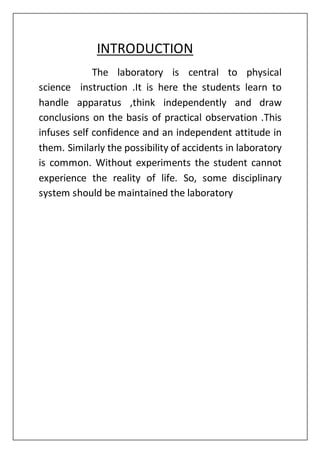
INTRODUCTION
The laboratory is central to physical
science instruction .It is here the students learn to
handle apparatus ,think independently and draw
conclusions on the basis of practical observation .This
infuses self confidence and an independent attitude in
them. Similarly the possibility of accidents in laboratory
is common. Without experiments the student cannot
experience the reality of life. So, some disciplinary
system should be maintained the laboratory
LABORATORY RULES
1, No pupils should be allowed to enter the laboratory
in the absence of the teacher
2, Every student should have a place assignedfor him
for his work
3, Pupils should perform only those experiments
assigned by the teacher
4, No equipment or chemical should be used until
proper instructions are received from the teacher
5, Reagent bottles should be returned to the shelf
immediately after use and these should not be
misplaced.
6, Specimens, solidwaste, broken glass, burnt up match
sticks and other laboratory wastes should be deposited
in waste boxes.
7, Any breakage of apparatus or accidents or injury
must be reported to the teacher.
8, All unnecessary talks should be avoided and playing
with the apparatus should be prohibited.
9, the apparatus should be disconnected, washed if
necessary and replaced in their proper places.
10 consider the safety of fellow students. A scientific
atmosphere should be kept up in the laboratory.
DISCIPLINE
The practical work in a laboratory requires good
discipline. The teacher should lay down strict guide
lines on the kind of behavior expected in the
laboratory. Students should be trained to leave their
work area as clean as possible and talking in the
laboratory should be discouraged.
Laboratory safety is a positive undertaking
which the science teacher is expected to take up at the
time of engaging in any activity in the laboratory in the
presence of his students. This would ensure acquisition
of safety conscious attitudes among pupils. Creation of
which is a very important duty of the science teacher.
ACCIDENTS& FIRST AIDS IN THE
LABORATORY
The purpose of first aid is to make the patient
secure and comfortable and to prevent deterioration in
condition until any necessary professional medical
assistance available.
Thus first aid stands for
 F- first
 I- investigate
 R- reassure
 S-steady
 T-treatment
 A- arrange
 I- immediate
 D- dispatch
Thus the scope of first aid- diagnosis, treatment and
transport must be understood by every teacher.
The following conditions are medical emergencies and
require immediate attention.
1. Severe bleeding
2. Absence of breathing
3. Eye injuries.
SOME COMMON LABORATORYMISHAPSAND
REMEDIES
Poison:-
The general principle should be to call the
doctor at once.
Consumed poisons / non corrosive poison:-
The victim should be made to vomit
immediately. Put two fingers inside the mouth or give
chilled salt water.
Corrosive poison:-
i. Acids: Do not make the patient vomit .Dilute
the acid with plenty of water. This will
reduce irritation. Plenty of water followed
by milk of magnesia.
ii. Alkalis: Do not make him vomit. Plenty of
water followed by lemon
iii. Unknown nature: Universal antidote –
activated carbon, magnesium oxide and
tannic acid in the ratio 2:1.
INHALING POISONOUS GAS
The first step should be to check his
breathing. Take the patient into fresh air loosen his
clothes. If conscious serve hot tea or coffee. To counter
chlorine or bromine fumes, the patient should smell
ammonia and rinse her mouth with sodium
bicarbonate.
FIRE
The following are among the sources of fire hazard
encountered in school science laboratories.
1. Ignition of solvent vapors: some of these vapors
ignite well below red heat. Flammable, volatile liquids
should not be poured from one container to another
near a naked flame.
2. Uncontrolled chemical reactions: It is essential
that a teacher rehearses all the experiments that she
and her pupils undertake and that only the minimum
quantities which are kept should be stored in a fire
resistant store.
3. Local heating due to electrical or other faults:
Fires can result from the inadvertent obstruction of
electric fan blades or overheating of gadgets with built-
in lamps. All electrical equipment used in school.
If a person’s clothing is on fire, it is
imperative that the victim is put into a horizontal
position immeadietly.This will limit the spread of
injury. The burnt clothing should be extinguished by
water by means of a fire blanket. The doctor should be
called at once.
EYE INJURIES
Following eye injuries call for immediate
attention
1. Acid in eyewash the eye with plenty of water. Then
apply weak solution of sodium bi carbonate
2. Alkali in eyewash with plenty of water. Then wash
with 1% solution of boric acid
3. Solid in eye: Do not rub the eye. Try blowing of the
solid. The eyelid may be turned back gently over a
match stick. Any foreign matter may be removed with
fine camel hair brush dipped in glycerin or with the end
of clothes
Burns can be used either by dry heat or chemicals.
Burns may be classified into,
1. Heat burns are accompanied by loss of
fluid from the blood in to the tissues causing blisters to
form. Small burns should be treated by cooling the
injured areas as rapidly as possible using running
water.
2. Chemical burns should be washed with copious
amount of water. Some chemical substances viz.
phosphorousand bromine, cause severe burns and medical
advice must be sought as a matter of urgency.
3. Acid burns should be washed immediatelywith
plenty of water and then with sodium bicarbonatesolution
followed by topicalapplication.
4. Alkaliburns shouldbe washed with water,
followed with weak acetic acid or lemon juice.
ELECTRIC SHOCK
The lowest level of current is detectable by the
skin is about 1mA at 50HZ. Any increase in current can pose a
serious threat to life. In the event of a shock first switch of f
the mains.
Use a dry stick /newspaper or rubber to pullthe persons
away from the point. Check If he is breathing and under no
circumstances must hisbody be touched.
CONCLUSION
Laboratory work is an essential
component of science education. Scientific theories
and practical work in science are the two sides of a
coin. These two aspects of science education should
supplement and complement to each other. If the
students have an acceptance towards the rules and
regulations of the laboratory accidents should be
prohibited to a limited extend.
REFERENCES
1. Dr. Mathew. T.K AND Dr. Molly Kutty.T.K(2013) Science
Education: Theoretical bases of teaching and pedagogic analysis.
2. Dr.Shivarajan .k (2005). Science Education method of teaching
and pedagogic analysis.

Online assignment aji (1)

  • 1.
    TOPIC: LABORATORY RULES,DISCIPLINE AND FIRST AID
  • 2.
    PAPER: EDU 09.8 -Theoreticalbase of physical science Education-2
  • 3.
    ONLINE ASSIGNMENT SUBMITTED TOSUBMITTED BY SMITHA MISS AJI.G LECTURER IN B.ED STUDENT PHYSICAL SCIENCE PHYSICAL SCIENCE SUBMITTED ON:5-8-2015
  • 4.
    INDEX SL.NO CONTENT PAGENO 1 INTRODUCTION 1 2 LABORATORY RULES 2 3 DISCIPLINE 3 4 ACCIDENTS AND FIRST AIDS 4-7 5 CONCLUSION 9 6 REFERENCE 10
  • 5.
    INTRODUCTION The laboratory iscentral to physical science instruction .It is here the students learn to handle apparatus ,think independently and draw conclusions on the basis of practical observation .This infuses self confidence and an independent attitude in them. Similarly the possibility of accidents in laboratory is common. Without experiments the student cannot experience the reality of life. So, some disciplinary system should be maintained the laboratory
  • 6.
    LABORATORY RULES 1, Nopupils should be allowed to enter the laboratory in the absence of the teacher 2, Every student should have a place assignedfor him for his work 3, Pupils should perform only those experiments assigned by the teacher 4, No equipment or chemical should be used until proper instructions are received from the teacher 5, Reagent bottles should be returned to the shelf immediately after use and these should not be misplaced. 6, Specimens, solidwaste, broken glass, burnt up match sticks and other laboratory wastes should be deposited in waste boxes. 7, Any breakage of apparatus or accidents or injury must be reported to the teacher. 8, All unnecessary talks should be avoided and playing with the apparatus should be prohibited.
  • 7.
    9, the apparatusshould be disconnected, washed if necessary and replaced in their proper places. 10 consider the safety of fellow students. A scientific atmosphere should be kept up in the laboratory. DISCIPLINE The practical work in a laboratory requires good discipline. The teacher should lay down strict guide lines on the kind of behavior expected in the laboratory. Students should be trained to leave their work area as clean as possible and talking in the laboratory should be discouraged. Laboratory safety is a positive undertaking which the science teacher is expected to take up at the time of engaging in any activity in the laboratory in the presence of his students. This would ensure acquisition of safety conscious attitudes among pupils. Creation of which is a very important duty of the science teacher.
  • 8.
    ACCIDENTS& FIRST AIDSIN THE LABORATORY The purpose of first aid is to make the patient secure and comfortable and to prevent deterioration in condition until any necessary professional medical assistance available. Thus first aid stands for  F- first  I- investigate  R- reassure  S-steady  T-treatment  A- arrange  I- immediate  D- dispatch Thus the scope of first aid- diagnosis, treatment and transport must be understood by every teacher. The following conditions are medical emergencies and require immediate attention. 1. Severe bleeding
  • 9.
    2. Absence ofbreathing 3. Eye injuries. SOME COMMON LABORATORYMISHAPSAND REMEDIES Poison:- The general principle should be to call the doctor at once. Consumed poisons / non corrosive poison:- The victim should be made to vomit immediately. Put two fingers inside the mouth or give chilled salt water. Corrosive poison:- i. Acids: Do not make the patient vomit .Dilute the acid with plenty of water. This will reduce irritation. Plenty of water followed by milk of magnesia. ii. Alkalis: Do not make him vomit. Plenty of water followed by lemon
  • 10.
    iii. Unknown nature:Universal antidote – activated carbon, magnesium oxide and tannic acid in the ratio 2:1. INHALING POISONOUS GAS The first step should be to check his breathing. Take the patient into fresh air loosen his clothes. If conscious serve hot tea or coffee. To counter chlorine or bromine fumes, the patient should smell ammonia and rinse her mouth with sodium bicarbonate. FIRE The following are among the sources of fire hazard encountered in school science laboratories. 1. Ignition of solvent vapors: some of these vapors ignite well below red heat. Flammable, volatile liquids should not be poured from one container to another near a naked flame. 2. Uncontrolled chemical reactions: It is essential that a teacher rehearses all the experiments that she and her pupils undertake and that only the minimum
  • 11.
    quantities which arekept should be stored in a fire resistant store. 3. Local heating due to electrical or other faults: Fires can result from the inadvertent obstruction of electric fan blades or overheating of gadgets with built- in lamps. All electrical equipment used in school. If a person’s clothing is on fire, it is imperative that the victim is put into a horizontal position immeadietly.This will limit the spread of injury. The burnt clothing should be extinguished by water by means of a fire blanket. The doctor should be called at once. EYE INJURIES Following eye injuries call for immediate attention 1. Acid in eyewash the eye with plenty of water. Then apply weak solution of sodium bi carbonate 2. Alkali in eyewash with plenty of water. Then wash with 1% solution of boric acid 3. Solid in eye: Do not rub the eye. Try blowing of the solid. The eyelid may be turned back gently over a match stick. Any foreign matter may be removed with
  • 12.
    fine camel hairbrush dipped in glycerin or with the end of clothes Burns can be used either by dry heat or chemicals. Burns may be classified into, 1. Heat burns are accompanied by loss of fluid from the blood in to the tissues causing blisters to form. Small burns should be treated by cooling the injured areas as rapidly as possible using running water. 2. Chemical burns should be washed with copious amount of water. Some chemical substances viz. phosphorousand bromine, cause severe burns and medical advice must be sought as a matter of urgency. 3. Acid burns should be washed immediatelywith plenty of water and then with sodium bicarbonatesolution followed by topicalapplication. 4. Alkaliburns shouldbe washed with water, followed with weak acetic acid or lemon juice. ELECTRIC SHOCK The lowest level of current is detectable by the skin is about 1mA at 50HZ. Any increase in current can pose a serious threat to life. In the event of a shock first switch of f the mains.
  • 13.
    Use a drystick /newspaper or rubber to pullthe persons away from the point. Check If he is breathing and under no circumstances must hisbody be touched.
  • 14.
    CONCLUSION Laboratory work isan essential component of science education. Scientific theories and practical work in science are the two sides of a coin. These two aspects of science education should supplement and complement to each other. If the students have an acceptance towards the rules and regulations of the laboratory accidents should be prohibited to a limited extend.
  • 15.
    REFERENCES 1. Dr. Mathew.T.K AND Dr. Molly Kutty.T.K(2013) Science Education: Theoretical bases of teaching and pedagogic analysis. 2. Dr.Shivarajan .k (2005). Science Education method of teaching and pedagogic analysis.