ON THE TRAIL TO

TRACEABILITY
NEW LEGISLATION, NEW COMPLEXITY
LEAD TO NEW CHALLENGES
Copyright © 2013, JDA Software Group, Inc. All rights reserved.
CHALLENGE…COMPLEXITY…CONFIDENCE?
The last decade has seen an unprecedented increase in the

The study yielded some interesting results. As we expected,

complexity of today’s global supply chains. More products

respondents expressed a range of opinions regarding the risks

come from more suppliers, from more places than ever before.

associated with their struggles to effectively trace and recall

Managing, monitoring and auditing the procurement,

products, and also as expected we found a diverse mix of recall

production, storage, transportation and handling of inventory in

capabilities. However, despite strong concerns over risks and

such an environment presents a significant challenge to

admittedly uneven capabilities, respondents reported an

businesses up and down the supply chain. And, as the

unexpectedly high degree of confidence in their ability to trace

challenges expand, so do the laws and regulations enacted by

problems one level up and down their supply chains.

countries around the globe designed to govern food and
product handling and ensure consumer safety.

What does that mean? Are they confident in their processes?
Their technology? Their partnerships? Read on to find out just

JDA commissioned this study to gauge the current state of our
ability to effectively track, trace, and recall products, both inside
the enterprise and up and down the supply chain. We surveyed

exactly where the industry stands…

ON THE TRAIL TO

supply chain and operations executives from close to 130 CPG,
Life Sciences, and Food & Beverage companies, most of whom
(~77%) represent companies greater than $500M in annual
revenue.

TRACEABILITY
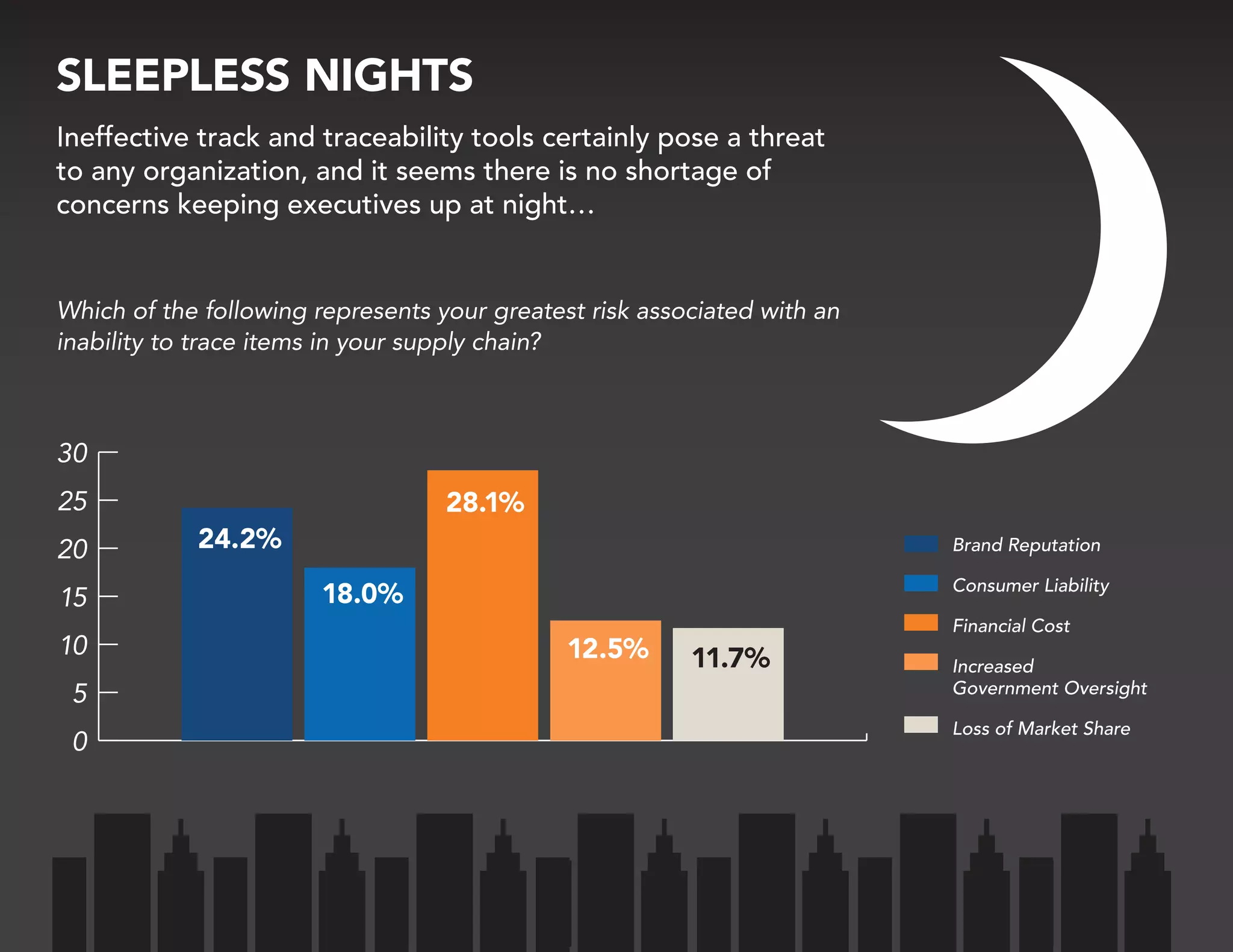
SLEEPLESS NIGHTS
Ineffective track and traceability tools certainly pose a threat
to any organization, and it seems there is no shortage of
concerns keeping executives up at night…

Which of the following represents your greatest risk associated with an
inability to trace items in your supply chain?

30

28.1%

25
20
15
10
5
0

24.2%

Brand Reputation
Consumer Liability

18.0%
12.5%

Financial Cost

11.7%

Increased
Government Oversight
Loss of Market Share
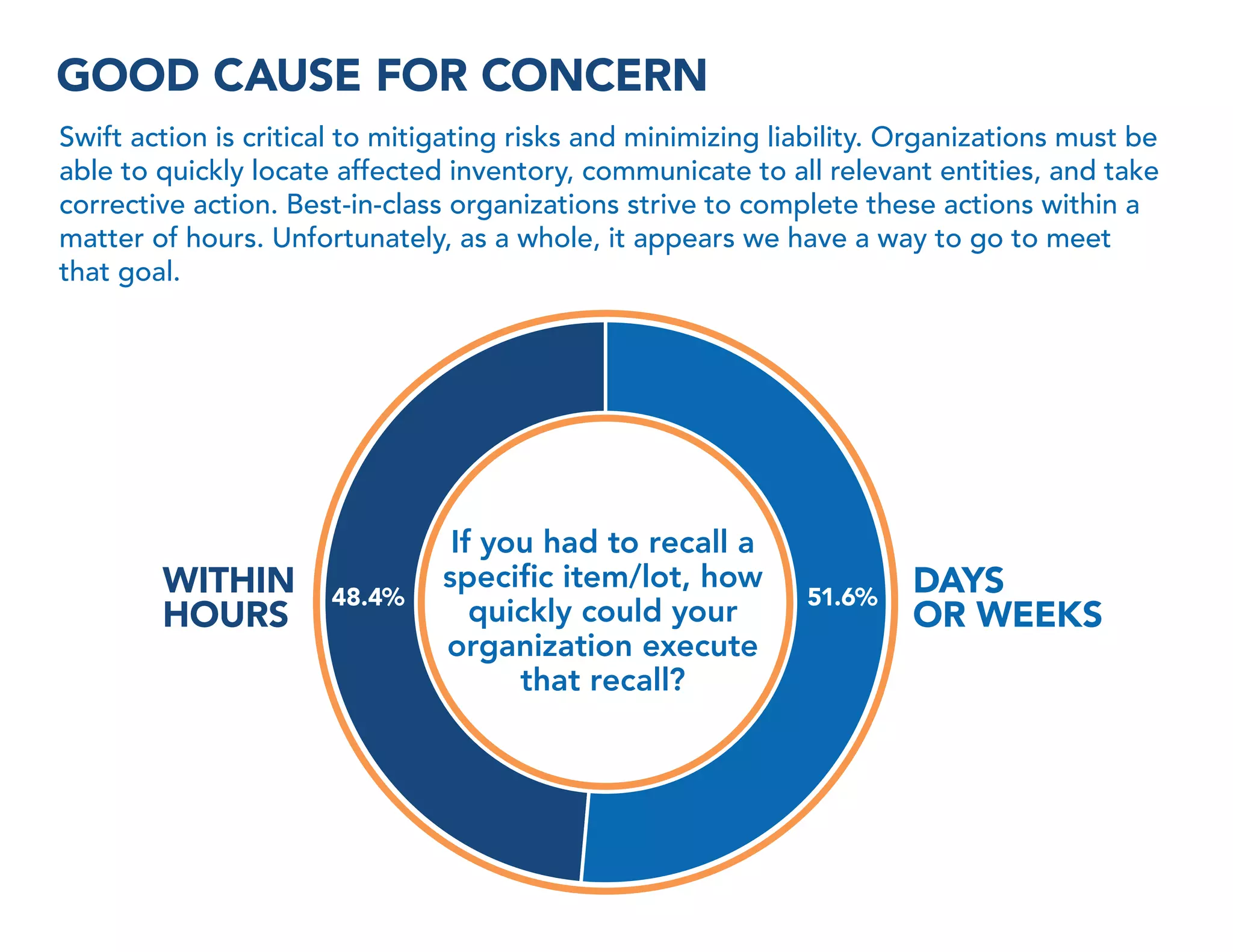
GOOD CAUSE FOR CONCERN
Swift action is critical to mitigating risks and minimizing liability. Organizations must be
able to quickly locate affected inventory, communicate to all relevant entities, and take
corrective action. Best-in-class organizations strive to complete these actions within a
matter of hours. Unfortunately, as a whole, it appears we have a way to go to meet
that goal.

WITHIN
HOURS

48.4%

If you had to recall a
specific item/lot, how
quickly could your
organization execute
that recall?

51.6%

DAYS
OR WEEKS
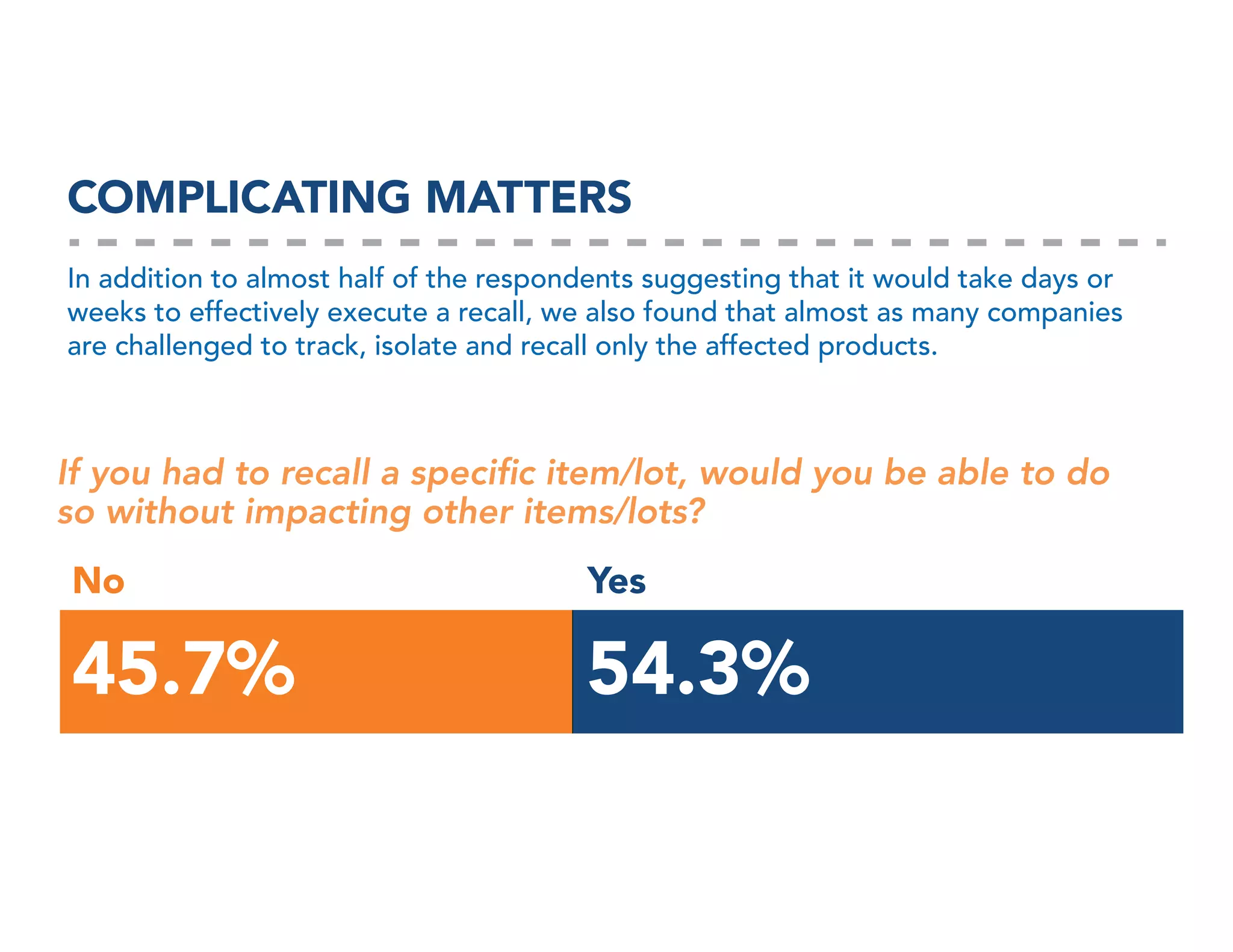
COMPLICATING MATTERS
In addition to almost half of the respondents suggesting that it would take days or
weeks to effectively execute a recall, we also found that almost as many companies
are challenged to track, isolate and recall only the affected products.

If you had to recall a specific item/lot, would you be able to do
so without impacting other items/lots?

No

Yes

45.7%

54.3%
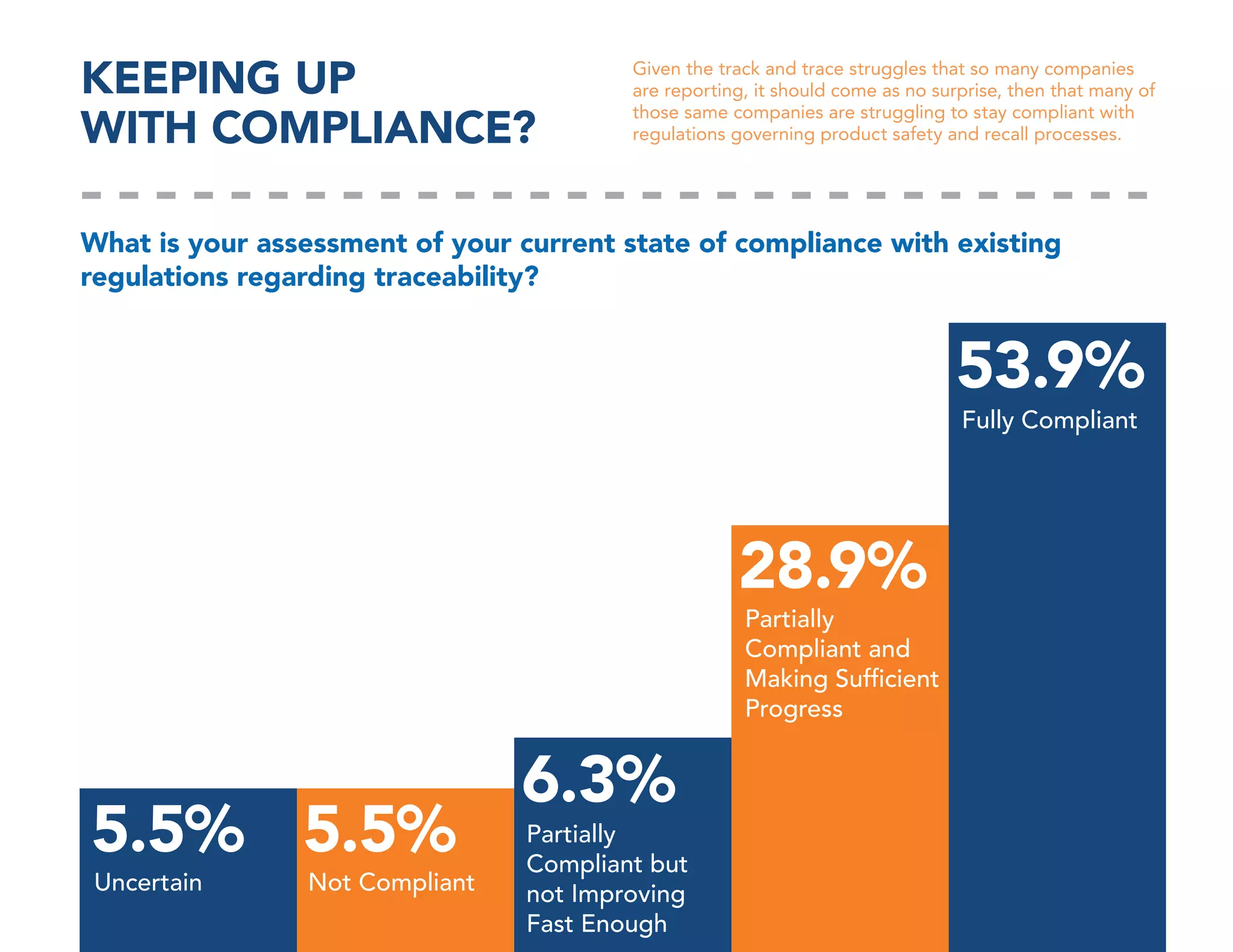
KEEPING UP
WITH COMPLIANCE?

Given the track and trace struggles that so many companies
are reporting, it should come as no surprise, then that many of
those same companies are struggling to stay compliant with
regulations governing product safety and recall processes.

What is your assessment of your current state of compliance with existing
regulations regarding traceability?

53.9%
Fully Compliant

28.9%

Partially
Compliant and
Making Sufficient
Progress

5.5% 5.5%
Uncertain

Not Compliant

6.3%
Partially
Compliant but
not Improving
Fast Enough
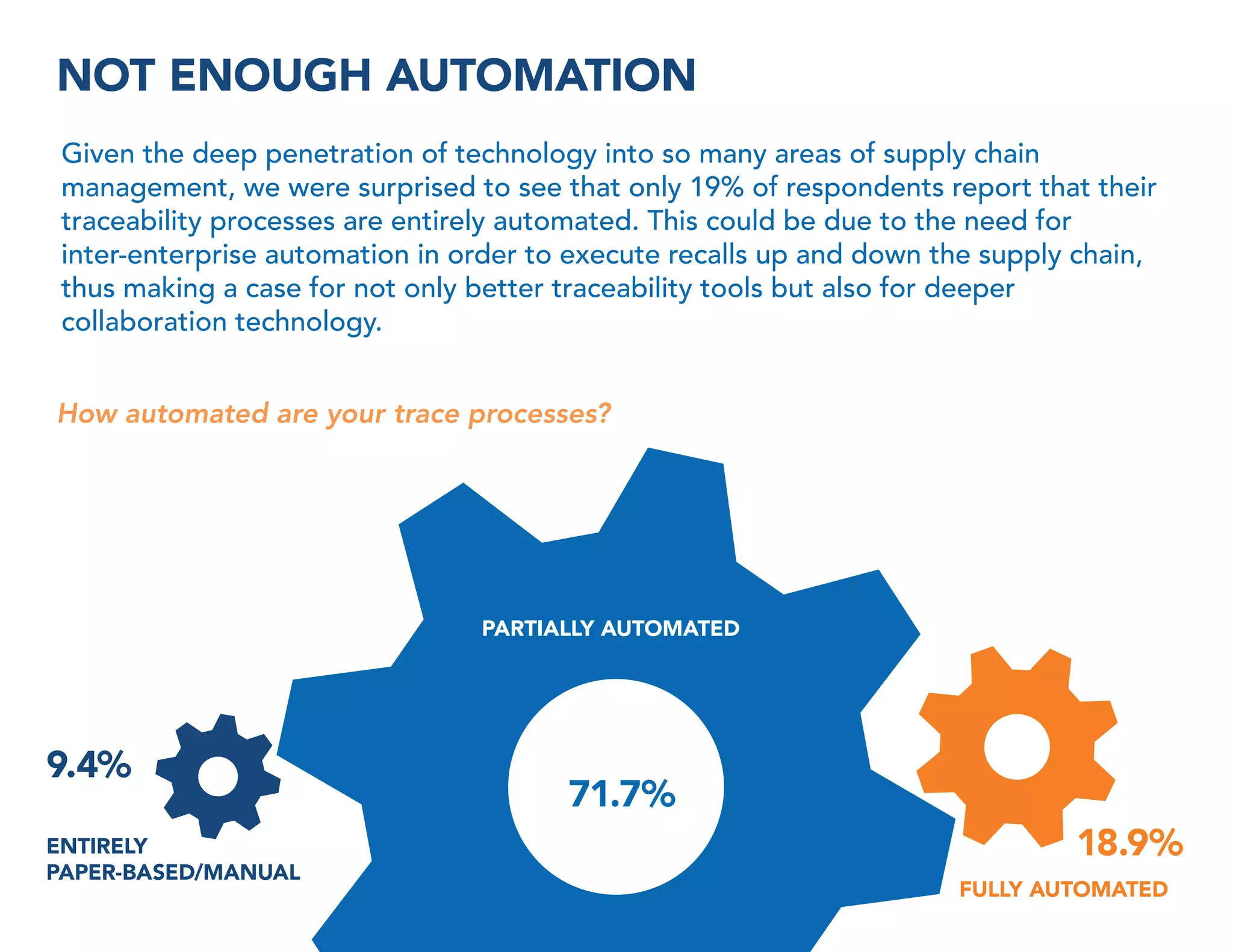
NOT ENOUGH AUTOMATION
Given the deep penetration of technology into so many areas of supply chain
management, we were surprised to see that only 19% of respondents report that their
traceability processes are entirely automated. This could be due to the need for
inter-enterprise automation in order to execute recalls up and down the supply chain,
thus making a case for not only better traceability tools but also for deeper
collaboration technology.
How automated are your trace processes?

PARTIALLY AUTOMATED

9.4%
ENTIRELY
PAPER-BASED/MANUAL

71.7%
18.9%
FULLY AUTOMATED
TS
S
O
C

G
IN
IS
R

LL
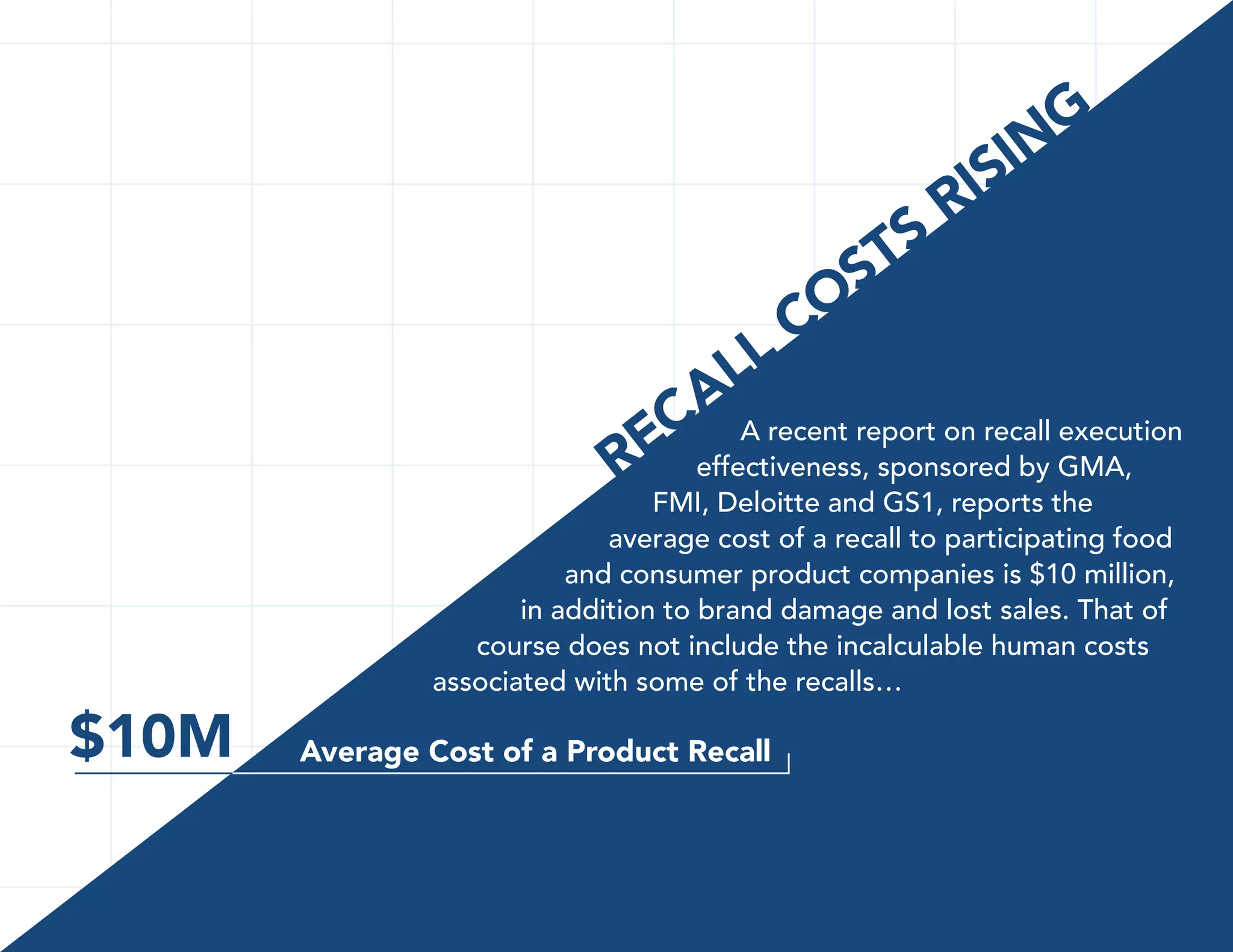
A A recent report on recall execution
ECeffectiveness, sponsored by GMA,
R

FMI, Deloitte and GS1, reports the
average cost of a recall to participating food
and consumer product companies is $10 million,
in addition to brand damage and lost sales. That of
course does not include the incalculable human costs
associated with some of the recalls…

$10M

Average Cost of a Product Recall
LONG LIST OF CONCERNS

The mounting challenges and
legislation, coupled with the
rapid expansion of regulations
and a lack of end-to-end
automation leaves most supply
executives with a long list of
concerns about their ability to
track and trace problem items…

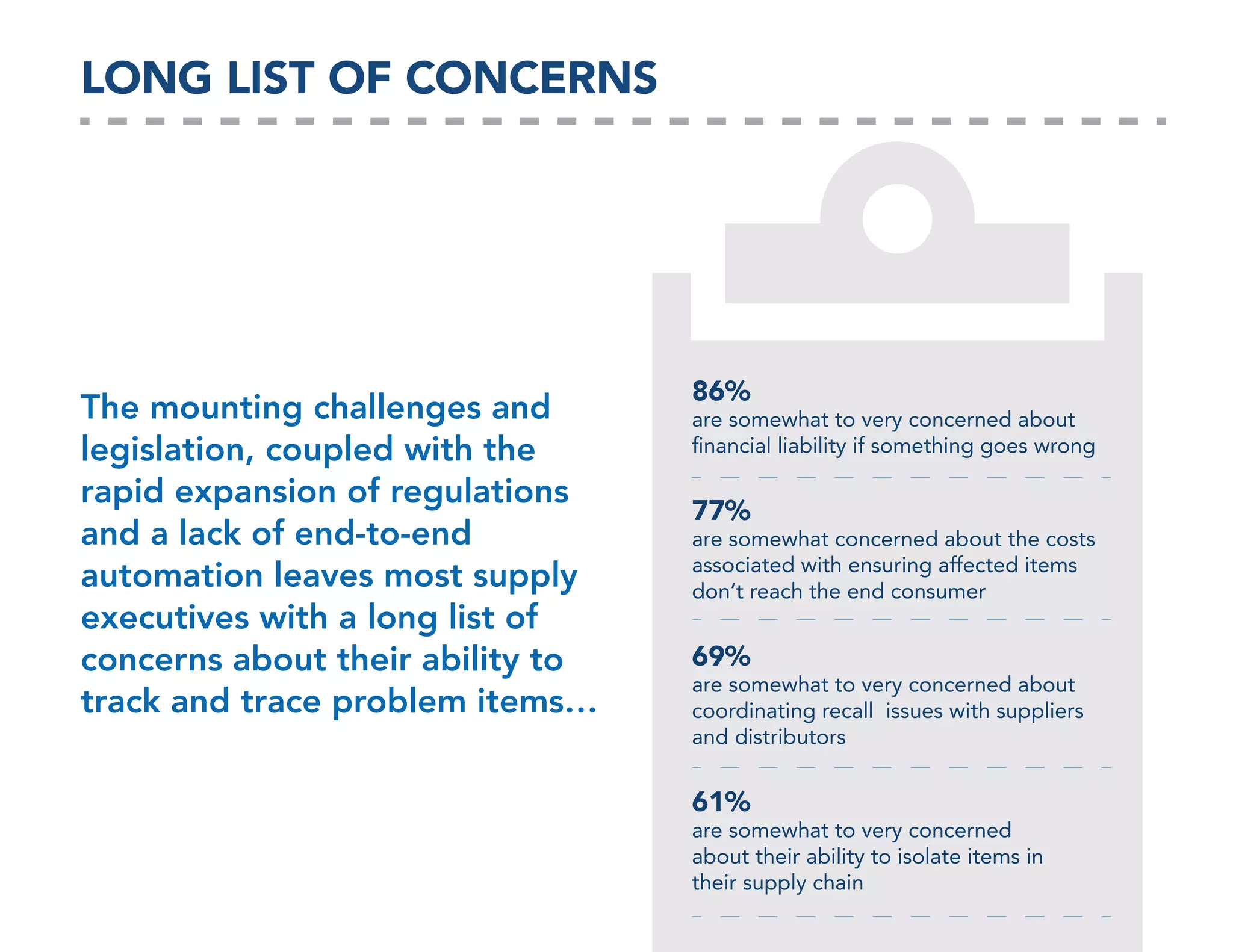
86%

are somewhat to very concerned about
financial liability if something goes wrong

77%

are somewhat concerned about the costs
associated with ensuring affected items
don’t reach the end consumer

69%

are somewhat to very concerned about
coordinating recall issues with suppliers
and distributors

61%

are somewhat to very concerned
about their ability to isolate items in
their supply chain
DESPITE THE CHALLENGES…CONFIDENCE?
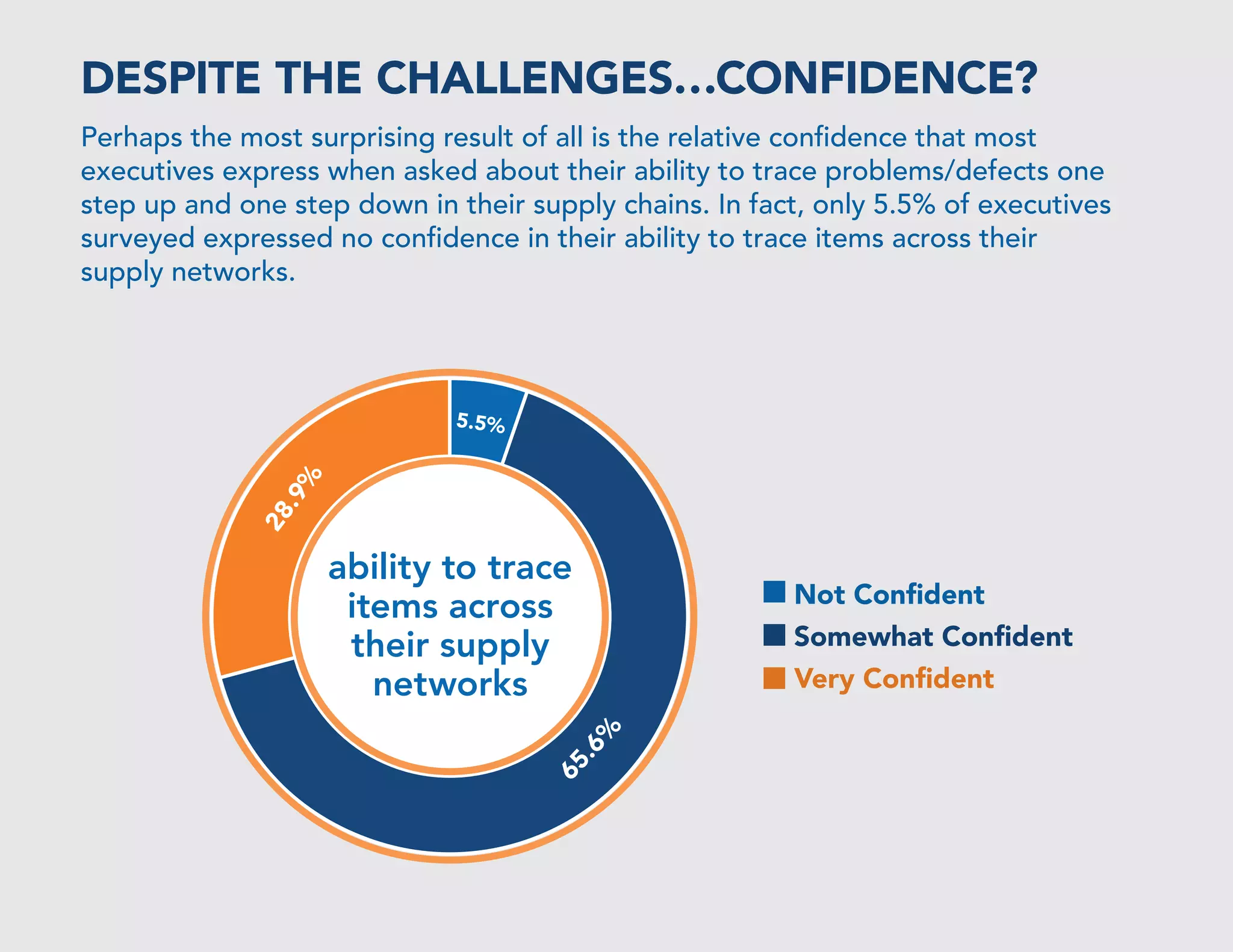
Perhaps the most surprising result of all is the relative confidence that most
executives express when asked about their ability to trace problems/defects one
step up and one step down in their supply chains. In fact, only 5.5% of executives
surveyed expressed no confidence in their ability to trace items across their
supply networks.

28

.9

%

5.5%

ability to trace
items across
their supply
networks
65
.6

%

Not Confident
Somewhat Confident
Very Confident
DESPITE THE CHALLENGES…OPPORTUNITY?
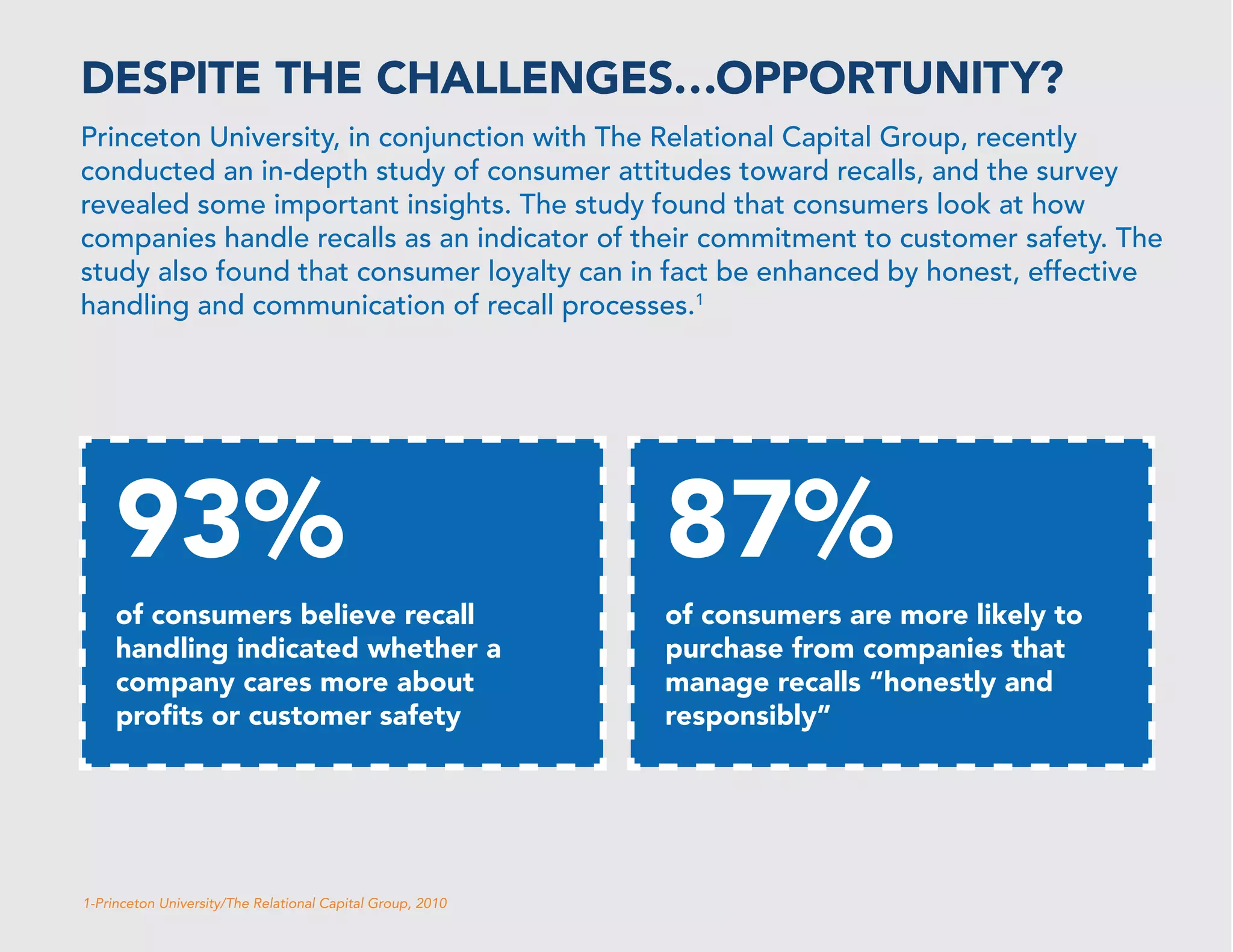
Princeton University, in conjunction with The Relational Capital Group, recently
conducted an in-depth study of consumer attitudes toward recalls, and the survey
revealed some important insights. The study found that consumers look at how
companies handle recalls as an indicator of their commitment to customer safety. The
study also found that consumer loyalty can in fact be enhanced by honest, effective
handling and communication of recall processes.1

93%

87%

of consumers believe recall
handling indicated whether a
company cares more about
profits or customer safety

of consumers are more likely to
purchase from companies that
manage recalls “honestly and
responsibly”

1-Princeton University/The Relational Capital Group, 2010
DO UPGRADE PLANS BELIE CONFIDENCE?
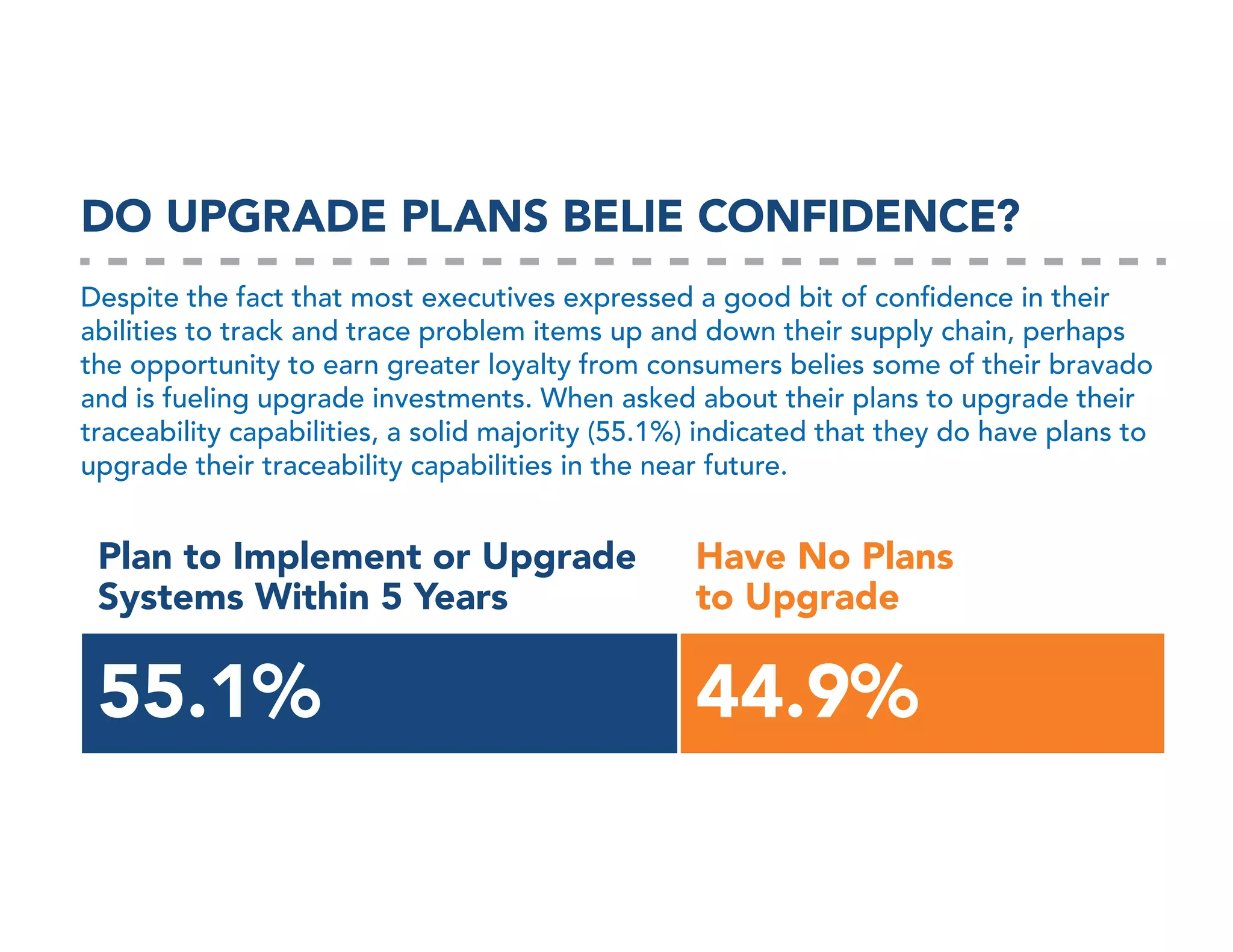
Despite the fact that most executives expressed a good bit of confidence in their
abilities to track and trace problem items up and down their supply chain, perhaps
the opportunity to earn greater loyalty from consumers belies some of their bravado
and is fueling upgrade investments. When asked about their plans to upgrade their
traceability capabilities, a solid majority (55.1%) indicated that they do have plans to
upgrade their traceability capabilities in the near future.

Plan to Implement or Upgrade
Systems Within 5 Years

Have No Plans
to Upgrade

55.1%

44.9%
SUMMARY AND CONCLUSIONS
Clearly, new legislation and new supply chain complexities have resulted in unprecedented recall challenges. The results
of this survey reveal a myriad of issues and challenges vexing supply chain professionals as they struggle to stay compliant
with shifting regulations and ever-more complex legislation.
Automation certainly has a role to play in overcoming these challenges, and we learned through this survey that many
companies recognize that they need to upgrade their technology to help solve their traceability challenges.
Only time will tell, but the future looks brighter than the present as more companies embrace more technology to help
solve more issues on The Trail to Traceability.
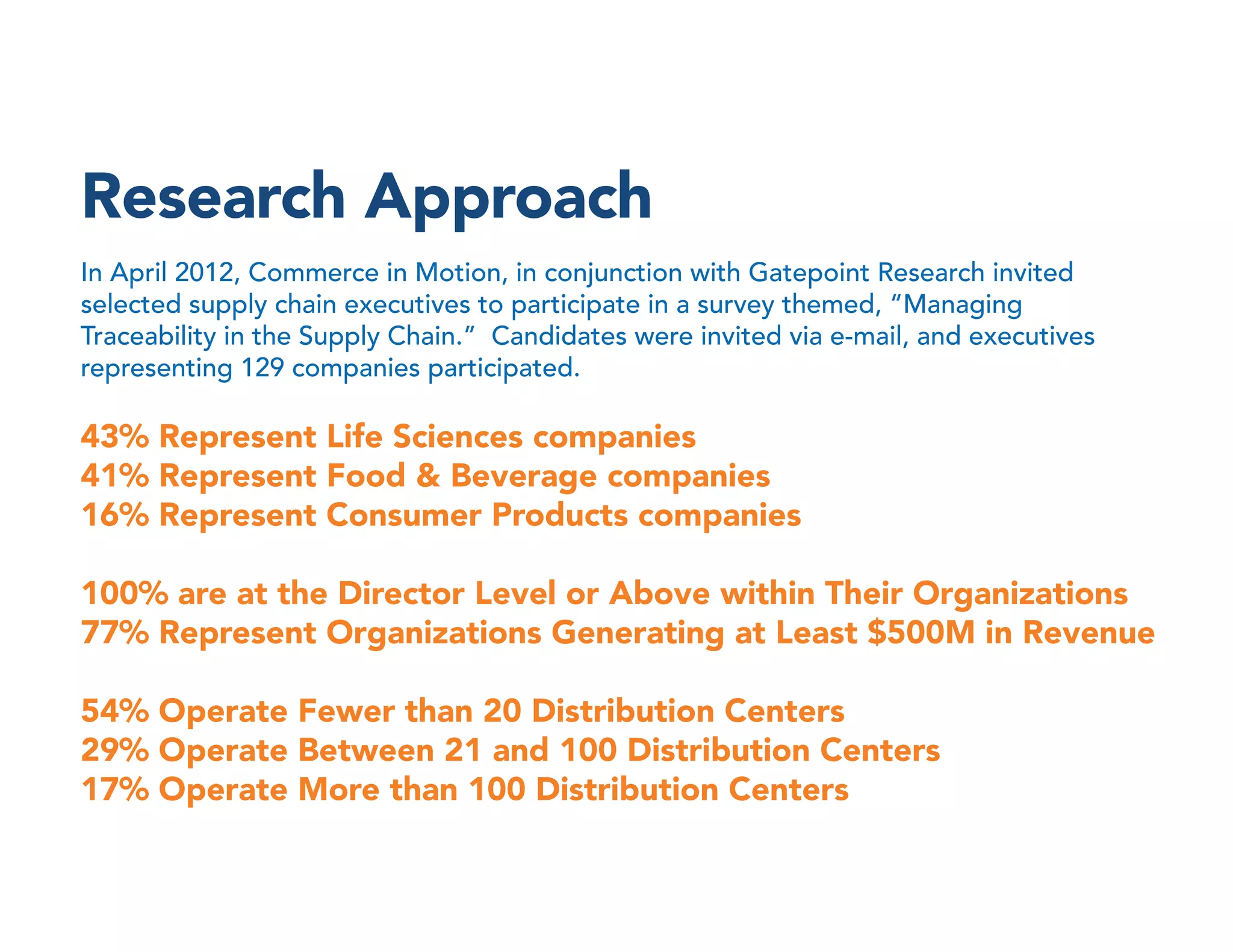
Research Approach
In April 2012, Commerce in Motion, in conjunction with Gatepoint Research invited
selected supply chain executives to participate in a survey themed, “Managing
Traceability in the Supply Chain.” Candidates were invited via e-mail, and executives
representing 129 companies participated.

43% Represent Life Sciences companies
41% Represent Food & Beverage companies
16% Represent Consumer Products companies
100% are at the Director Level or Above within Their Organizations
77% Represent Organizations Generating at Least $500M in Revenue
54% Operate Fewer than 20 Distribution Centers
29% Operate Between 21 and 100 Distribution Centers
17% Operate More than 100 Distribution Centers
Produced by

ON THE TRAIL TO

TRACEABILITY

In an era of relentless globalization, commerce never stops: markets are in motion,
products are in motion, employees are in motion, and even consumers are in motion.
Competition never rests and customers expect immediate gratification. Sustainable
competitive advantage can only be achieved by organizations that are capable of keeping
pace with the ever-changing dynamics of global supply chains and hyper-connected
consumers.
About JDA Software Group, Inc.
JDA® Software Group, Inc., The Supply Chain Company®, offers the broadest portfolio of
supply chain, retail merchandising, store operations and all-channel commerce solutions to
help companies manage the flow of goods from raw materials to finished products and
into the hands of consumers. JDA’s deep industry expertise and innovative cloud platform
help companies optimize inventory, labor and customer service levels. As a result, JDA
solutions have become the standard for the world’s leading retailers, manufacturers and
distributors.
visit jda.com

Copyright © 2013, JDA Software Group, Inc. All rights reserved.

On the-trail-to-traceability

  • 1.
    ON THE TRAILTO TRACEABILITY NEW LEGISLATION, NEW COMPLEXITY LEAD TO NEW CHALLENGES Copyright © 2013, JDA Software Group, Inc. All rights reserved.
  • 2.
    CHALLENGE…COMPLEXITY…CONFIDENCE? The last decadehas seen an unprecedented increase in the The study yielded some interesting results. As we expected, complexity of today’s global supply chains. More products respondents expressed a range of opinions regarding the risks come from more suppliers, from more places than ever before. associated with their struggles to effectively trace and recall Managing, monitoring and auditing the procurement, products, and also as expected we found a diverse mix of recall production, storage, transportation and handling of inventory in capabilities. However, despite strong concerns over risks and such an environment presents a significant challenge to admittedly uneven capabilities, respondents reported an businesses up and down the supply chain. And, as the unexpectedly high degree of confidence in their ability to trace challenges expand, so do the laws and regulations enacted by problems one level up and down their supply chains. countries around the globe designed to govern food and product handling and ensure consumer safety. What does that mean? Are they confident in their processes? Their technology? Their partnerships? Read on to find out just JDA commissioned this study to gauge the current state of our ability to effectively track, trace, and recall products, both inside the enterprise and up and down the supply chain. We surveyed exactly where the industry stands… ON THE TRAIL TO supply chain and operations executives from close to 130 CPG, Life Sciences, and Food & Beverage companies, most of whom (~77%) represent companies greater than $500M in annual revenue. TRACEABILITY
  • 3.
    SLEEPLESS NIGHTS Ineffective trackand traceability tools certainly pose a threat to any organization, and it seems there is no shortage of concerns keeping executives up at night… Which of the following represents your greatest risk associated with an inability to trace items in your supply chain? 30 28.1% 25 20 15 10 5 0 24.2% Brand Reputation Consumer Liability 18.0% 12.5% Financial Cost 11.7% Increased Government Oversight Loss of Market Share
  • 4.
    GOOD CAUSE FORCONCERN Swift action is critical to mitigating risks and minimizing liability. Organizations must be able to quickly locate affected inventory, communicate to all relevant entities, and take corrective action. Best-in-class organizations strive to complete these actions within a matter of hours. Unfortunately, as a whole, it appears we have a way to go to meet that goal. WITHIN HOURS 48.4% If you had to recall a specific item/lot, how quickly could your organization execute that recall? 51.6% DAYS OR WEEKS
  • 5.
    COMPLICATING MATTERS In additionto almost half of the respondents suggesting that it would take days or weeks to effectively execute a recall, we also found that almost as many companies are challenged to track, isolate and recall only the affected products. If you had to recall a specific item/lot, would you be able to do so without impacting other items/lots? No Yes 45.7% 54.3%
  • 6.
    KEEPING UP WITH COMPLIANCE? Giventhe track and trace struggles that so many companies are reporting, it should come as no surprise, then that many of those same companies are struggling to stay compliant with regulations governing product safety and recall processes. What is your assessment of your current state of compliance with existing regulations regarding traceability? 53.9% Fully Compliant 28.9% Partially Compliant and Making Sufficient Progress 5.5% 5.5% Uncertain Not Compliant 6.3% Partially Compliant but not Improving Fast Enough
  • 7.
    NOT ENOUGH AUTOMATION Giventhe deep penetration of technology into so many areas of supply chain management, we were surprised to see that only 19% of respondents report that their traceability processes are entirely automated. This could be due to the need for inter-enterprise automation in order to execute recalls up and down the supply chain, thus making a case for not only better traceability tools but also for deeper collaboration technology. How automated are your trace processes? PARTIALLY AUTOMATED 9.4% ENTIRELY PAPER-BASED/MANUAL 71.7% 18.9% FULLY AUTOMATED
  • 8.
    TS S O C G IN IS R LL A A recentreport on recall execution ECeffectiveness, sponsored by GMA, R FMI, Deloitte and GS1, reports the average cost of a recall to participating food and consumer product companies is $10 million, in addition to brand damage and lost sales. That of course does not include the incalculable human costs associated with some of the recalls… $10M Average Cost of a Product Recall
  • 9.
    LONG LIST OFCONCERNS The mounting challenges and legislation, coupled with the rapid expansion of regulations and a lack of end-to-end automation leaves most supply executives with a long list of concerns about their ability to track and trace problem items… 86% are somewhat to very concerned about financial liability if something goes wrong 77% are somewhat concerned about the costs associated with ensuring affected items don’t reach the end consumer 69% are somewhat to very concerned about coordinating recall issues with suppliers and distributors 61% are somewhat to very concerned about their ability to isolate items in their supply chain
  • 10.
    DESPITE THE CHALLENGES…CONFIDENCE? Perhapsthe most surprising result of all is the relative confidence that most executives express when asked about their ability to trace problems/defects one step up and one step down in their supply chains. In fact, only 5.5% of executives surveyed expressed no confidence in their ability to trace items across their supply networks. 28 .9 % 5.5% ability to trace items across their supply networks 65 .6 % Not Confident Somewhat Confident Very Confident
  • 11.
    DESPITE THE CHALLENGES…OPPORTUNITY? PrincetonUniversity, in conjunction with The Relational Capital Group, recently conducted an in-depth study of consumer attitudes toward recalls, and the survey revealed some important insights. The study found that consumers look at how companies handle recalls as an indicator of their commitment to customer safety. The study also found that consumer loyalty can in fact be enhanced by honest, effective handling and communication of recall processes.1 93% 87% of consumers believe recall handling indicated whether a company cares more about profits or customer safety of consumers are more likely to purchase from companies that manage recalls “honestly and responsibly” 1-Princeton University/The Relational Capital Group, 2010
  • 12.
    DO UPGRADE PLANSBELIE CONFIDENCE? Despite the fact that most executives expressed a good bit of confidence in their abilities to track and trace problem items up and down their supply chain, perhaps the opportunity to earn greater loyalty from consumers belies some of their bravado and is fueling upgrade investments. When asked about their plans to upgrade their traceability capabilities, a solid majority (55.1%) indicated that they do have plans to upgrade their traceability capabilities in the near future. Plan to Implement or Upgrade Systems Within 5 Years Have No Plans to Upgrade 55.1% 44.9%
  • 13.
    SUMMARY AND CONCLUSIONS Clearly,new legislation and new supply chain complexities have resulted in unprecedented recall challenges. The results of this survey reveal a myriad of issues and challenges vexing supply chain professionals as they struggle to stay compliant with shifting regulations and ever-more complex legislation. Automation certainly has a role to play in overcoming these challenges, and we learned through this survey that many companies recognize that they need to upgrade their technology to help solve their traceability challenges. Only time will tell, but the future looks brighter than the present as more companies embrace more technology to help solve more issues on The Trail to Traceability.
  • 14.
    Research Approach In April2012, Commerce in Motion, in conjunction with Gatepoint Research invited selected supply chain executives to participate in a survey themed, “Managing Traceability in the Supply Chain.” Candidates were invited via e-mail, and executives representing 129 companies participated. 43% Represent Life Sciences companies 41% Represent Food & Beverage companies 16% Represent Consumer Products companies 100% are at the Director Level or Above within Their Organizations 77% Represent Organizations Generating at Least $500M in Revenue 54% Operate Fewer than 20 Distribution Centers 29% Operate Between 21 and 100 Distribution Centers 17% Operate More than 100 Distribution Centers
  • 15.
    Produced by ON THETRAIL TO TRACEABILITY In an era of relentless globalization, commerce never stops: markets are in motion, products are in motion, employees are in motion, and even consumers are in motion. Competition never rests and customers expect immediate gratification. Sustainable competitive advantage can only be achieved by organizations that are capable of keeping pace with the ever-changing dynamics of global supply chains and hyper-connected consumers. About JDA Software Group, Inc. JDA® Software Group, Inc., The Supply Chain Company®, offers the broadest portfolio of supply chain, retail merchandising, store operations and all-channel commerce solutions to help companies manage the flow of goods from raw materials to finished products and into the hands of consumers. JDA’s deep industry expertise and innovative cloud platform help companies optimize inventory, labor and customer service levels. As a result, JDA solutions have become the standard for the world’s leading retailers, manufacturers and distributors. visit jda.com Copyright © 2013, JDA Software Group, Inc. All rights reserved.