Experimental Photography 
Shania Carter 
1
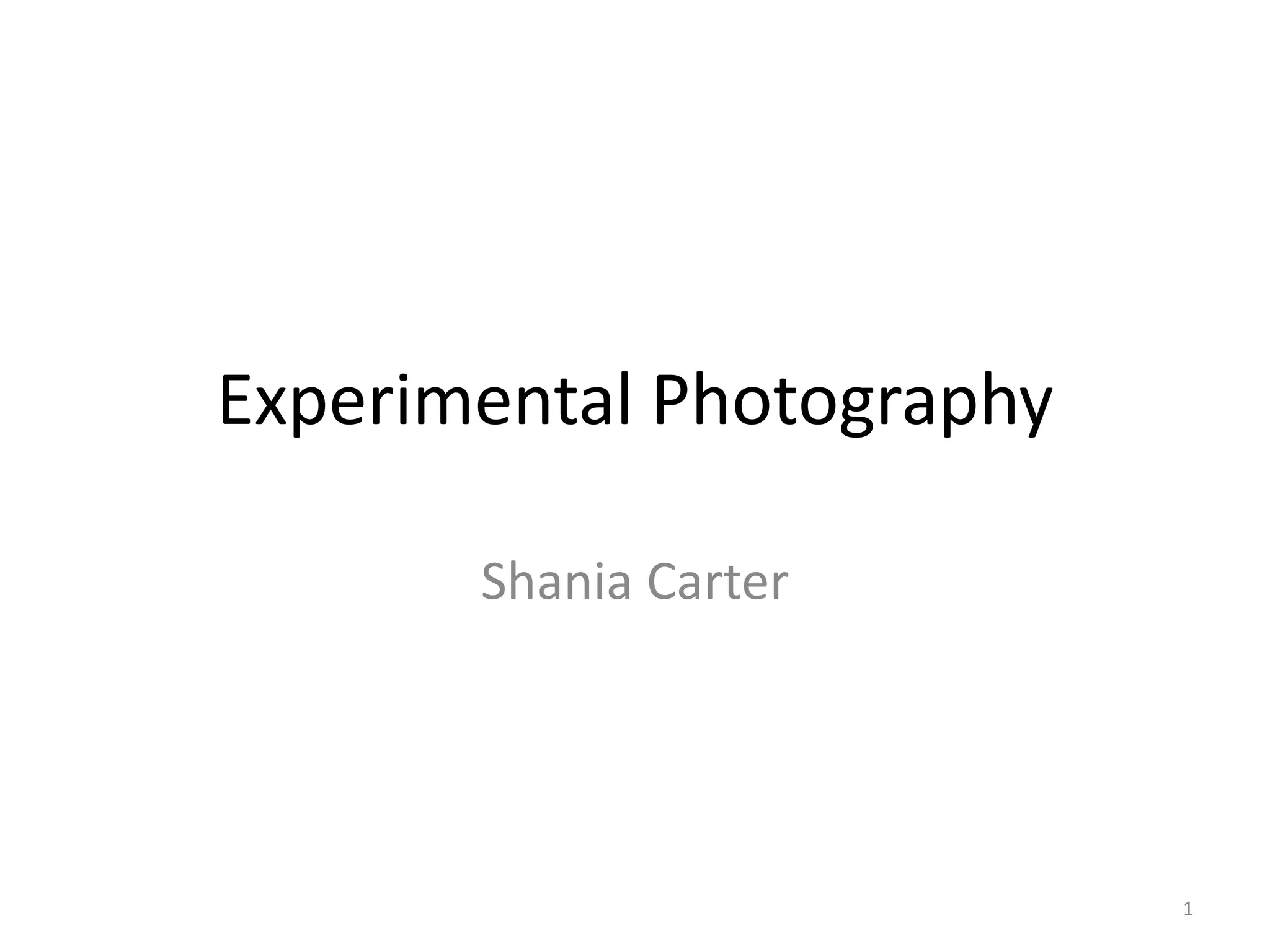
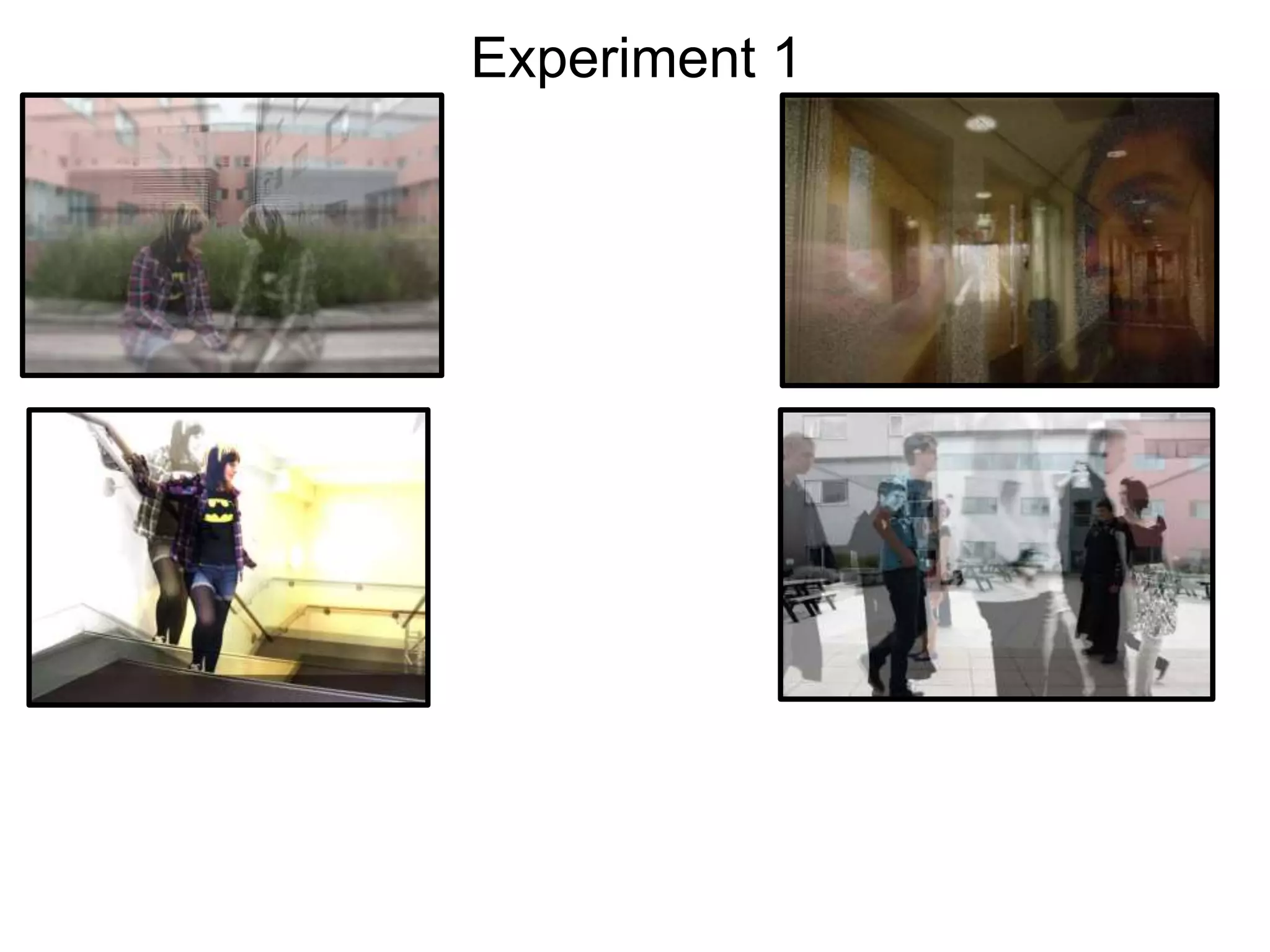
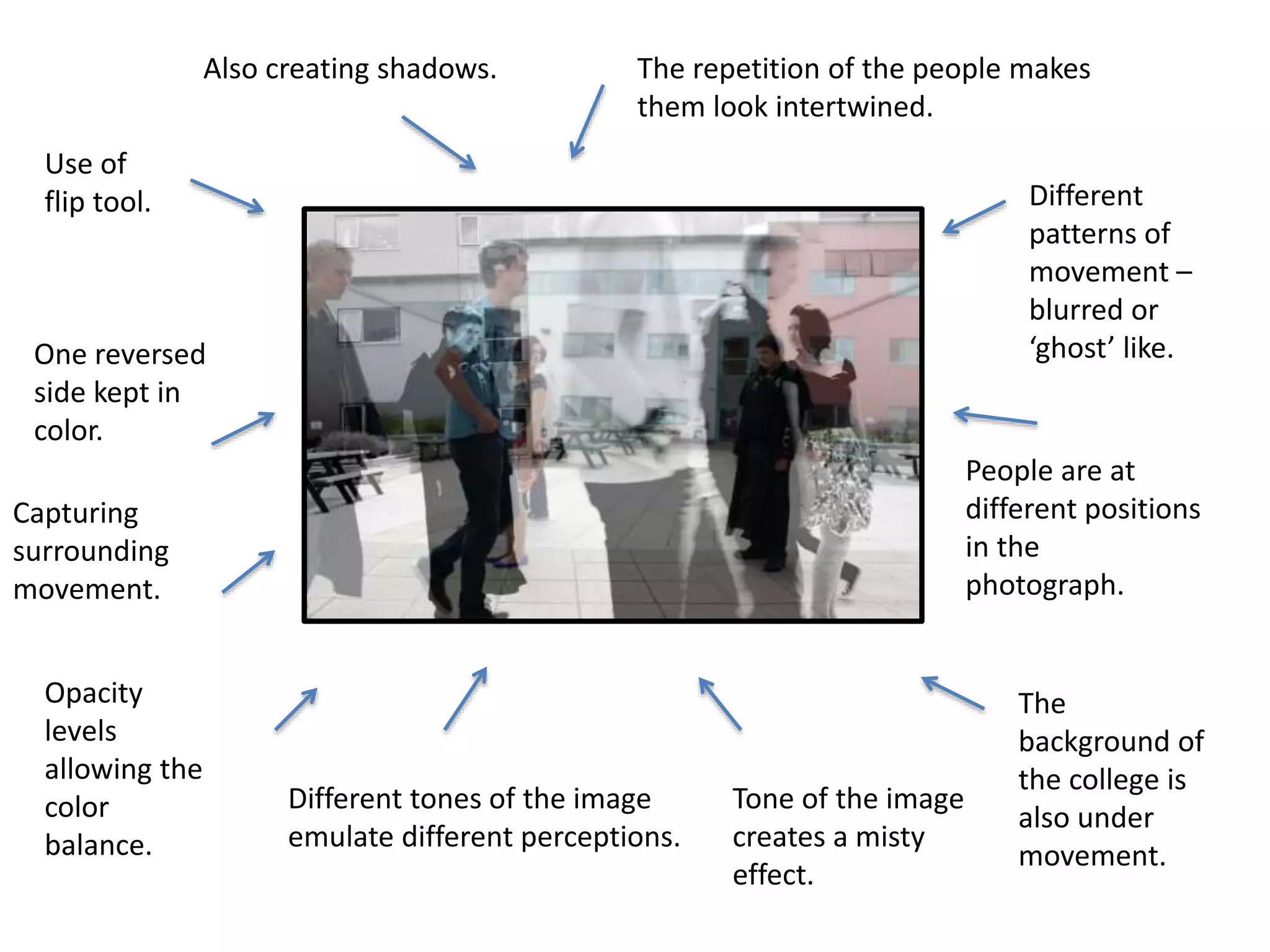
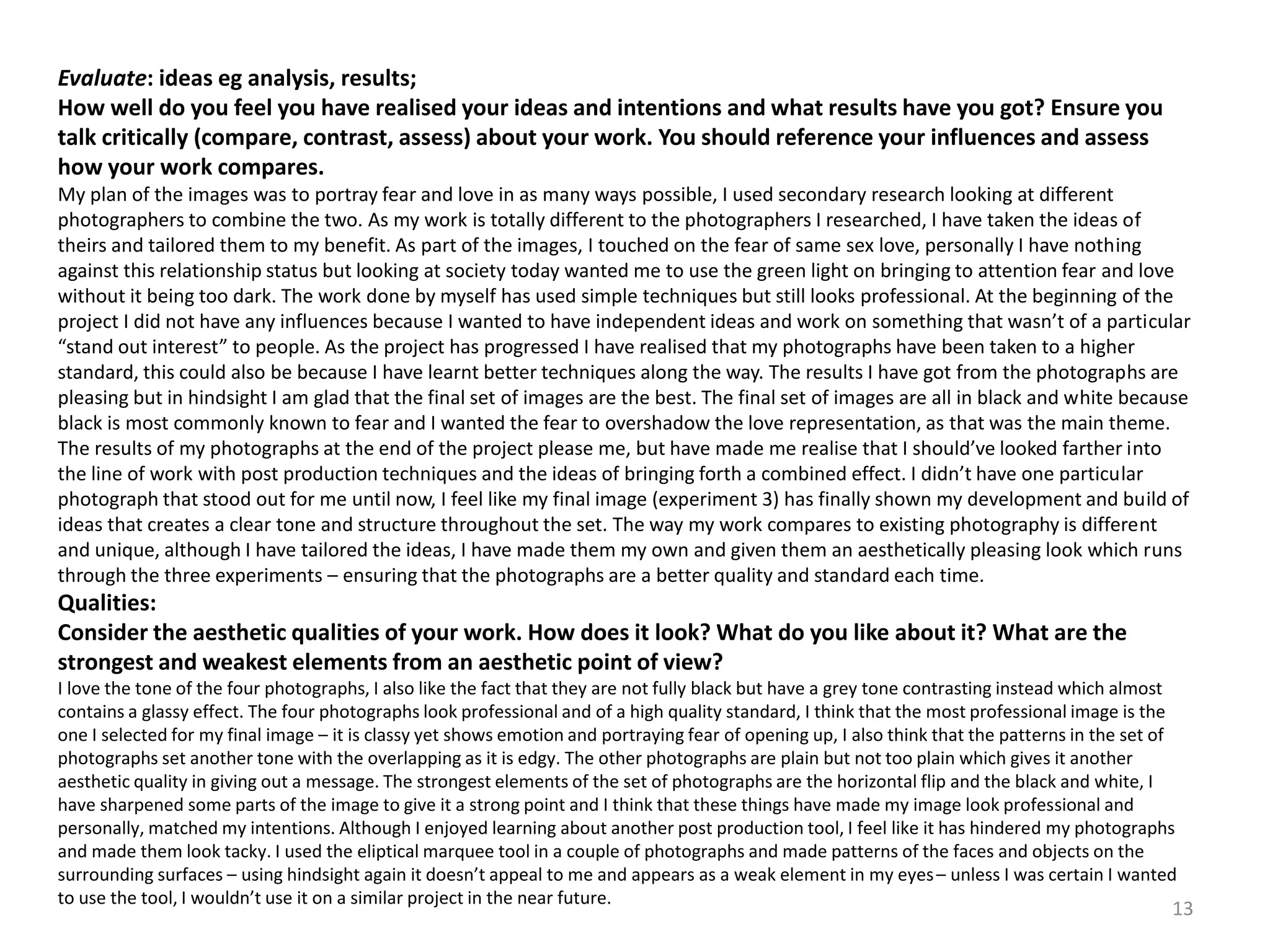
Experiment 1
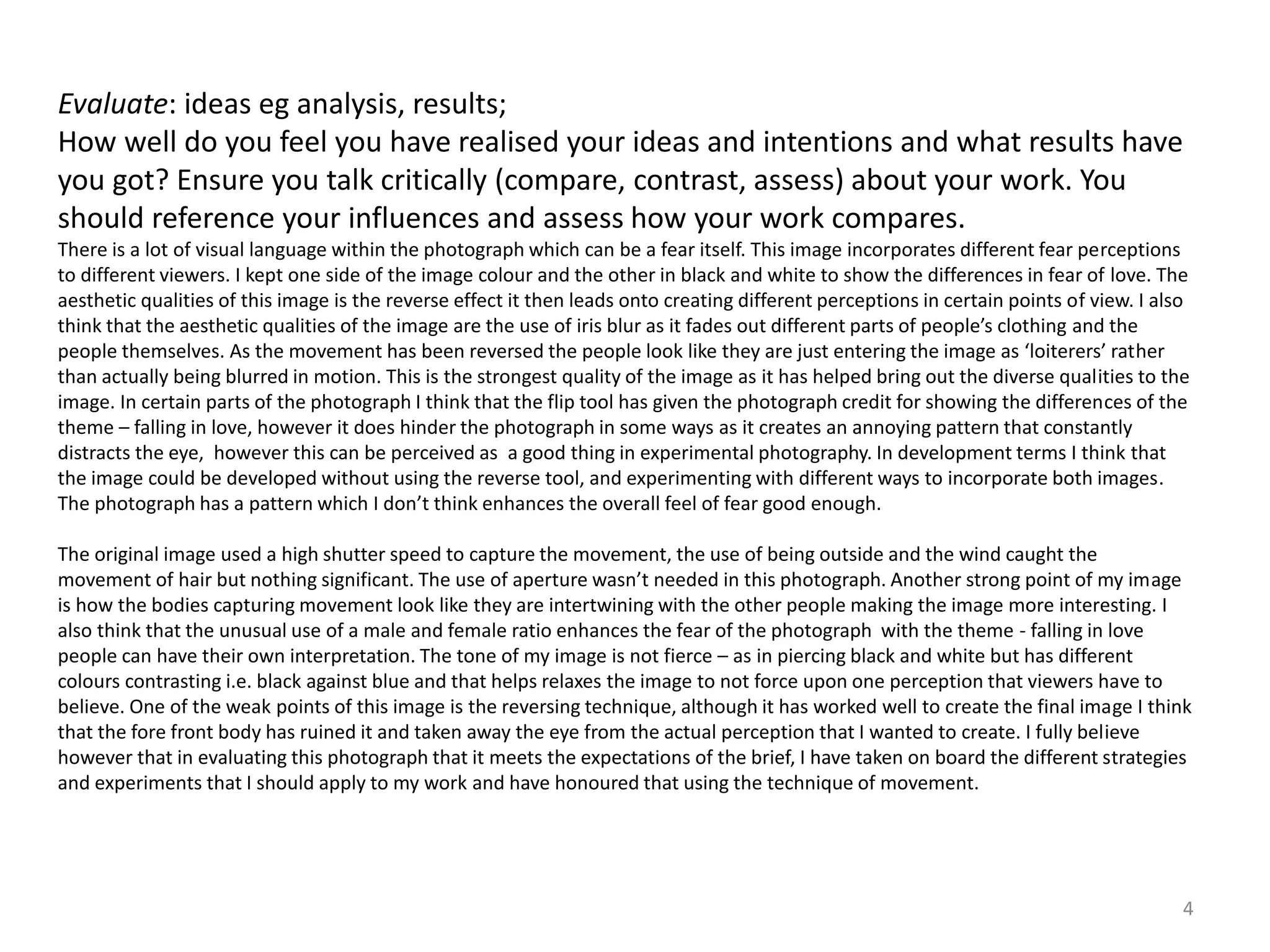
Use of 
flip tool. 
Also creating shadows. The repetition of the people makes 
One reversed 
side kept in 
color. 
Capturing 
surrounding 
movement. 
Opacity 
levels 
allowing the 
color 
balance. 
them look intertwined. 
Different tones of the image 
emulate different perceptions. 
Different 
patterns of 
movement – 
blurred or 
‘ghost’ like. 
People are at 
different positions 
in the 
photograph. 
Tone of the image 
creates a misty 
effect. 
The 
background of 
the college is 
also under 
movement.
Evaluate: ideas eg analysis, results; 
How well do you feel you have realised your ideas and intentions and what results have 
you got? Ensure you talk critically (compare, contrast, assess) about your work. You 
should reference your influences and assess how your work compares. 
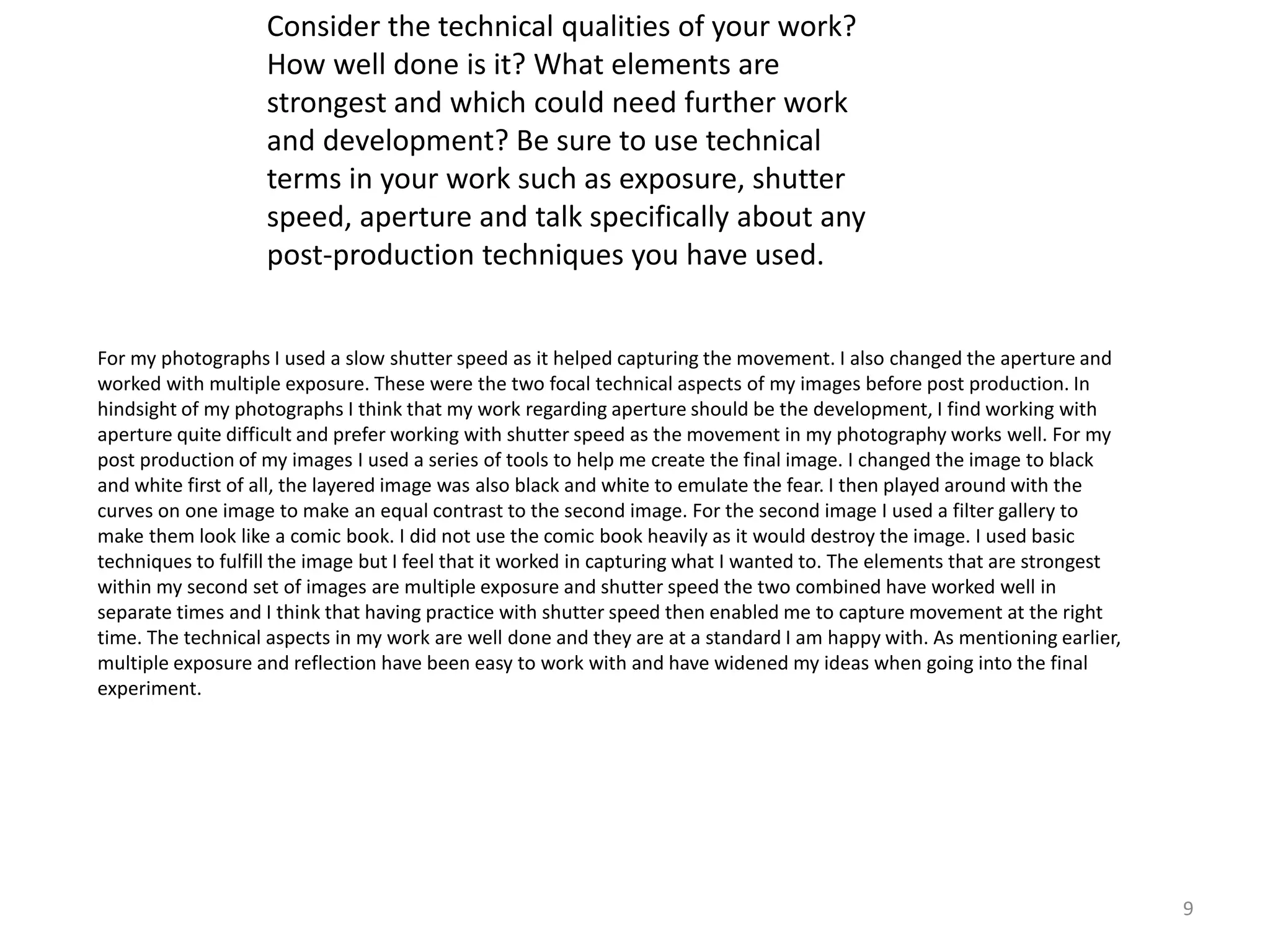
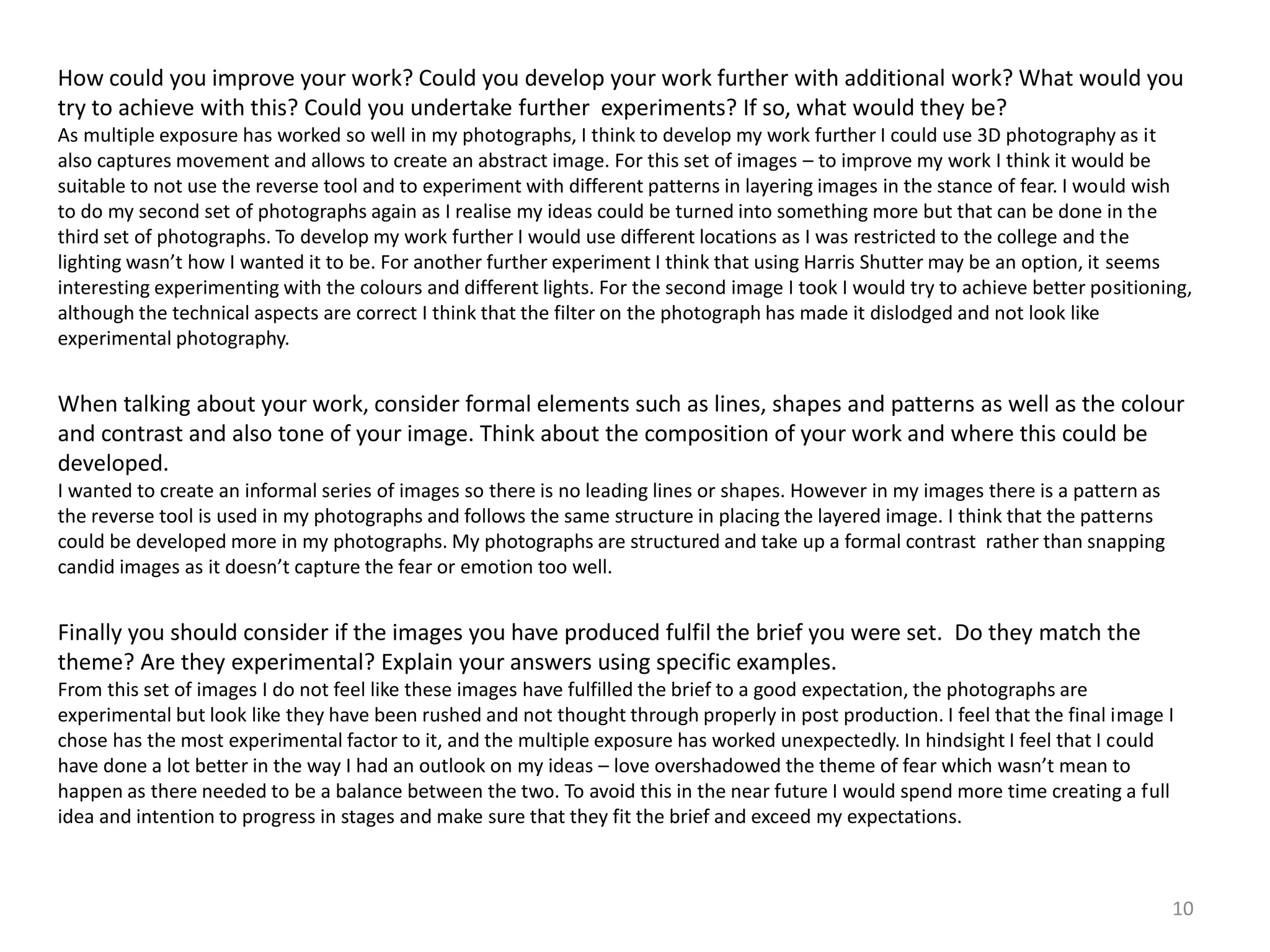
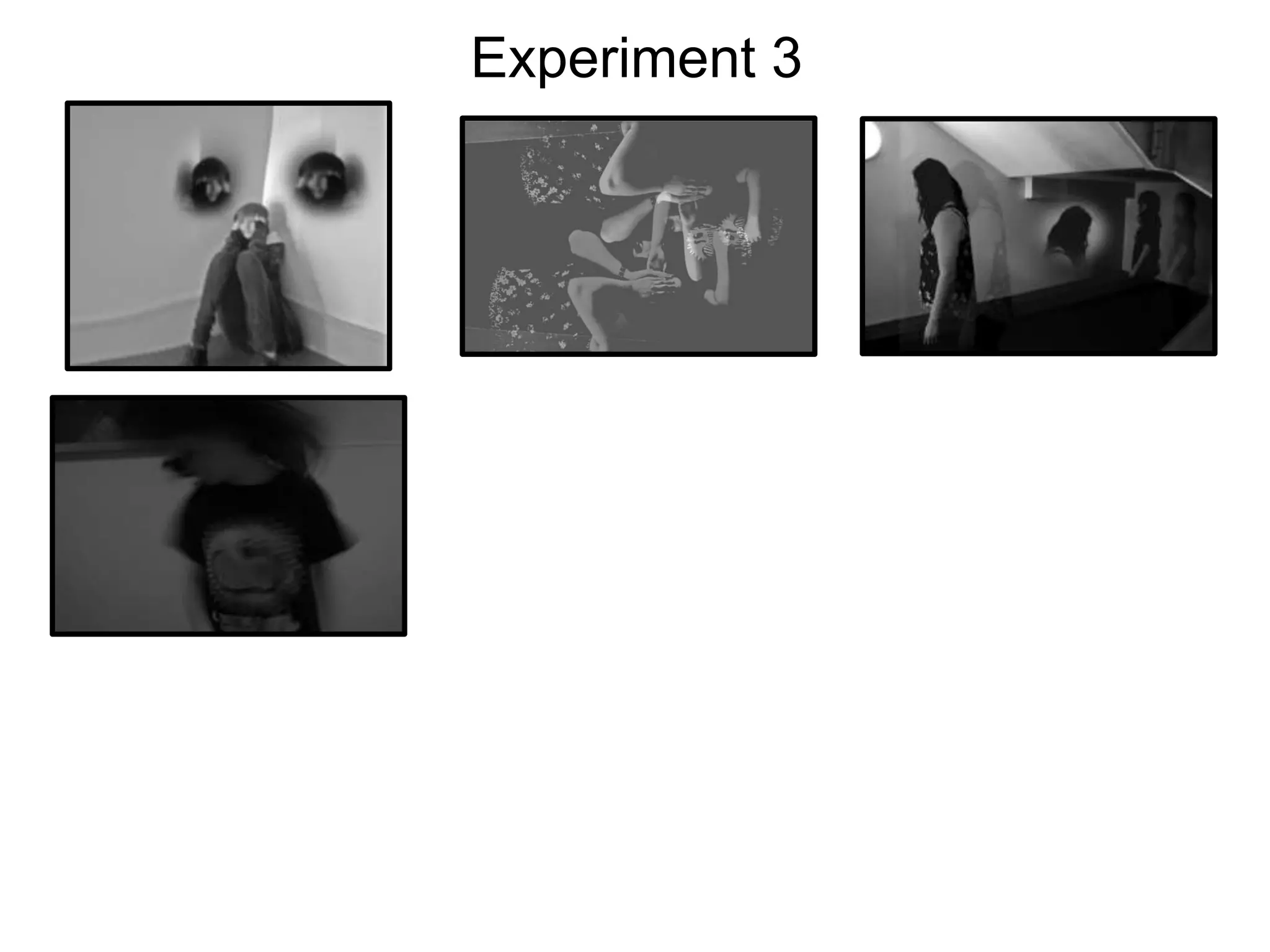
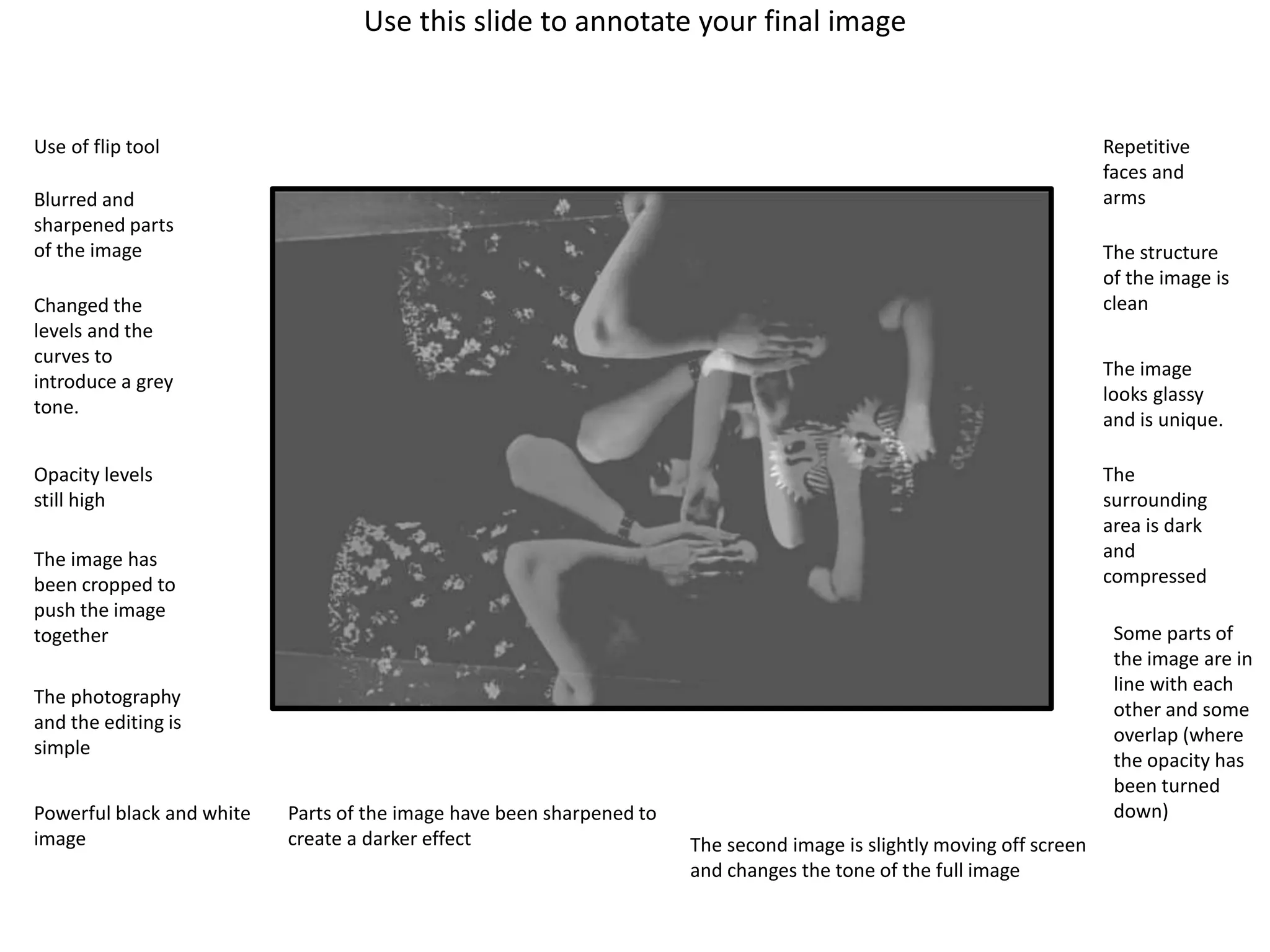
There is a lot of visual language within the photograph which can be a fear itself. This image incorporates different fear perceptions 
to different viewers. I kept one side of the image colour and the other in black and white to show the differences in fear of love. The 
aesthetic qualities of this image is the reverse effect it then leads onto creating different perceptions in certain points of view. I also 
think that the aesthetic qualities of the image are the use of iris blur as it fades out different parts of people’s clothing and the 
people themselves. As the movement has been reversed the people look like they are just entering the image as ‘loiterers’ rather 
than actually being blurred in motion. This is the strongest quality of the image as it has helped bring out the diverse qualities to the 
image. In certain parts of the photograph I think that the flip tool has given the photograph credit for showing the differences of the 
theme – falling in love, however it does hinder the photograph in some ways as it creates an annoying pattern that constantly 
distracts the eye, however this can be perceived as a good thing in experimental photography. In development terms I think that 
the image could be developed without using the reverse tool, and experimenting with different ways to incorporate both images. 
The photograph has a pattern which I don’t think enhances the overall feel of fear good enough. 
The original image used a high shutter speed to capture the movement, the use of being outside and the wind caught the 
movement of hair but nothing significant. The use of aperture wasn’t needed in this photograph. Another strong point of my image 
is how the bodies capturing movement look like they are intertwining with the other people making the image more interesting. I 
also think that the unusual use of a male and female ratio enhances the fear of the photograph with the theme - falling in love 
people can have their own interpretation. The tone of my image is not fierce – as in piercing black and white but has different 
colours contrasting i.e. black against blue and that helps relaxes the image to not force upon one perception that viewers have to 
believe. One of the weak points of this image is the reversing technique, although it has worked well to create the final image I think 
that the fore front body has ruined it and taken away the eye from the actual perception that I wanted to create. I fully believe 
however that in evaluating this photograph that it meets the expectations of the brief, I have taken on board the different strategies 
and experiments that I should apply to my work and have honoured that using the technique of movement. 
4
How could you improve your work? Could you develop your work further with additional work? What would you 
try to achieve with this? Could you undertake further experiments? If so, what would they be? 
To improve my work I would want to use a different shutter speed that enables me to capture the movement in split seconds. I also 
think to develop my work that I could play around with the tools on Photoshop like the use of multiply etc. as I could move the flip 
photograph around a lot more. To undertake further experiments my preferred choice would be light writing as it involves the use of 
movement and creates a lasting impression in the work of experimental photography. I would also develop my work by 
experimenting with post production more, there are a lot of tools that can be used to enhance an image and create unique effects 
instead of being repetitive. 
When talking about your work, consider formal elements such as lines, shapes and patterns as well as the colour 
and contrast and also tone of your image. Think about the composition of your work and where this could be 
developed. 
In my photograph I do not think there a very many formal elements as I haven’t taken into consideration the formal aspects of 
photography. My photograph does not have a leading line as the use of experimental and movement is to draw the eye to different 
parts of the image. The colour contrasts and tones of my photograph are soft and don’t imply one perception. I think that the 
informal elements of the image show that there can be many ways to view it. I don’t think that the composition of the photograph – 
from my perspective could be developed elsewhere as I believe that the placing from the use of the flip tool has implied the better 
side of experimental and movement photography and has given me the image I wanted. 
Finally you should consider if the images you have produced fulfil the brief you were set. Do they match the 
theme? Are they experimental? Explain your answers using specific examples. 
I fully believe that my first set of photographs fulfil the brief. I experimented with reflection before taking and choosing my final 
photographs for series one. The theme of fear can be experienced in different ways and I have taken and edited photographs that 
represent a different fear of falling in love, something people wouldn’t necessarily relate to. My photographs are experimental as 
they do not incorporate formal elements like you would expect in formal photography. I have used the flip tool in my set of 
photographs as I think that it shows reflection a lot more in the way patterns are formed. Although patterns are considered to be a 
formal element of photography I don’t think it clashes with the work in experimental photography. The theme of fear had always 
caught my eye when selecting the themes as it allows me to experiment with the different takes on what fear is for different people. 
The third photograph for me, shows the most reflection and development of the four, it brings out the levels and curves and also 
shows the use of good post production. 
5
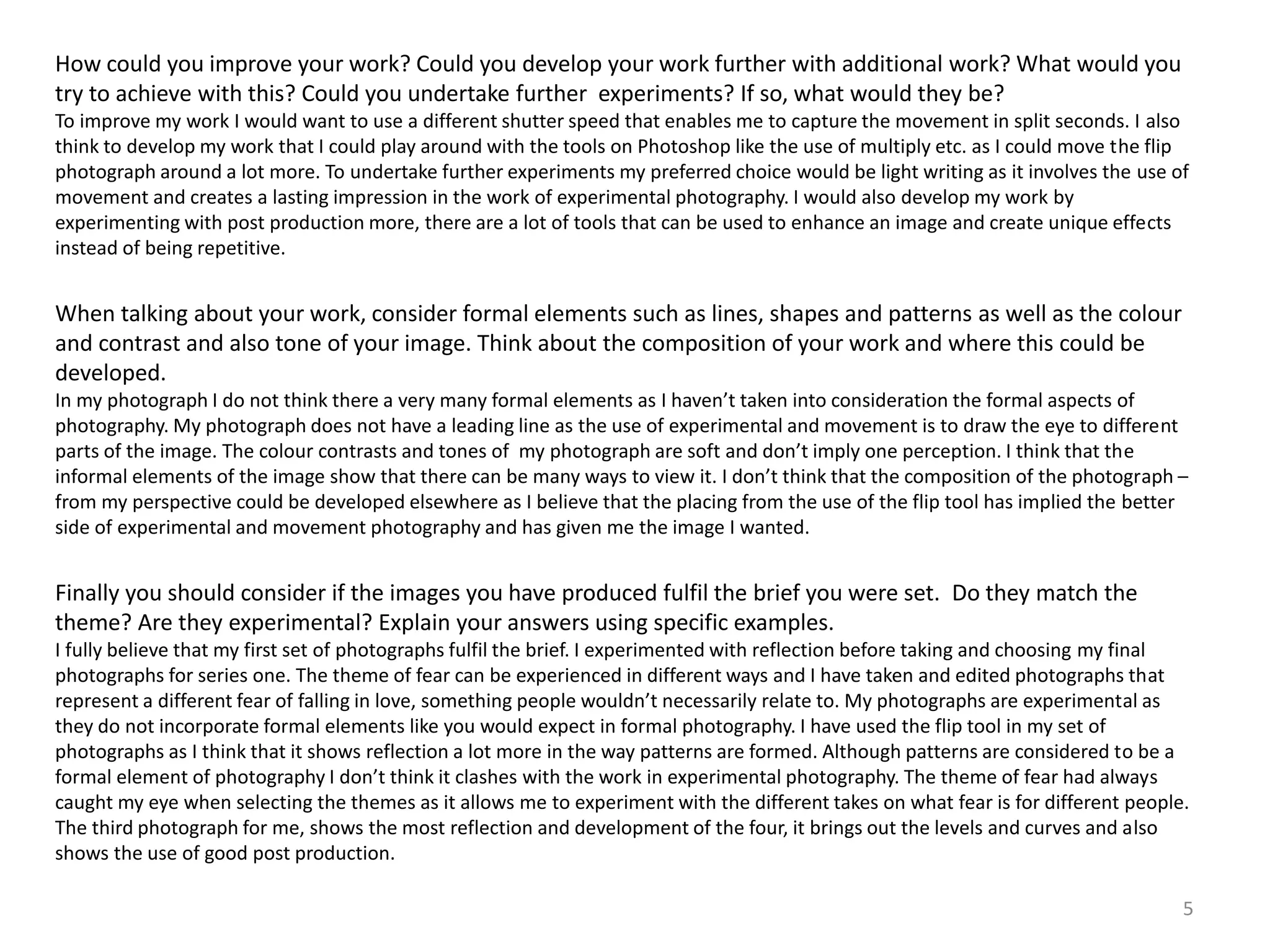
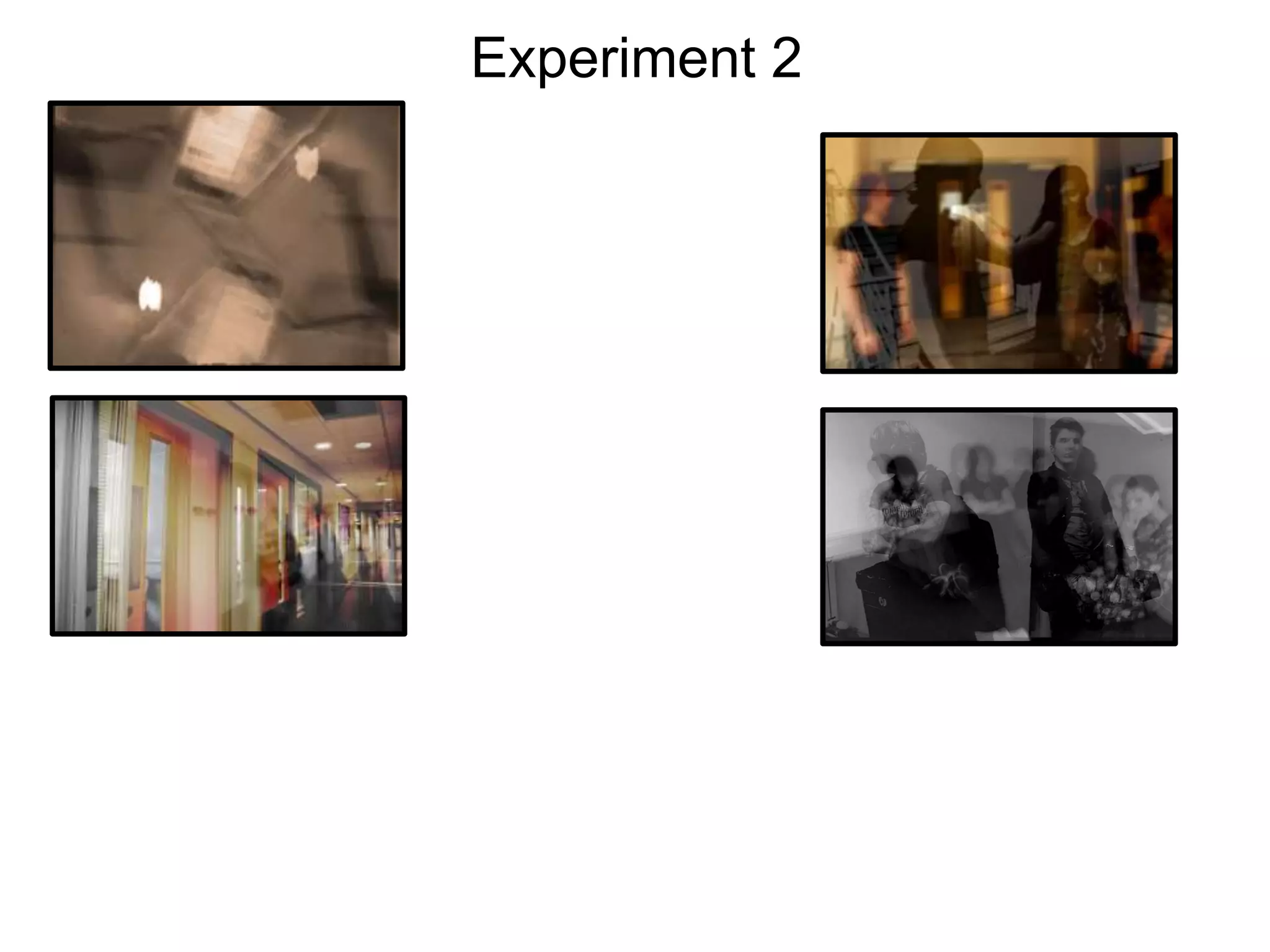
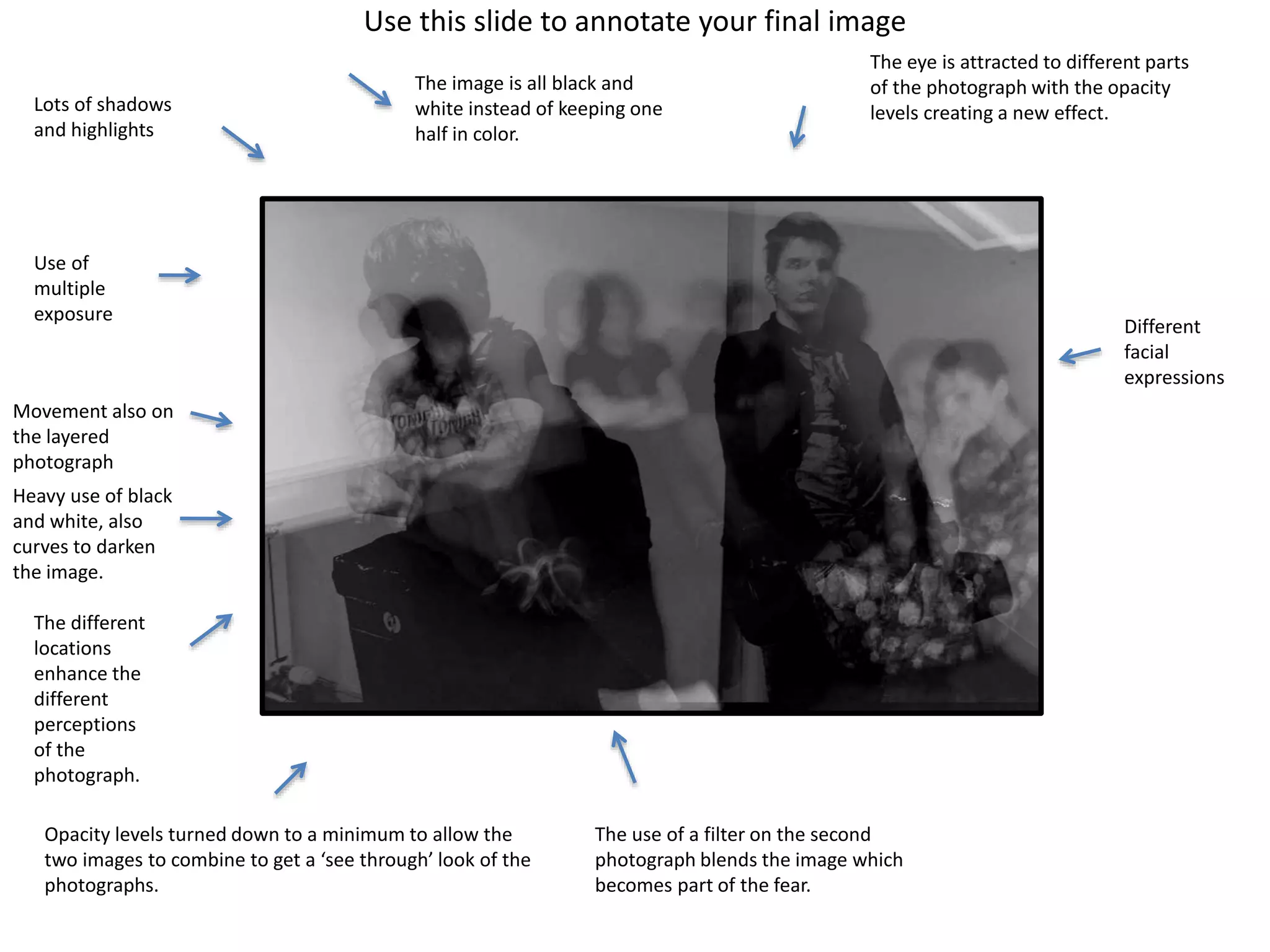
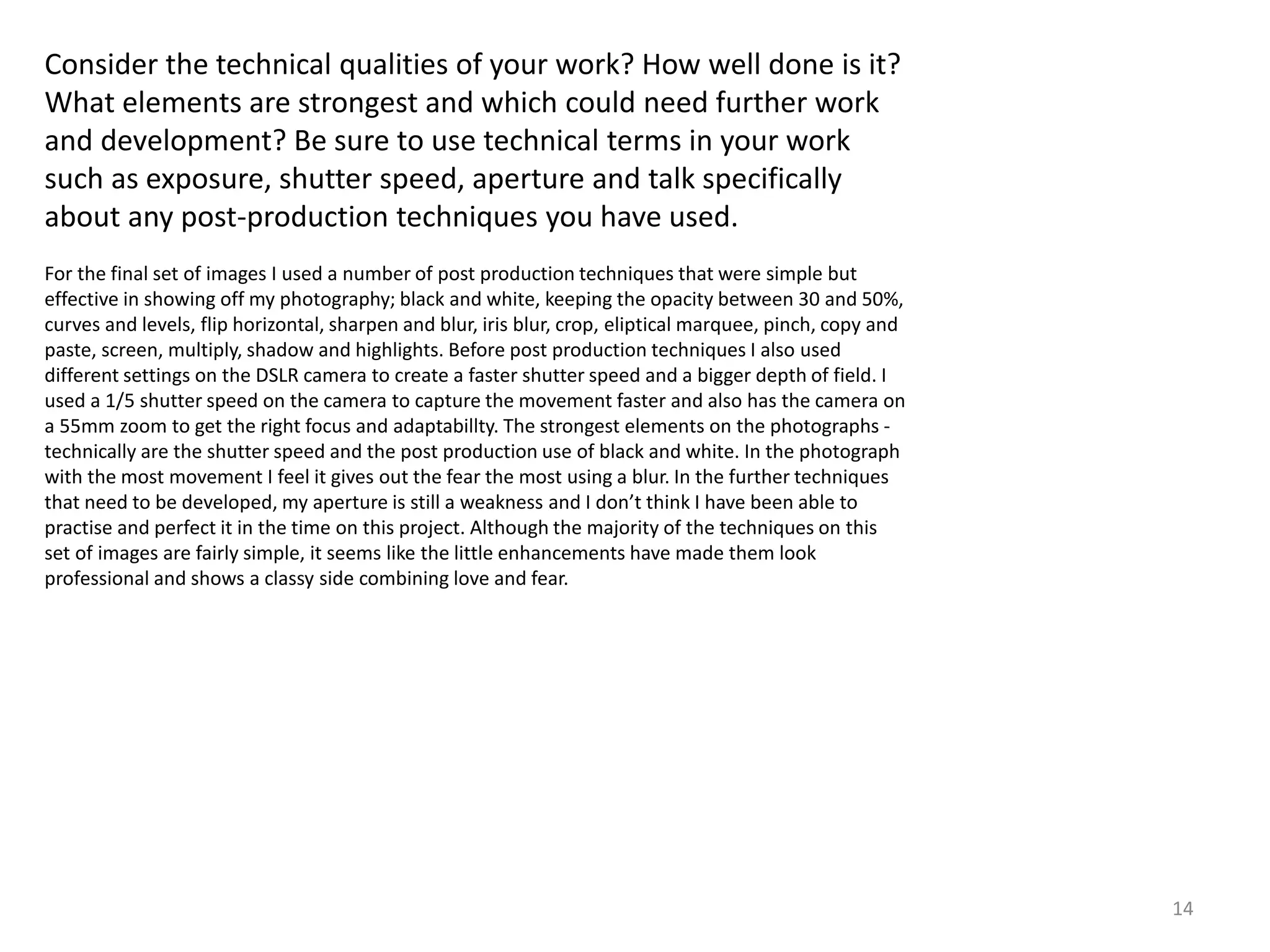
Experiment 2
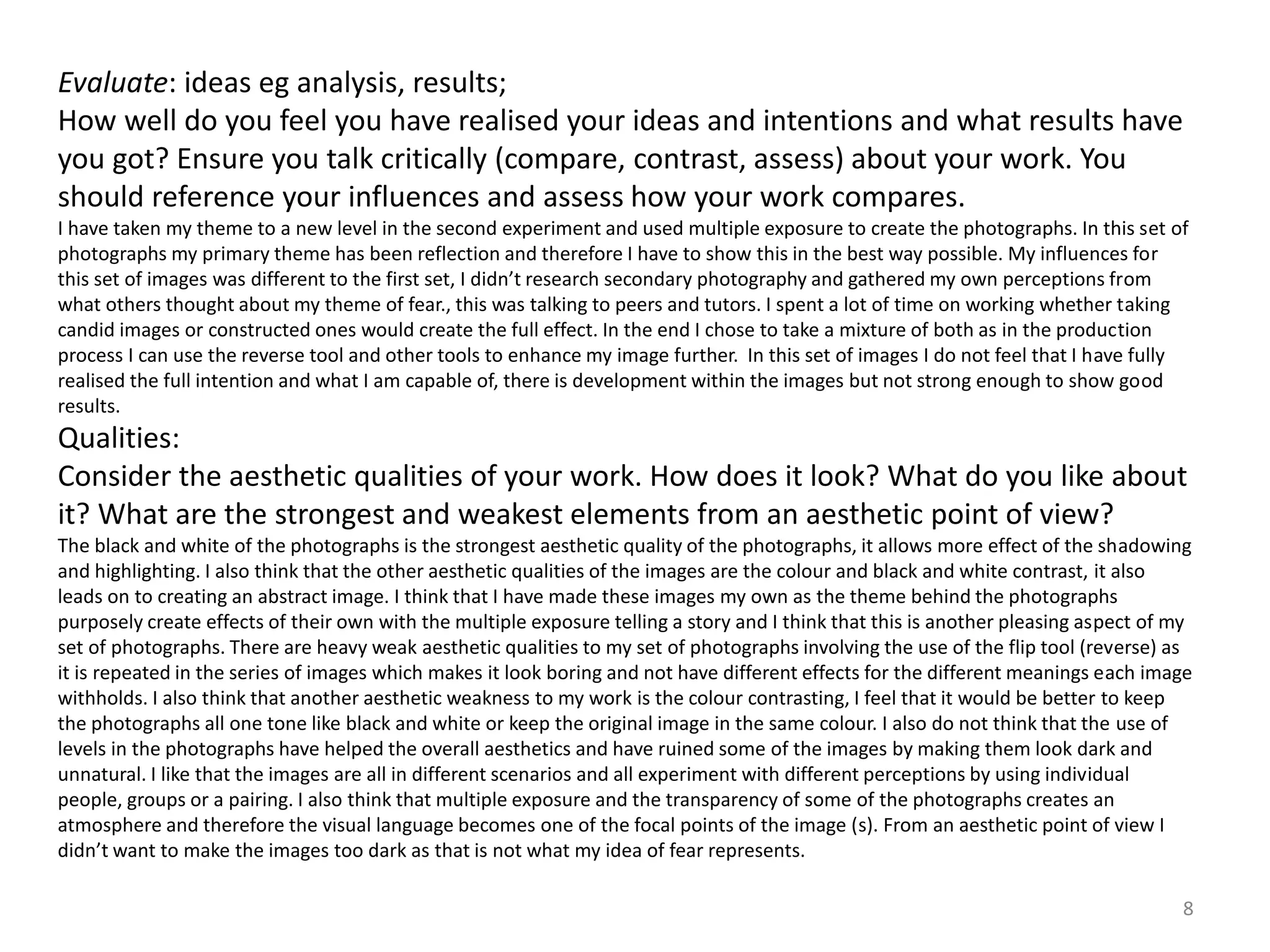
Use this slide to annotate your final image 
Lots of shadows 
and highlights 
Use of 
multiple 
exposure 
Movement also on 
the layered 
photograph 
Heavy use of black 
and white, also 
curves to darken 
the image. 
The different 
locations 
enhance the 
different 
perceptions 
of the 
photograph. 
The image is all black and 
white instead of keeping one 
half in color. 
Opacity levels turned down to a minimum to allow the 
two images to combine to get a ‘see through’ look of the 
photographs. 
The eye is attracted to different parts 
of the photograph with the opacity 
levels creating a new effect. 
The use of a filter on the second 
photograph blends the image which 
becomes part of the fear. 
Different 
facial 
expressions
Evaluate: ideas eg analysis, results; 
How well do you feel you have realised your ideas and intentions and what results have 
you got? Ensure you talk critically (compare, contrast, assess) about your work. You 
should reference your influences and assess how your work compares. 
I have taken my theme to a new level in the second experiment and used multiple exposure to create the photographs. In this set of 
photographs my primary theme has been reflection and therefore I have to show this in the best way possible. My influences for 
this set of images was different to the first set, I didn’t research secondary photography and gathered my own perceptions from 
what others thought about my theme of fear., this was talking to peers and tutors. I spent a lot of time on working whether taking 
candid images or constructed ones would create the full effect. In the end I chose to take a mixture of both as in the production 
process I can use the reverse tool and other tools to enhance my image further. In this set of images I do not feel that I have fully 
realised the full intention and what I am capable of, there is development within the images but not strong enough to show good 
results. 
Qualities: 
Consider the aesthetic qualities of your work. How does it look? What do you like about 
it? What are the strongest and weakest elements from an aesthetic point of view? 
The black and white of the photographs is the strongest aesthetic quality of the photographs, it allows more effect of the shadowing 
and highlighting. I also think that the other aesthetic qualities of the images are the colour and black and white contrast, it also 
leads on to creating an abstract image. I think that I have made these images my own as the theme behind the photographs 
purposely create effects of their own with the multiple exposure telling a story and I think that this is another pleasing aspect of my 
set of photographs. There are heavy weak aesthetic qualities to my set of photographs involving the use of the flip tool (reverse) as 
it is repeated in the series of images which makes it look boring and not have different effects for the different meanings each image 
withholds. I also think that another aesthetic weakness to my work is the colour contrasting, I feel that it would be better to keep 
the photographs all one tone like black and white or keep the original image in the same colour. I also do not think that the use of 
levels in the photographs have helped the overall aesthetics and have ruined some of the images by making them look dark and 
unnatural. I like that the images are all in different scenarios and all experiment with different perceptions by using individual 
people, groups or a pairing. I also think that multiple exposure and the transparency of some of the photographs creates an 
atmosphere and therefore the visual language becomes one of the focal points of the image (s). From an aesthetic point of view I 
didn’t want to make the images too dark as that is not what my idea of fear represents. 
8
9 
Consider the technical qualities of your work? 
How well done is it? What elements are 
strongest and which could need further work 
and development? Be sure to use technical 
terms in your work such as exposure, shutter 
speed, aperture and talk specifically about any 
post-production techniques you have used. 
For my photographs I used a slow shutter speed as it helped capturing the movement. I also changed the aperture and 
worked with multiple exposure. These were the two focal technical aspects of my images before post production. In 
hindsight of my photographs I think that my work regarding aperture should be the development, I find working with 
aperture quite difficult and prefer working with shutter speed as the movement in my photography works well. For my 
post production of my images I used a series of tools to help me create the final image. I changed the image to black 
and white first of all, the layered image was also black and white to emulate the fear. I then played around with the 
curves on one image to make an equal contrast to the second image. For the second image I used a filter gallery to 
make them look like a comic book. I did not use the comic book heavily as it would destroy the image. I used basic 
techniques to fulfill the image but I feel that it worked in capturing what I wanted to. The elements that are strongest 
within my second set of images are multiple exposure and shutter speed the two combined have worked well in 
separate times and I think that having practice with shutter speed then enabled me to capture movement at the right 
time. The technical aspects in my work are well done and they are at a standard I am happy with. As mentioning earlier, 
multiple exposure and reflection have been easy to work with and have widened my ideas when going into the final 
experiment.
How could you improve your work? Could you develop your work further with additional work? What would you 
try to achieve with this? Could you undertake further experiments? If so, what would they be? 
As multiple exposure has worked so well in my photographs, I think to develop my work further I could use 3D photography as it 
also captures movement and allows to create an abstract image. For this set of images – to improve my work I think it would be 
suitable to not use the reverse tool and to experiment with different patterns in layering images in the stance of fear. I would wish 
to do my second set of photographs again as I realise my ideas could be turned into something more but that can be done in the 
third set of photographs. To develop my work further I would use different locations as I was restricted to the college and the 
lighting wasn’t how I wanted it to be. For another further experiment I think that using Harris Shutter may be an option, it seems 
interesting experimenting with the colours and different lights. For the second image I took I would try to achieve better positioning, 
although the technical aspects are correct I think that the filter on the photograph has made it dislodged and not look like 
experimental photography. 
When talking about your work, consider formal elements such as lines, shapes and patterns as well as the colour 
and contrast and also tone of your image. Think about the composition of your work and where this could be 
developed. 
I wanted to create an informal series of images so there is no leading lines or shapes. However in my images there is a pattern as 
the reverse tool is used in my photographs and follows the same structure in placing the layered image. I think that the patterns 
could be developed more in my photographs. My photographs are structured and take up a formal contrast rather than snapping 
candid images as it doesn’t capture the fear or emotion too well. 
Finally you should consider if the images you have produced fulfil the brief you were set. Do they match the 
theme? Are they experimental? Explain your answers using specific examples. 
From this set of images I do not feel like these images have fulfilled the brief to a good expectation, the photographs are 
experimental but look like they have been rushed and not thought through properly in post production. I feel that the final image I 
chose has the most experimental factor to it, and the multiple exposure has worked unexpectedly. In hindsight I feel that I could 
have done a lot better in the way I had an outlook on my ideas – love overshadowed the theme of fear which wasn’t mean to 
happen as there needed to be a balance between the two. To avoid this in the near future I would spend more time creating a full 
idea and intention to progress in stages and make sure that they fit the brief and exceed my expectations. 
10
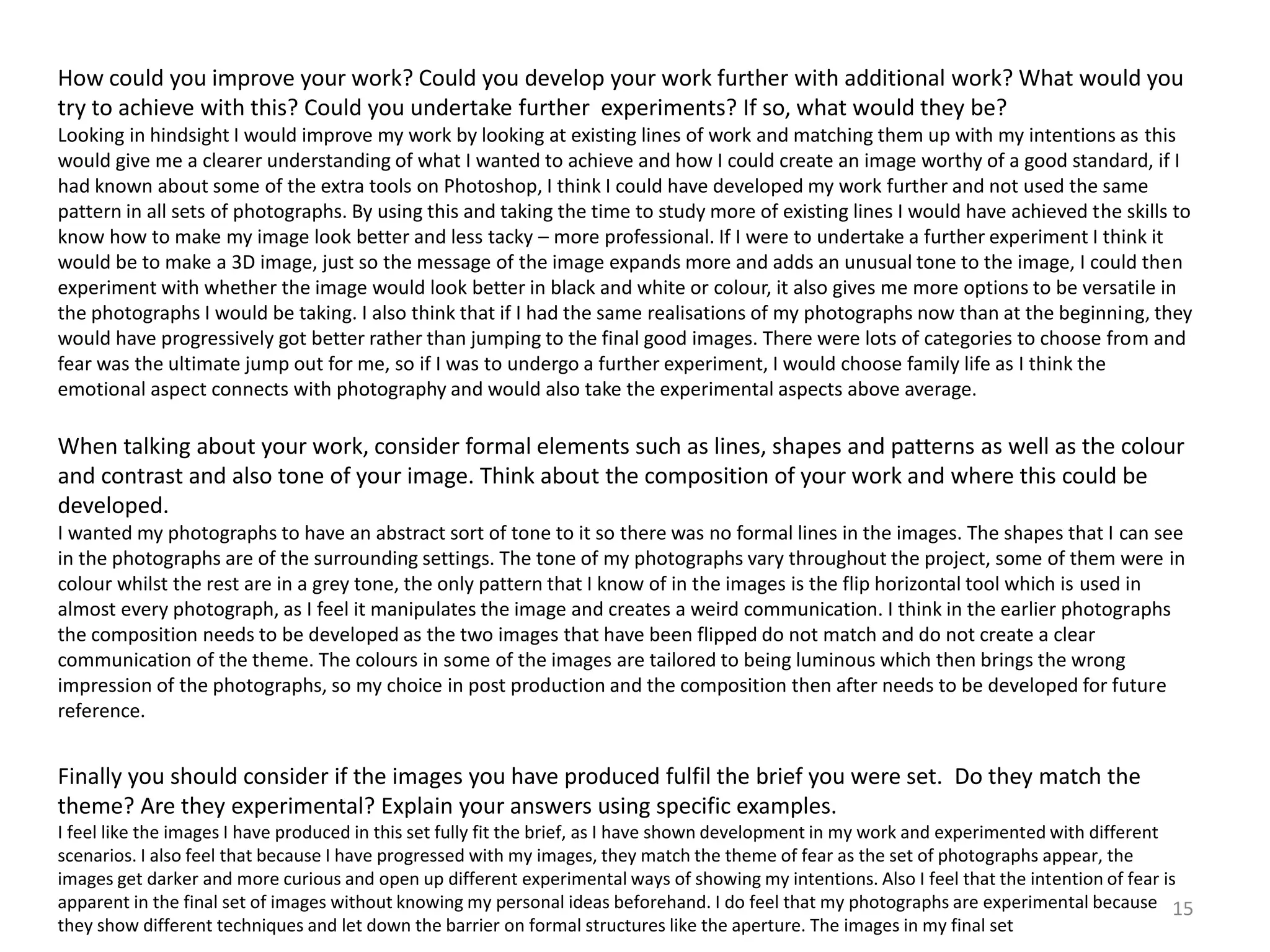
Experiment 3
Use this slide to annotate your final image 
Use of flip tool 
Blurred and 
sharpened parts 
of the image 
Changed the 
levels and the 
curves to 
introduce a grey 
tone. 
Opacity levels 
still high 
The image has 
been cropped to 
push the image 
together 
The photography 
and the editing is 
simple 
Powerful black and white 
image 
Parts of the image have been sharpened to 
create a darker effect The second image is slightly moving off screen 
and changes the tone of the full image 
Repetitive 
faces and 
arms 
The structure 
of the image is 
clean 
The image 
looks glassy 
and is unique. 
The 
surrounding 
area is dark 
and 
compressed 
Some parts of 
the image are in 
line with each 
other and some 
overlap (where 
the opacity has 
been turned 
down)
Evaluate: ideas eg analysis, results; 
How well do you feel you have realised your ideas and intentions and what results have you got? Ensure you 
talk critically (compare, contrast, assess) about your work. You should reference your influences and assess 
how your work compares. 
My plan of the images was to portray fear and love in as many ways possible, I used secondary research looking at different 
photographers to combine the two. As my work is totally different to the photographers I researched, I have taken the ideas of 
theirs and tailored them to my benefit. As part of the images, I touched on the fear of same sex love, personally I have nothing 
against this relationship status but looking at society today wanted me to use the green light on bringing to attention fear and love 
without it being too dark. The work done by myself has used simple techniques but still looks professional. At the beginning of the 
project I did not have any influences because I wanted to have independent ideas and work on something that wasn’t of a particular 
“stand out interest” to people. As the project has progressed I have realised that my photographs have been taken to a higher 
standard, this could also be because I have learnt better techniques along the way. The results I have got from the photographs are 
pleasing but in hindsight I am glad that the final set of images are the best. The final set of images are all in black and white because 
black is most commonly known to fear and I wanted the fear to overshadow the love representation, as that was the main theme. 
The results of my photographs at the end of the project please me, but have made me realise that I should’ve looked farther into 
the line of work with post production techniques and the ideas of bringing forth a combined effect. I didn’t have one particular 
photograph that stood out for me until now, I feel like my final image (experiment 3) has finally shown my development and build of 
ideas that creates a clear tone and structure throughout the set. The way my work compares to existing photography is different 
and unique, although I have tailored the ideas, I have made them my own and given them an aesthetically pleasing look which runs 
through the three experiments – ensuring that the photographs are a better quality and standard each time. 
Qualities: 
Consider the aesthetic qualities of your work. How does it look? What do you like about it? What are the 
strongest and weakest elements from an aesthetic point of view? 
I love the tone of the four photographs, I also like the fact that they are not fully black but have a grey tone contrasting instead which almost 
contains a glassy effect. The four photographs look professional and of a high quality standard, I think that the most professional image is the 
one I selected for my final image – it is classy yet shows emotion and portraying fear of opening up, I also think that the patterns in the set of 
photographs set another tone with the overlapping as it is edgy. The other photographs are plain but not too plain which gives it another 
aesthetic quality in giving out a message. The strongest elements of the set of photographs are the horizontal flip and the black and white, I 
have sharpened some parts of the image to give it a strong point and I think that these things have made my image look professional and 
personally, matched my intentions. Although I enjoyed learning about another post production tool, I feel like it has hindered my photographs 
and made them look tacky. I used the elipticalmarquee tool in a couple of photographs and made patterns of the faces and objects on the 
surrounding surfaces – using hindsight again it doesn’t appeal to me and appears as a weak element in my eyes – unless I was certain I wanted 
to use the tool, I wouldn’t use it on a similar project in the near future. 
13
14 
Consider the technical qualities of your work? How well done is it? 
What elements are strongest and which could need further work 
and development? Be sure to use technical terms in your work 
such as exposure, shutter speed, aperture and talk specifically 
about any post-production techniques you have used. 
For the final set of images I used a number of post production techniques that were simple but 
effective in showing off my photography; black and white, keeping the opacity between 30 and 50%, 
curves and levels, flip horizontal, sharpen and blur, iris blur, crop, eliptical marquee, pinch, copy and 
paste, screen, multiply, shadow and highlights. Before post production techniques I also used 
different settings on the DSLR camera to create a faster shutter speed and a bigger depth of field. I 
used a 1/5 shutter speed on the camera to capture the movement faster and also has the camera on 
a 55mm zoom to get the right focus and adaptabillty. The strongest elements on the photographs - 
technically are the shutter speed and the post production use of black and white. In the photograph 
with the most movement I feel it gives out the fear the most using a blur. In the further techniques 
that need to be developed, my aperture is still a weakness and I don’t think I have been able to 
practise and perfect it in the time on this project. Although the majority of the techniques on this 
set of images are fairly simple, it seems like the little enhancements have made them look 
professional and shows a classy side combining love and fear.
How could you improve your work? Could you develop your work further with additional work? What would you 
try to achieve with this? Could you undertake further experiments? If so, what would they be? 
Looking in hindsight I would improve my work by looking at existing lines of work and matching them up with my intentions as this 
would give me a clearer understanding of what I wanted to achieve and how I could create an image worthy of a good standard, if I 
had known about some of the extra tools on Photoshop, I think I could have developed my work further and not used the same 
pattern in all sets of photographs. By using this and taking the time to study more of existing lines I would have achieved the skills to 
know how to make my image look better and less tacky – more professional. If I were to undertake a further experiment I think it 
would be to make a 3D image, just so the message of the image expands more and adds an unusual tone to the image, I could then 
experiment with whether the image would look better in black and white or colour, it also gives me more options to be versatile in 
the photographs I would be taking. I also think that if I had the same realisations of my photographs now than at the beginning, they 
would have progressively got better rather than jumping to the final good images. There were lots of categories to choose from and 
fear was the ultimate jump out for me, so if I was to undergo a further experiment, I would choose family life as I think the 
emotional aspect connects with photography and would also take the experimental aspects above average. 
When talking about your work, consider formal elements such as lines, shapes and patterns as well as the colour 
and contrast and also tone of your image. Think about the composition of your work and where this could be 
developed. 
I wanted my photographs to have an abstract sort of tone to it so there was no formal lines in the images. The shapes that I can see 
in the photographs are of the surrounding settings. The tone of my photographs vary throughout the project, some of them were in 
colour whilst the rest are in a grey tone, the only pattern that I know of in the images is the flip horizontal tool which is used in 
almost every photograph, as I feel it manipulates the image and creates a weird communication. I think in the earlier photographs 
the composition needs to be developed as the two images that have been flipped do not match and do not create a clear 
communication of the theme. The colours in some of the images are tailored to being luminous which then brings the wrong 
impression of the photographs, so my choice in post production and the composition then after needs to be developed for future 
reference. 
Finally you should consider if the images you have produced fulfil the brief you were set. Do they match the 
theme? Are they experimental? Explain your answers using specific examples. 
I feel like the images I have produced in this set fully fit the brief, as I have shown development in my work and experimented with different 
scenarios. I also feel that because I have progressed with my images, they match the theme of fear as the set of photographs appear, the 
images get darker and more curious and open up different experimental ways of showing my intentions. Also I feel that the intention of fear is 
apparent in the final set of images without knowing my personal ideas beforehand. I do feel that my photographs are experimental because 
they show different techniques and let down the barrier on formal structures like the aperture. The images in my final set 
15

On going evaluations

  • 1.
  • 2.
  • 3.
    Use of fliptool. Also creating shadows. The repetition of the people makes One reversed side kept in color. Capturing surrounding movement. Opacity levels allowing the color balance. them look intertwined. Different tones of the image emulate different perceptions. Different patterns of movement – blurred or ‘ghost’ like. People are at different positions in the photograph. Tone of the image creates a misty effect. The background of the college is also under movement.
  • 4.
    Evaluate: ideas eganalysis, results; How well do you feel you have realised your ideas and intentions and what results have you got? Ensure you talk critically (compare, contrast, assess) about your work. You should reference your influences and assess how your work compares. There is a lot of visual language within the photograph which can be a fear itself. This image incorporates different fear perceptions to different viewers. I kept one side of the image colour and the other in black and white to show the differences in fear of love. The aesthetic qualities of this image is the reverse effect it then leads onto creating different perceptions in certain points of view. I also think that the aesthetic qualities of the image are the use of iris blur as it fades out different parts of people’s clothing and the people themselves. As the movement has been reversed the people look like they are just entering the image as ‘loiterers’ rather than actually being blurred in motion. This is the strongest quality of the image as it has helped bring out the diverse qualities to the image. In certain parts of the photograph I think that the flip tool has given the photograph credit for showing the differences of the theme – falling in love, however it does hinder the photograph in some ways as it creates an annoying pattern that constantly distracts the eye, however this can be perceived as a good thing in experimental photography. In development terms I think that the image could be developed without using the reverse tool, and experimenting with different ways to incorporate both images. The photograph has a pattern which I don’t think enhances the overall feel of fear good enough. The original image used a high shutter speed to capture the movement, the use of being outside and the wind caught the movement of hair but nothing significant. The use of aperture wasn’t needed in this photograph. Another strong point of my image is how the bodies capturing movement look like they are intertwining with the other people making the image more interesting. I also think that the unusual use of a male and female ratio enhances the fear of the photograph with the theme - falling in love people can have their own interpretation. The tone of my image is not fierce – as in piercing black and white but has different colours contrasting i.e. black against blue and that helps relaxes the image to not force upon one perception that viewers have to believe. One of the weak points of this image is the reversing technique, although it has worked well to create the final image I think that the fore front body has ruined it and taken away the eye from the actual perception that I wanted to create. I fully believe however that in evaluating this photograph that it meets the expectations of the brief, I have taken on board the different strategies and experiments that I should apply to my work and have honoured that using the technique of movement. 4
  • 5.
    How could youimprove your work? Could you develop your work further with additional work? What would you try to achieve with this? Could you undertake further experiments? If so, what would they be? To improve my work I would want to use a different shutter speed that enables me to capture the movement in split seconds. I also think to develop my work that I could play around with the tools on Photoshop like the use of multiply etc. as I could move the flip photograph around a lot more. To undertake further experiments my preferred choice would be light writing as it involves the use of movement and creates a lasting impression in the work of experimental photography. I would also develop my work by experimenting with post production more, there are a lot of tools that can be used to enhance an image and create unique effects instead of being repetitive. When talking about your work, consider formal elements such as lines, shapes and patterns as well as the colour and contrast and also tone of your image. Think about the composition of your work and where this could be developed. In my photograph I do not think there a very many formal elements as I haven’t taken into consideration the formal aspects of photography. My photograph does not have a leading line as the use of experimental and movement is to draw the eye to different parts of the image. The colour contrasts and tones of my photograph are soft and don’t imply one perception. I think that the informal elements of the image show that there can be many ways to view it. I don’t think that the composition of the photograph – from my perspective could be developed elsewhere as I believe that the placing from the use of the flip tool has implied the better side of experimental and movement photography and has given me the image I wanted. Finally you should consider if the images you have produced fulfil the brief you were set. Do they match the theme? Are they experimental? Explain your answers using specific examples. I fully believe that my first set of photographs fulfil the brief. I experimented with reflection before taking and choosing my final photographs for series one. The theme of fear can be experienced in different ways and I have taken and edited photographs that represent a different fear of falling in love, something people wouldn’t necessarily relate to. My photographs are experimental as they do not incorporate formal elements like you would expect in formal photography. I have used the flip tool in my set of photographs as I think that it shows reflection a lot more in the way patterns are formed. Although patterns are considered to be a formal element of photography I don’t think it clashes with the work in experimental photography. The theme of fear had always caught my eye when selecting the themes as it allows me to experiment with the different takes on what fear is for different people. The third photograph for me, shows the most reflection and development of the four, it brings out the levels and curves and also shows the use of good post production. 5
  • 6.
  • 7.
    Use this slideto annotate your final image Lots of shadows and highlights Use of multiple exposure Movement also on the layered photograph Heavy use of black and white, also curves to darken the image. The different locations enhance the different perceptions of the photograph. The image is all black and white instead of keeping one half in color. Opacity levels turned down to a minimum to allow the two images to combine to get a ‘see through’ look of the photographs. The eye is attracted to different parts of the photograph with the opacity levels creating a new effect. The use of a filter on the second photograph blends the image which becomes part of the fear. Different facial expressions
  • 8.
    Evaluate: ideas eganalysis, results; How well do you feel you have realised your ideas and intentions and what results have you got? Ensure you talk critically (compare, contrast, assess) about your work. You should reference your influences and assess how your work compares. I have taken my theme to a new level in the second experiment and used multiple exposure to create the photographs. In this set of photographs my primary theme has been reflection and therefore I have to show this in the best way possible. My influences for this set of images was different to the first set, I didn’t research secondary photography and gathered my own perceptions from what others thought about my theme of fear., this was talking to peers and tutors. I spent a lot of time on working whether taking candid images or constructed ones would create the full effect. In the end I chose to take a mixture of both as in the production process I can use the reverse tool and other tools to enhance my image further. In this set of images I do not feel that I have fully realised the full intention and what I am capable of, there is development within the images but not strong enough to show good results. Qualities: Consider the aesthetic qualities of your work. How does it look? What do you like about it? What are the strongest and weakest elements from an aesthetic point of view? The black and white of the photographs is the strongest aesthetic quality of the photographs, it allows more effect of the shadowing and highlighting. I also think that the other aesthetic qualities of the images are the colour and black and white contrast, it also leads on to creating an abstract image. I think that I have made these images my own as the theme behind the photographs purposely create effects of their own with the multiple exposure telling a story and I think that this is another pleasing aspect of my set of photographs. There are heavy weak aesthetic qualities to my set of photographs involving the use of the flip tool (reverse) as it is repeated in the series of images which makes it look boring and not have different effects for the different meanings each image withholds. I also think that another aesthetic weakness to my work is the colour contrasting, I feel that it would be better to keep the photographs all one tone like black and white or keep the original image in the same colour. I also do not think that the use of levels in the photographs have helped the overall aesthetics and have ruined some of the images by making them look dark and unnatural. I like that the images are all in different scenarios and all experiment with different perceptions by using individual people, groups or a pairing. I also think that multiple exposure and the transparency of some of the photographs creates an atmosphere and therefore the visual language becomes one of the focal points of the image (s). From an aesthetic point of view I didn’t want to make the images too dark as that is not what my idea of fear represents. 8
  • 9.
    9 Consider thetechnical qualities of your work? How well done is it? What elements are strongest and which could need further work and development? Be sure to use technical terms in your work such as exposure, shutter speed, aperture and talk specifically about any post-production techniques you have used. For my photographs I used a slow shutter speed as it helped capturing the movement. I also changed the aperture and worked with multiple exposure. These were the two focal technical aspects of my images before post production. In hindsight of my photographs I think that my work regarding aperture should be the development, I find working with aperture quite difficult and prefer working with shutter speed as the movement in my photography works well. For my post production of my images I used a series of tools to help me create the final image. I changed the image to black and white first of all, the layered image was also black and white to emulate the fear. I then played around with the curves on one image to make an equal contrast to the second image. For the second image I used a filter gallery to make them look like a comic book. I did not use the comic book heavily as it would destroy the image. I used basic techniques to fulfill the image but I feel that it worked in capturing what I wanted to. The elements that are strongest within my second set of images are multiple exposure and shutter speed the two combined have worked well in separate times and I think that having practice with shutter speed then enabled me to capture movement at the right time. The technical aspects in my work are well done and they are at a standard I am happy with. As mentioning earlier, multiple exposure and reflection have been easy to work with and have widened my ideas when going into the final experiment.
  • 10.
    How could youimprove your work? Could you develop your work further with additional work? What would you try to achieve with this? Could you undertake further experiments? If so, what would they be? As multiple exposure has worked so well in my photographs, I think to develop my work further I could use 3D photography as it also captures movement and allows to create an abstract image. For this set of images – to improve my work I think it would be suitable to not use the reverse tool and to experiment with different patterns in layering images in the stance of fear. I would wish to do my second set of photographs again as I realise my ideas could be turned into something more but that can be done in the third set of photographs. To develop my work further I would use different locations as I was restricted to the college and the lighting wasn’t how I wanted it to be. For another further experiment I think that using Harris Shutter may be an option, it seems interesting experimenting with the colours and different lights. For the second image I took I would try to achieve better positioning, although the technical aspects are correct I think that the filter on the photograph has made it dislodged and not look like experimental photography. When talking about your work, consider formal elements such as lines, shapes and patterns as well as the colour and contrast and also tone of your image. Think about the composition of your work and where this could be developed. I wanted to create an informal series of images so there is no leading lines or shapes. However in my images there is a pattern as the reverse tool is used in my photographs and follows the same structure in placing the layered image. I think that the patterns could be developed more in my photographs. My photographs are structured and take up a formal contrast rather than snapping candid images as it doesn’t capture the fear or emotion too well. Finally you should consider if the images you have produced fulfil the brief you were set. Do they match the theme? Are they experimental? Explain your answers using specific examples. From this set of images I do not feel like these images have fulfilled the brief to a good expectation, the photographs are experimental but look like they have been rushed and not thought through properly in post production. I feel that the final image I chose has the most experimental factor to it, and the multiple exposure has worked unexpectedly. In hindsight I feel that I could have done a lot better in the way I had an outlook on my ideas – love overshadowed the theme of fear which wasn’t mean to happen as there needed to be a balance between the two. To avoid this in the near future I would spend more time creating a full idea and intention to progress in stages and make sure that they fit the brief and exceed my expectations. 10
  • 11.
  • 12.
    Use this slideto annotate your final image Use of flip tool Blurred and sharpened parts of the image Changed the levels and the curves to introduce a grey tone. Opacity levels still high The image has been cropped to push the image together The photography and the editing is simple Powerful black and white image Parts of the image have been sharpened to create a darker effect The second image is slightly moving off screen and changes the tone of the full image Repetitive faces and arms The structure of the image is clean The image looks glassy and is unique. The surrounding area is dark and compressed Some parts of the image are in line with each other and some overlap (where the opacity has been turned down)
  • 13.
    Evaluate: ideas eganalysis, results; How well do you feel you have realised your ideas and intentions and what results have you got? Ensure you talk critically (compare, contrast, assess) about your work. You should reference your influences and assess how your work compares. My plan of the images was to portray fear and love in as many ways possible, I used secondary research looking at different photographers to combine the two. As my work is totally different to the photographers I researched, I have taken the ideas of theirs and tailored them to my benefit. As part of the images, I touched on the fear of same sex love, personally I have nothing against this relationship status but looking at society today wanted me to use the green light on bringing to attention fear and love without it being too dark. The work done by myself has used simple techniques but still looks professional. At the beginning of the project I did not have any influences because I wanted to have independent ideas and work on something that wasn’t of a particular “stand out interest” to people. As the project has progressed I have realised that my photographs have been taken to a higher standard, this could also be because I have learnt better techniques along the way. The results I have got from the photographs are pleasing but in hindsight I am glad that the final set of images are the best. The final set of images are all in black and white because black is most commonly known to fear and I wanted the fear to overshadow the love representation, as that was the main theme. The results of my photographs at the end of the project please me, but have made me realise that I should’ve looked farther into the line of work with post production techniques and the ideas of bringing forth a combined effect. I didn’t have one particular photograph that stood out for me until now, I feel like my final image (experiment 3) has finally shown my development and build of ideas that creates a clear tone and structure throughout the set. The way my work compares to existing photography is different and unique, although I have tailored the ideas, I have made them my own and given them an aesthetically pleasing look which runs through the three experiments – ensuring that the photographs are a better quality and standard each time. Qualities: Consider the aesthetic qualities of your work. How does it look? What do you like about it? What are the strongest and weakest elements from an aesthetic point of view? I love the tone of the four photographs, I also like the fact that they are not fully black but have a grey tone contrasting instead which almost contains a glassy effect. The four photographs look professional and of a high quality standard, I think that the most professional image is the one I selected for my final image – it is classy yet shows emotion and portraying fear of opening up, I also think that the patterns in the set of photographs set another tone with the overlapping as it is edgy. The other photographs are plain but not too plain which gives it another aesthetic quality in giving out a message. The strongest elements of the set of photographs are the horizontal flip and the black and white, I have sharpened some parts of the image to give it a strong point and I think that these things have made my image look professional and personally, matched my intentions. Although I enjoyed learning about another post production tool, I feel like it has hindered my photographs and made them look tacky. I used the elipticalmarquee tool in a couple of photographs and made patterns of the faces and objects on the surrounding surfaces – using hindsight again it doesn’t appeal to me and appears as a weak element in my eyes – unless I was certain I wanted to use the tool, I wouldn’t use it on a similar project in the near future. 13
  • 14.
    14 Consider thetechnical qualities of your work? How well done is it? What elements are strongest and which could need further work and development? Be sure to use technical terms in your work such as exposure, shutter speed, aperture and talk specifically about any post-production techniques you have used. For the final set of images I used a number of post production techniques that were simple but effective in showing off my photography; black and white, keeping the opacity between 30 and 50%, curves and levels, flip horizontal, sharpen and blur, iris blur, crop, eliptical marquee, pinch, copy and paste, screen, multiply, shadow and highlights. Before post production techniques I also used different settings on the DSLR camera to create a faster shutter speed and a bigger depth of field. I used a 1/5 shutter speed on the camera to capture the movement faster and also has the camera on a 55mm zoom to get the right focus and adaptabillty. The strongest elements on the photographs - technically are the shutter speed and the post production use of black and white. In the photograph with the most movement I feel it gives out the fear the most using a blur. In the further techniques that need to be developed, my aperture is still a weakness and I don’t think I have been able to practise and perfect it in the time on this project. Although the majority of the techniques on this set of images are fairly simple, it seems like the little enhancements have made them look professional and shows a classy side combining love and fear.
  • 15.
    How could youimprove your work? Could you develop your work further with additional work? What would you try to achieve with this? Could you undertake further experiments? If so, what would they be? Looking in hindsight I would improve my work by looking at existing lines of work and matching them up with my intentions as this would give me a clearer understanding of what I wanted to achieve and how I could create an image worthy of a good standard, if I had known about some of the extra tools on Photoshop, I think I could have developed my work further and not used the same pattern in all sets of photographs. By using this and taking the time to study more of existing lines I would have achieved the skills to know how to make my image look better and less tacky – more professional. If I were to undertake a further experiment I think it would be to make a 3D image, just so the message of the image expands more and adds an unusual tone to the image, I could then experiment with whether the image would look better in black and white or colour, it also gives me more options to be versatile in the photographs I would be taking. I also think that if I had the same realisations of my photographs now than at the beginning, they would have progressively got better rather than jumping to the final good images. There were lots of categories to choose from and fear was the ultimate jump out for me, so if I was to undergo a further experiment, I would choose family life as I think the emotional aspect connects with photography and would also take the experimental aspects above average. When talking about your work, consider formal elements such as lines, shapes and patterns as well as the colour and contrast and also tone of your image. Think about the composition of your work and where this could be developed. I wanted my photographs to have an abstract sort of tone to it so there was no formal lines in the images. The shapes that I can see in the photographs are of the surrounding settings. The tone of my photographs vary throughout the project, some of them were in colour whilst the rest are in a grey tone, the only pattern that I know of in the images is the flip horizontal tool which is used in almost every photograph, as I feel it manipulates the image and creates a weird communication. I think in the earlier photographs the composition needs to be developed as the two images that have been flipped do not match and do not create a clear communication of the theme. The colours in some of the images are tailored to being luminous which then brings the wrong impression of the photographs, so my choice in post production and the composition then after needs to be developed for future reference. Finally you should consider if the images you have produced fulfil the brief you were set. Do they match the theme? Are they experimental? Explain your answers using specific examples. I feel like the images I have produced in this set fully fit the brief, as I have shown development in my work and experimented with different scenarios. I also feel that because I have progressed with my images, they match the theme of fear as the set of photographs appear, the images get darker and more curious and open up different experimental ways of showing my intentions. Also I feel that the intention of fear is apparent in the final set of images without knowing my personal ideas beforehand. I do feel that my photographs are experimental because they show different techniques and let down the barrier on formal structures like the aperture. The images in my final set 15