On Estimating Variances for 
Topic Set Size Design
Tetsuya Sakai Waseda University tetsuyasakai@acm.org
Lifeng Shang Huawei Noah’s Ark Lab shang.lifeng@huawei.com
7th June 2016@EVIA 2016, Tokyo, Japan.
TAKEAWAYS
• Topic set size design provides principles and procedures for test 
collection builders to decide on the number of topics to create, but 
requires a variance estimate for a particular evaluation measure.
• To compute a variance estimate, one needs a topic‐by‐run matrix. 
This is inconvenient if we are building a test collection for a new task. 
How many topics and teams are required for obtaining a reliable 
estimate?
• Answer: According to our experiment with the STC data (100 topics 
times 16 teams), about 25 topics with a few teams seems sufficient, 
provided reasonably stable measures are used.
TALK OUTLINE
1. Topic set size design
2. NTCIR‐12 STC
3. Experiments
4. Conclusions and Future Work
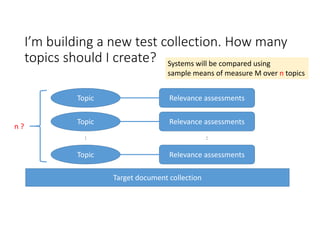
I’m building a new test collection. How many 
topics should I create?
Target document collection
Topic Relevance assessments
: :
n ?
Systems will be compared using 
sample means of measure M over n topics
Topic set size design [Sakai15IRJ]
http://link.springer.com/content/pdf/10.1007%2Fs10791‐015‐9273‐z.pdf
• Set n so as to ensure high statistical power for paired t‐tests
(comparing any two systems with a difference of minDt or larger)
• Set n so as to ensure high statistical power for one‐way ANOVAs
(comparing any m systems with a range of minD or larger)
• Set n so as to ensure the Confidence Interval (CI) of any system difference 
is no wider than δ. 
open access
Truth
H0 H1
Conclusion H0 Correct (1‐α) Type II Error (β)
H1 Type I Error (α) Correct (1‐β)
Power: ability to detect a 
real difference
One‐way ANOVA‐based topic set size design
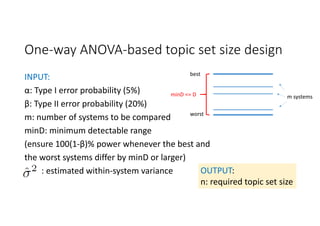
INPUT:
α: Type I error probability (5%)
β: Type II error probability (20%)
m: number of systems to be compared 
minD: minimum detectable range
(ensure 100(1‐β)% power whenever the best and
the worst systems differ by minD or larger)
: estimated within‐system variance OUTPUT:
n: required topic set size
m systems
best
worst
minD <= D
Relationships with the other two topic set size 
design methods [Sakai15IRJ]
ANOVA‐based results for m=10 can be 
used instead of CI‐based results
ANOVA‐based 
results for m=2 
can be used 
instead of t‐test‐
based results
Estimating the variance 
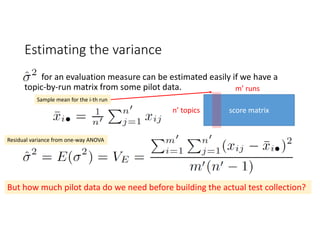
for an evaluation measure can be estimated easily if we have a 
topic‐by‐run matrix from some pilot data.
Sample mean for the i‐th run
Residual variance from one‐way ANOVA
score matrixn’ topics
m’ runs
But how much pilot data do we need before building the actual test collection?
TALK OUTLINE
1. Topic set size design
2. NTCIR‐12 STC
3. Experiments
4. Conclusions and Future Work
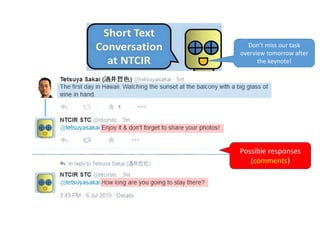
Possible responses 
(comments)
Don’t miss our task 
overview tomorrow after 
the keynote!
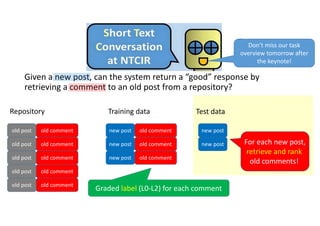
Given a new post, can the system return a “good” response by 
retrieving a comment to an old post from a repository?
old post old comment
new post
new post
new post
old comment
old comment
old comment
new post
new post For each new post, 
retrieve and rank   
old comments!
Graded label (L0‐L2) for each comment
Repository Training data Test data
Don’t miss our task 
overview tomorrow after 
the keynote!
STC Chinese subtask evaluation measure: 
nG@1 (or nDCG@1 [Jarvelin+02] )
L2‐relevant
L2‐relevant
L1‐relevant
L1‐relevant
1
2
3
4
ideal 
ranked list
3 points
3 points
1 points
1 points
L1‐relevant
Nonrelevant
L2‐relevant
Nonrelevant
1
2
3
4
System 
output
3 points
1 point
Nonrelevantk
:
nG@1=1/3
nG@1 = 0 or 1/3 or 1
Gain Gain
STC Chinese subtask evaluation measure: 
P+ [Sakai06AIRS]
L1‐relevant
Nonrelevant
L2‐relevant
Nonrelevant
1
2
3
4
System 
output
Nonrelevantk
:
rp : most relevant 
in list, nearest to 
the top 
No user will 
go beyond rp
50% of users
50% of users
1 point
3 points
L2‐relevant
L2‐relevant
L1‐relevant
L1‐relevant
1
2
3
4
ideal 
ranked list
3 points
3 points
1 point
1 point
Gain Gain
BR(3) = (2 + 4)/(3 + 7) = 0.6
BR(1) = (1 + 1)/(1 + 3) = 0.5
P+ = (BR(1) + BR(3))/ 2 = 0.5500
STC Chinese subtask evaluation measures: 
nERR@10 [Chapelle11]
L2‐relevant
L2‐relevant
L1‐relevant
L1‐relevant
1
2
3
4
ideal 
ranked list
L1‐relevant
Nonrelevant
L2‐relevant
Nonrelevant
1
2
3
4
System 
output
Nonrelevantk
:
All users All users
1/4 of users
3/4 of users
3/4 of users
1/4 of users
3/4 of users
3/4 of users
1/4 of users
1/4 of users
1/4 of users
1/4 of users
3/4 of users
3/4 of users
ERR = 0.4375
ERR* = 0.8519
nERR = ERR/ERR* = 0.5136
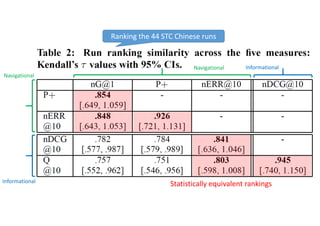
Informational
InformationalNavigational
Navigational
Ranking the 44 STC Chinese runs
Statistically equivalent rankings
STC Chinese subtask: the story so far [Sakai15AIRS]
https://waseda.box.com/AIRS2015
225 
topics
5 runs from
only 1 team
100
topics
44 runs from 16 teams
obtained through the NTCIR‐12 STC task
ANOVA‐based topic set size design
with variance estimates for nG@1, P+, nERR:
0.152, 0.064, 0.064.
Pilot data
TALK OUTLINE
1. Topic set size design
2. NTCIR‐12 STC
3. Experiments
4. Conclusions and Future Work
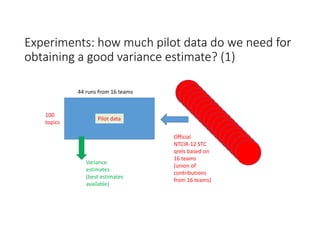
Experiments: how much pilot data do we need for 
obtaining a good variance estimate? (1)
100
topics
44 runs from 16 teams
Pilot data
Variance 
estimates
(best estimates
available)
Official
NTCIR‐12 STC
qrels based on
16 teams
(union of 
contributions
from 16 teams)
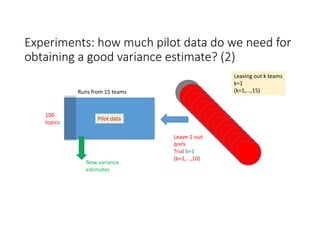
Experiments: how much pilot data do we need for 
obtaining a good variance estimate? (2)
100
topics
Runs from 15 teams
Pilot data
New variance 
estimates
Leave‐1‐out
qrels
Trial b=1
(b=1,...,10)
Leaving out k teams
k=1
(k=1,...,15)
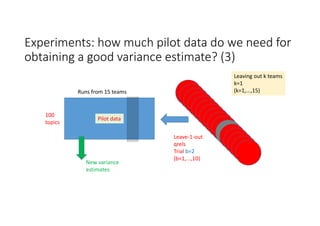
Experiments: how much pilot data do we need for 
obtaining a good variance estimate? (3)
100
topics
Runs from 15 teams
Pilot data
New variance 
estimates
Leave‐1‐out
qrels
Trial b=2
(b=1,...,10)
Leaving out k teams
k=1
(k=1,...,15)
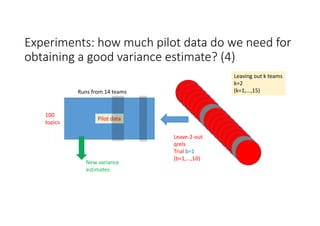
Experiments: how much pilot data do we need for 
obtaining a good variance estimate? (4)
100
topics
Runs from 14 teams
Pilot data
New variance 
estimates
Leave‐2‐out
qrels
Trial b=1
(b=1,...,10)
Leaving out k teams
k=2
(k=1,...,15)
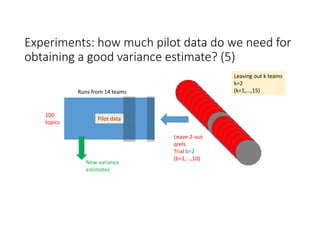
Experiments: how much pilot data do we need for 
obtaining a good variance estimate? (5)
100
topics
Runs from 14 teams
Pilot data
New variance 
estimates
Leave‐2‐out
qrels
Trial b=2
(b=1,...,10)
Leaving out k teams
k=2
(k=1,...,15)
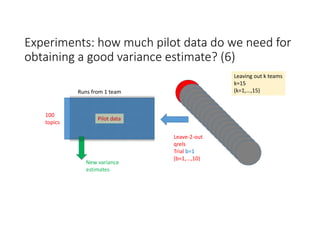
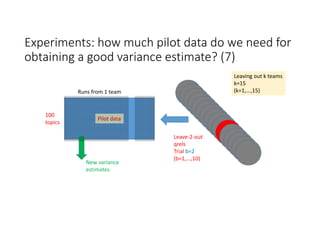
Experiments: how much pilot data do we need for 
obtaining a good variance estimate? (6)
100
topics
Runs from 1 team
Pilot data
New variance 
estimates
Leave‐2‐out
qrels
Trial b=1
(b=1,...,10)
Leaving out k teams
k=15
(k=1,...,15)
Experiments: how much pilot data do we need for 
obtaining a good variance estimate? (7)
100
topics
Runs from 1 team
Pilot data
New variance 
estimates
Leave‐2‐out
qrels
Trial b=2
(b=1,...,10)
Leaving out k teams
k=15
(k=1,...,15)
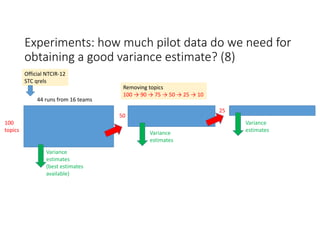
Experiments: how much pilot data do we need for 
obtaining a good variance estimate? (8)
100
topics
44 runs from 16 teams
Variance 
estimates
(best estimates
available)
50
25
Variance 
estimates
Variance 
estimates
Removing topics
100 → 90 → 75 → 50 → 25 → 10
Official NTCIR‐12
STC qrels
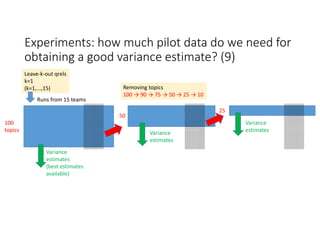
Experiments: how much pilot data do we need for 
obtaining a good variance estimate? (9)
100
topics
Runs from 15 teams
Variance 
estimates
(best estimates
available)
50
25
Variance 
estimates
Variance 
estimates
Removing topics
100 → 90 → 75 → 50 → 25 → 10
Leave‐k‐out qrels
k=1
(k=1,...,15)
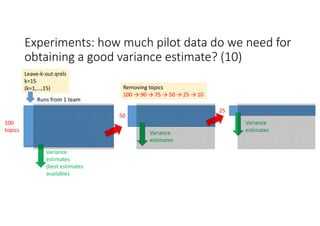
Experiments: how much pilot data do we need for 
obtaining a good variance estimate? (10)
100
topics
Runs from 1 team
Variance 
estimates
(best estimates
available)
50
25
Variance 
estimates
Variance 
estimates
Removing topics
100 → 90 → 75 → 50 → 25 → 10
Leave‐k‐out qrels
k=15
(k=1,...,15)
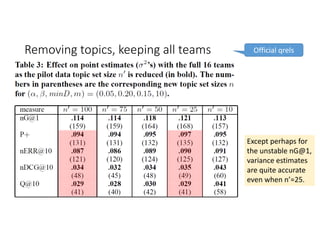
Removing topics, keeping all teams Official qrels
Except perhaps for
the unstable nG@1,
variance estimates 
are quite accurate 
even when n’=25.
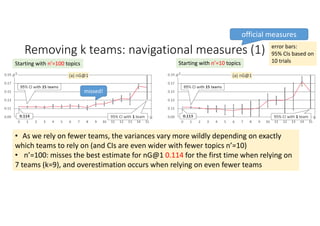
Removing k teams: navigational measures (1)
official measures
Starting with n’=100 topics Starting with n’=10 topics
error bars:
95% CIs based on
10 trials
• As we rely on fewer teams, the variances vary more wildly depending on exactly 
which teams to rely on (and CIs are even wider with fewer topics n’=10)
• n’=100: misses the best estimate for nG@1 0.114 for the first time when relying on 
7 teams (k=9), and overestimation occurs when relying on even fewer teams
missed!
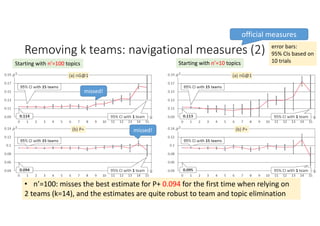
Removing k teams: navigational measures (2)
official measures
Starting with n’=100 topics Starting with n’=10 topics
error bars:
95% CIs based on
10 trials
• n’=100: misses the best estimate for P+ 0.094 for the first time when relying on 
2 teams (k=14), and the estimates are quite robust to team and topic elimination
missed!
missed!
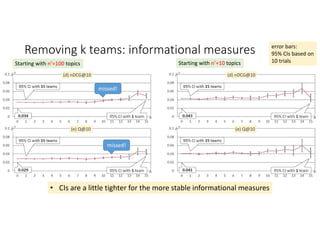
Removing k teams: informational measures
Starting with n’=100 topics Starting with n’=10 topics
error bars:
95% CIs based on
10 trials
• CIs are a little tighter for the more stable informational measures
missed!
missed!
TALK OUTLINE
1. Topic set size design
2. NTCIR‐12 STC
3. Experiments
4. Conclusions and Future Work
TAKEAWAYS AGAIN
• Topic set size design provides principles and procedures for test 
collection builders to decide on the number of topics to create, but 
requires a variance estimate for a particular evaluation measure.
• To compute a variance estimate, one needs a topic‐by‐run matrix. 
This is inconvenient if we are building a test collection for a new task. 
How many topics and teams are required for obtaining a reliable 
estimate?
• Answer: According to our experiment with the STC data (100 topics 
times 16 teams), about 25 topics with a few teams seems sufficient, 
provided reasonably stable measures are used.
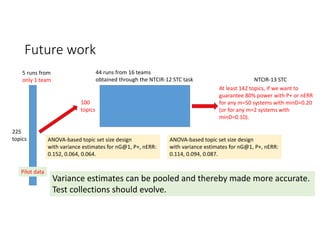
Future work
225 
topics
5 runs from
only 1 team
100
topics
44 runs from 16 teams
obtained through the NTCIR‐12 STC task
ANOVA‐based topic set size design
with variance estimates for nG@1, P+, nERR:
0.152, 0.064, 0.064.
Pilot data
NTCIR‐13 STC 
ANOVA‐based topic set size design
with variance estimates for nG@1, P+, nERR:
0.114, 0.094, 0.087.
At least 142 topics, if we want to 
guarantee 80% power with P+ or nERR
for any m=50 systems with minD=0.20 
(or for any m=2 systems with 
minD=0.10).
Variance estimates can be pooled and thereby made more accurate.
Test collections should evolve.

On Estimating Variances for Topic Set Size Design