DLMS/COSEM overview-C. Balasubramanya
DLMS stands for Device Language Message Specification.
The objective of DLMS is to provide an interoperable environment for structured modelling and
meter data exchange. DLMS supports applications such as remote meter reading, remote
control, and value-added services for metering any kind of energy, such as electricity, water, gas
or heat.
It is an international standard published as IEC 62056.
COSEM stands for Companion Specification for Energy Metering. It is an interface model for
communicating with energy metering equipment, providing a view of the functionality available
through the communications interfaces. The model uses an object-oriented approach.
The COSEM model allows for a manufacturer-independent and controlled method to identify,
retrieve and interpret the information held in any meter.
COSEM interface
By using the COSEM interface specifications, data collection systems and metering equipment
from different vendors can exchange data.
This interoperability is accomplished through object modeling.
The information of an object is organized in attributes. The attributes represent the
characteristics of an object by means of attribute values. The value of an attribute may affect the
behavior of an object. An object may offer a number of methods to either examine or modify the
values of the attributes.
Objects that share common characteristics are generalized as an interface class with a class_id.
Within a specific class, the common characteristics (attributes and methods) are described once
for all objects. Each instance of an interface class is called a COSEM object.
What is the DLMS protocol?
DLMS — Device Language Message Specification
DLMS/ COSEM (or IEC 62056) is the main global standard for smart energy metering, control
and management. It includes specifications for media-specific communication profiles, an object-
oriented data model and an application layer protocol.
• DLMS/ COSEM smart metering protocol is not specific to electricity metering and can
also be used for other utilities such as gas, water and heat.
• The suite of standards is developed and maintained by the DLMS User Association
(DLMS UA) and has been adopted by the International Electrotechnical Commission
(IEC) into the IEC 62056 series of standards.
DLMS/ COSEM consists of three main parts:
• COSEM (Companion Specification for Energy Metering) describes the general object
model and can be used for all kinds of applications.
• OBIS (Object Identification System) is the naming system of the objects.
• DLMS (Device Language Message Specification) is the application layer protocol that
is used to transform the data into messages.
DLMS/COSEM is an intelligent metering protocol used for the utilities such
as electricity, gas, water, heat, etc. In this post, I am writing here about the process of
smart energy metering, control, and management using DLMS COSEM protocol and
the significance of the OBIS code with an example.
Abbreviations:
• DLMS - Device Language Message Specification
• COSEM - Companion Specification for Energy Metering
• OBIS - Object Identification System
The DLMS COSEM standard suite (IEC 62056 / EN 13757- 1) is the most widely
accepted international utility meter data exchange standard.
DLMS based on below IEC standards:
• IEC 62056-21 Direct local data exchange
• IEC 62056-42 Physical Layer Services
• IEC 62056-46 Data link layer using HDLC protocol
• IEC 62056-47 COSEM transport layers
• IEC 62056-53 COSEM application layer
• IEC 62056-61 OBIS Object identification system
• IEC 62056-62 Interface objects
India Standard 15959 (Part-2)
Data exchange for electricity meter reading, tariff and load control: companion
specification part2 for smart meter.
DLMS is the application layer protocol that transforms the data into messages and
COSEM describes the general object model and can be used for all kinds of
presentations.
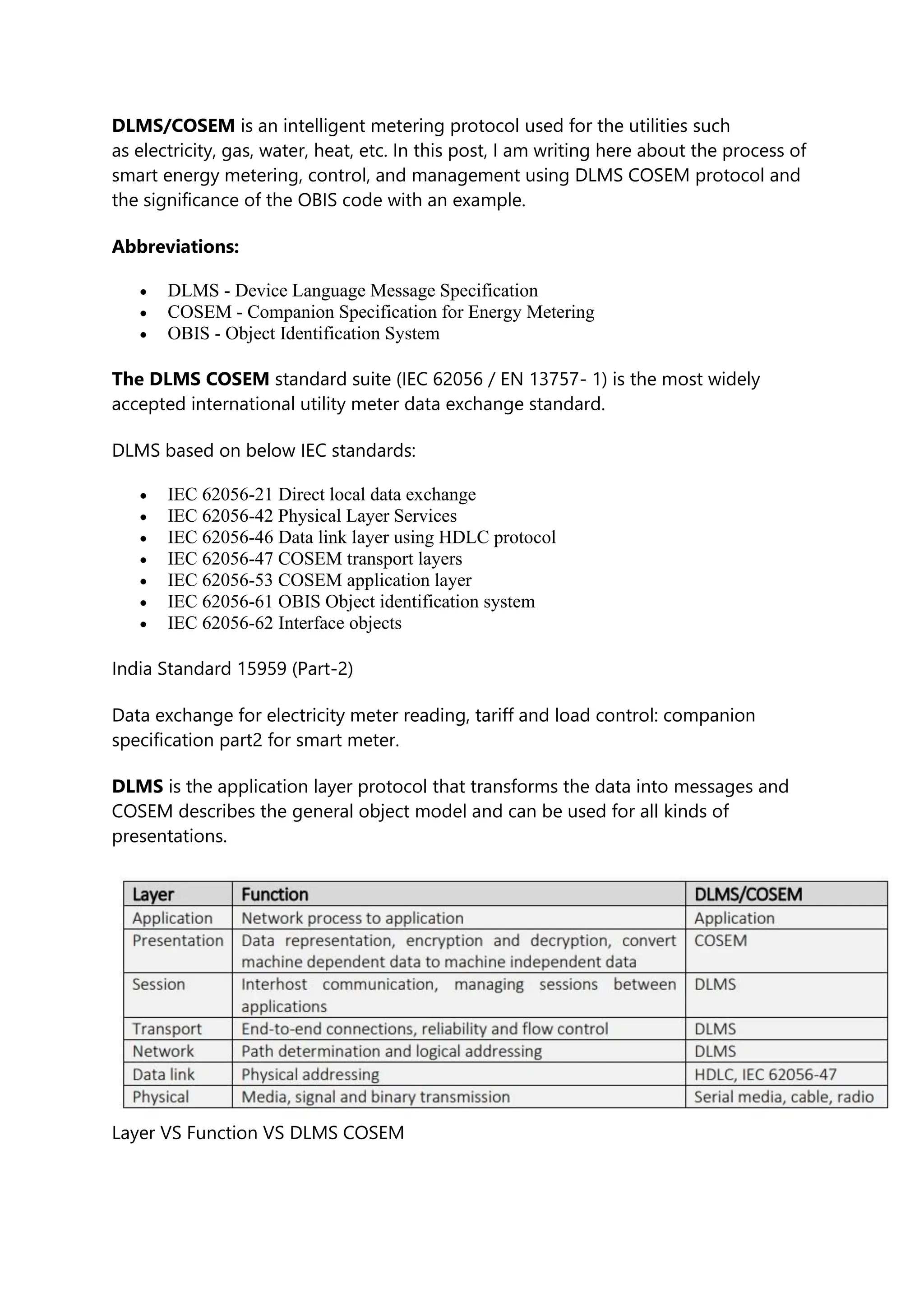
Layer VS Function VS DLMS COSEM
The DLMS / COSEM standard suite has been developed based on two strong and
proven concepts which allow covering the widest possible range of applications and
communication media:
1. Object modeling of Application Data.
2. Open Systems Interconnection (OSI) Model.
COSEM object definitions specify valid combinations of interface classes, OBIS
codes, and data types allowed.
The OBIS codes are the Logical Names of the COSEM objects, i.e. the instances of
COSEM interface classes. The combination of the interface class_id and the OBIS
code always uniquely identifies each and every object within the server.
It is a 6-byte number that uniquely identifies an object in a logical device.
OBIS codes identify data items used in energy metering equipment, in a hierarchical
structure using six values of group A to group F.
Group A: Specifies the medium (0= Abstract Objects, 1=Electricity, 7=gas, Etc.)
Group B: Specifies the channel.
Group C: Specifies the Physical Value (Current, Voltage, Energy, Etc.).
Group D: Identifies types, or the result of the processing of physical quantities
identified by values in value groups A and C, according to various specific algorithms.
Group E: Identifies further processing or classification of quantities identified by
values in value groups A to D.
Group F: Identifies historical values of data, identified by values in value groups A to
E, according to different billing periods. Where this is not relevant, this value group
can be used for further classification.
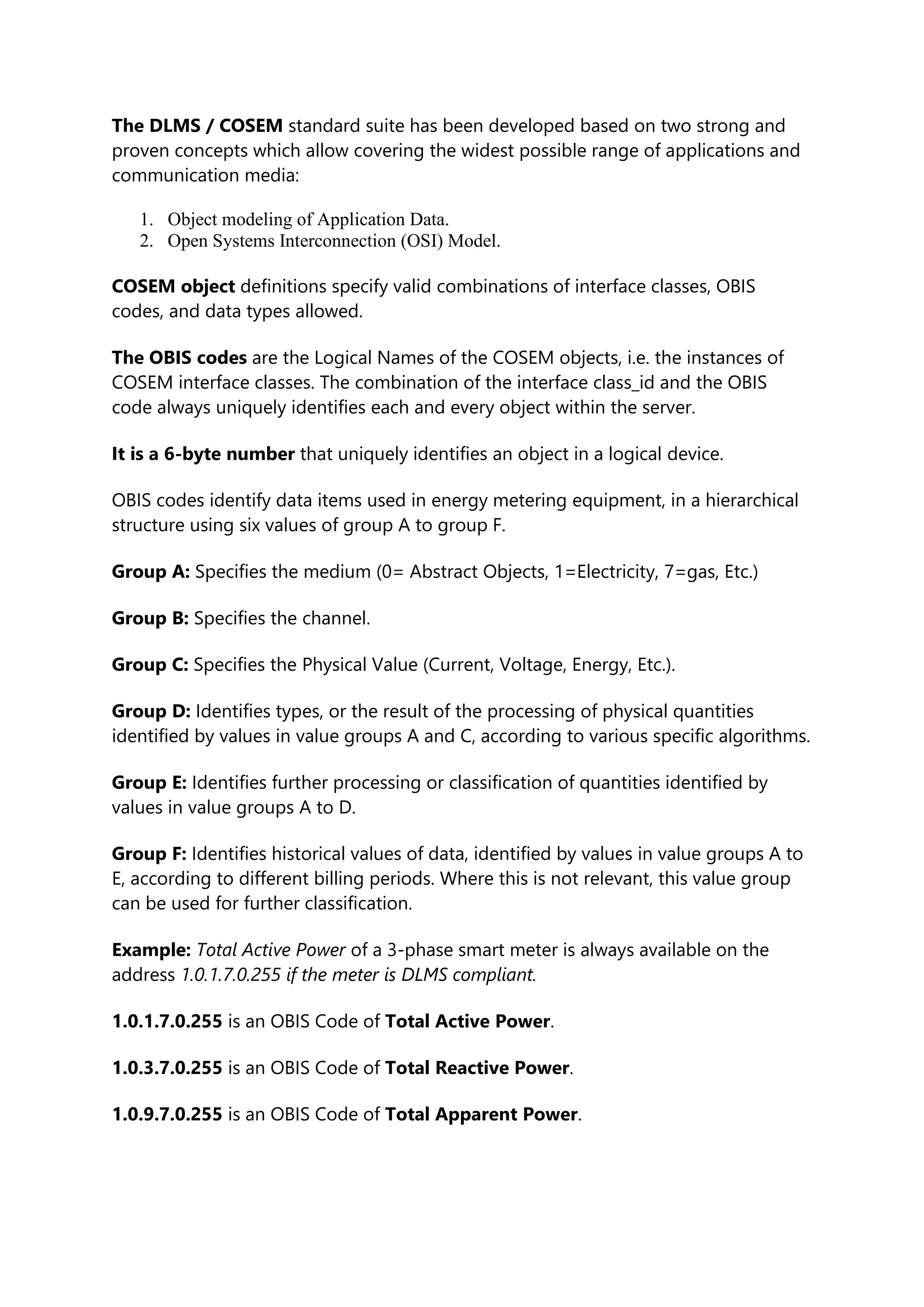
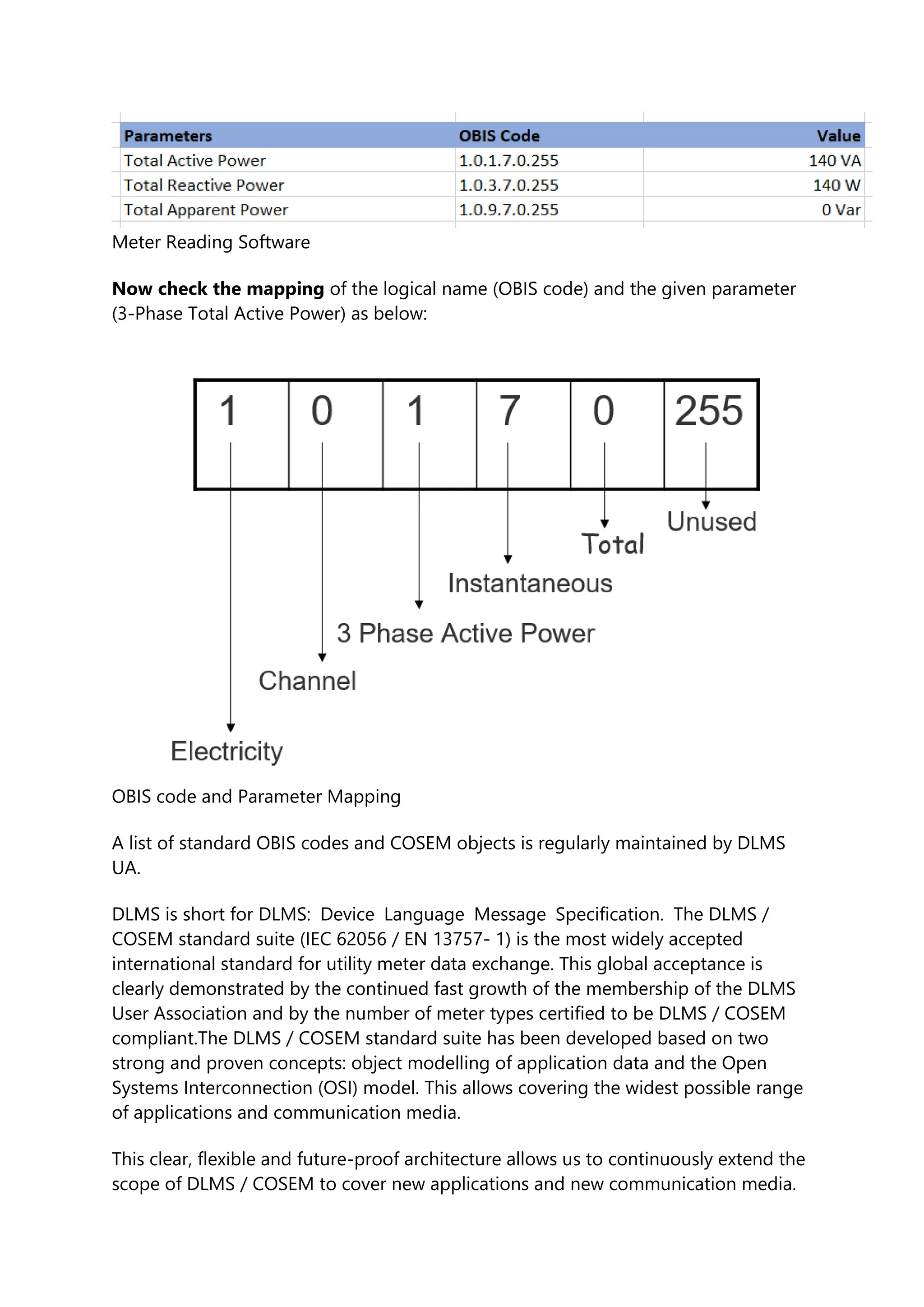
Example: Total Active Power of a 3-phase smart meter is always available on the
address 1.0.1.7.0.255 if the meter is DLMS compliant.
1.0.1.7.0.255 is an OBIS Code of Total Active Power.
1.0.3.7.0.255 is an OBIS Code of Total Reactive Power.
1.0.9.7.0.255 is an OBIS Code of Total Apparent Power.
Meter Reading Software
Now check the mapping of the logical name (OBIS code) and the given parameter
(3-Phase Total Active Power) as below:
OBIS code and Parameter Mapping
A list of standard OBIS codes and COSEM objects is regularly maintained by DLMS
UA.
DLMS is short for DLMS: Device Language Message Specification. The DLMS /
COSEM standard suite (IEC 62056 / EN 13757- 1) is the most widely accepted
international standard for utility meter data exchange. This global acceptance is
clearly demonstrated by the continued fast growth of the membership of the DLMS
User Association and by the number of meter types certified to be DLMS / COSEM
compliant.The DLMS / COSEM standard suite has been developed based on two
strong and proven concepts: object modelling of application data and the Open
Systems Interconnection (OSI) model. This allows covering the widest possible range
of applications and communication media.
This clear, flexible and future-proof architecture allows us to continuously extend the
scope of DLMS / COSEM to cover new applications and new communication media.
Initially, it was primarily used in the commercial & Industrial segment of electricity
metering over PSTN and GSM networks. Today, DLMS / COSEM forms the basis of
large multi-utility smart metering projects using GPRS and PLC networks to transport
data. The necessary extensions are the results of a good cooperation between
utilities and meter manufacturers, members of the DLMS UA, working on those
projects. They include such important additions as data exchange with meters
measuring various utilities, customer information, load management and load
switching, firmware update, event management, end-to-end cryptographic data
security and new communication media.
After understanding what DLMS is, let us understand DLMS/COSEM compliant
meter!DLMS compliant energy meter means the meter which adopt the DLMS /
COSEM standard suite (IEC 62056 / EN 13757- 1), for example our EM088188, which
is specially designed for Iraq, Syria, Afghanistan, Tajikistan etc.
Components that used inside meter (include battery and Display) could tolerate
harsh environments so the meter has long life. Based on stress test meter has long
life of 20 years at reference temperature and humidity with failure rate of 0.2% per
year.
Also EM129115 support DLMS support with famous Data model similar to IDIS data
model. Also the meters support Encryption, Message Authentication, Global Key,
Dedicated Key, General protection, as well as different type of HLS Authentication
and security policy (0 to 3).
Meter has two communication ports, Optical port and RS485 port with application
layer DLMS and opening Mode-E and direct HDLC. On RS485 port Meter support
broadcasting by means of Pre-established association.
Different load profiles record hourly, daily and monthly information’s for Billing
purposes, consumption, demand response and power quality management. Based on
Customer requirement capacity of load profile could be increased.
Log files are strong tools could be useful for utilities for outage management, fraud
detection and standard event log.
Firmware update is one of special feature of IVY DLMS energy meter, activation of
firmware doing in a few seconds without use external flash.
Hope this writeup is useful
In case of any doubts please contact:
C. Balasubramanya
balagubbi@gmail.com
9481184564

ON DLMS AND COSEM PROTOCOL FOR SMART METERS

  • 1.
    DLMS/COSEM overview-C. Balasubramanya DLMSstands for Device Language Message Specification. The objective of DLMS is to provide an interoperable environment for structured modelling and meter data exchange. DLMS supports applications such as remote meter reading, remote control, and value-added services for metering any kind of energy, such as electricity, water, gas or heat. It is an international standard published as IEC 62056. COSEM stands for Companion Specification for Energy Metering. It is an interface model for communicating with energy metering equipment, providing a view of the functionality available through the communications interfaces. The model uses an object-oriented approach. The COSEM model allows for a manufacturer-independent and controlled method to identify, retrieve and interpret the information held in any meter. COSEM interface By using the COSEM interface specifications, data collection systems and metering equipment from different vendors can exchange data. This interoperability is accomplished through object modeling. The information of an object is organized in attributes. The attributes represent the characteristics of an object by means of attribute values. The value of an attribute may affect the behavior of an object. An object may offer a number of methods to either examine or modify the values of the attributes. Objects that share common characteristics are generalized as an interface class with a class_id. Within a specific class, the common characteristics (attributes and methods) are described once for all objects. Each instance of an interface class is called a COSEM object. What is the DLMS protocol? DLMS — Device Language Message Specification DLMS/ COSEM (or IEC 62056) is the main global standard for smart energy metering, control and management. It includes specifications for media-specific communication profiles, an object- oriented data model and an application layer protocol. • DLMS/ COSEM smart metering protocol is not specific to electricity metering and can also be used for other utilities such as gas, water and heat. • The suite of standards is developed and maintained by the DLMS User Association (DLMS UA) and has been adopted by the International Electrotechnical Commission (IEC) into the IEC 62056 series of standards. DLMS/ COSEM consists of three main parts: • COSEM (Companion Specification for Energy Metering) describes the general object model and can be used for all kinds of applications. • OBIS (Object Identification System) is the naming system of the objects. • DLMS (Device Language Message Specification) is the application layer protocol that is used to transform the data into messages.
  • 2.
    DLMS/COSEM is anintelligent metering protocol used for the utilities such as electricity, gas, water, heat, etc. In this post, I am writing here about the process of smart energy metering, control, and management using DLMS COSEM protocol and the significance of the OBIS code with an example. Abbreviations: • DLMS - Device Language Message Specification • COSEM - Companion Specification for Energy Metering • OBIS - Object Identification System The DLMS COSEM standard suite (IEC 62056 / EN 13757- 1) is the most widely accepted international utility meter data exchange standard. DLMS based on below IEC standards: • IEC 62056-21 Direct local data exchange • IEC 62056-42 Physical Layer Services • IEC 62056-46 Data link layer using HDLC protocol • IEC 62056-47 COSEM transport layers • IEC 62056-53 COSEM application layer • IEC 62056-61 OBIS Object identification system • IEC 62056-62 Interface objects India Standard 15959 (Part-2) Data exchange for electricity meter reading, tariff and load control: companion specification part2 for smart meter. DLMS is the application layer protocol that transforms the data into messages and COSEM describes the general object model and can be used for all kinds of presentations. Layer VS Function VS DLMS COSEM
  • 3.
    The DLMS /COSEM standard suite has been developed based on two strong and proven concepts which allow covering the widest possible range of applications and communication media: 1. Object modeling of Application Data. 2. Open Systems Interconnection (OSI) Model. COSEM object definitions specify valid combinations of interface classes, OBIS codes, and data types allowed. The OBIS codes are the Logical Names of the COSEM objects, i.e. the instances of COSEM interface classes. The combination of the interface class_id and the OBIS code always uniquely identifies each and every object within the server. It is a 6-byte number that uniquely identifies an object in a logical device. OBIS codes identify data items used in energy metering equipment, in a hierarchical structure using six values of group A to group F. Group A: Specifies the medium (0= Abstract Objects, 1=Electricity, 7=gas, Etc.) Group B: Specifies the channel. Group C: Specifies the Physical Value (Current, Voltage, Energy, Etc.). Group D: Identifies types, or the result of the processing of physical quantities identified by values in value groups A and C, according to various specific algorithms. Group E: Identifies further processing or classification of quantities identified by values in value groups A to D. Group F: Identifies historical values of data, identified by values in value groups A to E, according to different billing periods. Where this is not relevant, this value group can be used for further classification. Example: Total Active Power of a 3-phase smart meter is always available on the address 1.0.1.7.0.255 if the meter is DLMS compliant. 1.0.1.7.0.255 is an OBIS Code of Total Active Power. 1.0.3.7.0.255 is an OBIS Code of Total Reactive Power. 1.0.9.7.0.255 is an OBIS Code of Total Apparent Power.
  • 4.
    Meter Reading Software Nowcheck the mapping of the logical name (OBIS code) and the given parameter (3-Phase Total Active Power) as below: OBIS code and Parameter Mapping A list of standard OBIS codes and COSEM objects is regularly maintained by DLMS UA. DLMS is short for DLMS: Device Language Message Specification. The DLMS / COSEM standard suite (IEC 62056 / EN 13757- 1) is the most widely accepted international standard for utility meter data exchange. This global acceptance is clearly demonstrated by the continued fast growth of the membership of the DLMS User Association and by the number of meter types certified to be DLMS / COSEM compliant.The DLMS / COSEM standard suite has been developed based on two strong and proven concepts: object modelling of application data and the Open Systems Interconnection (OSI) model. This allows covering the widest possible range of applications and communication media. This clear, flexible and future-proof architecture allows us to continuously extend the scope of DLMS / COSEM to cover new applications and new communication media.
  • 5.
    Initially, it wasprimarily used in the commercial & Industrial segment of electricity metering over PSTN and GSM networks. Today, DLMS / COSEM forms the basis of large multi-utility smart metering projects using GPRS and PLC networks to transport data. The necessary extensions are the results of a good cooperation between utilities and meter manufacturers, members of the DLMS UA, working on those projects. They include such important additions as data exchange with meters measuring various utilities, customer information, load management and load switching, firmware update, event management, end-to-end cryptographic data security and new communication media. After understanding what DLMS is, let us understand DLMS/COSEM compliant meter!DLMS compliant energy meter means the meter which adopt the DLMS / COSEM standard suite (IEC 62056 / EN 13757- 1), for example our EM088188, which is specially designed for Iraq, Syria, Afghanistan, Tajikistan etc. Components that used inside meter (include battery and Display) could tolerate harsh environments so the meter has long life. Based on stress test meter has long life of 20 years at reference temperature and humidity with failure rate of 0.2% per year. Also EM129115 support DLMS support with famous Data model similar to IDIS data model. Also the meters support Encryption, Message Authentication, Global Key, Dedicated Key, General protection, as well as different type of HLS Authentication and security policy (0 to 3). Meter has two communication ports, Optical port and RS485 port with application layer DLMS and opening Mode-E and direct HDLC. On RS485 port Meter support broadcasting by means of Pre-established association. Different load profiles record hourly, daily and monthly information’s for Billing purposes, consumption, demand response and power quality management. Based on Customer requirement capacity of load profile could be increased. Log files are strong tools could be useful for utilities for outage management, fraud detection and standard event log. Firmware update is one of special feature of IVY DLMS energy meter, activation of firmware doing in a few seconds without use external flash. Hope this writeup is useful In case of any doubts please contact: C. Balasubramanya balagubbi@gmail.com 9481184564