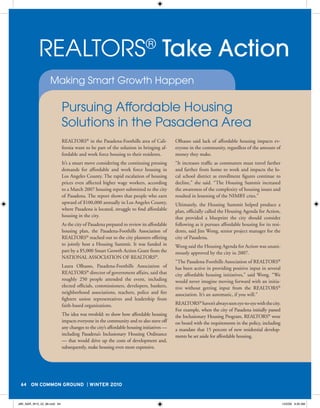
The document discusses the growing demand among home buyers for more walkable communities where daily needs can be met on foot rather than by car. Two generations in particular, millennials and baby boomers, are fueling this demand for walkable neighborhoods that mix residential and commercial uses. As a result, homes located in walkable areas are retaining their value better during the housing downturn, while auto-oriented suburbs have seen steeper drops. Smart growth principles that encourage compact, mixed-use development with alternative transportation options can help satisfy this pent-up demand for walkable living.


![across the country as people tire of long drives to jobs architecture program at Georgia Tech University and
and entertainment. In D.C., a wave of condo and town co-author of “Retrofitting Suburbia: Urban Design So-
home construction is being accompanied by new stores, lutions for Redesigning Suburbs.”
restaurants and other businesses — all ingredients of In some cases, the quest for a walkable way of life leads
walkable neighborhoods. toward the urban core. In others, it leads to places like
“I can’t tell you how many clients I’ve had who don’t Orenco Station outside Portland, Ore.
have cars,” Kiefer said. “They want to be able to walk Orenco Station is a walkable community built from scratch
different places and not use a car. It’s like a whole new around a light-rail station and a town center. About two-
matrix for evaluating [residential value].” thirds of the residents are empty nesters and most of the
The majority of his clients are either young professionals rest are young professionals, said Jim Rostel, a REALTOR®
in their 20s or empty nesters in their 50s, Kiefer said. and broker-owner at Orenco Station Realty.
They are members of the two largest generations in the “It’s really a self-contained community,” Rostel said.
history of America — the 78 million millennials born “I’ve had clients who moved in and sold one of their
between 1977 and 1996 and the 82 million baby boom- cars because you can walk to the grocery store, walk to
ers born between 1946 and 1964. Starbucks and you have light rail to go downtown.”
By 2015, the rising tide of both generations will peak at Walkability was at the top of Mark and Anna Stickel’s
44 million each — an unprecedented convergence, said list when they moved to Orenco Station two years ago.
Todd Zimmerman, managing director at Zimmerman/ The semi-retired couple own just one car and put only
Volk Associates, a real estate consulting firm. But size is about 3,000 miles a year on the odometer.
not the only similarity. The two generations also share
an appetite for walkable living — and the amenities that
go with it — that fits their childless lifestyles. Two generations share an appetite
“That’s not to say all households without kids don’t
want a single-family home on a large lot, but a lot of
for walkable living — and the
them don’t,” said Ellen Dunham-Jones, director of the amenities that go with it.
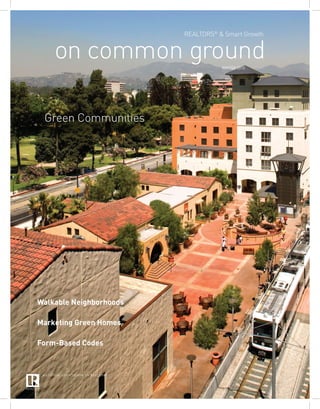
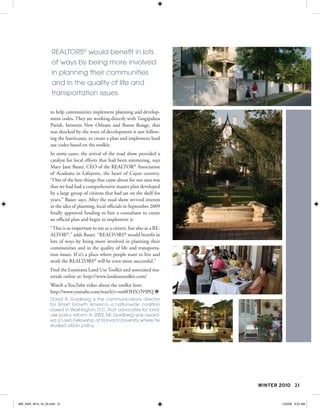
Orenco Station in Portland, Ore. Photos courtesy of www.flicker.com/photos/lisatown
5
JBK_NAR_W10_1_15.indd 5 12/2/09 9:19 AM](https://image.slidesharecdn.com/ocgwinter2010-091217112334-phpapp01/85/Smart-Growth-On-Common-Ground-Winter-2010-5-320.jpg)

![By emphasizing compact development with a mix of uses and
a range of transportation options beyond the automobile, smart
growth provides a basic framework for encouraging walkability.
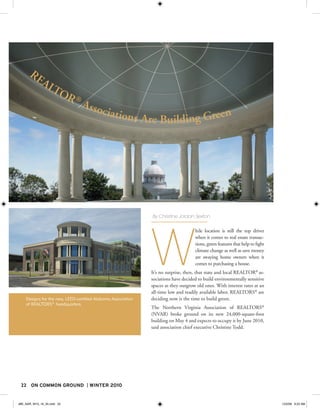
Mashpee, Mass.
Courtesy of DPZ
“The biggest problem we have in real estate is overbuild-
Kentlands in Gaithersburg, Md.
ing,” Leinberger said. “The most important thing is to
stop building [auto-oriented suburbs].”
That doesn’t mean the suburbs have no future. “The
pent-up demand for [walkable] neighborhoods is going
to be satisfied only partially in … downtowns and places
adjacent to downtowns,” Leinberger said. “Two-thirds
of the demand is going to be satisfied in the suburbs.”
Smart growth can help make that happen. Creating
walkable neighborhoods is both a principle of smart
growth and an outcome. By emphasizing compact
development with a mix of uses and a range of trans-
portation options beyond the automobile, smart growth Courtesy of DPZ
provides a basic framework for encouraging walkability.
The appetite for walkability isn’t just the result of mil-
lennials and baby boomers craving a different lifestyle.
Rising energy costs provide everyone with a reason to
take their cars out of the garage less often.
In a walkable neighborhood, a family spends 9 percent
of its income on its cars, Leinberger said. In an auto-ori-
ented suburb, it spends 25 percent.
Yet that may be worth it for families with children who
Courtesy of DART
want a big house and big yard no matter what. “There’s
WINTER 2010 7
JBK_NAR_W10_1_15.indd 7 12/2/09 9:19 AM](https://image.slidesharecdn.com/ocgwinter2010-091217112334-phpapp01/85/Smart-Growth-On-Common-Ground-Winter-2010-7-320.jpg)
![U.S. EPA Smart Growth
still a lot of people willing to make that trade-off,” Lein- The pendulum is clearly swinging
berger said. “It’s not a matter of what’s right and what’s
wrong. It’s a matter of choice.” away from continued development
Sandra Keith is a REALTOR® and broker-owner of of auto-oriented suburbs and
Lighthouse Realty in Sarasota, Fla. The predominant
development pattern there is “classic suburban sprawl,” toward walkable development.
Keith said, but the county is encouraging the creation of
walkable neighborhoods. New Town in St. Charles, Mo.
Keith said home buyers sometimes give mixed signals
about walkability. “It’s a Catch-22,” Keith said. “Al-
though people like [walkable neighborhoods], we are
very attached to our cars, and we’ve become used to
driving places.”
Nevertheless, Keith said, the pendulum is clearly swing-
ing away from continued development of auto-oriented
suburbs and toward walkable development. “It’s not just
a trendy thing,” she said. “I believe it is, in fact, a new
way of life.”
So does Dunham-Jones. And not just for the childless
millennials and baby boomers. Members of the child-
rearing generation in between — generation X — might
be joining them. “The idea that a single-family home
with a large lot is the best thing for families is coming
under more and more scrutiny,” Dunham-Jones said.
8 ON COMMON GROUND
JBK_NAR_W10_1_15.indd 8 12/2/09 9:19 AM](https://image.slidesharecdn.com/ocgwinter2010-091217112334-phpapp01/85/Smart-Growth-On-Common-Ground-Winter-2010-8-320.jpg)


![REALTORS® are catching
on to marketing walkability
and are spotlighting it in
advertising materials.
Courtesy of Jim Duncan
Above: Crozet, Va.
U.S. EPA Smart Growth
they walk to. You also need to determine what walk- “And often it’s about quality of life. They don’t want to
ability means to your buyer. For Europeans, walkability be in the car so much. They also want to save money.”
includes longer distances: a mile and a half to two miles. As REALTORS® are catching on to marketing walk-
Americans don’t want to walk as far,” said Duncan. ability, they are blogging about it and spotlighting it in
Duncan said his clients are focusing more and more advertising materials. This is true for Diane Brooks, a
on walkability. REALTOR® with F.C. Tucker Company, in the greater
“Really and truly, many are looking for this when they Indianapolis area.
go to buy. The way I define this with my clients is ‘being Regarding a sale for which Brooks represented the sell-
close to stuff, close to the things of civilization:’ coffee ers, Brooks found out after the offer was accepted that
shops and a grocery store, as well as restaurants. Parks walkability was very important to the buyers.
are huge for many of my clients. They want green spaces “It was one of their top criteria. They had lived in [the
they can go to with kids.” village] before and are now returning as empty nesters.
“I have young clients without kids who came from They wanted to be in the village and have the ability to
about 25 minutes outside of Charlottesville. They don’t walk to the library, five blocks from this home. I had
want to drive as much anymore. They want to walk or included a Walk Score in my marketing on that home,”
ride their bikes to work. It’s a huge lifestyle choice on said Brooks.
their part. Some clients are motivated by gas prices or “I will check the Walk Score Web site for any home that
they desire to be environmentally conscious. Others I have listed that is close to restaurants and shopping
want an urban environment,” Duncan said.
14 ON COMMON GROUND
JBK_NAR_W10_1_15.indd 14 12/2/09 9:19 AM](https://image.slidesharecdn.com/ocgwinter2010-091217112334-phpapp01/85/Smart-Growth-On-Common-Ground-Winter-2010-14-320.jpg)
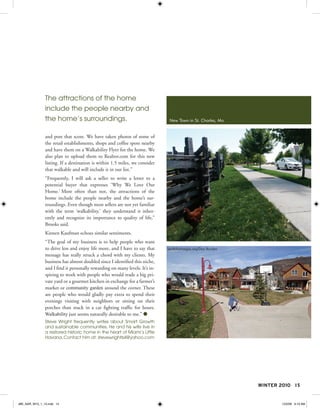


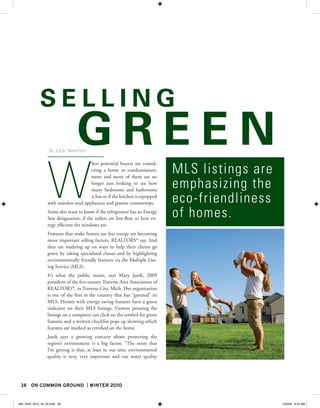
![River Ranch in Lafayette, La.
You had people in the
development community, the
regulatory community, real estate,
planners, economic developers,
local officials all together in a room
where they worked together to
“create” their community.
“It was really magnificent,” says Manning-Broome. “I thought it was fantastic. It drew from a lot of small
“You had people in the development community, the communities within a 50 to 60 mile radius of Alexan-
regulatory community, real estate, planners, economic dria. They loved it because they had never gotten any-
developers, local officials all together in a room where thing like that before.
they worked together to ‘create’ their community. All “They got into [the mapping game] like playing Mo-
the communities were incredibly different, but the take- nopoly, moving hotels around. Where you got to lay
away was that all could be created with our toolkit.” your community out and say here’s where the subdivi-
In 2006, REALTOR® and NAR Director Sandra sion should go, where the big lots and small lots go. We
Guidroz moved to Alexandria in central Louisiana from each put our different hats on — REALTORS®, local
Houma. “I moved north to get away from the hurri- officials and what have you — and we had some conten-
canes. I figured this was as far north as I could go with- tious issues, but it was good for us all to work through
out becoming a Yankee.” She found that Alexandria and them together. I hope they do it again.”
the very rural area around it had little familiarity with Meanwhile, Code Studio continues to work to refine
the planning, development and redevelopment issues the toolkit, with a new version that was due out at the
that she had known in Houma. The toolkit Road Show end of 2009. CPEX has continued to raise money to try
event in Alexandria was a big hit, she said.
20 ON COMMON GROUND
JBK_NAR_W10_16_35.indd 20 12/2/09 9:22 AM](https://image.slidesharecdn.com/ocgwinter2010-091217112334-phpapp01/85/Smart-Growth-On-Common-Ground-Winter-2010-20-320.jpg)




![At the same time, home builders in the Traverse City There are definitely parts of the
area were ripe to go green, including Pathway Homes.
Gary Jurkovich, chief executive officer, says he took a country that are seeing the need
chance, building five homes, chock-full of energy-saving to [highlight green features.]
and eco-friendly features, on speculation at a time when
the housing market was slowing down.
Next came Chrystal Ridge Condominiums, a 22-unit
development under construction. The 1,600-square-foot Each category will have a drop-down computer check list
condos, with full basement, are expected to have heating with features that are easily understood by consumers and
and cooling bills totaling only $800 a year, Jurkovich says, real estate agents, such as Energy Star appliances, Anderson
even in cold and snowy northwest Michigan. says. “Features will change over time as technology changes.
“We’re not seeing homes built out of straw bales and re- But the issues we’re addressing, such as energy conservation
cycled tires,” Jurkovich says. “One of the biggest things and water conservation — those are constant.”
is it has to be accessible to everybody.” On the national level, NAR’s Medina is working with the
Jurkovich says spending an extra $2,500 can equip a U.S. Green Building Council, the National Association of
home with spray foam insulation, low-flow bathroom Home Builders and others to develop a tool kit to serve
fixtures, a high-efficiency furnace and hot water tank, as a guide for other communities to add green features to
and compact fluorescent light bulbs. “You’ll get your their MLS listings. “There are definitely parts of the coun-
payback in 36 months and have a significant impact on try that are seeing the need to do this and they don’t have
the carbon footprint,” he says. too much guidance right now,” Medina says.
In the Tucson, Ariz., area, REALTORS® are about to
introduce a checkoff list with categories of features con-
sistent with national and local ratings systems for green
homes. “We look at these critical categories: energy,
water, resource efficiency, location, sustainable site and
indoor environmental quality,” says Jan Anderson of
Long Realty Co. and a member of the Tucson Multiple
Listing Service technology committee.
“One of the things we are trying to do is to help the
consumer understand what a green home is. It’s not
a random list of features, but a carefully thought-out
grouping to address all of the environmental issues in-
herent in home building, operation and maintenance,”
Anderson says.
WINTER 2010 31
JBK_NAR_W10_16_35.indd 31 12/2/09 9:22 AM](https://image.slidesharecdn.com/ocgwinter2010-091217112334-phpapp01/85/Smart-Growth-On-Common-Ground-Winter-2010-31-320.jpg)
![As more people build homes with green qualities or More cities are pressing builders to use LEED standards
add environmentally friendly improvements to existing for new public buildings. For homes, though, it can
homes, those features seem to fall into four standard cat- be costly to meet the qualifications; plus there is the
egories, Medina says: energy, water, indoor air quality expense of hiring a consultant to test and quantify the
and materials. Determining if homes with eco-friendly features, Medina says.
characteristics are “green” homes — if they are not certi- The National Association of Home Builders offers its
fied by a third party or do not fit with national program own sustainable standards, fairly similar to those for
standards — will be a question of degree. “It’s an issue LEED buildings, and certification requires an analysis
that we’re trying to figure out,” he says. “If I want to say by an independent contractor. But costs are generally
my home is energy efficient, how many features do I lower and much of the work can be prepared online,
need to have?” Medina says.
Medina says NAR’s tool kit will include a cover letter As for the potential hassle factor involved in MLSs
explaining why it makes sense to add green elements to adopting a green initiative, Medina says it is a question
the Multiple Listing Service; ideas on how to organize of “how responsive MLS decision makers want to be.
to get such changes made; case studies showing how The whole industry is changing. Consumers want it; the
some communities have greened their MLS; and a government is highly encouraging it through credits and
recommended data entry form. It will be a guide, not a incentives; and on the local level, it may be mandated.
mandate, Medina says. Some cities, like Boston, have adopted [sustainable re-
Builders and home owners can also pursue third-party quirements]. Building codes in cities like Boulder and
certification. LEED, or Leadership in Energy and En- Austin are heavily green,” he says.
vironmental Design, certification is probably best “The challenge for MLSs is: do you want to be proactive
known. Developed by the U.S. Green Building Council or reactive? This is going to happen. If it hasn’t gotten to
in Washington, D.C., the LEED designation requires your community yet, it will, within a couple of years,”
meeting a long list of standards assessed in a “rigorous Medina says.
third-party commissioning process,” the Green Building
Judy Newman is a business reporter for the
Council says.
Wisconsin State Journal newspaper in Madison, Wis.
Photos courtesy of www.flicker.com/photos/lisatown
32 ON COMMON GROUND
JBK_NAR_W10_16_35.indd 32 12/2/09 9:22 AM](https://image.slidesharecdn.com/ocgwinter2010-091217112334-phpapp01/85/Smart-Growth-On-Common-Ground-Winter-2010-32-320.jpg)


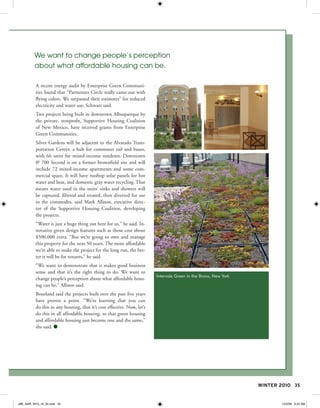


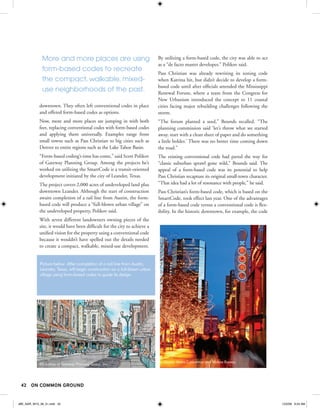
![Cherry Creek bike path
and Lodo grille and
dining in Denver, Colo.
All photos: Courtesy
of Denver Metro
Convention and
Photo by: Randy Brown Visitors Bureau Photo by: Steve Crecelius
requires buildings on two key streets to be built with One of the first steps involved in creating a form-based
retail facades. While the intent is that the buildings be code is to document the characteristics needed to pro-
used as retail, the code also allows them to be used as duce the intended outcome. The New Town project
dwellings or offices if retail demand is slow to develop. team studied St. Charles and other communities in
“By controlling the appearance, we believe the [intend- the region with vibrant urban fabrics, cataloging street
ed] use ultimately will follow the appearance as long as widths, setback distances, building facades and other
we get the appearance right,” Bounds said. urban characteristics — the DNA of compact, walkable,
mixed-use neighborhoods — at a block by block level.
Time will tell whether Pass Christian’s form-based code
produces the desired results, but the proof already is The form-based code — embedded in the master plan
coming out of the ground in New Town, a new urban and adopted by the city of St. Charles as the manda-
community of 5,700 homes being built from scratch on tory standard for all new urban development in the city
755 acres in St. Charles, Mo. — enabled Whittaker Homes to reproduce that DNA
in a way conventional codes typically do not. “You
“Our intent is to replicate a small town in the Midwest,” could piecemeal it [with conventional codes], and end
said Tim Busse, town architect. up with a form-based code, so why not begin with one,”
The developer, Whittaker Homes, wasn’t looking to Busse said.
utilize a form-based code when it conceived the project, The transect has become the most common organizing
Busse said, but the firm that planned the town, DPZ, principle — or basis for differentiating between zones
knew the SmartCode was the right tool.
Stan Obert for Denver Metro Convention and Visitors Bureau
WINTER 2010 43
JBK_NAR_W10_36_51.indd 43 12/2/09 9:24 AM](https://image.slidesharecdn.com/ocgwinter2010-091217112334-phpapp01/85/Smart-Growth-On-Common-Ground-Winter-2010-43-320.jpg)
![Form-based codes contribute to a
quality of life that many people desire
such as walkable communities, schools
located near homes, neighborhood
grocery stores, restaurants, etc. It’s an
easy lifestyle to sell.
River Ranch is a new urban community in Lafayette,
La. River Ranch was designed with a form-based model
but entitled under a conventional code. As a result, 119
variances were required to provide the details necessary
for compact, walkable, mixed-use neighborhoods.
“We needed 18 different street types alone — and half of
Steve Crecelius for Denver Metro Convention and Visitors Bureau them were not allowed [in the conventional code],” said
architect Steve Oubre, who prepared the master plan for
the 324-acre project. Other variances included decreas-
ing the minimum setback to 0 to 15 feet (it was 20 feet),
reducing minimum density to one unit per 3,500 square
feet (it was one unit per 5,000 square feet) and placing
parking at the rear instead of the front of buildings.
— of form-based codes. “I’ve heard it called a feathering
of the intensity of uses,” Busse said. Since that time, the city of Lafayette has amended its
zoning code to include a form-based option. The RE-
The transect mirrors the natural world by creating a ALTOR® Association of Acadiana is now pushing for
sequence of habitats — or in human terms built envi- form-based codes to be included in more zoning codes
ronments — that achieve urbanism through a series of throughout the six-parish region.
gradual transitions from very rural at the edge to very
urban at the center. “REALTORS® recognize that having a community
where people want to live and work is important to
The SmartCode identifies six rural-to-urban transect their business,” said Mary Jane Bauer, the association’s
zones. Within each zone, the SmartCode applies form- CEO. “Form-based codes contribute to a quality of life
based regulations to ensure the built environment is that many people desire such as walkable communities,
appropriate to the location. Exactly how that looks schools located near homes, neighborhood grocery
varies from place to place depending on the vision of stores, restaurants, etc. It’s an easy lifestyle to sell.”
stakeholders — the developer, community, local govern-
ment — and the geography involved. New Town, for That message is trickling up.
example, contains no natural (T-1) or rural (T-2) zones, “As more high-quality projects regulated by form-based
just sub-urban (T-3), general urban (T-4), urban center codes come out of the ground … cities, towns and
(T-5) and urban core (T-6). counties of all sizes across the country are becoming
One way to understand what a form-based code brings interested in using form-based codes,” Parolek said.
to the table is to consider what it takes to a develop com- “Practitioners have shown that FBCs are not just for
pact, walkable, mixed-use neighborhood without one. small sites, but can also be effective at citywide, county
and regional scales.”
44 ON COMMON GROUND
JBK_NAR_W10_36_51.indd 44 12/2/09 9:24 AM](https://image.slidesharecdn.com/ocgwinter2010-091217112334-phpapp01/85/Smart-Growth-On-Common-Ground-Winter-2010-44-320.jpg)
![Seaside, Fla.
South Lake Tahoe
By supporting compact, walkable, mixed-use development, a form-
based code is expected to limit auto use, thereby reducing emissions
and improving air quality.
The city of Denver and the Tahoe Regional Planning A desire to ensure the built environment comple-
Agency (TRPA) are banking on that as they prepare ments the surrounding landscape is one of the reasons
to replace their existing zoning codes with form-based the TRPA, which spans four counties straddling the
codes. California/Nevada border, is starting a two-year process
“We have a [conventional] code that’s really broken,” to develop a form-based code.
said Peter Park, manager of community planning and Vast stretches of the region are wilderness, but it in-
development in Denver. “It doesn’t support a lot of the cludes the city of South Lake Tahoe and a number of
policies in our adopted plans for sustainability, transpor- small towns, where a legacy of “strip commercial” devel-
tation and land use.” opment is out of sync with the natural setting, said John
Denver’s form-based code is expected to go to the city Hitchcock, TRPA’s principal planner.
council early next year. In areas where the city wants Environmental issues are also a driving force. By sup-
to maintain stability, such as historic residential neigh- porting compact, walkable, mixed-use development, a
borhoods with bungalows on small lots, the code will form-based code is expected to limit auto use, thereby
ensure future development jibes with existing character- reducing emissions and improving air quality.
istics. In areas targeted for change, such as near new rail In addition, compact development will leave more room
stations, the code will pave the way for transit-oriented for natural and/or man-made detention basins to filter
development featuring a mix of uses and housing types sediments before they make their way into Lake Tahoe
within walking distance of the stations. and degrade its prized clarity, Hitchcock said.
“The point is to have a vision of what kind of place we Brad Broberg is a Seattle-based freelance writer spe-
want and then have the regulations to support that,” cializing in business and development issues. His work
Park said. appears regularly in the Puget Sound Business Jour-
nal and the Seattle Daily Journal of Commerce.
WINTER 2010 45
JBK_NAR_W10_36_51.indd 45 12/2/09 9:24 AM](https://image.slidesharecdn.com/ocgwinter2010-091217112334-phpapp01/85/Smart-Growth-On-Common-Ground-Winter-2010-45-320.jpg)


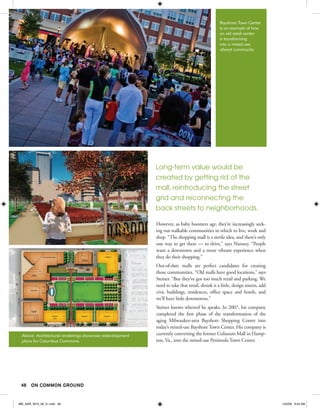


![The LEED-ND system is Norquist said that very example happened in the Chicago
area when a major bank headquarters moved to a new
calibrated to deal with smaller location in a highly-efficient building that earned a high
communities and smaller projects LEED rating, but was isolated far from public transit.
“The old headquarters was on a transit line, but the new
as well as larger cities. one was built so far away that everybody who worked
there had to drive. People who used to take transit had
“The LEED building program was limited in that a to buy a car,” he said. “The energy spent on commuting
building could get a platinum (the highest standard to the new building blew out the energy savings in the
of building sustainability), gold or silver certification, LEED-certified building.”
but be in a location where the employees or residents
“The Bank of America Tower on Sixth Avenue between
would be driving unnecessarily long drives to get to
42nd and 43rd streets in Manhattan is a perfect example
work, shopping or home,” said John Norquist, CNU
of a building that was built to meet LEED platinum
president and CEO.
building standards, but would also meet LEED neigh-
borhood standards because it is an infill site with some-
thing like a half dozen major transit lines reached by
elevators right underneath it,” Norquist said of the 54-
The Bank of America Tower story skyscraper on Bryant Park. “Not every place is like
on Sixth Avenue in Manhattan Manhattan, so the [LEED-ND] system is calibrated to
deal with smaller communities and smaller projects.
www.flicker.com/photos/dockphotos
While filled with complex calculations for everything
from number of streets per block (small streets and lots
of them earn high points) to ways of conserving topsoil
and wetlands on-site, Norquist stresses that LEED-ND’s
bottom line is market-friendly.
U.S. EPA Smart Growth
53
JBK_NAR_W10_52_68.indd 53 12/2/09 9:26 AM](https://image.slidesharecdn.com/ocgwinter2010-091217112334-phpapp01/85/Smart-Growth-On-Common-Ground-Winter-2010-53-320.jpg)