Alberto Pérez
Mazuecos 3ÂşB
What is the ombudsman?
An ombudsman is an official, usually appointed by the government or
by parliament but with a significant degree of independence, who is
charged with representing the interests of the public by investigating
and addressing complaints of maladministration or violation of rights.
In some countries an Inspector General, Citizen Advocate or other
official may have duties similar to those of a national ombudsman, and
may also be appointed by the legislature. Below the national level an
ombudsman may be appointed by a state, local or municipal
government, and unofficial ombudsmen may be appointed by, or even
work for, a corporation such as a utility supplier or a newspaper, for an
NGO, or for a professional regulatory body.
What is the ombudsman?

 Whether appointed by the legislature, the executive, or an
organisation (or, less frequently, elected by the constituency
that he or she serves), the typical duties of an ombudsman are
to investigate complaints and attempt to resolve them, usually
through recommendations (binding or not) or mediation.
Ombudsmen sometimes also aim to identify systemic issues
leading to poor service or breaches of people's rights. At the
national level, most ombudsmen have a wide mandate to deal
with the entire public sector, and sometimes also elements of
the private sector (for example, contracted service providers).
In some cases, there is a more restricted mandate, for
example with particular sectors of society. More recent
developments have included the creation of specialised
Children's Ombudsman and Information Commissioner
agencies.
What is the ombudsman?

In some jurisdictions an ombudsman charged with the handling of
concerns about national government is more formally referred to as
the "Parliamentary Commissioner" (e.g. the United Kingdom
Parliamentary Commissioner for Administration, and the Western
Australian state Ombudsman). In many countries where the
ombudsman's remit extends beyond dealing with alleged
maladministration to promoting and protecting human rights, the
ombudsman is recognised as the national human rights institution.
The post of ombudsman had by the end of the 20th century been
instituted by most governments and by some intergovernmental
organizations such as the European Union
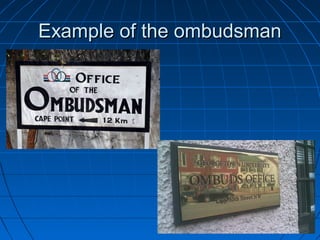
Example of the ombudsman
In Politics
In general, an ombudsman is a state official appointed to provide a check on
 government activity in the interests of the citizen, and to oversee the investigation
 of complaints of improper government activity against the citizen. If the
 ombudsman finds a complaint to be substantiated, the problem may get rectified,
 or an ombudsman report is published making recommendations for change.
 Further redress depends on the laws of the country concerned, but this typically
 involves financial compensation. Ombudsmen in most countries do not have the
 power to initiate legal proceedings or prosecution on the grounds of a complaint.
 This role is sometimes referred to as a "tribunitian" role, and has been traditionally
 fulfilled by elected representatives – the term refers to the ancient Roman "
 tribunes of the plebians" (tribuni plebis), whose role was to intercede in the
 political process on behalf of common citizens.
 The major advantage of an ombudsman is that he or she examines complaints
 from outside the offending state institution, thus avoiding the conflicts of interest
 inherent in self-policing. However, the ombudsman system relies heavily on the
 selection of an appropriate individual for the office, and on the cooperation of at
 least some effective official from within the apparatus of the state.
In organisation
Many private companies, universities, non-profit organisations and government agencies
also have an ombudsman (or an ombuds office) to serve internal employees, and
managers and/or other constituencies. These ombudsman roles are structured to
function independently, by reporting to the CEO or board of directors, and according to
International Ombudsman Association (IOA) Standards of Practice they do not have any
other role in the organisation. Organisational ombudsmen often receive more complaints
than alternative procedures such as anonymous hot-lines

Since the 1960s, the profession has grown in the United States, and Canada, particularly
in corporations, universities and government agencies. The organizational ombudsman
works as a designated neutral party, one who is high-ranking in an organization, but who is
not part of executive management. Using an alternative dispute resolution (ADR) or
appropriate dispute resolution approach, an organisational ombudsman can provide
options to whistleblowers or employees and managers with ethical concerns; provide
coaching, shuttle diplomacy, generic solutions (meaning a solution which protects the
identity of one individual by applying to a class of people, rather than just for the one
individual) and mediation for conflicts; track problem areas; and make recommendations
for changes to policies or procedures in support of orderly systems change.
European Union
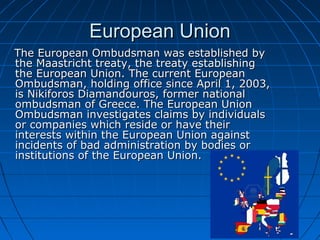
The European Ombudsman was established by
the Maastricht treaty, the treaty establishing
the European Union. The current European
Ombudsman, holding office since April 1, 2003,
is Nikiforos Diamandouros, former national
ombudsman of Greece. The European Union
Ombudsman investigates claims by individuals
or companies which reside or have their
interests within the European Union against
incidents of bad administration by bodies or
institutions of the European Union.
Spain

The Spanish state ombudsman is the Defender of the
People (Defensor del Pueblo), dealing with complaints of
maladministration and having the capacity to bring cases at the
Constitutional Court. The office is prominent in the international
networks of ombudsmen and national human rights institutions,
particularly through the Ibero-American Ombudsman Federation
(FIO).
Ombudsman

Ombudsman

  • 1.
  • 2.
    What is theombudsman? An ombudsman is an official, usually appointed by the government or by parliament but with a significant degree of independence, who is charged with representing the interests of the public by investigating and addressing complaints of maladministration or violation of rights. In some countries an Inspector General, Citizen Advocate or other official may have duties similar to those of a national ombudsman, and may also be appointed by the legislature. Below the national level an ombudsman may be appointed by a state, local or municipal government, and unofficial ombudsmen may be appointed by, or even work for, a corporation such as a utility supplier or a newspaper, for an NGO, or for a professional regulatory body.
  • 3.
    What is theombudsman? Whether appointed by the legislature, the executive, or an organisation (or, less frequently, elected by the constituency that he or she serves), the typical duties of an ombudsman are to investigate complaints and attempt to resolve them, usually through recommendations (binding or not) or mediation. Ombudsmen sometimes also aim to identify systemic issues leading to poor service or breaches of people's rights. At the national level, most ombudsmen have a wide mandate to deal with the entire public sector, and sometimes also elements of the private sector (for example, contracted service providers). In some cases, there is a more restricted mandate, for example with particular sectors of society. More recent developments have included the creation of specialised Children's Ombudsman and Information Commissioner agencies.
  • 4.
    What is theombudsman? In some jurisdictions an ombudsman charged with the handling of concerns about national government is more formally referred to as the "Parliamentary Commissioner" (e.g. the United Kingdom Parliamentary Commissioner for Administration, and the Western Australian state Ombudsman). In many countries where the ombudsman's remit extends beyond dealing with alleged maladministration to promoting and protecting human rights, the ombudsman is recognised as the national human rights institution. The post of ombudsman had by the end of the 20th century been instituted by most governments and by some intergovernmental organizations such as the European Union
  • 5.
    Example of theombudsman
  • 6.
    In Politics In general,an ombudsman is a state official appointed to provide a check on government activity in the interests of the citizen, and to oversee the investigation of complaints of improper government activity against the citizen. If the ombudsman finds a complaint to be substantiated, the problem may get rectified, or an ombudsman report is published making recommendations for change. Further redress depends on the laws of the country concerned, but this typically involves financial compensation. Ombudsmen in most countries do not have the power to initiate legal proceedings or prosecution on the grounds of a complaint. This role is sometimes referred to as a "tribunitian" role, and has been traditionally fulfilled by elected representatives – the term refers to the ancient Roman " tribunes of the plebians" (tribuni plebis), whose role was to intercede in the political process on behalf of common citizens. The major advantage of an ombudsman is that he or she examines complaints from outside the offending state institution, thus avoiding the conflicts of interest inherent in self-policing. However, the ombudsman system relies heavily on the selection of an appropriate individual for the office, and on the cooperation of at least some effective official from within the apparatus of the state.
  • 7.
    In organisation Many privatecompanies, universities, non-profit organisations and government agencies also have an ombudsman (or an ombuds office) to serve internal employees, and managers and/or other constituencies. These ombudsman roles are structured to function independently, by reporting to the CEO or board of directors, and according to International Ombudsman Association (IOA) Standards of Practice they do not have any other role in the organisation. Organisational ombudsmen often receive more complaints than alternative procedures such as anonymous hot-lines Since the 1960s, the profession has grown in the United States, and Canada, particularly in corporations, universities and government agencies. The organizational ombudsman works as a designated neutral party, one who is high-ranking in an organization, but who is not part of executive management. Using an alternative dispute resolution (ADR) or appropriate dispute resolution approach, an organisational ombudsman can provide options to whistleblowers or employees and managers with ethical concerns; provide coaching, shuttle diplomacy, generic solutions (meaning a solution which protects the identity of one individual by applying to a class of people, rather than just for the one individual) and mediation for conflicts; track problem areas; and make recommendations for changes to policies or procedures in support of orderly systems change.
  • 8.
    European Union The EuropeanOmbudsman was established by the Maastricht treaty, the treaty establishing the European Union. The current European Ombudsman, holding office since April 1, 2003, is Nikiforos Diamandouros, former national ombudsman of Greece. The European Union Ombudsman investigates claims by individuals or companies which reside or have their interests within the European Union against incidents of bad administration by bodies or institutions of the European Union.
  • 9.
    Spain The Spanish stateombudsman is the Defender of the People (Defensor del Pueblo), dealing with complaints of maladministration and having the capacity to bring cases at the Constitutional Court. The office is prominent in the international networks of ombudsmen and national human rights institutions, particularly through the Ibero-American Ombudsman Federation (FIO).