Adv. Vijay Jayshwal
Kathmandu University School of Law
Remedies for Maladministration
12/27/2019
Maladministration …..
 Public maladministration can be defined broadly as
‘administrative action or inaction’ resulting from
‘improper considerations or conduct’.
 It embraces all the features of “poor governance”, such
as injustice, failure to carry out legislative intent,
unreasonable delay, administrative error, negligence,
inadequate investigation, unfair policy, partiality,
arbitrariness, inefficiency, violation of law or regulation,
abuse of authority, discrimination, and other acts that are
frequently inflicted upon the governed, intentionally or
unintentionally, by those who govern.
 Public maladministration is characterized by three major
categories of administrative impropriety: (1) managerial
incompetence; (2) abuse of power; and (3)
bureaucratic corruption.
 Bureaucratic corruption refers to unclean acts committed
by government officials, such as ‘bending the law,
discarding morality, dishonesty, venality, nepotism,
appointment of jobs and contracts to unqualified persons,
12/27/2019
 There are three types of remedy for public
maladministration: managerial, legal and political.
 The managerial approach to public
maladministration entails management-oriented
reforms and aims at maximizing ‘effectiveness,
efficiency and economy’. Modern techniques of
scientific management in the areas of recruitment,
promotion and functional specialization can be utilized
to tackle the managerial roots of maladministration.
 From a legal perspective, administrative laws can be
enacted to check the power of bureaucrats
particularly those ‘street-level’ bureaucrats who have
frequent and direct interaction with citizens at the
grassroots level and who enjoy a considerable degree
of discretion in their work.
 Examples of these ‘street-level’ bureaucrats are the
police officers patrolling on the street.
 The legal approach to public maladministration is
contingent upon the judiciary’s ability to check the
12/27/2019
 Finally, the political approach to public
maladministration emphasizes governmental
openness and responsiveness, the legislature’s
assertiveness in checking any arbitrary action
committed by the state, and citizen participation
in selecting their representatives who can transfer
their complaints and views to the governing
authorities.
12/27/2019
Features of Maladministration
 Delay.
 Incorrect action or failure to take any action.
 Failure to follow procedures or the law.
 Failure to provide information.
 Inadequate record-keeping.
 Failure to investigate.
 Failure to reply.
 Misleading or inaccurate statements.
 Failure to abide by enabling laws.
 Improper action etc.
12/27/2019
The Ombudsman Remedy
 The concept of the ombudsman as an interface between
citizens and administrative agencies of government in
situations of disputes in one widely recognized in both tradition
and law throughout the world.
 The historical tradition of ombudsman-like functions is
particularly rich, ranging from the Roman Republic's censors
through an elaborate administrative control system the "Control
Yuan" developed during the Han Dynasty in ancient China to
intercessions of the medieval Christian Church between subject
and feudal lord.
 Direct organizational ancestors of the modern ombudsman were
created during the early 18th century. This period saw Peter the
Great appoint a Procurator General for the Russian empire in
1722. This "eye of the Czar" was charged not only with ensuring
the enforcement of laws and edicts, but also with protecting the
population from excessive official action.
 In 1713 Charles IX appointed an "Ombudsman" for his Swedish
kingdom for the same basic reason, to be a legal safeguard
against over zealous state administration.
 This office evolved through the 1809 Swedish Constitution into
the model for today's ombudsman offices world-wide.
 Today, it has become one of key defining features of modern
12/27/2019
 The first ombudsman's office in North America
was established in the Canadian province of
Alberta and was largely patterned after the New
Zealand Ombudsman office. The first United
States effort to implement this concept was
undertaken in Nassau County, New York, where
the County Executive, a political officer, appointed
a "Public Protector" with ombudsman-like
functions.
12/27/2019
Legal Status
 The legal concept of the ombudsman also enjoys
widespread acceptance and agreement world-wide.
 The International Bar Association defines the ombudsman
as "an Office established by constitution or statute, headed
by an independent, high-level, public official, who is
responsible to the Legislature or Parliament, who receives
complaints from aggrieved persons against government
agencies, officials and employers, or who acts on his own
motion, and has the power to investigate and recommend
corrective action and issue reports.”
 This official nature of the ombudsman's status is reflected
in its American form as defined by the American Bar
Association's Administrative Law Section as "an
independent governmental official who receives complaints
against government agencies and officials from aggrieved
persons, who investigates, and who, if the complaints are
justified, makes recommendations to remedy the
complaints.”
 This legal status varies from formal constitutional
provisions - such as those which govern the Swedish
12/27/2019
Jurisdiction
 An ombudsman's jurisdiction is almost always
officially limited to that of its sponsoring or parent
governments. This limitation is often more
apparent on the office's organization chart than in
its operations.
 Ultimately this spreading informal jurisdiction is
mandated by the types of complaints brought to
the ombudsman.
 For instance, studies of the Detroit Ombudsman's
complaint intake revealed that approximately half
of all problems brought to their attention involved
citizen complaints about the actions of other
citizens.
 The major areas of concern generating these
12/27/2019
Ombudsmen in the UK
 The first ombudsman to be established was the
Parliamentary Commissioner for Administration
whose office was created by the Parliamentary
Commissioner Act 1967.
 The Parliamentary Commissioner Act 1969
established the office in Northern Ireland to deal
with complaints against the Northern Ireland
government.
 It also deals with the complaints in the province
against local bodies and certain public bodies.
 This institution is also responsible to deal with the
investigating maladministration in local
government.
12/27/2019
The Parliamentary Commissioner for
Administration
 The Parliamentary Commissioner is accountable to
parliament. It has statutory power and reinforces the
capacity of parliament to deal with complaints against
the executive.
 It reports the parliament through a series of annual
reports, including reports of particular investigations
and matters of concern.
 The respective MPs have locus standi to bring the
issues to the commissioner. The “MP Filter’ is one of
defining features of UK Ombudsman in order to
identify early grievances .
 The function of the Parliamentary Ombudsman is to
investigate complaints from members of the public
who believe that they have suffered injustice due to
12/27/2019
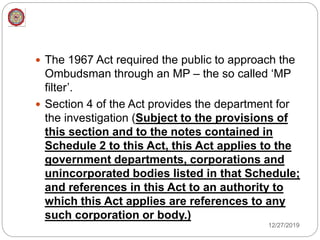
 The 1967 Act required the public to approach the
Ombudsman through an MP – the so called ‘MP
filter’.
 Section 4 of the Act provides the department for
the investigation (Subject to the provisions of
this section and to the notes contained in
Schedule 2 to this Act, this Act applies to the
government departments, corporations and
unincorporated bodies listed in that Schedule;
and references in this Act to an authority to
which this Act applies are references to any
such corporation or body.)
12/27/2019
Matters excluded from Investigation by
the Parliamentary Commissioner
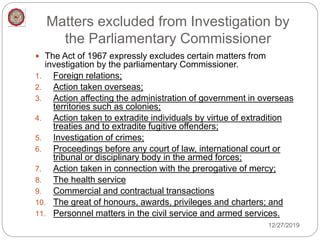
 The Act of 1967 expressly excludes certain matters from
investigation by the parliamentary Commissioner.
1. Foreign relations;
2. Action taken overseas;
3. Action affecting the administration of government in overseas
territories such as colonies;
4. Action taken to extradite individuals by virtue of extradition
treaties and to extradite fugitive offenders;
5. Investigation of crimes;
6. Proceedings before any court of law, international court or
tribunal or disciplinary body in the armed forces;
7. Action taken in connection with the prerogative of mercy;
8. The health service
9. Commercial and contractual transactions
10. The great of honours, awards, privileges and charters; and
11. Personnel matters in the civil service and armed services.
12/27/2019
Complaint
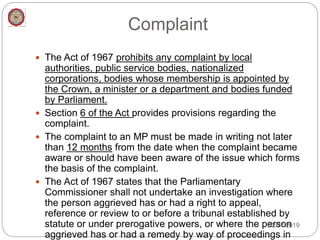
 The Act of 1967 prohibits any complaint by local
authorities, public service bodies, nationalized
corporations, bodies whose membership is appointed by
the Crown, a minister or a department and bodies funded
by Parliament.
 Section 6 of the Act provides provisions regarding the
complaint.
 The complaint to an MP must be made in writing not later
than 12 months from the date when the complaint became
aware or should have been aware of the issue which forms
the basis of the complaint.
 The Act of 1967 states that the Parliamentary
Commissioner shall not undertake an investigation where
the person aggrieved has or had a right to appeal,
reference or review to or before a tribunal established by
statute or under prerogative powers, or where the person
aggrieved has or had a remedy by way of proceedings in
12/27/2019
The Investigation of administrative
functions
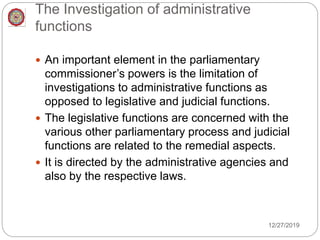
 An important element in the parliamentary
commissioner’s powers is the limitation of
investigations to administrative functions as
opposed to legislative and judicial functions.
 The legislative functions are concerned with the
various other parliamentary process and judicial
functions are related to the remedial aspects.
 It is directed by the administrative agencies and
also by the respective laws.
12/27/2019
Procedure in respect of
investigations.
 Whether a complaint should be investigated is entirely a matter of
discretion for the parliamentary commissioner.
 If a complaint is to be investigated, the commissioner proceeds in
private and gives the head of any department or official concerned an
opportunity to make comments. Section 7 of the Act provides the
procedure for the investigation:-
(1)Where the Commissioner proposes to conduct an investigation pursuant
to a complaint under this Act, he shall afford to the principal officer of
the department or authority concerned, and to any other person who is
alleged in the complaint to have taken or authorized the action
complained of, an opportunity to comment on any allegations contained
in the complaint.
 Where the Commissioner proposes to conduct an investigation pursuant
to a complaint under section 5(1A) of this Act, he shall give the person
to whom the complaint relates an opportunity to comment on any
allegations contained in the complaint.
(2)Every shall be conducted in private, but except as aforesaid the
procedure for conducting an investigation shall be such as the
Commissioner considers appropriate in the circumstances of the case;
and without prejudice to the generality of the foregoing provision the
Commissioner may obtain information from such persons and in such
manner, and make such inquiries, as he thinks fit, and may determine
whether any person may be represented, by counsel or solicitor or
otherwise, in the investigation. 12/27/2019
(3)The Commissioner may, if he thinks fit, pay to the
person by whom the complaint was made and to any
other person who attends or furnishes information for
the purposes of an investigation under this Act—
(a)sums in respect of expenses properly incurred by
them;
(b)allowances by way of compensation for the loss of
their time, in accordance with such scales and subject
to such conditions as may be determined by the
Treasury.
(4)The conduct of an investigation under this Act shall
not affect any action taken by the department or
authority concerned , or any power or duty of to take
further action with respect to any matters subject to
the investigation; but where the person aggrieved has
been removed from the United Kingdom under any
Order in force under the Aliens Restriction Acts
1914 and 1919 or under he shall, if the Commissioner
so directs, be permitted to re-enter and remain in the
United Kingdom, subject to such conditions as the
12/27/2019
Injustice in Consequences of maladministration
 The Act of 1967 allows the parliamentary
Commissioner to investigate complaints from those
who allege that they have suffered injustice in
consequences of maladministration where they
consent to a reference of that complaint by the MP to
the Parliamentary Commissioner.
 The term injustice may have wider and multiple
interpretation which needs to be defined in the law.
 In 1967 the term as the time of discussion in the UK
parliament, maladministration includes “ bias, neglect,
inattention, delay, incompetence, ineptitude,
arbitrariness and so on.”
 The Act has thought of substantive and procedural
maladministration.
12/27/2019
Judicial review of reports and
decisions
 It has been established in R v Parliamentary
Commissioner for Administration (1994) that both
the decisions and reports made by the
Parliamentary Commissioner relating to an
investigation into an alleged case of
maladministration are susceptible to judicial
review.
 This has established a substantive application for
judicial review of the Parliamentary Commissioner
had come before the courts.
12/27/2019
Thank you
12/27/2019

remediesformaladministration-191227035239.pdf

  • 1.
    Adv. Vijay Jayshwal KathmanduUniversity School of Law Remedies for Maladministration 12/27/2019
  • 2.
    Maladministration …..  Publicmaladministration can be defined broadly as ‘administrative action or inaction’ resulting from ‘improper considerations or conduct’.  It embraces all the features of “poor governance”, such as injustice, failure to carry out legislative intent, unreasonable delay, administrative error, negligence, inadequate investigation, unfair policy, partiality, arbitrariness, inefficiency, violation of law or regulation, abuse of authority, discrimination, and other acts that are frequently inflicted upon the governed, intentionally or unintentionally, by those who govern.  Public maladministration is characterized by three major categories of administrative impropriety: (1) managerial incompetence; (2) abuse of power; and (3) bureaucratic corruption.  Bureaucratic corruption refers to unclean acts committed by government officials, such as ‘bending the law, discarding morality, dishonesty, venality, nepotism, appointment of jobs and contracts to unqualified persons, 12/27/2019
  • 3.
     There arethree types of remedy for public maladministration: managerial, legal and political.  The managerial approach to public maladministration entails management-oriented reforms and aims at maximizing ‘effectiveness, efficiency and economy’. Modern techniques of scientific management in the areas of recruitment, promotion and functional specialization can be utilized to tackle the managerial roots of maladministration.  From a legal perspective, administrative laws can be enacted to check the power of bureaucrats particularly those ‘street-level’ bureaucrats who have frequent and direct interaction with citizens at the grassroots level and who enjoy a considerable degree of discretion in their work.  Examples of these ‘street-level’ bureaucrats are the police officers patrolling on the street.  The legal approach to public maladministration is contingent upon the judiciary’s ability to check the 12/27/2019
  • 4.
     Finally, thepolitical approach to public maladministration emphasizes governmental openness and responsiveness, the legislature’s assertiveness in checking any arbitrary action committed by the state, and citizen participation in selecting their representatives who can transfer their complaints and views to the governing authorities. 12/27/2019
  • 5.
    Features of Maladministration Delay.  Incorrect action or failure to take any action.  Failure to follow procedures or the law.  Failure to provide information.  Inadequate record-keeping.  Failure to investigate.  Failure to reply.  Misleading or inaccurate statements.  Failure to abide by enabling laws.  Improper action etc. 12/27/2019
  • 6.
    The Ombudsman Remedy The concept of the ombudsman as an interface between citizens and administrative agencies of government in situations of disputes in one widely recognized in both tradition and law throughout the world.  The historical tradition of ombudsman-like functions is particularly rich, ranging from the Roman Republic's censors through an elaborate administrative control system the "Control Yuan" developed during the Han Dynasty in ancient China to intercessions of the medieval Christian Church between subject and feudal lord.  Direct organizational ancestors of the modern ombudsman were created during the early 18th century. This period saw Peter the Great appoint a Procurator General for the Russian empire in 1722. This "eye of the Czar" was charged not only with ensuring the enforcement of laws and edicts, but also with protecting the population from excessive official action.  In 1713 Charles IX appointed an "Ombudsman" for his Swedish kingdom for the same basic reason, to be a legal safeguard against over zealous state administration.  This office evolved through the 1809 Swedish Constitution into the model for today's ombudsman offices world-wide.  Today, it has become one of key defining features of modern 12/27/2019
  • 7.
     The firstombudsman's office in North America was established in the Canadian province of Alberta and was largely patterned after the New Zealand Ombudsman office. The first United States effort to implement this concept was undertaken in Nassau County, New York, where the County Executive, a political officer, appointed a "Public Protector" with ombudsman-like functions. 12/27/2019
  • 8.
    Legal Status  Thelegal concept of the ombudsman also enjoys widespread acceptance and agreement world-wide.  The International Bar Association defines the ombudsman as "an Office established by constitution or statute, headed by an independent, high-level, public official, who is responsible to the Legislature or Parliament, who receives complaints from aggrieved persons against government agencies, officials and employers, or who acts on his own motion, and has the power to investigate and recommend corrective action and issue reports.”  This official nature of the ombudsman's status is reflected in its American form as defined by the American Bar Association's Administrative Law Section as "an independent governmental official who receives complaints against government agencies and officials from aggrieved persons, who investigates, and who, if the complaints are justified, makes recommendations to remedy the complaints.”  This legal status varies from formal constitutional provisions - such as those which govern the Swedish 12/27/2019
  • 9.
    Jurisdiction  An ombudsman'sjurisdiction is almost always officially limited to that of its sponsoring or parent governments. This limitation is often more apparent on the office's organization chart than in its operations.  Ultimately this spreading informal jurisdiction is mandated by the types of complaints brought to the ombudsman.  For instance, studies of the Detroit Ombudsman's complaint intake revealed that approximately half of all problems brought to their attention involved citizen complaints about the actions of other citizens.  The major areas of concern generating these 12/27/2019
  • 10.
    Ombudsmen in theUK  The first ombudsman to be established was the Parliamentary Commissioner for Administration whose office was created by the Parliamentary Commissioner Act 1967.  The Parliamentary Commissioner Act 1969 established the office in Northern Ireland to deal with complaints against the Northern Ireland government.  It also deals with the complaints in the province against local bodies and certain public bodies.  This institution is also responsible to deal with the investigating maladministration in local government. 12/27/2019
  • 11.
    The Parliamentary Commissionerfor Administration  The Parliamentary Commissioner is accountable to parliament. It has statutory power and reinforces the capacity of parliament to deal with complaints against the executive.  It reports the parliament through a series of annual reports, including reports of particular investigations and matters of concern.  The respective MPs have locus standi to bring the issues to the commissioner. The “MP Filter’ is one of defining features of UK Ombudsman in order to identify early grievances .  The function of the Parliamentary Ombudsman is to investigate complaints from members of the public who believe that they have suffered injustice due to 12/27/2019
  • 12.
     The 1967Act required the public to approach the Ombudsman through an MP – the so called ‘MP filter’.  Section 4 of the Act provides the department for the investigation (Subject to the provisions of this section and to the notes contained in Schedule 2 to this Act, this Act applies to the government departments, corporations and unincorporated bodies listed in that Schedule; and references in this Act to an authority to which this Act applies are references to any such corporation or body.) 12/27/2019
  • 13.
    Matters excluded fromInvestigation by the Parliamentary Commissioner  The Act of 1967 expressly excludes certain matters from investigation by the parliamentary Commissioner. 1. Foreign relations; 2. Action taken overseas; 3. Action affecting the administration of government in overseas territories such as colonies; 4. Action taken to extradite individuals by virtue of extradition treaties and to extradite fugitive offenders; 5. Investigation of crimes; 6. Proceedings before any court of law, international court or tribunal or disciplinary body in the armed forces; 7. Action taken in connection with the prerogative of mercy; 8. The health service 9. Commercial and contractual transactions 10. The great of honours, awards, privileges and charters; and 11. Personnel matters in the civil service and armed services. 12/27/2019
  • 14.
    Complaint  The Actof 1967 prohibits any complaint by local authorities, public service bodies, nationalized corporations, bodies whose membership is appointed by the Crown, a minister or a department and bodies funded by Parliament.  Section 6 of the Act provides provisions regarding the complaint.  The complaint to an MP must be made in writing not later than 12 months from the date when the complaint became aware or should have been aware of the issue which forms the basis of the complaint.  The Act of 1967 states that the Parliamentary Commissioner shall not undertake an investigation where the person aggrieved has or had a right to appeal, reference or review to or before a tribunal established by statute or under prerogative powers, or where the person aggrieved has or had a remedy by way of proceedings in 12/27/2019
  • 15.
    The Investigation ofadministrative functions  An important element in the parliamentary commissioner’s powers is the limitation of investigations to administrative functions as opposed to legislative and judicial functions.  The legislative functions are concerned with the various other parliamentary process and judicial functions are related to the remedial aspects.  It is directed by the administrative agencies and also by the respective laws. 12/27/2019
  • 16.
    Procedure in respectof investigations.  Whether a complaint should be investigated is entirely a matter of discretion for the parliamentary commissioner.  If a complaint is to be investigated, the commissioner proceeds in private and gives the head of any department or official concerned an opportunity to make comments. Section 7 of the Act provides the procedure for the investigation:- (1)Where the Commissioner proposes to conduct an investigation pursuant to a complaint under this Act, he shall afford to the principal officer of the department or authority concerned, and to any other person who is alleged in the complaint to have taken or authorized the action complained of, an opportunity to comment on any allegations contained in the complaint.  Where the Commissioner proposes to conduct an investigation pursuant to a complaint under section 5(1A) of this Act, he shall give the person to whom the complaint relates an opportunity to comment on any allegations contained in the complaint. (2)Every shall be conducted in private, but except as aforesaid the procedure for conducting an investigation shall be such as the Commissioner considers appropriate in the circumstances of the case; and without prejudice to the generality of the foregoing provision the Commissioner may obtain information from such persons and in such manner, and make such inquiries, as he thinks fit, and may determine whether any person may be represented, by counsel or solicitor or otherwise, in the investigation. 12/27/2019
  • 17.
    (3)The Commissioner may,if he thinks fit, pay to the person by whom the complaint was made and to any other person who attends or furnishes information for the purposes of an investigation under this Act— (a)sums in respect of expenses properly incurred by them; (b)allowances by way of compensation for the loss of their time, in accordance with such scales and subject to such conditions as may be determined by the Treasury. (4)The conduct of an investigation under this Act shall not affect any action taken by the department or authority concerned , or any power or duty of to take further action with respect to any matters subject to the investigation; but where the person aggrieved has been removed from the United Kingdom under any Order in force under the Aliens Restriction Acts 1914 and 1919 or under he shall, if the Commissioner so directs, be permitted to re-enter and remain in the United Kingdom, subject to such conditions as the 12/27/2019
  • 18.
    Injustice in Consequencesof maladministration  The Act of 1967 allows the parliamentary Commissioner to investigate complaints from those who allege that they have suffered injustice in consequences of maladministration where they consent to a reference of that complaint by the MP to the Parliamentary Commissioner.  The term injustice may have wider and multiple interpretation which needs to be defined in the law.  In 1967 the term as the time of discussion in the UK parliament, maladministration includes “ bias, neglect, inattention, delay, incompetence, ineptitude, arbitrariness and so on.”  The Act has thought of substantive and procedural maladministration. 12/27/2019
  • 19.
    Judicial review ofreports and decisions  It has been established in R v Parliamentary Commissioner for Administration (1994) that both the decisions and reports made by the Parliamentary Commissioner relating to an investigation into an alleged case of maladministration are susceptible to judicial review.  This has established a substantive application for judicial review of the Parliamentary Commissioner had come before the courts. 12/27/2019
  • 20.