OLYMPIC WONDER Determination  & Will Power Story Sports Wing of RERF/Brahma Kumaris
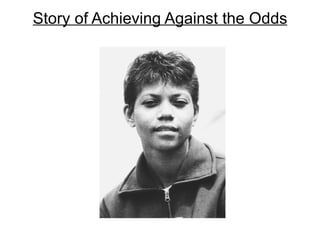
Story of Achieving Against the Odds
Most Successful Polio Victim
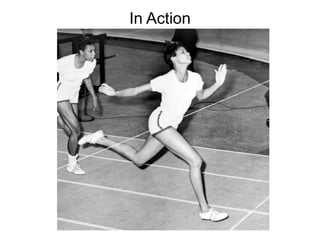
In Action
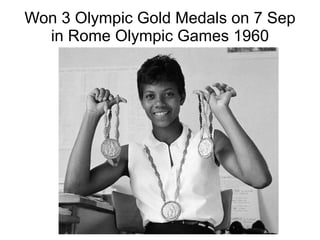
Won 3 Olympic Gold Medals on 7 Sep in Rome Olympic Games 1960
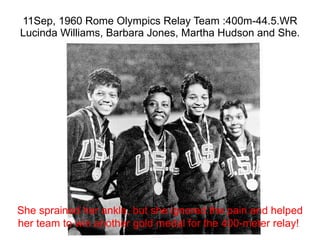
11Sep, 1960 Rome Olympics Relay Team :400m-44.5.WR Lucinda Williams, Barbara Jones, Martha Hudson and She. She sprained her ankle, but she ignored the pain and helped her team to win another gold medal for the 400-meter relay!
One of the most Celebrated  Female Athletes of All Time.
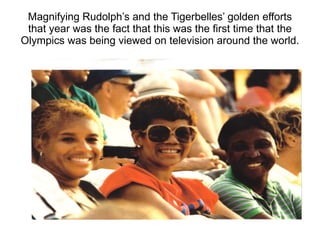
Magnifying Rudolph’s and the Tigerbelles’ golden efforts that year was the fact that this was the first time that the Olympics was being viewed on television around the world.
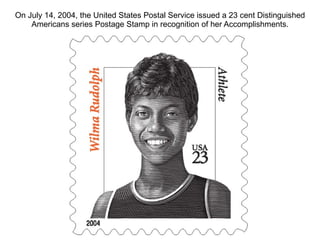
On July 14, 2004, the United States Postal Service issued a 23 cent Distinguished Americans series Postage Stamp in recognition of her Accomplishments.
Statue
Statue
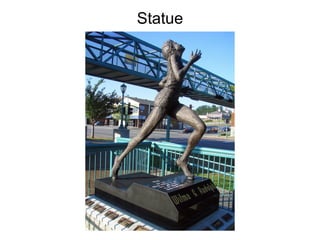
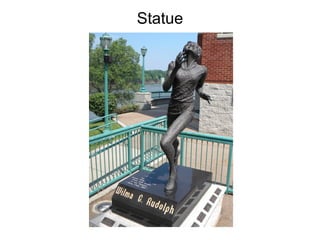
Wilma Glodean Rudolph Statue  To honor one of America's most outstanding Olympic athletes and her legacy, a Bronze Life size Statue of Clarksville, Tennessee  native Wilma Rudolph was hand-crafted in  her likeness. The statue can be viewed at  the southern end of the Cumberland River  Walk at the base of the Pedestrian  Overpass, College Street & Riverside Drive.
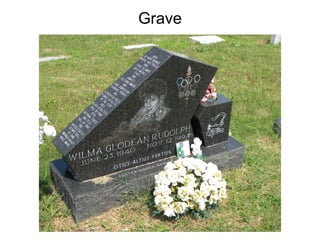
Grave
Wilma Glodean Rudolph BirthDate: 23 June 1940 Birth Place: Clarksville, Tennessee, USA  Feat: 3 Olympic Gold Medals in Rome Olympic Games 1960 Events: 100m-11Sec;  200m-23.2Sec-OR;  400m-44.5Sec-WR Died of Brain Cancer on 12 Nov 1994
Family Background Her parents, Ed and Blanche Rudolph,  were honest, hardworking people, but were  very poor. Mr. Rudolph worked as a railroad  porter and handyman. Mrs. Rudolph did  cooking, laundry and housecleaning for  wealthy white families. Wilma Rudolph was  the 20th of 22. children. At that time most  African American women were either  homemakers or domestic servants for whites.
Suffered from  ☻ Born Prematurely weighed 4.5 lbs as such the bulk of her childhood was spent in bed. ☻  She suffered from Double Pneumonia and Scarlet Fever. Measles, Whooping Cough, Mumps, Chicken-Pox . But she continued to fight, and she fought them all! ☻  Soon after, she was a victim of the Poliovirus. The polio rendered her left leg powerless, and she had to use metal braces at the age of six.  Left Leg & Foot were becoming weak and deformed  and the doctors declared that Wilma would never be able to walk on her own.  ☻  Racial Segregation-discrimination of Black & White ☻  Poverty - To make matters worse, her family was poor and could not afford good medical care.  But Wilma did not lose hope.
Suffered from  “ I spent most of my time trying to figure out how to get them off” – she thought.
Determination of Her Mother  The doctor told Mrs. Rudolph that Wilma would never walk. But Mrs. Rudolph would not give up on Wilma. She found out that she could be treated at Meharry Hospital, the black medical college of Fisk University in Nashville. Even though it was 50 miles (75Km) away, Wilma's mother took her there twice a week for two years, until she was able to walk with the aid of a metal leg brace.  Finally, by age 12, she could walk normally, without the crutches, brace, or corrective shoes.
The efforts of the Rudolph family paid 4 Years of Age: She suffered from Double Pneumonia  and Scarlet Fever. 7 Year of Age: She first began school. 9 Years of Age: One Sunday, Wilma removed her braces and walked down the aisle of the church. A triumph – but it was only a beginning of many more victories to come…. She  was very happy to be on her feet again 12 YEARS OF AGE: She could walk normally, without the crutches, brace, or corrective shoes.  She finally achieved her dream of shedding her handicap and becoming like other children.  She gradually started participating in sports. While in high school, Wilma was on the basketball  Team 13 Years of Age: when she realized that she was much faster than the rest, she switched to athletics. participated in Race and lost. She impressed one and all .  15 Years of Age: She was spotted by Tennessee State track and field coach Edward S. Temple. She  had already gained some track experience on Burt High School's track team two years before, mostly as a way to keep busy between basketball seasons. Being discovered by Temple was a major break for a young athlete.  16 YEARS OF AGE : That was it! Wilma grabbed this opportunity and never looked back! She rose higher and higher. She participated in the 1956 Olympic games in Melbourne and returned with a bronze medal – a great feat from a ‘polio cripple‘. She won a bronze medal in the 4x4 relay  at her first Olympic Games in 1956 Melbourne, Aus 20 YEARS OF AGE: On Sep 7, 1960, in Rome, Wilma became the first American woman to win 3 gold medals in the Olympics. She won the 100-meter dash, the 200-meter dash, and ran the anchor on the 400-meter relay team. She was a hero; awards were showered on her. She received unprecedented fame and honor. The media called her ‘the black Gazelle‘ and fans followed her all over the world. 22 YEARS OF AGE:  She  retired from track competition in 1962  after winning two races at a U.S.–Soviet meet. 27 YEARS OF AGE: In 1967 Vice-President Hubert Humphrey invited Wilma to participate in "Operation Champ," an athletic outreach program for underprivileged youth in the ghettoes of 16 major cities. She started her own non-profit organization, The Wilma Rudolph Foundation, to continue this kind of work.  The foundation provided free coaching in a variety of sports, and academic assistance and support as well.  37 YEARS OF AGE: In 1977 she wrote her autobiography, simply titled, "Wilma." It was adapted as a television movie; Wilma worked on it as a consultant.  54 YEARS OF AGE: In July 1994, shortly after her mother’s death, Wilma Rudolph was diagnosed with brain and throat cancer. On November 12, 1994, she died of cancer in her home in Nashville, Tennessee.
Participation in a Track Meet A few years later, Wilma participated in a track meet at Tuskegee Institute, where she lost every single race. But one person who watched her run that day --  Track Coach Ed Temple  of Tennessee State University -- saw her, thought she had potential, and recruited her to his summer "track camps" at TSU. Only a year later, at the age of 16, Wilma Rudolph won a bronze medal at the 1956 Olympics in Melbourne, Australia., the coach for the famous Tigerbells, the women's track team at Tennessee State University.
Wilma Received Numerous Awards ⌂  United Press Athlete of the Year 1960 ⌂  Associated Press Woman Athlete of the Year 1960. ⌂  James E. Sullivan Award 1961  ⌂  National Black Sports & Entertainment Hall of Fame in 1973  ⌂  National Track and Field Hall of Fame in 1974.  ⌂  National Women's Hall of Fame in 1994,  ⌂  The U.S. Olympic Hall of Fame in 1983  ⌂  National Sports Award in 1993.
QUOTES “ Your attitude, not your aptitude, determines your altitude.” - Zig Ziglar
QUOTES “ Champions aren’t made in gyms.  Champions are made from something they have deep inside them  a desire,  a dream,  a vision.  They have to have the skill and the will.  But the  will  must be stronger than the  skill .” - Muhammad Ali
QUOTE “ Our greatest glory is not in never falling, but in rising every time we fall.” - Confucious
QUOTE “ Life isn’t about finding yourself. Life’s about creating yourself.” - George Bernard Shaw
QUOTE “ The tragedy of life doesn’t lie in not reaching your goal. The tragedy lies in having no goals to reach.” - Benjamin Mays
INSPIRATION FOR THE WHOLE WORLD She was an inspiration not only for the Sports World but the medical fraternity as well.
QUALITIES OF WILMA √  Extraordinary Courage √  Ability to Overcome Adversity √  Soft spoken  √  Gracious.  √  The great Jackie Joyner Kersey rates Wilma as her greatest inspiration – a rare tribute.  √  Welfare of Others:  Wilma’s greatest achievement was the creation of the Wilma Rudolph sports foundation, a non-profit organization that has helped many athletes. This great personality who was voted as among the 50 best athletes of the century succumbed to a brain tumour in 1994.

Olympic wonder Wilma Rudolph

  • 1.
    OLYMPIC WONDER Determination & Will Power Story Sports Wing of RERF/Brahma Kumaris
  • 2.
    Story of AchievingAgainst the Odds
  • 3.
  • 4.
  • 5.
    Won 3 OlympicGold Medals on 7 Sep in Rome Olympic Games 1960
  • 6.
    11Sep, 1960 RomeOlympics Relay Team :400m-44.5.WR Lucinda Williams, Barbara Jones, Martha Hudson and She. She sprained her ankle, but she ignored the pain and helped her team to win another gold medal for the 400-meter relay!
  • 7.
    One of themost Celebrated Female Athletes of All Time.
  • 8.
    Magnifying Rudolph’s andthe Tigerbelles’ golden efforts that year was the fact that this was the first time that the Olympics was being viewed on television around the world.
  • 9.
    On July 14,2004, the United States Postal Service issued a 23 cent Distinguished Americans series Postage Stamp in recognition of her Accomplishments.
  • 10.
  • 11.
  • 12.
    Wilma Glodean RudolphStatue To honor one of America's most outstanding Olympic athletes and her legacy, a Bronze Life size Statue of Clarksville, Tennessee native Wilma Rudolph was hand-crafted in her likeness. The statue can be viewed at the southern end of the Cumberland River Walk at the base of the Pedestrian Overpass, College Street & Riverside Drive.
  • 13.
  • 14.
    Wilma Glodean RudolphBirthDate: 23 June 1940 Birth Place: Clarksville, Tennessee, USA Feat: 3 Olympic Gold Medals in Rome Olympic Games 1960 Events: 100m-11Sec; 200m-23.2Sec-OR; 400m-44.5Sec-WR Died of Brain Cancer on 12 Nov 1994
  • 15.
    Family Background Herparents, Ed and Blanche Rudolph, were honest, hardworking people, but were very poor. Mr. Rudolph worked as a railroad porter and handyman. Mrs. Rudolph did cooking, laundry and housecleaning for wealthy white families. Wilma Rudolph was the 20th of 22. children. At that time most African American women were either homemakers or domestic servants for whites.
  • 16.
    Suffered from ☻ Born Prematurely weighed 4.5 lbs as such the bulk of her childhood was spent in bed. ☻ She suffered from Double Pneumonia and Scarlet Fever. Measles, Whooping Cough, Mumps, Chicken-Pox . But she continued to fight, and she fought them all! ☻ Soon after, she was a victim of the Poliovirus. The polio rendered her left leg powerless, and she had to use metal braces at the age of six. Left Leg & Foot were becoming weak and deformed and the doctors declared that Wilma would never be able to walk on her own. ☻ Racial Segregation-discrimination of Black & White ☻ Poverty - To make matters worse, her family was poor and could not afford good medical care. But Wilma did not lose hope.
  • 17.
    Suffered from “ I spent most of my time trying to figure out how to get them off” – she thought.
  • 18.
    Determination of HerMother The doctor told Mrs. Rudolph that Wilma would never walk. But Mrs. Rudolph would not give up on Wilma. She found out that she could be treated at Meharry Hospital, the black medical college of Fisk University in Nashville. Even though it was 50 miles (75Km) away, Wilma's mother took her there twice a week for two years, until she was able to walk with the aid of a metal leg brace. Finally, by age 12, she could walk normally, without the crutches, brace, or corrective shoes.
  • 19.
    The efforts ofthe Rudolph family paid 4 Years of Age: She suffered from Double Pneumonia and Scarlet Fever. 7 Year of Age: She first began school. 9 Years of Age: One Sunday, Wilma removed her braces and walked down the aisle of the church. A triumph – but it was only a beginning of many more victories to come…. She was very happy to be on her feet again 12 YEARS OF AGE: She could walk normally, without the crutches, brace, or corrective shoes. She finally achieved her dream of shedding her handicap and becoming like other children. She gradually started participating in sports. While in high school, Wilma was on the basketball Team 13 Years of Age: when she realized that she was much faster than the rest, she switched to athletics. participated in Race and lost. She impressed one and all . 15 Years of Age: She was spotted by Tennessee State track and field coach Edward S. Temple. She had already gained some track experience on Burt High School's track team two years before, mostly as a way to keep busy between basketball seasons. Being discovered by Temple was a major break for a young athlete. 16 YEARS OF AGE : That was it! Wilma grabbed this opportunity and never looked back! She rose higher and higher. She participated in the 1956 Olympic games in Melbourne and returned with a bronze medal – a great feat from a ‘polio cripple‘. She won a bronze medal in the 4x4 relay at her first Olympic Games in 1956 Melbourne, Aus 20 YEARS OF AGE: On Sep 7, 1960, in Rome, Wilma became the first American woman to win 3 gold medals in the Olympics. She won the 100-meter dash, the 200-meter dash, and ran the anchor on the 400-meter relay team. She was a hero; awards were showered on her. She received unprecedented fame and honor. The media called her ‘the black Gazelle‘ and fans followed her all over the world. 22 YEARS OF AGE: She retired from track competition in 1962 after winning two races at a U.S.–Soviet meet. 27 YEARS OF AGE: In 1967 Vice-President Hubert Humphrey invited Wilma to participate in "Operation Champ," an athletic outreach program for underprivileged youth in the ghettoes of 16 major cities. She started her own non-profit organization, The Wilma Rudolph Foundation, to continue this kind of work. The foundation provided free coaching in a variety of sports, and academic assistance and support as well. 37 YEARS OF AGE: In 1977 she wrote her autobiography, simply titled, "Wilma." It was adapted as a television movie; Wilma worked on it as a consultant. 54 YEARS OF AGE: In July 1994, shortly after her mother’s death, Wilma Rudolph was diagnosed with brain and throat cancer. On November 12, 1994, she died of cancer in her home in Nashville, Tennessee.
  • 20.
    Participation in aTrack Meet A few years later, Wilma participated in a track meet at Tuskegee Institute, where she lost every single race. But one person who watched her run that day -- Track Coach Ed Temple of Tennessee State University -- saw her, thought she had potential, and recruited her to his summer "track camps" at TSU. Only a year later, at the age of 16, Wilma Rudolph won a bronze medal at the 1956 Olympics in Melbourne, Australia., the coach for the famous Tigerbells, the women's track team at Tennessee State University.
  • 21.
    Wilma Received NumerousAwards ⌂ United Press Athlete of the Year 1960 ⌂ Associated Press Woman Athlete of the Year 1960. ⌂ James E. Sullivan Award 1961 ⌂ National Black Sports & Entertainment Hall of Fame in 1973 ⌂ National Track and Field Hall of Fame in 1974. ⌂ National Women's Hall of Fame in 1994, ⌂ The U.S. Olympic Hall of Fame in 1983 ⌂ National Sports Award in 1993.
  • 22.
    QUOTES “ Yourattitude, not your aptitude, determines your altitude.” - Zig Ziglar
  • 23.
    QUOTES “ Championsaren’t made in gyms. Champions are made from something they have deep inside them a desire, a dream, a vision. They have to have the skill and the will. But the will must be stronger than the skill .” - Muhammad Ali
  • 24.
    QUOTE “ Ourgreatest glory is not in never falling, but in rising every time we fall.” - Confucious
  • 25.
    QUOTE “ Lifeisn’t about finding yourself. Life’s about creating yourself.” - George Bernard Shaw
  • 26.
    QUOTE “ Thetragedy of life doesn’t lie in not reaching your goal. The tragedy lies in having no goals to reach.” - Benjamin Mays
  • 27.
    INSPIRATION FOR THEWHOLE WORLD She was an inspiration not only for the Sports World but the medical fraternity as well.
  • 28.
    QUALITIES OF WILMA√ Extraordinary Courage √ Ability to Overcome Adversity √ Soft spoken √ Gracious. √ The great Jackie Joyner Kersey rates Wilma as her greatest inspiration – a rare tribute. √ Welfare of Others: Wilma’s greatest achievement was the creation of the Wilma Rudolph sports foundation, a non-profit organization that has helped many athletes. This great personality who was voted as among the 50 best athletes of the century succumbed to a brain tumour in 1994.