IIM Kashipur
Kashipur Quizzing League (KQL)
KQL Food Quiz
By
Ashwin Murali
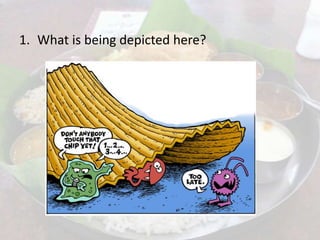
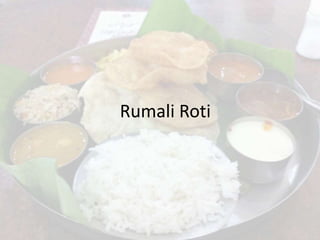
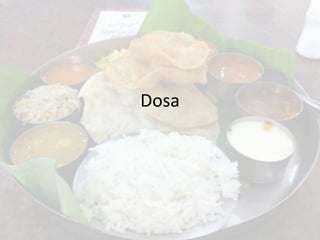
1. What is being depicted here?
5 second rule
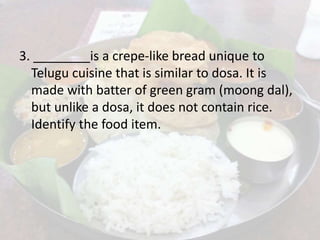
2. It is a thin bread from the northern part of
India and Pakistan and a traditional element in
Mughlai cuisine. The first part of the food item
literally means handkerchief in Urdu and
Hindi. During the Mughal period, the roti was
used like a cloth to wipe off the excess oil off
the hands after the completion of an oil rich
food laden with meat and fat.
Rumali Roti
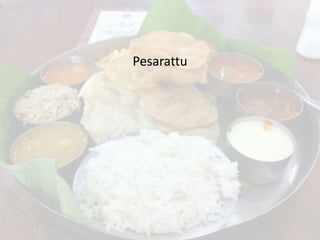
3. ________is a crepe-like bread unique to
Telugu cuisine that is similar to dosa. It is
made with batter of green gram (moong dal),
but unlike a dosa, it does not contain rice.
Identify the food item.
Pesarattu
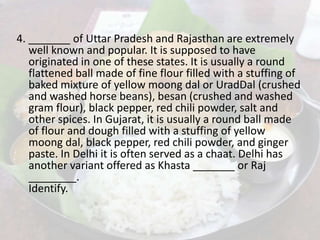
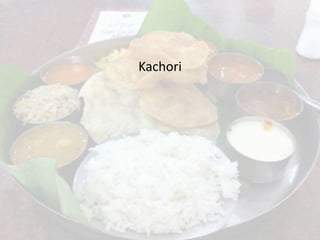
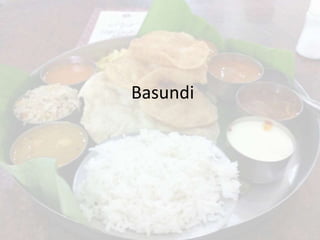
4. _______ of Uttar Pradesh and Rajasthan are extremely
well known and popular. It is supposed to have
originated in one of these states. It is usually a round
flattened ball made of fine flour filled with a stuffing of
baked mixture of yellow moong dal or UradDal (crushed
and washed horse beans), besan (crushed and washed
gram flour), black pepper, red chili powder, salt and
other spices. In Gujarat, it is usually a round ball made
of flour and dough filled with a stuffing of yellow
moong dal, black pepper, red chili powder, and ginger
paste. In Delhi it is often served as a chaat. Delhi has
another variant offered as Khasta _______ or Raj
________.
Identify.
Kachori
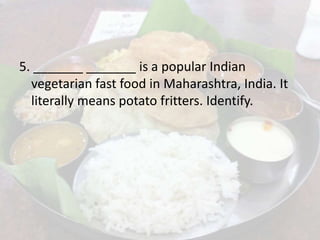
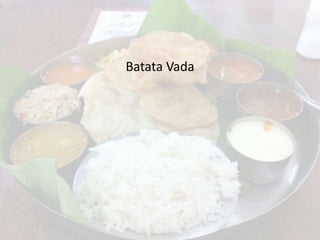
5. _______ _______ is a popular Indian
vegetarian fast food in Maharashtra, India. It
literally means potato fritters. Identify.
Batata Vada
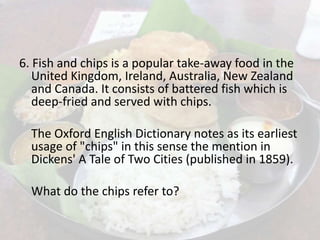
6. Fish and chips is a popular take-away food in the
United Kingdom, Ireland, Australia, New Zealand
and Canada. It consists of battered fish which is
deep-fried and served with chips.
The Oxford English Dictionary notes as its earliest
usage of "chips" in this sense the mention in
Dickens' A Tale of Two Cities (published in 1859).
What do the chips refer to?
French Fries
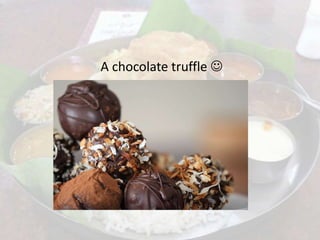
7. Perhaps they are names for their resemblance
to a fungus, this is a type of chocolate
confectionery that is traditionally made with a
chocolate ganache center coated in chocolate
or cocoa powder, usually in a spherical,
conical, or curved shape. Other fillings may
replace the ganache. What?
A chocolate truffle 
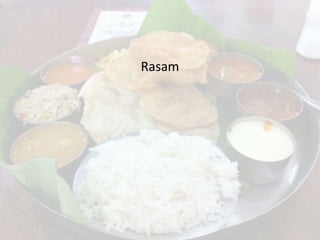
8. The Vaishnavites call it “Satruamudhu” in
Tamil. The Brits simply anglicized the name.
The basic ingredients are pepper and water.
By what popular name is this “dish” known?
Rasam
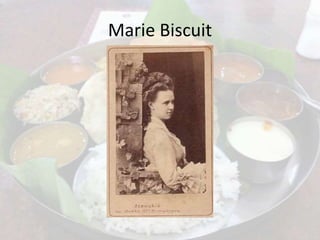
9. _____ Alexandrovna of Russia married Prince
Alfred, Duke of Edinburgh, the second son of
Queen Victoria and Prince Albert and became
Duchess of Edinburgh and Duchess of Saxe-
Coburg and Gotha.
From 1893 until her death, she had the distinction
of being a Russian grand duchess (by birth), a
British royal duchess (by marriage), and the
consort (and later widow) of a German sovereign
duke.
Something was prepared for her wedding to the
Prince and named after her, which has now
become a household name.
What?
Marie Biscuit
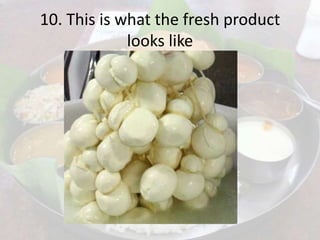
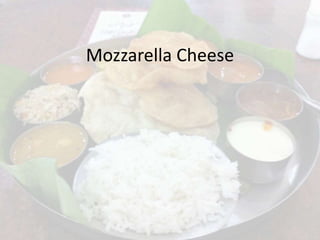
10. This is what the fresh product
looks like
Mozzarella Cheese
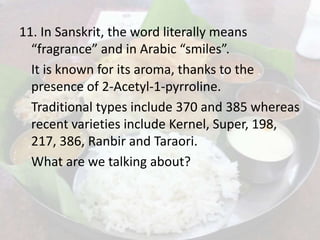
11. In Sanskrit, the word literally means
“fragrance” and in Arabic “smiles”.
It is known for its aroma, thanks to the
presence of 2-Acetyl-1-pyrroline.
Traditional types include 370 and 385 whereas
recent varieties include Kernel, Super, 198,
217, 386, Ranbir and Taraori.
What are we talking about?
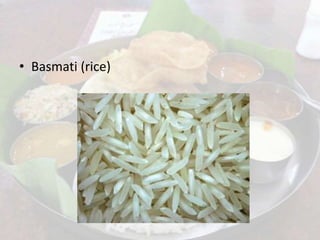
• Basmati (rice)
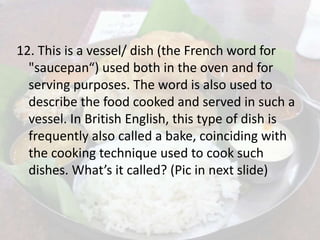
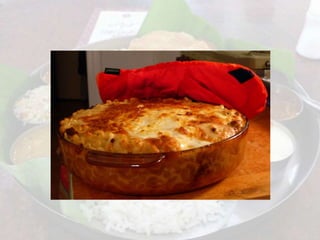
12. This is a vessel/ dish (the French word for
"saucepan“) used both in the oven and for
serving purposes. The word is also used to
describe the food cooked and served in such a
vessel. In British English, this type of dish is
frequently also called a bake, coinciding with
the cooking technique used to cook such
dishes. What’s it called? (Pic in next slide)
Casserole
13. Called Schwarzwälderkirschtorte in German, .
The origin of ----- is unknown, but historians
believes it originated in the late 16th century in
the ------- Region (Der Schwarzwald in German)
located in the state of Baden-Württemberg. The
name, Schwarzwald, evokes darkness and mystery
coming from the romantic woods in Germany. It
contains whipped cream, extract from sour
Morello cherries and chocolate. The confectioner
Josef Keller claims to have invented …….. in its
present form in 1915 in the then prominent Café
Agner in Bad Godesberg. This claim, however, has
never been substantiated.What?
Black Forest Cake
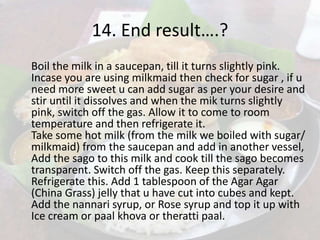
14. End result….?
Boil the milk in a saucepan, till it turns slightly pink.
Incase you are using milkmaid then check for sugar , if u
need more sweet u can add sugar as per your desire and
stir until it dissolves and when the mik turns slightly
pink, switch off the gas. Allow it to come to room
temperature and then refrigerate it.
Take some hot milk (from the milk we boiled with sugar/
milkmaid) from the saucepan and add in another vessel,
Add the sago to this milk and cook till the sago becomes
transparent. Switch off the gas. Keep this separately.
Refrigerate this. Add 1 tablespoon of the Agar Agar
(China Grass) jelly that u have cut into cubes and kept.
Add the nannari syrup, or Rose syrup and top it up with
Ice cream or paal khova or theratti paal.
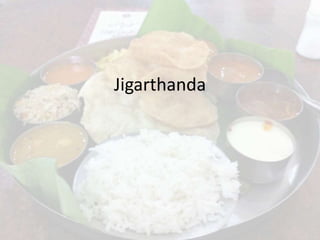
Jigarthanda
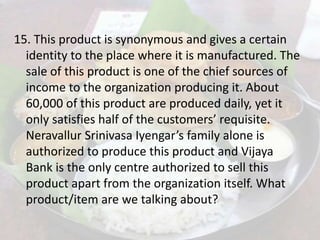
15. This product is synonymous and gives a certain
identity to the place where it is manufactured. The
sale of this product is one of the chief sources of
income to the organization producing it. About
60,000 of this product are produced daily, yet it
only satisfies half of the customers’ requisite.
Neravallur Srinivasa Iyengar’s family alone is
authorized to produce this product and Vijaya
Bank is the only centre authorized to sell this
product apart from the organization itself. What
product/item are we talking about?
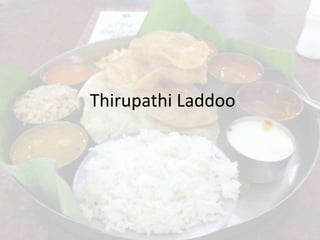
Thirupathi Laddoo
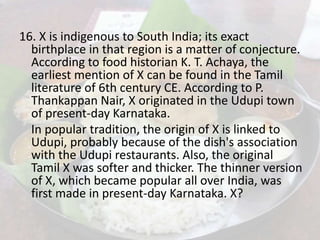
16. X is indigenous to South India; its exact
birthplace in that region is a matter of conjecture.
According to food historian K. T. Achaya, the
earliest mention of X can be found in the Tamil
literature of 6th century CE. According to P.
Thankappan Nair, X originated in the Udupi town
of present-day Karnataka.
In popular tradition, the origin of X is linked to
Udupi, probably because of the dish's association
with the Udupi restaurants. Also, the original
Tamil X was softer and thicker. The thinner version
of X, which became popular all over India, was
first made in present-day Karnataka. X?
Dosa
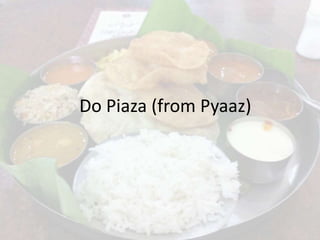
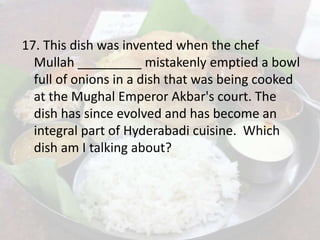
17. This dish was invented when the chef
Mullah _________ mistakenly emptied a bowl
full of onions in a dish that was being cooked
at the Mughal Emperor Akbar's court. The
dish has since evolved and has become an
integral part of Hyderabadi cuisine. Which
dish am I talking about?
Do Piaza (from Pyaaz)
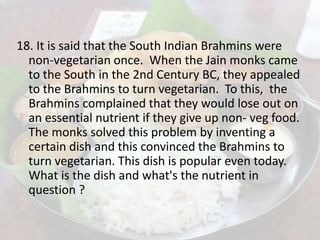
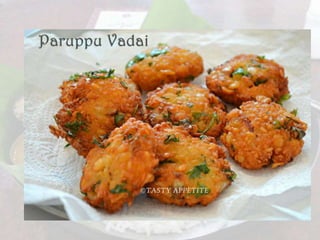
18. It is said that the South Indian Brahmins were
non-vegetarian once. When the Jain monks came
to the South in the 2nd Century BC, they appealed
to the Brahmins to turn vegetarian. To this, the
Brahmins complained that they would lose out on
an essential nutrient if they give up non- veg food.
The monks solved this problem by inventing a
certain dish and this convinced the Brahmins to
turn vegetarian. This dish is popular even today.
What is the dish and what's the nutrient in
question ?
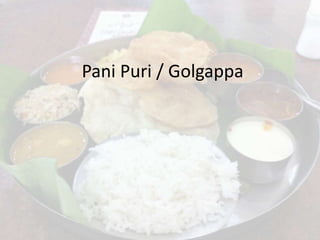
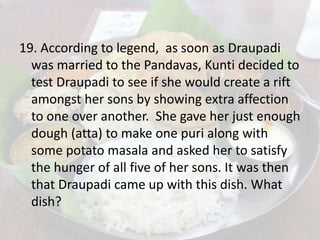
19. According to legend, as soon as Draupadi
was married to the Pandavas, Kunti decided to
test Draupadi to see if she would create a rift
amongst her sons by showing extra affection
to one over another. She gave her just enough
dough (atta) to make one puri along with
some potato masala and asked her to satisfy
the hunger of all five of her sons. It was then
that Draupadi came up with this dish. What
dish?
Pani Puri / Golgappa
20. In the late 1700s, this fruit was considered
poisonous due to the fact that many
aristocrats would get sick and die after eating
it. Infact, the fruits weren't poisonous, but
they were eaten from pewter plates which
contained lead, and the acidic juices from the
fruit would cause the lead to be leached out
from the plates and be consumed, hence
causing lead poisoning. Which popular fruit
am I talking about ?
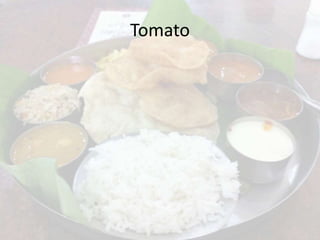
Tomato
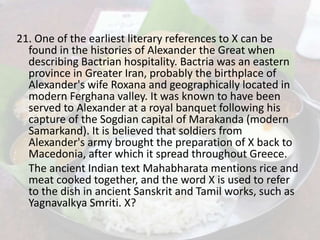
21. One of the earliest literary references to X can be
found in the histories of Alexander the Great when
describing Bactrian hospitality. Bactria was an eastern
province in Greater Iran, probably the birthplace of
Alexander's wife Roxana and geographically located in
modern Ferghana valley. It was known to have been
served to Alexander at a royal banquet following his
capture of the Sogdian capital of Marakanda (modern
Samarkand). It is believed that soldiers from
Alexander's army brought the preparation of X back to
Macedonia, after which it spread throughout Greece.
The ancient Indian text Mahabharata mentions rice and
meat cooked together, and the word X is used to refer
to the dish in ancient Sanskrit and Tamil works, such as
Yagnavalkya Smriti. X?
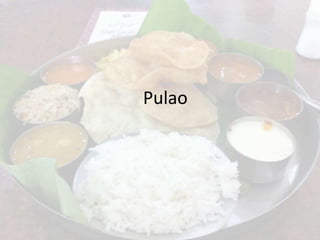
Pulao
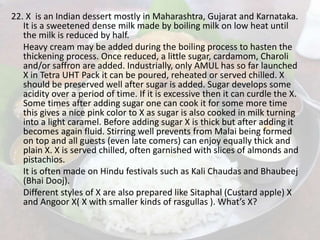
22. X is an Indian dessert mostly in Maharashtra, Gujarat and Karnataka.
It is a sweetened dense milk made by boiling milk on low heat until
the milk is reduced by half.
Heavy cream may be added during the boiling process to hasten the
thickening process. Once reduced, a little sugar, cardamom, Charoli
and/or saffron are added. Industrially, only AMUL has so far launched
X in Tetra UHT Pack it can be poured, reheated or served chilled. X
should be preserved well after sugar is added. Sugar develops some
acidity over a period of time. If it is excessive then it can curdle the X.
Some times after adding sugar one can cook it for some more time
this gives a nice pink color to X as sugar is also cooked in milk turning
into a light caramel. Before adding sugar X is thick but after adding it
becomes again fluid. Stirring well prevents from Malai being formed
on top and all guests (even late comers) can enjoy equally thick and
plain X. X is served chilled, often garnished with slices of almonds and
pistachios.
It is often made on Hindu festivals such as Kali Chaudas and Bhaubeej
(Bhai Dooj).
Different styles of X are also prepared like Sitaphal (Custard apple) X
and Angoor X( X with smaller kinds of rasgullas ). What’s X?
Basundi
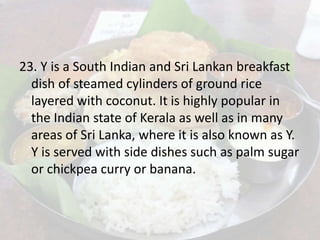
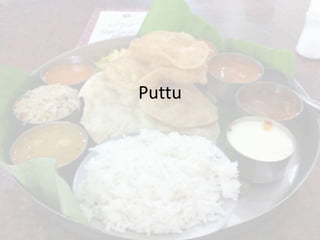
23. Y is a South Indian and Sri Lankan breakfast
dish of steamed cylinders of ground rice
layered with coconut. It is highly popular in
the Indian state of Kerala as well as in many
areas of Sri Lanka, where it is also known as Y.
Y is served with side dishes such as palm sugar
or chickpea curry or banana.
Puttu
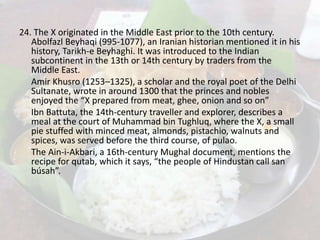
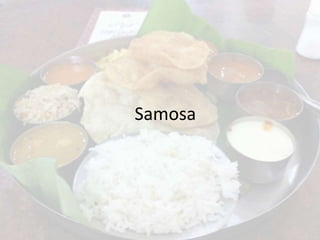
24. The X originated in the Middle East prior to the 10th century.
Abolfazl Beyhaqi (995-1077), an Iranian historian mentioned it in his
history, Tarikh-e Beyhaghi. It was introduced to the Indian
subcontinent in the 13th or 14th century by traders from the
Middle East.
Amir Khusro (1253–1325), a scholar and the royal poet of the Delhi
Sultanate, wrote in around 1300 that the princes and nobles
enjoyed the “X prepared from meat, ghee, onion and so on”
Ibn Battuta, the 14th-century traveller and explorer, describes a
meal at the court of Muhammad bin Tughluq, where the X, a small
pie stuffed with minced meat, almonds, pistachio, walnuts and
spices, was served before the third course, of pulao.
The Ain-i-Akbari, a 16th-century Mughal document, mentions the
recipe for qutab, which it says, “the people of Hindustan call san
búsah”.
Samosa
25. When Mughals invaded India, they brought
along their own cuisine. They did not take to
any Indian food items except one item. They
adopted the Indian tradition with respect to
this item and decided that no feast is complete
without this item. Which item that is an
integral component of any feast in India am I
talking about?
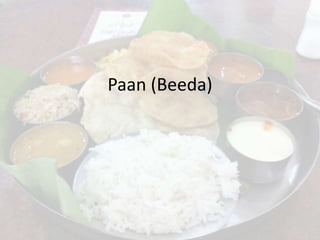
Paan (Beeda)
Thank You!

Food quiz

  • 1.
    IIM Kashipur Kashipur QuizzingLeague (KQL) KQL Food Quiz By Ashwin Murali
  • 2.
    1. What isbeing depicted here?
  • 3.
  • 4.
    2. It isa thin bread from the northern part of India and Pakistan and a traditional element in Mughlai cuisine. The first part of the food item literally means handkerchief in Urdu and Hindi. During the Mughal period, the roti was used like a cloth to wipe off the excess oil off the hands after the completion of an oil rich food laden with meat and fat.
  • 5.
  • 6.
    3. ________is acrepe-like bread unique to Telugu cuisine that is similar to dosa. It is made with batter of green gram (moong dal), but unlike a dosa, it does not contain rice. Identify the food item.
  • 7.
  • 8.
    4. _______ ofUttar Pradesh and Rajasthan are extremely well known and popular. It is supposed to have originated in one of these states. It is usually a round flattened ball made of fine flour filled with a stuffing of baked mixture of yellow moong dal or UradDal (crushed and washed horse beans), besan (crushed and washed gram flour), black pepper, red chili powder, salt and other spices. In Gujarat, it is usually a round ball made of flour and dough filled with a stuffing of yellow moong dal, black pepper, red chili powder, and ginger paste. In Delhi it is often served as a chaat. Delhi has another variant offered as Khasta _______ or Raj ________. Identify.
  • 9.
  • 10.
    5. _______ _______is a popular Indian vegetarian fast food in Maharashtra, India. It literally means potato fritters. Identify.
  • 11.
  • 12.
    6. Fish andchips is a popular take-away food in the United Kingdom, Ireland, Australia, New Zealand and Canada. It consists of battered fish which is deep-fried and served with chips. The Oxford English Dictionary notes as its earliest usage of "chips" in this sense the mention in Dickens' A Tale of Two Cities (published in 1859). What do the chips refer to?
  • 13.
  • 14.
    7. Perhaps theyare names for their resemblance to a fungus, this is a type of chocolate confectionery that is traditionally made with a chocolate ganache center coated in chocolate or cocoa powder, usually in a spherical, conical, or curved shape. Other fillings may replace the ganache. What?
  • 15.
  • 16.
    8. The Vaishnavitescall it “Satruamudhu” in Tamil. The Brits simply anglicized the name. The basic ingredients are pepper and water. By what popular name is this “dish” known?
  • 17.
  • 18.
    9. _____ Alexandrovnaof Russia married Prince Alfred, Duke of Edinburgh, the second son of Queen Victoria and Prince Albert and became Duchess of Edinburgh and Duchess of Saxe- Coburg and Gotha. From 1893 until her death, she had the distinction of being a Russian grand duchess (by birth), a British royal duchess (by marriage), and the consort (and later widow) of a German sovereign duke. Something was prepared for her wedding to the Prince and named after her, which has now become a household name. What?
  • 19.
  • 20.
    10. This iswhat the fresh product looks like
  • 21.
  • 22.
    11. In Sanskrit,the word literally means “fragrance” and in Arabic “smiles”. It is known for its aroma, thanks to the presence of 2-Acetyl-1-pyrroline. Traditional types include 370 and 385 whereas recent varieties include Kernel, Super, 198, 217, 386, Ranbir and Taraori. What are we talking about?
  • 23.
  • 24.
    12. This isa vessel/ dish (the French word for "saucepan“) used both in the oven and for serving purposes. The word is also used to describe the food cooked and served in such a vessel. In British English, this type of dish is frequently also called a bake, coinciding with the cooking technique used to cook such dishes. What’s it called? (Pic in next slide)
  • 26.
  • 27.
    13. Called Schwarzwälderkirschtortein German, . The origin of ----- is unknown, but historians believes it originated in the late 16th century in the ------- Region (Der Schwarzwald in German) located in the state of Baden-Württemberg. The name, Schwarzwald, evokes darkness and mystery coming from the romantic woods in Germany. It contains whipped cream, extract from sour Morello cherries and chocolate. The confectioner Josef Keller claims to have invented …….. in its present form in 1915 in the then prominent Café Agner in Bad Godesberg. This claim, however, has never been substantiated.What?
  • 28.
  • 29.
    14. End result….? Boilthe milk in a saucepan, till it turns slightly pink. Incase you are using milkmaid then check for sugar , if u need more sweet u can add sugar as per your desire and stir until it dissolves and when the mik turns slightly pink, switch off the gas. Allow it to come to room temperature and then refrigerate it. Take some hot milk (from the milk we boiled with sugar/ milkmaid) from the saucepan and add in another vessel, Add the sago to this milk and cook till the sago becomes transparent. Switch off the gas. Keep this separately. Refrigerate this. Add 1 tablespoon of the Agar Agar (China Grass) jelly that u have cut into cubes and kept. Add the nannari syrup, or Rose syrup and top it up with Ice cream or paal khova or theratti paal.
  • 30.
  • 31.
    15. This productis synonymous and gives a certain identity to the place where it is manufactured. The sale of this product is one of the chief sources of income to the organization producing it. About 60,000 of this product are produced daily, yet it only satisfies half of the customers’ requisite. Neravallur Srinivasa Iyengar’s family alone is authorized to produce this product and Vijaya Bank is the only centre authorized to sell this product apart from the organization itself. What product/item are we talking about?
  • 32.
  • 33.
    16. X isindigenous to South India; its exact birthplace in that region is a matter of conjecture. According to food historian K. T. Achaya, the earliest mention of X can be found in the Tamil literature of 6th century CE. According to P. Thankappan Nair, X originated in the Udupi town of present-day Karnataka. In popular tradition, the origin of X is linked to Udupi, probably because of the dish's association with the Udupi restaurants. Also, the original Tamil X was softer and thicker. The thinner version of X, which became popular all over India, was first made in present-day Karnataka. X?
  • 34.
  • 35.
    17. This dishwas invented when the chef Mullah _________ mistakenly emptied a bowl full of onions in a dish that was being cooked at the Mughal Emperor Akbar's court. The dish has since evolved and has become an integral part of Hyderabadi cuisine. Which dish am I talking about?
  • 36.
  • 37.
    18. It issaid that the South Indian Brahmins were non-vegetarian once. When the Jain monks came to the South in the 2nd Century BC, they appealed to the Brahmins to turn vegetarian. To this, the Brahmins complained that they would lose out on an essential nutrient if they give up non- veg food. The monks solved this problem by inventing a certain dish and this convinced the Brahmins to turn vegetarian. This dish is popular even today. What is the dish and what's the nutrient in question ?
  • 39.
    19. According tolegend, as soon as Draupadi was married to the Pandavas, Kunti decided to test Draupadi to see if she would create a rift amongst her sons by showing extra affection to one over another. She gave her just enough dough (atta) to make one puri along with some potato masala and asked her to satisfy the hunger of all five of her sons. It was then that Draupadi came up with this dish. What dish?
  • 40.
    Pani Puri /Golgappa
  • 41.
    20. In thelate 1700s, this fruit was considered poisonous due to the fact that many aristocrats would get sick and die after eating it. Infact, the fruits weren't poisonous, but they were eaten from pewter plates which contained lead, and the acidic juices from the fruit would cause the lead to be leached out from the plates and be consumed, hence causing lead poisoning. Which popular fruit am I talking about ?
  • 42.
  • 43.
    21. One ofthe earliest literary references to X can be found in the histories of Alexander the Great when describing Bactrian hospitality. Bactria was an eastern province in Greater Iran, probably the birthplace of Alexander's wife Roxana and geographically located in modern Ferghana valley. It was known to have been served to Alexander at a royal banquet following his capture of the Sogdian capital of Marakanda (modern Samarkand). It is believed that soldiers from Alexander's army brought the preparation of X back to Macedonia, after which it spread throughout Greece. The ancient Indian text Mahabharata mentions rice and meat cooked together, and the word X is used to refer to the dish in ancient Sanskrit and Tamil works, such as Yagnavalkya Smriti. X?
  • 44.
  • 45.
    22. X isan Indian dessert mostly in Maharashtra, Gujarat and Karnataka. It is a sweetened dense milk made by boiling milk on low heat until the milk is reduced by half. Heavy cream may be added during the boiling process to hasten the thickening process. Once reduced, a little sugar, cardamom, Charoli and/or saffron are added. Industrially, only AMUL has so far launched X in Tetra UHT Pack it can be poured, reheated or served chilled. X should be preserved well after sugar is added. Sugar develops some acidity over a period of time. If it is excessive then it can curdle the X. Some times after adding sugar one can cook it for some more time this gives a nice pink color to X as sugar is also cooked in milk turning into a light caramel. Before adding sugar X is thick but after adding it becomes again fluid. Stirring well prevents from Malai being formed on top and all guests (even late comers) can enjoy equally thick and plain X. X is served chilled, often garnished with slices of almonds and pistachios. It is often made on Hindu festivals such as Kali Chaudas and Bhaubeej (Bhai Dooj). Different styles of X are also prepared like Sitaphal (Custard apple) X and Angoor X( X with smaller kinds of rasgullas ). What’s X?
  • 46.
  • 47.
    23. Y isa South Indian and Sri Lankan breakfast dish of steamed cylinders of ground rice layered with coconut. It is highly popular in the Indian state of Kerala as well as in many areas of Sri Lanka, where it is also known as Y. Y is served with side dishes such as palm sugar or chickpea curry or banana.
  • 48.
  • 49.
    24. The Xoriginated in the Middle East prior to the 10th century. Abolfazl Beyhaqi (995-1077), an Iranian historian mentioned it in his history, Tarikh-e Beyhaghi. It was introduced to the Indian subcontinent in the 13th or 14th century by traders from the Middle East. Amir Khusro (1253–1325), a scholar and the royal poet of the Delhi Sultanate, wrote in around 1300 that the princes and nobles enjoyed the “X prepared from meat, ghee, onion and so on” Ibn Battuta, the 14th-century traveller and explorer, describes a meal at the court of Muhammad bin Tughluq, where the X, a small pie stuffed with minced meat, almonds, pistachio, walnuts and spices, was served before the third course, of pulao. The Ain-i-Akbari, a 16th-century Mughal document, mentions the recipe for qutab, which it says, “the people of Hindustan call san búsah”.
  • 50.
  • 51.
    25. When Mughalsinvaded India, they brought along their own cuisine. They did not take to any Indian food items except one item. They adopted the Indian tradition with respect to this item and decided that no feast is complete without this item. Which item that is an integral component of any feast in India am I talking about?
  • 52.
  • 53.