12/11/2014
MSC301
THE IMPACT OF CHANGE IN OIL
PRICE- IN PRODUCTION OPERATIONS
AND GLOBAL SUPPLY CHAIN
MANAGEMENT
MSC301 MTI
December 11, 2014
Page 1
Submitted by:
Sl. Name I.D.
1 Kazi Tamanna 11104136
2 Samiya Yesmin 11304043
3 Golam Asfia 11304057
4 Rezwone Chowdhury 10204021
5 Mukeet Anis 10304061
MSC301
Md. Tamzidul Islam
Senior lecturer
Section 01
12/11/2014
MSC301 MTI
December 11, 2014
Page 2
CONTENTS
1. Summary.......................................................................................................................3
2. Historical Trend of Oil Price ........................................................................................4
3. Impact of Change in Oil Prices on Productivity...........................................................6
4. Impact of Change in Oil Prices on Production Strategy: ............................................9
5. Impact of Change in Oil Prices on Location selection...............................................10
6. Impact of Change in Oil Prices on Supplier Selection Method..................................12
7. Impact of Change in Oil Prices on Transportation.....................................................14
8. Impact of Change in Oil Prices on Distribution Strategy...........................................16
9. Impact of Change in Oil Prices on Inventory Management.......................................18
10. Ethical Implications....................................................................................................20
11. Environmental Implications: Oil Earth And Humanity.............................................22
I. Bibliography.....................................................................................................................24
MSC301 MTI
December 11, 2014
Page 3
1. SUMMARY
This paper on "The Impact of Change in Oil Price- in Production Operations and
Global Supply Chain Management" is a part of our MSC301: Production-Operations
Management course work. Here, we have talked about the impact of change in oil price made
on Productivity, Production strategy, location selection, supplier selection method, mode of
transportation, distribution stategy and inventory management, of any supply chain.
MSC301 MTI
December 11, 2014
Page 4
2. HISTORICAL TREND OF OIL PRICE
From 1948 through the end of the 1960s, crude oil prices ranged between $2.50 and
$3.00. The price of oil rose from $2.50 in 1948 to about $3.00 in 1957. When viewed in
2010 dollars, a different story emerges with crude oil prices fluctuating between $17 and $19
during most of the period. The apparent 20% price increase in nominal prices just kept up
with inflation.
From 1958 to 1970, prices were stable near $3.00 per barrel, but in real terms the price of
crude oil declined from $19 to $14 per barrel. Not only was price of crude lower when
adjusted for inflation, but in 1971 and 1972 the international producer suffered the additional
effect of a weaker US dollar.
OPEC was established in 1960 with five founding members: Iran, Iraq, Kuwait, Saudi Arabia
and Venezuela. Two of the representatives at the initial meetings previously studied the
Texas Railroad Commission's method of controlling price through limitations on production.
By the end of 1971, six other nations had joined the group: Qatar, Indonesia, Libya, United
Arab Emirates, Algeria and Nigeria. From the foundation of the Organization of Petroleum
Exporting Countries through 1972, member countries experienced steady decline in the
purchasing power of a barrel of oil.
Throughout the post war period exporting countries found increased demand for their crude
oil but a 30% decline in the purchasing power of a barrel of oil. In March 1971, the balance
of power shifted. That month the Texas Railroad Commission set proration at 100 percent
for the first time. This meant that Texas producers were no longer limited in the volume of
oil that they could produce from their wells. More important, it meant that the power to
control crude oil prices shifted from the United States (Texas, Oklahoma and Louisiana) to
OPEC. By 1971, there was no spare production capacity in the U.S. and therefore no tool to
put an upper limit on prices.
MSC301 MTI
December 11, 2014
Page 5
A little more than two years later, OPEC through the unintended consequence of war
obtained a glimpse of its power to influence prices. It took over a decade from its formation
for OPEC to realize the extent of its ability to influence the world market.
OPEC has seldom been effective at controlling prices. The only enforcement
mechanism that ever existed in OPEC is Saudi spare capacity and that power resides with a
single member not the organization as a whole. With enough spare capacity to be able to
increase production sufficiently to offset the impact of lower prices on its own revenue; Saudi
Arabia could enforce discipline by threatening to increase production enough to crash prices.
During the 1979-1980 periods of rapidly increasing prices, Saudi Arabia's oil minister Ahmed
Yamani repeatedly warned other members of OPEC that high prices would lead to a
reduction in demand. Global recession caused a reduction in demand which led to lower
crude prices. People took up alternative measures such as insulation in their homes or to
replace energy efficient equipment in factories. The reaction to the oil price increase at the
end of the decade was permanent and had never respond to lower prices with increased
consumption of oil.
The price of crude oil spiked in 1990 with the lower production, uncertainty
associated with the Iraqi invasion of Kuwait and the ensuing Gulf War. The world and
particularly the Middle East had a much harsher view of Saddam Hussein invading Arab
Kuwait than they did Persian Iran. The proximity to the world's largest oil producer helped to
shape the reaction. Following what became known as the Gulf War to liberate Kuwait, crude
oil prices entered a period of steady decline. In 1994, the inflation adjusted oil price reached
the lowest level since 1973. The price cycle then turned up. The United States economy was
strong and the Asian Pacific region was booming. From 1990 to 1997, world oil consumption
increased 6.2 million barrels per day. Asian consumption accounted for all but 300,000
barrels per day of that gain and contributed to a price recovery that extended into 1997.
Declining Russian production contributed to the price recovery. Between 1990 and 1996
Russian production declined more than five million barrels per day. In a world that consumes
more than 80 million barrels per day of petroleum products that added a significant risk
premium to crude oil price and was largely responsible for prices in excess of $40-$50 per
barrel. Other major factors contributing to higher prices included a weak dollar and the rapid
growth in Asian economies and their petroleum consumption.
MSC301 MTI
December 11, 2014
Page 6
3. IMPACT OF CHANGE IN OIL PRICES ON
PRODUCTIVITY
The oil price shocks of the 1970s and 1980s, and the subsequent global recession,
sparked a wave of empirical studies. Focusing on oil price shocks in the 1970s and 1980s,
early empirical studies tended to find a negative relationship between oil prices and real
activity (Hamilton, 1983) (Hulten, 1989)
1 However, this relationship was increasingly questioned in the mid-1980s, when
energy prices dropped sharply, without subsequent increase in economic activity. In response,
several empirical studies suggested that the impact of energy prices on the macro economy
was not symmetric, and measured oil price shocks, based on the notion that oil price
increases should have negative effects on growth, while falling oil prices may only yield
small boosts to GDP.
2 Still, by the late 1990s, a consensus began emerging in the literature that there might
be a negative relationship between oil prices and real activity, but its magnitude is likely to be
small.
3. Lastly, several empirical studies have focused on the role of monetary policy in
responding to oil price shocks, examining whether central banks tighten monetary policy to
avoid inflationary effects, or support economic growth by lowering interest rates. (DePratto,
Ma, & Resende, 2009). Energy prices affect the economy primarily through the supply side,
whereas we do not find substantial demand-side effects; (ii) higher oil prices have temporary
negative effects on both the output gap and on trend growth, which translates into a
permanent reduction in the level of potential and actual output. Also, results for the United
States indicate that oil supply shocks have more persistent negative effects on trend growth
than oil demand shocks. These effects are statistically significant; however, our simulations
also indicate that the effects are economically small. . The second strand of the literature is
been based on economic theory, and theoretical studies do not provide a clear picture whether
oil prices should or should not have substantial effects on the macro economy. For instance,
(Kliesen, 2008) shows that the price elasticity of the demand for oil is low in the short-term,
MSC301 MTI
December 11, 2014
Page 7
because firms and consumers cannot change their production or consumption patterns
immediately, so the effects of higher oil prices on GDP might be small (at least initially). In
that case, the negative demand shock for energy-intensive goods may cause substantial
reallocation of labour, which – if costly – can have a large impact on the overall economy
even if oil as share of GDP is low. Monopolistic producers can increase their mark-ups
during oil price shocks, depressing output, and variations in utilization rates for productive
capital as a function of energy use, finding that oil price shocks causes sharp, simultaneous
declines in energy use and capital utilization with large effects on output.
4. Lastly, the explanation of why the fall in energy prices in the 1980s failed to spur
economic growth points to asymmetric effects, arising through (at least) two important
channels (Jimenez-Rodriguez first by rending parts of the existing capital stock obsolete, any
change in energy prices requires costly adjustment.5 The second channel is a negative
demand shock when energy price increase, or a positive demand shock when energy prices
fall.6 Also, both shocks interact, as the impact of the positive demand shock from falling
energy prices is reduced by the need to adjust the capital shock.
The period of high volatility in oil markets between 2002 and 2008 has renewed
interest in the analysis of energy prices. Central banks are interested in the macroeconomic
effects of changes to oil prices, since the appropriate monetary policy reaction to higher
energy prices depends on the correct identification of its macroeconomic impact, which
requires an understanding of the transmission channels. Unfortunately, most existing studies
employ either a empirical approach with little theoretical underpinnings, or a primarily
theoretical approach with limited empirical application. The recent literature suggests that
fluctuations in oil prices have little, if any, macroeconomic impact and that the transmission
occurs primarily via the demand side.
First, we find that higher oil prices have only small (but still statistically significant)
effects on trend growth, but they lower the level of GDP permanently.
Second, our results indicate that the most likely channel in the short term is not the
demand side effect, but the supply side channel. This confirms the notion put forward in
Rasche and Tatom (1977) and Bruno (1984) that higher energy prices act in a similar way as
technological regress. Third, our findings regarding the monetary policy response to higher
oil prices qualify the results of Cologni and Manera (2008). All countries respond to higher
MSC301 MTI
December 11, 2014
Page 8
oil prices by increasing interest rates, but real interest rates become negative, as the rise in
inflation more than offsets the increase in interest rates. Consequently, monetary policy
remains stimulative – the only exception is a positive shock to oil demand, to which U.S.
monetary policy responds with tighter real interest rates (confirming that the distinction
between oil supply and oil demand shocks made in Kilian, 2009, is important).
Lastly, when considering the possibility that central bank might not fully understand
the transmission of energy prices and consequently set monetary policy incorrectly, it turns
out that oil price movements have only minor effects on the economy as a whole, and
consequently the effects
MSC301 MTI
December 11, 2014
Page 9
4. IMPACT OF CHANGE IN OIL PRICES ON
PRODUCTION STRATEGY:
As growing number of firms strive to serve the market from factories close to
proximity, higher oil prices have set another trend: switch from dedicated to flexible
manufacturing strategy. In flexible manufacturing technique each factory possesses the
capacity of producing multiple products whereas in dedicated manufacturing each plant
focuses on producing a handful of products. Dedicated manufacturing reduces production
costs through achieving economies of scale and fewer assembly lines. It results in higher
transportation cost because companies cannot fulfill demand from nearest factories. The
opposite is true for flexible manufacturing where production cost will rise but higher
transportation cost due to rise in oil price will fall.
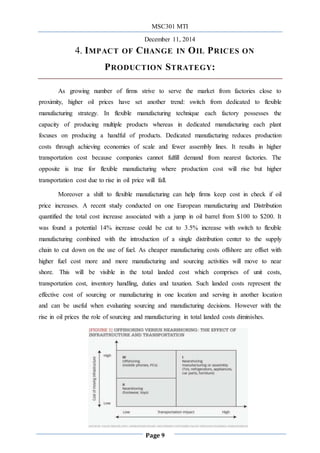
Moreover a shift to flexible manufacturing can help firms keep cost in check if oil
price increases. A recent study conducted on one European manufacturing and Distribution
quantified the total cost increase associated with a jump in oil barrel from $100 to $200. It
was found a potential 14% increase could be cut to 3.5% increase with switch to flexible
manufacturing combined with the introduction of a single distribution center to the supply
chain to cut down on the use of fuel. As cheaper manufacturing costs offshore are offset with
higher fuel cost more and more manufacturing and sourcing activities will move to near
shore. This will be visible in the total landed cost which comprises of unit costs,
transportation cost, inventory handling, duties and taxation. Such landed costs represent the
effective cost of sourcing or manufacturing in one location and serving in another location
and can be useful when evaluating sourcing and manufacturing decisions. However with the
rise in oil prices the role of sourcing and manufacturing in total landed costs diminishes.
MSC301 MTI
December 11, 2014
Page 10
5. IMPACT OF CHANGE IN OIL PRICES ON LOCATION
SELECTION
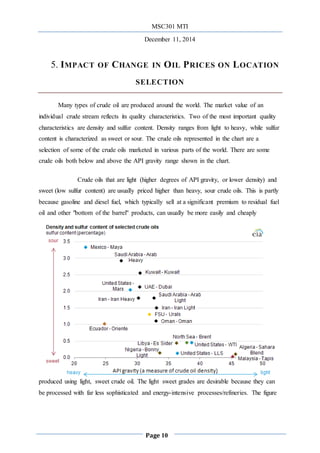
Many types of crude oil are produced around the world. The market value of an
individual crude stream reflects its quality characteristics. Two of the most important quality
characteristics are density and sulfur content. Density ranges from light to heavy, while sulfur
content is characterized as sweet or sour. The crude oils represented in the chart are a
selection of some of the crude oils marketed in various parts of the world. There are some
crude oils both below and above the API gravity range shown in the chart.
Crude oils that are light (higher degrees of API gravity, or lower density) and
sweet (low sulfur content) are usually priced higher than heavy, sour crude oils. This is partly
because gasoline and diesel fuel, which typically sell at a significant premium to residual fuel
oil and other "bottom of the barrel" products, can usually be more easily and cheaply
produced using light, sweet crude oil. The light sweet grades are desirable because they can
be processed with far less sophisticated and energy-intensive processes/refineries. The figure
MSC301 MTI
December 11, 2014
Page 11
shows select crude types from around the world with their corresponding sulfur content and
density characteristics. (Today in Energy: U.S. Energy Information Adminstration, 2012)
Thus when setting up manufacturing or fuel dependent operations it is important that
the crude oil quality, distant to oil refinery and distant to manufacturing/operatiuons plant, all
costs and time requirement have to be calculated to decide upon, to set the company's supply
chain. As without fuel the entire operation will be at a standstill. The impact of oil price on
location selection is high indeed. As we know transportation costs result in 40% of
operational costs, without the addition of any value-adding process, and all transportation
modes require fuel. Thus with increasing Oil prices we see an increase in cost of location.
This positively increasing relationship results in an increase in overall production costs, this
in turn would result in reduced supply as overall costs increas, or vice versa.
MSC301 MTI
December 11, 2014
Page 12
6. IMPACT OF CHANGE IN OIL PRICES ON SUPPLIER
SELECTION METHOD
Increasing oil prices has been a major issue for supply chain management for the last
5-7 years. From studying various articles regarding this matter over the internet we have
summarized few key points that various companies can take into consideration.
Flexible Infrastructure
Supply chains have undergone dramatic changes in recent years in response to
shifting product needs, labor costs, taxes and environmental considerations. Having the
flexibility to employ multiple routes to market is an important risk mitigation strategy, but it
also provides the capability needed to rebalance product flows in response to changing input
costs.
Network Optimization
If oil prices increase, you may be forced to look at where distribution centers are
located in relation to areas of key demand. For many companies, the combination of higher
logistics costs and additional inventory requirements have already triggered the movement of
supply chain activities closer to key markets. In an economic climate where the cost of fuel
continues to rise uncontrollably, network optimization can help you strike a balance between
inventory costs, labour costs and distribution center location(s). A network optimization
analysis may result in the addition or closing down of distribution centers or even the
movement of centers to more optimal locations. It is important to remember that frequent
evaluations are necessary to ensure your supply chain model matches current conditions.
Postponement Strategies
A postponement strategy based on your network optimization analysis can help
increase the density of product coming from remote manufacturing locations. By sending
unfinished or unpackaged goods into regions that are closer to the end consumer for final
assembly, you can maintain inventory at a flexible level and reduce fuel costs.
Shipping Practices
Making changes to your shipping practices can dramatically impact your bottom line,
but can also benefit the environment. And there are several creative approaches to shipping
MSC301 MTI
December 11, 2014
Page 13
available today. This can be as simple as establishing specific delivery dates with key
customers which will enable you to consolidate shipping. You can also partner with a
company that is not a competitor and that ships product to the same retail locations.
Consolidating shipments between multiple brand owners can lead to a reduction in cost and
an increase in shipment density.
Environmental Responsibility
Adopting sustainable supply chain practices can help you reduce costs and stay in line
with social and corporate environmental responsibilities. One thing to consider is using
alternative sources of fuel in your trucks and other vehicles. By using sources other than oil,
you can potentially avoid fluctuating prices and the complexities that follow. Another area to
evaluate is product packaging. Bulky product packaging made from synthetic materials and
plastics is not friendly to your operations, shipping costs, or the environment. By redesigning
packaging to be more compact and made from recyclable materials with little or no plastic,
you can increase pallet density which reduces shipping costs, and also decrease your carbon
footprint.
In order to overcome unforeseen obstacles like the inconsistent cost of oil, you must
have a firm understanding of how your supply chain functions, and what you want it to
accomplish. Know your key markets, do you want to reach consumers domestically or in
other regions of the world and decide whether or not your current processes and distribution
center locations are equipped to handle this demand. Determine whether or not your current
shipping practices are in need of an upgrade to more efficient, cost-effective and eco-friendly
methods. Once you have this information, you can work internally or with an outsource
partner to implement strategies and best practices that can add flexibility to your
infrastructure.
MSC301 MTI
December 11, 2014
Page 14
7. IMPACT OF CHANGE IN OIL PRICES ON MODE OF
TRANSPORTATION
Since the mid-1990s, many corporations have tried to reduce operational costs and
achieve a lean supply chain by emphasizing manufacturing outsourcing, off shoring, plant
rationalization, and facility consolidation. The underlying justification behind these trends
was cheap oil. In many industries transportation costs accounted for just a few percentage
points of total operational costs. Hence, more emphasis was given to reducing manufacturing
costs through off shoring or outsourcing, rationalizing plants to take advantage of economies
of scale in production costs and reduce capital investment, and consolidating distribution
centers and warehouses to reduce inventory levels and fixed facility costs.
The recent increases in oil prices are starting to reverse this trend. As crude oil prices
increase, transportation costs become more important relative to inventory, production, and
facility fixed costs. As a result the following solutions aroused:
Regional distribution centers became more attractive. As oil prices increase, outbound
transportation costs became more expensive, and as a result, it is becoming more and more
crucial to minimize the distance of the finished product—from distribution centers to retail
outlets. This can be achieved by establishing more warehouses which are each responsible for
a specific region. The increase in transportation costs will force companies to ship large
quantities at a time to take achieve economies of scale.
As higher transportation costs trump competitive manufacturing costs, more and more
manufacturing and sourcing activities will move to "near shoring." The need to move
manufacturing facilities from low-cost countries to locations closer to market demand is
aggravated by financial pressure to reduce time to market.
Supply chain flexibility has become the focus of an organization. As oil price and
volatility increase it has become imperative to quench the thirst pf demand from the closest
manufacturing plant.
MSC301 MTI
December 11, 2014
Page 15
The implications are clear. The higher the price of a barrel of oil, the more important
it is to invest in a flexible strategy because it reduces transportation costs.
Beyond their effect on network and transportation strategies, escalating and volatile
oil prices also affect business strategies in general and supply chains in particular. Let's start
by reviewing two important impacts.
Higher oil prices will increase total safety stock in the supply chain and increasing lot
sizes. The switch from quick and frequent deliveries to efficient, slow, and less frequent
shipments will also drive up inventory. Assuming that lead times remain the same and that
there is no change in sourcing locations; supply chain inventory will increase as oil prices
increase.
The appropriate supply chain strategy for a particular product depends on a variety of
drivers, but the most important for this discussion is economies of scale. Everything else
remaining constant, the higher the importance of economies of scale in reducing cost, the
greater the value of aggregating demand and thus the greater the importance of managing the
supply chain based on a long-term forecast—a push-based strategy. We expect that escalating
oil prices will drive more supply chain stages toward a push strategy.
MSC301 MTI
December 11, 2014
Page 16
8. IMPACT OF CHANGE IN OIL PRICES ON
DISTRIBUTION STRATEGY
Since the mid-1990s, many corporations have tried to reduce operational costs and
achieve a lean supply chain by emphasizing manufacturing outsourcing, offshoring, plant
rationalization, and facility consolidation. The underlying rationale behind these trends was
cheap oil. Indeed, in many industries transportation costs accounted for just a few percentage
points of total operational costs. Hence, more emphasis was given to reducing manufacturing
costs through offshoring or outsourcing, rationalizing plants to take advantage of economies
of scale in production costs and reduce capital investment, and consolidating distribution
centers and warehouses to reduce inventory levels and fixed facility costs.
The recent increases in oil prices are starting to reverse this trend. Indeed, as crude oil
prices increase, transportation costs become more important relative to inventory, production,
and facility fixed costs. Thus, three trade-offs emerge:
Regional distribution centers are more attractive. As oil prices increase, outbound
transportation costs become more expensive, and as a consequence, it is increasingly more
important to minimize the distance of the final leg—from distribution centers to retail outlets.
This can be achieved by establishing more warehouses, each responsible for a specific region.
Of course, more warehouses imply more safety stock and hence higher inventory levels.
Finally, the increase in transportation costs will force companies to ship large quantities to
take advantage of economies of scale. Therefore, larger warehouses will be needed.
Sourcing and production move closer to demand. As cheaper manufacturing costs are
offset by higher transportation costs, more and more manufacturing and sourcing activities
will move to "near-shoring." This is nicely illustrated by total landed costs, which include
unit costs, transportation costs, inventory and handling costs, duties and taxation, and the
costs of finance. Landed cost, which represents the effective cost of sourcing or
manufacturing in one location and serving customers in other locations, should be used when
evaluating sourcing and manufacturing decisions. Evidently, as transportation costs increase,
the role of sourcing and production costs in determining total landed cost diminishes.
MSC301 MTI
December 11, 2014
Page 17
The need to move manufacturing facilities from low-cost countries to locations closer
to market demand in the United States is exacerbated by financial pressure to reduce time to
market. These two forces—the effect of transportation on total landed costs and the pressure
to reduce time to market—have motivated some industries to move manufacturing facilities
from Asia to Mexico.
Supply chain flexibility becomes the focus of the organization. As oil price and
volatility increase, it becomes more important to serve demand from the closest
manufacturing plant. However, this is not possible if each plant specializes in producing just
a few products, a strategy known as dedicated manufacturing.
A dedicated manufacturing environment often reduces manufacturing costs because
economies of scale come into play and fewer setups are required to switch between different
products. Unfortunately, such a strategy may result in long delivery legs to reach market
demand and hence higher transportation costs. By contrast, a full flexibility manufacturing
strategy, where each plant is able to produce all products, increases production costs but
reduces transportation costs.
The implications are clear. The higher the price of a barrel of oil, the more important
it is to invest in a flexible strategy because it reduces transportation costs.
MSC301 MTI
December 11, 2014
Page 18
9. IMPACT OF CHANGE IN OIL PRICES ON
INVENTORY MANAGEMENT
In recent years, supply-chain tactics that were considered essential to success -- things
like moving factories offshore where labor is cheaper and making quick and frequent
deliveries to retailers to keep inventories low, are losing luster. When oil was cheaper, the
trend was to move factories offshore and keep inventories low because costs associated with
manufacturing and inventory outweighed the cheap transportation costs. High oil prices are
upending those strategies.
As transportation costs become more dominant, it becomes increasingly important to
minimize the length of the journey from distribution center to retailer and to ship in large
quantities to take advantage of economies of scale. To accomplish this, additional and larger
warehouses become necessary, which implies more stock, hence higher inventory levels and
costs. Data from the annual State of Logistics Report, sponsored by the Council of Supply
Chain Management Professionals found U.S. logistics costs, which include all the expenses
associated with moving goods, rose 52% from 2002 to 2007, including 62% rise in inventory-
carrying costs. Maintaining more inventories can be risky because products may lose value if
demand or prices fall. But the benefits can outweigh the risks when transportation costs
become a bigger burden than inventory expenses. Higher oil prices will have two important
effects—increasing total safety stock in the supply chain (because of the need for more
regional warehouses) and increasing lot sizes (to take advantage of economies of scale). At
the same time, the switch from quick and frequent deliveries to efficient, slow, and less
frequent shipments will also drive up inventory. Thus, assuming that lead times remain the
same and that there is no change in sourcing location; supply chain inventory will increase as
oil prices increase. The higher the importance of economies of scale in reducing cost, the
greater the value of aggregating demand and thus the greater the importance of managing the
supply chain based on a long-term forecast—a push-based strategy. As oil prices increase, the
importance of economies of scale (such as shipping large quantities) increases, hence the
MSC301 MTI
December 11, 2014
Page 19
importance of a push-based strategy. Therefore, escalating oil prices will drive more supply
chain stages toward a push strategy. (Simchi-Levi D. , 2011)
As oil prices increase, trade-offs between inventory and transportation costs become more
important, and as a result, positioning inventory correctly can have a dramatic Impact of
Change in Oil Prices on logistics costs. For example, in a hub-and-spoke network, items are
shipped from manufacturing facilities to primary warehouses (hubs), and from there to
secondary warehouses (spokes), and finally, to retail stores. In such a network, high-
volume/low-variability products must be positioned at the secondary warehouses because of
the need to take advantage of economies of scale—safety stock is not an issue since forecasts
are accurate for products with these characteristics. (Simchi-Levi D. , 2014) By contrast,
forecast accuracy is poor for low-volume/high-variability products, thus these products are
positioned at primary warehouses to reduce inventory by taking advantage of the risk pooling
concept. Many companies are not very good at positioning inventory in their supply chain.
They try to keep as much inventory close to the customers as possible, hold some inventory
at every location, and store as much raw material as possible. In such a strategy, each facility
in the supply chain optimizes its own objective with very little regard to the impact of its
decisions on other facilities in the supply chain. This typically leads to:
 High inventory levels and low inventory turns, and
 Inconsistent service levels across locations and products.
Moreover as oil prices increase, it becomes more important to reduce the bullwhip
effect—that is, to reduce supply chain variability. This can be done by reducing lead times,
sharing information across the various facilities in the supply chain, or strategic partnering
such as vendor-managed inventory. Tighter supply chain integration increases with escalating
oil prices. Sharing information about what products are moving off store shelves, what
promotions retailers are planning and what volume discounts distributors are offering can
reduce the likelihood that manufacturers will provide deliverables at the wrong time and thus
help maintain balanced inventory level.
MSC301 MTI
December 11, 2014
Page 20
10. ETHICAL IMPLICATIONS
Steven kopits, the managing director of Douglas Westwood said in one of his semi
academic talks at the Columbia Sipa University (center for Global energy policy) “The
Chinese will be very big in oil market and that is going to lead to some interesting
political situations” . It is very clear to the rest of the world the wars that go on around the
globe in many ways result from energy sustainability. Let’s try to look at the Iraq war and
Gulf war. Even though the political giants refuse to admit it, the active citizens know where
the killing spree started from. If the Chinese companies start playing big into the field of oil
industry, it will have some ethical implications. Asians have different moral and ethical
particles than the Arabs and the Americans. That is sure to have some major impact on the
overall war and peace situation in the entire world.
Now, let us focus on the national situation for a change. We live in a developing
country where the par capita income does not allow us to go forward as a nation where
buying capability is comparable with the developed nations. At the same time the fuel (read
oil) price has been springing up every year or so living birth of compressed natural gas
consumption all over the nation. Either that is a great thing or not, that is not the arguments
here. My question is if raising the price of oil for the government is the right thing to do or
not. In other words, is it ethically sound? TO give an example of ethical implications, let us
focus on the history of imported CNG run auto rickshaws. When in Bangladesh the
government introduces CNG as a result of high oil price, some ministers and higher officials
imported a number of vehicles from India and in the process resulted in corruption of multy
crors of taka. (source, transparency international ). What we can see if we follow the trend,
rise of oil price gives birth to ethical implication in trigger effect manner.
Nations like Saudi Arabia and America are manipulating the price of oil for decades
now. Leading towards an economic slowdown in rest of the world time to time. Driving
people in and out of business without any prior notice. Prices have been driven for mutual
beneficial interest of Saudi Arabia and America while both the government wants to keep the
rest of the world’s oil pricing under control. That being said, it does affect the business world
in a major way in terms of ethics. It is not fair for the companies from rest of the world to
MSC301 MTI
December 11, 2014
Page 21
have to put up with artificial boundaries and preset prices ignoring the demand and supply. In
many ways these two countries are slowly giving birth to the next world war as par the
experts suggests.
Interesting fact is America pressures Saudi Arabia to reduce the oil prices to put
pressure on Iran and Russia and India surprisingly benefits from it and gets the taxi boom. It
was possible because of the fact that India exports 80% of its needed oil from aboard.
Amazing fact was the oil price reduced by 40% resulting a huge economic push to the oil
market and transportation business in India. Mr. Jim Rogers , author of Hot Commodities and
who is also an investor said, “Nothing in the market surprises me. When the market goes up ,
it goes up more than they should, when it goes down it goes down , it goes down more than I
should”. The ethical point of view of this particular aspect is, it is not fair for the global
citizens to endure what these political forces have lined up for them in the days to come.
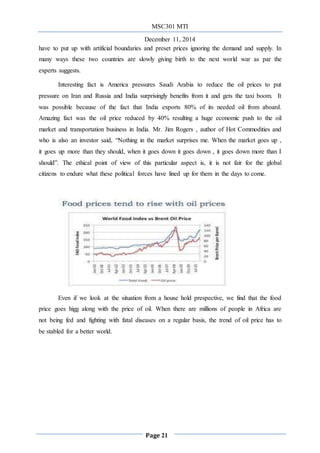
Even if we look at the situation from a house hold prespective, we find that the food
price goes higg along with the price of oil. When there are millions of people in Africa are
not being fed and fighting with fatal diseases on a regular basis, the trend of oil price has to
be stabled for a better world.
MSC301 MTI
December 11, 2014
Page 22
11. ENVIRONMENTAL IMPLICATIONS:
OIL EARTH AND HUMANITY
Talking about global warming and climate change, the first thing that comes to
anyone’s mind is the abuse of cheap fuel and the industry waste. To be specific, the prices of
oil may not have a clear effect on the environment straight away. The effect a little bit
complex. The price of oil price depends on from where and how the oil was collected and
purified. The price also depends on the political situation of the entire globe. And while
producing this commodity, the environment in being highly polluted from all over the world.
Leading to global warming and other natural disasters .
If the companies were socially responsible and politicians were also caring for
humanity, then the oil price and the environmental impacts would have been minimum .
Recent news from Bangladesh states that oil spills from Sundarbans has the ability
ruin life in the natural habitat over at the best part of the forest. In the modern age when the
ships are the equipped with heavy technologies and safety nets, oil spills have been a major
issue for the environment.
Since oil in lighter than water and it doesn’t not decompose, it will stay on the surface of the
water for a very long time and will harm the ecosystem. It can hamper the lives of human
beings in many ways. If not today, if not tomorrow it will come back and haunt us in the form
of huge natural disasters in years to come.
Different companies are coming up with different strategies to cope with the changes
in oil price and not all of them are being environmental friendly. In a lot of ways we find out
that companies that are heavily in shipping and adding value to a product by changing it’s
location rely on the easiest and cheapest mode of transportation , it straight away has an
effect on the environment where the prices of the oil of directly responsible. Air traffic cost
environmental pollution, half burned fuel in the atmosphere causes air air pollution and oil
spills causes water polluting running the eco system.
What we can see here is that the price of oil has a holistic effect in the economy and
well being of the world. As long the political leaders are after their own benefit and feeding
MSC301 MTI
December 11, 2014
Page 23
their giant ego, the rest of the world would have to pay for this for as long as it goes on. Since
a lot of the problems are caused by one single issue, the world peace can also be achieved
also by limiting the fluctuation of this one single issue.
12. CONCLUSION
Throughout the paper on we see that the impact of change in oil price- in production
operations and global supply chain management is a positive relationship. As oil price
increases so does the cost of production strategy. And to set up a low cost and highly efficient
supply chain, it is imperative than we consider all aspects of fuel logistics as it is the life
blood of any manufacturing/production company.
MSC301 MTI
December 11, 2014
Page 24
I. BIBLIOGRAPHY
DePratto, B., Ma, P., & Resende, C. d. (2009). How Changes in Oil Prices Affect the
Macroeconomy.
Hamilton, J. (1983). Oil and the macroeconomy sinceWorldWar II. Journal of
Political Economy 91 .
Hulten, C. R. (1989). Energy obsolescence and the productivity slowdown. in D. W.
Jorgenson and R. Landau (eds), Technology and capital formation .
Kliesen, K. L. (2008). Oil and the U.S. macroeconomy: An update and a simple
forecasting exercise. Federal Reserve Bank of St. Louis Working Paper 2008-009A.
Simchi-Levi, D. (2014, Dec 01). How volatile oil prices will rock the supply chain.
SupplyChainQuaterly .
Simchi-Levi, D. (2011, Feb 16). Supply Chain News: Understanding the "Operations
Rules". Retrieved from SupplyChainDigest.
Today in Energy: U.S. Energy Information Adminstration. (2012, July 26). Retrieved
from U.S. Energy Information Adminstration:
http://www.eia.gov/todayinenergy/detail.cfm?id=7110

MSC301- The Impact of Change in Oil Price

  • 1.
    12/11/2014 MSC301 THE IMPACT OFCHANGE IN OIL PRICE- IN PRODUCTION OPERATIONS AND GLOBAL SUPPLY CHAIN MANAGEMENT
  • 2.
    MSC301 MTI December 11,2014 Page 1 Submitted by: Sl. Name I.D. 1 Kazi Tamanna 11104136 2 Samiya Yesmin 11304043 3 Golam Asfia 11304057 4 Rezwone Chowdhury 10204021 5 Mukeet Anis 10304061 MSC301 Md. Tamzidul Islam Senior lecturer Section 01 12/11/2014
  • 3.
    MSC301 MTI December 11,2014 Page 2 CONTENTS 1. Summary.......................................................................................................................3 2. Historical Trend of Oil Price ........................................................................................4 3. Impact of Change in Oil Prices on Productivity...........................................................6 4. Impact of Change in Oil Prices on Production Strategy: ............................................9 5. Impact of Change in Oil Prices on Location selection...............................................10 6. Impact of Change in Oil Prices on Supplier Selection Method..................................12 7. Impact of Change in Oil Prices on Transportation.....................................................14 8. Impact of Change in Oil Prices on Distribution Strategy...........................................16 9. Impact of Change in Oil Prices on Inventory Management.......................................18 10. Ethical Implications....................................................................................................20 11. Environmental Implications: Oil Earth And Humanity.............................................22 I. Bibliography.....................................................................................................................24
  • 4.
    MSC301 MTI December 11,2014 Page 3 1. SUMMARY This paper on "The Impact of Change in Oil Price- in Production Operations and Global Supply Chain Management" is a part of our MSC301: Production-Operations Management course work. Here, we have talked about the impact of change in oil price made on Productivity, Production strategy, location selection, supplier selection method, mode of transportation, distribution stategy and inventory management, of any supply chain.
  • 5.
    MSC301 MTI December 11,2014 Page 4 2. HISTORICAL TREND OF OIL PRICE From 1948 through the end of the 1960s, crude oil prices ranged between $2.50 and $3.00. The price of oil rose from $2.50 in 1948 to about $3.00 in 1957. When viewed in 2010 dollars, a different story emerges with crude oil prices fluctuating between $17 and $19 during most of the period. The apparent 20% price increase in nominal prices just kept up with inflation. From 1958 to 1970, prices were stable near $3.00 per barrel, but in real terms the price of crude oil declined from $19 to $14 per barrel. Not only was price of crude lower when adjusted for inflation, but in 1971 and 1972 the international producer suffered the additional effect of a weaker US dollar. OPEC was established in 1960 with five founding members: Iran, Iraq, Kuwait, Saudi Arabia and Venezuela. Two of the representatives at the initial meetings previously studied the Texas Railroad Commission's method of controlling price through limitations on production. By the end of 1971, six other nations had joined the group: Qatar, Indonesia, Libya, United Arab Emirates, Algeria and Nigeria. From the foundation of the Organization of Petroleum Exporting Countries through 1972, member countries experienced steady decline in the purchasing power of a barrel of oil. Throughout the post war period exporting countries found increased demand for their crude oil but a 30% decline in the purchasing power of a barrel of oil. In March 1971, the balance of power shifted. That month the Texas Railroad Commission set proration at 100 percent for the first time. This meant that Texas producers were no longer limited in the volume of oil that they could produce from their wells. More important, it meant that the power to control crude oil prices shifted from the United States (Texas, Oklahoma and Louisiana) to OPEC. By 1971, there was no spare production capacity in the U.S. and therefore no tool to put an upper limit on prices.
  • 6.
    MSC301 MTI December 11,2014 Page 5 A little more than two years later, OPEC through the unintended consequence of war obtained a glimpse of its power to influence prices. It took over a decade from its formation for OPEC to realize the extent of its ability to influence the world market. OPEC has seldom been effective at controlling prices. The only enforcement mechanism that ever existed in OPEC is Saudi spare capacity and that power resides with a single member not the organization as a whole. With enough spare capacity to be able to increase production sufficiently to offset the impact of lower prices on its own revenue; Saudi Arabia could enforce discipline by threatening to increase production enough to crash prices. During the 1979-1980 periods of rapidly increasing prices, Saudi Arabia's oil minister Ahmed Yamani repeatedly warned other members of OPEC that high prices would lead to a reduction in demand. Global recession caused a reduction in demand which led to lower crude prices. People took up alternative measures such as insulation in their homes or to replace energy efficient equipment in factories. The reaction to the oil price increase at the end of the decade was permanent and had never respond to lower prices with increased consumption of oil. The price of crude oil spiked in 1990 with the lower production, uncertainty associated with the Iraqi invasion of Kuwait and the ensuing Gulf War. The world and particularly the Middle East had a much harsher view of Saddam Hussein invading Arab Kuwait than they did Persian Iran. The proximity to the world's largest oil producer helped to shape the reaction. Following what became known as the Gulf War to liberate Kuwait, crude oil prices entered a period of steady decline. In 1994, the inflation adjusted oil price reached the lowest level since 1973. The price cycle then turned up. The United States economy was strong and the Asian Pacific region was booming. From 1990 to 1997, world oil consumption increased 6.2 million barrels per day. Asian consumption accounted for all but 300,000 barrels per day of that gain and contributed to a price recovery that extended into 1997. Declining Russian production contributed to the price recovery. Between 1990 and 1996 Russian production declined more than five million barrels per day. In a world that consumes more than 80 million barrels per day of petroleum products that added a significant risk premium to crude oil price and was largely responsible for prices in excess of $40-$50 per barrel. Other major factors contributing to higher prices included a weak dollar and the rapid growth in Asian economies and their petroleum consumption.
  • 7.
    MSC301 MTI December 11,2014 Page 6 3. IMPACT OF CHANGE IN OIL PRICES ON PRODUCTIVITY The oil price shocks of the 1970s and 1980s, and the subsequent global recession, sparked a wave of empirical studies. Focusing on oil price shocks in the 1970s and 1980s, early empirical studies tended to find a negative relationship between oil prices and real activity (Hamilton, 1983) (Hulten, 1989) 1 However, this relationship was increasingly questioned in the mid-1980s, when energy prices dropped sharply, without subsequent increase in economic activity. In response, several empirical studies suggested that the impact of energy prices on the macro economy was not symmetric, and measured oil price shocks, based on the notion that oil price increases should have negative effects on growth, while falling oil prices may only yield small boosts to GDP. 2 Still, by the late 1990s, a consensus began emerging in the literature that there might be a negative relationship between oil prices and real activity, but its magnitude is likely to be small. 3. Lastly, several empirical studies have focused on the role of monetary policy in responding to oil price shocks, examining whether central banks tighten monetary policy to avoid inflationary effects, or support economic growth by lowering interest rates. (DePratto, Ma, & Resende, 2009). Energy prices affect the economy primarily through the supply side, whereas we do not find substantial demand-side effects; (ii) higher oil prices have temporary negative effects on both the output gap and on trend growth, which translates into a permanent reduction in the level of potential and actual output. Also, results for the United States indicate that oil supply shocks have more persistent negative effects on trend growth than oil demand shocks. These effects are statistically significant; however, our simulations also indicate that the effects are economically small. . The second strand of the literature is been based on economic theory, and theoretical studies do not provide a clear picture whether oil prices should or should not have substantial effects on the macro economy. For instance, (Kliesen, 2008) shows that the price elasticity of the demand for oil is low in the short-term,
  • 8.
    MSC301 MTI December 11,2014 Page 7 because firms and consumers cannot change their production or consumption patterns immediately, so the effects of higher oil prices on GDP might be small (at least initially). In that case, the negative demand shock for energy-intensive goods may cause substantial reallocation of labour, which – if costly – can have a large impact on the overall economy even if oil as share of GDP is low. Monopolistic producers can increase their mark-ups during oil price shocks, depressing output, and variations in utilization rates for productive capital as a function of energy use, finding that oil price shocks causes sharp, simultaneous declines in energy use and capital utilization with large effects on output. 4. Lastly, the explanation of why the fall in energy prices in the 1980s failed to spur economic growth points to asymmetric effects, arising through (at least) two important channels (Jimenez-Rodriguez first by rending parts of the existing capital stock obsolete, any change in energy prices requires costly adjustment.5 The second channel is a negative demand shock when energy price increase, or a positive demand shock when energy prices fall.6 Also, both shocks interact, as the impact of the positive demand shock from falling energy prices is reduced by the need to adjust the capital shock. The period of high volatility in oil markets between 2002 and 2008 has renewed interest in the analysis of energy prices. Central banks are interested in the macroeconomic effects of changes to oil prices, since the appropriate monetary policy reaction to higher energy prices depends on the correct identification of its macroeconomic impact, which requires an understanding of the transmission channels. Unfortunately, most existing studies employ either a empirical approach with little theoretical underpinnings, or a primarily theoretical approach with limited empirical application. The recent literature suggests that fluctuations in oil prices have little, if any, macroeconomic impact and that the transmission occurs primarily via the demand side. First, we find that higher oil prices have only small (but still statistically significant) effects on trend growth, but they lower the level of GDP permanently. Second, our results indicate that the most likely channel in the short term is not the demand side effect, but the supply side channel. This confirms the notion put forward in Rasche and Tatom (1977) and Bruno (1984) that higher energy prices act in a similar way as technological regress. Third, our findings regarding the monetary policy response to higher oil prices qualify the results of Cologni and Manera (2008). All countries respond to higher
  • 9.
    MSC301 MTI December 11,2014 Page 8 oil prices by increasing interest rates, but real interest rates become negative, as the rise in inflation more than offsets the increase in interest rates. Consequently, monetary policy remains stimulative – the only exception is a positive shock to oil demand, to which U.S. monetary policy responds with tighter real interest rates (confirming that the distinction between oil supply and oil demand shocks made in Kilian, 2009, is important). Lastly, when considering the possibility that central bank might not fully understand the transmission of energy prices and consequently set monetary policy incorrectly, it turns out that oil price movements have only minor effects on the economy as a whole, and consequently the effects
  • 10.
    MSC301 MTI December 11,2014 Page 9 4. IMPACT OF CHANGE IN OIL PRICES ON PRODUCTION STRATEGY: As growing number of firms strive to serve the market from factories close to proximity, higher oil prices have set another trend: switch from dedicated to flexible manufacturing strategy. In flexible manufacturing technique each factory possesses the capacity of producing multiple products whereas in dedicated manufacturing each plant focuses on producing a handful of products. Dedicated manufacturing reduces production costs through achieving economies of scale and fewer assembly lines. It results in higher transportation cost because companies cannot fulfill demand from nearest factories. The opposite is true for flexible manufacturing where production cost will rise but higher transportation cost due to rise in oil price will fall. Moreover a shift to flexible manufacturing can help firms keep cost in check if oil price increases. A recent study conducted on one European manufacturing and Distribution quantified the total cost increase associated with a jump in oil barrel from $100 to $200. It was found a potential 14% increase could be cut to 3.5% increase with switch to flexible manufacturing combined with the introduction of a single distribution center to the supply chain to cut down on the use of fuel. As cheaper manufacturing costs offshore are offset with higher fuel cost more and more manufacturing and sourcing activities will move to near shore. This will be visible in the total landed cost which comprises of unit costs, transportation cost, inventory handling, duties and taxation. Such landed costs represent the effective cost of sourcing or manufacturing in one location and serving in another location and can be useful when evaluating sourcing and manufacturing decisions. However with the rise in oil prices the role of sourcing and manufacturing in total landed costs diminishes.
  • 11.
    MSC301 MTI December 11,2014 Page 10 5. IMPACT OF CHANGE IN OIL PRICES ON LOCATION SELECTION Many types of crude oil are produced around the world. The market value of an individual crude stream reflects its quality characteristics. Two of the most important quality characteristics are density and sulfur content. Density ranges from light to heavy, while sulfur content is characterized as sweet or sour. The crude oils represented in the chart are a selection of some of the crude oils marketed in various parts of the world. There are some crude oils both below and above the API gravity range shown in the chart. Crude oils that are light (higher degrees of API gravity, or lower density) and sweet (low sulfur content) are usually priced higher than heavy, sour crude oils. This is partly because gasoline and diesel fuel, which typically sell at a significant premium to residual fuel oil and other "bottom of the barrel" products, can usually be more easily and cheaply produced using light, sweet crude oil. The light sweet grades are desirable because they can be processed with far less sophisticated and energy-intensive processes/refineries. The figure
  • 12.
    MSC301 MTI December 11,2014 Page 11 shows select crude types from around the world with their corresponding sulfur content and density characteristics. (Today in Energy: U.S. Energy Information Adminstration, 2012) Thus when setting up manufacturing or fuel dependent operations it is important that the crude oil quality, distant to oil refinery and distant to manufacturing/operatiuons plant, all costs and time requirement have to be calculated to decide upon, to set the company's supply chain. As without fuel the entire operation will be at a standstill. The impact of oil price on location selection is high indeed. As we know transportation costs result in 40% of operational costs, without the addition of any value-adding process, and all transportation modes require fuel. Thus with increasing Oil prices we see an increase in cost of location. This positively increasing relationship results in an increase in overall production costs, this in turn would result in reduced supply as overall costs increas, or vice versa.
  • 13.
    MSC301 MTI December 11,2014 Page 12 6. IMPACT OF CHANGE IN OIL PRICES ON SUPPLIER SELECTION METHOD Increasing oil prices has been a major issue for supply chain management for the last 5-7 years. From studying various articles regarding this matter over the internet we have summarized few key points that various companies can take into consideration. Flexible Infrastructure Supply chains have undergone dramatic changes in recent years in response to shifting product needs, labor costs, taxes and environmental considerations. Having the flexibility to employ multiple routes to market is an important risk mitigation strategy, but it also provides the capability needed to rebalance product flows in response to changing input costs. Network Optimization If oil prices increase, you may be forced to look at where distribution centers are located in relation to areas of key demand. For many companies, the combination of higher logistics costs and additional inventory requirements have already triggered the movement of supply chain activities closer to key markets. In an economic climate where the cost of fuel continues to rise uncontrollably, network optimization can help you strike a balance between inventory costs, labour costs and distribution center location(s). A network optimization analysis may result in the addition or closing down of distribution centers or even the movement of centers to more optimal locations. It is important to remember that frequent evaluations are necessary to ensure your supply chain model matches current conditions. Postponement Strategies A postponement strategy based on your network optimization analysis can help increase the density of product coming from remote manufacturing locations. By sending unfinished or unpackaged goods into regions that are closer to the end consumer for final assembly, you can maintain inventory at a flexible level and reduce fuel costs. Shipping Practices Making changes to your shipping practices can dramatically impact your bottom line, but can also benefit the environment. And there are several creative approaches to shipping
  • 14.
    MSC301 MTI December 11,2014 Page 13 available today. This can be as simple as establishing specific delivery dates with key customers which will enable you to consolidate shipping. You can also partner with a company that is not a competitor and that ships product to the same retail locations. Consolidating shipments between multiple brand owners can lead to a reduction in cost and an increase in shipment density. Environmental Responsibility Adopting sustainable supply chain practices can help you reduce costs and stay in line with social and corporate environmental responsibilities. One thing to consider is using alternative sources of fuel in your trucks and other vehicles. By using sources other than oil, you can potentially avoid fluctuating prices and the complexities that follow. Another area to evaluate is product packaging. Bulky product packaging made from synthetic materials and plastics is not friendly to your operations, shipping costs, or the environment. By redesigning packaging to be more compact and made from recyclable materials with little or no plastic, you can increase pallet density which reduces shipping costs, and also decrease your carbon footprint. In order to overcome unforeseen obstacles like the inconsistent cost of oil, you must have a firm understanding of how your supply chain functions, and what you want it to accomplish. Know your key markets, do you want to reach consumers domestically or in other regions of the world and decide whether or not your current processes and distribution center locations are equipped to handle this demand. Determine whether or not your current shipping practices are in need of an upgrade to more efficient, cost-effective and eco-friendly methods. Once you have this information, you can work internally or with an outsource partner to implement strategies and best practices that can add flexibility to your infrastructure.
  • 15.
    MSC301 MTI December 11,2014 Page 14 7. IMPACT OF CHANGE IN OIL PRICES ON MODE OF TRANSPORTATION Since the mid-1990s, many corporations have tried to reduce operational costs and achieve a lean supply chain by emphasizing manufacturing outsourcing, off shoring, plant rationalization, and facility consolidation. The underlying justification behind these trends was cheap oil. In many industries transportation costs accounted for just a few percentage points of total operational costs. Hence, more emphasis was given to reducing manufacturing costs through off shoring or outsourcing, rationalizing plants to take advantage of economies of scale in production costs and reduce capital investment, and consolidating distribution centers and warehouses to reduce inventory levels and fixed facility costs. The recent increases in oil prices are starting to reverse this trend. As crude oil prices increase, transportation costs become more important relative to inventory, production, and facility fixed costs. As a result the following solutions aroused: Regional distribution centers became more attractive. As oil prices increase, outbound transportation costs became more expensive, and as a result, it is becoming more and more crucial to minimize the distance of the finished product—from distribution centers to retail outlets. This can be achieved by establishing more warehouses which are each responsible for a specific region. The increase in transportation costs will force companies to ship large quantities at a time to take achieve economies of scale. As higher transportation costs trump competitive manufacturing costs, more and more manufacturing and sourcing activities will move to "near shoring." The need to move manufacturing facilities from low-cost countries to locations closer to market demand is aggravated by financial pressure to reduce time to market. Supply chain flexibility has become the focus of an organization. As oil price and volatility increase it has become imperative to quench the thirst pf demand from the closest manufacturing plant.
  • 16.
    MSC301 MTI December 11,2014 Page 15 The implications are clear. The higher the price of a barrel of oil, the more important it is to invest in a flexible strategy because it reduces transportation costs. Beyond their effect on network and transportation strategies, escalating and volatile oil prices also affect business strategies in general and supply chains in particular. Let's start by reviewing two important impacts. Higher oil prices will increase total safety stock in the supply chain and increasing lot sizes. The switch from quick and frequent deliveries to efficient, slow, and less frequent shipments will also drive up inventory. Assuming that lead times remain the same and that there is no change in sourcing locations; supply chain inventory will increase as oil prices increase. The appropriate supply chain strategy for a particular product depends on a variety of drivers, but the most important for this discussion is economies of scale. Everything else remaining constant, the higher the importance of economies of scale in reducing cost, the greater the value of aggregating demand and thus the greater the importance of managing the supply chain based on a long-term forecast—a push-based strategy. We expect that escalating oil prices will drive more supply chain stages toward a push strategy.
  • 17.
    MSC301 MTI December 11,2014 Page 16 8. IMPACT OF CHANGE IN OIL PRICES ON DISTRIBUTION STRATEGY Since the mid-1990s, many corporations have tried to reduce operational costs and achieve a lean supply chain by emphasizing manufacturing outsourcing, offshoring, plant rationalization, and facility consolidation. The underlying rationale behind these trends was cheap oil. Indeed, in many industries transportation costs accounted for just a few percentage points of total operational costs. Hence, more emphasis was given to reducing manufacturing costs through offshoring or outsourcing, rationalizing plants to take advantage of economies of scale in production costs and reduce capital investment, and consolidating distribution centers and warehouses to reduce inventory levels and fixed facility costs. The recent increases in oil prices are starting to reverse this trend. Indeed, as crude oil prices increase, transportation costs become more important relative to inventory, production, and facility fixed costs. Thus, three trade-offs emerge: Regional distribution centers are more attractive. As oil prices increase, outbound transportation costs become more expensive, and as a consequence, it is increasingly more important to minimize the distance of the final leg—from distribution centers to retail outlets. This can be achieved by establishing more warehouses, each responsible for a specific region. Of course, more warehouses imply more safety stock and hence higher inventory levels. Finally, the increase in transportation costs will force companies to ship large quantities to take advantage of economies of scale. Therefore, larger warehouses will be needed. Sourcing and production move closer to demand. As cheaper manufacturing costs are offset by higher transportation costs, more and more manufacturing and sourcing activities will move to "near-shoring." This is nicely illustrated by total landed costs, which include unit costs, transportation costs, inventory and handling costs, duties and taxation, and the costs of finance. Landed cost, which represents the effective cost of sourcing or manufacturing in one location and serving customers in other locations, should be used when evaluating sourcing and manufacturing decisions. Evidently, as transportation costs increase, the role of sourcing and production costs in determining total landed cost diminishes.
  • 18.
    MSC301 MTI December 11,2014 Page 17 The need to move manufacturing facilities from low-cost countries to locations closer to market demand in the United States is exacerbated by financial pressure to reduce time to market. These two forces—the effect of transportation on total landed costs and the pressure to reduce time to market—have motivated some industries to move manufacturing facilities from Asia to Mexico. Supply chain flexibility becomes the focus of the organization. As oil price and volatility increase, it becomes more important to serve demand from the closest manufacturing plant. However, this is not possible if each plant specializes in producing just a few products, a strategy known as dedicated manufacturing. A dedicated manufacturing environment often reduces manufacturing costs because economies of scale come into play and fewer setups are required to switch between different products. Unfortunately, such a strategy may result in long delivery legs to reach market demand and hence higher transportation costs. By contrast, a full flexibility manufacturing strategy, where each plant is able to produce all products, increases production costs but reduces transportation costs. The implications are clear. The higher the price of a barrel of oil, the more important it is to invest in a flexible strategy because it reduces transportation costs.
  • 19.
    MSC301 MTI December 11,2014 Page 18 9. IMPACT OF CHANGE IN OIL PRICES ON INVENTORY MANAGEMENT In recent years, supply-chain tactics that were considered essential to success -- things like moving factories offshore where labor is cheaper and making quick and frequent deliveries to retailers to keep inventories low, are losing luster. When oil was cheaper, the trend was to move factories offshore and keep inventories low because costs associated with manufacturing and inventory outweighed the cheap transportation costs. High oil prices are upending those strategies. As transportation costs become more dominant, it becomes increasingly important to minimize the length of the journey from distribution center to retailer and to ship in large quantities to take advantage of economies of scale. To accomplish this, additional and larger warehouses become necessary, which implies more stock, hence higher inventory levels and costs. Data from the annual State of Logistics Report, sponsored by the Council of Supply Chain Management Professionals found U.S. logistics costs, which include all the expenses associated with moving goods, rose 52% from 2002 to 2007, including 62% rise in inventory- carrying costs. Maintaining more inventories can be risky because products may lose value if demand or prices fall. But the benefits can outweigh the risks when transportation costs become a bigger burden than inventory expenses. Higher oil prices will have two important effects—increasing total safety stock in the supply chain (because of the need for more regional warehouses) and increasing lot sizes (to take advantage of economies of scale). At the same time, the switch from quick and frequent deliveries to efficient, slow, and less frequent shipments will also drive up inventory. Thus, assuming that lead times remain the same and that there is no change in sourcing location; supply chain inventory will increase as oil prices increase. The higher the importance of economies of scale in reducing cost, the greater the value of aggregating demand and thus the greater the importance of managing the supply chain based on a long-term forecast—a push-based strategy. As oil prices increase, the importance of economies of scale (such as shipping large quantities) increases, hence the
  • 20.
    MSC301 MTI December 11,2014 Page 19 importance of a push-based strategy. Therefore, escalating oil prices will drive more supply chain stages toward a push strategy. (Simchi-Levi D. , 2011) As oil prices increase, trade-offs between inventory and transportation costs become more important, and as a result, positioning inventory correctly can have a dramatic Impact of Change in Oil Prices on logistics costs. For example, in a hub-and-spoke network, items are shipped from manufacturing facilities to primary warehouses (hubs), and from there to secondary warehouses (spokes), and finally, to retail stores. In such a network, high- volume/low-variability products must be positioned at the secondary warehouses because of the need to take advantage of economies of scale—safety stock is not an issue since forecasts are accurate for products with these characteristics. (Simchi-Levi D. , 2014) By contrast, forecast accuracy is poor for low-volume/high-variability products, thus these products are positioned at primary warehouses to reduce inventory by taking advantage of the risk pooling concept. Many companies are not very good at positioning inventory in their supply chain. They try to keep as much inventory close to the customers as possible, hold some inventory at every location, and store as much raw material as possible. In such a strategy, each facility in the supply chain optimizes its own objective with very little regard to the impact of its decisions on other facilities in the supply chain. This typically leads to:  High inventory levels and low inventory turns, and  Inconsistent service levels across locations and products. Moreover as oil prices increase, it becomes more important to reduce the bullwhip effect—that is, to reduce supply chain variability. This can be done by reducing lead times, sharing information across the various facilities in the supply chain, or strategic partnering such as vendor-managed inventory. Tighter supply chain integration increases with escalating oil prices. Sharing information about what products are moving off store shelves, what promotions retailers are planning and what volume discounts distributors are offering can reduce the likelihood that manufacturers will provide deliverables at the wrong time and thus help maintain balanced inventory level.
  • 21.
    MSC301 MTI December 11,2014 Page 20 10. ETHICAL IMPLICATIONS Steven kopits, the managing director of Douglas Westwood said in one of his semi academic talks at the Columbia Sipa University (center for Global energy policy) “The Chinese will be very big in oil market and that is going to lead to some interesting political situations” . It is very clear to the rest of the world the wars that go on around the globe in many ways result from energy sustainability. Let’s try to look at the Iraq war and Gulf war. Even though the political giants refuse to admit it, the active citizens know where the killing spree started from. If the Chinese companies start playing big into the field of oil industry, it will have some ethical implications. Asians have different moral and ethical particles than the Arabs and the Americans. That is sure to have some major impact on the overall war and peace situation in the entire world. Now, let us focus on the national situation for a change. We live in a developing country where the par capita income does not allow us to go forward as a nation where buying capability is comparable with the developed nations. At the same time the fuel (read oil) price has been springing up every year or so living birth of compressed natural gas consumption all over the nation. Either that is a great thing or not, that is not the arguments here. My question is if raising the price of oil for the government is the right thing to do or not. In other words, is it ethically sound? TO give an example of ethical implications, let us focus on the history of imported CNG run auto rickshaws. When in Bangladesh the government introduces CNG as a result of high oil price, some ministers and higher officials imported a number of vehicles from India and in the process resulted in corruption of multy crors of taka. (source, transparency international ). What we can see if we follow the trend, rise of oil price gives birth to ethical implication in trigger effect manner. Nations like Saudi Arabia and America are manipulating the price of oil for decades now. Leading towards an economic slowdown in rest of the world time to time. Driving people in and out of business without any prior notice. Prices have been driven for mutual beneficial interest of Saudi Arabia and America while both the government wants to keep the rest of the world’s oil pricing under control. That being said, it does affect the business world in a major way in terms of ethics. It is not fair for the companies from rest of the world to
  • 22.
    MSC301 MTI December 11,2014 Page 21 have to put up with artificial boundaries and preset prices ignoring the demand and supply. In many ways these two countries are slowly giving birth to the next world war as par the experts suggests. Interesting fact is America pressures Saudi Arabia to reduce the oil prices to put pressure on Iran and Russia and India surprisingly benefits from it and gets the taxi boom. It was possible because of the fact that India exports 80% of its needed oil from aboard. Amazing fact was the oil price reduced by 40% resulting a huge economic push to the oil market and transportation business in India. Mr. Jim Rogers , author of Hot Commodities and who is also an investor said, “Nothing in the market surprises me. When the market goes up , it goes up more than they should, when it goes down it goes down , it goes down more than I should”. The ethical point of view of this particular aspect is, it is not fair for the global citizens to endure what these political forces have lined up for them in the days to come. Even if we look at the situation from a house hold prespective, we find that the food price goes higg along with the price of oil. When there are millions of people in Africa are not being fed and fighting with fatal diseases on a regular basis, the trend of oil price has to be stabled for a better world.
  • 23.
    MSC301 MTI December 11,2014 Page 22 11. ENVIRONMENTAL IMPLICATIONS: OIL EARTH AND HUMANITY Talking about global warming and climate change, the first thing that comes to anyone’s mind is the abuse of cheap fuel and the industry waste. To be specific, the prices of oil may not have a clear effect on the environment straight away. The effect a little bit complex. The price of oil price depends on from where and how the oil was collected and purified. The price also depends on the political situation of the entire globe. And while producing this commodity, the environment in being highly polluted from all over the world. Leading to global warming and other natural disasters . If the companies were socially responsible and politicians were also caring for humanity, then the oil price and the environmental impacts would have been minimum . Recent news from Bangladesh states that oil spills from Sundarbans has the ability ruin life in the natural habitat over at the best part of the forest. In the modern age when the ships are the equipped with heavy technologies and safety nets, oil spills have been a major issue for the environment. Since oil in lighter than water and it doesn’t not decompose, it will stay on the surface of the water for a very long time and will harm the ecosystem. It can hamper the lives of human beings in many ways. If not today, if not tomorrow it will come back and haunt us in the form of huge natural disasters in years to come. Different companies are coming up with different strategies to cope with the changes in oil price and not all of them are being environmental friendly. In a lot of ways we find out that companies that are heavily in shipping and adding value to a product by changing it’s location rely on the easiest and cheapest mode of transportation , it straight away has an effect on the environment where the prices of the oil of directly responsible. Air traffic cost environmental pollution, half burned fuel in the atmosphere causes air air pollution and oil spills causes water polluting running the eco system. What we can see here is that the price of oil has a holistic effect in the economy and well being of the world. As long the political leaders are after their own benefit and feeding
  • 24.
    MSC301 MTI December 11,2014 Page 23 their giant ego, the rest of the world would have to pay for this for as long as it goes on. Since a lot of the problems are caused by one single issue, the world peace can also be achieved also by limiting the fluctuation of this one single issue. 12. CONCLUSION Throughout the paper on we see that the impact of change in oil price- in production operations and global supply chain management is a positive relationship. As oil price increases so does the cost of production strategy. And to set up a low cost and highly efficient supply chain, it is imperative than we consider all aspects of fuel logistics as it is the life blood of any manufacturing/production company.
  • 25.
    MSC301 MTI December 11,2014 Page 24 I. BIBLIOGRAPHY DePratto, B., Ma, P., & Resende, C. d. (2009). How Changes in Oil Prices Affect the Macroeconomy. Hamilton, J. (1983). Oil and the macroeconomy sinceWorldWar II. Journal of Political Economy 91 . Hulten, C. R. (1989). Energy obsolescence and the productivity slowdown. in D. W. Jorgenson and R. Landau (eds), Technology and capital formation . Kliesen, K. L. (2008). Oil and the U.S. macroeconomy: An update and a simple forecasting exercise. Federal Reserve Bank of St. Louis Working Paper 2008-009A. Simchi-Levi, D. (2014, Dec 01). How volatile oil prices will rock the supply chain. SupplyChainQuaterly . Simchi-Levi, D. (2011, Feb 16). Supply Chain News: Understanding the "Operations Rules". Retrieved from SupplyChainDigest. Today in Energy: U.S. Energy Information Adminstration. (2012, July 26). Retrieved from U.S. Energy Information Adminstration: http://www.eia.gov/todayinenergy/detail.cfm?id=7110