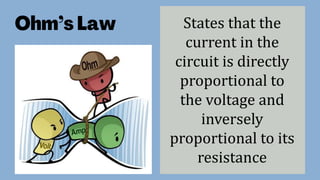
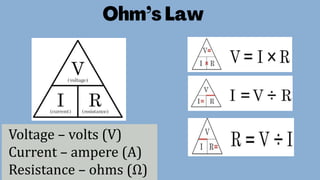
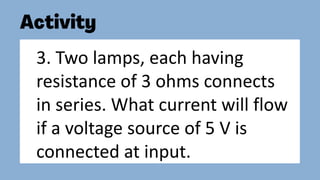
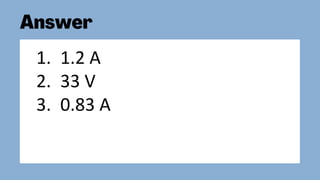
- Ohm's Law defines the relationship between voltage, current, and resistance in electrical circuits. It states that current is directly proportional to voltage and inversely proportional to resistance.
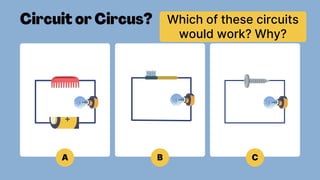
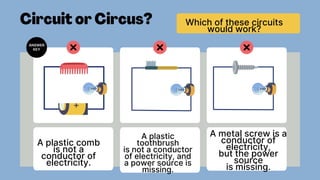
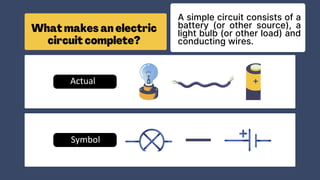
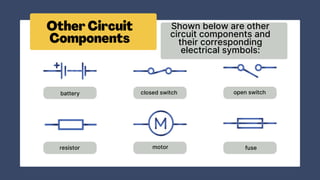
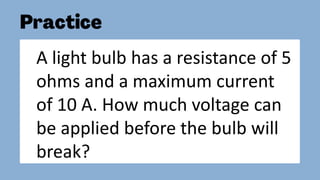
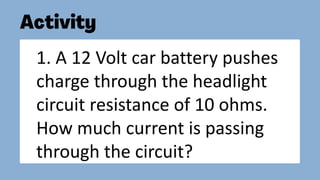
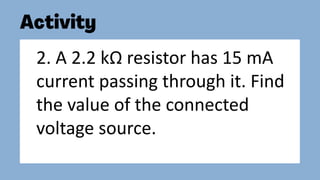
- The document provides examples of solving circuit problems using Ohm's Law and defines common circuit components and their symbols.
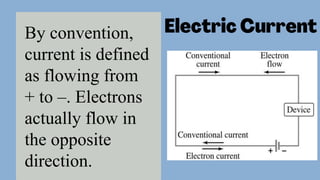
- Key circuit concepts covered include voltage, current, resistance, series and parallel circuits, and applying calculations for current, voltage, and resistance.