Northwest Ohio Transit
Network
Joint Powers Authority
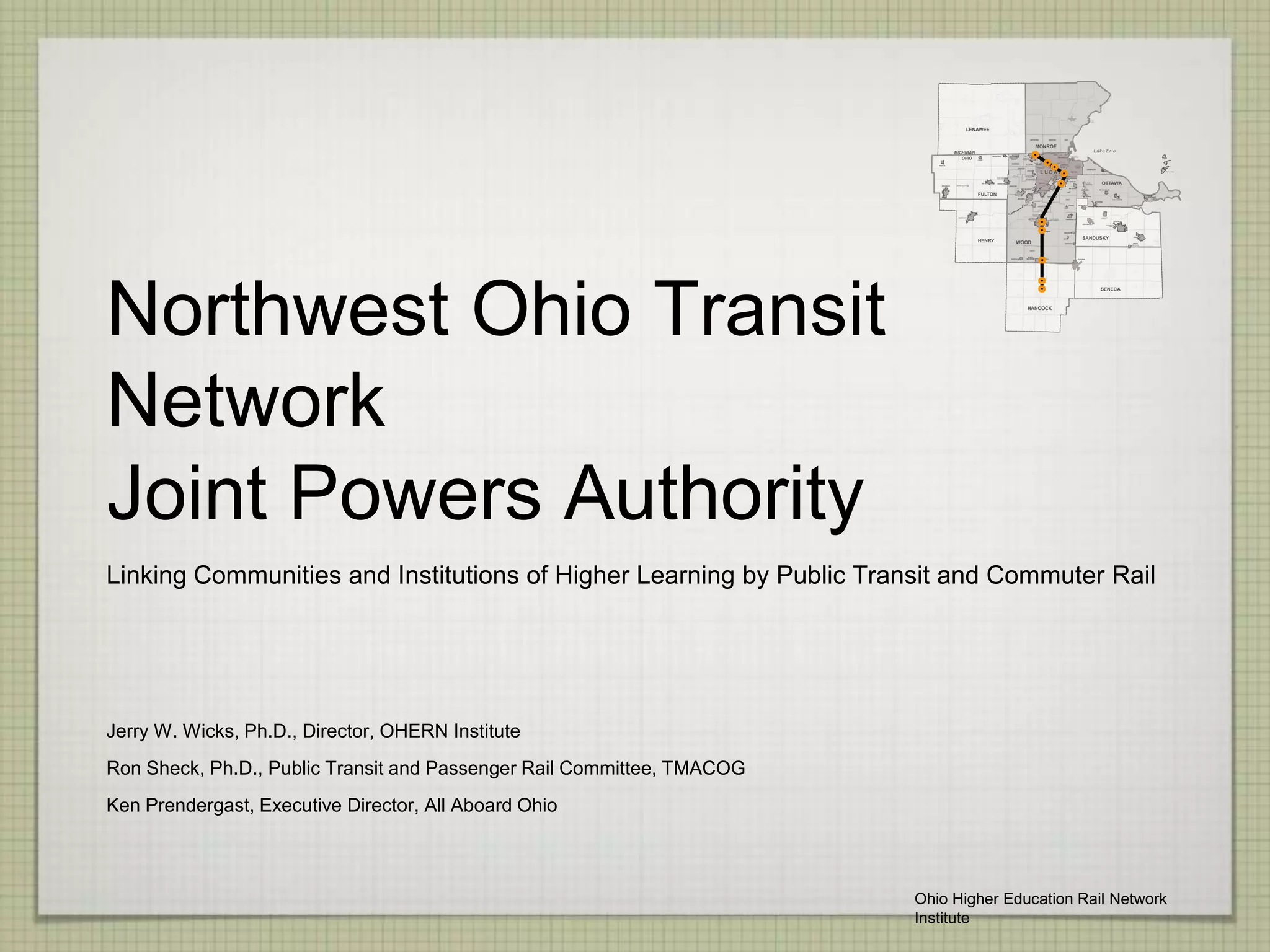
Linking Communities and Institutions of Higher Learning by Public Transit and Commuter Rail
Jerry W. Wicks, Ph.D., Director, OHERN Institute
Ron Sheck, Ph.D., Public Transit and Passenger Rail Committee, TMACOG
Ken Prendergast, Executive Director, All Aboard Ohio
Ohio Higher Education Rail Network
Institute
WHY PASSENGER RAIL IN NW OHIO?
• Passenger rail - more efficient, greater capacity and extensible
• Strengthen the economy - halt further population decline
• Our region faces strong competition for new investment
Our competitors will offer:
• More opportunities for industry
• Better personal opportunities for education
• Attractive living environments and a variety of mobility options
Ohio Higher Education Rail Network
Institute
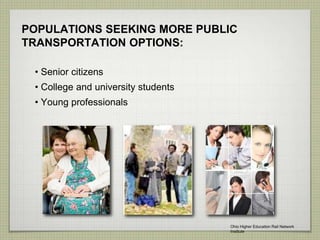
POPULATIONS SEEKING MORE PUBLIC
TRANSPORTATION OPTIONS:
• Senior citizens
• College and university students
• Young professionals
Ohio Higher Education Rail Network
Institute
This proposal responds to key transportation goals and priorities
in TMACOG’s most recent transportation planning document,
“On the Move: 2007-2035 Transportation Plan-Update 2011”
• Intercity passenger rail
• Transit connection linking BGSU, Owens & Univ. of Toledo
• Public transit region-wide
• Fuel efficient modes of transit, like rail and bus
• A truly integrated regional transit system and
• Transit for seniors, people with disabilities and non-drivers
Ohio Higher Education Rail Network
Institute
JOINT POWERS AUTHORITY (JPA)
Created through an agreement between:
• Two or more public authorities (e.g. city and county
governments, port authorities, transit authorities or public
colleges and universities) can operate collectively as a new,
separate entity.
• Under Ohio state law, public entities may create multi-county
authorities to undertake regional, intrastate or even interstate
transportation projects and services.
Ohio Higher Education Rail Network
Institute
CHARACTERISTICS OF JPA
• Used where activity transcends boundaries of existing authorities
• Are distinct from their member authorities
• Have separate operating boards
• Boards have the powers of any or all of the participating agencies
• Authorizing agreement defines the powers allowed to be
exercised
Ohio Higher Education Rail Network
Institute
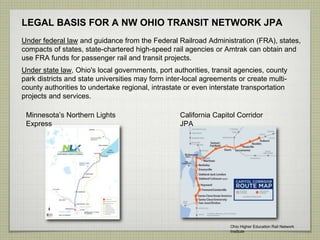
LEGAL BASIS FOR A NW OHIO TRANSIT NETWORK JPA
Under federal law and guidance from the Federal Railroad Administration (FRA), states,
compacts of states, state-chartered high-speed rail agencies or Amtrak can obtain and
use FRA funds for passenger rail and transit projects.
Under state law, Ohio's local governments, port authorities, transit agencies, county
park districts and state universities may form inter-local agreements or create multi-
county authorities to undertake regional, intrastate or even interstate transportation
projects and services.
Minnesota’s Northern Lights
Express
California Capitol Corridor
JPA
Ohio Higher Education Rail Network
Institute
BASIC FEATURES OF PROPOSED SYSTEM
• Corridor - Sylvania, Ohio to Findlay, Ohio
• Rail line serves as a rapid link to transit service providers
• Connects Amtrak, universities, commercial taxi/bus services & bike paths
• Coordinated schedules among transit services
• Work toward a common regional fare payment
• Service begins with three DMU train sets
• Maximum speed 79 mph
• Potential for extending rail service
• Pursue infrastructure upgrades to rail, bridge and stations
Ohio Higher Education Rail Network
Institute
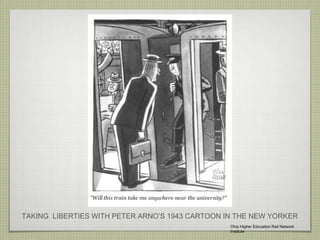
TAKING LIBERTIES WITH PETER ARNO’S 1943 CARTOON IN THE NEW YORKER
Ohio Higher Education Rail Network
Institute
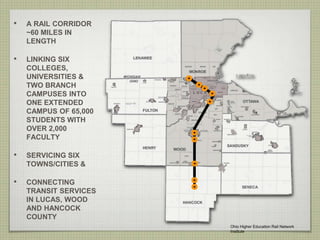
• A RAIL CORRIDOR
~60 MILES IN
LENGTH
• LINKING SIX
COLLEGES,
UNIVERSITIES &
TWO BRANCH
CAMPUSES INTO
ONE EXTENDED
CAMPUS OF 65,000
STUDENTS WITH
OVER 2,000
FACULTY
• SERVICING SIX
TOWNS/CITIES &
• CONNECTING
TRANSIT SERVICES
IN LUCAS, WOOD
AND HANCOCK
COUNTY
Ohio Higher Education Rail Network
Institute
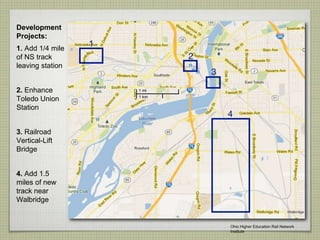
Development
Projects:
1. Add 1/4 mile
of NS track
leaving station
2. Enhance
Toledo Union
Station
3. Railroad
Vertical-Lift
Bridge
4. Add 1.5
miles of new
track near
Walbridge
Ohio Higher Education Rail Network
Institute
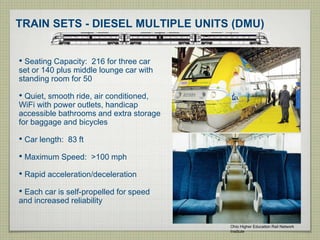
TRAIN SETS - DIESEL MULTIPLE UNITS (DMU)
• Seating Capacity: 216 for three car
set or 140 plus middle lounge car with
standing room for 50
• Quiet, smooth ride, air conditioned,
WiFi with power outlets, handicap
accessible bathrooms and extra storage
for baggage and bicycles
• Car length: 83 ft
• Maximum Speed: >100 mph
• Rapid acceleration/deceleration
• Each car is self-propelled for speed
and increased reliability
Ohio Higher Education Rail Network
Institute
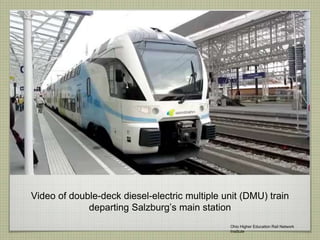
Video of double-deck diesel-electric multiple unit (DMU) train
departing Salzburg’s main station
Ohio Higher Education Rail Network
Institute
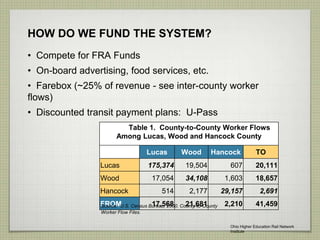
Table Table 1. County-to-County Worker Flows
Among Lucas, Wood and Hancock County
Lucas Wood Hancock TO
Lucas 175,374 19,504 607 20,111
Wood 17,054 34,108 1,603 18,657
Hancock 514 2,177 29,157 2,691
FROM 17,568 21,681 2,210 41,459Source: U.S. Census Bureau, 2000. County-to-County
Worker Flow Files.
HOW DO WE FUND THE SYSTEM?
• Compete for FRA Funds
• On-board advertising, food services, etc.
• Farebox (~25% of revenue - see inter-county worker
flows)
• Discounted transit payment plans: U-Pass
Ohio Higher Education Rail Network
Institute
Ohio Higher Education Rail Network
Institute
U-PASS IS BIG!
U-PASS
IS
SMART!
Ohio Higher Education Rail Network
Institute
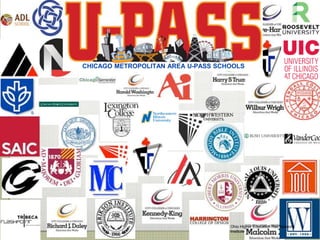
CHICAGO METROPOLITAN AREA U-PASS SCHOOLS
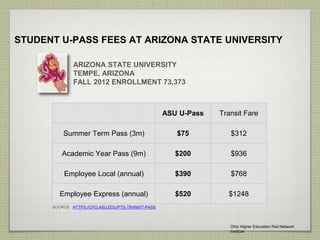
STUDENT U-PASS FEES AT ARIZONA STATE UNIVERSITY
ARIZONA STATE UNIVERSITY
TEMPE, ARIZONA
FALL 2012 ENROLLMENT 73,373
ASU U-Pass Transit Fare
Summer Term Pass (3m) $75 $312
Academic Year Pass (9m) $200 $936
Employee Local (annual) $390 $768
Employee Express (annual) $520 $1248
SOURCE: HTTPS://CFO.ASU.EDU/PTS-TRANSIT-PASS
Ohio Higher Education Rail Network
Institute
Ohio Higher Education Rail Network
Institute
- CLICK ABOVE FOR VIDEO -
Ohio Higher Education Rail Network
Institute
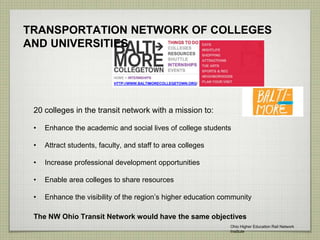
TRANSPORTATION NETWORK OF COLLEGES
AND UNIVERSITIES
20 colleges in the transit network with a mission to:
• Enhance the academic and social lives of college students
• Attract students, faculty, and staff to area colleges
• Increase professional development opportunities
• Enable area colleges to share resources
• Enhance the visibility of the region’s higher education community
HTTP://WWW.BALTIMORECOLLEGETOWN.ORG/
The NW Ohio Transit Network would have the same objectives
Ohio Higher Education Rail Network
Institute
Potential Annual Revenue from a Universal $25 a Semester U-Pass Program
Metropolitan Area Non-profit Colleges and
Universities
Student
Enrollment
Full-Time Faculty Revenue
Lourdes University 2,490 91 $129,050
University of Toledo 22,610 851 $1,173,050
Mercy College 1,210 64 $63,700
Owens Community College* 14,605 201 $740,300
Bowling Green State University 17,580 827 $920,350
Owens Comm. College - Findlay* 2,391 -- $119,550
University of Findlay 4,990 211 $260,050
Fall/Spring subtotal 65,876 2,245 $3,406,050
Summer term (.25** x Enrollment x $50) 16,469 561 $425,750
Total Annual Revenue $3,831,800
*Owens CC 2012 Fact Sheet
**Simplifying assumption - summer enrollment is 25% of academic year total.
Source: www.american-school-search.com
Ohio Higher Education Rail Network
Institute
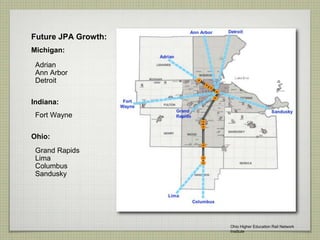
Future JPA Growth:
Michigan:
Adrian
Ann Arbor
Detroit
Indiana:
Fort Wayne
Ohio:
Grand Rapids
Lima
Columbus
Sandusky
Ohio Higher Education Rail Network
Institute
WHAT LIES AHEAD?
Creating the JPA is only the first step in a long process
Creation of the JPA enables a series of administrative actions:
– Working to organize and design a transportation system
– Discussions with area schools about the JPA’s implications:
– Ability to pursue unexpected opportunities for passenger rail
• What can be shared among schools and will policies need to
change?
• What learning and research opportunities can be developed?
Ohio Higher Education Rail Network
Institute
NEXT STEPS
• Vote of support from committee for continued development of the JPA
• Formation of a JPA advisory group to review:
a. Terms of the agreement used in forming the JPA
b. Analysis of the rail corridor
c. Other issues
• Continue informal meetings with transit, city, county and university
officials
• Pursue funding opportunities for planning with TMACOG and transit
• Invite representatives from either the Northern Lights Express or the
California Capitol Corridor to make a presentation at the Toledo Club
Ohio Higher Education Rail Network
Institute
Author Affiliations
Jerry W. Wicks, Ph.D.
Professor Emeritus, Sociology, Bowling Green State University; Director, Ohio Higher Education Rail Network Institute;
Member, Public Transit and Passenger Rail Committee, Toledo Metropolitan Council of Governments (TMACOG); Board
Member, All Aboard Ohio
The Ohio Higher Education Rail Network (OHERN) Institute is an educational and research division of All Aboard Ohio.
OHERN’s principle goal is the strengthening of higher education through research into the social, demographic and economic
effects of integrating passenger rail and public transit with college life. (OHERN.ORG)
All Aboard Ohio is a non-profit, member-based organization dedicated to promoting improved public transportation and
passenger rail service throughout the state.
All Aboard Ohio exists to increase public awareness of the need to improve and increase safe and efficient intercity
passenger rail and local public transportation service in Ohio and informational activities. throughout the United States by
conducting nonpartisan research and educational and
All Aboard Ohio is incorporated in Ohio as a non-profit association and exempt from federal income tax under the IRS Code,
section 501(c)(3), as a publicly supported educational organization. Dues and donations to All Aboard Ohio are tax-deductible
in accordance with the IRS code.

Ohio Higher Education Rail Network (OHERN.ORG)

  • 1.
    Northwest Ohio Transit Network JointPowers Authority Linking Communities and Institutions of Higher Learning by Public Transit and Commuter Rail Jerry W. Wicks, Ph.D., Director, OHERN Institute Ron Sheck, Ph.D., Public Transit and Passenger Rail Committee, TMACOG Ken Prendergast, Executive Director, All Aboard Ohio Ohio Higher Education Rail Network Institute
  • 2.
    WHY PASSENGER RAILIN NW OHIO? • Passenger rail - more efficient, greater capacity and extensible • Strengthen the economy - halt further population decline • Our region faces strong competition for new investment Our competitors will offer: • More opportunities for industry • Better personal opportunities for education • Attractive living environments and a variety of mobility options Ohio Higher Education Rail Network Institute
  • 3.
    POPULATIONS SEEKING MOREPUBLIC TRANSPORTATION OPTIONS: • Senior citizens • College and university students • Young professionals Ohio Higher Education Rail Network Institute
  • 4.
    This proposal respondsto key transportation goals and priorities in TMACOG’s most recent transportation planning document, “On the Move: 2007-2035 Transportation Plan-Update 2011” • Intercity passenger rail • Transit connection linking BGSU, Owens & Univ. of Toledo • Public transit region-wide • Fuel efficient modes of transit, like rail and bus • A truly integrated regional transit system and • Transit for seniors, people with disabilities and non-drivers Ohio Higher Education Rail Network Institute
  • 5.
    JOINT POWERS AUTHORITY(JPA) Created through an agreement between: • Two or more public authorities (e.g. city and county governments, port authorities, transit authorities or public colleges and universities) can operate collectively as a new, separate entity. • Under Ohio state law, public entities may create multi-county authorities to undertake regional, intrastate or even interstate transportation projects and services. Ohio Higher Education Rail Network Institute
  • 6.
    CHARACTERISTICS OF JPA •Used where activity transcends boundaries of existing authorities • Are distinct from their member authorities • Have separate operating boards • Boards have the powers of any or all of the participating agencies • Authorizing agreement defines the powers allowed to be exercised Ohio Higher Education Rail Network Institute
  • 7.
    LEGAL BASIS FORA NW OHIO TRANSIT NETWORK JPA Under federal law and guidance from the Federal Railroad Administration (FRA), states, compacts of states, state-chartered high-speed rail agencies or Amtrak can obtain and use FRA funds for passenger rail and transit projects. Under state law, Ohio's local governments, port authorities, transit agencies, county park districts and state universities may form inter-local agreements or create multi- county authorities to undertake regional, intrastate or even interstate transportation projects and services. Minnesota’s Northern Lights Express California Capitol Corridor JPA Ohio Higher Education Rail Network Institute
  • 8.
    BASIC FEATURES OFPROPOSED SYSTEM • Corridor - Sylvania, Ohio to Findlay, Ohio • Rail line serves as a rapid link to transit service providers • Connects Amtrak, universities, commercial taxi/bus services & bike paths • Coordinated schedules among transit services • Work toward a common regional fare payment • Service begins with three DMU train sets • Maximum speed 79 mph • Potential for extending rail service • Pursue infrastructure upgrades to rail, bridge and stations Ohio Higher Education Rail Network Institute
  • 9.
    TAKING LIBERTIES WITHPETER ARNO’S 1943 CARTOON IN THE NEW YORKER Ohio Higher Education Rail Network Institute
  • 10.
    • A RAILCORRIDOR ~60 MILES IN LENGTH • LINKING SIX COLLEGES, UNIVERSITIES & TWO BRANCH CAMPUSES INTO ONE EXTENDED CAMPUS OF 65,000 STUDENTS WITH OVER 2,000 FACULTY • SERVICING SIX TOWNS/CITIES & • CONNECTING TRANSIT SERVICES IN LUCAS, WOOD AND HANCOCK COUNTY Ohio Higher Education Rail Network Institute
  • 11.
    Development Projects: 1. Add 1/4mile of NS track leaving station 2. Enhance Toledo Union Station 3. Railroad Vertical-Lift Bridge 4. Add 1.5 miles of new track near Walbridge Ohio Higher Education Rail Network Institute
  • 12.
    TRAIN SETS -DIESEL MULTIPLE UNITS (DMU) • Seating Capacity: 216 for three car set or 140 plus middle lounge car with standing room for 50 • Quiet, smooth ride, air conditioned, WiFi with power outlets, handicap accessible bathrooms and extra storage for baggage and bicycles • Car length: 83 ft • Maximum Speed: >100 mph • Rapid acceleration/deceleration • Each car is self-propelled for speed and increased reliability Ohio Higher Education Rail Network Institute
  • 13.
    Video of double-deckdiesel-electric multiple unit (DMU) train departing Salzburg’s main station Ohio Higher Education Rail Network Institute
  • 14.
    Table Table 1.County-to-County Worker Flows Among Lucas, Wood and Hancock County Lucas Wood Hancock TO Lucas 175,374 19,504 607 20,111 Wood 17,054 34,108 1,603 18,657 Hancock 514 2,177 29,157 2,691 FROM 17,568 21,681 2,210 41,459Source: U.S. Census Bureau, 2000. County-to-County Worker Flow Files. HOW DO WE FUND THE SYSTEM? • Compete for FRA Funds • On-board advertising, food services, etc. • Farebox (~25% of revenue - see inter-county worker flows) • Discounted transit payment plans: U-Pass Ohio Higher Education Rail Network Institute
  • 15.
    Ohio Higher EducationRail Network Institute U-PASS IS BIG! U-PASS IS SMART!
  • 16.
    Ohio Higher EducationRail Network Institute CHICAGO METROPOLITAN AREA U-PASS SCHOOLS
  • 17.
    STUDENT U-PASS FEESAT ARIZONA STATE UNIVERSITY ARIZONA STATE UNIVERSITY TEMPE, ARIZONA FALL 2012 ENROLLMENT 73,373 ASU U-Pass Transit Fare Summer Term Pass (3m) $75 $312 Academic Year Pass (9m) $200 $936 Employee Local (annual) $390 $768 Employee Express (annual) $520 $1248 SOURCE: HTTPS://CFO.ASU.EDU/PTS-TRANSIT-PASS Ohio Higher Education Rail Network Institute
  • 18.
    Ohio Higher EducationRail Network Institute
  • 19.
    - CLICK ABOVEFOR VIDEO - Ohio Higher Education Rail Network Institute
  • 20.
    TRANSPORTATION NETWORK OFCOLLEGES AND UNIVERSITIES 20 colleges in the transit network with a mission to: • Enhance the academic and social lives of college students • Attract students, faculty, and staff to area colleges • Increase professional development opportunities • Enable area colleges to share resources • Enhance the visibility of the region’s higher education community HTTP://WWW.BALTIMORECOLLEGETOWN.ORG/ The NW Ohio Transit Network would have the same objectives Ohio Higher Education Rail Network Institute
  • 21.
    Potential Annual Revenuefrom a Universal $25 a Semester U-Pass Program Metropolitan Area Non-profit Colleges and Universities Student Enrollment Full-Time Faculty Revenue Lourdes University 2,490 91 $129,050 University of Toledo 22,610 851 $1,173,050 Mercy College 1,210 64 $63,700 Owens Community College* 14,605 201 $740,300 Bowling Green State University 17,580 827 $920,350 Owens Comm. College - Findlay* 2,391 -- $119,550 University of Findlay 4,990 211 $260,050 Fall/Spring subtotal 65,876 2,245 $3,406,050 Summer term (.25** x Enrollment x $50) 16,469 561 $425,750 Total Annual Revenue $3,831,800 *Owens CC 2012 Fact Sheet **Simplifying assumption - summer enrollment is 25% of academic year total. Source: www.american-school-search.com Ohio Higher Education Rail Network Institute
  • 22.
    Future JPA Growth: Michigan: Adrian AnnArbor Detroit Indiana: Fort Wayne Ohio: Grand Rapids Lima Columbus Sandusky Ohio Higher Education Rail Network Institute
  • 23.
    WHAT LIES AHEAD? Creatingthe JPA is only the first step in a long process Creation of the JPA enables a series of administrative actions: – Working to organize and design a transportation system – Discussions with area schools about the JPA’s implications: – Ability to pursue unexpected opportunities for passenger rail • What can be shared among schools and will policies need to change? • What learning and research opportunities can be developed? Ohio Higher Education Rail Network Institute
  • 24.
    NEXT STEPS • Voteof support from committee for continued development of the JPA • Formation of a JPA advisory group to review: a. Terms of the agreement used in forming the JPA b. Analysis of the rail corridor c. Other issues • Continue informal meetings with transit, city, county and university officials • Pursue funding opportunities for planning with TMACOG and transit • Invite representatives from either the Northern Lights Express or the California Capitol Corridor to make a presentation at the Toledo Club Ohio Higher Education Rail Network Institute
  • 25.
    Author Affiliations Jerry W.Wicks, Ph.D. Professor Emeritus, Sociology, Bowling Green State University; Director, Ohio Higher Education Rail Network Institute; Member, Public Transit and Passenger Rail Committee, Toledo Metropolitan Council of Governments (TMACOG); Board Member, All Aboard Ohio The Ohio Higher Education Rail Network (OHERN) Institute is an educational and research division of All Aboard Ohio. OHERN’s principle goal is the strengthening of higher education through research into the social, demographic and economic effects of integrating passenger rail and public transit with college life. (OHERN.ORG) All Aboard Ohio is a non-profit, member-based organization dedicated to promoting improved public transportation and passenger rail service throughout the state. All Aboard Ohio exists to increase public awareness of the need to improve and increase safe and efficient intercity passenger rail and local public transportation service in Ohio and informational activities. throughout the United States by conducting nonpartisan research and educational and All Aboard Ohio is incorporated in Ohio as a non-profit association and exempt from federal income tax under the IRS Code, section 501(c)(3), as a publicly supported educational organization. Dues and donations to All Aboard Ohio are tax-deductible in accordance with the IRS code.