

2010 Virginia General Assembly Session & JCHC Workforce Recommendations Delegate Dave Nutter -  Member of the Joint Commission on Health Care Stephen Bowman, J.D., M.P.P. -  Senior Staff Attorney, Joint Commission on Health Care   March 16, 2010
Agenda General Assembly Bills Passed State Budget JCHC Health Care Workforce Presentation and Recommendations JCHC Studies for 2010
Bills Pending  Governor’s Signature
Creation of the Virginia Health Workforce Development Authority House Bill 1304 - Delegate Dave Nutter  Senate Bill 731 -  Senator Roscoe Reynolds   Takes over the duties of the Statewide AHEC program  Facilitates the development of a statewide health professions pipeline that identifies, educates, recruits, and retains a competent quality workforce
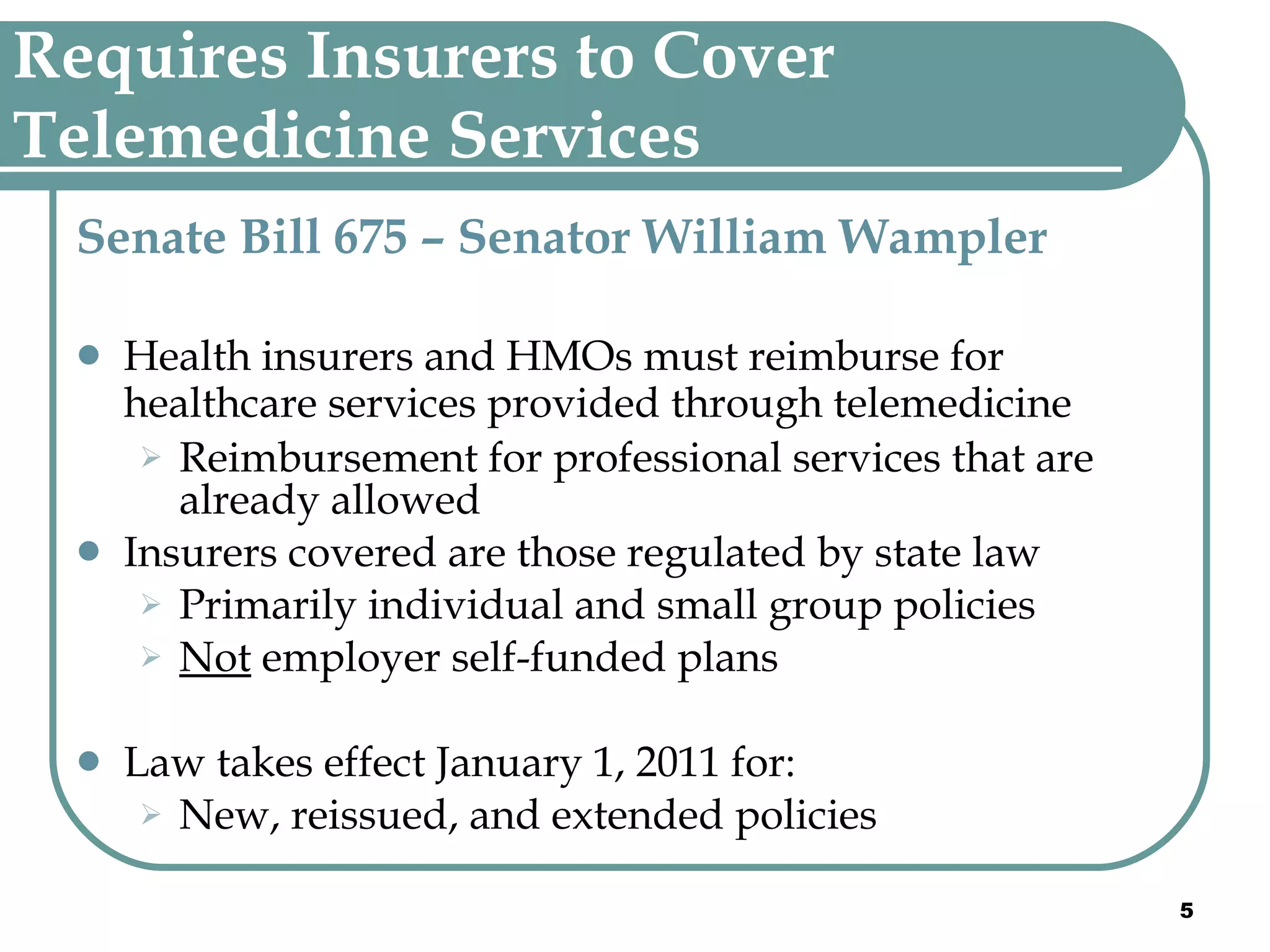
Requires Insurers to Cover Telemedicine Services  Senate Bill 675 – Senator William Wampler Health insurers and HMOs must reimburse for healthcare services provided through telemedicine   Reimbursement for professional services that are already allowed Insurers covered are those regulated by state law Primarily individual and small group policies Not  employer self-funded plans Law takes effect January 1, 2011 for: New, reissued, and extended policies
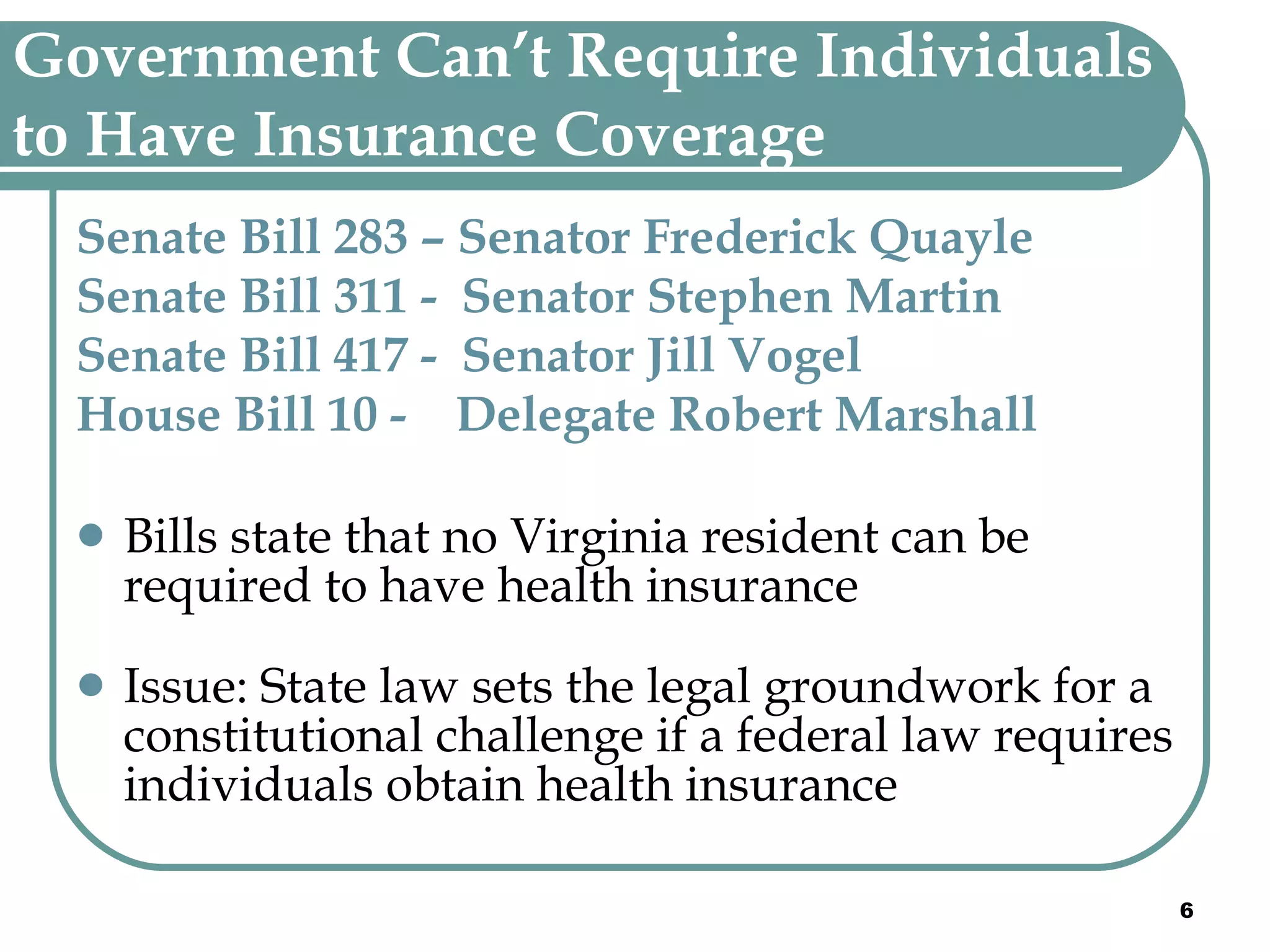
Government Can’t Require Individuals to Have Insurance Coverage   Senate Bill 283 – Senator Frederick Quayle Senate Bill 311 -  Senator Stephen Martin Senate Bill 417 -  Senator Jill Vogel  House Bill 10 -  Delegate Robert Marshall Bills state that no Virginia resident can be required to have health insurance Issue: State law sets the legal groundwork for a constitutional challenge if a federal law requires individuals obtain health insurance
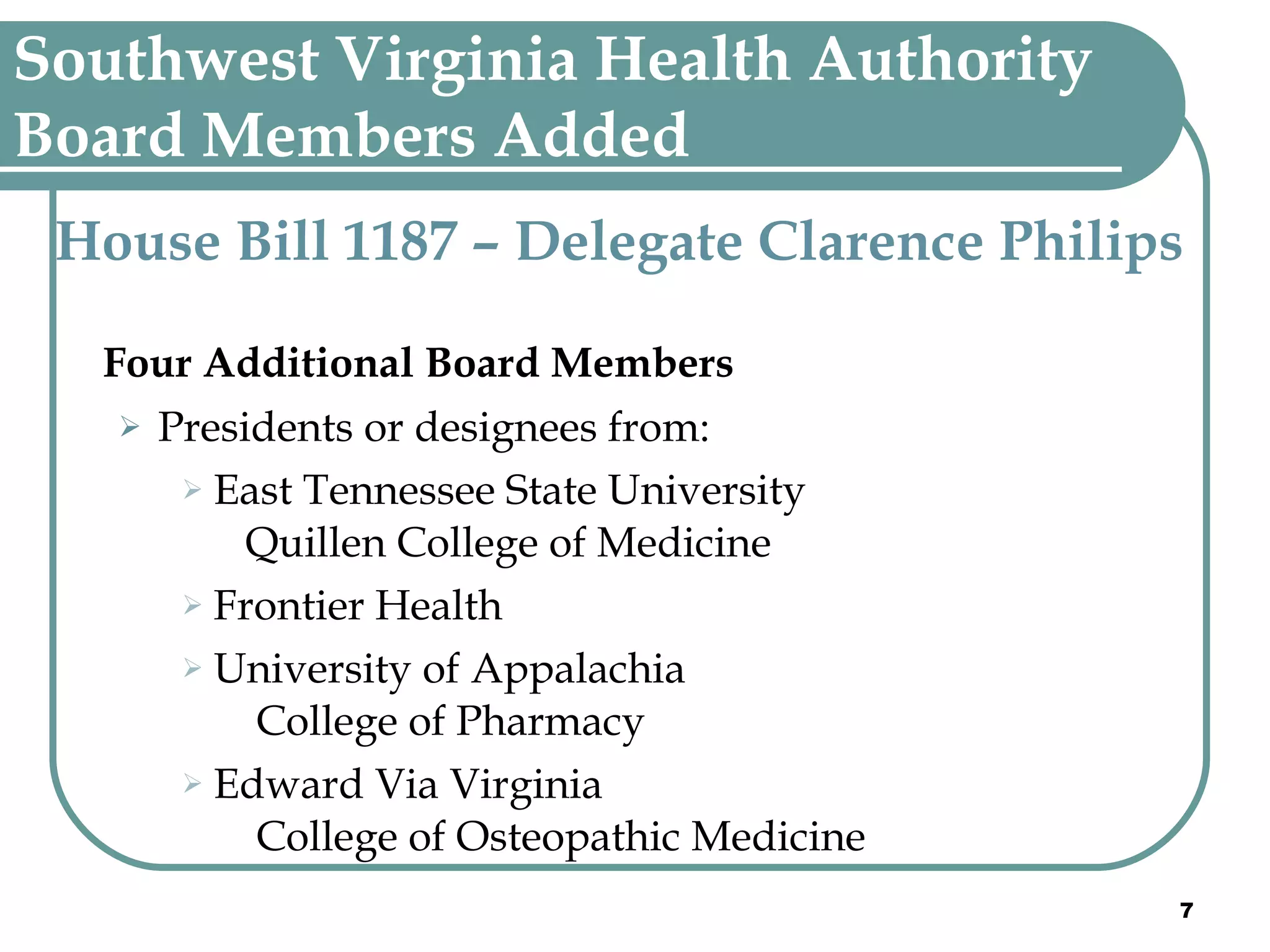
Southwest Virginia Health Authority   Board Members Added House Bill 1187 – Delegate Clarence Philips   Four Additional Board Members   Presidents or designees from: East Tennessee State University   Quillen College of Medicine Frontier Health University of Appalachia    College of Pharmacy Edward Via Virginia    College of Osteopathic Medicine
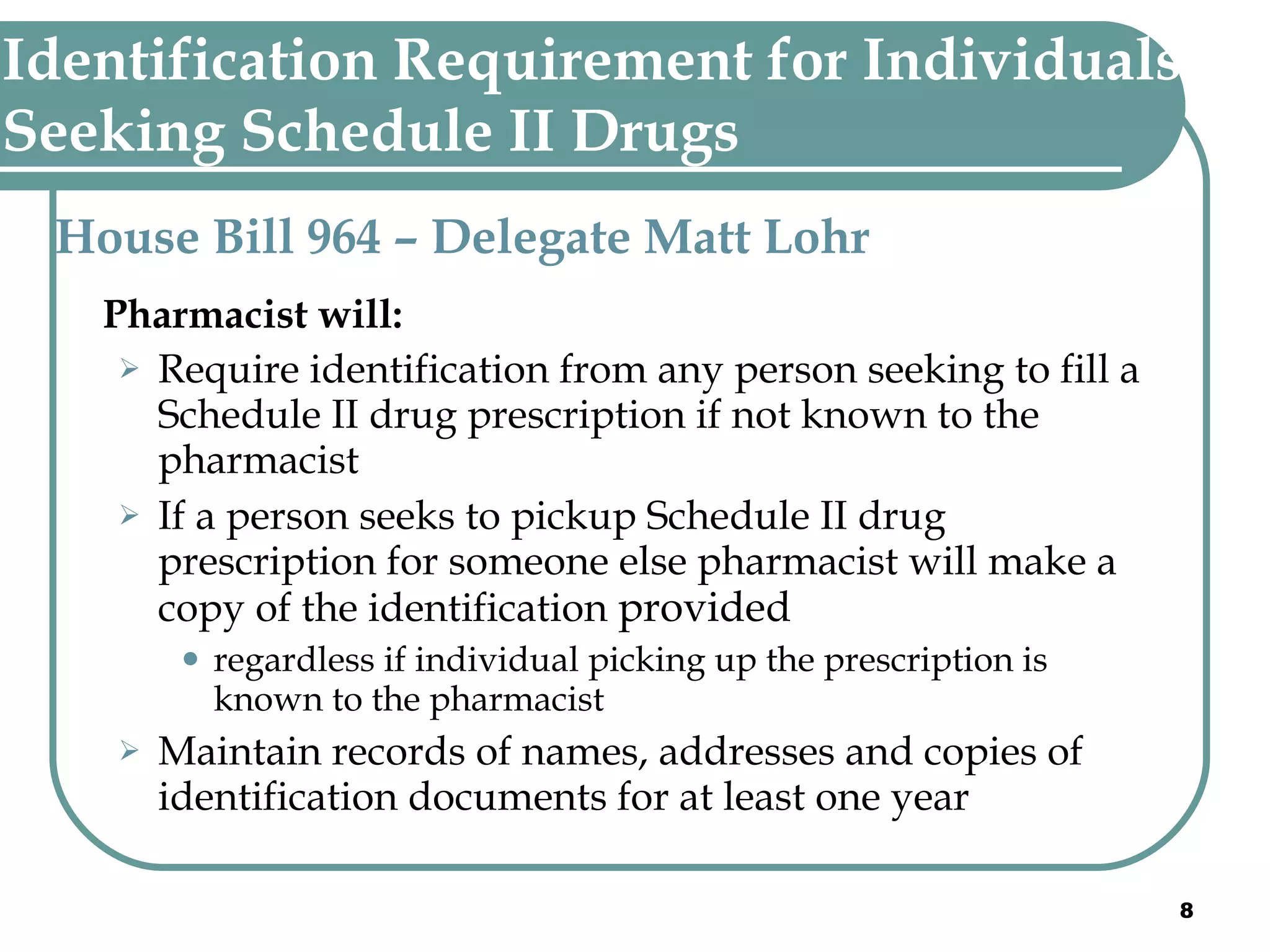
Identification Requirement for Individuals Seeking Schedule II Drugs House Bill 964 – Delegate Matt Lohr   Pharmacist will: Require identification from any person seeking to fill a Schedule II drug prescription if not known to the pharmacist If a person seeks to pickup Schedule II drug prescription for someone else pharmacist will make a copy of the identification  provided  regardless if individual picking up the prescription is known to the pharmacist  Maintain records of names, addresses and copies of identification documents for at least one year
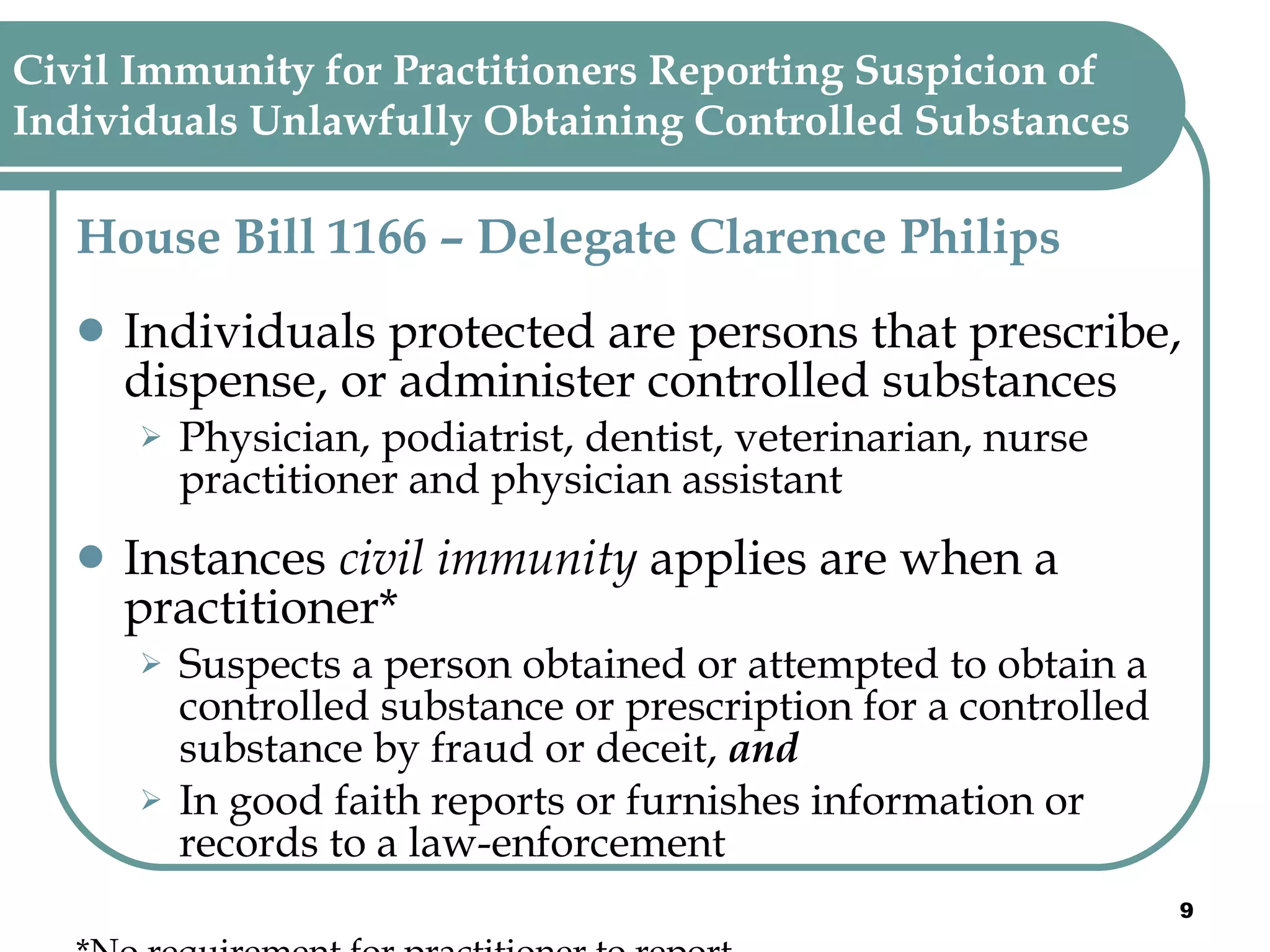
Civil Immunity for Practitioners Reporting Suspicion of  Individuals Unlawfully Obtaining Controlled Substances House Bill 1166 – Delegate Clarence Philips   Individuals protected are persons that prescribe, dispense, or administer controlled substances  Physician, podiatrist, dentist, veterinarian, nurse practitioner and physician assistant   Instances  civil immunity  applies are when a practitioner* Suspects a person obtained or attempted to obtain a controlled substance or prescription for a controlled substance by fraud or deceit,  and In good faith reports or furnishes information or records to a law-enforcement *No requirement for practitioner to report
State Budget
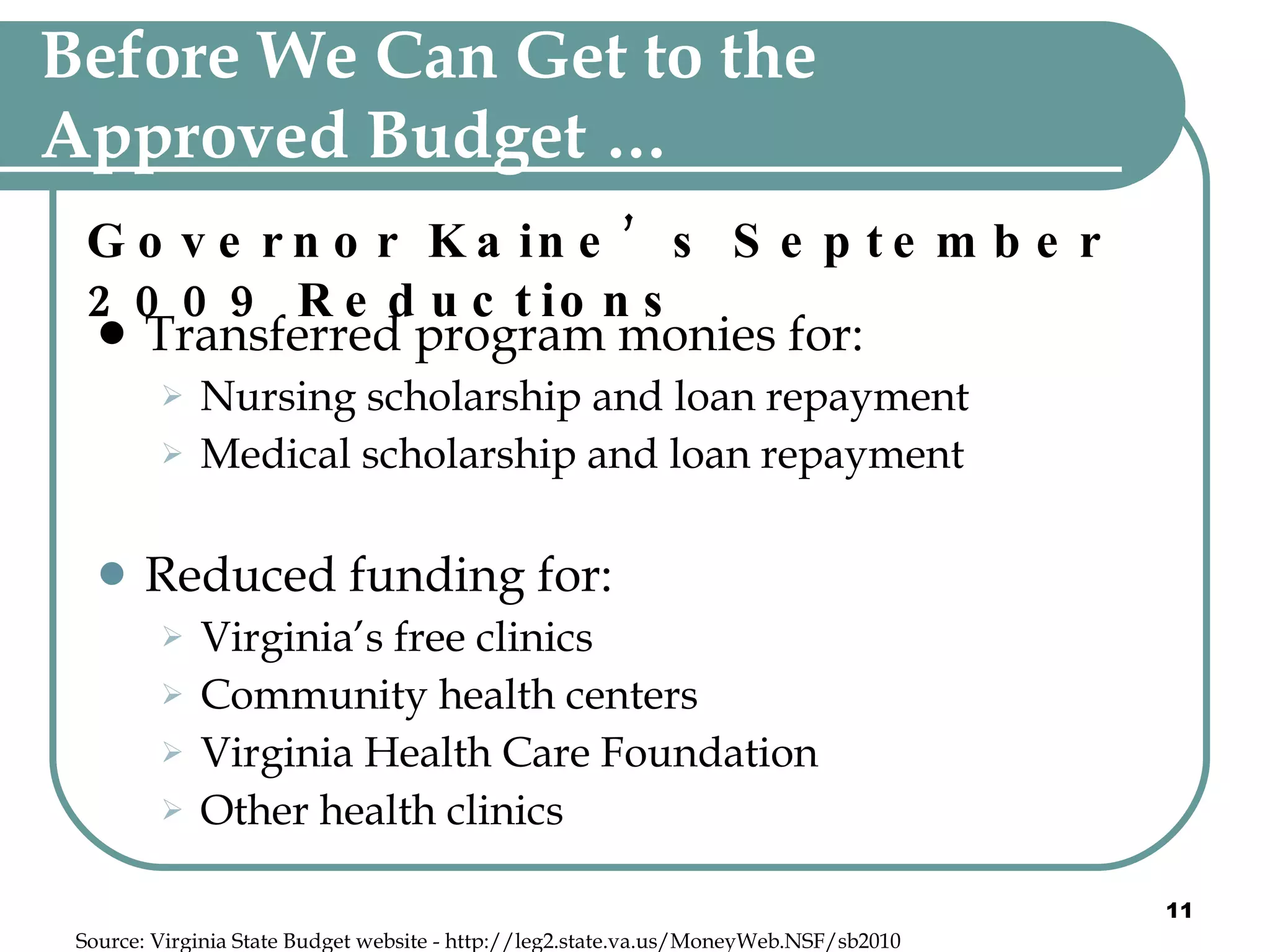
Before We Can Get to the Approved Budget … Transferred program monies for: Nursing scholarship and loan repayment Medical scholarship and loan repayment Reduced funding for: Virginia’s free clinics Community health centers  Virginia Health Care Foundation  Other health clinics Source: Virginia State Budget website - http://leg2.state.va.us/MoneyWeb.NSF/sb2010 Governor Kaine’s September 2009 Reductions
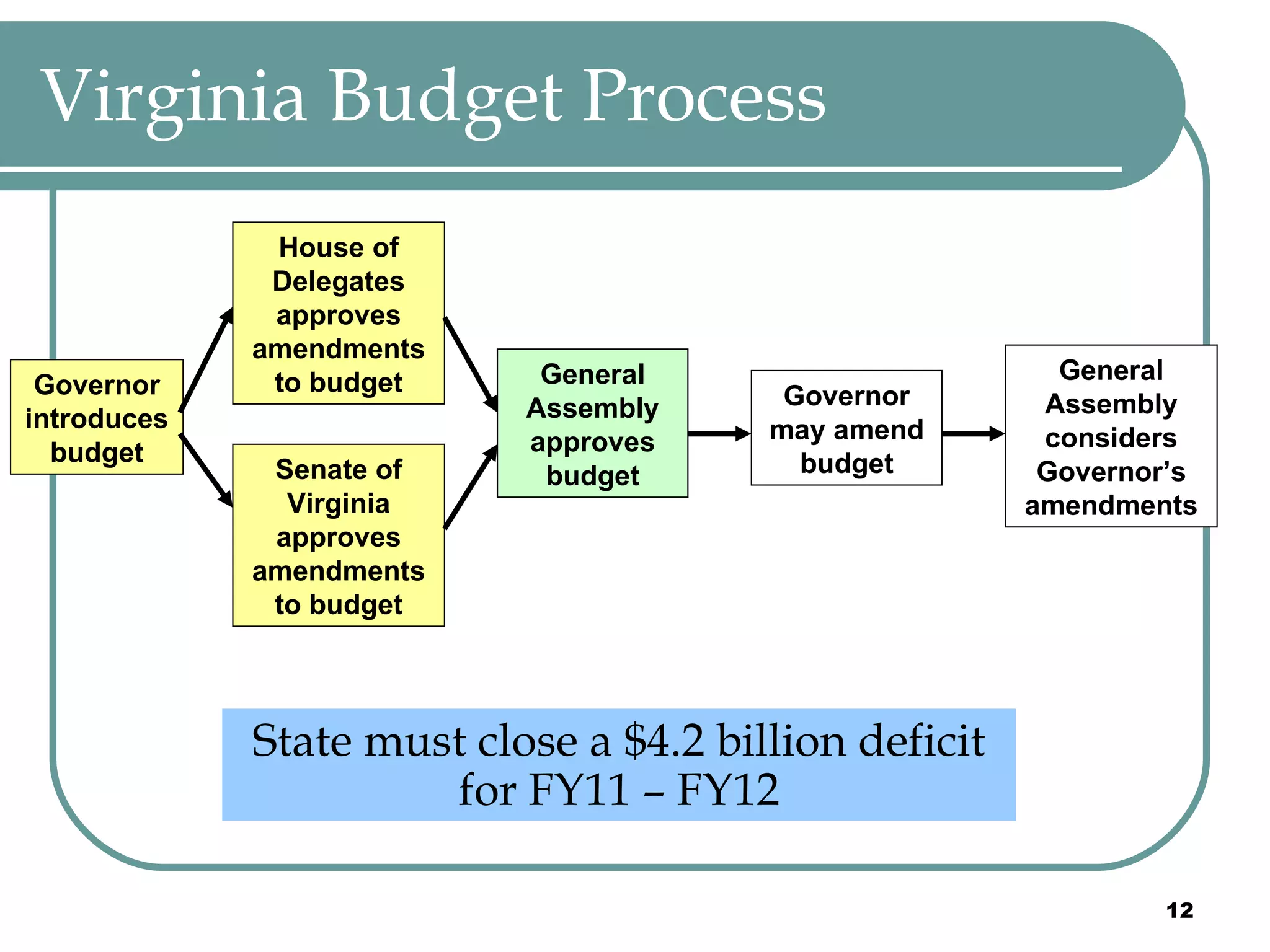
Virginia Budget Process Governor introduces budget House of Delegates approves amendments to budget Senate of Virginia approves amendments to budget General Assembly approves budget Governor may amend budget State must close a $4.2 billion deficit for FY11 – FY12 General Assembly considers Governor’s amendments
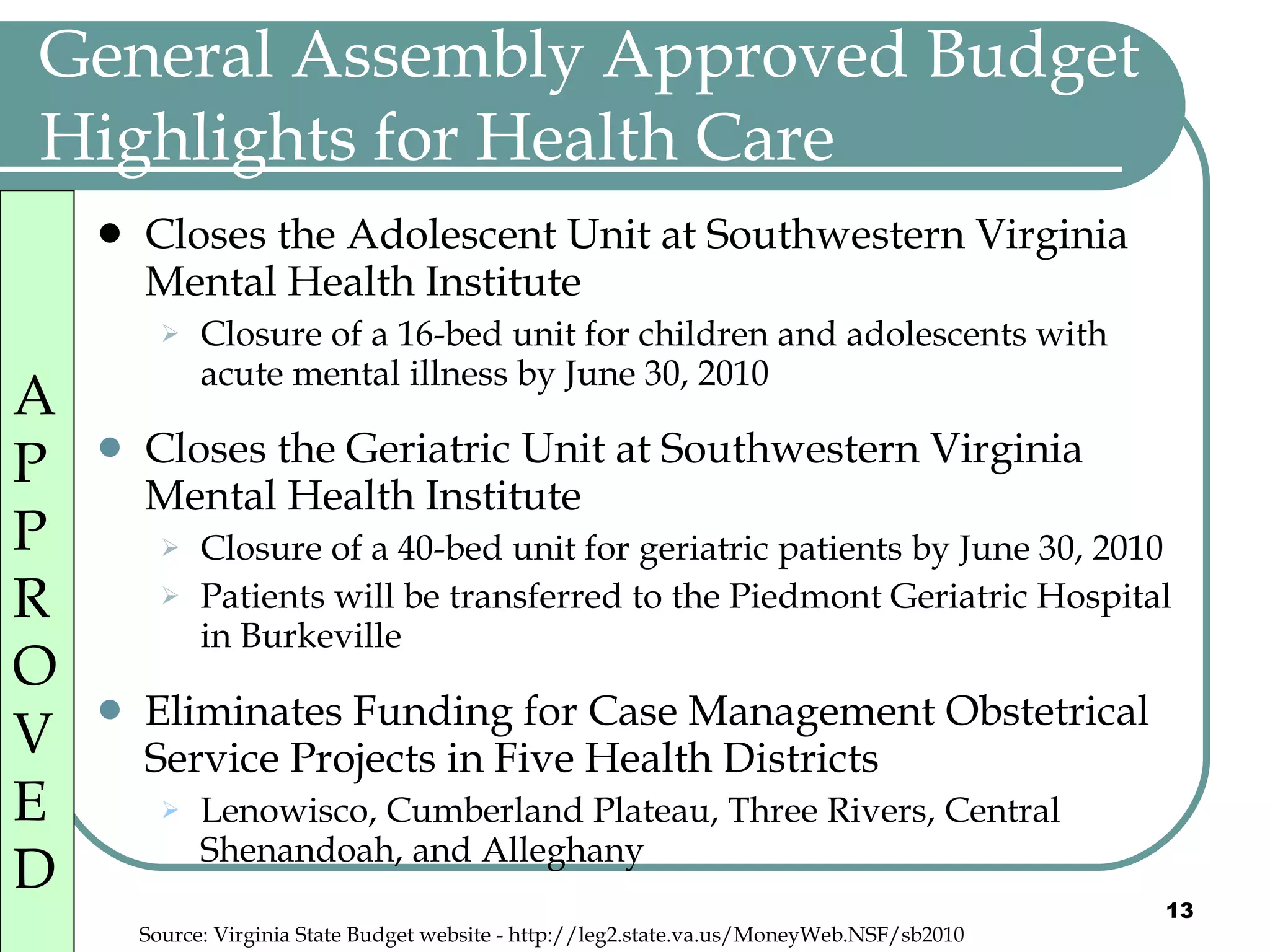
General Assembly Approved Budget Highlights for Health Care  Closes the Adolescent Unit at Southwestern Virginia Mental Health Institute Closure of a 16-bed unit for children and adolescents with acute mental illness by June 30, 2010  Closes the Geriatric Unit at Southwestern Virginia Mental Health Institute Closure of a 40-bed unit for geriatric patients by June 30, 2010  Patients will be transferred to the Piedmont Geriatric Hospital in Burkeville Eliminates Funding for Case Management Obstetrical Service Projects in Five Health Districts  Lenowisco, Cumberland Plateau, Three Rivers, Central Shenandoah, and Alleghany Source: Virginia State Budget website - http://leg2.state.va.us/MoneyWeb.NSF/sb2010 APPROVED
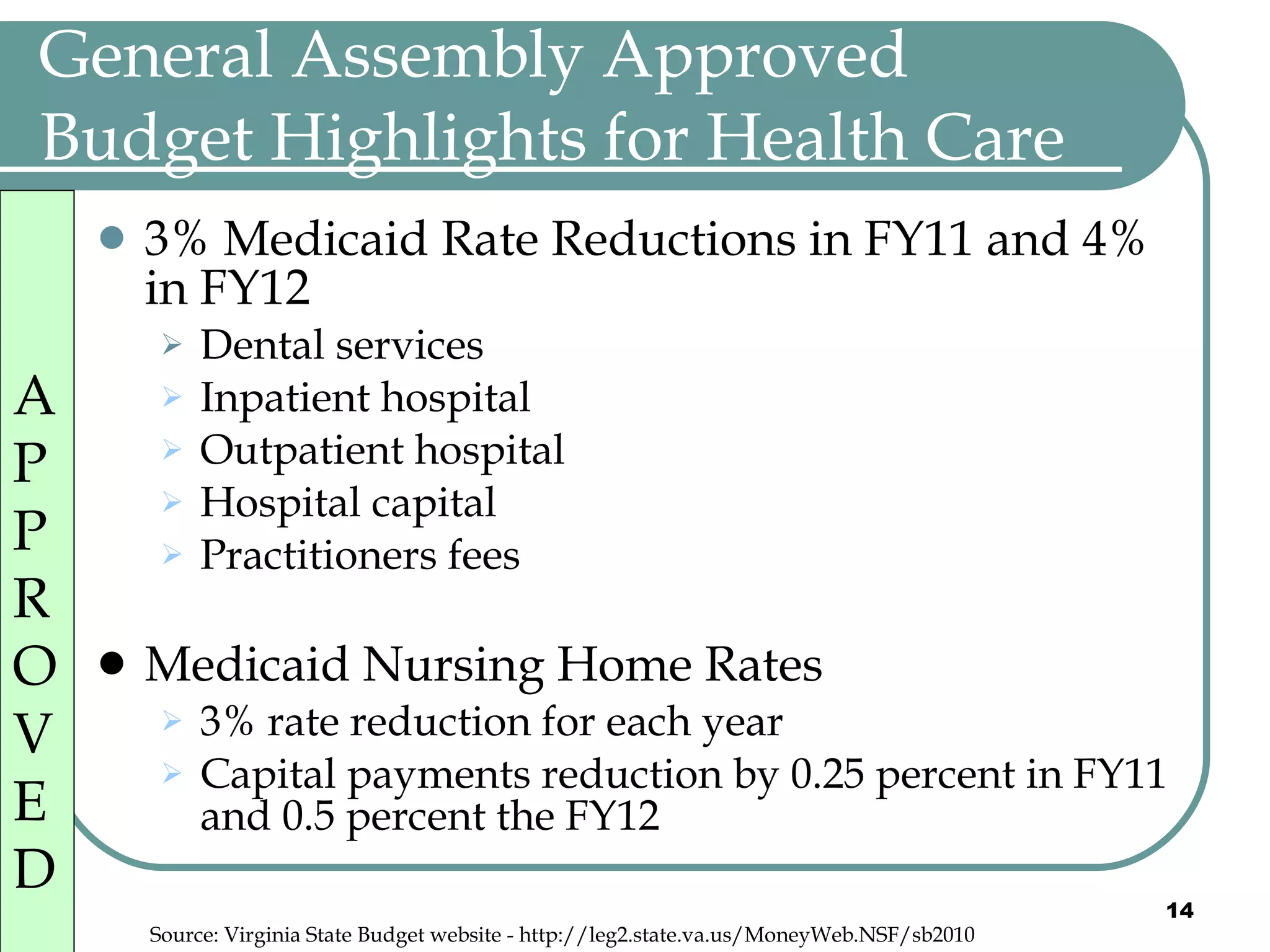
General Assembly Approved Budget Highlights for Health Care 3% Medicaid Rate Reductions in FY11 and 4% in FY12 Dental services Inpatient hospital  Outpatient hospital  Hospital capital Practitioners fees  Medicaid Nursing Home Rates 3% rate reduction for each year Capital payments reduction by 0.25 percent in FY11 and 0.5 percent the FY12 Source: Virginia State Budget website - http://leg2.state.va.us/MoneyWeb.NSF/sb2010 APPROVED
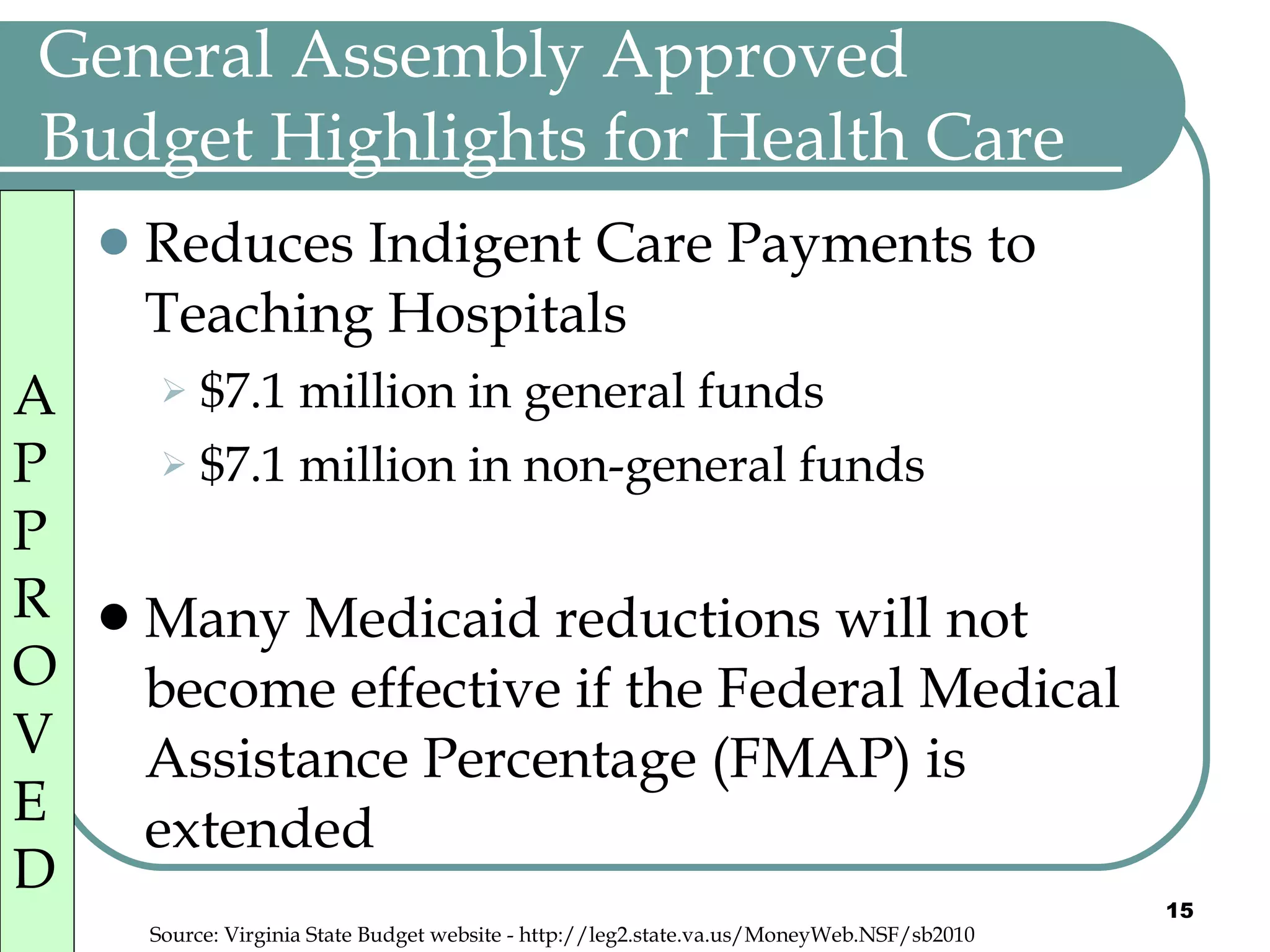
General Assembly Approved Budget Highlights for Health Care Reduces Indigent Care Payments to Teaching Hospitals  $7.1 million in general funds $7.1 million in non-general funds Many Medicaid reductions will not become effective if the Federal Medical Assistance Percentage (FMAP) is extended  Source: Virginia State Budget website - http://leg2.state.va.us/MoneyWeb.NSF/sb2010 APPROVED
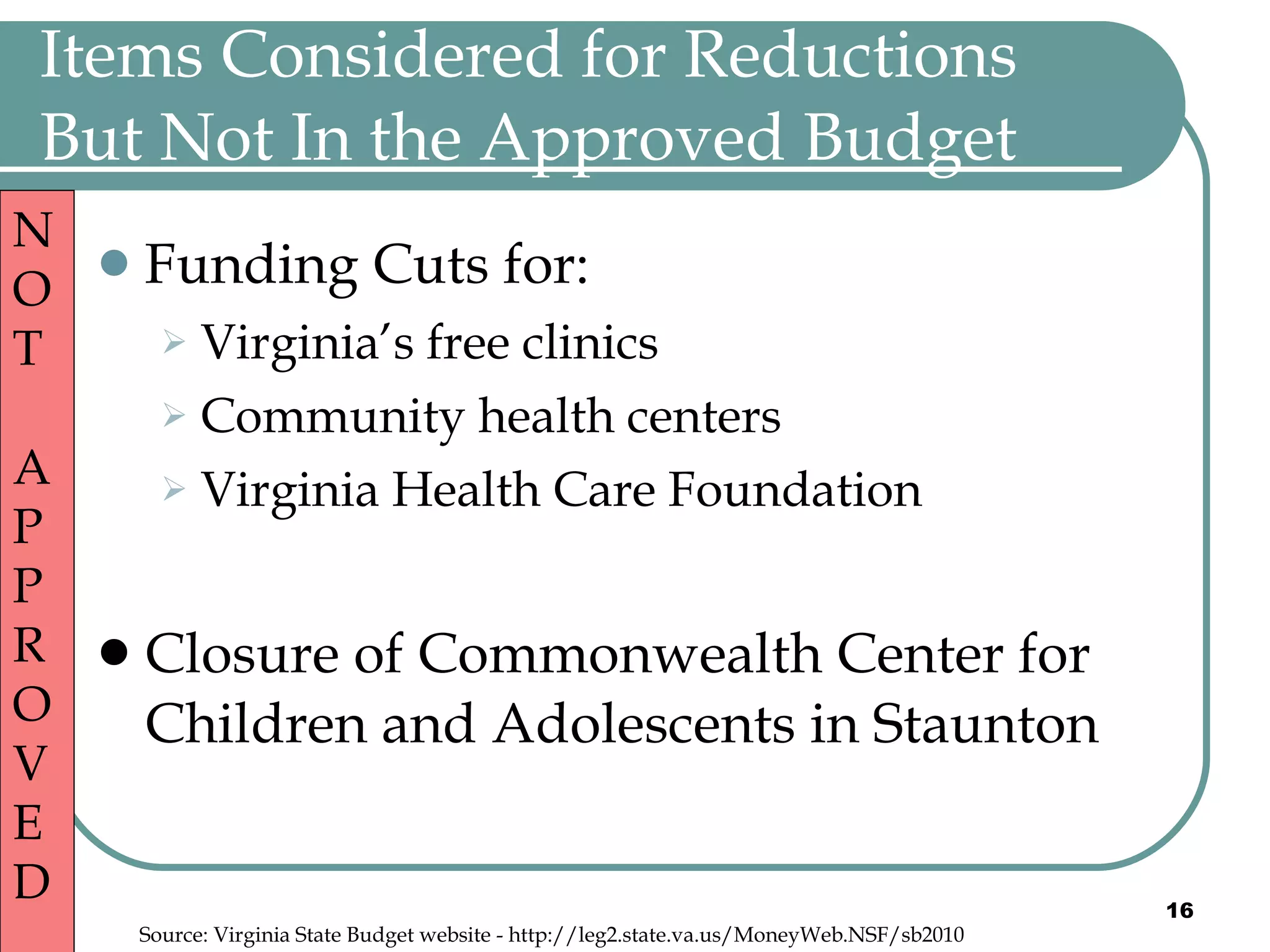
Items Considered for Reductions But Not In the Approved Budget Funding Cuts for: Virginia’s free clinics Community health centers  Virginia Health Care Foundation Closure of Commonwealth Center for Children and Adolescents in Staunton Source: Virginia State Budget website - http://leg2.state.va.us/MoneyWeb.NSF/sb2010 N OT APPROVED
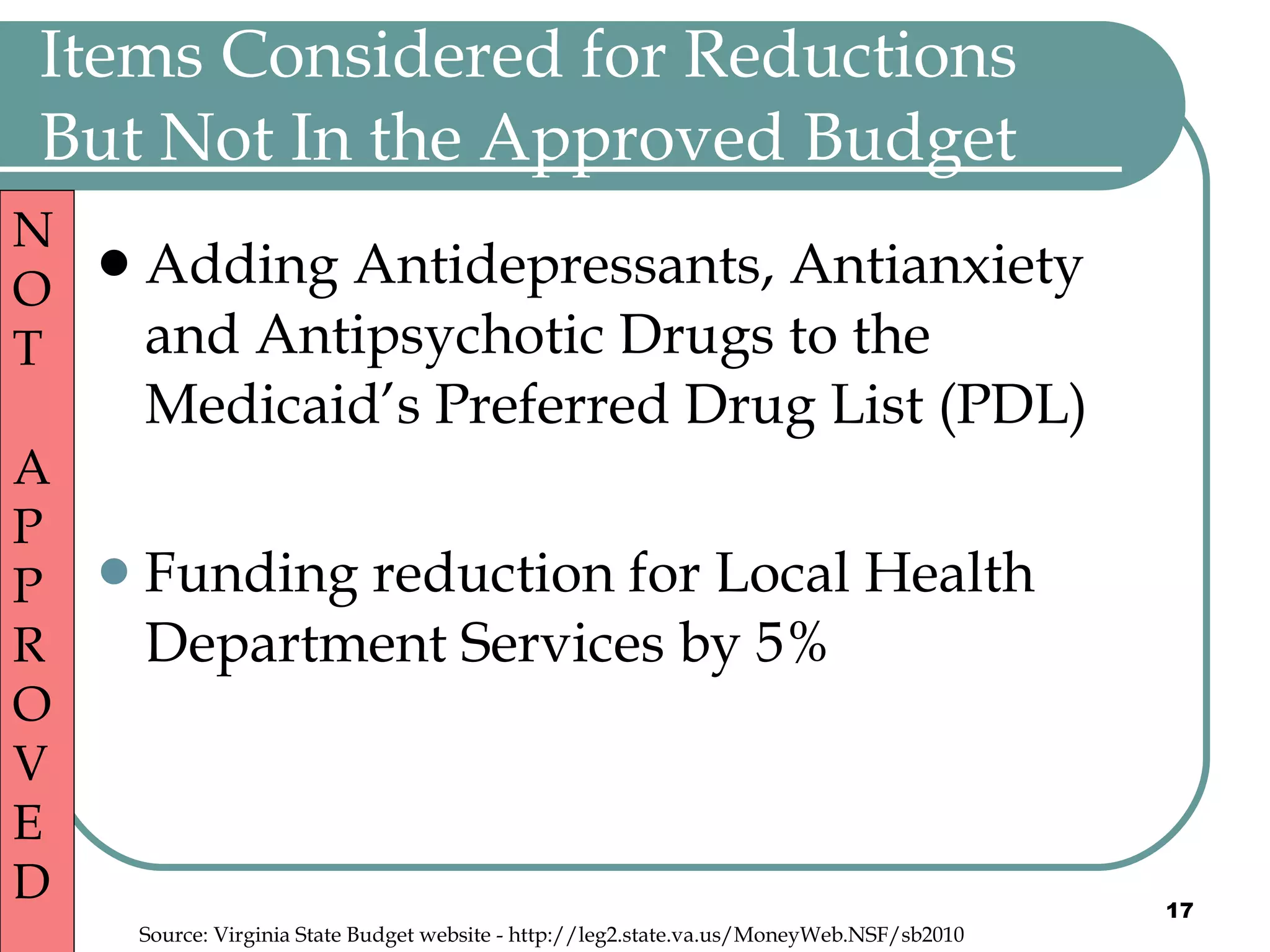
Items Considered for Reductions But Not In the Approved Budget Adding Antidepressants, Antianxiety and Antipsychotic Drugs to the Medicaid’s Preferred Drug List (PDL) Funding reduction for Local Health Department Services by 5% Source: Virginia State Budget website - http://leg2.state.va.us/MoneyWeb.NSF/sb2010 N OT APPROVED
Virginia’s Health Care Workforce:  Present and Future Need Physicians, Psychiatrists, Dentists, Clinical Psychologists and Pharmacists Virginia Rural Workforce Summit March 16, 2010 Stephen W. Bowman Senior Staff Attorney/Methodologist Joint Commission on Health Care
Agenda Demand and Supply  Shortages JCHC Recommended Policies
Demand and Supply
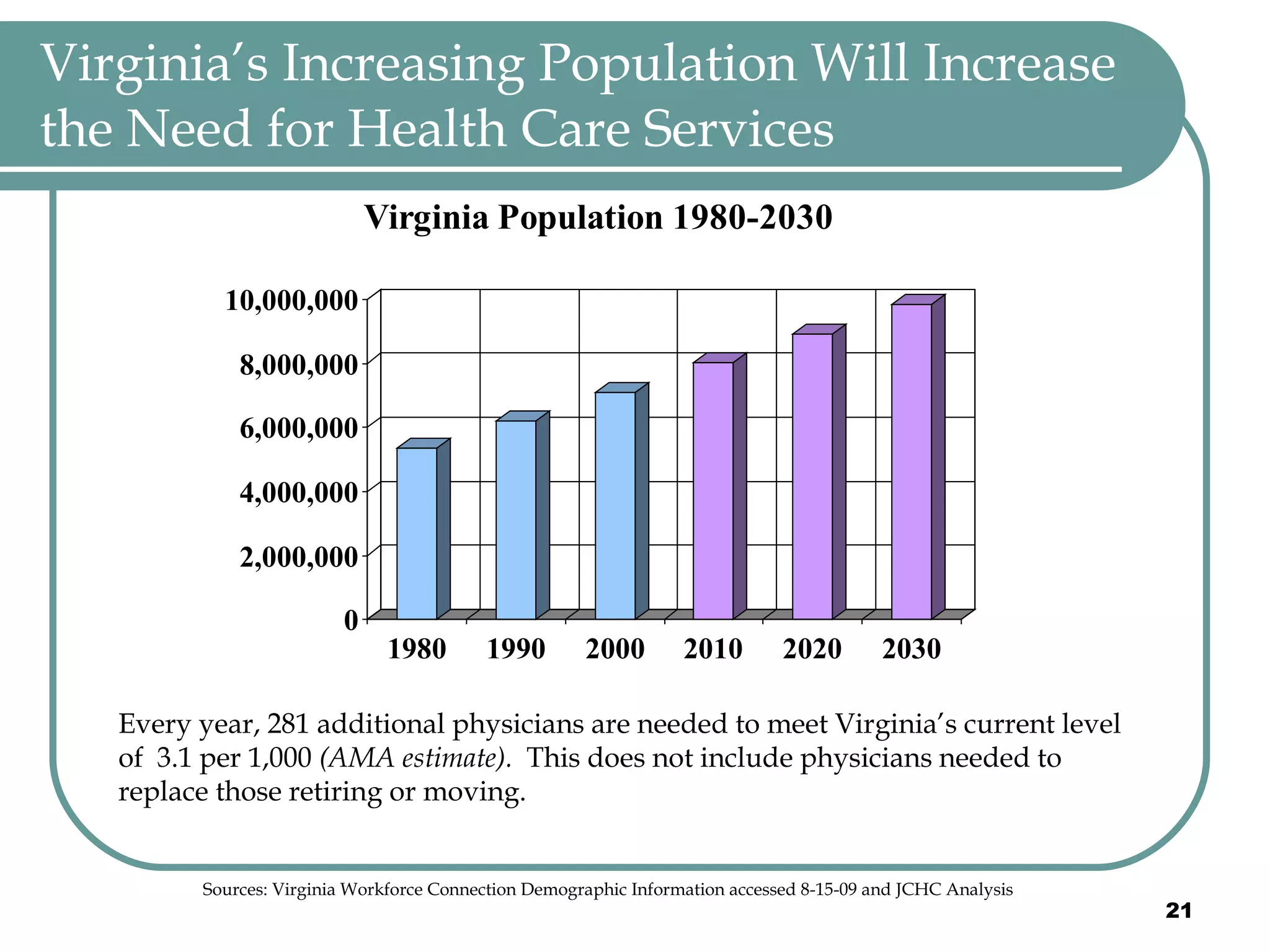
Virginia’s Increasing Population Will Increase the Need for Health Care Services Every year, 281 additional physicians are needed to meet Virginia’s current level of  3.1 per 1,000  (AMA estimate).   This does not include physicians needed to replace those retiring or moving. Sources: Virginia Workforce Connection Demographic Information accessed 8-15-09 and JCHC Analysis
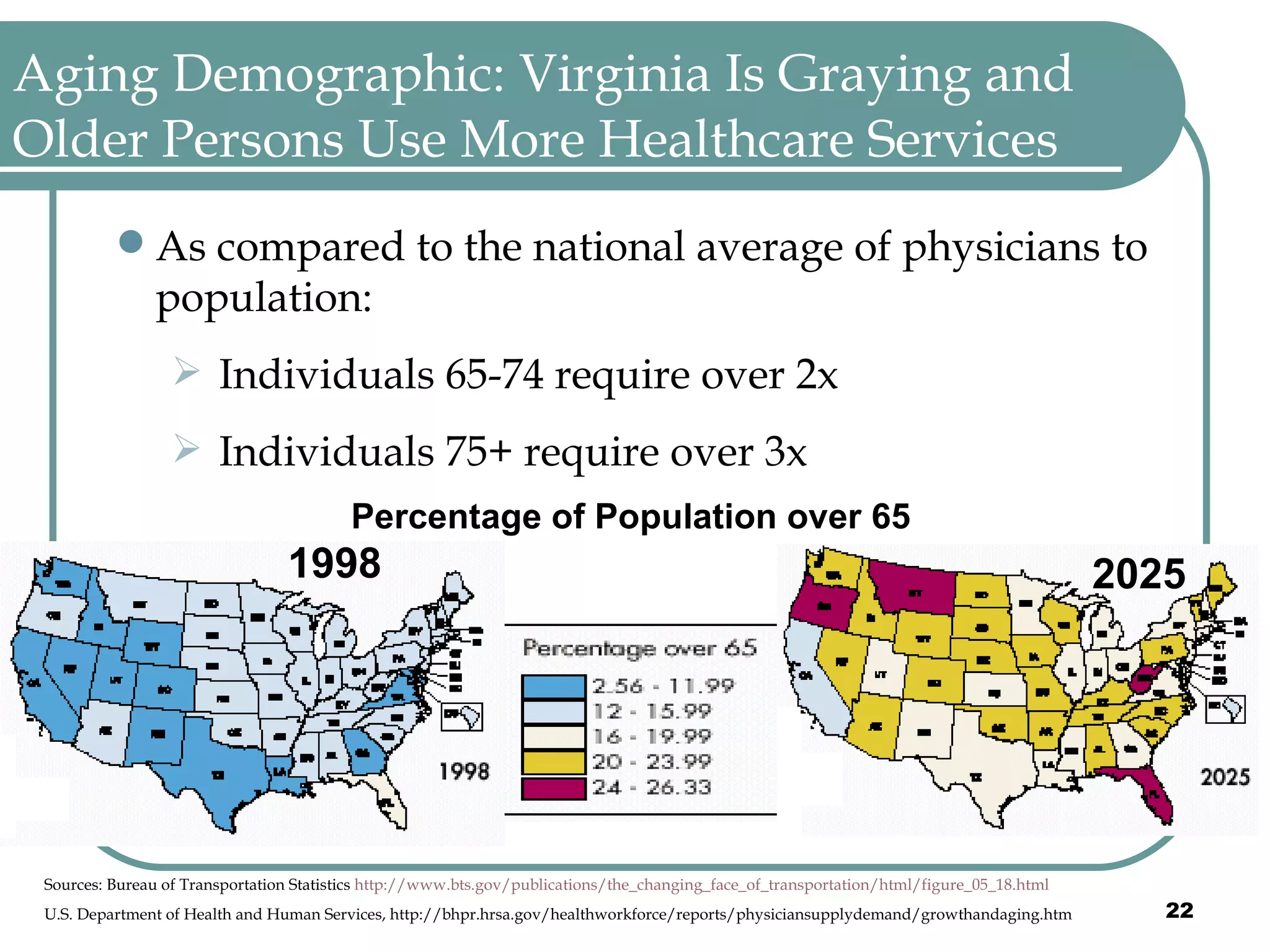
Aging Demographic: Virginia Is Graying and Older Persons Use More Healthcare Services As compared to the national average of physicians to  population: Individuals 65-74 require over 2x  Individuals 75+ require over 3x Sources: Bureau of Transportation Statistics  http://www.bts.gov/publications/the_changing_face_of_transportation/html/figure_05_18.html U.S. Department of Health and Human Services, http://bhpr.hrsa.gov/healthworkforce/reports/physiciansupplydemand/growthandaging.htm 2025 Percentage of Population over 65  1998
2,425 Students Were Enrolled in Virginia Medical Schools in 2008 Sources: JCHC email correspondence with each institution and SCHEV. Va. Medical School Takes Shape, Smith and Hardy,  Richmond Times Dispatch, January 3, 2007 & WSLS video report, McNew, May 22, 2008  http://www.wsls.com/sls/news/local/article/roanoke_medical_school_has_a_name/11444/ PHYSICIAN 678   191 192 160 135 557 50% 643 2,425 Total (2008)      40 (Expected) 200 (Expected) Virginia Tech Carilion School of Medicine  (Roanoke)  [Opens August 2010] 139 30% 191 680 Edward Via Virginia College of Osteopathic Medicine -VCOM  (Blacksburg) 181 58% 192 741 Virginia Commonwealth University School of Medicine  (Richmond) 130 54% 145 559 University of Virginia School of Medicine  (Charlottesville) 107 64% 115 445 Eastern Virginia Medical School  (Norfolk) Total Enrollment  (2008) 2008 Graduates % in-state 2008 entering class 2008 entering class-size 2012  entering  class-size (Estimated  )
$50.6 Million General Funds Were Spent Toward Medical School Education in 2007-08 Tuition  in-state  (2008-2009 ) 2007-08 General funds/per student* 2007-08 General funds*    (in millions ) Tuition  out-of-state (2008-2009 ) 2007-08   Non-General funds*  (in millions ) *  Totals do not include Family Practice Program (residencies) and Area Health Center funding Sources: JCHC email correspondence with each institution and SCHEV. Va. Medical School Takes Shape, Smith and Hardy,  Richmond Times Dispatch, January 3, 2007 & WSLS video report, McNew, May 22, 2008  http://www.wsls.com/sls/news/local/article/roanoke_medical_school_has_a_name/11444/ PHYSICIAN $ 52.8 $ 0  $ 20.8 $ 31.8 $ 0 $ 50.6 $ 39,740 (average) $ 28,794  (average) Total (2008)      Virginia Tech Carilion School of Medicine  (Roanoke)  [Opens August 2010] $ 0 $ 0  $ 32,900 $ 32,900 Edward Via Virginia College of Osteopathic Medicine -VCOM  (Blacksburg) $ 22,833 $ 16.9 $ 38,892 $ 25,390 Virginia Commonwealth University School of Medicine  (Richmond) $ 29,733 $ 16.6 $ 42,650 $ 32,650 University of Virginia School of Medicine  (Charlottesville) $ 33,786 $ 15.1 $ 44,328 $ 23,980 Eastern Virginia Medical School  (Norfolk)
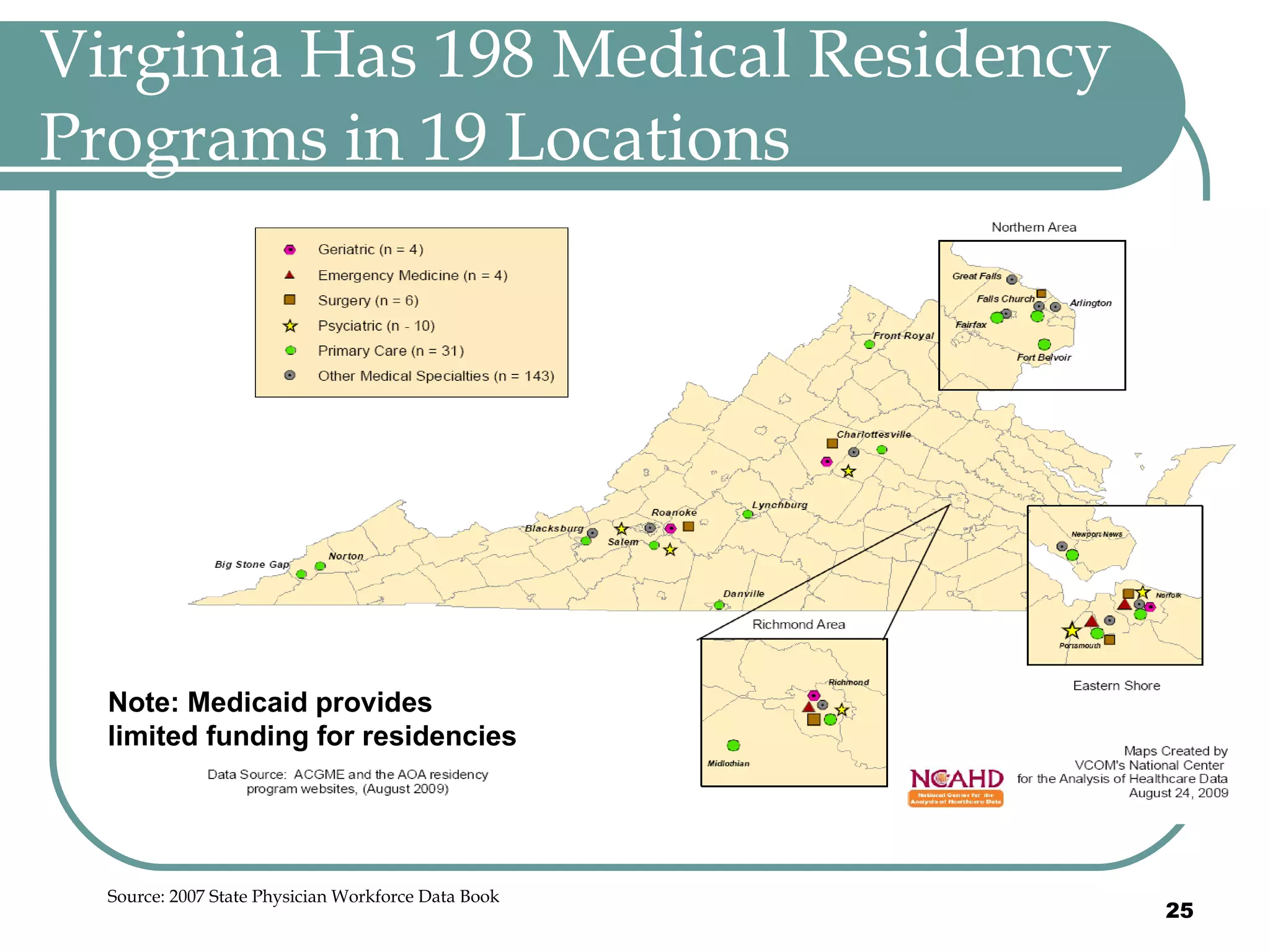
Virginia Has 198 Medical Residency Programs in 19 Locations Source: 2007 State Physician Workforce Data Book Note: Medicaid provides limited funding for residencies
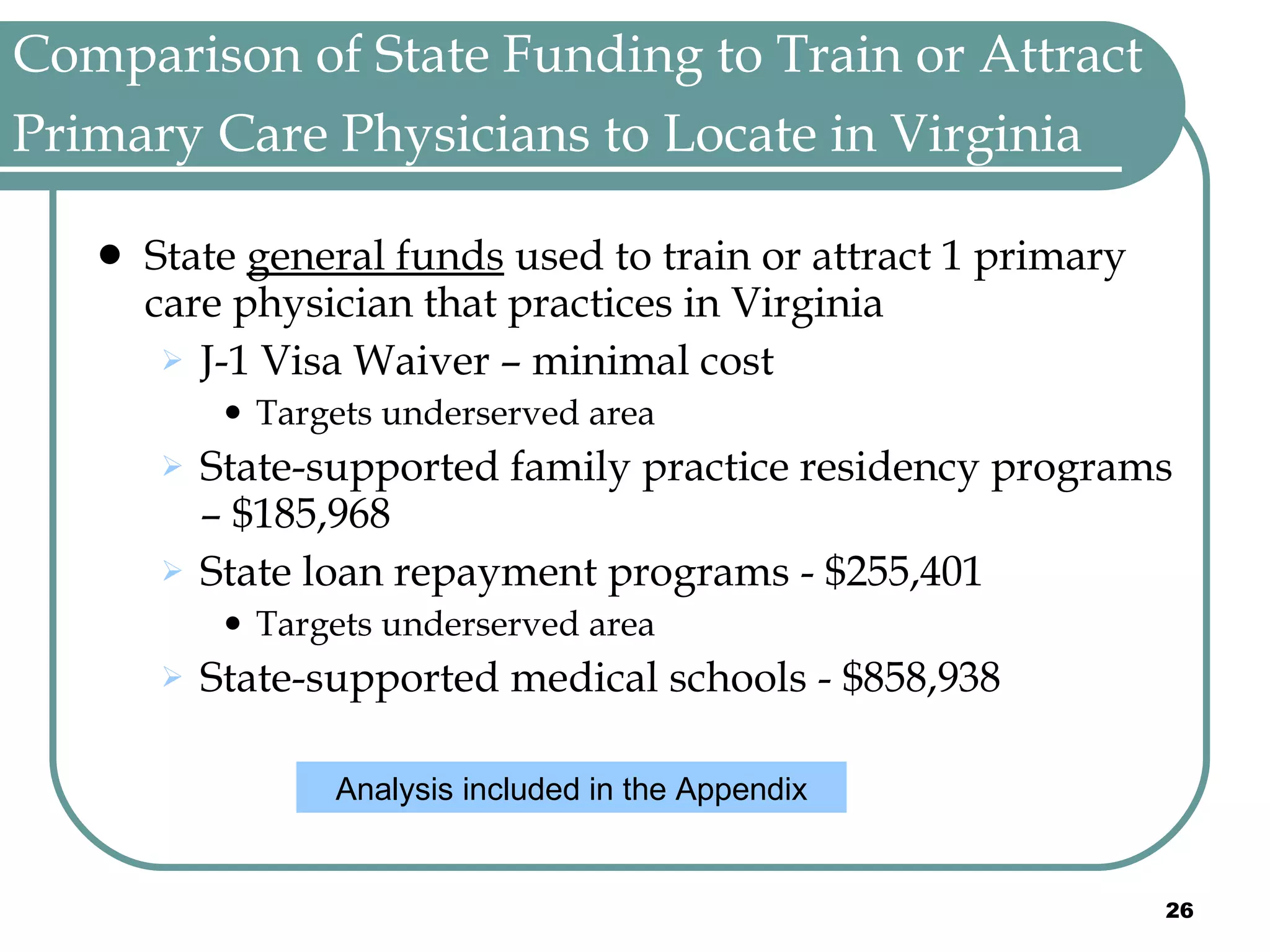
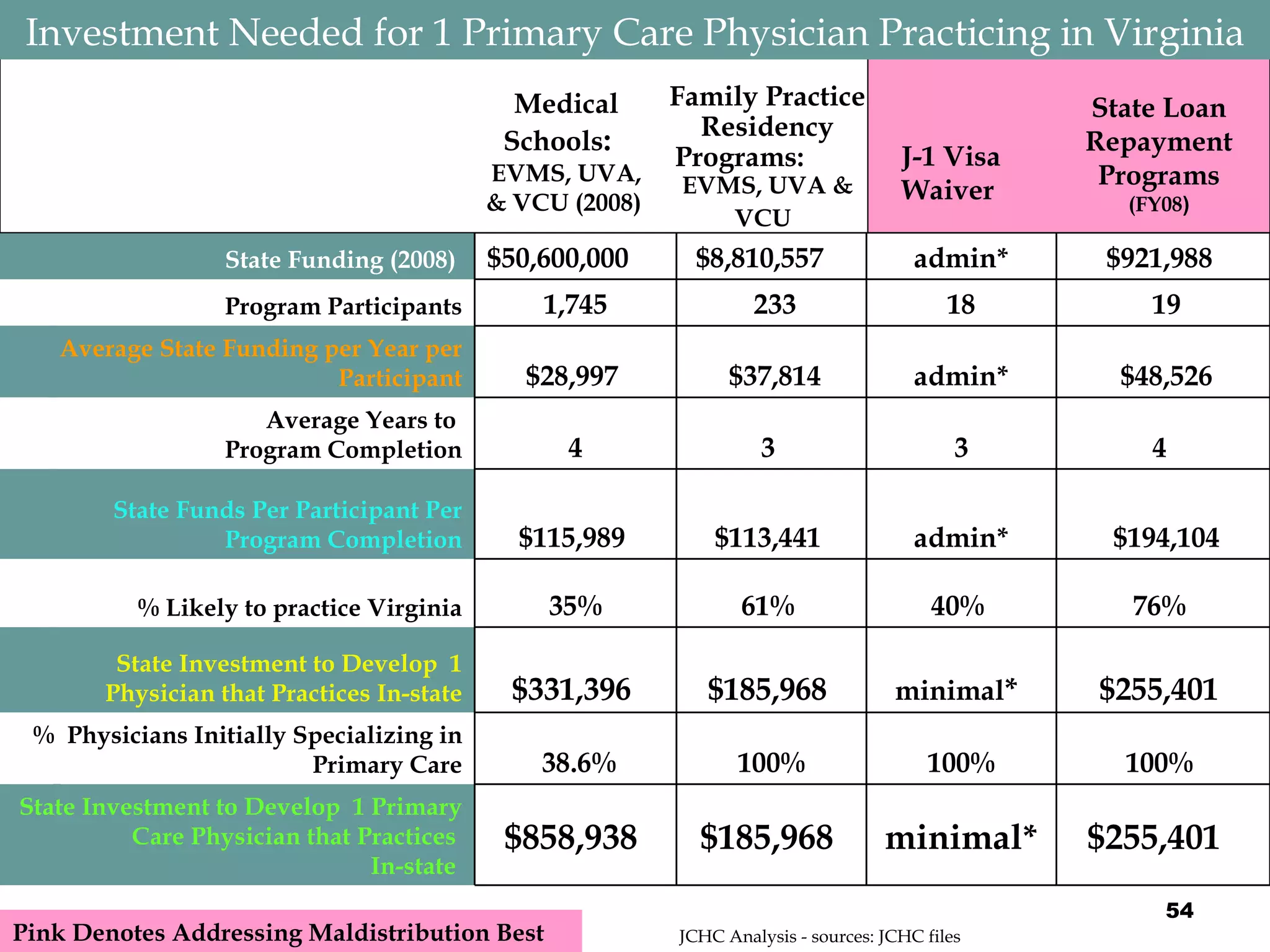
Comparison of State Funding to Train or Attract Primary Care Physicians to Locate in Virginia   State  general funds  used to train or attract 1 primary care physician that practices in Virginia J-1 Visa Waiver – minimal cost Targets underserved area State-supported family practice residency programs – $185,968 State loan repayment programs - $255,401 Targets underserved area State-supported medical schools - $858,938 Analysis included in the Appendix
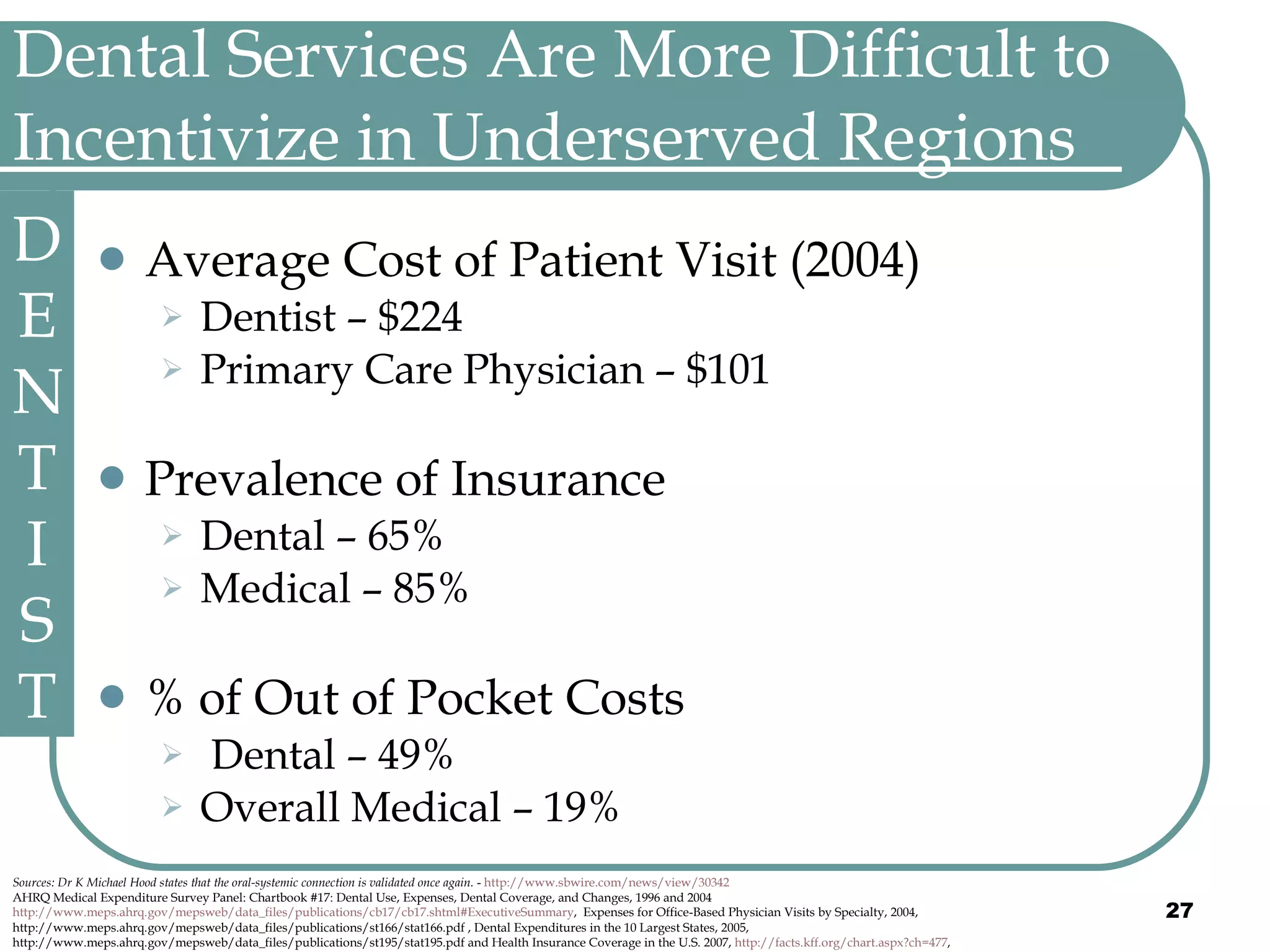
Dental Services Are More Difficult to Incentivize in Underserved Regions Average Cost of Patient Visit (2004) Dentist – $224  Primary Care Physician – $101 Prevalence of Insurance Dental – 65% Medical – 85% % of Out of Pocket Costs  Dental – 49% Overall Medical – 19% DENTIST Sources: Dr K Michael Hood states that the oral-systemic connection is validated once again.  -  http://www.sbwire.com/news/view/30342 AHRQ Medical Expenditure Survey Panel: Chartbook #17: Dental Use, Expenses, Dental Coverage, and Changes, 1996 and 2004  http://www.meps.ahrq.gov/mepsweb/data_files/publications/cb17/cb17.shtml#ExecutiveSummary ,  Expenses for Office-Based Physician Visits by Specialty, 2004,   http://www.meps.ahrq.gov/mepsweb/data_files/publications/st166/stat166.pdf , Dental Expenditures in the 10 Largest States, 2005, http://www.meps.ahrq.gov/mepsweb/data_files/publications/st195/stat195.pdf and Health Insurance Coverage in the U.S. 2007,  http://facts.kff.org/chart.aspx?ch=477 ,
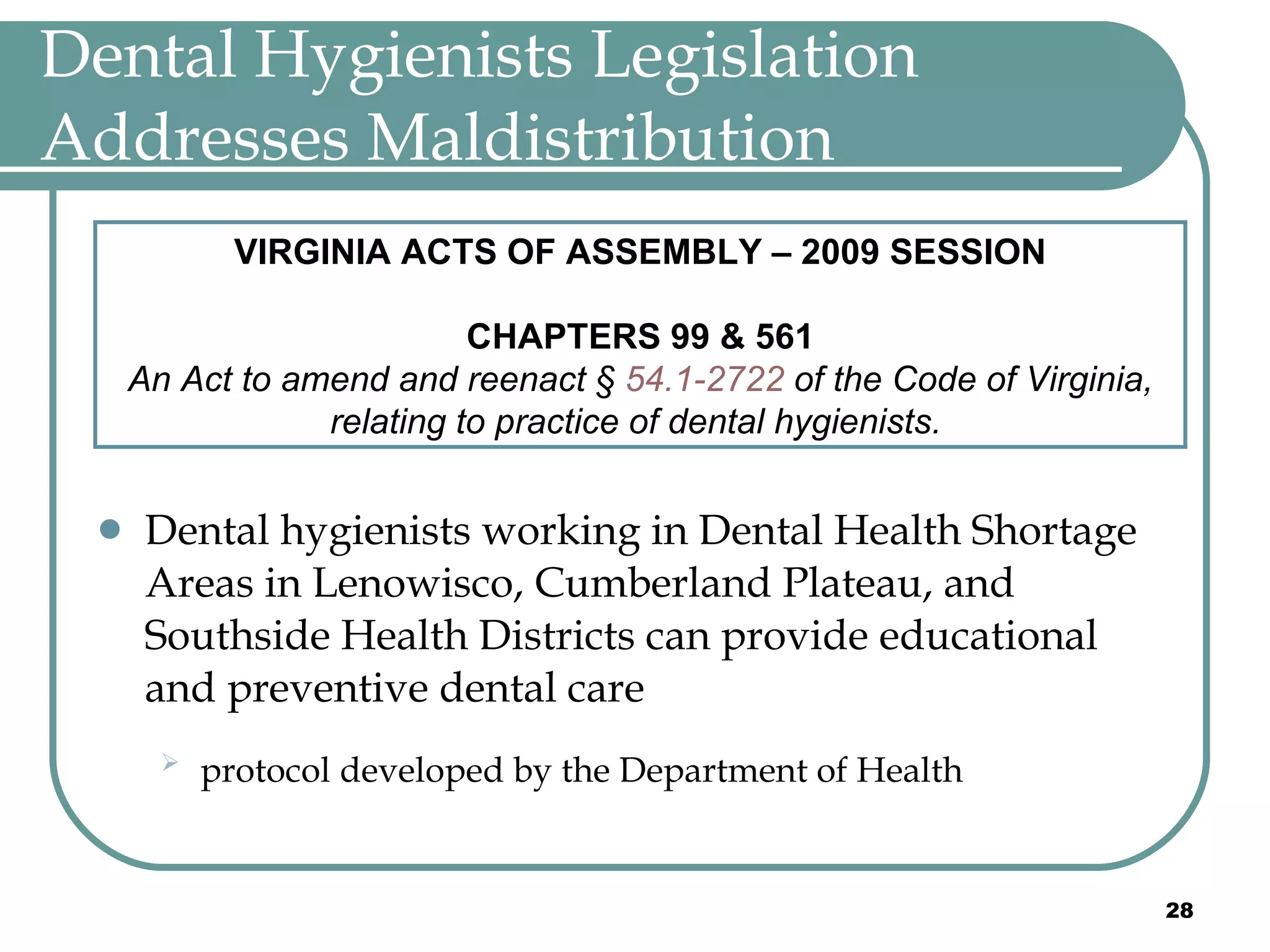
Dental Hygienists Legislation Addresses Maldistribution Dental hygienists working in Dental Health Shortage Areas in Lenowisco, Cumberland Plateau, and Southside Health Districts can provide educational and preventive dental care protocol developed by the Department of Health   VIRGINIA ACTS OF ASSEMBLY – 2009 SESSION CHAPTERS 99 & 561 An Act to amend and reenact §  54.1-2722  of the Code of Virginia, relating to practice of dental hygienists.
Shortages
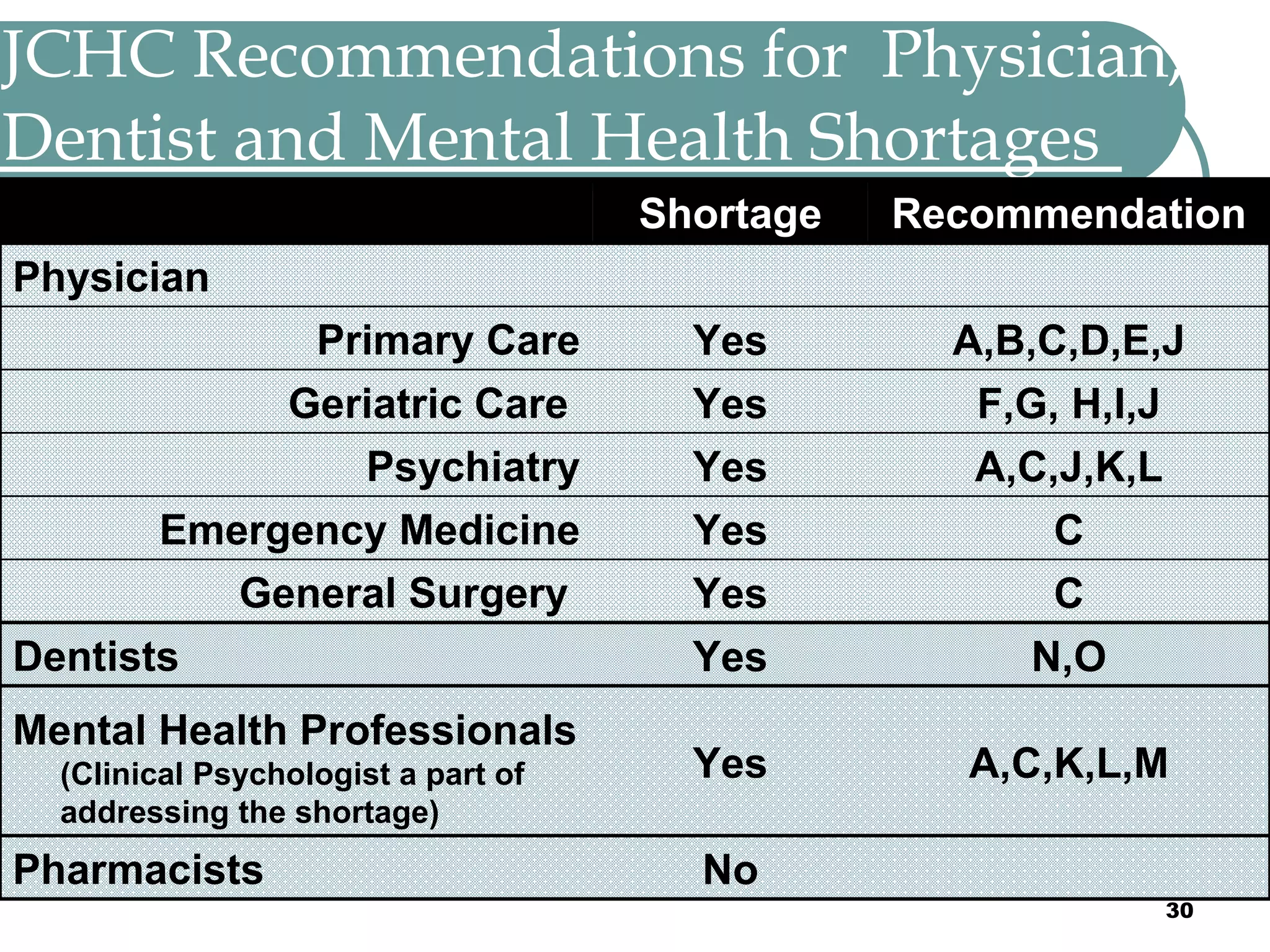
JCHC Recommendations for  Physician, Dentist and Mental Health Shortages No Pharmacists A,C,K,L,M Yes Mental Health Professionals (Clinical Psychologist a part of addressing the shortage) N,O Yes Dentists C Yes General Surgery  C Yes Emergency Medicine A,C,J,K,L Yes Psychiatry F,G, H,I,J Yes Geriatric Care  A,B,C,D,E,J Yes Primary Care     Physician Recommendation Shortage  
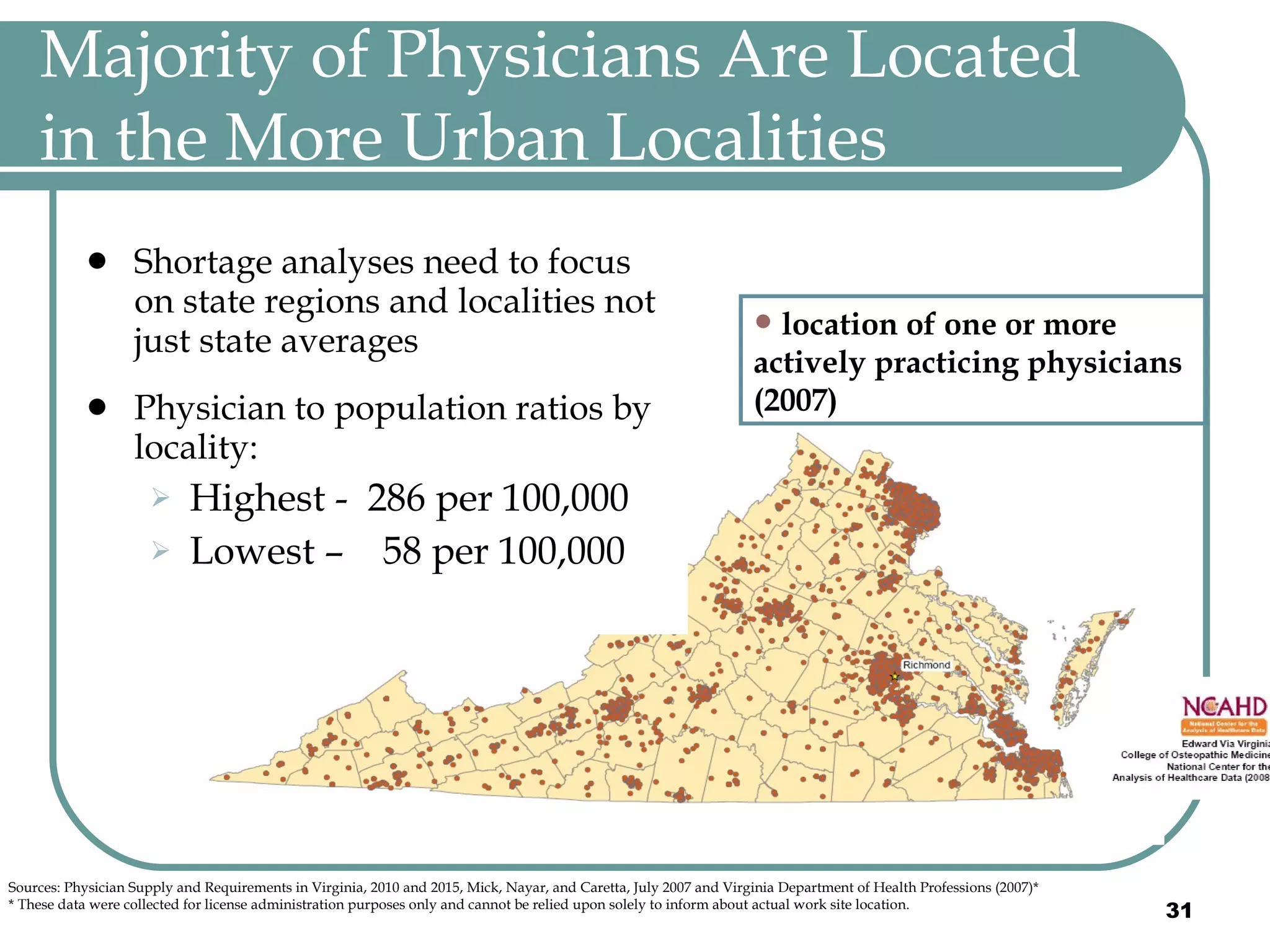
Majority of Physicians Are Located in the More Urban Localities Shortage analyses need to focus on state regions and localities not just state averages  Physician to population ratios by locality: Highest -  286 per 100,000 Lowest –  58 per 100,000 location of one or more actively practicing physicians  (2007) Sources: Physician Supply and Requirements in Virginia, 2010 and 2015, Mick, Nayar, and Caretta, July 2007 and Virginia Department of Health Professions (2007)*   * These data were collected for license administration purposes only and cannot be relied upon solely to inform about actual work site location.
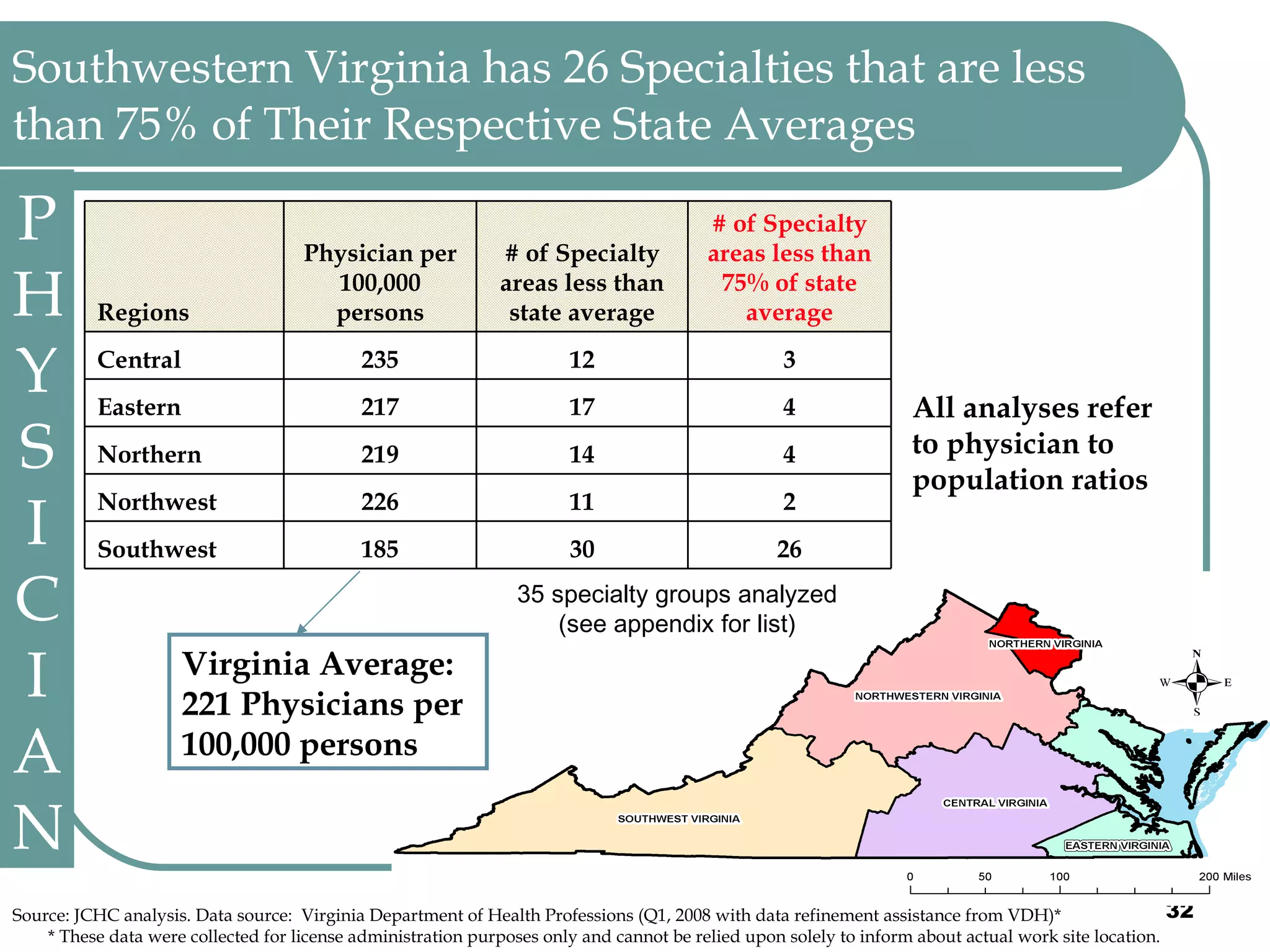
Southwestern Virginia has 26 Specialties that are less than 75% of Their Respective State Averages PHYSICIAN Source: JCHC analysis. Data source:  Virginia Department of Health Professions (Q1, 2008 with data refinement assistance from VDH)*            * These data were collected for license administration purposes only and cannot be relied upon solely to inform about actual work site location. Virginia Average: 221 Physicians per  100,000 persons 35 specialty groups analyzed (see appendix for list) All analyses refer to physician to population ratios 185 226 219 217 235 Physician per 100,000 persons 4 14 Northern 3 12 Central 4 17 Eastern 26 30 Southwest 2 11 Northwest # of Specialty areas less than 75% of state average # of Specialty areas less than state average Regions
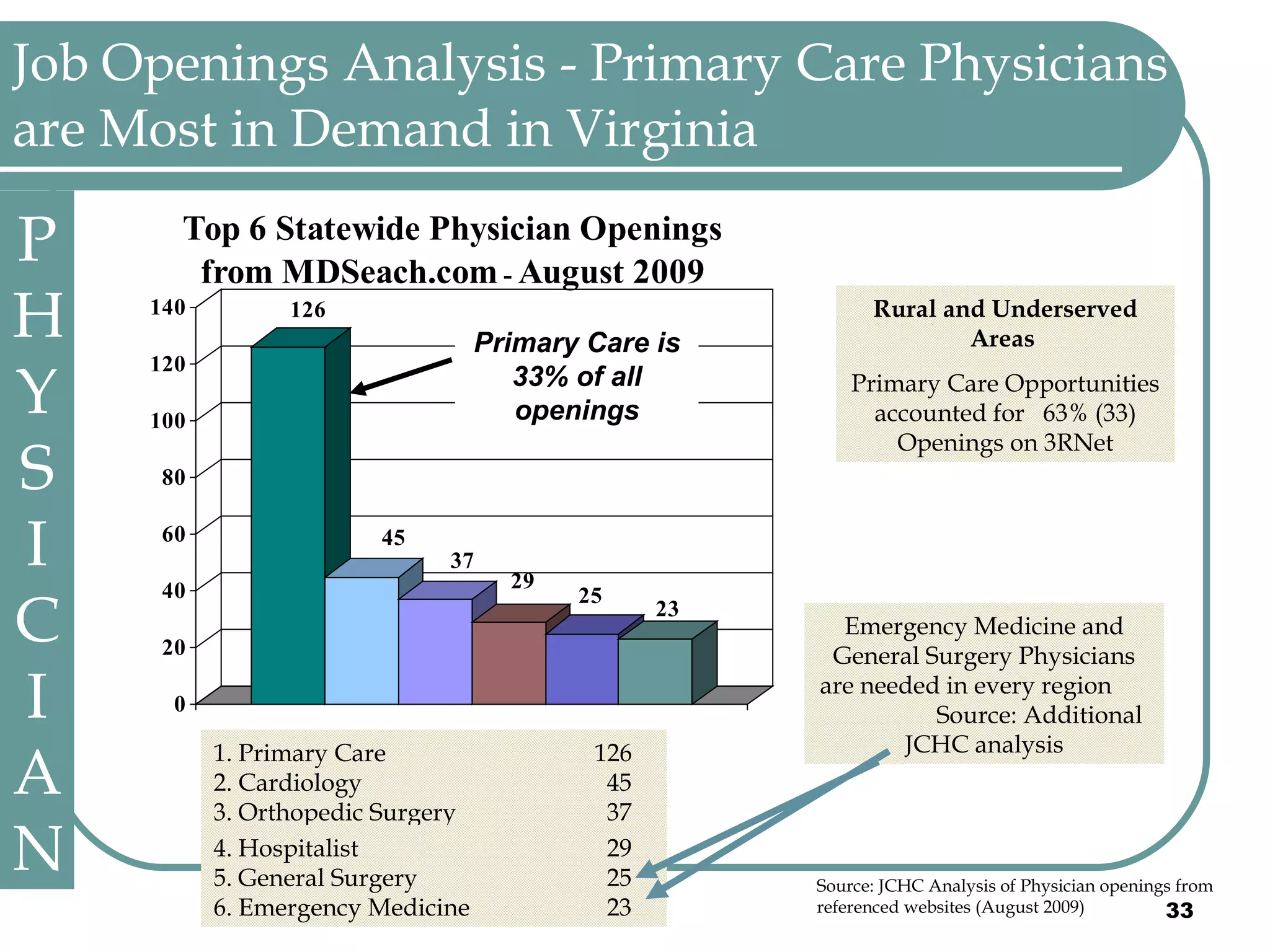
Job Openings Analysis - Primary Care Physicians are Most in Demand in Virginia Primary Care is 33% of all openings Rural and Underserved Areas  Primary Care Opportunities accounted for  63% (33) Openings on 3RNet Emergency Medicine and General Surgery Physicians are needed in every region  Source: Additional JCHC analysis PHYSICIAN 1. Primary Care 126 2. Cardiology    45 3. Orthopedic Surgery    37 4. Hospitalist    29 5. General Surgery    25 6. Emergency Medicine    23 Source: JCHC Analysis of Physician openings from referenced websites (August 2009)
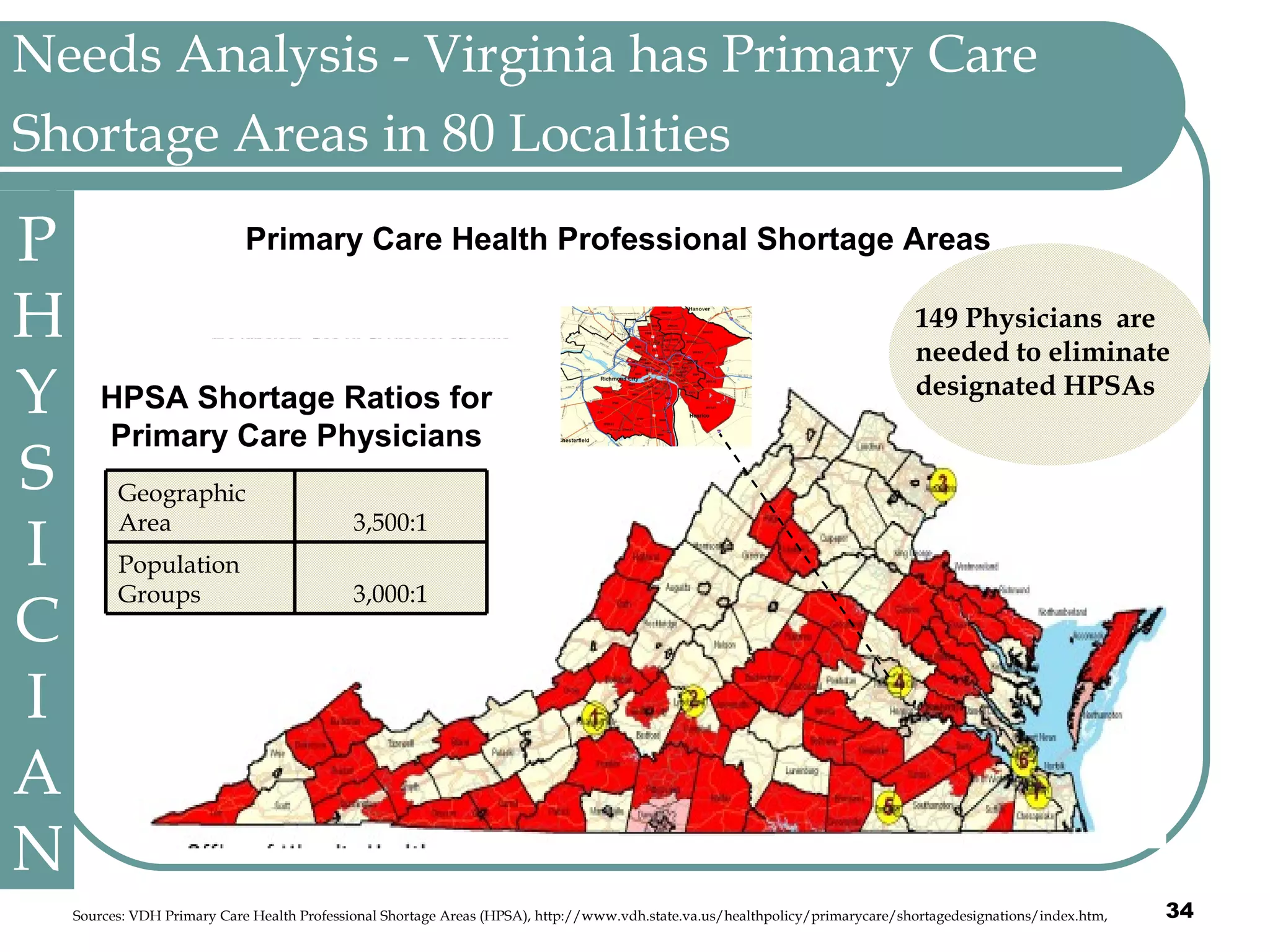
Needs Analysis - Virginia has Primary Care Shortage Areas in 80 Localities   Primary Care Health Professional Shortage Areas   HPSA Shortage Ratios for Primary Care Physicians PHYSICIAN Sources: VDH Primary Care Health Professional Shortage Areas (HPSA), http://www.vdh.state.va.us/healthpolicy/primarycare/shortagedesignations/index.htm, 3,000:1 Population Groups 3,500:1 Geographic Area 149 Physicians  are needed to eliminate designated HPSAs
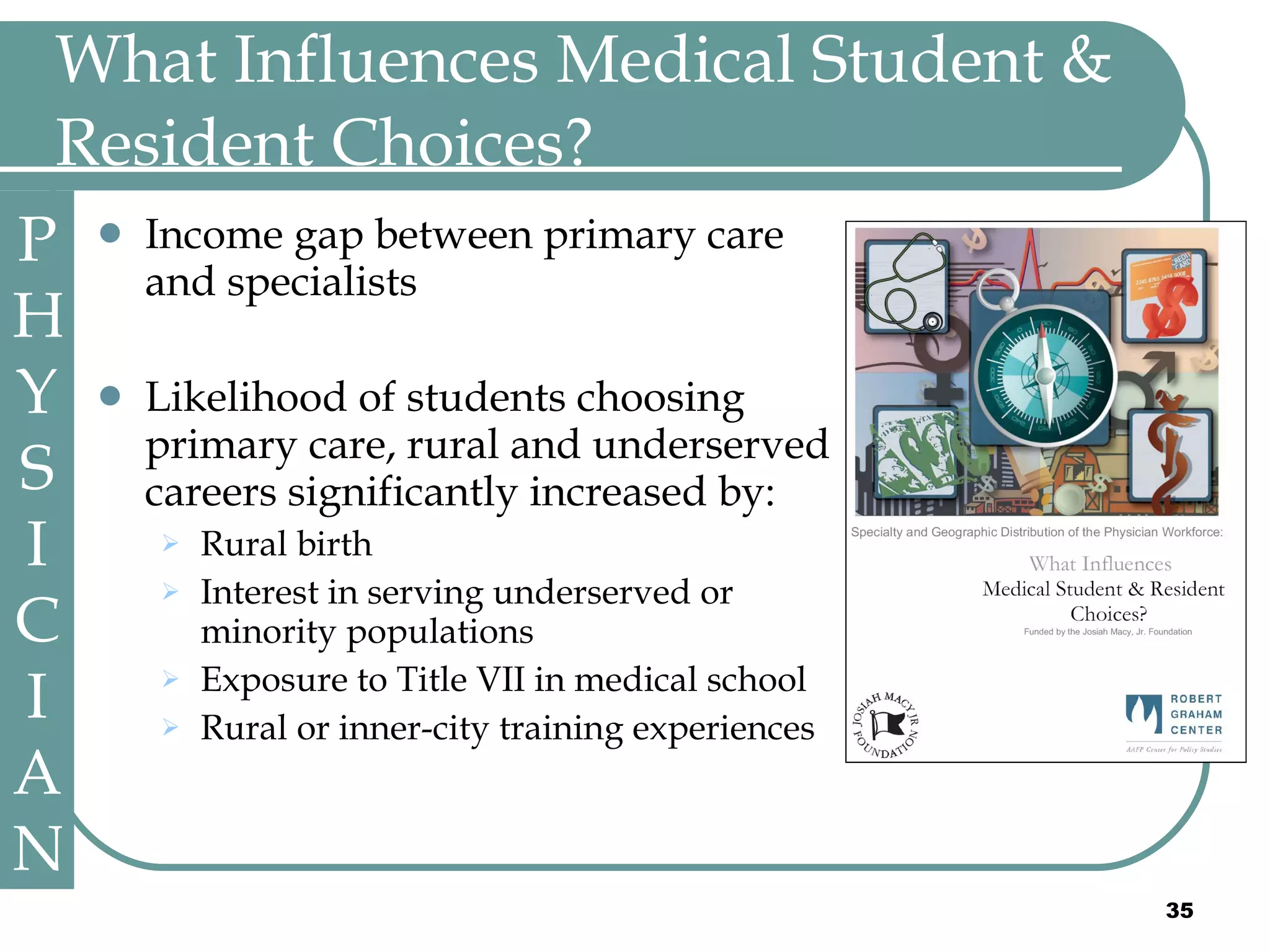
What Influences Medical Student & Resident Choices? Income gap between primary care and specialists Likelihood of students choosing primary care, rural and underserved careers significantly increased by: Rural birth  Interest in serving underserved or minority populations Exposure to Title VII in medical school Rural or inner-city training experiences PHYSICIAN
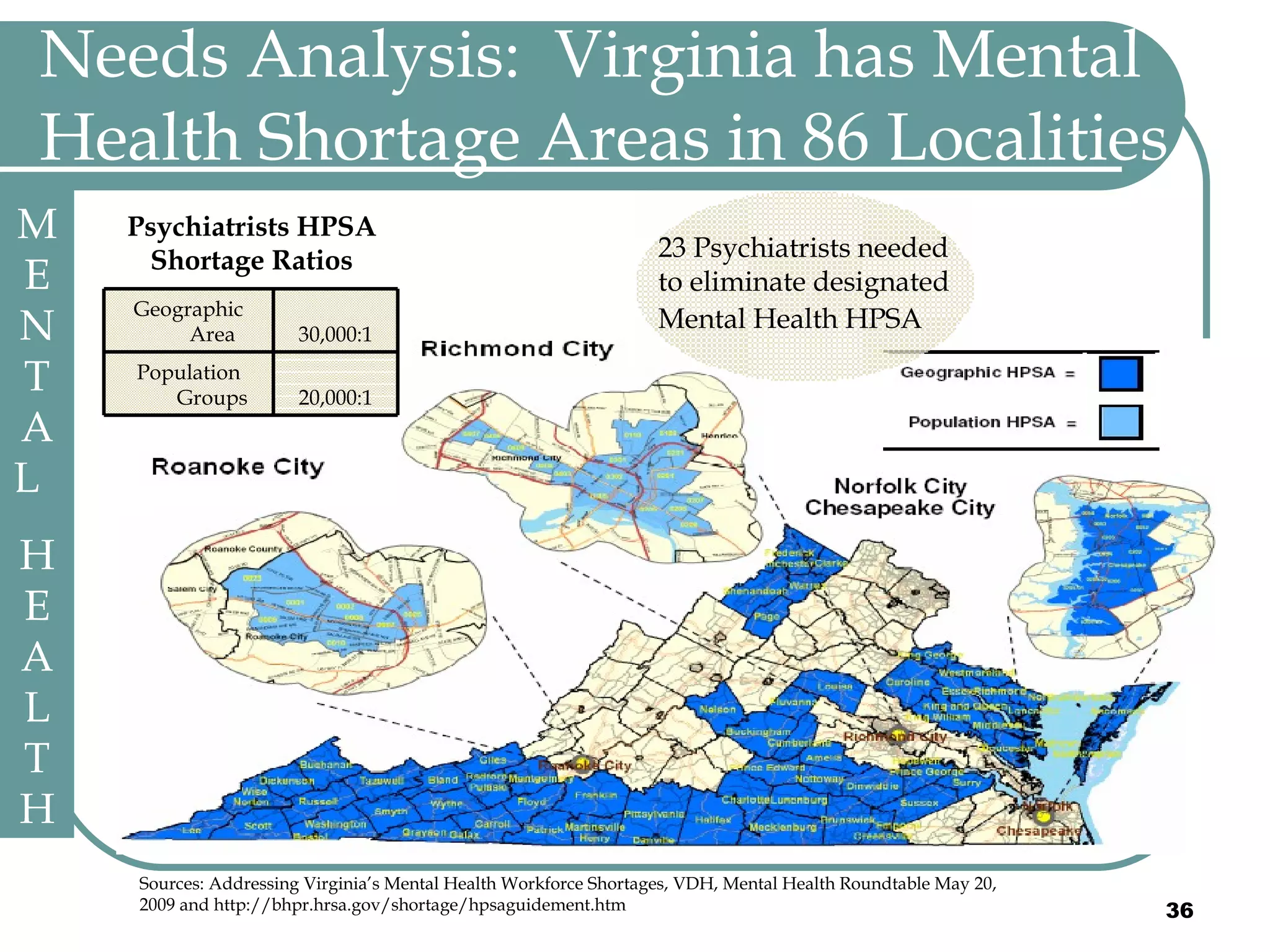
Needs Analysis:  Virginia has Mental Health Shortage Areas in 86 Localities Psychiatrists HPSA Shortage Ratios 23 Psychiatrists needed to eliminate designated Mental Health HPSA   MENTAL  HEALTH Sources: Addressing Virginia’s Mental Health Workforce Shortages, VDH, Mental Health Roundtable May 20, 2009 and http://bhpr.hrsa.gov/shortage/hpsaguidement.htm 20,000:1 Population Groups 30,000:1 Geographic Area
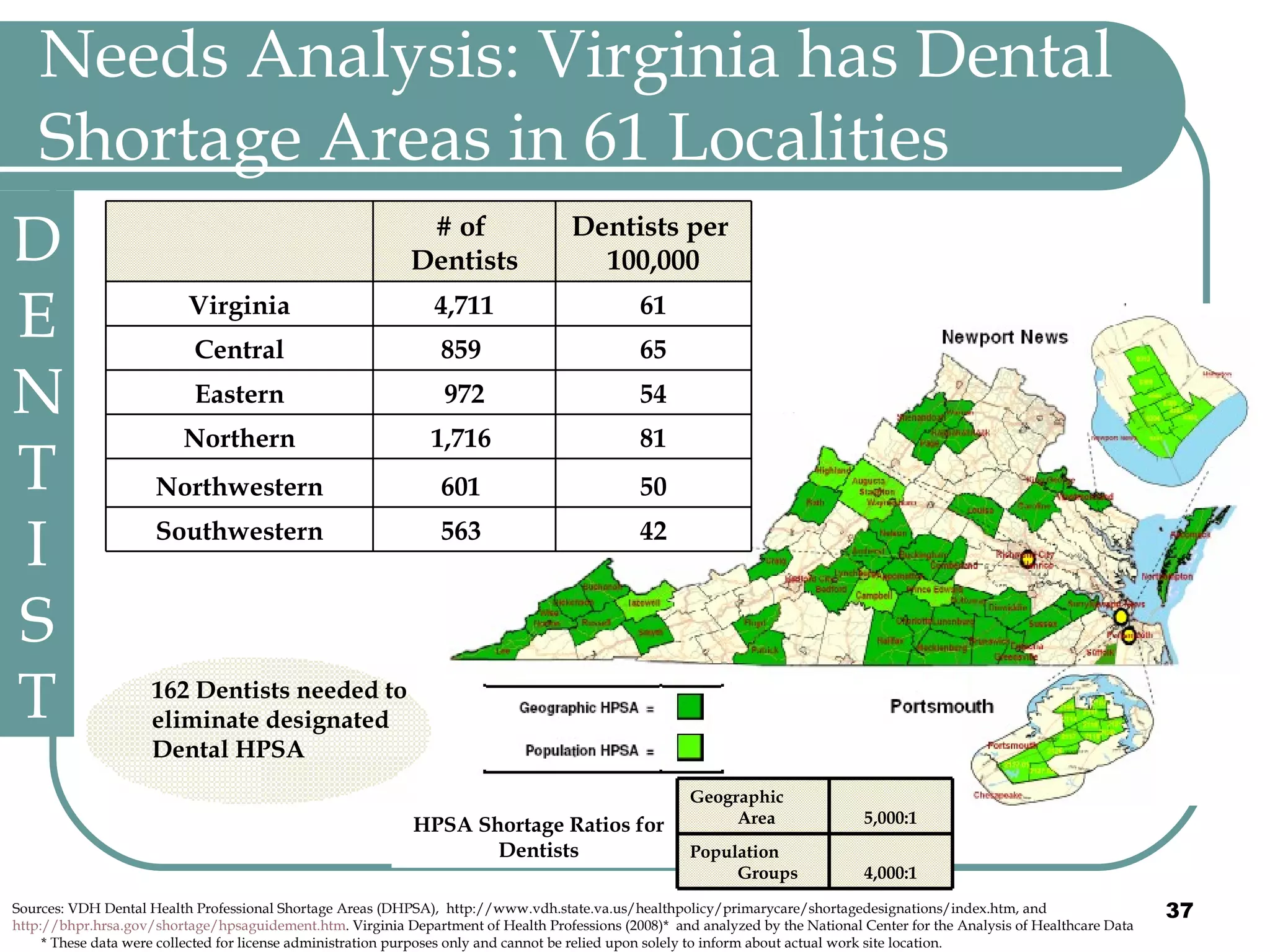
Needs Analysis: Virginia has Dental Shortage Areas in 61 Localities HPSA Shortage Ratios for Dentists DENTIST Sources: VDH Dental Health Professional Shortage Areas (DHPSA),  http://www.vdh.state.va.us/healthpolicy/primarycare/shortagedesignations/index.htm, and  http://bhpr.hrsa.gov/shortage/hpsaguidement.htm . Virginia Department of Health Professions (2008)*  and analyzed by the National Center for the Analysis of Healthcare Data          * These data were collected for license administration purposes only and cannot be relied upon solely to inform about actual work site location. 4,000:1 Population Groups 5,000:1 Geographic Area 162 Dentists needed to eliminate designated Dental HPSA 61 4,711 Virginia 42 563  Southwestern 50 601  Northwestern 81 1,716  Northern 54 972  Eastern 65 859  Central Dentists per  100,000 # of  Dentists  
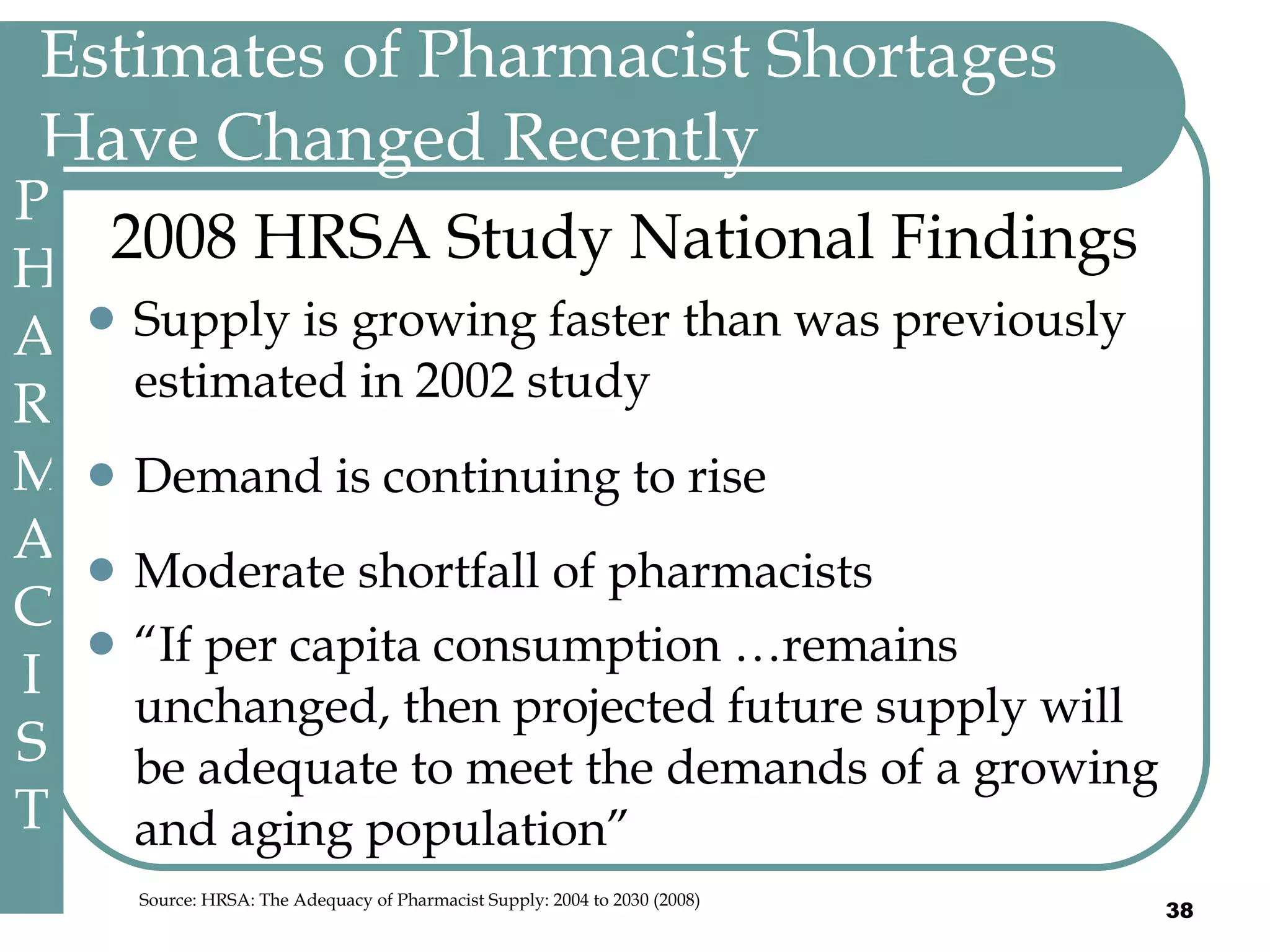
Estimates of Pharmacist Shortages Have Changed Recently  2008 HRSA Study National Findings Supply is growing faster than was previously estimated in 2002 study Demand is continuing to rise Moderate shortfall of pharmacists “ If per capita consumption …remains unchanged, then projected future supply will be adequate to meet the demands of a growing and aging population” PHARMACIST  Source: HRSA: The Adequacy of Pharmacist Supply: 2004 to 2030 (2008)
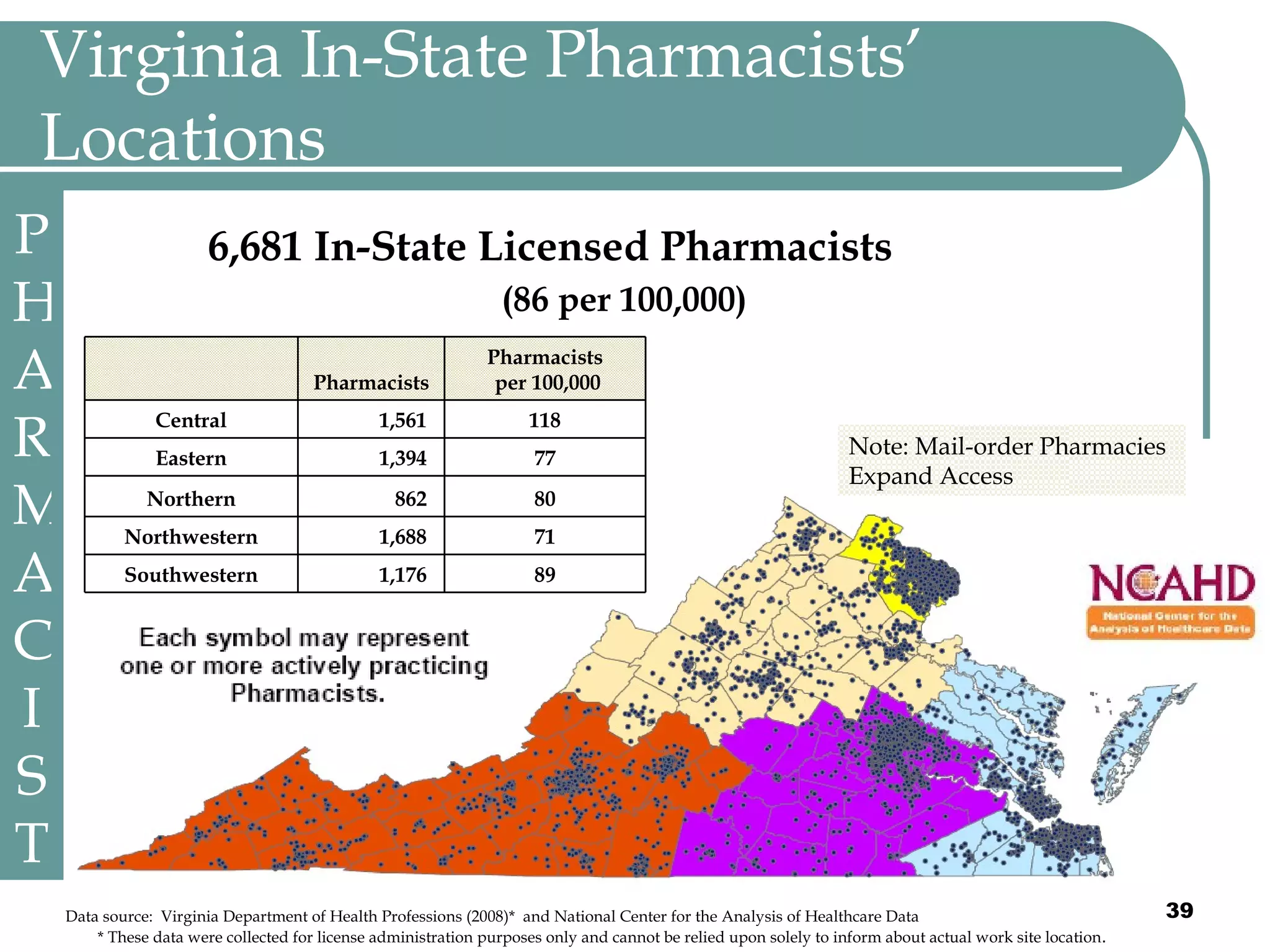
Virginia In-State Pharmacists’ Locations PHARMACIST Note: Mail-order Pharmacies Expand Access Data source:  Virginia Department of Health Professions (2008)*  and National Center for the Analysis of Healthcare Data          * These data were collected for license administration purposes only and cannot be relied upon solely to inform about actual work site location . 6,681 In-State Licensed Pharmacists  (86 per 100,000) 89 1,176  Southwestern 71 1,688  Northwestern 80 862  Northern 77 1,394  Eastern 118 1,561  Central Pharmacists per 100,000 Pharmacists  
JCHC Recommended Policies
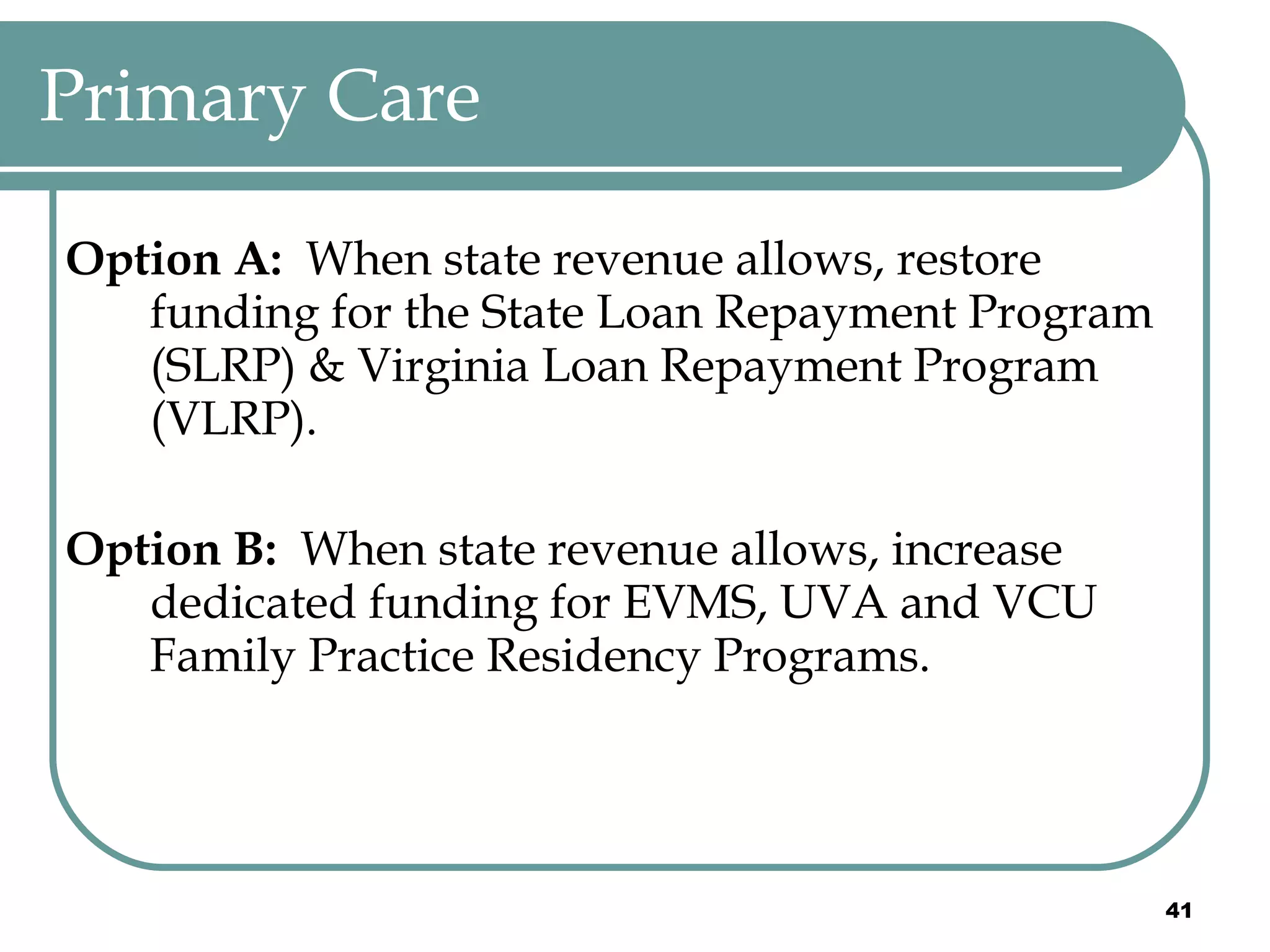
Primary Care Option A:   When state revenue allows, restore funding for the State Loan Repayment Program (SLRP) & Virginia Loan Repayment Program (VLRP). Option B:  When state revenue allows, increase dedicated funding for EVMS, UVA and VCU Family Practice Residency Programs.
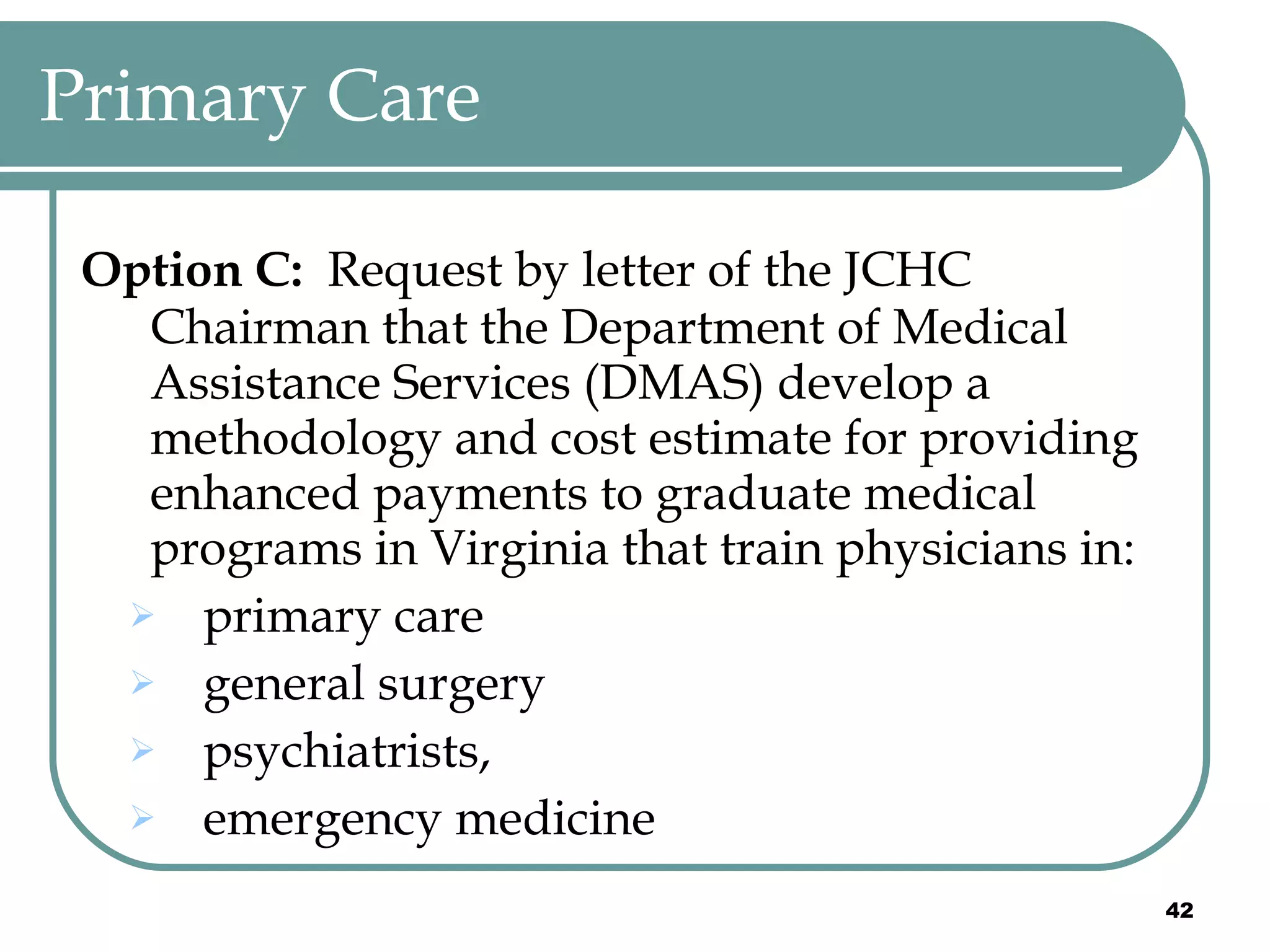
Primary Care Option C:   Request by letter of the JCHC Chairman that the Department of Medical Assistance Services (DMAS) develop a methodology and cost estimate for providing enhanced payments to graduate medical programs in Virginia that train physicians in: primary care general surgery psychiatrists,  emergency medicine
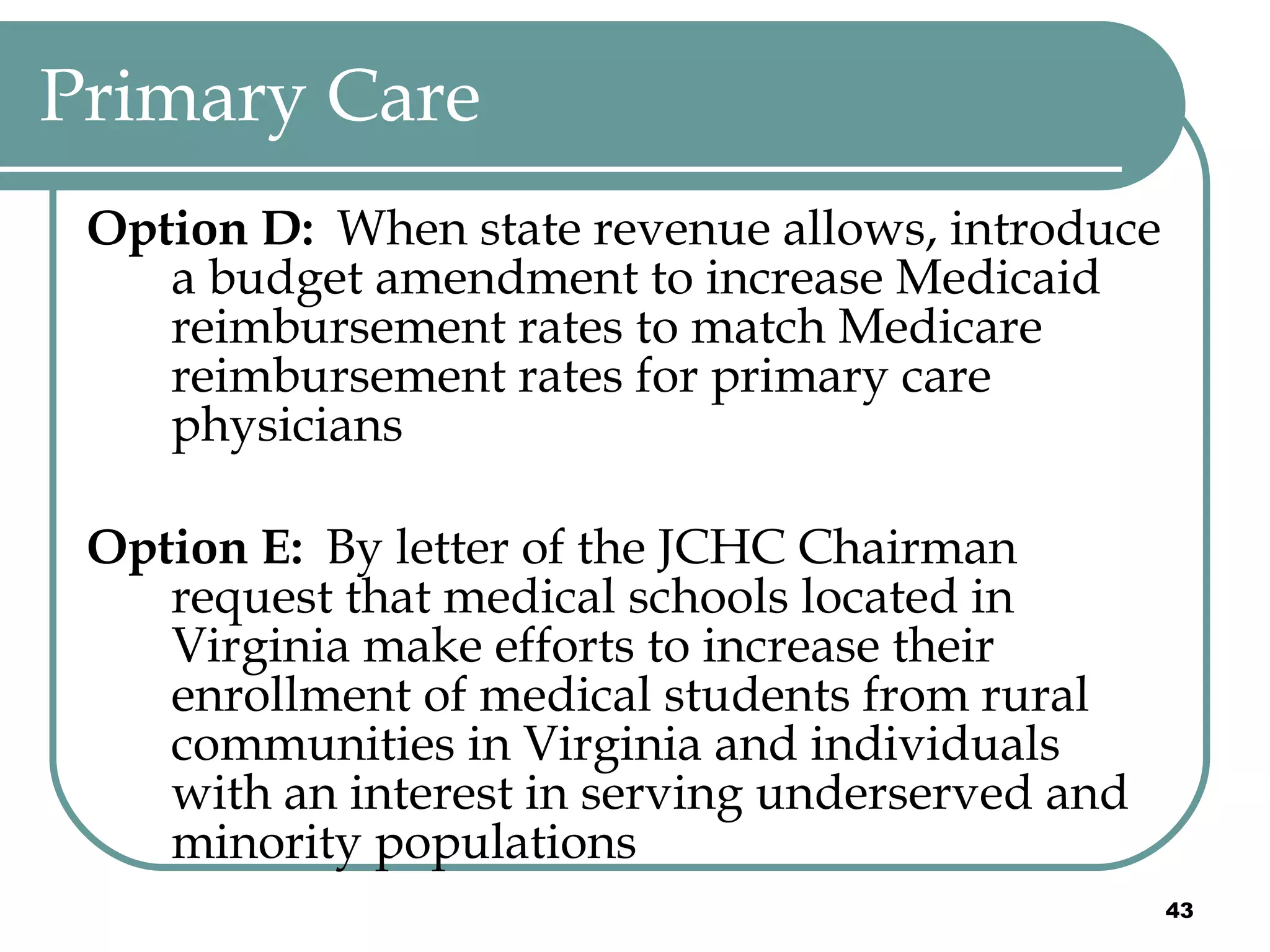
Primary Care Option D:  When state revenue allows, introduce a budget amendment to increase Medicaid reimbursement rates to match Medicare reimbursement rates for primary care physicians Option E:  By letter of the JCHC Chairman request that medical schools located in Virginia make efforts to increase their enrollment of medical students from rural communities in Virginia and individuals with an interest in serving underserved and minority populations
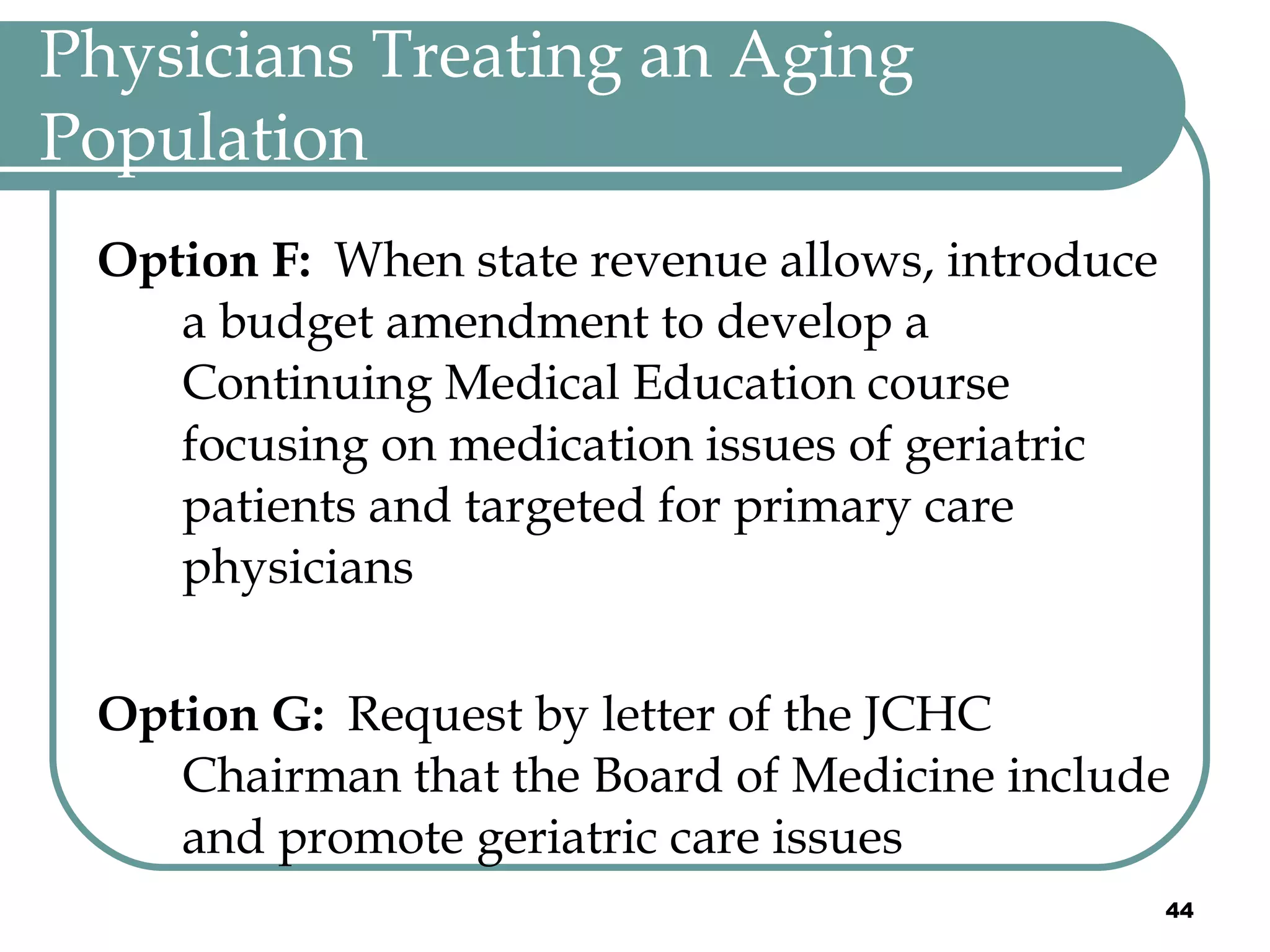
Physicians Treating an Aging Population Option F:  When state revenue allows, introduce a budget amendment to develop a Continuing Medical Education course focusing on medication issues of geriatric patients and targeted for primary care physicians  Option G:  Request by letter of the JCHC Chairman that the Board of Medicine include and promote geriatric care issues
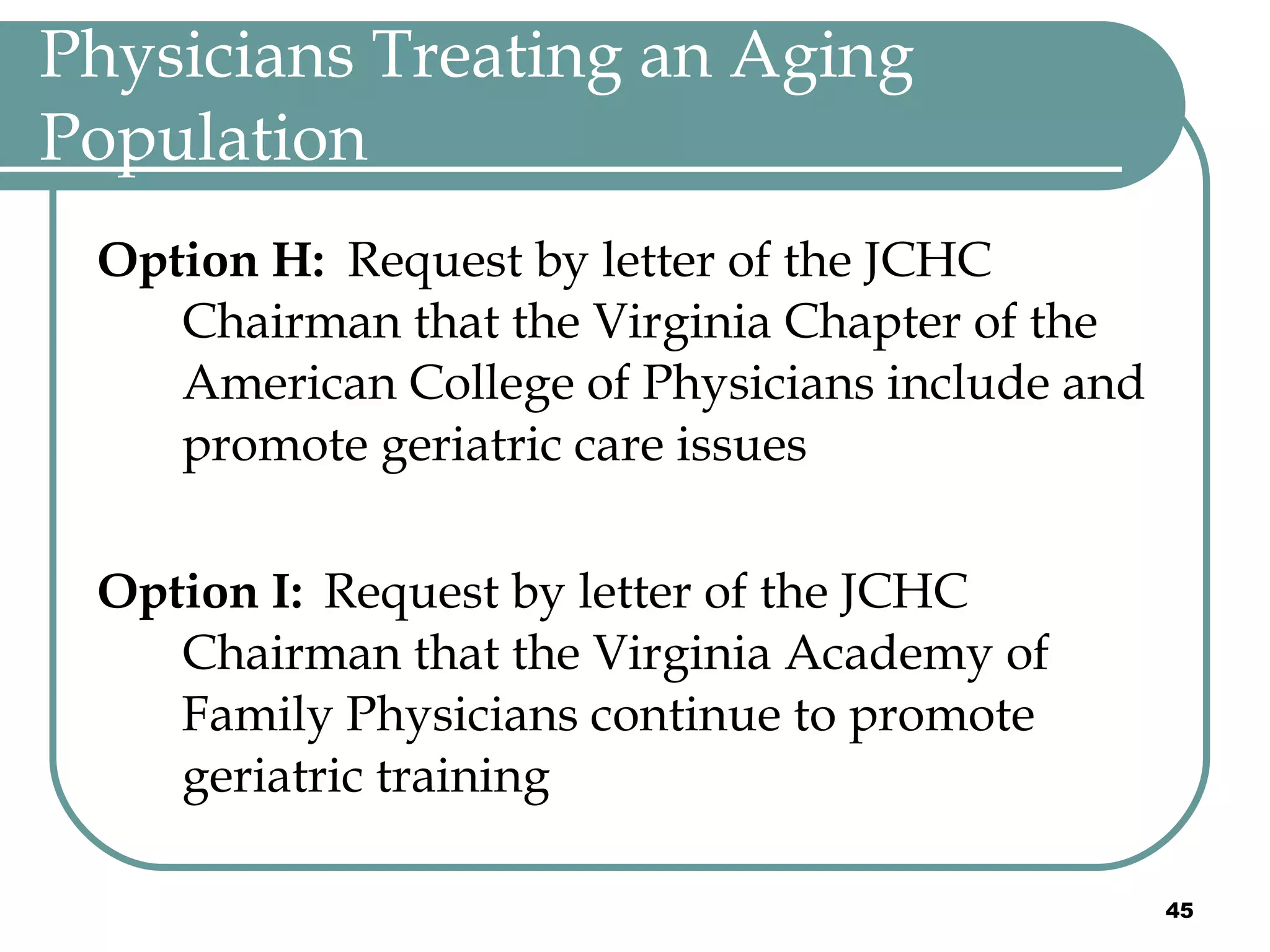
Physicians Treating an Aging Population Option H:  Request by letter of the JCHC Chairman that the Virginia Chapter of the American College of Physicians include and promote geriatric care issues Option I:   Request by letter of the JCHC Chairman that the Virginia Academy of Family Physicians continue to promote geriatric training
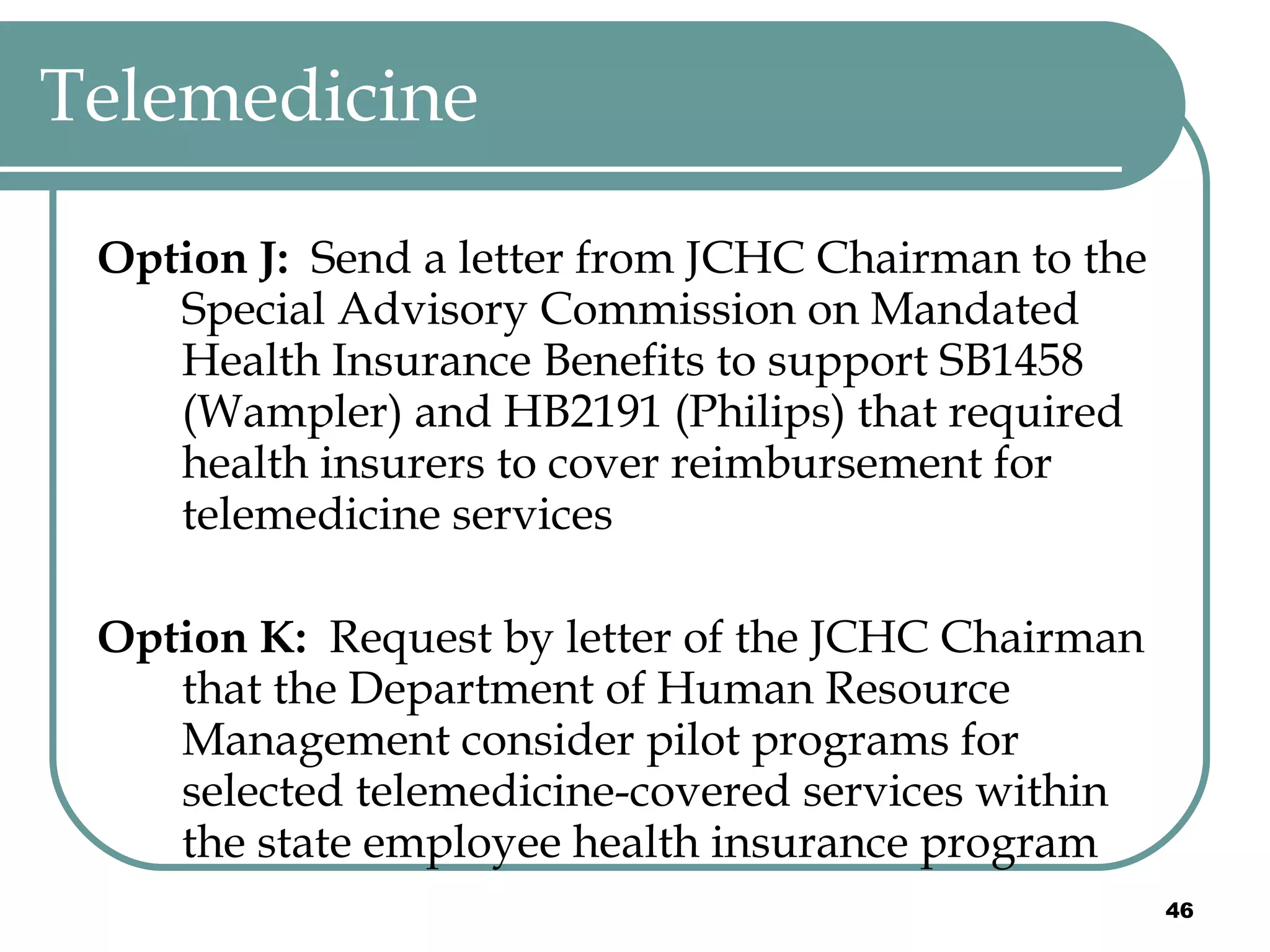
Telemedicine Option J:  Send a letter from JCHC Chairman to the Special Advisory Commission on Mandated Health Insurance Benefits to support SB1458 (Wampler) and HB2191 (Philips) that required health insurers to cover reimbursement for telemedicine services Option K:  Request by letter of the JCHC Chairman that the Department of Human Resource Management consider pilot programs for selected telemedicine-covered services within the state employee health insurance program
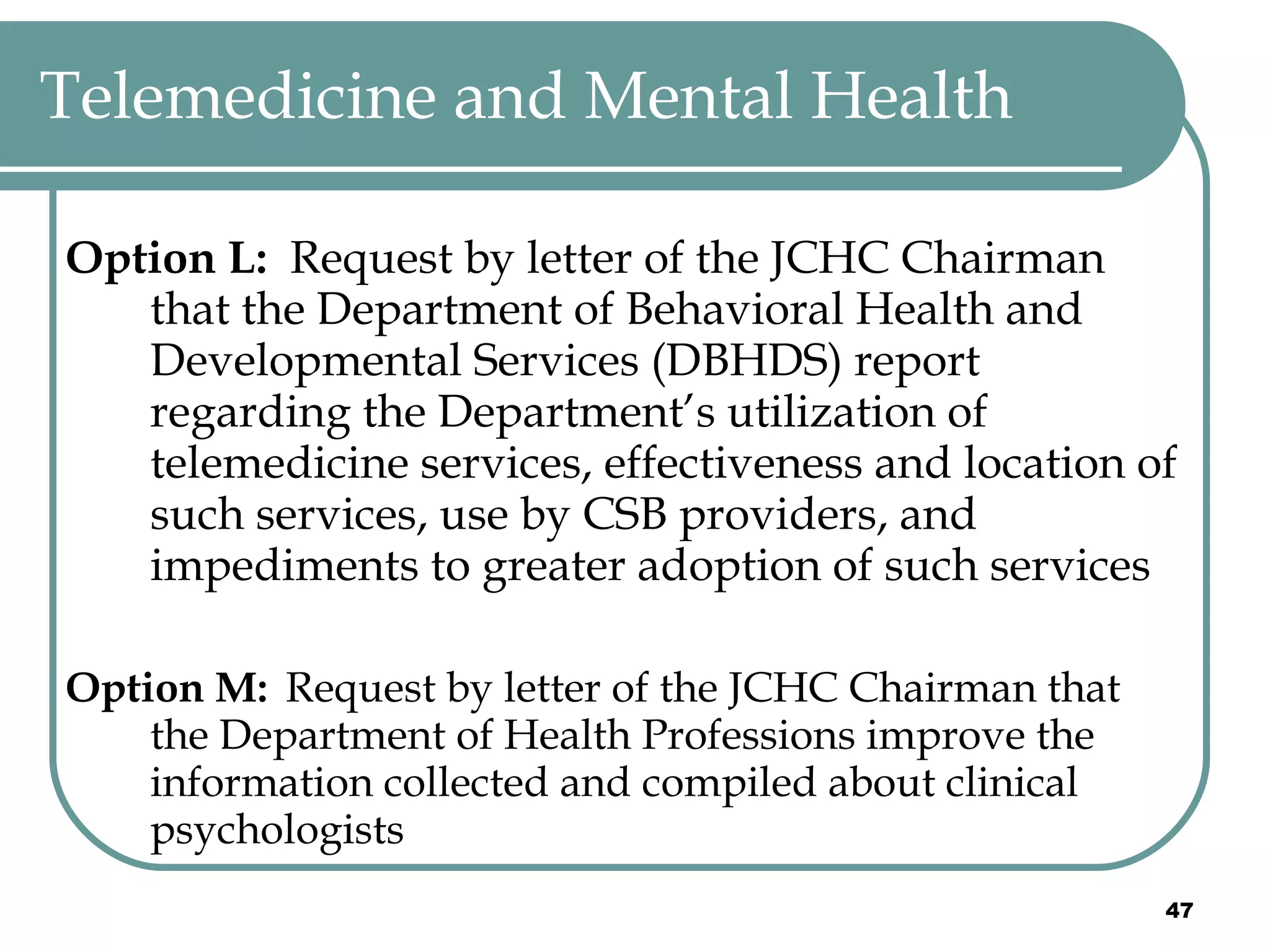
Telemedicine and Mental Health Option L:  Request by letter of the JCHC Chairman that the Department of Behavioral Health and Developmental Services (DBHDS) report regarding the Department’s utilization of telemedicine services, effectiveness and location of such services, use by CSB providers, and impediments to greater adoption of such services Option M:   Request by letter of the JCHC Chairman that the Department of Health Professions improve the information collected and compiled about clinical psychologists
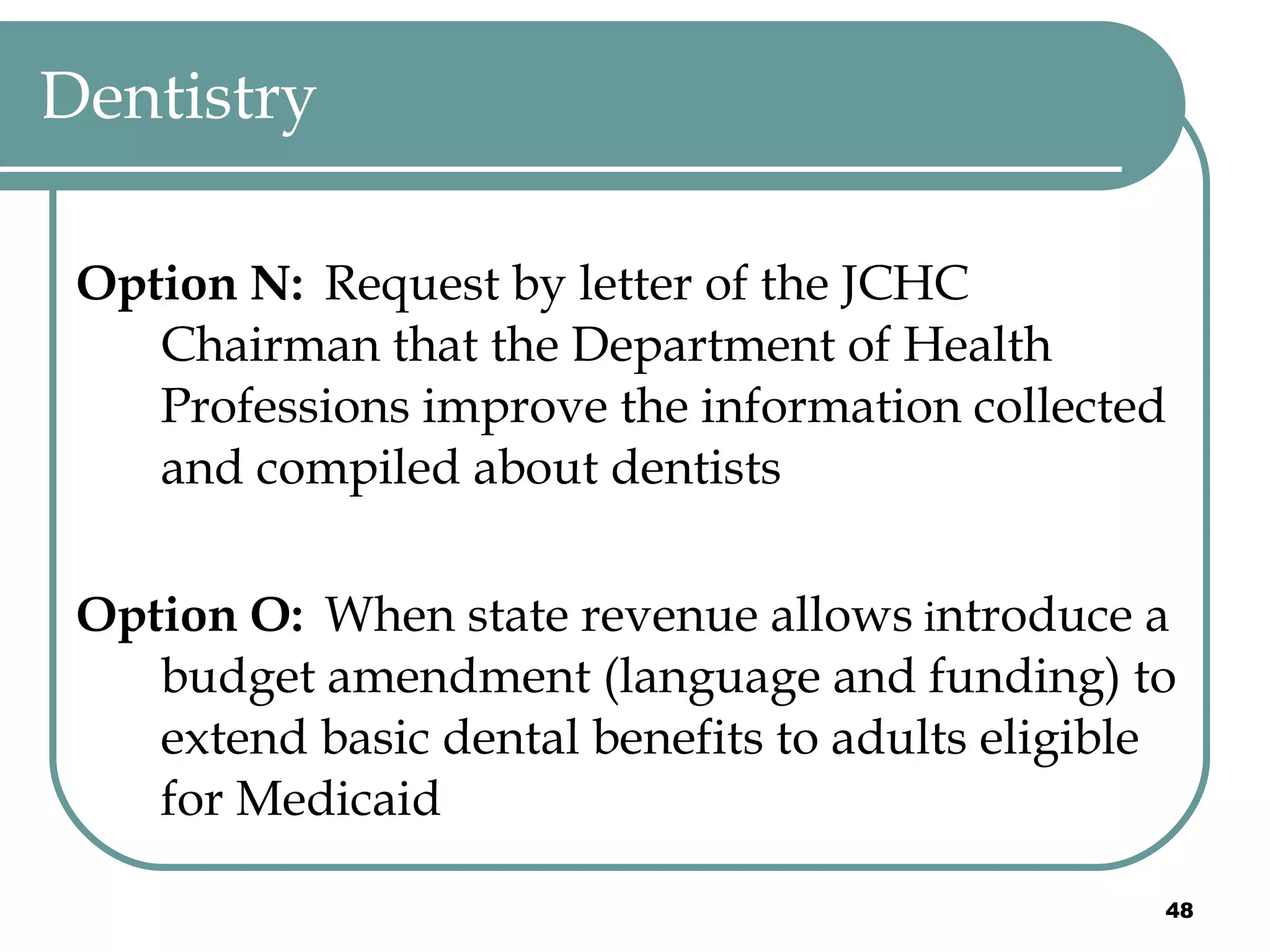
Dentistry Option N:   Request by letter of the JCHC Chairman that the Department of Health Professions improve the information collected and compiled about dentists Option O:   When state revenue allows  i ntroduce a budget amendment (language and funding) to extend basic dental benefits to adults eligible for Medicaid
Contact Information  The full presentation given to JCHC September 1, 2009 that includes additional data and analyses can be found at the JCHC website http://jchc.state.va.us/ Stephen Bowman E-mail: [email_address] Phone: 804-786-5445  Mail:  Joint Commission on Health Care P.O. Box 1322  Richmond, Virginia  23218
JCHC 2010 Studies
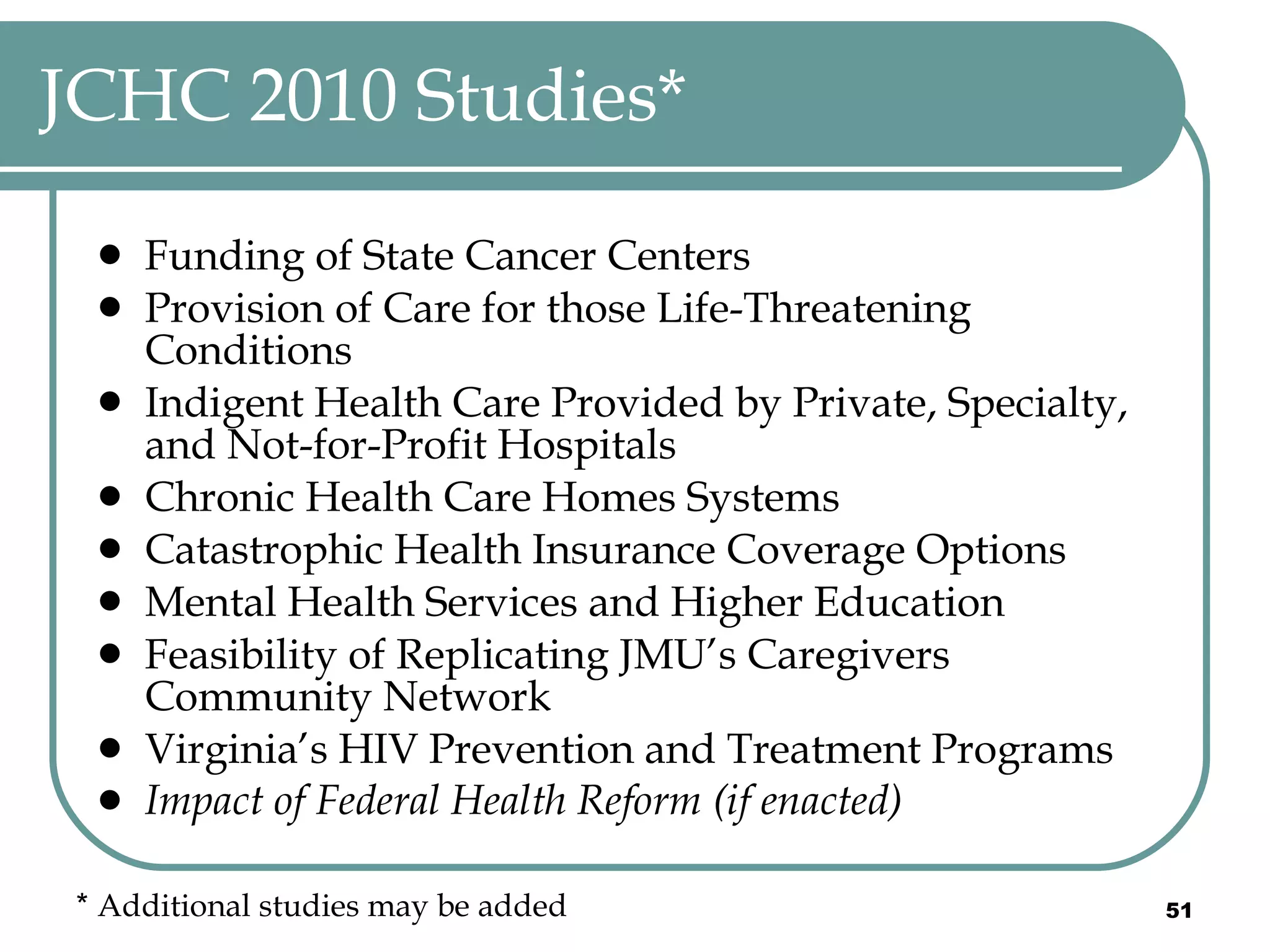
JCHC 2010 Studies* Funding of State Cancer Centers  Provision of Care for those Life-Threatening Conditions  Indigent Health Care Provided by Private, Specialty, and Not-for-Profit Hospitals Chronic Health Care Homes Systems Catastrophic Health Insurance Coverage Options Mental Health Services and Higher Education  Feasibility of Replicating JMU’s Caregivers Community Network  Virginia’s HIV Prevention and Treatment Programs  Impact of Federal Health Reform (if enacted) *  Additional studies may be added
APPENDIX: JCHC Health Care Workforce Presentation
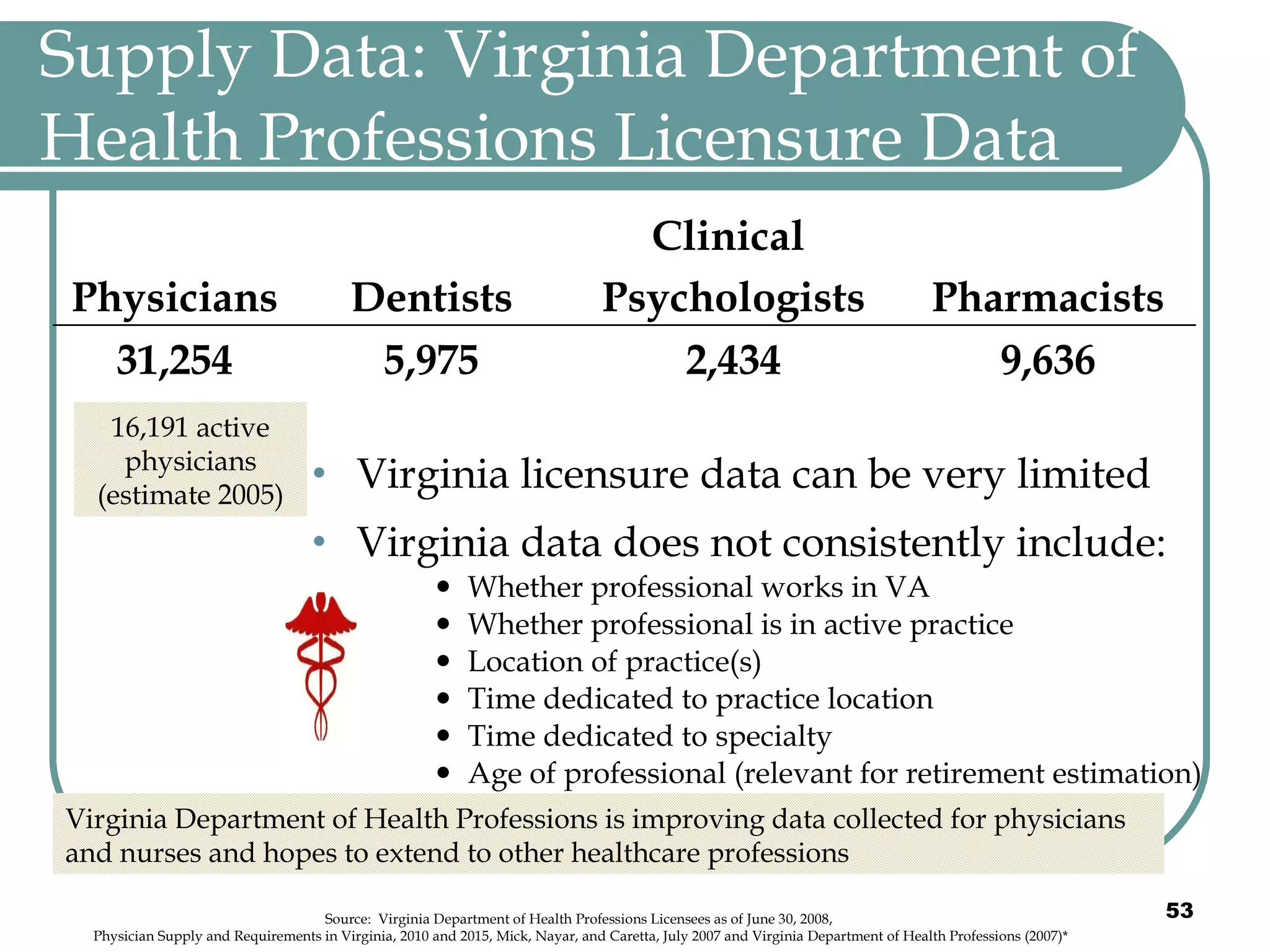
Supply Data: Virginia Department of Health Professions Licensure Data Virginia licensure data can be very limited Virginia data does not consistently include: Whether professional works in VA Whether professional is in active practice Location of practice(s) Time dedicated to practice location Time dedicated to specialty  Age of professional (relevant for retirement estimation) Virginia Department of Health Professions is improving data collected for physicians and nurses and hopes to extend to other healthcare professions Source:  Virginia Department of Health Professions Licensees as of June 30, 2008,  Physician Supply and Requirements in Virginia, 2010 and 2015, Mick, Nayar, and Caretta, July 2007 and Virginia Department of Health Professions (2007)* 16,191 active physicians (estimate 2005) 9,636 2,434 5,975 31,254 Pharmacists Clinical  Psychologists Dentists Physicians
Medical Schools :   EVMS, UVA,   & VCU (2008)   Family Practice Residency Programs:  EVMS, UVA & VCU   Pink Denotes Addressing Maldistribution Best JCHC Analysis - sources: JCHC files J-1 Visa Waiver State Loan Repayment Programs   (FY08 ) Investment Needed for 1 Primary Care Physician Practicing in Virginia $255,401   minimal* $185,968  $858,938  State Investment to Develop  1 Primary Care Physician that Practices  In-state  100%  100% 100%   38.6% %  Physicians Initially Specializing in Primary Care $255,401     minimal * $185,968  $331,396  State Investment to Develop  1 Physician that Practices In-state 76%  40%  61%  35% % Likely to practice Virginia   $194,104 admin* $113,441  $115,989  State Funds Per Participant Per Program Completion 4  3 3  4 Average Years to  Program Completion   $48,526 admin*   $37,814 $28,997  Average State Funding per Year per Participant   19 18   233 1,745 Program Participants $921,988  admin*   $8,810,557 $50,600,000  State Funding (2008)
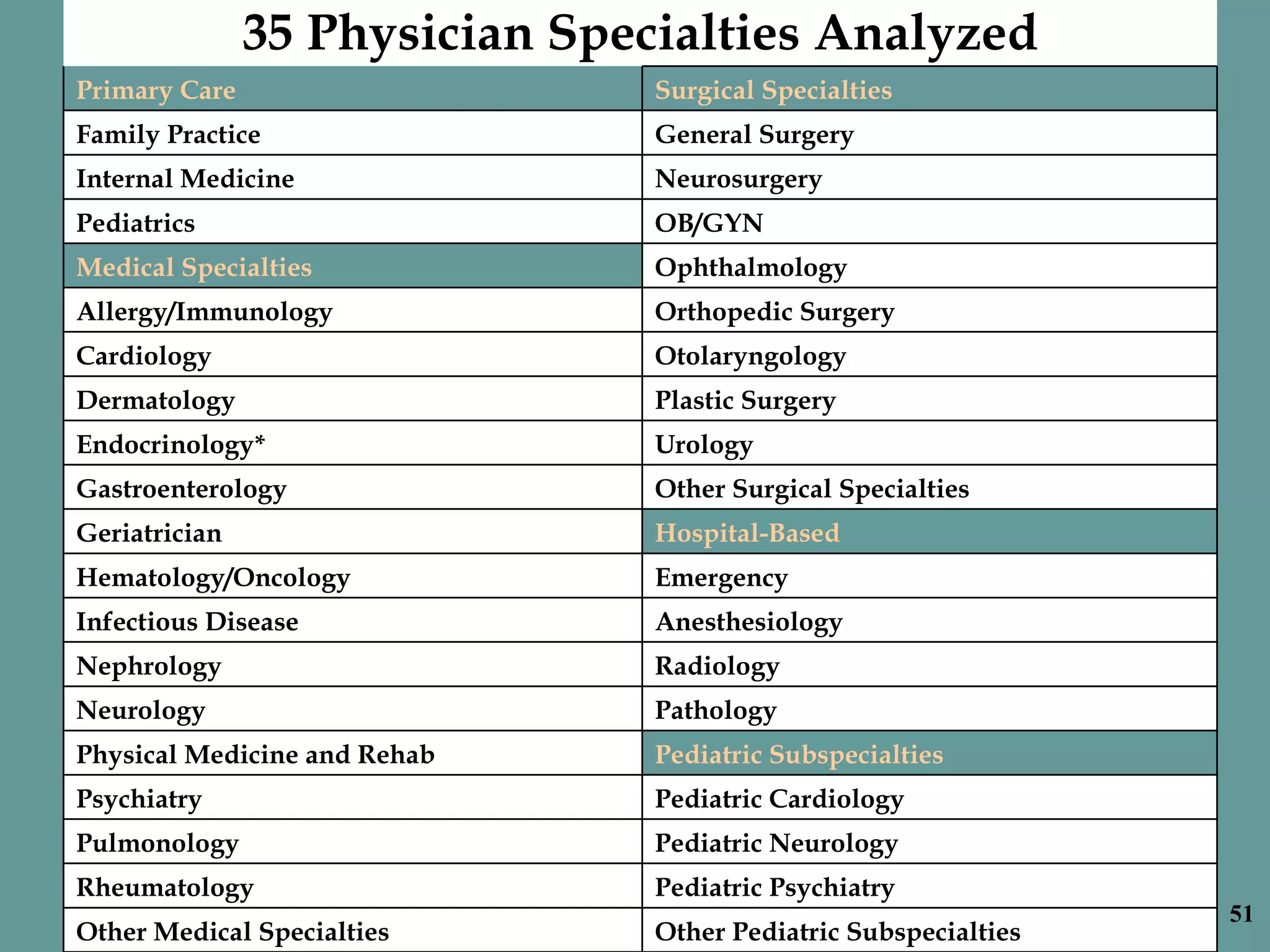
51 Other Pediatric Subspecialties Other Medical Specialties Pediatric Psychiatry  Rheumatology  Pediatric Neurology  Pulmonology  Pediatric Cardiology  Psychiatry  Pediatric Subspecialties  Physical Medicine and Rehab  Pathology  Neurology  Radiology  Nephrology  Anesthesiology  Infectious Disease Emergency  Hematology/Oncology  Hospital-Based  Geriatrician Other Surgical Specialties Gastroenterology  Urology  Endocrinology*  Plastic Surgery  Dermatology  Otolaryngology  Cardiology  Orthopedic Surgery  Allergy/Immunology  Ophthalmology  Medical Specialties  OB/GYN  Pediatrics  Neurosurgery  Internal Medicine  General Surgery  Family Practice  Surgical Specialties  Primary Care  35 Physician Specialties Analyzed

Nutter

  • 1.
    2010 Virginia GeneralAssembly Session & JCHC Workforce Recommendations Delegate Dave Nutter - Member of the Joint Commission on Health Care Stephen Bowman, J.D., M.P.P. - Senior Staff Attorney, Joint Commission on Health Care March 16, 2010
  • 2.
    Agenda General AssemblyBills Passed State Budget JCHC Health Care Workforce Presentation and Recommendations JCHC Studies for 2010
  • 3.
    Bills Pending Governor’s Signature
  • 4.
    Creation of theVirginia Health Workforce Development Authority House Bill 1304 - Delegate Dave Nutter Senate Bill 731 - Senator Roscoe Reynolds Takes over the duties of the Statewide AHEC program Facilitates the development of a statewide health professions pipeline that identifies, educates, recruits, and retains a competent quality workforce
  • 5.
    Requires Insurers toCover Telemedicine Services Senate Bill 675 – Senator William Wampler Health insurers and HMOs must reimburse for healthcare services provided through telemedicine Reimbursement for professional services that are already allowed Insurers covered are those regulated by state law Primarily individual and small group policies Not employer self-funded plans Law takes effect January 1, 2011 for: New, reissued, and extended policies
  • 6.
    Government Can’t RequireIndividuals to Have Insurance Coverage Senate Bill 283 – Senator Frederick Quayle Senate Bill 311 - Senator Stephen Martin Senate Bill 417 - Senator Jill Vogel House Bill 10 - Delegate Robert Marshall Bills state that no Virginia resident can be required to have health insurance Issue: State law sets the legal groundwork for a constitutional challenge if a federal law requires individuals obtain health insurance
  • 7.
    Southwest Virginia HealthAuthority Board Members Added House Bill 1187 – Delegate Clarence Philips Four Additional Board Members Presidents or designees from: East Tennessee State University Quillen College of Medicine Frontier Health University of Appalachia College of Pharmacy Edward Via Virginia College of Osteopathic Medicine
  • 8.
    Identification Requirement forIndividuals Seeking Schedule II Drugs House Bill 964 – Delegate Matt Lohr Pharmacist will: Require identification from any person seeking to fill a Schedule II drug prescription if not known to the pharmacist If a person seeks to pickup Schedule II drug prescription for someone else pharmacist will make a copy of the identification provided regardless if individual picking up the prescription is known to the pharmacist Maintain records of names, addresses and copies of identification documents for at least one year
  • 9.
    Civil Immunity forPractitioners Reporting Suspicion of Individuals Unlawfully Obtaining Controlled Substances House Bill 1166 – Delegate Clarence Philips Individuals protected are persons that prescribe, dispense, or administer controlled substances Physician, podiatrist, dentist, veterinarian, nurse practitioner and physician assistant Instances civil immunity applies are when a practitioner* Suspects a person obtained or attempted to obtain a controlled substance or prescription for a controlled substance by fraud or deceit, and In good faith reports or furnishes information or records to a law-enforcement *No requirement for practitioner to report
  • 10.
  • 11.
    Before We CanGet to the Approved Budget … Transferred program monies for: Nursing scholarship and loan repayment Medical scholarship and loan repayment Reduced funding for: Virginia’s free clinics Community health centers Virginia Health Care Foundation Other health clinics Source: Virginia State Budget website - http://leg2.state.va.us/MoneyWeb.NSF/sb2010 Governor Kaine’s September 2009 Reductions
  • 12.
    Virginia Budget ProcessGovernor introduces budget House of Delegates approves amendments to budget Senate of Virginia approves amendments to budget General Assembly approves budget Governor may amend budget State must close a $4.2 billion deficit for FY11 – FY12 General Assembly considers Governor’s amendments
  • 13.
    General Assembly ApprovedBudget Highlights for Health Care Closes the Adolescent Unit at Southwestern Virginia Mental Health Institute Closure of a 16-bed unit for children and adolescents with acute mental illness by June 30, 2010 Closes the Geriatric Unit at Southwestern Virginia Mental Health Institute Closure of a 40-bed unit for geriatric patients by June 30, 2010 Patients will be transferred to the Piedmont Geriatric Hospital in Burkeville Eliminates Funding for Case Management Obstetrical Service Projects in Five Health Districts Lenowisco, Cumberland Plateau, Three Rivers, Central Shenandoah, and Alleghany Source: Virginia State Budget website - http://leg2.state.va.us/MoneyWeb.NSF/sb2010 APPROVED
  • 14.
    General Assembly ApprovedBudget Highlights for Health Care 3% Medicaid Rate Reductions in FY11 and 4% in FY12 Dental services Inpatient hospital Outpatient hospital Hospital capital Practitioners fees Medicaid Nursing Home Rates 3% rate reduction for each year Capital payments reduction by 0.25 percent in FY11 and 0.5 percent the FY12 Source: Virginia State Budget website - http://leg2.state.va.us/MoneyWeb.NSF/sb2010 APPROVED
  • 15.
    General Assembly ApprovedBudget Highlights for Health Care Reduces Indigent Care Payments to Teaching Hospitals $7.1 million in general funds $7.1 million in non-general funds Many Medicaid reductions will not become effective if the Federal Medical Assistance Percentage (FMAP) is extended Source: Virginia State Budget website - http://leg2.state.va.us/MoneyWeb.NSF/sb2010 APPROVED
  • 16.
    Items Considered forReductions But Not In the Approved Budget Funding Cuts for: Virginia’s free clinics Community health centers Virginia Health Care Foundation Closure of Commonwealth Center for Children and Adolescents in Staunton Source: Virginia State Budget website - http://leg2.state.va.us/MoneyWeb.NSF/sb2010 N OT APPROVED
  • 17.
    Items Considered forReductions But Not In the Approved Budget Adding Antidepressants, Antianxiety and Antipsychotic Drugs to the Medicaid’s Preferred Drug List (PDL) Funding reduction for Local Health Department Services by 5% Source: Virginia State Budget website - http://leg2.state.va.us/MoneyWeb.NSF/sb2010 N OT APPROVED
  • 18.
    Virginia’s Health CareWorkforce: Present and Future Need Physicians, Psychiatrists, Dentists, Clinical Psychologists and Pharmacists Virginia Rural Workforce Summit March 16, 2010 Stephen W. Bowman Senior Staff Attorney/Methodologist Joint Commission on Health Care
  • 19.
    Agenda Demand andSupply Shortages JCHC Recommended Policies
  • 20.
  • 21.
    Virginia’s Increasing PopulationWill Increase the Need for Health Care Services Every year, 281 additional physicians are needed to meet Virginia’s current level of 3.1 per 1,000 (AMA estimate). This does not include physicians needed to replace those retiring or moving. Sources: Virginia Workforce Connection Demographic Information accessed 8-15-09 and JCHC Analysis
  • 22.
    Aging Demographic: VirginiaIs Graying and Older Persons Use More Healthcare Services As compared to the national average of physicians to population: Individuals 65-74 require over 2x Individuals 75+ require over 3x Sources: Bureau of Transportation Statistics http://www.bts.gov/publications/the_changing_face_of_transportation/html/figure_05_18.html U.S. Department of Health and Human Services, http://bhpr.hrsa.gov/healthworkforce/reports/physiciansupplydemand/growthandaging.htm 2025 Percentage of Population over 65 1998
  • 23.
    2,425 Students WereEnrolled in Virginia Medical Schools in 2008 Sources: JCHC email correspondence with each institution and SCHEV. Va. Medical School Takes Shape, Smith and Hardy, Richmond Times Dispatch, January 3, 2007 & WSLS video report, McNew, May 22, 2008 http://www.wsls.com/sls/news/local/article/roanoke_medical_school_has_a_name/11444/ PHYSICIAN 678   191 192 160 135 557 50% 643 2,425 Total (2008)     40 (Expected) 200 (Expected) Virginia Tech Carilion School of Medicine (Roanoke) [Opens August 2010] 139 30% 191 680 Edward Via Virginia College of Osteopathic Medicine -VCOM (Blacksburg) 181 58% 192 741 Virginia Commonwealth University School of Medicine (Richmond) 130 54% 145 559 University of Virginia School of Medicine (Charlottesville) 107 64% 115 445 Eastern Virginia Medical School (Norfolk) Total Enrollment (2008) 2008 Graduates % in-state 2008 entering class 2008 entering class-size 2012 entering class-size (Estimated )
  • 24.
    $50.6 Million GeneralFunds Were Spent Toward Medical School Education in 2007-08 Tuition in-state (2008-2009 ) 2007-08 General funds/per student* 2007-08 General funds* (in millions ) Tuition out-of-state (2008-2009 ) 2007-08 Non-General funds* (in millions ) * Totals do not include Family Practice Program (residencies) and Area Health Center funding Sources: JCHC email correspondence with each institution and SCHEV. Va. Medical School Takes Shape, Smith and Hardy, Richmond Times Dispatch, January 3, 2007 & WSLS video report, McNew, May 22, 2008 http://www.wsls.com/sls/news/local/article/roanoke_medical_school_has_a_name/11444/ PHYSICIAN $ 52.8 $ 0 $ 20.8 $ 31.8 $ 0 $ 50.6 $ 39,740 (average) $ 28,794 (average) Total (2008)     Virginia Tech Carilion School of Medicine (Roanoke) [Opens August 2010] $ 0 $ 0 $ 32,900 $ 32,900 Edward Via Virginia College of Osteopathic Medicine -VCOM (Blacksburg) $ 22,833 $ 16.9 $ 38,892 $ 25,390 Virginia Commonwealth University School of Medicine (Richmond) $ 29,733 $ 16.6 $ 42,650 $ 32,650 University of Virginia School of Medicine (Charlottesville) $ 33,786 $ 15.1 $ 44,328 $ 23,980 Eastern Virginia Medical School (Norfolk)
  • 25.
    Virginia Has 198Medical Residency Programs in 19 Locations Source: 2007 State Physician Workforce Data Book Note: Medicaid provides limited funding for residencies
  • 26.
    Comparison of StateFunding to Train or Attract Primary Care Physicians to Locate in Virginia State general funds used to train or attract 1 primary care physician that practices in Virginia J-1 Visa Waiver – minimal cost Targets underserved area State-supported family practice residency programs – $185,968 State loan repayment programs - $255,401 Targets underserved area State-supported medical schools - $858,938 Analysis included in the Appendix
  • 27.
    Dental Services AreMore Difficult to Incentivize in Underserved Regions Average Cost of Patient Visit (2004) Dentist – $224 Primary Care Physician – $101 Prevalence of Insurance Dental – 65% Medical – 85% % of Out of Pocket Costs Dental – 49% Overall Medical – 19% DENTIST Sources: Dr K Michael Hood states that the oral-systemic connection is validated once again. - http://www.sbwire.com/news/view/30342 AHRQ Medical Expenditure Survey Panel: Chartbook #17: Dental Use, Expenses, Dental Coverage, and Changes, 1996 and 2004 http://www.meps.ahrq.gov/mepsweb/data_files/publications/cb17/cb17.shtml#ExecutiveSummary , Expenses for Office-Based Physician Visits by Specialty, 2004, http://www.meps.ahrq.gov/mepsweb/data_files/publications/st166/stat166.pdf , Dental Expenditures in the 10 Largest States, 2005, http://www.meps.ahrq.gov/mepsweb/data_files/publications/st195/stat195.pdf and Health Insurance Coverage in the U.S. 2007, http://facts.kff.org/chart.aspx?ch=477 ,
  • 28.
    Dental Hygienists LegislationAddresses Maldistribution Dental hygienists working in Dental Health Shortage Areas in Lenowisco, Cumberland Plateau, and Southside Health Districts can provide educational and preventive dental care protocol developed by the Department of Health VIRGINIA ACTS OF ASSEMBLY – 2009 SESSION CHAPTERS 99 & 561 An Act to amend and reenact § 54.1-2722 of the Code of Virginia, relating to practice of dental hygienists.
  • 29.
  • 30.
    JCHC Recommendations for Physician, Dentist and Mental Health Shortages No Pharmacists A,C,K,L,M Yes Mental Health Professionals (Clinical Psychologist a part of addressing the shortage) N,O Yes Dentists C Yes General Surgery C Yes Emergency Medicine A,C,J,K,L Yes Psychiatry F,G, H,I,J Yes Geriatric Care A,B,C,D,E,J Yes Primary Care     Physician Recommendation Shortage  
  • 31.
    Majority of PhysiciansAre Located in the More Urban Localities Shortage analyses need to focus on state regions and localities not just state averages Physician to population ratios by locality: Highest - 286 per 100,000 Lowest – 58 per 100,000 location of one or more actively practicing physicians (2007) Sources: Physician Supply and Requirements in Virginia, 2010 and 2015, Mick, Nayar, and Caretta, July 2007 and Virginia Department of Health Professions (2007)*  * These data were collected for license administration purposes only and cannot be relied upon solely to inform about actual work site location.
  • 32.
    Southwestern Virginia has26 Specialties that are less than 75% of Their Respective State Averages PHYSICIAN Source: JCHC analysis. Data source:  Virginia Department of Health Professions (Q1, 2008 with data refinement assistance from VDH)*          * These data were collected for license administration purposes only and cannot be relied upon solely to inform about actual work site location. Virginia Average: 221 Physicians per 100,000 persons 35 specialty groups analyzed (see appendix for list) All analyses refer to physician to population ratios 185 226 219 217 235 Physician per 100,000 persons 4 14 Northern 3 12 Central 4 17 Eastern 26 30 Southwest 2 11 Northwest # of Specialty areas less than 75% of state average # of Specialty areas less than state average Regions
  • 33.
    Job Openings Analysis- Primary Care Physicians are Most in Demand in Virginia Primary Care is 33% of all openings Rural and Underserved Areas Primary Care Opportunities accounted for 63% (33) Openings on 3RNet Emergency Medicine and General Surgery Physicians are needed in every region Source: Additional JCHC analysis PHYSICIAN 1. Primary Care 126 2. Cardiology 45 3. Orthopedic Surgery 37 4. Hospitalist 29 5. General Surgery 25 6. Emergency Medicine 23 Source: JCHC Analysis of Physician openings from referenced websites (August 2009)
  • 34.
    Needs Analysis -Virginia has Primary Care Shortage Areas in 80 Localities Primary Care Health Professional Shortage Areas HPSA Shortage Ratios for Primary Care Physicians PHYSICIAN Sources: VDH Primary Care Health Professional Shortage Areas (HPSA), http://www.vdh.state.va.us/healthpolicy/primarycare/shortagedesignations/index.htm, 3,000:1 Population Groups 3,500:1 Geographic Area 149 Physicians are needed to eliminate designated HPSAs
  • 35.
    What Influences MedicalStudent & Resident Choices? Income gap between primary care and specialists Likelihood of students choosing primary care, rural and underserved careers significantly increased by: Rural birth Interest in serving underserved or minority populations Exposure to Title VII in medical school Rural or inner-city training experiences PHYSICIAN
  • 36.
    Needs Analysis: Virginia has Mental Health Shortage Areas in 86 Localities Psychiatrists HPSA Shortage Ratios 23 Psychiatrists needed to eliminate designated Mental Health HPSA MENTAL HEALTH Sources: Addressing Virginia’s Mental Health Workforce Shortages, VDH, Mental Health Roundtable May 20, 2009 and http://bhpr.hrsa.gov/shortage/hpsaguidement.htm 20,000:1 Population Groups 30,000:1 Geographic Area
  • 37.
    Needs Analysis: Virginiahas Dental Shortage Areas in 61 Localities HPSA Shortage Ratios for Dentists DENTIST Sources: VDH Dental Health Professional Shortage Areas (DHPSA), http://www.vdh.state.va.us/healthpolicy/primarycare/shortagedesignations/index.htm, and http://bhpr.hrsa.gov/shortage/hpsaguidement.htm . Virginia Department of Health Professions (2008)*  and analyzed by the National Center for the Analysis of Healthcare Data         * These data were collected for license administration purposes only and cannot be relied upon solely to inform about actual work site location. 4,000:1 Population Groups 5,000:1 Geographic Area 162 Dentists needed to eliminate designated Dental HPSA 61 4,711 Virginia 42 563 Southwestern 50 601 Northwestern 81 1,716 Northern 54 972 Eastern 65 859 Central Dentists per 100,000 # of Dentists  
  • 38.
    Estimates of PharmacistShortages Have Changed Recently 2008 HRSA Study National Findings Supply is growing faster than was previously estimated in 2002 study Demand is continuing to rise Moderate shortfall of pharmacists “ If per capita consumption …remains unchanged, then projected future supply will be adequate to meet the demands of a growing and aging population” PHARMACIST Source: HRSA: The Adequacy of Pharmacist Supply: 2004 to 2030 (2008)
  • 39.
    Virginia In-State Pharmacists’Locations PHARMACIST Note: Mail-order Pharmacies Expand Access Data source:  Virginia Department of Health Professions (2008)*  and National Center for the Analysis of Healthcare Data         * These data were collected for license administration purposes only and cannot be relied upon solely to inform about actual work site location . 6,681 In-State Licensed Pharmacists (86 per 100,000) 89 1,176 Southwestern 71 1,688 Northwestern 80 862 Northern 77 1,394 Eastern 118 1,561 Central Pharmacists per 100,000 Pharmacists  
  • 40.
  • 41.
    Primary Care OptionA: When state revenue allows, restore funding for the State Loan Repayment Program (SLRP) & Virginia Loan Repayment Program (VLRP). Option B: When state revenue allows, increase dedicated funding for EVMS, UVA and VCU Family Practice Residency Programs.
  • 42.
    Primary Care OptionC: Request by letter of the JCHC Chairman that the Department of Medical Assistance Services (DMAS) develop a methodology and cost estimate for providing enhanced payments to graduate medical programs in Virginia that train physicians in: primary care general surgery psychiatrists, emergency medicine
  • 43.
    Primary Care OptionD: When state revenue allows, introduce a budget amendment to increase Medicaid reimbursement rates to match Medicare reimbursement rates for primary care physicians Option E: By letter of the JCHC Chairman request that medical schools located in Virginia make efforts to increase their enrollment of medical students from rural communities in Virginia and individuals with an interest in serving underserved and minority populations
  • 44.
    Physicians Treating anAging Population Option F: When state revenue allows, introduce a budget amendment to develop a Continuing Medical Education course focusing on medication issues of geriatric patients and targeted for primary care physicians Option G: Request by letter of the JCHC Chairman that the Board of Medicine include and promote geriatric care issues
  • 45.
    Physicians Treating anAging Population Option H: Request by letter of the JCHC Chairman that the Virginia Chapter of the American College of Physicians include and promote geriatric care issues Option I: Request by letter of the JCHC Chairman that the Virginia Academy of Family Physicians continue to promote geriatric training
  • 46.
    Telemedicine Option J: Send a letter from JCHC Chairman to the Special Advisory Commission on Mandated Health Insurance Benefits to support SB1458 (Wampler) and HB2191 (Philips) that required health insurers to cover reimbursement for telemedicine services Option K: Request by letter of the JCHC Chairman that the Department of Human Resource Management consider pilot programs for selected telemedicine-covered services within the state employee health insurance program
  • 47.
    Telemedicine and MentalHealth Option L: Request by letter of the JCHC Chairman that the Department of Behavioral Health and Developmental Services (DBHDS) report regarding the Department’s utilization of telemedicine services, effectiveness and location of such services, use by CSB providers, and impediments to greater adoption of such services Option M: Request by letter of the JCHC Chairman that the Department of Health Professions improve the information collected and compiled about clinical psychologists
  • 48.
    Dentistry Option N: Request by letter of the JCHC Chairman that the Department of Health Professions improve the information collected and compiled about dentists Option O: When state revenue allows i ntroduce a budget amendment (language and funding) to extend basic dental benefits to adults eligible for Medicaid
  • 49.
    Contact Information The full presentation given to JCHC September 1, 2009 that includes additional data and analyses can be found at the JCHC website http://jchc.state.va.us/ Stephen Bowman E-mail: [email_address] Phone: 804-786-5445 Mail: Joint Commission on Health Care P.O. Box 1322 Richmond, Virginia 23218
  • 50.
  • 51.
    JCHC 2010 Studies*Funding of State Cancer Centers Provision of Care for those Life-Threatening Conditions Indigent Health Care Provided by Private, Specialty, and Not-for-Profit Hospitals Chronic Health Care Homes Systems Catastrophic Health Insurance Coverage Options Mental Health Services and Higher Education Feasibility of Replicating JMU’s Caregivers Community Network Virginia’s HIV Prevention and Treatment Programs Impact of Federal Health Reform (if enacted) * Additional studies may be added
  • 52.
    APPENDIX: JCHC HealthCare Workforce Presentation
  • 53.
    Supply Data: VirginiaDepartment of Health Professions Licensure Data Virginia licensure data can be very limited Virginia data does not consistently include: Whether professional works in VA Whether professional is in active practice Location of practice(s) Time dedicated to practice location Time dedicated to specialty Age of professional (relevant for retirement estimation) Virginia Department of Health Professions is improving data collected for physicians and nurses and hopes to extend to other healthcare professions Source:  Virginia Department of Health Professions Licensees as of June 30, 2008, Physician Supply and Requirements in Virginia, 2010 and 2015, Mick, Nayar, and Caretta, July 2007 and Virginia Department of Health Professions (2007)* 16,191 active physicians (estimate 2005) 9,636 2,434 5,975 31,254 Pharmacists Clinical Psychologists Dentists Physicians
  • 54.
    Medical Schools : EVMS, UVA, & VCU (2008) Family Practice Residency Programs: EVMS, UVA & VCU Pink Denotes Addressing Maldistribution Best JCHC Analysis - sources: JCHC files J-1 Visa Waiver State Loan Repayment Programs (FY08 ) Investment Needed for 1 Primary Care Physician Practicing in Virginia $255,401   minimal* $185,968  $858,938  State Investment to Develop 1 Primary Care Physician that Practices In-state 100%  100% 100%   38.6% % Physicians Initially Specializing in Primary Care $255,401    minimal * $185,968  $331,396 State Investment to Develop 1 Physician that Practices In-state 76%  40%  61%  35% % Likely to practice Virginia   $194,104 admin* $113,441  $115,989 State Funds Per Participant Per Program Completion 4  3 3  4 Average Years to Program Completion   $48,526 admin*   $37,814 $28,997 Average State Funding per Year per Participant   19 18   233 1,745 Program Participants $921,988  admin*   $8,810,557 $50,600,000 State Funding (2008)
  • 55.
    51 Other PediatricSubspecialties Other Medical Specialties Pediatric Psychiatry Rheumatology Pediatric Neurology Pulmonology Pediatric Cardiology Psychiatry Pediatric Subspecialties Physical Medicine and Rehab Pathology Neurology Radiology Nephrology Anesthesiology Infectious Disease Emergency Hematology/Oncology Hospital-Based Geriatrician Other Surgical Specialties Gastroenterology Urology Endocrinology* Plastic Surgery Dermatology Otolaryngology Cardiology Orthopedic Surgery Allergy/Immunology Ophthalmology Medical Specialties OB/GYN Pediatrics Neurosurgery Internal Medicine General Surgery Family Practice Surgical Specialties Primary Care 35 Physician Specialties Analyzed

Editor's Notes

  • #14 These pilots were created to ensure women had access to obstetrical services in areas of the Commonwealth 80 where such services were not available. Local health districts will be required to develop their own strategies to support the project.
  • #23 (781 per 100,000 versus 253 per 100,000
  • #28 (54% -Private and 11% - Public) Medicaid
  • #36 We don’t fill all of our slots like many of the states. J-1s just prefer more attractive locations like Florida. However, the numbers are increasing in Virginia.
  • #37 Virginia currently has 65 separate Mental HPSA Designations in 85 Counties 25 Community Health Centers 25 Correctional Facilities 2 State Mental Hospitals 16 Geographic Areas (10 CSB Catchment Areas)
  • #39 The supply of pharmacists is growing significantly faster than was previously projected . The total active pharmacist supply is projected to grow from 226,000 in 2004 (the base year for the projection model) to 305,000 by 2020 and 368,000 by 2030. The number of full time equivalent (FTE) pharmacists is projected to grow from 191,200 in 2004 to 260,000 by 2020 and 319,000 by 2030. These projections are higher than those in the HRSA 2000 report and primarily result from updated retirement patterns, the opening of new pharmacy programs, and increased enrollment at existing programs. The number of colleges and schools of pharmacy with accredited professional degree programs rose from 82 in 2000 to 92 by 2005. The American Association of Colleges of Pharmacy predicts that 103 programs will be open by Fall 2007 and 110 by Fall 2010. iii The Adequacy of Pharmacist Supply The number of entry-level degree graduates from schools of pharmacy has increased from 7,300 in 2000 to 9,100 in 2005. This number will likely continue to increase to about 12,000 graduates per year by 2030. The use of distance learning models in pharmacy education has expanded since the 2000 report, and has contributed to the growth in existing training programs. Raising the minimum education level (to a Pharm.D) for new pharmacists does not appear to have reduced the desirability of pharmacy as a career. Applications to pharmacy programs are at an all time high. • The demand for pharmacists continues to grow. Changing population demographics are expected to increase demand to 256,000 pharmacists by 2020 and 295,000 by 2030 if per capita consumption of pharmaceuticals were to remain unchanged; supply and demand would remain roughly in balance. Per capita consumption will likely increase, however, as new drugs become available. Under a scenario with moderate growth in per capita consumption of pharmaceuticals, demand would likely reach 289,000 by 2020 and 357,000 by 2030. The major demand determinants are: Population growth—especially growth of the elderly population. Rising per capita consumption of pharmaceuticals (controlling for changing demographics). Increased need for pharmacists to counsel and educate patients as drugs become more complex and a growing portion of the population receives care for chronic conditions. Increased use of pharmacy technicians and technology that can improve productivity, dampening the growth in demand for pharmacists. • There is currently a moderate shortfall of pharmacists . Vacancy rates of 8 percent and higher that were common in the early 2000s have moderated. In 2004 the overall vacancy rate was approximately 5 percent, which is equivalent to a shortfall of approximately 10,400 pharmacists. Factors that contributed to this reduction in the vacancy rate include: Rising salaries for pharmacists, which has a positive impact on supply and a negative impact on demand for pharmacists (with pharmacies scaling back on the number of hours they are open and scaling back on staff due to rising labor costs); Increased use of pharmacy technicians and technology that have boosted pharmacist productivity; and An expansion in the scope of work performed by pharmacy technicians that has reduced the amount of time pharmacists spend dispensing medications. Anecdotal evidence suggests that the vacancy rate has started to rise again and it is projected that the Nation will continue to experience a moderate shortfall of pharmacists. • The future supply of pharmacists is projected to grow at a rate similar to the projected growth in demand from changing demographics. If per capita consumption of pharmaceuticals (adjusting for changing demographics) remains unchanged, then projected future supply will be adequate to meet the demands of a growing and aging population. iv The Adequacy of Pharmacist Supply If per capita consumption continues to grow at rates seen in the past few years, then the current shortfall will continue to grow. The baseline supply scenario assumes that expansion of the Nation’s educational capacity will occur as planned, with output from the Nation ’s pharmacy programs increasing by approximately 100 new graduates per year (equivalent to approximately one new school of pharmacy per year). The “best estimate” demand scenario assumes that the role of pharmacists will remain largely unchanged, and that increased time spent counseling and educating patients will be offset by increased productivity through greater use of pharmacy technicians and technology to improve dispensing efficiency. Over the next 2 decades, the projected average annual increase in demand for pharmacists will grow by approximately 1.4 percent per year due to population growth and aging. Increasing per capita consumption of pharmaceuticals could add another 2 percent to the annual growth. With moderate (approximately 1 percent) annual growth in pharmaceutical consumption per capita, demand could reach 289,000 in 2020. Supply is projected to be 260,000 pharmacists, resulting in a shortfall of 29,000 pharmacists (10 percent). By 2030 demand is projected to be 357,000; supply is expected to be 319,000 resulting in a shortage of 38,000 pharmacists (11 percent). Supply and demand are projected
  • #40 The supply of pharmacists is growing significantly faster than was previously projected . The total active pharmacist supply is projected to grow from 226,000 in 2004 (the base year for the projection model) to 305,000 by 2020 and 368,000 by 2030. The number of full time equivalent (FTE) pharmacists is projected to grow from 191,200 in 2004 to 260,000 by 2020 and 319,000 by 2030. These projections are higher than those in the HRSA 2000 report and primarily result from updated retirement patterns, the opening of new pharmacy programs, and increased enrollment at existing programs. The number of colleges and schools of pharmacy with accredited professional degree programs rose from 82 in 2000 to 92 by 2005. The American Association of Colleges of Pharmacy predicts that 103 programs will be open by Fall 2007 and 110 by Fall 2010. iii The Adequacy of Pharmacist Supply The number of entry-level degree graduates from schools of pharmacy has increased from 7,300 in 2000 to 9,100 in 2005. This number will likely continue to increase to about 12,000 graduates per year by 2030. The use of distance learning models in pharmacy education has expanded since the 2000 report, and has contributed to the growth in existing training programs. Raising the minimum education level (to a Pharm.D) for new pharmacists does not appear to have reduced the desirability of pharmacy as a career. Applications to pharmacy programs are at an all time high. • The demand for pharmacists continues to grow. Changing population demographics are expected to increase demand to 256,000 pharmacists by 2020 and 295,000 by 2030 if per capita consumption of pharmaceuticals were to remain unchanged; supply and demand would remain roughly in balance. Per capita consumption will likely increase, however, as new drugs become available. Under a scenario with moderate growth in per capita consumption of pharmaceuticals, demand would likely reach 289,000 by 2020 and 357,000 by 2030. The major demand determinants are: Population growth—especially growth of the elderly population. Rising per capita consumption of pharmaceuticals (controlling for changing demographics). Increased need for pharmacists to counsel and educate patients as drugs become more complex and a growing portion of the population receives care for chronic conditions. Increased use of pharmacy technicians and technology that can improve productivity, dampening the growth in demand for pharmacists. • There is currently a moderate shortfall of pharmacists . Vacancy rates of 8 percent and higher that were common in the early 2000s have moderated. In 2004 the overall vacancy rate was approximately 5 percent, which is equivalent to a shortfall of approximately 10,400 pharmacists. Factors that contributed to this reduction in the vacancy rate include: Rising salaries for pharmacists, which has a positive impact on supply and a negative impact on demand for pharmacists (with pharmacies scaling back on the number of hours they are open and scaling back on staff due to rising labor costs); Increased use of pharmacy technicians and technology that have boosted pharmacist productivity; and An expansion in the scope of work performed by pharmacy technicians that has reduced the amount of time pharmacists spend dispensing medications. Anecdotal evidence suggests that the vacancy rate has started to rise again and it is projected that the Nation will continue to experience a moderate shortfall of pharmacists. • The future supply of pharmacists is projected to grow at a rate similar to the projected growth in demand from changing demographics. If per capita consumption of pharmaceuticals (adjusting for changing demographics) remains unchanged, then projected future supply will be adequate to meet the demands of a growing and aging population. iv The Adequacy of Pharmacist Supply If per capita consumption continues to grow at rates seen in the past few years, then the current shortfall will continue to grow. The baseline supply scenario assumes that expansion of the Nation’s educational capacity will occur as planned, with output from the Nation ’s pharmacy programs increasing by approximately 100 new graduates per year (equivalent to approximately one new school of pharmacy per year). The “best estimate” demand scenario assumes that the role of pharmacists will remain largely unchanged, and that increased time spent counseling and educating patients will be offset by increased productivity through greater use of pharmacy technicians and technology to improve dispensing efficiency. Over the next 2 decades, the projected average annual increase in demand for pharmacists will grow by approximately 1.4 percent per year due to population growth and aging. Increasing per capita consumption of pharmaceuticals could add another 2 percent to the annual growth. With moderate (approximately 1 percent) annual growth in pharmaceutical consumption per capita, demand could reach 289,000 in 2020. Supply is projected to be 260,000 pharmacists, resulting in a shortfall of 29,000 pharmacists (10 percent). By 2030 demand is projected to be 357,000; supply is expected to be 319,000 resulting in a shortage of 38,000 pharmacists (11 percent). Supply and demand are projected
  • #54 Talk about overall increases in
  • #55 % from Medical School Specializing in Primary care is P1 Family Med, ped, internal divided by total slots available for 2007