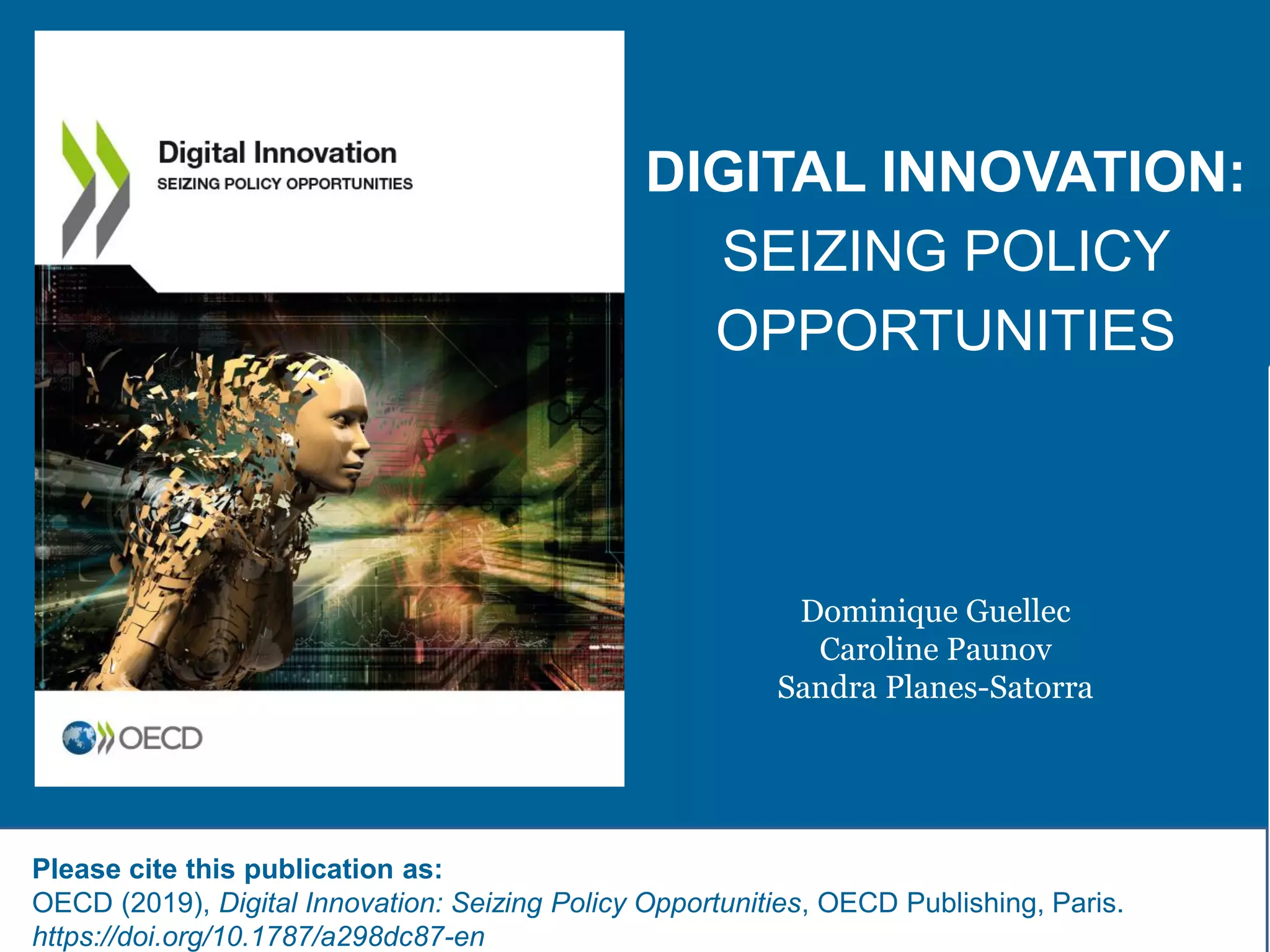
DIGITAL INNOVATION:
SEIZING POLICY
OPPORTUNITIES
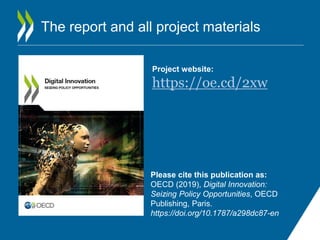
Please cite this publication as:
OECD (2019), Digital Innovation: Seizing Policy Opportunities, OECD Publishing, Paris.
https://doi.org/10.1787/a298dc87-en
Dominique Guellec
Caroline Paunov
Sandra Planes-Satorra
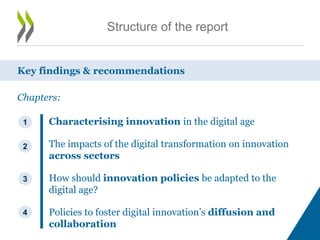
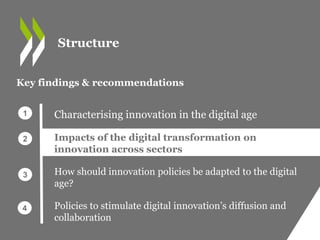
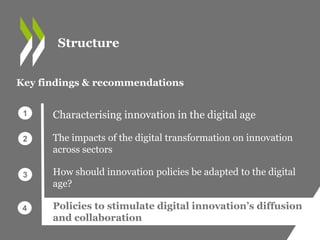
Structure of the report
Characterising innovation in the digital age
The impacts of the digital transformation on innovation
across sectors
How should innovation policies be adapted to the
digital age?
Policies to foster digital innovation’s diffusion and
collaboration
Key findings & recommendations
1
2
3
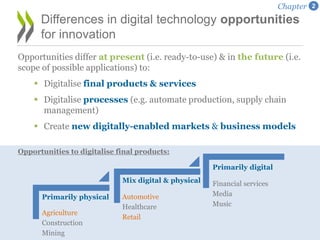
4
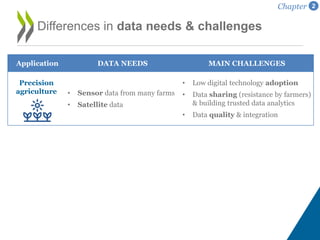
Chapters:
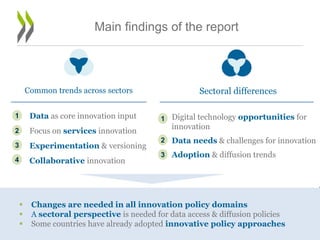
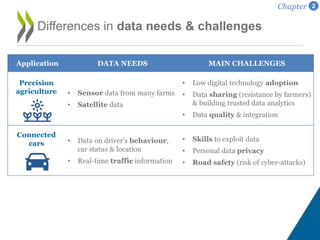
Common trends across sectors
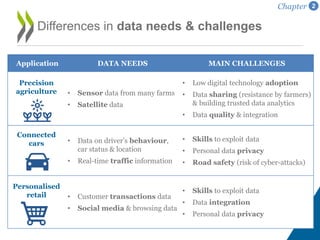
1. Data as core innovation input
2. Focus on services innovation
3. Experimentation & versioning
4. Collaborative innovation
Main findings of the report
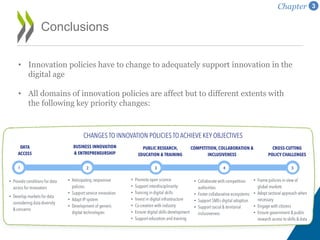
Sectoral differences
1. Digital technology opportunities for
innovation
2. Data needs & challenges for innovation
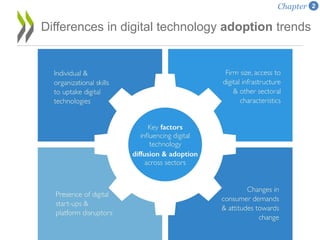
3. Adoption & diffusion trends
 Changes are needed in all innovation policy domains
 A sectoral perspective is needed for data access & diffusion policies
 Some countries have already adopted innovative policy approaches
1
2
3
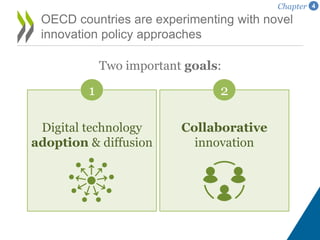
4
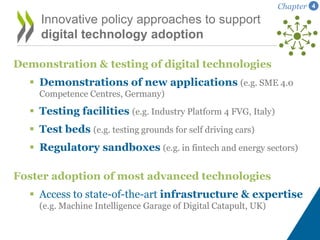
1
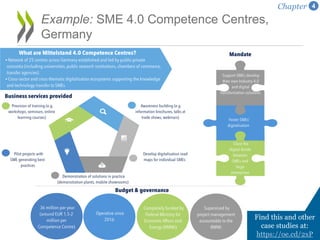
2
3
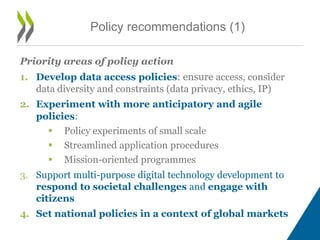
Priority areas of policy action
1. Develop data access policies: ensure access, consider
data diversity and constraints (data privacy, ethics, IP)
2. Experiment with more anticipatory and agile
policies:
 Policy experiments of small scale
 Streamlined application procedures
 Mission-oriented programmes
3. Support multi-purpose digital technology development to
respond to societal challenges and engage with
citizens
4. Set national policies in a context of global markets
Policy recommendations (1)
Principles for innovation policy areas that need adjustment in
the digital age
1. Facilitate digital technology diffusion to support inclusion in
the digital age
2. Support service innovation: revise initiatives that exclude services
innovation, consider new ones targeting services
3. Support collaboration for innovation: networks and platforms
for interaction, knowledge intermediaries, open innovation
4. Promote digitalisation of public research: training for scientists;
investments in digital infrastructure for science; creation of spaces for
co-creation with industry
5. Build digital skills, including data analytics : adjust university &
vocational education programmes
Policy recommendations (2)
Policy areas requiring a sectoral approach
 Data access policies
 Digital technology adoption policies
 Policies supporting development of sectoral applications
of digital technologies where market conditions have inhibited
the development of private sector-led solutions
Policy recommendations (3)
Characterising innovation in the digital age
Impacts of the digital transformation on innovation across
sectors
How should innovation policies be adapted to the digital
age?
Policies to stimulate digital innovation’s diffusion and
collaboration
Key findings & recommendations
1
2
3
4
Structure
Questions addressed:
• How are digital technologies changing innovation
processes and outcomes?
• What are the effects of these changes on market dynamics?
Chapter 1. Characterising innovation in
the digital age
Chapter 1
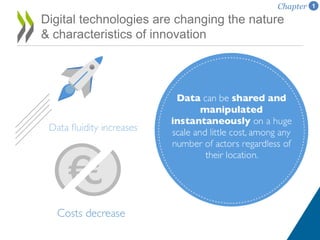
Digital technologies are changing the nature
& characteristics of innovation
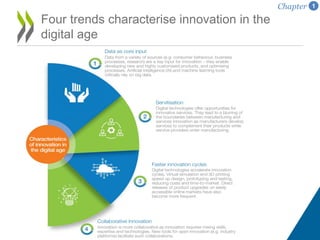
Chapter 1
Four trends characterise innovation in the
digital age
Chapter 1
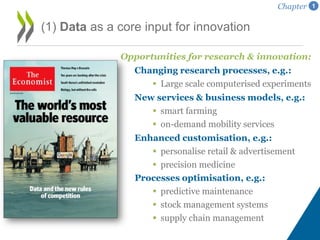
Opportunities for research & innovation:
Changing research processes, e.g.:
 Large scale computerised experiments
New services & business models, e.g.:
 smart farming
 on-demand mobility services
Enhanced customisation, e.g.:
 personalise retail & advertisement
 precision medicine
Processes optimisation, e.g.:
 predictive maintenance
 stock management systems
 supply chain management
(1) Data as a core input for innovation
Chapter 1
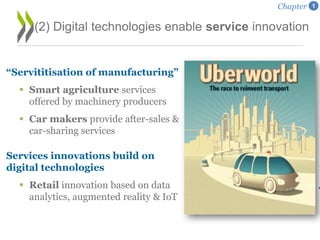
“Servititisation of manufacturing”
 Smart agriculture services
offered by machinery producers
 Car makers provide after-sales &
car-sharing services
Services innovations build on
digital technologies
 Retail innovation based on data
analytics, augmented reality & IoT
(2) Digital technologies enable service innovation
Chapter 1
 Accelerated design, prototyping & testing with 3D-
printing & virtual simulation
 Release of pilot versions to the market
 Regular upgrading (based on consumer’s feedback)
 Flexible manufacturing enabling small series production
at low cost (allowing more personalisation)
(3) Innovation cycles are faster
Chapter 1
(4) Innovation is more collaborative
Collaboration takes different forms:
 Data sharing
 Business incubation & acceleration
programmes
 Partnerships (e.g. with tech firms,
start-ups, public research)
 Corporate venture capital &
acquisitions (e.g. of tech start-ups)
 Platforms & other innovation
ecosystems (e.g. crowdsourcing;
industry platforms)
Chapter 1
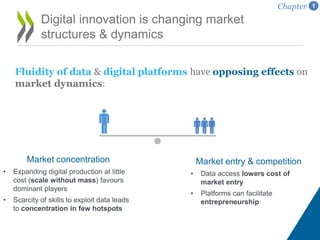
Fluidity of data & digital platforms have opposing effects on
market dynamics:
Digital innovation is changing market
structures & dynamics
Market concentration
• Expanding digital production at little
cost (scale without mass) favours
dominant players
• Scarcity of skills to exploit data leads
to concentration in few hotspots
Market entry & competition
• Data access lowers cost of
market entry
• Platforms can facilitate
entrepreneurship
Chapter 1
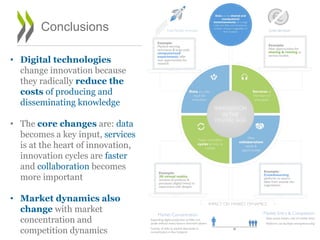
Conclusions
• Digital technologies
change innovation because
they radically reduce the
costs of producing and
disseminating knowledge
• The core changes are: data
becomes a key input, services
is at the heart of innovation,
innovation cycles are faster
and collaboration becomes
more important
• Market dynamics also
change with market
concentration and
competition dynamics
Characterising innovation in the digital age
Impacts of the digital transformation on
innovation across sectors
How should innovation policies be adapted to the digital
age?
Policies to stimulate digital innovation’s diffusion and
collaboration
Key findings & recommendations
1
2
3
4
Structure
Questions addressed:
• How are digital technologies integrated in the agri-food,
automotive and retail sectors?
• What are differences in how digital technologies affect
innovation across sectors? What explains differences?
Chapter 2. Impacts of the digital
transformation on innovation across sectors
Chapter 2
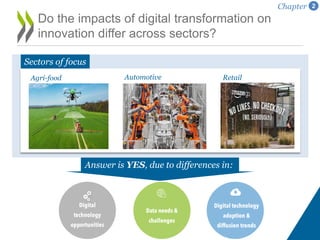
Do the impacts of digital transformation on
innovation differ across sectors?
Agri-food Automotive Retail
Sectors of focus
Answer is YES, due to differences in:
Chapter 2
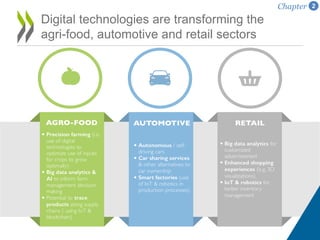
Digital technologies are transforming the
agri-food, automotive and retail sectors
Chapter 2
Opportunities differ at present (i.e. ready-to-use) & in the future (i.e.
scope of possible applications) to:
 Digitalise final products & services
 Digitalise processes (e.g. automate production, supply chain
management)
 Create new digitally-enabled markets & business models
Differences in digital technology opportunities
for innovation
Chapter 2
Primarily physical
Agriculture
Construction
Mining
Mix digital & physical
Automotive
Healthcare
Retail
Primarily digital
Financial services
Media
Music
Opportunities to digitalise final products:
Differences in data needs & challenges
Application DATA NEEDS MAIN CHALLENGES
Precision
agriculture • Sensor data from many farms
• Satellite data
• Low digital technology adoption
• Data sharing (resistance by farmers)
& building trusted data analytics
• Data quality & integration
Chapter 2
Differences in data needs & challenges
Application DATA NEEDS MAIN CHALLENGES
Precision
agriculture • Sensor data from many farms
• Satellite data
• Low digital technology adoption
• Data sharing (resistance by farmers)
& building trusted data analytics
• Data quality & integration
Connected
cars • Data on driver’s behaviour,
car status & location
• Real-time traffic information
• Skills to exploit data
• Personal data privacy
• Road safety (risk of cyber-attacks)
Chapter 2
Differences in data needs & challenges
Application DATA NEEDS MAIN CHALLENGES
Precision
agriculture • Sensor data from many farms
• Satellite data
• Low digital technology adoption
• Data sharing (resistance by farmers)
& building trusted data analytics
• Data quality & integration
Connected
cars • Data on driver’s behaviour,
car status & location
• Real-time traffic information
• Skills to exploit data
• Personal data privacy
• Road safety (risk of cyber-attacks)
Personalised
retail • Customer transactions data
• Social media & browsing data
• Skills to exploit data
• Data integration
• Personal data privacy
Chapter 2
Differences in digital technology adoption trends
Chapter 2
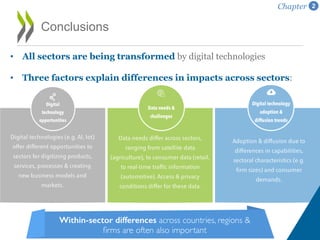
Conclusions
• All sectors are being transformed by digital technologies
• Three factors explain differences in impacts across sectors:
Chapter 2
Characterising innovation in the digital age
Impacts of the digital transformation on innovation across
sectors
How should innovation policies be adapted to the
digital age?
Policies to stimulate digital innovation’s diffusion and
collaboration
Key findings & recommendations
1
2
3
4
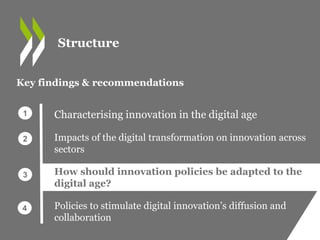
Structure
Questions addressed:
• Are existing innovation policies adequate to support
innovation in the digital age?
• If not, how should innovation policies change?
Chapter 3. How should innovation policies
be adapted to the digital age?
Chapter 3
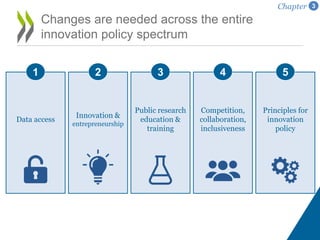
Changes are needed across the entire
innovation policy spectrum
Data access
Innovation &
entrepreneurship
Public research
education &
training
Competition,
collaboration,
inclusiveness
Principles for
innovation
policy
1 2 3 4 5
Chapter 3
 Ensure access to data for innovators:
 Taking into account diversity of data
 Preserving rights & incentives to produce data
 Explore the development of markets for data
 Challenges to consider (appropriability, market
value, privacy, transaction costs)  could be
mitigated with digital tools (Platforms,
Blockchain)
(1) Data access policies
Chapter 3
 Ensure innovation policies are anticipatory,
responsive & agile, e.g.:
Policy experiments of small scale, to be scaled up or
abandoned following assessment of impact
Digital tools for policy design & monitoring
Accelerate application procedures (e.g. Pass French
Tech provides simplified access to services to start-ups)
Mission-oriented programmes that set goals without
imposing means to reach them (e.g. DARPA model)
Anticipatory regulation (e.g. as performed by the
UK Food Standards Agency)
(2) Innovation & entrepreneurship policies (i)
Chapter 3
 Support service innovation that implements
digital technologies (e.g. Smart and Digital Services
Initiative, Austria)
 Adapt IP systems (notably to AI challenges)
 Support development of generic digital
technologies to address societal challenges
E.g. Artificial Intelligence Forum in New Zealand
gathers industry, academia and government to
discuss socio-economic challenges of AI and develop
roadmaps to shape future impacts
(2) Innovation & entrepreneurship policies (ii)
Chapter 3
 Promote open science
 Support interdisciplinary research & education
 Support training in digital skills for researchers
 Ensure skills needed for digital innovation are
developed (e.g. revise university programmes)
 Invest in digital tools & infrastructure for science
 Creating spaces for co-creation with industry (e.g.
joint research labs)
(3) Public research, education & training policies
Chapter 3
 Collaborate with competition authorities in addressing
market power in the digital age
 Promote collaborative innovation ecosystems (more
in Chapter 4)
 Facilitate digital technology adoption by firms
(particularly SMEs) (more in Chapter 4)
 Support digital innovation to serve social &
environmental purposes
 Support social & territorial inclusiveness in digital
innovation activities (links to Innovation for Inclusive
Growth project; see paper)
(4) Policies to foster competitive, collaborative
& inclusive innovation ecosystems
Chapter 3
(5) General principles for innovation policies
Chapter 3
 Collaborate internationally to frame national
policies in view of global markets
 Adopt a sectoral approach in:
 Data access policies
 Digital technology diffusion policies
 Policies supporting digital technology development
 Engage with citizens to appropriately consider
technology-related public concerns in policy making
 Ensure government & public research access to
skills & data
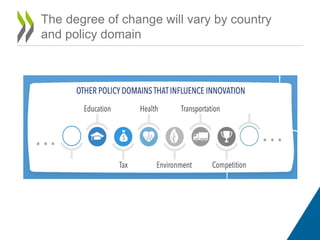
The degree of change will vary by country
and policy domain
Conclusions
Chapter 3
• Innovation policies have to change to adequately support innovation in the
digital age
• All domains of innovation policies are affect but to different extents with
the following key priority changes:
Characterising innovation in the digital age
The impacts of the digital transformation on innovation
across sectors
How should innovation policies be adapted to the digital
age?
Policies to stimulate digital innovation’s diffusion
and collaboration
Key findings & recommendations
1
2
3
4
Structure
Questions addressed:
• What new instruments have countries implemented to
support digital technology adoption & diffusion?
• What are best practice examples of policy initiatives aimed
at stimulating collaborative innovation in the digital age?
Chapter 4. Policies to stimulate digital
innovation’s diffusion and collaboration
Chapter 4
Two important goals:
OECD countries are experimenting with novel
innovation policy approaches
Digital technology
adoption & diffusion
1
Collaborative
innovation
2
Chapter 4
Demonstration & testing of digital technologies
 Demonstrations of new applications (e.g. SME 4.0
Competence Centres, Germany)
 Testing facilities (e.g. Industry Platform 4 FVG, Italy)
 Test beds (e.g. testing grounds for self driving cars)
 Regulatory sandboxes (e.g. in fintech and energy sectors)
Foster adoption of most advanced technologies
 Access to state-of-the-art infrastructure & expertise
(e.g. Machine Intelligence Garage of Digital Catapult, UK)
Innovative policy approaches to support
digital technology adoption
Chapter 4
Example: SME 4.0 Competence Centres,
Germany
Chapter 4
Find this and other
case studies at:
https://oe.cd/2xP
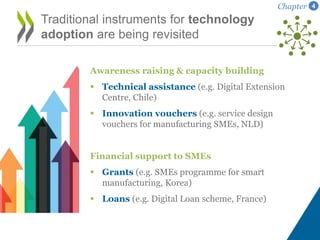
Awareness raising & capacity building
 Technical assistance (e.g. Digital Extension
Centre, Chile)
 Innovation vouchers (e.g. service design
vouchers for manufacturing SMEs, NLD)
Financial support to SMEs
 Grants (e.g. SMEs programme for smart
manufacturing, Korea)
 Loans (e.g. Digital Loan scheme, France)
Traditional instruments for technology
adoption are being revisited
Chapter 4
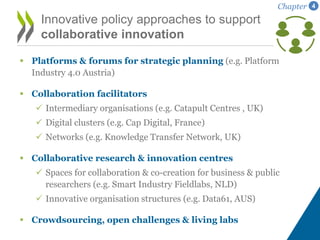
 Platforms & forums for strategic planning (e.g. Platform
Industry 4.0 Austria)
 Collaboration facilitators
 Intermediary organisations (e.g. Catapult Centres , UK)
 Digital clusters (e.g. Cap Digital, France)
 Networks (e.g. Knowledge Transfer Network, UK)
 Collaborative research & innovation centres
 Spaces for collaboration & co-creation for business & public
researchers (e.g. Smart Industry Fieldlabs, NLD)
 Innovative organisation structures (e.g. Data61, AUS)
 Crowdsourcing, open challenges & living labs
Innovative policy approaches to support
collaborative innovation
Chapter 4
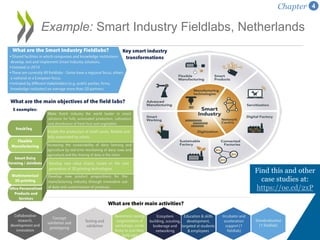
Example: Smart Industry Fieldlabs, Netherlands
Chapter 4
Find this and other
case studies at:
https://oe.cd/2xP
• New instruments are being used across countries to
support:
– Digital technology adoption (e.g. test beds, regulatory
sandboxes)
– Collaborative innovation (e.g. creation of intermediaries,
R&D centres, open challenges)
• Traditional instruments (e.g. grants, awareness raising) are
still relevant but are being revisited to respond to new
challenges and leverage digital technologies
Conclusions
Chapter 4
Project website:
https://oe.cd/2xw
The report and all project materials
Please cite this publication as:
OECD (2019), Digital Innovation:
Seizing Policy Opportunities, OECD
Publishing, Paris.
https://doi.org/10.1787/a298dc87-en
Project events
Netherlands
April 2018
Website
Summary
London
September 2017
Website
Summary
Paris
June 2017
Website
Summary
Paris
June 2018
Website
Summary
4 workshops Report launch event
London
April 2019
https://oe.cd/2xs
Policy papers
Guellec, D. and C. Paunov (2018), "Innovation
policies in the digital age", OECD Science,
Technology and Industry Policy Papers, No. 59, OECD
Publishing, Paris, https://doi.org/10.1787/eadd1094-en.
Paunov, C. and S. Planes-Satorra (2019), "The impacts
of digital transformation on innovation across
sectors", OECD Science, Technology and Industry
Policy Papers, OECD Publishing, Paris (forthcoming)
Planes-Satorra, S. and C. Paunov (2019), "The digital
innovation landscape in 2019", OECD Science,
Technology and Industry Policy Papers, OECD
Publishing, Paris (forthcoming)
Case studies
Find all country case study contributions at: https://oe.cd/2xP
Contact
Dominique Guellec, Dominique.Guellec@oecd.org
Caroline Paunov, Caroline.Paunov@oecd.org
Sandra Planes-Satorra, Sandra.PlanesSatorra@oecd.org

Oecd digital innovation_summaryreport_fullreport_website

  • 1.
    DIGITAL INNOVATION: SEIZING POLICY OPPORTUNITIES Pleasecite this publication as: OECD (2019), Digital Innovation: Seizing Policy Opportunities, OECD Publishing, Paris. https://doi.org/10.1787/a298dc87-en Dominique Guellec Caroline Paunov Sandra Planes-Satorra
  • 2.
    Structure of thereport Characterising innovation in the digital age The impacts of the digital transformation on innovation across sectors How should innovation policies be adapted to the digital age? Policies to foster digital innovation’s diffusion and collaboration Key findings & recommendations 1 2 3 4 Chapters:
  • 3.
    Common trends acrosssectors 1. Data as core innovation input 2. Focus on services innovation 3. Experimentation & versioning 4. Collaborative innovation Main findings of the report Sectoral differences 1. Digital technology opportunities for innovation 2. Data needs & challenges for innovation 3. Adoption & diffusion trends  Changes are needed in all innovation policy domains  A sectoral perspective is needed for data access & diffusion policies  Some countries have already adopted innovative policy approaches 1 2 3 4 1 2 3
  • 4.
    Priority areas ofpolicy action 1. Develop data access policies: ensure access, consider data diversity and constraints (data privacy, ethics, IP) 2. Experiment with more anticipatory and agile policies:  Policy experiments of small scale  Streamlined application procedures  Mission-oriented programmes 3. Support multi-purpose digital technology development to respond to societal challenges and engage with citizens 4. Set national policies in a context of global markets Policy recommendations (1)
  • 5.
    Principles for innovationpolicy areas that need adjustment in the digital age 1. Facilitate digital technology diffusion to support inclusion in the digital age 2. Support service innovation: revise initiatives that exclude services innovation, consider new ones targeting services 3. Support collaboration for innovation: networks and platforms for interaction, knowledge intermediaries, open innovation 4. Promote digitalisation of public research: training for scientists; investments in digital infrastructure for science; creation of spaces for co-creation with industry 5. Build digital skills, including data analytics : adjust university & vocational education programmes Policy recommendations (2)
  • 6.
    Policy areas requiringa sectoral approach  Data access policies  Digital technology adoption policies  Policies supporting development of sectoral applications of digital technologies where market conditions have inhibited the development of private sector-led solutions Policy recommendations (3)
  • 7.
    Characterising innovation inthe digital age Impacts of the digital transformation on innovation across sectors How should innovation policies be adapted to the digital age? Policies to stimulate digital innovation’s diffusion and collaboration Key findings & recommendations 1 2 3 4 Structure
  • 8.
    Questions addressed: • Howare digital technologies changing innovation processes and outcomes? • What are the effects of these changes on market dynamics? Chapter 1. Characterising innovation in the digital age Chapter 1
  • 9.
    Digital technologies arechanging the nature & characteristics of innovation Chapter 1
  • 10.
    Four trends characteriseinnovation in the digital age Chapter 1
  • 11.
    Opportunities for research& innovation: Changing research processes, e.g.:  Large scale computerised experiments New services & business models, e.g.:  smart farming  on-demand mobility services Enhanced customisation, e.g.:  personalise retail & advertisement  precision medicine Processes optimisation, e.g.:  predictive maintenance  stock management systems  supply chain management (1) Data as a core input for innovation Chapter 1
  • 12.
    “Servititisation of manufacturing” Smart agriculture services offered by machinery producers  Car makers provide after-sales & car-sharing services Services innovations build on digital technologies  Retail innovation based on data analytics, augmented reality & IoT (2) Digital technologies enable service innovation Chapter 1
  • 13.
     Accelerated design,prototyping & testing with 3D- printing & virtual simulation  Release of pilot versions to the market  Regular upgrading (based on consumer’s feedback)  Flexible manufacturing enabling small series production at low cost (allowing more personalisation) (3) Innovation cycles are faster Chapter 1
  • 14.
    (4) Innovation ismore collaborative Collaboration takes different forms:  Data sharing  Business incubation & acceleration programmes  Partnerships (e.g. with tech firms, start-ups, public research)  Corporate venture capital & acquisitions (e.g. of tech start-ups)  Platforms & other innovation ecosystems (e.g. crowdsourcing; industry platforms) Chapter 1
  • 15.
    Fluidity of data& digital platforms have opposing effects on market dynamics: Digital innovation is changing market structures & dynamics Market concentration • Expanding digital production at little cost (scale without mass) favours dominant players • Scarcity of skills to exploit data leads to concentration in few hotspots Market entry & competition • Data access lowers cost of market entry • Platforms can facilitate entrepreneurship Chapter 1
  • 16.
    Conclusions • Digital technologies changeinnovation because they radically reduce the costs of producing and disseminating knowledge • The core changes are: data becomes a key input, services is at the heart of innovation, innovation cycles are faster and collaboration becomes more important • Market dynamics also change with market concentration and competition dynamics
  • 17.
    Characterising innovation inthe digital age Impacts of the digital transformation on innovation across sectors How should innovation policies be adapted to the digital age? Policies to stimulate digital innovation’s diffusion and collaboration Key findings & recommendations 1 2 3 4 Structure
  • 18.
    Questions addressed: • Howare digital technologies integrated in the agri-food, automotive and retail sectors? • What are differences in how digital technologies affect innovation across sectors? What explains differences? Chapter 2. Impacts of the digital transformation on innovation across sectors Chapter 2
  • 19.
    Do the impactsof digital transformation on innovation differ across sectors? Agri-food Automotive Retail Sectors of focus Answer is YES, due to differences in: Chapter 2
  • 20.
    Digital technologies aretransforming the agri-food, automotive and retail sectors Chapter 2
  • 21.
    Opportunities differ atpresent (i.e. ready-to-use) & in the future (i.e. scope of possible applications) to:  Digitalise final products & services  Digitalise processes (e.g. automate production, supply chain management)  Create new digitally-enabled markets & business models Differences in digital technology opportunities for innovation Chapter 2 Primarily physical Agriculture Construction Mining Mix digital & physical Automotive Healthcare Retail Primarily digital Financial services Media Music Opportunities to digitalise final products:
  • 22.
    Differences in dataneeds & challenges Application DATA NEEDS MAIN CHALLENGES Precision agriculture • Sensor data from many farms • Satellite data • Low digital technology adoption • Data sharing (resistance by farmers) & building trusted data analytics • Data quality & integration Chapter 2
  • 23.
    Differences in dataneeds & challenges Application DATA NEEDS MAIN CHALLENGES Precision agriculture • Sensor data from many farms • Satellite data • Low digital technology adoption • Data sharing (resistance by farmers) & building trusted data analytics • Data quality & integration Connected cars • Data on driver’s behaviour, car status & location • Real-time traffic information • Skills to exploit data • Personal data privacy • Road safety (risk of cyber-attacks) Chapter 2
  • 24.
    Differences in dataneeds & challenges Application DATA NEEDS MAIN CHALLENGES Precision agriculture • Sensor data from many farms • Satellite data • Low digital technology adoption • Data sharing (resistance by farmers) & building trusted data analytics • Data quality & integration Connected cars • Data on driver’s behaviour, car status & location • Real-time traffic information • Skills to exploit data • Personal data privacy • Road safety (risk of cyber-attacks) Personalised retail • Customer transactions data • Social media & browsing data • Skills to exploit data • Data integration • Personal data privacy Chapter 2
  • 25.
    Differences in digitaltechnology adoption trends Chapter 2
  • 26.
    Conclusions • All sectorsare being transformed by digital technologies • Three factors explain differences in impacts across sectors: Chapter 2
  • 27.
    Characterising innovation inthe digital age Impacts of the digital transformation on innovation across sectors How should innovation policies be adapted to the digital age? Policies to stimulate digital innovation’s diffusion and collaboration Key findings & recommendations 1 2 3 4 Structure
  • 28.
    Questions addressed: • Areexisting innovation policies adequate to support innovation in the digital age? • If not, how should innovation policies change? Chapter 3. How should innovation policies be adapted to the digital age? Chapter 3
  • 29.
    Changes are neededacross the entire innovation policy spectrum Data access Innovation & entrepreneurship Public research education & training Competition, collaboration, inclusiveness Principles for innovation policy 1 2 3 4 5 Chapter 3
  • 30.
     Ensure accessto data for innovators:  Taking into account diversity of data  Preserving rights & incentives to produce data  Explore the development of markets for data  Challenges to consider (appropriability, market value, privacy, transaction costs)  could be mitigated with digital tools (Platforms, Blockchain) (1) Data access policies Chapter 3
  • 31.
     Ensure innovationpolicies are anticipatory, responsive & agile, e.g.: Policy experiments of small scale, to be scaled up or abandoned following assessment of impact Digital tools for policy design & monitoring Accelerate application procedures (e.g. Pass French Tech provides simplified access to services to start-ups) Mission-oriented programmes that set goals without imposing means to reach them (e.g. DARPA model) Anticipatory regulation (e.g. as performed by the UK Food Standards Agency) (2) Innovation & entrepreneurship policies (i) Chapter 3
  • 32.
     Support serviceinnovation that implements digital technologies (e.g. Smart and Digital Services Initiative, Austria)  Adapt IP systems (notably to AI challenges)  Support development of generic digital technologies to address societal challenges E.g. Artificial Intelligence Forum in New Zealand gathers industry, academia and government to discuss socio-economic challenges of AI and develop roadmaps to shape future impacts (2) Innovation & entrepreneurship policies (ii) Chapter 3
  • 33.
     Promote openscience  Support interdisciplinary research & education  Support training in digital skills for researchers  Ensure skills needed for digital innovation are developed (e.g. revise university programmes)  Invest in digital tools & infrastructure for science  Creating spaces for co-creation with industry (e.g. joint research labs) (3) Public research, education & training policies Chapter 3
  • 34.
     Collaborate withcompetition authorities in addressing market power in the digital age  Promote collaborative innovation ecosystems (more in Chapter 4)  Facilitate digital technology adoption by firms (particularly SMEs) (more in Chapter 4)  Support digital innovation to serve social & environmental purposes  Support social & territorial inclusiveness in digital innovation activities (links to Innovation for Inclusive Growth project; see paper) (4) Policies to foster competitive, collaborative & inclusive innovation ecosystems Chapter 3
  • 35.
    (5) General principlesfor innovation policies Chapter 3  Collaborate internationally to frame national policies in view of global markets  Adopt a sectoral approach in:  Data access policies  Digital technology diffusion policies  Policies supporting digital technology development  Engage with citizens to appropriately consider technology-related public concerns in policy making  Ensure government & public research access to skills & data
  • 36.
    The degree ofchange will vary by country and policy domain
  • 37.
    Conclusions Chapter 3 • Innovationpolicies have to change to adequately support innovation in the digital age • All domains of innovation policies are affect but to different extents with the following key priority changes:
  • 38.
    Characterising innovation inthe digital age The impacts of the digital transformation on innovation across sectors How should innovation policies be adapted to the digital age? Policies to stimulate digital innovation’s diffusion and collaboration Key findings & recommendations 1 2 3 4 Structure
  • 39.
    Questions addressed: • Whatnew instruments have countries implemented to support digital technology adoption & diffusion? • What are best practice examples of policy initiatives aimed at stimulating collaborative innovation in the digital age? Chapter 4. Policies to stimulate digital innovation’s diffusion and collaboration Chapter 4
  • 40.
    Two important goals: OECDcountries are experimenting with novel innovation policy approaches Digital technology adoption & diffusion 1 Collaborative innovation 2 Chapter 4
  • 41.
    Demonstration & testingof digital technologies  Demonstrations of new applications (e.g. SME 4.0 Competence Centres, Germany)  Testing facilities (e.g. Industry Platform 4 FVG, Italy)  Test beds (e.g. testing grounds for self driving cars)  Regulatory sandboxes (e.g. in fintech and energy sectors) Foster adoption of most advanced technologies  Access to state-of-the-art infrastructure & expertise (e.g. Machine Intelligence Garage of Digital Catapult, UK) Innovative policy approaches to support digital technology adoption Chapter 4
  • 42.
    Example: SME 4.0Competence Centres, Germany Chapter 4 Find this and other case studies at: https://oe.cd/2xP
  • 43.
    Awareness raising &capacity building  Technical assistance (e.g. Digital Extension Centre, Chile)  Innovation vouchers (e.g. service design vouchers for manufacturing SMEs, NLD) Financial support to SMEs  Grants (e.g. SMEs programme for smart manufacturing, Korea)  Loans (e.g. Digital Loan scheme, France) Traditional instruments for technology adoption are being revisited Chapter 4
  • 44.
     Platforms &forums for strategic planning (e.g. Platform Industry 4.0 Austria)  Collaboration facilitators  Intermediary organisations (e.g. Catapult Centres , UK)  Digital clusters (e.g. Cap Digital, France)  Networks (e.g. Knowledge Transfer Network, UK)  Collaborative research & innovation centres  Spaces for collaboration & co-creation for business & public researchers (e.g. Smart Industry Fieldlabs, NLD)  Innovative organisation structures (e.g. Data61, AUS)  Crowdsourcing, open challenges & living labs Innovative policy approaches to support collaborative innovation Chapter 4
  • 45.
    Example: Smart IndustryFieldlabs, Netherlands Chapter 4 Find this and other case studies at: https://oe.cd/2xP
  • 46.
    • New instrumentsare being used across countries to support: – Digital technology adoption (e.g. test beds, regulatory sandboxes) – Collaborative innovation (e.g. creation of intermediaries, R&D centres, open challenges) • Traditional instruments (e.g. grants, awareness raising) are still relevant but are being revisited to respond to new challenges and leverage digital technologies Conclusions Chapter 4
  • 47.
    Project website: https://oe.cd/2xw The reportand all project materials Please cite this publication as: OECD (2019), Digital Innovation: Seizing Policy Opportunities, OECD Publishing, Paris. https://doi.org/10.1787/a298dc87-en
  • 48.
    Project events Netherlands April 2018 Website Summary London September2017 Website Summary Paris June 2017 Website Summary Paris June 2018 Website Summary 4 workshops Report launch event London April 2019 https://oe.cd/2xs
  • 49.
    Policy papers Guellec, D.and C. Paunov (2018), "Innovation policies in the digital age", OECD Science, Technology and Industry Policy Papers, No. 59, OECD Publishing, Paris, https://doi.org/10.1787/eadd1094-en. Paunov, C. and S. Planes-Satorra (2019), "The impacts of digital transformation on innovation across sectors", OECD Science, Technology and Industry Policy Papers, OECD Publishing, Paris (forthcoming) Planes-Satorra, S. and C. Paunov (2019), "The digital innovation landscape in 2019", OECD Science, Technology and Industry Policy Papers, OECD Publishing, Paris (forthcoming)
  • 50.
    Case studies Find allcountry case study contributions at: https://oe.cd/2xP
  • 51.
    Contact Dominique Guellec, Dominique.Guellec@oecd.org CarolinePaunov, Caroline.Paunov@oecd.org Sandra Planes-Satorra, Sandra.PlanesSatorra@oecd.org