oer_logo_EN_1 by Breno Trautwein is licensed under CC BY-SA 2.0

OERs
Amy Herman
Library Faculty, Olympic College
What are Open Educational
Resources?
1.Works in the Public Domain:
•
Not protected by copyright law
•
Include government documents
•
Include works published prior to 1923
•
Many caveats/exceptions; see:
http://www.unc.edu/~unclng/public-d.htm
2.Open-licensed works:
•
Covered by copyright law but licensed for re-use
•
Creative Commons licenses are the most
common type of open-licensing; see:
http://creativecommons.org/licenses/
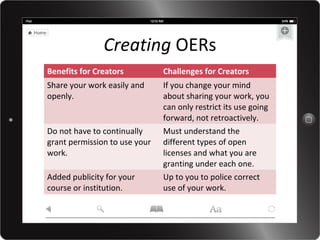
Creating OERs
Benefits for Creators

Challenges for Creators

Share your work easily and
openly.

If you change your mind
about sharing your work, you
can only restrict its use going
forward, not retroactively.
Must understand the
different types of open
licenses and what you are
granting under each one.
Up to you to police correct
use of your work.

Do not have to continually
grant permission to use your
work.
Added publicity for your
course or institution.
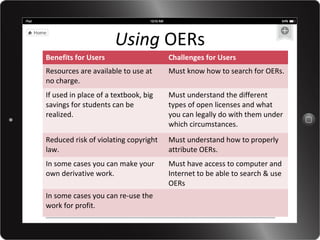
Using OERs
Benefits for Users

Challenges for Users

Resources are available to use at
no charge.

Must know how to search for OERs.

If used in place of a textbook, big
savings for students can be
realized.

Must understand the different
types of open licenses and what
you can legally do with them under
which circumstances.

Reduced risk of violating copyright
law.

Must understand how to properly
attribute OERs.

In some cases you can make your
own derivative work.

Must have access to computer and
Internet to be able to search & use
OERs

In some cases you can re-use the
work for profit.

Open Educational Resources

  • 1.
    oer_logo_EN_1 by BrenoTrautwein is licensed under CC BY-SA 2.0 OERs Amy Herman Library Faculty, Olympic College
  • 2.
    What are OpenEducational Resources? 1.Works in the Public Domain: • Not protected by copyright law • Include government documents • Include works published prior to 1923 • Many caveats/exceptions; see: http://www.unc.edu/~unclng/public-d.htm 2.Open-licensed works: • Covered by copyright law but licensed for re-use • Creative Commons licenses are the most common type of open-licensing; see: http://creativecommons.org/licenses/
  • 3.
    Creating OERs Benefits forCreators Challenges for Creators Share your work easily and openly. If you change your mind about sharing your work, you can only restrict its use going forward, not retroactively. Must understand the different types of open licenses and what you are granting under each one. Up to you to police correct use of your work. Do not have to continually grant permission to use your work. Added publicity for your course or institution.
  • 4.
    Using OERs Benefits forUsers Challenges for Users Resources are available to use at no charge. Must know how to search for OERs. If used in place of a textbook, big savings for students can be realized. Must understand the different types of open licenses and what you can legally do with them under which circumstances. Reduced risk of violating copyright law. Must understand how to properly attribute OERs. In some cases you can make your own derivative work. Must have access to computer and Internet to be able to search & use OERs In some cases you can re-use the work for profit.