Obtaining, Providing
and Disseminating
Information
Cagayan State University Lasam
Centro 02, Lasam, Cagayan
Subject Teacher
ROCKY BOY M. CASILANA
UNIT 4:
At the end of this unit, you are
expected to:
1. discuss the type of information and ways of
obtaining, providing and disseminating Information;
2. demonstrate the different ways in obtaining
through group activities and:
3. appreciate the type of information, diferent types
of obtaining and providing and disseminating
information by actively participating int the
communicative tasks given in class.
ACTIVATING PRIOR KNOWLEDGE
(KWL)
Know
Want To Know
Learned
Topic 1. The Types of Information and
Ways of Obtaining Information
At the end of the lesson, you are expected to:
1. discuss the kind of information;
2. compare and contrast the kinds of
information; and
3. perform the different ways in obtaining
information through collaborative activity.
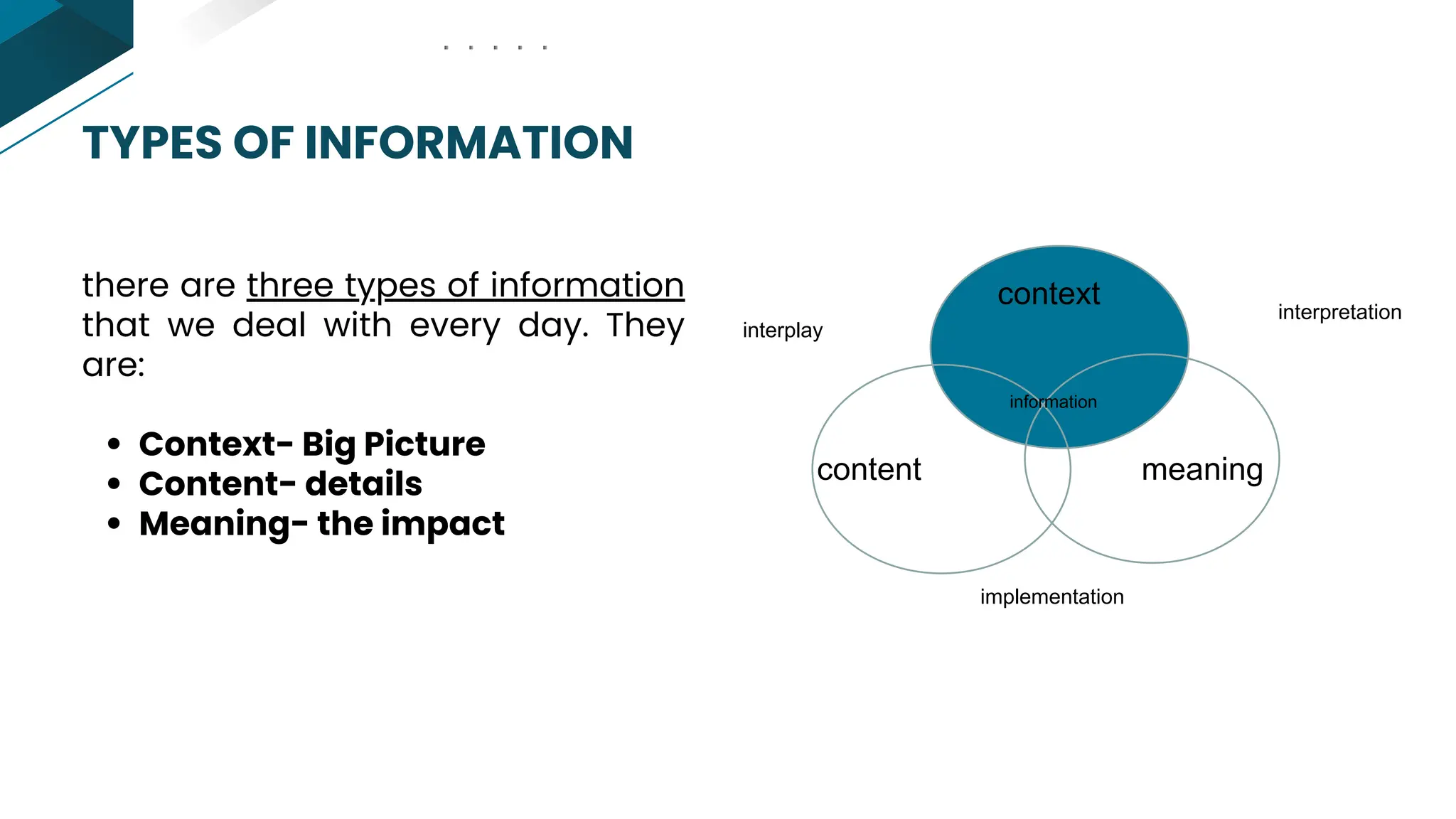
TYPES OF INFORMATION
Context- Big Picture
Content- details
Meaning- the impact
there are three types of information
that we deal with every day. They
are:
context
content meaning
information
interpretation
interplay
implementation
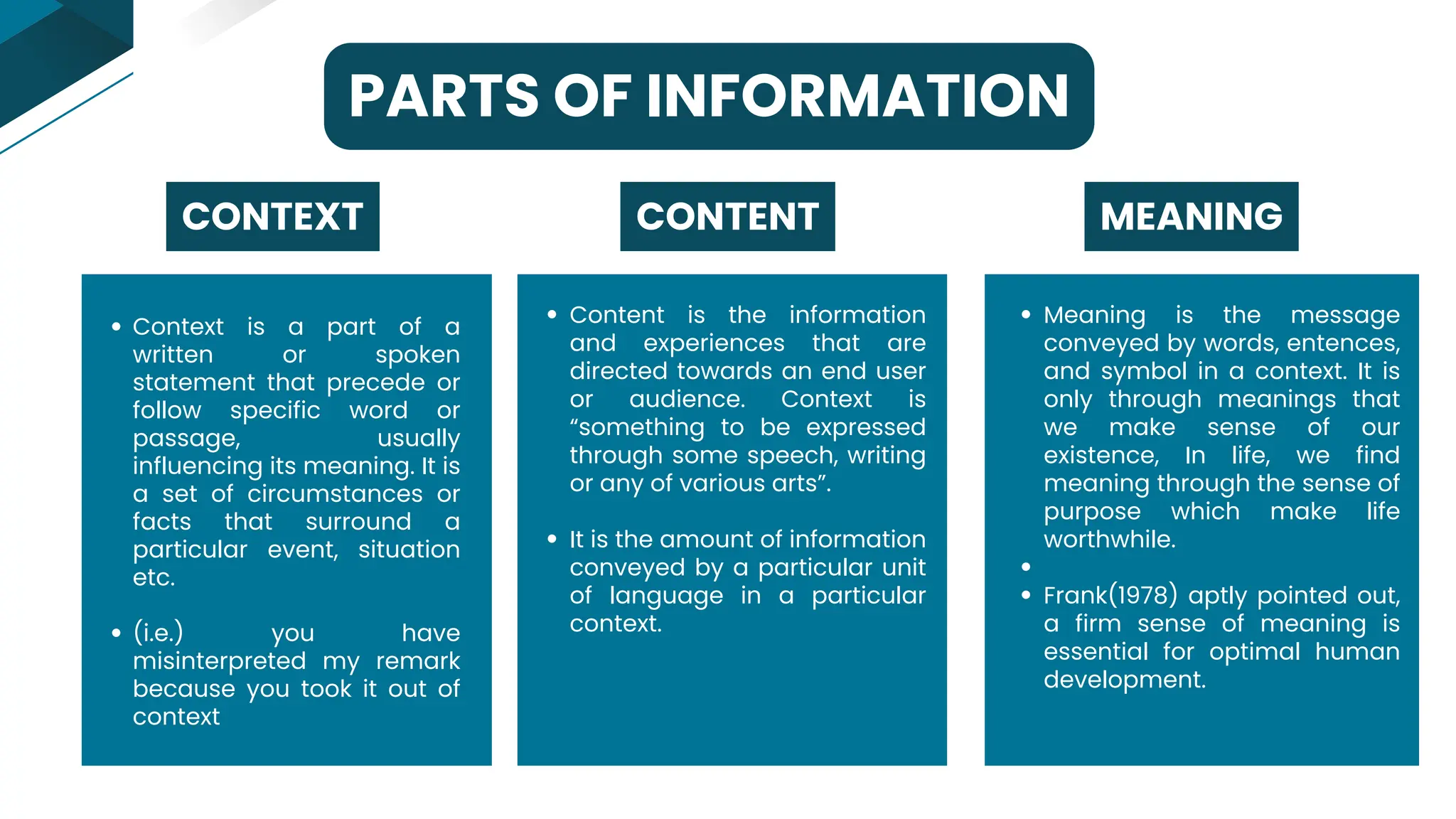
PARTS OF INFORMATION
Context is a part of a
written or spoken
statement that precede or
follow specific word or
passage, usually
influencing its meaning. It is
a set of circumstances or
facts that surround a
particular event, situation
etc.
(i.e.) you have
misinterpreted my remark
because you took it out of
context
CONTENT
CONTEXT
Content is the information
and experiences that are
directed towards an end user
or audience. Context is
“something to be expressed
through some speech, writing
or any of various arts”.
It is the amount of information
conveyed by a particular unit
of language in a particular
context.
MEANING
Meaning is the message
conveyed by words, entences,
and symbol in a context. It is
only through meanings that
we make sense of our
existence, In life, we find
meaning through the sense of
purpose which make life
worthwhile.
Frank(1978) aptly pointed out,
a firm sense of meaning is
essential for optimal human
development.
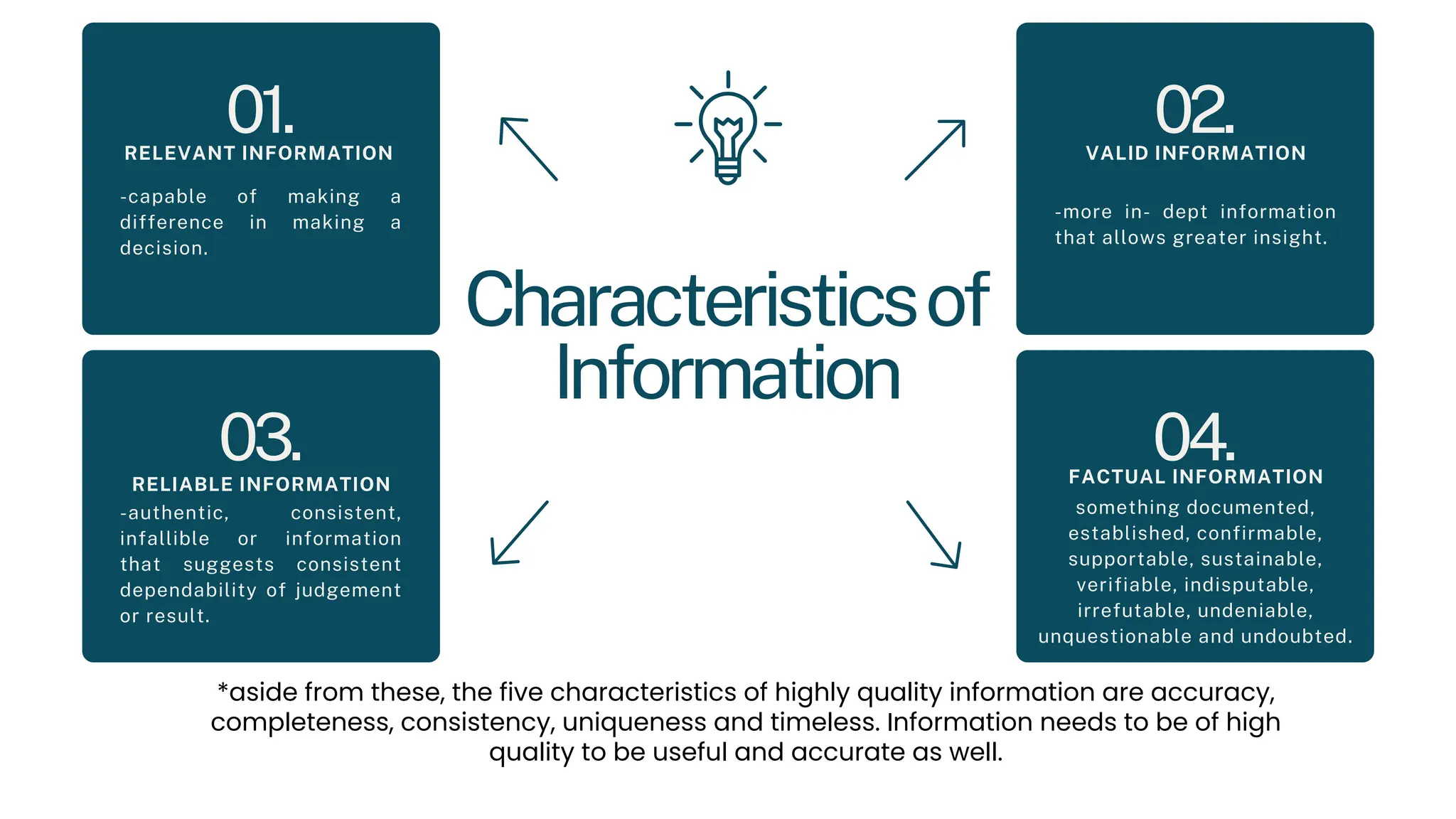
Characteristicsof
Information
-capable of making a
difference in making a
decision.
01.
-more in- dept information
that allows greater insight.
02.
-authentic, consistent,
infallible or information
that suggests consistent
dependability of judgement
or result.
03.
something documented,
established, confirmable,
supportable, sustainable,
verifiable, indisputable,
irrefutable, undeniable,
unquestionable and undoubted.
04.
RELEVANT INFORMATION VALID INFORMATION
RELIABLE INFORMATION FACTUAL INFORMATION
*aside from these, the five characteristics of highly quality information are accuracy,
completeness, consistency, uniqueness and timeless. Information needs to be of high
quality to be useful and accurate as well.
Topic 2. Providing and
Disseminating Information
Discuss the different ways of obtaining,
providing and disseminating information;
Identify the different methods in
disseminating information, and
Obtain provide and disseminate
information by actively participating in
the communicative tasks given in class.
At the end of the lesson, you are expected to:
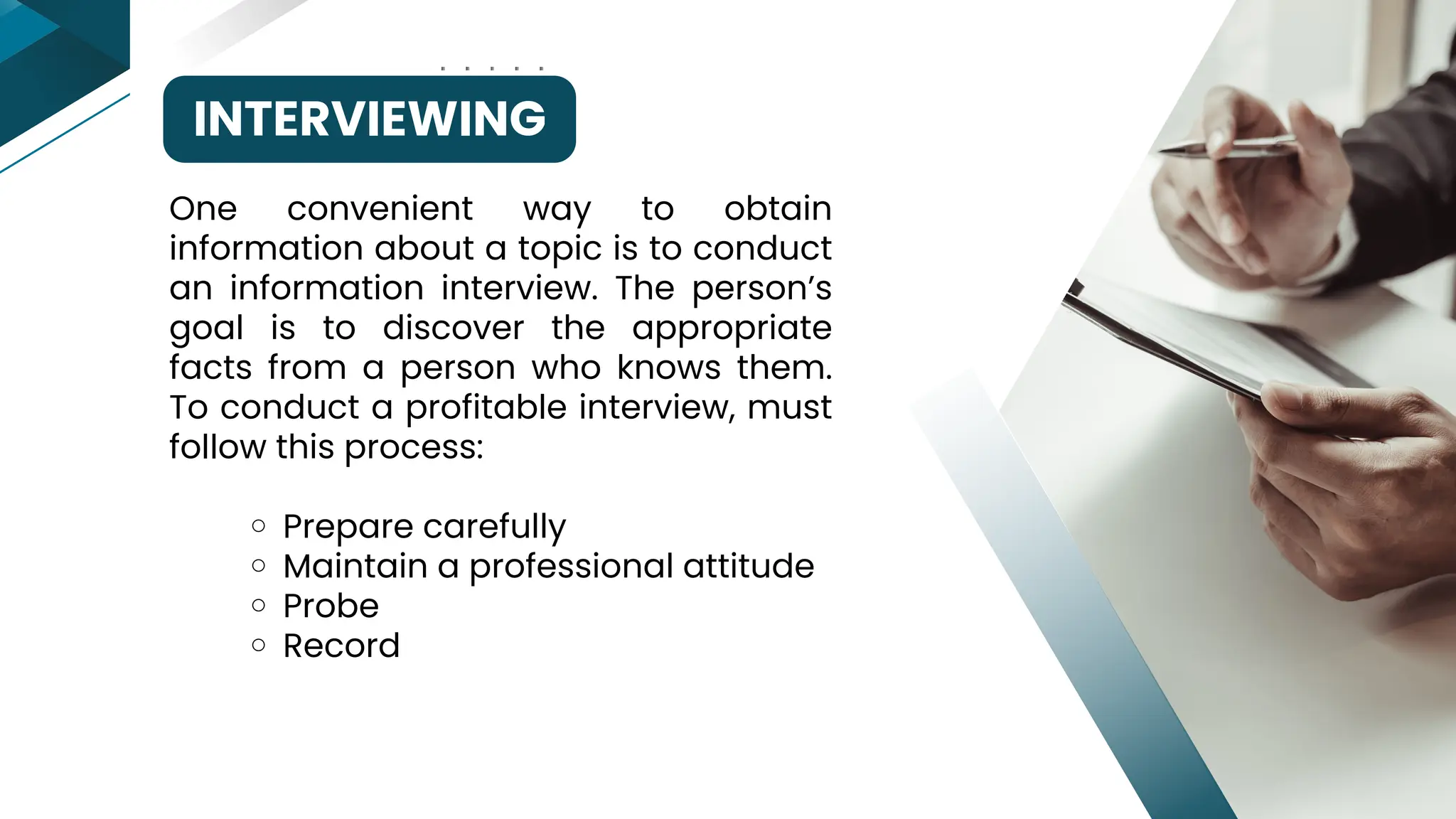
INTERVIEWING
Prepare carefully
Maintain a professional attitude
Probe
Record
One convenient way to obtain
information about a topic is to conduct
an information interview. The person’s
goal is to discover the appropriate
facts from a person who knows them.
To conduct a profitable interview, must
follow this process:
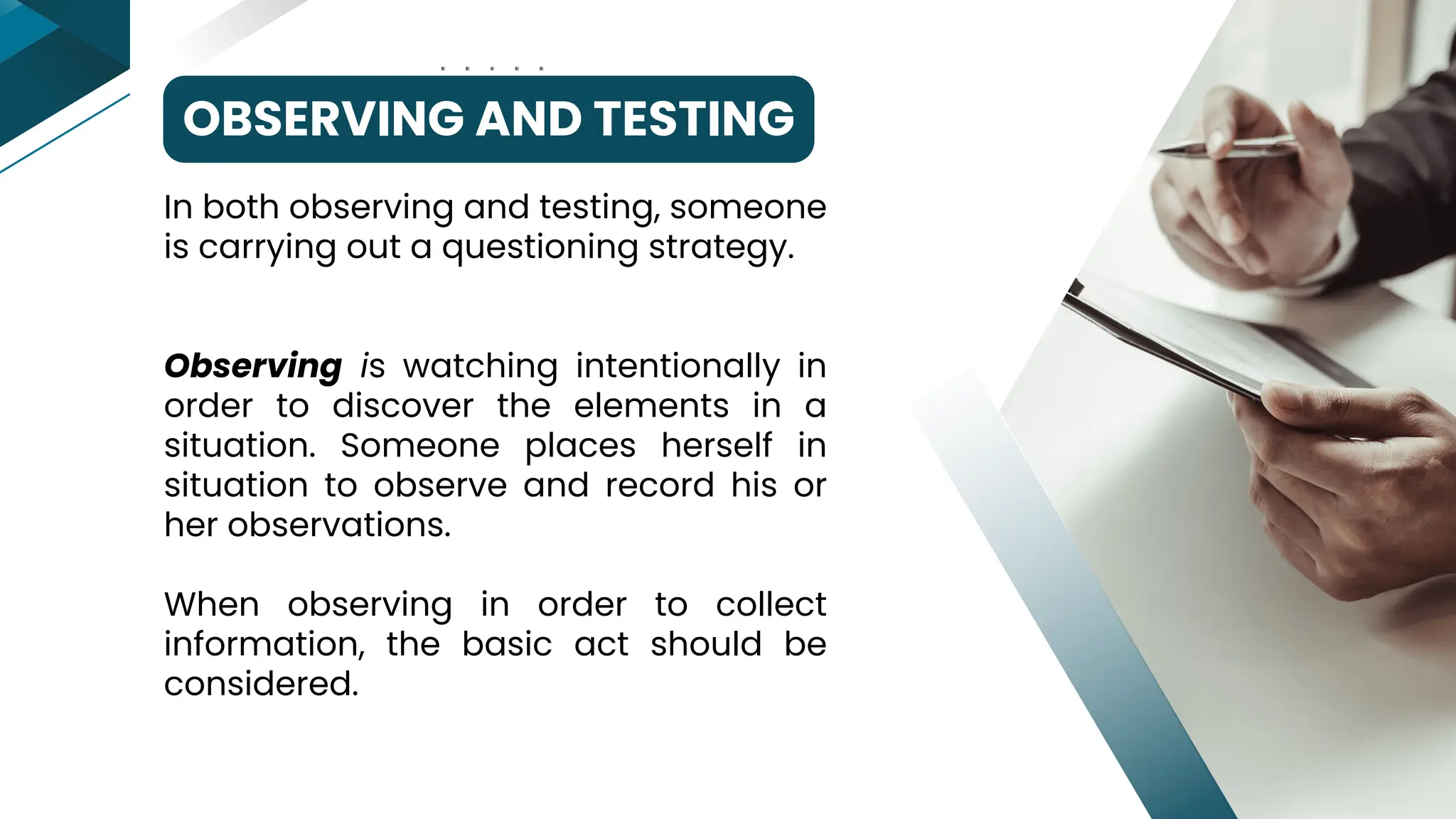
OBSERVING AND TESTING
In both observing and testing, someone
is carrying out a questioning strategy.
Observing is watching intentionally in
order to discover the elements in a
situation. Someone places herself in
situation to observe and record his or
her observations.
When observing in order to collect
information, the basic act should be
considered.
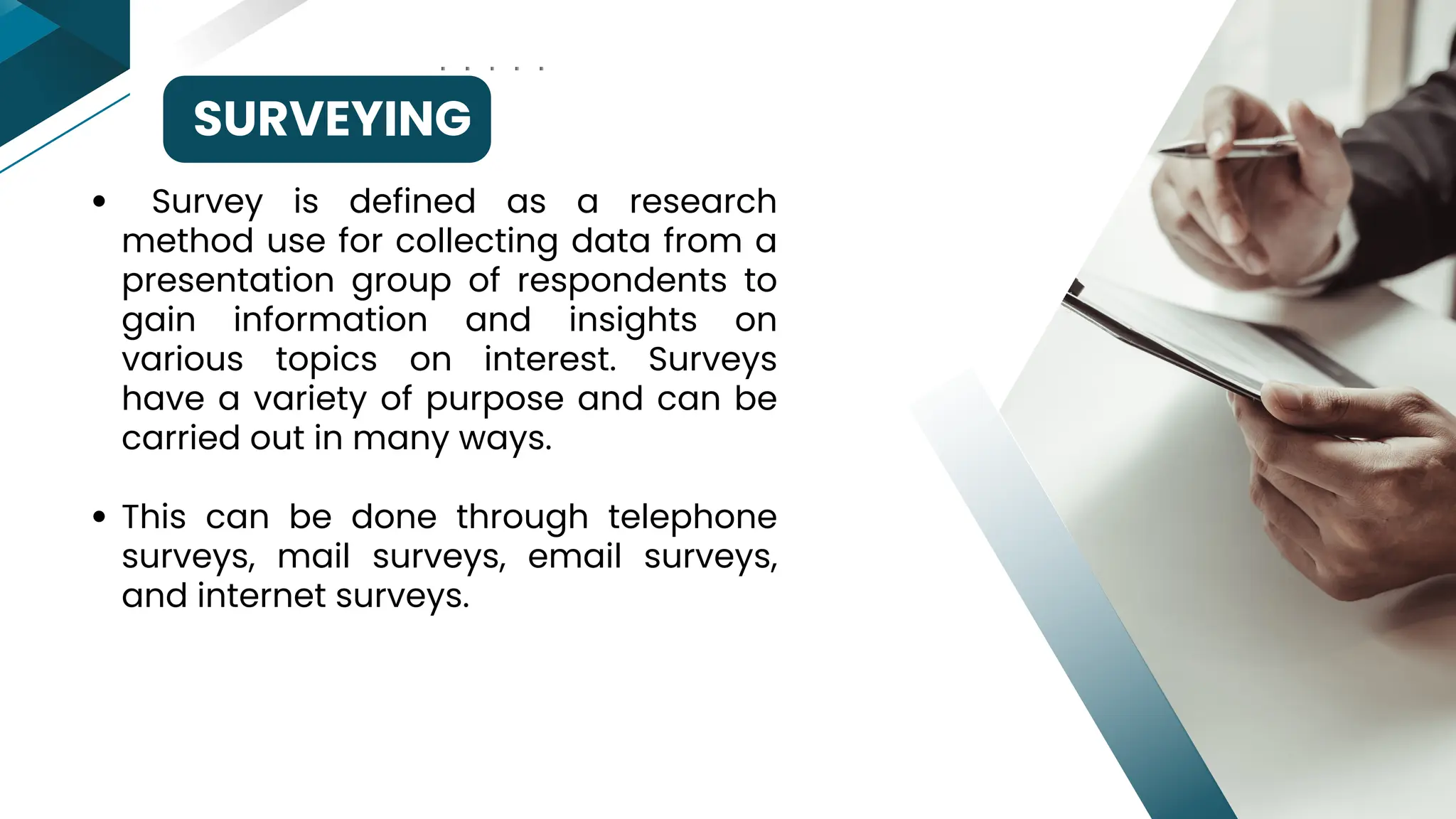
SURVEYING
Survey is defined as a research
method use for collecting data from a
presentation group of respondents to
gain information and insights on
various topics on interest. Surveys
have a variety of purpose and can be
carried out in many ways.
This can be done through telephone
surveys, mail surveys, email surveys,
and internet surveys.
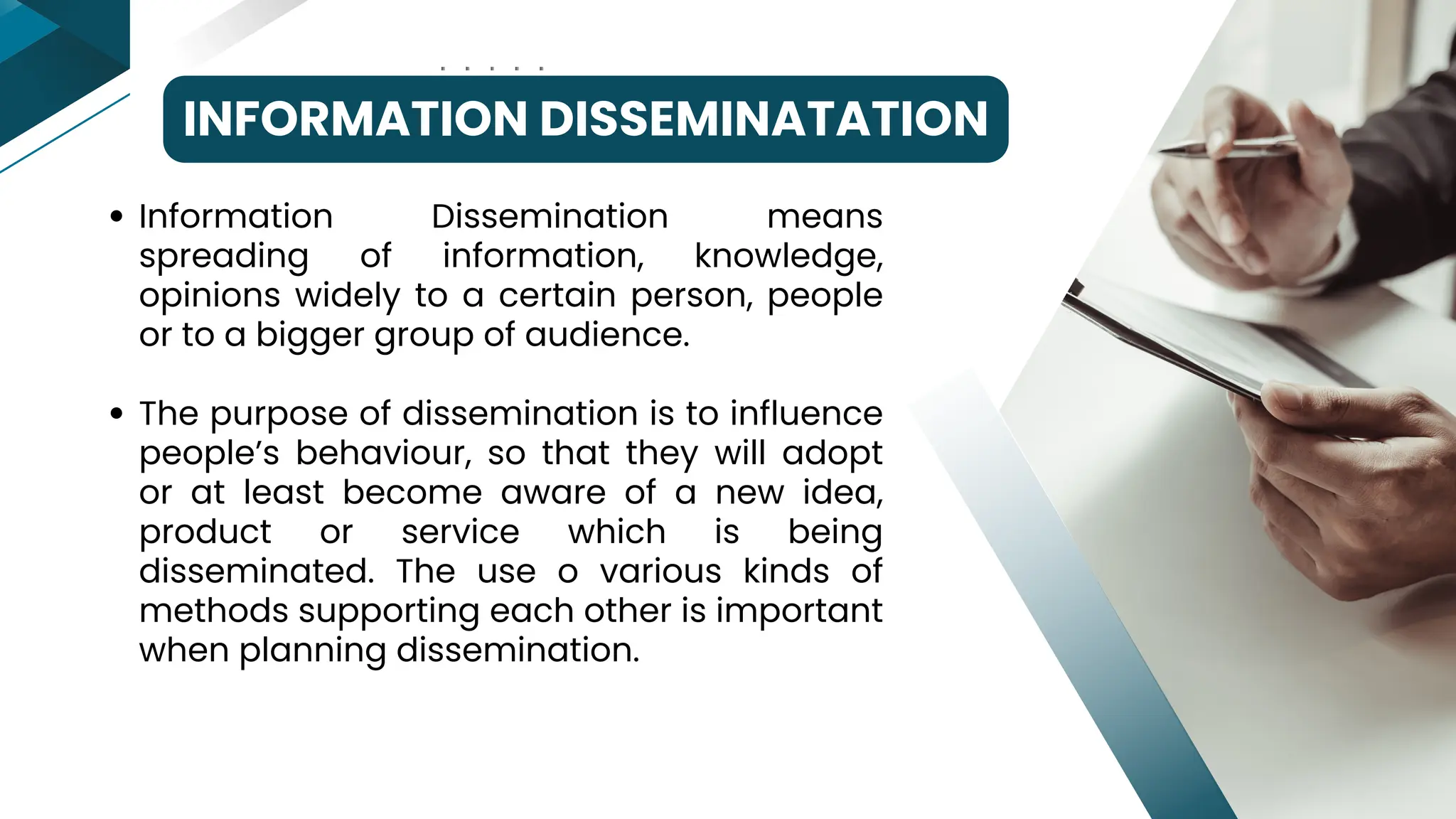
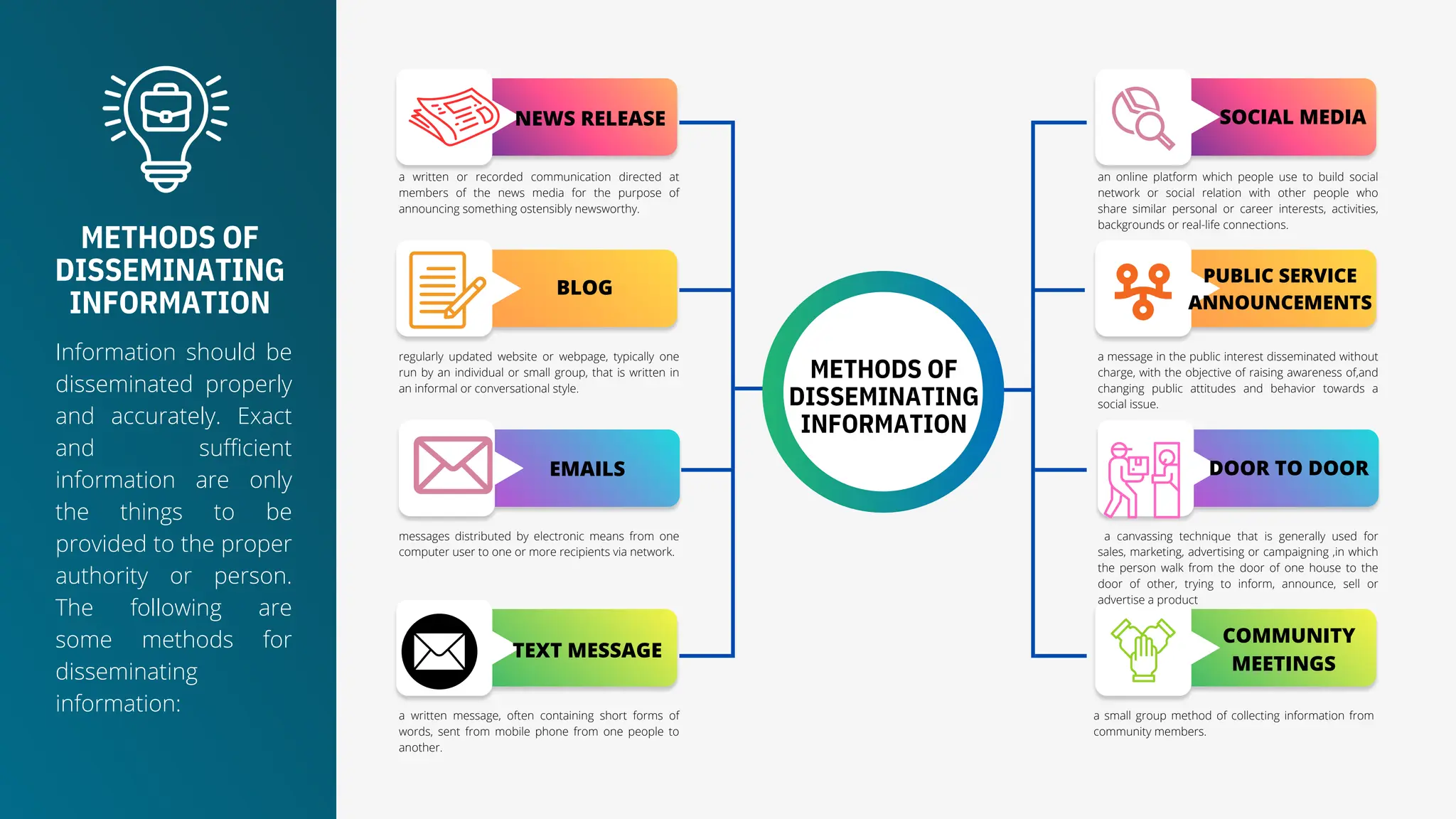
INFORMATION DISSEMINATATION
Information Dissemination means
spreading of information, knowledge,
opinions widely to a certain person, people
or to a bigger group of audience.
The purpose of dissemination is to influence
people’s behaviour, so that they will adopt
or at least become aware of a new idea,
product or service which is being
disseminated. The use o various kinds of
methods supporting each other is important
when planning dissemination.
NEWS RELEASE
BLOG
EMAILS
TEXT MESSAGE
SOCIAL MEDIA
PUBLIC SERVICE
ANNOUNCEMENTS
DOOR TO DOOR
COMMUNITY
MEETINGS
a written or recorded communication directed at
members of the news media for the purpose of
announcing something ostensibly newsworthy.
an online platform which people use to build social
network or social relation with other people who
share similar personal or career interests, activities,
backgrounds or real-life connections.
regularly updated website or webpage, typically one
run by an individual or small group, that is written in
an informal or conversational style.
a message in the public interest disseminated without
charge, with the objective of raising awareness of,and
changing public attitudes and behavior towards a
social issue.
messages distributed by electronic means from one
computer user to one or more recipients via network.
a canvassing technique that is generally used for
sales, marketing, advertising or campaigning ,in which
the person walk from the door of one house to the
door of other, trying to inform, announce, sell or
advertise a product
a written message, often containing short forms of
words, sent from mobile phone from one people to
another.
a small group method of collecting information from
community members.
METHODS OF
DISSEMINATING
INFORMATION
METHODS OF
DISSEMINATING
INFORMATION
Information should be
disseminated properly
and accurately. Exact
and sufficient
information are only
the things to be
provided to the proper
authority or person.
The following are
some methods for
disseminating
information:
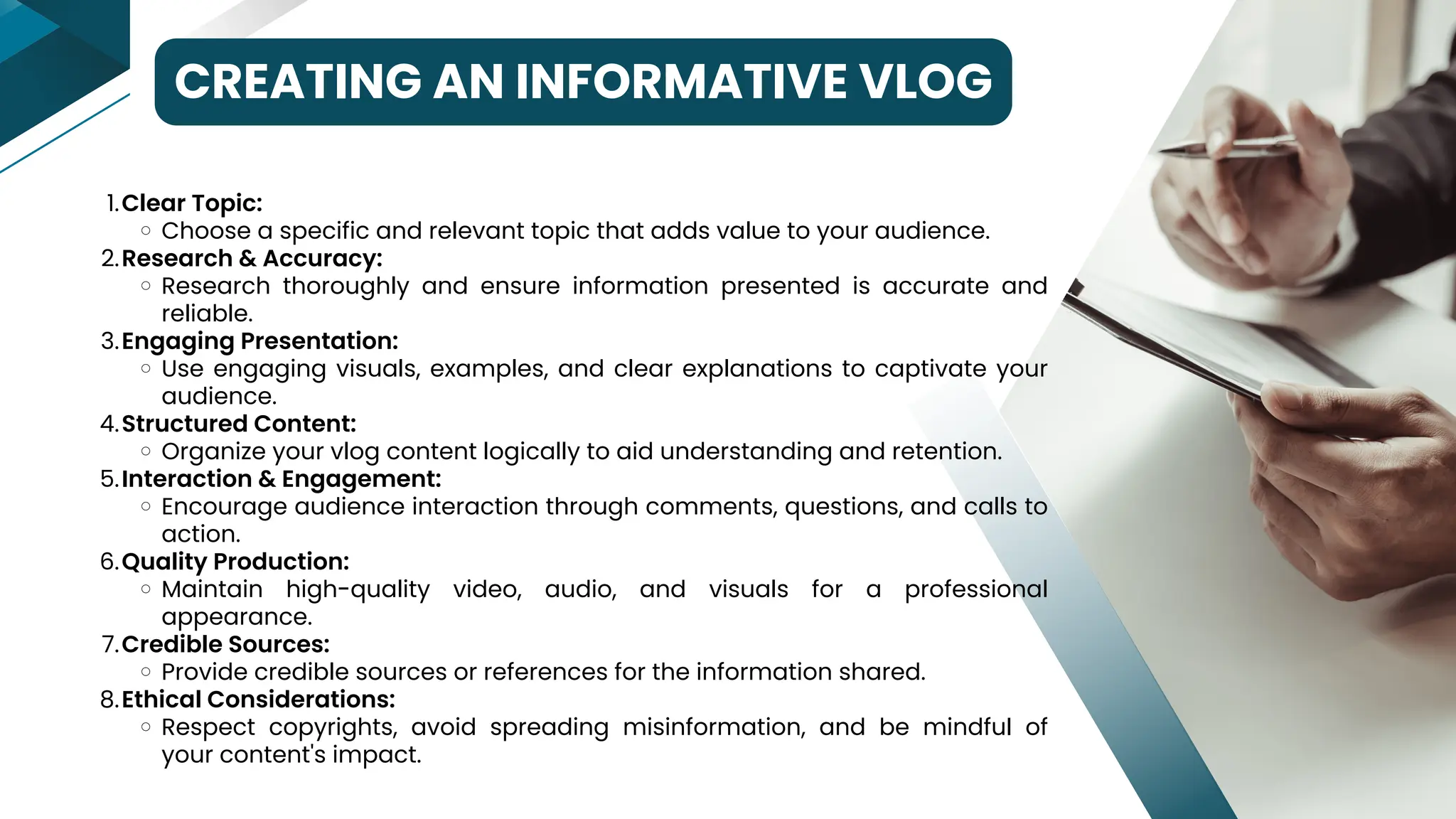
CREATING AN INFORMATIVE VLOG
Clear Topic:
Choose a specific and relevant topic that adds value to your audience.
Research & Accuracy:
Research thoroughly and ensure information presented is accurate and
reliable.
Engaging Presentation:
Use engaging visuals, examples, and clear explanations to captivate your
audience.
Structured Content:
Organize your vlog content logically to aid understanding and retention.
Interaction & Engagement:
Encourage audience interaction through comments, questions, and calls to
action.
Quality Production:
Maintain high-quality video, audio, and visuals for a professional
appearance.
Credible Sources:
Provide credible sources or references for the information shared.
Ethical Considerations:
Respect copyrights, avoid spreading misinformation, and be mindful of
your content's impact.
1.
2.
3.
4.
5.
6.
7.
8.

Obtaining, Providing and Disseminating Information

  • 1.
    Obtaining, Providing and Disseminating Information CagayanState University Lasam Centro 02, Lasam, Cagayan Subject Teacher ROCKY BOY M. CASILANA UNIT 4:
  • 2.
    At the endof this unit, you are expected to: 1. discuss the type of information and ways of obtaining, providing and disseminating Information; 2. demonstrate the different ways in obtaining through group activities and: 3. appreciate the type of information, diferent types of obtaining and providing and disseminating information by actively participating int the communicative tasks given in class.
  • 3.
  • 4.
    Topic 1. TheTypes of Information and Ways of Obtaining Information At the end of the lesson, you are expected to: 1. discuss the kind of information; 2. compare and contrast the kinds of information; and 3. perform the different ways in obtaining information through collaborative activity.
  • 5.
    TYPES OF INFORMATION Context-Big Picture Content- details Meaning- the impact there are three types of information that we deal with every day. They are: context content meaning information interpretation interplay implementation
  • 6.
    PARTS OF INFORMATION Contextis a part of a written or spoken statement that precede or follow specific word or passage, usually influencing its meaning. It is a set of circumstances or facts that surround a particular event, situation etc. (i.e.) you have misinterpreted my remark because you took it out of context CONTENT CONTEXT Content is the information and experiences that are directed towards an end user or audience. Context is “something to be expressed through some speech, writing or any of various arts”. It is the amount of information conveyed by a particular unit of language in a particular context. MEANING Meaning is the message conveyed by words, entences, and symbol in a context. It is only through meanings that we make sense of our existence, In life, we find meaning through the sense of purpose which make life worthwhile. Frank(1978) aptly pointed out, a firm sense of meaning is essential for optimal human development.
  • 7.
    Characteristicsof Information -capable of makinga difference in making a decision. 01. -more in- dept information that allows greater insight. 02. -authentic, consistent, infallible or information that suggests consistent dependability of judgement or result. 03. something documented, established, confirmable, supportable, sustainable, verifiable, indisputable, irrefutable, undeniable, unquestionable and undoubted. 04. RELEVANT INFORMATION VALID INFORMATION RELIABLE INFORMATION FACTUAL INFORMATION *aside from these, the five characteristics of highly quality information are accuracy, completeness, consistency, uniqueness and timeless. Information needs to be of high quality to be useful and accurate as well.
  • 8.
    Topic 2. Providingand Disseminating Information Discuss the different ways of obtaining, providing and disseminating information; Identify the different methods in disseminating information, and Obtain provide and disseminate information by actively participating in the communicative tasks given in class. At the end of the lesson, you are expected to:
  • 9.
    INTERVIEWING Prepare carefully Maintain aprofessional attitude Probe Record One convenient way to obtain information about a topic is to conduct an information interview. The person’s goal is to discover the appropriate facts from a person who knows them. To conduct a profitable interview, must follow this process:
  • 10.
    OBSERVING AND TESTING Inboth observing and testing, someone is carrying out a questioning strategy. Observing is watching intentionally in order to discover the elements in a situation. Someone places herself in situation to observe and record his or her observations. When observing in order to collect information, the basic act should be considered.
  • 11.
    SURVEYING Survey is definedas a research method use for collecting data from a presentation group of respondents to gain information and insights on various topics on interest. Surveys have a variety of purpose and can be carried out in many ways. This can be done through telephone surveys, mail surveys, email surveys, and internet surveys.
  • 12.
    INFORMATION DISSEMINATATION Information Disseminationmeans spreading of information, knowledge, opinions widely to a certain person, people or to a bigger group of audience. The purpose of dissemination is to influence people’s behaviour, so that they will adopt or at least become aware of a new idea, product or service which is being disseminated. The use o various kinds of methods supporting each other is important when planning dissemination.
  • 13.
    NEWS RELEASE BLOG EMAILS TEXT MESSAGE SOCIALMEDIA PUBLIC SERVICE ANNOUNCEMENTS DOOR TO DOOR COMMUNITY MEETINGS a written or recorded communication directed at members of the news media for the purpose of announcing something ostensibly newsworthy. an online platform which people use to build social network or social relation with other people who share similar personal or career interests, activities, backgrounds or real-life connections. regularly updated website or webpage, typically one run by an individual or small group, that is written in an informal or conversational style. a message in the public interest disseminated without charge, with the objective of raising awareness of,and changing public attitudes and behavior towards a social issue. messages distributed by electronic means from one computer user to one or more recipients via network. a canvassing technique that is generally used for sales, marketing, advertising or campaigning ,in which the person walk from the door of one house to the door of other, trying to inform, announce, sell or advertise a product a written message, often containing short forms of words, sent from mobile phone from one people to another. a small group method of collecting information from community members. METHODS OF DISSEMINATING INFORMATION METHODS OF DISSEMINATING INFORMATION Information should be disseminated properly and accurately. Exact and sufficient information are only the things to be provided to the proper authority or person. The following are some methods for disseminating information:
  • 14.
    CREATING AN INFORMATIVEVLOG Clear Topic: Choose a specific and relevant topic that adds value to your audience. Research & Accuracy: Research thoroughly and ensure information presented is accurate and reliable. Engaging Presentation: Use engaging visuals, examples, and clear explanations to captivate your audience. Structured Content: Organize your vlog content logically to aid understanding and retention. Interaction & Engagement: Encourage audience interaction through comments, questions, and calls to action. Quality Production: Maintain high-quality video, audio, and visuals for a professional appearance. Credible Sources: Provide credible sources or references for the information shared. Ethical Considerations: Respect copyrights, avoid spreading misinformation, and be mindful of your content's impact. 1. 2. 3. 4. 5. 6. 7. 8.