














R   E   P   O   R   T
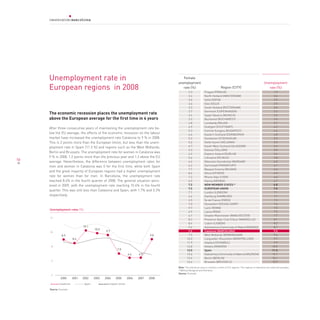
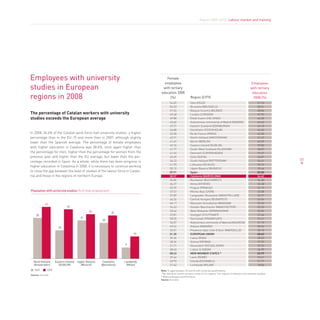
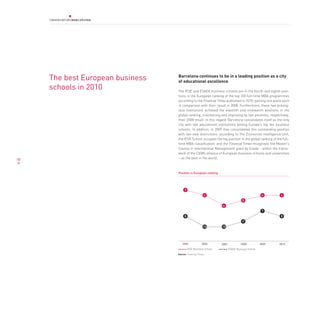
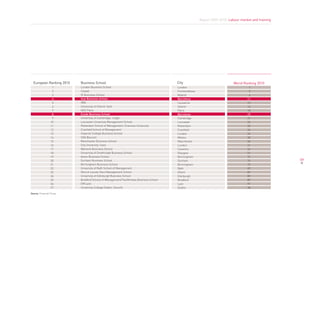
OBSERVATORI DE BARCELONA
October 2010


BARCELONA CITY COUNCIL
Jordi W. Carnes i Ayats
Deputy Mayor for Treasury Affairs and Economic Promotion
Mateu Hernandez i Maluquer
General Manager of Economic Promotion
Àngels Santigosa i Copete
Director of the Study Programme on Economic Activities and Employment


BARCELONA CHAMBER OF COMMERCE
Miquel Valls i Maseda
President
Xavier Carbonell i Roura
Managing Director of the Barcelona Chamber of Commerce
Joan Ramon Rovira i Homs
Director of the Economic Studies Office of the Barcelona Chamber of Commerce


TECHNICAL TEAM
Oscar Villar
Economist. Coordinator of the Executive Secretariat of the Barcelona Observatory
Teresa Udina
Economist. Economic Activities and Employment Studies Programme
Management, Barcelona City Council
Ana Belmonte
Economist. Economic Studies Office of the Barcelona Chamber of Commerce
Sandra Gutiérrez
Statistician. Economic Studies Office of the Barcelona Chamber of Commerce


Graphic Design:
Toni Fresno
Barcelona Chamber of Commerce

Layout:
DVA Associats

Prepress and Printing:
Ingoprint

Copyright Deposit:
XXXX
r   e   p   o   r   t
In Barcelona, as in everywhere else, 2009 was the second year of the             necessary to project itself as a powerful capital in the Mediterranean Eu-
deepest crisis for seventy years. An intense global recession with a strong      rope arena.
impact on businesses, serious consequences for the job market and one
which will force us to reconsider the very basis of our production model         Barcelona must also stand out as a city of creativity and education. An
and future growth.                                                               educational city in the broadest sense of the word, where culture is a cen-
                                                                                 tral pillar of public life. Where small and large cultural facilities are ac-
Fortunately, however, Barcelona is facing this difficult situation from a        companied by politics that help people with an education to take a risk
very different reality than that of seventy years ago as the city is starting    with creative proposals, as is the case of the creation factories, and this
from the footing of an economic situation and a competitiveness in Europe        cultural and creative wealth generates citizenry, economic value and so-
and worldwide that it did not enjoy in past crises. In effect – as this report   cial change.
by the Barcelona Observatory highlights – there are many prestigious in-
dicators and sources that insist that despite the depth of this global crisis,   To achieve its future objectives, Barcelona needs new connectivities that
Barcelona and its metropolitan area are one of the most attractive and           afford it better internal organisation and that strengthen its openness to
competitive destinations in the world and a leading area in terms of its         the world. I would like to highlight here the strategic value of the Mediter-
economy, business and attraction of talent.                                      ranean corridor – recently endorsed by the European Commission – and
                                                                                 of the future Sagrera station, which will become the main gateway into
In all, the challenges posed by the current economic situation – which are       and out of Barcelona and one of the driving forces of a region – the north
most acute in the problem of unemployment – mean that the main priority          of the city – undergoing a profound transformation. Similarly, changes in
of municipal government can be none other than the decisive fight against        the global circuits and flows of goods strengthen the strategic positioning
the crisis, in which the city is fully involved. I would like to comment here    of the Mediterranean and represents the opportunity of the Port of Barce-
on the value of having such an instrument of coordination as the Agree-          lona becoming one of the major distributors of maritime traffic from Asia.
ment for Quality Employment in Barcelona – the result of the agreement
between the Government of Catalonia, Barcelona City Council and trades           Finally, one of the symbols of identity of the Barcelona of the future must
unions and business organisations – which has been strengthened since            be sustainability. Due to conviction, due to the challenges that twenty-
2009 with new resources, new agents and new agreements. Besides this,            first-century cities of the world in general and in the Mediterranean in
after the greatest investment initiative of its history, with a total of 1,800   particular have to face, and because this is one of the keys to the trans-
million euros between 2009 and 2010, the City Council is ready to put in         formation of the economic model that we need. Barcelona’s commitment
place an austerity plan that will contribute to reducing the public deficit      to electric or hybrid vehicles, which forms a connection with our industrial
while guaranteeing the priority investments and policies aimed at eco-           tradition to progress towards a new energy model, is an emblematic ex-
nomic reactivation, care for people and coexistence in the public space.         ample of the line to be pursued.

All of this austerity initiative, however, must not prevent future undertak-     It is true that we are facing formidable challenges, but at the same time
ings from going ahead. Over the last 30 years, Barcelona has been able to        we have great assets with which to face them. One of the most important
manage crises as opportunities to relaunch the economy, and it has come          of these is the very strength of the Barcelona brand, which the reports by
out stronger every time. In light of the formidable challenges posed by          the Barcelona Observatory highlight year after year, and which we pro-
the current situation, we must once again ensure that short-term actions         pose to manage explicitly in cooperation with the Chamber of Commerce
against the crisis are compatible with the medium- and long-term strat-          and other major actors in the city. In presenting this eighth annual report,
egy that the City Council and the leading economic and social agents are         I would like to convey my congratulations to the technical team for their
redefining and channelling in what we are calling the 2020 Agenda.               work, I would like to thank the cooperation of a broad range of institutions
                                                                                 and organisations that provide their support and I would like to show my
In effect, Barcelona aspires to become the principal economic power-             faith in the strengthening of public-private cooperation, without a doubt
house of southern Europe on the 2020 horizon. On the basis of the diver-         one of the distinctive traits and one of the keys to the success of Barce-
sified economic structure that characterises it, the city will continue to       lona’s process of economic transformation.
promote innovation and the knowledge economy, the attraction of compa-                                                                           Jordi Hereu
nies and talent, the major transformation projects and the infrastructures                                                                Mayor of Barcelona
From the economic, business and social point of view, 2009 was a difficult       pillars on which the Ara+que mai programme is based, which the Bar-
year. The worldwide recession that we have experienced has been the              celona Chamber of Commerce offers companies with the aim of foster-
strongest in the post-war period. The impact of the recession has also           ing growth and improving competitiveness. As part of this programme,
been hard on our economic sphere, both nationally and regionally and             our institution fosters internationalisation to help companies begin and
locally. However, we began to register an improvement in the second half         strengthen their presence abroad. It also offers support for innovation and
of 2009, with more moderate falls in activity than during the first part of      training through aid, courses and grants, and through advice to make this
the year. In addition, this improvement translated into positive growth in       investment profitable and to enhance the development of information and
economic activity in Catalonia in the first quarter of 2010, after falling for   communication technologies. Parallel to this, the Chamber of Commerce
seven consecutive quarters, and it is predicted that this positive path will     is developing a new support plan for business funding so that companies
become firmly established in 2011, even though the rate of growth will           can find out all the financial instruments available to them and so get the
still be weak.                                                                   best funding scheme, and a business resources optimisation programme,
                                                                                 consisting of cost reduction and management improvement plans.
We should remember that the city of Barcelona has taken a significant
qualitative leap in the last two decades and that, in addition, in the cur-      We need to work so that the city continues to improve its positioning, both
rent setting of serious economic difficulties, the positioning of the city in    at a European level and worldwide. We have clear examples of the ad-
the international and European context remains solid. We can see this            vances we are making, such as the opening of the Alba Synchrotron, the
from the eighth report by the Barcelona Observatory, which Barcelona             most powerful light source in southern Europe and the most complex and
City Council and the Barcelona Chamber of Commerce offer all economic            high-level science facility in Spain, which came into operation in March
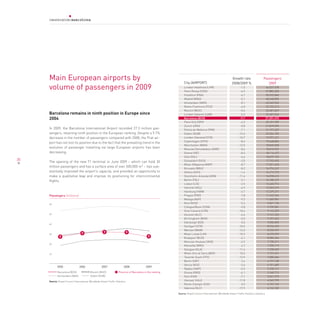
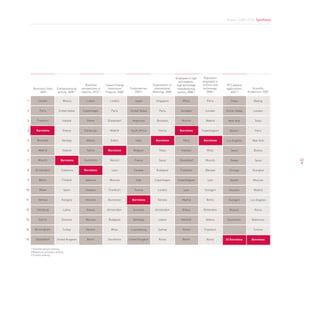
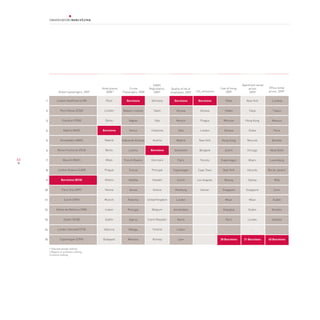
agents. By way of example, Barcelona was the fourth favourite European           2010, and the opening of the new Terminal T-1 at El Prat airport, which
city among European executives for locating their businesses in 2009,            has led to an increase in the number of intercontinental flights from Bar-
with the city going up one place compared with 2008 and becoming es-             celona. Similarly, we need to continue advancing in projects that have a
tablished among the top five favourite cities for business. Barcelona also       significant economic impact on the city, such as the future intermodal
improved the ability to organise international meetings, for the second          station of La Sagrera, which will connect the high-speed railway with the
year running, to achieve fifth place worldwide. Similarly, the rate of busi-     public and private transport networks. Today, this is the largest under-
ness activity in the province of Barcelona remains higher than countries         ground railway project in Europe.
such as Finland, the United Kingdom, France and Japan.
                                                                                 I would like to end by expressing my gratitude to the technical team for
Barcelona’s infrastructures, such as the airport and the port, also retain       their hard work and their constant striving for improvement in the project
a preferred position: ninth European airport in volume of passengers and         represented by the Barcelona Observatory and to all the institutions that
first of the main Mediterranean ports in volume of cruise passengers. We         have once again this year helped by providing information and enriching
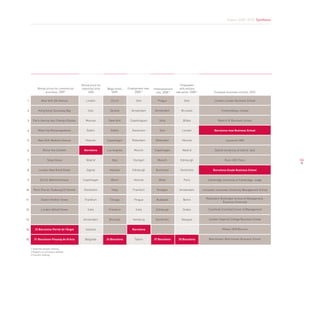
should also mention the good positioning of the IESE and ESADE busi-             the content of the report that we now present to you.
ness schools, in fourth and eighth place respectively in the European
ranking published by the Financial Times in 2010.

All the agents, public and private, institutions and companies, have
helped make Barcelona an attractive and competitive city with a good ex-
ternal image, but we need to keep working so that we do not lose this
good positioning and to improve in those areas where there is still room
to grow.

Catalonia in general, and Barcelona in particular, are well positioned
in such key aspects as the degree of openness to the outside and the
centres of excellence in applied research and higher education. These                                                              Miquel Valls i Maseda
are the pillars of medium- and long-term sustainable economic growth:                                  President of the Barcelona Chamber of Commerce
internationalisation, innovation and education. And these are also the
S   u   M   M   a   r   y
4
Report 2009-2010. Sumari


6    Introduction                                                     38   Sustainability and quality of life


9    Datasheet Barcelona                                              39   Introduction
                                                                      41   The compromise of European companies
12   The Barcelona observatory                                        42   Best European cities for quality of life of employees
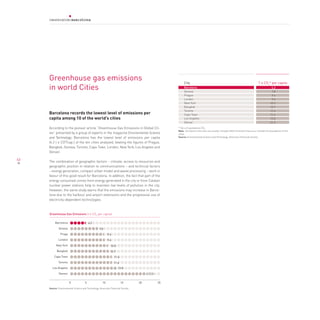
                                                                      43   Greenhouse gas emissions in world Cities
14   Results:


15   City for business                                                44   Prices and costs


16   Introduction                                                     45   Introduction
17   Best European cities for business                                46   Cost of living in cities around the world
18   Entrepreneurial activity in OECD countries                       47   Apartment rental prices in the cities of the world
19   Business perspectives in the European regions for 2010: The      48   Office rental prices in the cities of the world
     opinion of business people                                       49   Rental prices for commercial permises in the cities of the world
21   Main European regions receiving foreign investment projects      50   Rental prices for industrial land in the cities of the world
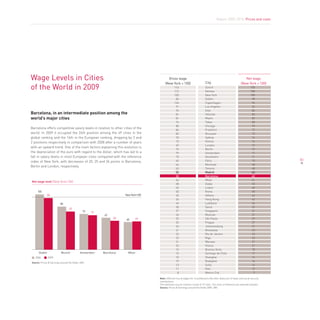
22   Corporate tax and VAT in countries around the world              51   Wage Levels in Cities of the World                                   5
23   Main world cities organizing international meetings


                                                                      52   Labour market and training
24   The knowlegde society
                                                                      53   Introduction
25   Introduction                                                     54   Employment rate in European regions
26   Population employed in technological manufacturing sectors and   56   Unemployment rate in European regions
     services in European regions                                     57   Employees with university studies in European regions
28   Population employed in science and technology and Research       58   The best European business schools
     and Development expenditure in European regions
30   Applications for patents in main OECD provinces                  60   Synthesis
32   Main cities of the world in scientific production
                                                                      65   Monographic
33   Tourism


34   Introduction
35   Main European airports by volume of passengers
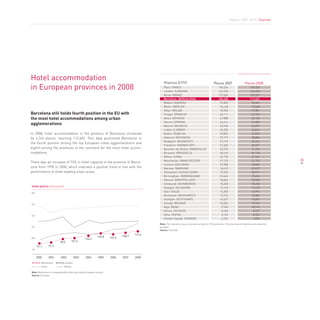
36   Hotel accommodation in European provinces
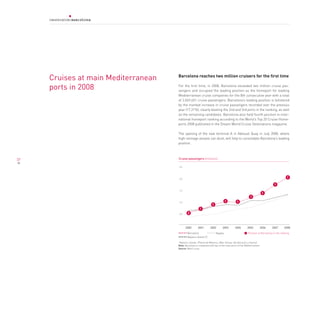
37   Cruises at main Mediterranean ports
I   N   t   r   o   D   u   C   t   I   o   N
The macroeconomic evolution of 2009 was marked by the most serious              the Agreement, 7,500 direct job positions were created in the city in 2010.
    economic recession to have occurred in decades on a global level, with          Similarly, the city of Barcelona is proactive in company support, a source
    sharp drops in the GDPs of Catalonia, Spain and the economies of the            of job creation. In this regard, the Barcelona Chamber of Commerce has
    OECD countries, a drastic reduction in international trade, a financial cri-    developed a special plan to foster company growth and improve competi-
    sis that generated great difficulties for families and companies to obtain      tiveness. This plan consists of providing companies with tools to obtain
    credit and an intense adjustment process in the property market, particu-       the best financing, promoting internationalisation with programmes and
    larly in some economies. The collapse in activity during the first semester     aids for companies to start up and consolidate their presence abroad,
    was followed by a more moderate decline in the second part of the year,         promoting innovation through R&D&I support and aid, offering courses
    which, together with the gradual breakthrough of the more advanced              and grants for training competitive professionals, and maximising busi-
    economies from the recession, led to the recovery of business loyalty in-       ness resources through optimal management.
    dexes and allowed a more favourable forecast to be given for 2010.
                                                                                    The city of Barcelona has dealt with the recession by making the highest
    Under these difficult circumstances, special value can be given to the          investment in its history: €1,028 million in 2009 and 836 million in 2010,
    solid competitive position that Barcelona has maintained among the top          the highest investment per capita of the large Spanish cities. In addition
    European cities and that is described in detail in this report. In this re-     to contributing proactively to stimulating economic activity, this injection
    gard, it is worth noting that in 2009, it recovered the fourth position among   of resources will result in a significant improvement of public space and
    the best cities for businesses in the continent according to the European       equipment and will have an impact on all of the city’s districts. Further-
    Cities Monitor prepared by Cushman & Wakefield – surpassed only by Lon-         more, the municipal budget for 2010 will reinforce the resources destined
7
    don, Paris and Frankfurt – and for the fifth consecutive year it was in the     for economic promotion policies and public care, and the city has healthy
    top five positions in the ranking. In addition, it remained in first place as   local finances that constitute a top-level asset for dealing with the current
    the city with the best quality of life for workers and as the city with the     economic situation.
    greatest progress. Similarly, the prestigious FDI Magazine – the maga-
    zine of the Financial Times – recently set Barcelona in fifth place in the      While it is establishing short-term impact measures, Barcelona maintains
    global ranking of the 25 top European cities for the future 2010/2011 and       a clear strategy for advancing towards a new economic growth model
    in first place among cities in southern Europe. While certain political and     based on knowledge, creativity, innovation and sustainability. The reces-
    economic regulation tools are in the hands of state governments or su-          sion will not stop the city from implementing this strategy in depth, with
    pranational bodies, cities play a key role in the struggle against the reces-   milestones such as the recent inauguration of the Synchrotron – the most
    sion in a global economy where the large urban areas are primary play-          powerful synchrotron light source in the south of Europe and the most
    ers regarding growth and competition. In this respect, the proactive role       complex and top-level scientific facility in the State - obtaining the dis-
    that Barcelona has again developed should be mentioned, leading to the          tinction “International Campus of Excellence” for the Barcelona Knowledge
    OECD appointing the Barcelona Principles, ten recommendations resulting         Campus project and the UAB, and the remarkable increase in the number
    from the exchange of experiences and cooperation of 41 cities under the         of workers dedicated to research and development and other technologi-
    framework of the LEED (Local Economic and Employment Development)               cal activities. Among the measures promoted by the local government, it
    Programme, as the response for cities facing the challenges of the reces-       is worth noting the progress of the strategic clusters of the innovation dis-
    sion. In fact, Barcelona is using these recommendations to guide it in its      trict 22@ - ICT, design, medical technologies, media and energy - where
    response to the recession, using the strategic support points listed below.     more than 1,500 companies have been located, the development of a new
                                                                                    agriculture and food cluster in the Zona Franca and the preparation of the
    The city is dealing with the recession by exercising cooperative leader-        implementation of two new clusters on Education and Multilingualism.
    ship. Its strategy in terms of the labour market is indicated through the       The city is also advancing in sustainability terms and, for example, Bar-
    Agreement for Quality Employment in Barcelona – signed by the Minis-            celona will coordinate part of the European research in renewable ener-
    try of Labour, Barcelona City Hall, Foment del Treball, PIMEC, CCOO and         gies in the KIC Innoenergy project, with an associated investment of €450
    UGT in May 2008, subsequently joined by the municipal groups of ICV-            million, and it is working on the development and promotion of the use of
    EUiA and ERC - and it was reinforced during 2009-10 with additional re-         electric vehicles in the Catalan capital.
    sources aimed at creating direct employment and providing courses and
    guidance for the unemployed and motivating the creation of new compa-           The opening-up of Barcelona’s economy to the world is one of the
    nies by Barcelona Activa. With the application of combined measures in          strength factors that has most clearly contributed to its recovery, as is
Report 2009-2010. Introduction


demonstrated by the fact that Barcelona is the leader of exports in the
Spanish economy and the notable resistance to the recession shown by
its tourism trade. Barcelona continues to maximise the attraction of for-
eign investment, economic activity and talent with actions such as the
Barcelona Economic Triangle in cooperation with the Generalitat of Cata-
lonia to attract economic activity and foreign investment to the metro-
politan region of Barcelona, the motivation of the Do it in Barcelona pro-
gramme for international professionals, researchers and entrepreneurs
that want to begin their professional and business activity in the city, and
the progressive development of the international network of Consulates
of the Sea.

Within the scope of traditional competitiveness factors, Barcelona con-
tinues to focus on large productive infrastructures. The progressive im-
provement in infrastructures with national and international connections
in recent years was reinforced in 2009 with the inauguration of the new
airport terminal – with a capacity for 55 million visitors a year - the open-
ing of new intercontinental routes and the preparation of the strategic
plan of the Aerial Route Development Committee (CDRA), which has con-                                             8
solidated the commitment to internationalisation. The Port of Barcelona
is the leading cruise centre, and this is accompanied by the implementa-
tion of a Strategic Plan that will reinforce its logistic potential and capac-
ity. In addition, Barcelona continues to be in the first five positions in the
global ranking for organising trade fair and congress events.

The current economic situation lends particular value to citizen proxim-
ity policies. In the sphere of economic promotion, Barcelona is noted in
this sense for fostering urban business proximity through its commercial
core policy, remodelling the city’s market network, specific measures for
the city’s young people regarding professional guidance and entering the
labour market, or its dynamising actions in neighbourhoods that require
special attention.

To sum up, Barcelona is dealing with the economic recession by main-
taining favourable international positioning and developing policies in line
with the OECD recommendations for recovering large urban areas. The
challenges presented by the current situation – in which the experts fore-
cast that the breakthrough from the recession will open the doors to a
slow and complex recovery process – mean that it is essential to progress
in this strategy, to reinforce the various cooperation formulas between
the public and private sectors – one of the key reasons for the econom-
ic transformation that the city has undergone – and to intensify actions
leading to a change in the production model.
D   a   t   a   S   H   e   e   t
B   a   r   C   e   L       N   a
                                    11
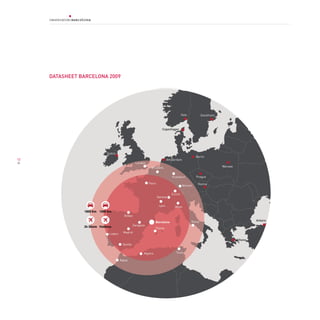
Datasheet Barcelona 2009


10
Report 2009-2010. Datasheet Barcelona 2009


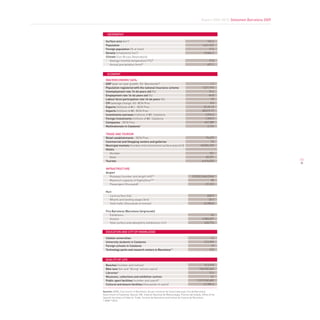
    GeoGrapHy

  Surface area (km2)                                                                                102.2
  population                                                                                    1,621,537
  Foreign population (% of total)                                                                    17.5
  Density (inhabitants/ km2)                                                                     15,866.3
  Climate (Can Bruixa Observatory)
     Average monthly temperature (ºC)*                                                               17.8
     Annual precipitation (mm)*                                                                     607.2


    eCoNoMy

  MaCroeCoNoMIC Data:
  GDp (year-on-year growth, %)- Barcelonès*                                                           1.7
  population registered with the national insurance scheme                                      1,021,974
  unemployment rate 16-64 years old (%)                                                              15.4
  employment rate 16-64 years old (%)                                                                66.8
  Labour force participation rate 16-64 years (%)                                                      79
  CpI (average change, %)- BCN Prov.                                                                  0.5
  exports (millions of € ) - BCN Prov.                                                           32,261.8
  Imports (millions of €)- BCN Prov.                                                            48,519.77
  Investments overseas (millions of €)- Catalonia                                                 1,096.3
  Foreign investments (millions of €)- Catalonia                                                  1,365.3
  Companies - BCN Prov.                                                                           467,385
  Multinationals in Catalonia*                                                                      3,124

  traDe aND tourISM
  retail establishments - BCN Prov.                                                               74,692
  Commercial and Shopping centers and galleries                                                       24
  Municipal markets (number and commercial surface area (m2))                                 45/206,769
  Hotels
     Number                                                                                           321
     Beds                                                                                          60,331
  tourists                                                                                      6,476,033                                   11

  INFraStruCture
  airport
     Runways (number and length (m))**                                                3/3352;2660;2540
     Maximum capacity of flights/hour**                                                             90
     Passengers (thousand)                                                                      27,312

  port
     Land surface (ha)                                                                              828.9
     Wharfs and landing stages (km)                                                                  20.3
     Total traffic (thousands of tonnes)                                                         42,980.8

  Fira Barcelona (Barcelona fairgrounds)
     Exhibitions                                                                                       52
     Visitors                                                                                   2,983,097
     Total surface area devoted to exhibitionsc (m2)                                              633,774


  eDuCatIoN aND CIty oF KNoWLeDGe

  Catalan universities                                                                                 12
  university students in Catalonia                                                                212,959
  Foreign schools in Catalonia                                                                         19
  technology parks and research centers in Barcelona**                                                210


  QuaLIty oF LIFe
  Beaches (number and metres)                                                                   7/ 3,910
  Bike lane (km and “Bicing” service users)                                                 156/182,062
  Libraries*                                                                                         214
  Museums, collections and exhibition centres                                                         41
  public sport facilities (number and users)*                                             1,511/182,682
  Cultural and leisure facilities (thousands of users)                                         41,989.4

Sources: AENA, City Council of Barcelona, Anuari comarcal de Caixa Catalunya, Fira de Barcelona,
Government of Catalonia, Idescat, INE, Instituto Nacional de Meteorología, Puertos del Estado, Office of the
Spanish Secretary of State for Trade, Turisme de Barcelona and Institut de Cultura de Barcelona
* 2008 **2010
t   H   e       B   a   r   C   e   L   o   N   a
        o   B   S   e   r   V   a   t   o   r   y
                                                    15
Informe 2009-2010. The Barcelona observatory


We are pleased to present the 2009-2010 Barcelona Observatory Report           The publication will include the following sections:

The Barcelona Observatory is an initiative promoted by the Barcelona           • A general introduction on the city’s economy and economic develop-
City Council and Chamber of Commerce in conjunction with several local         ment efforts.
entities, which over the years have worked together with the executive
secretary to provide information and make critical contributions in their      • A section with the results of 26 indexes covering six fields: businesses,
respective sectors.                                                            knowledge, tourism, sustainability and quality of life, prices and costs,
                                                                               and labour market and education.
The purpose of the report – the twentieth annual Barcelona Observatory
Report – is to provide a platform to help business people make decisions       • A white paper by Nick Leon, Director of Design London, has been in-
and establish businesses in Barcelona, to attract talent and to provide        cluded titled The Well Connected City: an Integrated Approach to Plan-
support for the presentation of candidates for events or the opening of        ning and Implementing Digital Technologies.
venues in the city of Barcelona. As in previous years, Barcelona continues
to be positioned among the top cities according to recognised economic         • A section with a summarised comparison of Barcelona’s positioning
and social indexes.                                                            among the top cities has been added which provides visual, condensed
                                                                               information for each of the indexes analysed.
The format of the 2009-2010 report has been updated with four main
features:                                                                      The Barcelona Observatory can be characterised by the following key tenets:
                                                                                                                                                             13
• The number of indexes has been reassessed and changed significantly          • It is based on a set of indexes, which are generally defined on a city
in order to provide the reader with a comprehensive and coherent por-          scale, but which can be expanded to cover issues of a territorial scale.
trayal of the city’s main indexes, its positioning, its character and the
challenges it faces. Specifically, the report now includes a total of 26 in-   • Data is collect from a sample group that in some cases can include as
dexes, two of which are new. For the first time the Barcelona Observa-         many as 60 cities worldwide. It should be noted that in the case of certain
tory will also provide information on the awarding of international patents    indicators, due to the sample size, only the most important urban areas
via the Patent Cooperation Treaty and present indexes of greenhouse gas        are included.
emissions.
                                                                               • Whenever possible, the indexes include graphs of trends so that devel-
• Another new addition to the report will be a white paper written by a        opments in each specific field can be assessed.
recognised expert in the field of analysis and comparative study of urban
economies, which over the years will provide insight into topics related to    • The report’s sources of information are highly respected international
this field in order to enrich content derived from the index analysis.         institutes and entities.

• Visual elements for each index have been introduced, in the form of          • Data and information is compiled using the most up-to-date sources
graphs and maps, which make the results easier to understand and               available.
trends easier to spot and analyse.
                                                                               The Barcelona Observatory also has its own website from which users
• The amount of summarised graphic content has been increased, com-            anywhere in the world can freely access information in the report as well
bining all the indexes in order to make Barcelona’s positioning clear at a     as supplementary content, and follow events and the most important
glance.                                                                        projects in Barcelona.
r   e   S   u   L   t   S
Report 2009-2010. City for business


CITY FOR BUSINESS                            15
                                             21
Introduction

     After the downturn in 2008 caused by the international property and fi-
     nancial crisis, the evolution of 2008 was marked by the worst economic
     recession in decades and a sharp drop in Gross Domestic Product in
     Catalonia, Spain and the OECD countries. Nevertheless, the decline in
     activity during the first quarter was followed by a more moderate con-
     traction in the second part of the year. This, together with the more ad-
     vanced economies gradually leaving the recession behind, resulted in the
     recovery of business confidence indexes and more favourable forecasts
     for 2010, as reflected in the Eurochambers annual survey.

     In this difficult climate, Barcelona maintained excellent positioning
     among top European cities selected by European executives for locating
     their businesses. Also, in 2009, it regained fourth place among the best
     cities for business according to Cushman & Wakefield’s European Cit-
     ies Monitor. Barcelona’s noteworthy rating was recently reaffirmed in the
     selection of European Cities and Regions of the Future 2010/2011 in FDI
16
     Magazine – a magazine of the Financial Times – where Barcelona placed
     fifth in the global ranking of the 25 top cities in Europe and first for cities
     in southern Europe. Other significant indicators corroborate Barcelona’s
     favourable positioning. These include the total entrepreneurial activity of
     the population residing in the province, which clearly exceeds the EU av-
     erage; foreign investment projects received, and the city’s excellent posi-
     tion in global ranking of the organisation of international meetings, which
     has improved for the second consecutive year.

     The City Council of Barcelona, the Chamber of Commerce and other local
     public and private entities jointly develop programmes that aim to con-
     solidate the Barcelona brand and its international position by attracting
     foreign businesses and financing, supporting strategic urban clusters,
     attracting and retaining talent, internationalising innovative companies,
     promoting international aerial connections and bringing conferences to
     the city. Among the projects developed in 2009, of particular interest are
     the Barcelona Innovation Zone, which is promoting a new cluster for the
     food sector and audiovisual and cultural industry in the Zona Franca; the
     signing of the cooperative agreement to develop the Barcelona Design
     Innovation Cluster; the promotion of the HiT World Innovation Summit
     fairs for innovation and emerging economic sectors; and The Brandery, a
     new contemporary urban fashion trade show; the extension of the inter-
     national Consulate of the Sea network to strengthen economic links with
     strategic urban areas; and the support of the creation of over 1,000 new
     companies by Barcelona Activa, a local development agency.
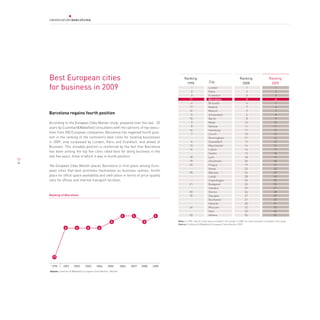
Best European cities                                                                            Ranking
                                                                                                                              City
                                                                                                                                                             Ranking                      Ranking
                                                                                                      1990                                                    2008                         2009
     for business in 2009                                                                                   1
                                                                                                            2
                                                                                                                              London
                                                                                                                              Paris
                                                                                                                                                                   1
                                                                                                                                                                   2
                                                                                                                                                                                                1
                                                                                                                                                                                                2
                                                                                                            3                 Frankfurt                            3                            3
                                                                                                           11                 Barcelona                            5                            4
                                                                                                            4                 Brussels                             4                            5
                                                                                                           17                 Madrid                               7                            6
                                                                                                           12                 Munich                               9                            7
     Barcelona regains fourth position                                                                      5                 Amsterdam                            6                            8
                                                                                                           15                 Berlin                               8                            9
     According to the European Cities Monitor study, prepared over the last 20                              9                 Milan                               13                           10
                                                                                                            8                 Geneva                              11                           11
     years by Cushman&Wakefield consultants with the opinions of top execu-
                                                                                                           14                 Hamburg                             17                           12
     tives from 500 European companies, Barcelona has regained fourth posi-                                 7                 Zurich                              10                           13
     tion in the ranking of the continent’s best cities for locating businesses                             -                 Birmingham                          21                           14
     in 2009, only surpassed by London, Paris and Frankfurt, and ahead of                                   6                 Düsseldorf                          12                           15
     Brussels. This enviable position is reinforced by the fact that Barcelona                             13                 Manchester                          14                           16
                                                                                                           16                 Lisbon                              16                           17
     has been among the top five cities rated best for doing business in the                                -                                                     15                           18
                                                                                                                              Dublin
     last five years, three of which it was in fourth position.                                            18                 Lyon                                18                           19
17                                                                                                         19                 Stockholm                           20                           20
     The European Cities Monitor places Barcelona in first place among Euro-                               23                 Prague                              19                           21
                                                                                                            -                 Rome                                25                           22
     pean cities that best promotes themselves as business centres, fourth
                                                                                                           25                 Warsaw                              24                           23
     place for office space availability and sixth place in terms of price-quality                          -                 Leeds                               28                           24
     ratio for offices and internal transport facilities.                                                   -                 Copenhagen                          23                           25
                                                                                                           21                 Budapest                            22                           25
                                                                                                            -                 Istanbul                            29                           27
                                                                                                           20                 Vienna                              26                           28
     ranking of Barcelona                                                                                  10                 Glasgow                             27                           29
                                                                                                            -                 Bucharest                           31                           30
                                                                                                            -                 Helsinki                            30                           31
                                                                                                           24                 Moscow                              32                           32
                                                                                                                              Oslo                                33                           33
                                                                     4      4             4                22                 Athens                              34                           34

                                                          5                        5            Note: In 1990, only 25 cities were included in the study. In 2009, 34 cities has been included in the study.
                                                                                                Source: Cushman & Wakefield, European Cities Monitor 2009
                  6         6         6         6


       11

      1990      2001      2002      2003      2004      2005        2006   2007   2008   2009
     Source: Cushman & Wakefield, European Cities Monitor Monitor
Report 2009-2010. City for business


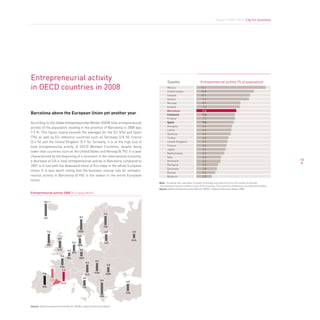
Entrepreneurial activity                                                                                Country                         Entrepreneurial activity (% of population)
in OECD countries in 2008                                                                               Mexico
                                                                                                        United states
                                                                                                                                         13.1
                                                                                                                                         10.8
                                                                                                        Iceland                          10.1
                                                                                                        Greece                            9.9
                                                                                                        Norway                            8.7
                                                                                                        Ireland                           7.6
                                                                                                        Barcelona                         7.5
Barcelona above the European Union yet another year                                                     Catalonia                         7.3
                                                                                                        Finland                           7.3
According to the Global Entrepreneurship Monitor (GEM) total entrepreneurial                            Spain                             7.0
                                                                                                        Hungary                           6.6
activity of the population residing in the province of Barcelona in 2008 was
                                                                                                        Latvia                            6.5
7.5 %. This figure clearly exceeds the averages for the EU (6%) and Spain                               Slovenia                          6.4
(7%) as well as EU reference countries such as Germany (3.8 %), France                                  Turkey                            6.0
(5.6 %) and the United Kingdom (5.9 %). Similarly, it is at the high end of                             United Kingdom                    5.9
total entrepreneurial activity of OECD Member Countries, despite being                                  France                            5.6
                                                                                                        Japan                             5.4
lower than countries such as the United States and Norway (8.7%). In a year                             Netherlands                       5.2
characterised by the beginning of a recession in the international economy,                             Italy                             4.6
a decrease of 0.8 in total entrepreneurial activity in Barcelona compared to                            Denmark                           4.4                                                               18
2007 is in line with the downward trend of this index in the whole European                             Romania                           4.0
                                                                                                        Germany                           3.8
Union. It is also worth noting that the business closure rate for entrepre-
                                                                                                        Russia                            3.5
neurial activity in Barcelona (0.9%) is the lowest in the entire European                               Belgium                           2.9
Union.
                                                                                                 Note: Including start-ups (less 3 months of activity) and new firms (3 to 42 months of activity).
                                                                                                 The statistical source contains a total of 45 countries. The countries of reference are selected samples
                                                                                                 Source: Global Entrepreneurship Monitor (GEM), Catalonia Executive Report 2008
entrepreneurial activity 2008 (% of population)

           10.1


                                                                             7.3
           ICe                                     8.7


                                                                             FIN

                 7.6                              Nor                        6.5           3.5
                                                  4.4
                             5.9
                                                                                           ruS
                                            5.2                              Lat
                 Ire                              DeN
                             u.KI     2.9          3.8
                                            Net
                               5.6
                                      BeL          Ger
                                                                 6.6
                                                           6.4
                                                                               4.0
                       7.3     Fra
                                7.5
           7.0                                                   HuN
                                                           SLo                roM
                                                         4.6
                   Cat                                                 9.9           6.0
                                BCN
          Spa                                           Ita

                                                                                     tur
                                                                       Gre


Source: Global Entrepreneurship Monitor (GEM), Catalonia Executive Report
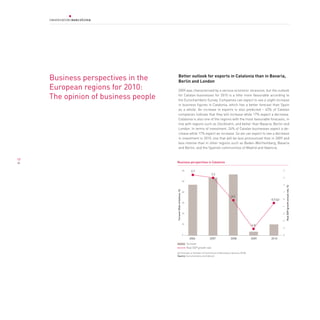
Business perspectives in the            Better outlook for exports in Catalonia than in Bavaria,
                                             Berlin and London
     European regions for 2010:              2009 was characterised by a serious economic recession, but the outlook

     The opinion of business people          for Catalan businesses for 2010 is a little more favourable according to
                                             the Eurochambers Survey. Companies can expect to see a slight increase
                                             in business figures in Catalonia, which has a better forecast than Spain
                                             as a whole. An increase in exports is also predicted – 43% of Catalan
                                             companies indicate that they will increase while 17% expect a decrease.
                                             Catalonia is also one of the regions with the most favourable forecasts, in
                                             line with regions such as Stockholm, and better than Bavaria, Berlin and
                                             London. In terms of investment, 24% of Catalan businesses expect a de-
                                             crease while 17% expect an increase. So we can expect to see a decrease
                                             in investment in 2010, one that will be less pronounced than in 2009 and
                                             less intense than in other regions such as Baden-Württemberg, Bavaria
                                             and Berlin; and the Spanish communities of Madrid and Valencia.


19
                                      Business perspectives in Catalonia

                                                                      60      3.7                                                4
                                                                                                  3.2
                                                                                                                                 3
                                                                      50
                                                                                                                                 2


                                                                                                                                      real GDp (growth annual rate, %)
                                      turnover (rate of balance, %)


                                                                      40                                                         1
                                                                                                                       5
                                                                                                        0.2
                                                                                                                      -0.5 (p)   0
                                                                      30
                                                                                                                                 -1


                                                                      20                                                         -2


                                                                                                                                 -3
                                                                      10                                       -4.0
                                                                                                                                 -4


                                                                      0                                                          -5
                                                                             2006            2007       2008   2009   2010
                                                                           Turnover
                                                                           Real GDP growth rate

                                      (p) Forecast of Camber of Commerce of Barcelona (January 2010)
                                      Source: Eurochambres and Idescat
Report 2009-2010. City for business


                                                    Turnover                                                        Exports                                         Investment
 Region (CITY)                                     (% Balance)                 Region (CITY)                      (% Balance)   Region (CITY)                      (% Balance)
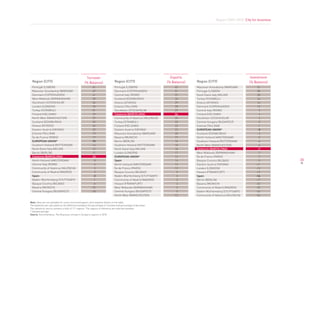
 Portugal (LISBON)                                        61                   Portugal (LISBON)                       62       Masovian Voivodeship (WARSAW)           31
 Masovian Voivodeship (WARSAW)                            47                   Denmark (COPENHAGEN)                    51       Portugal (LISBON)                       30
 Denmark (COPENHAGEN)                                     41                   Central Italy (ROME)                    37       Nord-Ovest Italy (MILAN)                28
 West Midlands (BIRMINGHAM)                               39                   Scotland (EDINBURGH)                    34       Turkey (ISTANBUL)                       24
 Stockholm (STOCKHOLM)                                    34                   Greece (ATHENS)                         29       Greece (ATHENS)                         16
 London (LONDON)                                          33                   Estonia (TALLINN)                       28       Denmark (COPENHAGEN)                    12
 Turkey (ISTANBUL)                                        31                   Stockholm (STOCKHOLM)                   27       Central Italy (ROME)                     9
 Finland (HELSINKI)                                       29                   Catalonia (BarCeLoNa)                   26       Finland (HELSINKI)                       4
 North West (MANCHESTER)                                  27                   Community of Valencia (VALENCIA)        24       Stockholm (STOCKHOLM)                    2
 Scotland (EDINBURGH)                                     25                   Turkey (ISTANBUL)                       23       Central Hungary (BUDAPEST)               0
 Greece (ATHENS)                                          24                   Finland (HELSINKI)                      22       Estonia (TALLINN)                       -1
 Eastern Austria (VIENNA)                                 22                   Eastern Austria (VIENNA)                22       europeaN uNIoN*                         -3
 Estonia (TALLINN)                                        19                   Masovian Voivodeship (WARSAW)           20       Scotland (EDINBURGH)                    -3
 Île de France (PARIS)                                    17                   Bavaria (MUNICH)                        19       North Holland (AMSTERDAM)               -5
 europeaN uNIoN*                                          15                   Berlin (BERLÍN)                         18       Southern Holland (ROTTERDAM)            -6
 Southern Holland (ROTTERDAM)                             14                   Southern Holland (ROTTERDAM)            18       North West (MANCHESTER)                 -6
 Nord-Ovest Italy (MILAN)                                 12                   Nord-Ovest Italy (MILAN)                18       Catalonia (BarCeLoNa)                   -7
 Berlin (BERLÍN)                                          11                   London (LONDON)                         17       West Midlands (BIRMINGHAM)              -7
 Catalonia (BarCeLoNa)                                    10                   europeaN uNIoN*                         16       Île de France (PARIS)                   -7
 North Holland (AMSTERDAM)                                 8                   Spain                                   16       Basque Country (BILBAO)                 -9          20
 Central Italy (ROME)                                      4                   North Holland (AMSTERDAM)               13       Eastern Austria (VIENNA)               -11
 Community of Valencia (VALENCIA)                          3                   Île de France (PARIS)                   12       London (LONDON)                        -12
 Community of Madrid (MADRID)                              2                   Basque Country (BILBAO)                  9       Hessen (FRANKFURT)                     -15
 Spain                                                     2                   Baden-Württemberg (STUTTGART)            5       Spain                                  -16
 Baden-Württemberg (STUTTGART)                            -1                   Community of Madrid (MADRID)             5       Berlin (BERLÍN)                        -17
 Basque Country (BILBAO)                                  -6                   Hessen (FRANKFURT)                       4       Bavaria (MUNICH)                       -22
 Bavaria (MUNICH)                                        -10                   West Midlands (BIRMINGHAM)              -2       Community of Madrid (MADRID)           -23
 Central Hungary (BUDAPEST)                              -18                   Central Hungary (BUDAPEST)              -5       Baden-Württemberg (STUTTGART)          -24
                                                                               North West (MANCHESTER)                -12       Community of Valencia (VALENCIA)       -26

Note: Data are not available for some countries/regions, wich explains blanks in the table.
The balances are calculated as the difference between the percentage of increase and percentage of decrease.
The statistical source contains a total of 111 regions. The regions of reference are selected samples
* Sample average.
Source: Eurochambres, The Business climate in Europe’s regions in 2010
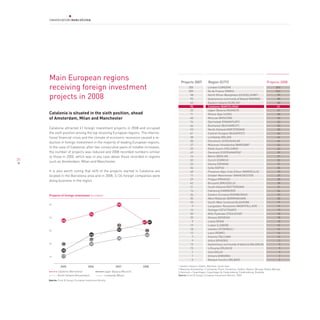
Main European regions                                                               Projects 2007            Region (CITY)                                        Projects 2008
     receiving foreign investment                                                               305
                                                                                                209
                                                                                                                 London (LONDON)
                                                                                                                 Île de France (PARIS)
                                                                                                                                                                               262
                                                                                                                                                                               222

     projects in 2008                                                                            58
                                                                                                 95
                                                                                                                 North Rhine-Westphalia (DÜSSELDORF)
                                                                                                                 Autonomous community of Madrid (MADRID)
                                                                                                                                                                                99
                                                                                                                                                                                80
                                                                                                 43              Eastern Ireland (DUBLIN)1                                      68
                                                                                                 90              Catalonia (BarCeLoNa)                                          61
                                                                                                 52              Upper Bavaria (MUNICH)                                         61
     Catalonia is situated in the sixth position, ahead                                          71              Rhone-Alps (LYON)                                              58
     of Amsterdam, Milan and Manchester                                                          60              Moscow (MOSCOW)                                                56
                                                                                                 74              Darmstadt (FRANKFURT)                                          53
                                                                                                 66              Bucharest (BUCHAREST)                                          52
     Catalonia attracted 61 foreign investment projects in 2008 and occupied                     53              North Holland (AMSTERDAM)                                      50
     the sixth position among the top receiving European regions. The interna-                   61              Central Hungary (BUDAPEST)                                     46
     tional financial crisis and the climate of economic recession caused a re-                  38              Lombardy (MILAN)                                               46
                                                                                                 50              Stockholm (STOCKHOLM)                                          44
     duction in foreign investment in the majority of leading European regions.
                                                                                                 37              Masovian Voivodeship (WARSAW)2                                 42
     In the case of Catalonia, after two consecutive years of notable increases,                 25              Etelä-Suomi (HELSINKI)                                         42
     the number of projects was reduced and 2008 recorded numbers similar                        49              Denmark (COPENHAGEN)3                                          39
     to those in 2005, which was in any case above those recorded in regions                     16              Berlin (BERLIN)                                                37
21                                                                                               32              Zurich (ZURICH)                                                32
     such as Amsterdam, Milan and Manchester.
                                                                                                 23              Vienna (VIENNA)                                                31
                                                                                                 34              Sofia (SOFIA)                                                  30
     It is also worth noting that 44% of the projects started in Catalonia are                   40              Provence-Alps-Cote D’Azur (MARSEILLE)                          30
     located in the Barcelona area and in 2008, 3,124 foreign companies were                     11              Greater Manchester (MANCHESTER)                                29
                                                                                                 29              Prague (PRAGUE)                                                28
     doing business in the region.
                                                                                                 42              Brussels (BRUSSELS)                                            28
                                                                                                 21              South Holland (ROTTERDAM)                                      27
                                                                                                 16              Hamburg (HAMBURG)                                              24
     projects of foreign investment (number)                                                     34              Eastern Scotland (EDINBURGH)                                   23
                                                                                                 35              West Midlands (BIRMINGHAM)                                     20
                                                                                                 33              South-West Scotland (GLASGOW)                                  19
     90                                                         90                                9              Languedoc-Roussillon (MONTPELLIER)                             19
                                                                                                 14              Stuttgart (STUTTGART)                                          19
                                         74                                                      30              Midi-Pyrénées (TOULOUSE)                                       18
     70                                                                                          25              Geneva (GENEVA)                                                18
                64                                                                                9              Latvia (RIGA)                                                  18
                                                                               61 61
                                                                53                               19              Lisbon (LISBON)                                                16
                                                                52                               18              Istanbul (ISTANBUL)                                            16
     50                                                                         50
                                                                                                 12              Lazio (ROME)                                                   16
                                         44                                     46
                                                                                                  7              Estonia (TALLINN)                                              14
                                         37                     38
                                                                                                  9              Attica (ATHENS)                                                13
     30         30                       33                                                      13              Autonomous community of Valencia (VALENCIA)                     9
                                                                                                 15              Lithuania (VÍLNIUS)                                             9
                25                                                                                1              Oslo (OSLO)                                                     9
     10         17                                                                                1              Ankara (ANKARA)                                                 3
                                                                                                  5              Basque Country (BILBAO)                                         2

               2005                    2006                    2007            2008    1 Eastern Ireland = Dublin, Mid-East, South-East.
                                                                                       2 Masovian Voivodeship = Ciechanow, Plock, Ostrolecko, Siedlce, Radom, Warsaw, Miasto Warsaw.
            Catalonia (Barcelona)                     Upper Bavaria (Munich)           3 Denmark = Copenhagen, Copenhagen & Frederiskberg, Frederiskborg, Roskilde.
            North Holland (Amsterdam)                 Lombardy (Milan)                 Source: Ernst & Young’s European Investment Monitor, 2009

     Source: Ernst & Young’s European Investment Monitor
Report 2009-2010. City for business


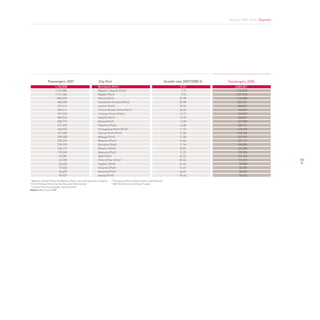
Corporate tax and VAT                                                                              Country                  VAT Standard Rate (%) Corporate Tax Rate (%)

in countries around the world                                                                         Japan
                                                                                              United States
                                                                                                                                           5.0
                                                                                                                                             -
                                                                                                                                                                             40.7
                                                                                                                                                                             40.0

in 2009                                                                                           Argentina
                                                                                                South Africa
                                                                                                                                          21.0
                                                                                                                                          14.0
                                                                                                                                                                             35.0
                                                                                                                                                                             34.6
                                                                                                        India                             12.5                               34.0
                                                                                                   Belgium                                21.0                               34.0
                                                                                                     France                               19.6                               33.3
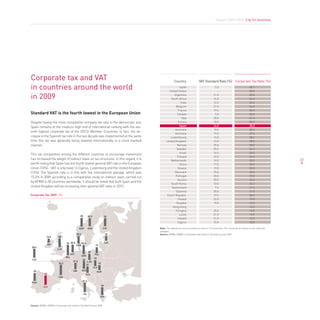
Standard VAT is the fourth lowest in the European Union                                              Canada                                5.0                               33.0
                                                                                                         Italy                            20.0                               31.4
Despite having the most competitive company tax rate in the democratic era,                          Tunisia                              18.0                               30.0
Spain remains at the medium-high end of international ranking with the sev-                            Spain                              16.0                               30.0
                                                                                                   Australia                              10.0                               30.0
enth highest corporate tax of the OECD Member Countries. In fact, the de-
                                                                                                   Germany                                19.0                               29.4
crease in the Spanish tax rate in the last decade was implemented at the same                  Luxembourg                                 15.0                               28.6
time this tax was generally being lowered internationally in a more marked                  United Kingdom                                15.0                               28.0
manner.                                                                                              Norway                               25.0                               28.0
                                                                                                    Sweden                                25.0                               26.3
                                                                                                       Israel                             16.5                               26.0
This tax competition among the different countries to encourage investment
                                                                                                     Finland                              22.0                               26.0
has increased the weight of indirect taxes on tax structures. In this regard, it is            Netherlands                                19.0                               25.5               22
worth noting that Spain has the fourth lowest general VAT rate in the European                         China                              17.0                               25.0
Union (16%) – VAT is only lower in Cyprus, Luxemburg and the United Kingdom                          Greece                               19.0                               25.0
(15%). The Spanish rate is in line with the international average, which was                      Denmark                                 25.0                               25.0
15.2% in 2009 according to a comparative study on indirect taxes carried out                       Portugal                               20.0                               25.0
                                                                                                     Austria                              20.0                               25.0
by KPMG in 90 countries worldwide. It should be noted that both Spain and the
                                                                                                South Korea                               10.0                               24.2
United Kingdom will be increasing their general VAT rates in 2010.                              Switzerland                                7.6                               21.2
                                                                                                    Slovenia                              20.0                               21.0
Corporate tax 2009 (%)                                                                      Czech Republic                                19.0                               20.0
                                                                                                     Poland                               22.0                               19.0
                                                                                                    Slovakia                              19.0                               19.0
                                                                                                 Hong Kong                                   -                               16.5
                                                                                                   Hungary                                25.0                               16.0
                                              28
                                                                                                       Latvia                             21.0                               15.0
                                                         26.3                   26
                                                                                                     Ireland                              21.5                               12.5
                                                                                                     Cyprus                               15.0                               10.0

                                              Nor        SWe                FIN       Note: The statistical source contains a total of 116 countries. The countries of reference are selected
                                                                                      samples
                                           25.5                                 15    Source: KPMG, KPMG’s Corporate and Indirect Tax Rate Survey 2009
             12.5       28

                               34 25.5            29.4                          Lat
                 Ire                       DeN                   19
 28.6
                       u.KI
                                                          20
                                     Net                         poL
                                                  Ger
                               BeL
                                                                19
 LuX                                              25
                                       21.2              C.re
                        33.3                                          16
                                                         21
                                                                SLo
  25                                   SWI        auS
                                                                     HuN
            30                                         SLo
                        Fra
                                                  31.4
 por
                                                                           25
           Spa


                                                   Ita
                                                                       Gre


Source: KPMG, KPMG’s Corporate and Indirect Tax Rate Survey 2009
Growth rate
                                                                                    Congresses 2007            City                   2007/2008 (%)   Congresses 2008
                                                                                             482               Singapore                   32.16            637
                                                                                             357               Paris                       17.37            419
                                                                                             276               Brussels                     8.33            299
                                                                                             321               Vienna                     -22.43            249

     Main world cities organizing                                                            175
                                                                                             129
                                                                                                               Barcelona
                                                                                                               Tokyo
                                                                                                                                           10.29
                                                                                                                                           16.28
                                                                                                                                                            193
                                                                                                                                                            150


     international meetings in 2008
                                                                                             127               Seoul                       -1.57            125
                                                                                              91               Budapest                    27.47            116
                                                                                              82               Copenhagen                  26.83            104
                                                                                             134               London                     -23.13            103
                                                                                             188               Geneva                     -45.74            102
                                                                                             129               Amsterdam                  -23.26             99
                                                                                             126               Lisbon                     -22.22             98
                                                                                              94               Sydney                       3.19             97
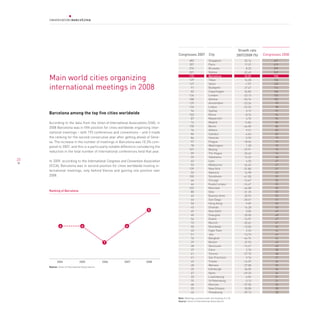
     Barcelona among the top five cities worldwide                                           103               Rome                        -8.74             94
                                                                                              87               Maastricht                   5.75             92
     According to the data from the Union of International Associations (UIA), in             74               Madrid                      14.86             85
                                                                                             150               Berlin                     -44.00             84
     2008 Barcelona was in fifth position for cities worldwide organising inter-
                                                                                              76               Athens                       9.21             83
     national meetings – with 193 conferences and conventions – and it made                   86               Istanbul                    -4.65             82
     the ranking for the second consecutive year after getting ahead of Gene-                 84               Helsinki                    -5.95             79
     va. The increase in the number of meetings in Barcelona was 10.3% com-                   97               Prague                     -18.56             79
     pared to 2007, and this is a particularly notable difference considering the             78               Washington                   1.28             79
                                                                                             107               Beijing                    -29.91             75
     reduction in the total number of international conferences held that year.               59               The Hague                   25.42             74
                                                                                              59               Yokohama                    15.25             68
23   In 2009, according to the International Congress and Convention Association              63               Lyon                         6.35             67
     (ICCA), Barcelona was in second position for cities worldwide hosting in-                53               Melbourne                   26.42             67
                                                                                             139               New York                   -51.80             67
     ternational meetings, only behind Vienna and gaining one position over
                                                                                              53               Valencia                    16.98             62
     2008.                                                                                   100               Stockholm                  -41.00             59
                                                                                              66               Chicago                    -16.67             55
                                                                                              66               Kuala Lumpur               -16.67             55
                                                                                             102               Montreal                   -46.08             55
     ranking of Barcelona                                                                     80               Oslo                       -31.25             55
                                                                                              43               Buenos Aires                20.93             52
                                                                                              64               San Diego                  -20.31             51
                                                                                              55               Hong Kong                   -9.09             50
                                                                                              43               Orlando                     16.28             50
                                                                        5                     49               New Delhi                    0.00             49
                                                                                              40               Shanghai                    20.00             48
                                                                                              56               Dublin                     -16.07             47
                                                                                              73               Munich                     -35.62             47
              6                    6                       6                                  50               Noordwijk                  -10.00             45
                                                                                              43               Cape Town                    2.33             44
                                                                                              51               Jeju                       -13.73             44
                                                                                              76               Bangkok                    -44.74             42
                                                    7                                         29               Boston                      37.93             40
                                                                                              48               Vancouver                  -16.67             40
                                                                                              37               Cairo                        2.70             38
                                                                                              61               Toronto                    -37.70             38
                                                                                              41               San Francisco               -9.76             37
            2004                 2005              2006   2007         2008                   42               Trieste                    -14.29             36
                                                                                              48               Warsaw                     -27.08             35
     Source: Union of International Associations
                                                                                              25               Edinburgh                   36.00             34
                                                                                              67               Kyoto                      -49.25             34
                                                                                              33               Luxembourg                  -6.06             31
                                                                                              32               St Petersburg               -3.13             31
                                                                                              48               Moscow                     -37.50             30
                                                                                              25               New Orleans                 20.00             30
                                                                                              46               Strasbourg                 -39.13             28
                                                                                    Note: Meetings counted under the heading A or B
                                                                                    Source: Union of International Associations
Report 2009-2010. The knowlegde society


THE KNOWLEDGE SOCIETY                               24
                                                    31
Introduction

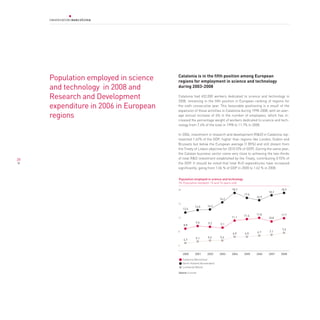
     Barcelona continues to win positions due to the fact that it uses knowl-       Significant progress has been made in the last few years in the field of
     edge as one of the city’s economic growth engines and is advancing in          knowledge, and it has also been transferred to the production structure:
     both the provision of resources – infrastructural and economic – for re-       Catalonia is currently situated among the top ten regions in Europe with
     search, and the transfer of knowledge to the production system and the         regard to the number of workers in manufacturing sectors of high and
     generation and attraction of talent.                                           medium-high technological intensity and in knowledge-intensive and
                                                                                    high-technology service sectors, and by regions, it has the fifth highest
     The city continues to pave the way for the creation of poles of research       number of employees in science and technology. Barcelona has a high-
     centres that permit the advancement of knowledge and its practical ap-         quality training system. Recent examples of its potential are the award
     plication in the business world. A recent example is the Synchrotron –         of the “International Campus of Excellence” distinction for the Barcelona
     the most powerful synchrotron light source in the south of Europe and          Knowledge Campus project and the UAB, and the fact that 59 of the Mas-
     the most complex and top-level scientific installation in the State - which    ter’s courses offered in the metropolitan area of Barcelona are classified
     came into operation in March 2010 and will serve high-technology com-          as Masters of Global Excellence under the Strategic Metropolitan Plan.
     panies and researchers in various scientific fields from physics and           Good schools and universities are essential for training good profession-
     chemistry to medicine and biology. Other examples are the Barcelona Bi-        als and attracting talent from other cities of the world, to which the Do it
     omedical Research Park, the Catalonia Computing and Communications             in Barcelona programme also contributes. This programme is promoted
     Centre (CESCA), the Nuclear Magnetic Resonance Laboratory (RMN-                by the City Hall and it is aimed at international business people, profes-
25
     Barcelona), the Barcelona SuperComputing Centre (BSC), the Technol-            sionals, researchers and graduates who want to do business in the city.
     ogy Transfer Centre of the Universitat Politècnica de Catalunya (UPC) and
     the i2CAT Foundation. In total, the city has more than 400 research and
     innovation centres that form a powerful system of spaces for the produc-
     tion, transfer, dissemination and use of knowledge and act as a means of
     contact between the science and business worlds.

     One of the indices of knowledge generation and the transfer of this
     knowledge to practical applications is the research, development and
     innovation investment index. It should be noted that R+D expenditure in
     Catalonia increased from 1.06% of GDP in 2000 to 1.62% of GDP in 2008.
     Furthermore, the Catalan business community is very close to reaching
     two thirds of the goal for total R+D investment established in the Treaty of
     Lisbon. The effort to promote research in recent years has led to Barce-
     lona achieving the sixth position in Europe and the fifteenth on an inter-
     national level for scientific production, with 12,211 publications in 2009.
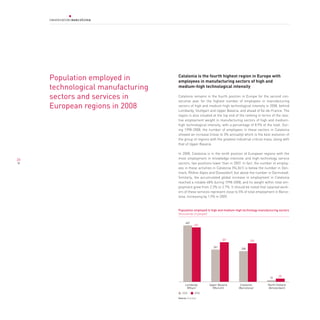
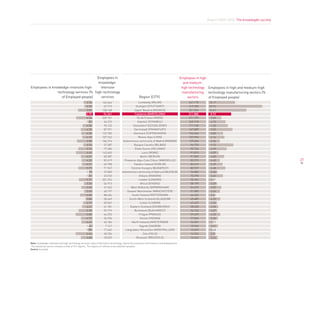
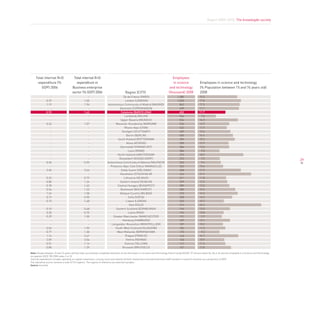
Population employed in        Catalonia is the fourth highest region in Europe with
                                   employees in manufacturing sectors of high and
     technological manufacturing   medium-high technological intensity

     sectors and services in       Catalonia remains in the fourth position in Europe for the second con-
                                   secutive year for the highest number of employees in manufacturing
     European regions in 2008      sectors of high and medium-high technological intensity in 2008, behind
                                   Lombardy, Stuttgart and Upper Bavaria, and ahead of Île-de-France. The
                                   region is also situated at the top end of the ranking in terms of the rela-
                                   tive employment weight in manufacturing sectors of high and medium-
                                   high technological intensity, with a percentage of 8.9% of the total. Dur-
                                   ing 1998-2008, the number of employees in these sectors in Catalonia
                                   showed an increase (close to 3% annually) which is the best evolution of
                                   the group of regions with the greatest industrial critical mass, along with
                                   that of Upper Bavaria.

                                   In 2008, Catalonia is in the tenth position of European regions with the
26                                 most employment in knowledge-intensive and high-technology service
                                   sectors, two positions lower than in 2007. In fact, the number of employ-
                                   ees in these activities in Catalonia (94,361) is below the number in Den-
                                   mark, Rhône-Alpes and Düsseldorf, but above the number in Darmstadt.
                                   Similarly, the accumulated global increase in employment in Catalonia
                                   reached a notable 68% during 1998-2008, and its weight within total em-
                                   ployment grew from 2.3% to 2.7%. It should be noted that salaried work-
                                   ers of these services represent close to 5% of total employment in Barce-
                                   lona, increasing by 1.9% in 2009.


                                   population employed in high and medium-high technology manufacturing sectors
                                   (thousands of people)

                                         457
                                                 441


                                                                 321                312

                                                           261
                                                                              248


                                                                                                       25
                                                                                                 12

                                         Lombardy       Upper Bavaria        Catalonia          North Holland
                                          (Milan)         (Munich)          (Barcelona)         (Amsterdam)
                                      2000       2008
                                   Source: Eurostat
Report 2009-2010. The knowlegde society


                                        Employees in                                                                                    Employees in high
                                         knowledge-                                                                                       and medium-
Employees in knowledge-intensive high-    intensive                                                                                      high technology Employees in high and medium-high
                technology services (% high-technology                                                                                   manufacturing technology manufacturing sectors (%
                   of Employed people)     services                                               Region (CITY)                              sectors      of Employed people)
                                                  3.74           162.444                         Lombardy (MILAN)                            441.170     10.17
                                                  3.35            67.719                      Stuttgart (STUTTGART)                          419.358     20.76
                                                  5.83           128.168                     Upper Bavaria (MUNICH)                          321.024     14.61
                                                  2.70            94.361                     Catalonia (BarCeLoNa)                           311.880      8.93
                                                  6.36           339.151                       Île de France (PARIS)                         271.799      5.09
                                                  1.82            66.315                       Istanbul (ISTANBUL)                           245.710      6.73
                                                  4.06            95.125                    Düsseldorf (DÜSSELDORF)                          171.160      7.30
                                                  4.75            87.971                     Darmstadt (FRANKFURT)                           167.089      9.03
                                                  4.30           122.782                    Denmark (COPENHAGEN)                             166.264      5.83
                                                  4.19           107.742                         Rhone-Alps (LYON)                           157.994      6.14
                                                  6.08           186.274            Autonomous community of Madrid (MADRID)                  139.664      4.56
                                                  3.75            37.287                    Basque Country (BILBAO)                           96.770      9.73
                                                  5.76            77.283                     Etelä-Suomi (HELSINKI)                           93.734      6.99
                                                  6.40           143.465                            Lazio (ROME)                              91.815      4.09
                                                  4.51            68.387                           Berlin (BERLIN)                            91.083      6.00
                                                  4.35            82.419             Provence-Alps-Cote D’Azur (MARSEILLE)                    83.273      4.40                                    27
                                                  4.21            65.758                     Eastern Ireland (DUBLIN)                         82.612      5.29
                                                  5.77            71.947                   Central Hungary (BUDAPEST)                         80.737      6.48
                                                  1.70            37.830           Autonomous community of Valencia (VALENCIA)                76.882      3.45
                                                  1.81            23.510                         Ankara (ANKARA)                              70.290      5.42
                                                  5.37           201.374                         London (LONDON)                              70.181      1.87
                                                  3.20            54.913                           Attica (ATHENS)                            58.199      3.39
                                                  4.40            47.452                  West Midlands (BIRMINGHAM)                          54.375      5.05
                                                  3.40            40.197               Greater Manchester (MANCHESTER)                        51.382      4.34
                                                  5.00            88.404                   South Holland (ROTTERDAM)                          46.323      2.62
                                                  2.86            28.649                 South-West Scotland (GLASGOW)                        45.489      4.53
                                                  3.79            50.067                          Lisbon (LISBON)                             42.637      3.23
                                                  4.21            41.181                  Eastern Scotland (EDINBURGH)                        38.630      3.95
                                                  5.78            59.719                     Bucharest (BUCHAREST)                            34.743      3.37
                                                  6.88            44.293                         Prague (PRAGUE)                              29.269      4.55
                                                  4.72            36.936                          Vienna (VIENNA)                             27.844      3.56
                                                  4.42            62.184                   North Holland (AMSTERDAM)                          24.601      1.75
                                                  1.62             7.147                          Zagreb (ZAGREB)                             15.963      3.61
                                                  1.89            17.642              Languedoc-Roussillon (MONTPELLIER)                      15.697      1.68
                                                  6.66            40.336                             Oslo (OSLO)                              14.524      2.40
                                                  4.68            18.533                      Brussels (BRUSSELS)                             13.642      3.44
Note: knowledge-intensive and high-technology services covers information technology, telecommunications and research and development
The statistical source contains a total of 314 regions. The regions of reference are selected samples
Source: Eurostat
Population employed in science    Catalonia is in the fifth position among European
                                       regions for employment in science and technology
     and technology in 2008 and        during 2003-2008

     Research and Development          Catalonia had 652,000 workers dedicated to science and technology in
                                       2008, remaining in the fifth position in European ranking of regions for
     expenditure in 2006 in European   the sixth consecutive year. This favourable positioning is a result of the
                                       expansion of these activities in Catalonia during 1998-2008, with an aver-
     regions                           age annual increase of 6% in the number of employees, which has in-
                                       creased the percentage weight of workers dedicated to science and tech-
                                       nology from 7.4% of the total in 1998 to 11.7% in 2008.

                                       In 2006, investment in research and development (R&D) in Catalonia rep-
                                       resented 1.42% of the GDP, higher than regions like London, Dublin and
                                       Brussels but below the European average (1.85%) and still distant from
                                       the Treaty of Lisbon objective for 2010 (3% of GDP). During the same year,
                                       the Catalan business sector came very close to achieving the two-thirds
28                                     of total R&D investment established by the Treaty, contributing 0.92% of
                                       the GDP. It should be noted that total R+D expenditures have increased
                                       significantly, going from 1.06 % of GDP in 2000 to 1.62 % in 2008.


                                       population employed in science and technology
                                       (% Population between 15 and 74 years old)

                                       20                                      18.7                         18.9
                                                                                                     18.2
                                                                                       17.5
                                                                                              16.9
                                                                        16.2
                                       16
                                                     14.0      14.2
                                            13.4

                                                                                       11.4   11.8          11.7
                                       12                                      11.1                  10.8
                                                      9.5       9.2
                                            8.8                         9.1
                                                                                                            7.6
                                       8                                                      6.7    7.1
                                                                               6.5     6.5
                                                      5.1      5.6      5.6
                                            4.7
                                       4


                                            2000     2001      2002     2003   2004    2005   2006   2007   2008
                                            Catalonia (Barcelona)
                                            North Holland (Amsterdam)
                                            Lombardy (Milan)

                                       Source: Eurostat
Report 2009-2010. The knowlegde society


     Total internal R+D                  Total internal R+D                                                                            Employees
      expenditure (%                       expenditure in                                                                              in science                 Employees in science and technology
         GDP) 2006                      Business enterprise                                                                          and technology               (% Population between 15 and 74 years old)
                                        sector (% GDP) 2006                               Region (CITY)                             (thousand) 2008               2008
                  -                                   -                              Île de France (PARIS)                                  1,385                 16.3
               0.37                                1.05                                London (LONDON)                                      1,020                 17.8
               1.19                                1.96                  Autonomous Community of Madrid (MADRID)                              842                 17.3
                  -                                   -                           Denmark (COPENHAGEN)                                        699                 17.1
               0.92                                1.42                            Catalonia (BarCeLoNa)                                      652                 11.7
                  -                                   -                               Lombardy (MILAN)                                        566                  7.6
                  -                                   -                            Upper Bavaria (MUNICH)                                     554                 16.5
               0.33                                1.07                        Masovian Voivodeship (WARSAW)                                  536                 12.9
                  -                                   -                               Rhone-Alps (LYON)                                       522                 11.9
                  -                                   -                             Stuttgart (STUTTGART)                                     409                 13.4
                  -                                   -                                 Berlin (BERLIN)                                       400                 14.4
                  -                                   -                          South Holland (ROTTERDAM)                                    395                 15.2
                  -                                   -                                 Attica (ATHENS)                                       390                 12.9
                  -                                   -                            Darmstadt (FRANKFURT)                                      384                 13.0
                  -                                   -                                   Lazio (ROME)                                        384                  9.0
                  -                                   -                          North Holland (AMSTERDAM)                                    375                 18.9
                  -                                   -                           Düsseldorf (DÜSSELDORF)                                     372                  9.2
                                                                                                                                                                                                                                        29
               0.36                                0.95                  Autonomous Community of Valencia (VALENCIA)                          365                  9.6
                  -                                   -                    Provence-Alps-Cote D’Azur (MARSEILLE)                              362                 10.4
               2.40                                3.46                            Etelä-Suomi (HÈLSINKI)                                     358                 17.9
                  -                                   -                           Stockholm (STOCKHOLM)                                       324                 21.9
               0.22                                0.79                               Lithuania (VÍLNIUS)                                     311                 11.8
               0.80                                1.24                            Eastern Ireland (DUBLIN)                                   299                 12.3
               0.78                                1.45                          Central Hungary (BUDAPEST)                                   289                 13.0
               0.54                                1.23                            Bucharest (BUCHAREST)                                      280                 15.5
               1.24                                1.58                           Basque Country (BILBAO)                                     273                 16.5
               0.19                                0.90                                   Sofia (SOFIA)                                       238                 14.2
               0.73                                1.48                                 Lisbon (LISBON)                                       232                 10.7
                  -                                   -                                    Oslo (OSLO)                                        212                 26.3
               0.10                                0.48                         Eastern Scotland (EDINBURGH)                                  196                 13.5
               0.35                                0.70                                   Latvia (RIGA)                                       194                 10.8
               0.29                                1.00                      Greater Manchester (MANCHESTER)                                  191                  9.9
                  -                                   -                             Hamburg (HAMBURG)                                         187                 13.1
                  -                                   -                     Languedoc-Roussillon (MONTPELLIER)                                187                 10.3
               0.54                                1.95                        South-West Scotland (GLASGOW)                                  182                 11.3
               0.77                                1.30                         West Midlands (BIRMINGHAM)                                    175                  9.2
               1.14                                2.47                                Prague (PRAGUE)                                        163                 16.7
               2.09                                3.54                                 Vienna (VIENNA)                                       140                 10.9
               0.51                                1.14                                Estonia (TALLINN)                                      117                 11.3
               0.80                                1.39                             Brussels (BRUSSELS)                                       107                 13.8

Note: People between 15 and 74 years old that have successfully completed education at the third level in a Science and Technology field of study (ISCED ‘97 version levels 5a, 5b or 6) and are employed in a Science and Technology
occupation (ISCO ‘88 COM codes 2 or 3).
Internal expenditure includes spending on capital investment, running costs and salaries (of both researchers and administrative staff) involved in research activities as a proportion of GDP.
The statistical source contains a total of 314 regions. The regions of reference are selected samples
Source: Eurostat
Applications for patents in main   Barcelona records an increase in international
                                        technological patents
     OECD provinces in 2007
                                        In 2007, Barcelona occupied the 24th position among the top provinces
                                        of reference of the OECD, with 392 PCT patents, in accordance with the
                                        inventor’s place of residence. The significant progress of the last dec-
                                        ade has enabled it to reach the same number of patents as European
                                        provinces of reference, such as Milan or Lyon, and overtake Amsterdam,
                                        Montreal, Dublin and Brussels, but nevertheless still far behind the main
                                        metropolises of global reference. In particular, it must be pointed out that
                                        Barcelona nearly doubled its number of PCT technological patents during
                                        2002-2007, reaching almost the same level as Düsseldorf. This favoura-
                                        ble evolution enabled Barcelona to maintain its position among the urban
                                        areas of reference (29th) in 2007.


30                                      pCt* patents (number)

                                        600


                                        500

                                                                                                       407.5
                                                                                       378.2                   391.5
                                        400                                                    376.5


                                        300                                    272.4
                                                                       236.1
                                                           212.4
                                        200    187.5


                                        100


                                          0
                                               2000         2001       2002    2003    2004    2005    2006    2007

                                               Barcelona              Milan
                                               Amsterdam              Dublin
                                        * Patent Cooperation Treaty
                                        Source: OECD
Report 2009-2010. The knowlegde society


   Applications for PCT               Applications for PCT technological                                                    Total PCT patents applications
  technological patents                patents per million inhabitants                       Province (CITY)                    per million inhabitants      Total PCT patents applications
             4,464.81                                       349.96                           Tokyo (TOKYO)                             635.95                           8,113.42
             3,568.99                                       374.64                           Silicon Valley (SAN JOSE)                 638.89                           6,086.37
             1,476.60                                        63.91                           New York (NEW YORK)                       179.32                           4,142.80
             1,151.81                                       140.20                           Boston (BOSTON)                           396.41                           3,256.73
               937.04                                        48.06                           Los Angeles (LOS ANGELES)                 129.16                           2,518.05
             1,102.22                                       109.94                           Seoul (SEOUL)                             217.75                           2,183.07
               540.82                                        61.37                           Osaka (OSAKA)                             241.74                           2,130.24
               690.33                                        66.10                           Chicago (CHICAGO)                         188.29                           1,966.37
             1,208.22                                       266.15                           Seattle (SEATTLE)                         392.80                           1,783.13
               388.67                                        59.69                           Houston (HOUSTON)                         259.31                           1,688.59
               360.29                                       134.91                           Stuttgart (STUTTGART)                     610.41                           1,630.21
               614.13                                       235.44                           Munich (MUNICH)                           604.58                           1,577.02
               544.37                                       281.50                           Stockholm (STOCKHOLM)                     557.83                           1,078.73
                77.82                                        26.27                           Düsseldorf (DÜSSELDORF)                   267.59                             792.59
               399.95                                       289.55                           Uusima (HELSINKI)                         509.46                             703.71
               205.98                                        60.40                           Berlin (BERLIN)                           186.93                             637.47
               244.64                                            -                           London (LONDON)                                -                             635.03
               208.32                                            -                           Paris (PARIS)                                  -                             584.43
               109.91                                        31.78                           Rotterdam (ROTTERDAM)                     145.58                             503.45
                                                                                                                                                                                              31
                85.49                                        21.95                           Milan (MILAN)                             113.58                             442.46
                36.51                                            -                           Rhône (LYON)                                   -                             396.34
                74.43                                        14.04                           Barcelona (BarCeLoNa)                      73.87                             391.51
                84.00                                        32.07                           Amsterdam (AMSTERDAM)                     138.35                             362.43
               160.38                                            -                           Montreal (MONTREAL)                            -                             348.88
               126.10                                        20.60                           Madrid (MADRID)                            55.13                             337.44
               173.24                                       103.67                           Vienna (VIENNA)                           199.52                             333.40
               142.20                                            -                           Toronto (TORONTO)                              -                             296.13
                33.75                                         2.68                           Istanbul (INSTANBUL)                       17.86                             224.61
                38.51                                        76.43                           Copenhagen (COPENHAGEN)                   425.16                             214.24
                56.26                                        13.94                           Rome (ROME)                                51.08                             206.23
                85.43                                            -                           Bouches-du-Rhône (MARSEILLE)                   -                             173.14
                57.49                                       103.66                           Oslo (OSLO)                               233.63                             129.56
                57.42                                            -                           Dublin (DUBLIN)                                -                             124.79
                38.49                                        22.65                           Budapest (BUDAPEST)                        62.50                             106.19
                50.93                                            -                           Edinburgh (EDINBURGH)                          -                             104.03
                16.11                                        15.50                           Brussels (BRUSSELS)                        99.17                             103.13
                35.14                                            -                           Manchester (MANCHESTER)                        -                             101.95
                16.22                                         6.62                           Valencia (VALENCIA)                        33.73                              82.71
                10.50                                         2.59                           Attica (ATHENS)                            17.52                              70.91
                 9.62                                            -                           Hérault (MONTPELLIER)                          -                              69.80
                12.13                                        10.11                           Prague (PRAGUE)                            44.70                              53.64
                11.77                                            -                           Birmingham (BIRMINGHAM)                        -                              40.24
                 6.55                                         5.76                           Vizcaya (BILBAO)                           30.95                              35.20
                 8.48                                         4.19                           Lisbon (LISBON)                            16.57                              33.52
                14.78                                            -                           Glasgow (GLASGOW)                              -                              32.08
                10.75                                         6.31                           Warsaw (WARSAW)                            18.79                              32.03

Note: Counting patents according to the inventor’s region of residence
The statistical source contains a total of 1742 provinces. The provinces of reference are selected samples
Source: OECD
World                                                 World         European
                                                                                                       Ranking                                               Ranking         Ranking Publications
                                                                                                        2008            City                                  2009            2009     in 2009
                                                                                                            1           Beijing                                   1                -              33,376
                                                                                                            2           London                                    2                1              30,145
                                                                                                            3           Tokyo                                     3                -              28,893
                                                                                                            4           Paris                                     4                2              24,269
                                                                                                            5           New York                                  5                -              22,548
                                                                                                                        Boston
     Main cities of the world in
                                                                                                            6                                                     6                -              22,500
                                                                                                            7           Seoul                                     7                -              22,294
                                                                                                            8           Shanghai                                  8                -              17,156

     scientific production in 2009                                                                          9
                                                                                                           10
                                                                                                                        Moscow
                                                                                                                        Madrid
                                                                                                                                                                  9
                                                                                                                                                                 10
                                                                                                                                                                                   3
                                                                                                                                                                                   4
                                                                                                                                                                                                  15,818
                                                                                                                                                                                                  13,619
                                                                                                           11           Los Angeles                              11                -              13,113
                                                                                                           15           Rome                                     12                5              12,454
                                                                                                           12           Baltimore                                13                -              12,414
                                                                                                           13           Toronto                                  14                -              12,414
                                                                                                           20           Barcelona                                15                6              12,211
     Barcelona moves up five positions in the international                                                14           Philadelphia                             16                -              12,199
                                                                                                           21           Cambridge Massachusetts                  17                -              12,190
     ranking                                                                                               17           Chicago                                  18                -              12,120
                                                                                                           18           São Paulo                                19                -              12,105
     In 2009, Barcelona moved up to the 6th position in the European ranking                               19           Berlin                                   20                7              11,972
     and 15th in the international ranking for cities with scientific production,                          16           Houston                                  21                -              11,808
                                                                                                           24           Munich                                   22                8              10,909
     with a total of 12,211 publications generated, a 4.7% increase on the pre-
                                                                                                           23           Milan                                    23                9              10,673
     vious year.                                                                                           22           Osaka                                    24                -              10,596
                                                                                                           25           Montreal                                 25                -              10,241
     With reference to 2008, Barcelona moved up five positions in the interna-                             27           Cambridge                                26               10               9,624
                                                                                                           26           Hong Kong                                27                -               9,467
     tional ranking, overtaking Philadelphia, Cambridge (Massachusetts), Chi-
32                                                                                                         28           Amsterdam                                28               11               9,119
     cago, São Paulo and Berlin, and one place in the European city ranking.                               31           Singapore                                29                -               8,979
                                                                                                           33           Melbourne                                30                -               8,979
                                                                                                           34           Zurich                                   31               12               8,707
                                                                                                           32           Oxford                                   32               13               8,635
     ranking of Barcelona
                                                                                                           29           Pittsburgh                               33                -               8,587
                                                                                                           30           San Francisco                            34                -               8,478
                                                                                                           35           Stockholm                                35               14               7,896
                                                                                                           36           Athens                                   36               15               6,873
                                                                                                           37           Prague                                   37               16               6,618
                                                                                                6
                                                          7                    7                           38           Copenhagen                               38               17               6,425
                                    9                                                                      41           Lyon                                     39               18               6,038
              11                                                                                           39           Manchester                               40               19               6,030
                                                                                                           40           Warsaw                                   41               20               5,786
                                                                                                           43           Edinburgh                                42               21               5,288
                                                                                               15
                                                                                                           42           Mexico City                              43                -               5,183
                                                                                                           44           Brussels                                 44               22               5,173
                                                                              20                           47           Toulouse                                 45               23               5,163
                                   21                    21                                                48           Buenos Aires                             46                -               4,901
                                                                                                           45           Rio de Janeiro                           47                -               4,803
                                                                                                           49           Dublin                                   48               24               4,749
              27                                                                                           46           Naples                                   49               25               4,736
                                                                                                           52           Hamburg                                  50               26               4,686
            2005                  2006                  2007                 2008              2009        50           New Delhi                                51                -               4,623
                                                                                                           55           Turin                                    52               27               4,617
        World Ranking
                                                                                                           53           Montpellier                              53               28               4,590
        European Ranking
                                                                                                           51           Glasgow                                  54               29               4,467
     Source: Universitat Politècnica de Catalunya - Centre de Política del Sòl i Valoracions               56           Valencia                                 55               30               4,444
                                                                                                           54           St Petersburg                            56               31               4,402
                                                                                                           58           Marseille                                57               32               4,379
                                                                                                           57           Yokohama                                 58                -               4,234
                                                                                                           59           Basel                                    59               33               4,116
                                                                                                           60           Lisbon                                   60               34               4,056
                                                                                                           62           Frankfurt                                61               35               3,694
                                                                                                           63           Tel Aviv                                 62                -               3,664
                                                                                                           61           Liverpool                                63               36               3,654
                                                                                                      Source: Universidad Politécnica de Cataluña - Centro de Política del Suelo y Valoraciones, Reporte sobre
                                                                                                      la Evolución 2008-2009 de la producción científica de las principales ciudades del mundo
Report 2009-2010. Tourism


TOURISM                     41
                            33
Introduction

     2009 was characterised by a general decrease in tourism at a global lev-
     el, the main causes being economic uncertainty and a serious increase
     in the unemployment rate. Therefore, the economic context was not fa-
     vourable internally or externally. Despite this situation, Barcelona’s tour-
     ism sector has managed to resist the recession remarkably, and 2009
     closed with a 2.6% increase in overnight stays and a slight reduction in
     the number of tourists, below that recorded at a European and global lev-
     el. In addition, the city continues to increase its number of hotels, which
     was 321 on 31 December 2009 and will continue to grow over the next few
     years. The forecast for 2010 is the opening of 15 new hotels, representing
     1,505 new hotel places.

     Based on this evolution and the strong growth in tourism from 1993 to
     2007, the city is working towards maintaining this increase while ensur-
     ing that it is economically and socially sustainable. The main instrument
     in this regard is the Strategic Tourism Plan 2015, undertaken by Turisme
34
40
     de Barcelona, which will soon present the future lines of action regard-
     ing tourism in the city. It should be noted that, according to the studies
     carried out within the framework of the Plan, the city attracts a total of
     over 18 million tourists every year, who generate an approximate daily
     expenditure of €20,000,000 and an impact of between 8 and 10% of the
     Gross Domestic Product, manifesting the significant role that tourism
     plays in Barcelona’s economy.

     2009 signified a major improvement for Barcelona in terms of infrastruc-
     tures linked to tourism and internationalisation. In June, the new T-1 ter-
     minal of the El Prat airport was inaugurated, with a surface area of over
     500,000 m2 and a capacity for over 30 million passengers, spurring an
     increase from 237 to 248 intercontinental flights between 2008 and 2009.

     The forecasts for 2010 are a little better than 2009, suggesting that the
     main customer markets in Europe will slowly recover. In fact, data from
     the end of 2009 and the beginning of 2010 already present positive signs.
     In the first three months of 2010, the number of passengers using airport
     Barcelona increased by 5% - one of the best indicators recorded in Span-
     ish airports – and the number of tourists and overnight stays in the city
     show an interannual increase of two digits.
Main European airports by                                                                                       City (AIRPORT)
                                                                                                                                                                     Growth rate                    Passengers
                                                                                                                                                                     2008/2009 %                       2009
     volume of passengers in 2009                                                                                    London Heathrow (LHR)
                                                                                                                     Paris Roissy (CDG)
                                                                                                                                                                            -1.5
                                                                                                                                                                            -4.9
                                                                                                                                                                                                         66,037,578
                                                                                                                                                                                                         57,883,282
                                                                                                                     Frankfurt (FRA)                                        -4.7                         50,932,840
                                                                                                                     Madrid (MAD)                                           -5.1                         48,248,890
                                                                                                                     Amsterdam (AMS)                                        -8.1                         43,569,553
                                                                                                                     Rome-Fiumicino (FCO)                                   -4.0                         33,723,213
                                                                                                                     Munich (MUC)                                           -5.4                         32,681,067
     Barcelona remains in ninth position in Europe since                                                             London Gatwick (LGW)                                   -5.3                         32,401,046
     2004                                                                                                            Barcelona (BCN)                                        -9.7                         27,301,493
                                                                                                                     Paris Orly (ORY)                                       -4.2                         25,101,709
                                                                                                                     Zurich (ZRH)                                           -0.8                         21,879,095
     In 2009, the Barcelona International Airport recorded 27.3 million pas-                                         Palma de Mallorca (PMI)                                -7.1                         21,197,229
     sengers, retaining ninth position in the European ranking. Despite a 9.7%                                       Dublin (DUB)                                          -12.6                         20,504,705
     decrease in the number of passengers compared with 2008, the Prat air-                                          London Stansted (STN)                                 -10.7                         19,957,221
     port has not lost its position due to the fact that the prevailing trend in the                                 Copenhagen (CPH)                                       -8.4                         19,668,804
                                                                                                                     Manchester (MAN)                                      -12.0                         18,840,008
     evolution of passenger travelling via large European airports has been                                          Moscow Domodedovo (DME)                                -8.6                         18,674,947
     decreasing.                                                                                                     Vienna (VIE)                                           -8.3                         18,114,427
                                                                                                                     Oslo (OSL)                                             -6.6                         18,079,732
35                                                                                                                   Düsseldorf (DUS)                                       -2.0                         17,793,493
     The opening of the new T1 terminal in June 2009 – which can hold 30
                                                                                                                     Milan-Malpensa (MXP)                                   -8.7                         17,551,635
     million passengers and has a surface area of over 500,000 m2 – has sub-
                                                                                                                     Brussels (BRU)                                         -8.2                         16,974,247
     stantially improved the airport’s capacity, and provided an opportunity to                                      Athens (ATH)                                           -1.4                         16,213,723
     make a qualitative leap and improve its positioning for intercontinental                                        Stockholm-Arlanda (ARN)                               -11.4                         16,098,610
     flights.                                                                                                        Berlin (TXL)                                           -2.1                         14,180,237
                                                                                                                     Lisbon (LIS)                                           -2.5                         13,260,974
                                                                                                                     Helsinki (HEL)                                         -6.9                         12,503,372
                                                                                                                     Hamburg (HAM)                                          -4.7                         12,229,271
     passengers (millions)                                                                                           Prague (PRG)                                           -7.8                         11,643,366
                                                                                                                     Malaga (AGP)                                           -9.3                         11,605,981
     60                                                                                                              Nice (NCE)                                             -5.3                          9,831,136
                                                                                                                     Cologne/Bonn (CGN)                                     -5.8                          9,739,581
                                                                                                                     Gran Canaria (LPA)                                    -10.4                          9,143,329
     50                                                                                                              Alicante (ALC)                                         -4.6                          9,131,323
                                                                                                                     Birmingham (BHX)                                       -5.5                          9,107,462
                                                                                                                     Edinburgh (EDI)                                         0.5                          9,050,890
     40
                                                                                                                     Stuttgart (STR)                                       -10.0                          8,934,493
                                                                                                                     Warsaw (WAW)                                          -12.0                          8,320,927
                                    9                     9                        9
     30                                                                                                              Milan Linate (LIN)                                    -10.5                          8,295,099
              9                                                                                   9                  Budapest (BUD)                                         -4.1                          8,084,364
                                                                                                                     Moscow-Vnukovo (VKO)                                   -2.3                          7,730,211
     20
                                                                                                                     Marseille (MRS)                                         4.7                          7,290,119
                                                                                                                     Glasgow (GLA)                                         -11.6                          7,228,659
     10                                                                                                              Milan-Orio al Serio (BGY)                              10.5                          7,157,421
                                                                                                                     Tenerife South (TFS)                                  -13.9                          7,080,684
                                                                                                                     Berlin (SXF)                                            2.4                          6,797,158
                                                                                                                     Venice (VCE)                                           -2.6                          6,701,689
            2005                  2006                  2007                  2008              2009
                                                                                                                     Naples (NAP)                                           -5.5                          5,330,161
             Barcelona (BCN)                 Munich (MUC)                Posicion of Barcelona in the ranking        Girona (GRO)                                           -4.1                          5,268,715
             Amsterdam (AMS)                 Dublin (DUB)                                                            Faro (FAO)                                             -7.1                          5,061,910
     Source: Airport Council International, Worldwide Airport Traffic Statistics                                     Hanover (HAJ)                                         -11.8                          4,969,799
                                                                                                                     Rome-Ciampin (CIA)                                      0.3                          4,757,743
                                                                                                                     Valencia (VLC)                                        -17.9                          4,742,182
                                                                                                                Source: Airport Council International, Worldwide Airport Traffic Statistics Statistics
Report 2009-2010. Tourism


Hotel accommodation                                                                            Province (CITY)                                  Places 2007                    Places 2008
in European provinces in 2008                                                                  Paris (PARIS)
                                                                                               London (LONDON)
                                                                                                                                                     154,524
                                                                                                                                                     124,920
                                                                                                                                                                                   156,330
                                                                                                                                                                                   124,920
                                                                                               Rome (ROME)                                           115,504                       122,557
                                                                                               Barcelona (BarCeLoNa)                                 108,658                       113,402
                                                                                               Madrid (MADRID)                                        92,802                        96,547
                                                                                               Berlin (BERLIN)                                        76,168                        79,668
                                                                                               Milan (MILAN)                                          70,206                        77,381
Barcelona still holds fourth position in the EU with                                           Prague (PRAGUE)                                        63,111                        67,753
the most hotel accommodations among urban                                                      Attica (ATHENS)                                        61,888                        62,168
                                                                                               Vienna (VIENNA)                                        44,414                        49,005
agglomerations                                                                                 Munich (MUNICH)                                        43,940                        46,099
                                                                                               Lisbon (LISBON)                                        45,255                        45,812
In 2008, hotel accommodation in the province of Barcelona increased                            Dublin (DUBLIN)                                        39,893                        42,559
by 4,744 places, reaching 113,402. This data positioned Barcelona in                           Valencia (VALENCIA)                                    37,719                        38,886
                                                                                               Budapest (BUDAPEST)                                    37,193                        36,526
the fourth position among the top European urban agglomerations and
                                                                                               Frankfurt (FRANKFURT)                                  31,505                        32,071
eighth among the provinces in the continent for the most hotel accom-                          Bouches-du-Rhône (MARSEILLE)                           30,570                        31,250
modations.                                                                                     Brussels (BRUSSELS)                                    30,610                        31,170
                                                                                               Rhône (LYON)                                           26,770                        27,544
                                                                                               Manchester (MANCHESTER)                                27,155                        27,155             36
There was an increase of 73% in hotel capacity in the province of Barce-
                                                                                               Uusima (HELSINKI)                                      25,388                        26,863
lona from 1998 to 2008, which indicates a positive trend in line with the                      Warsaw (WARSAW)                                        18,610                        22,677
performance of other leading urban areas.                                                      Düsseldorf (DÜSSELDORF)                                19,230                        20,911
                                                                                               Birmingham (BIRMINGHAM)                                20,434                        20,434
                                                                                               Hérault (MONTPELLIER)                                  18,862                        18,900
                                                                                               Edinburgh (EDINBURGH)                                  18,268                        18,268
Hotel places (thousand)                                                                        Glasgow (GLASGOW)                                      17,418                        17,418
180
                                                                                               Oslo (OSLO)                                            16,283                        16,997
                                                                                               Bucharest (BUCHAREST)                                  12,215                        16,882
                                                                                               Stuttgart (STUTTGART)                                  14,637                        15,054
160                                                                                            Vizcaya (BILBAO)                                       10,582                        10,932
                                                                                               Riga (RIGA)                                             9,940                        10,914
                                                                                               Vilnius (VILNIUS)                                       8,186                         8,457
140                                                                                            Sofia (SOFIA)                                           5,765                         8,326
                                                                                               Greater Zagreb (ZAGREB)                                 6,376                         6,594
                                                                                            Note: The statistical source contains a total of 1372 provinces. The provinces of reference are selected
120                                                                                         samples
                                                                                            Source: Eurostat
                                                                                    113.4
                                                           109.8            108.7
100                                             104.2               107.4
                         98.5      101.4
      91.1     92.2
 80


      2000     2001       2002        2003      2004        2005    2006    2007    2008
         Barcelona           London
         Paris               Rome

Note: Barcelona is compared with other big urban European centers
Source: Eurostat
Cruises at main Mediterranean   Barcelona reaches two million cruisers for the first time

     ports in 2008                   For the first time, in 2008, Barcelona exceeded two million cruise pas-
                                     sengers and occupied the leading position as the homeport for leading
                                     Mediterranean cruise companies for the 8th consecutive year with a total
                                     of 2,069,651 cruise passengers. Barcelona’s leading position is bolstered
                                     by the marked increase in cruise passengers recorded over the previous
                                     year (17.21%), clearly beating the 2nd and 3rd ports in the ranking, as well
                                     as the remaining candidates. Barcelona also held fourth position in inter-
                                     national homeport ranking according to the World’s Top 20 Cruise Home-
                                     ports 2008 published in the Dream World Cruise Destinations magazine.

                                     The opening of the new terminal A in Adossat Quay in July 2008, where
                                     high-tonnage vessels can dock, will help to consolidate Barcelona’s leading
                                     position.


37                                   Cruise passengers (millions)

                                         2.5


                                         2.0
                                                                                                                                       1

                                                                                                                            1
                                         1.5
                                                                                                                    1
                                                                                                       1
                                         1.0                                       1      1
                                                                      1
                                                           1
                                         0.5    2


                                               2000      2001        2002      2003      2004       2005           2006   2007      2008
                                                Barcelona                 Naples                     Position of Barcelona in the ranking
                                                Balears Island (1)
                                     1
                                      Balearic Islands (Palma de Mallorca, Maó, Eivissa, Alcúdia and La Savina).
                                     Note: Barcelona is compared with two of the main ports of the Mediterranean
                                     Source: Med Cruise
Report 2009-2010. Tourism


                Passengers 2007                                  City Port                                                        Growth rate 2007/2008 %   Passengers 2008
                       1,765,838                                Barcelona (port)                                                           17.21                2,069,651
                       1,219,886                                Balearic Islands (Port) 1                                                   7.72                1,314,090
                       1,151,345                                Naples (Port)                                                               7.45                1,237,075
                       1,003,529                                Venice (Port)                                                              21.08                1,215,088
                         686,000                                Dubrovnik-Korkula (Port)                                                   23.98                  850,521
                         713,114                                Livorno (Port)                                                             19.04                  848,861
                         559,411                                French Riviera Ports (Port) 2                                              36.23                  762,092
                         721,592                                Tunisian Ports (Port) 3                                                    -3.71                  694,829
                         489,532                                Valletta (Port)                                                            13.75                  556,841
                         520,197                                Genoa (Port)                                                                5.33                  547,905
                         471,395                                Palermo (Port)                                                             14.28                  538,721
                         376,592                                Portuguese Ports (Port) 4                                                  11.19                  418,725
                         427,408                                Cyprus Ports (Port)                                                       -11.86                  376,706
                         290,558                                Malaga (Port)                                                              21.48                  352,959
                         293,296                                Messina (Port)                                                             14.94                  337,117
                         275,993                                Gibraltar (Port)                                                           11.96                  308,989
                         184,117                                Monaco (Port)                                                              25.81                  231,639
                         179,209                                Valencia (Port)                                                            11.23                  199,335
                          99,281                                Split (Port)                                                               25.43                  124,525
                          62,739                                Ports Of Var (Port) 5                                                      87.46                  117,612               38
                          63,638                                Cagliari (Port)                                                            41.42                   90,000
                          72,063                                Alicante (Port)                                                            14.47                   82,487
                          36,439                                Almeria (Port)                                                             66.57                   60,695
                          93,937                                Alanya (Port)                                                             -39.60                   56,734
1
 Balearic Islands (Palma de Mallorca, Maho, Ibiza, Alcudia and La Savina).   4
                                                                                 Portuguese Ports (Lisboa, Azores and Patimao).
2
 French Riviera Ports (Cannes, Nice and Villefranche).                       5
                                                                                 VAR Ports (Toulon and Saint Tropez).
3
 Tunisian Ports (La Goulette, Souse Bizerte).
Source: Med Cruise 2008
Report 2009-2010. Sustainability and quality of life


SUSTAINABILITY AND QUALITY OF LIFE                                        47
                                                                          39
Introduction

     Given our current circumstances, energy efficiency, the development of        Considering the urban dimension, construction of the Zona Franca – Gran
     renewable energy sources and the progressive reduction of greenhouse          Via l’Hospitalet Energy Generation Centre started in 2010. The office will
     effect gas emissions are essential elements when considering a new            combine different systems in order to improve energy efficiency. The centre
     model for production and parameters for competition in the twenty-first       will provide service to the new Marina and Zona Franca neighbourhoods in
     century.                                                                      accordance with recent guidelines to incorporate the use of the most ef-
                                                                                   ficient and least contaminating power supplies in the planning of major
     In light of this, Barcelona is stepping up its commitment to sustainability   urban development projects, as was done in the Forum area and 22@.
     on all fronts, encompassing all aspects of urban life, business, economic
     promotion and urban development.                                              Finally, it should be pointed out that the city of Barcelona’s environmental
                                                                                   efforts have been recognised in Europe. This is corroborated by the fact
     Currently, the Barcelona Energy Agency is directing the Plan for Energy,      that in 2010, Barcelona was selected to be one of six cities nominated to
     Climate Change and Air Quality (PECQ - Pla d’Energia, Canvi Climàtic i        become the Green Capital of Europe in 2012-2013, a prize awarded by the
     Qualitat de l’Aire) for 2020, which will foster wide-reaching actions which   European Commission to recognise the efforts of cities to preserve the
     take advantage of local renewable resources, and increased energy ef-         environment.
     ficiency and management of demand.
                                                                                   In terms of quality of life, Barcelona continues to be the European city
40
46
     Barcelona is also well-positioned as an international centre for alterna-     with the best quality of life for workers for the twelfth consecutive year
     tive energy research, thanks in part to being selected as the location for    according to the European Cities Monitor. This distinction is reinforced
     Kic Innoenergy, a part of the European network for innovation in sustain-     by the fact that other rankings such as the Global Urban Competitive-
     able energy. Kic Innoenergy is directed by the Polytechnic University of      ness Report 2007-2008 ranks Barcelona as number eleven worldwide for
     Catalonia and ESADE with the participation of research centres and com-       the city’s lifestyle. Also, the rankings of popular American and English
     panies in Spain and Portugal.                                                 magazines such as Askmen, Time Out and Monocle’s in 2009 show Bar-
                                                                                   celona to be one of the most attractive cities for living, according to their
     On the subject of energy and climate change, this year the Observatory        readers.
     is to include the results of a comparative study carried out by university
     experts published in Environmental Science and Technology, an Ameri-
     can magazine. It names Barcelona as the least contaminated of ten cit-
     ies analysed worldwide. Barcelona was also home to the Carbon Expo in
     2009, a major international carbon emission control event.

     Of note on the business front is the promotion of an electric vehicle by
     Endesa and the City Council of Barcelona and the launching of Oficina
     LIVE (Logistics for the Implementation of the Electric Vehicle), which will
     set the timetable for the implementation for these types of vehicles in the
     city and the implementation of the MOVELE project – a project financed
     by the state government in Barcelona, Madrid and Seville to promote
     the use of electric vehicles. Also, environmental commitments made by
     companies in Barcelona, Catalonia and Spain are remarkable as demon-
     strated by the increase in 2009 of EMAS environmental management cer-
     tification and the adoption of ISO 14001 environmental quality standards.
Environmental commitments                                                                            Country
                                                                                                                                            Registration ISO
                                                                                                                                             140001 2008
                                                                                                                                                                            Registration
                                                                                                                                                                            EMAS 2009
     of European companies in 2009                                                                        Germany
                                                                                                          Spain
                                                                                                                                                    5,709
                                                                                                                                                   16,443
                                                                                                                                                                                1,379
                                                                                                                                                                                1,159
                                                                                                          Italy                                    12,922                       1,037
                                                                                                          Catalonia                                     -                         310
                                                                                                          Austria                                     837                         253
                                                                                                          Barcelona                                     -                         237
                                                                                                          Denmark                                     873                          93
     The number of EMAS certificates in the area of                                                       Portugal                                    534                          79
     Barcelona increases by more than 50%                                                                 Sweden                                    4,478                          75
                                                                                                          Greece                                      463                          69
                                                                                                          United Kingdom                            9,455                          65
     In 2009, there was a substantial increase recorded in the number of EU reg-                          Belgium                                     730                          49
     istrations with regard to EMAS, the Eco-Management and Audit Scheme,                                 Czech Republic                            3,318                          31
     both in Catalonia (52%) and in Barcelona (59%). This evolution largely ex-                           Finland                                     991                          25
     plains the increase recorded in Spain (12%), which reached a total of 1,159                          Norway                                      673                          21
                                                                                                          Hungary                                   1,834                          20
     certified companies. In addition, it must be pointed out that Barcelona’s                            Poland                                    1,544                          19
     companies obtained nearly the same number of EMAS certificates as Aus-                               France                                    3,482                          17
     tria, and three times more than Sweden or the United Kingdom.                                        Ireland                                     515                           8
41                                                                                                        Netherlands                               1,314                           7
                                                                                                          Slovakia                                    672                           6
     With regard to obtaining ISO 14001 certifications, Spanish companies were
                                                                                                          Latvia                                       79                           6
     once again the leaders in the European continent in 2008, with an interan-                           Cyprus                                       71                           5
     nual increase of nearly 19%. The dynamism of the Spanish business sector                             Romania                                   3,884                           3
     in this field has resulted in there being 3,500 more certified companies in                          Slovenia                                    444                           3
                                                                                                          Estonia                                     233                           2
     Spain than in Italy, the second country in the continental ranking.
                                                                                                          Luxembourg                                   50                           2
                                                                                                          Malta                                         8                           1
                                                                                                          Lithuania                                   402                           0
     eMaS accreditations (number)                                                                         Bulgaria                                    321                           0
                                                                                                      Source: European Commission, Eco-Management and Audit Scheme (EMAS)
     350


     300

                                                                                         237
     250
                                                                                          4
     200
                                  162                168
                                                                      149
                                   4                 4
     150                                                               4
                123

     100
                 5


      50


                2005             2006              2007              2008               2009
            Barcelona               United Kingdom             Position of Barcelona in the ranking
            Austria

     Source: European Commission, Eco-Management and Audit Scheme (EMAS)
Report 2009-2010. Sustainability and quality of life


Best European cities for quality
                                                                                        Ranking 2008                    City                       Ranking 2009
of life of employees in 2009                                                                      1
                                                                                                  4
                                                                                                                        Barcelona
                                                                                                                        Geneva
                                                                                                                                                          1
                                                                                                                                                          2
                                                                                                  2                     Munich                            3
                                                                                                 12                     Oslo                              4
                                                                                                  9                     Madrid                            5
                                                                                                  3                     Stockholm                         6
                                                                                                  5                     Paris                             7
Barcelona, best European city for twelfth consecutive                                             9                     Copenhagen                        8
year                                                                                              5                     Zurich                            9
                                                                                                 12                     Hamburg                          10
                                                                                                 14                     London                           11
For the twelfth consecutive year, Barcelona is the best European city for                         8                     Amsterdam                        12
workers’ quality of life, according to the European executives surveyed in                       15                     Rome                             13
2009 by Cushman & Wakefield in the European Cities Monitor. It is followed                       16                     Lisbon                           14
in the ranking by Geneva, Munich – which loses its second position – and                          7                     Lyon                             14
                                                                                                 17                     Brussels                         16
Oslo and Madrid, which made notable progress in comparison with 2008.
                                                                                                 24                     Leeds                            17
                                                                                                 11                     Dublin                           17
This privileged position for quality of life is one of the assets that allow                     19                     Vienna                           19
Barcelona, year after year, to remain among the top European cities for                          22                     Milan                            20             42
                                                                                                 20                     Berlin                           21
doing business, as it is one of the essential factors in deciding on busi-
                                                                                                 27                     Birmingham                       22
ness location and attracting and retaining talent.                                               18                     Manchester                       22
                                                                                                 25                     Düsseldorf                       24
                                                                                                 23                     Frankfurt                        24
                                                                                                 21                     Glasgow                          24
                                                                                                 29                     Prague                           27
Best european cities in quality of life (ranking)                                                26                     Athens                           28
                                                                                                 28                     Helsinki                         29
                                                                                                 31                     Bucharest                        30
    1          1          1          1          1       1      1      1      1
                                                                                                 34                     Istanbul                         31
                                                                      2
                                                                                                 30                     Budapest                         31
    3          3                                                             3
                                                                                                 32                     Warsaw                           33
                                     4          4
                                                                                                 32                     Moscow                           34
                          5                             5
                                                               6                   Source: Cushman & Wakefield, European Cities Monitor 2009


                          8          8                                8

                                                              10
                                                       11
                                                                            12
               13

   15

                                               17
  2001       2002       2003       2004       2005     2006   2007   2008   2009
   Barcelona        Munich        Amsterdam

Source: Cushman & Wakefield, European Cities Monitor
Greenhouse gas emissions                                                                        City                                                                 T e CO2* per capita
     in world Cities                                                                                 Barcelona
                                                                                                     Geneva
                                                                                                                                                                                      4.2
                                                                                                                                                                                      7.8
                                                                                                     Prague                                                                           9.4
                                                                                                     London                                                                           9.6
                                                                                                     New York                                                                        10.5
                                                                                                     Bangkok                                                                         10.7
                                                                                                     Toronto                                                                         11.6
     Barcelona records the lowest level of emissions per                                             Cape Town                                                                       11.6
     capita among 10 of the world’s cities                                                           Los Angeles                                                                     13.0
                                                                                                     Denver                                                                          21.5

     According to the pioneer article “Greenhouse Gas Emissions in Global Cit-                  * Tons of equivalence CO2
                                                                                                Note: Emissions from end-use activity. Includes GHG emissions that occur outside the boundaries of the
     ies” presented by a group of experts in the magazine Environmental Science                 cities.
     and Technology, Barcelona has the lowest level of emissions per capita                     Source: Environmental Science and Technology. American Chemical Society

     (4.2 t e CO2/cap.) of the ten cities analysed, beating the figures of Prague,
     Bangkok, Geneva, Toronto, Cape Town, London, New York, Los Angeles and
     Denver.

43
     The combination of geographic factors – climate, access to resources and
     geographic position in relation to communications – and technical factors
     – energy generation, compact urban model and waste processing – work in
     favour of this good result for Barcelona. In addition, the fact that part of the
     energy consumed comes from energy generated in the city or from Catalan
     nuclear power stations help to maintain low levels of pollution in the city.
     However, the same study warns that the emissions may increase in Barce-
     lona due to the harbour and airport extensions and the progressive use of
     electricity-dependent technologies.


     Greenhouse Gas emissions (t e CO2 per capita)

          Barcelona                      4.2
             Geneva                              7.8
              Praga                                      9.4
             London                                      9.6
           New York                                         10.5
           Bangkok                                         10.7
         Cape Town                                             11.6
             Toronto                                           11.6
       Los Angeles                                                 13.0
             Denver                                                                 21.5


                       0             5              10                15       20          25
     Source: Environmental Science and Technology. American Chemical Society
Report 2009-2010. Prices and costs


PRICES AND COSTS                           53
                                           44
Introduction

     The city of Barcelona continues to maintain a competitive position
     among the top cities in Europe and the world. 2009 was a year of very
     moderate growth in terms of prices, and in some cases there was even
     a decrease. This tendency was quite general on an international lev-
     el, and it occurred in Barcelona as a result of the drop in demand and
     also in prices of raw materials such as oil. In fact, prices in Barcelona
     province increased by 0.5% in 2009, far below the rates of the period
     from 2002 to 2008 (3.7%), and only slightly above the growth recorded in
     Catalonia (0.2% in 2009).

     In this context, the city of Barcelona recorded drops in the prices of of-
     fice leasing, property and industrial land. These reductions left Barce-
     lona in a more competitive position than the previous year, improving
     by seven positions – dropping from 31 to 38 – in the world cost-of-living
     ranking drawn up by Mercer Human Resource Consulting. In any case,
     the city remains among the leading European cities in relation to in-
45
     dustrial land renting, but it recorded varying evolutions in premises
     renting in the main commercial streets. In terms of salaries, Barcelona
     remains in the middle bracket of the cities of the world studied in 2009.

     However, the level of prices is not the only advantage Barcelona has
     over the competition. The city continues to work towards improving the
     quantity and quality of its supply of space for economic activity with
     policies such as the development of new business areas included in the
     Barcelona Economic Triangle: – district 22@, the Delta Bcn area and the
     Alba Park. There are also other factors, such as the quality of goods or
     services provided, location, environment, etc. which can differentiate it
     from other cities and make it more competitive, and in this regard Bar-
     celona has assets that give it particular added value, such as its high
     quality of life.
Cost of living in cities around
                                                                                                             Ranking 2008                     City                                   Ranking 2009
     the world in 2009                                                                                                 2
                                                                                                                      11
                                                                                                                                              Tokyo
                                                                                                                                              Osaka
                                                                                                                                                                                              1
                                                                                                                                                                                              2
                                                                                                                       1                      Moscow                                          3
                                                                                                                       8                      Geneva                                          4
                                                                                                                       6                      Hong Kong                                       5
                                                                                                                       9                      Zurich                                          6
                                                                                                                       7                      Copenhagen                                      7
     Barcelona moves up seven positions in the global                                                                 22                      New York                                        8
     ranking                                                                                                          20                      Beijing                                         9
                                                                                                                      13                      Singapore                                      10
                                                                                                                      10                      Milan                                          11
     Barcelona moved up seven positions in the worldwide ranking of cities                                            24                      Shanghai                                       12
     for cost of living in 2009. The annual study made by Mercer Human Re-                                            12                      Paris                                          13
     source Consulting, based on the analysis of prices of over 200 products                                           4                      Oslo                                           14
     and basic services in 143 cities worldwide, placed Barcelona in the 38th                                         89                      Caracas                                        15
                                                                                                                       3                      London                                         16
     position in 2009.
                                                                                                                      14                      Tel Aviv                                       17
                                                                                                                      16                      Rome                                           18
     The improvement in the city’s cost of living position was mainly due to the                                      21                      Helsinki                                       19
46                                                                                                                    52                      Dubai                                          20
     devaluation of the euro against the dollar, which began halfway through
                                                                                                                      19                      Vienna                                         21
     2008. In contrast, inflation did not have a significant effect on fluctuations
                                                                                                                      61                      Shenzhen                                       22
     in ranking as falling prices in raw materials, energy and basic consumer                                         55                      Los Angeles                                    23
     goods were widely seen on a global level in 2009.                                                                70                      Guangzhou                                      23
                                                                                                                      16                      Dublin                                         25
                                                                                                                      65                      Abu Dhabi                                      26
                                                                                                                      34                      Douala                                         27
     ranking of Barcelona                                                                                             25                      Athens                                         28
     Highest cost                                                                                                     25                      Amsterdam                                      29
                                                                                                                      45                      Bratislava                                     30
                                                               31               31                                    89                      White Plains                                   31
                                                                                                                      30                      Lagos                                          32
                                                                                                                      74                      Tehran                                         33
                                                                                                                      51                      Abidjan                                        34
                                                                                                 38                   41                      Dakar                                          34
                                                                                                                      78                      San Francisco                                  34
                           43                                                                                         28                      Madrid                                         37
                                                                                                                      43                      Luxembourg                                     38
                                                                                                                      31                      Barcelona                                      38
                                                                                                                      57                      Algiers                                        40
                                                                                                                      77                      Honolulu                                       41
                                                                                                                      39                      Brussels                                       41
             56                              56                                                                       80                      Beirut                                         41
                                                                                                                      44                      Almaty                                         44
     Lowest cost                                                                                                      75                      Miami                                          45
        2004              2005              2006              2007             2008              2009                 18                      St Petersburg                                  46
                                                                                                                      37                      Munich                                         47
     Source: Mercer Human Resource Consulting, Worldwide Cost of Living Survey - city rankings
                                                                                                                      40                      Frankfurt                                      48
                                                                                                                      38                      Berlin                                         49
                                                                                                                      84                      Chicago                                        50
                                                                                                        Source: Mercer Human Resource Consulting, World-wide Cost of Living Survey 2009 - city rankings
Report 2009-2010. Prices and costs


Apartment rental prices in the                                                           City                                                         Apartment rental ($/month)
cities of the world in 2009                                                              New York
                                                                                         Tokyo
                                                                                                                                                                        8,330
                                                                                                                                                                        7,200
                                                                                         Hong Kong                                                                      7,150
                                                                                         Dubai                                                                          4,990
                                                                                         Moscow                                                                         4,470
                                                                                         Chicago                                                                        4,410
                                                                                         Miami                                                                          4,260
Barcelona continues to be competitive, with prices                                       Helsinki                                                                       3,920
below the average of the leading cities of the world                                     Sydney                                                                         3,800
                                                                                         Singapore                                                                      3,660
                                                                                         Milan                                                                          3,570
In 2009, the cost of renting a home in Barcelona was on average approxi-                 Dublin                                                                         3,500
mately $1,870 per month, according to data from the Swiss Banking Un-                    London                                                                         3,450
ion. This price continues to be competitive in relation to the leading cities            Seoul                                                                          3,400
in Europe and the world such as London, Paris, New York, Frankfurt and                   Los Angeles                                                                    3,360
                                                                                         Paris                                                                          3,280
Brussels, situating Barcelona 33% below the average index of the cities
                                                                                         Geneva                                                                         3,230
studied.                                                                                 Zürich                                                                         2,930
                                                                                         Frankfurt                                                                      2,900
The current recession, which was largely sparked by the property mar-                    Brussels                                                                       2,880                    47
                                                                                         Toronto                                                                        2,770
ket, has halted the sharp growth in housing prices recorded in previous
                                                                                         Oslo                                                                           2,720
years. In this context, between 2006 and 2009, home rentals in Barcelona                 Amsterdam                                                                      2,580
showed a more moderate increase than in the majority of cities analysed,                 Copenhagen                                                                     2,440
with an average annual variation of 5%, keeping Barcelona in the middle-                 Rome                                                                           2,390
                                                                                         Budapest                                                                       2,340
lower bracket of the urban areas studied.
                                                                                         São Paulo                                                                      2,310
                                                                                         Vienna                                                                         2,260
                                                                                         Rio de Janeiro                                                                 2,240
apartment rental prices ($/month)                                                        Kiev                                                                           2,000
                                                                                         Barcelona                                                                      1,870
                                                                                         Ljubljana                                                                      1,870
  4,000
                                                                                         Madrid                                                                         1,830
                                                                                         Stockholm                                                                      1,830
  3,500
                                                                                         Berlin                                                                         1,820
  3,000                                                                                  Athens                                                                         1,800
                                                                                         Montreal                                                                       1,800
  2,500                                                                                  Warsaw                                                                         1,750
                                                                                         Bratislava                                                                     1,630
  2,000
                                                                      31                 Buenos Aires                                                                   1,560
                                                  34                                     Shanghai                                                                       1,430
  1,500
                                                                     1,870
                                                 1,610                                   Prague                                                                         1,370
                                      42                                                 Santiago de Chile                                                              1,310
  1,000       34                                                                         Lisbon                                                                         1,270
                                     1,090
             990                                                                         Vilnius                                                                        1,220
    500
                                                                                         Johannesburg                                                                   1,180
                                                                                         Sofia                                                                          1,180
             2000                    2003        2006                2009                Mexico City                                                                      930
                                                                                         Riga                                                                             860
          Barcelona              Milan                      Position of Barcelona
          Amsterdam              Dublin                     in the ranking          Note: Rents are based on apartments built after 1980 (4 rooms, kitchen, bathroom; with garage)
                                                                                    including all incidental costs, the level of housing comfort conforms to the expectations of salaried mid-
Source: Price & Earnings around the Globe, UBS                                      management employees in areas favored by them.
                                                                                    The statistical source contains a total of 73 cities. The cities of reference are selected samples
                                                                                    Source: Prices & Earnings around the Globe 2009, UBS
Office rental prices in the cities                                                           City                                                                 Office rental (€/m²)
     of the world in 2009                                                                         London
                                                                                                  Tokyo
                                                                                                                                                                                   1,359
                                                                                                                                                                                   1,262
                                                                                                  Moscow                                                                             968
                                                                                                  Paris                                                                              901
                                                                                                  Bombay                                                                             898
                                                                                                  New Delhi                                                                          659
                                                                                                  Luxembourg                                                                         652
     Barcelona becomes more competitive in a context of                                           Rio de Janeiro                                                                     643
     falling prices                                                                               Milan                                                                              621
                                                                                                  Zürich                                                                             613
                                                                                                  Dublin                                                                             598
     According to the Global Market Rents study by Richard Ellis, in 2009 office                  Geneva                                                                             580
     leasing in the city of Barcelona dropped sharply by 24%, setting the price                   Istanbul                                                                           570
     per square metre at €333, a quarter of the price in London. After the                        Frankfurt                                                                          555
     upward evolution of the period from 2004 to 2007, the economic recession                     Hong Kong                                                                          553
                                                                                                  Edinburgh                                                                          530
     led to huge price drops for offices on an international level in 2008, and
                                                                                                  Manchester                                                                         524
     particularly in 2009, especially in cities in the countries most affected by                 New York                                                                           507
     the financial and property crisis. In this regard, Barcelona stands among                    Rome                                                                               505
48                                                                                                Stockholm                                                                          499
     the 15 most competitive cities of the 50 studied in terms of leasing –
                                                                                                  Madrid                                                                             498
     gaining positions over Amsterdam, Helsinki and Hamburg - moving from
                                                                                                  Glasgow                                                                            488
     a middle-low position in 2008 to a low position in 2009.                                     Athens                                                                             474
                                                                                                  Seoul                                                                              465
                                                                                                  Munich                                                                             455
                                                                                                  Toronto                                                                            447
     office rental prices (M/m2)                                                                  Shanghai                                                                           437
                                                                                                  Oslo                                                                               431
     900                                                                                          Amsterdam                                                                          400
                                                                                                  Brussels                                                                           398
     800                                                                                          Warsaw                                                                             387
                                                                                                  Prague                                                                             387
     700
                                                                                                  Sydney                                                                             383
                                                                                                  Washington D.C.                                                                    380
                                                                                                  Beijing                                                                            368
     600
                                                                                                  Helsinki                                                                           367
                                                                                                  Buenos Aires                                                                       367
     500
                                                                                                  Hamburg                                                                            343
                                                              45                                  Copenhagen                                                                         340
     400
                                      38               43                                         Barcelona                                                                          333
                  29                                                           40                 Vienna                                                                             332
     300                                                                                          Lisbon                                                                             316
                                                                                                  Mexico City                                                                        289
                                                                                                  Berlin                                                                             276
                 2005                2006             2007    2008            2009
                                                                                                  Montreal                                                                           275
             Barcelona               Milan           Munich          Position of Barcelona        Silicon Valley                                                                     273
             Amsterdam               Dublin                          in the ranking               Boston                                                                             268
                                                                                                  San Juan de Puerto Rico                                                            255
     Source: CB Richard Ellis, Global Market Rents
                                                                                                  San Francisco                                                                      250
                                                                                                  Santiago de Chile                                                                  243
                                                                                                  Atlanta                                                                            155
                                                                                             Note: The annual price includes the total costs for occupying an office located in the centre of the city.
                                                                                             The statistical source contains a total of 179 cities. The cities of reference are selected samples
                                                                                             Source: CB Richard Ellis, Global Market Rents 2009
Report 2009-2010. Prices and costs


                                                                                                                                                                                  Rental commercial
                                                                                                       City                        Street                                          premises (€/m²)
                                                                                                       New York                    5th Avenue                                                  13,027
                                                                                                       Hong Kong                   Causeway Bay                                                11,687
                                                                                                       Paris                       Avenue des Champs Elysées                                    7,732
                                                                                                       Milan                       Via Montenapoleone                                           6,800
                                                                                                       New York                    Madison Avenue                                               6,705
                                                                                                       Rome                        Via Condotti                                                 6,500
                                                                                                       Tokyo                       Ginza                                                        5,950

Rental prices for commercial
                                                                                                       London                      New Bond Street                                              5,885
                                                                                                       Zürich                      Bahnhofstrasse                                               5,246
                                                                                                       Paris                       Rue du Faubourg St Honoré                                    4,787

permises in the cities of the                                                                          Dublin
                                                                                                       London
                                                                                                                                   Grafton Street
                                                                                                                                   Oxford Street
                                                                                                                                                                                                4,356
                                                                                                                                                                                                4,101

world in 2009                                                                                          Los Angeles
                                                                                                       Munich
                                                                                                       Sydney
                                                                                                                                   Rodeo Drive (Beverly Hills)
                                                                                                                                   Kaufingerstraße
                                                                                                                                   Pitt Street Mall
                                                                                                                                                                                                3,832
                                                                                                                                                                                                3,600
                                                                                                                                                                                                3,437
                                                                                                       Seoul                       Myeongdong                                                   3,410
                                                                                                       Frankfurt                   Zeil                                                         3,120
Prices in Barcelona are more than 50% lower than in                                                    Athens                      Ermou                                                        3,120
Paris and London                                                                                       Vienna                      Kärntnerstraße                                               3,120
                                                                                                       Chicago                     North Michigan Avenue                                        3,065
                                                                                                       San Francisco               Union Square                                                 3,065
After some years of an upward trend, the impact of the economic reces-                                 Madrid                      preciados                                                    2,880
sion and the drop in demand in retail activity meant that in 2009 leasing                              Barcelona                   portal de l’Àngel                                            2,760
prices of commercial premises fell by 8% in the top European cities and                                São Paulo                   Iguatemi Shopping                                            2,695
                                                                                                       Stuttgart                   Königstraße                                                  2,640
by 6% on a global level. In this climate, the evolution in main commercial
                                                                                                       Berlin                      Tauentzienstraße (south)                                     2,640
streets in Barcelona in 2009 shows a contrast between the 4.5 % increase                               Melbourne                   Bourke Street                                                2,577
in the price of commercial premises in Portal de l’Àngel – which became                                Hamburg                     Mönckebergstraße                                             2,520
the 23rd most expensive street in the world – the maintenance of those                                 Madrid                      Serrano                                                      2,520

in Passeig de Gràcia and Rambla Catalunya and the reduction (-12.5%) in
                                                                                                       Moscow                      Tverskaya                                                    2,492      49
                                                                                                       Barcelona                   passeig de Gràcia                                            2,400
those in Avinguda Diagonal. On the whole, however, Barcelona continues                                 Singapore                   Orchard Road                                                 2,302
to be in a good position for attracting retail activity, and leasing prices                            Amsterdam                   Kalverstraat                                                 2,300
in Portal de l’Àngel are still less than half of those of the main shopping                            Copenhagen                  Strøget                                                      2,216
                                                                                                       Shanghai                    East Nanjing Road                                            2,204
streets in Paris, Rome and London.
                                                                                                       Toronto                     Bloor Street                                                 1,989
                                                                                                       Prague                      Na Prikope/Wenceslas Square                                  1,980
                                                                                                       Birmingham                  High Street                                                  1,936
rental prices for commercial premises (t/m2)                                                           Newcastle                   Northumberland Street                                        1,840
                                                                                                       Edinburgh                   Princes Street                                               1,827
       Rambla de Catalunya                                                                             Manchester                  Market Square                                                1,807
                                        1,320
                (Barcelona)             1,320                                                          Istanbul                    Abdi Ipekci (European side)                                  1,709
               Kalverstraat                     2,300                                                  Rotterdam                   Lijnbaan                                                     1,700
              (Amsterdam)                       2,400                                                  Oslo                        Karl Johan Gate                                              1,661
         Passeig de Gràcia                      2,400                                                  Brussels                    Rue Neuve                                                    1,625
                (Barcelona)                     2,400
                                                                                                       Valencia                    Colon                                                        1,560
             Portal de l’Àngel                   2,760                                                 Kuala Lumpur                Suria KLCC                                                   1,559
                  (Barcelona)                    2,640
                    Preciados                                                                          Beijing                     Wanfujing                                                    1,495
                                                   2,880
                     (Madrid)                      2,880                                               Lyon                        Rue de la République                                         1,473
                                                        3,600
                                                                                                       Tel Aviv                    Ramat Aviv                                                   1,452
                                                        3,360                                          Rio de Janeiro              Rio Sul Shopping                                             1,446
                Grafton Street                            4,356                                        Helsinki                    City Centre                                                  1,440
                      (Dublín)                                5,621                                    Seville                     tetuán                                                       1,440
          Via Montenapoleone                                          6,800
                        (Milà)                                                                         Vancouver                   Robson Street                                                1,392
                                                                      6,700
                                                                                                       Bilbao                      Gran Via                                                     1,380
Avenue des Champs Elysées                                                7,732
                    (París)                                              7,732                         Marseille                   Rue St Ferréol                                               1,326
               5th Avenue                                                                              Barcelona                   rambla de Catalunya                                          1,320
                                                                                            13,027
               (New York)                                                               12,612         Stockholm                   Biblioteksgatan                                              1,286
                                                                                                       Zaragoza                    pl. de la Independencia                                      1,260
   2008        2009              0    2,000     4,000       6,000     8,000 10,000 12,000 14,000       Budapest                    Váci utca                                                    1,200
                                                                                                       Beirut                      ABC Centre Achrafieh                                           997
Source: Cushman & Wakefield, Main Streets Across the World                                             Lisbon                      Chiado                                                         960
                                                                                                       Bombay                      Linking Road, Western Suburban                                 945
                                                                                                       Kuwait City                 Raya Mall                                                      886
                                                                                                       Barcelona                   avinguda Diagonal                                              840
                                                                                                     Note: Annual price per square metre.
                                                                                                     The statistical source contains a total of 177 cities. The cities of reference are selected samples
                                                                                                     Source: Cushman & Wakefield, Main Streets Across the World 2009
Rental prices for industrial land                                                              Highest price for a
                                                                                                  premises of more than
                                                                                                                                                                 Highest price for a
                                                                                                                                                               premises of more than
     in the cities of the world in 2009                                                                 5,000 m²
                                                                                                                                          City
                                                                                                                                                                5,000 m² (€/m²/year)
                                                                                                                                                                       in 2009
                                                                                                   (€/m²/year) in 2008
                                                                                                                210                       London                        161
                                                                                                                130                       Oslo                          137
                                                                                                                 86                       Moscow                        130
                                                                                                                130                       Dublin                        115
     Barcelona is situated in the sixth position in the                                                         130                       Helsinki                      110
                                                                                                                108                       Barcelona                     102
     continental ranking, with a price reduction of 5%                                                           96                       Madrid                         84
                                                                                                                 72                       Zagreb                         78
     Barcelona remained at the top end of European cities with regard to indus-                                  75                       Copenhagen                     77
     trial land leasing in 2009, with a maximum price of E102/m2/year which                                     105                       Stockholm                      75
                                                                                                                 72                       Frankfurt                      69
     situated it in the sixth position in the continental ranking, while in 2008 it                                                       Sofia
                                                                                                                 72                                                      66
     occupied the fifth position. London continues to be the most expensive in-                                  90                       Amsterdam                      65
     dustrial location in Europe, followed by Oslo, Moscow, Dublin and Helsinki.                                 66                       Istanbul                       64
                                                                                                                 78                       Belgrade                       60
                                                                                                                 70                       Milan                          58
     The unfavourable evolution of industrial activity in 2009 in the majority of
50                                                                                                               54                       Bucharest                      54
     urban areas analysed in the study led to a standstill or reduction in the                                   54                       Prague                         54
     price of industrial land, which in the case of Barcelona fell by 5% in com-                                 53                       Paris                          53
     parison with the previous year.                                                                             48                       Lyon                           49
                                                                                                                 46                       Bratislava                     46
                                                                                                                 45                       Brussels                       45
                                                                                                                 44                       Lille                          45
     Highest price for a premises of more than 5,000 m2 (M/m2/year)                                              44                       Warsaw                         44
                                                                                                                 42                       Antwerp                        42
                                                                                                                 48                       Budapest                       42
     150                                                                                                         39                       Limburg                        40
                                                                                                Font: King Sturge, European Industrial Property Markets 2009

     125


               3                                                  5
     100                                  6                                       6


      75


      50


             2006                       2007                     2008            2009
            Barcelona                Milan                              Position of Barcelona
            Amsterdam                Dublin                             in the ranking

     Source: King Sturge, European Industrial Property Markets
Report 2009-2010. Prices and costs


Wage Levels in Cities                                                                      Gross wage
                                                                                                                                City
                                                                                                                                                                       Net wage
                                                                                         (New York = 100)                                                           (New York = 100)
of the World in 2009                                                                              116
                                                                                                  112
                                                                                                                                Zürich
                                                                                                                                Geneva
                                                                                                                                                                             120
                                                                                                                                                                             108
                                                                                                  100                           New York                                     100
                                                                                                   84                           Dublin                                        99
                                                                                                  126                           Copenhagen                                    94
                                                                                                   91                           Los Angeles                                   92
                                                                                                   93                           Oslo                                          84
Barcelona, in an intermediate position among the                                                   81                           Helsinki                                      83
world’s major cities                                                                               81                           Miami                                         83
                                                                                                   74                           Tokyo                                         83
                                                                                                   80                           Chicago                                       79
Barcelona offers competitive salary levels in relation to other cities of the                      84                           Frankfurt                                     77
world. In 2009 it occupied the 24th position among the 49 cities in the                            82                           Brussels                                      75
global ranking and the 16th in the European ranking, dropping by 3 and                             70                           Sydney                                        74
2 positions respectively in comparison with 2008 after a number of years                           72                           Vienna                                        74
                                                                                                   69                           London                                        73
with an upward trend. One of the main factors explaining this evolution is
                                                                                                   76                           Berlin                                        72
the depreciation of the euro with regard to the dollar, which has led to a                         79                           Amsterdam                                     71
fall in salary levels in most European cities compared with the reference                          75                           Stockholm                                     71
index of New York, with decreases of 20, 25 and 36 points in Barcelona,                            69                           Paris                                         70         51
                                                                                                   64                           Montreal                                      68
Berlin and London, respectively.
                                                                                                   65                           Toronto                                       68
                                                                                                   55                           Madrid                                        63
                                                                                                   55                           Barcelona                                     62
                                                                                                   64                           Milan                                         61
Net wage level (New York=100)
                                                                                                   38                           Dubai                                         53
                                                                                                   45                           Lisbon                                        49
     105                                                                                           50                           Rome                                          48
             99                                                    New York=100                    45                           Athens                                        46
                                                                                                   34                           Hong Kong                                     42
                         85                                                                        44                           Ljubljana                                     36
                                                                                                   30                           Seoul                                         32
                                 77                                5
                                             73                                                    27                           Singapore                                     31
                                                  71
                                                        67                                         26                           Moscow                                        31
                                                              62               61                  25                           São Paulo                                     29
                                                                    60
                                                                                                   25                           Prague                                        27
                                                                                                   26                           Johannesburg                                  27
                                                                                                   21                           Bratislava                                    23
                                                                                                   22                           Rio de Janeiro                                23
                                                                                                   22                           Riga                                          23
                                                                                                   21                           Warsaw                                        21
                                                                                                   22                           Vilnius                                       21
                                                                                                   15                           Buenos Aires                                  18
      Dublin              Munich           Amsterdam   Barcelona       Milan                       15                           Santiago de Chile                             17
   2006        2009                                                                                15                           Shanghai                                      16
                                                                                                   19                           Budapest                                      16
Source: Prices & Earnings around the Globe, UBS
                                                                                                   13                           Sofia                                         14
                                                                                                   11                           Kiev                                          12
                                                                                                    8                           Mexico City                                    9
                                                                                    Note: Effective hourly wages for 14 professions.Net after deduction of taxes and social security
                                                                                    contributions
                                                                                    The statistical source contains a total of 73 cities. The cities of reference are selected samples
                                                                                    Source: Prices & Earnings around the Globe 2009, UBS
Report 2009-2010. Labour market and training


LABOUR MARKET AND TRAINING                                  61
                                                            52
Introduction

     The fall in economic activity in Spain and Catalonia in 2008 and its in-
     tensification in 2009 had a negative effect on the labour market both in
     Barcelona and its surrounding area. Even though there were signs of al-
     leviation towards the end of the year, experts agree that the recovery of
     jobs lost as a result of the recession will extend into 2011.

     This process of adjustment in the labour market and net destruction of
     jobs is a result of a period of expansion that lasted over a decade, and it
     has led to a net increase in the unemployment rate in Barcelona, Cata-
     lonia and Spain that is above the European average, which Catalonia ex-
     ceeded in 2008 and the city of Barcelona exceeded in 2009 with an unem-
     ployment rate of over 15%.

     Despite this unfavourable evolution, the structural advance in partici-
     pation levels reached in the labour market during the previous phase
     means that activity and employment rates in Barcelona and Catalonia
53
60
     continue clearly to exceed the EU average. On the other hand, the trend
     in the city is less negative than in its surrounding area: it has over a mil-
     lion people registered with the Social Security and it closed 2009 with an
     employment rate (79%) that was higher than both the European average
     and the rates before the recession.

     The city has a powerful instrument for developing local active employ-
     ment and development policies agreed between the City Council and the
     Generalitat (Government) of Catalonia, the Quality Employment Agree-
     ment, which aims to alleviate the effects of this situation and advance in
     economic recovery towards a model of future growth.

     With regard to education, Barcelona continues to be the only city with two
     business schools that are among the top ten in Europe and the top twenty
     worldwide according to the Financial Times. In addition, in 2009 they con-
     solidated two new distinctions: according to The Economist Intelligence
     Unit, the IESE School occupies the top position in the global ranking in
     the full-time MBA classification, and the Financial Times recognises the
     Master’s Course in International Management given by Esade – within
     the framework of the CEMS alliance of European business schools and
     universities – as the best in the world.

     Finally, it must be pointed out that the percentage of workers with uni-
     versity studies in Catalonia was significant in 2008 and is above the EU-15
     average, reaching a level of almost 39% in the case of women.
Employment rate in European   The employment rate stays above the European average

     regions in 2008               Catalonia registered an employment rate of 69.9% in 2008, although this
                                   represents a 1.1% decrease compared to the previous year, it is still 4
                                   points above the rate recorded in the whole of the EU and higher than
                                   leading regions such as London, Dublin, Île-de-France and Lombardy.
                                   The employment rate for women showed particularly favourable gains
                                   and was not affected by the current economic trend. Women’s employ-
                                   ment increased by 0.7% in Catalonia, reaching 62.2%, and for the third
                                   consecutive year it exceeded the objective of 60% established by the Lis-
                                   bon Summit for the year, although it is still far behind Scandinavia, where
                                   the rate is over 70%.

                                   The employment rate in Barcelona was 66.8% in the fourth quarter of
                                   2009, while the employment rate for women reached 62.7%. Despite the
                                   decrease in this index over the year, these percentages exceeded those
                                   in Spain by 7.9% and 9.4% and are above the average in the European
                                   Union.
54


                                   employment rates (%)

                                    75

                                                                                                     71.0
                                                                                              70.4
                                                                                     69.3                   69.9
                                    70
                                                                             67.0
                                                                      66.3
                                                       64.9   64.5
                                    65       64.0


                                    60


                                    55


                                    50

                                            2000       2001   2002    2003   2004    2005     2006   2007   2008
                                           Catalonia          Spain          European Union
                                   Source: Eurostat
Report 2009-2010. Labour market and training


 Female employment rate                        Growth rate 2007/2008                                                                      Growth rate 2007/2008     Employment rate (%)
        (%) 2008                                      (in p.p)                              Region (CITY)                                        (in p.p)                 2008
                   78.5                                        1.9                          Oslo (OSLO)                                            1.0                       79.8
                   72.7                                        1.8                          North Holland (AMSTERDAM)                              1.6                       78.3
                   74.3                                        1.1                          Denmark (COPENHAGEN)                                   0.9                       78.1
                   75.1                                        1.0                          Stockholm (STOCKHOLM)                                  1.0                       77.0
                   69.8                                        1.2                          South Holland (ROTTERDAM)                              0.9                       76.1
                   70.7                                        1.7                          Upper Bavaria (MUNICH)                                 1.3                       75.8
                   69.5                                        1.6                          Stuttgart (STUTTGART)                                  1.4                       75.3
                   69.6                                        0.3                          Eastern Scotland (EDINBURGH)                           0.4                       74.6
                   71.7                                       -0.2                          Etelä-Suomi (HÈLSINKI)                                 0.7                       74.0
                   66.1                                        1.5                          Darmstadt (FRANKFURT)                                  1.4                       72.0
                   64.0                                       -0.7                          Prague (PRAGUE)                                       -0.1                       71.5
                   67.6                                        2.2                          Sofia (SOFIA)                                          2.5                       71.0
                   66.5                                        1.6                          Hamburg (HAMBURG)                                      1.2                       70.9
                   62.2                                        0.7                          Catalonia (BarCeLoNa)                                 -1.1                       69.9
                   66.3                                        0.4                          Estonia (TALLINN)                                      0.4                       69.8
                   62.0                                        0.0                          Autonomous Community of Madrid (MADRID)               -1.2                       69.6
                   62.0                                        1.4                          London (LONDON)                                        1.3                       69.6
                   65.1                                       -1.5                          South-West Scotland (GLASGOW)                         -1.4                       69.4
                   65.4                                        1.0                          Latvia (RIGA)                                          0.3                       68.6
                   65.3                                        0.8                          Lisbon (LISBON)                                        1.2                       68.5             55
                   61.1                                       -0.4                          Eastern Ireland (DUBLIN)                              -1.3                       68.3
                   63.2                                       -1.1                          Greater Manchester (MANCHESTER)                       -0.8                       68.0
                   59.2                                        1.1                          Basque Country (BILBAO)                                0.5                       67.9
                   61.4                                        0.4                          Düsseldorf (DÜSSELDORF)                                1.0                       67.8
                   64.6                                        1.6                          Île de France (PARIS)                                  0.9                       67.6
                   62.3                                        1.0                          Vienna (VIENNA)                                        0.4                       67.4
                   57.1                                        0.5                          Lombardy (MILAN)                                       0.3                       67.0
                   59.0                                        0.7                          europeaN uNIoN                                         0.5                       65.9
                   61.1                                        0.8                          Rhone-Alps (LYON)                                     -0.3                       65.7
                   55.4                                        0.5                          Autonomous Community of Valencia (VALENCIA)           -1.3                       64.7
                   58.0                                        2.3                          Masovian Voivodeship (WARSAW)                          3.7                       64.6
                   54.9                                        0.2                          Spain                                                 -1.3                       64.3
                   61.8                                       -0.4                          Lithuania (VÍLNIUS)                                   -0.6                       64.3
                   57.3                                       -1.4                          West Midlands (BIRMINGHAM)                            -1.8                       63.7
                   52.2                                        2.0                          Attica (ATHENS)                                        1.0                       63.4
                   56.2                                        0.3                          Bucharest (BUCHAREST)                                  0.9                       63.3
                   60.9                                        0.3                          Berlin (BERLIN)                                        0.5                       62.9
                   56.5                                        0.1                          Central Hungary (BUDAPEST)                             0.0                       62.7
                   56.8                                        1.6                          Provence-Alps-Cote D’Azur (MARSEILLE)                  1.4                       61.6
                   54.5                                        1.1                          NeW MeMBer StateS *                                    1.2                       61.2
                   49.0                                        0.9                          Lazio (ROME)                                           0.5                       60.2
                   54.4                                       -0.6                          Languedoc-Roussillon (MONTPELLIER)                     0.0                       58.8
                   48.4                                        0.1                          Brussels (BRUSSELS)                                    0.8                       55.6
                   20.8                                        0.9                          Istanbul (ISTANBUL)                                    0.1                       44.8
                   20.7                                        0.0                          Ankara (ANKARA)                                       -1.0                       43.5
Note: Active population between 15 and 64 years old
The statistical source contains a total of 314 regions. The regions of reference are selected samples
* Without Bulgaria and Romania
Source: Eurostat
Unemployment rate in                                                                 Female
                                                                                       unemployment                                                                      Unemployment
     European regions in 2008                                                             rate (%)
                                                                                                2.3             Prague (PRAGUE)
                                                                                                                               Region (CITY)                                rate (%)
                                                                                                                                                                                  1.9
                                                                                                2.6             North Holland (AMSTERDAM)                                         2.6
                                                                                                3.0             Sofia (SOFIA)                                                     2.9
                                                                                                2.6             Oslo (OSLO)                                                       2.9
                                                                                                3.3             South Holland (ROTTERDAM)                                         3.0
                                                                                                3.7             Denmark (COPENHAGEN)                                              3.3
     The economic recession places the unemployment rate                                        3.4             Upper Bavaria (MUNICH)                                            3.3
     above the European average for the first time in 4 years                                   2.5             Bucharest (BUCHAREST)                                             3.4
                                                                                                4.8             Lombardy (MILAN)                                                  3.7
                                                                                                4.9             Stuttgart (STUTTGART)                                             4.2
     After three consecutive years of maintaining the unemployment rate be-
                                                                                                5.3             Central Hungary (BUDAPEST)                                        4.6
     low the EU average, the effects of the economic recession on the labour                    4.4             Eastern Scotland (EDINBURGH)                                      4.8
     market have increased the unemployment rate Catalonia to 9 % in 2008.                      5.3             Stockholm (STOCKHOLM)                                             5.2
     This is 2 points more than the European Union, but less than the unem-                     5.6             Etelä-Suomi (HÈLSINKI)                                            5.3
     ployment rate in Spain (11.3 %) and regions such as the West Midlands,                     4.7             South-West Scotland (GLASGOW)                                     5.4
                                                                                                5.3             Estonia (TALLINN)                                                 5.5
     Berlin and Brussels. The unemployment rate for women in Catalonia was                      4.2             Eastern Ireland (DUBLIN)                                          5.6
     9 % in 2008, 1.2 points more than the previous year and 1.3 above the EU                   5.6             Lithuania (VÍLNIUS)                                               5.8
56
     average. Nevertheless, the difference between unemployment rates for                       6.4             Masovian Voivodeship (WARSAW)                                     6.0
     men and women in Catalonia was 0 for the first time, while both Spain                      6.2             Darmstadt (FRANKFURT)                                             6.1
                                                                                                7.7             Basque Country (BILBAO)                                           6.4
     and the great majority of European regions had a higher unemployment
                                                                                                8.6             Attica (ATHENS)                                                   6.5
     rate for women than for men. In Barcelona, the unemployment rate                           7.2             Rhone-Alps (LYON)                                                 6.6
     reached 8.4% in the fourth quarter of 2008. The general situation wors-                    6.5             Vienna (VIENNA)                                                   6.7
     ened in 2009, with the unemployment rate reaching 15.4% in the fourth                      7.5             NeW MeMBer StateS *                                               6.8
                                                                                                7.5             europeaN uNIoN                                                    7.0
     quarter. This was still less than Catalonia and Spain, with 1.7% and 3.3%
                                                                                                7.1             London (LONDON)                                                   7.1
     respectively.                                                                              6.4             Hamburg (HAMBURG)                                                 7.1
                                                                                                6.5             Île de France (PARIS)                                             7.2
                                                                                                7.0             Düsseldorf (DÜSSELDORF)                                           7.4
                                                                                                9.7             Lazio (ROME)                                                      7.5
     unemployment rates (%)
                                                                                                6.9             Latvia (RIGA)                                                     7.5
                                                                                                6.7             Greater Manchester (MANCHESTER)                                   7.7
     12
                                                                                                8.3             Provence-Alps-Cote D’Azur (MARSEILLE)                             8.1
                                                                                                8.4             Lisbon (LISBON)                                                   8.2
                                10.1                                                            9.6             Autonomous Community of Madrid (MADRID)                           8.7
                                         10.0
     10                                         9.7                                             9.0             Catalonia (BarCeLoNa)                                             9.0
               8.9                                                              9.0             7.5             West Midlands (BIRMINGHAM)                                        9.4
                         8.6                                                                   10.0             Languedoc-Roussillon (MONTPELLIER)                                9.7
                                                                                               11.9             Istanbul (ISTANBUL)                                               9.9
      8                                                                                        14.8             Ankara (ANKARA)                                                  10.5
                                                        7.0                                    13.0             Spain                                                            11.3
                                                                  6.6    6.5                   13.6             Autonomous Community of Valencia (VALENCIA)                      12.1
                                                                                               13.4             Berlin (BERLIN)                                                  15.1
      6
                                                                                               16.6             Brussels (BRUSSELS)                                              15.9
                                                                                       Note: The statistical source contains a total of 314 regions. The regions of reference are selected samples
                                                                                       * Without Bulgaria and Romania
                                                                                       Source: Eurostat
      4
              2000       2001   2002     2003   2004   2005       2006   2007   2008

             Catalonia           Spain           European Union

     Source: Eurostat
Report 2009-2010. Labour market and training


Employees with university                                                          Female
                                                                                  employees                                                                            Employees
studies in European                                                              with tertiary                                                                         with tertiary
                                                                                education 2008                                                                          education
regions in 2008                                                                      (%)                    Region (CITY)                                                2008 (%)
                                                                                        54.69               Oslo (OSLO)                                                       51.73
                                                                                        56.53               Brussels (BRUSSELS)                                               50.91
                                                                                        51.54               Basque Country (BILBAO)                                           48.84
The percentage of Catalan workers with university                                       49.68               London (LONDON)                                                   47.92
studies exceeds the European average                                                    49.88               Etelä-Suomi (HELSINKI)                                            44.00
                                                                                        45.60               Autonomous community of Madrid (MADRID)                           43.62
                                                                                        47.21               Eastern Scotland (EDINBURGH)                                      43.15
                                                                                        46.88               Stockholm (STOCKHOLM)                                             42.63
In 2008, 34.6% of the Catalan work force had university studies, a higher               45.30               Île de France (PARIS)                                             42.50
percentage than in the EU-15 and more than in 2007, although slightly                   42.91               North Holland (AMSTERDAM)                                         41.47
lower than the Spanish average. The percentage of female employees                      41.67               Berlin (BERLIN)                                                   40.59
                                                                                        45.76               Eastern Ireland (DUBLIN)                                          39.80
with higher education in Catalonia was 38.6%, once again higher than
                                                                                        41.77               South-West Scotland (GLASGOW)                                     38.07
the percentage for men, higher than the percentage for women from the                   41.45               Denmark (COPENHAGEN)                                              37.27
previous year and higher than the EU average, but lower than the per-                   43.69               Sofia (SOFIA)                                                     36.87
centage recorded in Spain. As a whole, while there has been progress in                 36.23               South Holland (ROTTERDAM)                                         36.61      57
                                                                                        41.95               Lithuania (VÍLNIUS)                                               35.74
higher education in Catalonia in 2008, it is necessary to continue working
                                                                                        30.10               Upper Bavaria (MUNICH)                                            35.46
to close the gap between the level of studies of the labour force in Catalo-            39.91               Spain                                                             35.05
nia and those in the regions of northern Europe.                                        38.57               Catalonia (BarCeLoNa)                                             34.62
                                                                                        36.86               Bucharest (BUCHAREST)                                             34.50
                                                                                        36.27               Attica (ATHENS)                                                   33.28
                                                                                        32.39               Prague (PRAGUE)                                                   33.19
population with university studies (% of total employment)                              37.57               Rhone-Alps (LYON)                                                 33.08
                                                                                        37.89               Languedoc-Roussillon (MONTPELLIER)                                32.97
                                                                                        34.26               Central Hungary (BUDAPEST)                                        32.94
             42                                                                         40.17               Masovian Voivodeship (WARSAW)                                     32.50
                              40                                                        34.43               Greater Manchester (MANCHESTER)                                   32.32
                                               36                                       35.66               West Midlands (BIRMINGHAM)                                        32.04
                                                              35
    33                                                                                  23.81               Stuttgart (STUTTGART)                                             31.64
                                         31                          5                  28.05               Darmstadt (FRANKFURT)                                             31.61
                                                       29
                                                                                        36.07               Autonomous community of Valencia (VALENCIA)                       31.10
                       23                                                               49.54               Ankara (ANKARA)                                                   30.54
                                                                                        32.01               Provence-Alps-Cote D’Azur (MARSEILLE)                             30.10
                                                                          18            31.35               europeaN uNIoN                                                    28.63
                                                                                        35.36               Latvia (RIGA)                                                     28.33
                                                                                        28.26               Vienna (VIENNA)                                                   27.93
                                                                     9                  21.71               Düsseldorf (DÜSSELDORF)                                           25.33
                                                                                        28.65               Lisbon (LISBON)                                                   24.59
                                                                                        28.63               NeW MeMBer StateS *                                               23.77
                                                                                        29.44               Lazio (ROME)                                                      23.61
  Nord Holland       Eastern Ireland   Upper Bavaria    Catalonia    Lombardy           40.93               Istanbul(ISTANBUL)                                                21.77
  (Amsterdam)          (DUBLIN)          (Munich)      (Barcelona)    (Milan)           21.63               Lombardy (MILAN)                                                  18.06
   2000       2008                                                              Note: % aged between 25 and 64 with university qualifications
                                                                                 The statistical source contains a total of 314 regions. The regions of reference are selected samples
Source: Eurostat
                                                                                * Without Bulgaria and Romania
                                                                                Source: Eurostat
The best European business   Barcelona continues to be in a leading position as a city
                                  of educational excellence
     schools in 2010              The IESE and ESADE business schools are in the fourth and eighth posi-
                                  tions in the European ranking of the top 100 full-time MBA programmes
                                  according to the Financial Times published in 2010, gaining one place each
                                  in comparison with their result in 2008. Furthermore, these two prestig-
                                  ious institutions achieved the eleventh and nineteenth positions in the
                                  global ranking, maintaining and improving by two positions, respectively,
                                  their 2008 result. In this regard, Barcelona consolidates itself as the only
                                  city with two educational institutions among Europe’s top ten business
                                  schools. In addition, in 2009 they consolidated this outstanding position
                                  with two new distinctions: according to The Economist Intelligence Unit,
                                  the IESE School occupies the top position in the global ranking of the full-
                                  time MBA classification, and the Financial Times recognises the Master’s
                                  Course in International Management given by Esade – within the frame-
                                  work of the CEMS alliance of European business schools and universities
58                                – as the best in the world.


                                  position in european ranking


                                       3
                                                            4                                     4      4
                                                                                    5
                                                                   6
                                                                                                  7
                                       8                                                                 8
                                                                                    9
                                                        10        10


                                     2005              2006       2007            2008           2009   2010
                                           IESE Business School          ESADE Business School
                                  Source: Financial Times
Report 2009-2010. Labour market and training


  European Ranking 2010   Business School                                            City                                 World Ranking 2010
                   1      London Business School                                     London                                        1
                   2      Insead                                                     Fontainebleau                                 5
                   3      IE Business School                                         Madrid                                        6
                   4      Iese Business School                                       Barcelona                                    11
                   5      IMD                                                        Lausanne                                     15
                   6      University of Oxford: Saïd                                 Oxford                                       16
                   7      HEC Paris                                                  Paris                                        18
                   8      esade Business School                                      Barcelona                                    19
                   9      University of Cambridge: Judge                             Cambridge                                    21
                  10      Lancaster University Management School                     Lancaster                                    24
                  11      Rotterdam School of Management, Erasmus University         Rotterdam                                    25
                  12      Cranfield School of Management                             Cranfield                                    26
                  13      Imperial College Business School                           London                                       32
                  14      SDA Bocconi                                                Milano                                       38
                  15      Manchester Business School                                 Manchester                                   40
                  16      City University: Cass                                      London                                       41
                  17      Warwick Business School                                    Coventry                                     42
                  18      University of Strathclyde Business School                  Glasgow                                      51
                  19      Aston Business School                                      Birmingham                                   73
                  20      Durham Business School                                     Durham                                       74                59
                  21      Birmingham Business School                                 Birmingham                                   75
                  22      University of Bath School of Management                    Bath                                         87
                  23      Vlerick Leuven Gent Management School                      Ghent                                        87
                  24      University of Edinburgh Business School                    Edinburgh                                    89
                  25      Bradford School of Management/TiasNimbas Business School   Bradford                                     89
                  26      EM Lyon                                                    Lyon                                         97
                  27      University College Dublin: Smurfit                         Dublin                                       98
Source: Financial Times
S   y   N   t   H   e   S   I   S
The 2009-2010 report released by the Barcelona Observatory makes it             The future holds some important challenges for Barcelona, in an ex-
     clear that, although the world is being battered by the crisis, Barcelona       tremely complex context because of Spain’s current economic situati-
     has not relinquished its solid international position and that it is still an   on. This situation means a firm policy established by consensus that is
     extremely strong brand:                                                         needed to face the crisis, which will stimulate new, quality employment.
                                                                                     Austerity must be practiced in public funding, which must continue to fo-
     Firstly, according to top European executives, Barcelona is back in fourth      cus strategically on the new, production model for the future based on
     position in the ranking of the Continent’s best business cities and is          knowledge, creativity and innovation. This investment must define the
     among the world’s top five for organising international conferences and         overall management of the Barcelona brand and new types of public and
     meetings. Even though the evolution of the indicators and direct and in-        private collaboration as fundamental instruments.
     direct foreign investment and business activity is clearly in recession, this
     is not denying Barcelona and Catalonia a prominent position in the Euro-
     pean context.

     The successful strategy of moving towards a knowledge and creativity-
     based economy is leading to significant progress. One particularly outs-
     tanding fact is that Barcelona is 15th in the world ranking of cities in
     terms of scientific production. Catalonia is also among the five top regi-
     ons in Europe in terms of specialist science and technology workers and
61
     workers employed by high or medium-high intensity technology manu-
     facturers.

     Barcelona is still firmly established among Europe’s leading cities for
     tourists.Its tourist industry has been notably resistant to the crisis, with
     its clear leadership in Mediterranean cruises and improvements to air-
     port infrastructures.

     Barcelona has been a leader in quality of life for some years now, thanks
     to good performance of some significant sustainability indicators, such
     as the low level of CO, emissions in comparative terms.

     Barcelona moved up seven positions in the world ranking of cities for cost
     of living, and registered falls in office and industrial land rental prices,
     which make its offer more competitive. However, salaries have not risen
     to the same degree as they have in the reference cities.

     When it comes to training, Barcelona has two business schools which
     position it among European and world leaders, and the percentage of
     workers with university studies is continuing to grow.

     The evolution of its employment indicators was not so favorable, with job
     losses and an unemployment rate above the European average for the
     first time in four years. However, the value of overall employment rate
     and the women’s employment rate are above European Union averages.
Report 2009-2010. Synthesis


                                                                                                                         Employees in high    Population
                                                                                                                           and medium-       employed in
                                                    Business        Inward Foreign                     Organization of    high technology    science and   PCT patents
       Business Cities,      Entrepreneurial     perspectives in      Investment      Corporate tax,    International     manufacturing      technology,   applications,       Scientific
            2009             activity, 20081,3   exports, 20101,2   Projects, 20082      20091,3       Meetings, 2008     sectors, 20081,2      20081,2       20071,2       Production, 2009


 1         London                 Mexico             Lisbon            London             Japan          Singapore            Milan             Paris         Tokyo             Beijing


 2           Paris            United states      Copenhagen             Paris          United States        Paris            Stuttgart         London      Silicon Valley       London


 3        Frankfurt               Iceland            Rome            Düsseldorf         Argentina         Brussels            Munich           Madrid       New York             Tokyo


 4        Barcelona               Greece           Edinburgh           Madrid          South Africa        Vienna           Barcelona        Copenhaguen      Boston             Paris


 5         Brussels               Norway            Athens             Dublin              India         Barcelona             Paris          Barcelona    Los Angeles         New York


 6          Madrid                Ireland            Tallinn          Barcelona          Belgium           Tokyo             Istanbul           Milan         Seoul             Boston


 7         Munich               Barcelona         Stockholm            Munich             France           Seoul            Düsseldorf         Munich         Osaka              Seoul         62

 8       Amsterdam               Catalonia         Barcelona            Lyon             Canada           Budapest          Frankfurt          Warsaw        Chicago           Shanghai


 9          Berlin                Finland           Valencia           Moscow              Italy        Copenhagen        Copenhaguen           Lyon          Seattle           Moscow


10          Milan                     Spain         Istanbul          Frankfurt           Tunisia          London              Lyon           Stuttgart      Houston            Madrid


11         Geneva                Hungary            Helsinki          Bucharest         Barcelona          Geneva             Madrid            Berlin       Stuttgart        Los Angeles


12        Hamburg                 Latvia             Vienna          Amsterdam           Australia      Amsterdam             Bilbao          Rotterdam       Munich             Rome


13          Zurich               Slovenia           Warsaw            Budapest           Germany           Lisbon            Helsinki          Athens       Stockholm          Baltimore


14      Birmingham                Turkey            Munich              Milan          Luxembourg          Sydney             Rome            Frankfurt          …              Toronto


15       Düsseldorf          United Kingdom          Berlin          Stockholm        United Kingdom       Rome               Berlin            Rome       22 Barcelona        Barcelona


     1 Selected sample ranking
     2 Regions or provinces ranking
     3 Country ranking
EMAS                                                                Apartment rental
                                             Hotel places,        Cruise          Regristation,   Quality of life of                   Cost of living,        prices,       Office rental
                  Airport passengers, 2009      20081,2      Passengers, 2008        20093        employees, 2009      CO2 emissions       2009                20091        prices, 20091


      1         London Heathrow (LHR)           Paris           Barcelona           Germany          Barcelona          Barcelona          Tokyo            New York           Londres


      2             Paris Roissy (CDG)        London         Balearic Islands        Spain             Geneva            Geneva            Osaka              Tokyo            Tòquio


      3              Frankfurt (FRA)           Rome               Naples              Italy            Munich            Prague           Moscow           Hong Kong           Moscou


      4               Madrid (MAD)           Barcelona            Venice           Catalonia            Oslo             London           Geneva              Dubai             París


      5             Amsterdam (AMS)            Madrid        Dubrovnik-Korkula       Austria           Madrid           New York        Hong Kong           Moscow             Bombai


      6          Rome-Fiumicino (FCO)          Berlin             Livorno          Barcelona         Stockholm           Bangkok           Zurich           Chicago          Nova Delhi


63    7               Munich (MUC)             Milan          French Riviera       Denmark              Paris            Toronto       Copenhagen            Miami           Luxemburg


      8          London Gatwick (LGW)          Prague             Tunisia           Portugal        Copenhagen          Cape Town        New York           Helsinki        Rio de Janeiro


      9             Barcelona (BCN)            Athens             Valletta          Sweden             Zurich          Los Angeles        Beijing            Sydney             Milà


     10              Paris Orly (ORY)          Vienna             Genoa              Greece           Hamburg            Denver         Singapore           Singapore           Zuric


     11                Zurich (ZRH)            Munich            Palermo         United Kingdom        London                              Milan              Milan            Dublín


     12         Palma de Mallorca (PMI)        Lisbon            Portugal           Belgium         Amsterdam                            Shanghai            Dublin            Ginebra


     13                Dublin (DUB)            Dublin             Cyprus         Czech Republic        Rome                                Paris             London            Istanbul


     14          London Stansted (STN)        Valencia            Malaga            Finland            Lisbon                                …                 …                  …


     15            Copenhagen (CPH)          Budapest            Messina            Norway              Lyon                           38 Barcelona       31 Barcelona      40 Barcelona


          1 Selected sample ranking
          2 Regions or provinces ranking
          3 Country ranking
Report 2009-2010. Synthesis


                                          Rental price for                                                         Employees
           Rental prices for commercial   industrial land,   Wage levels,   Employment rate,   Unemployment       with tertiary
                 premises, 20091               2009            20091            20081,2         rate, 20081,2   education, 20081,2           European business schools, 2010


 1            New York-5th Avenue            London             Zürich            Oslo            Prague              Oslo                   London-London Business School


 2         Hong Kong-Causeway Bay              Oslo            Geneva         Amsterdam         Amsterdam           Brussels                       Fontainebleau-Insead


 3     Paris-Avenue des Champs Elysées       Moscow           New York       Copenhaguen           Sofia             Bilbao                     Madrid-IE Business School


 4         Milan-Via Montenapoleone           Dublin            Dublin         Stockholm           Oslo              London                  Barcelona-Iese Business School


 5         New York-Madison Avenue           Helsinki        Copenhagen        Rotterdam        Rotterdam           Helsinki                          Lausanne-IMD


 6              Rome-Via Condotti           Barcelona        Los Angeles        Munich         Copenhagen            Madrid                   Oxford-University of Oxford: Saïd


 7                 Tokyo-Ginza                Madrid             Oslo           Stuttgart         Munich           Edinburgh                          Paris-HEC Paris                   64

 8          London-New Bond Street            Zagreb           Helsinki        Edinburgh        Bucharest          Stockholm                Barcelona-Esade Business School


 9           Zürich-Bahnhofstrasse         Copenhagen           Miami           Helsinki          Milan               Paris              Cambridge-University of Cambridge: Judge


10     Paris-Rue du Faubourg St Honoré      Stockholm           Tokyo          Frankfurt         Stuttgart        Amsterdam          Lancaster-Lancaster University Management School


11            Dublin-Grafton Street         Frankfurt          Chicago          Prague           Budapest            Berlin            Rotterdam-Rotterdam School of Management,
                                                                                                                                                  Erasmus University

12            London-Oxford Street             Sofia          Frankfurt          Sofia          Edinburgh            Dublin              Cranfield-Cranfield School of Management


13                        …                Amsterdam           Brussels        Hamburg          Stockholm           Glasgow              London-Imperial College Business School


14      23 Barcelona-Portal de l’Àngel       Istanbul             …            Barcelona            ...                 ...                         Milano-SDA Bocconi


15      31 Barcelona-Passeig de Gràcia      Belgrade         24 Barcelona        Tallinn       37 Barcelona       20 Barcelona           Manchester-Manchester Business School


     1 Selected sample ranking
     2 Regions or provinces ranking
     3 Country ranking
M   o   N   o   G   r   a   p   H   I   C
THE WELL-CONNECTED                                          The imperative of innovation


     CITY
                                                                 The battleground of international competitiveness in the 21st century
                                                                 is innovation and cities [1], which are increasingly viewed as the caul-
                                                                 drons of innovation, enriching not only their surrounding regions, but
     AN INTEGRATED APPROACH                                      their nations. Across the globe, cities are undergoing massive renewal,
                                                                 fundamental shifts in the nature of work and the workplaces they host,
     TO PLANNING AND DEPLOYMENT                                  and transformations to their output and consumption. And in the rap-
     OF DIGITAL TECHNOLOGIES                                     idly industrialising countries we see small towns being transformed into
                                                                 metropolises and entire new cities planned. From the City of London to
                                                                 Chennai, Shoreditch to Shanghai, and Amsterdam to Dubai; cities are
     April 2010                                                  growing, transforming and repositioning themselves as players on a glo-
     Nick Leon, Director of Design London at the Royal College   bal stage. This transformation includes major installation and renewal of
     of Art and Imperial College                                 ICT infrastructures and radical changes in the delivery of public services.

                                                                 Historically, cities became established at the intersections of trade
                                                                 routes or where geography favoured production and distribution of physi-
                                                                 cal goods. These advantages were reinforced through agglomeration,
                                                                 economies of scale, the development of sophisticated infrastructures,
66                                                               especially road, rail and air links, and the enrichment and diffusion of
                                                                 expert knowledge through universities and research centres. In present
                                                                 day knowledge-based, services-led economies where communications
                                                                 networks can sometimes seem more important than rail and road net-
                                                                 works, global cities are emerging as the command and control centres of
                                                                 international business, and the ICT infrastructure they provide is a major
                                                                 influence on businesses seeking to relocate. [2], [3]


                                                                 The Knowledge-Based, Networked Economy and the Role of ICT

                                                                 In a global and highly networked economy, cities are linked one to another
                                                                 and in turn to secondary nodes of production, distribution and consump-
                                                                 tion. There is evidence that the strongest cities become stronger and for
                                                                 those that are left behind the climb to achieve prosperity is long and tortu-
                                                                 ous. For instance, New York is the only one of the 16 largest cities, in either
                                                                 the north-eastern or mid-western United States, with a higher population
                                                                 today than it had 50 years ago. The decline of some cities has been precipi-
                                                                 tous, with their populations halving over the last 70 years while the total US
                                                                 population almost doubled in the same period. As Glaeser pointed out in
                                                                 his analysis of the Skilled City, the stakes are high and the future economic
                                                                 vitality of major cities depends on their ability to attract, develop and main-
                                                                 tain skilled resources. [4], [5]

                                                                 The topic I am investigating in this paper is how cities are using techno-
                                                                 logical systems to transform and compete in the global knowledge-based
                                                                 economy, and the role of digital and communications technologies and re-
                                                                 lated services and how they fit into a more comprehensive, integrated ap-
                                                                 proach to planning. Roads, railways and airports, electricity and telecom-
                                                                 munications transformed cities in the 19th and 20th centuries. How are
Report 2009-2010. Monographic


investments in new digital technologies and differences in deployment and
usage models favouring certain cities in the rapidly shifting 21st century                            While the city deployments differed considerably. as did the outcomes,
world? It is an environment where cities are competing for investment and                             we identified a common set of problems encountered by cities and city
new jobs, and trying to become hubs of innovation in the knowledge econo-                             districts. These are:
my to deliver prosperity to their citizens.
                                                                                                      • capabilities of public sector organisations to develop, build and operate
In this paper we explore the key challenges facing cities in their deploy-                              the systems
ment of pervasive broadband networks and related services and draw par-                               • sustainable business model
allels with the challenges faced by cities in the 19th century in their de-                           • achieving cross-departmental buy-in and cooperation
ployment of telephony and electrical networks. The analysis can provide
                                                                                                      • transforming service delivery rather than simply e-enabling the front
guidance to policymakers and practitioners, especially technology and ICT
                                                                                                        end of existing services
service providers. This guidance is embodied in a strategic planning model
based on eight factors related to these challenges. This model provides                               • creating compelling content and services and engaging and involving
policymakers and practitioners with a tool for a more integrated approach                               the community in determining the content, services and priorities
to planning, the prioritisation of requirements, the assessment of vendor                             • comprehensive deployment models and accessibility for the entire
propositions, and calibration of systems once they have been deployed.                                  community including people with special needs
                                                                                                      • internal and external governance and asset ownership models; clear
Over a two-year period, Imperial College London carried out nine detailed                               definition of roles and responsibilities.
case studies in European and US cities and a quantitative analysis of 168
US cities [6]. The research involved interviewing over 100 members of the                             A comparison of the case study cities with the experience of cities at the    67
city authorities and related agencies and private sector organisations. The                           end of the 19th and early 20th centuries, as they deployed new techno-
findings were published in 2010.                                                                      logical infrastructures such as electricity, telephony, telegraphy, etc,
                                                                                                      highlights similar sets of challenges. Historical analysis as well as Large
The individual city case studies, information from interviews and documen-                            Technical Systems (LTS) theory [7], [8] predicts many of the problems be-
tation on other cities, show that there is wide variation in terms of the suc-                        ing experienced by the cities in the case studies and points to a series
cess of the various initiatives.                                                                      of factors that must be addressed for a city to successfully exploit new
                                                                                                      technological infrastructures and deliver the social and economic divi-
The research highlighted the need for a more integrated approach to plan-                             dend from their deployment.
ning technical infrastructure with spatial planning, economic development
and social capital development strategies within the city. This model, which
is depicted in Figure 1, illustrates the principle attributes of what we refer
to as a Well-Connected City.
                                                                                                      Eight factors that can influence a successful outcome
Infrastructure                                                                 Regional and city
and services                                                                   level policies for
to support                                                                     innovation including   I have synthesised the challenges that emerge from the case studies and
knowledge                                                                      presence of lead       those predicted by LTS theory and the related literature on urbanism,
intensive, service                                                             users                  innovation and capabilities, into eight key factors for effective city-wide
led, networked
economy
                         Infrastructure                 economic
                                                                               Demand as well         broadband networks and related services. The case studies and other
                          and Services                 Development                                    interviews indicate that these factors are those most likely to influence
                                                                               as supply side
                                                                               interventions          successful outcome and that lack of focus in any one of them could result
                                            Well                                                      in flawed deployment and suboptimal outcomes.
                                          Connected
                                             City                                                     We will now examine each of these factors in relation to the case stud-
                                                                                                      ies, and some examples of best practice. The eight influencing factors we
Built environment,                                                             Large pool             consider are:
amenities and            urban Design                   Social Capital         of scientific
programmes                                                                     and technical
to attract and                                                                 resources and          1. functionality
connect firms and                                                              regional market        2. accessibility
skilled knowledge                                                              for specialised
workers                                                                        skills                 3. compelling content
                                                                                                      4. deployment and delivery
               Figure 1: Integrated Planning Model for a Well-Connected City                          5. service integration
6. spatial integration                                                          ing a broad range of devices. Corpus Christi deployed around 2,000 nodes
     7. governance and ownership                                                     to ensure an entire city and its suburbs could be covered by municipal
     8. sustainability - economic, technological, environmental.                     broadband, while Stuttgart tested 1,500 different types of mobile phones
                                                                                     to ensure that its MobilCity services could be used almost regardless of
     Functionality: refers to the nature of the infrastructure, the technolo-        the type of device and its form factor.
     gies and standards supported by the network, network capacity, latency,
     availability, security and quality of service. Cities such as Taipei, Songdo    Digital Bridge in Shoreditch, RegenTV in Newham and the telecare portal
     in Seoul, and Canary Wharf are examples of high performance networks            in Karlskrona are all examples of portals designed to be accessed using
     with rich functionality supporting a broad range of technologies. Cities        digital TV, and combine the familiar interface of a remote control, and
     where coverage is patchy, performance inconsistent or poor find it dif-         video and data formats accessible to users with limited or no experience
     ficult to attract subscribers, and those they do attract often discontinue      of using computers and browser-based GUI. The case study of the City
     their subscriptions. Lack of security deters content providers and the en-      of London in particular demonstrates that it is essential to allow other
     terprise market. The importance of security, especially for the enterprise      firms access to systems through the provision of guest capabilities for
     market, was stressed in an interview with Niall Murphy, CTO of Cloud            the wireless networks in firms they may be visiting. This highlights the
     Networks, and by the Canary Wharf Corporation executive team respon-            importance of security to give firms confidence in allowing access. Ac-
     sible for Canary Wharf’s wireless network. The issue of functionality is        cessibility also includes affordability of the service and a key element of
     closely entwined with politics. Poor performance and patchy coverage of         the deployment in Philadelphia, Corpus Christi and San Francisco was
     municipal wireless networks, especially when they have been promoted            the provision of low-cost broadband access for the community, including
     as a low cost alternative to the DSL or cable broadband services from in-       free wireless access to some city specific services.
68   cumbent telecoms operators, have political ramifications for the city au-       Early deployments of electric and telephone networks experienced simi-
     thorities and mayors who are promoting pervasive broadband availability         lar problems including limitations of geographic coverage, especially into
     for all as a key plank of their campaigns.                                      dispersed suburbs, poor districts and rural environments and interop-
                                                                                     erability. Users were faced with the problem of proprietary systems and
     Cities such as Corpus Christi, Portland and Philadelphia are regularly          being locked into one supplier for all components of the system. The law
     cited in the US press as examples of cities where the expectations of           on interoperability of different services and networks was introduced in
     citizens and performance of the network are not aligned, and where sub-         the UK with the Electrical Act of 1882 and subsequent acts in 1885 which
     scriber numbers are low and comments in online forums and chat rooms            ensured that users could purchase electrical appliances from suppliers
     are negative. A century ago there were similar problems in London when          other than the electric network supplier. In the early days of electricity
     each London borough acted independently and the lack of standardisa-            supply, transformers were used to ensure interoperability before stand-
     tion and limited functionality of services made electricity a luxury service    ards emerged. The initial costs of the electricity supply in London meant
     that offered little more than lighting. Compounding this were the early         that home electric lighting was a luxury reserved for the rich. This con-
     technical failures of flagship projects such as the Holborn Viaduct Station     trasts with the situation in Berlin where the city authorities negotiated
     and Sebastian de Ferranti’s Deptford project for a massive power station        with AEG and Siemens & Halske to create the Berlin electricity supply
     to supply most of London in the 1890s. The technical failure, particularly      company, BEW, and where price was regulated by the city [7]. Policies to
     at Deptford, increased political nervousness about large scale projects.        ensure the widespread accessibility of electricity supply both in terms of
     This highlights the importance of realistic expectations about functional-      coverage and pricing were a core element in the public private partner-
     ity, and promotion of that functionality. It underlines the importance of       ships, one of the best being Berlin. The importance of coverage and ac-
     ensuring effective technological understanding among city authority and         cessibility is as relevant in digital technologies today as it was in teleph-
     public officials.                                                               ony, telegraphy, electrical power, transport and sanitation over a century
                                                                                     ago, and accessibility has more than just a physical dimension.

     accessibility: of municipal broadband networks and related services re-
     fers to the need to provide access via a wide range of devices, PC, digital     Compelling Content: Taking existing content and simply enabling it for
     TV, mobile phones. It includes ease of access via a single portal with a        delivery over a broadband network is likely to be ineffective as we found in
     single sign-on to multiple applications, or via a familiar interface regard-    the case studies. Both information and service content have to be highly
     less of the technology. Network coverage and continuity or persistence of       relevant to users, and users need to be involved in its definition and crea-
     connection and applications on the move, as well as ubiquitous access           tion. Digital Bridge is one of the best examples of compelling content and
     are important. Affordability is also important. The case study of the City of   shows that it requires regular updating in terms of content and style. Dig-
     London explained how some boroughs had deployed a wireless network              ital Bridge in Shoreditch is exemplary in its engagement with the local
     that enabled users to work through their existing service provider inter-       community, in establishing priorities for content, and creating a sense
     faces – Vodafone, Skype, Vonage, i-Pass, etc. - that could be accessed us-      of ownership. Another example is at Newham and the RegenTV project.
Report 2009-2010. Monographic


Most of the TV content is created by the community, for the community.          band-enabled internet services, and over 3 million people participated
This sense of ownership, locality and currency is crucial to usage, and         in its programmes which kick started the massive exploitation of fixed
the importance of compelling content is reflected in the Barcelona case         and mobile broadband services. In contrast, Barcelona’s Virtual Memoria
study and the Virtual Memoria project.                                          project is trying to reach a large community of retired people as well as
                                                                                schoolchildren. However, without the investment in deployment they are
The nature of the services and content of municipal or community broad-         reaching only hundreds rather than tens of thousands of users who could
band networks is analogous to the multiplicity of applications of electri-      benefit from this initiative. Similarly, Shoreditch was faced with deploy-
cal energy in the home. The development of telephony services since the         ment challenges with the roll out of the Digital Bridge platform and servic-
1950s has transformed the value of telecommunications to the public             es. These were again down to an imbalance of resources between service
and private sectors and for home use. In 1878, when Edison launched the         innovation and service deployment.
benefits of installing electricity in their homes to the public it was on the
basis of incandescent lamps, electricity meters, and electrical appliances      The growth of new energy technologies in the 19th century give some
such as dynamos. At that time he still had not developed a practical in-        clues as to the challenges we might face in the 21st century with digital
candescent lamp or even reliable electricity generation or distribution         technologies. Steam engines and then electrical networks deployments
capabilities. However, he knew that compelling applications and services        emphasise the importance of generating demand through educating
would be required to establish a market. Within a decade, the firm Merz         users on potential applications and value of services for residential and
and McLellan in England was working with firms to help them under-              professional markets. Charles T James was an engineer in the late 19th
stand how to reorganise their manufacturing plants to exploit the new           century who travelled the Eastern seaboard of the US explaining and edu-
energy source and Samuel Insull in Chicago ran the “electricity store”          cating mill owners about the transformations achievable by steam pow-
to promote the appliances that could be used at home, spending more             ered mills. He demonstrated how these mills could be relocated from
                                                                                                                                                               69
on the promotion of these services than was spent by the entire British         the inaccessible and narrow valleys required for water power, to wharves
electricity industry at the time. The electric streetcar was another exam-      where coal could be delivered and products transported more easily, or
ple of how electricity networks could deliver a new and valued service          closer to the markets they served [8]. Engineering consultants, such as
for consumers. It was introduced first in Berlin and Chicago, and later in      Von Miller, Merz and McLellan, and Klingenberg, worked in close partner-
New York. [7], [8]                                                              ship with entrepreneurs such as Emil Rathenau, who founded AEG, and
                                                                                Edison to develop demand for electricity services. They worked with large
The old electrical networks and the new digital networks deliver value          public sector and private corporations, demonstrating how electricity
through the services they enable. They are crucial enabling components          could transform manufacturing processes and public transportation, and
in much larger socio-economic and technological network. The appli-             designed the electrical systems to supply motors and machine tools. [7]
cations must be attractive whether an information search service for
employment opportunities in the borough, a managed service for small            Deployment is the translation of a technological system into user value,
businesses (Corpus Christi and Shoreditch), a socio-cultural service such       coupled with a transformation of the industrial, institutional and indi-
as Virtual Memoria in Barcelona, or lamps, dynamos, vacuum cleaners,            vidual user to enable them to assimilate that system and translate the
and electric streetcars in Berlin, Chicago, London and New York, there          benefits gained into business, social or personal value. This is at least as
needs to be compelling content and applications to drive the diffusion          important today with digital technologies as it was a century ago.
and the adoption of this form of technological innovation.

                                                                                Service transformation and Integration: Digital broadband networks
Deployment: A city or individual firm may produce good content and offer        provide a means not only of delivering existing services and content,
extensive services and excellent functionality but if the resources are not     but enabling service transformation. Corpus Christi, Westminster, and
in place to help new users learn about the services and their value, train      Shoreditch are both web-enabling their services with an internet front
them in their use, and support their use, then all investment will be wast-     end and transforming their services in terms of scope and end to end
ed. The case studies and secondary research on other cities identifies          delivery with the goal of improving their effectiveness and efficiency. The
that some cities have invested heavily in infrastructure and services, but      big gains reported are in workforce productivity and greater community
usage rates were low, or services and delivery had not been well thought        engagement. The risks involved in making only cosmetic changes are
through and support costs were too high. Where a city works with a third        poor take up of services, or uneven take up. If the front end of a serv-
party with previous experience in the deployment of city networks and           ice is transformed so it increases community awareness of the service,
their exploitation, success is more likely. However experience needs to         ease of use and attractiveness, but if delivery uses existing methods and
be relevant, because cities have different social, cultural and economic        resources the service will be overstretched, quality will be poor and re-
contexts that will strongly influence the outcome. South Korea invested         sources and spending may rise. All of these scenarios will impact on the
massively in deployment and training potential users of ICT and broad-          long-term sustainability of the service.
History gives us many examples of the transforming characteristic of new        industries supported. The CCS framework shown in Figure 2 is a refine-
     technological systems, enabling transformation of production processes          ment of the Well-Connected City planning schematic shown earlier. The
     and public services. For instance the Franklin Institute noted that the ad-     framework highlights the relationship between each of the components
     vantage of electricity: “almost prophetic anticipation of the assembly line,    as well as the three networks of actors that commission new technical
     lay primarily in freedom to locate machinery, improvements in lighting          infrastructure and related services, the consumers of the services offered
     and ventilation, cleanliness” and “the 20-30% increases in output that          and the firms or organisations that undertake the deployment and provi-
     were attributable to all these factors”. [9]                                    sion of the infrastructure and services.

     Just over 100 years ago Charles Merz of the engineering consulting firm                                                                              CCS Framework and Key actors

     Merz and McLellan advised potential customers that electrical power and
                                                                                                                                                     User Experience and Value For Business and
     motors could “replace steam engines, and that the workplace could be                                                                                           Consumers
     reorganised because individual electric motor drive permitted more free-
     dom of location”, and the deployment and transformations made possi-
                                                                                                                                                              Applications and Service
     ble by electrification rather than Taylorism enabled American factories to


                                                                                                           Industrial and Social Capital including


                                                                                                                                                                                                                                      autoritats municipals i responsables
                                                                                                                                                                      Delivery


                                                                                                                                                                                                    Governance Including Social and
     double productivity between 1900 and 1930. [7]


                                                                                                                                                                                                     Political context and economic
                                                                                                                Skills and Cultural Context


                                                                                                                                                                                                          development strategy


                                                                                                                                                                                                                                              de sistemes i serveis
                                                                                     Comunitat i usuaris
     The introduction of earlier technological networks, substituting one


                                                                                        dels serveis
     component of the system while retaining the configuration of the other                                                                                   Technological Systems
     components – whether technological, organisational, process design, or
70   institutional - is not sustainable. If only the technical components of the
     system are changed, they are likely to snap back into their earlier shape.
                                                                                                                                                                Spatial Organisation
                                                                                                                                                                and Urban Planning
     Spatial integration: ICT and the extension of its reach through fixed and
     wireless broadband networks are enabling new services and applica-                                                                                        Environment - Physical
     tions. These in turn are promoting changes in lifestyles, work patterns
     and in the case of the public sector, the nature of service delivery. These                                  Systems and related technical and finance service providers
     services are bringing new meaning to public spaces, malls, parks, city                                                                                Figure 2: CCS Framework and Key actors
     squares as they are transformed into spaces where people can meet to
     work or access community services. We are all experiencing a trend to-
     wards greater mobility, distributed work patterns and knowledge inten-
     sive work, and the development of open innovation models that involve
                                                                                     These shape the configuration of the technological system, and in turn,
     collaboration across an extended enterprise, rather than through verti-
                                                                                     will reshape the city. One of the more striking examples of this is Berlin
     cally integrated firms. The types of knowledge and the respective spatial
                                                                                     and described by Thomas Hughes:
     conditions required to support the diversity of work patterns in different
     industries, vary depending on the industry sector and even the specific
                                                                                     “As in other industrializing cities, electric light and power helped shape
     team working practices. Trends emerge as cities take account of these
                                                                                     Berlin’s architecture; deeply influenced the design of its factories, and
     factors and plan spatial organisations and infrastructure around the re-
                                                                                     workshops, and chemical plants; stimulated industrial growth; deter-
     quirements of industries and firms and institutions involved. An example
                                                                                     mined the location of the city’s transportation systems; provided tel-
     of this is the 22@ District of Innovation in Barcelona. Ramon Sagarra, who
                                                                                     ephone and telegraph communication; and when substituted for steam
     is responsible for the city’s infrastructure, is planning the transformation
                                                                                     power, lessened noise and dirt. In short electrification affected the way in
     of the infrastructure, the networks, and their capacity, and the spatial
                                                                                     which workers labored and management organized, and Berliners lived.
     organisation of each urban industry cluster. In Barcelona, the spatial or-
                                                                                     Because of this, the private company that supplied most of the electric
     ganisation of the new industrial zones where firms, universities, research
                                                                                     light and power for Berlin until 1915, and the municipal government that
     centres and incubators are clustered, takes account of the different work
                                                                                     regulated electrical supply shaped the history of Berlin.” [7]
     patterns and interactions in each designated industry cluster – bio-med-
     ical, digital media, ICT, and most recently the new energy park, bTEC.
                                                                                     Governance: Governance is a broad topic but the most fundamental area
                                                                                     relates to who owns and shapes the technological system, in the context
     The Complex City Systems (CCS) conceptual framework posited by Leon
                                                                                     of this paper, who owns the broadband network and who controls its ev-
     [5] indicates that the nature of technological systems, their configuration
                                                                                     olution and sets the future strategy. These issues need to be considered
     and style of their deployment are closely related to the spatial and geo-
                                                                                     in terms of the content to be delivered over the network. The governance
     graphic characteristics of the region, city or district and the nature of the
Report 2009-2010. Monographic


model includes the community and its role in specifying the content and           The approach to tackling the issue of economic sustainability is to have a
nature of the services that will be delivered and also the stance of whoever      killer application, for instance automated meter reading (AMR) in Corpus
is operating the network – whether their stance will be neutral in relation       Christi, parking enforcement in Westminster, or an intelligent transpor-
to content and scope of new services or do they have vested interests.            tation system in Stuttgart. In each of these cases there are tangible, di-
                                                                                  rect budgetary savings and in the case of parking enforcement additional
Experience from the City of London and Karlskrona highlights why com-             income from these services. These effective applications justify initial
municating agreed aims and objectives to all the stakeholders and agree-          network deployment and running costs. The incremental costs of adding
ment about key performance indicators is crucial. Comparison of the               applications with softer benefits will be modest in comparison and not
electrification of London and Berlin in the 1880s is an example here. Con-        subject to changes in the political priorities of the incumbent administra-
tinuously changing the indicators or vacillating between them can reduce          tion.
confidence and the sustainability of an initiative. Objectives are not fixed
by the governance model, but consideration needs to be given to a formal          Another solution is to work with a partner, as in the City of London case
change management process to allow adaptations and refinements not                study, which can make the investments required to deploy the network,
only to the services but also to their performance measurement.                   and bring in a range of additional content and service partners to pro-
The challenge of establishing an appropriate governance model that re-            vide added value services. Such an approach lowers the costs of systems
flects the capabilities of the public and private sector partners arises in       deployment and ensures regular updates. Companies such as Earthlink
the implementation of all the technological systems. A city authority’s re-       and Cloud Networks have a series of partnerships in place, and an exist-
sources and its capabilities will shape the form of any public private part-      ing business model based on subscriptions. This model enabled them to
nership. Hughes describes the relationship between the partners in Berlin         take over the existing network assets and operations already deployed by
as follows:                                                                       cities or to install new networks and make services available to the city
                                                                                                                                                                71
                                                                                  as the anchor tenant, with shared revenues in exchange for rights of way
“The Municipal Government was not overawed by the technical, mana-                to city assets such as lamp posts and other street furniture.
gerial, scientific and financial power of its private utility. Berlin officials
drew upon the proud tradition of the Prussian civil service, demanding            The case study research found evidence of the challenges facing cities
and receiving the same respect and authority that public officials of the         such as Norwich, and inner city districts in London such as Shoreditch
state and national governments received”. [7]                                     and Newham, which are finding it difficult to sustain ongoing operations,
                                                                                  move from pilot to full roll out of services, and refresh the technology
And with reference to London, which contrasts poorly with Berlin, he              to meet evolving community needs. In the case of Shoreditch, once ini-
adds that a similarly progressive combination of coordinated forces was           tial funding from the local authority, UK government programmes such
needed to overcome the vested and historical interests in London, how-            as the New Deal for Communities, or EU funding under Objective 2 was
ever such a combination did not exist.                                            exhausted, without a sustainable economic model, the municipality or
                                                                                  district was faced with having to find another partner or closing down
Good governance accompanies a city or its agencies capabilities and the           the initiative. What often starts as a programme addressing social cohe-
above lessons are pertinent to the deployment of all types of technologi-         sion and community engagement, or delivering new and more efficient
cal systems.                                                                      community services on the back of a technological model, can quickly
                                                                                  become a failed project.
Sustainability: Some of the initiatives studied have run out of funding or
lost momentum in terms of organisational support, usage or exploitation.          We can consider these issues as being ‘econo-technical’ in nature and
The research found that almost all of the initiatives had received seed           we see that one of the more important aspects of Edison’s activities was
funding but without the development of a sustainable business model in            his concern for economic factors, at every stage of the technology devel-
place from the start, exhibit a tendency to expire within 3 years. The ini-       opment. Since technological change involves economic, legal, legislative
tial funding might launch them with some acclaim, but after a year, even          and scientific aspects, Edison needed a highly supportive financier net-
if the results were good, the next budget cycle is underway or budgets            work, from the very outset. This network was developed with the help of
already set, and it is too late for funding to be reallocated from depart-        Grosvenor Lowrey, Edison’s Chief Counsel, and his close association with
ments who are benefitting from the new services. Typically, a third year          Drexel Morgan and Company. Without this, Edison’s inventions could not
of funding might be secured during the second year, but it is often inad-         have been commercialised successfully and transferred to other world
equate and even more new investment is required by now to refresh the             cities. Successful deployment of new technological systems involves a
technology. The result is that the project is choked of new investment,           synthesis of social and market needs, financial trends, economic prin-
service quality falls without a technology refresh, deployment resources          ciples, technological innovations, engineering design, and managerial
are insufficient and usage falls – a vicious cycle ensues that is likely to       techniques. Over a century ago we see evidence of this synthesis, yet the
spell the demise of the project.                                                  case studies show that the planning and deployment of digital technolo-
gies including municipal wireless and high speed broadband do not al-                   Each of these factors provides a measure for planning and assessing the
     ways exploit an integrated planning approach that involves all of these                 overall effectiveness and sustainability of the CCS framework as shown
     factors.                                                                                in Figure 4 which depicts the primary link between attributes and the rel-
                                                                                             evant components of the CCS framework.
     At the start of the 21st century, a sustainable system municipal and com-
     munity broadband will need to involve all of these social, economic and                                 Content                                                              Accesibility
     technological components, just as we observed 120 years earlier with
     the deployment of electrical and telecommunications networks.                                                                                                                                                    Deployment
                                                                                                                                               User Experience and Value For Business
                                                                                                                                                          and Consumers

     Summary of the factors and a potential planning approach
                                                                                             Service
     Cities and districts may not excel in all of the eight factors described                Integration                                              Aplications and Service


                                                                                                                                                                                   economic development strategy
                                                                                                               Industrial and Social Capital
                                                                                                                                                              Delivery


                                                                                                                                                                                     Governance Including Social
     above; however, overlooking one or more may reduce or negate the value


                                                                                                                Skills and Cultura Context
                                                                                                                                                                                                                    Sustainability


                                                                                                                                                                                       and poltical context and
     of the investment, or may determine an unsustainable path. Balance is
                                                                                             Functionality                                                 Technological
     required, spending a lot on services and not enough on accessibility, de-


                                                                                                                         including
                                                                                                                                                    Infrastructure and Systems
     ploying a network without a sustainable business model, developing con-
                                                                                             Spatial
     tent without involving users or spending enough on deploying the service                Integration                                               Spatial Organisation
     in the community, will likely produce poor results, as evidenced by the                                                                           and Urban Planning                                          Governance and
                                                                                                                                                                                                                       Partnership
72   case studies and experience in other cities.                                                                                                                                                                           Model
                                                                                                                                                      Environment - Physical
     Figure 3 provides a schematic depiction of these eight attributes; as a city
     plans deployment it can prioritise needs and the requirements of the sys-                               Figure 4: Integrating the CCS Framework with the ICT Integration Quotient
     tem. Cities’ needs differ based on overall objectives, the specific services
     they deploy, and the existing capabilities and resources available. Cities
     can use these eight attributes to compare competing proposals and eval-
     uate actual deployment against planned objectives. The concentric rings
     represent the levels of importance of each attribute, which is assessed                 Conclusions
     by the city authority, and the level of deployment versus best in class ex-
     amples.                                                                                 In this paper we have explored the similarity between the deployment of
                                                                                             digital technologies at the start of the 21st century and a historical analy-
                         Content                          Accessibility
                                                                                             sis of how cities planned and exploited a radical new set of technologies
                                                                                             in the late 19th century. The findings and the tools we describe can help
                                                                                             city authorities, systems and service providers, strategists and practition-
          Funtionality                                                  Sustainability
                                                                                             ers to operationalise the findings from the case studies and historical
                                                                                             analysis. With the tools outlined here, city authorities and related agen-
                                                                                             cies will be better able to develop more effective strategies for digital net-
                                                                                             works and related systems architectures, requirements statements and
                                                                                             deployment plans.
           Service
                                                                       Governance            The tools can be used not only in the planning but also in the assessment
           Integration
                                                                                             of the solutions proposed by prospective partners, vendors or the city’s
                                                                                             own resources and enable them to measure results, compare capabilities
               Spatial Integration                       Desployment                         delivered with originally projected needs, and compare with deployments
                                                                                             in other world cities.
                                                                                    Plan
                                                                                    Actual
                                                                                             In conclusion, creating a smart city needs a great deal more than smart
                           Figure 3: Schematic for ICT Innovation Quotient                   infrastructure or ‘plumbing,’ A well-connected city is connected by more
                                                                                             than technology, the connection begins with a connected planning proc-
                                                                                             ess that involves inclusive social and cultural development programmes,
                                                                                             an aligned economic development strategy, a sophisticated interdisci-
Report 2009-2010. Monographic


plinary innovation system, and an integrated infrastructure programme             Bibliography
linked to strategic urban design.
                                                                                  [1] US Council on Competitiveness (2004). Innovation: The New Reality for National
                                                                                      Prosperity”, 21st Century Innovation Working Group Final Report
In the case studies we identified only a handful of global cities who can
demonstrate such an integrated approach. The price of failure is high.            [2] Hall, P. (1998). Cities in Civilisation. New York: Pantheon Books.
When London failed to exploit such an integrated approach 120 years ago
with the introduction of electrical networks it ceded its position as a lead-     [3] Hall, P. & Pain, K. (2006). The polycentric metropolis: learning from mega-city
ing industrial city to other global cities and took 40 years to recover. Cities       regions in Europe. London: Earthscan Publications
that fail to innovate risk a steep decline. The deployment of digital tech-       [4] Glaeser, E.L. (1998). Information Technology and the Future of Cities. Journal of
nologies is a crucial ingredient in creating an environment for innovation.           Urban Economic 43, 136 – 156.
However, unless the planning and deployment of these technologies are
integrated with the social, cultural and economic programmes of the city,         [5] Glaeser, E.L. (2004). The Rise of the Skilled City. Wharton Papers on Urban Affairs.
the transformation of its services and the overall spatial planning, these            5, 47-105.
technologies will not contribute fully to the innovative capacity of the city,
                                                                                  [6] Leon, N (2010). Complex City Systems: PhD Thesis, University of London
public service transformation or social cohesion.
                                                                                  [7] Hughes, T.P. (1983). Networks of Power: Electrification in Western Society, 1880-
                                                                                      1930, Baltimore, Mr: John Hopkins University Press

                                                                                  [8] Bijker, W.E., Hughes, T. P. & Pinch, T.P. (Eds). The Social Construction of Tech-
                                                                                      nological Systems: New Directions in the Sociology and History of Technology.
                                                                                      Cambridge, Ma: MIT Press.                                                              73

                                                                                  [9] Nye, D. (1999). Consuming Power: A Social History of American Energies. Cam-
                                                                                     bridge, Ma: MIT Press. (Page 141)
Sponsors:


Barcelona Observatory
Barcelona Observatory Secretariat
Barcelona Chamber of Commerce
Avinguda Diagonal, 452
08006 Barcelona

Tel: +34 934 169 389
Fax: +34 934 169 436
E-mail: observatorib@cambrabcn.org
www.observatoribarcelona.org

The Barcelona Observatory. 2009-10 Report

  • 1.
    R E P O R T
  • 2.
    OBSERVATORI DE BARCELONA October2010 BARCELONA CITY COUNCIL Jordi W. Carnes i Ayats Deputy Mayor for Treasury Affairs and Economic Promotion Mateu Hernandez i Maluquer General Manager of Economic Promotion Àngels Santigosa i Copete Director of the Study Programme on Economic Activities and Employment BARCELONA CHAMBER OF COMMERCE Miquel Valls i Maseda President Xavier Carbonell i Roura Managing Director of the Barcelona Chamber of Commerce Joan Ramon Rovira i Homs Director of the Economic Studies Office of the Barcelona Chamber of Commerce TECHNICAL TEAM Oscar Villar Economist. Coordinator of the Executive Secretariat of the Barcelona Observatory Teresa Udina Economist. Economic Activities and Employment Studies Programme Management, Barcelona City Council Ana Belmonte Economist. Economic Studies Office of the Barcelona Chamber of Commerce Sandra Gutiérrez Statistician. Economic Studies Office of the Barcelona Chamber of Commerce Graphic Design: Toni Fresno Barcelona Chamber of Commerce Layout: DVA Associats Prepress and Printing: Ingoprint Copyright Deposit: XXXX
  • 3.
    r e p o r t
  • 4.
    In Barcelona, asin everywhere else, 2009 was the second year of the necessary to project itself as a powerful capital in the Mediterranean Eu- deepest crisis for seventy years. An intense global recession with a strong rope arena. impact on businesses, serious consequences for the job market and one which will force us to reconsider the very basis of our production model Barcelona must also stand out as a city of creativity and education. An and future growth. educational city in the broadest sense of the word, where culture is a cen- tral pillar of public life. Where small and large cultural facilities are ac- Fortunately, however, Barcelona is facing this difficult situation from a companied by politics that help people with an education to take a risk very different reality than that of seventy years ago as the city is starting with creative proposals, as is the case of the creation factories, and this from the footing of an economic situation and a competitiveness in Europe cultural and creative wealth generates citizenry, economic value and so- and worldwide that it did not enjoy in past crises. In effect – as this report cial change. by the Barcelona Observatory highlights – there are many prestigious in- dicators and sources that insist that despite the depth of this global crisis, To achieve its future objectives, Barcelona needs new connectivities that Barcelona and its metropolitan area are one of the most attractive and afford it better internal organisation and that strengthen its openness to competitive destinations in the world and a leading area in terms of its the world. I would like to highlight here the strategic value of the Mediter- economy, business and attraction of talent. ranean corridor – recently endorsed by the European Commission – and of the future Sagrera station, which will become the main gateway into In all, the challenges posed by the current economic situation – which are and out of Barcelona and one of the driving forces of a region – the north most acute in the problem of unemployment – mean that the main priority of the city – undergoing a profound transformation. Similarly, changes in of municipal government can be none other than the decisive fight against the global circuits and flows of goods strengthen the strategic positioning the crisis, in which the city is fully involved. I would like to comment here of the Mediterranean and represents the opportunity of the Port of Barce- on the value of having such an instrument of coordination as the Agree- lona becoming one of the major distributors of maritime traffic from Asia. ment for Quality Employment in Barcelona – the result of the agreement between the Government of Catalonia, Barcelona City Council and trades Finally, one of the symbols of identity of the Barcelona of the future must unions and business organisations – which has been strengthened since be sustainability. Due to conviction, due to the challenges that twenty- 2009 with new resources, new agents and new agreements. Besides this, first-century cities of the world in general and in the Mediterranean in after the greatest investment initiative of its history, with a total of 1,800 particular have to face, and because this is one of the keys to the trans- million euros between 2009 and 2010, the City Council is ready to put in formation of the economic model that we need. Barcelona’s commitment place an austerity plan that will contribute to reducing the public deficit to electric or hybrid vehicles, which forms a connection with our industrial while guaranteeing the priority investments and policies aimed at eco- tradition to progress towards a new energy model, is an emblematic ex- nomic reactivation, care for people and coexistence in the public space. ample of the line to be pursued. All of this austerity initiative, however, must not prevent future undertak- It is true that we are facing formidable challenges, but at the same time ings from going ahead. Over the last 30 years, Barcelona has been able to we have great assets with which to face them. One of the most important manage crises as opportunities to relaunch the economy, and it has come of these is the very strength of the Barcelona brand, which the reports by out stronger every time. In light of the formidable challenges posed by the Barcelona Observatory highlight year after year, and which we pro- the current situation, we must once again ensure that short-term actions pose to manage explicitly in cooperation with the Chamber of Commerce against the crisis are compatible with the medium- and long-term strat- and other major actors in the city. In presenting this eighth annual report, egy that the City Council and the leading economic and social agents are I would like to convey my congratulations to the technical team for their redefining and channelling in what we are calling the 2020 Agenda. work, I would like to thank the cooperation of a broad range of institutions and organisations that provide their support and I would like to show my In effect, Barcelona aspires to become the principal economic power- faith in the strengthening of public-private cooperation, without a doubt house of southern Europe on the 2020 horizon. On the basis of the diver- one of the distinctive traits and one of the keys to the success of Barce- sified economic structure that characterises it, the city will continue to lona’s process of economic transformation. promote innovation and the knowledge economy, the attraction of compa- Jordi Hereu nies and talent, the major transformation projects and the infrastructures Mayor of Barcelona
  • 5.
    From the economic,business and social point of view, 2009 was a difficult pillars on which the Ara+que mai programme is based, which the Bar- year. The worldwide recession that we have experienced has been the celona Chamber of Commerce offers companies with the aim of foster- strongest in the post-war period. The impact of the recession has also ing growth and improving competitiveness. As part of this programme, been hard on our economic sphere, both nationally and regionally and our institution fosters internationalisation to help companies begin and locally. However, we began to register an improvement in the second half strengthen their presence abroad. It also offers support for innovation and of 2009, with more moderate falls in activity than during the first part of training through aid, courses and grants, and through advice to make this the year. In addition, this improvement translated into positive growth in investment profitable and to enhance the development of information and economic activity in Catalonia in the first quarter of 2010, after falling for communication technologies. Parallel to this, the Chamber of Commerce seven consecutive quarters, and it is predicted that this positive path will is developing a new support plan for business funding so that companies become firmly established in 2011, even though the rate of growth will can find out all the financial instruments available to them and so get the still be weak. best funding scheme, and a business resources optimisation programme, consisting of cost reduction and management improvement plans. We should remember that the city of Barcelona has taken a significant qualitative leap in the last two decades and that, in addition, in the cur- We need to work so that the city continues to improve its positioning, both rent setting of serious economic difficulties, the positioning of the city in at a European level and worldwide. We have clear examples of the ad- the international and European context remains solid. We can see this vances we are making, such as the opening of the Alba Synchrotron, the from the eighth report by the Barcelona Observatory, which Barcelona most powerful light source in southern Europe and the most complex and City Council and the Barcelona Chamber of Commerce offer all economic high-level science facility in Spain, which came into operation in March agents. By way of example, Barcelona was the fourth favourite European 2010, and the opening of the new Terminal T-1 at El Prat airport, which city among European executives for locating their businesses in 2009, has led to an increase in the number of intercontinental flights from Bar- with the city going up one place compared with 2008 and becoming es- celona. Similarly, we need to continue advancing in projects that have a tablished among the top five favourite cities for business. Barcelona also significant economic impact on the city, such as the future intermodal improved the ability to organise international meetings, for the second station of La Sagrera, which will connect the high-speed railway with the year running, to achieve fifth place worldwide. Similarly, the rate of busi- public and private transport networks. Today, this is the largest under- ness activity in the province of Barcelona remains higher than countries ground railway project in Europe. such as Finland, the United Kingdom, France and Japan. I would like to end by expressing my gratitude to the technical team for Barcelona’s infrastructures, such as the airport and the port, also retain their hard work and their constant striving for improvement in the project a preferred position: ninth European airport in volume of passengers and represented by the Barcelona Observatory and to all the institutions that first of the main Mediterranean ports in volume of cruise passengers. We have once again this year helped by providing information and enriching should also mention the good positioning of the IESE and ESADE busi- the content of the report that we now present to you. ness schools, in fourth and eighth place respectively in the European ranking published by the Financial Times in 2010. All the agents, public and private, institutions and companies, have helped make Barcelona an attractive and competitive city with a good ex- ternal image, but we need to keep working so that we do not lose this good positioning and to improve in those areas where there is still room to grow. Catalonia in general, and Barcelona in particular, are well positioned in such key aspects as the degree of openness to the outside and the centres of excellence in applied research and higher education. These Miquel Valls i Maseda are the pillars of medium- and long-term sustainable economic growth: President of the Barcelona Chamber of Commerce internationalisation, innovation and education. And these are also the
  • 6.
    S u M M a r y 4
  • 7.
    Report 2009-2010. Sumari 6 Introduction 38 Sustainability and quality of life 9 Datasheet Barcelona 39 Introduction 41 The compromise of European companies 12 The Barcelona observatory 42 Best European cities for quality of life of employees 43 Greenhouse gas emissions in world Cities 14 Results: 15 City for business 44 Prices and costs 16 Introduction 45 Introduction 17 Best European cities for business 46 Cost of living in cities around the world 18 Entrepreneurial activity in OECD countries 47 Apartment rental prices in the cities of the world 19 Business perspectives in the European regions for 2010: The 48 Office rental prices in the cities of the world opinion of business people 49 Rental prices for commercial permises in the cities of the world 21 Main European regions receiving foreign investment projects 50 Rental prices for industrial land in the cities of the world 22 Corporate tax and VAT in countries around the world 51 Wage Levels in Cities of the World 5 23 Main world cities organizing international meetings 52 Labour market and training 24 The knowlegde society 53 Introduction 25 Introduction 54 Employment rate in European regions 26 Population employed in technological manufacturing sectors and 56 Unemployment rate in European regions services in European regions 57 Employees with university studies in European regions 28 Population employed in science and technology and Research 58 The best European business schools and Development expenditure in European regions 30 Applications for patents in main OECD provinces 60 Synthesis 32 Main cities of the world in scientific production 65 Monographic 33 Tourism 34 Introduction 35 Main European airports by volume of passengers 36 Hotel accommodation in European provinces 37 Cruises at main Mediterranean ports
  • 8.
    I N t r o D u C t I o N
  • 9.
    The macroeconomic evolutionof 2009 was marked by the most serious the Agreement, 7,500 direct job positions were created in the city in 2010. economic recession to have occurred in decades on a global level, with Similarly, the city of Barcelona is proactive in company support, a source sharp drops in the GDPs of Catalonia, Spain and the economies of the of job creation. In this regard, the Barcelona Chamber of Commerce has OECD countries, a drastic reduction in international trade, a financial cri- developed a special plan to foster company growth and improve competi- sis that generated great difficulties for families and companies to obtain tiveness. This plan consists of providing companies with tools to obtain credit and an intense adjustment process in the property market, particu- the best financing, promoting internationalisation with programmes and larly in some economies. The collapse in activity during the first semester aids for companies to start up and consolidate their presence abroad, was followed by a more moderate decline in the second part of the year, promoting innovation through R&D&I support and aid, offering courses which, together with the gradual breakthrough of the more advanced and grants for training competitive professionals, and maximising busi- economies from the recession, led to the recovery of business loyalty in- ness resources through optimal management. dexes and allowed a more favourable forecast to be given for 2010. The city of Barcelona has dealt with the recession by making the highest Under these difficult circumstances, special value can be given to the investment in its history: €1,028 million in 2009 and 836 million in 2010, solid competitive position that Barcelona has maintained among the top the highest investment per capita of the large Spanish cities. In addition European cities and that is described in detail in this report. In this re- to contributing proactively to stimulating economic activity, this injection gard, it is worth noting that in 2009, it recovered the fourth position among of resources will result in a significant improvement of public space and the best cities for businesses in the continent according to the European equipment and will have an impact on all of the city’s districts. Further- Cities Monitor prepared by Cushman & Wakefield – surpassed only by Lon- more, the municipal budget for 2010 will reinforce the resources destined 7 don, Paris and Frankfurt – and for the fifth consecutive year it was in the for economic promotion policies and public care, and the city has healthy top five positions in the ranking. In addition, it remained in first place as local finances that constitute a top-level asset for dealing with the current the city with the best quality of life for workers and as the city with the economic situation. greatest progress. Similarly, the prestigious FDI Magazine – the maga- zine of the Financial Times – recently set Barcelona in fifth place in the While it is establishing short-term impact measures, Barcelona maintains global ranking of the 25 top European cities for the future 2010/2011 and a clear strategy for advancing towards a new economic growth model in first place among cities in southern Europe. While certain political and based on knowledge, creativity, innovation and sustainability. The reces- economic regulation tools are in the hands of state governments or su- sion will not stop the city from implementing this strategy in depth, with pranational bodies, cities play a key role in the struggle against the reces- milestones such as the recent inauguration of the Synchrotron – the most sion in a global economy where the large urban areas are primary play- powerful synchrotron light source in the south of Europe and the most ers regarding growth and competition. In this respect, the proactive role complex and top-level scientific facility in the State - obtaining the dis- that Barcelona has again developed should be mentioned, leading to the tinction “International Campus of Excellence” for the Barcelona Knowledge OECD appointing the Barcelona Principles, ten recommendations resulting Campus project and the UAB, and the remarkable increase in the number from the exchange of experiences and cooperation of 41 cities under the of workers dedicated to research and development and other technologi- framework of the LEED (Local Economic and Employment Development) cal activities. Among the measures promoted by the local government, it Programme, as the response for cities facing the challenges of the reces- is worth noting the progress of the strategic clusters of the innovation dis- sion. In fact, Barcelona is using these recommendations to guide it in its trict 22@ - ICT, design, medical technologies, media and energy - where response to the recession, using the strategic support points listed below. more than 1,500 companies have been located, the development of a new agriculture and food cluster in the Zona Franca and the preparation of the The city is dealing with the recession by exercising cooperative leader- implementation of two new clusters on Education and Multilingualism. ship. Its strategy in terms of the labour market is indicated through the The city is also advancing in sustainability terms and, for example, Bar- Agreement for Quality Employment in Barcelona – signed by the Minis- celona will coordinate part of the European research in renewable ener- try of Labour, Barcelona City Hall, Foment del Treball, PIMEC, CCOO and gies in the KIC Innoenergy project, with an associated investment of €450 UGT in May 2008, subsequently joined by the municipal groups of ICV- million, and it is working on the development and promotion of the use of EUiA and ERC - and it was reinforced during 2009-10 with additional re- electric vehicles in the Catalan capital. sources aimed at creating direct employment and providing courses and guidance for the unemployed and motivating the creation of new compa- The opening-up of Barcelona’s economy to the world is one of the nies by Barcelona Activa. With the application of combined measures in strength factors that has most clearly contributed to its recovery, as is
  • 10.
    Report 2009-2010. Introduction demonstratedby the fact that Barcelona is the leader of exports in the Spanish economy and the notable resistance to the recession shown by its tourism trade. Barcelona continues to maximise the attraction of for- eign investment, economic activity and talent with actions such as the Barcelona Economic Triangle in cooperation with the Generalitat of Cata- lonia to attract economic activity and foreign investment to the metro- politan region of Barcelona, the motivation of the Do it in Barcelona pro- gramme for international professionals, researchers and entrepreneurs that want to begin their professional and business activity in the city, and the progressive development of the international network of Consulates of the Sea. Within the scope of traditional competitiveness factors, Barcelona con- tinues to focus on large productive infrastructures. The progressive im- provement in infrastructures with national and international connections in recent years was reinforced in 2009 with the inauguration of the new airport terminal – with a capacity for 55 million visitors a year - the open- ing of new intercontinental routes and the preparation of the strategic plan of the Aerial Route Development Committee (CDRA), which has con- 8 solidated the commitment to internationalisation. The Port of Barcelona is the leading cruise centre, and this is accompanied by the implementa- tion of a Strategic Plan that will reinforce its logistic potential and capac- ity. In addition, Barcelona continues to be in the first five positions in the global ranking for organising trade fair and congress events. The current economic situation lends particular value to citizen proxim- ity policies. In the sphere of economic promotion, Barcelona is noted in this sense for fostering urban business proximity through its commercial core policy, remodelling the city’s market network, specific measures for the city’s young people regarding professional guidance and entering the labour market, or its dynamising actions in neighbourhoods that require special attention. To sum up, Barcelona is dealing with the economic recession by main- taining favourable international positioning and developing policies in line with the OECD recommendations for recovering large urban areas. The challenges presented by the current situation – in which the experts fore- cast that the breakthrough from the recession will open the doors to a slow and complex recovery process – mean that it is essential to progress in this strategy, to reinforce the various cooperation formulas between the public and private sectors – one of the key reasons for the econom- ic transformation that the city has undergone – and to intensify actions leading to a change in the production model.
  • 11.
    D a t a S H e e t B a r C e L N a 11
  • 12.
  • 13.
    Report 2009-2010. DatasheetBarcelona 2009 GeoGrapHy Surface area (km2) 102.2 population 1,621,537 Foreign population (% of total) 17.5 Density (inhabitants/ km2) 15,866.3 Climate (Can Bruixa Observatory) Average monthly temperature (ºC)* 17.8 Annual precipitation (mm)* 607.2 eCoNoMy MaCroeCoNoMIC Data: GDp (year-on-year growth, %)- Barcelonès* 1.7 population registered with the national insurance scheme 1,021,974 unemployment rate 16-64 years old (%) 15.4 employment rate 16-64 years old (%) 66.8 Labour force participation rate 16-64 years (%) 79 CpI (average change, %)- BCN Prov. 0.5 exports (millions of € ) - BCN Prov. 32,261.8 Imports (millions of €)- BCN Prov. 48,519.77 Investments overseas (millions of €)- Catalonia 1,096.3 Foreign investments (millions of €)- Catalonia 1,365.3 Companies - BCN Prov. 467,385 Multinationals in Catalonia* 3,124 traDe aND tourISM retail establishments - BCN Prov. 74,692 Commercial and Shopping centers and galleries 24 Municipal markets (number and commercial surface area (m2)) 45/206,769 Hotels Number 321 Beds 60,331 tourists 6,476,033 11 INFraStruCture airport Runways (number and length (m))** 3/3352;2660;2540 Maximum capacity of flights/hour** 90 Passengers (thousand) 27,312 port Land surface (ha) 828.9 Wharfs and landing stages (km) 20.3 Total traffic (thousands of tonnes) 42,980.8 Fira Barcelona (Barcelona fairgrounds) Exhibitions 52 Visitors 2,983,097 Total surface area devoted to exhibitionsc (m2) 633,774 eDuCatIoN aND CIty oF KNoWLeDGe Catalan universities 12 university students in Catalonia 212,959 Foreign schools in Catalonia 19 technology parks and research centers in Barcelona** 210 QuaLIty oF LIFe Beaches (number and metres) 7/ 3,910 Bike lane (km and “Bicing” service users) 156/182,062 Libraries* 214 Museums, collections and exhibition centres 41 public sport facilities (number and users)* 1,511/182,682 Cultural and leisure facilities (thousands of users) 41,989.4 Sources: AENA, City Council of Barcelona, Anuari comarcal de Caixa Catalunya, Fira de Barcelona, Government of Catalonia, Idescat, INE, Instituto Nacional de Meteorología, Puertos del Estado, Office of the Spanish Secretary of State for Trade, Turisme de Barcelona and Institut de Cultura de Barcelona * 2008 **2010
  • 14.
    t H e B a r C e L o N a o B S e r V a t o r y 15
  • 15.
    Informe 2009-2010. TheBarcelona observatory We are pleased to present the 2009-2010 Barcelona Observatory Report The publication will include the following sections: The Barcelona Observatory is an initiative promoted by the Barcelona • A general introduction on the city’s economy and economic develop- City Council and Chamber of Commerce in conjunction with several local ment efforts. entities, which over the years have worked together with the executive secretary to provide information and make critical contributions in their • A section with the results of 26 indexes covering six fields: businesses, respective sectors. knowledge, tourism, sustainability and quality of life, prices and costs, and labour market and education. The purpose of the report – the twentieth annual Barcelona Observatory Report – is to provide a platform to help business people make decisions • A white paper by Nick Leon, Director of Design London, has been in- and establish businesses in Barcelona, to attract talent and to provide cluded titled The Well Connected City: an Integrated Approach to Plan- support for the presentation of candidates for events or the opening of ning and Implementing Digital Technologies. venues in the city of Barcelona. As in previous years, Barcelona continues to be positioned among the top cities according to recognised economic • A section with a summarised comparison of Barcelona’s positioning and social indexes. among the top cities has been added which provides visual, condensed information for each of the indexes analysed. The format of the 2009-2010 report has been updated with four main features: The Barcelona Observatory can be characterised by the following key tenets: 13 • The number of indexes has been reassessed and changed significantly • It is based on a set of indexes, which are generally defined on a city in order to provide the reader with a comprehensive and coherent por- scale, but which can be expanded to cover issues of a territorial scale. trayal of the city’s main indexes, its positioning, its character and the challenges it faces. Specifically, the report now includes a total of 26 in- • Data is collect from a sample group that in some cases can include as dexes, two of which are new. For the first time the Barcelona Observa- many as 60 cities worldwide. It should be noted that in the case of certain tory will also provide information on the awarding of international patents indicators, due to the sample size, only the most important urban areas via the Patent Cooperation Treaty and present indexes of greenhouse gas are included. emissions. • Whenever possible, the indexes include graphs of trends so that devel- • Another new addition to the report will be a white paper written by a opments in each specific field can be assessed. recognised expert in the field of analysis and comparative study of urban economies, which over the years will provide insight into topics related to • The report’s sources of information are highly respected international this field in order to enrich content derived from the index analysis. institutes and entities. • Visual elements for each index have been introduced, in the form of • Data and information is compiled using the most up-to-date sources graphs and maps, which make the results easier to understand and available. trends easier to spot and analyse. The Barcelona Observatory also has its own website from which users • The amount of summarised graphic content has been increased, com- anywhere in the world can freely access information in the report as well bining all the indexes in order to make Barcelona’s positioning clear at a as supplementary content, and follow events and the most important glance. projects in Barcelona.
  • 16.
    r e S u L t S
  • 17.
    Report 2009-2010. Cityfor business CITY FOR BUSINESS 15 21
  • 18.
    Introduction After the downturn in 2008 caused by the international property and fi- nancial crisis, the evolution of 2008 was marked by the worst economic recession in decades and a sharp drop in Gross Domestic Product in Catalonia, Spain and the OECD countries. Nevertheless, the decline in activity during the first quarter was followed by a more moderate con- traction in the second part of the year. This, together with the more ad- vanced economies gradually leaving the recession behind, resulted in the recovery of business confidence indexes and more favourable forecasts for 2010, as reflected in the Eurochambers annual survey. In this difficult climate, Barcelona maintained excellent positioning among top European cities selected by European executives for locating their businesses. Also, in 2009, it regained fourth place among the best cities for business according to Cushman & Wakefield’s European Cit- ies Monitor. Barcelona’s noteworthy rating was recently reaffirmed in the selection of European Cities and Regions of the Future 2010/2011 in FDI 16 Magazine – a magazine of the Financial Times – where Barcelona placed fifth in the global ranking of the 25 top cities in Europe and first for cities in southern Europe. Other significant indicators corroborate Barcelona’s favourable positioning. These include the total entrepreneurial activity of the population residing in the province, which clearly exceeds the EU av- erage; foreign investment projects received, and the city’s excellent posi- tion in global ranking of the organisation of international meetings, which has improved for the second consecutive year. The City Council of Barcelona, the Chamber of Commerce and other local public and private entities jointly develop programmes that aim to con- solidate the Barcelona brand and its international position by attracting foreign businesses and financing, supporting strategic urban clusters, attracting and retaining talent, internationalising innovative companies, promoting international aerial connections and bringing conferences to the city. Among the projects developed in 2009, of particular interest are the Barcelona Innovation Zone, which is promoting a new cluster for the food sector and audiovisual and cultural industry in the Zona Franca; the signing of the cooperative agreement to develop the Barcelona Design Innovation Cluster; the promotion of the HiT World Innovation Summit fairs for innovation and emerging economic sectors; and The Brandery, a new contemporary urban fashion trade show; the extension of the inter- national Consulate of the Sea network to strengthen economic links with strategic urban areas; and the support of the creation of over 1,000 new companies by Barcelona Activa, a local development agency.
  • 19.
    Best European cities Ranking City Ranking Ranking 1990 2008 2009 for business in 2009 1 2 London Paris 1 2 1 2 3 Frankfurt 3 3 11 Barcelona 5 4 4 Brussels 4 5 17 Madrid 7 6 12 Munich 9 7 Barcelona regains fourth position 5 Amsterdam 6 8 15 Berlin 8 9 According to the European Cities Monitor study, prepared over the last 20 9 Milan 13 10 8 Geneva 11 11 years by Cushman&Wakefield consultants with the opinions of top execu- 14 Hamburg 17 12 tives from 500 European companies, Barcelona has regained fourth posi- 7 Zurich 10 13 tion in the ranking of the continent’s best cities for locating businesses - Birmingham 21 14 in 2009, only surpassed by London, Paris and Frankfurt, and ahead of 6 Düsseldorf 12 15 Brussels. This enviable position is reinforced by the fact that Barcelona 13 Manchester 14 16 16 Lisbon 16 17 has been among the top five cities rated best for doing business in the - 15 18 Dublin last five years, three of which it was in fourth position. 18 Lyon 18 19 17 19 Stockholm 20 20 The European Cities Monitor places Barcelona in first place among Euro- 23 Prague 19 21 - Rome 25 22 pean cities that best promotes themselves as business centres, fourth 25 Warsaw 24 23 place for office space availability and sixth place in terms of price-quality - Leeds 28 24 ratio for offices and internal transport facilities. - Copenhagen 23 25 21 Budapest 22 25 - Istanbul 29 27 20 Vienna 26 28 ranking of Barcelona 10 Glasgow 27 29 - Bucharest 31 30 - Helsinki 30 31 24 Moscow 32 32 Oslo 33 33 4 4 4 22 Athens 34 34 5 5 Note: In 1990, only 25 cities were included in the study. In 2009, 34 cities has been included in the study. Source: Cushman & Wakefield, European Cities Monitor 2009 6 6 6 6 11 1990 2001 2002 2003 2004 2005 2006 2007 2008 2009 Source: Cushman & Wakefield, European Cities Monitor Monitor
  • 20.
    Report 2009-2010. Cityfor business Entrepreneurial activity Country Entrepreneurial activity (% of population) in OECD countries in 2008 Mexico United states 13.1 10.8 Iceland 10.1 Greece 9.9 Norway 8.7 Ireland 7.6 Barcelona 7.5 Barcelona above the European Union yet another year Catalonia 7.3 Finland 7.3 According to the Global Entrepreneurship Monitor (GEM) total entrepreneurial Spain 7.0 Hungary 6.6 activity of the population residing in the province of Barcelona in 2008 was Latvia 6.5 7.5 %. This figure clearly exceeds the averages for the EU (6%) and Spain Slovenia 6.4 (7%) as well as EU reference countries such as Germany (3.8 %), France Turkey 6.0 (5.6 %) and the United Kingdom (5.9 %). Similarly, it is at the high end of United Kingdom 5.9 total entrepreneurial activity of OECD Member Countries, despite being France 5.6 Japan 5.4 lower than countries such as the United States and Norway (8.7%). In a year Netherlands 5.2 characterised by the beginning of a recession in the international economy, Italy 4.6 a decrease of 0.8 in total entrepreneurial activity in Barcelona compared to Denmark 4.4 18 2007 is in line with the downward trend of this index in the whole European Romania 4.0 Germany 3.8 Union. It is also worth noting that the business closure rate for entrepre- Russia 3.5 neurial activity in Barcelona (0.9%) is the lowest in the entire European Belgium 2.9 Union. Note: Including start-ups (less 3 months of activity) and new firms (3 to 42 months of activity). The statistical source contains a total of 45 countries. The countries of reference are selected samples Source: Global Entrepreneurship Monitor (GEM), Catalonia Executive Report 2008 entrepreneurial activity 2008 (% of population) 10.1 7.3 ICe 8.7 FIN 7.6 Nor 6.5 3.5 4.4 5.9 ruS 5.2 Lat Ire DeN u.KI 2.9 3.8 Net 5.6 BeL Ger 6.6 6.4 4.0 7.3 Fra 7.5 7.0 HuN SLo roM 4.6 Cat 9.9 6.0 BCN Spa Ita tur Gre Source: Global Entrepreneurship Monitor (GEM), Catalonia Executive Report
  • 21.
    Business perspectives inthe Better outlook for exports in Catalonia than in Bavaria, Berlin and London European regions for 2010: 2009 was characterised by a serious economic recession, but the outlook The opinion of business people for Catalan businesses for 2010 is a little more favourable according to the Eurochambers Survey. Companies can expect to see a slight increase in business figures in Catalonia, which has a better forecast than Spain as a whole. An increase in exports is also predicted – 43% of Catalan companies indicate that they will increase while 17% expect a decrease. Catalonia is also one of the regions with the most favourable forecasts, in line with regions such as Stockholm, and better than Bavaria, Berlin and London. In terms of investment, 24% of Catalan businesses expect a de- crease while 17% expect an increase. So we can expect to see a decrease in investment in 2010, one that will be less pronounced than in 2009 and less intense than in other regions such as Baden-Württemberg, Bavaria and Berlin; and the Spanish communities of Madrid and Valencia. 19 Business perspectives in Catalonia 60 3.7 4 3.2 3 50 2 real GDp (growth annual rate, %) turnover (rate of balance, %) 40 1 5 0.2 -0.5 (p) 0 30 -1 20 -2 -3 10 -4.0 -4 0 -5 2006 2007 2008 2009 2010 Turnover Real GDP growth rate (p) Forecast of Camber of Commerce of Barcelona (January 2010) Source: Eurochambres and Idescat
  • 22.
    Report 2009-2010. Cityfor business Turnover Exports Investment Region (CITY) (% Balance) Region (CITY) (% Balance) Region (CITY) (% Balance) Portugal (LISBON) 61 Portugal (LISBON) 62 Masovian Voivodeship (WARSAW) 31 Masovian Voivodeship (WARSAW) 47 Denmark (COPENHAGEN) 51 Portugal (LISBON) 30 Denmark (COPENHAGEN) 41 Central Italy (ROME) 37 Nord-Ovest Italy (MILAN) 28 West Midlands (BIRMINGHAM) 39 Scotland (EDINBURGH) 34 Turkey (ISTANBUL) 24 Stockholm (STOCKHOLM) 34 Greece (ATHENS) 29 Greece (ATHENS) 16 London (LONDON) 33 Estonia (TALLINN) 28 Denmark (COPENHAGEN) 12 Turkey (ISTANBUL) 31 Stockholm (STOCKHOLM) 27 Central Italy (ROME) 9 Finland (HELSINKI) 29 Catalonia (BarCeLoNa) 26 Finland (HELSINKI) 4 North West (MANCHESTER) 27 Community of Valencia (VALENCIA) 24 Stockholm (STOCKHOLM) 2 Scotland (EDINBURGH) 25 Turkey (ISTANBUL) 23 Central Hungary (BUDAPEST) 0 Greece (ATHENS) 24 Finland (HELSINKI) 22 Estonia (TALLINN) -1 Eastern Austria (VIENNA) 22 Eastern Austria (VIENNA) 22 europeaN uNIoN* -3 Estonia (TALLINN) 19 Masovian Voivodeship (WARSAW) 20 Scotland (EDINBURGH) -3 Île de France (PARIS) 17 Bavaria (MUNICH) 19 North Holland (AMSTERDAM) -5 europeaN uNIoN* 15 Berlin (BERLÍN) 18 Southern Holland (ROTTERDAM) -6 Southern Holland (ROTTERDAM) 14 Southern Holland (ROTTERDAM) 18 North West (MANCHESTER) -6 Nord-Ovest Italy (MILAN) 12 Nord-Ovest Italy (MILAN) 18 Catalonia (BarCeLoNa) -7 Berlin (BERLÍN) 11 London (LONDON) 17 West Midlands (BIRMINGHAM) -7 Catalonia (BarCeLoNa) 10 europeaN uNIoN* 16 Île de France (PARIS) -7 North Holland (AMSTERDAM) 8 Spain 16 Basque Country (BILBAO) -9 20 Central Italy (ROME) 4 North Holland (AMSTERDAM) 13 Eastern Austria (VIENNA) -11 Community of Valencia (VALENCIA) 3 Île de France (PARIS) 12 London (LONDON) -12 Community of Madrid (MADRID) 2 Basque Country (BILBAO) 9 Hessen (FRANKFURT) -15 Spain 2 Baden-Württemberg (STUTTGART) 5 Spain -16 Baden-Württemberg (STUTTGART) -1 Community of Madrid (MADRID) 5 Berlin (BERLÍN) -17 Basque Country (BILBAO) -6 Hessen (FRANKFURT) 4 Bavaria (MUNICH) -22 Bavaria (MUNICH) -10 West Midlands (BIRMINGHAM) -2 Community of Madrid (MADRID) -23 Central Hungary (BUDAPEST) -18 Central Hungary (BUDAPEST) -5 Baden-Württemberg (STUTTGART) -24 North West (MANCHESTER) -12 Community of Valencia (VALENCIA) -26 Note: Data are not available for some countries/regions, wich explains blanks in the table. The balances are calculated as the difference between the percentage of increase and percentage of decrease. The statistical source contains a total of 111 regions. The regions of reference are selected samples * Sample average. Source: Eurochambres, The Business climate in Europe’s regions in 2010
  • 23.
    Main European regions Projects 2007 Region (CITY) Projects 2008 receiving foreign investment 305 209 London (LONDON) Île de France (PARIS) 262 222 projects in 2008 58 95 North Rhine-Westphalia (DÜSSELDORF) Autonomous community of Madrid (MADRID) 99 80 43 Eastern Ireland (DUBLIN)1 68 90 Catalonia (BarCeLoNa) 61 52 Upper Bavaria (MUNICH) 61 Catalonia is situated in the sixth position, ahead 71 Rhone-Alps (LYON) 58 of Amsterdam, Milan and Manchester 60 Moscow (MOSCOW) 56 74 Darmstadt (FRANKFURT) 53 66 Bucharest (BUCHAREST) 52 Catalonia attracted 61 foreign investment projects in 2008 and occupied 53 North Holland (AMSTERDAM) 50 the sixth position among the top receiving European regions. The interna- 61 Central Hungary (BUDAPEST) 46 tional financial crisis and the climate of economic recession caused a re- 38 Lombardy (MILAN) 46 50 Stockholm (STOCKHOLM) 44 duction in foreign investment in the majority of leading European regions. 37 Masovian Voivodeship (WARSAW)2 42 In the case of Catalonia, after two consecutive years of notable increases, 25 Etelä-Suomi (HELSINKI) 42 the number of projects was reduced and 2008 recorded numbers similar 49 Denmark (COPENHAGEN)3 39 to those in 2005, which was in any case above those recorded in regions 16 Berlin (BERLIN) 37 21 32 Zurich (ZURICH) 32 such as Amsterdam, Milan and Manchester. 23 Vienna (VIENNA) 31 34 Sofia (SOFIA) 30 It is also worth noting that 44% of the projects started in Catalonia are 40 Provence-Alps-Cote D’Azur (MARSEILLE) 30 located in the Barcelona area and in 2008, 3,124 foreign companies were 11 Greater Manchester (MANCHESTER) 29 29 Prague (PRAGUE) 28 doing business in the region. 42 Brussels (BRUSSELS) 28 21 South Holland (ROTTERDAM) 27 16 Hamburg (HAMBURG) 24 projects of foreign investment (number) 34 Eastern Scotland (EDINBURGH) 23 35 West Midlands (BIRMINGHAM) 20 33 South-West Scotland (GLASGOW) 19 90 90 9 Languedoc-Roussillon (MONTPELLIER) 19 14 Stuttgart (STUTTGART) 19 74 30 Midi-Pyrénées (TOULOUSE) 18 70 25 Geneva (GENEVA) 18 64 9 Latvia (RIGA) 18 61 61 53 19 Lisbon (LISBON) 16 52 18 Istanbul (ISTANBUL) 16 50 50 12 Lazio (ROME) 16 44 46 7 Estonia (TALLINN) 14 37 38 9 Attica (ATHENS) 13 30 30 33 13 Autonomous community of Valencia (VALENCIA) 9 15 Lithuania (VÍLNIUS) 9 25 1 Oslo (OSLO) 9 10 17 1 Ankara (ANKARA) 3 5 Basque Country (BILBAO) 2 2005 2006 2007 2008 1 Eastern Ireland = Dublin, Mid-East, South-East. 2 Masovian Voivodeship = Ciechanow, Plock, Ostrolecko, Siedlce, Radom, Warsaw, Miasto Warsaw. Catalonia (Barcelona) Upper Bavaria (Munich) 3 Denmark = Copenhagen, Copenhagen & Frederiskberg, Frederiskborg, Roskilde. North Holland (Amsterdam) Lombardy (Milan) Source: Ernst & Young’s European Investment Monitor, 2009 Source: Ernst & Young’s European Investment Monitor
  • 24.
    Report 2009-2010. Cityfor business Corporate tax and VAT Country VAT Standard Rate (%) Corporate Tax Rate (%) in countries around the world Japan United States 5.0 - 40.7 40.0 in 2009 Argentina South Africa 21.0 14.0 35.0 34.6 India 12.5 34.0 Belgium 21.0 34.0 France 19.6 33.3 Standard VAT is the fourth lowest in the European Union Canada 5.0 33.0 Italy 20.0 31.4 Despite having the most competitive company tax rate in the democratic era, Tunisia 18.0 30.0 Spain remains at the medium-high end of international ranking with the sev- Spain 16.0 30.0 Australia 10.0 30.0 enth highest corporate tax of the OECD Member Countries. In fact, the de- Germany 19.0 29.4 crease in the Spanish tax rate in the last decade was implemented at the same Luxembourg 15.0 28.6 time this tax was generally being lowered internationally in a more marked United Kingdom 15.0 28.0 manner. Norway 25.0 28.0 Sweden 25.0 26.3 Israel 16.5 26.0 This tax competition among the different countries to encourage investment Finland 22.0 26.0 has increased the weight of indirect taxes on tax structures. In this regard, it is Netherlands 19.0 25.5 22 worth noting that Spain has the fourth lowest general VAT rate in the European China 17.0 25.0 Union (16%) – VAT is only lower in Cyprus, Luxemburg and the United Kingdom Greece 19.0 25.0 (15%). The Spanish rate is in line with the international average, which was Denmark 25.0 25.0 15.2% in 2009 according to a comparative study on indirect taxes carried out Portugal 20.0 25.0 Austria 20.0 25.0 by KPMG in 90 countries worldwide. It should be noted that both Spain and the South Korea 10.0 24.2 United Kingdom will be increasing their general VAT rates in 2010. Switzerland 7.6 21.2 Slovenia 20.0 21.0 Corporate tax 2009 (%) Czech Republic 19.0 20.0 Poland 22.0 19.0 Slovakia 19.0 19.0 Hong Kong - 16.5 Hungary 25.0 16.0 28 Latvia 21.0 15.0 26.3 26 Ireland 21.5 12.5 Cyprus 15.0 10.0 Nor SWe FIN Note: The statistical source contains a total of 116 countries. The countries of reference are selected samples 25.5 15 Source: KPMG, KPMG’s Corporate and Indirect Tax Rate Survey 2009 12.5 28 34 25.5 29.4 Lat Ire DeN 19 28.6 u.KI 20 Net poL Ger BeL 19 LuX 25 21.2 C.re 33.3 16 21 SLo 25 SWI auS HuN 30 SLo Fra 31.4 por 25 Spa Ita Gre Source: KPMG, KPMG’s Corporate and Indirect Tax Rate Survey 2009
  • 25.
    Growth rate Congresses 2007 City 2007/2008 (%) Congresses 2008 482 Singapore 32.16 637 357 Paris 17.37 419 276 Brussels 8.33 299 321 Vienna -22.43 249 Main world cities organizing 175 129 Barcelona Tokyo 10.29 16.28 193 150 international meetings in 2008 127 Seoul -1.57 125 91 Budapest 27.47 116 82 Copenhagen 26.83 104 134 London -23.13 103 188 Geneva -45.74 102 129 Amsterdam -23.26 99 126 Lisbon -22.22 98 94 Sydney 3.19 97 Barcelona among the top five cities worldwide 103 Rome -8.74 94 87 Maastricht 5.75 92 According to the data from the Union of International Associations (UIA), in 74 Madrid 14.86 85 150 Berlin -44.00 84 2008 Barcelona was in fifth position for cities worldwide organising inter- 76 Athens 9.21 83 national meetings – with 193 conferences and conventions – and it made 86 Istanbul -4.65 82 the ranking for the second consecutive year after getting ahead of Gene- 84 Helsinki -5.95 79 va. The increase in the number of meetings in Barcelona was 10.3% com- 97 Prague -18.56 79 pared to 2007, and this is a particularly notable difference considering the 78 Washington 1.28 79 107 Beijing -29.91 75 reduction in the total number of international conferences held that year. 59 The Hague 25.42 74 59 Yokohama 15.25 68 23 In 2009, according to the International Congress and Convention Association 63 Lyon 6.35 67 (ICCA), Barcelona was in second position for cities worldwide hosting in- 53 Melbourne 26.42 67 139 New York -51.80 67 ternational meetings, only behind Vienna and gaining one position over 53 Valencia 16.98 62 2008. 100 Stockholm -41.00 59 66 Chicago -16.67 55 66 Kuala Lumpur -16.67 55 102 Montreal -46.08 55 ranking of Barcelona 80 Oslo -31.25 55 43 Buenos Aires 20.93 52 64 San Diego -20.31 51 55 Hong Kong -9.09 50 43 Orlando 16.28 50 5 49 New Delhi 0.00 49 40 Shanghai 20.00 48 56 Dublin -16.07 47 73 Munich -35.62 47 6 6 6 50 Noordwijk -10.00 45 43 Cape Town 2.33 44 51 Jeju -13.73 44 76 Bangkok -44.74 42 7 29 Boston 37.93 40 48 Vancouver -16.67 40 37 Cairo 2.70 38 61 Toronto -37.70 38 41 San Francisco -9.76 37 2004 2005 2006 2007 2008 42 Trieste -14.29 36 48 Warsaw -27.08 35 Source: Union of International Associations 25 Edinburgh 36.00 34 67 Kyoto -49.25 34 33 Luxembourg -6.06 31 32 St Petersburg -3.13 31 48 Moscow -37.50 30 25 New Orleans 20.00 30 46 Strasbourg -39.13 28 Note: Meetings counted under the heading A or B Source: Union of International Associations
  • 26.
    Report 2009-2010. Theknowlegde society THE KNOWLEDGE SOCIETY 24 31
  • 27.
    Introduction Barcelona continues to win positions due to the fact that it uses knowl- Significant progress has been made in the last few years in the field of edge as one of the city’s economic growth engines and is advancing in knowledge, and it has also been transferred to the production structure: both the provision of resources – infrastructural and economic – for re- Catalonia is currently situated among the top ten regions in Europe with search, and the transfer of knowledge to the production system and the regard to the number of workers in manufacturing sectors of high and generation and attraction of talent. medium-high technological intensity and in knowledge-intensive and high-technology service sectors, and by regions, it has the fifth highest The city continues to pave the way for the creation of poles of research number of employees in science and technology. Barcelona has a high- centres that permit the advancement of knowledge and its practical ap- quality training system. Recent examples of its potential are the award plication in the business world. A recent example is the Synchrotron – of the “International Campus of Excellence” distinction for the Barcelona the most powerful synchrotron light source in the south of Europe and Knowledge Campus project and the UAB, and the fact that 59 of the Mas- the most complex and top-level scientific installation in the State - which ter’s courses offered in the metropolitan area of Barcelona are classified came into operation in March 2010 and will serve high-technology com- as Masters of Global Excellence under the Strategic Metropolitan Plan. panies and researchers in various scientific fields from physics and Good schools and universities are essential for training good profession- chemistry to medicine and biology. Other examples are the Barcelona Bi- als and attracting talent from other cities of the world, to which the Do it omedical Research Park, the Catalonia Computing and Communications in Barcelona programme also contributes. This programme is promoted Centre (CESCA), the Nuclear Magnetic Resonance Laboratory (RMN- by the City Hall and it is aimed at international business people, profes- 25 Barcelona), the Barcelona SuperComputing Centre (BSC), the Technol- sionals, researchers and graduates who want to do business in the city. ogy Transfer Centre of the Universitat Politècnica de Catalunya (UPC) and the i2CAT Foundation. In total, the city has more than 400 research and innovation centres that form a powerful system of spaces for the produc- tion, transfer, dissemination and use of knowledge and act as a means of contact between the science and business worlds. One of the indices of knowledge generation and the transfer of this knowledge to practical applications is the research, development and innovation investment index. It should be noted that R+D expenditure in Catalonia increased from 1.06% of GDP in 2000 to 1.62% of GDP in 2008. Furthermore, the Catalan business community is very close to reaching two thirds of the goal for total R+D investment established in the Treaty of Lisbon. The effort to promote research in recent years has led to Barce- lona achieving the sixth position in Europe and the fifteenth on an inter- national level for scientific production, with 12,211 publications in 2009.
  • 28.
    Population employed in Catalonia is the fourth highest region in Europe with employees in manufacturing sectors of high and technological manufacturing medium-high technological intensity sectors and services in Catalonia remains in the fourth position in Europe for the second con- secutive year for the highest number of employees in manufacturing European regions in 2008 sectors of high and medium-high technological intensity in 2008, behind Lombardy, Stuttgart and Upper Bavaria, and ahead of Île-de-France. The region is also situated at the top end of the ranking in terms of the rela- tive employment weight in manufacturing sectors of high and medium- high technological intensity, with a percentage of 8.9% of the total. Dur- ing 1998-2008, the number of employees in these sectors in Catalonia showed an increase (close to 3% annually) which is the best evolution of the group of regions with the greatest industrial critical mass, along with that of Upper Bavaria. In 2008, Catalonia is in the tenth position of European regions with the 26 most employment in knowledge-intensive and high-technology service sectors, two positions lower than in 2007. In fact, the number of employ- ees in these activities in Catalonia (94,361) is below the number in Den- mark, Rhône-Alpes and Düsseldorf, but above the number in Darmstadt. Similarly, the accumulated global increase in employment in Catalonia reached a notable 68% during 1998-2008, and its weight within total em- ployment grew from 2.3% to 2.7%. It should be noted that salaried work- ers of these services represent close to 5% of total employment in Barce- lona, increasing by 1.9% in 2009. population employed in high and medium-high technology manufacturing sectors (thousands of people) 457 441 321 312 261 248 25 12 Lombardy Upper Bavaria Catalonia North Holland (Milan) (Munich) (Barcelona) (Amsterdam) 2000 2008 Source: Eurostat
  • 29.
    Report 2009-2010. Theknowlegde society Employees in Employees in high knowledge- and medium- Employees in knowledge-intensive high- intensive high technology Employees in high and medium-high technology services (% high-technology manufacturing technology manufacturing sectors (% of Employed people) services Region (CITY) sectors of Employed people) 3.74 162.444 Lombardy (MILAN) 441.170 10.17 3.35 67.719 Stuttgart (STUTTGART) 419.358 20.76 5.83 128.168 Upper Bavaria (MUNICH) 321.024 14.61 2.70 94.361 Catalonia (BarCeLoNa) 311.880 8.93 6.36 339.151 Île de France (PARIS) 271.799 5.09 1.82 66.315 Istanbul (ISTANBUL) 245.710 6.73 4.06 95.125 Düsseldorf (DÜSSELDORF) 171.160 7.30 4.75 87.971 Darmstadt (FRANKFURT) 167.089 9.03 4.30 122.782 Denmark (COPENHAGEN) 166.264 5.83 4.19 107.742 Rhone-Alps (LYON) 157.994 6.14 6.08 186.274 Autonomous community of Madrid (MADRID) 139.664 4.56 3.75 37.287 Basque Country (BILBAO) 96.770 9.73 5.76 77.283 Etelä-Suomi (HELSINKI) 93.734 6.99 6.40 143.465 Lazio (ROME) 91.815 4.09 4.51 68.387 Berlin (BERLIN) 91.083 6.00 4.35 82.419 Provence-Alps-Cote D’Azur (MARSEILLE) 83.273 4.40 27 4.21 65.758 Eastern Ireland (DUBLIN) 82.612 5.29 5.77 71.947 Central Hungary (BUDAPEST) 80.737 6.48 1.70 37.830 Autonomous community of Valencia (VALENCIA) 76.882 3.45 1.81 23.510 Ankara (ANKARA) 70.290 5.42 5.37 201.374 London (LONDON) 70.181 1.87 3.20 54.913 Attica (ATHENS) 58.199 3.39 4.40 47.452 West Midlands (BIRMINGHAM) 54.375 5.05 3.40 40.197 Greater Manchester (MANCHESTER) 51.382 4.34 5.00 88.404 South Holland (ROTTERDAM) 46.323 2.62 2.86 28.649 South-West Scotland (GLASGOW) 45.489 4.53 3.79 50.067 Lisbon (LISBON) 42.637 3.23 4.21 41.181 Eastern Scotland (EDINBURGH) 38.630 3.95 5.78 59.719 Bucharest (BUCHAREST) 34.743 3.37 6.88 44.293 Prague (PRAGUE) 29.269 4.55 4.72 36.936 Vienna (VIENNA) 27.844 3.56 4.42 62.184 North Holland (AMSTERDAM) 24.601 1.75 1.62 7.147 Zagreb (ZAGREB) 15.963 3.61 1.89 17.642 Languedoc-Roussillon (MONTPELLIER) 15.697 1.68 6.66 40.336 Oslo (OSLO) 14.524 2.40 4.68 18.533 Brussels (BRUSSELS) 13.642 3.44 Note: knowledge-intensive and high-technology services covers information technology, telecommunications and research and development The statistical source contains a total of 314 regions. The regions of reference are selected samples Source: Eurostat
  • 30.
    Population employed inscience Catalonia is in the fifth position among European regions for employment in science and technology and technology in 2008 and during 2003-2008 Research and Development Catalonia had 652,000 workers dedicated to science and technology in 2008, remaining in the fifth position in European ranking of regions for expenditure in 2006 in European the sixth consecutive year. This favourable positioning is a result of the expansion of these activities in Catalonia during 1998-2008, with an aver- regions age annual increase of 6% in the number of employees, which has in- creased the percentage weight of workers dedicated to science and tech- nology from 7.4% of the total in 1998 to 11.7% in 2008. In 2006, investment in research and development (R&D) in Catalonia rep- resented 1.42% of the GDP, higher than regions like London, Dublin and Brussels but below the European average (1.85%) and still distant from the Treaty of Lisbon objective for 2010 (3% of GDP). During the same year, the Catalan business sector came very close to achieving the two-thirds 28 of total R&D investment established by the Treaty, contributing 0.92% of the GDP. It should be noted that total R+D expenditures have increased significantly, going from 1.06 % of GDP in 2000 to 1.62 % in 2008. population employed in science and technology (% Population between 15 and 74 years old) 20 18.7 18.9 18.2 17.5 16.9 16.2 16 14.0 14.2 13.4 11.4 11.8 11.7 12 11.1 10.8 9.5 9.2 8.8 9.1 7.6 8 6.7 7.1 6.5 6.5 5.1 5.6 5.6 4.7 4 2000 2001 2002 2003 2004 2005 2006 2007 2008 Catalonia (Barcelona) North Holland (Amsterdam) Lombardy (Milan) Source: Eurostat
  • 31.
    Report 2009-2010. Theknowlegde society Total internal R+D Total internal R+D Employees expenditure (% expenditure in in science Employees in science and technology GDP) 2006 Business enterprise and technology (% Population between 15 and 74 years old) sector (% GDP) 2006 Region (CITY) (thousand) 2008 2008 - - Île de France (PARIS) 1,385 16.3 0.37 1.05 London (LONDON) 1,020 17.8 1.19 1.96 Autonomous Community of Madrid (MADRID) 842 17.3 - - Denmark (COPENHAGEN) 699 17.1 0.92 1.42 Catalonia (BarCeLoNa) 652 11.7 - - Lombardy (MILAN) 566 7.6 - - Upper Bavaria (MUNICH) 554 16.5 0.33 1.07 Masovian Voivodeship (WARSAW) 536 12.9 - - Rhone-Alps (LYON) 522 11.9 - - Stuttgart (STUTTGART) 409 13.4 - - Berlin (BERLIN) 400 14.4 - - South Holland (ROTTERDAM) 395 15.2 - - Attica (ATHENS) 390 12.9 - - Darmstadt (FRANKFURT) 384 13.0 - - Lazio (ROME) 384 9.0 - - North Holland (AMSTERDAM) 375 18.9 - - Düsseldorf (DÜSSELDORF) 372 9.2 29 0.36 0.95 Autonomous Community of Valencia (VALENCIA) 365 9.6 - - Provence-Alps-Cote D’Azur (MARSEILLE) 362 10.4 2.40 3.46 Etelä-Suomi (HÈLSINKI) 358 17.9 - - Stockholm (STOCKHOLM) 324 21.9 0.22 0.79 Lithuania (VÍLNIUS) 311 11.8 0.80 1.24 Eastern Ireland (DUBLIN) 299 12.3 0.78 1.45 Central Hungary (BUDAPEST) 289 13.0 0.54 1.23 Bucharest (BUCHAREST) 280 15.5 1.24 1.58 Basque Country (BILBAO) 273 16.5 0.19 0.90 Sofia (SOFIA) 238 14.2 0.73 1.48 Lisbon (LISBON) 232 10.7 - - Oslo (OSLO) 212 26.3 0.10 0.48 Eastern Scotland (EDINBURGH) 196 13.5 0.35 0.70 Latvia (RIGA) 194 10.8 0.29 1.00 Greater Manchester (MANCHESTER) 191 9.9 - - Hamburg (HAMBURG) 187 13.1 - - Languedoc-Roussillon (MONTPELLIER) 187 10.3 0.54 1.95 South-West Scotland (GLASGOW) 182 11.3 0.77 1.30 West Midlands (BIRMINGHAM) 175 9.2 1.14 2.47 Prague (PRAGUE) 163 16.7 2.09 3.54 Vienna (VIENNA) 140 10.9 0.51 1.14 Estonia (TALLINN) 117 11.3 0.80 1.39 Brussels (BRUSSELS) 107 13.8 Note: People between 15 and 74 years old that have successfully completed education at the third level in a Science and Technology field of study (ISCED ‘97 version levels 5a, 5b or 6) and are employed in a Science and Technology occupation (ISCO ‘88 COM codes 2 or 3). Internal expenditure includes spending on capital investment, running costs and salaries (of both researchers and administrative staff) involved in research activities as a proportion of GDP. The statistical source contains a total of 314 regions. The regions of reference are selected samples Source: Eurostat
  • 32.
    Applications for patentsin main Barcelona records an increase in international technological patents OECD provinces in 2007 In 2007, Barcelona occupied the 24th position among the top provinces of reference of the OECD, with 392 PCT patents, in accordance with the inventor’s place of residence. The significant progress of the last dec- ade has enabled it to reach the same number of patents as European provinces of reference, such as Milan or Lyon, and overtake Amsterdam, Montreal, Dublin and Brussels, but nevertheless still far behind the main metropolises of global reference. In particular, it must be pointed out that Barcelona nearly doubled its number of PCT technological patents during 2002-2007, reaching almost the same level as Düsseldorf. This favoura- ble evolution enabled Barcelona to maintain its position among the urban areas of reference (29th) in 2007. 30 pCt* patents (number) 600 500 407.5 378.2 391.5 400 376.5 300 272.4 236.1 212.4 200 187.5 100 0 2000 2001 2002 2003 2004 2005 2006 2007 Barcelona Milan Amsterdam Dublin * Patent Cooperation Treaty Source: OECD
  • 33.
    Report 2009-2010. Theknowlegde society Applications for PCT Applications for PCT technological Total PCT patents applications technological patents patents per million inhabitants Province (CITY) per million inhabitants Total PCT patents applications 4,464.81 349.96 Tokyo (TOKYO) 635.95 8,113.42 3,568.99 374.64 Silicon Valley (SAN JOSE) 638.89 6,086.37 1,476.60 63.91 New York (NEW YORK) 179.32 4,142.80 1,151.81 140.20 Boston (BOSTON) 396.41 3,256.73 937.04 48.06 Los Angeles (LOS ANGELES) 129.16 2,518.05 1,102.22 109.94 Seoul (SEOUL) 217.75 2,183.07 540.82 61.37 Osaka (OSAKA) 241.74 2,130.24 690.33 66.10 Chicago (CHICAGO) 188.29 1,966.37 1,208.22 266.15 Seattle (SEATTLE) 392.80 1,783.13 388.67 59.69 Houston (HOUSTON) 259.31 1,688.59 360.29 134.91 Stuttgart (STUTTGART) 610.41 1,630.21 614.13 235.44 Munich (MUNICH) 604.58 1,577.02 544.37 281.50 Stockholm (STOCKHOLM) 557.83 1,078.73 77.82 26.27 Düsseldorf (DÜSSELDORF) 267.59 792.59 399.95 289.55 Uusima (HELSINKI) 509.46 703.71 205.98 60.40 Berlin (BERLIN) 186.93 637.47 244.64 - London (LONDON) - 635.03 208.32 - Paris (PARIS) - 584.43 109.91 31.78 Rotterdam (ROTTERDAM) 145.58 503.45 31 85.49 21.95 Milan (MILAN) 113.58 442.46 36.51 - Rhône (LYON) - 396.34 74.43 14.04 Barcelona (BarCeLoNa) 73.87 391.51 84.00 32.07 Amsterdam (AMSTERDAM) 138.35 362.43 160.38 - Montreal (MONTREAL) - 348.88 126.10 20.60 Madrid (MADRID) 55.13 337.44 173.24 103.67 Vienna (VIENNA) 199.52 333.40 142.20 - Toronto (TORONTO) - 296.13 33.75 2.68 Istanbul (INSTANBUL) 17.86 224.61 38.51 76.43 Copenhagen (COPENHAGEN) 425.16 214.24 56.26 13.94 Rome (ROME) 51.08 206.23 85.43 - Bouches-du-Rhône (MARSEILLE) - 173.14 57.49 103.66 Oslo (OSLO) 233.63 129.56 57.42 - Dublin (DUBLIN) - 124.79 38.49 22.65 Budapest (BUDAPEST) 62.50 106.19 50.93 - Edinburgh (EDINBURGH) - 104.03 16.11 15.50 Brussels (BRUSSELS) 99.17 103.13 35.14 - Manchester (MANCHESTER) - 101.95 16.22 6.62 Valencia (VALENCIA) 33.73 82.71 10.50 2.59 Attica (ATHENS) 17.52 70.91 9.62 - Hérault (MONTPELLIER) - 69.80 12.13 10.11 Prague (PRAGUE) 44.70 53.64 11.77 - Birmingham (BIRMINGHAM) - 40.24 6.55 5.76 Vizcaya (BILBAO) 30.95 35.20 8.48 4.19 Lisbon (LISBON) 16.57 33.52 14.78 - Glasgow (GLASGOW) - 32.08 10.75 6.31 Warsaw (WARSAW) 18.79 32.03 Note: Counting patents according to the inventor’s region of residence The statistical source contains a total of 1742 provinces. The provinces of reference are selected samples Source: OECD
  • 34.
    World World European Ranking Ranking Ranking Publications 2008 City 2009 2009 in 2009 1 Beijing 1 - 33,376 2 London 2 1 30,145 3 Tokyo 3 - 28,893 4 Paris 4 2 24,269 5 New York 5 - 22,548 Boston Main cities of the world in 6 6 - 22,500 7 Seoul 7 - 22,294 8 Shanghai 8 - 17,156 scientific production in 2009 9 10 Moscow Madrid 9 10 3 4 15,818 13,619 11 Los Angeles 11 - 13,113 15 Rome 12 5 12,454 12 Baltimore 13 - 12,414 13 Toronto 14 - 12,414 20 Barcelona 15 6 12,211 Barcelona moves up five positions in the international 14 Philadelphia 16 - 12,199 21 Cambridge Massachusetts 17 - 12,190 ranking 17 Chicago 18 - 12,120 18 São Paulo 19 - 12,105 In 2009, Barcelona moved up to the 6th position in the European ranking 19 Berlin 20 7 11,972 and 15th in the international ranking for cities with scientific production, 16 Houston 21 - 11,808 24 Munich 22 8 10,909 with a total of 12,211 publications generated, a 4.7% increase on the pre- 23 Milan 23 9 10,673 vious year. 22 Osaka 24 - 10,596 25 Montreal 25 - 10,241 With reference to 2008, Barcelona moved up five positions in the interna- 27 Cambridge 26 10 9,624 26 Hong Kong 27 - 9,467 tional ranking, overtaking Philadelphia, Cambridge (Massachusetts), Chi- 32 28 Amsterdam 28 11 9,119 cago, São Paulo and Berlin, and one place in the European city ranking. 31 Singapore 29 - 8,979 33 Melbourne 30 - 8,979 34 Zurich 31 12 8,707 32 Oxford 32 13 8,635 ranking of Barcelona 29 Pittsburgh 33 - 8,587 30 San Francisco 34 - 8,478 35 Stockholm 35 14 7,896 36 Athens 36 15 6,873 37 Prague 37 16 6,618 6 7 7 38 Copenhagen 38 17 6,425 9 41 Lyon 39 18 6,038 11 39 Manchester 40 19 6,030 40 Warsaw 41 20 5,786 43 Edinburgh 42 21 5,288 15 42 Mexico City 43 - 5,183 44 Brussels 44 22 5,173 20 47 Toulouse 45 23 5,163 21 21 48 Buenos Aires 46 - 4,901 45 Rio de Janeiro 47 - 4,803 49 Dublin 48 24 4,749 27 46 Naples 49 25 4,736 52 Hamburg 50 26 4,686 2005 2006 2007 2008 2009 50 New Delhi 51 - 4,623 55 Turin 52 27 4,617 World Ranking 53 Montpellier 53 28 4,590 European Ranking 51 Glasgow 54 29 4,467 Source: Universitat Politècnica de Catalunya - Centre de Política del Sòl i Valoracions 56 Valencia 55 30 4,444 54 St Petersburg 56 31 4,402 58 Marseille 57 32 4,379 57 Yokohama 58 - 4,234 59 Basel 59 33 4,116 60 Lisbon 60 34 4,056 62 Frankfurt 61 35 3,694 63 Tel Aviv 62 - 3,664 61 Liverpool 63 36 3,654 Source: Universidad Politécnica de Cataluña - Centro de Política del Suelo y Valoraciones, Reporte sobre la Evolución 2008-2009 de la producción científica de las principales ciudades del mundo
  • 35.
  • 36.
    Introduction 2009 was characterised by a general decrease in tourism at a global lev- el, the main causes being economic uncertainty and a serious increase in the unemployment rate. Therefore, the economic context was not fa- vourable internally or externally. Despite this situation, Barcelona’s tour- ism sector has managed to resist the recession remarkably, and 2009 closed with a 2.6% increase in overnight stays and a slight reduction in the number of tourists, below that recorded at a European and global lev- el. In addition, the city continues to increase its number of hotels, which was 321 on 31 December 2009 and will continue to grow over the next few years. The forecast for 2010 is the opening of 15 new hotels, representing 1,505 new hotel places. Based on this evolution and the strong growth in tourism from 1993 to 2007, the city is working towards maintaining this increase while ensur- ing that it is economically and socially sustainable. The main instrument in this regard is the Strategic Tourism Plan 2015, undertaken by Turisme 34 40 de Barcelona, which will soon present the future lines of action regard- ing tourism in the city. It should be noted that, according to the studies carried out within the framework of the Plan, the city attracts a total of over 18 million tourists every year, who generate an approximate daily expenditure of €20,000,000 and an impact of between 8 and 10% of the Gross Domestic Product, manifesting the significant role that tourism plays in Barcelona’s economy. 2009 signified a major improvement for Barcelona in terms of infrastruc- tures linked to tourism and internationalisation. In June, the new T-1 ter- minal of the El Prat airport was inaugurated, with a surface area of over 500,000 m2 and a capacity for over 30 million passengers, spurring an increase from 237 to 248 intercontinental flights between 2008 and 2009. The forecasts for 2010 are a little better than 2009, suggesting that the main customer markets in Europe will slowly recover. In fact, data from the end of 2009 and the beginning of 2010 already present positive signs. In the first three months of 2010, the number of passengers using airport Barcelona increased by 5% - one of the best indicators recorded in Span- ish airports – and the number of tourists and overnight stays in the city show an interannual increase of two digits.
  • 37.
    Main European airportsby City (AIRPORT) Growth rate Passengers 2008/2009 % 2009 volume of passengers in 2009 London Heathrow (LHR) Paris Roissy (CDG) -1.5 -4.9 66,037,578 57,883,282 Frankfurt (FRA) -4.7 50,932,840 Madrid (MAD) -5.1 48,248,890 Amsterdam (AMS) -8.1 43,569,553 Rome-Fiumicino (FCO) -4.0 33,723,213 Munich (MUC) -5.4 32,681,067 Barcelona remains in ninth position in Europe since London Gatwick (LGW) -5.3 32,401,046 2004 Barcelona (BCN) -9.7 27,301,493 Paris Orly (ORY) -4.2 25,101,709 Zurich (ZRH) -0.8 21,879,095 In 2009, the Barcelona International Airport recorded 27.3 million pas- Palma de Mallorca (PMI) -7.1 21,197,229 sengers, retaining ninth position in the European ranking. Despite a 9.7% Dublin (DUB) -12.6 20,504,705 decrease in the number of passengers compared with 2008, the Prat air- London Stansted (STN) -10.7 19,957,221 port has not lost its position due to the fact that the prevailing trend in the Copenhagen (CPH) -8.4 19,668,804 Manchester (MAN) -12.0 18,840,008 evolution of passenger travelling via large European airports has been Moscow Domodedovo (DME) -8.6 18,674,947 decreasing. Vienna (VIE) -8.3 18,114,427 Oslo (OSL) -6.6 18,079,732 35 Düsseldorf (DUS) -2.0 17,793,493 The opening of the new T1 terminal in June 2009 – which can hold 30 Milan-Malpensa (MXP) -8.7 17,551,635 million passengers and has a surface area of over 500,000 m2 – has sub- Brussels (BRU) -8.2 16,974,247 stantially improved the airport’s capacity, and provided an opportunity to Athens (ATH) -1.4 16,213,723 make a qualitative leap and improve its positioning for intercontinental Stockholm-Arlanda (ARN) -11.4 16,098,610 flights. Berlin (TXL) -2.1 14,180,237 Lisbon (LIS) -2.5 13,260,974 Helsinki (HEL) -6.9 12,503,372 Hamburg (HAM) -4.7 12,229,271 passengers (millions) Prague (PRG) -7.8 11,643,366 Malaga (AGP) -9.3 11,605,981 60 Nice (NCE) -5.3 9,831,136 Cologne/Bonn (CGN) -5.8 9,739,581 Gran Canaria (LPA) -10.4 9,143,329 50 Alicante (ALC) -4.6 9,131,323 Birmingham (BHX) -5.5 9,107,462 Edinburgh (EDI) 0.5 9,050,890 40 Stuttgart (STR) -10.0 8,934,493 Warsaw (WAW) -12.0 8,320,927 9 9 9 30 Milan Linate (LIN) -10.5 8,295,099 9 9 Budapest (BUD) -4.1 8,084,364 Moscow-Vnukovo (VKO) -2.3 7,730,211 20 Marseille (MRS) 4.7 7,290,119 Glasgow (GLA) -11.6 7,228,659 10 Milan-Orio al Serio (BGY) 10.5 7,157,421 Tenerife South (TFS) -13.9 7,080,684 Berlin (SXF) 2.4 6,797,158 Venice (VCE) -2.6 6,701,689 2005 2006 2007 2008 2009 Naples (NAP) -5.5 5,330,161 Barcelona (BCN) Munich (MUC) Posicion of Barcelona in the ranking Girona (GRO) -4.1 5,268,715 Amsterdam (AMS) Dublin (DUB) Faro (FAO) -7.1 5,061,910 Source: Airport Council International, Worldwide Airport Traffic Statistics Hanover (HAJ) -11.8 4,969,799 Rome-Ciampin (CIA) 0.3 4,757,743 Valencia (VLC) -17.9 4,742,182 Source: Airport Council International, Worldwide Airport Traffic Statistics Statistics
  • 38.
    Report 2009-2010. Tourism Hotelaccommodation Province (CITY) Places 2007 Places 2008 in European provinces in 2008 Paris (PARIS) London (LONDON) 154,524 124,920 156,330 124,920 Rome (ROME) 115,504 122,557 Barcelona (BarCeLoNa) 108,658 113,402 Madrid (MADRID) 92,802 96,547 Berlin (BERLIN) 76,168 79,668 Milan (MILAN) 70,206 77,381 Barcelona still holds fourth position in the EU with Prague (PRAGUE) 63,111 67,753 the most hotel accommodations among urban Attica (ATHENS) 61,888 62,168 Vienna (VIENNA) 44,414 49,005 agglomerations Munich (MUNICH) 43,940 46,099 Lisbon (LISBON) 45,255 45,812 In 2008, hotel accommodation in the province of Barcelona increased Dublin (DUBLIN) 39,893 42,559 by 4,744 places, reaching 113,402. This data positioned Barcelona in Valencia (VALENCIA) 37,719 38,886 Budapest (BUDAPEST) 37,193 36,526 the fourth position among the top European urban agglomerations and Frankfurt (FRANKFURT) 31,505 32,071 eighth among the provinces in the continent for the most hotel accom- Bouches-du-Rhône (MARSEILLE) 30,570 31,250 modations. Brussels (BRUSSELS) 30,610 31,170 Rhône (LYON) 26,770 27,544 Manchester (MANCHESTER) 27,155 27,155 36 There was an increase of 73% in hotel capacity in the province of Barce- Uusima (HELSINKI) 25,388 26,863 lona from 1998 to 2008, which indicates a positive trend in line with the Warsaw (WARSAW) 18,610 22,677 performance of other leading urban areas. Düsseldorf (DÜSSELDORF) 19,230 20,911 Birmingham (BIRMINGHAM) 20,434 20,434 Hérault (MONTPELLIER) 18,862 18,900 Edinburgh (EDINBURGH) 18,268 18,268 Hotel places (thousand) Glasgow (GLASGOW) 17,418 17,418 180 Oslo (OSLO) 16,283 16,997 Bucharest (BUCHAREST) 12,215 16,882 Stuttgart (STUTTGART) 14,637 15,054 160 Vizcaya (BILBAO) 10,582 10,932 Riga (RIGA) 9,940 10,914 Vilnius (VILNIUS) 8,186 8,457 140 Sofia (SOFIA) 5,765 8,326 Greater Zagreb (ZAGREB) 6,376 6,594 Note: The statistical source contains a total of 1372 provinces. The provinces of reference are selected 120 samples Source: Eurostat 113.4 109.8 108.7 100 104.2 107.4 98.5 101.4 91.1 92.2 80 2000 2001 2002 2003 2004 2005 2006 2007 2008 Barcelona London Paris Rome Note: Barcelona is compared with other big urban European centers Source: Eurostat
  • 39.
    Cruises at mainMediterranean Barcelona reaches two million cruisers for the first time ports in 2008 For the first time, in 2008, Barcelona exceeded two million cruise pas- sengers and occupied the leading position as the homeport for leading Mediterranean cruise companies for the 8th consecutive year with a total of 2,069,651 cruise passengers. Barcelona’s leading position is bolstered by the marked increase in cruise passengers recorded over the previous year (17.21%), clearly beating the 2nd and 3rd ports in the ranking, as well as the remaining candidates. Barcelona also held fourth position in inter- national homeport ranking according to the World’s Top 20 Cruise Home- ports 2008 published in the Dream World Cruise Destinations magazine. The opening of the new terminal A in Adossat Quay in July 2008, where high-tonnage vessels can dock, will help to consolidate Barcelona’s leading position. 37 Cruise passengers (millions) 2.5 2.0 1 1 1.5 1 1 1.0 1 1 1 1 0.5 2 2000 2001 2002 2003 2004 2005 2006 2007 2008 Barcelona Naples Position of Barcelona in the ranking Balears Island (1) 1 Balearic Islands (Palma de Mallorca, Maó, Eivissa, Alcúdia and La Savina). Note: Barcelona is compared with two of the main ports of the Mediterranean Source: Med Cruise
  • 40.
    Report 2009-2010. Tourism Passengers 2007 City Port Growth rate 2007/2008 % Passengers 2008 1,765,838 Barcelona (port) 17.21 2,069,651 1,219,886 Balearic Islands (Port) 1 7.72 1,314,090 1,151,345 Naples (Port) 7.45 1,237,075 1,003,529 Venice (Port) 21.08 1,215,088 686,000 Dubrovnik-Korkula (Port) 23.98 850,521 713,114 Livorno (Port) 19.04 848,861 559,411 French Riviera Ports (Port) 2 36.23 762,092 721,592 Tunisian Ports (Port) 3 -3.71 694,829 489,532 Valletta (Port) 13.75 556,841 520,197 Genoa (Port) 5.33 547,905 471,395 Palermo (Port) 14.28 538,721 376,592 Portuguese Ports (Port) 4 11.19 418,725 427,408 Cyprus Ports (Port) -11.86 376,706 290,558 Malaga (Port) 21.48 352,959 293,296 Messina (Port) 14.94 337,117 275,993 Gibraltar (Port) 11.96 308,989 184,117 Monaco (Port) 25.81 231,639 179,209 Valencia (Port) 11.23 199,335 99,281 Split (Port) 25.43 124,525 62,739 Ports Of Var (Port) 5 87.46 117,612 38 63,638 Cagliari (Port) 41.42 90,000 72,063 Alicante (Port) 14.47 82,487 36,439 Almeria (Port) 66.57 60,695 93,937 Alanya (Port) -39.60 56,734 1 Balearic Islands (Palma de Mallorca, Maho, Ibiza, Alcudia and La Savina). 4 Portuguese Ports (Lisboa, Azores and Patimao). 2 French Riviera Ports (Cannes, Nice and Villefranche). 5 VAR Ports (Toulon and Saint Tropez). 3 Tunisian Ports (La Goulette, Souse Bizerte). Source: Med Cruise 2008
  • 41.
    Report 2009-2010. Sustainabilityand quality of life SUSTAINABILITY AND QUALITY OF LIFE 47 39
  • 42.
    Introduction Given our current circumstances, energy efficiency, the development of Considering the urban dimension, construction of the Zona Franca – Gran renewable energy sources and the progressive reduction of greenhouse Via l’Hospitalet Energy Generation Centre started in 2010. The office will effect gas emissions are essential elements when considering a new combine different systems in order to improve energy efficiency. The centre model for production and parameters for competition in the twenty-first will provide service to the new Marina and Zona Franca neighbourhoods in century. accordance with recent guidelines to incorporate the use of the most ef- ficient and least contaminating power supplies in the planning of major In light of this, Barcelona is stepping up its commitment to sustainability urban development projects, as was done in the Forum area and 22@. on all fronts, encompassing all aspects of urban life, business, economic promotion and urban development. Finally, it should be pointed out that the city of Barcelona’s environmental efforts have been recognised in Europe. This is corroborated by the fact Currently, the Barcelona Energy Agency is directing the Plan for Energy, that in 2010, Barcelona was selected to be one of six cities nominated to Climate Change and Air Quality (PECQ - Pla d’Energia, Canvi Climàtic i become the Green Capital of Europe in 2012-2013, a prize awarded by the Qualitat de l’Aire) for 2020, which will foster wide-reaching actions which European Commission to recognise the efforts of cities to preserve the take advantage of local renewable resources, and increased energy ef- environment. ficiency and management of demand. In terms of quality of life, Barcelona continues to be the European city 40 46 Barcelona is also well-positioned as an international centre for alterna- with the best quality of life for workers for the twelfth consecutive year tive energy research, thanks in part to being selected as the location for according to the European Cities Monitor. This distinction is reinforced Kic Innoenergy, a part of the European network for innovation in sustain- by the fact that other rankings such as the Global Urban Competitive- able energy. Kic Innoenergy is directed by the Polytechnic University of ness Report 2007-2008 ranks Barcelona as number eleven worldwide for Catalonia and ESADE with the participation of research centres and com- the city’s lifestyle. Also, the rankings of popular American and English panies in Spain and Portugal. magazines such as Askmen, Time Out and Monocle’s in 2009 show Bar- celona to be one of the most attractive cities for living, according to their On the subject of energy and climate change, this year the Observatory readers. is to include the results of a comparative study carried out by university experts published in Environmental Science and Technology, an Ameri- can magazine. It names Barcelona as the least contaminated of ten cit- ies analysed worldwide. Barcelona was also home to the Carbon Expo in 2009, a major international carbon emission control event. Of note on the business front is the promotion of an electric vehicle by Endesa and the City Council of Barcelona and the launching of Oficina LIVE (Logistics for the Implementation of the Electric Vehicle), which will set the timetable for the implementation for these types of vehicles in the city and the implementation of the MOVELE project – a project financed by the state government in Barcelona, Madrid and Seville to promote the use of electric vehicles. Also, environmental commitments made by companies in Barcelona, Catalonia and Spain are remarkable as demon- strated by the increase in 2009 of EMAS environmental management cer- tification and the adoption of ISO 14001 environmental quality standards.
  • 43.
    Environmental commitments Country Registration ISO 140001 2008 Registration EMAS 2009 of European companies in 2009 Germany Spain 5,709 16,443 1,379 1,159 Italy 12,922 1,037 Catalonia - 310 Austria 837 253 Barcelona - 237 Denmark 873 93 The number of EMAS certificates in the area of Portugal 534 79 Barcelona increases by more than 50% Sweden 4,478 75 Greece 463 69 United Kingdom 9,455 65 In 2009, there was a substantial increase recorded in the number of EU reg- Belgium 730 49 istrations with regard to EMAS, the Eco-Management and Audit Scheme, Czech Republic 3,318 31 both in Catalonia (52%) and in Barcelona (59%). This evolution largely ex- Finland 991 25 plains the increase recorded in Spain (12%), which reached a total of 1,159 Norway 673 21 Hungary 1,834 20 certified companies. In addition, it must be pointed out that Barcelona’s Poland 1,544 19 companies obtained nearly the same number of EMAS certificates as Aus- France 3,482 17 tria, and three times more than Sweden or the United Kingdom. Ireland 515 8 41 Netherlands 1,314 7 Slovakia 672 6 With regard to obtaining ISO 14001 certifications, Spanish companies were Latvia 79 6 once again the leaders in the European continent in 2008, with an interan- Cyprus 71 5 nual increase of nearly 19%. The dynamism of the Spanish business sector Romania 3,884 3 in this field has resulted in there being 3,500 more certified companies in Slovenia 444 3 Estonia 233 2 Spain than in Italy, the second country in the continental ranking. Luxembourg 50 2 Malta 8 1 Lithuania 402 0 eMaS accreditations (number) Bulgaria 321 0 Source: European Commission, Eco-Management and Audit Scheme (EMAS) 350 300 237 250 4 200 162 168 149 4 4 150 4 123 100 5 50 2005 2006 2007 2008 2009 Barcelona United Kingdom Position of Barcelona in the ranking Austria Source: European Commission, Eco-Management and Audit Scheme (EMAS)
  • 44.
    Report 2009-2010. Sustainabilityand quality of life Best European cities for quality Ranking 2008 City Ranking 2009 of life of employees in 2009 1 4 Barcelona Geneva 1 2 2 Munich 3 12 Oslo 4 9 Madrid 5 3 Stockholm 6 5 Paris 7 Barcelona, best European city for twelfth consecutive 9 Copenhagen 8 year 5 Zurich 9 12 Hamburg 10 14 London 11 For the twelfth consecutive year, Barcelona is the best European city for 8 Amsterdam 12 workers’ quality of life, according to the European executives surveyed in 15 Rome 13 2009 by Cushman & Wakefield in the European Cities Monitor. It is followed 16 Lisbon 14 in the ranking by Geneva, Munich – which loses its second position – and 7 Lyon 14 17 Brussels 16 Oslo and Madrid, which made notable progress in comparison with 2008. 24 Leeds 17 11 Dublin 17 This privileged position for quality of life is one of the assets that allow 19 Vienna 19 Barcelona, year after year, to remain among the top European cities for 22 Milan 20 42 20 Berlin 21 doing business, as it is one of the essential factors in deciding on busi- 27 Birmingham 22 ness location and attracting and retaining talent. 18 Manchester 22 25 Düsseldorf 24 23 Frankfurt 24 21 Glasgow 24 29 Prague 27 Best european cities in quality of life (ranking) 26 Athens 28 28 Helsinki 29 31 Bucharest 30 1 1 1 1 1 1 1 1 1 34 Istanbul 31 2 30 Budapest 31 3 3 3 32 Warsaw 33 4 4 32 Moscow 34 5 5 6 Source: Cushman & Wakefield, European Cities Monitor 2009 8 8 8 10 11 12 13 15 17 2001 2002 2003 2004 2005 2006 2007 2008 2009 Barcelona Munich Amsterdam Source: Cushman & Wakefield, European Cities Monitor
  • 45.
    Greenhouse gas emissions City T e CO2* per capita in world Cities Barcelona Geneva 4.2 7.8 Prague 9.4 London 9.6 New York 10.5 Bangkok 10.7 Toronto 11.6 Barcelona records the lowest level of emissions per Cape Town 11.6 capita among 10 of the world’s cities Los Angeles 13.0 Denver 21.5 According to the pioneer article “Greenhouse Gas Emissions in Global Cit- * Tons of equivalence CO2 Note: Emissions from end-use activity. Includes GHG emissions that occur outside the boundaries of the ies” presented by a group of experts in the magazine Environmental Science cities. and Technology, Barcelona has the lowest level of emissions per capita Source: Environmental Science and Technology. American Chemical Society (4.2 t e CO2/cap.) of the ten cities analysed, beating the figures of Prague, Bangkok, Geneva, Toronto, Cape Town, London, New York, Los Angeles and Denver. 43 The combination of geographic factors – climate, access to resources and geographic position in relation to communications – and technical factors – energy generation, compact urban model and waste processing – work in favour of this good result for Barcelona. In addition, the fact that part of the energy consumed comes from energy generated in the city or from Catalan nuclear power stations help to maintain low levels of pollution in the city. However, the same study warns that the emissions may increase in Barce- lona due to the harbour and airport extensions and the progressive use of electricity-dependent technologies. Greenhouse Gas emissions (t e CO2 per capita) Barcelona 4.2 Geneva 7.8 Praga 9.4 London 9.6 New York 10.5 Bangkok 10.7 Cape Town 11.6 Toronto 11.6 Los Angeles 13.0 Denver 21.5 0 5 10 15 20 25 Source: Environmental Science and Technology. American Chemical Society
  • 46.
    Report 2009-2010. Pricesand costs PRICES AND COSTS 53 44
  • 47.
    Introduction The city of Barcelona continues to maintain a competitive position among the top cities in Europe and the world. 2009 was a year of very moderate growth in terms of prices, and in some cases there was even a decrease. This tendency was quite general on an international lev- el, and it occurred in Barcelona as a result of the drop in demand and also in prices of raw materials such as oil. In fact, prices in Barcelona province increased by 0.5% in 2009, far below the rates of the period from 2002 to 2008 (3.7%), and only slightly above the growth recorded in Catalonia (0.2% in 2009). In this context, the city of Barcelona recorded drops in the prices of of- fice leasing, property and industrial land. These reductions left Barce- lona in a more competitive position than the previous year, improving by seven positions – dropping from 31 to 38 – in the world cost-of-living ranking drawn up by Mercer Human Resource Consulting. In any case, the city remains among the leading European cities in relation to in- 45 dustrial land renting, but it recorded varying evolutions in premises renting in the main commercial streets. In terms of salaries, Barcelona remains in the middle bracket of the cities of the world studied in 2009. However, the level of prices is not the only advantage Barcelona has over the competition. The city continues to work towards improving the quantity and quality of its supply of space for economic activity with policies such as the development of new business areas included in the Barcelona Economic Triangle: – district 22@, the Delta Bcn area and the Alba Park. There are also other factors, such as the quality of goods or services provided, location, environment, etc. which can differentiate it from other cities and make it more competitive, and in this regard Bar- celona has assets that give it particular added value, such as its high quality of life.
  • 48.
    Cost of livingin cities around Ranking 2008 City Ranking 2009 the world in 2009 2 11 Tokyo Osaka 1 2 1 Moscow 3 8 Geneva 4 6 Hong Kong 5 9 Zurich 6 7 Copenhagen 7 Barcelona moves up seven positions in the global 22 New York 8 ranking 20 Beijing 9 13 Singapore 10 10 Milan 11 Barcelona moved up seven positions in the worldwide ranking of cities 24 Shanghai 12 for cost of living in 2009. The annual study made by Mercer Human Re- 12 Paris 13 source Consulting, based on the analysis of prices of over 200 products 4 Oslo 14 and basic services in 143 cities worldwide, placed Barcelona in the 38th 89 Caracas 15 3 London 16 position in 2009. 14 Tel Aviv 17 16 Rome 18 The improvement in the city’s cost of living position was mainly due to the 21 Helsinki 19 46 52 Dubai 20 devaluation of the euro against the dollar, which began halfway through 19 Vienna 21 2008. In contrast, inflation did not have a significant effect on fluctuations 61 Shenzhen 22 in ranking as falling prices in raw materials, energy and basic consumer 55 Los Angeles 23 goods were widely seen on a global level in 2009. 70 Guangzhou 23 16 Dublin 25 65 Abu Dhabi 26 34 Douala 27 ranking of Barcelona 25 Athens 28 Highest cost 25 Amsterdam 29 45 Bratislava 30 31 31 89 White Plains 31 30 Lagos 32 74 Tehran 33 51 Abidjan 34 38 41 Dakar 34 78 San Francisco 34 43 28 Madrid 37 43 Luxembourg 38 31 Barcelona 38 57 Algiers 40 77 Honolulu 41 39 Brussels 41 56 56 80 Beirut 41 44 Almaty 44 Lowest cost 75 Miami 45 2004 2005 2006 2007 2008 2009 18 St Petersburg 46 37 Munich 47 Source: Mercer Human Resource Consulting, Worldwide Cost of Living Survey - city rankings 40 Frankfurt 48 38 Berlin 49 84 Chicago 50 Source: Mercer Human Resource Consulting, World-wide Cost of Living Survey 2009 - city rankings
  • 49.
    Report 2009-2010. Pricesand costs Apartment rental prices in the City Apartment rental ($/month) cities of the world in 2009 New York Tokyo 8,330 7,200 Hong Kong 7,150 Dubai 4,990 Moscow 4,470 Chicago 4,410 Miami 4,260 Barcelona continues to be competitive, with prices Helsinki 3,920 below the average of the leading cities of the world Sydney 3,800 Singapore 3,660 Milan 3,570 In 2009, the cost of renting a home in Barcelona was on average approxi- Dublin 3,500 mately $1,870 per month, according to data from the Swiss Banking Un- London 3,450 ion. This price continues to be competitive in relation to the leading cities Seoul 3,400 in Europe and the world such as London, Paris, New York, Frankfurt and Los Angeles 3,360 Paris 3,280 Brussels, situating Barcelona 33% below the average index of the cities Geneva 3,230 studied. Zürich 2,930 Frankfurt 2,900 The current recession, which was largely sparked by the property mar- Brussels 2,880 47 Toronto 2,770 ket, has halted the sharp growth in housing prices recorded in previous Oslo 2,720 years. In this context, between 2006 and 2009, home rentals in Barcelona Amsterdam 2,580 showed a more moderate increase than in the majority of cities analysed, Copenhagen 2,440 with an average annual variation of 5%, keeping Barcelona in the middle- Rome 2,390 Budapest 2,340 lower bracket of the urban areas studied. São Paulo 2,310 Vienna 2,260 Rio de Janeiro 2,240 apartment rental prices ($/month) Kiev 2,000 Barcelona 1,870 Ljubljana 1,870 4,000 Madrid 1,830 Stockholm 1,830 3,500 Berlin 1,820 3,000 Athens 1,800 Montreal 1,800 2,500 Warsaw 1,750 Bratislava 1,630 2,000 31 Buenos Aires 1,560 34 Shanghai 1,430 1,500 1,870 1,610 Prague 1,370 42 Santiago de Chile 1,310 1,000 34 Lisbon 1,270 1,090 990 Vilnius 1,220 500 Johannesburg 1,180 Sofia 1,180 2000 2003 2006 2009 Mexico City 930 Riga 860 Barcelona Milan Position of Barcelona Amsterdam Dublin in the ranking Note: Rents are based on apartments built after 1980 (4 rooms, kitchen, bathroom; with garage) including all incidental costs, the level of housing comfort conforms to the expectations of salaried mid- Source: Price & Earnings around the Globe, UBS management employees in areas favored by them. The statistical source contains a total of 73 cities. The cities of reference are selected samples Source: Prices & Earnings around the Globe 2009, UBS
  • 50.
    Office rental pricesin the cities City Office rental (€/m²) of the world in 2009 London Tokyo 1,359 1,262 Moscow 968 Paris 901 Bombay 898 New Delhi 659 Luxembourg 652 Barcelona becomes more competitive in a context of Rio de Janeiro 643 falling prices Milan 621 Zürich 613 Dublin 598 According to the Global Market Rents study by Richard Ellis, in 2009 office Geneva 580 leasing in the city of Barcelona dropped sharply by 24%, setting the price Istanbul 570 per square metre at €333, a quarter of the price in London. After the Frankfurt 555 upward evolution of the period from 2004 to 2007, the economic recession Hong Kong 553 Edinburgh 530 led to huge price drops for offices on an international level in 2008, and Manchester 524 particularly in 2009, especially in cities in the countries most affected by New York 507 the financial and property crisis. In this regard, Barcelona stands among Rome 505 48 Stockholm 499 the 15 most competitive cities of the 50 studied in terms of leasing – Madrid 498 gaining positions over Amsterdam, Helsinki and Hamburg - moving from Glasgow 488 a middle-low position in 2008 to a low position in 2009. Athens 474 Seoul 465 Munich 455 Toronto 447 office rental prices (M/m2) Shanghai 437 Oslo 431 900 Amsterdam 400 Brussels 398 800 Warsaw 387 Prague 387 700 Sydney 383 Washington D.C. 380 Beijing 368 600 Helsinki 367 Buenos Aires 367 500 Hamburg 343 45 Copenhagen 340 400 38 43 Barcelona 333 29 40 Vienna 332 300 Lisbon 316 Mexico City 289 Berlin 276 2005 2006 2007 2008 2009 Montreal 275 Barcelona Milan Munich Position of Barcelona Silicon Valley 273 Amsterdam Dublin in the ranking Boston 268 San Juan de Puerto Rico 255 Source: CB Richard Ellis, Global Market Rents San Francisco 250 Santiago de Chile 243 Atlanta 155 Note: The annual price includes the total costs for occupying an office located in the centre of the city. The statistical source contains a total of 179 cities. The cities of reference are selected samples Source: CB Richard Ellis, Global Market Rents 2009
  • 51.
    Report 2009-2010. Pricesand costs Rental commercial City Street premises (€/m²) New York 5th Avenue 13,027 Hong Kong Causeway Bay 11,687 Paris Avenue des Champs Elysées 7,732 Milan Via Montenapoleone 6,800 New York Madison Avenue 6,705 Rome Via Condotti 6,500 Tokyo Ginza 5,950 Rental prices for commercial London New Bond Street 5,885 Zürich Bahnhofstrasse 5,246 Paris Rue du Faubourg St Honoré 4,787 permises in the cities of the Dublin London Grafton Street Oxford Street 4,356 4,101 world in 2009 Los Angeles Munich Sydney Rodeo Drive (Beverly Hills) Kaufingerstraße Pitt Street Mall 3,832 3,600 3,437 Seoul Myeongdong 3,410 Frankfurt Zeil 3,120 Prices in Barcelona are more than 50% lower than in Athens Ermou 3,120 Paris and London Vienna Kärntnerstraße 3,120 Chicago North Michigan Avenue 3,065 San Francisco Union Square 3,065 After some years of an upward trend, the impact of the economic reces- Madrid preciados 2,880 sion and the drop in demand in retail activity meant that in 2009 leasing Barcelona portal de l’Àngel 2,760 prices of commercial premises fell by 8% in the top European cities and São Paulo Iguatemi Shopping 2,695 Stuttgart Königstraße 2,640 by 6% on a global level. In this climate, the evolution in main commercial Berlin Tauentzienstraße (south) 2,640 streets in Barcelona in 2009 shows a contrast between the 4.5 % increase Melbourne Bourke Street 2,577 in the price of commercial premises in Portal de l’Àngel – which became Hamburg Mönckebergstraße 2,520 the 23rd most expensive street in the world – the maintenance of those Madrid Serrano 2,520 in Passeig de Gràcia and Rambla Catalunya and the reduction (-12.5%) in Moscow Tverskaya 2,492 49 Barcelona passeig de Gràcia 2,400 those in Avinguda Diagonal. On the whole, however, Barcelona continues Singapore Orchard Road 2,302 to be in a good position for attracting retail activity, and leasing prices Amsterdam Kalverstraat 2,300 in Portal de l’Àngel are still less than half of those of the main shopping Copenhagen Strøget 2,216 Shanghai East Nanjing Road 2,204 streets in Paris, Rome and London. Toronto Bloor Street 1,989 Prague Na Prikope/Wenceslas Square 1,980 Birmingham High Street 1,936 rental prices for commercial premises (t/m2) Newcastle Northumberland Street 1,840 Edinburgh Princes Street 1,827 Rambla de Catalunya Manchester Market Square 1,807 1,320 (Barcelona) 1,320 Istanbul Abdi Ipekci (European side) 1,709 Kalverstraat 2,300 Rotterdam Lijnbaan 1,700 (Amsterdam) 2,400 Oslo Karl Johan Gate 1,661 Passeig de Gràcia 2,400 Brussels Rue Neuve 1,625 (Barcelona) 2,400 Valencia Colon 1,560 Portal de l’Àngel 2,760 Kuala Lumpur Suria KLCC 1,559 (Barcelona) 2,640 Preciados Beijing Wanfujing 1,495 2,880 (Madrid) 2,880 Lyon Rue de la République 1,473 3,600 Tel Aviv Ramat Aviv 1,452 3,360 Rio de Janeiro Rio Sul Shopping 1,446 Grafton Street 4,356 Helsinki City Centre 1,440 (Dublín) 5,621 Seville tetuán 1,440 Via Montenapoleone 6,800 (Milà) Vancouver Robson Street 1,392 6,700 Bilbao Gran Via 1,380 Avenue des Champs Elysées 7,732 (París) 7,732 Marseille Rue St Ferréol 1,326 5th Avenue Barcelona rambla de Catalunya 1,320 13,027 (New York) 12,612 Stockholm Biblioteksgatan 1,286 Zaragoza pl. de la Independencia 1,260 2008 2009 0 2,000 4,000 6,000 8,000 10,000 12,000 14,000 Budapest Váci utca 1,200 Beirut ABC Centre Achrafieh 997 Source: Cushman & Wakefield, Main Streets Across the World Lisbon Chiado 960 Bombay Linking Road, Western Suburban 945 Kuwait City Raya Mall 886 Barcelona avinguda Diagonal 840 Note: Annual price per square metre. The statistical source contains a total of 177 cities. The cities of reference are selected samples Source: Cushman & Wakefield, Main Streets Across the World 2009
  • 52.
    Rental prices forindustrial land Highest price for a premises of more than Highest price for a premises of more than in the cities of the world in 2009 5,000 m² City 5,000 m² (€/m²/year) in 2009 (€/m²/year) in 2008 210 London 161 130 Oslo 137 86 Moscow 130 130 Dublin 115 Barcelona is situated in the sixth position in the 130 Helsinki 110 108 Barcelona 102 continental ranking, with a price reduction of 5% 96 Madrid 84 72 Zagreb 78 Barcelona remained at the top end of European cities with regard to indus- 75 Copenhagen 77 trial land leasing in 2009, with a maximum price of E102/m2/year which 105 Stockholm 75 72 Frankfurt 69 situated it in the sixth position in the continental ranking, while in 2008 it Sofia 72 66 occupied the fifth position. London continues to be the most expensive in- 90 Amsterdam 65 dustrial location in Europe, followed by Oslo, Moscow, Dublin and Helsinki. 66 Istanbul 64 78 Belgrade 60 70 Milan 58 The unfavourable evolution of industrial activity in 2009 in the majority of 50 54 Bucharest 54 urban areas analysed in the study led to a standstill or reduction in the 54 Prague 54 price of industrial land, which in the case of Barcelona fell by 5% in com- 53 Paris 53 parison with the previous year. 48 Lyon 49 46 Bratislava 46 45 Brussels 45 44 Lille 45 Highest price for a premises of more than 5,000 m2 (M/m2/year) 44 Warsaw 44 42 Antwerp 42 48 Budapest 42 150 39 Limburg 40 Font: King Sturge, European Industrial Property Markets 2009 125 3 5 100 6 6 75 50 2006 2007 2008 2009 Barcelona Milan Position of Barcelona Amsterdam Dublin in the ranking Source: King Sturge, European Industrial Property Markets
  • 53.
    Report 2009-2010. Pricesand costs Wage Levels in Cities Gross wage City Net wage (New York = 100) (New York = 100) of the World in 2009 116 112 Zürich Geneva 120 108 100 New York 100 84 Dublin 99 126 Copenhagen 94 91 Los Angeles 92 93 Oslo 84 Barcelona, in an intermediate position among the 81 Helsinki 83 world’s major cities 81 Miami 83 74 Tokyo 83 80 Chicago 79 Barcelona offers competitive salary levels in relation to other cities of the 84 Frankfurt 77 world. In 2009 it occupied the 24th position among the 49 cities in the 82 Brussels 75 global ranking and the 16th in the European ranking, dropping by 3 and 70 Sydney 74 2 positions respectively in comparison with 2008 after a number of years 72 Vienna 74 69 London 73 with an upward trend. One of the main factors explaining this evolution is 76 Berlin 72 the depreciation of the euro with regard to the dollar, which has led to a 79 Amsterdam 71 fall in salary levels in most European cities compared with the reference 75 Stockholm 71 index of New York, with decreases of 20, 25 and 36 points in Barcelona, 69 Paris 70 51 64 Montreal 68 Berlin and London, respectively. 65 Toronto 68 55 Madrid 63 55 Barcelona 62 64 Milan 61 Net wage level (New York=100) 38 Dubai 53 45 Lisbon 49 105 50 Rome 48 99 New York=100 45 Athens 46 34 Hong Kong 42 85 44 Ljubljana 36 30 Seoul 32 77 5 73 27 Singapore 31 71 67 26 Moscow 31 62 61 25 São Paulo 29 60 25 Prague 27 26 Johannesburg 27 21 Bratislava 23 22 Rio de Janeiro 23 22 Riga 23 21 Warsaw 21 22 Vilnius 21 15 Buenos Aires 18 Dublin Munich Amsterdam Barcelona Milan 15 Santiago de Chile 17 2006 2009 15 Shanghai 16 19 Budapest 16 Source: Prices & Earnings around the Globe, UBS 13 Sofia 14 11 Kiev 12 8 Mexico City 9 Note: Effective hourly wages for 14 professions.Net after deduction of taxes and social security contributions The statistical source contains a total of 73 cities. The cities of reference are selected samples Source: Prices & Earnings around the Globe 2009, UBS
  • 54.
    Report 2009-2010. Labourmarket and training LABOUR MARKET AND TRAINING 61 52
  • 55.
    Introduction The fall in economic activity in Spain and Catalonia in 2008 and its in- tensification in 2009 had a negative effect on the labour market both in Barcelona and its surrounding area. Even though there were signs of al- leviation towards the end of the year, experts agree that the recovery of jobs lost as a result of the recession will extend into 2011. This process of adjustment in the labour market and net destruction of jobs is a result of a period of expansion that lasted over a decade, and it has led to a net increase in the unemployment rate in Barcelona, Cata- lonia and Spain that is above the European average, which Catalonia ex- ceeded in 2008 and the city of Barcelona exceeded in 2009 with an unem- ployment rate of over 15%. Despite this unfavourable evolution, the structural advance in partici- pation levels reached in the labour market during the previous phase means that activity and employment rates in Barcelona and Catalonia 53 60 continue clearly to exceed the EU average. On the other hand, the trend in the city is less negative than in its surrounding area: it has over a mil- lion people registered with the Social Security and it closed 2009 with an employment rate (79%) that was higher than both the European average and the rates before the recession. The city has a powerful instrument for developing local active employ- ment and development policies agreed between the City Council and the Generalitat (Government) of Catalonia, the Quality Employment Agree- ment, which aims to alleviate the effects of this situation and advance in economic recovery towards a model of future growth. With regard to education, Barcelona continues to be the only city with two business schools that are among the top ten in Europe and the top twenty worldwide according to the Financial Times. In addition, in 2009 they con- solidated two new distinctions: according to The Economist Intelligence Unit, the IESE School occupies the top position in the global ranking in the full-time MBA classification, and the Financial Times recognises the Master’s Course in International Management given by Esade – within the framework of the CEMS alliance of European business schools and universities – as the best in the world. Finally, it must be pointed out that the percentage of workers with uni- versity studies in Catalonia was significant in 2008 and is above the EU-15 average, reaching a level of almost 39% in the case of women.
  • 56.
    Employment rate inEuropean The employment rate stays above the European average regions in 2008 Catalonia registered an employment rate of 69.9% in 2008, although this represents a 1.1% decrease compared to the previous year, it is still 4 points above the rate recorded in the whole of the EU and higher than leading regions such as London, Dublin, Île-de-France and Lombardy. The employment rate for women showed particularly favourable gains and was not affected by the current economic trend. Women’s employ- ment increased by 0.7% in Catalonia, reaching 62.2%, and for the third consecutive year it exceeded the objective of 60% established by the Lis- bon Summit for the year, although it is still far behind Scandinavia, where the rate is over 70%. The employment rate in Barcelona was 66.8% in the fourth quarter of 2009, while the employment rate for women reached 62.7%. Despite the decrease in this index over the year, these percentages exceeded those in Spain by 7.9% and 9.4% and are above the average in the European Union. 54 employment rates (%) 75 71.0 70.4 69.3 69.9 70 67.0 66.3 64.9 64.5 65 64.0 60 55 50 2000 2001 2002 2003 2004 2005 2006 2007 2008 Catalonia Spain European Union Source: Eurostat
  • 57.
    Report 2009-2010. Labourmarket and training Female employment rate Growth rate 2007/2008 Growth rate 2007/2008 Employment rate (%) (%) 2008 (in p.p) Region (CITY) (in p.p) 2008 78.5 1.9 Oslo (OSLO) 1.0 79.8 72.7 1.8 North Holland (AMSTERDAM) 1.6 78.3 74.3 1.1 Denmark (COPENHAGEN) 0.9 78.1 75.1 1.0 Stockholm (STOCKHOLM) 1.0 77.0 69.8 1.2 South Holland (ROTTERDAM) 0.9 76.1 70.7 1.7 Upper Bavaria (MUNICH) 1.3 75.8 69.5 1.6 Stuttgart (STUTTGART) 1.4 75.3 69.6 0.3 Eastern Scotland (EDINBURGH) 0.4 74.6 71.7 -0.2 Etelä-Suomi (HÈLSINKI) 0.7 74.0 66.1 1.5 Darmstadt (FRANKFURT) 1.4 72.0 64.0 -0.7 Prague (PRAGUE) -0.1 71.5 67.6 2.2 Sofia (SOFIA) 2.5 71.0 66.5 1.6 Hamburg (HAMBURG) 1.2 70.9 62.2 0.7 Catalonia (BarCeLoNa) -1.1 69.9 66.3 0.4 Estonia (TALLINN) 0.4 69.8 62.0 0.0 Autonomous Community of Madrid (MADRID) -1.2 69.6 62.0 1.4 London (LONDON) 1.3 69.6 65.1 -1.5 South-West Scotland (GLASGOW) -1.4 69.4 65.4 1.0 Latvia (RIGA) 0.3 68.6 65.3 0.8 Lisbon (LISBON) 1.2 68.5 55 61.1 -0.4 Eastern Ireland (DUBLIN) -1.3 68.3 63.2 -1.1 Greater Manchester (MANCHESTER) -0.8 68.0 59.2 1.1 Basque Country (BILBAO) 0.5 67.9 61.4 0.4 Düsseldorf (DÜSSELDORF) 1.0 67.8 64.6 1.6 Île de France (PARIS) 0.9 67.6 62.3 1.0 Vienna (VIENNA) 0.4 67.4 57.1 0.5 Lombardy (MILAN) 0.3 67.0 59.0 0.7 europeaN uNIoN 0.5 65.9 61.1 0.8 Rhone-Alps (LYON) -0.3 65.7 55.4 0.5 Autonomous Community of Valencia (VALENCIA) -1.3 64.7 58.0 2.3 Masovian Voivodeship (WARSAW) 3.7 64.6 54.9 0.2 Spain -1.3 64.3 61.8 -0.4 Lithuania (VÍLNIUS) -0.6 64.3 57.3 -1.4 West Midlands (BIRMINGHAM) -1.8 63.7 52.2 2.0 Attica (ATHENS) 1.0 63.4 56.2 0.3 Bucharest (BUCHAREST) 0.9 63.3 60.9 0.3 Berlin (BERLIN) 0.5 62.9 56.5 0.1 Central Hungary (BUDAPEST) 0.0 62.7 56.8 1.6 Provence-Alps-Cote D’Azur (MARSEILLE) 1.4 61.6 54.5 1.1 NeW MeMBer StateS * 1.2 61.2 49.0 0.9 Lazio (ROME) 0.5 60.2 54.4 -0.6 Languedoc-Roussillon (MONTPELLIER) 0.0 58.8 48.4 0.1 Brussels (BRUSSELS) 0.8 55.6 20.8 0.9 Istanbul (ISTANBUL) 0.1 44.8 20.7 0.0 Ankara (ANKARA) -1.0 43.5 Note: Active population between 15 and 64 years old The statistical source contains a total of 314 regions. The regions of reference are selected samples * Without Bulgaria and Romania Source: Eurostat
  • 58.
    Unemployment rate in Female unemployment Unemployment European regions in 2008 rate (%) 2.3 Prague (PRAGUE) Region (CITY) rate (%) 1.9 2.6 North Holland (AMSTERDAM) 2.6 3.0 Sofia (SOFIA) 2.9 2.6 Oslo (OSLO) 2.9 3.3 South Holland (ROTTERDAM) 3.0 3.7 Denmark (COPENHAGEN) 3.3 The economic recession places the unemployment rate 3.4 Upper Bavaria (MUNICH) 3.3 above the European average for the first time in 4 years 2.5 Bucharest (BUCHAREST) 3.4 4.8 Lombardy (MILAN) 3.7 4.9 Stuttgart (STUTTGART) 4.2 After three consecutive years of maintaining the unemployment rate be- 5.3 Central Hungary (BUDAPEST) 4.6 low the EU average, the effects of the economic recession on the labour 4.4 Eastern Scotland (EDINBURGH) 4.8 market have increased the unemployment rate Catalonia to 9 % in 2008. 5.3 Stockholm (STOCKHOLM) 5.2 This is 2 points more than the European Union, but less than the unem- 5.6 Etelä-Suomi (HÈLSINKI) 5.3 ployment rate in Spain (11.3 %) and regions such as the West Midlands, 4.7 South-West Scotland (GLASGOW) 5.4 5.3 Estonia (TALLINN) 5.5 Berlin and Brussels. The unemployment rate for women in Catalonia was 4.2 Eastern Ireland (DUBLIN) 5.6 9 % in 2008, 1.2 points more than the previous year and 1.3 above the EU 5.6 Lithuania (VÍLNIUS) 5.8 56 average. Nevertheless, the difference between unemployment rates for 6.4 Masovian Voivodeship (WARSAW) 6.0 men and women in Catalonia was 0 for the first time, while both Spain 6.2 Darmstadt (FRANKFURT) 6.1 7.7 Basque Country (BILBAO) 6.4 and the great majority of European regions had a higher unemployment 8.6 Attica (ATHENS) 6.5 rate for women than for men. In Barcelona, the unemployment rate 7.2 Rhone-Alps (LYON) 6.6 reached 8.4% in the fourth quarter of 2008. The general situation wors- 6.5 Vienna (VIENNA) 6.7 ened in 2009, with the unemployment rate reaching 15.4% in the fourth 7.5 NeW MeMBer StateS * 6.8 7.5 europeaN uNIoN 7.0 quarter. This was still less than Catalonia and Spain, with 1.7% and 3.3% 7.1 London (LONDON) 7.1 respectively. 6.4 Hamburg (HAMBURG) 7.1 6.5 Île de France (PARIS) 7.2 7.0 Düsseldorf (DÜSSELDORF) 7.4 9.7 Lazio (ROME) 7.5 unemployment rates (%) 6.9 Latvia (RIGA) 7.5 6.7 Greater Manchester (MANCHESTER) 7.7 12 8.3 Provence-Alps-Cote D’Azur (MARSEILLE) 8.1 8.4 Lisbon (LISBON) 8.2 10.1 9.6 Autonomous Community of Madrid (MADRID) 8.7 10.0 10 9.7 9.0 Catalonia (BarCeLoNa) 9.0 8.9 9.0 7.5 West Midlands (BIRMINGHAM) 9.4 8.6 10.0 Languedoc-Roussillon (MONTPELLIER) 9.7 11.9 Istanbul (ISTANBUL) 9.9 8 14.8 Ankara (ANKARA) 10.5 7.0 13.0 Spain 11.3 6.6 6.5 13.6 Autonomous Community of Valencia (VALENCIA) 12.1 13.4 Berlin (BERLIN) 15.1 6 16.6 Brussels (BRUSSELS) 15.9 Note: The statistical source contains a total of 314 regions. The regions of reference are selected samples * Without Bulgaria and Romania Source: Eurostat 4 2000 2001 2002 2003 2004 2005 2006 2007 2008 Catalonia Spain European Union Source: Eurostat
  • 59.
    Report 2009-2010. Labourmarket and training Employees with university Female employees Employees studies in European with tertiary with tertiary education 2008 education regions in 2008 (%) Region (CITY) 2008 (%) 54.69 Oslo (OSLO) 51.73 56.53 Brussels (BRUSSELS) 50.91 51.54 Basque Country (BILBAO) 48.84 The percentage of Catalan workers with university 49.68 London (LONDON) 47.92 studies exceeds the European average 49.88 Etelä-Suomi (HELSINKI) 44.00 45.60 Autonomous community of Madrid (MADRID) 43.62 47.21 Eastern Scotland (EDINBURGH) 43.15 46.88 Stockholm (STOCKHOLM) 42.63 In 2008, 34.6% of the Catalan work force had university studies, a higher 45.30 Île de France (PARIS) 42.50 percentage than in the EU-15 and more than in 2007, although slightly 42.91 North Holland (AMSTERDAM) 41.47 lower than the Spanish average. The percentage of female employees 41.67 Berlin (BERLIN) 40.59 45.76 Eastern Ireland (DUBLIN) 39.80 with higher education in Catalonia was 38.6%, once again higher than 41.77 South-West Scotland (GLASGOW) 38.07 the percentage for men, higher than the percentage for women from the 41.45 Denmark (COPENHAGEN) 37.27 previous year and higher than the EU average, but lower than the per- 43.69 Sofia (SOFIA) 36.87 centage recorded in Spain. As a whole, while there has been progress in 36.23 South Holland (ROTTERDAM) 36.61 57 41.95 Lithuania (VÍLNIUS) 35.74 higher education in Catalonia in 2008, it is necessary to continue working 30.10 Upper Bavaria (MUNICH) 35.46 to close the gap between the level of studies of the labour force in Catalo- 39.91 Spain 35.05 nia and those in the regions of northern Europe. 38.57 Catalonia (BarCeLoNa) 34.62 36.86 Bucharest (BUCHAREST) 34.50 36.27 Attica (ATHENS) 33.28 32.39 Prague (PRAGUE) 33.19 population with university studies (% of total employment) 37.57 Rhone-Alps (LYON) 33.08 37.89 Languedoc-Roussillon (MONTPELLIER) 32.97 34.26 Central Hungary (BUDAPEST) 32.94 42 40.17 Masovian Voivodeship (WARSAW) 32.50 40 34.43 Greater Manchester (MANCHESTER) 32.32 36 35.66 West Midlands (BIRMINGHAM) 32.04 35 33 23.81 Stuttgart (STUTTGART) 31.64 31 5 28.05 Darmstadt (FRANKFURT) 31.61 29 36.07 Autonomous community of Valencia (VALENCIA) 31.10 23 49.54 Ankara (ANKARA) 30.54 32.01 Provence-Alps-Cote D’Azur (MARSEILLE) 30.10 18 31.35 europeaN uNIoN 28.63 35.36 Latvia (RIGA) 28.33 28.26 Vienna (VIENNA) 27.93 9 21.71 Düsseldorf (DÜSSELDORF) 25.33 28.65 Lisbon (LISBON) 24.59 28.63 NeW MeMBer StateS * 23.77 29.44 Lazio (ROME) 23.61 Nord Holland Eastern Ireland Upper Bavaria Catalonia Lombardy 40.93 Istanbul(ISTANBUL) 21.77 (Amsterdam) (DUBLIN) (Munich) (Barcelona) (Milan) 21.63 Lombardy (MILAN) 18.06 2000 2008 Note: % aged between 25 and 64 with university qualifications The statistical source contains a total of 314 regions. The regions of reference are selected samples Source: Eurostat * Without Bulgaria and Romania Source: Eurostat
  • 60.
    The best Europeanbusiness Barcelona continues to be in a leading position as a city of educational excellence schools in 2010 The IESE and ESADE business schools are in the fourth and eighth posi- tions in the European ranking of the top 100 full-time MBA programmes according to the Financial Times published in 2010, gaining one place each in comparison with their result in 2008. Furthermore, these two prestig- ious institutions achieved the eleventh and nineteenth positions in the global ranking, maintaining and improving by two positions, respectively, their 2008 result. In this regard, Barcelona consolidates itself as the only city with two educational institutions among Europe’s top ten business schools. In addition, in 2009 they consolidated this outstanding position with two new distinctions: according to The Economist Intelligence Unit, the IESE School occupies the top position in the global ranking of the full- time MBA classification, and the Financial Times recognises the Master’s Course in International Management given by Esade – within the frame- work of the CEMS alliance of European business schools and universities 58 – as the best in the world. position in european ranking 3 4 4 4 5 6 7 8 8 9 10 10 2005 2006 2007 2008 2009 2010 IESE Business School ESADE Business School Source: Financial Times
  • 61.
    Report 2009-2010. Labourmarket and training European Ranking 2010 Business School City World Ranking 2010 1 London Business School London 1 2 Insead Fontainebleau 5 3 IE Business School Madrid 6 4 Iese Business School Barcelona 11 5 IMD Lausanne 15 6 University of Oxford: Saïd Oxford 16 7 HEC Paris Paris 18 8 esade Business School Barcelona 19 9 University of Cambridge: Judge Cambridge 21 10 Lancaster University Management School Lancaster 24 11 Rotterdam School of Management, Erasmus University Rotterdam 25 12 Cranfield School of Management Cranfield 26 13 Imperial College Business School London 32 14 SDA Bocconi Milano 38 15 Manchester Business School Manchester 40 16 City University: Cass London 41 17 Warwick Business School Coventry 42 18 University of Strathclyde Business School Glasgow 51 19 Aston Business School Birmingham 73 20 Durham Business School Durham 74 59 21 Birmingham Business School Birmingham 75 22 University of Bath School of Management Bath 87 23 Vlerick Leuven Gent Management School Ghent 87 24 University of Edinburgh Business School Edinburgh 89 25 Bradford School of Management/TiasNimbas Business School Bradford 89 26 EM Lyon Lyon 97 27 University College Dublin: Smurfit Dublin 98 Source: Financial Times
  • 62.
    S y N t H e S I S
  • 63.
    The 2009-2010 reportreleased by the Barcelona Observatory makes it The future holds some important challenges for Barcelona, in an ex- clear that, although the world is being battered by the crisis, Barcelona tremely complex context because of Spain’s current economic situati- has not relinquished its solid international position and that it is still an on. This situation means a firm policy established by consensus that is extremely strong brand: needed to face the crisis, which will stimulate new, quality employment. Austerity must be practiced in public funding, which must continue to fo- Firstly, according to top European executives, Barcelona is back in fourth cus strategically on the new, production model for the future based on position in the ranking of the Continent’s best business cities and is knowledge, creativity and innovation. This investment must define the among the world’s top five for organising international conferences and overall management of the Barcelona brand and new types of public and meetings. Even though the evolution of the indicators and direct and in- private collaboration as fundamental instruments. direct foreign investment and business activity is clearly in recession, this is not denying Barcelona and Catalonia a prominent position in the Euro- pean context. The successful strategy of moving towards a knowledge and creativity- based economy is leading to significant progress. One particularly outs- tanding fact is that Barcelona is 15th in the world ranking of cities in terms of scientific production. Catalonia is also among the five top regi- ons in Europe in terms of specialist science and technology workers and 61 workers employed by high or medium-high intensity technology manu- facturers. Barcelona is still firmly established among Europe’s leading cities for tourists.Its tourist industry has been notably resistant to the crisis, with its clear leadership in Mediterranean cruises and improvements to air- port infrastructures. Barcelona has been a leader in quality of life for some years now, thanks to good performance of some significant sustainability indicators, such as the low level of CO, emissions in comparative terms. Barcelona moved up seven positions in the world ranking of cities for cost of living, and registered falls in office and industrial land rental prices, which make its offer more competitive. However, salaries have not risen to the same degree as they have in the reference cities. When it comes to training, Barcelona has two business schools which position it among European and world leaders, and the percentage of workers with university studies is continuing to grow. The evolution of its employment indicators was not so favorable, with job losses and an unemployment rate above the European average for the first time in four years. However, the value of overall employment rate and the women’s employment rate are above European Union averages.
  • 64.
    Report 2009-2010. Synthesis Employees in high Population and medium- employed in Business Inward Foreign Organization of high technology science and PCT patents Business Cities, Entrepreneurial perspectives in Investment Corporate tax, International manufacturing technology, applications, Scientific 2009 activity, 20081,3 exports, 20101,2 Projects, 20082 20091,3 Meetings, 2008 sectors, 20081,2 20081,2 20071,2 Production, 2009 1 London Mexico Lisbon London Japan Singapore Milan Paris Tokyo Beijing 2 Paris United states Copenhagen Paris United States Paris Stuttgart London Silicon Valley London 3 Frankfurt Iceland Rome Düsseldorf Argentina Brussels Munich Madrid New York Tokyo 4 Barcelona Greece Edinburgh Madrid South Africa Vienna Barcelona Copenhaguen Boston Paris 5 Brussels Norway Athens Dublin India Barcelona Paris Barcelona Los Angeles New York 6 Madrid Ireland Tallinn Barcelona Belgium Tokyo Istanbul Milan Seoul Boston 7 Munich Barcelona Stockholm Munich France Seoul Düsseldorf Munich Osaka Seoul 62 8 Amsterdam Catalonia Barcelona Lyon Canada Budapest Frankfurt Warsaw Chicago Shanghai 9 Berlin Finland Valencia Moscow Italy Copenhagen Copenhaguen Lyon Seattle Moscow 10 Milan Spain Istanbul Frankfurt Tunisia London Lyon Stuttgart Houston Madrid 11 Geneva Hungary Helsinki Bucharest Barcelona Geneva Madrid Berlin Stuttgart Los Angeles 12 Hamburg Latvia Vienna Amsterdam Australia Amsterdam Bilbao Rotterdam Munich Rome 13 Zurich Slovenia Warsaw Budapest Germany Lisbon Helsinki Athens Stockholm Baltimore 14 Birmingham Turkey Munich Milan Luxembourg Sydney Rome Frankfurt … Toronto 15 Düsseldorf United Kingdom Berlin Stockholm United Kingdom Rome Berlin Rome 22 Barcelona Barcelona 1 Selected sample ranking 2 Regions or provinces ranking 3 Country ranking
  • 65.
    EMAS Apartment rental Hotel places, Cruise Regristation, Quality of life of Cost of living, prices, Office rental Airport passengers, 2009 20081,2 Passengers, 2008 20093 employees, 2009 CO2 emissions 2009 20091 prices, 20091 1 London Heathrow (LHR) Paris Barcelona Germany Barcelona Barcelona Tokyo New York Londres 2 Paris Roissy (CDG) London Balearic Islands Spain Geneva Geneva Osaka Tokyo Tòquio 3 Frankfurt (FRA) Rome Naples Italy Munich Prague Moscow Hong Kong Moscou 4 Madrid (MAD) Barcelona Venice Catalonia Oslo London Geneva Dubai París 5 Amsterdam (AMS) Madrid Dubrovnik-Korkula Austria Madrid New York Hong Kong Moscow Bombai 6 Rome-Fiumicino (FCO) Berlin Livorno Barcelona Stockholm Bangkok Zurich Chicago Nova Delhi 63 7 Munich (MUC) Milan French Riviera Denmark Paris Toronto Copenhagen Miami Luxemburg 8 London Gatwick (LGW) Prague Tunisia Portugal Copenhagen Cape Town New York Helsinki Rio de Janeiro 9 Barcelona (BCN) Athens Valletta Sweden Zurich Los Angeles Beijing Sydney Milà 10 Paris Orly (ORY) Vienna Genoa Greece Hamburg Denver Singapore Singapore Zuric 11 Zurich (ZRH) Munich Palermo United Kingdom London Milan Milan Dublín 12 Palma de Mallorca (PMI) Lisbon Portugal Belgium Amsterdam Shanghai Dublin Ginebra 13 Dublin (DUB) Dublin Cyprus Czech Republic Rome Paris London Istanbul 14 London Stansted (STN) Valencia Malaga Finland Lisbon … … … 15 Copenhagen (CPH) Budapest Messina Norway Lyon 38 Barcelona 31 Barcelona 40 Barcelona 1 Selected sample ranking 2 Regions or provinces ranking 3 Country ranking
  • 66.
    Report 2009-2010. Synthesis Rental price for Employees Rental prices for commercial industrial land, Wage levels, Employment rate, Unemployment with tertiary premises, 20091 2009 20091 20081,2 rate, 20081,2 education, 20081,2 European business schools, 2010 1 New York-5th Avenue London Zürich Oslo Prague Oslo London-London Business School 2 Hong Kong-Causeway Bay Oslo Geneva Amsterdam Amsterdam Brussels Fontainebleau-Insead 3 Paris-Avenue des Champs Elysées Moscow New York Copenhaguen Sofia Bilbao Madrid-IE Business School 4 Milan-Via Montenapoleone Dublin Dublin Stockholm Oslo London Barcelona-Iese Business School 5 New York-Madison Avenue Helsinki Copenhagen Rotterdam Rotterdam Helsinki Lausanne-IMD 6 Rome-Via Condotti Barcelona Los Angeles Munich Copenhagen Madrid Oxford-University of Oxford: Saïd 7 Tokyo-Ginza Madrid Oslo Stuttgart Munich Edinburgh Paris-HEC Paris 64 8 London-New Bond Street Zagreb Helsinki Edinburgh Bucharest Stockholm Barcelona-Esade Business School 9 Zürich-Bahnhofstrasse Copenhagen Miami Helsinki Milan Paris Cambridge-University of Cambridge: Judge 10 Paris-Rue du Faubourg St Honoré Stockholm Tokyo Frankfurt Stuttgart Amsterdam Lancaster-Lancaster University Management School 11 Dublin-Grafton Street Frankfurt Chicago Prague Budapest Berlin Rotterdam-Rotterdam School of Management, Erasmus University 12 London-Oxford Street Sofia Frankfurt Sofia Edinburgh Dublin Cranfield-Cranfield School of Management 13 … Amsterdam Brussels Hamburg Stockholm Glasgow London-Imperial College Business School 14 23 Barcelona-Portal de l’Àngel Istanbul … Barcelona ... ... Milano-SDA Bocconi 15 31 Barcelona-Passeig de Gràcia Belgrade 24 Barcelona Tallinn 37 Barcelona 20 Barcelona Manchester-Manchester Business School 1 Selected sample ranking 2 Regions or provinces ranking 3 Country ranking
  • 67.
    M o N o G r a p H I C
  • 68.
    THE WELL-CONNECTED The imperative of innovation CITY The battleground of international competitiveness in the 21st century is innovation and cities [1], which are increasingly viewed as the caul- drons of innovation, enriching not only their surrounding regions, but AN INTEGRATED APPROACH their nations. Across the globe, cities are undergoing massive renewal, fundamental shifts in the nature of work and the workplaces they host, TO PLANNING AND DEPLOYMENT and transformations to their output and consumption. And in the rap- OF DIGITAL TECHNOLOGIES idly industrialising countries we see small towns being transformed into metropolises and entire new cities planned. From the City of London to Chennai, Shoreditch to Shanghai, and Amsterdam to Dubai; cities are April 2010 growing, transforming and repositioning themselves as players on a glo- Nick Leon, Director of Design London at the Royal College bal stage. This transformation includes major installation and renewal of of Art and Imperial College ICT infrastructures and radical changes in the delivery of public services. Historically, cities became established at the intersections of trade routes or where geography favoured production and distribution of physi- cal goods. These advantages were reinforced through agglomeration, economies of scale, the development of sophisticated infrastructures, 66 especially road, rail and air links, and the enrichment and diffusion of expert knowledge through universities and research centres. In present day knowledge-based, services-led economies where communications networks can sometimes seem more important than rail and road net- works, global cities are emerging as the command and control centres of international business, and the ICT infrastructure they provide is a major influence on businesses seeking to relocate. [2], [3] The Knowledge-Based, Networked Economy and the Role of ICT In a global and highly networked economy, cities are linked one to another and in turn to secondary nodes of production, distribution and consump- tion. There is evidence that the strongest cities become stronger and for those that are left behind the climb to achieve prosperity is long and tortu- ous. For instance, New York is the only one of the 16 largest cities, in either the north-eastern or mid-western United States, with a higher population today than it had 50 years ago. The decline of some cities has been precipi- tous, with their populations halving over the last 70 years while the total US population almost doubled in the same period. As Glaeser pointed out in his analysis of the Skilled City, the stakes are high and the future economic vitality of major cities depends on their ability to attract, develop and main- tain skilled resources. [4], [5] The topic I am investigating in this paper is how cities are using techno- logical systems to transform and compete in the global knowledge-based economy, and the role of digital and communications technologies and re- lated services and how they fit into a more comprehensive, integrated ap- proach to planning. Roads, railways and airports, electricity and telecom- munications transformed cities in the 19th and 20th centuries. How are
  • 69.
    Report 2009-2010. Monographic investmentsin new digital technologies and differences in deployment and usage models favouring certain cities in the rapidly shifting 21st century While the city deployments differed considerably. as did the outcomes, world? It is an environment where cities are competing for investment and we identified a common set of problems encountered by cities and city new jobs, and trying to become hubs of innovation in the knowledge econo- districts. These are: my to deliver prosperity to their citizens. • capabilities of public sector organisations to develop, build and operate In this paper we explore the key challenges facing cities in their deploy- the systems ment of pervasive broadband networks and related services and draw par- • sustainable business model allels with the challenges faced by cities in the 19th century in their de- • achieving cross-departmental buy-in and cooperation ployment of telephony and electrical networks. The analysis can provide • transforming service delivery rather than simply e-enabling the front guidance to policymakers and practitioners, especially technology and ICT end of existing services service providers. This guidance is embodied in a strategic planning model based on eight factors related to these challenges. This model provides • creating compelling content and services and engaging and involving policymakers and practitioners with a tool for a more integrated approach the community in determining the content, services and priorities to planning, the prioritisation of requirements, the assessment of vendor • comprehensive deployment models and accessibility for the entire propositions, and calibration of systems once they have been deployed. community including people with special needs • internal and external governance and asset ownership models; clear Over a two-year period, Imperial College London carried out nine detailed definition of roles and responsibilities. case studies in European and US cities and a quantitative analysis of 168 US cities [6]. The research involved interviewing over 100 members of the A comparison of the case study cities with the experience of cities at the 67 city authorities and related agencies and private sector organisations. The end of the 19th and early 20th centuries, as they deployed new techno- findings were published in 2010. logical infrastructures such as electricity, telephony, telegraphy, etc, highlights similar sets of challenges. Historical analysis as well as Large The individual city case studies, information from interviews and documen- Technical Systems (LTS) theory [7], [8] predicts many of the problems be- tation on other cities, show that there is wide variation in terms of the suc- ing experienced by the cities in the case studies and points to a series cess of the various initiatives. of factors that must be addressed for a city to successfully exploit new technological infrastructures and deliver the social and economic divi- The research highlighted the need for a more integrated approach to plan- dend from their deployment. ning technical infrastructure with spatial planning, economic development and social capital development strategies within the city. This model, which is depicted in Figure 1, illustrates the principle attributes of what we refer to as a Well-Connected City. Eight factors that can influence a successful outcome Infrastructure Regional and city and services level policies for to support innovation including I have synthesised the challenges that emerge from the case studies and knowledge presence of lead those predicted by LTS theory and the related literature on urbanism, intensive, service users innovation and capabilities, into eight key factors for effective city-wide led, networked economy Infrastructure economic Demand as well broadband networks and related services. The case studies and other and Services Development interviews indicate that these factors are those most likely to influence as supply side interventions successful outcome and that lack of focus in any one of them could result Well in flawed deployment and suboptimal outcomes. Connected City We will now examine each of these factors in relation to the case stud- ies, and some examples of best practice. The eight influencing factors we Built environment, Large pool consider are: amenities and urban Design Social Capital of scientific programmes and technical to attract and resources and 1. functionality connect firms and regional market 2. accessibility skilled knowledge for specialised workers skills 3. compelling content 4. deployment and delivery Figure 1: Integrated Planning Model for a Well-Connected City 5. service integration
  • 70.
    6. spatial integration ing a broad range of devices. Corpus Christi deployed around 2,000 nodes 7. governance and ownership to ensure an entire city and its suburbs could be covered by municipal 8. sustainability - economic, technological, environmental. broadband, while Stuttgart tested 1,500 different types of mobile phones to ensure that its MobilCity services could be used almost regardless of Functionality: refers to the nature of the infrastructure, the technolo- the type of device and its form factor. gies and standards supported by the network, network capacity, latency, availability, security and quality of service. Cities such as Taipei, Songdo Digital Bridge in Shoreditch, RegenTV in Newham and the telecare portal in Seoul, and Canary Wharf are examples of high performance networks in Karlskrona are all examples of portals designed to be accessed using with rich functionality supporting a broad range of technologies. Cities digital TV, and combine the familiar interface of a remote control, and where coverage is patchy, performance inconsistent or poor find it dif- video and data formats accessible to users with limited or no experience ficult to attract subscribers, and those they do attract often discontinue of using computers and browser-based GUI. The case study of the City their subscriptions. Lack of security deters content providers and the en- of London in particular demonstrates that it is essential to allow other terprise market. The importance of security, especially for the enterprise firms access to systems through the provision of guest capabilities for market, was stressed in an interview with Niall Murphy, CTO of Cloud the wireless networks in firms they may be visiting. This highlights the Networks, and by the Canary Wharf Corporation executive team respon- importance of security to give firms confidence in allowing access. Ac- sible for Canary Wharf’s wireless network. The issue of functionality is cessibility also includes affordability of the service and a key element of closely entwined with politics. Poor performance and patchy coverage of the deployment in Philadelphia, Corpus Christi and San Francisco was municipal wireless networks, especially when they have been promoted the provision of low-cost broadband access for the community, including as a low cost alternative to the DSL or cable broadband services from in- free wireless access to some city specific services. 68 cumbent telecoms operators, have political ramifications for the city au- Early deployments of electric and telephone networks experienced simi- thorities and mayors who are promoting pervasive broadband availability lar problems including limitations of geographic coverage, especially into for all as a key plank of their campaigns. dispersed suburbs, poor districts and rural environments and interop- erability. Users were faced with the problem of proprietary systems and Cities such as Corpus Christi, Portland and Philadelphia are regularly being locked into one supplier for all components of the system. The law cited in the US press as examples of cities where the expectations of on interoperability of different services and networks was introduced in citizens and performance of the network are not aligned, and where sub- the UK with the Electrical Act of 1882 and subsequent acts in 1885 which scriber numbers are low and comments in online forums and chat rooms ensured that users could purchase electrical appliances from suppliers are negative. A century ago there were similar problems in London when other than the electric network supplier. In the early days of electricity each London borough acted independently and the lack of standardisa- supply, transformers were used to ensure interoperability before stand- tion and limited functionality of services made electricity a luxury service ards emerged. The initial costs of the electricity supply in London meant that offered little more than lighting. Compounding this were the early that home electric lighting was a luxury reserved for the rich. This con- technical failures of flagship projects such as the Holborn Viaduct Station trasts with the situation in Berlin where the city authorities negotiated and Sebastian de Ferranti’s Deptford project for a massive power station with AEG and Siemens & Halske to create the Berlin electricity supply to supply most of London in the 1890s. The technical failure, particularly company, BEW, and where price was regulated by the city [7]. Policies to at Deptford, increased political nervousness about large scale projects. ensure the widespread accessibility of electricity supply both in terms of This highlights the importance of realistic expectations about functional- coverage and pricing were a core element in the public private partner- ity, and promotion of that functionality. It underlines the importance of ships, one of the best being Berlin. The importance of coverage and ac- ensuring effective technological understanding among city authority and cessibility is as relevant in digital technologies today as it was in teleph- public officials. ony, telegraphy, electrical power, transport and sanitation over a century ago, and accessibility has more than just a physical dimension. accessibility: of municipal broadband networks and related services re- fers to the need to provide access via a wide range of devices, PC, digital Compelling Content: Taking existing content and simply enabling it for TV, mobile phones. It includes ease of access via a single portal with a delivery over a broadband network is likely to be ineffective as we found in single sign-on to multiple applications, or via a familiar interface regard- the case studies. Both information and service content have to be highly less of the technology. Network coverage and continuity or persistence of relevant to users, and users need to be involved in its definition and crea- connection and applications on the move, as well as ubiquitous access tion. Digital Bridge is one of the best examples of compelling content and are important. Affordability is also important. The case study of the City of shows that it requires regular updating in terms of content and style. Dig- London explained how some boroughs had deployed a wireless network ital Bridge in Shoreditch is exemplary in its engagement with the local that enabled users to work through their existing service provider inter- community, in establishing priorities for content, and creating a sense faces – Vodafone, Skype, Vonage, i-Pass, etc. - that could be accessed us- of ownership. Another example is at Newham and the RegenTV project.
  • 71.
    Report 2009-2010. Monographic Mostof the TV content is created by the community, for the community. band-enabled internet services, and over 3 million people participated This sense of ownership, locality and currency is crucial to usage, and in its programmes which kick started the massive exploitation of fixed the importance of compelling content is reflected in the Barcelona case and mobile broadband services. In contrast, Barcelona’s Virtual Memoria study and the Virtual Memoria project. project is trying to reach a large community of retired people as well as schoolchildren. However, without the investment in deployment they are The nature of the services and content of municipal or community broad- reaching only hundreds rather than tens of thousands of users who could band networks is analogous to the multiplicity of applications of electri- benefit from this initiative. Similarly, Shoreditch was faced with deploy- cal energy in the home. The development of telephony services since the ment challenges with the roll out of the Digital Bridge platform and servic- 1950s has transformed the value of telecommunications to the public es. These were again down to an imbalance of resources between service and private sectors and for home use. In 1878, when Edison launched the innovation and service deployment. benefits of installing electricity in their homes to the public it was on the basis of incandescent lamps, electricity meters, and electrical appliances The growth of new energy technologies in the 19th century give some such as dynamos. At that time he still had not developed a practical in- clues as to the challenges we might face in the 21st century with digital candescent lamp or even reliable electricity generation or distribution technologies. Steam engines and then electrical networks deployments capabilities. However, he knew that compelling applications and services emphasise the importance of generating demand through educating would be required to establish a market. Within a decade, the firm Merz users on potential applications and value of services for residential and and McLellan in England was working with firms to help them under- professional markets. Charles T James was an engineer in the late 19th stand how to reorganise their manufacturing plants to exploit the new century who travelled the Eastern seaboard of the US explaining and edu- energy source and Samuel Insull in Chicago ran the “electricity store” cating mill owners about the transformations achievable by steam pow- to promote the appliances that could be used at home, spending more ered mills. He demonstrated how these mills could be relocated from 69 on the promotion of these services than was spent by the entire British the inaccessible and narrow valleys required for water power, to wharves electricity industry at the time. The electric streetcar was another exam- where coal could be delivered and products transported more easily, or ple of how electricity networks could deliver a new and valued service closer to the markets they served [8]. Engineering consultants, such as for consumers. It was introduced first in Berlin and Chicago, and later in Von Miller, Merz and McLellan, and Klingenberg, worked in close partner- New York. [7], [8] ship with entrepreneurs such as Emil Rathenau, who founded AEG, and Edison to develop demand for electricity services. They worked with large The old electrical networks and the new digital networks deliver value public sector and private corporations, demonstrating how electricity through the services they enable. They are crucial enabling components could transform manufacturing processes and public transportation, and in much larger socio-economic and technological network. The appli- designed the electrical systems to supply motors and machine tools. [7] cations must be attractive whether an information search service for employment opportunities in the borough, a managed service for small Deployment is the translation of a technological system into user value, businesses (Corpus Christi and Shoreditch), a socio-cultural service such coupled with a transformation of the industrial, institutional and indi- as Virtual Memoria in Barcelona, or lamps, dynamos, vacuum cleaners, vidual user to enable them to assimilate that system and translate the and electric streetcars in Berlin, Chicago, London and New York, there benefits gained into business, social or personal value. This is at least as needs to be compelling content and applications to drive the diffusion important today with digital technologies as it was a century ago. and the adoption of this form of technological innovation. Service transformation and Integration: Digital broadband networks Deployment: A city or individual firm may produce good content and offer provide a means not only of delivering existing services and content, extensive services and excellent functionality but if the resources are not but enabling service transformation. Corpus Christi, Westminster, and in place to help new users learn about the services and their value, train Shoreditch are both web-enabling their services with an internet front them in their use, and support their use, then all investment will be wast- end and transforming their services in terms of scope and end to end ed. The case studies and secondary research on other cities identifies delivery with the goal of improving their effectiveness and efficiency. The that some cities have invested heavily in infrastructure and services, but big gains reported are in workforce productivity and greater community usage rates were low, or services and delivery had not been well thought engagement. The risks involved in making only cosmetic changes are through and support costs were too high. Where a city works with a third poor take up of services, or uneven take up. If the front end of a serv- party with previous experience in the deployment of city networks and ice is transformed so it increases community awareness of the service, their exploitation, success is more likely. However experience needs to ease of use and attractiveness, but if delivery uses existing methods and be relevant, because cities have different social, cultural and economic resources the service will be overstretched, quality will be poor and re- contexts that will strongly influence the outcome. South Korea invested sources and spending may rise. All of these scenarios will impact on the massively in deployment and training potential users of ICT and broad- long-term sustainability of the service.
  • 72.
    History gives usmany examples of the transforming characteristic of new industries supported. The CCS framework shown in Figure 2 is a refine- technological systems, enabling transformation of production processes ment of the Well-Connected City planning schematic shown earlier. The and public services. For instance the Franklin Institute noted that the ad- framework highlights the relationship between each of the components vantage of electricity: “almost prophetic anticipation of the assembly line, as well as the three networks of actors that commission new technical lay primarily in freedom to locate machinery, improvements in lighting infrastructure and related services, the consumers of the services offered and ventilation, cleanliness” and “the 20-30% increases in output that and the firms or organisations that undertake the deployment and provi- were attributable to all these factors”. [9] sion of the infrastructure and services. Just over 100 years ago Charles Merz of the engineering consulting firm CCS Framework and Key actors Merz and McLellan advised potential customers that electrical power and User Experience and Value For Business and motors could “replace steam engines, and that the workplace could be Consumers reorganised because individual electric motor drive permitted more free- dom of location”, and the deployment and transformations made possi- Applications and Service ble by electrification rather than Taylorism enabled American factories to Industrial and Social Capital including autoritats municipals i responsables Delivery Governance Including Social and double productivity between 1900 and 1930. [7] Political context and economic Skills and Cultural Context development strategy de sistemes i serveis Comunitat i usuaris The introduction of earlier technological networks, substituting one dels serveis component of the system while retaining the configuration of the other Technological Systems components – whether technological, organisational, process design, or 70 institutional - is not sustainable. If only the technical components of the system are changed, they are likely to snap back into their earlier shape. Spatial Organisation and Urban Planning Spatial integration: ICT and the extension of its reach through fixed and wireless broadband networks are enabling new services and applica- Environment - Physical tions. These in turn are promoting changes in lifestyles, work patterns and in the case of the public sector, the nature of service delivery. These Systems and related technical and finance service providers services are bringing new meaning to public spaces, malls, parks, city Figure 2: CCS Framework and Key actors squares as they are transformed into spaces where people can meet to work or access community services. We are all experiencing a trend to- wards greater mobility, distributed work patterns and knowledge inten- sive work, and the development of open innovation models that involve These shape the configuration of the technological system, and in turn, collaboration across an extended enterprise, rather than through verti- will reshape the city. One of the more striking examples of this is Berlin cally integrated firms. The types of knowledge and the respective spatial and described by Thomas Hughes: conditions required to support the diversity of work patterns in different industries, vary depending on the industry sector and even the specific “As in other industrializing cities, electric light and power helped shape team working practices. Trends emerge as cities take account of these Berlin’s architecture; deeply influenced the design of its factories, and factors and plan spatial organisations and infrastructure around the re- workshops, and chemical plants; stimulated industrial growth; deter- quirements of industries and firms and institutions involved. An example mined the location of the city’s transportation systems; provided tel- of this is the 22@ District of Innovation in Barcelona. Ramon Sagarra, who ephone and telegraph communication; and when substituted for steam is responsible for the city’s infrastructure, is planning the transformation power, lessened noise and dirt. In short electrification affected the way in of the infrastructure, the networks, and their capacity, and the spatial which workers labored and management organized, and Berliners lived. organisation of each urban industry cluster. In Barcelona, the spatial or- Because of this, the private company that supplied most of the electric ganisation of the new industrial zones where firms, universities, research light and power for Berlin until 1915, and the municipal government that centres and incubators are clustered, takes account of the different work regulated electrical supply shaped the history of Berlin.” [7] patterns and interactions in each designated industry cluster – bio-med- ical, digital media, ICT, and most recently the new energy park, bTEC. Governance: Governance is a broad topic but the most fundamental area relates to who owns and shapes the technological system, in the context The Complex City Systems (CCS) conceptual framework posited by Leon of this paper, who owns the broadband network and who controls its ev- [5] indicates that the nature of technological systems, their configuration olution and sets the future strategy. These issues need to be considered and style of their deployment are closely related to the spatial and geo- in terms of the content to be delivered over the network. The governance graphic characteristics of the region, city or district and the nature of the
  • 73.
    Report 2009-2010. Monographic modelincludes the community and its role in specifying the content and The approach to tackling the issue of economic sustainability is to have a nature of the services that will be delivered and also the stance of whoever killer application, for instance automated meter reading (AMR) in Corpus is operating the network – whether their stance will be neutral in relation Christi, parking enforcement in Westminster, or an intelligent transpor- to content and scope of new services or do they have vested interests. tation system in Stuttgart. In each of these cases there are tangible, di- rect budgetary savings and in the case of parking enforcement additional Experience from the City of London and Karlskrona highlights why com- income from these services. These effective applications justify initial municating agreed aims and objectives to all the stakeholders and agree- network deployment and running costs. The incremental costs of adding ment about key performance indicators is crucial. Comparison of the applications with softer benefits will be modest in comparison and not electrification of London and Berlin in the 1880s is an example here. Con- subject to changes in the political priorities of the incumbent administra- tinuously changing the indicators or vacillating between them can reduce tion. confidence and the sustainability of an initiative. Objectives are not fixed by the governance model, but consideration needs to be given to a formal Another solution is to work with a partner, as in the City of London case change management process to allow adaptations and refinements not study, which can make the investments required to deploy the network, only to the services but also to their performance measurement. and bring in a range of additional content and service partners to pro- The challenge of establishing an appropriate governance model that re- vide added value services. Such an approach lowers the costs of systems flects the capabilities of the public and private sector partners arises in deployment and ensures regular updates. Companies such as Earthlink the implementation of all the technological systems. A city authority’s re- and Cloud Networks have a series of partnerships in place, and an exist- sources and its capabilities will shape the form of any public private part- ing business model based on subscriptions. This model enabled them to nership. Hughes describes the relationship between the partners in Berlin take over the existing network assets and operations already deployed by as follows: cities or to install new networks and make services available to the city 71 as the anchor tenant, with shared revenues in exchange for rights of way “The Municipal Government was not overawed by the technical, mana- to city assets such as lamp posts and other street furniture. gerial, scientific and financial power of its private utility. Berlin officials drew upon the proud tradition of the Prussian civil service, demanding The case study research found evidence of the challenges facing cities and receiving the same respect and authority that public officials of the such as Norwich, and inner city districts in London such as Shoreditch state and national governments received”. [7] and Newham, which are finding it difficult to sustain ongoing operations, move from pilot to full roll out of services, and refresh the technology And with reference to London, which contrasts poorly with Berlin, he to meet evolving community needs. In the case of Shoreditch, once ini- adds that a similarly progressive combination of coordinated forces was tial funding from the local authority, UK government programmes such needed to overcome the vested and historical interests in London, how- as the New Deal for Communities, or EU funding under Objective 2 was ever such a combination did not exist. exhausted, without a sustainable economic model, the municipality or district was faced with having to find another partner or closing down Good governance accompanies a city or its agencies capabilities and the the initiative. What often starts as a programme addressing social cohe- above lessons are pertinent to the deployment of all types of technologi- sion and community engagement, or delivering new and more efficient cal systems. community services on the back of a technological model, can quickly become a failed project. Sustainability: Some of the initiatives studied have run out of funding or lost momentum in terms of organisational support, usage or exploitation. We can consider these issues as being ‘econo-technical’ in nature and The research found that almost all of the initiatives had received seed we see that one of the more important aspects of Edison’s activities was funding but without the development of a sustainable business model in his concern for economic factors, at every stage of the technology devel- place from the start, exhibit a tendency to expire within 3 years. The ini- opment. Since technological change involves economic, legal, legislative tial funding might launch them with some acclaim, but after a year, even and scientific aspects, Edison needed a highly supportive financier net- if the results were good, the next budget cycle is underway or budgets work, from the very outset. This network was developed with the help of already set, and it is too late for funding to be reallocated from depart- Grosvenor Lowrey, Edison’s Chief Counsel, and his close association with ments who are benefitting from the new services. Typically, a third year Drexel Morgan and Company. Without this, Edison’s inventions could not of funding might be secured during the second year, but it is often inad- have been commercialised successfully and transferred to other world equate and even more new investment is required by now to refresh the cities. Successful deployment of new technological systems involves a technology. The result is that the project is choked of new investment, synthesis of social and market needs, financial trends, economic prin- service quality falls without a technology refresh, deployment resources ciples, technological innovations, engineering design, and managerial are insufficient and usage falls – a vicious cycle ensues that is likely to techniques. Over a century ago we see evidence of this synthesis, yet the spell the demise of the project. case studies show that the planning and deployment of digital technolo-
  • 74.
    gies including municipalwireless and high speed broadband do not al- Each of these factors provides a measure for planning and assessing the ways exploit an integrated planning approach that involves all of these overall effectiveness and sustainability of the CCS framework as shown factors. in Figure 4 which depicts the primary link between attributes and the rel- evant components of the CCS framework. At the start of the 21st century, a sustainable system municipal and com- munity broadband will need to involve all of these social, economic and Content Accesibility technological components, just as we observed 120 years earlier with the deployment of electrical and telecommunications networks. Deployment User Experience and Value For Business and Consumers Summary of the factors and a potential planning approach Service Cities and districts may not excel in all of the eight factors described Integration Aplications and Service economic development strategy Industrial and Social Capital Delivery Governance Including Social above; however, overlooking one or more may reduce or negate the value Skills and Cultura Context Sustainability and poltical context and of the investment, or may determine an unsustainable path. Balance is Functionality Technological required, spending a lot on services and not enough on accessibility, de- including Infrastructure and Systems ploying a network without a sustainable business model, developing con- Spatial tent without involving users or spending enough on deploying the service Integration Spatial Organisation in the community, will likely produce poor results, as evidenced by the and Urban Planning Governance and Partnership 72 case studies and experience in other cities. Model Environment - Physical Figure 3 provides a schematic depiction of these eight attributes; as a city plans deployment it can prioritise needs and the requirements of the sys- Figure 4: Integrating the CCS Framework with the ICT Integration Quotient tem. Cities’ needs differ based on overall objectives, the specific services they deploy, and the existing capabilities and resources available. Cities can use these eight attributes to compare competing proposals and eval- uate actual deployment against planned objectives. The concentric rings represent the levels of importance of each attribute, which is assessed Conclusions by the city authority, and the level of deployment versus best in class ex- amples. In this paper we have explored the similarity between the deployment of digital technologies at the start of the 21st century and a historical analy- Content Accessibility sis of how cities planned and exploited a radical new set of technologies in the late 19th century. The findings and the tools we describe can help city authorities, systems and service providers, strategists and practition- Funtionality Sustainability ers to operationalise the findings from the case studies and historical analysis. With the tools outlined here, city authorities and related agen- cies will be better able to develop more effective strategies for digital net- works and related systems architectures, requirements statements and deployment plans. Service Governance The tools can be used not only in the planning but also in the assessment Integration of the solutions proposed by prospective partners, vendors or the city’s own resources and enable them to measure results, compare capabilities Spatial Integration Desployment delivered with originally projected needs, and compare with deployments in other world cities. Plan Actual In conclusion, creating a smart city needs a great deal more than smart Figure 3: Schematic for ICT Innovation Quotient infrastructure or ‘plumbing,’ A well-connected city is connected by more than technology, the connection begins with a connected planning proc- ess that involves inclusive social and cultural development programmes, an aligned economic development strategy, a sophisticated interdisci-
  • 75.
    Report 2009-2010. Monographic plinaryinnovation system, and an integrated infrastructure programme Bibliography linked to strategic urban design. [1] US Council on Competitiveness (2004). Innovation: The New Reality for National Prosperity”, 21st Century Innovation Working Group Final Report In the case studies we identified only a handful of global cities who can demonstrate such an integrated approach. The price of failure is high. [2] Hall, P. (1998). Cities in Civilisation. New York: Pantheon Books. When London failed to exploit such an integrated approach 120 years ago with the introduction of electrical networks it ceded its position as a lead- [3] Hall, P. & Pain, K. (2006). The polycentric metropolis: learning from mega-city ing industrial city to other global cities and took 40 years to recover. Cities regions in Europe. London: Earthscan Publications that fail to innovate risk a steep decline. The deployment of digital tech- [4] Glaeser, E.L. (1998). Information Technology and the Future of Cities. Journal of nologies is a crucial ingredient in creating an environment for innovation. Urban Economic 43, 136 – 156. However, unless the planning and deployment of these technologies are integrated with the social, cultural and economic programmes of the city, [5] Glaeser, E.L. (2004). The Rise of the Skilled City. Wharton Papers on Urban Affairs. the transformation of its services and the overall spatial planning, these 5, 47-105. technologies will not contribute fully to the innovative capacity of the city, [6] Leon, N (2010). Complex City Systems: PhD Thesis, University of London public service transformation or social cohesion. [7] Hughes, T.P. (1983). Networks of Power: Electrification in Western Society, 1880- 1930, Baltimore, Mr: John Hopkins University Press [8] Bijker, W.E., Hughes, T. P. & Pinch, T.P. (Eds). The Social Construction of Tech- nological Systems: New Directions in the Sociology and History of Technology. Cambridge, Ma: MIT Press. 73 [9] Nye, D. (1999). Consuming Power: A Social History of American Energies. Cam- bridge, Ma: MIT Press. (Page 141)
  • 76.
    Sponsors: Barcelona Observatory Barcelona ObservatorySecretariat Barcelona Chamber of Commerce Avinguda Diagonal, 452 08006 Barcelona Tel: +34 934 169 389 Fax: +34 934 169 436 E-mail: observatorib@cambrabcn.org www.observatoribarcelona.org