© Ramesh JainSlide 1
Using Data Streams to Model Real
You
Ramesh Jain
(Collaborators: Laleh Jalali, Hyungik Oh)
jain@ics.uci.edu
© Ramesh JainSlide 2
Society exists only as a mental concept;
in the real world there are only
individuals.
-- Oscar Wilde
© Ramesh JainSlide 3
Humans are Smart Sensors.
3
Humans are Smart Actuators
Humans are the goal as well as the
source of Technology.
© Ramesh JainSlide 4
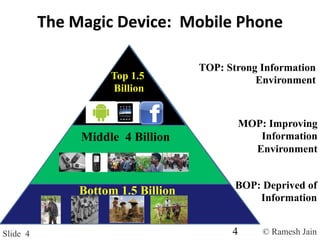
The	Magic	Device:		Mobile	Phone	
Middle 4 Billion
Top 1.5
Billion
Bottom 1.5 Billion
MOP: Improving
Information
Environment
TOP: Strong Information
Environment
BOP: Deprived of
Information
4
© Ramesh JainSlide 5
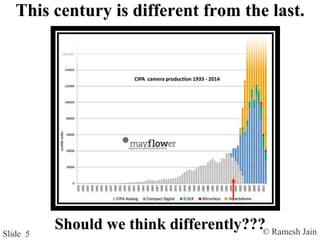
This century is different from the last.
Should we think differently???
© Ramesh JainSlide 6
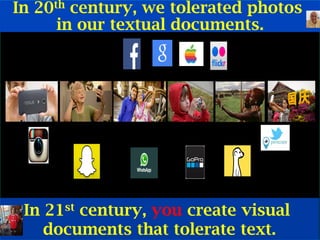
In 20th century, we tolerated photos
in our textual documents.
In 21st century, you create visual
documents that tolerate text.
© Ramesh JainSlide 7
Most Fundamental Problem:
Connecting People’s Needs to
Resources Effectively, Efficiently,
and Promptly in given Situations.
© Ramesh JainSlide 8
Major transformation in human
history are a chronicle of building
Social Machines for
How People’s need are
connected to Resources.
© Ramesh JainSlide 9
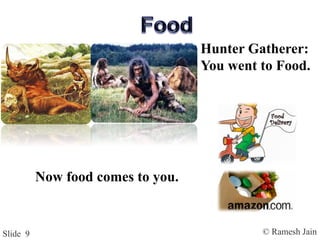
Hunter Gatherer:
You went to Food.
Now food comes to you.
© Ramesh JainSlide 10
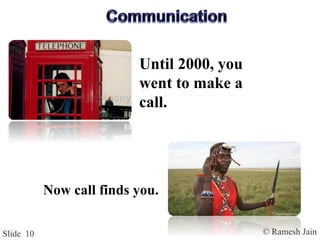
Until 2000, you
went to make a
call.
Now call finds you.
© Ramesh JainSlide 11
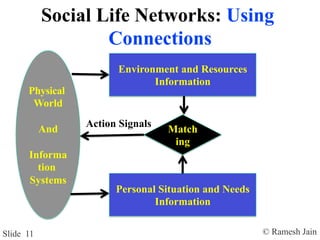
Social Life Networks: Using
Connections
Physical
World
And
Informa
tion
Systems
Environment and Resources
Information
Personal Situation and Needs
Information
Match
ing
Action Signals
© Ramesh JainSlide 12
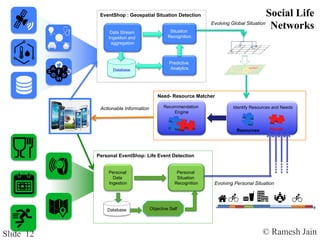
EventShop : Geospatial Situation Detection
Situation
Recognition
Data Stream
Ingestion and
aggregation
Database
Predictive
Analytics
Personal EventShop: Life Event Detection
Personal
Situation
Recognition
Database
Personal
Data
Ingestion
Objective Self
Recommendation
Engine
Need- Resource Matcher
Identify Resources and Needs
Resources Needs
Evolving Global Situation
Evolving Personal Situation
Actionable Information
Social Life
Networks
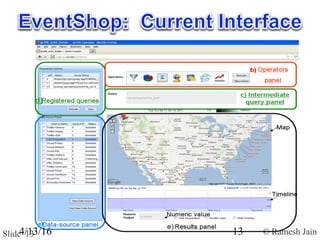
© Ramesh JainSlide 134/13/16 13
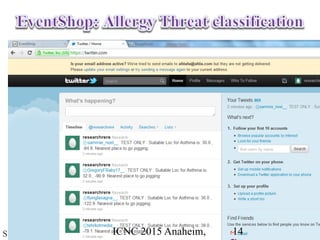
© Ramesh JainSlide 14 ICNC 2015 Anaheim, 14
© Ramesh JainSlide 15
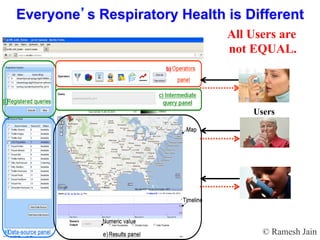
Everyone’s Respiratory Health is Different
Disaster
Situation
Assimilation
and Control
Environmental
Resources and
Historic Data
Governmental Agencies
Internet of Things
Social Sources
Experts
Users
All Users are
not EQUAL.
© Ramesh JainSlide 16
Disruption in Healthcare
We go to the source of
healthcare.
Can healthcare come
to me in time?
© Ramesh JainSlide 17
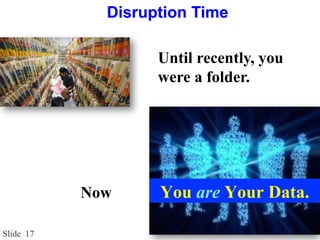
Until recently, you
were a folder.
Now You are Your Data.
Disruption Time
© Ramesh JainSlide 18
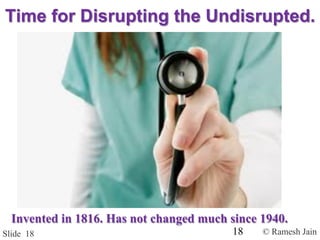
Time for Disrupting the Undisrupted.
Invented in 1816. Has not changed much since 1940.
18
© Ramesh JainSlide 19
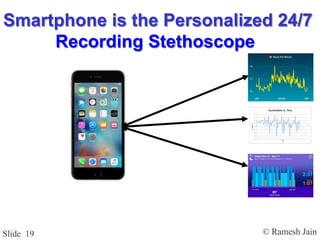
Smartphone is the Personalized 24/7
Recording Stethoscope
© Ramesh JainSlide 20
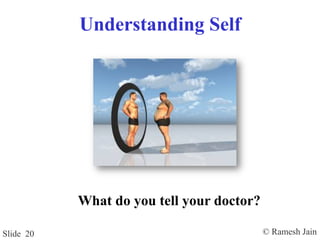
Understanding Self
What do you tell your doctor?
© Ramesh JainSlide 21
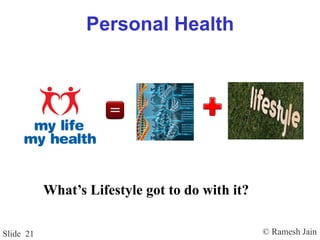
Personal Health
What’s Lifestyle got to do with it?
© Ramesh JainSlide 22
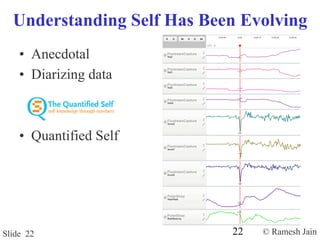
Understanding Self Has Been Evolving
•  Anecdotal
•  Diarizing data
•  Quantified Self
22
© Ramesh JainSlide 23
Objective Self helps in understanding
and predicting situations.
23
© Ramesh JainSlide 24
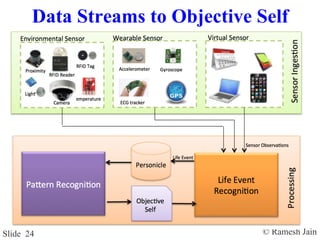
Data Streams to Objective Self
© Ramesh JainSlide 25
REALITY
DATA
MODEL
Modeling
Explain , Prevent , Understand
Predict
ABSTRACTION
[Sensors, Web2.0,
Infrastructures, etc.]
[Conceptual,
Mathematical,
Graphical, Statistical,
etc.]
© Ramesh JainSlide 26
© Ramesh JainSlide 27
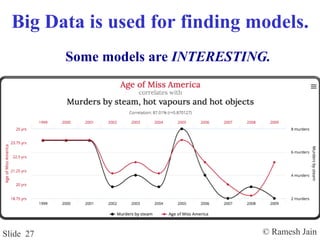
Big Data is used for finding models.
Some models are INTERESTING.
© Ramesh JainSlide 28
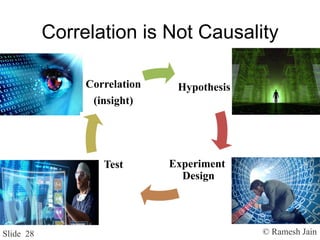
Correlation
(insight)
Hypothesis
Experiment
Design
Test
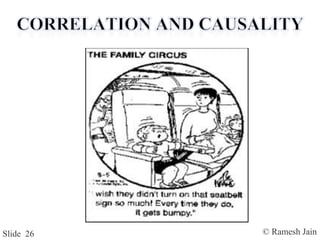
Correlation is Not Causality
© Ramesh JainSlide 29
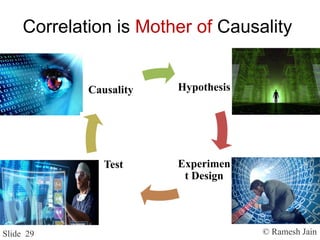
Hypothesis
Experimen
t Design
Test
Causality
Correlation is Mother of Causality
© Ramesh JainSlide 30
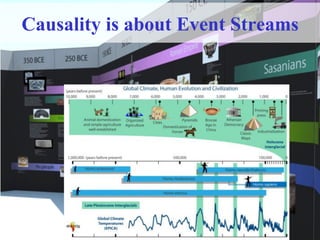
Causality is about Event Streams
© Ramesh JainSlide 31
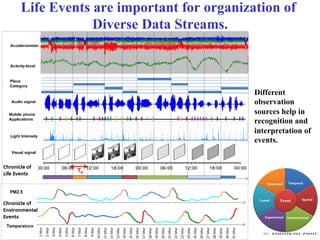
Life Events are important for organization of
Diverse Data Streams.
Different
observation
sources help in
recognition and
interpretation of
events.
© Ramesh JainSlide 32
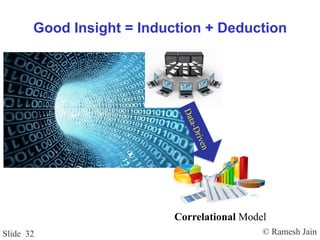
Good Insight = Induction + Deduction
Correlational Model
© Ramesh JainSlide 33
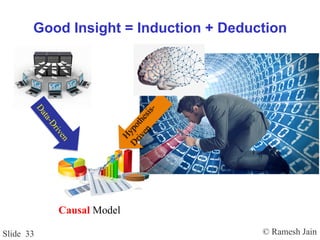
Good Insight = Induction + Deduction
Causal Model
© Ramesh JainSlide 34
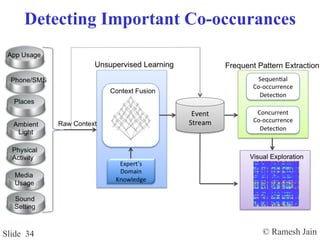
Detecting Important Co-occurances
© Ramesh JainSlide 35
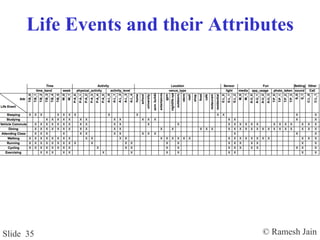
Life Events and their Attributes
© Ramesh JainSlide 36
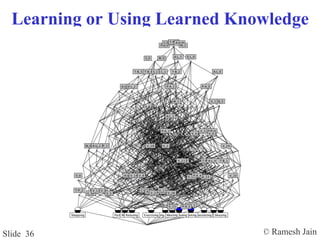
Learning or Using Learned Knowledge
© Ramesh JainSlide 37
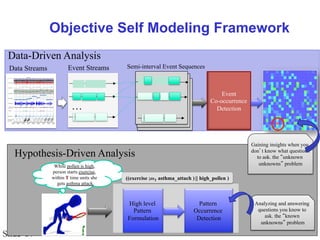
Event
Co-occurrence
Detection
High level
Pattern
Formulation
Pattern
Occurrence
Detection
…
Data Streams Event Streams
While pollen is high,
person starts exercise,
within T time units she
gets asthma attack
((exercise ;ωT asthma_attach ) || high_pollen )
Semi-interval Event Sequences
Objective Self Modeling Framework
Analyzing and answering
questions you know to
ask. the “known
unknowns” problem
Gaining insights when you
don’t know what questions
to ask. the “unknown
unknowns” problem
Data-Driven Analysis
Hypothesis-Driven Analysis
© Ramesh JainSlide 38
Pattern Formulation Operators
Selection Operation σP
Sequence Operation ( ρ1 ; ρ2 ; … ; ρk )
Conditional Sequence Operation ( ρ1 ;ωΔt1 ρ2 ;ωΔt2 … ; ωΔtk-1 ρk )
Concurrency Operation ( ρ1 ρ2 … ρk )
Alternation Operation ( ρ1 | ρ2 | … | ρk )
Time ( ωΔt ρ )
Co-occurrence ( COρ1 , ρ2 [Δt ] )
© Ramesh JainSlide 39
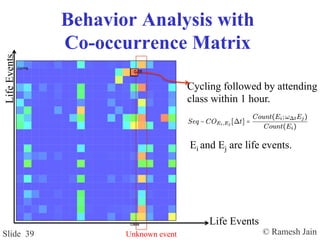
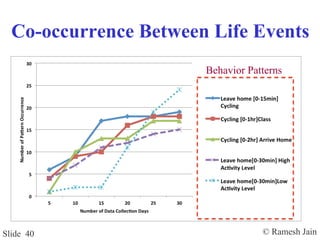
Cycling followed by attending
class within 1 hour.
Behavior Analysis with
Co-occurrence Matrix
Life Events
LifeEvents
Ei and Ej are life events.
Unknown event
© Ramesh JainSlide 40
Co-occurrence Between Life Events
Behavior Patterns
© Ramesh JainSlide 41
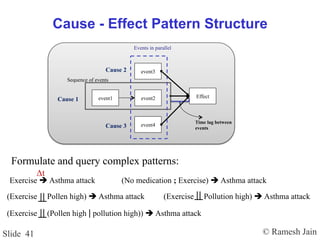
Cause - Effect Pattern Structure
event1 event2
event3
event4
Effect
Time lag between
events
Sequence of events
Events in parallel
Cause 1
Cause 2
Cause 3
(No medication ; Exercise) è Asthma attack
(Exercise Pollen high) è Asthma attack
(Exercise (Pollen high | pollution high)) è Asthma attack
(Exercise Pollution high) è Asthma attack
Exercise è Asthma attack
Δt
Formulate and query complex patterns:
© Ramesh JainSlide 42
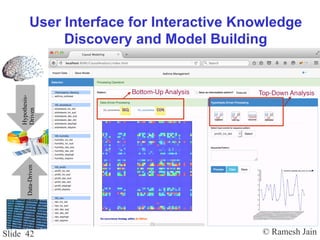
User Interface for Interactive Knowledge
Discovery and Model Building
Data-Driven
Hypothesis-
Driven
© Ramesh JainSlide 43
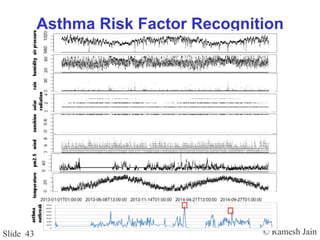
Asthma Risk Factor Recognition
© Ramesh JainSlide 44
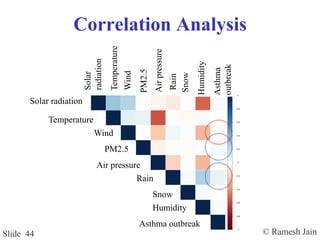
Correlation Analysis
Solar radiation
Solar
radiation
Temperature
Wind
PM2.5
Air pressure
Rain
Snow
Humidity
Asthma outbreak
Temperature
Wind
PM2.5
Airpressure
Rain
Snow
Humidity
Asthma
outbreak
© Ramesh JainSlide 45
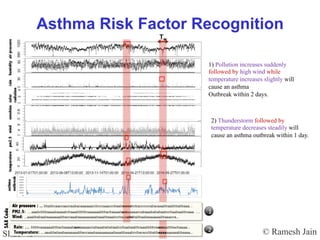
Asthma Risk Factor Recognition
1) Pollution increases suddenly
followed by high wind while
temperature increases slightly will
cause an asthma
Outbreak within 2 days.
2) Thunderstorm followed by
temperature decreases steadily will
cause an asthma outbreak within 1 day.
© Ramesh JainSlide 46
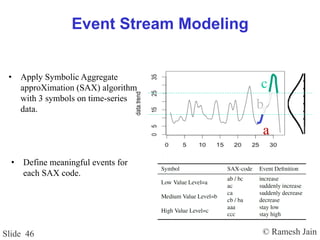
Event Stream Modeling
•  Apply Symbolic Aggregate
approXimation (SAX) algorithm
with 3 symbols on time-series
data.
a
b
c
•  Define meaningful events for
each SAX code.
© Ramesh JainSlide 47
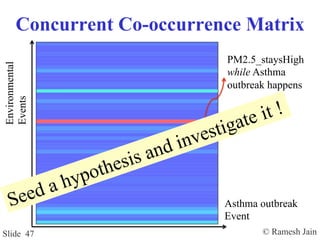
Concurrent Co-occurrence Matrix
Asthma outbreak
Event
Environmental
Events
PM2.5_staysHigh
while Asthma
outbreak happens
Seed a hypothesis and investigate it !
© Ramesh JainSlide 48
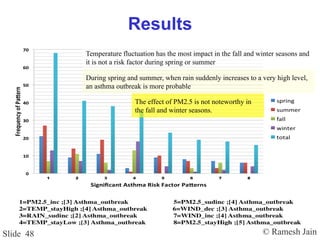
Results
Temperature fluctuation has the most impact in the fall and winter seasons and
it is not a risk factor during spring or summer
During spring and summer, when rain suddenly increases to a very high level,
an asthma outbreak is more probable
The effect of PM2.5 is not noteworthy in
the fall and winter seasons.
© Ramesh JainSlide 49
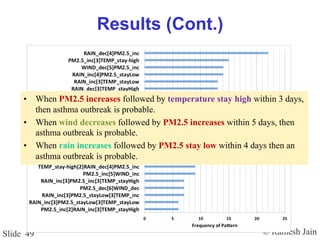
Results (Cont.)
•  When PM2.5 increases followed by temperature stay high within 3 days,
then asthma outbreak is probable.
•  When wind decreases followed by PM2.5 increases within 5 days, then
asthma outbreak is probable.
•  When rain increases followed by PM2.5 stay low within 4 days then an
asthma outbreak is probable.
© Ramesh JainSlide 50
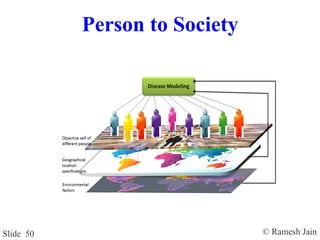
Person to Society
© Ramesh JainSlide 51
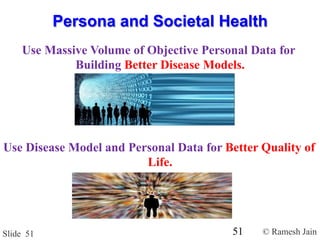
Use Massive Volume of Objective Personal Data for
Building Better Disease Models.
Persona and Societal Health
Use Disease Model and Personal Data for Better Quality of
Life.
51
© Ramesh JainSlide 52
Need Data.
Need Collaborators.
© Ramesh JainSlide 53
Thanks for your time and attention.
For questions: jain@ics.uci.edu

Objective self modeling real you

  • 1.
    © Ramesh JainSlide1 Using Data Streams to Model Real You Ramesh Jain (Collaborators: Laleh Jalali, Hyungik Oh) jain@ics.uci.edu
  • 2.
    © Ramesh JainSlide2 Society exists only as a mental concept; in the real world there are only individuals. -- Oscar Wilde
  • 3.
    © Ramesh JainSlide3 Humans are Smart Sensors. 3 Humans are Smart Actuators Humans are the goal as well as the source of Technology.
  • 4.
    © Ramesh JainSlide4 The Magic Device: Mobile Phone Middle 4 Billion Top 1.5 Billion Bottom 1.5 Billion MOP: Improving Information Environment TOP: Strong Information Environment BOP: Deprived of Information 4
  • 5.
    © Ramesh JainSlide5 This century is different from the last. Should we think differently???
  • 6.
    © Ramesh JainSlide6 In 20th century, we tolerated photos in our textual documents. In 21st century, you create visual documents that tolerate text.
  • 7.
    © Ramesh JainSlide7 Most Fundamental Problem: Connecting People’s Needs to Resources Effectively, Efficiently, and Promptly in given Situations.
  • 8.
    © Ramesh JainSlide8 Major transformation in human history are a chronicle of building Social Machines for How People’s need are connected to Resources.
  • 9.
    © Ramesh JainSlide9 Hunter Gatherer: You went to Food. Now food comes to you.
  • 10.
    © Ramesh JainSlide10 Until 2000, you went to make a call. Now call finds you.
  • 11.
    © Ramesh JainSlide11 Social Life Networks: Using Connections Physical World And Informa tion Systems Environment and Resources Information Personal Situation and Needs Information Match ing Action Signals
  • 12.
    © Ramesh JainSlide12 EventShop : Geospatial Situation Detection Situation Recognition Data Stream Ingestion and aggregation Database Predictive Analytics Personal EventShop: Life Event Detection Personal Situation Recognition Database Personal Data Ingestion Objective Self Recommendation Engine Need- Resource Matcher Identify Resources and Needs Resources Needs Evolving Global Situation Evolving Personal Situation Actionable Information Social Life Networks
  • 13.
    © Ramesh JainSlide134/13/16 13
  • 14.
    © Ramesh JainSlide14 ICNC 2015 Anaheim, 14
  • 15.
    © Ramesh JainSlide15 Everyone’s Respiratory Health is Different Disaster Situation Assimilation and Control Environmental Resources and Historic Data Governmental Agencies Internet of Things Social Sources Experts Users All Users are not EQUAL.
  • 16.
    © Ramesh JainSlide16 Disruption in Healthcare We go to the source of healthcare. Can healthcare come to me in time?
  • 17.
    © Ramesh JainSlide17 Until recently, you were a folder. Now You are Your Data. Disruption Time
  • 18.
    © Ramesh JainSlide18 Time for Disrupting the Undisrupted. Invented in 1816. Has not changed much since 1940. 18
  • 19.
    © Ramesh JainSlide19 Smartphone is the Personalized 24/7 Recording Stethoscope
  • 20.
    © Ramesh JainSlide20 Understanding Self What do you tell your doctor?
  • 21.
    © Ramesh JainSlide21 Personal Health What’s Lifestyle got to do with it?
  • 22.
    © Ramesh JainSlide22 Understanding Self Has Been Evolving •  Anecdotal •  Diarizing data •  Quantified Self 22
  • 23.
    © Ramesh JainSlide23 Objective Self helps in understanding and predicting situations. 23
  • 24.
    © Ramesh JainSlide24 Data Streams to Objective Self
  • 25.
    © Ramesh JainSlide25 REALITY DATA MODEL Modeling Explain , Prevent , Understand Predict ABSTRACTION [Sensors, Web2.0, Infrastructures, etc.] [Conceptual, Mathematical, Graphical, Statistical, etc.]
  • 26.
  • 27.
    © Ramesh JainSlide27 Big Data is used for finding models. Some models are INTERESTING.
  • 28.
    © Ramesh JainSlide28 Correlation (insight) Hypothesis Experiment Design Test Correlation is Not Causality
  • 29.
    © Ramesh JainSlide29 Hypothesis Experimen t Design Test Causality Correlation is Mother of Causality
  • 30.
    © Ramesh JainSlide30 Causality is about Event Streams
  • 31.
    © Ramesh JainSlide31 Life Events are important for organization of Diverse Data Streams. Different observation sources help in recognition and interpretation of events.
  • 32.
    © Ramesh JainSlide32 Good Insight = Induction + Deduction Correlational Model
  • 33.
    © Ramesh JainSlide33 Good Insight = Induction + Deduction Causal Model
  • 34.
    © Ramesh JainSlide34 Detecting Important Co-occurances
  • 35.
    © Ramesh JainSlide35 Life Events and their Attributes
  • 36.
    © Ramesh JainSlide36 Learning or Using Learned Knowledge
  • 37.
    © Ramesh JainSlide37 Event Co-occurrence Detection High level Pattern Formulation Pattern Occurrence Detection … Data Streams Event Streams While pollen is high, person starts exercise, within T time units she gets asthma attack ((exercise ;ωT asthma_attach ) || high_pollen ) Semi-interval Event Sequences Objective Self Modeling Framework Analyzing and answering questions you know to ask. the “known unknowns” problem Gaining insights when you don’t know what questions to ask. the “unknown unknowns” problem Data-Driven Analysis Hypothesis-Driven Analysis
  • 38.
    © Ramesh JainSlide38 Pattern Formulation Operators Selection Operation σP Sequence Operation ( ρ1 ; ρ2 ; … ; ρk ) Conditional Sequence Operation ( ρ1 ;ωΔt1 ρ2 ;ωΔt2 … ; ωΔtk-1 ρk ) Concurrency Operation ( ρ1 ρ2 … ρk ) Alternation Operation ( ρ1 | ρ2 | … | ρk ) Time ( ωΔt ρ ) Co-occurrence ( COρ1 , ρ2 [Δt ] )
  • 39.
    © Ramesh JainSlide39 Cycling followed by attending class within 1 hour. Behavior Analysis with Co-occurrence Matrix Life Events LifeEvents Ei and Ej are life events. Unknown event
  • 40.
    © Ramesh JainSlide40 Co-occurrence Between Life Events Behavior Patterns
  • 41.
    © Ramesh JainSlide41 Cause - Effect Pattern Structure event1 event2 event3 event4 Effect Time lag between events Sequence of events Events in parallel Cause 1 Cause 2 Cause 3 (No medication ; Exercise) è Asthma attack (Exercise Pollen high) è Asthma attack (Exercise (Pollen high | pollution high)) è Asthma attack (Exercise Pollution high) è Asthma attack Exercise è Asthma attack Δt Formulate and query complex patterns:
  • 42.
    © Ramesh JainSlide42 User Interface for Interactive Knowledge Discovery and Model Building Data-Driven Hypothesis- Driven
  • 43.
    © Ramesh JainSlide43 Asthma Risk Factor Recognition
  • 44.
    © Ramesh JainSlide44 Correlation Analysis Solar radiation Solar radiation Temperature Wind PM2.5 Air pressure Rain Snow Humidity Asthma outbreak Temperature Wind PM2.5 Airpressure Rain Snow Humidity Asthma outbreak
  • 45.
    © Ramesh JainSlide45 Asthma Risk Factor Recognition 1) Pollution increases suddenly followed by high wind while temperature increases slightly will cause an asthma Outbreak within 2 days. 2) Thunderstorm followed by temperature decreases steadily will cause an asthma outbreak within 1 day.
  • 46.
    © Ramesh JainSlide46 Event Stream Modeling •  Apply Symbolic Aggregate approXimation (SAX) algorithm with 3 symbols on time-series data. a b c •  Define meaningful events for each SAX code.
  • 47.
    © Ramesh JainSlide47 Concurrent Co-occurrence Matrix Asthma outbreak Event Environmental Events PM2.5_staysHigh while Asthma outbreak happens Seed a hypothesis and investigate it !
  • 48.
    © Ramesh JainSlide48 Results Temperature fluctuation has the most impact in the fall and winter seasons and it is not a risk factor during spring or summer During spring and summer, when rain suddenly increases to a very high level, an asthma outbreak is more probable The effect of PM2.5 is not noteworthy in the fall and winter seasons.
  • 49.
    © Ramesh JainSlide49 Results (Cont.) •  When PM2.5 increases followed by temperature stay high within 3 days, then asthma outbreak is probable. •  When wind decreases followed by PM2.5 increases within 5 days, then asthma outbreak is probable. •  When rain increases followed by PM2.5 stay low within 4 days then an asthma outbreak is probable.
  • 50.
    © Ramesh JainSlide50 Person to Society
  • 51.
    © Ramesh JainSlide51 Use Massive Volume of Objective Personal Data for Building Better Disease Models. Persona and Societal Health Use Disease Model and Personal Data for Better Quality of Life. 51
  • 52.
    © Ramesh JainSlide52 Need Data. Need Collaborators.
  • 53.
    © Ramesh JainSlide53 Thanks for your time and attention. For questions: jain@ics.uci.edu