OBJECT-ORIENTED
DATABASE MODEL
history
The first of this model was the semantic
 data model (SDM) developed by M.
 Hammer and D. Mcleon and published
 in 1981 in their database description
 with SDM : A Semantic Database
 Model
   Since SDM is an object- oriented data
    model (OODM). In turn the OODM
    becomes the basis for the object
    oriented database model with the
    manage of through an object oriented
    database management system
    (OODBMS)
OBJECT-ORIENTED
DATABASE MODEL
   In the object oriented data model the
    (OODM). Both data and their
    relationship are contained in a single
    structure known us an object.
   An object includes information about
    relationship between the facts within
    the object, as well as information
    about its relationship with other
    objects.
It is said to be ‘’SEMANTIC DATA
   MODEL’’
The OO Data model components


   An object is the abstraction of the real-
    word entity. An object represents only one
    occurrence of entity.
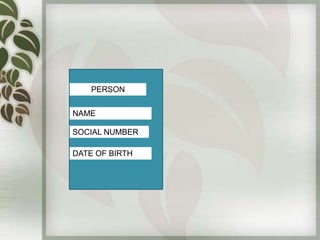
   Attributes describe the property of an
    object.
PERSON


NAME

SOCIAL NUMBER

DATE OF BIRTH
   Objects that are similar in
    characteristics are grouped in class.
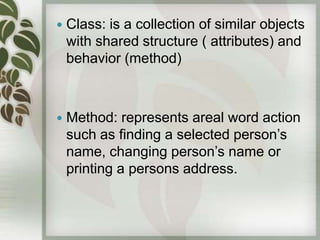
   Class: is a collection of similar objects
    with shared structure ( attributes) and
    behavior (method)


   Method: represents areal word action
    such as finding a selected person’s
    name, changing person’s name or
    printing a persons address.
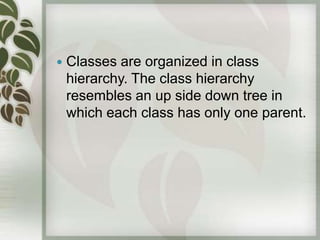
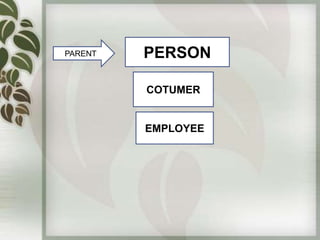
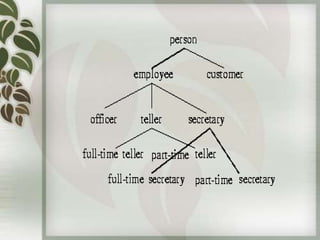
   Classes are organized in class
    hierarchy. The class hierarchy
    resembles an up side down tree in
    which each class has only one parent.
PARENT   PERSON

         COTUMER


         EMPLOYEE
   Inheritance is the ability of an object
    within the class hierarchy to inherit the
    attributes and methods of the class
    above it.
   Unified modeling language : describes
    a set of diagrams and symbols that
    can be used to graphically model a
    system.
   UML class diagram: are used to
    represent data and their relationships
    within the larger UML object oriented
    system modeling language,
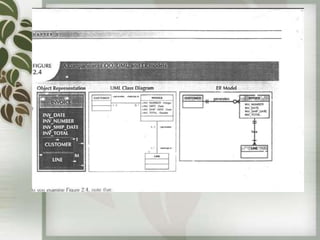
   The object representation of the
    invoice includes all related objects
    within the same box. The
    connectivity is (1 and many)indicate
    the relationship of the related
    objects to the invoice.
The end!!!!!!!

Object oriented database model

  • 1.
  • 2.
    history The first ofthis model was the semantic data model (SDM) developed by M. Hammer and D. Mcleon and published in 1981 in their database description with SDM : A Semantic Database Model
  • 3.
    Since SDM is an object- oriented data model (OODM). In turn the OODM becomes the basis for the object oriented database model with the manage of through an object oriented database management system (OODBMS)
  • 4.
  • 5.
    In the object oriented data model the (OODM). Both data and their relationship are contained in a single structure known us an object.
  • 6.
    An object includes information about relationship between the facts within the object, as well as information about its relationship with other objects.
  • 7.
    It is saidto be ‘’SEMANTIC DATA MODEL’’
  • 8.
    The OO Datamodel components  An object is the abstraction of the real- word entity. An object represents only one occurrence of entity.
  • 9.
    Attributes describe the property of an object.
  • 10.
  • 11.
    Objects that are similar in characteristics are grouped in class.
  • 12.
    Class: is a collection of similar objects with shared structure ( attributes) and behavior (method)  Method: represents areal word action such as finding a selected person’s name, changing person’s name or printing a persons address.
  • 13.
    Classes are organized in class hierarchy. The class hierarchy resembles an up side down tree in which each class has only one parent.
  • 14.
    PARENT PERSON COTUMER EMPLOYEE
  • 15.
    Inheritance is the ability of an object within the class hierarchy to inherit the attributes and methods of the class above it.
  • 17.
    Unified modeling language : describes a set of diagrams and symbols that can be used to graphically model a system.
  • 18.
    UML class diagram: are used to represent data and their relationships within the larger UML object oriented system modeling language,
  • 20.
    The object representation of the invoice includes all related objects within the same box. The connectivity is (1 and many)indicate the relationship of the related objects to the invoice.
  • 21.