Object Detection
Using Structure-Preserving
Wavelet Pyramid Reflection Removal Network
Goal: Removing reflections and improving the recognition rate of objects in the image at the same time
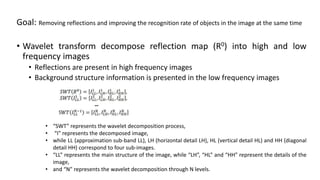
• Wavelet transform decompose reflection map (R0) into high and low
frequency images
• Reflections are present in high frequency images
• Background structure information is presented in the low frequency images
• “SWT” represents the wavelet decomposition process,
• “I” represents the decomposed image,
• while LL (approximation sub-band LL), LH (horizontal detail LH), HL (vertical detail HL) and HH (diagonal
detail HH) correspond to four sub-images.
• “LL” represents the main structure of the image, while “LH”, “HL” and “HH” represent the details of the
image,
• and “N” represents the wavelet decomposition through N levels.
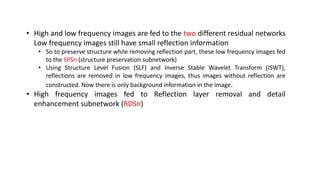
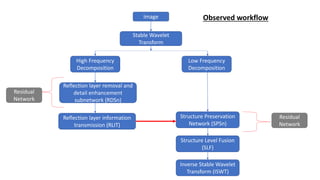
• High and low frequency images are fed to the two different residual networks
Low frequency images still have small reflection information
• So to preserve structure while removing reflection part, these low frequency images fed
to the SPSn (structure preservation subnetwork)
• Using Structure Level Fusion (SLF) and Inverse Stable Wavelet Transform (ISWT),
reflections are removed in low frequency images, thus images without reflection are
constructed. Now there is only background information in the image.
• High frequency images fed to Reflection layer removal and detail
enhancement subnetwork (RDSn)
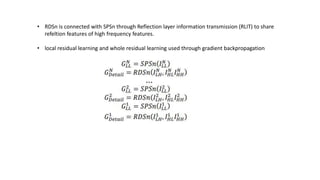
• RDSn is connected with SPSn through Reflection layer information transmission (RLIT) to share
refeltion features of high frequency features.
• local residual learning and whole residual learning used through gradient backpropagation
Image
Stable Wavelet
Transform
High Frequency
Decomposition
Low Frequency
Decomposition
Structure Preservation
Network (SPSn)
Structure Level Fusion
(SLF)
Inverse Stable Wavelet
Transform (ISWT)
Reflection layer removal and
detail enhancement
subnetwork (RDSn)
Reflection layer information
transmission (RLIT)
Residual
Network
Residual
Network
Observed workflow
Review Questions
• What are the results on real world test data?
• What is the running time on test images?
• What is convergence of presented Structure-Preserving Wavelet
Pyramid Reflection Removal Network with other methods presented
in the table 1?
• What is the functionality of the Reflection Layer Information
Transmission (RLIT)?

Object Detection using structure preserving wavelet pyramid reflection removal network.pptx

  • 1.
    Object Detection Using Structure-Preserving WaveletPyramid Reflection Removal Network
  • 2.
    Goal: Removing reflectionsand improving the recognition rate of objects in the image at the same time • Wavelet transform decompose reflection map (R0) into high and low frequency images • Reflections are present in high frequency images • Background structure information is presented in the low frequency images • “SWT” represents the wavelet decomposition process, • “I” represents the decomposed image, • while LL (approximation sub-band LL), LH (horizontal detail LH), HL (vertical detail HL) and HH (diagonal detail HH) correspond to four sub-images. • “LL” represents the main structure of the image, while “LH”, “HL” and “HH” represent the details of the image, • and “N” represents the wavelet decomposition through N levels.
  • 3.
    • High andlow frequency images are fed to the two different residual networks Low frequency images still have small reflection information • So to preserve structure while removing reflection part, these low frequency images fed to the SPSn (structure preservation subnetwork) • Using Structure Level Fusion (SLF) and Inverse Stable Wavelet Transform (ISWT), reflections are removed in low frequency images, thus images without reflection are constructed. Now there is only background information in the image. • High frequency images fed to Reflection layer removal and detail enhancement subnetwork (RDSn)
  • 4.
    • RDSn isconnected with SPSn through Reflection layer information transmission (RLIT) to share refeltion features of high frequency features. • local residual learning and whole residual learning used through gradient backpropagation
  • 5.
    Image Stable Wavelet Transform High Frequency Decomposition LowFrequency Decomposition Structure Preservation Network (SPSn) Structure Level Fusion (SLF) Inverse Stable Wavelet Transform (ISWT) Reflection layer removal and detail enhancement subnetwork (RDSn) Reflection layer information transmission (RLIT) Residual Network Residual Network Observed workflow
  • 6.
    Review Questions • Whatare the results on real world test data? • What is the running time on test images? • What is convergence of presented Structure-Preserving Wavelet Pyramid Reflection Removal Network with other methods presented in the table 1? • What is the functionality of the Reflection Layer Information Transmission (RLIT)?