Obesity & Gout
Abstract
Obesity is result of a complex variety of social, behavioral, cultural, environmental,
physiological and genetic factors. Obesity is not only a cosmetic concern it is ultimately life
threatening.In India 120 million urban indians are seriously obese. BMI is significantly
associated with risk for gout compared with persons with BMI of 21- 22.9 kg/m2
the age,
adjusted relative risk for gout is 1.40 for a BMI of 23 – 24.9 kg/m2,
2 – 3.5 kg/m2
for BMI of 25 –
25.9 kg/m2
, 3.26 for BMI of 30 – 34.9 kg/m2
& 4.41 for a BMI of 35 kg/m2
or higher. Weight gain
over time is also associated with risk of gout, even after adjusting for initial weight & other risk
factors. Gout afflicts an estimated 840 out of 100,000 people. Gout is strongly associated with
obesity, hypertension, hyperlipidemia and DM. Gout is condition with abnormally high levels of
uric acid in and around the joints and decreased kidney functions. Data suggests that obesity
increases serum urate by eliciting both increase production and decrease renal excretion of
urate. In the normative ageing study, weight gain between the 1st
and 3rd
visits was positively
associated with increase in serum urate. In contrast weight reduction has been shown in
prospective studies to be associated with decline in uric acid levels. Vatarakta runs on the lines
of santarpanotha janya vyadhi and according to the classics it is caused due to `` mishthanna
sukha bhojinaam….etc``
Introduction
Health is a big asset which requires proper care and nurturing. A fit and trim body
gives inner and outer confidence whereas an obese physique makes you dull and pessimistic. It
also results in emotional suffering which is one of the most painful parts of obesity. Obesity is
result of a complex variety of social, behavioral, cultural, environmental, physiological and
genetic factors. Obesity is not just a cosmetic problem and it ultimately leads to life threatening
conditions. Someone who is grossly overweight is twice as likely to die prematurely as compared
to an average – weight person. This is because obesity has been linked to several medical
conditions such as diabetes, stroke etc.
Gout is one such illness which is closely associated with Obesity. Gout is a joint
disease caused by high levels of uric acid in blood. In other words to say Gout or gouty arthritis
is defined as an attack of a metabolic disease which deposits uric acid in joints. Obesity is a
primary cause for gout according to current research. At least half of all the gout sufferers are
overweight if not obese. (www.bellaonline.com/site/lowcarb)
Vatarakta runs on the lines of santarpanothajanya vyadhi and caused due to “Mishthanna
sukhabhojinaam” which is also nidana of Sthoulya that is obesity.
Obesity
" Obesity " specifically refers to an excessive amount of body fat. It is an abnormal
accumulation of body fat, usually 20 percent or more over an individual's ideal body weight.
Obesity is associated with an increased risk of illness, disability, and death.
Body mass index (BMI) is a simple index of weight-for-height that is commonly used in
classifying overweight and obesity in adult populations and individuals. It is defined as the
weight in kilograms divided by the square of the height in meters (kg/m2). BMI provides the
most useful population-level measure of overweight and obesity as it is the same for both sexes
and for all ages of adults. The World Health Organization (WHO) defines "overweight" as a
BMI equal to or more than 25, and "obesity" as a BMI equal to or more than 30. But there is
evidence that risk of chronic disease in populations increases progressively from a BMI of 21.
Overweight and obesity lead to serious health consequences. Risk increases
progressively as BMI increases. Raised body mass index is a major risk factor for many chronic
diseases which include gout.
Gout
The term “Gout” comes from the Latin word “gutta” meaning “a drop” which
describes the large lump of urate deposits. Gout has been studied by physicians and has caused
suffering in countless humans since the days of Hippocrates or even before.
Gout is a form of arthritis that causes severe pain and swelling in the joints. It most
commonly affects the big toe ( approx 75 % of first attacks ) , but may also affect the heel, ankle,
wrist or elbow. Gout usually comes on suddenly, goes away in 5-10 days, and can keep
recurring. It is different from other forms of arthritis because it occurs when there are high levels
of uric acid circulating in the blood, which can cause urate crystals to settle in the tissues of the
joints. Gout is more common in overweight people and the risk of developing the disorder
increases with higher body weights.
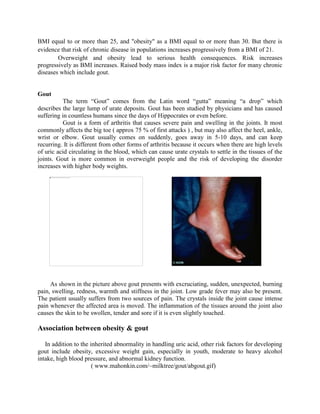
As shown in the picture above gout presents with excruciating, sudden, unexpected, burning
pain, swelling, redness, warmth and stiffness in the joint. Low grade fever may also be present.
The patient usually suffers from two sources of pain. The crystals inside the joint cause intense
pain whenever the affected area is moved. The inflammation of the tissues around the joint also
causes the skin to be swollen, tender and sore if it is even slightly touched.
Association between obesity & gout
In addition to the inherited abnormality in handling uric acid, other risk factors for developing
gout include obesity, excessive weight gain, especially in youth, moderate to heavy alcohol
intake, high blood pressure, and abnormal kidney function.
( www.mahonkin.com/~milktree/gout/abgout.gif)
Researchers report a clear link between body weight and uric acid levels. In one Japanese
study, overweight people had two to more than three times the rate of hyperuricemia as those
who maintained a healthy weight. ( healthguide.howstuffworks.com )
Data suggests that obesity increases serum urate by eliciting both increased production and
decreased renal excretion of urate. In contrast weight reduction has been shown in prospective
studies to be associated with decline uric acid levels. ( Epidemiology, risk factors, and lifestyle
modifications for gout Kenneth G Saag1 and Hyon Choi2 )
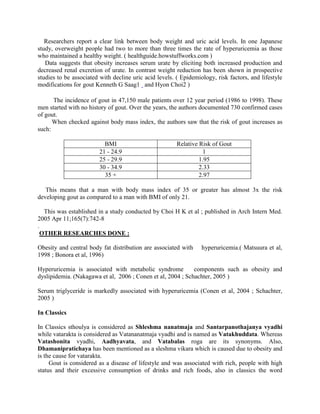
The incidence of gout in 47,150 male patients over 12 year period (1986 to 1998). These
men started with no history of gout. Over the years, the authors documented 730 confirmed cases
of gout.
When checked against body mass index, the authors saw that the risk of gout increases as
such:
BMI Relative Risk of Gout
21 - 24.9 1
25 - 29.9 1.95
30 - 34.9 2.33
35 + 2.97
This means that a man with body mass index of 35 or greater has almost 3x the risk
developing gout as compared to a man with BMI of only 21.
This was established in a study conducted by Choi H K et al ; published in Arch Intern Med.
2005 Apr 11;165(7):742-8
.
OTHER RESEARCHES DONE :
Obesity and central body fat distribution are associated with hyperuricemia.( Matsuura et al,
1998 ; Bonora et al, 1996)
Hyperuricemia is associated with metabolic syndrome components such as obesity and
dyslipidemia. (Nakagawa et al, 2006 ; Conen et al, 2004 ; Schachter, 2005 )
Serum triglyceride is markedly associated with hyperuricemia (Conen et al, 2004 ; Schachter,
2005 )
In Classics
In Classics sthoulya is considered as Shleshma nanatmaja and Santarpanothajanya vyadhi
while vatarakta is considered as Vatananatmaja vyadhi and is named as Vatakhuddata. Whereas
Vatashonita vyadhi, Aadhyavata, and Vatabalas roga are its synonyms. Also,
Dhamanipratichaya has been mentioned as a sleshma vikara which is caused due to obesity and
is the cause for vatarakta.
Gout is considered as a disease of lifestyle and was associated with rich, people with high
status and their excessive consumption of drinks and rich foods, also in classics the word
“aadhya” means ”rich” and aadhyavata means the disease affecting the rich class due to
involvement of vata. On the other hand, obesity is also a disease which affects people who
indulge in excessive consumption of drinks and rich foods.
Association between Sthoulya and Vatarakta
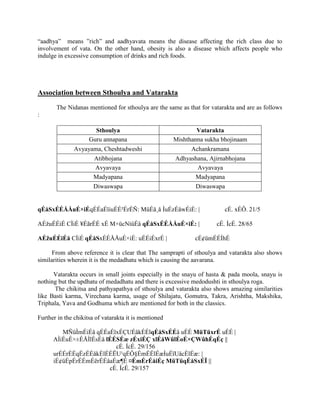
The Nidanas mentioned for sthoulya are the same as that for vatarakta and are as follows
:
Sthoulya Vatarakta
Guru annapana Mishthanna sukha bhojinaam
Avyayama, Cheshtadweshi Achankramana
Atibhojana Adhyashana, Ajirnabhojana
Avyavaya Avyavaya
Madyapana Madyapana
Diwaswapa Diwaswapa
qÉåSxÉÉÅÅuÉ×iÉqÉÉaÉïiuÉɲÉrÉÑ: MüÉå¸å ÌuÉzÉåwÉiÉ: | cÉ. xÉÔ. 21/5
AÉžuÉÉiÉ CÌiÉ ¥ÉãrÉÉ xÉ M×ücNíûÉå qÉåSxÉÉÅÅuÉ×iÉ: | cÉ. ÍcÉ. 28/65
AÉžuÉÉiÉå CÌiÉ qÉåSxÉÉÅÅuÉ×iÉ: uÉÉiÉxrÉ | cÉ¢ümÉÉÍhÉ
From above reference it is clear that The samprapti of sthoulya and vatarakta also shows
similarities wherein it is the medadhatu which is causing the aavarana.
Vatarakta occurs in small joints especially in the snayu of hasta & pada moola, snayu is
nothing but the updhatu of medadhatu and there is excessive medodushti in sthoulya roga.
The chikitsa and pathyapathya of sthoulya and vatarakta also shows amazing similarities
like Basti karma, Virechana karma, usage of Shilajatu, Gomutra, Takra, Arishtha, Makshika,
Triphala, Yava and Godhuma which are mentioned for both in the classics.
Further in the chikitsa of vatarakta it is mentioned
MÑüÌmÉiÉå qÉÉaÉïxÉÇUÉåkÉÉlqÉåSxÉÉå uÉÉ MüTüxrÉ uÉÉ |
AÌiÉuÉ×±ÉÅÌlÉsÉå lÉÉSÉæ zÉxiÉÇ xlÉåWûlÉoÉ×ÇWûhÉqÉç ||
cÉ. ÍcÉ. 29/156
urÉÉrÉÉqÉzÉÉåkÉlÉÉËU¹qÉÔ§ÉmÉÉlÉæÌuÉïUåcÉlÉæ: |
iÉ¢üÉpÉrÉÉmÉërÉÉåaÉæ¶É ¤ÉmÉrÉåiÉç MüTüqÉåSxÉÏ ||
cÉ. ÍcÉ. 29/157
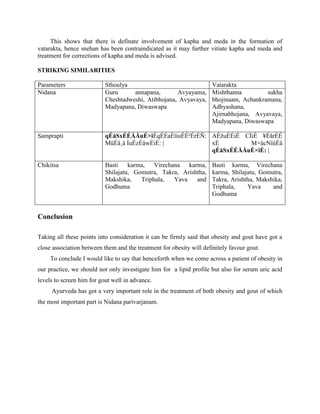
This shows that there is definate involvement of kapha and meda in the formation of
vatarakta, hence snehan has been contraindicated as it may further vitiate kapha and meda and
treatment for corrections of kapha and meda is advised.
STRIKING SIMILARITIES
Parameters Sthoulya Vatarakta
Nidana Guru annapana, Avyayama,
Cheshtadweshi, Atibhojana, Avyavaya,
Madyapana, Diwaswapa
Mishthanna sukha
bhojinaam, Achankramana,
Adhyashana,
Ajirnabhojana, Avyavaya,
Madyapana, Diwaswapa
Samprapti qÉåSxÉÉÅÅuÉ×iÉqÉÉaÉïiuÉɲÉrÉÑ:
MüÉå¸å ÌuÉzÉåwÉiÉ: |
AÉžuÉÉiÉ CÌiÉ ¥ÉãrÉÉ
xÉ M×ücNíûÉå
qÉåSxÉÉÅÅuÉ×iÉ: |
Chikitsa Basti karma, Virechana karma,
Shilajatu, Gomutra, Takra, Arishtha,
Makshika, Triphala, Yava and
Godhuma
Basti karma, Virechana
karma, Shilajatu, Gomutra,
Takra, Arishtha, Makshika,
Triphala, Yava and
Godhuma
Conclusion
Taking all these points into consideration it can be firmly said that obesity and gout have got a
close association between them and the treatment for obesity will definitely favour gout.
To conclude I would like to say that henceforth when we come across a patient of obesity in
our practice, we should not only investigate him for a lipid profile but also for serum uric acid
levels to screen him for gout well in advance.
Ayurveda has got a very important role in the treatment of both obesity and gout of which
the most important part is Nidana parivarjanam.

Obesity & gout

  • 1.
    Obesity & Gout Abstract Obesityis result of a complex variety of social, behavioral, cultural, environmental, physiological and genetic factors. Obesity is not only a cosmetic concern it is ultimately life threatening.In India 120 million urban indians are seriously obese. BMI is significantly associated with risk for gout compared with persons with BMI of 21- 22.9 kg/m2 the age, adjusted relative risk for gout is 1.40 for a BMI of 23 – 24.9 kg/m2, 2 – 3.5 kg/m2 for BMI of 25 – 25.9 kg/m2 , 3.26 for BMI of 30 – 34.9 kg/m2 & 4.41 for a BMI of 35 kg/m2 or higher. Weight gain over time is also associated with risk of gout, even after adjusting for initial weight & other risk factors. Gout afflicts an estimated 840 out of 100,000 people. Gout is strongly associated with obesity, hypertension, hyperlipidemia and DM. Gout is condition with abnormally high levels of uric acid in and around the joints and decreased kidney functions. Data suggests that obesity increases serum urate by eliciting both increase production and decrease renal excretion of urate. In the normative ageing study, weight gain between the 1st and 3rd visits was positively associated with increase in serum urate. In contrast weight reduction has been shown in prospective studies to be associated with decline in uric acid levels. Vatarakta runs on the lines of santarpanotha janya vyadhi and according to the classics it is caused due to `` mishthanna sukha bhojinaam….etc`` Introduction Health is a big asset which requires proper care and nurturing. A fit and trim body gives inner and outer confidence whereas an obese physique makes you dull and pessimistic. It also results in emotional suffering which is one of the most painful parts of obesity. Obesity is result of a complex variety of social, behavioral, cultural, environmental, physiological and genetic factors. Obesity is not just a cosmetic problem and it ultimately leads to life threatening conditions. Someone who is grossly overweight is twice as likely to die prematurely as compared to an average – weight person. This is because obesity has been linked to several medical conditions such as diabetes, stroke etc. Gout is one such illness which is closely associated with Obesity. Gout is a joint disease caused by high levels of uric acid in blood. In other words to say Gout or gouty arthritis is defined as an attack of a metabolic disease which deposits uric acid in joints. Obesity is a primary cause for gout according to current research. At least half of all the gout sufferers are overweight if not obese. (www.bellaonline.com/site/lowcarb) Vatarakta runs on the lines of santarpanothajanya vyadhi and caused due to “Mishthanna sukhabhojinaam” which is also nidana of Sthoulya that is obesity. Obesity " Obesity " specifically refers to an excessive amount of body fat. It is an abnormal accumulation of body fat, usually 20 percent or more over an individual's ideal body weight. Obesity is associated with an increased risk of illness, disability, and death. Body mass index (BMI) is a simple index of weight-for-height that is commonly used in classifying overweight and obesity in adult populations and individuals. It is defined as the weight in kilograms divided by the square of the height in meters (kg/m2). BMI provides the most useful population-level measure of overweight and obesity as it is the same for both sexes and for all ages of adults. The World Health Organization (WHO) defines "overweight" as a
  • 2.
    BMI equal toor more than 25, and "obesity" as a BMI equal to or more than 30. But there is evidence that risk of chronic disease in populations increases progressively from a BMI of 21. Overweight and obesity lead to serious health consequences. Risk increases progressively as BMI increases. Raised body mass index is a major risk factor for many chronic diseases which include gout. Gout The term “Gout” comes from the Latin word “gutta” meaning “a drop” which describes the large lump of urate deposits. Gout has been studied by physicians and has caused suffering in countless humans since the days of Hippocrates or even before. Gout is a form of arthritis that causes severe pain and swelling in the joints. It most commonly affects the big toe ( approx 75 % of first attacks ) , but may also affect the heel, ankle, wrist or elbow. Gout usually comes on suddenly, goes away in 5-10 days, and can keep recurring. It is different from other forms of arthritis because it occurs when there are high levels of uric acid circulating in the blood, which can cause urate crystals to settle in the tissues of the joints. Gout is more common in overweight people and the risk of developing the disorder increases with higher body weights. As shown in the picture above gout presents with excruciating, sudden, unexpected, burning pain, swelling, redness, warmth and stiffness in the joint. Low grade fever may also be present. The patient usually suffers from two sources of pain. The crystals inside the joint cause intense pain whenever the affected area is moved. The inflammation of the tissues around the joint also causes the skin to be swollen, tender and sore if it is even slightly touched. Association between obesity & gout In addition to the inherited abnormality in handling uric acid, other risk factors for developing gout include obesity, excessive weight gain, especially in youth, moderate to heavy alcohol intake, high blood pressure, and abnormal kidney function. ( www.mahonkin.com/~milktree/gout/abgout.gif)
  • 3.
    Researchers report aclear link between body weight and uric acid levels. In one Japanese study, overweight people had two to more than three times the rate of hyperuricemia as those who maintained a healthy weight. ( healthguide.howstuffworks.com ) Data suggests that obesity increases serum urate by eliciting both increased production and decreased renal excretion of urate. In contrast weight reduction has been shown in prospective studies to be associated with decline uric acid levels. ( Epidemiology, risk factors, and lifestyle modifications for gout Kenneth G Saag1 and Hyon Choi2 ) The incidence of gout in 47,150 male patients over 12 year period (1986 to 1998). These men started with no history of gout. Over the years, the authors documented 730 confirmed cases of gout. When checked against body mass index, the authors saw that the risk of gout increases as such: BMI Relative Risk of Gout 21 - 24.9 1 25 - 29.9 1.95 30 - 34.9 2.33 35 + 2.97 This means that a man with body mass index of 35 or greater has almost 3x the risk developing gout as compared to a man with BMI of only 21. This was established in a study conducted by Choi H K et al ; published in Arch Intern Med. 2005 Apr 11;165(7):742-8 . OTHER RESEARCHES DONE : Obesity and central body fat distribution are associated with hyperuricemia.( Matsuura et al, 1998 ; Bonora et al, 1996) Hyperuricemia is associated with metabolic syndrome components such as obesity and dyslipidemia. (Nakagawa et al, 2006 ; Conen et al, 2004 ; Schachter, 2005 ) Serum triglyceride is markedly associated with hyperuricemia (Conen et al, 2004 ; Schachter, 2005 ) In Classics In Classics sthoulya is considered as Shleshma nanatmaja and Santarpanothajanya vyadhi while vatarakta is considered as Vatananatmaja vyadhi and is named as Vatakhuddata. Whereas Vatashonita vyadhi, Aadhyavata, and Vatabalas roga are its synonyms. Also, Dhamanipratichaya has been mentioned as a sleshma vikara which is caused due to obesity and is the cause for vatarakta. Gout is considered as a disease of lifestyle and was associated with rich, people with high status and their excessive consumption of drinks and rich foods, also in classics the word
  • 4.
    “aadhya” means ”rich”and aadhyavata means the disease affecting the rich class due to involvement of vata. On the other hand, obesity is also a disease which affects people who indulge in excessive consumption of drinks and rich foods. Association between Sthoulya and Vatarakta The Nidanas mentioned for sthoulya are the same as that for vatarakta and are as follows : Sthoulya Vatarakta Guru annapana Mishthanna sukha bhojinaam Avyayama, Cheshtadweshi Achankramana Atibhojana Adhyashana, Ajirnabhojana Avyavaya Avyavaya Madyapana Madyapana Diwaswapa Diwaswapa qÉåSxÉÉÅÅuÉ×iÉqÉÉaÉïiuÉɲÉrÉÑ: MüÉå¸å ÌuÉzÉåwÉiÉ: | cÉ. xÉÔ. 21/5 AÉžuÉÉiÉ CÌiÉ ¥ÉãrÉÉ xÉ M×ücNíûÉå qÉåSxÉÉÅÅuÉ×iÉ: | cÉ. ÍcÉ. 28/65 AÉžuÉÉiÉå CÌiÉ qÉåSxÉÉÅÅuÉ×iÉ: uÉÉiÉxrÉ | cÉ¢ümÉÉÍhÉ From above reference it is clear that The samprapti of sthoulya and vatarakta also shows similarities wherein it is the medadhatu which is causing the aavarana. Vatarakta occurs in small joints especially in the snayu of hasta & pada moola, snayu is nothing but the updhatu of medadhatu and there is excessive medodushti in sthoulya roga. The chikitsa and pathyapathya of sthoulya and vatarakta also shows amazing similarities like Basti karma, Virechana karma, usage of Shilajatu, Gomutra, Takra, Arishtha, Makshika, Triphala, Yava and Godhuma which are mentioned for both in the classics. Further in the chikitsa of vatarakta it is mentioned MÑüÌmÉiÉå qÉÉaÉïxÉÇUÉåkÉÉlqÉåSxÉÉå uÉÉ MüTüxrÉ uÉÉ | AÌiÉuÉ×±ÉÅÌlÉsÉå lÉÉSÉæ zÉxiÉÇ xlÉåWûlÉoÉ×ÇWûhÉqÉç || cÉ. ÍcÉ. 29/156 urÉÉrÉÉqÉzÉÉåkÉlÉÉËU¹qÉÔ§ÉmÉÉlÉæÌuÉïUåcÉlÉæ: | iÉ¢üÉpÉrÉÉmÉërÉÉåaÉæ¶É ¤ÉmÉrÉåiÉç MüTüqÉåSxÉÏ || cÉ. ÍcÉ. 29/157
  • 5.
    This shows thatthere is definate involvement of kapha and meda in the formation of vatarakta, hence snehan has been contraindicated as it may further vitiate kapha and meda and treatment for corrections of kapha and meda is advised. STRIKING SIMILARITIES Parameters Sthoulya Vatarakta Nidana Guru annapana, Avyayama, Cheshtadweshi, Atibhojana, Avyavaya, Madyapana, Diwaswapa Mishthanna sukha bhojinaam, Achankramana, Adhyashana, Ajirnabhojana, Avyavaya, Madyapana, Diwaswapa Samprapti qÉåSxÉÉÅÅuÉ×iÉqÉÉaÉïiuÉɲÉrÉÑ: MüÉå¸å ÌuÉzÉåwÉiÉ: | AÉžuÉÉiÉ CÌiÉ ¥ÉãrÉÉ xÉ M×ücNíûÉå qÉåSxÉÉÅÅuÉ×iÉ: | Chikitsa Basti karma, Virechana karma, Shilajatu, Gomutra, Takra, Arishtha, Makshika, Triphala, Yava and Godhuma Basti karma, Virechana karma, Shilajatu, Gomutra, Takra, Arishtha, Makshika, Triphala, Yava and Godhuma Conclusion Taking all these points into consideration it can be firmly said that obesity and gout have got a close association between them and the treatment for obesity will definitely favour gout. To conclude I would like to say that henceforth when we come across a patient of obesity in our practice, we should not only investigate him for a lipid profile but also for serum uric acid levels to screen him for gout well in advance. Ayurveda has got a very important role in the treatment of both obesity and gout of which the most important part is Nidana parivarjanam.