The Life of Ernest Oberholtzer 1884 to 1977  (93) < compare to Aldo Leopold 1887 to 1948 >  “ Ober’s might just be the greatest uncelebrated environmental story in North American history… We have too few environmental heroes to allow one so important as Ernest Oberholtzer to slip from our collective memory.”   --Joe Paddock, biographer,  Keeper of the Wild , 2001
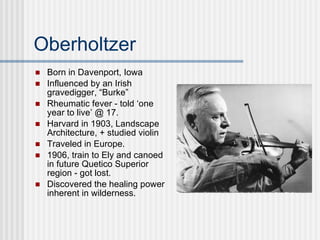
Oberholtzer Born in Davenport, Iowa Influenced by an Irish gravedigger, “Burke” Rheumatic fever - told ‘one year to live’ @ 17.  Harvard in 1903, Landscape Architecture, + studied violin  Traveled in Europe.  1906, train to Ely and canoed in future Quetico Superior region - got lost. Discovered the healing power inherent in wilderness.
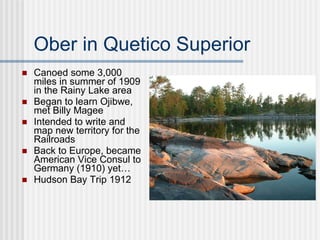
Ober in Quetico Superior Canoed some 3,000 miles in summer of 1909 in the Rainy Lake area Began to learn Ojibwe, met Billy Magee Intended to write and map new territory for the Railroads Back to Europe, became American Vice Consul to Germany (1910) yet… Hudson Bay Trip 1912
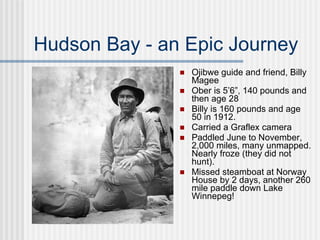
Hudson Bay - an Epic Journey Ojibwe guide and friend, Billy Magee Ober is 5’6”, 140 pounds and then age 28 Billy is 160 pounds and age 50 in 1912.  Carried a Graflex camera Paddled June to November, 2,000 miles, many unmapped. Nearly froze (they did not hunt).  Missed steamboat at Norway House by 2 days, another 260 mile paddle down Lake Winnepeg!
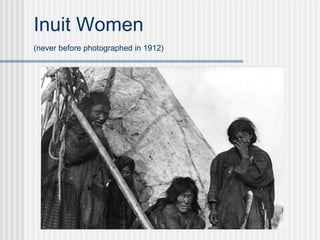
Inuit Women (never before photographed in 1912)
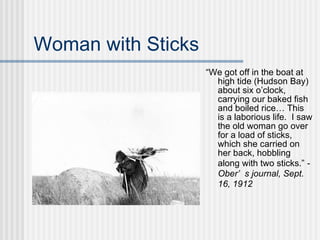
Woman with Sticks “ We got off in the boat at high tide (Hudson Bay) about six o’clock, carrying our baked fish and boiled rice… This is a laborious life.  I saw the old woman go over for a load of sticks, which she carried on her back, hobbling along with two sticks.”  -Ober’s journal, Sept. 16, 1912
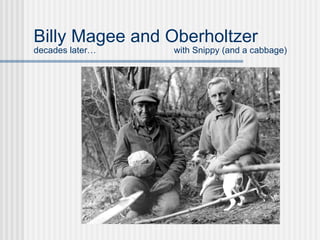
Billy Magee and Oberholtzer decades later…   with Snippy (and a cabbage)
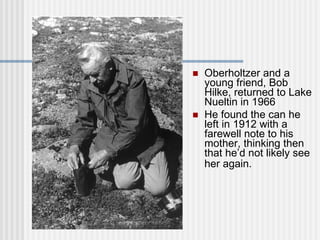
Oberholtzer and a young friend, Bob Hilke, returned to Lake Nueltin in 1966 He found the can he left in 1912 with a farewell note to his mother, thinking then that he’d not likely see her again.
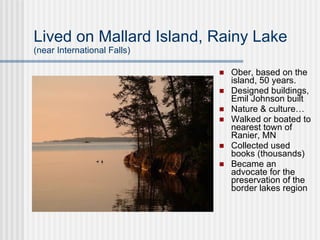
Lived on Mallard Island, Rainy Lake   (near International Falls) Ober, based on the  island, 50 years.  Designed buildings, Emil Johnson built Nature & culture…  Walked or boated to nearest town of Ranier, MN Collected used books (thousands) Became an advocate for the preservation of the border lakes region
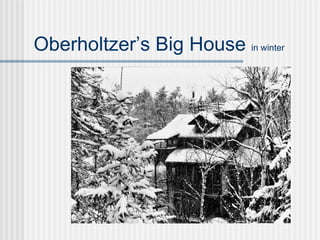
Oberholtzer’s Big House  in winter
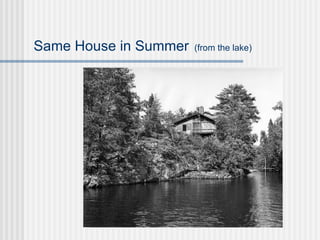
Same House in Summer   (from the lake)
Oberholtzer, Advocate Nine-year standoff with Edward Wellington Backus, lumberman and industrialist Backus’ vision = a series of dams controlling border lakes for hydro-power production  Ober - support from Chicago, Mpls lawyers and friends. Frances Andrews, Sewell Tyng.  President of the Quetico-Superior Council Not against use of the land-- a balance Contemporary of Gifford Pinchot, Sigurd Olson, Leopold.
Eventual Accomplishments Befriended the Native peoples, learned their language and customs-- called “Atisokan” Helped pass the Shipstead Nolan Act on July 3, 1930.  (one of first officially recognized wilderness areas)  Wilderness Act passed in 1964 Voyageurs Nat’l Park - est. 1972 Boundary Waters Wilderness Act - passed in 1978.
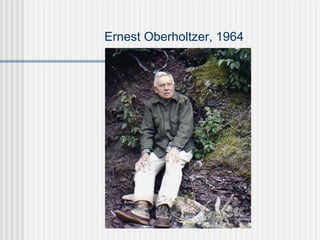
Ernest Oberholtzer, 1964
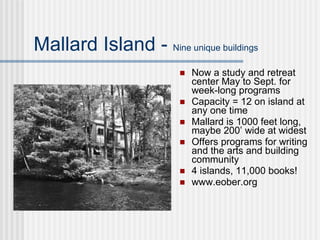
Mallard Island -  Nine unique buildings Now a study and retreat center May to Sept. for week-long programs Capacity = 12 on island at any one time Mallard is 1000 feet long, maybe 200’ wide at widest Offers programs for writing and the arts and building community 4 islands, 11,000 books! www.eober.org
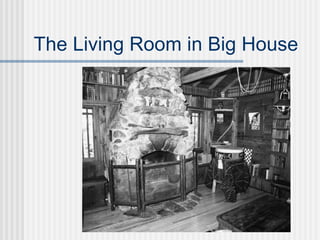
The Living Room in Big House
From Ernest Oberholtzer, 1929 American Forests Magazine “ Our population has increased… <with> even faster growth in wealth and leisure.  No other people ever had so many worldly goods or so much freedom of movement. “ It’s all the more significant that manmade things are not satisfying the restless… they find about them skeletons of lost beauty, shrunken streams, scraggly woods, shanties, rubbish…  “ No wonder they are showing an appreciation for unspoiled nature… The demand is one of the instinctive wants of body and spirit.”

Oberholtzer

  • 1.
    The Life ofErnest Oberholtzer 1884 to 1977 (93) < compare to Aldo Leopold 1887 to 1948 > “ Ober’s might just be the greatest uncelebrated environmental story in North American history… We have too few environmental heroes to allow one so important as Ernest Oberholtzer to slip from our collective memory.” --Joe Paddock, biographer, Keeper of the Wild , 2001
  • 2.
    Oberholtzer Born inDavenport, Iowa Influenced by an Irish gravedigger, “Burke” Rheumatic fever - told ‘one year to live’ @ 17. Harvard in 1903, Landscape Architecture, + studied violin Traveled in Europe. 1906, train to Ely and canoed in future Quetico Superior region - got lost. Discovered the healing power inherent in wilderness.
  • 3.
    Ober in QueticoSuperior Canoed some 3,000 miles in summer of 1909 in the Rainy Lake area Began to learn Ojibwe, met Billy Magee Intended to write and map new territory for the Railroads Back to Europe, became American Vice Consul to Germany (1910) yet… Hudson Bay Trip 1912
  • 4.
    Hudson Bay -an Epic Journey Ojibwe guide and friend, Billy Magee Ober is 5’6”, 140 pounds and then age 28 Billy is 160 pounds and age 50 in 1912. Carried a Graflex camera Paddled June to November, 2,000 miles, many unmapped. Nearly froze (they did not hunt). Missed steamboat at Norway House by 2 days, another 260 mile paddle down Lake Winnepeg!
  • 5.
    Inuit Women (neverbefore photographed in 1912)
  • 6.
    Woman with Sticks“ We got off in the boat at high tide (Hudson Bay) about six o’clock, carrying our baked fish and boiled rice… This is a laborious life. I saw the old woman go over for a load of sticks, which she carried on her back, hobbling along with two sticks.” -Ober’s journal, Sept. 16, 1912
  • 7.
    Billy Magee andOberholtzer decades later… with Snippy (and a cabbage)
  • 8.
    Oberholtzer and ayoung friend, Bob Hilke, returned to Lake Nueltin in 1966 He found the can he left in 1912 with a farewell note to his mother, thinking then that he’d not likely see her again.
  • 9.
    Lived on MallardIsland, Rainy Lake (near International Falls) Ober, based on the island, 50 years. Designed buildings, Emil Johnson built Nature & culture… Walked or boated to nearest town of Ranier, MN Collected used books (thousands) Became an advocate for the preservation of the border lakes region
  • 10.
  • 11.
    Same House inSummer (from the lake)
  • 12.
    Oberholtzer, Advocate Nine-yearstandoff with Edward Wellington Backus, lumberman and industrialist Backus’ vision = a series of dams controlling border lakes for hydro-power production Ober - support from Chicago, Mpls lawyers and friends. Frances Andrews, Sewell Tyng. President of the Quetico-Superior Council Not against use of the land-- a balance Contemporary of Gifford Pinchot, Sigurd Olson, Leopold.
  • 13.
    Eventual Accomplishments Befriendedthe Native peoples, learned their language and customs-- called “Atisokan” Helped pass the Shipstead Nolan Act on July 3, 1930. (one of first officially recognized wilderness areas) Wilderness Act passed in 1964 Voyageurs Nat’l Park - est. 1972 Boundary Waters Wilderness Act - passed in 1978.
  • 14.
  • 15.
    Mallard Island - Nine unique buildings Now a study and retreat center May to Sept. for week-long programs Capacity = 12 on island at any one time Mallard is 1000 feet long, maybe 200’ wide at widest Offers programs for writing and the arts and building community 4 islands, 11,000 books! www.eober.org
  • 16.
    The Living Roomin Big House
  • 17.
    From Ernest Oberholtzer,1929 American Forests Magazine “ Our population has increased… <with> even faster growth in wealth and leisure. No other people ever had so many worldly goods or so much freedom of movement. “ It’s all the more significant that manmade things are not satisfying the restless… they find about them skeletons of lost beauty, shrunken streams, scraggly woods, shanties, rubbish… “ No wonder they are showing an appreciation for unspoiled nature… The demand is one of the instinctive wants of body and spirit.”