GERUNDS AND INFINITIVES
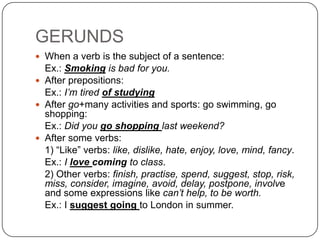
GERUNDS
 When a verb is the subject of a sentence:
  Ex.: Smoking is bad for you.
 After prepositions:
  Ex.: I’m tired of studying
 After go+many activities and sports: go swimming, go
  shopping:
  Ex.: Did you go shopping last weekend?
 After some verbs:
  1) “Like” verbs: like, dislike, hate, enjoy, love, mind, fancy.
  Ex.: I love coming to class.
  2) Other verbs: finish, practise, spend, suggest, stop, risk,
  miss, consider, imagine, avoid, delay, postpone, involve
  and some expressions like can’t help, to be worth.
  Ex.: I suggest going to London in summer.
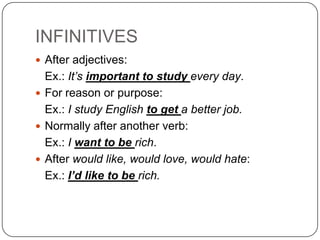
INFINITIVES
 After adjectives:
  Ex.: It’s important to study every day.
 For reason or purpose:
  Ex.: I study English to get a better job.
 Normally after another verb:
  Ex.: I want to be rich.
 After would like, would love, would hate:
  Ex.: I’d like to be rich.
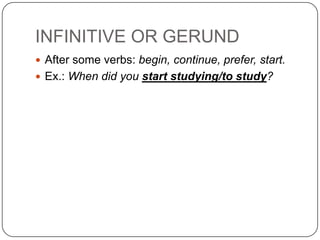
INFINITIVE OR GERUND
 After some verbs: begin, continue, prefer, start.
 Ex.: When did you start studying/to study?
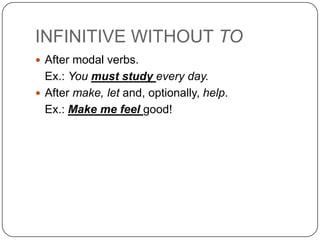
INFINITIVE WITHOUT TO
 After modal verbs.
  Ex.: You must study every day.
 After make, let and, optionally, help.
  Ex.: Make me feel good!
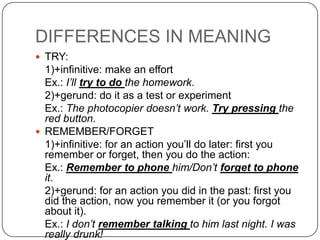
DIFFERENCES IN MEANING
 TRY:
  1)+infinitive: make an effort
  Ex.: I’ll try to do the homework.
  2)+gerund: do it as a test or experiment
  Ex.: The photocopier doesn’t work. Try pressing the
  red button.
 REMEMBER/FORGET
  1)+infinitive: for an action you’ll do later: first you
  remember or forget, then you do the action:
  Ex.: Remember to phone him/Don’t forget to phone
  it.
  2)+gerund: for an action you did in the past: first you
  did the action, now you remember it (or you forgot
  about it).
  Ex.: I don’t remember talking to him last night. I was
  really drunk!

Gerunds and infinitives

  • 1.
  • 2.
    GERUNDS  When averb is the subject of a sentence: Ex.: Smoking is bad for you.  After prepositions: Ex.: I’m tired of studying  After go+many activities and sports: go swimming, go shopping: Ex.: Did you go shopping last weekend?  After some verbs: 1) “Like” verbs: like, dislike, hate, enjoy, love, mind, fancy. Ex.: I love coming to class. 2) Other verbs: finish, practise, spend, suggest, stop, risk, miss, consider, imagine, avoid, delay, postpone, involve and some expressions like can’t help, to be worth. Ex.: I suggest going to London in summer.
  • 3.
    INFINITIVES  After adjectives: Ex.: It’s important to study every day.  For reason or purpose: Ex.: I study English to get a better job.  Normally after another verb: Ex.: I want to be rich.  After would like, would love, would hate: Ex.: I’d like to be rich.
  • 4.
    INFINITIVE OR GERUND After some verbs: begin, continue, prefer, start.  Ex.: When did you start studying/to study?
  • 5.
    INFINITIVE WITHOUT TO After modal verbs. Ex.: You must study every day.  After make, let and, optionally, help. Ex.: Make me feel good!
  • 6.
    DIFFERENCES IN MEANING TRY: 1)+infinitive: make an effort Ex.: I’ll try to do the homework. 2)+gerund: do it as a test or experiment Ex.: The photocopier doesn’t work. Try pressing the red button.  REMEMBER/FORGET 1)+infinitive: for an action you’ll do later: first you remember or forget, then you do the action: Ex.: Remember to phone him/Don’t forget to phone it. 2)+gerund: for an action you did in the past: first you did the action, now you remember it (or you forgot about it). Ex.: I don’t remember talking to him last night. I was really drunk!