Hannes Tschofenig, Blaine Cook
      (IETF#79, Beijing)
Acknowledgements
• I would like to thank to Pasi Eronen. We are
  re-using some of his slides in this
  presentation.


12/29/12         IETF #79, OAuth Tutorial Beijing   2
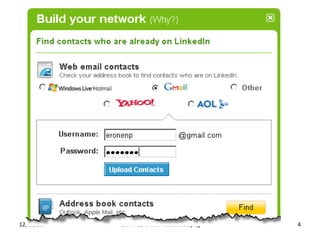
The Problem: Secure Data Sharing


12/29/12    IETF #79, OAuth Tutorial Beijing   3
12/29/12   IETF #79, OAuth Tutorial Beijing   4
Example OAuth Exchange


12/29/12         IETF #79, OAuth Tutorial Beijing   5
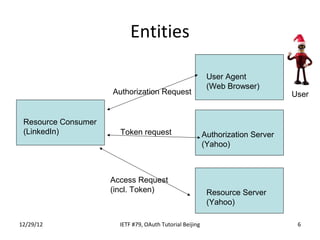
Entities

                                                           User Agent
                                                           (Web Browser)
                     Authorization Request                                       User


 Resource Consumer
 (LinkedIn)            Token request                      Authorization Server
                                                          (Yahoo)


                     Access Request
                     (incl. Token)                         Resource Server
                                                           (Yahoo)

12/29/12               IETF #79, OAuth Tutorial Beijing                           6
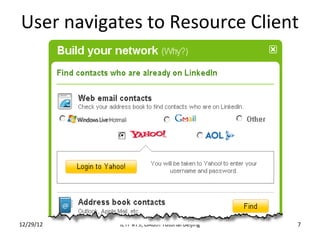
User navigates to Resource Client


12/29/12   IETF #79, OAuth Tutorial Beijing   7
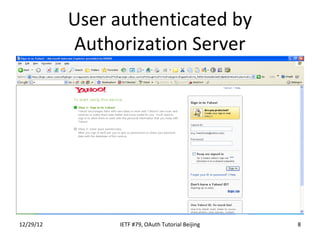
User authenticated by
           Authorization Server


12/29/12        IETF #79, OAuth Tutorial Beijing   8
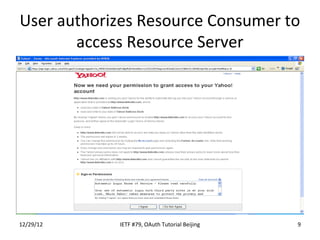
User authorizes Resource Consumer to
       access Resource Server


12/29/12    IETF #79, OAuth Tutorial Beijing   9
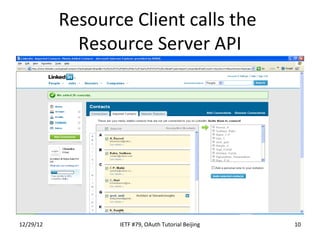
Resource Client calls the
             Resource Server API


12/29/12          IETF #79, OAuth Tutorial Beijing   10
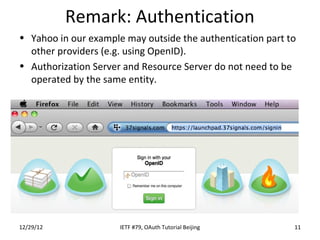
Remark: Authentication
• Yahoo in our example may outside the authentication part to
  other providers (e.g. using OpenID).
• Authorization Server and Resource Server do not need to be
  operated by the same entity.


12/29/12              IETF #79, OAuth Tutorial Beijing      11
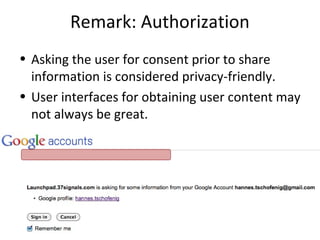
Remark: Authorization
• Asking the user for consent prior to share
  information is considered privacy-friendly.
• User interfaces for obtaining user content may
  not always be great.


12/29/12         IETF #79, OAuth Tutorial Beijing   12
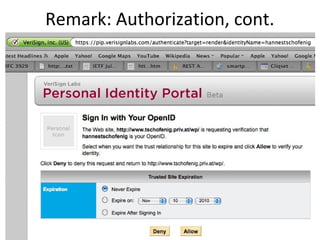
Remark: Authorization, cont.


12/29/12            IETF #79, OAuth Tutorial Beijing   13
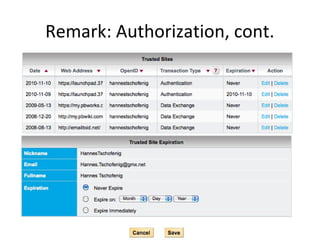
Remark: Authorization, cont.


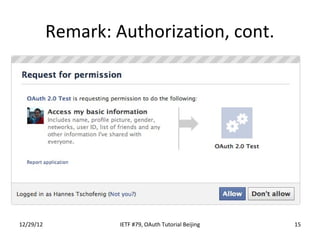
12/29/12            IETF #79, OAuth Tutorial Beijing   15
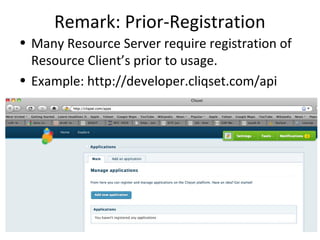
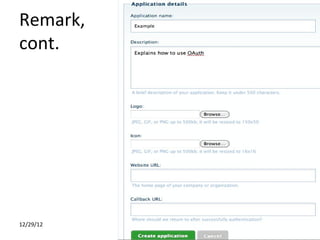
Remark: Prior-Registration
• Many Resource Server require registration of
  Resource Client’s prior to usage.
• Example: http://developer.cliqset.com/api


12/29/12           IETF #79, OAuth Tutorial Beijing   16
Remark,
cont.


12/29/12   IETF #79, OAuth Tutorial Beijing   17
History


12/29/12   IETF #79, OAuth Tutorial Beijing   18
History
• November 2006: Blaine Cook was looking into the possibility of
  using OpenID to accomplish the functionality for delegated
  authentication. He got in touch with some other folks that had
  a similar need.
• December 2006: Blaine wrote a "reference implementation" for
  Twitter based on all the existing OAuth-patterned APIs, which
  Blaine and Kellan Elliott-McCrea turned into a rough functional
  draft
• April 2007: Google group was created with a small group of
  implementers to write a proposal for an open protocol.
• July 2007: OAuth 1.0 (with code for major programming
  languages)
• September 2007: Re-write of specification to focus on a single
  flow (instead of "web", "mobile", and "desktop" flows)
• Deployment of OAuth well on it’s way:
  http://wiki.oauth.net/ServiceProviders
12/29/12              IETF #79, OAuth Tutorial Beijing       19
History, cont.
• 1st OAuth BOF (Minneapolis, November 2008, IETF#73)
     – BOF Chairs: Sam Hartman, Mark Nottingham
     – BOF went OK but a couple of charter questions couldn’t be resolved.
• 2nd OAuth BOF (San Francisco, March 2009, IETF#74)
     – BOF Chairs: Hannes Tschofenig, Blaine Cook
     – Charter discussed on the mailing list and also during the meeting. Finalized
        shortly after the meeting
• IETF wide review of the OAuth charter text (28 th April 2009)
     – Announcement: http://www.ietf.org/mail-archive/web/ietf-
        announce/current/msg06009.html
• OAuth working group was created (May 2009)
     – Chairs: Blaine Cook, Peter Saint Andre
•   Feb 2010: 'The OAuth 1.0 Protocol ‘ approved as Informational RFC:
     –
12/29/12 http://www.ietf.org/mail-archive/web/ietf-announce/current/msg07047.html
                                  IETF #79, OAuth Tutorial Beijing                    20
History, cont.
•   March 2010: Peter Saint Andre became Area Director and Hannes Tschofenig
    became Blaine’s co-chair.
•   March 2010: IETF OAuth meeting in Anaheim
•   April 2010: OAuth 2.0 <draft-ietf-oauth-v2-00.txt> published co-authored by Eran,
    Dick, David.
•   May 2010: First OAuth interim meeting co-located with IIW to discuss open issues.
•   July 2010: Maastricht IETF meeting
•   November 2010: Document split into “abstract” specification and separate bearer
    token and message signing specification.
•   November 2010: Beijing IETF meeting – no official OAuth working group meeting.
    Discussions about security for OAuth

12/29/12                        IETF #79, OAuth Tutorial Beijing                    21
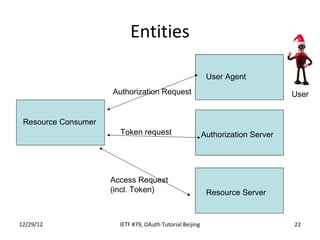
Entities

                                                           User Agent
                     Authorization Request                                       User


 Resource Consumer
                       Token request                      Authorization Server


                     Access Request
                     (incl. Token)                         Resource Server


12/29/12               IETF #79, OAuth Tutorial Beijing                          22
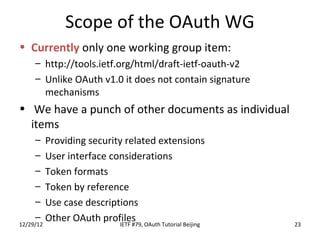
Scope of the OAuth WG
• Currently only one working group item:
    – http://tools.ietf.org/html/draft-ietf-oauth-v2
    – Unlike OAuth v1.0 it does not contain signature
      mechanisms
• We have a punch of other documents as individual
  items
    –    Providing security related extensions
    –    User interface considerations
    –    Token formats
    –    Token by reference
    –    Use case descriptions
    –    Other OAuth profiles OAuth Tutorial Beijing
12/29/12                  IETF #79,                     23
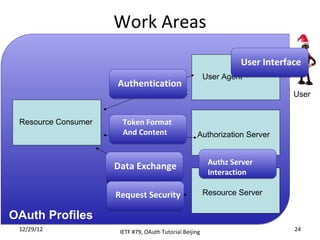
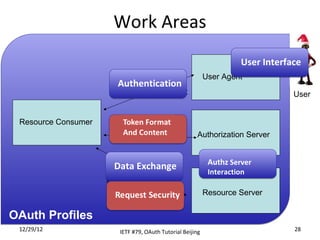
Work Areas
                                                                    User Interface
                                                           User Agent
                       Authentication
                     Authorization Request                                      User


 Resource Consumer      Token Format
                     Token Request
                        And Content                   Authorization Server


                                                            Authz Server
                      Data Exchange
                                                            Interaction
                     Access Request
                     (incl. Token)                         Resource Server
                       Request Security

OAuth Profiles
 12/29/12               IETF #79, OAuth Tutorial Beijing                        24
Web Server Flow
12/29/12   IETF #79, OAuth Tutorial Beijing   26
A little bit about OAuth security…


          Se curity
Work Areas
                                                                     User Interface
                                                           User Agent
                       Authentication
                     Authorization Request                                       User


 Resource Consumer
                     Token Request
                                                      Authorization Server


                                                            Authz Server
                      Data Exchange
                                                            Interaction
                     Access Request
                     (incl. Token)                         Resource Server

OAuth Profiles
 12/29/12               IETF #79, OAuth Tutorial Beijing                         28
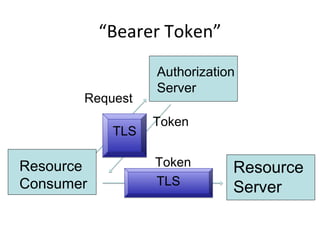
“Bearer Token”
                  Authorization
                  Server
       Request
                  Token
            TLS

Resource          Token       Resource
Consumer          TLS
                              Server
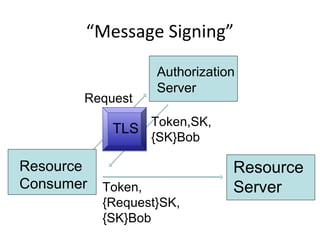
“Message Signing”
                   Authorization
                   Server
       Request
                Token,SK,
            TLS
                {SK}Bob

Resource                       Resource
Consumer   Token,              Server
           {Request}SK,
           {SK}Bob
Conclusion
• Open Web Authentication (OAuth) is developed in
  the IETF to provide delegated authentication for
  Web-based environments.
     – Usage for non-Web based applications has been proposed
       as well.
• Work is in progress and re-chartering will expand the
  work to include new features and use cases as well
  as security.
• Join the OAuth mailing list at
  http://datatracker.ietf.org/wg/oauth/charter/ to
  make your contribution.
12/29/12               IETF #79, OAuth Tutorial Beijing     31
Backup Slides


12/29/12    IETF #79, OAuth Tutorial Beijing   32
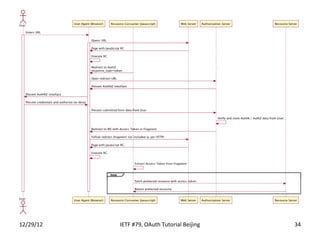
JavaScript Flow
(User Agent Flow in Draft)
12/29/12   IETF #79, OAuth Tutorial Beijing   34
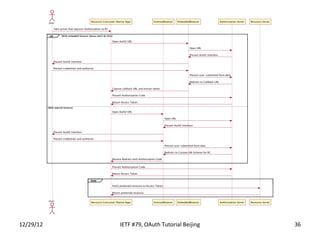
Native Application Flow
12/29/12   IETF #79, OAuth Tutorial Beijing   36
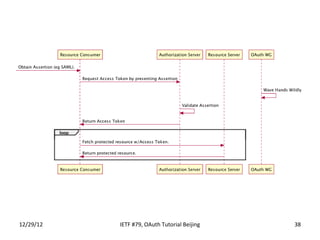
Autonomous Flow
12/29/12   IETF #79, OAuth Tutorial Beijing   38
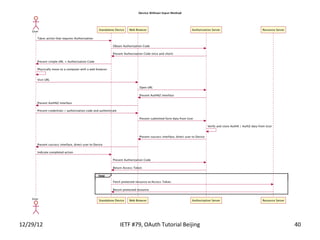
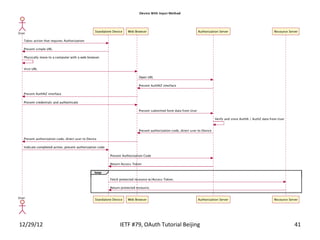
Device Flow
12/29/12   IETF #79, OAuth Tutorial Beijing   40
12/29/12   IETF #79, OAuth Tutorial Beijing   41

Oauth tutorial

  • 1.
    Hannes Tschofenig, BlaineCook (IETF#79, Beijing)
  • 2.
    Acknowledgements • I wouldlike to thank to Pasi Eronen. We are re-using some of his slides in this presentation. 12/29/12 IETF #79, OAuth Tutorial Beijing 2
  • 3.
    The Problem: SecureData Sharing 12/29/12 IETF #79, OAuth Tutorial Beijing 3
  • 4.
    12/29/12 IETF #79, OAuth Tutorial Beijing 4
  • 5.
    Example OAuth Exchange 12/29/12 IETF #79, OAuth Tutorial Beijing 5
  • 6.
    Entities User Agent (Web Browser) Authorization Request User Resource Consumer (LinkedIn) Token request Authorization Server (Yahoo) Access Request (incl. Token) Resource Server (Yahoo) 12/29/12 IETF #79, OAuth Tutorial Beijing 6
  • 7.
    User navigates toResource Client 12/29/12 IETF #79, OAuth Tutorial Beijing 7
  • 8.
    User authenticated by Authorization Server 12/29/12 IETF #79, OAuth Tutorial Beijing 8
  • 9.
    User authorizes ResourceConsumer to access Resource Server 12/29/12 IETF #79, OAuth Tutorial Beijing 9
  • 10.
    Resource Client callsthe Resource Server API 12/29/12 IETF #79, OAuth Tutorial Beijing 10
  • 11.
    Remark: Authentication • Yahooin our example may outside the authentication part to other providers (e.g. using OpenID). • Authorization Server and Resource Server do not need to be operated by the same entity. 12/29/12 IETF #79, OAuth Tutorial Beijing 11
  • 12.
    Remark: Authorization • Askingthe user for consent prior to share information is considered privacy-friendly. • User interfaces for obtaining user content may not always be great. 12/29/12 IETF #79, OAuth Tutorial Beijing 12
  • 13.
    Remark: Authorization, cont. 12/29/12 IETF #79, OAuth Tutorial Beijing 13
  • 14.
  • 15.
    Remark: Authorization, cont. 12/29/12 IETF #79, OAuth Tutorial Beijing 15
  • 16.
    Remark: Prior-Registration • ManyResource Server require registration of Resource Client’s prior to usage. • Example: http://developer.cliqset.com/api 12/29/12 IETF #79, OAuth Tutorial Beijing 16
  • 17.
    Remark, cont. 12/29/12 IETF #79, OAuth Tutorial Beijing 17
  • 18.
    History 12/29/12 IETF #79, OAuth Tutorial Beijing 18
  • 19.
    History • November 2006:Blaine Cook was looking into the possibility of using OpenID to accomplish the functionality for delegated authentication. He got in touch with some other folks that had a similar need. • December 2006: Blaine wrote a "reference implementation" for Twitter based on all the existing OAuth-patterned APIs, which Blaine and Kellan Elliott-McCrea turned into a rough functional draft • April 2007: Google group was created with a small group of implementers to write a proposal for an open protocol. • July 2007: OAuth 1.0 (with code for major programming languages) • September 2007: Re-write of specification to focus on a single flow (instead of "web", "mobile", and "desktop" flows) • Deployment of OAuth well on it’s way: http://wiki.oauth.net/ServiceProviders 12/29/12 IETF #79, OAuth Tutorial Beijing 19
  • 20.
    History, cont. • 1stOAuth BOF (Minneapolis, November 2008, IETF#73) – BOF Chairs: Sam Hartman, Mark Nottingham – BOF went OK but a couple of charter questions couldn’t be resolved. • 2nd OAuth BOF (San Francisco, March 2009, IETF#74) – BOF Chairs: Hannes Tschofenig, Blaine Cook – Charter discussed on the mailing list and also during the meeting. Finalized shortly after the meeting • IETF wide review of the OAuth charter text (28 th April 2009) – Announcement: http://www.ietf.org/mail-archive/web/ietf- announce/current/msg06009.html • OAuth working group was created (May 2009) – Chairs: Blaine Cook, Peter Saint Andre • Feb 2010: 'The OAuth 1.0 Protocol ‘ approved as Informational RFC: – 12/29/12 http://www.ietf.org/mail-archive/web/ietf-announce/current/msg07047.html IETF #79, OAuth Tutorial Beijing 20
  • 21.
    History, cont. • March 2010: Peter Saint Andre became Area Director and Hannes Tschofenig became Blaine’s co-chair. • March 2010: IETF OAuth meeting in Anaheim • April 2010: OAuth 2.0 <draft-ietf-oauth-v2-00.txt> published co-authored by Eran, Dick, David. • May 2010: First OAuth interim meeting co-located with IIW to discuss open issues. • July 2010: Maastricht IETF meeting • November 2010: Document split into “abstract” specification and separate bearer token and message signing specification. • November 2010: Beijing IETF meeting – no official OAuth working group meeting. Discussions about security for OAuth 12/29/12 IETF #79, OAuth Tutorial Beijing 21
  • 22.
    Entities User Agent Authorization Request User Resource Consumer Token request Authorization Server Access Request (incl. Token) Resource Server 12/29/12 IETF #79, OAuth Tutorial Beijing 22
  • 23.
    Scope of theOAuth WG • Currently only one working group item: – http://tools.ietf.org/html/draft-ietf-oauth-v2 – Unlike OAuth v1.0 it does not contain signature mechanisms • We have a punch of other documents as individual items – Providing security related extensions – User interface considerations – Token formats – Token by reference – Use case descriptions – Other OAuth profiles OAuth Tutorial Beijing 12/29/12 IETF #79, 23
  • 24.
    Work Areas User Interface User Agent Authentication Authorization Request User Resource Consumer Token Format Token Request And Content Authorization Server Authz Server Data Exchange Interaction Access Request (incl. Token) Resource Server Request Security OAuth Profiles 12/29/12 IETF #79, OAuth Tutorial Beijing 24
  • 25.
  • 26.
    12/29/12 IETF #79, OAuth Tutorial Beijing 26
  • 27.
    A little bitabout OAuth security… Se curity
  • 28.
    Work Areas User Interface User Agent Authentication Authorization Request User Resource Consumer Token Request Authorization Server Authz Server Data Exchange Interaction Access Request (incl. Token) Resource Server OAuth Profiles 12/29/12 IETF #79, OAuth Tutorial Beijing 28
  • 29.
    “Bearer Token” Authorization Server Request Token TLS Resource Token Resource Consumer TLS Server
  • 30.
    “Message Signing” Authorization Server Request Token,SK, TLS {SK}Bob Resource Resource Consumer Token, Server {Request}SK, {SK}Bob
  • 31.
    Conclusion • Open WebAuthentication (OAuth) is developed in the IETF to provide delegated authentication for Web-based environments. – Usage for non-Web based applications has been proposed as well. • Work is in progress and re-chartering will expand the work to include new features and use cases as well as security. • Join the OAuth mailing list at http://datatracker.ietf.org/wg/oauth/charter/ to make your contribution. 12/29/12 IETF #79, OAuth Tutorial Beijing 31
  • 32.
    Backup Slides 12/29/12 IETF #79, OAuth Tutorial Beijing 32
  • 33.
  • 34.
    12/29/12 IETF #79, OAuth Tutorial Beijing 34
  • 35.
  • 36.
    12/29/12 IETF #79, OAuth Tutorial Beijing 36
  • 37.
  • 38.
    12/29/12 IETF #79, OAuth Tutorial Beijing 38
  • 39.
  • 40.
    12/29/12 IETF #79, OAuth Tutorial Beijing 40
  • 41.
    12/29/12 IETF #79, OAuth Tutorial Beijing 41