Molecular re-evaluation of
Phytophthora species isolated during
30 years of vegetation health
surveys in Western Australia
Mike Stukely, Giles Hardy, Dianne White, Janet Webster,
Juanita Ciampini and Treena Burgess
Jarrah ForestNorthern sand plain
Black gravel site
Swan Costal Plain
Fitzgerald National Park
Impact of Phytophthora cinnamomi on plant species
in Western Australia
Direct Impacts
• Out of 5710 described species in the South-West Botanical Province
• 2285 species susceptible (40%)
• 800 highly susceptible (14%)
Indirect Impacts
• Loss of biomass
• Loss of litter
• Loss of refugia for fauna
• Loss of food resources
• Increased exposure
• Loss of pollinators
• Loss of nesting sites
Phytophthora is listed as a
‘KEY THREATENING PROCESS’
to Australia’s Biodiversity by
Commonwealth Government
Dieback mapping and vegetative health surveys
•For over 30 years aerial photography has been used to map the extent
of disease in WA
•Many areas are uninterpretable aerially and ‘Dieback Interpreters’ are
sent in to ground truth
•They are trained to recognise susceptible indicator species. First
indication of the presence of P. cinnamomi is the death of susceptible
indicator species from the families Proteaceae, Epacridaceae,
Dilleniaceae, Xanthorrhoeaceae, Fabaceae.
•Usually ground truth areas of native vegetation due to be logged
•Samples are taken (usually soil from rhizosphere of dying plants) and
sent to vegetation heath service (VHS)
•Soils are baited with cotyledons of Eucalyptus sieberi
•After 5(-10) days cotyledons are examined and plated onto selective
media
•About 15% of phytophthora isolates are not P. cinnamomi
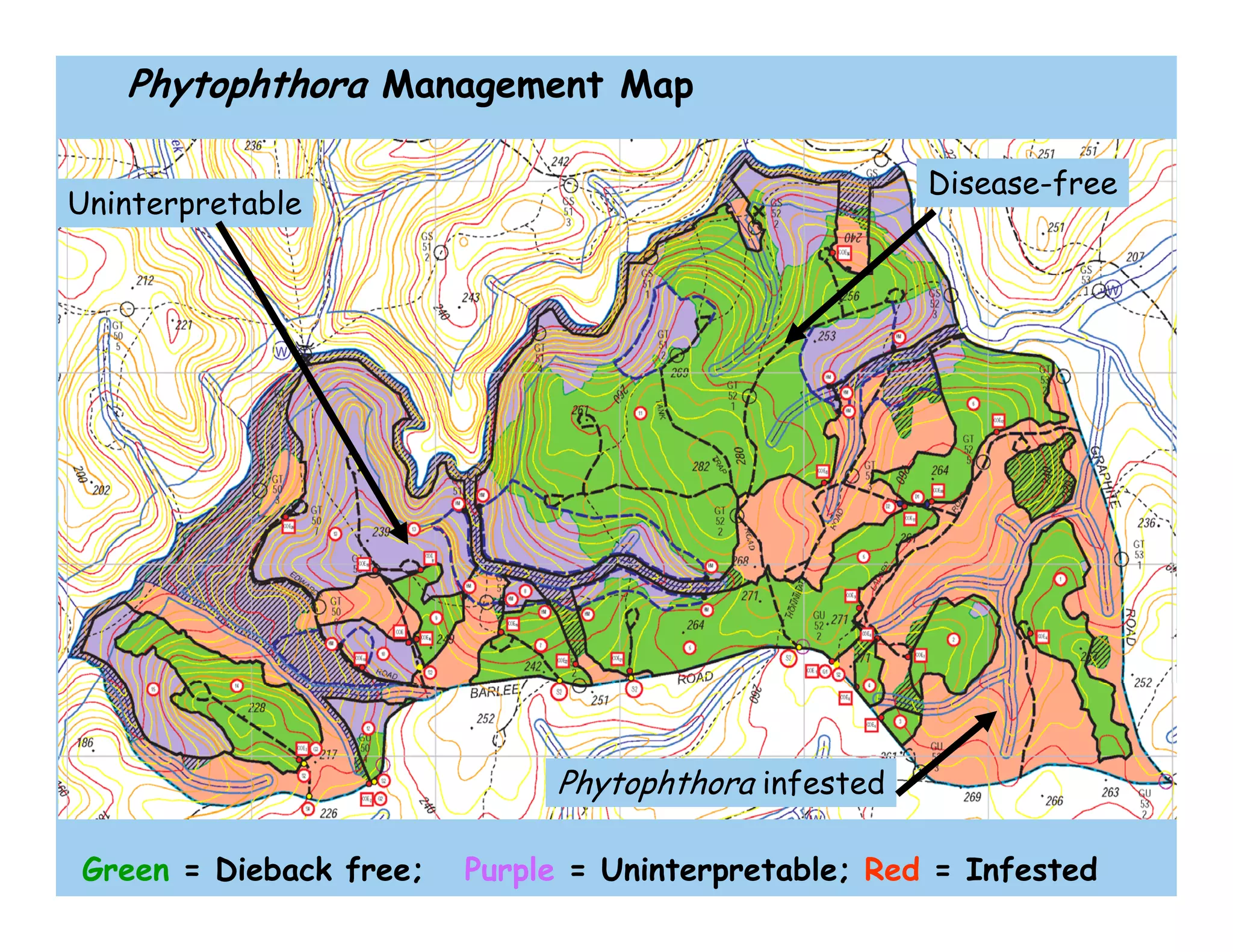
Phytophthora Management Map
Green = Dieback free; Purple = Uninterpretable; Red = Infested
Uninterpretable
Disease-free
Phytophthora infested
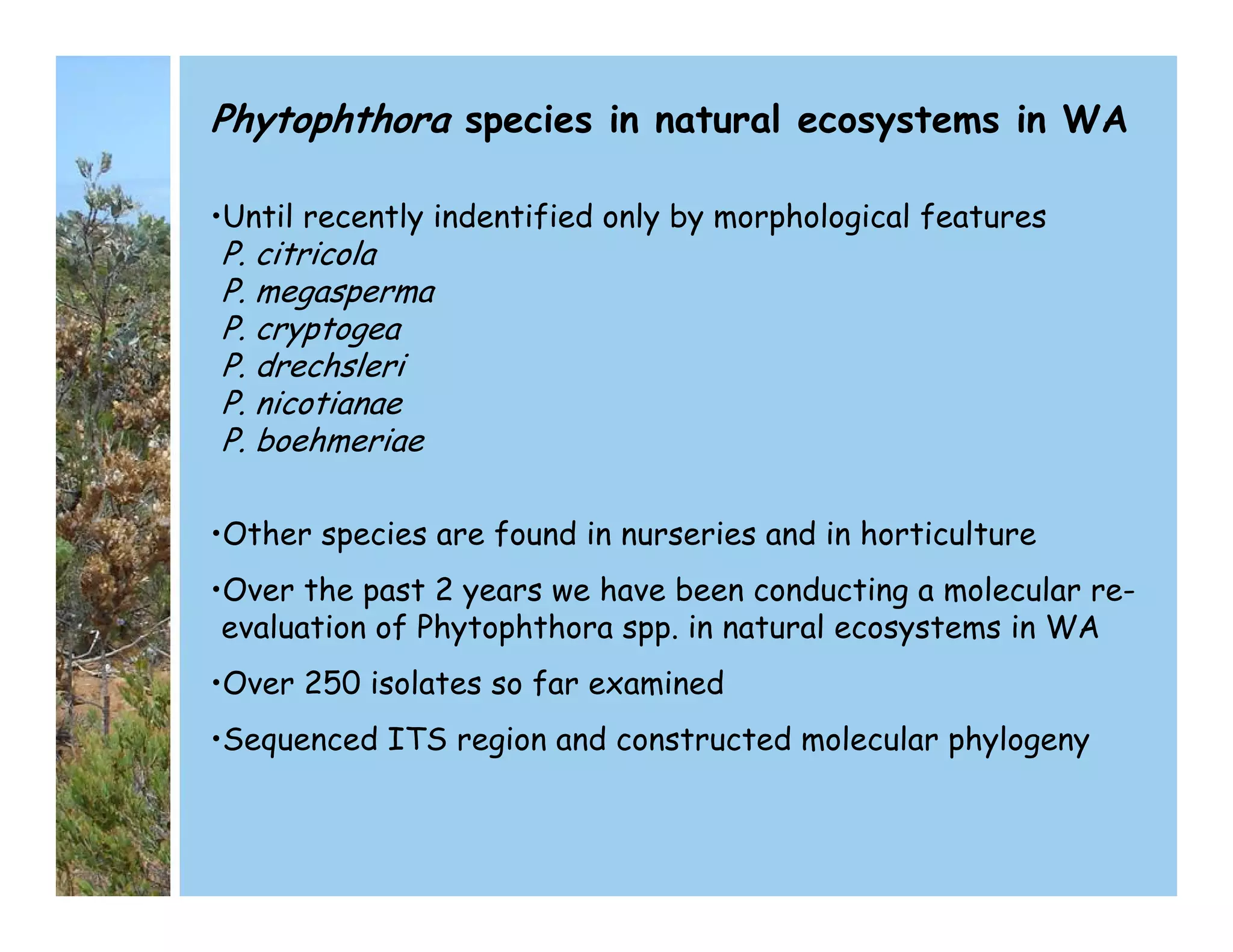
Phytophthora species in natural ecosystems in WA
•Until recently indentified only by morphological features
P. citricola
P. megasperma
P. cryptogea
P. drechsleri
P. nicotianae
P. boehmeriae
•Other species are found in nurseries and in horticulture
•Over the past 2 years we have been conducting a molecular re-
evaluation of Phytophthora spp. in natural ecosystems in WA
•Over 250 isolates so far examined
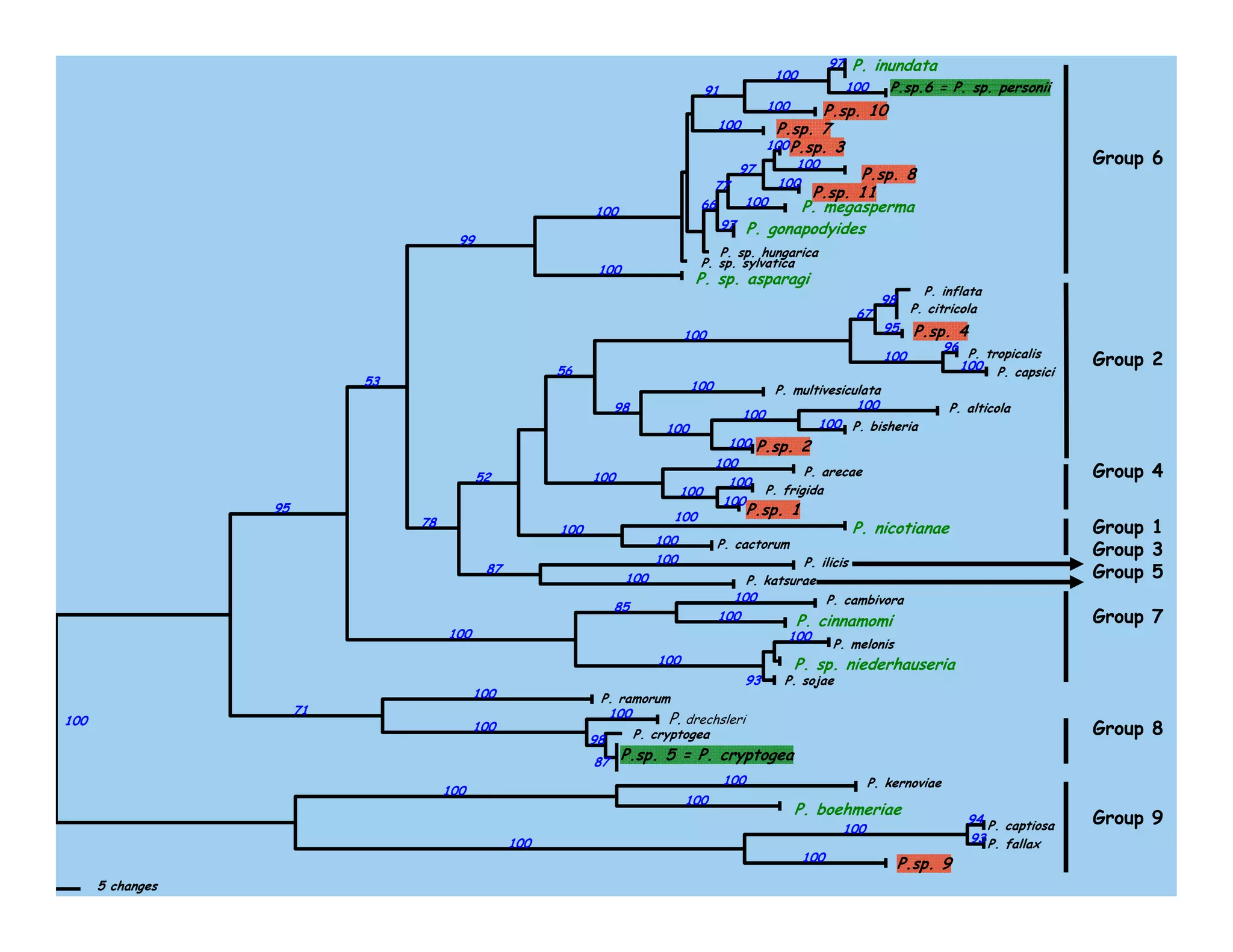
•Sequenced ITS region and constructed molecular phylogeny
P. inundata
P.sp.6 = P. sp. personii
P.sp. 10
P.sp. 7
P.sp. 3
P.sp. 8
P.sp. 11
P. megasperma
P. gonapodyides
P. sp. hungarica
P. sp. sylvatica
P. sp. asparagi
P. inflata
P. citricola
P.sp. 4
P. tropicalis
P. capsici
P. multivesiculata
P. alticola
P. bisheria
P.sp. 2
P. arecae
P. frigida
P.sp. 1
P. nicotianae
P. cactorum
P. ilicis
P. katsurae
P. cambivora
P. cinnamomi
P. melonis
P. sp. niederhauseria
P. sojae
P. ramorum
P. drechsleri
P. cryptogea
P.sp. 5 = P. cryptogea
P. kernoviae
P. boehmeriae
P. captiosa
P. fallax
P.sp. 9
5 changes
Group 6
Group 2
Group 4
Group 1
Group 3
Group 5
Group 7
Group 8
Group 9
99
100
91
100
97
100
100
100
66
77
97
100
100
100
100
97
100
56
100
67
98
95
100
96
100
98
100
100
100
100
100
100
52 100
100
100
100
100
100
100
100
53
78
87
100
100
100
85
100
100
100
100
93
100
95
71
100
100
100
98
87
100
100
100
100
100
94
93
100
P. humicola
P. inundata
P. sp. personii
TCH 009 - P.sp. 10
VHS 17779 - P.sp. 10
Phytophthora sp. P462 AF541911
Phytophthora sp. P532 DQ512952
Phytophthora sp. PgChlamydo
P. gonapodyides
Phytophthora sp. P1049 AF541904
Phytophthora sp. P896 AF541903
VHS 9854 - P.sp. 7
DCE 68 - P.sp. 7
DDS 3599
P.sp. 3
VHS 16108
VHS 17350
P.sp. 8
VHS 16115
P.sp. 11
VHS 5185
P. megasperma
P. hungarica
P. sylvatica
P. sp. asparagi
P. citricola
P. nicotianae
P. boehmeriae
5 changes
96
93
100
91
100
100
64
68
88
82
100
100
97
80
82
77
100
67
51
91
96
65
54
52
88
100
100
100
100
100
100
Often the morphological and molecular
identifications do not match
Isolates Morphology DNA
Many P. citricola P.sp.4
Many P. citricola P.sp.2
All tested P. drechsleri P.sp.3/8
Two P. megasperma P.sp.7
Many P. megasperma P.sp.9
TCH009 P. megasperma var sojae P.sp.10
VHS17183 P. megasperma P. megasperma
All tested P. nicotianae P. nicotianae
All tested P. cinnamomi P. cinnamomi
All Tested P. cryptogea P. cryptogea
Phytophthora species in natural ecosystems in WA
•New records for WA
P. inundata
P. gonapodyides
P. sp. asparagi
P. sp. niederhauseria
P. sp. personii
•At least seven new Phytophthora species which are genetically
distinct to currently described species
Phytophthora species in natural ecosystems in WA
Banksia sp., X. preissii2P. sp. 11
B. prionotes, B. grandis2P. sp. 10
B. attenuata, B. baxteri, D. cirsioides, D. falcata, A.
cuneata, Isopogon sp.; Pinus radiata (plantation)
23P. sp. 9
Soil and water baits – native forest3P. sp. 8
X. preissii; Pinus radiata (plantation)4P. sp. 7
E. marginata, B. attenuata, B. grandis, B. littoralis, B.
menziesii, B. prionotes, Conospermum sp., Leucopogon
verticillatus, X. gracilis, Podocarpus drouyniana,
Patersonia sp., Bossiaea sp., Gastrolobium spinosum;
Pinus radiata (plantation)
64P. sp. 4
E. marginata, B. attenuata,
B. grandis; Pinus radiata (plantation)
15P. sp. 3
Eucalyptus marginata, Corymbia calophylla, B. grandis,
Dryandra squarrosa, Patersonia xanthina
21P. sp. 2
B. menziesii, B. littoralis,
B. attenuata, B media
10P. sp. 1
Host speciesNo.Species
Significance of new phytophthora species
•Do they pose a threat to biodiversity?
•If yes, then management strategies will be developed
•Need to investigate
host range/pathogenicity
distribution
factors affecting spread
•Are these species introduced?
•Are any of these species hybrids?
O10 Treena
O10 Treena

O10 Treena

  • 1.
    Molecular re-evaluation of Phytophthoraspecies isolated during 30 years of vegetation health surveys in Western Australia Mike Stukely, Giles Hardy, Dianne White, Janet Webster, Juanita Ciampini and Treena Burgess
  • 2.
    Jarrah ForestNorthern sandplain Black gravel site Swan Costal Plain Fitzgerald National Park
  • 3.
    Impact of Phytophthoracinnamomi on plant species in Western Australia Direct Impacts • Out of 5710 described species in the South-West Botanical Province • 2285 species susceptible (40%) • 800 highly susceptible (14%) Indirect Impacts • Loss of biomass • Loss of litter • Loss of refugia for fauna • Loss of food resources • Increased exposure • Loss of pollinators • Loss of nesting sites Phytophthora is listed as a ‘KEY THREATENING PROCESS’ to Australia’s Biodiversity by Commonwealth Government
  • 4.
    Dieback mapping andvegetative health surveys •For over 30 years aerial photography has been used to map the extent of disease in WA •Many areas are uninterpretable aerially and ‘Dieback Interpreters’ are sent in to ground truth •They are trained to recognise susceptible indicator species. First indication of the presence of P. cinnamomi is the death of susceptible indicator species from the families Proteaceae, Epacridaceae, Dilleniaceae, Xanthorrhoeaceae, Fabaceae. •Usually ground truth areas of native vegetation due to be logged •Samples are taken (usually soil from rhizosphere of dying plants) and sent to vegetation heath service (VHS) •Soils are baited with cotyledons of Eucalyptus sieberi •After 5(-10) days cotyledons are examined and plated onto selective media •About 15% of phytophthora isolates are not P. cinnamomi
  • 5.
    Phytophthora Management Map Green= Dieback free; Purple = Uninterpretable; Red = Infested Uninterpretable Disease-free Phytophthora infested
  • 6.
    Phytophthora species innatural ecosystems in WA •Until recently indentified only by morphological features P. citricola P. megasperma P. cryptogea P. drechsleri P. nicotianae P. boehmeriae •Other species are found in nurseries and in horticulture •Over the past 2 years we have been conducting a molecular re- evaluation of Phytophthora spp. in natural ecosystems in WA •Over 250 isolates so far examined •Sequenced ITS region and constructed molecular phylogeny
  • 7.
    P. inundata P.sp.6 =P. sp. personii P.sp. 10 P.sp. 7 P.sp. 3 P.sp. 8 P.sp. 11 P. megasperma P. gonapodyides P. sp. hungarica P. sp. sylvatica P. sp. asparagi P. inflata P. citricola P.sp. 4 P. tropicalis P. capsici P. multivesiculata P. alticola P. bisheria P.sp. 2 P. arecae P. frigida P.sp. 1 P. nicotianae P. cactorum P. ilicis P. katsurae P. cambivora P. cinnamomi P. melonis P. sp. niederhauseria P. sojae P. ramorum P. drechsleri P. cryptogea P.sp. 5 = P. cryptogea P. kernoviae P. boehmeriae P. captiosa P. fallax P.sp. 9 5 changes Group 6 Group 2 Group 4 Group 1 Group 3 Group 5 Group 7 Group 8 Group 9 99 100 91 100 97 100 100 100 66 77 97 100 100 100 100 97 100 56 100 67 98 95 100 96 100 98 100 100 100 100 100 100 52 100 100 100 100 100 100 100 100 53 78 87 100 100 100 85 100 100 100 100 93 100 95 71 100 100 100 98 87 100 100 100 100 100 94 93 100
  • 8.
    P. humicola P. inundata P.sp. personii TCH 009 - P.sp. 10 VHS 17779 - P.sp. 10 Phytophthora sp. P462 AF541911 Phytophthora sp. P532 DQ512952 Phytophthora sp. PgChlamydo P. gonapodyides Phytophthora sp. P1049 AF541904 Phytophthora sp. P896 AF541903 VHS 9854 - P.sp. 7 DCE 68 - P.sp. 7 DDS 3599 P.sp. 3 VHS 16108 VHS 17350 P.sp. 8 VHS 16115 P.sp. 11 VHS 5185 P. megasperma P. hungarica P. sylvatica P. sp. asparagi P. citricola P. nicotianae P. boehmeriae 5 changes 96 93 100 91 100 100 64 68 88 82 100 100 97 80 82 77 100 67 51 91 96 65 54 52 88 100 100 100 100 100 100
  • 9.
    Often the morphologicaland molecular identifications do not match Isolates Morphology DNA Many P. citricola P.sp.4 Many P. citricola P.sp.2 All tested P. drechsleri P.sp.3/8 Two P. megasperma P.sp.7 Many P. megasperma P.sp.9 TCH009 P. megasperma var sojae P.sp.10 VHS17183 P. megasperma P. megasperma All tested P. nicotianae P. nicotianae All tested P. cinnamomi P. cinnamomi All Tested P. cryptogea P. cryptogea
  • 10.
    Phytophthora species innatural ecosystems in WA •New records for WA P. inundata P. gonapodyides P. sp. asparagi P. sp. niederhauseria P. sp. personii •At least seven new Phytophthora species which are genetically distinct to currently described species
  • 11.
    Phytophthora species innatural ecosystems in WA Banksia sp., X. preissii2P. sp. 11 B. prionotes, B. grandis2P. sp. 10 B. attenuata, B. baxteri, D. cirsioides, D. falcata, A. cuneata, Isopogon sp.; Pinus radiata (plantation) 23P. sp. 9 Soil and water baits – native forest3P. sp. 8 X. preissii; Pinus radiata (plantation)4P. sp. 7 E. marginata, B. attenuata, B. grandis, B. littoralis, B. menziesii, B. prionotes, Conospermum sp., Leucopogon verticillatus, X. gracilis, Podocarpus drouyniana, Patersonia sp., Bossiaea sp., Gastrolobium spinosum; Pinus radiata (plantation) 64P. sp. 4 E. marginata, B. attenuata, B. grandis; Pinus radiata (plantation) 15P. sp. 3 Eucalyptus marginata, Corymbia calophylla, B. grandis, Dryandra squarrosa, Patersonia xanthina 21P. sp. 2 B. menziesii, B. littoralis, B. attenuata, B media 10P. sp. 1 Host speciesNo.Species
  • 15.
    Significance of newphytophthora species •Do they pose a threat to biodiversity? •If yes, then management strategies will be developed •Need to investigate host range/pathogenicity distribution factors affecting spread •Are these species introduced? •Are any of these species hybrids?