Building Oracle on LXC 
Linux Containers 
Gilbert Standen, Solution Architect 
Violin Memory 
© Viol in Memory, Inc . 2014 CONFIDENTIAL | 1
Presenter Information 
 Gilbert Standen 
 Solution Architect, Oracle & Virtualization, Violin Memory, Inc. 
 Presenter, NYOUG, 2007, 2008, 2014 
 Presenter, AUSOUG, “Oracle Communities with 20:20 Foresight”, 2006, 2007 
 Presenter, (Violin Memory All Flash Arrays), Oracle Open World, 2014 
 Production Oracle DBA (20 Years) 
 Violin Memory All-Flash-Array (AFA) Evangelist 
 Ubuntu Linux Evangelist (Oracle EE DB on Ubuntu / Oracle RAC on Ubuntu) 
 Virtualization Evangelist 
 Mountain Biker and Digital Trance Music Bum 
© Viol in Memory, Inc . 2014 CONFIDENTIAL | 2
Presentation Description 
 Today I want to show you the amazing performance and manageability 
advantages of running Oracle DB workloads in LXC Linux Containers. 
 I will share names of the very largest datacenter organizations in the world 
which have converted part or all of their infrastructure to Linux Containers. 
 Specifically, we will look at the implementation of Oracle EE databases in 
Linux Containers and hopefully include some practical hands-on information. 
 I will share with you some performance graphs generated by SLOB running 
Oracle databases in LXC Linux Containers on unremarkable commodity 
SuperMicro dual-socket servers attached to a Violin 6616 SLC all-flash array. 
 Why am I doing this? My main reason is to hopefully convince you that 
Linux Containers are the best high-performance way to run any Oracle 
databases at high-performance, also achieving efficient utilization on Linux. 
© Viol in Memory, Inc . 2014 CONFIDENTIAL | 3
Credits and Recognition 
 A large number of people and organizations made this presentation possible. 
 Caryl Lee, Executive Director, NYOUG 
 Michael Olin, President, NYOUG 
 Violin Memory Lab Support (Justin Pham, Jalal Schenk, Charles Vuong) 
 Kurt Schmidt 
 The woman to whom I am married 20 years, Dr. Yelena Belyaeva-Standen 
 My mother, Mary Elizabeth “Betty” Standen (nee Bell) 
 My father, who passed away in 1996, who believed you can be/do anything 
 The large and growing number of people blogging on this topic. 
 The FlashDBA website http://www.flashdba.com 
© Viol in Memory, Inc . 2014 CONFIDENTIAL | 4
Oracle Performance Assessment Service (OPAS) 
 Most performance graphs used in this presentation for comparing Oracle 
database running in OEL 6.6 KVM guest vs. Oracle database running in OEL 
6.6 LXC Linux Container were generated using the Violin Memory Oracle 
Performance Assessment Service (OPAS), a FREE online performance tool. 
 OPAS is a FREE web tool at http://awr.vmem.com . It takes as input a zip file 
containing a set of Oracle Automated Workload Repository (AWR) reports in 
TEXT format ONLY and generates online a performance assessment report 
complete with graphs on latency, throughput, IOPS and many more metrics. 
 OPAS is available on the www and is a FREE TOOL to quickly get a 
performance assessment of an Oracle database. This is a service for which 
some companies have charged several thousand dollars or more. 
 A couple of the graphs at near end were generated by www.chartgo.com 
© Viol in Memory, Inc . 2014 CONFIDENTIAL | 5
Resources 
My blog: https://sites.google.com/site/nandydandyoracle 
The above site has very detailed hands-on, step-by-step, how-to 
guides on how to deploy Oracle 12c Grid Infrastructure Standalone Oracle Restart 
enabled databases, and Oracle 12c GNS ASM RAC Clusters in OEL 6 LXC Linux 
Containers. These guides include copious blockquote command codeblocks. 
Guides are there, and I have tested, Oracle 12c Standalone and RAC deployments 
in Oracle Enterprise Linux 6.5 LXC Linux Containers on both Oracle Enterprise 
Linux 6.6 and on Ubuntu 14.04.1. Slides here are intended just to give a flavor 
of the overall simplicity of LXC. 
© Viol in Memory, Inc . 2014 CONFIDENTIAL | 6
Wim Coaekerts Blogs on Linux Containers… 
 “This really shows the power of containers on Linux and Linux itself. We have all these various 
Linux distributions but inside lxc (or docker) you can run ubuntu, debian, gentoo, 
yourowncustomcrazything and it will just run, old versions of OL, newer versions of OL, all on 
the same host kernel.” 
 “I can run OL6.5 and create OL4, OL5, OL6 containers or docker images but I can also run any 
old debian or slackware images at the same time.” 
 “To try out LXC, you need to install the LXC packages. LXC is capable of using Oracle VM Oracle 
Linux templates as a base image to create a container. “ 
 “The use of btrfs in particular and being able to easily create clones/snapshots of container 
images. To get started : have an Oracle Linux 6.5 installation with UEK3 and LXC installed and 
configured.” 
 “LXC by default uses ‘/container’ as the directory to store container images and metadata” 
[Note: On Ubuntu it uses ‘/var/lib/lxc’ as the default container storage directory). 
© Viol in Memory, Inc . 2014 CONFIDENTIAL | 7
The “Big Picture” on Linux Containers 
Since this presentation is about “Building Oracle on LXC Linux Containers” it 
doesn’t really cover the big picture. James Bottomley has described that here: 
The Future of Containers in Linux and OpenStack 
James Bottomley is CTO of Virtualization at Parallels. He is a kernel developer 
and maintainer of the SCSI subsystem and PA-RISC architecture. He is also the 
Chair of the Linux Foundation Technical Advisory Board (TAB). Highly 
recommended viewing. 
Also, this link by Joe Beda, Sr. Staff Software Engineer, Google Cloud Platform, 
from June 2014 should also be viewed. Google spins up 2 billion containers per 
week, or about 3,300 containers every second, of every day, of every year. 
Everything at Google Runs in A Container 
© Viol in Memory, Inc . 2014 CONFIDENTIAL | 8
Service Providers Already Using Linux Containers 
© Viol in Memory, Inc . 2014 CONFIDENTIAL | 9
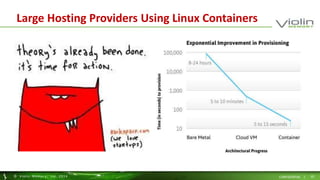
Large Hosting Providers Using Linux Containers 
© Viol in Memory, Inc . 2014 CONFIDENTIAL | 10
Other Technology Providers – You & Me, and… 
© Viol in Memory, Inc . 2014 CONFIDENTIAL | 11
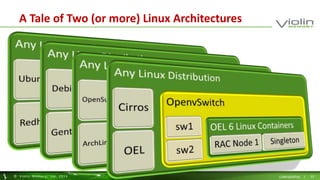
A Tale of Two (or more) Linux Architectures 
© Viol in Memory, Inc . 2014 CONFIDENTIAL | 12
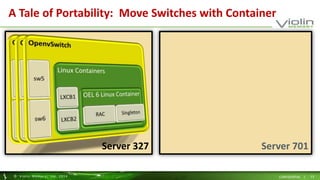
A Tale of Portability: Move Switches with Container 
Server 327 Server 701 
© Viol in Memory, Inc . 2014 CONFIDENTIAL | 13
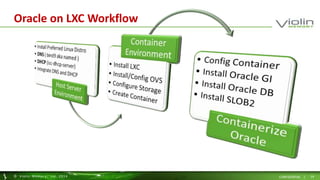
Oracle on LXC Workflow 
© Viol in Memory, Inc . 2014 CONFIDENTIAL | 14
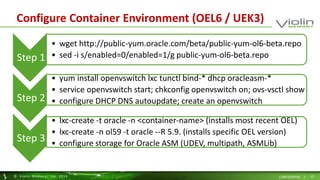
Configure Container Environment (OEL6 / UEK3) 
Step 1 
• wget http://public-yum.oracle.com/beta/public-yum-ol6-beta.repo 
• sed -i s/enabled=0/enabled=1/g public-yum-ol6-beta.repo 
Step 2 
• yum install openvswitch lxc tunctl bind-* dhcp oracleasm-* 
• service openvswitch start; chkconfig openvswitch on; ovs-vsctl show 
• configure DHCP DNS autoupdate; create an openvswitch 
Step 3 
• lxc-create -t oracle -n <container-name> (installs most recent OEL) 
• lxc-create -n ol59 -t oracle --R 5.9. (installs specific OEL version) 
• configure storage for Oracle ASM (UDEV, multipath, ASMLib) 
© Viol in Memory, Inc . 2014 CONFIDENTIAL | 15
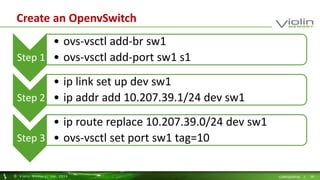
Create an OpenvSwitch 
Step 1 
• ovs-vsctl add-br sw1 
• ovs-vsctl add-port sw1 s1 
Step 2 
• ip link set up dev sw1 
• ip addr add 10.207.39.1/24 dev sw1 
Step 3 
• ip route replace 10.207.39.0/24 dev sw1 
• ovs-vsctl set port sw1 tag=10 
© Viol in Memory, Inc . 2014 CONFIDENTIAL | 16
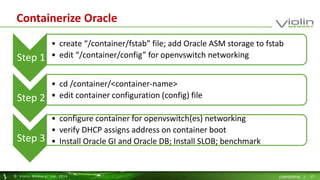
Containerize Oracle 
Step 1 
• create “/container/fstab” file; add Oracle ASM storage to fstab 
• edit “/container/config” for openvswitch networking 
Step 2 
• cd /container/<container-name> 
• edit container configuration (config) file 
Step 3 
• configure container for openvswitch(es) networking 
• verify DHCP assigns address on container boot 
• Install Oracle GI and Oracle DB; Install SLOB; benchmark 
© Viol in Memory, Inc . 2014 CONFIDENTIAL | 17
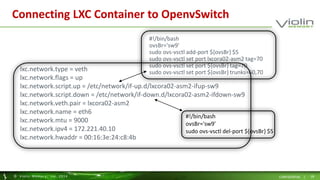
Connecting LXC Container to OpenvSwitch 
#!/bin/bash 
ovsBr='sw9' 
sudo ovs-vsctl add-port ${ovsBr} $5 
sudo ovs-vsctl set port lxcora02-asm2 tag=70 
sudo ovs-vsctl set port ${ovsBr} tag=70 
sudo ovs-vsctl set port ${ovsBr} trunks=60,70 
lxc.network.type = veth 
lxc.network.flags = up 
lxc.network.script.up = /etc/network/if-up.d/lxcora02-asm2-ifup-sw9 
lxc.network.script.down = /etc/network/if-down.d/lxcora02-asm2-ifdown-sw9 
lxc.network.veth.pair = lxcora02-asm2 
lxc.network.name = eth6 
lxc.network.mtu = 9000 
lxc.network.ipv4 = 172.221.40.10 
lxc.network.hwaddr = 00:16:3e:24:c8:4b 
#!/bin/bash 
ovsBr='sw9' 
sudo ovs-vsctl del-port ${ovsBr} $5 
© Viol in Memory, Inc . 2014 CONFIDENTIAL | 18
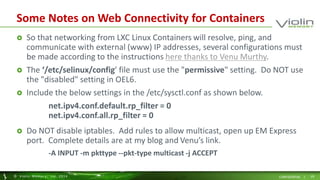
Some Notes on Web Connectivity for Containers 
 So that networking from LXC Linux Containers will resolve, ping, and 
communicate with external (www) IP addresses, several configurations must 
be made according to the instructions here thanks to Venu Murthy. 
 The ‘/etc/selinux/config’ file must use the "permissive" setting. Do NOT use 
the "disabled" setting in OEL6. 
 Include the below settings in the /etc/sysctl.conf as shown below. 
net.ipv4.conf.default.rp_filter = 0 
net.ipv4.conf.all.rp_filter = 0 
 Do NOT disable iptables. Add rules to allow multicast, open up EM Express 
port. Complete details are at my blog and Venu’s link. 
-A INPUT -m pkttype --pkt-type multicast -j ACCEPT 
© Viol in Memory, Inc . 2014 CONFIDENTIAL | 19
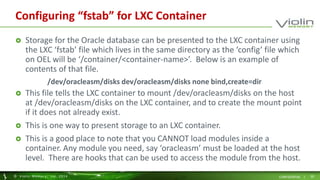
Configuring “fstab” for LXC Container 
 Storage for the Oracle database can be presented to the LXC container using 
the LXC ‘fstab’ file which lives in the same directory as the ‘config’ file which 
on OEL will be ‘/container/<container-name>’. Below is an example of 
contents of that file. 
/dev/oracleasm/disks dev/oracleasm/disks none bind,create=dir 
 This file tells the LXC container to mount /dev/oracleasm/disks on the host 
at /dev/oracleasm/disks on the LXC container, and to create the mount point 
if it does not already exist. 
 This is one way to present storage to an LXC container. 
 This is a good place to note that you CANNOT load modules inside a 
container. Any module you need, say ‘oracleasm’ must be loaded at the host 
level. There are hooks that can be used to access the module from the host. 
© Viol in Memory, Inc . 2014 CONFIDENTIAL | 20
Oracle 12c (12.1.0.2.0) ASM Flex Cluster and GNS 
 Oracle GNS (Grid Naming Service) has particularly interesting implications 
for migration of RAC nodes running in LXC Linux Containers 
 Because only a single IP address need be defined in corporate DNS (and the 
rest of the IP required for RAC handled by Oracle GNS) the mechanics of 
migrating an LXC containerized RAC node from one server host to another 
server host is thus greatly simplified. 
 Even without live migration, one can envision updating local_listener on one 
of the RAC nodes, and draining off connections to the other RAC nodes, and 
then shutting down the drained RAC node and bringing it up on another 
host. The software Openvswitch and even the rootfs of the migrating RAC 
container can be pre-staged on the destination host. 
© Viol in Memory, Inc . 2014 CONFIDENTIAL | 21
LXC: Learning from the Past, Getting it Right… 
 You can create your own company 
repository of containers and cut 
deployment time for Oracle 
systems to seconds rather than 
days by prebuilding everything 
then just deploying the container. 
 All these hardware tricks are 
completely unnecessary for 
Containers. Things like VT-d, VT-x, 
etc. were simply for hypervisors. 
 Hardware manufacturers will be 
able to turn away from chip 
optimizations for hypervisors. 
 The Technical Advisory Board of 
Linux Foundation and other key 
players learned a great deal from 
the Xen vs. KVM “disaster”. It was 
decided and is completed that 
kernel version 3.12 supports in-tree 
ALL containerization schemes 
on a standardized containerization 
set of kernel components. 
 The youth of Linux is ending and 
the golden age of Linux is just 
beginning. 
© Viol in Memory, Inc . 2014 CONFIDENTIAL | 22
Linux Container Security…a Brief Mention 
 LXD is coming promising security equivalent to a hypervisor. 
 Hostile root has been a part of container technology for over 10 
years (‘root’ in the container / ‘nobody’ in the host). 
 Linux containers use POSIX file ‘capabilities’ to tell LXC what 
capabilities to drop before starting. 
 Cgroups, apparmor, selinux, seccomp, and user namespace are 
also used. 
© Viol in Memory, Inc . 2014 CONFIDENTIAL | 23
Hypervisors and Containers 
 Hypervisors provide virtual 
emulated hardware. Examples 
are VMWare, KVM, VirtualBox and 
Xen. 
 The problem with hypervisors is 
that the emulated hardware 
introduces additional bootup 
time, addition disk space 
requirements, and reduced IO, 
network, CPU performance. 
 Over the years, various hardware 
and software strategies were used 
to try to boost performance. 
 Linux Containers are based on 
sharing the one kernel and 
resources of a single operating 
system. 
 Linux Containers use server bare 
metal hardware, use minimal disk 
space, and deliver bare-metal 
performance. The main problem 
one might envision is upgrading a 
kernel on a Container host. 
 As noted, Oracle has solved the 
container kernel upgrade problem 
using their ksplice technology… 
© Viol in Memory, Inc . 2014 CONFIDENTIAL | 24
Oracle Ksplice (zero-downtime security updates) 
 On July 21, 2011, Oracle acquired Ksplice Inc. 
 Ksplice provides zero downtime update technology for Linux kernels. 
 Ksplice Uptrack can apply 100% of the important kernel security updates 
released by Linux vendors without rebooting which is critical for hosts 
running hundreds of Linux Containers requiring zero-downtime operation. 
 Ksplice Uptrack is available for Oracle Linux, free of charge, for Oracle Linux 
customers with a Premier support subscription. 
 Anyone can use Ksplice Uptrack for free on Ubuntu Desktop and Fedora to 
learn how it works and test it out. 
 100,000+ servers at over 700 companies are protected with Ksplice Uptrack. 
 Over 2 million production updates successfully applied by Ksplice Uptrack. 
© Viol in Memory, Inc . 2014 CONFIDENTIAL | 25
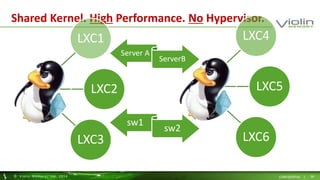
Shared Kernel. High Performance. No Hypervisor. 
LXC1 
LXC2 
LXC3 
LXC4 
LXC5 
LXC6 
Server A 
ServerB 
sw1 
sw2 
© Viol in Memory, Inc . 2014 CONFIDENTIAL | 26
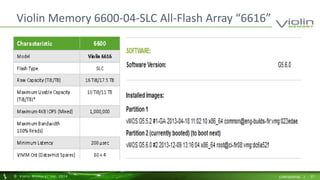
Violin Memory 6600-04-SLC All-Flash Array “6616” 
© Viol in Memory, Inc . 2014 CONFIDENTIAL | 27
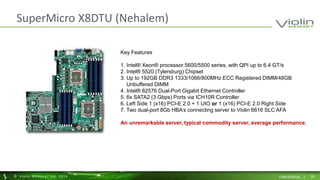
SuperMicro X8DTU (Nehalem) 
Key Features 
1. Intel® Xeon® processor 5600/5500 series, with QPI up to 6.4 GT/s 
2. Intel® 5520 (Tylersburg) Chipset 
3. Up to 192GB DDR3 1333/1066/800MHz ECC Registered DIMM/48GB 
Unbuffered DIMM 
4. Intel® 82576 Dual-Port Gigabit Ethernet Controller 
5. 6x SATA2 (3 Gbps) Ports via ICH10R Controller 
6. Left Side 1 (x16) PCI-E 2.0 + 1 UIO or 1 (x16) PCI-E 2.0 Right Side 
7. Two dual-port 8Gb HBA’s connecting server to Violin 6616 SLC AFA 
An unremarkable server, typical commodity server, average performance. 
© Viol in Memory, Inc . 2014 CONFIDENTIAL | 28
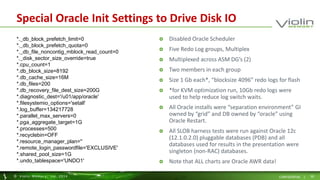
Specific Oracle Initialization Parameter Settings 
 Parameters used were those prescribed by Chris Buckel at his “FlashDBA” 
website for use with SLOB2 benchmarking. The settings are shown on the 
following slides for reference and convenience. 
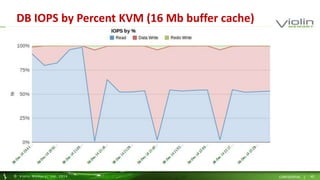
 These parameter settings are designed to MINIMIZE buffer cache hit ratio in 
order MAXIMIZE physical reads and to MINIMIZE logical reads so that 
latency to storage is tested. Therefore, the buffer cache is dialed down to 
16Mb. 
© Viol in Memory, Inc . 2014 CONFIDENTIAL | 29
Special Oracle Init Settings to Drive Disk IO 
 Disabled Oracle Scheduler 
 Five Redo Log groups, Multiplex 
 Multiplexed across ASM DG’s (2) 
 Two members in each group 
 Size 1 Gb each*, “blocksize 4096” redo logs for flash 
 *for KVM optimization run, 10Gb redo logs were 
used to help reduce log switch waits. 
 All Oracle installs were “separation environment” GI 
owned by “grid” and DB owned by “oracle” using 
Oracle Restart. 
 All SLOB harness tests were run against Oracle 12c 
(12.1.0.2.0) pluggable databases (PDB) and all 
databases used for results in the presentation were 
singleton (non-RAC) databases. 
 Note that ALL charts are Oracle AWR data! 
*._db_block_prefetch_limit=0 
*._db_block_prefetch_quota=0 
*._db_file_noncontig_mblock_read_count=0 
*._disk_sector_size_override=true 
*.cpu_count=1 
*.db_block_size=8192 
*.db_cache_size=16M 
*.db_files=200 
*.db_recovery_file_dest_size=200G 
*.diagnostic_dest='/u01/app/oracle' 
*.filesystemio_options='setall' 
*.log_buffer=134217728 
*.parallel_max_servers=0 
*.pga_aggregate_target=1G 
*.processes=500 
*.recyclebin=OFF 
*.resource_manager_plan='' 
*.remote_login_passwordfile='EXCLUSIVE' 
*.shared_pool_size=1G 
*.undo_tablespace='UNDO1' 
© Viol in Memory, Inc . 2014 CONFIDENTIAL | 30
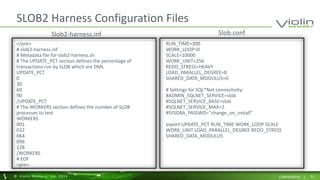
SLOB2 Harness Configuration Files 
Slob2-harness.inf Slob.conf 
</pre> 
# slob2-harness.inf 
# Metadata file for slob2-harness.sh 
# The UPDATE_PCT section defines the percentage of 
transactions run by SLOB which are DML 
UPDATE_PCT 
0 
30 
60 
90 
/UPDATE_PCT 
# The WORKERS section defines the number of SLOB 
processes to test 
WORKERS 
001 
032 
064 
096 
128 
/WORKERS 
# EOF 
<pre> 
RUN_TIME=300 
WORK_LOOP=0 
SCALE=10000 
WORK_UNIT=256 
REDO_STRESS=HEAVY 
LOAD_PARALLEL_DEGREE=8 
SHARED_DATA_MODULUS=0 
# Settings for SQL*Net connectivity: 
#ADMIN_SQLNET_SERVICE=slob 
#SQLNET_SERVICE_BASE=slob 
#SQLNET_SERVICE_MAX=2 
#SYSDBA_PASSWD="change_on_install" 
export UPDATE_PCT RUN_TIME WORK_LOOP SCALE 
WORK_UNIT LOAD_PARALLEL_DEGREE REDO_STRESS 
SHARED_DATA_MODULUS 
© Viol in Memory, Inc . 2014 CONFIDENTIAL | 31
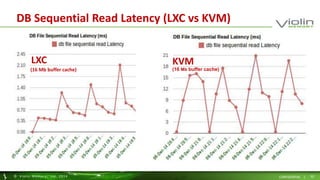
DB Sequential Read Latency (LXC vs KVM) 
LXC KVM 
(16 Mb buffer cache) (16 Mb buffer cache) 
© Viol in Memory, Inc . 2014 CONFIDENTIAL | 32
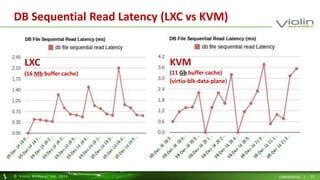
DB Sequential Read Latency (LXC vs KVM) 
LXC 
(16 Mb buffer cache) 
KVM 
(11 Gb buffer cache) 
(virtio-blk-data-plane) 
© Viol in Memory, Inc . 2014 CONFIDENTIAL | 33
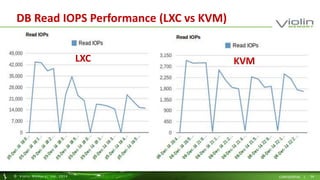
DB Read IOPS Performance (LXC vs KVM) 
LXC KVM 
© Viol in Memory, Inc . 2014 CONFIDENTIAL | 34
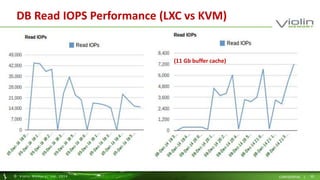
DB Read IOPS Performance (LXC vs KVM) 
(11 Gb buffer cache) 
© Viol in Memory, Inc . 2014 CONFIDENTIAL | 35
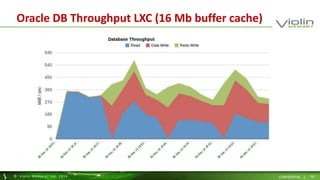
Oracle DB Throughput LXC (16 Mb buffer cache) 
© Viol in Memory, Inc . 2014 CONFIDENTIAL | 36
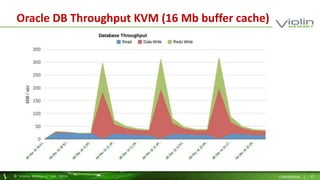
Oracle DB Throughput KVM (16 Mb buffer cache) 
© Viol in Memory, Inc . 2014 CONFIDENTIAL | 37
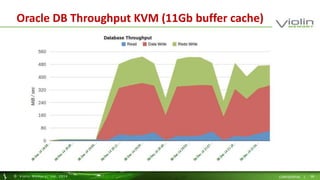
Oracle DB Throughput KVM (11Gb buffer cache) 
© Viol in Memory, Inc . 2014 CONFIDENTIAL | 38
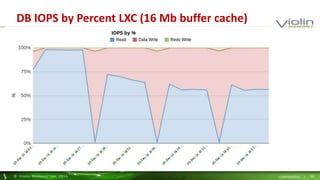
DB IOPS by Percent LXC (16 Mb buffer cache) 
© Viol in Memory, Inc . 2014 CONFIDENTIAL | 39
DB IOPS by Percent KVM (16 Mb buffer cache) 
© Viol in Memory, Inc . 2014 CONFIDENTIAL | 40
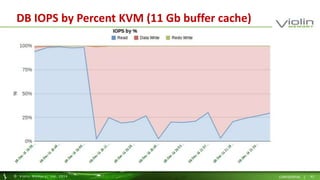
DB IOPS by Percent KVM (11 Gb buffer cache) 
© Viol in Memory, Inc . 2014 CONFIDENTIAL | 41
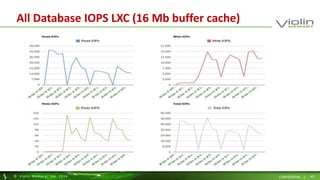
All Database IOPS LXC (16 Mb buffer cache) 
© Viol in Memory, Inc . 2014 CONFIDENTIAL | 42
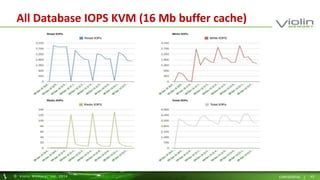
All Database IOPS KVM (16 Mb buffer cache) 
© Viol in Memory, Inc . 2014 CONFIDENTIAL | 43
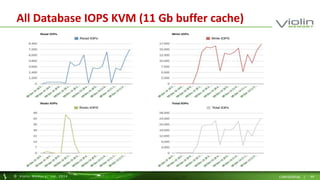
All Database IOPS KVM (11 Gb buffer cache) 
© Viol in Memory, Inc . 2014 CONFIDENTIAL | 44
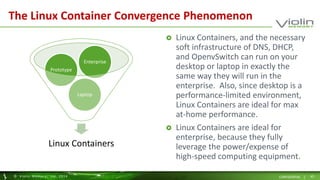
The Linux Container Convergence Phenomenon 
Enterprise 
Laptop 
Prototype 
Linux Containers 
 Linux Containers, and the necessary 
soft infrastructure of DNS, DHCP, 
and OpenvSwitch can run on your 
desktop or laptop in exactly the 
same way they will run in the 
enterprise. Also, since desktop is a 
performance-limited environment, 
Linux Containers are ideal for max 
at-home performance. 
 Linux Containers are ideal for 
enterprise, because they fully 
leverage the power/expense of 
high-speed computing equipment. 
© Viol in Memory, Inc . 2014 CONFIDENTIAL | 45
Seven Advantages of Linux Containers 
 Massive reduction in deployment (creation) time 
 Massive reduction in bootup time (boot starts at init) 
 Massive virtualization performance improvement (bare metal performance) 
 Massive virtualization manageability improvement (files can be edited at host level) 
 Consolidation of Enterprise to “Standard” (non-hypervisor) generic Linux skillsets 
 Linux Containers deliver all the efficient resource utilization 
 No hypervisor, no virtualized hardwar, bare-metal performance 
© Viol in Memory, Inc . 2014 CONFIDENTIAL | 46
Container Manageability 
Ever had a virtual machine image file “go bad”? VM would 
not start. If you were smart or lucky, maybe you had a backup 
of the image file. If not, then the next resort is to try and 
fix the problem. This usually involves tools like “guestfish” or 
“virsh-rescue” or starting the VM up with a rescue ISO, to fix 
the misconfiguration or the corruption. 
With Linux Containers, this will NEVER happen, because the 
Container filesystem resides on the same filesystem as the host. 
© Viol in Memory, Inc . 2014 CONFIDENTIAL | 47
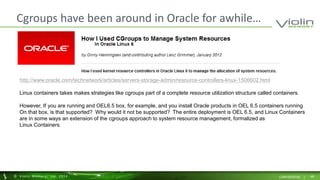
Cgroups have been around in Oracle for awhile… 
http://www.oracle.com/technetwork/articles/servers-storage-admin/resource-controllers-linux-1506602.html 
Linux containers takes makes strategies like cgroups part of a complete resource utilization structure called containers. 
However, If you are running and OEL6.5 box, for example, and you install Oracle products in OEL 6.5 containers running 
On that box, is that supported? Why would it not be supported? The entire deployment is OEL 6.5, and Linux Containers 
are in some ways an extension of the cgroups approach to system resource management, formalized as 
Linux Containers. 
© Viol in Memory, Inc . 2014 CONFIDENTIAL | 48
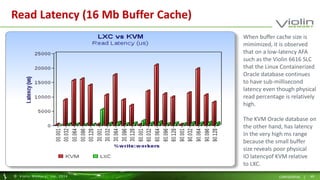
Read Latency (16 Mb Buffer Cache) 
When buffer cache size is 
mimimized, it is observed 
that on a low-latency AFA 
such as the Violin 6616 SLC 
that the Linux Containerized 
Oracle database continues 
to have sub-millisecond 
latency even though physical 
read percentage is relatively 
high. 
The KVM Oracle database on 
the other hand, has latency 
In the very high ms range 
because the small buffer 
size reveals poor physical 
IO latencyof KVM relative 
to LXC. 
© Viol in Memory, Inc . 2014 CONFIDENTIAL | 49
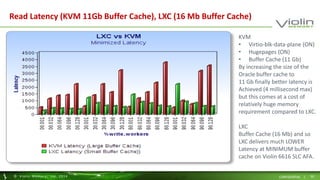
Read Latency (KVM 11Gb Buffer Cache), LXC (16 Mb Buffer Cache) 
KVM 
• Virtio-blk-data-plane (ON) 
• Hugepages (ON) 
• Buffer Cache (11 Gb) 
By increasing the size of the 
Oracle buffer cache to 
11 Gb finally better latency is 
Achieved (4 millisecond max) 
but this comes at a cost of 
relatively huge memory 
requirement compared to LXC. 
LXC 
Buffer Cache (16 Mb) and so 
LXC delivers much LOWER 
Latency at MINIMUM buffer 
cache on Violin 6616 SLC AFA. 
© Viol in Memory, Inc . 2014 CONFIDENTIAL | 50
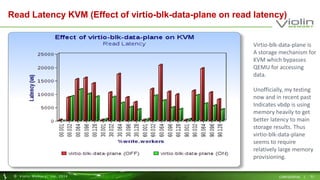
Read Latency KVM (Effect of virtio-blk-data-plane on read latency) 
Virtio-blk-data-plane is 
A storage mechanism for 
KVM which bypasses 
QEMU for accessing 
data. 
Unofficially, my testing 
now and in recent past 
Indicates vbdp is using 
memory heavily to get 
better latency to main 
storage results. Thus 
virtio-blk-data-plane 
seems to require 
relatively large memory 
provisioning. 
© Viol in Memory, Inc . 2014 CONFIDENTIAL | 51
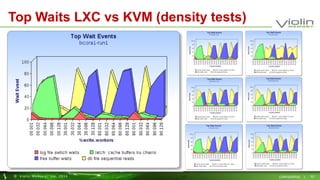
Top Waits LXC vs KVM (density tests) 
© Viol in Memory, Inc . 2014 CONFIDENTIAL | 52
Building Oracle on LXC in OEL UEK[2,3] Kernels (References) 
 Wim Coaekerts Blog (October 9, 2011) 
Getting LXC, OpenvSwitch, and BTRFS from Beta Repo. 
Oracle VM templates can be converted to containerization. 
 Converting Oracle VM templates to Linux Containers 
Oracle® Linux Administrator's Solutions Guide for Release 6 
Chapter 9 Linux Containers 
Chapter 10 Docker 
 However, best to use UEK3 Kernels. 
 The 3.12 kernel provides unified Container support This means 
 That on 3.12, LXC, OpenVZ, Parallels, . 
© Viol in Memory, Inc . 2014 CONFIDENTIAL | 53
References 
IBM Research Report 
An Updated Performance Comparison of Virtual Machines and Linux Containers 
Wes Felter, Alexandre Ferreira, Ram Rajamony, Juan Rubio 
IBM Research Division 
RC25482 (AUS1407-001) July 21, 2014 
http://domino.research.ibm.com/library/cyberdig.nsf/papers/0929052195DD8 
19C85257D2300681E7B/$File/rc25482.pdf 
This paper compares LXC Linux Containers and KVM Guest but does so from 
the OS point of view (but does include a section on comparison of MySQL DB 
running in LXC Container vs. MySQL running in KVM guest). 
© Viol in Memory, Inc . 2014 CONFIDENTIAL | 54
Contacts & Web Presence 
 gstanden@vmem.com 
 gilstanden@hotmail.com 
 http://sites.google.com/site/nandydandyoracle 
 http://www.consultingcommandos.us 
 http://m.consultingcommandos.us 
 http://www.violin-memory.com 
 http://www.facebook.com/oraclehsc 
 http://www.facebook.com/gilbert_standen 
 Twitter: @yoyo_gbiker 
 THANK YOU. QUESTIONS? 
© Viol in Memory, Inc . 2014 CONFIDENTIAL | 55

nyoug-lxc-december-12-final

  • 1.
    Building Oracle onLXC Linux Containers Gilbert Standen, Solution Architect Violin Memory © Viol in Memory, Inc . 2014 CONFIDENTIAL | 1
  • 2.
    Presenter Information Gilbert Standen  Solution Architect, Oracle & Virtualization, Violin Memory, Inc.  Presenter, NYOUG, 2007, 2008, 2014  Presenter, AUSOUG, “Oracle Communities with 20:20 Foresight”, 2006, 2007  Presenter, (Violin Memory All Flash Arrays), Oracle Open World, 2014  Production Oracle DBA (20 Years)  Violin Memory All-Flash-Array (AFA) Evangelist  Ubuntu Linux Evangelist (Oracle EE DB on Ubuntu / Oracle RAC on Ubuntu)  Virtualization Evangelist  Mountain Biker and Digital Trance Music Bum © Viol in Memory, Inc . 2014 CONFIDENTIAL | 2
  • 3.
    Presentation Description Today I want to show you the amazing performance and manageability advantages of running Oracle DB workloads in LXC Linux Containers.  I will share names of the very largest datacenter organizations in the world which have converted part or all of their infrastructure to Linux Containers.  Specifically, we will look at the implementation of Oracle EE databases in Linux Containers and hopefully include some practical hands-on information.  I will share with you some performance graphs generated by SLOB running Oracle databases in LXC Linux Containers on unremarkable commodity SuperMicro dual-socket servers attached to a Violin 6616 SLC all-flash array.  Why am I doing this? My main reason is to hopefully convince you that Linux Containers are the best high-performance way to run any Oracle databases at high-performance, also achieving efficient utilization on Linux. © Viol in Memory, Inc . 2014 CONFIDENTIAL | 3
  • 4.
    Credits and Recognition  A large number of people and organizations made this presentation possible.  Caryl Lee, Executive Director, NYOUG  Michael Olin, President, NYOUG  Violin Memory Lab Support (Justin Pham, Jalal Schenk, Charles Vuong)  Kurt Schmidt  The woman to whom I am married 20 years, Dr. Yelena Belyaeva-Standen  My mother, Mary Elizabeth “Betty” Standen (nee Bell)  My father, who passed away in 1996, who believed you can be/do anything  The large and growing number of people blogging on this topic.  The FlashDBA website http://www.flashdba.com © Viol in Memory, Inc . 2014 CONFIDENTIAL | 4
  • 5.
    Oracle Performance AssessmentService (OPAS)  Most performance graphs used in this presentation for comparing Oracle database running in OEL 6.6 KVM guest vs. Oracle database running in OEL 6.6 LXC Linux Container were generated using the Violin Memory Oracle Performance Assessment Service (OPAS), a FREE online performance tool.  OPAS is a FREE web tool at http://awr.vmem.com . It takes as input a zip file containing a set of Oracle Automated Workload Repository (AWR) reports in TEXT format ONLY and generates online a performance assessment report complete with graphs on latency, throughput, IOPS and many more metrics.  OPAS is available on the www and is a FREE TOOL to quickly get a performance assessment of an Oracle database. This is a service for which some companies have charged several thousand dollars or more.  A couple of the graphs at near end were generated by www.chartgo.com © Viol in Memory, Inc . 2014 CONFIDENTIAL | 5
  • 6.
    Resources My blog:https://sites.google.com/site/nandydandyoracle The above site has very detailed hands-on, step-by-step, how-to guides on how to deploy Oracle 12c Grid Infrastructure Standalone Oracle Restart enabled databases, and Oracle 12c GNS ASM RAC Clusters in OEL 6 LXC Linux Containers. These guides include copious blockquote command codeblocks. Guides are there, and I have tested, Oracle 12c Standalone and RAC deployments in Oracle Enterprise Linux 6.5 LXC Linux Containers on both Oracle Enterprise Linux 6.6 and on Ubuntu 14.04.1. Slides here are intended just to give a flavor of the overall simplicity of LXC. © Viol in Memory, Inc . 2014 CONFIDENTIAL | 6
  • 7.
    Wim Coaekerts Blogson Linux Containers…  “This really shows the power of containers on Linux and Linux itself. We have all these various Linux distributions but inside lxc (or docker) you can run ubuntu, debian, gentoo, yourowncustomcrazything and it will just run, old versions of OL, newer versions of OL, all on the same host kernel.”  “I can run OL6.5 and create OL4, OL5, OL6 containers or docker images but I can also run any old debian or slackware images at the same time.”  “To try out LXC, you need to install the LXC packages. LXC is capable of using Oracle VM Oracle Linux templates as a base image to create a container. “  “The use of btrfs in particular and being able to easily create clones/snapshots of container images. To get started : have an Oracle Linux 6.5 installation with UEK3 and LXC installed and configured.”  “LXC by default uses ‘/container’ as the directory to store container images and metadata” [Note: On Ubuntu it uses ‘/var/lib/lxc’ as the default container storage directory). © Viol in Memory, Inc . 2014 CONFIDENTIAL | 7
  • 8.
    The “Big Picture”on Linux Containers Since this presentation is about “Building Oracle on LXC Linux Containers” it doesn’t really cover the big picture. James Bottomley has described that here: The Future of Containers in Linux and OpenStack James Bottomley is CTO of Virtualization at Parallels. He is a kernel developer and maintainer of the SCSI subsystem and PA-RISC architecture. He is also the Chair of the Linux Foundation Technical Advisory Board (TAB). Highly recommended viewing. Also, this link by Joe Beda, Sr. Staff Software Engineer, Google Cloud Platform, from June 2014 should also be viewed. Google spins up 2 billion containers per week, or about 3,300 containers every second, of every day, of every year. Everything at Google Runs in A Container © Viol in Memory, Inc . 2014 CONFIDENTIAL | 8
  • 9.
    Service Providers AlreadyUsing Linux Containers © Viol in Memory, Inc . 2014 CONFIDENTIAL | 9
  • 10.
    Large Hosting ProvidersUsing Linux Containers © Viol in Memory, Inc . 2014 CONFIDENTIAL | 10
  • 11.
    Other Technology Providers– You & Me, and… © Viol in Memory, Inc . 2014 CONFIDENTIAL | 11
  • 12.
    A Tale ofTwo (or more) Linux Architectures © Viol in Memory, Inc . 2014 CONFIDENTIAL | 12
  • 13.
    A Tale ofPortability: Move Switches with Container Server 327 Server 701 © Viol in Memory, Inc . 2014 CONFIDENTIAL | 13
  • 14.
    Oracle on LXCWorkflow © Viol in Memory, Inc . 2014 CONFIDENTIAL | 14
  • 15.
    Configure Container Environment(OEL6 / UEK3) Step 1 • wget http://public-yum.oracle.com/beta/public-yum-ol6-beta.repo • sed -i s/enabled=0/enabled=1/g public-yum-ol6-beta.repo Step 2 • yum install openvswitch lxc tunctl bind-* dhcp oracleasm-* • service openvswitch start; chkconfig openvswitch on; ovs-vsctl show • configure DHCP DNS autoupdate; create an openvswitch Step 3 • lxc-create -t oracle -n <container-name> (installs most recent OEL) • lxc-create -n ol59 -t oracle --R 5.9. (installs specific OEL version) • configure storage for Oracle ASM (UDEV, multipath, ASMLib) © Viol in Memory, Inc . 2014 CONFIDENTIAL | 15
  • 16.
    Create an OpenvSwitch Step 1 • ovs-vsctl add-br sw1 • ovs-vsctl add-port sw1 s1 Step 2 • ip link set up dev sw1 • ip addr add 10.207.39.1/24 dev sw1 Step 3 • ip route replace 10.207.39.0/24 dev sw1 • ovs-vsctl set port sw1 tag=10 © Viol in Memory, Inc . 2014 CONFIDENTIAL | 16
  • 17.
    Containerize Oracle Step1 • create “/container/fstab” file; add Oracle ASM storage to fstab • edit “/container/config” for openvswitch networking Step 2 • cd /container/<container-name> • edit container configuration (config) file Step 3 • configure container for openvswitch(es) networking • verify DHCP assigns address on container boot • Install Oracle GI and Oracle DB; Install SLOB; benchmark © Viol in Memory, Inc . 2014 CONFIDENTIAL | 17
  • 18.
    Connecting LXC Containerto OpenvSwitch #!/bin/bash ovsBr='sw9' sudo ovs-vsctl add-port ${ovsBr} $5 sudo ovs-vsctl set port lxcora02-asm2 tag=70 sudo ovs-vsctl set port ${ovsBr} tag=70 sudo ovs-vsctl set port ${ovsBr} trunks=60,70 lxc.network.type = veth lxc.network.flags = up lxc.network.script.up = /etc/network/if-up.d/lxcora02-asm2-ifup-sw9 lxc.network.script.down = /etc/network/if-down.d/lxcora02-asm2-ifdown-sw9 lxc.network.veth.pair = lxcora02-asm2 lxc.network.name = eth6 lxc.network.mtu = 9000 lxc.network.ipv4 = 172.221.40.10 lxc.network.hwaddr = 00:16:3e:24:c8:4b #!/bin/bash ovsBr='sw9' sudo ovs-vsctl del-port ${ovsBr} $5 © Viol in Memory, Inc . 2014 CONFIDENTIAL | 18
  • 19.
    Some Notes onWeb Connectivity for Containers  So that networking from LXC Linux Containers will resolve, ping, and communicate with external (www) IP addresses, several configurations must be made according to the instructions here thanks to Venu Murthy.  The ‘/etc/selinux/config’ file must use the "permissive" setting. Do NOT use the "disabled" setting in OEL6.  Include the below settings in the /etc/sysctl.conf as shown below. net.ipv4.conf.default.rp_filter = 0 net.ipv4.conf.all.rp_filter = 0  Do NOT disable iptables. Add rules to allow multicast, open up EM Express port. Complete details are at my blog and Venu’s link. -A INPUT -m pkttype --pkt-type multicast -j ACCEPT © Viol in Memory, Inc . 2014 CONFIDENTIAL | 19
  • 20.
    Configuring “fstab” forLXC Container  Storage for the Oracle database can be presented to the LXC container using the LXC ‘fstab’ file which lives in the same directory as the ‘config’ file which on OEL will be ‘/container/<container-name>’. Below is an example of contents of that file. /dev/oracleasm/disks dev/oracleasm/disks none bind,create=dir  This file tells the LXC container to mount /dev/oracleasm/disks on the host at /dev/oracleasm/disks on the LXC container, and to create the mount point if it does not already exist.  This is one way to present storage to an LXC container.  This is a good place to note that you CANNOT load modules inside a container. Any module you need, say ‘oracleasm’ must be loaded at the host level. There are hooks that can be used to access the module from the host. © Viol in Memory, Inc . 2014 CONFIDENTIAL | 20
  • 21.
    Oracle 12c (12.1.0.2.0)ASM Flex Cluster and GNS  Oracle GNS (Grid Naming Service) has particularly interesting implications for migration of RAC nodes running in LXC Linux Containers  Because only a single IP address need be defined in corporate DNS (and the rest of the IP required for RAC handled by Oracle GNS) the mechanics of migrating an LXC containerized RAC node from one server host to another server host is thus greatly simplified.  Even without live migration, one can envision updating local_listener on one of the RAC nodes, and draining off connections to the other RAC nodes, and then shutting down the drained RAC node and bringing it up on another host. The software Openvswitch and even the rootfs of the migrating RAC container can be pre-staged on the destination host. © Viol in Memory, Inc . 2014 CONFIDENTIAL | 21
  • 22.
    LXC: Learning fromthe Past, Getting it Right…  You can create your own company repository of containers and cut deployment time for Oracle systems to seconds rather than days by prebuilding everything then just deploying the container.  All these hardware tricks are completely unnecessary for Containers. Things like VT-d, VT-x, etc. were simply for hypervisors.  Hardware manufacturers will be able to turn away from chip optimizations for hypervisors.  The Technical Advisory Board of Linux Foundation and other key players learned a great deal from the Xen vs. KVM “disaster”. It was decided and is completed that kernel version 3.12 supports in-tree ALL containerization schemes on a standardized containerization set of kernel components.  The youth of Linux is ending and the golden age of Linux is just beginning. © Viol in Memory, Inc . 2014 CONFIDENTIAL | 22
  • 23.
    Linux Container Security…aBrief Mention  LXD is coming promising security equivalent to a hypervisor.  Hostile root has been a part of container technology for over 10 years (‘root’ in the container / ‘nobody’ in the host).  Linux containers use POSIX file ‘capabilities’ to tell LXC what capabilities to drop before starting.  Cgroups, apparmor, selinux, seccomp, and user namespace are also used. © Viol in Memory, Inc . 2014 CONFIDENTIAL | 23
  • 24.
    Hypervisors and Containers  Hypervisors provide virtual emulated hardware. Examples are VMWare, KVM, VirtualBox and Xen.  The problem with hypervisors is that the emulated hardware introduces additional bootup time, addition disk space requirements, and reduced IO, network, CPU performance.  Over the years, various hardware and software strategies were used to try to boost performance.  Linux Containers are based on sharing the one kernel and resources of a single operating system.  Linux Containers use server bare metal hardware, use minimal disk space, and deliver bare-metal performance. The main problem one might envision is upgrading a kernel on a Container host.  As noted, Oracle has solved the container kernel upgrade problem using their ksplice technology… © Viol in Memory, Inc . 2014 CONFIDENTIAL | 24
  • 25.
    Oracle Ksplice (zero-downtimesecurity updates)  On July 21, 2011, Oracle acquired Ksplice Inc.  Ksplice provides zero downtime update technology for Linux kernels.  Ksplice Uptrack can apply 100% of the important kernel security updates released by Linux vendors without rebooting which is critical for hosts running hundreds of Linux Containers requiring zero-downtime operation.  Ksplice Uptrack is available for Oracle Linux, free of charge, for Oracle Linux customers with a Premier support subscription.  Anyone can use Ksplice Uptrack for free on Ubuntu Desktop and Fedora to learn how it works and test it out.  100,000+ servers at over 700 companies are protected with Ksplice Uptrack.  Over 2 million production updates successfully applied by Ksplice Uptrack. © Viol in Memory, Inc . 2014 CONFIDENTIAL | 25
  • 26.
    Shared Kernel. HighPerformance. No Hypervisor. LXC1 LXC2 LXC3 LXC4 LXC5 LXC6 Server A ServerB sw1 sw2 © Viol in Memory, Inc . 2014 CONFIDENTIAL | 26
  • 27.
    Violin Memory 6600-04-SLCAll-Flash Array “6616” © Viol in Memory, Inc . 2014 CONFIDENTIAL | 27
  • 28.
    SuperMicro X8DTU (Nehalem) Key Features 1. Intel® Xeon® processor 5600/5500 series, with QPI up to 6.4 GT/s 2. Intel® 5520 (Tylersburg) Chipset 3. Up to 192GB DDR3 1333/1066/800MHz ECC Registered DIMM/48GB Unbuffered DIMM 4. Intel® 82576 Dual-Port Gigabit Ethernet Controller 5. 6x SATA2 (3 Gbps) Ports via ICH10R Controller 6. Left Side 1 (x16) PCI-E 2.0 + 1 UIO or 1 (x16) PCI-E 2.0 Right Side 7. Two dual-port 8Gb HBA’s connecting server to Violin 6616 SLC AFA An unremarkable server, typical commodity server, average performance. © Viol in Memory, Inc . 2014 CONFIDENTIAL | 28
  • 29.
    Specific Oracle InitializationParameter Settings  Parameters used were those prescribed by Chris Buckel at his “FlashDBA” website for use with SLOB2 benchmarking. The settings are shown on the following slides for reference and convenience.  These parameter settings are designed to MINIMIZE buffer cache hit ratio in order MAXIMIZE physical reads and to MINIMIZE logical reads so that latency to storage is tested. Therefore, the buffer cache is dialed down to 16Mb. © Viol in Memory, Inc . 2014 CONFIDENTIAL | 29
  • 30.
    Special Oracle InitSettings to Drive Disk IO  Disabled Oracle Scheduler  Five Redo Log groups, Multiplex  Multiplexed across ASM DG’s (2)  Two members in each group  Size 1 Gb each*, “blocksize 4096” redo logs for flash  *for KVM optimization run, 10Gb redo logs were used to help reduce log switch waits.  All Oracle installs were “separation environment” GI owned by “grid” and DB owned by “oracle” using Oracle Restart.  All SLOB harness tests were run against Oracle 12c (12.1.0.2.0) pluggable databases (PDB) and all databases used for results in the presentation were singleton (non-RAC) databases.  Note that ALL charts are Oracle AWR data! *._db_block_prefetch_limit=0 *._db_block_prefetch_quota=0 *._db_file_noncontig_mblock_read_count=0 *._disk_sector_size_override=true *.cpu_count=1 *.db_block_size=8192 *.db_cache_size=16M *.db_files=200 *.db_recovery_file_dest_size=200G *.diagnostic_dest='/u01/app/oracle' *.filesystemio_options='setall' *.log_buffer=134217728 *.parallel_max_servers=0 *.pga_aggregate_target=1G *.processes=500 *.recyclebin=OFF *.resource_manager_plan='' *.remote_login_passwordfile='EXCLUSIVE' *.shared_pool_size=1G *.undo_tablespace='UNDO1' © Viol in Memory, Inc . 2014 CONFIDENTIAL | 30
  • 31.
    SLOB2 Harness ConfigurationFiles Slob2-harness.inf Slob.conf </pre> # slob2-harness.inf # Metadata file for slob2-harness.sh # The UPDATE_PCT section defines the percentage of transactions run by SLOB which are DML UPDATE_PCT 0 30 60 90 /UPDATE_PCT # The WORKERS section defines the number of SLOB processes to test WORKERS 001 032 064 096 128 /WORKERS # EOF <pre> RUN_TIME=300 WORK_LOOP=0 SCALE=10000 WORK_UNIT=256 REDO_STRESS=HEAVY LOAD_PARALLEL_DEGREE=8 SHARED_DATA_MODULUS=0 # Settings for SQL*Net connectivity: #ADMIN_SQLNET_SERVICE=slob #SQLNET_SERVICE_BASE=slob #SQLNET_SERVICE_MAX=2 #SYSDBA_PASSWD="change_on_install" export UPDATE_PCT RUN_TIME WORK_LOOP SCALE WORK_UNIT LOAD_PARALLEL_DEGREE REDO_STRESS SHARED_DATA_MODULUS © Viol in Memory, Inc . 2014 CONFIDENTIAL | 31
  • 32.
    DB Sequential ReadLatency (LXC vs KVM) LXC KVM (16 Mb buffer cache) (16 Mb buffer cache) © Viol in Memory, Inc . 2014 CONFIDENTIAL | 32
  • 33.
    DB Sequential ReadLatency (LXC vs KVM) LXC (16 Mb buffer cache) KVM (11 Gb buffer cache) (virtio-blk-data-plane) © Viol in Memory, Inc . 2014 CONFIDENTIAL | 33
  • 34.
    DB Read IOPSPerformance (LXC vs KVM) LXC KVM © Viol in Memory, Inc . 2014 CONFIDENTIAL | 34
  • 35.
    DB Read IOPSPerformance (LXC vs KVM) (11 Gb buffer cache) © Viol in Memory, Inc . 2014 CONFIDENTIAL | 35
  • 36.
    Oracle DB ThroughputLXC (16 Mb buffer cache) © Viol in Memory, Inc . 2014 CONFIDENTIAL | 36
  • 37.
    Oracle DB ThroughputKVM (16 Mb buffer cache) © Viol in Memory, Inc . 2014 CONFIDENTIAL | 37
  • 38.
    Oracle DB ThroughputKVM (11Gb buffer cache) © Viol in Memory, Inc . 2014 CONFIDENTIAL | 38
  • 39.
    DB IOPS byPercent LXC (16 Mb buffer cache) © Viol in Memory, Inc . 2014 CONFIDENTIAL | 39
  • 40.
    DB IOPS byPercent KVM (16 Mb buffer cache) © Viol in Memory, Inc . 2014 CONFIDENTIAL | 40
  • 41.
    DB IOPS byPercent KVM (11 Gb buffer cache) © Viol in Memory, Inc . 2014 CONFIDENTIAL | 41
  • 42.
    All Database IOPSLXC (16 Mb buffer cache) © Viol in Memory, Inc . 2014 CONFIDENTIAL | 42
  • 43.
    All Database IOPSKVM (16 Mb buffer cache) © Viol in Memory, Inc . 2014 CONFIDENTIAL | 43
  • 44.
    All Database IOPSKVM (11 Gb buffer cache) © Viol in Memory, Inc . 2014 CONFIDENTIAL | 44
  • 45.
    The Linux ContainerConvergence Phenomenon Enterprise Laptop Prototype Linux Containers  Linux Containers, and the necessary soft infrastructure of DNS, DHCP, and OpenvSwitch can run on your desktop or laptop in exactly the same way they will run in the enterprise. Also, since desktop is a performance-limited environment, Linux Containers are ideal for max at-home performance.  Linux Containers are ideal for enterprise, because they fully leverage the power/expense of high-speed computing equipment. © Viol in Memory, Inc . 2014 CONFIDENTIAL | 45
  • 46.
    Seven Advantages ofLinux Containers  Massive reduction in deployment (creation) time  Massive reduction in bootup time (boot starts at init)  Massive virtualization performance improvement (bare metal performance)  Massive virtualization manageability improvement (files can be edited at host level)  Consolidation of Enterprise to “Standard” (non-hypervisor) generic Linux skillsets  Linux Containers deliver all the efficient resource utilization  No hypervisor, no virtualized hardwar, bare-metal performance © Viol in Memory, Inc . 2014 CONFIDENTIAL | 46
  • 47.
    Container Manageability Everhad a virtual machine image file “go bad”? VM would not start. If you were smart or lucky, maybe you had a backup of the image file. If not, then the next resort is to try and fix the problem. This usually involves tools like “guestfish” or “virsh-rescue” or starting the VM up with a rescue ISO, to fix the misconfiguration or the corruption. With Linux Containers, this will NEVER happen, because the Container filesystem resides on the same filesystem as the host. © Viol in Memory, Inc . 2014 CONFIDENTIAL | 47
  • 48.
    Cgroups have beenaround in Oracle for awhile… http://www.oracle.com/technetwork/articles/servers-storage-admin/resource-controllers-linux-1506602.html Linux containers takes makes strategies like cgroups part of a complete resource utilization structure called containers. However, If you are running and OEL6.5 box, for example, and you install Oracle products in OEL 6.5 containers running On that box, is that supported? Why would it not be supported? The entire deployment is OEL 6.5, and Linux Containers are in some ways an extension of the cgroups approach to system resource management, formalized as Linux Containers. © Viol in Memory, Inc . 2014 CONFIDENTIAL | 48
  • 49.
    Read Latency (16Mb Buffer Cache) When buffer cache size is mimimized, it is observed that on a low-latency AFA such as the Violin 6616 SLC that the Linux Containerized Oracle database continues to have sub-millisecond latency even though physical read percentage is relatively high. The KVM Oracle database on the other hand, has latency In the very high ms range because the small buffer size reveals poor physical IO latencyof KVM relative to LXC. © Viol in Memory, Inc . 2014 CONFIDENTIAL | 49
  • 50.
    Read Latency (KVM11Gb Buffer Cache), LXC (16 Mb Buffer Cache) KVM • Virtio-blk-data-plane (ON) • Hugepages (ON) • Buffer Cache (11 Gb) By increasing the size of the Oracle buffer cache to 11 Gb finally better latency is Achieved (4 millisecond max) but this comes at a cost of relatively huge memory requirement compared to LXC. LXC Buffer Cache (16 Mb) and so LXC delivers much LOWER Latency at MINIMUM buffer cache on Violin 6616 SLC AFA. © Viol in Memory, Inc . 2014 CONFIDENTIAL | 50
  • 51.
    Read Latency KVM(Effect of virtio-blk-data-plane on read latency) Virtio-blk-data-plane is A storage mechanism for KVM which bypasses QEMU for accessing data. Unofficially, my testing now and in recent past Indicates vbdp is using memory heavily to get better latency to main storage results. Thus virtio-blk-data-plane seems to require relatively large memory provisioning. © Viol in Memory, Inc . 2014 CONFIDENTIAL | 51
  • 52.
    Top Waits LXCvs KVM (density tests) © Viol in Memory, Inc . 2014 CONFIDENTIAL | 52
  • 53.
    Building Oracle onLXC in OEL UEK[2,3] Kernels (References)  Wim Coaekerts Blog (October 9, 2011) Getting LXC, OpenvSwitch, and BTRFS from Beta Repo. Oracle VM templates can be converted to containerization.  Converting Oracle VM templates to Linux Containers Oracle® Linux Administrator's Solutions Guide for Release 6 Chapter 9 Linux Containers Chapter 10 Docker  However, best to use UEK3 Kernels.  The 3.12 kernel provides unified Container support This means  That on 3.12, LXC, OpenVZ, Parallels, . © Viol in Memory, Inc . 2014 CONFIDENTIAL | 53
  • 54.
    References IBM ResearchReport An Updated Performance Comparison of Virtual Machines and Linux Containers Wes Felter, Alexandre Ferreira, Ram Rajamony, Juan Rubio IBM Research Division RC25482 (AUS1407-001) July 21, 2014 http://domino.research.ibm.com/library/cyberdig.nsf/papers/0929052195DD8 19C85257D2300681E7B/$File/rc25482.pdf This paper compares LXC Linux Containers and KVM Guest but does so from the OS point of view (but does include a section on comparison of MySQL DB running in LXC Container vs. MySQL running in KVM guest). © Viol in Memory, Inc . 2014 CONFIDENTIAL | 54
  • 55.
    Contacts & WebPresence  gstanden@vmem.com  gilstanden@hotmail.com  http://sites.google.com/site/nandydandyoracle  http://www.consultingcommandos.us  http://m.consultingcommandos.us  http://www.violin-memory.com  http://www.facebook.com/oraclehsc  http://www.facebook.com/gilbert_standen  Twitter: @yoyo_gbiker  THANK YOU. QUESTIONS? © Viol in Memory, Inc . 2014 CONFIDENTIAL | 55