Introduction to Town+Gown: Possible Collaborations
with the Urban Systems Collaborative

A Presentation to Urban Systems Collaborative


Terri Matthews, Senior Policy Advisor
New York City Department of Design and Construction


                                                      1
Setting the Stage for Town+Gown

RAND Institute's famous 1988 study of large projects concluded that government process is the
most significant driver of both public and civilian project costs

       But RAND noted that the "host government makes the rules; the host government can change
       the rules"

“We have met the enemy and the enemy is us!” Pogo

But,

The built environment is a complex and dynamic social system where its issues cannot be
adequately comprehended in isolation from the wider system of which they are a part

Government operates in the built environment simultaneously in different capacities as if it is an
aggregation of multiple personalities

       owner and client of construction services that implement its capital program, government
       has many concerns in common with private owners; namely, project budget, schedule,
       quality and safety

              moreover, within any jurisdiction, there may be several public owners operating their
              own portions of the built environment

       regulator of built environment participants and built environment products, primarily for
       public health, safety and welfare purposes

       economic development catalyst focused on specific private economic activity

       financier of its capital programs, at the state and local government levels with the issuance
       of tax-exempt debt, itself a form of subsidy from both federal and state government levels,
       and the receipt of grants from higher levels of government

All is then further complicated by the inter-related activities of several levels of government—
federal, state and local—all similarly engaged

What to do?


                                                                                                     2
One Problem: Inadequate Levels of Research in the Built Environment

From the construction perspective

      The Building Congress released a July 2008 report entitled, New York's Rising Construction
      Costs: Issues and Solutions, recommending a role for the public sector to increase research
      to foster innovation in construction operations.

From the built environment perspective

      Minerva Partners released a report from a collaborative project focusing on the future of
      preservation entitled, Preservation Vision: Planning for the Future of Preservation in New
      York City, recommending an effort to undertake serious research.

Long-standing structural hurdles make increasing built environment research difficult

      low levels of investment, as general proposition
      low levels of public sponsorship
      inadequate linkages between research and application
      fragmented nature of construction industry
      traditional research methodology also suffers from tendency to become fractured, dividing
      "knowledge into domains with particular sub-disciplines"

On the Ground:

Built environment is a complex social system

Research must be contextual and systemic

Not needed: another research center or think tank but

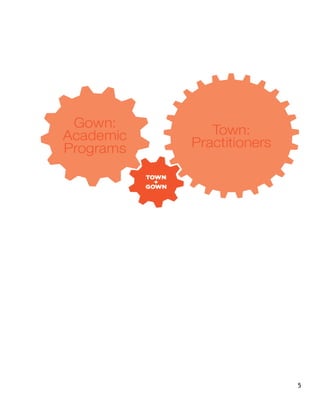
      A gear shift linking academics and practitioners for practically-based research project and
      bridging divides between them, with practitioners as equal partners in knowledge production

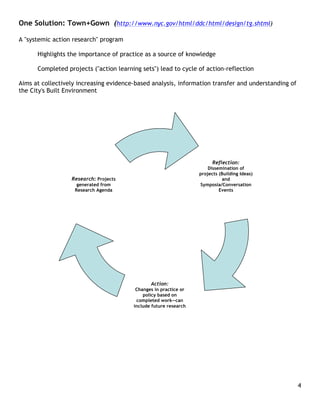
      A wheel, with spokes, turning in action-learning cycles, linking researchers and
      practitioners to

             work that sustains future research

             discussions that facilitate practice and policy changes based on research


                                                                                                    3
One Solution: Town+Gown (http://www.nyc.gov/html/ddc/html/design/tg.shtml)

A "systemic action research" program

      Highlights the importance of practice as a source of knowledge

      Completed projects ("action learning sets") lead to cycle of action-reflection

Aims at collectively increasing evidence-based analysis, information transfer and understanding of
the City's Built Environment


                                                                        Reflection:
                                                                      Dissemination of
                                                                  projects (Building Ideas)
                  Research: Projects                                        and
                    generated from                                Symposia/Conversation
                   Research Agenda                                         Events


                                               Action:
                                         Changes in practice or
                                            policy based on
                                         completed work—can
                                        include future research


                                                                                                     4
5
Town+Gown:
Facilitates partnerships between academics and practitioners on Built Environment research
projects, generating discussion and follow-up research aimed at making changes in practices and
policies.

Before each academic year, Town+Gown works with City agencies and graduate programs to
develop a City-wide Built Environment Research Agenda

During the academic year, Town+Gown supports academic-practitioner collaborations on particular
research projects from the Research Agenda.

Disseminates research results and fosters on-going discussions

      Following end of each academic year, Town+Gown will publish its Building Ideas Review,
      abstracting the final project reports that are available to members of Town+Gown

      Town+Gown organizes collaborative events—symposia and conferences, bringing academics
      and practitioners together to focus on the results of research

Town+Gown also publishes a periodic newsletter, Building Ideas Catalog, summarizing and linking
to Built Environment reports and articles

Consists of:

Town Group—practitioners that participate in the City's built environment; so far public owner
practitioners

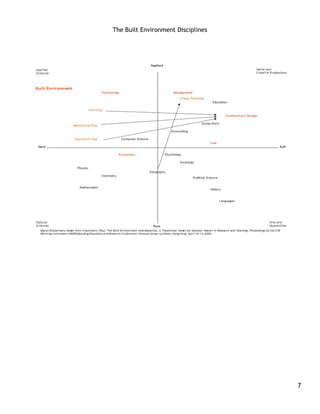
Gown Group—academic institutions with graduate and undergraduate programs in fields that
overlap with Built Environment disciplines

Applied Analysis and Research Group—practitioner organizations and individuals who participate
actively in the program, who are neither Town nor Gown and are available to provide practical
context for project researchers/investigators—AARG about to be merged into Town

Advisory Group—people interested in both the Built Environment and the Town+Gown program


                                                                                                  6
The Built Environment Disciplines


                                    7
For Members of Town: What Town+Gown Can Do for You!

  Facilitates bridging academic/practitioner divide for your Built Environment research questions
  in service learning programs as well funded research with as professors and Ph.D. students

     Can make contacts and manage relationships with academic programs, faculty advisors and
     student teams from project inception to "peer" review

     Wide dissemination of Research Agenda gets your research questions in front of all
     participating schools, increasing the chances that applied research will result

     Academic consortium contract currently under development will facilitate procurement
     process for expense funds during fiscal year; also will be available to all public owner
     members of Town

  Develops a coherent and comprehensive Built Environment research agenda with real and
  relevant questions

     Helps identify cross-agency issues, multi-disciplinary issues

     In conjunction with experiential/service learning programs, one project can lead to various
     follow-up projects over time

     More than one school can work on pieces of same question

  Publishes annual Building Ideas Review, abstracting students' work, presenting the results of all
  projects and making the final reports available to members of Town+Gown

  Sponsors collaborative discussion events for "real time" consideration of completed work among
  Town+Gown members as foundation for possible changes to practices and policies

  Bi-monthly Building Ideas Catalog summarizes and links to reports and articles related to the
  Built Environment

  A library/clearinghouse feature under development


                                                                                                    8
For Members of Gown: What Town+Gown Can Do for You!

  Provides a comprehensive and coherent City-wide research agenda with real and relevant
  questions focused on the Built Environment for use by:

  Experiential/service learning programs in developing capstone projects, workshops, studios and
  internships

        for various projects over time—one project can lead to a follow-up project

        multi-disciplinary opportunities within own institution or with other institutions

  Professors to develop courses around, use as case-studies and/or work on/propose academic
  research projects

  Bridges academic/practitioner divide for in-service learning programs, Master’s thesis and Ph.D.
  dissertations, as well as individual professors research

  Can make introductions and help manage relationships with practitioner agencies from project
  inception to "peer" review

  Collaborative discussion events with members of Town and other academic institutions in Gown
  provide opportunities for academics to engage with public policy makers on place- and data-
  based inquiries and analyses, providing opportunities for future work

  Academic consortium contract in development will make procurement of academic services
  easier for members of Town, thus increasing the chances of funded research

  Increases exposure of academic work product among practitioners

  Publishes annual Building Ideas Review, presenting programs and academic work to a wider
  audience of built environment practitioners

  Disseminates bi-monthly Building Ideas Catalog that summarizes and links to reports and
  articles related to the Built Environment, that can include your own work and work from your
  programs, expanding the audience for your work to built environment practitioners


                                                                                                 9
Town:


Department of Aging
Department of Buildings
Department of City Planning
Department of Citywide Administrative Services
Department of Cultural Affairs
Department of Design and Construction
Department of Environmental Protection
Department of Health and Mental Hygiene
Health and Hospitals Corporation
Department of Housing Preservation and Development
Department of Information Technology and Telecommunications
Landmarks Preservation Commission
Law Department
Department of Parks and Recreation
Department of Sanitation
Department of Small Business Services
Department of Transportation
Mayor’s Office
   Capital Project Development
   Construction Services
   Environmental Coordination
   Management and Budget
   Operations
New York City Economic Development Corporation
New York City Design Commission

Port Authority of New York and New Jersey
New York Power Authority
New York City Transit
New York City School Construction Authority
Empire State Development Corporation
Dormitory Authority of the State of New York


                                                              10
Gown:
Public Administration/Policy

Columbia/School of International and Public Affairs
NYU/Wagner School of Public Service1
New School/Milano School of Management and Urban Policy
CUNY/Baruch School of Public Affairs
Pace University Graduate School

Urban Planning

Columbia/Graduate School of Architecture, Planning and Preservation
CUNY/Hunter College, Graduate School, Departments of Urban Affairs and Urban Planning

Engineering

NYU/Polytechnic Institute
CUNY/Grove School of Engineering, City College of New York
Manhattan College/Engineering School
Cooper-Union School of Engineering
New York Institute of Technology
Columbia/Fu School of Engineering, Center for Technology, Innovation and Community Engagement

Architecture

New School/Parsons School of Design
New York Institute of Technology
Columbia/Graduate School of Architecture, Planning and Preservation
Cooper-Union School of Architecture
Pratt School of Architecture

Real Estate Development/Construction Management

NYU/School of Continuing and Professional Studies, Schack Institute of Real Estate

Law

Brooklyn Law School/Clinical Program

Business Administration

Manhattan College/School of Business


1
    Includes Urban Planning program.
                                                                                                11
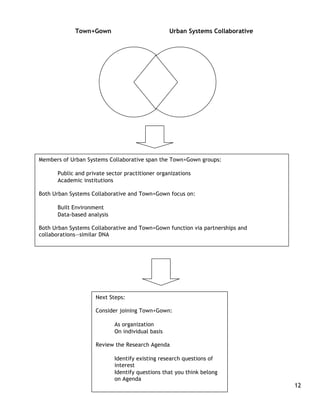
Town+Gown                            Urban Systems Collaborative


Members of Urban Systems Collaborative span the Town+Gown groups:

      Public and private sector practitioner organizations
      Academic institutions

Both Urban Systems Collaborative and Town+Gown focus on:

      Built Environment
      Data-based analysis

Both Urban Systems Collaborative and Town+Gown function via partnerships and
collaborations—similar DNA


                    Next Steps:

                    Consider joining Town+Gown:

                            As organization
                            On individual basis

                    Review the Research Agenda

                            Identify existing research questions of
                            interest
                            Identify questions that you think belong
                            on Agenda
                                                                                12

NYC Town+Gown

  • 1.
    Introduction to Town+Gown:Possible Collaborations with the Urban Systems Collaborative A Presentation to Urban Systems Collaborative Terri Matthews, Senior Policy Advisor New York City Department of Design and Construction 1
  • 2.
    Setting the Stagefor Town+Gown RAND Institute's famous 1988 study of large projects concluded that government process is the most significant driver of both public and civilian project costs But RAND noted that the "host government makes the rules; the host government can change the rules" “We have met the enemy and the enemy is us!” Pogo But, The built environment is a complex and dynamic social system where its issues cannot be adequately comprehended in isolation from the wider system of which they are a part Government operates in the built environment simultaneously in different capacities as if it is an aggregation of multiple personalities owner and client of construction services that implement its capital program, government has many concerns in common with private owners; namely, project budget, schedule, quality and safety moreover, within any jurisdiction, there may be several public owners operating their own portions of the built environment regulator of built environment participants and built environment products, primarily for public health, safety and welfare purposes economic development catalyst focused on specific private economic activity financier of its capital programs, at the state and local government levels with the issuance of tax-exempt debt, itself a form of subsidy from both federal and state government levels, and the receipt of grants from higher levels of government All is then further complicated by the inter-related activities of several levels of government— federal, state and local—all similarly engaged What to do? 2
  • 3.
    One Problem: InadequateLevels of Research in the Built Environment From the construction perspective The Building Congress released a July 2008 report entitled, New York's Rising Construction Costs: Issues and Solutions, recommending a role for the public sector to increase research to foster innovation in construction operations. From the built environment perspective Minerva Partners released a report from a collaborative project focusing on the future of preservation entitled, Preservation Vision: Planning for the Future of Preservation in New York City, recommending an effort to undertake serious research. Long-standing structural hurdles make increasing built environment research difficult low levels of investment, as general proposition low levels of public sponsorship inadequate linkages between research and application fragmented nature of construction industry traditional research methodology also suffers from tendency to become fractured, dividing "knowledge into domains with particular sub-disciplines" On the Ground: Built environment is a complex social system Research must be contextual and systemic Not needed: another research center or think tank but A gear shift linking academics and practitioners for practically-based research project and bridging divides between them, with practitioners as equal partners in knowledge production A wheel, with spokes, turning in action-learning cycles, linking researchers and practitioners to work that sustains future research discussions that facilitate practice and policy changes based on research 3
  • 4.
    One Solution: Town+Gown(http://www.nyc.gov/html/ddc/html/design/tg.shtml) A "systemic action research" program Highlights the importance of practice as a source of knowledge Completed projects ("action learning sets") lead to cycle of action-reflection Aims at collectively increasing evidence-based analysis, information transfer and understanding of the City's Built Environment Reflection: Dissemination of projects (Building Ideas) Research: Projects and generated from Symposia/Conversation Research Agenda Events Action: Changes in practice or policy based on completed work—can include future research 4
  • 5.
  • 6.
    Town+Gown: Facilitates partnerships betweenacademics and practitioners on Built Environment research projects, generating discussion and follow-up research aimed at making changes in practices and policies. Before each academic year, Town+Gown works with City agencies and graduate programs to develop a City-wide Built Environment Research Agenda During the academic year, Town+Gown supports academic-practitioner collaborations on particular research projects from the Research Agenda. Disseminates research results and fosters on-going discussions Following end of each academic year, Town+Gown will publish its Building Ideas Review, abstracting the final project reports that are available to members of Town+Gown Town+Gown organizes collaborative events—symposia and conferences, bringing academics and practitioners together to focus on the results of research Town+Gown also publishes a periodic newsletter, Building Ideas Catalog, summarizing and linking to Built Environment reports and articles Consists of: Town Group—practitioners that participate in the City's built environment; so far public owner practitioners Gown Group—academic institutions with graduate and undergraduate programs in fields that overlap with Built Environment disciplines Applied Analysis and Research Group—practitioner organizations and individuals who participate actively in the program, who are neither Town nor Gown and are available to provide practical context for project researchers/investigators—AARG about to be merged into Town Advisory Group—people interested in both the Built Environment and the Town+Gown program 6
  • 7.
    The Built EnvironmentDisciplines 7
  • 8.
    For Members ofTown: What Town+Gown Can Do for You! Facilitates bridging academic/practitioner divide for your Built Environment research questions in service learning programs as well funded research with as professors and Ph.D. students Can make contacts and manage relationships with academic programs, faculty advisors and student teams from project inception to "peer" review Wide dissemination of Research Agenda gets your research questions in front of all participating schools, increasing the chances that applied research will result Academic consortium contract currently under development will facilitate procurement process for expense funds during fiscal year; also will be available to all public owner members of Town Develops a coherent and comprehensive Built Environment research agenda with real and relevant questions Helps identify cross-agency issues, multi-disciplinary issues In conjunction with experiential/service learning programs, one project can lead to various follow-up projects over time More than one school can work on pieces of same question Publishes annual Building Ideas Review, abstracting students' work, presenting the results of all projects and making the final reports available to members of Town+Gown Sponsors collaborative discussion events for "real time" consideration of completed work among Town+Gown members as foundation for possible changes to practices and policies Bi-monthly Building Ideas Catalog summarizes and links to reports and articles related to the Built Environment A library/clearinghouse feature under development 8
  • 9.
    For Members ofGown: What Town+Gown Can Do for You! Provides a comprehensive and coherent City-wide research agenda with real and relevant questions focused on the Built Environment for use by: Experiential/service learning programs in developing capstone projects, workshops, studios and internships for various projects over time—one project can lead to a follow-up project multi-disciplinary opportunities within own institution or with other institutions Professors to develop courses around, use as case-studies and/or work on/propose academic research projects Bridges academic/practitioner divide for in-service learning programs, Master’s thesis and Ph.D. dissertations, as well as individual professors research Can make introductions and help manage relationships with practitioner agencies from project inception to "peer" review Collaborative discussion events with members of Town and other academic institutions in Gown provide opportunities for academics to engage with public policy makers on place- and data- based inquiries and analyses, providing opportunities for future work Academic consortium contract in development will make procurement of academic services easier for members of Town, thus increasing the chances of funded research Increases exposure of academic work product among practitioners Publishes annual Building Ideas Review, presenting programs and academic work to a wider audience of built environment practitioners Disseminates bi-monthly Building Ideas Catalog that summarizes and links to reports and articles related to the Built Environment, that can include your own work and work from your programs, expanding the audience for your work to built environment practitioners 9
  • 10.
    Town: Department of Aging Departmentof Buildings Department of City Planning Department of Citywide Administrative Services Department of Cultural Affairs Department of Design and Construction Department of Environmental Protection Department of Health and Mental Hygiene Health and Hospitals Corporation Department of Housing Preservation and Development Department of Information Technology and Telecommunications Landmarks Preservation Commission Law Department Department of Parks and Recreation Department of Sanitation Department of Small Business Services Department of Transportation Mayor’s Office Capital Project Development Construction Services Environmental Coordination Management and Budget Operations New York City Economic Development Corporation New York City Design Commission Port Authority of New York and New Jersey New York Power Authority New York City Transit New York City School Construction Authority Empire State Development Corporation Dormitory Authority of the State of New York 10
  • 11.
    Gown: Public Administration/Policy Columbia/School ofInternational and Public Affairs NYU/Wagner School of Public Service1 New School/Milano School of Management and Urban Policy CUNY/Baruch School of Public Affairs Pace University Graduate School Urban Planning Columbia/Graduate School of Architecture, Planning and Preservation CUNY/Hunter College, Graduate School, Departments of Urban Affairs and Urban Planning Engineering NYU/Polytechnic Institute CUNY/Grove School of Engineering, City College of New York Manhattan College/Engineering School Cooper-Union School of Engineering New York Institute of Technology Columbia/Fu School of Engineering, Center for Technology, Innovation and Community Engagement Architecture New School/Parsons School of Design New York Institute of Technology Columbia/Graduate School of Architecture, Planning and Preservation Cooper-Union School of Architecture Pratt School of Architecture Real Estate Development/Construction Management NYU/School of Continuing and Professional Studies, Schack Institute of Real Estate Law Brooklyn Law School/Clinical Program Business Administration Manhattan College/School of Business 1 Includes Urban Planning program. 11
  • 12.
    Town+Gown Urban Systems Collaborative Members of Urban Systems Collaborative span the Town+Gown groups: Public and private sector practitioner organizations Academic institutions Both Urban Systems Collaborative and Town+Gown focus on: Built Environment Data-based analysis Both Urban Systems Collaborative and Town+Gown function via partnerships and collaborations—similar DNA Next Steps: Consider joining Town+Gown: As organization On individual basis Review the Research Agenda Identify existing research questions of interest Identify questions that you think belong on Agenda 12