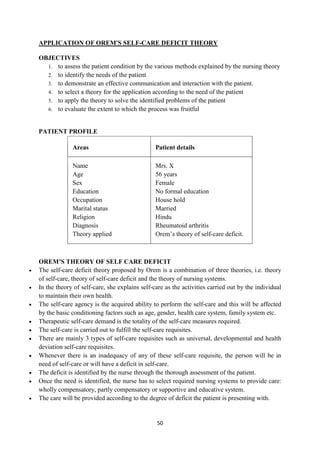
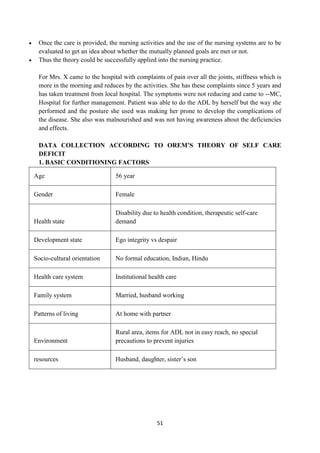
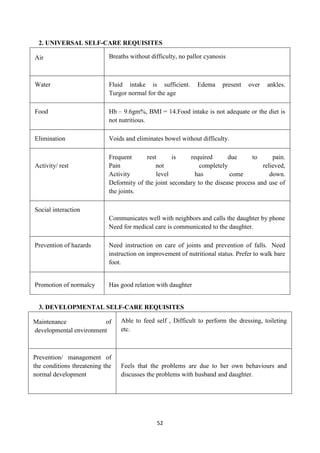
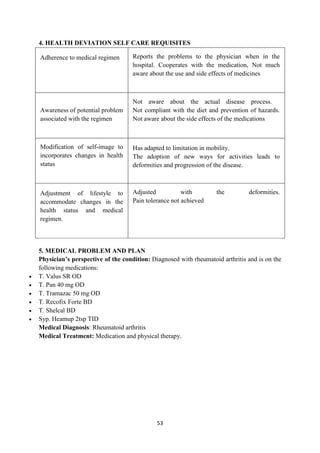
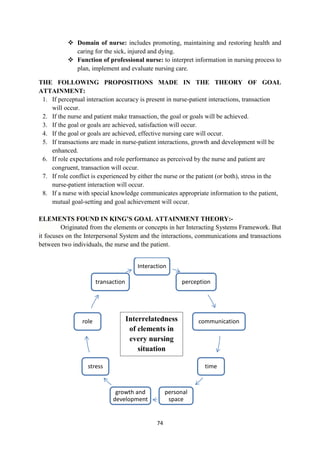
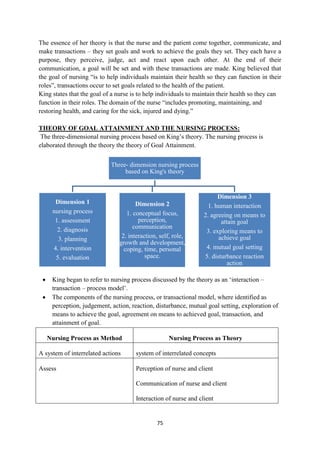
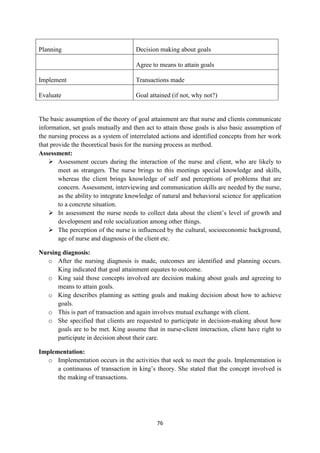
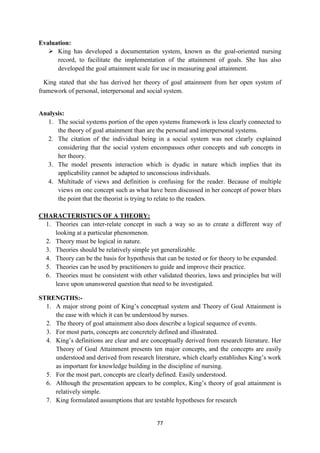
1
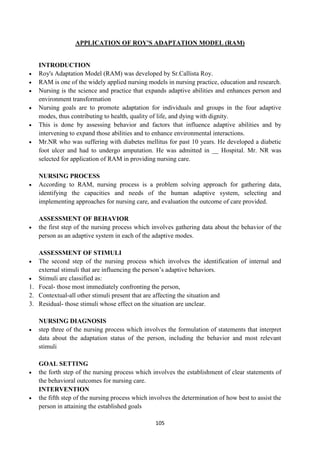
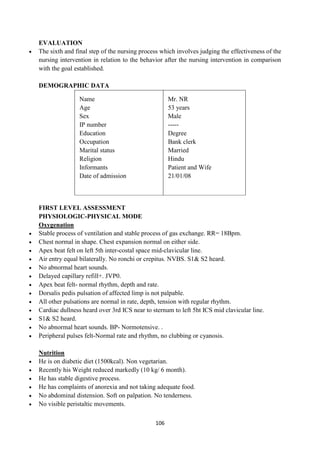
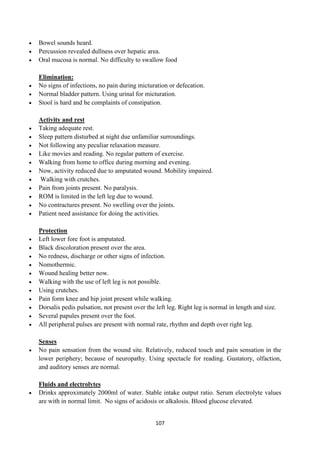
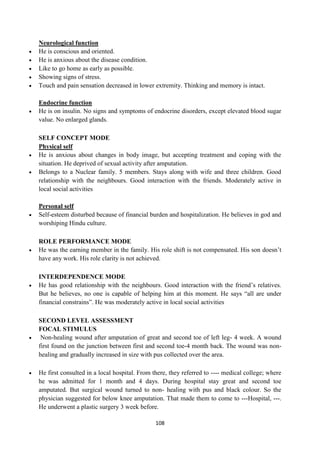
MODULE ON
NURSING THEORY
2
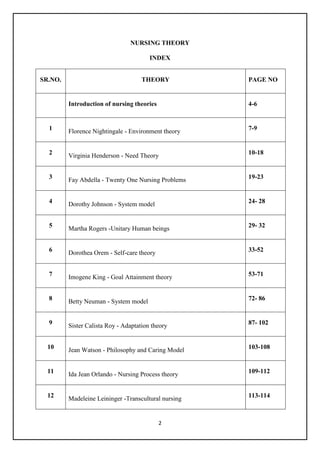
NURSING THEORY
INDEX
SR.NO. THEORY PAGE NO
Introduction of nursing theories 4-6
1 1. Florence Nightingale - Environment theory 7-9
2 2. Virginia Henderson - Need Theory 10-18
3 3. Fay Abdella - Twenty One Nursing Problems 19-23
4 4. Dorothy Johnson - System model 24- 28
5 5. Martha Rogers -Unitary Human beings 29- 32
6 6. Dorothea Orem - Self-care theory 33-52
7 7. Imogene King - Goal Attainment theory 53-71
8 8. Betty Neuman - System model 72- 86
9 Sister Calista Roy - Adaptation theory 87- 102
10 Jean Watson - Philosophy and Caring Model 103-108
11 Ida Jean Orlando - Nursing Process theory 109-112
12 Madeleine Leininger -Transcultural nursing 113-114
3
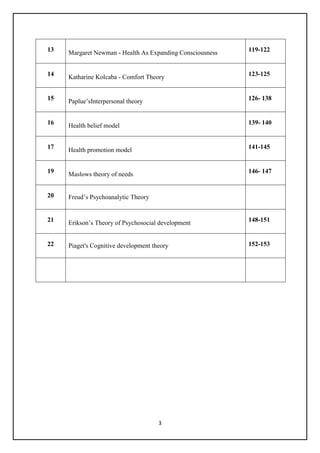
13 Margaret Newman - Health As Expanding Consciousness 119-122
14 Katharine Kolcaba - Comfort Theory 123-125
15 Paplue‘sInterpersonal theory 126- 138
16 Health belief model 139- 140
17 Health promotion model 141-145
19 Maslows theory of needs 146- 147
20 Freud‘s Psychoanalytic Theory
21 Erikson‘s Theory of Psychosocial development 148-151
22 Piaget's Cognitive development theory 152-153
4
NURSING THEORY
DEFINITION
Nursing theory is an organized and systematic articulation of a set of statements related to
questions in the discipline of nursing.
"A nursing theory is a set of concepts, definitions, relationships, and assumptions or
propositions derived from nursing models or from other disciplines and project a purposive,
systematic view of phenomena by designing specific inter-relationships among concepts for
the purposes of describing, explaining, predicting, and /or prescribing."
IMPORTANCE OF NURSING THEORIES
1. Nursing theory aims to describe, predict and explain the phenomenon of nursing
2. It should provide the foundations of nursing practice, help to generate further
knowledge and indicate in which direction nursing should develop in the future.
Theory is important because it helps us to decide what we know and what we need to
know
3. It helps to distinguish what should form the basis of practice by explicitly describing
nursing. The benefits of having a defined body of theory in nursing include better
patient care, enhanced professional status for nurses, improved communication
between nurses, and guidance for research and education
4. The main exponent of nursing – caring – cannot be measured, it is vital to have the
theory to analyze and explain what nurses do.
5. As medicine tries to make a move towards adopting a more multidisciplinary
approach to health care, nursing continues to strive to establish a unique body of
knowledge.
6. This can be seen as an attempt by the nursing profession to maintain its professional
boundaries.
EVOLUTION OF NURSING THEORIES & APPLICATION
 The history of professional nursing begins with Florence nightingale.
 Later in last century nursing began with a strong emphasis on practice.
 Following that came the curriculum era which addressed the questions about what the
nursing students should study in order to achieve the required standard of nursing.
 As more and more nurses began to pursue higher degrees in nursing, there emerged
the research era.
 Later graduate education and masters education was given much importance.
 The development of the theory era was a natural outgrowth of the research era.
 With an increased number of researches it became obvious that the research without
theory produced isolated information; however research and theory produced the
nursing sciences.
 Within the contemporary phase there is an emphasis on theory use and theory based
nursing practice and lead to the continued development of the theories.
NURSING THEORY
5
CHARACTERISTICS OF THEORIES
1. Interrelating concepts in such a way as to create a different way of looking at
a particular phenomenon.
2. Logical in nature.
3. Generalizable.
4. Bases for hypotheses that can be tested.
5. Increasing the general body of knowledge within the discipline through the research
implemented to validate them.
6. Used by the practitioners to guide and improve their practice.
7. Consistent with other validated theories, laws, and principles but will leave open
unanswered questions that need to be investigated.
PURPOSES OF THEORY
IN PRACTICE
1. Assist nurses to describe, explain, and predict everyday experiences.
2. Serve to guide assessment, intervention, and evaluation of nursing care.
3. Provide a rationale for collecting reliable and valid data about the health status of
clients, which are essential for effective decision making and implementation.
4. Help to establish criteria to measure the quality of nursing care
5. Help build a common nursing terminology to use in communicating with other health
professionals. Ideas are developed and words defined.
6. Enhance autonomy (independence and self-governance) of nursing by defining its
own independent functions.
IN RESEARCH
1. Offer a framework for generating knowledge and new ideas.
2. Assist in discovering knowledge gaps in the specific field of study.
3. Offer a systematic approach to identify questions for study; select variables,
interpret findings, and validate nursing interventions.
4. Approaches to developing nursing theory
5. Borrowing conceptual frameworks from other disciplines.
6. Inductively looking at nursing practice to discover theories/concepts to
explain phenomena.
7. Deductively looking for the compatibility of a general nursing theory with
nursing practice.
8. Questions from practicing Nurse about using Nursing theory
CONCLUSION
If theory is expected to benefit practice, it must be developed co-operatively with
people who practice nursing. People who do research and develop theories think
differently about theory when they perceive the reality of practice. Theories do not
provide the same type of procedural guidelines for practice as do situation- specific
principles and procedures or rules. Procedural rules or principles help to standardize
nursing practice and can also be useful in achieving minimum goals of quality of care.
6
Theory is ought to improve the nursing practice. One of the most common ways
theory has been organized in practice is in the nursing process of analyzing
assessment data.
7
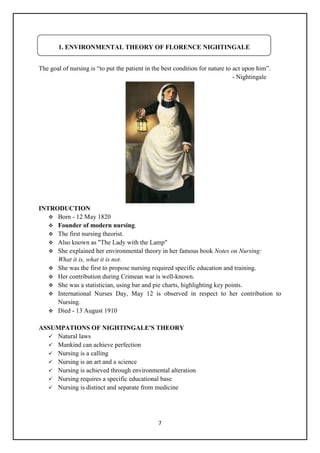
The goal of nursing is ―to put the patient in the best condition for nature to act upon him‖.
- Nightingale
INTRODUCTION
 Born - 12 May 1820
 Founder of modern nursing.
 The first nursing theorist.
 Also known as "The Lady with the Lamp"
 She explained her environmental theory in her famous book Notes on Nursing:
What it is, what it is not.
 She was the first to propose nursing required specific education and training.
 Her contribution during Crimean war is well-known.
 She was a statistician, using bar and pie charts, highlighting key points.
 International Nurses Day, May 12 is observed in respect to her contribution to
Nursing.
 Died - 13 August 1910
ASSUMPATIONS OF NIGHTINGALE'S THEORY
 Natural laws
 Mankind can achieve perfection
 Nursing is a calling
 Nursing is an art and a science
 Nursing is achieved through environmental alteration
 Nursing requires a specific educational base
 Nursing is distinct and separate from medicine
1. ENVIRONMENTAL THEORY OF FLORENCE NIGHTINGALE
8
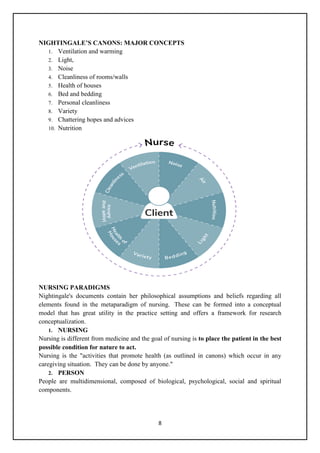
NIGHTINGALE’S CANONS: MAJOR CONCEPTS
1. Ventilation and warming
2. Light,
3. Noise
4. Cleanliness of rooms/walls
5. Health of houses
6. Bed and bedding
7. Personal cleanliness
8. Variety
9. Chattering hopes and advices
10. Nutrition
NURSING PARADIGMS
Nightingale's documents contain her philosophical assumptions and beliefs regarding all
elements found in the metaparadigm of nursing. These can be formed into a conceptual
model that has great utility in the practice setting and offers a framework for research
conceptualization.
1. NURSING
Nursing is different from medicine and the goal of nursing is to place the patient in the best
possible condition for nature to act.
Nursing is the "activities that promote health (as outlined in canons) which occur in any
caregiving situation. They can be done by anyone."
2. PERSON
People are multidimensional, composed of biological, psychological, social and spiritual
components.
9
3. HEALTH
Health is ―not only to be well, but to be able to use well every power we have‖. Disease is
considered as the absence of comfort.
4. ENVIRONMENT
"Poor or difficult environments led to poor health and disease".
"Environment could be altered to improve conditions so that the natural laws would allow
healing to occur."
CRITICISMS
1. She emphasized subservience to doctors.
2. She focused more on physical factors than on psychological needs of patient.
CONCLUSION
Florence Nightingale provided a professional model for nursing organization. She was the
first to use a theoretical foundation to nursing. Her thoughts have influenced nursing
significantly.
APPLICATION OF NIGHTINGALE'S THEORY IN PRACTICE:
"Patients are to be put in the best condition for nature to act on them; it is the responsibility of
nurses to reduce noise, to relieve patients‘ anxieties, and to help them sleep. ―As per most of
the nursing theories, environmental adaptation remains the basis of holistic nursing care.
Scenario:
I was on evening duty in surgical unit a patient was brought to surgical unit through
causality. Patient was Mrs. X with post op colostomy. Patient was operated for intestinal
obstruction due to unknown etiology. She is companied by her mother in law and three
children. Mrs X was a widow. Her husband was killed in the war turn Northern Province
of Afghanistan three years back. Patient was extremely pale with septic wound; colostomy
bag was not covered properly rather it was covered by plastic bag. Entire skin of abdomen
was red and lacerated on examination she was febrile with 103f temperature Blood
Pressure was 100/70 and pulse was 96/min weight was 38 kg. Lab findings were
hemoglobin 8.5 with moderately leukocytosis. During history taking patient attendant told
that they live in a small house patient room was also shared by 5 children mother in law
and two Cattles. Patient is economically poor, living on less than 1 dollar per day. On
previous medical history there was intestinal infestation they were used to drink water
from nearby well. According to patient attendant
Application of Nightingale’s Theory to Nursing Care of Mrs. X
Person Mrs. X is in need of nursing care through nature reparative process. Nurse‘s goal is
to promote nature in the process with application of nightingale theory with nursing
process model.
10
Assessment:
A. Physical Environment
Nightingale theory suggests assessment of environment through 13 canons:
According to verbal statement of Mrs. X, and her attendant the house where they live is
injurious to Mrs. X health as their room is overcrowded and shared by domestic castles.
They used well water and use nearby field for toileting purpose which is the worse form of
sanitation and most common Couse of contamination of water which leads to gastro
enteric pathology
Currently Mrs. X is lying on bed in surgical unit with a colostomy bag not appropriately
attached rather over tied by a plastic shopping bag. The leakage of feces contents badly
infected the stoma and lacerate the abdominal skin.
Nursing Diagnosis
1. Infection related to the contamination of the wound with feces
2. Impaired Skin Integrity related to skin contamination with feces
Interventions
It is planed that Mrs. x and her attendant well be fully educate regarding importance and
methods of cleaning drinking water. Proper disposal for house excreta and source of social
aid will be searched for financial support to Mrs. X in this connection.
Mrs. X Was provided a side room in the unit. Her stoma was cleaned with antiseptics and
colostomy bag was appropriately applied. The surrounding skin was washed with saline
and soothing anti-infective ointment was applied. A pad (gauze) putted to absorb the flow
of feces Demonstration regarding stoma care and change of bag provided to patient. Room
windows were kept open for ventilation. Prescribed medication were given.
B. Psychological Environment
Mrs. X was very much anxious regarding her health and kids as she is a widow and have
financial Burdon as well as she is feeling little bit concern due to non-national and
therefore have limited approaches to local resources currently. She has problem to adopt to
new life style with stoma and have difficulty in falling asleep due to fear of opening bag
during sleep time.
Nursing Diagnoses
1. Anxiety related to fear of isolation from native country and culture
2. Disturbed Sleep Pattern related to the fear of the state of the stoma
11
Nursing Intervention
Mrs. X was reassured that she will soon adapt to society. Her special deserving case in
financial terms was forwarded to hospital administration for free treatment and a non-
government organization was contacted to help her in easing financial burden.
Environmental factors were evaluated to avoid disturbance in her sleep. Her visitors were
informed regarding importance of rest and sleep in her recovery they were counseled to
minimize rush in sleeping hours and avoid unnecessary interruption in the room
environment of Mrs. X.
Mrs. X was explained that her stoma bag will not open during sleep as it is closed
mechanically.
C. Nutritional Status
Mrs. X was underweight she lost weight significantly in the last three weeks. Due to fear
of colostomy problem she was afraid of eating as according to her attendant she avoids
eating as after eating she develops empting problem.
Nursing Diagnosis
1. Imbalanced Nutrition Less Than Body Requirements related to ignorance against the
needs of food.
Interventions
Nutritionist was consulted regarding food menu appropriate for Mrs. X condition
Adequate nutrition was provided: containing foods rich in nutritious values and less in
gastro enteric troubles.
Client was motivated for eating and reassured not spare food due to fear of causing
trouble.
Beside systematic care given through nursing process under the influence of nightingale
theoretical stance her remaining canon are related to observation of patient condition and
petty management which focus on continuity of care. In case of Mrs. X observe her
condition critically and after keen observation of case her attendant was demonstrated and
trained regarding colostomy dressing, cleanness of stoma with antiseptic moisturizing
medication, patient diet need and variety along with observation of skin color near stoma
was explained in detail.
12
―Nursing theories mirror different realities, throughout their development; they reflected the
interests of nurses of that time.‖
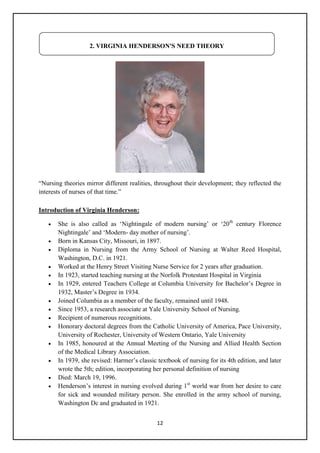
Introduction of Virginia Henderson:
 She is also called as ‗Nightingale of modern nursing‘ or ‗20th
century Florence
Nightingale‘ and ‗Modern- day mother of nursing‘.
 Born in Kansas City, Missouri, in 1897.
 Diploma in Nursing from the Army School of Nursing at Walter Reed Hospital,
Washington, D.C. in 1921.
 Worked at the Henry Street Visiting Nurse Service for 2 years after graduation.
 In 1923, started teaching nursing at the Norfolk Protestant Hospital in Virginia
 In 1929, entered Teachers College at Columbia University for Bachelor‘s Degree in
1932, Master‘s Degree in 1934.
 Joined Columbia as a member of the faculty, remained until 1948.
 Since 1953, a research associate at Yale University School of Nursing.
 Recipient of numerous recognitions.
 Honorary doctoral degrees from the Catholic University of America, Pace University,
University of Rochester, University of Western Ontario, Yale University
 In 1985, honoured at the Annual Meeting of the Nursing and Allied Health Section
of the Medical Library Association.
 In 1939, she revised: Harmer‘s classic textbook of nursing for its 4th edition, and later
wrote the 5th; edition, incorporating her personal definition of nursing
 Died: March 19, 1996.
 Henderson‘s interest in nursing evolved during 1st
world war from her desire to care
for sick and wounded military person. She enrolled in the army school of nursing,
Washington Dc and graduated in 1921.
2. VIRGINIA HENDERSON'S NEED THEORY
13
Achievements of Virginia Henderson:
She has relieved honorary doctoral degrees from the:
 Boston College.
 Catholic university of America
 Emory university
 Pace university
 Rush university
 Yale university
 Thomas Jefferson university
THEORY BACKGROUND
 Henderson was educated during the empiricist era in medicine and nursing, which
focused on patient needs. The theory presents a patient as a sum of parts with
biopsychosocial need and the patient is neither client nor consumer.
 Henderson‘s concept of nursing was derived from her practice and education
therefore her work is inductive.
 She called her definition of nursing her concept and emphasized the importance of
increasing the patient‘s independence so that progress after hospitalization would not
be delayed.
 She categorized nursing activities into 14 components, based on human needs.
 She described the nurse's role as substitutive (doing for the person), supplementary
(helping the person), complementary (working with the person), with the goal of
helping the person become as independent as possible.
 Her definition of nursing was: Assisting individuals to gain independence in relation
to the performance of activities contributing to health or its recovery.
"The unique function of the nurse is to assist the individual, sick or well, in the
performance of those activities contributing to health or its recovery (or to peaceful
death) that he would perform unaided if he had the necessary strength, will or
knowledge. And to do this in such a way as to help him gain independence as rapidly as
possible" (Henderson, 1966).
Classic definition: ―I say that the nurse does for others what they would do for themselves if
they had the strength, the will, and the knowledge. But I go to say that the nurse makes the
patient independent of him or her as soon as possible.‖
– Virginia Henderson
Assumptions:
The major assumptions of theory are that:
 Nurse‘s care for patients until patient can care for themselves once again.
 Patient desire to return to health, but this assumption is not explicitly stated.
 Nurses are willing to serve and that nurses will devote themselves to the patient day
and night.
 Final assumptions that nurses should be educated at the university level in both arts
and sciences.
14
14 components of Virginia Henderson’s theory:
1. Breathe normally.
2. Eat and drink adequately.
3. Eliminate body waste.
4. Move and maintain desirable posture.
5. Sleep and rest.
6. Select suitable clothes: dress and undress.
7. Maintain body temperature within normal range adjusting to modifying
environment.
8. Keep body well and well groomed.
9. Avoid dangers in environment and avoid injuring others.
10. Communicate with others in expressing emotions, needs, fears or opinions.
11. Worship according to one‘s faith.
12. Work in such a way that there is a sense of accomplishment.
13. Play or participate in various forms of recreation.
14. Learn, discover or satisfy the curiosity that leads to a normal development
and health and use the available facility.
Major concepts of theory:
Major
concepts
of theory
Human
Nursing
Environ
ment
Health
15
1. Human:
Human having basic needs that are included in the fourteen components. She said ―it is
equally important to realize that these needs are satisfied by infinitely varied patterns of
living, no two which are alike‖.
Considers biological, psychological, sociological and spiritual components. She also believes
that mind and body are inseparable, they are interrelated.
2. Nursing:
Nurse serves to make patient complete, whole and independent. The nurse is expected to
carry-out physician‘s therapeutic plan. Individualized care is the result of nurse‘s creativity in
planning for care.
Temporarily assisting the individual who lacks the necessary strength, will and knowledge to
satisfy 1 or more 14 basic components. Nurse serves the patient to make ‗complete‘ ‗whole‘
or ‗independent‘
3. Environment (society):
Setting in which an individual learns unique pattern of living. For external conditions and
influences that affect life and development. Individual in relation to families. Supports tasks
of private and public.
Society expects nurses to act for individuals who are unable to function independently in
return she expects society to contribute to nursing education.
4. Health:
Definition based on individual‘s ability to function independently.
Nurses needs to stress promotion of health and prevention and cure of disease.
Good health is a challenge. Health affected by age, cultural background, physical, intellectual
capacity and emotional balance.
HENDERSON’S AND NURSING PROCESS
‖Summarization of the stages of the nursing process as applied to Henderson‘s definition of
nursing and to the 14 components of basic nursing care.
Nursing Process Henderson’s 14 components and definition of nursing
Nursing Assessment Henderson‘s 14 components
Nursing Diagnosis Analysis: Compare data to knowledge base of health and disease.
Nursing plan Identify individual‘s ability to meet own needs with or without
assistance, taking into consideration strength, will or knowledge.
Nursing
implementation
Document how the nurse can assist the individual, sick or well.
16
Assist the sick or well individual in to performance of activities in
meeting human needs to maintain health, recover from illness, or to
aid in peaceful death.
Nursing process Implementation based on the physiological principles, age, cultural
background, emotional balance, and physical and intellectual
capacities. Carry out treatment prescribed by the physician.
Nursing evaluation
Henderson‘s 14 components and definition of nursing
Use the acceptable definition of; nursing and appropriate laws
related to the practice of nursing.
The quality of care is drastically affected by the preparation and
native ability of the nursing personnel rather that the amount of
hours of care.
Successful outcomes of nursing care are based on the speed with
which or degree to which the patient performs independently the
activities of daily living
COMPARISON WITH MASLOW'S HIERARCHY OF NEED
Maslow's Henderson
Physiological
needs
Breathe normally
Eat and drink adequately Eliminate by all avenues of elimination Move
and maintain desirable posture Sleep and rest Select suitable clothing
Maintain body temperature Keep body clean and well-groomed and
protect the integument
Safety Needs Avoid environmental dangers and avoid injuring other
Belongingness
and love needs
Communicate with others
worship according to one's faith
Esteem needs Work at something providing a sense of accomplishment
Play or participate in various forms of recreation
Learn, discover, or satisfy curiosity
17
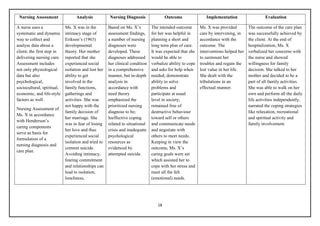
Example – Case Scenario:
Ms. X, a 25 year‘s old female client was admitted in the surgical unit, with attempted suicide.
Two weeks ago, she ingested toilet cleaner because of a family dispute. Ms. X lived a rural
life and had studied till 8th standard. Upon history taking, her mother informed that her
marriage was planned two days before the incidence. She was reluctant to share the reason
for her suicide but stated that she was stressed out and tried to kill herself. Later on, her
mother reported that she was impulsive and emotional person.
Her physical assessment revealed alert, oriented but depressed female.
Her chief complaints were difficulty in breathing and mood swings.
Her CT scan and endoscopy showed damaged larynx, mouth and stomach ulcers respectively.
The dietician advised liquid diet but Ms. X showed dislike and resisted eating due to her
limited intake of food.
Foley‘s catheter was passed for accurate record of her daily intake and output.
She was noncompliance towards her intake and developed dehydration, irritability and
insomnia as evidenced by dry mouth, sunken eyes with dark circles around.
18
Nursing Assessment Analysis Nursing Diagnosis Outcome Implementation Evaluation
A nurse uses a
systematic and dynamic
way to collect and
analyse data about a
client; the first step in
delivering nursing care.
Assessment includes
not only physiological
data but also
psychological,
sociocultural, spiritual,
economic, and life-style
factors as well.
Nursing Assessment of
Ms. X in accordance
with Henderson‘s
caring components
serve as basis for
formulation of a
nursing diagnosis and
care plan.
Ms. X was in the
intimacy stage of
Erikson‘s (1963)
developmental
theory. Her mother
reported that she
experienced social
isolation and lost her
ability to get
involved in the
family functions,
gatherings and
activities .She was
not happy with the
family decision of
her marriage. She
was in fear of losing
her love and thus
experienced social
isolation and tried to
commit suicide.
Avoiding intimacy,
fearing commitment
and relationships can
lead to isolation,
loneliness,
Based on Ms. X‘s
assessment findings,
a number of nursing
diagnoses were
developed. These
diagnoses addressed
her clinical condition
in a comprehensive
manner, but in-depth
analysis in
accordance with
need theory
emphasized the
prioritized nursing
diagnose to be;
Ineffective coping
related to situational
crisis and inadequate
psychological
resources as
evidenced by
attempted suicide.
The intended outcome
for her was helpful in
planning a short and
long term plan of care.
It was expected that she
would be able to
verbalize ability to cope
and asks for help when
needed, demonstrate
ability to solve
problems and
participate at usual
level in society;
remained free of
destructive behaviour
toward self or others
and communicate needs
and negotiate with
others to meet needs.
Keeping in view the
outcome, Ms. X‘s
caring goals were set
which assisted her to
cope with her stress and
meet all the felt
(emotional) needs.
Ms. X was provided
care by intervening, in
accordance with the
outcome. The
interventions helped her
to surmount her
troubles and regain the
lost value in her life.
She dealt with the
tribulations in an
effectual manner.
The outcome of the care plan
was successfully achieved by
the client. At the end of
hospitalization, Ms. X
verbalized her concerns with
the nurse and showed
willingness for family
decision. She talked to her
mother and decided to be a
part of all family activities.
She was able to walk on her
own and perform all the daily
life activities independently,
narrated the coping strategies
like relaxation, recreational
and spiritual activity and
family involvement.
19
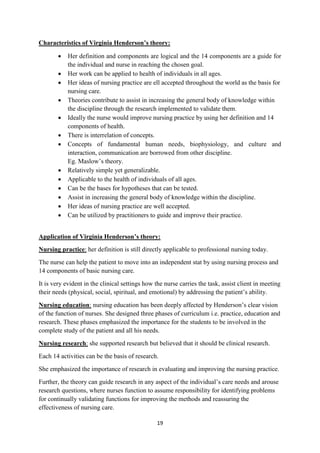
Characteristics of Virginia Henderson’s theory:
 Her definition and components are logical and the 14 components are a guide for
the individual and nurse in reaching the chosen goal.
 Her work can be applied to health of individuals in all ages.
 Her ideas of nursing practice are ell accepted throughout the world as the basis for
nursing care.
 Theories contribute to assist in increasing the general body of knowledge within
the discipline through the research implemented to validate them.
 Ideally the nurse would improve nursing practice by using her definition and 14
components of health.
 There is interrelation of concepts.
 Concepts of fundamental human needs, biophysiology, and culture and
interaction, communication are borrowed from other discipline.
Eg. Maslow‘s theory.
 Relatively simple yet generalizable.
 Applicable to the health of individuals of all ages.
 Can be the bases for hypotheses that can be tested.
 Assist in increasing the general body of knowledge within the discipline.
 Her ideas of nursing practice are well accepted.
 Can be utilized by practitioners to guide and improve their practice.
Application of Virginia Henderson’s theory:
Nursing practice: her definition is still directly applicable to professional nursing today.
The nurse can help the patient to move into an independent stat by using nursing process and
14 components of basic nursing care.
It is very evident in the clinical settings how the nurse carries the task, assist client in meeting
their needs (physical, social, spiritual, and emotional) by addressing the patient‘s ability.
Nursing education: nursing education has been deeply affected by Henderson‘s clear vision
of the function of nurses. She designed three phases of curriculum i.e. practice, education and
research. These phases emphasized the importance for the students to be involved in the
complete study of the patient and all his needs.
Nursing research: she supported research but believed that it should be clinical research.
Each 14 activities can be the basis of research.
She emphasized the importance of research in evaluating and improving the nursing practice.
Further, the theory can guide research in any aspect of the individual‘s care needs and arouse
research questions, where nurses function to assume responsibility for identifying problems
for continually validating functions for improving the methods and reassuring the
effectiveness of nursing care.
20
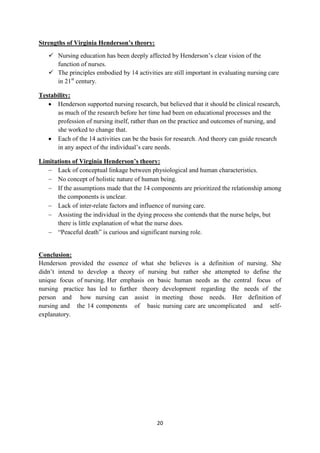
Strengths of Virginia Henderson’s theory:
 Nursing education has been deeply affected by Henderson‘s clear vision of the
function of nurses.
 The principles embodied by 14 activities are still important in evaluating nursing care
in 21st
century.
Testability:
 Henderson supported nursing research, but believed that it should be clinical research,
as much of the research before her time had been on educational processes and the
profession of nursing itself, rather than on the practice and outcomes of nursing, and
she worked to change that.
 Each of the 14 activities can be the basis for research. And theory can guide research
in any aspect of the individual‘s care needs.
Limitations of Virginia Henderson’s theory:
 Lack of conceptual linkage between physiological and human characteristics.
 No concept of holistic nature of human being.
 If the assumptions made that the 14 components are prioritized the relationship among
the components is unclear.
 Lack of inter-relate factors and influence of nursing care.
 Assisting the individual in the dying process she contends that the nurse helps, but
there is little explanation of what the nurse does.
 ―Peaceful death‖ is curious and significant nursing role.
Conclusion:
Henderson provided the essence of what she believes is a definition of nursing. She
didn‘t intend to develop a theory of nursing but rather she attempted to define the
unique focus of nursing. Her emphasis on basic human needs as the central focus of
nursing practice has led to further theory development regarding the needs of the
person and how nursing can assist in meeting those needs. Her definition of
nursing and the 14 components of basic nursing care are uncomplicated and self-
explanatory.
21
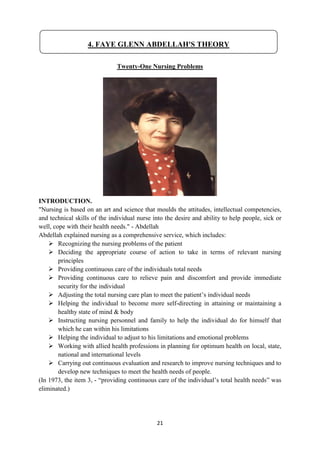
Twenty-One Nursing Problems
INTRODUCTION.
"Nursing is based on an art and science that moulds the attitudes, intellectual competencies,
and technical skills of the individual nurse into the desire and ability to help people, sick or
well, cope with their health needs." - Abdellah
Abdellah explained nursing as a comprehensive service, which includes:
 Recognizing the nursing problems of the patient
 Deciding the appropriate course of action to take in terms of relevant nursing
principles
 Providing continuous care of the individuals total needs
 Providing continuous care to relieve pain and discomfort and provide immediate
security for the individual
 Adjusting the total nursing care plan to meet the patient‘s individual needs
 Helping the individual to become more self-directing in attaining or maintaining a
healthy state of mind & body
 Instructing nursing personnel and family to help the individual do for himself that
which he can within his limitations
 Helping the individual to adjust to his limitations and emotional problems
 Working with allied health professions in planning for optimum health on local, state,
national and international levels
 Carrying out continuous evaluation and research to improve nursing techniques and to
develop new techniques to meet the health needs of people.
(In 1973, the item 3, - ―providing continuous care of the individual‘s total health needs‖ was
eliminated.)
4. FAYE GLENN ABDELLAH'S THEORY
22
ABOUT THE THEORIST AND THEORETICAL SOURCES
 Birth:1919
 Abdellah‘s patient - centred approach to nursing was developed inductively from her
practice and is considered a human needs theory.
 The theory was created to assist with nursing education and is most applicable to the
education of nurses.
 Although it was intended to guide care of those in the hospital, it also has relevance for
nursing care in community settings.
MAJOR ASSUMPTIONS, CONCEPTS & RELATIONSHIPS
 She uses the term ‗she‘ for nurses, ‗he‘ for doctors and patients, and refers to the
object of nursing as ‗patient‘ rather than client or consumer.
 She referred to nursing diagnosis during a time when nurses were taught that
diagnosis was not a nurses‘ prerogative.
 change and anticipated changes that affect nursing;
 the need to appreciate the interconnectedness of social enterprises and social
problems;
 the impact of problems such as poverty, racism, pollution, education, and so forth on
health care delivery;
 changing nursing education
 continuing education for professional nurses
 development of nursing leaders from under reserved groups
Abdellah and colleagues developed a list of 21 nursing problems. They also identified 10
steps to identify the client‘s problems. 11 nursing skills to be used in developing a treatment
typology
10 STEPS TO IDENTIFY CLIENTS' PROBLEMS
1. Learn to know the patient
2. Sort out relevant and significant data
3. Make generalizations about available data in relation to similar nursing problems
presented by other patients
4. Identify the therapeutic plan
5. Test generalizations with the patient and make additional generalizations
6. Validate the patient‘s conclusions about his nursing problems
7. Continue to observe and evaluate the patient over a period of time to identify any
attitudes and clues affecting his behaviour
8. Explore the patient‘s and family‘s reaction to the therapeutic plan and involve them in
the plan
9. Identify how the nurses feels about the patient‘s nursing problems
10. Discuss and develop a comprehensive nursing care plan
23
11 NURSING SKILLS
1. Observation of health status
2. Skills of communication
3. Application of knowledge
4. Teaching of patients and families
5. Planning and organization of work
6. Use of resource materials
7. Use of personnel resources
8. Problem-solving
9. Direction of work of others
10. Therapeutic use of the self
11. Nursing procedure
21 NURSING PROBLEMS
Three major categories
a) Physical, sociological, and emotional needs of clients
b) Types of interpersonal relationships between the nurse and patient
c) Common elements of client care
BASIC TO ALL PATIENTS
1) To maintain good hygiene and physical comfort
2) To promote optimal activity: exercise, rest and sleep
3) To promote safety through the prevention of accidents, injury, or other trauma and
through the prevention of the spread of infection
4) To maintain good body mechanics and prevent and correct deformity
SUSTENAL CARE NEEDS
1) To facilitate the maintenance of a supply of oxygen to all body cells
2) To facilitate the maintenance of nutrition of all body cells
3) To facilitate the maintenance of elimination
4) To facilitate the maintenance of fluid and electrolyte balance
5) To recognize the physiological responses of the body to disease conditions
6) To facilitate the maintenance of regulatory mechanisms and functions
7) To facilitate the maintenance of sensory function.
REMEDIAL CARE NEEDS
1) To identify and accept positive and negative expressions, feelings, and reactions
2) To identify and accept the interrelatedness of emotions and organic illness
3) To facilitate the maintenance of effective verbal and non-verbal communication
4) To promote the development of productive interpersonal relationships
5) To facilitate progress toward achievement of personal spiritual goals
6) To create and / or maintain a therapeutic environment
7) To facilitate awareness of self as an individual with varying physical , emotional, and
developmental needs
24
RESTORATIVE CARE NEEDS
1) To accept the optimum possible goals in the light of limitations, physical and
emotional
2) To use community resources as an aid in resolving problems arising from illness
3) To understand the role of social problems as influencing factors in the case of illness
ABDELLAH’S THEORY AND THE FOUR MAJOR CONCEPTS
1) NURSING
 Nursing is a helping profession.
 Nursing care is doing something to or for the person or providing information to the
person with the goals of meeting needs, increasing or restoring self-help ability, or
alleviating impairment.
 Nursing is broadly grouped into the 21 problem areas to guide care and promote use
of nursing judgment.
 Nursing to be comprehensive service.
2) PERSON
 Abdellah describes people as having physical, emotional, and sociological needs.
 Patient is described as the only justification for the existence of nursing.
 Individuals (and families) are the recipients of nursing
 Health, or achieving of it, is the purpose of nursing services.
3) HEALTH
 In Patient–Centred Approaches to Nursing, Abdellah describes health as a state
mutually exclusive of illness.
 Although Abdellah does not give a definition of health, she speaks to ―total health
needs‖ and ―a healthy state of mind and body‖ in her description of nursing as a
comprehensive service.
4) SOCIETY AND ENVIRONMENT
 Society is included in ―planning for optimum health on local, state, national, and
international levels‖. However, as she further delineated her ideas, the focus of
nursing service is clearly the individual.
 The environment is the home or community from which patient comes.
FOCUS OF CARE PENDULUM.
25
Faye Abdellah‘s work is a set of problems formulated in terms of nursing-centered services
used to determine the patient‘s needs. The nursing-centered orientation to client care appears
to be contradicting the client-centered approach that Abdellah professes to support. This can
be observed by her desire to move away from a disease-centered orientation.
In her attempt to bring the nursing practice to its proper relationship with restorative and
preventive measures for meeting total client needs, she seems to swing the pendulum to the
opposite pole, from the disease orientation to nursing orientation, while leaving the client
somewhere in the middle.
Characteristics of the theory
1. Abdellah‘s theory has inter-related the concepts of health, nursing problems, and
problem solving.
2. Problem solving is an activity that is inherently logical in nature.
3. Framework focus on nursing practice and individuals.
4. The results of testing such hypothesis would contribute to the general body of nursing
knowledge
5. Easy to apply in practice.
Strengths
 The problem-solving approach is readily generalizable to the client with specific
health needs and specific nursing problems.
 With the model‘s nature, healthcare providers and practitioners can use Abdellah‘s
problem-solving approach to guide various activities within the clinical setting. This
is true when considering a nursing practice that deals with clients with specific needs
and specific nursing problems.
 The language of Faye Abdellah‘s framework is simple and easy to comprehend.
 The theoretical statement greatly focuses on problem-solving, an activity that is
inherently logical in nature.
Weaknesses
 The major limitation to Abdellah‘s theory and the 21 nursing problems is their robust
nurse-centered orientation. She rather conceptualized nurses‘ actions in nursing care
which is contrary to her aim.
 Another point is the lack of emphasis on what the client is to achieve was given in
client care.
 The framework seems to focus quite heavily on nursing practice and individuals. This
somewhat limits the generalizing ability, although the problem-solving approach is
readily generalizable to clients with specific health needs and specific nursing.
 Also, Abdellah‘s framework is inconsistent with the concept of holism. The nature of
the 21 nursing problems attests to this. As a result, the client may be diagnosed with
numerous problems leading to fractionalized care efforts. Potential problems might be
overlooked because the client is not deemed to be in a particular illness stage.
26
USE OF 21 PROBLEMS IN THE NURSING PROCESS
ASSESSMENT PHASE
 Nursing problems provide guidelines for the collection of data.
 A principle underlying the problem solving approach is that for each identified
problem, pertinent data are collected.
 The overt or covert nature of the problems necessitates a direct or indirect approach,
respectively.
NURSING DIAGNOSIS
 The results of data collection would determine the client‘s specific overt or covert
problems.
 These specific problems would be grouped under one or more of the broader nursing
problems.
 This step is consistent with that involved in nursing diagnosis
PLANNING PHASE
 The statements of nursing problems most closely resemble goal statements. Once the
problem has been diagnosed, the nursing goals have been established.
IMPLEMENTATION
 Using the goals as the framework, a plan is developed and appropriate nursing
interventions are determined.
EVALUATION
 The most appropriate evaluation would be the nurse progress or lack of progress
toward the achievement of the stated goals.
CONCLUSION
Abdellah‘s typology of 21 nursing problems is a conceptual model mainly concerned with
patient‘s needs and nurses‘ role in problem identification using a problem analysis approach.
According to the model, patients are described as having physical, emotional, and
sociological needs. People are also the only justification for the existence of nursing. Without
people, nursing would not be a profession since they are the recipients of nursing. From this
framework, 21 nursing problems were developed. Abdellah‘s theory provides a basis for
determining and organizing nursing care. The problems also provide a basis for organizing
appropriate nursing strategies. As a whole, the theory is intended to guide care not just in the
hospital setting but can also be applied to community nursing, as well. The model has
interrelated concepts of health and nursing problems and problem-solving, which is
inherently logical in nature.
27
APPLICATION OF ABDELLAH’S THEORY IN A MENTAL HEALTH
INSTITUTION
1. To maintain good hygiene and physical comfort
 Patients are bathed every morning after waking up and in the government hospital,
charity ward, they are altogether taking a bath assisted by the nurses.
 After that, they are provided by hospital gowns to keep them clean.
2. To promote optimal activity: exercise, rest, and sleep.
 Every morning, they are encouraged to exercise altogether and one patient leads the
rest to perform daily workout like stretching or dance class.
 After taking their night medications, they are allowed to rest and sleep.
 As a nurse, keep a calm and quiet environment for them to have a good sleep.
3. To promote safety through prevention of accident, injury, or other trauma and through the
prevention of the spread of infection.
 As many patients stay together in one single room in a ward, nurse prevent spread of
infection by isolating patients with communicable diseases like scabies.
 Maintain safety precautions because patients with mental illness are likely to have
suicidal, homicidal and escape precautions therefore nurse should be aware of their
happenings all the time.
4. To maintain good body mechanics and prevent and correct deformity.
 With patients with bed sores, good body mechanics is very important so nurse turn the
patient from side to side or change position to prevent immobility and pressure.
5. To facilitate the maintenance of a supply of oxygen to all body cells.
 If a patient verbalizes difficulty of breathing, and upon assessment, he is grasping for
air, after proper referral nurse attach supply of oxygen via nasal cannula or face mask.
6. To facilitate the maintenance of nutrition of all body cells.
 Patients eat altogether in a pantry where they are supplied with the same tray of food.
 For patients who eat very fast, they are prone to choking so nurse have to supervise
their feeding and divide large pieces of food into small pieces.
 With patients who don‘t want to eat, nurse feed them. Nurse don‘t want patients to be
malnourished due to poor food intake.
7. To facilitate the maintenance of elimination.
 Patients who have difficulty in elimination, provide dietary supplements like fiber-
rich foods for those with constipation.
 Most disturbed patients are with restraints so they just urinate on the floor, nurse have
to change their clothes to prevent infection.
28
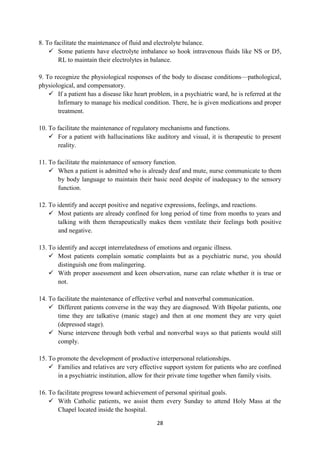
8. To facilitate the maintenance of fluid and electrolyte balance.
 Some patients have electrolyte imbalance so hook intravenous fluids like NS or D5,
RL to maintain their electrolytes in balance.
9. To recognize the physiological responses of the body to disease conditions—pathological,
physiological, and compensatory.
 If a patient has a disease like heart problem, in a psychiatric ward, he is referred at the
Infirmary to manage his medical condition. There, he is given medications and proper
treatment.
10. To facilitate the maintenance of regulatory mechanisms and functions.
 For a patient with hallucinations like auditory and visual, it is therapeutic to present
reality.
11. To facilitate the maintenance of sensory function.
 When a patient is admitted who is already deaf and mute, nurse communicate to them
by body language to maintain their basic need despite of inadequacy to the sensory
function.
12. To identify and accept positive and negative expressions, feelings, and reactions.
 Most patients are already confined for long period of time from months to years and
talking with them therapeutically makes them ventilate their feelings both positive
and negative.
13. To identify and accept interrelatedness of emotions and organic illness.
 Most patients complain somatic complaints but as a psychiatric nurse, you should
distinguish one from malingering.
 With proper assessment and keen observation, nurse can relate whether it is true or
not.
14. To facilitate the maintenance of effective verbal and nonverbal communication.
 Different patients converse in the way they are diagnosed. With Bipolar patients, one
time they are talkative (manic stage) and then at one moment they are very quiet
(depressed stage).
 Nurse intervene through both verbal and nonverbal ways so that patients would still
comply.
15. To promote the development of productive interpersonal relationships.
 Families and relatives are very effective support system for patients who are confined
in a psychiatric institution, allow for their private time together when family visits.
16. To facilitate progress toward achievement of personal spiritual goals.
 With Catholic patients, we assist them every Sunday to attend Holy Mass at the
Chapel located inside the hospital.
29
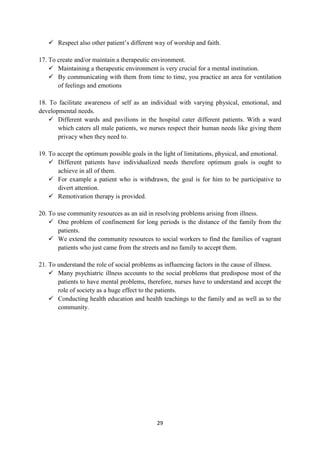
 Respect also other patient‘s different way of worship and faith.
17. To create and/or maintain a therapeutic environment.
 Maintaining a therapeutic environment is very crucial for a mental institution.
 By communicating with them from time to time, you practice an area for ventilation
of feelings and emotions
18. To facilitate awareness of self as an individual with varying physical, emotional, and
developmental needs.
 Different wards and pavilions in the hospital cater different patients. With a ward
which caters all male patients, we nurses respect their human needs like giving them
privacy when they need to.
19. To accept the optimum possible goals in the light of limitations, physical, and emotional.
 Different patients have individualized needs therefore optimum goals is ought to
achieve in all of them.
 For example a patient who is withdrawn, the goal is for him to be participative to
divert attention.
 Remotivation therapy is provided.
20. To use community resources as an aid in resolving problems arising from illness.
 One problem of confinement for long periods is the distance of the family from the
patients.
 We extend the community resources to social workers to find the families of vagrant
patients who just came from the streets and no family to accept them.
21. To understand the role of social problems as influencing factors in the cause of illness.
 Many psychiatric illness accounts to the social problems that predispose most of the
patients to have mental problems, therefore, nurses have to understand and accept the
role of society as a huge effect to the patients.
 Conducting health education and health teachings to the family and as well as to the
community.
30
INTRODUCTION
 September 9, 2013 in Savannah, Georgia.
 B. Sc. N. from Vanderbilt University in Nashville, Tennessee, in 1942; and her
M.P.H. from Harvard University in Boston in 1948.
 From 1949 till retirement in 1978 she was an assistant professor of paediatric nursing,
an associate professor of nursing, and a professor of nursing at the University of
California in Los Angeles.
 Johnson stressed the importance of research-based knowledge about the effect of
nursing care on clients.
BEHAVIOR SYSTEM MODEL
 Dorothy first proposed her model of nursing care in 1968 as fostering of ―the efficient
and effective behavioral functioning in the patient to prevent illness".
 She also stated that nursing was ―concerned with man as an integrated whole and this
is the specific knowledge of order we require‖.
 In 1980 Johnson published her conceptualization of ―behavioral system of model for
nursing‖ where she explains her definitions of the behavioral system model.
DEFINITION OF NURSING
She defined nursing as “an external regulatory force which acts to preserve the organization
and integration of the patients behaviors at an optimum level under those conditions in which
the behaviors constitutes a threat to the physical or social health, or in which illness is found‖
4. DOROTHY JOHNSON'S BEHAVIOUR SYSTEM MODEL
31
Four goals of nursing are to assist the patient:
1. Whose behavior commensurate with social demands.
2. Who is able to modify his behavior in ways that it supports biological imperatives
3. Who is able to benefit to the fullest extent during illness from the physicians knowledge and
skill.
4. Whose behavior does not give evidence of unnecessary trauma as a consequence of illness
ASSUMPTIONS
There are several layers of assumptions that Johnson makes in the development of
conceptualization of the behavioral system model viz.
 Assumptions about system
 Assumptions about structure
 Assumptions about functions
ASSUMPTIONS ABOUT SYSTEM
There are 4 assumptions of system:
1. First, there is ―organization, interaction, interdependency and integration of the parts and
elements of behaviors that go to make up the system ‖
2. A system ―tends to achieve a balance among the various forces operating within and upon it',
and that man strive continually to maintain a behavioral system balance and steady state by
more or less automatic adjustments and adaptations to the natural forces impinging upon
him.‖
3. A behavioral system, which both requires and results in some degree of regularity and
constancy in behavior, is essential to man that is to say, it is functionally significant in that it
serves a useful purpose, both in social life and for the individual.
4. Last, ―system balance reflects adjustments and adaptations that are successful in some way
and to some degree.‖
Assumptions about structure and function of each subsystem
 ―From the form the behavior takes and the consequences it achieves can be inferred what
―drive‖ has been stimulated or what ―goal‖ is being sought‖
 Each individual has a ―predisposition to act with reference to the goal, in certain ways rather
than the other ways‖. This predisposition is called as ―set‖.
 Each subsystem has a repertoire of choices or ―scope of action‖
 The fourth assumption is that it produce ―observable outcome‖ that is the individual‘s
behavior.
Each subsystem has three functional requirements
1. System must be ―protected" from noxious influences with which system cannot cope‖.
2. Each subsystem must be ―nurtured‖ through the input of appropriate supplies from the
environment.
3. Each subsystem must be ―stimulated‖ for use to enhance growth and prevent stagnation.
 These behaviors are ―orderly, purposeful and predictable and sufficiently stable and recurrent
to be amenable to description and explanation‖
32
JOHNSON’S BEHAVIORAL SUBSYSTEM
 Attachment or affiliative subsystem: ―social inclusion intimacy and the formation and
attachment of a strong social bond.‖
 Dependency subsystem: ―approval, attention or recognition and physical assistance‖
 Ingestive subsystem: ―the emphasis is on the meaning and structures of the social
events surrounding the occasion when the food is eaten‖
 Eliminative subsystem: “human cultures have defined different socially acceptable
behaviors for excretion of waste, but the existence of such a pattern remains different from
culture to Culture.‖
 Sexual subsystem:" both biological and social factor affect the behavior in the sexual
subsystem‖
 Aggressive subsystem: " it relates to the behaviors concerned with protection and self-
preservation Johnson views aggressive subsystem as one that generates defensive response
from the individual when life or territory is being threatened‖
 Achievement subsystem: “provokesbehavior that attempt to control the environment
intellectual, physical, creative, mechanical and social skills achievement are some of the
areas that Johnson recognizes".
REPRESENTATION OF JOHNSON'S MODEL
33
THE FOUR MAJOR CONCEPTS
a) ―Human being‖ as having two major systems, the biological system and the
behavioral system. It is role of the medicine to focus on biological system where as
Nursling's focus is the behavioral system.
b) ―Society‖ relates to the environment on which the individual exists. According to
Johnson an individual‘s behavior is influenced by the events in the environment
c) ―Health‖ is a purposeful adaptive response, physically mentally, emotionally, and
socially to internal and external stimuli in order to maintain stability and comfort.
d) ―Nursing‖ has a primary goal that is to foster equilibrium within the individual.
Nursing is concerned with the organized and integrated whole, but that the major
focus is on maintaining a balance in the Behavior system when illness occurs in an
individual.
NURSING PROCESS
1) ASSESSMENT
Grubbs developed an assessment tool based on Johnson‘s seven subsystems plus a subsystem
she labeled as restorative which focused on activities of daily living. An assessment based on
behavioral model does not easily permit the nurse to gather detailed information about the
biological systems:
 Affiliation
 Dependency
 Sexuality
 Aggression
 Elimination
 Ingestion
 Achievement
 Restorative
2) DIAGNOSIS
Diagnosis tends to be general to the system than specific to the problem. Grubb has proposed
4 categories of nursing diagnosis derived from Johnson's behavioral system model:
1) Insufficiency
2) Discrepancy
3) Incompatibility
4) Dominance
3) PLANNING AND IMPLEMENTATION
Implementation of the nursing care related to the diagnosis may be difficult because of lack
of clients input in to the plan. the plan will focus on nurses actions to modify clients behavior,
these plan than have a goal ,to bring about homeostasis in a subsystem, based on nursing
assessment of the individuals drive, set behavior, repertoire, and observable behavior. The
plan may include protection, nurturance or stimulation of the identified subsystem.
4) EVALUATION
Evaluation is based on the attainment of a goal of balance in the identified subsystems. If the
baseline data are available for an individual, the nurse may have goal for the individual to
return to the baseline behavior. If the alterations in the behavior that are planned do occur, the
34
nurse should be able to observe the return to the previous behavior patterns. Johnson's
behavioral model with the nursing process is a nurse centered activity, with the nurse
determining the client‘s needs and state behavior appropriate for that need.
JOHNSON’S AND CHARACTERISTICS OF A THEORY
1) Interrelate concepts to create a different way of viewing a phenomenon - Concepts in
Johnson's theory are interrelated.
2) Theories must be logical in nature- Johnson's theory is logical in nature.
3) Theories must be simple yet generalizable - The theory is simple.
4) Theories can be bases of hypothesis that can be tested - Research studies are conducted
applying Jonhson's theory.
5) Theories contribute to and assist in increasing the body of knowledge within the
discipline through the research implemented to validate them.
6) Theories can be utilized by practitioners to guide and improve their practice.
7) Theories must be consistent with other validated theories, laws and principles but will
leave unanswered questions that need to be investigated.
LIMITATION
1) Johnson does not clearly inter-relate her concepts of subsystems comprising the
behavioural system model.
2) The definition of concept is so abstract that they are difficult to use.
3) It is difficult to test Johnson's model by development of hypothesis.
4) The focus on the behavioral system makes it difficult for nurses to work with physically
impaired individual to use this theory.
5) The model is very individual oriented so the nurses working with the group have
difficulty in its implementation.
6) The model is very individual oriented so the family of the client is only considered as an
environment.
7) Johnson does not define the expected outcomes when one of the system is affected by the
nursing implementation an implicit expectation is made that all human in all cultures will
attain same outcome –homeostasis.
8) Johnson‘s behavioral system model is not flexible.
SUMMARY
Johnson‘s Behavioral system model is a model of nursing care that advocates the fostering of
efficient and effective behavioral functioning in the patient to prevent illness. The patient is
defined as behavioral system composed of 7 behavioral subsystems. Each subsystem
composed of four structural characteristics i.e. drives, set, choices and observable behavior.
Three functional requirement of each subsystem includes
(1) Protection from noxious influences,
(2) Provision for the nurturing environment, and
(3) Stimulation for growth.
Any imbalance in each system results in disequilibrium .it is nursing role to assist the client
to return to the state of equilibrium.
35
Martha E Rogers
INTRODUCTION
 Theorist - Martha E Rogers
 Born :May 12, 1914, Dallas, Texas, USA
 Diploma : Knoxville General Hospital School of Nursing(1936)
 Graduation in Public Health Nursing : George Peabody College, TN, 1937
 MA :Teachers college, Columbia university, New York, 1945
 MPH :Johns Hopkins University, Baltimore, MD, 1952
 Doctorate in nursing :Johns Hopkins University, Baltimore, 1954
 Fellowship: American academy of nursing
 Position: Professor Emerita, Division of Nursing, New York University, Consultant,
Speaker
 Died : March 13 , 1994
PUBLICATIONS OF MARTHA ROGERS
 Theoretical basis of nursing (Rogers 1970)
 Nursing science and art :a prospective (Rogers 1988)
 Nursing :science of unitary, irreducible, human beings update (Rogers 1990)
 Vision of space based nursing (Rogers 1990)
OVERVIEW OF ROGERIAN MODEL
 Rogers‘s conceptual system provides a body of knowledge in nursing.
 Rogers‘s model provides the way of viewing the unitary human being.
 Humans are viewed as integral with the universe.
 The unitary human being and the environment are one, not dichotomous
 Nursing focus on people and the manifestations that emerge from the mutual human
/environmental field process
 Change of pattern and organization of the human field and the environmental field is
propagated by waves
 The manifestations of the field patterning that emerge are observable events
 The identification of the pattern provide knowledge and understanding of human
experience
5. SCIENCE OF UNITARY HUMAN BEINGS
36
 Basic characteristics which describes the life process of human: energy field,
openness, pattern, and pan dimensionality
 Basic concepts include unitary human being, environment, and homeodynamic
principles
CONCEPTS OF ROGERS MODEL
1) ENERGY FIELD
 The energy field is the fundamental unit of both the living and nonliving
 This energy field "provide a way to perceive people and environment as irreducible
wholes"
 The energy fields continuously vary in intensity, density, and extent.
2) OPENNESS
 The human field and the environmental field are constantly exchanging their energy
 There are no boundaries or barrier that inhibit energy flow between fields
3) PATTERN
 Pattern is defined as the distinguishing characteristic of an energy field perceived as a
single waves
 "Pattern is an abstraction and it gives identity to the field"
4) PANDIMENSIONALITY
 Pandimensionality is defined as "nonlinear domain without spatial or temporal
attributes"
 The parameters that human use in language to describe events is arbitrary.
 The present is relative; there is no temporal ordering of lives.
5) HOMEODYNAMIC PRINCIPLES
 The principles of homeodynamic postulates the way of perceiving unitary human
beings
 The fundamental unit of the living system is an energy field
 Three principle of homeodynamics
 Resonancy
 Helicy
 integrality
6) RESONANCE
 Resonance is an ordered arrangement of rhythm characterizing both human field and
environmental field that undergoes continuous dynamic metamorphosis in the human
environmental process
7) HELICY
 Helicy describes the unpredictable, but continuous, nonlinear evolution of energy
fields as evidenced by non-repeatingr hythmicties
 The principle of Helicy postulates an ordering of the humans evolutionary emergence
8) INTEGRALITY
 The mutual, continuous relationship of the human energy field and the environmental
field.
 Changes occur by the continuous re-patterning of the human and environmental fields
by resonance waves
37
 The fields are one and integrated but unique to each other.
NURSING PARADIGMS
1) UNITARY HUMAN BEING (PERSON)
 A unitary human being is an "irreducible, indivisible, pan dimensional (four-
dimensional) energy field identified by pattern and manifesting characteristics that are
specific to the whole and which cannot be predicted from knowledge of the parts" and
"a unified whole having its own distinctive characteristics which cannot be perceived
by looking at, describing, or summarizing the parts"
2) ENVIRONMENT
 The environment is an "irreducible, pan dimensional energy field identified by pattern
and integral with the human field"
 The field coexist and are integral.
 Manifestation emerges from this field and is perceived.
3) HEALTH
 "an expression of the life process; they are the "characteristics and behavior emerging
out of the mutual, simultaneous interaction of the human and environmental fields"
 Health and illness are the part of the sane continuum.
 The multiple events taking place along life's axis denote the extent to which man is
achieving his maximum health potential and very in their expressions from greatest
health to those conditions which are incompatible with the maintaining life process
4) NURSING
Two dimensions Independent science of nursing
1. An organized body of knowledge which is specific to nursing is arrived at by scientific
research and logical analysis
2. Art of nursing practice:
 The creative use of science for the betterment of the human
 The creative use of its knowledge is the art of its practice
 Nursing exists to serve people.
38
 It is the direct and overriding responsibility to the society
 The safe practice of nursing depends on the nature and amount of scientific nursing
knowledge the individual brings to practice- the imaginative, intellectual judgment with
which such knowledge is made in service to the mankind.
ROGERIAN THEORIES-GRAND THEORIES
1. THEORY OF PARANORMAL PHENOMENA
This theory explains precognition, déjàvu, clairvoyance, telepathy, and therapeutic touch
Clairvoyance is rational in a four dimensional human field in continuous mutual, simultaneous
interaction with a four dimensional world; there is no linear time nor any separation of human
and the environmental fields
2. THE THEORY OF ACCELERATING EVOLUTION
Theory postulates that evolutionary change is speeding up and that the range of diversity of life
process is widening.
Higher wave frequencies are associated with accelerating human development
3. THEORY OF RHYTHMICITY
Focus on the human field rhythms (these rhythms are different from the biological, psychological
rhythm)
Theory deals with the manifestations of the whole unitary man as changes in human sleep wake
patterns, indices of human field motion, perception of time passing, and other rhythmic
development
THEORIES DERIVED FROM THE SCIENCE OF UNITARY HUMAN BEINGS
 The perspective rhythm model (Patrick 1983)
 Theory of health as expanding consciousness (Neuman, 1986)
 Theory of creativity, actualization and empathy (Alligood 1991)
 Theory of self-transcendence (Reed1997)
 Power as knowing participation in change (Barrett 1998)
39
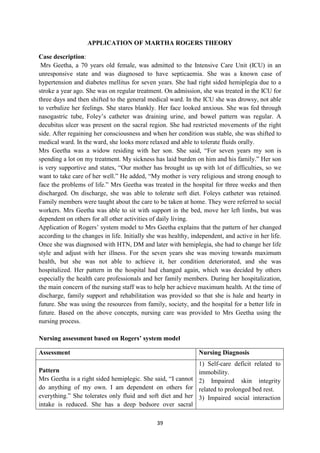
APPLICATION OF MARTHA ROGERS THEORY
Case description:
Mrs Geetha, a 70 years old female, was admitted to the Intensive Care Unit (ICU) in an
unresponsive state and was diagnosed to have septicaemia. She was a known case of
hypertension and diabetes mellitus for seven years. She had right sided hemiplegia due to a
stroke a year ago. She was on regular treatment. On admission, she was treated in the ICU for
three days and then shifted to the general medical ward. In the ICU she was drowsy, not able
to verbalize her feelings. She stares blankly. Her face looked anxious. She was fed through
nasogastric tube, Foley‘s catheter was draining urine, and bowel pattern was regular. A
decubitus ulcer was present on the sacral region. She had restricted movements of the right
side. After regaining her consciousness and when her condition was stable, she was shifted to
medical ward. In the ward, she looks more relaxed and able to tolerate fluids orally.
Mrs Geetha was a widow residing with her son. She said, ―For seven years my son is
spending a lot on my treatment. My sickness has laid burden on him and his family.‖ Her son
is very supportive and states, ―Our mother has brought us up with lot of difficulties, so we
want to take care of her well.‖ He added, ―My mother is very religious and strong enough to
face the problems of life.‖ Mrs Geetha was treated in the hospital for three weeks and then
discharged. On discharge, she was able to tolerate soft diet. Foleys catheter was retained.
Family members were taught about the care to be taken at home. They were referred to social
workers. Mrs Geetha was able to sit with support in the bed, move her left limbs, but was
dependent on others for all other activities of daily living.
Application of Rogers‘ system model to Mrs Geetha explains that the pattern of her changed
according to the changes in life. Initially she was healthy, independent, and active in her life.
Once she was diagnosed with HTN, DM and later with hemiplegia, she had to change her life
style and adjust with her illness. For the seven years she was moving towards maximum
health, but she was not able to achieve it, her condition deteriorated, and she was
hospitalized. Her pattern in the hospital had changed again, which was decided by others
especially the health care professionals and her family members. During her hospitalization,
the main concern of the nursing staff was to help her achieve maximum health. At the time of
discharge, family support and rehabilitation was provided so that she is hale and hearty in
future. She was using the resources from family, society, and the hospital for a better life in
future. Based on the above concepts, nursing care was provided to Mrs Geetha using the
nursing process.
Nursing assessment based on Rogers’ system model
Assessment Nursing Diagnosis
Pattern
Mrs Geetha is a right sided hemiplegic. She said, ―I cannot
do anything of my own. I am dependent on others for
everything.‖ She tolerates only fluid and soft diet and her
intake is reduced. She has a deep bedsore over sacral
1) Self-care deficit related to
immobility.
2) Impaired skin integrity
related to prolonged bed rest.
3) Impaired social interaction
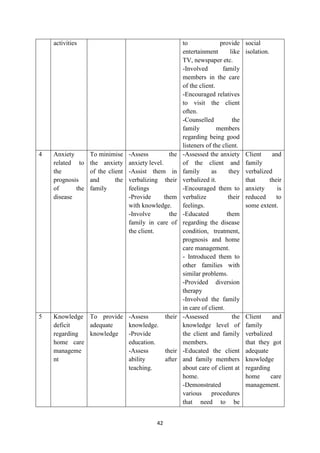
40
region. Her pattern is decided by others in the hospital. She
said, ―I am not able to mix up with others due to my
condition, I feel lonely.‖ Mrs Geetha‘s son stated, ―She is
very religious and bold enough to face the problems of life,
but now she has lost the confidence. She feels lonely and
isolated.‖ Mrs Geetha strives hard to achieve the fullest
health within her limits
related to activity intolerance
and inability to travel to usual
social activities.
4) Interrupted family process
related to financial crisis.
5) Anxiety related to prognosis
of the disease.
6) Risk for care giver strain
related to the chronic illness.
7) Knowledge deficit of the
caregiver related to homecare
management.
8) Risk for complications
related to the chronic illness.
Resonancy
Mrs Geetha is on treatment. She complies with it. She
states, ―If I do not take these medicines my condition may
deteriorate further.‖ She further states, ―My illness has laid
burden on my son.‖ But her son is very supportive. It is
observed that sometimes she is pleasant, sometimes dull
and withdrawn. When she was dull she said, ―I feel
depressed and guilty of my illness. I do not know what will
happen in the future?‖
Helicy
In Mrs Geetha‘s present condition she is unidirectional in
moving towards achieving health within her limits. She
said, ―I accept my illness; I may be recovering by using all
the resources available. I do not fear death.‖ Her son stated,
―We will support and care for our mother throughout her
remaining life.‖
Integrality
As Mrs Geetha is hemiplegic and ready for discharge, her
family has to do some modifications at home. She has to
get treatment for her HTN and DM also. Her son stated, ―I
do not know how to take care of her at home and prevent
any forth coming problems.‖
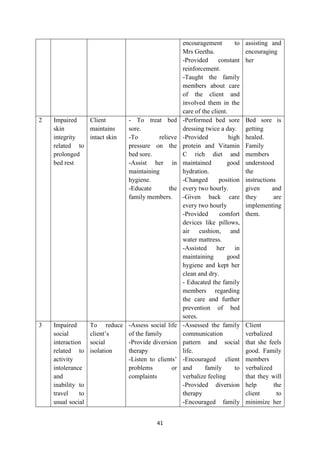
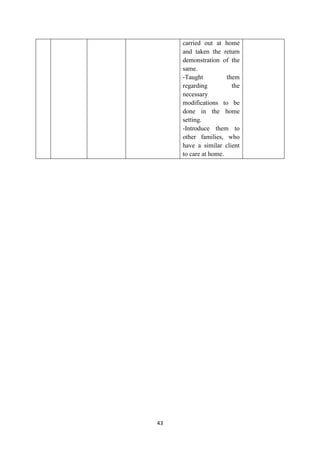
Nursing care plan for Mrs Geetha
Sr.
no.
Nursing
diagnosis
Goal/
objective
Planning Implementation Evaluation
1 Self-care
deficit
related to
immobility
To meet the
self-care
needs
(activities of
daily living
[ADL])
-To assist the
client in meeting
ADL.
-Provide constant
encouragement
-Provide family
support.
-Performed ADL
which the client is
not able to do
-Assisted the client in
washing, eating,
grooming etc.
-Provided constant
Client is
carrying out
the activities
within her
limits.
Family
members are
41
encouragement to
Mrs Geetha.
-Provided constant
reinforcement.
-Taught the family
members about care
of the client and
involved them in the
care of the client.
assisting and
encouraging
her
2 Impaired
skin
integrity
related to
prolonged
bed rest
Client
maintains
intact skin
- To treat bed
sore.
-To relieve
pressure on the
bed sore.
-Assist her in
maintaining
hygiene.
-Educate the
family members.
-Performed bed sore
dressing twice a day.
-Provided high
protein and Vitamin
C rich diet and
maintained good
hydration.
-Changed position
every two hourly.
-Given back care
every two hourly
-Provided comfort
devices like pillows,
air cushion, and
water mattress.
-Assisted her in
maintaining good
hygiene and kept her
clean and dry.
- Educated the family
members regarding
the care and further
prevention of bed
sores.
Bed sore is
getting
healed.
Family
members
understood
the
instructions
given and
they are
implementing
them.
3 Impaired
social
interaction
related to
activity
intolerance
and
inability to
travel to
usual social
To reduce
client‘s
social
isolation
-Assess social life
of the family
-Provide diversion
therapy
-Listen to clients‘
problems or
complaints
-Assessed the family
communication
pattern and social
life.
-Encouraged client
and family to
verbalize feeling
-Provided diversion
therapy
-Encouraged family
Client
verbalized
that she feels
good. Family
members
verbalized
that they will
help the
client to
minimize her
42
activities to provide
entertainment like
TV, newspaper etc.
-Involved family
members in the care
of the client.
-Encouraged relatives
to visit the client
often.
-Counselled the
family members
regarding being good
listeners of the client.
social
isolation.
4 Anxiety
related to
the
prognosis
of the
disease
To minimise
the anxiety
of the client
and the
family
-Assess the
anxiety level.
-Assist them in
verbalizing their
feelings
-Provide them
with knowledge.
-Involve the
family in care of
the client.
-Assessed the anxiety
of the client and
family as they
verbalized it.
-Encouraged them to
verbalize their
feelings.
-Educated them
regarding the disease
condition, treatment,
prognosis and home
care management.
- Introduced them to
other families with
similar problems.
-Provided diversion
therapy
-Involved the family
in care of client.
Client and
family
verbalized
that their
anxiety is
reduced to
some extent.
5 Knowledge
deficit
regarding
home care
manageme
nt
To provide
adequate
knowledge
-Assess their
knowledge.
-Provide
education.
-Assess their
ability after
teaching.
-Assessed the
knowledge level of
the client and family
members.
-Educated the client
and family members
about care of client at
home.
-Demonstrated
various procedures
that need to be
Client and
family
verbalized
that they got
adequate
knowledge
regarding
home care
management.
43
carried out at home
and taken the return
demonstration of the
same.
-Taught them
regarding the
necessary
modifications to be
done in the home
setting.
-Introduce them to
other families, who
have a similar client
to care at home.
44
INTRODUCTION
 Born 1914 in Baltimore, US
 Earned her diploma at Providence Hospital – Washington, DC
 1939 – BSN Ed., Catholic University of America
 1945 – MSN Ed., Catholic University of America
 She worked as a staff nurse, private duty nurse, nurse educator and administrator and nurse
consultant.
 Received honorary Doctor of Science degree in 1976.
 Theory was first published in Nursing: Concepts of Practice in 1971, second in 1980, in
1995, and 2001.
MAJOR ASSUMPTIONS
 People should be self-reliant and responsible for their own care and others in their family
needing care
 People are distinct individuals
 Nursing is a form of action – interaction between two or more persons
 Successfully meeting universal and development self-care requisites is an important
component of primary care prevention and ill health
 A person‘s knowledge of potential health problems is necessary for promoting self-care
behaviors
 Self-care and dependent care are behaviors learned within a socio-cultural context
DEFINITIONS OF DOMAIN CONCEPTS
1) Nursing is an art, a helping service, and a technology
 Actions deliberately selected and performed by nurses to help individuals or groups
under their care to maintain or change conditions in themselves or their environments
 Encompasses the patient‘s perspective of health condition ,the physician‘s perspective
, and the nursing perspective
6. DOROTHEA OREM'S SELF-CARE THEORY
45
 Goal of nursing – to render the patient or members of his family capable of meeting
the patient‘s self-care needs
 To maintain a state of health
 To regain normal or near normal state of health in the event of disease or injury
 To stabilize ,control ,or minimize the effects of chronic poor health or disability
2) Health – health and healthy are terms used to describe living things …
 It is when they are structurally and functionally whole or sound … wholeness or
integrity. .includes that which makes a person human,…operating in conjunction with
physiological and psychophysiological mechanisms and a material structure and in
relation to and interacting with other human beings
3) Environment
 environment components are enthronement factors, enthronement elements,
conditions, and developed environment
4) Human being – has the capacity to reflect, symbolize and use symbols
 Conceptualized as a total being with universal, developmental needs and capable of
continuous self-care
 A unity that can function biologically, symbolically and socially
5) Nursing client
 A human being who has "health related /health derived limitations that render him
incapable of continuous self-care or dependent care or limitations that result in
ineffective / incomplete care.
 A human being is the focus of nursing only when a self –care requisites exceeds self-
care capabilities
Nursing problem
 deficits in universal, developmental, and health derived or health related conditions
Nursing process
 A system to determine (1)why a person is under care
(2) a plan for care ,
(3) the implementation of care
Nursing therapeutics
 deliberate, systematic and purposeful action,
OREM’S GENERAL THEORY OF NURSING
Orem‘s general theory of nursing in three related parts:-
a) Theory of self-care
b) Theory of self-care deficit
c) Theory of nursing system
46
A. THEORY OF SELF CARE
This theory Includes:
 Self-care – practice of activities that individual initiates and perform on their own behalf in
maintaining life ,health and well being
 Self-care agency – is a human ability which is "the ability for engaging in self-care" -
conditioned by age developmental state, life experience sociocultural orientation health and
available resources
 Therapeutic self-care demand – "totality of self-care actions to be performed for some
duration in order to meet self-care requisites by using valid methods and related sets of
operations and actions"
 Self-care requisites - action directed towards provision of self-care. 3 categories of self-care
requisites are-
 Universal self-care requisites
 Developmental self-care requisites
 Health deviation self-care requisites
1. Universal self-care requisites
 Associated with life processes and the maintenance of the integrity of human structure and
functioning
 Common to all , ADL
 Identifies these requisites as:
 Maintenance of sufficient intake of air,water, food
 Provision of care associated with elimination process
 Balance between activity and rest, between solitude and social interaction
 Prevention of hazards to human life well-being and
 Promotion of human functioning
2. Developmental self-care requisites
 Associated with developmental processes/ derived from a condition or associated with an
event
E.g. adjusting to a new job, adjusting to body changes
3. Health deviation self-care
 Required in conditions of illness, injury, or disease .these include:--
 Seeking and securing appropriate medical assistance
 Being aware of and attending to the effects and results of pathologic conditions
 Effectively carrying out medically prescribed measures
 Modifying self-concepts in accepting oneself as being in a particular state of health and in
specific forms of health care
 Learning to live with effects of pathologic conditions
B. THEORY OF SELF CARE DEFICIT
 Specifies when nursing is needed
 Nursing is required when an adult (or in the case of a dependent, the parent) is incapable or
limited in the provision of continuous effective self-care.
 Orem identifies 5 methods of helping:
1. Acting for and doing for others
47
2. Guiding others
3. Supporting another
4. Providing an environment promoting personal development in relation to meet
future demands
5. Teaching another
C. THEORY OF NURSING SYSTEMS
 Describes how the patient‘s self-care needs will be met by the nurse, the patient, or both.
 Identifies 3 classifications of nursing system to meet the self-care requisites of the patient:-
1. Wholly compensatory system
2. Partly compensatory system
3. Supportive – educative system
 Design and elements of nursing system
 Define scope of nursing, responsibility in health care situations
 General and specific roles of nurses and patients
 Reasons for nurses‘ relationship with patients and
 Orem recognized that specialized technologies are usually developed by members of the
health profession
 A technology is systematized information about a process or a method for affecting some
desired result through deliberate practical endeavour, with or without use of materials or
instruments.
48
CATEGORIES OF TECHNOLOGIES
1. SOCIAL OR INTERPERSONAL
 Communication adjusted to age, health status
 Maintaining interpersonal, intra group or inter group relations for coordination of
efforts
 Maintaining therapeutic relationship in light of psychosocial modes of functioning in
health and disease
 Giving human assistance adapted to human needs ,action abilities and limitations
2. REGULATORY TECHNOLOGIES
 Maintaining and promoting life processes
 Regulating psycho physiological modes of functioning in health and disease
 Promoting human growth and development
 Regulating position and movement in space
OREM’S THEORY AND NURSING PROCESS
 Nursing process presents a method to determine the self-care deficits and then to define the
roles of person or nurse to meet the self-care demands.
 The steps within the approach are considered to be the technical component of the nursing
process.
 Orem emphasizes that the technological component "must be coordinated with interpersonal
and social processes within nursing situations.
Nursing
Process
Orem’s Nursing Process
 Assessment  Diagnosis and prescription; determine why nursing is needed. analyze
and interpret –make judgment regarding care
 Design of a nursing system and plan for delivery of care
 Production and management of nursing systems
Step 1-collect data in six areas:-
1. The person‘s health status
2. The physician‘s perspective of the person‘s health status
3. The person‘s perspective of his or her health
4. The health goals within the context of life history ,life style, and
health status
5. The person‘s requirements for self-care
6. The person‘s capacity to perform self-care
49
 Nursing
diagnosis

 Plans with
scientific
rationale
Step 2
 Nurse designs a system that is wholly or partly compensatory or
supportive-educative.
 The 2 actions are:-
1. Bringing out a good organization of the components of patients‘
therapeutic self-care demands
2. Selection of combination of ways of helping that will be effective and
efficient in compensating for/ overcoming patient‘s self-care deficits
 Implementation

 evaluation
Step 3
 Nurse assists the patient or family in self-care matters to achieve
identified and described health and health related results. collecting
evidence in evaluating results achieved against results specified in the
nursing system design
 Actions are directed by etiology component of nursing diagnosis
 evaluation
OREM’S WORK AND THE CHARACTERISTICS OF A THEORY
 Orem's theory interrelate concepts in such a way as to create a different way of looking at a
particular phenomenon
 Is logical in nature.
 is relatively simple yet generalizable
 is basis for hypothesis that can be tested
 contribute to and assist in increasing the general body of knowledge within the discipline
through the research implemented to validate them
 can be used by the practitioners to guide and improve their practice
 must be consistent with other validated theories ,laws and principles
STRENGTHS
 Provides a comprehensive base to nursing practice
 It has utility for professional nursing in the areas of nursing practice nursing curricula
,nursing education administration ,and nursing research
 Specifies when nursing is needed
 Her self-care approach is contemporary with the concepts of health promotion and health
maintenance
LIMITATIONS
 In general system theory a system is viewed as a single whole thing while Orem defines a
system as a single whole, thing.
 Health is often viewed as dynamic and ever changing.
 The theory is illness oriented.
50
APPLICATION OF OREM'S SELF-CARE DEFICIT THEORY
OBJECTIVES
1. to assess the patient condition by the various methods explained by the nursing theory
2. to identify the needs of the patient
3. to demonstrate an effective communication and interaction with the patient.
4. to select a theory for the application according to the need of the patient
5. to apply the theory to solve the identified problems of the patient
6. to evaluate the extent to which the process was fruitful
PATIENT PROFILE
Areas Patient details
Name
Age
Sex
Education
Occupation
Marital status
Religion
Diagnosis
Theory applied
Mrs. X
56 years
Female
No formal education
House hold
Married
Hindu
Rheumatoid arthritis
Orem‘s theory of self-care deficit.
OREM’S THEORY OF SELF CARE DEFICIT
 The self-care deficit theory proposed by Orem is a combination of three theories, i.e. theory
of self-care, theory of self-care deficit and the theory of nursing systems.
 In the theory of self-care, she explains self-care as the activities carried out by the individual
to maintain their own health.
 The self-care agency is the acquired ability to perform the self-care and this will be affected
by the basic conditioning factors such as age, gender, health care system, family system etc.
 Therapeutic self-care demand is the totality of the self-care measures required.
 The self-care is carried out to fulfill the self-care requisites.
 There are mainly 3 types of self-care requisites such as universal, developmental and health
deviation self-care requisites.
 Whenever there is an inadequacy of any of these self-care requisite, the person will be in
need of self-care or will have a deficit in self-care.
 The deficit is identified by the nurse through the thorough assessment of the patient.
 Once the need is identified, the nurse has to select required nursing systems to provide care:
wholly compensatory, partly compensatory or supportive and educative system.
 The care will be provided according to the degree of deficit the patient is presenting with.
51
 Once the care is provided, the nursing activities and the use of the nursing systems are to be
evaluated to get an idea about whether the mutually planned goals are met or not.
 Thus the theory could be successfully applied into the nursing practice.
For Mrs. X came to the hospital with complaints of pain over all the joints, stiffness which is
more in the morning and reduces by the activities. She has these complaints since 5 years and
has taken treatment from local hospital. The symptoms were not reducing and came to --MC,
Hospital for further management. Patient was able to do the ADL by herself but the way she
performed and the posture she used was making her prone to develop the complications of
the disease. She also was malnourished and was not having awareness about the deficiencies
and effects.
DATA COLLECTION ACCORDING TO OREM’S THEORY OF SELF CARE
DEFICIT
1. BASIC CONDITIONING FACTORS
Age 56 year
Gender Female
Health state
Disability due to health condition, therapeutic self-care
demand
Development state Ego integrity vs despair
Socio-cultural orientation No formal education, Indian, Hindu
Health care system Institutional health care
Family system Married, husband working
Patterns of living At home with partner
Environment
Rural area, items for ADL not in easy reach, no special
precautions to prevent injuries
resources Husband, daughter, sister‘s son
52
2. UNIVERSAL SELF-CARE REQUISITES
Air Breaths without difficulty, no pallor cyanosis
Water Fluid intake is sufficient. Edema present over ankles.
Turgor normal for the age
Food Hb – 9.6gm%, BMI = 14.Food intake is not adequate or the diet is
not nutritious.
Elimination Voids and eliminates bowel without difficulty.
Activity/ rest
Frequent rest is required due to pain.
Pain not completely relieved,
Activity level has come down.
Deformity of the joint secondary to the disease process and use of
the joints.
Social interaction
Communicates well with neighbors and calls the daughter by phone
Need for medical care is communicated to the daughter.
Prevention of hazards Need instruction on care of joints and prevention of falls. Need
instruction on improvement of nutritional status. Prefer to walk bare
foot.
Promotion of normalcy Has good relation with daughter
3. DEVELOPMENTAL SELF-CARE REQUISITES
Maintenance of
developmental environment
Able to feed self , Difficult to perform the dressing, toileting
etc.
Prevention/ management of
the conditions threatening the
normal development
Feels that the problems are due to her own behaviours and
discusses the problems with husband and daughter.
53
4. HEALTH DEVIATION SELF CARE REQUISITES
Adherence to medical regimen Reports the problems to the physician when in the
hospital. Cooperates with the medication, Not much
aware about the use and side effects of medicines
Awareness of potential problem
associated with the regimen
Not aware about the actual disease process.
Not compliant with the diet and prevention of hazards.
Not aware about the side effects of the medications
Modification of self-image to
incorporates changes in health
status
Has adapted to limitation in mobility.
The adoption of new ways for activities leads to
deformities and progression of the disease.
Adjustment of lifestyle to
accommodate changes in the
health status and medical
regimen.
Adjusted with the deformities.
Pain tolerance not achieved
5. MEDICAL PROBLEM AND PLAN
Physician’s perspective of the condition: Diagnosed with rheumatoid arthritis and is on the
following medications:
 T. Valus SR OD
 T. Pan 40 mg OD
 T. Tramazac 50 mg OD
 T. Recofix Forte BD
 T. Shelcal BD
 Syp. Heamup 2tsp TID
Medical Diagnosis: Rheumatoid arthritis
Medical Treatment: Medication and physical therapy.
54
AREAS AND PRIORITY ACCORDING TO OREM’S THEORY OF SELF-CARE
DEFICIT:
IMPORTANT FOR PRIORITIZING THE NURSING DIAGNOSIS.
1. Air
2. Water
3. Food
4. Elimination
5. Activity/ Rest
6. Solitude/ Interaction
7. Prevention of hazards
8. Promotion of normalcy
9. Maintain a developmental environment.
10. Prevent or manage the developmental threats
11. Maintenance of health status
12. Awareness and management of the disease process.
13. Adherence to the medical regimen
14. Awareness of potential problem.
15. modify self-image
16. Adjust life style to accommodate health status changes and MR
DATA COLLECTION ACCORDING TO OREM’S THEORY OF SELF CARE
DEFICIT
1. BASIC CONDITIONING FACTORS
Age 56 year
Gender Female
Health state Disability due to health condition, therapeutic self-care demand
Development state Ego integrity vs despair
Sociocultural
orientation No formal education, Indian, Hindu
Health care system Institutional health care
55
Family system Married, husband working
Patterns of living At home with partner
Environment
Rural area, items for ADL not in easy reach, no special precautions to
prevent injuries
resources Husband, daughter, sister‘s son
2. UNIVERSAL SELF-CARE REQUISITES
Air Breaths without difficulty, no pallor cyanosis
Water
Fluid intake is sufficient. Edema present over ankles.
Turgor normal for the age
Food
Hb – 9.6gm%, BMI = 14.Food intake is not adequate or the diet is not
nutritious.
Elimination Voids and eliminates bowel without difficulty.
Activity/ rest Frequent rest is required due to pain.
Pain not completely relieved.
Activity level has come down.
Deformity of the joint secondary to the disease process and use of the
joints.
Social interaction
Communicates well with neighbors and calls the daughter by phone Need
for medical care is communicated to the daughter.
56
Prevention of
hazards
Need instruction on care of joints and prevention of falls. Need
instruction on improvement of nutritional status. Prefer to walk bare foot.
Promotion of
normalcy Has good relation with daughter
3. DEVELOPMENTAL SELF-CARE REQUISITES
Maintenance of
developmental environment
Able to feed self , Difficult to perform the dressing, toileting
etc
Prevention/ management of
the conditions threatening
the normal development
Feels that the problems are due to her own behaviours and
discusses the problems with husband and daughter.
4. HEALTH DEVIATION SELF CARE REQUISITES
Adherence to medical regimen
Reports the problems to the physician when in the
hospital. Cooperates with the medication, Not much
aware about the use and side effects of medicines
Awareness of potential problem
associated with the regimen
Not aware about the actual disease process.
Not compliant with the diet and prevention of hazards.
Not aware about the side effects of the medications
Modification of self-image to
incorporates changes in health
status
Has adapted to limitation in mobility.
The adoption of new ways for activities leads to
deformities and progression of the disease.
Adjustment of lifestyle to
accommodate changes in the
health status and medical
Adjusted with the deformities.
Pain tolerance not achieved
57
regimen.
5. MEDICAL PROBLEM AND PLAN
Physician’s perspective of the condition: Diagnosed with rheumatoid arthritis and is on the
following medications:
 T. Valus SR OD
 T. Pan 40 mg OD
 T. Tramazac 50 mg OD
 T. Recofix Forte BD
 T. Shelcal BD
 Syp. Heamup 2tsp TID
Medical Diagnosis: Rheumatoid arthritis
Medical Treatment: Medication and physical therapy.
PRIORITY ACCORDING TO OREM’S THEORY OF SELF-CARE DEFICIT:
IMPORTANT FOR PRIORITIZING THE NURSING DIAGNOSIS.
 Air
 Water
 Food
 Elimination
 Activity/ Rest
 Solitude/ Interaction
 Prevention of hazards
 Promotion of normalcy
 Maintain a developmental environment.
 Prevent or manage the developmental threats
 Maintenance of health status
 Awareness and management of the disease process.
 Adherence to the medical regimen
 Awareness of potential problem.
 modify self-image
 Adjust life style to accommodate health status changes and MR
58
APPLYING THE OREM’S THEORY OF SELF-CARE DEFICIT, A NURSING CARE
PLAN FOR MRS. X COULD BE PREPARED AS FOLLOWS …
A. THERAPEUTIC SELF CARE DEMAND: DEFICIENT AREA: FOOD
ADEQUACY OF SELF CARE AGENCY: INADEQUATE
NURSING DIAGNOSIS- Inability to maintain the ideal nutrition related to inadequate
intake and knowledge deficit
a. Outcome:
 Improved nutrition
 Maintenance of a balanced diet with adequate iron supplementation.
b. Nursing Goals and objectives
Goal: to achieve optimal levels of nutrition.
Objectives: Mrs. X will:
 State the importance of maintaining a balanced diet.
 List the food items rich in iron, that are available in the locality.
c. Design of the nursing system: Supportive educative
d. Method of helping:
 guidance
 support
 Teaching
 Providing developmental environment
IMPLEMENTATION
Mutually planned and identified the objectives and the patient were made to understand about
the required changes in the behaviour to have the requisites met.
EVALUATION
 Mrs. X understood the importance of maintaining an optimum nutrition.
 She told that she will select the iron rich diet for her food.
 She listed the foods that are rich in iron and that are locally available.
 The self-care deficit in terms of food will be decreased with the initiation of the
nutritional intake.
 The supportive educative system was useful for Mrs. X
59
B. THERAPEUTIC SELF CARE DEMAND: DEFICIENT AREA: ACTIVITY
ADEQUACY OF SELF CARE AGENCY: INADEQUATE
NURSING DIAGNOSIS- Self-care deficit: dressing, toileting related to restricted joint
movement, secondary to the inflammatory process in the joints.
a. Outcome:
 improved self-care
 Maintain the ability to perform the toileting and dressing with modification as
required.
b. Nursing Goals and objectives
Goal: to achieve optimal levels of ability for self-care.
Objectives: Mrs. X will:
 perform the dressing activities within limitations
 utilize the alternative measures available for improving the toileting
 perform the other activities of daily living with minimal assistance.
c. Design of the nursing system: Partly compensatory
d. Method of helping:
1. Guidance:
 Assess the various hindering factors for self-care and how to tackle them.
2. Support:
 Provide all the articles needed for self-care, near to the patient and ask the family
members also to give the articles near to her.
 Provide passive exercises and make to perform active exercises so as to promote the
mobility of the joint.
 Make the patient use commodes or stools to perform toileting and insist on avoidance
of squatting position
 Provide assistance whenever needed for the self-care activities
 Provide encouragement and positive reinforcement for minor improvement in the
activity level.
 Initiate the pain relieving measures always before the patient go for any of the
activities of daily living
 Make the patient to use loose fitting clothes which will be easy to wear and remove.
3. Teaching:
 Teach the family members the limitation in the activity level the patient has and the
cooperation required
4. Promoting a developmental environment:
 Teach the family and help them to practice how to help the patient according to her
needs
IMPLEMENTATION
 Mutually planned and identified the objectives and the patient was made to
understand about the required changes in the behaviour to have the requisites met.
60
EVALUATION
 Patient was performing some of the activities and she practiced toileting using a
commode in the hospital.
 She verbalized an improved comfort and self-care ability.
 She performed the dressing activities with minimal assistance
 Patient verbalized that she will perform the activities as instructed to get her ADL
done.
 The partly compensatory system was useful for Mrs. X
C. THERAPEUTIC SELF CARE DEMAND: DEFICIENT AREA: PAIN CONTROL
ADEQUACY OF SELF CARE AGENCY: INADEQUATE
NURSING DIAGNOSIS- Ineffective pain control related to lack of utilization of pain relief
measures
a. Outcome:
 improved pain self control
 achieve and maintain a reduction in the pain.
b. Nursing Goals and objectives
Goal: to achieve reduction in the pain.
Objectives: Mrs. X will:
 describe the total plan of pharmacological and non pharmacological pain relief
 demonstrate a reduction in the pain behaviours
 verbalize a reduction in the pain scale score from 7 – 4
c. Design of the nursing system: supportive educative
d. method of helping:
Guidance:
 Explore the past experience of pain and methods used to manage them.
 Ask the client to report the intensity, location, severity, associated and aggravating
factors.
Support:
 Provide rest to the joints and avoid excessive manipulations
 provide hot and cold application to have better mobility.
 Encourage exercises to the joints by immersing in the warm water.
 Administer T. Ultracet and Tab Diclofecac as prescribed.
 Provide diversion and psychological support to the patient
Teaching:
 Teach the non – pharmacological method to the patient once the pain is a little
reduced.
Providing the developmental environment:
 Discuss with the patient the necessity to maintain a pain diary with all information
regarding episodes of pain and refer to that periodically
61
 Enquire from the health team, the need for opioid analgesics or other analgesics and
get a prescription for the patient.
IMPLEMENTATION
EVALUATION
 Patient still has pain over the joints and she agreed that she will use the measures for
pain relief that is told to her.
 The pain scale score was 6 after the measures were provided to the patient.
 She demonstrated slight reduction in the pain behaviours.
 The supportive educative system was useful for Mrs. X
D. THERAPEUTIC SELF CARE DEMAND: DEFICIENT AREA: PREVENTION OF
HAZARDS.
ADEQUACY OF SELF CARE AGENCY: INADEQUATE
NURSING DIAGNOSIS
 Potential for fall and fractures related to rheumatoid arthritis.
OUTCOMES AND PLAN
a. Outcome:
 Absence of falls and injury to the patient
b. Nursing Goals and objectives
Goal: prevent the falls and injury and to maintain a good body mechanics.
Objectives: Mrs. X will:
 remain free from injury as evidenced by:
 absence of signs and symptoms of fall or injury
 Explaining the methods to prevent the injury.
c. Design of the nursing system: supportive educative
d. method of helping: Support
 Never leave the client alone in the unit
 Assess the patients gait, activities and the mental status for any confusion or
disorientation
 Encourage the patient to use supportive devices as required.
 Provide a safe environment in the hospital by avoiding sharp objects or wooden
objects on the way and slippery floor.
 Involve the family members in providing and maintaining a safe environment in the
home
 Involve the family members to provide support to the patient whenever necessary
 Plan a balanced diet for the patient with a mutual interaction
IMPLEMENTATION
EVALUATION
 Patient remained free from injury as evidenced by absence of signs and symptoms.
 Patient explained the various measures that they will take to prevent the injury.
 The supportive educative system was useful for Mrs. X
62
E. THERAPEUTIC SELF CARE DEMAND: DEFICIENT AREA: PREVENTION OF
HAZARDS.
ADEQUACY OF SELF CARE AGENCY: INADEQUATE
NURSING DIAGNOSIS:
 Potential for impaired skin integrity related to edema secondary to renal cysts.
OUTCOMES AND PLAN:
a. Outcome:
 Maintenance of normal skin integrity.
b. nursing Goals and objectives
Goal: Maintain the skin integrity and take measures to prevent skin impairment.
Objectives: Mrs. X will:
 maintain a normal skin integrity
 list the measures to prevent the loss of skin integrity
 identify the measures to relieve edema.
c. Design of the nursing system: supportive educative
d. method of helping: Support:
 Assess the skin regularly for any excoriation or loss of integrity or colour changes.
Keep the skin clean always
 Avoid stress or pressure over the area of edema by providing extra cushions or
padding
 Monitor the lab values as well as the patient for any signs and symptoms of renal
failure.
 Encourage the patient to use slippers while walking and that should not be tight
fitting.
 Assess the edema for its degree, pitting or non pitting and continue the assessment
daily.
 Provide a leg end elevated position or elevation of the leg on a pillow if no cardiac
abnormalities are identified.
 Explain the patient the need for taking care of the edematous parts
 Explain the patient to report the symptoms like decreased urine output, palpitations,
increased edema etc. to the health team
IMPLEMENTATION
EVALUATION
 Patient remained free from impaired skin integrity
 She listed the measures to prevent the loss of skin integrity
 She identified the measures to relieve edema.
 The supportive educative system was useful for Mrs. x
63
F. THERAPEUTIC SELF CARE DEMAND: DEFICIENT AREA: AWARENESS OF
THE DISEASE PROCESS AND MANAGEMENT
ADEQUACY OF SELF CARE AGENCY: INADEQUATE
NURSING DIAGNOSIS
 Potential for complications related to rheumatoid arthritis secondary to knowledge deficit.
OUTCOMES AND PLAN
a. Outcome:
 Absence of complications and improved awareness about the disease process.
b. nursing Goals and objectives
Goal: Improve the knowledge of the patient about the disease process and the complications.
Objectives: Mrs. X will:
 verbalize the various complication and their preventions
 verbalize the changes occurring with the disease process and the treatment available
 describe the actions and side effects of the medications which she is using
c. Design of the nursing system: Supportive educative
d. Methods of helping:
 Guidance
 Teaching
 Promoting a developmental environment
IMPLEMENTATION
EVALUATION
 Patient got adequate information regarding the disease
 She verbalized what she understood about the disease and its management.
 Patient has cleared her doubts regarding the medication actions and the side effect
 The supportive educative system was useful for Mrs. X
EVALUATION OF THE APPLICATION OF SELF CARE DEFICIT THEORY
The theory of self-care deficit when applied could identify the self-care requisites of Mrs. X
from various aspects. This was helpful to provide care in a comprehensive manner. Patient
was very cooperative. the application of this theory revealed how well the supportive and
educative and partly compensatory system could be used for solving the problems in a patient
with rheumatoid arthritis.
64
Introduction:
 Imogene King was born on Jan. 30 1923 in west point, Lowa.
 She completed her basic nursing education in1945, when she received her diploma in
nursing from St. John‘s hospital school of nursing, St Louis.
 In 1948, she received her B.Sc in nursing education and in 1957, her M.Sc. in nursing
from St. Louis University.
 In 1961 she was awarded a doctorate in education from teachers college, Colombia
University, New York City.
 She held various positions in nursing education, administration and practice.
 King began formulating her theory, while as an associated professor of nursing at Loyola
University Chicago, where she developed a master‘s degree programmer in nursing, using
a conceptual framework.
 She was actively involved in the establishment of King International Nursing Group,
 In 1971, she published towards a theory for nursing general concepts of human behavior,
in which she proposed a conceptual framework for nursing rather than a theory.
 In 1981, she published towards a theory for nursing; systems, concepts and process.
1. King proposes an open systems framework as a basis for her theory of goal attainment.
2. She links then concepts essential to understanding nursing as a major system within the
health care system.
3. Her vision of the nursing process placed a strong emphasis on interpersonal processes.
 King bases her theory on general system theory, the behavioral sciences and deductive
and inductive reasoning.
What was the impetus for king to write about nursing?
 During the 20th
century the rapidity of knowledge development in many areas had a
great impact on the profession of nursing as on the rest of the society.
7. KING’S GOAL ATTENMENT THEORY
65
 In the 1960s, as emerging professionals nurses were identifying the knowledge base
specific to nursing practice and to an expanding role for nurses.
 In 1964 king published a paper discussing problems and prospects for the development
of nursing knowledge
 In 1968 she first identified several concepts she later use in her conceptual system and
continued to discuss the need for nursing knowledge base.
 in this environment king (1971)sought to answer several questions.-
 What are some of the social and educational changes in united states that have
influence changes in nursing?
 What basic elements are continuous throughout this change in nursing?
 What is the scope of the practice of nursing and in what kind of settings do
nurses perform their functions?
 Are the current goals of nursing similar to those of the past half century?
 What are the dimensions of practice that have given the field of nursing
unifying focus overtime?
In exploring the literature on systems analysis and general system theory, king (1971)
develop additional questions:
 What kind of decisions are nurses required to make in the course of their roles
and responsibilities?
 What kind of information is essential for them to make decisions?
 What are the alternatives in nursing situations?
 What alternative courses of actions do nurses have in making critical decisions
about another individuals care recovery and health?
 What skills do nurses now perform and what knowledge is essential for nurses to
make decision about alternatives?
Even though this questions post several decades ago they still provide food for thought.
King towards a theory for nursing:
‗General concepts of human behavior‘ were published in1971 and a ‗theory for
nursing: systems concept process‘ in 1981. These publications grew from kings thoughts
about the vast amount of knowledge available to nurses and difficulty this present to the
individual nurse in choosing the facts and concepts relevant to given to situation.
In the preface to, ‗towards a theory for nursing‘, king clearly stated that she was
proposing a conceptual framework for nursing and not a nursing theory. As she denoted in
the title, her purpose was to help move toward theory for nursing.
In contrast in the preface to a ‗theory for nursing‘ she indicates that she has expanded
and builds on the original framework. In the second publication she again presents her system
based conceptual framework and discuss the relationship of the concepts she identified as
fundamental to comprehending nursing as a system in the health care systems. She also
discussed concept of development and knowledge application in nursing and through
explication of her theory of goal attainment, derived from the open system framework,
showed one-way of constructing theory.
66
King identified her work as a conceptual system. The function of a conceptual system
is to give support for arranging ideas or concepts into group that provides meaning.
KINGS OPEN SYSTEM FRAMEWORK/ CONCEPTUAL SYSTEM:
General information:
I. Are based on the assumption, humans have open interaction with their
environment.
II. Consist of three interacting systems; personal, interpersonal and social.
Purposes of the conceptual framework:
 Name concepts necessary to nursing as a discipline.
 Provide for the derivation of theories that are tested through research as part of the
development of the scientific base for nursing knowledge.
 Provide an organizing structure nursing curriculum
 Lead to nursing practice, based in theory that supports quality care in all settings in
which nursing occurs.
Concept and knowledge may be similar across disciplines, but the way each profession
uses them will differ.
 The conceptual system includes goal, structure functions, recourses and decision
making, which king says are essential elements.
 Decision making occurs when chaises are made in resource allocation to support
attaining system.
In conceptual system health is the goal for nursing. Structure is represented by three
open systems.
1. Functions are demonstrated in reciprocal relations of individuals in interaction and
transactions.
2. Resource includes people, money goods and services for items needed to carry out
specific activities.
3. Decision-making occurs when choices are made in resource allocation to support
attaining system goal.
Assumptions:
1. The assumptions that human beings are open system in constant interaction with
their environment.
2. That nursing focus is human being interacting with their environment.
3. Nursing goals is to help individuals and groups to maintain health.
CONCEPT AND KING’S CONCEPTUALSYSTEM FRAMEWORK OF KINGS
GOAL ATTAINMENT THEORY:-
Kings identifies the conceptual framework as an open system framework. Following are
major Concepts and sub-concepts of Imogene King‘s Theory of Goal Attainment:
67
1. Nursing- Nursing is a process of action, reaction, and interaction whereby nurse and client
share information about their perceptions in the nursing situation.
2. Health- Health is a dynamic life experience of a human being, which implies continuous
adjustment to stressors in the internal and external environment through optimum use of
one‘s resources to achieve maximum potential for daily living.
3. Individual -Individuals are social beings who are rational and sentient. Humans
communicate their thoughts, actions, customs, and beliefs through language. Persons exhibit
common characteristics such as the ability to perceive, to think, to feel, to choose between
alternative courses of action, to set goals, to select the means to achieve goals, and to make
decisions.
4. Environment- Environment is the background for human interactions. It is both external
to, and internal to, the individual.
5. Action - Action is defined as a sequence of behaviors involving mental and physical
action. The sequence is first mental action to recognize the presenting conditions; then
physical action to begin activities related to those conditions; and finally, mental action in an
effort to exert control over the situation, combined with physical action seeking to achieve
goals.
6. Reaction - Reaction is not specifically defined but might be considered to be included in
the sequence of behaviors described in action.
Imogene King used a ‗system‘ approach in the development of her dynamic interacting
systems framework and in her subsequent Goal Attainment Theory.
The conceptual framework is composed of three interacting systems:
PERSONAL SYSTEM INTERPERSONAL SYSTEM SOCIAL SYSTEM
Perception
Interaction Power
Growth and development
Communication Decision making
Space
Transaction Status
Self
Role Authority
Body image
Stress Organisation
Time
68
PERSONAL SYSTEMS:-
Individuals are personal systems. Each individual is an open, total, unique system in constant
interaction with the environment. Interactions between and among personal systems are the
focus of King‘s conceptual systeme.g.,Patients, family members, friends, other health care
professionals, and nurses etc. The following concepts provide foundational knowledge that
contributes to understanding individuals as personal systems:
1. Perception: ―A process of organizing, interpreting, and transforming information from
sense data and memory‖.
2. Self: ―knowledge of self is a key to understanding human behaviour‖. Self is a dynamic
individual, action-oriented open system.
3. Growth and development: ―The processes that take place in an individual‘s life that
help the individual move from potential capacity for achievement to self-actualization‖.
4. Body image: ―An individual‘s perceptions of his/her own body and others reactions to
his/her appearance‖.
5. Time: ―Duration and relation between the occurrence of one event and occurrence of
another event‖.
6. Personal space: ―Existing in all directions and is the same everywhere‖. Defined by
physical area known territory.
INTERPERSONAL SYSTEMS:-
Interpersonal systems are formed by the interactions of two or more individuals. King refers
to two individuals as dyads, three as triads and four or more individuals as small group or
large group. This shows how the nurse interrelates with a co-worker or patient, particularly in
a nurse-patient relationship. Communication between the nurse and the client can be verbal or
nonverbal. Collaboration between the Dyads (nurse-patient) is very important for the
attainment of the goal.
Concepts critical to understanding interactions between individuals are defined as follows:
1. Communication: intrapersonal, interpersonal, verbal and non-verbal modes of
interaction that contribute to development of human relationships.
69
2. Interaction: ―Acts of two or more persons in mutual presence‖. ―The process of
interactions between two or more individuals represents a sequence of verbal and
nonverbal behaviours that are goal-directed‖.
3. Role: ―Set of behaviours expected when occupying a position in a social system.
4. Stress: ―Dynamic state whereby a human exchange energy and information between the
person and the environment for regulation and control of stressors‖.
5. Stressors: Events that produce stress.
6. Transaction: Transactions are defined as goal attainment involving the communication
with the environment‖.
SOCIAL SYSTEMS:-
Social systems are composed of large groups with common interests or goals. This
shows how the nurse interacts with co-workers, superiors, subordinates and the client
environment in general. Interactions with social systems influence individuals throughout the
life span.
Concepts that are useful to understand interactions within social systems and between social
and personal systems are defined as follows:
1. Organization: ―A system whose continuous activities are conducted to achieve goals‖.
Refers to a group of people with similar interest, who have prescribed roles and positions
and who use resources to achieve personal and organizational goals.
 An organization is characterized by a structure that orders position and activities
and includes formal and informal arrangements of people to gain both personal
and organizational goals.
 It has functions that describe the roles and positions of people, the activities to be
performed.
 It has goals or outcomes to be achieved.
 It has resources.
 King defined an organization as being made-up of individuals who have
prescribed roles and positions and who make use of resources to meet goals- both
personal and organizational.
King proposed four parameters for organization:
 The first are those values held by human being as the patterns of behavior and
expectations, need and desired outcomes of the individuals in the system.
 The second is the environment in which the system exists and that influenced the
availability of resources, both materials and human.
 The third is the humans in the system: family members, administration, staff and
members.
 The fourth involves the technology used to reach the goals of the organization.
2. Authority: it refers to the observable behavior of providing guidance and order and
being responsible for actions; and technology to facilitate goal attainment.
It is observable through the regularity, direction and responsibility for actions it provides;
universal; necessary to formal organizations; reciprocal because it requires cooperation;
70
resides in a holder who must be perceived as legitimate; situation; essential to goal
achievement and associated with power. Assumptions on authority include,
1. It can be described by human beings and seen as legitimate
2. it can be held by professionals through their competence in using special skills and
knowledge
3. It can exercised through group leadership by those with human relation skills
King defined authority as an active, reciprocal process of transaction in which the actors
experience, understanding and values influence the meaning, legitimacy and acceptance of
those in organizational positions with authority.
3. Decision making: it results from developing and acting on perceived choices for goal
attainment.
It is characterized as necessary to provide order in an individuals or groups, living and
working, universal, individual, personal, subjective, situational, continuous process and goal
directed.
It is a changing and orderly process through which choices related to goals are made
among identified possible activities and individual and group actions are taken to move
toward the goal
4. Power, which is situational, dynamic and goal- directed, is characterized by the ability to
use resources for goal achievement; power is also a means by which one or more persons
can influence others.
5. Status: it refers to the position occupied by a person in a group or the position occupied
by a group in relation to other groups in an organization; it is accompanied by certain
duties, privileges and obligations.
It is defined as a concept in social system. It characterized as situational, position
dependent and reversible. King defined status as the relationship of o0nes place in group to
others in the group or of a group to other groups.
GOAL ATTAINMENT THEORY:
Theories may be derived from conceptual frameworks. King has derived a theory of goal
attainment from the concepts and systems of her conceptual system. This theory focus on
process to aid nurses in the nurse patient relationship, helping their patients meets the goals
they have set for their health.
General information:
The major elements of theory are seen in the interpersonal systems in which two people
who are usually strangers, come together in a health care organization to help and to be
helped to maintain a state of health that permits functioning in role. The theory focus on
king‘s belief ‗the practice of nursing is differentiated from that of other health professions by
what nurses do with and for individuals‘.
1. According to king, each individual brings to interaction different set values, ideas,
attitudes and perception to exchange.
71
2. Individuals come together for a purpose; each person makes a judgment, takes
mental or physical action and reacts to the other individuals and the situation.
Interaction:
 It is the observable verbal and nonverbal goal-directed behavior of two or more
people in mutual presence and includes a perception and communication.
 Each individual involved in interaction brings different ideas, attitudes and
perceptions to the exchange.
 It can be directly observable.
Perception:
 Perception is reality as seen by each individual
 A person imports energy from the environment and transforms, process and stores it.
 The individual, then exports this energy, as demonstrated by observable behaviors.
Communication:
 A person provides information directly the goals and the means to achieve it.
 The other person receives this information and processes it.
Transaction:
 Two individuals mutually identify the goals and the means to achieve it.
 They reach an agreement about; how to attain these goals and then set about to realize
them.
72
EG:
Role:
 Each person occupies a position in a social system that has specific rules and
obligations.
 Roles can be congruent (resulting in transactions) or in conflict (resulting in stress).
Decision-making:
 The process of making choices from the many available, based upon facts and values,
implementing the choice made and then evaluating the results in relation to goals
achieved
 It permits the lives of individuals and organization.
KING’S THEORY AND THE FOUR CONCEPTS OF THE NURSING
METAPARADIGM:
1. Person:
 Person is a social, sentient, rational, reactive, perceiving, controlling, purposeful,
action-oriented, time-oriented and spiritual being.
 Has a right to self-knowledge, participation in decision that affects life and health and
acceptance or rejection of health care.
 Has three fundamental health needs; timely and useful health information, care that
prevents illness and help when self-care demands cannot be met.
 From these beliefs about human beings, she derived the assumptions that are specific
to nurse-client interaction:
 Perceptions of the nurse and client influence the interaction process.
 Goals, needs, and values of the nurse and the client influence the interaction
process.
 Individuals have a right to knowledge about themselves
 Individuals have a right to participate in decisions that influence their lives,
their health, and community services
 Individuals have a right to accept or reject care
73
 Goals of health professionals and goals of recipients of health care may not be
congruent
Human being has three fundamental needs:
 The need for health information that is usable at the time when it is needed
 The need for care that seeks to prevent illness.
 The need for care when human beings are unable to help themselves.
King indicated that nurse have the opportunity to find out what health information the client
has, how the client views his own health and what actions client takes for heath maintenance.
2. Environment and society:
 Is not specifically defined by king, although, she used the terms internal environment
and external environment in her open systems approach.
 Environment is a function of balance between internal and external interactions, the
external environment for a system is portion of world that exists outside of the
system.
 Could be interpreted from the general systems theory as an open system with
permeable boundaries that allow the exchange of matter, energy and information.
3. Health:
 Is described by king as a dynamic stare in the life cycle; illness is viewed as an
interference in the continuum of the life cycle.
 Implies continuous adjustment to stress in the internal and external environments,
using personal resources to achieve optimal daily living.
4. Nursing:
 Refers to observable nurse-client interaction, the focus of which is to help the
individual maintain health and function in an appropriate role.
 Is viewed as an interpersonal process of action, reaction, interaction and transaction; a
nurse‘s perceptions and those of the client‘s influence the interaction.
 Promotes, maintains and restores health and care for the sick, injured or dying client.
 Is a service profession that meets a social need?
 Entails planning, implementing and evaluating nursing care.
 Encourages a nurse and a client to share information about their perceptions(if
perceptions are accurate, then goals are attained, growth and development is
enhanced, and effective nursing care results; additionally if a nurse and a client
perceive congruent role expectations and performance, transactions occur if role
conflict ensures, stress occurs).
 Uses a goal oriented approach in which individuals within a social system interact; the
nurse brings special knowledge and skills to the nursing process and the client brings
self-knowledge and perceptions.
 King discusses the goal, domain and function of the professional nurse.
 Goal of nurse: to help individuals to maintain their health, so that they can
function in their roles.
74
 Domain of nurse: includes promoting, maintaining and restoring health and
caring for the sick, injured and dying.
 Function of professional nurse: to interpret information in nursing process to
plan, implement and evaluate nursing care.
THE FOLLOWING PROPOSITIONS MADE IN THE THEORY OF GOAL
ATTAINMENT:
1. If perceptual interaction accuracy is present in nurse-patient interactions, transaction
will occur.
2. If the nurse and patient make transaction, the goal or goals will be achieved.
3. If the goal or goals are achieved, satisfaction will occur.
4. If the goal or goals are achieved, effective nursing care will occur.
5. If transactions are made in nurse-patient interactions, growth and development will be
enhanced.
6. If role expectations and role performance as perceived by the nurse and patient are
congruent, transaction will occur.
7. If role conflict is experienced by either the nurse or the patient (or both), stress in the
nurse-patient interaction will occur.
8. If a nurse with special knowledge communicates appropriate information to the patient,
mutual goal-setting and goal achievement will occur.
ELEMENTS FOUND IN KING’S GOAL ATTAINMENT THEORY:-
Originated from the elements or concepts in her Interacting Systems Framework. But
it focuses on the Interpersonal System and the interactions, communications and transactions
between two individuals, the nurse and the patient.
Interaction
perception
communication
time
personal
space
growth and
development
stress
role
transaction
Interrelatedness
of elements in
every nursing
situation
75
The essence of her theory is that the nurse and the patient come together, communicate, and
make transactions – they set goals and work to achieve the goals they set. They each have a
purpose, they perceive, judge, act and react upon each other. At the end of their
communication, a goal will be set and with these transactions are made. King believed that
the goal of nursing ―is to help individuals maintain their health so they can function in their
roles‖, transactions occur to set goals related to the health of the patient.
King states that the goal of a nurse is to help individuals to maintain their health so they can
function in their roles. The domain of the nurse ―includes promoting, maintaining, and
restoring health, and caring for the sick, injured and dying.‖
THEORY OF GOAL ATTAINMENT AND THE NURSING PROCESS:
The three-dimensional nursing process based on King‘s theory. The nursing process is
elaborated through the theory the theory of Goal Attainment.
 King began to refer to nursing process discussed by the theory as an ‗interaction –
transaction – process model‘.
 The components of the nursing process, or transactional model, where identified as
perception, judgement, action, reaction, disturbance, mutual goal setting, exploration of
means to achieve the goal, agreement on means to achieved goal, transaction, and
attainment of goal.
Nursing Process as Method Nursing Process as Theory
A system of interrelated actions system of interrelated concepts
Assess Perception of nurse and client
Communication of nurse and client
Interaction of nurse and client
Three- dimension nursing process
based on King's theory
Dimension 1
nursing process
1. assessment
2. diagnosis
3. planning
4. intervention
5. evaluation
Dimension 2
1. conceptual focus,
perception,
communication
2. interaction, self, role,
growth and development,
coping, time, personal
space.
Dimension 3
1. human interaction
2. agreeing on means to
attain goal
3. exploring means to
achieve goal
4. mutual goal setting
5. disturbance reaction
action
76
Planning Decision making about goals
Agree to means to attain goals
Implement Transactions made
Evaluate Goal attained (if not, why not?)
The basic assumption of the theory of goal attainment are that nurse and clients communicate
information, set goals mutually and then act to attain those goals is also basic assumption of
the nursing process as a system of interrelated actions and identified concepts from her work
that provide the theoretical basis for the nursing process as method.
Assessment:
 Assessment occurs during the interaction of the nurse and client, who are likely to
meet as strangers. The nurse brings to this meetings special knowledge and skills,
whereas the client brings knowledge of self and perceptions of problems that are
concern. Assessment, interviewing and communication skills are needed by the nurse,
as the ability to integrate knowledge of natural and behavioral science for application
to a concrete situation.
 In assessment the nurse needs to collect data about the client‘s level of growth and
development and role socialization among other things.
 The perception of the nurse is influenced by the cultural, socioeconomic background,
age of nurse and diagnosis of the client etc.
Nursing diagnosis:
o After the nursing diagnosis is made, outcomes are identified and planning occurs.
King indicated that goal attainment equates to outcome.
o King said those concepts involved are decision making about goals and agreeing to
means to attain goals.
o King describes planning as setting goals and making decision about how to achieve
goals.
o This is part of transaction and again involves mutual exchange with client.
o She specified that clients are requested to participate in decision-making about how
goals are to be met. King assume that in nurse-client interaction, client have right to
participate in decision about their care.
Implementation:
o Implementation occurs in the activities that seek to meet the goals. Implementation is
a continuous of transaction in king‘s theory. She stated that the concept involved is
the making of transactions.
77
Evaluation:
 King has developed a documentation system, known as the goal-oriented nursing
record, to facilitate the implementation of the attainment of goals. She has also
developed the goal attainment scale for use in measuring goal attainment.
King stated that she has derived her theory of goal attainment from her open system of
framework of personal, interpersonal and social system.
Analysis:
1. The social systems portion of the open systems framework is less clearly connected to
the theory of goal attainment than are the personal and interpersonal systems.
2. The citation of the individual being in a social system was not clearly explained
considering that the social system encompasses other concepts and sub concepts in
her theory.
3. The model presents interaction which is dyadic in nature which implies that its
applicability cannot be adapted to unconscious individuals.
4. Multitude of views and definition is confusing for the reader. Because of multiple
views on one concept such as what have been discussed in her concept of power blurs
the point that the theorist is trying to relate to the readers.
CHARACTERISTICS OF A THEORY:
1. Theories can inter-relate concept in such a way so as to create a different way of
looking at a particular phenomenon.
2. Theory must be logical in nature.
3. Theories should be relatively simple yet generalizable.
4. Theory can be the basis for hypothesis that can be tested or for theory to be expanded.
5. Theories can be used by practitioners to guide and improve their practice.
6. Theories must be consistent with other validated theories, laws and principles but will
leave upon unanswered question that need to be investigated.
STRENGTHS:-
1. A major strong point of King‘s conceptual system and Theory of Goal Attainment is
the ease with which it can be understood by nurses.
2. The theory of goal attainment also does describe a logical sequence of events.
3. For most parts, concepts are concretely defined and illustrated.
4. King‘s definitions are clear and are conceptually derived from research literature. Her
Theory of Goal Attainment presents ten major concepts, and the concepts are easily
understood and derived from research literature, which clearly establishes King‘s work
as important for knowledge building in the discipline of nursing.
5. For the most part, concepts are clearly defined. Easily understood.
6. Although the presentation appears to be complex, King‘s theory of goal attainment is
relatively simple.
7. King formulated assumptions that are testable hypotheses for research
78
WEAKNESSES:-
1. Theory of Goal Attainment has been criticized for having limited application in areas
of nursing in which patients are unable to interact competently with the nurse.
2. Another limitation relates to the lack of development of application of the theory in
providing nursing care to groups, families, or communities.
LIMITATIONS:
1. She indicates that nurses are concerned about the health care of groups but
concentrates her discussion on nursing as occurring in a dyadic relationship.
2. Kings theory presents nine major concepts, thus making theory complex.
3. King took learning and control as a sub-concept but does not define it.
4. King says that the nurse and client are strangers, yet she speaks of their working
together for goal attainment and of the importance of health maintenance.
5. The major limitation in relations to this characteristic is the effort required of the
reader to sift through the presentation of a conceptual framework and a theory with
repeated definitions to find the basic concepts.
6. Another limitation relates to the lack of development of application of the theory in
providing nursing care to groups, families, or communities.
7. It is not parsimonious, having numerous concepts, multiple assumptions, many
statements, and many relationships on a number of levels.
APPLICATIONS OF THE THEORY:
Practice:
 Knowledge of the concepts of goal attainment theory has been used in most specialty
area in nursing practice.
 Its relationship to practice is obvious because the profession of nursing primarily
function through interactions with individuals and groups within environment.
 King stated ‗nurses who have knowledge of concepts of this theory are able to
perceive what is happening to patients and family members and are able to suggest
approaches for coping with the situation.
 King also developed a documentation system a Goal-oriented nursing record
(GONR), to accompany the theory of goal attainment and record goals and outcomes.
GONR is a method of collecting data, identifying problems and implementing and
evaluating care that has been used effectively in patient‘s settings.
 The theory and GONR are used in the practice as nurse have the ability to provide
individualized plan of care while encouraging active participation from clients in the
decision-making phase.
 The major elements of GONR system are:
 Database
 Nursing diagnosis
 Goal list
 Nursing orders
 Progress notes
79
 Flow sheets
 Discharge summery
 Kings systems framework and theory have been implemented in a variety of
national and international practice setting.
Education:
 Kings conceptual framework has been used at several universities for designing
curriculum in nursing programs.
 In 1980, brown and lee reported that king‘s concepts are useful in developing a
framework for use in nursing education, organizing a body of knowledge for nurses
clarifying nursing as a discipline.
Research:
1. Many research projects have used king‘s work as a theoretical base. Some research
projects have used concepts from kings system of framework like winker developed a
systems view of health.
2. Other research projects have used king‘s framework as a theoretical base.
3. Middle range theories have also been developed using kings systems of framework.
These include Frey‘s theory of families, children and chronic illness.
4. King‘s theory of goal attainment does describe a logical sequence of events.
80
APPLICATIONS OF THE THEORY:
Mr. XYZ is 77 years old, married, were admitted in Hospital on 19/11/2020 with a complaint
of abdominal pain diagnosis of appendicitis was made, and underwent appendectomy. Has a
history of hypertension since 12 years. On 24/11/2020 awaits for discharge.
The first nursing process is nurse meeting the client. The nurse interacts and communicates
with the client. Assessment is done by data collection about the client based on relevant
concepts.
The client‘s perception of the situation is as follows. Client says,‖ I have undergone surgery
for appendectomy‖. ―The wound is healing, and I do not have any other issue.‖ ―I am hurting
at surgical site.‖ ―I‘m on medicines for high blood pressure for the last 12 years from other
hospital‖.
Nurse perceptions of the situation are client underwent appendectomy operation
on19/11/2020. Client has problems related to maintenance of health. Client is at risk of
infection development. Client has pain at surgical site. Client may develop complications due
to high blood pressure in future.
 The other information nurse need to assist this client is by Communication of nurse and
client Interaction of nurse and client to achieve health is as under.
HISTORY: Identification details: Mr. XYZ is 77yrs married, male, studied up to graduation
is doing business, a practices Hindu religion, got admitted in Hospital on 19/11/2020 with a
diagnosis of appendectomy.
PRESENT HISTORY OF ILLNESS: Pain at surgical site.
PAST HEALTH HISTORY: Client has hypertension for 12 years.
CLIENT‘S SOCIOECONOMIC STATUS: Low economic status, earning Rs 15000/- month.
Client is non-vegetarian, non-smoker, and non-alcoholic. Client has knowledge of health care
facilities.
PHYSICAL EXAMINATION: revealed that client is alert, conscious, and oriented, slight
heavy built, nourishment adequate, with BMI of 27; client vital signs are normal except BP
150/90 mmHg, and general head-to-foot examination reveals normal findings and abdominal
surgical wound, which is healing. Subjective problems are pain at the surgical site. Review of
relevant systems reveals following. GI system inspection reveals good wound healing.
Auscultation reveals normal bowel sounds, palpation reveals pain at site of surgery,
abdominal organs are normal, and percussion has no dull sound suggesting fluid collection or
ascites.
LABORATORY INVESTIGATIONS: FBS – 97 mg/dl, Na(130-143mEq/dl) – 139 mEq /
dl, K+ (3.5-5 mg/dl) – 3.7 mEq / dl, Urea(8-35mg/dl)-31 mg / dl, Sr. Cr (0.6-1.6 mg/ dl)- 1.1
mg/ dl.
Client has acute pain at surgical site. Client has risk for infection due to age and insufficient
knowledge. Client is at risk of developing complications of high blood pressure. Client
requires health maintenance education. Client requires pain management. Client understands
to take care of his health risks and agrees to comply with these aspects. Based on the
assessment done, i.e. Based on the clinical judgment of client‘s actual and potential health
problems, the nursing diagnoses are formed.
81
NURSING DIAGNOSIS: In nursing process, the data collection by assessment is used to
derive nursing diagnosis According to King in process of this goal attainment; the problem is
identified by the nurse, concerns and hindrances about who should be approached for help.
1. Acute pain related to surgical incision
2. Risk for infection related to surgical incision
4. Deficient knowledge regarding the treatment and home care
5. Ineffective health maintenance
PLANNING: Post diagnosis, interventions planning, for problem solving done. In goal
attainment, by setting the goal and making the decisions, and agreeing on the ways for
achievement of goal, planning is presented. Transactions and participation of client‘s is
encouraged in decision making on the means for goal achievement. Goal identification and
achievement planning for goals, in the traditional nursing process, planning is harmonious
with this step. Following goals are in best interest of the client.
1. The client will feel comfortable, as evidenced by a reduced pain, and be able to sleep and
rest.
2. The client will have no infection as evidenced by normal vital signs.
4. Client will acquire sufficient knowledge about care at home and the treatment.
5. Client will attend to health problems promptly
CLIENT’S GOALS: are to reduce pain, have faster healing, getting enough knowledge
regarding health issues. Professional goals are matching with the client‘s goals.
The priority goals are pain relief, being free of infection, improved knowledge of health
issues, promptly attending to health issues, working with the nurses and doctors, improving
knowledge, revealing necessary information about health issues are the client perceptions as
the best means of goal achievement. The client‘s willingness to work towards the goal is
important. Following are the goals required.
Goal 1: Assess the pain characteristics, administer meds prescribed, response monitoring to
drug regime, provide care in calm and efficient manner to provide reassurance to the client
and reduce his anxiety, and according to client‘s requests provide a comfortable position.
Goal 2: Monitor vital signs; administer antibiotics as advised, use aseptic techniques while
changing dressing, kept the surgical wound site clean, report surgeon regarding early signs of
infection.
Goal 3: Measures of treatment and benefits should be explained to client in a language that
patient understands. Nurse should explain and demonstrate the care at home, doubts must be
clarified of the client as the client may present with some important matters. To reinforce
teaching, the information should be repeated as necessary.
Goal 4: Health education about restriction of lifting heavy weight (more than 20kg) for 6
months, further treatment as necessary, control of diet for his high blood pressure, measures
of rehabilitation for better lifestyle promotion.
Actual activities are involved in implementation of nursing process, to achieve the goals. The
result of this step is transactions. Transactions takes place because other person perceives the
circumstances, interprets these perceptions, and acting in response. Action-reactions lead to
82
transactions which has a common view and obligation. Implementation is reflected in this
step of the traditional nursing process.
EVALUATION involves finding out if the goals are met or not. As King describes,
evaluation tells us about goal attainment and effective nursing care. My actions are helpful to
the client acquire mutual specific goals. Short-term goals must be met before client is
discharge from hospital.
Long-term goals said to be met, because the client is motivated to continue care at home. All
of the actions are working. Client‘s response to my actions is that he is satisfied with my
actions. Client‘s age is a worrisome factor in achievement of goal regarding maintenance of
health.
CONCLUSION:-
King contributed to the advancement of nursing knowledge through the development of her
conceptual system and middle-range Theory of Goal Attainment. By focusing on the
attainment of goals, or outcomes, by nurse-patient partnerships, King provided a conceptual
system and middle-range theory that has demonstrated its usefulness to nurses. Nurses
working in a variety of settings with patients from around the world continue to use King‘s
work to improve the quality of patient care.
83
INTRODUCTION
 Theorist - Betty Neuman - born in 1924, in Lowel, Ohio.
 BS in nursing in 1957; MS in Mental Health Public health consultation, from UCLA in 1966;
Ph.D. in clinical psychology
 Theory was publlished in:―A Model for Teaching Total Person Approach to Patient
Problems‖ in Nursing Research - 1972.
 "Conceptual Models for Nursing Practice", first edition in 1974, and second edition in 1980.
 Betty Neuman‘s system model provides a comprehensive flexible holistic and system based
perspective for nursing.
DEVELOPMENT OF THE MODEL
Neuman‘s model was influenced by:
 The philosophy writer‘sdeChardin and Cornu (on wholeness in system).
 Von Bertalanfy, and Lazlo on general system theory.
 Selye on stress theory.
 Lararus on stress and coping.
BASIC ASSUMPTIONS
1. Each client system is unique, a composite of factors and characteristics within a given range
of responses contained within a basic structure.
2. Many known, unknown, and universal stressors exist. Each differ in its potential for
disturbing a client‘s usual stability level or normal LOD (Line of Defence).
3. The particular inter-relationships of client variables at any point in time can affect the degree
to which a client is protected by the flexible LOD against possible reaction to stressors.
4. Each client/ client system has evolved a normal range of responses to the environment that is
referred to as a normal LOD. The normal LOD can be used as a standard from which to
measure health deviation.
8. BETTY NEUMAN'S SYSTEM MODEL
84
5. When the flexible LOD is no longer capable of protecting the client/ client system against an
environmental stressor, the stressor breaks through the normal LOD
6. The client whether in a state of wellness or illness, is a dynamic composite of the inter-
relationships of the variables. Wellness is on a continuum of available energy to support the
system in an optimal state of system stability.
7. Implicit within each client system are internal resistance factors known as LOR, which
function to stabilize and realign the client to the usual wellness state.
8. Primary prevention relates to G.K. that is applied in client assessment and intervention, in
identification and reduction of possible or actual risk factors.
9. Secondary prevention relates to symptomatology following a reaction to stressor, appropriate
ranking of intervention priorities and treatment to reduce their noxious effects.
10. Tertiary prevention relates to adjustive processes taking place as reconstitution begins and
maintenance factors move the back in circular manner toward primary prevention.
11. The client as a system is in dynamic, constant energy exchange with the environment.
MAJOR CONCEPTS (NEUMAN, 2002)
85
1. CONTENT
 The variables of the person in interaction with the internal and external environment
comprise the whole client system
2. BASIC STRUCTURE/CENTRAL CORE
 The common client survival factors in unique individual characteristics representing
basic system energy resources.
 The basic structure, or central core, is made up of the basic survival factors which
include: normal temp., range, genetic structure, response pattern,organ strength or
weakness, ego structure.
 Stability, or homeostasis, occurs when the amount of energy that is available exceeds
that being used by the system.
 A homeostatic body system is constantly in a dynamic process of input, output,
feedback, and compensation, which leads to a state of balance.
3. DEGREE TO REACTION
 The amount of system instability resulting from stressor invasion of the normal LOD.
4. ENTROPY
 A process of energy depletion and disorganization moving the system toward illness
or possible death.
5. FLEXIBLE LOD
 A protective, accordion like mechanism that surrounds and protects the normal LOD
from invasion by stressors.
6. NORMAL LOD
 It represents what the client has become over time, or the usual state of wellness. It is
considered dynamic because it can expand or contract over time.
7. LINE OF RESISTANCE-LOR
 The series of concentric circles that surrounds the basic structure.
 Protection factors activated when stressors have penetrated the normal LOD, causing
a reaction symptomatology. E.g. mobilization of WBC and activation of immune
system mechanism
8. INPUT- OUTPUT
 The matter, energy, and information exchanged between client and environment that
is entering or leaving the system at any point in time.
9. NEGENTROPY
 A process of energy conservation that increase organization and complexity, moving
the system toward stability or a higher degree of wellness.
10. OPEN SYSTEM
 A system in which there is continuous flow of input and process, output and feedback.
It is a system of organized complexity where all elements are in interaction.
11. PREVENTION AS INTERVENTION
 Interventions modes for nursing action and determinants for entry of both client and
nurse in to health care system.
12. RECONSTITUTION
 The return and maintenance of system stability, following treatment for stressor
reaction, which may result in a higher or lower level of wellness.
86
13. STABILITY
 A state of balance of harmony requiring energy exchanges as the client adequately
copes with stressors to retain, attain, or maintain an optimal level of health thus
preserving system integrity.
14. STRESSORS
 Environmental factors, intra (emotion, feeling), inter (role expectation), and extra
personal (job or finance pressure) in nature, that have potential for disrupting system
stability.
 A stressor is any phenomenon that might penetrate both the F and N LOD, resulting
either a positive or negative outcome.
15. WELLNESS/ILLNESS
 Wellness is the condition in which all system parts and subparts are in harmony with
the whole system of the client.
 Illness is a state of insufficiency with disrupting needs unsatisfied (Neuman, 2002).
16. PREVENTION
 The primary nursing intervention.
 Focuses on keeping stressors and the stress response from having a detrimental effect
on the body.
PRIMARY PREVENTION
 Occurs before the system reacts to a stressor.
 Strengthens the person (primary the flexible LOD) to enable him to better deal with
stressors
 Includes health promotion and maintenance of wellness.
SECONDARY PREVENTION
 Occurs after the system reacts to a stressor and is provided in terms of existing
system.
 Focuses on preventing damage to the central core by strengthening the internal lines
of resistance and/or removing the stressor.
TERTIARY PREVENTION
 Occurs after the system has been treated through secondary prevention strategies.
 Offers support to the client and attempts to add energy to the system or reduce energy
needed in order to facilitate reconstitution.
FOUR NURSING PARADIGMS
PERSON
Human being is a total person as a client system and the person is a layered multidimensional
being.
Each layer consists of five person variable or subsystems:
 Physiological - Refers of the physicochemical structure and function of the body.
 Psychological - Refers to mental processes and emotions.
 Socio-cultural - Refers to relationships and social/cultural expectations and activities.
 Spiritual - Refers to the influence of spiritual beliefs.
 Developmental - Refers to those processes related to development over the lifespan.
87
ENVIRONMENT
 "The totality of the internal and external forces (intrapersonal, interpersonal and extra-
personal stressors) which surround a person and with which they interact at any given
time."
 The internal environment exists within the client system.
 The external environment exists outside the client system.
 The created environment is an environment that is created and developed
unconsciously by the client and is symbolic of system wholeness.
HEALTH
 Health is equated with wellness.
 ―The condition in which all parts and subparts (variables) are in harmony with the
whole of the client (Neuman, 1995)‖.
 The client system moves toward illness and death when more energy is needed than is
available. The client system moved toward wellness when more energy is available
than is needed
NURSING
 A unique profession that is concerned with all of the variables which influence the
response a person might have to a stressor.
 Person is seen as a whole, and it is the task of nursing to address the whole person.
 Neuman defines nursing as ―action which assist individuals, families and groups to
maintain a maximum level of wellness, and the primary aim is stability of the
patient/client system, through nursing interventions to reduce stressors.‘‘
 The role of the nurse is seen in terms of degree of reaction to stressors, and the use of
primary, secondary and tertiary interventions.
NEUMAN'S MODEL & CHRACTERISTICS
1. interrelated concepts
2. Logically consistent.
3. logical sequence
4. Fairly simple and straightforward in approach.
5. easily identifiable definitions
6. provided guidelines for nursing education and practice
7. applicable in the practice
CONCLUSION
 Betty Neuman‘s system model provides a comprehensive flexible holistic and system based
perspective for nursing.
 Neuman's model focuses on the response of the client system to actual or potential
environmental stressors and the use of primary, secondary and tertiary nursing prevention
intervention for retention, attainment, and maintenance of optimal client system wellness.
88
APPLICATION OF BETTY NEUMAN'S SYSTEM MODEL
ASSESSMENT
PATIENT PROFILE
1. Name- Mr. AM
2. Age- 66 years
3. Sex-Male
4. Marital status-married
5. Referral source- Referred from Medical College
STRESSORS AS PERCEIVED BY CLIENT
(Information collected from the patient and his wife)
 Major stress area, or areas of health concern
 Patient was suffering from severe abdominal pain, nausea, vomiting, yellowish
discolorations of eye, palm, and urine, reduced appetite and gross weight loss (8 kg
within 4 months)
 Patient is been diagnosed to have Periampullary carcinoma one week back.
 Patient underwent operative procedure i.e. WHIPPLE‘S PROCEDURE- Pancreato
duodenectomy on 27/3/08.
 Psychologically disturbed about his disease condition- anticipating it as a life
threatening condition. Patient is in depressive mood and does not interacting.
 Patient is disturbed by the thoughts that he became a burden to his children with so
many serious illnesses which made them to stay with him at hospital.
 Patient has pitting type of edema over the ankle region, and it is more during the
evening and will not be relieved by elevation of the affected extremities.
 He had developed BPH few months back (2008 January) and underwent surgery
TURP on January 17. Still he has mild difficulty in initiating the stream of urine.
 Patient is a known case of Diabetes since last 28 years and for the last 4 years he is on
Inj. H.Insulin (4U-0-0). It is adding up his distress regarding his health.
Life style patterns
 patient is a retired school teacher
 cares for wife and other family members
 living with his son and his family
 active in church
 participates in community group meeting i.e. local politics
 has a supportive spouse and family
 taking mixed diet
 no habits of smoking or drinking
 spends leisure time by reading newspaper, watching TV, spending time with family
members and relatives
89
Have you experienced a similar problem?
 The fatigue is similar to that of previous hospitalization (after the surgery of the BPH)
 Severity of pain was somewhat similar in the previous time of surgery i.e. TURP.
 Was psychologically disturbed during the previous surgery i.e. TURP.
 What helped then- family members psychological support helped him to overcome
the crisis situation
Anticipation of the future
 Concerns about the healthy and speedy recovery.
 Anticipation of changes in the lifestyle and food habits
 Anticipating about the demands of modified life style
 Anticipating the needs of future follow up
What doing to help himself?
 Talking to his friends and relatives
 Reading the religious materials i.e. reading the Bible
 Instillation of positive thoughts i.e. planning about the activities to be resume after
discharge, spending time with grandchildren, going to the church, return back to the
social interactions etc.
 Avoiding the negative thoughts i.e. diverts the attentions from the pain or difficulties,
try to eliminate the disturbing thoughts about the disease and surgery etc
 Trying to accept the reality
What is expected of others?
 Family members visiting the patient and spending some time with him will help to a
great extent to relieve his tension.
 Convey a warm and accepting behaviour towards him.
 Family members will help him to meet his own personal needs as much as possible.
 Involve the patient also in taking decisions about his own care, treatment, follow up
etc
STRESSORS AS PERCEIVED BY THE CARE GIVER.
Major stress areas
 Persistent fatigue
 Massive weight loss i.e.( 8 kg of body weight within 4 months)
 History of BPH and its surgery
 Persistence of urinary symptoms (difficulty in initiating the stream of urine) and
edema of the lower extremities
 Persistent disease- chronic hypertensive since last 28 years
 Depressive ideations and negative thoughts
 Present circumstances differing from the usual pattern of living
 Hospitalization
 acute pain ( before the surgery patient had pain because of the underlying pathology
and after the surgery pain is present at the surgical site)
90
 nausea and vomiting which was present before the surgery and is still persisting after
the surgery also
 anticipatory anxiety concerns the recovery and prognosis of the disease
 negative thoughts that he has become a burden to his children
 Anticipatory anxiety concerning the restrictions after the surgery and the life style
modifications which are to be followed.
Clients past experience with the similar situations
 Patient verbalized that the severity of pain, nausea, fatigue etc was similar to that of
patient‘s previous surgery. Counter checked with the family members that what they
observed.
 Psychologically disturbed previously also before the surgery. (collected from the
patient and counter checked with the relatives)
 Client perceived that the present disease condition is much more severe than the
previous condition. He thinks it is a serious form of cancer and the recovery is very
poor. So patient is psychologically depressed.
Future anticipations
 Client is capable of handling the situation- will need support and encouragement to do
so.
 He has the plans to go back home and to resume the activities which he was doing
prior to the hospitalization.
 He also planned in his mind about the future follow up ie continuation of
chemotherapy
What client can do to help himself?
 Patient is using his own coping strategies to adjust to the situations.
 He is spending time to read religious books and also spends time in talking with
others
 He is trying to clarify his own doubts in an attempt to eliminate doubts and to instill
hope.
 He sets his major goal i.e. a healthy and speedy recovery.
 Client's expectations of family, friends and caregivers
 he sees the health care providers as a source pf information.
 He tries to consider them as a significant members who can help to overcome the
stress
 He seeks both psychological and physical support from the care givers, friends and
family members
 He sees the family members as helping hands and feels relaxed when they are with
him.
Evaluation/ summary of impressions-
 There is no apparent discrepancies identified between patient‘s perception and the
care givers perceptions.
91
INTRAPERSONAL FACTORS
1. Physical examination and investigations
 Height- 162 cm
 Weight – 42 kg
 TPR- 37o C, 74 b/m, 14 breaths per min
 BP- 130/78 mm of Hg
 Eye- vision is normal, on examination the appearance of eye is normal. Conjunctiva is
pale in appearance. Pupils reacting to the light.
 Ear- appearance of ears normal. No wax deposition. Pinna is normal in appearance
and hearing ability is also normal.
 Respiratory system- respiratory rate is normal, no abnormal sounds on auscultation.
Respiratory rate is 16 breaths per min.
 Cardiovascular system- heart rate is 76 per min. on auscultation no abnormalities
detected. Edema is present over the left ankle which is non pitting in nature.
 GIT- patient has the complaints of reduced appetite, nausea; vomiting etc. food intake
is very less. Mouth- on examination is normal. Bowel sounds are reduced. Abdomen
could not be palpated because of the presence of the surgical incision. Bowel habits
are not regular after the hospitalization
 Extremities- range of motion of the extremities are normal. Edema is present over the
left ankle which is none pitting in nature. Because of weakness and fatigue he is not
able to walk without support
 Integumentary system- extremities are mild yellowish in color. No cyanosis. Capillary
refill is normal.
 Genitor urinary system- patient has difficulty in initiating the urine stream. No
complaints of painful micturation or difficulty in passing urine.
 Self acre activities- perform some of his activities, for getting up from the bed he
needs some other person‘s support. To walk also he needs a support. He do his
personal care activities with the support from the others
 Immunizations- it is been told that he has taken the immunizations at the specific
periods itself and he also had taken hepatitis immunization around 8 years back
 Sleep –. He told that sleep is reduced because of the pain and other difficulties. Sleep
is reduced after the hospitalization because of the noisy environment.
 Diet and nutrition- patient is taking mixed diet, but the food intake is less when
compared to previous food intake because of the nausea and vomiting. Usually he
takes food three times a day.
 Habits- patient does not have the habit of drinking or smoking.
 Other complaints- patient has the complaints of pain fatigue, loss of appetite,
dizziness, difficulty in urination, etc...
2. Psycho- socio cultural
 Anxious about his condition
 Depressive mood
 Patient is a retired teacher and he is Christian by religion.
 Studied up to BA
 Married and has 4 children(2sons and 2 daughters)
92
 Congenial home environment and good relationship with wife and children
 Is active in the social activities at his native place and also actively involves in the
religious activities too.
 Good and congenial relationship with the neighbors
 Has some good and close friend at his place and he actively interact with them. They
also very supportive to him
 Good social support system is present from the family as well as from the
neighborhood
3. Developmental factors
 Patient confidently says that he had been worked for 32 years as a teacher and he was
a very good teacher for students and was a good coworker for the friends.
 He told that he could manage the official and house hold activities very well
 He was very active after the retirement and once he go back also he will resume the
activities
4. Spiritual belief system
 Patient is Christian by religion
 He believes in got and used to go to church and also an active member in the religious
activities.
 He has a personal Bible and he used to read it min of 2 times a day and also whenever
he is worried or tensed he used to pray or read Bible.
 He has a good social support system present which helps him to keep his mind active.
INTERPERSONAL FACTORS
 has supportive family and friends
 good social interaction with others
 good social support system is present
 active in the agricultural works at home after the retirement
 Active in the religious activities.
 Good interpersonal relationship with wife and the children
 Good social adjustment present
EXTRAPERSONAL FACTORS
 All the health care facilities are present at his place
 All communication facilities, travel and transport facilities etc are present at his own
place.
 His house at a village which is not much far from the city and the facilities are
available at the place.
 Financially they are stable and are able to meet the treatment expenses.
SUMMARY
Physiological- thin body built pallor of extremities, yellowish discoloration of the mucus
membrane and sclera of eye. Nausea, vomiting, reduced appetite, reduced urinary output.
Diagnosed to have periampullary carcinoma.
93
Psycho socio cultural factors- patient is anxious about his condition. Depressive mood. Not
interacting much with others. Good support system is present.
Developmental –no developmental abnormalities. Appropriate to the age.
Spiritual- patient‘s belief system has a positive contribution to his recovery and adjustment.
CLINICAL FEATURES
 Pain abdomen since 4 days
 Discoloration of urine
 Complaints of vomiting
 Fatigue
 Reduced appetite
 on and off fever
 Yellowish discoloration of eye, palms and nails
 Complaints of weight loss
 Edema over the left leg
INVESTIGATIONS VALUES
Hemoglobin(13-19g/dl) 6.9
HCT (40-50%) 21.9
WBC (4000-11000 cells/cumm) 12200
Neutrophil (40-75%) 77.2
Lymphocyte (25-45%) 10.5
Monocyte (2-10%) 4.5
Eosinophil (0-10%) 2.6
Basophil (0-2%) .2
Platelet (150000-400000 cells/cumm) 345000
ESR (0-10mm/hr) 86
RBS (60-150 mg/dl) 148
Pus C/S _
USG USG shows mild diffuse cell growth at
the Ampulla of Vater which suggests
peri ampullary carcinoma of Grade I
without metastasis and gross spread.
94
Urea (8-35mg/dl) 28
Creatinine (0.6-1.6 mg/dl) 1.8
Sodium (130-143 mEq/L) 136
Potassium (3.5-5 mEq/L) 4
PT (patient)(11.4-15.6 sec) 12.3
APTT- patient (24- 32.4 sec) 26.4
Blood group A+
HIV Negative
HCV Negative
HBsAg Negative
Urine Protein (negative) Negative
Urine WBC (0-5 cells/hpf) Nil
RBC (nil ) Nil
Initial Treatment
Post-operative period (immediate
post op)
Patient got admitted to ---- Medical
college for 3 days and the symptoms
not relieved. So they asked for
discharge and came to ---this hospital.
There he was treated with:
 Inj Tramazac IV SOS
 IV fluids – DNS
Treatment at this hospital...
Pre operative period
 Tab Clovipas 75 mg 0-1-0
 Tab Monotrate 1-0-1
 Tab Metalor XL 1-0-0
 Inj H Insulin S/C 6-0-6U
 Inj Tramazac 50 mg IV Q8H
 Inj Emset 4 mg Q8H
 Inj Pethedine 1mg SOS
 Inj Phenargan SOS
 Inj Pantodac 40 mg IV OD
 Inj Clexane 0.3 ml S/C OD
 Inj Vorth P 40 mg IM Q12H
 Inj calcium Gluconate 10 ml over 10
min
 IV fluids – DNS
Late post op period after 3 days of
surgery)
 Inj H Insulin S/C 6-0-6U
 Tab Pantodac 40 mg 1-0-0
 Cap beneficiale 0-1-0
 Tab Clovipas 75 mg 0-1-0
 Tab Monotrate 1-0-1
 Tab Metalor XL 1-0-0
95
 Tab Pantodac 40 mg 1-0-0
 Cap beneficiale 0-1-0
 Syp Aristozyme 1-1-1
 K bind I sachet TID
Surgical management
 Patient underwent Whipple‘s procedure
(pancreato duodenectomy)
OTHER INSTRUCTIONS
 Incentive spirometry
 Steam inhalation
 Eearly ambulation
 Diabetic diet
NURSING PROCESS
I. NURSING DIAGNOSIS
 Acute pain related to the presence of surgical wound on abdomen secondary to periampullary
carcinoma
Desired Outcome/goal: Patient will get relief from pain as evidenced by a reduction in the
pain scale score and verbalization.
96
NURSING ACTIONS
Primary prevention Secondary prevention Tertiary prevention
 Assess severity of pain by using
a pain scale
 Check the surgical site for any
signs of infection or
complications
 Support the areas with extra
pillow to allow the normal
alignment and to prevent strain
 Handle the area gently. Avoid
unnecessary handling as this will
affect the healing process
 lean the area around the incision
and do surgical dressing at the
site of incision to prevent any
form of infections
 Provide non-pharmacological
measures for pain relief such as
diversional activity which diverts
the patients mind.
 Administer the pain medications
as per the prescription by the
pain clinics to relieve the severity
of pain.
 Keep the patient‘s body clean in
order to avoid infection

 Teach the patient about
the relaxation
techniques and make
him to do it
 Encourage the patient
to divert his mind from
pain and to engage in
pleasurable activities
like taking with others
 Do not allow the
patient to do strenuous
activities. And explain
to the patient why
those activities are
contraindicated.
 Involve the patient in
making decisions
about his own care and
provide a positive
psychological support
 Provide the primary
preventive care
whenever necessary.
 Educate the client
about the importance
of cleanliness and
encourage him to
maintain good
personal hygiene.
 Involve the family
members in the care
of patient
 Encourage relatives to
be with the client in
order provide a
psychological well-
being to patient.
 Educate the family
members about the
pain management
measures.
 Provide the primary
and secondary
preventive measures
to the client whenever
necessary.


Evaluation – patient verbalized that the pain got reduced and the pain scale score also was
zero. His facial expression also reveals that he got relief from pain.
II. NURSING DIAGNOSIS
Activity intolerance related to fatigue secondary to pain at the surgery site, and dietary
restrictions
Outcome/ goals: Client will develop appropriate levels of activity free from excess fatigue,
as evidenced by normal vital signs & verbalized understanding of the benefits of gradual
increase in activity & exercise.
97
Nursing actions
Primary prevention Secondary prevention Tertiary prevention
 Adequately oxygenate the
client
 Instruct the client to avoid
the activities which causes
extreme fatigue
 Provide the necessary
articles near the patient‘s
bed side.
 Assist the patient in early
ambulation
 Monitor client‘s response to
the activities in order to
reduce discomforts.
 Provide nutritious diet to
the client.
 Avoid psychological
distress to the client. Tell
the family members to be
with him.
 Schedule rest periods
because it helps to alleviate
fatigue
 Instruct the client to avoid
the activities which causes
extreme fatigue.
 Advice the client to perform
exercises to strengthen the
extremities& promote
activities
 Tell the client to avoid the
activities such as straining
at stool etc.
 Teach the client about the
importance of early
ambulation and assist the
patient in early ambulation
 Teach the mobility
exercises appropriate for
the patient to improve the
circulation
 Encourage the client to do
the mobility exercises
 Tell the family members to
provide nutritious diet in a
frequent intervals
 Teach the patient and the
family about the importance
of psychological wellbeing in
recovery.
 Provide the primary and
secondary level care if
necessary.
Evaluation – patient verbalized that his activity level improved. He is able to do some of his
activities with assistance. Fatigue relieved and patient looks much more active and
interactive.
NURSING DIAGNOSIS-III
Impaired physical mobility related to presence of dressing, pain at the site of surgical
incision
Outcomes/goals: Patient will have improved physical mobility as evidenced by walking with
minimum support and doing the activities in limit.
Nursing actions
98
Primary prevention Secondary prevention Tertiary prevention
 Provide active and passive
exercises to all the
extremities to improve the
muscle tone and strength.
 Make the patient to perform
the breathing exercises
which will strengthen the
respiratory muscle.
 Massage the upper and lower
extremities which help to
improve the circulation.
 Provide articles near to the
patient and encourage doing
activities within limits which
promote a feeling of
wellbeing.
 Provide positive
reinforcement for even a
small improvement to
increase the frequency of
the desired activity.
 Teach the mobility
exercises appropriate for the
patient to improve the
circulation and to prevent
contractures
 Mobilize the patient and
encourage him to do so
whenever possible
 Motivate the client to
involve in his own care
activities
 Provide primary preventive
measures whenever
necessary
 Educate and re-educate the
client and family about the
patients care and recovery
 Support the patient, and
family towards the
attainment of the goals
 Coordinate the care
activities with the family
members and other
disciplines like
physiotherapy.
 Teach the importance of
psychological wellbeing
which influence indirectly
the physical recovery
 Provide primary preventive
measures whenever
necessary
CONCLUSION
The Neuman‘s system model when applied in nursing practice helped in identifying the
interpersonal, intrapersonal and extra personal stressors of Mr. AM from various aspects.
This was helpful to provide care in a comprehensive manner. The application of this theory
revealed how well the primary, secondary and tertiary prevention interventions could be used
for solving the problems in the client.
99
INTRODUCTION
 Sr.Callista Roy- nurse theorist, writer, lecturer, researcher and teacher
 Professor and Nurse Theorist at the Boston College of Nursing in Chestnut Hill
 Born at Los Angeles on October 14, 1939.
 Bachelor of Arts with a major in nursing - Mount St. Mary's College, Los Angeles in
1963.
 Master's degree program in paediatric nursing - University of California, Los Angeles
in 1966.
 Master‘s and PhD in Sociology in 1973 and 1977.
 Worked with Dorothy E. Johnson
 Worked as f faculty of Mount St. Mary's College in 1966.
 Organized course content according to a view of person and family as adaptive
systems.
 RAM as a basis of curriculum at Mount St. Mary‘s College
 1970-The model was implemented in Mount St. Mary‘s school
 1971- She was made chair of the nursing department at the college.
ASSUMPTIONS (ROY 1989; ROY AND ANDREWS 1991)
EXPLICIT ASSUMPTIONS
 The person is a bio-psycho-social being.
 The person is in constant interaction with a changing environment.
 To cope with a changing world, person uses both innate and acquired mechanisms
which are biological, psychological and social in origin.
 Health and illness are inevitable dimensions of the person‘s life.
 To respond positively to environmental changes, the person must adapt.
 The person‘s adaptation is a function of the stimulus he is exposed to and his
adaptation level
 The person‘s adaptation level is such that it comprises a zone indicating the range of
stimulation that will lead to a positive response.
9. ROY'S ADAPTATION MODEL
100
 The person has 4 modes of adaptation: physiologic needs, self- concept, role function
and inter-dependence.
 "Nursing accepts the humanistic approach of valuing other persons‘ opinions, and
viewpoints" Interpersonal relations are an integral part of nursing
 There is a dynamic objective for existence with ultimate goal of achieving dignity and
integrity.
IMPLICIT ASSUMPTIONS
1) A person can be reduced to parts for study and care.
2) Nursing is based on causality.
3) Patient‘s values and opinions are to be considered and respected.
4) A state of adaptation frees an individual‘s energy to respond to other stimuli.
MAJOR CONCEPTS
1) Adaptation -- goal of nursing
2) Person -- adaptive system
3) Environment -- stimuli
4) Health -- outcome of adaptation
5) Nursing- promoting adaptation and health
1. ADAPTATION
 Responding positively to environmental changes.
 The process and outcome of individuals and groups who use conscious awareness, self-
reflection and choice to create human and environmental integration
2. PERSON
 Bio-psycho-social being in constant interaction with a changing environment
 Uses innate and acquired mechanisms to adapt
 An adaptive system described as a whole comprised of parts
 Functions as a unity for some purpose
 Includes people as individuals or in groups-families, organizations, communities, and society
as a whole.
3. ENVIRONMENT
 Focal - internal or external and immediately confronting the person
 Contextual- all stimuli present in the situation that contribute to effect of focal stimulus
 Residual-a factor whose effects in the current situation are unclear
 All conditions, circumstances, and influences surrounding and affecting the development and
behavior of persons and groups with particular consideration of mutuality of person and earth
resources, including focal, contextual and residual stimuli
4. HEALTH
 Inevitable dimension of person's life
101
 Represented by a health-illness continuum
 A state and a process of being and becoming integrated and whole
5. NURSING
 To promote adaptation in the four adaptive modes
 To promote adaptation for individuals and groups in the four adaptive modes, thus
contributing to health, quality of life, and dying with dignity by assessing behaviors and
factors that influence adaptive abilities and by intervening to enhance environmental
interactions
SUBSYSTEMS
 Cognator subsystem — A major coping process involving 4 cognitive-emotive
channels: perceptual and information processing, learning, judgment and emotion.
 Regulator subsystem — a basic type of adaptive process that responds automatically
through neural, chemical, and endocrine coping channels
FOUR ADAPTIVE MODES
1. Physiologic Needs
2. Self-Concept
3. Role Function
4. Interdependence
THEORY DEVELOPMENT
PHILOSOPHICAL ASSUMPTIONS
1. Persons have mutual relationships with the world and God
2. Human meaning is rooted in an omega point convergence of the universe
3. God is intimately revealed in the diversity of creation and is the common destiny of
creation
4. Persons use human creative abilities of awareness, enlightenment, and faith
5. Persons are accountable for the processes of deriving, sustaining, and transforming
the universe
ADAPTATION AND GROUPS
Includes relating persons, partners, families, organizations, communities, nations, and society
as a whole
A. Persons
1. Physiologic
2. Self-Concept
3. Role Function
4. Interdependence
B. Groups
1. Physical
2. Group Identity
3. Role Function
102
4. Interdependence
ROLE FUNCTION MODE
 Underlying Need of Social integrity
 The need to know who one is in relation to others so that one can act
 The need for role clarity of all participants in group
ADAPTATION LEVEL
 A zone within which stimulation will lead to a positive or adaptive response
 Adaptive mode processes described on three levels:
1. Integrated
2. Compensatory
3. Compromised
INTEGRATED LIFE PROCESSES
 Adaptation level where the structures and functions of the life processes work to meet needs
 Examples of Integrated Adaptation-
 Stable process of breathing and ventilation
 Effective processes for moral-ethical-spiritual growth
COMPENSATORY PROCESSES
 Adaptation level where the cognator and regulator are activated by a challenge to the
life processes
 Compensatory Adaptation Examples:
 Grieving as a growth process, higher levels of adaptation and transcendence
103
 Role transition, growth in a new role
COMPROMISED PROCESSES
 Adaptation level resulting from inadequate integrated and compensatory life
processes
 Adaptation problem
 Compromised Adaptation Examples
 Hypoxia
 Unresolved Loss
 Stigma
 Abusive Relationships
THE NURSING PROCESS
 RAM offers guidelines to nurse in developing the nursing process.
 The elements :
1. First level assessment
2. Second level assessment
3. Diagnosis
4. Goal setting
5. Intervention
6. evaluation
USEFULNESS OF ADAPTATION MODEL
 Scientific knowledge for practice
 Clinical assessment and intervention
 Research variables
 To guide nursing practice
 To organize nursing education
 Curricular frame work for various nursing colleges
CHARACTERISTICS OF THE THEORY
1. interrelated
2. logical in nature
3. relatively simple yet generalizable
4. can be the basis for the hypotheses that can be tested
5. contribute to and assist in increasing the general body of knowledge of a discipline
6. can be utilized by the practitioners to guide and improve their practice
7. consistent with other validated theories, laws and principles
8. Testable
SUMMARY
104
5 elements of theory are person, goal of nursing, nursing activities, health and environment.
Persons are viewed as living adaptive systems whose behaviours may be classified as adaptive
responses or ineffective responses.
These behaviors are derived from regulator and cognator mechanisms. These mechanisms work
within 4 adaptive modes. The goal of nursing is to promote adaptive responses in relation to 4
adaptive modes, using information about person‘s adaptation level, and various stimuli. Nursing
activities involve manipulation of these stimuli to promote adaptive responses.
Health is a process of becoming integrated and able to meet goals of survival, growth,
reproduction, and mastery. The environment consists of person‘s internal and external stimuli.
105
APPLICATION OF ROY'S ADAPTATION MODEL (RAM)
INTRODUCTION
 Roy's Adaptation Model (RAM) was developed by Sr.Callista Roy.
 RAM is one of the widely applied nursing models in nursing practice, education and research.
 Nursing is the science and practice that expands adaptive abilities and enhances person and
environment transformation
 Nursing goals are to promote adaptation for individuals and groups in the four adaptive
modes, thus contributing to health, quality of life, and dying with dignity.
 This is done by assessing behavior and factors that influence adaptive abilities and by
intervening to expand those abilities and to enhance environmental interactions.
 Mr.NR who was suffering with diabetes mellitus for past 10 years. He developed a diabetic
foot ulcer and had to undergo amputation. He was admitted in __ Hospital. Mr. NR was
selected for application of RAM in providing nursing care.
NURSING PROCESS
 According to RAM, nursing process is a problem solving approach for gathering data,
identifying the capacities and needs of the human adaptive system, selecting and
implementing approaches for nursing care, and evaluation the outcome of care provided.
ASSESSMENT OF BEHAVIOR
 the first step of the nursing process which involves gathering data about the behavior of the
person as an adaptive system in each of the adaptive modes.
ASSESSMENT OF STIMULI
 The second step of the nursing process which involves the identification of internal and
external stimuli that are influencing the person‘s adaptive behaviors.
 Stimuli are classified as:
1. Focal- those most immediately confronting the person,
2. Contextual-all other stimuli present that are affecting the situation and
3. Residual- those stimuli whose effect on the situation are unclear.
NURSING DIAGNOSIS
 step three of the nursing process which involves the formulation of statements that interpret
data about the adaptation status of the person, including the behavior and most relevant
stimuli
GOAL SETTING
 the forth step of the nursing process which involves the establishment of clear statements of
the behavioral outcomes for nursing care.
INTERVENTION
 the fifth step of the nursing process which involves the determination of how best to assist the
person in attaining the established goals
106
EVALUATION
 The sixth and final step of the nursing process which involves judging the effectiveness of the
nursing intervention in relation to the behavior after the nursing intervention in comparison
with the goal established.
DEMOGRAPHIC DATA
Name
Age
Sex
IP number
Education
Occupation
Marital status
Religion
Informants
Date of admission
Mr. NR
53 years
Male
-----
Degree
Bank clerk
Married
Hindu
Patient and Wife
21/01/08
FIRST LEVEL ASSESSMENT
PHYSIOLOGIC-PHYSICAL MODE
Oxygenation
 Stable process of ventilation and stable process of gas exchange. RR= 18Bpm.
 Chest normal in shape. Chest expansion normal on either side.
 Apex beat felt on left 5th inter-costal space mid-clavicular line.
 Air entry equal bilaterally. No ronchi or crepitus. NVBS. S1& S2 heard.
 No abnormal heart sounds.
 Delayed capillary refill+. JVP0.
 Apex beat felt- normal rhythm, depth and rate.
 Dorsalis pedis pulsation of affected limp is not palpable.
 All other pulsations are normal in rate, depth, tension with regular rhythm.
 Cardiac dullness heard over 3rd ICS near to sternum to left 5ht ICS mid clavicular line.
 S1& S2 heard.
 No abnormal heart sounds. BP- Normotensive. .
 Peripheral pulses felt-Normal rate and rhythm, no clubbing or cyanosis.
Nutrition
 He is on diabetic diet (1500kcal). Non vegetarian.
 Recently his Weight reduced markedly (10 kg/ 6 month).
 He has stable digestive process.
 He has complaints of anorexia and not taking adequate food.
 No abdominal distension. Soft on palpation. No tenderness.
 No visible peristaltic movements.
107
 Bowel sounds heard.
 Percussion revealed dullness over hepatic area.
 Oral mucosa is normal. No difficulty to swallow food
Elimination:
 No signs of infections, no pain during micturation or defecation.
 Normal bladder pattern. Using urinal for micturation.
 Stool is hard and he complaints of constipation.
Activity and rest
 Taking adequate rest.
 Sleep pattern disturbed at night due unfamiliar surroundings.
 Not following any peculiar relaxation measure.
 Like movies and reading. No regular pattern of exercise.
 Walking from home to office during morning and evening.
 Now, activity reduced due to amputated wound. Mobility impaired.
 Walking with crutches.
 Pain from joints present. No paralysis.
 ROM is limited in the left leg due to wound.
 No contractures present. No swelling over the joints.
 Patient need assistance for doing the activities.
Protection
 Left lower fore foot is amputated.
 Black discoloration present over the area.
 No redness, discharge or other signs of infection.
 Nomothermic.
 Wound healing better now.
 Walking with the use of left leg is not possible.
 Using crutches.
 Pain form knee and hip joint present while walking.
 Dorsalis pedis pulsation, not present over the left leg. Right leg is normal in length and size.
 Several papules present over the foot.
 All peripheral pulses are present with normal rate, rhythm and depth over right leg.
Senses
 No pain sensation from the wound site. Relatively, reduced touch and pain sensation in the
lower periphery; because of neuropathy. Using spectacle for reading. Gustatory, olfaction,
and auditory senses are normal.
Fluids and electrolytes
 Drinks approximately 2000ml of water. Stable intake output ratio. Serum electrolyte values
are with in normal limit. No signs of acidosis or alkalosis. Blood glucose elevated.
108
Neurological function
 He is conscious and oriented.
 He is anxious about the disease condition.
 Like to go home as early as possible.
 Showing signs of stress.
 Touch and pain sensation decreased in lower extremity. Thinking and memory is intact.
Endocrine function
 He is on insulin. No signs and symptoms of endocrine disorders, except elevated blood sugar
value. No enlarged glands.
SELF CONCEPT MODE
Physical self
 He is anxious about changes in body image, but accepting treatment and coping with the
situation. He deprived of sexual activity after amputation.
 Belongs to a Nuclear family. 5 members. Stays along with wife and three children. Good
relationship with the neighbours. Good interaction with the friends. Moderately active in
local social activities
Personal self
 Self-esteem disturbed because of financial burden and hospitalization. He believes in god and
worshiping Hindu culture.
ROLE PERFORMANCE MODE
 He was the earning member in the family. His role shift is not compensated. His son doesn‘t
have any work. His role clarity is not achieved.
INTERDEPENDENCE MODE
 He has good relationship with the neighbours. Good interaction with the friend‘s relatives.
But he believes, no one is capable of helping him at this moment. He says ―all are under
financial constrains‖. He was moderately active in local social activities
SECOND LEVEL ASSESSMENT
FOCAL STIMULUS
 Non-healing wound after amputation of great and second toe of left leg- 4 week. A wound
first found on the junction between first and second toe-4 month back. The wound was non-
healing and gradually increased in size with pus collected over the area.
 He first consulted in a local hospital. From there, they referred to ---- medical college; where
he was admitted for 1 month and 4 days. During hospital stay great and second toe
amputated. But surgical wound turned to non- healing with pus and black colour. So the
physician suggested for below knee amputation. That made them to come to ---Hospital, ---.
He underwent a plastic surgery 3 week before.
109
CONTEXTUAL STIMULI
 Known case DM for past 10 years. Was on oral hypoglycemic agent for initial 2 years, but
switched to insulin and using it for 8 years now. Not wearing foot wear in house and
premises.
RESIDUAL STIMULI
 He had TB attack 10 year back, and took complete course of treatment. Previously, he
admitted in ---Hospital for leg pain about 4 year back. . Mother‘s brother had DM. Mother
had history of PTB. He is a graduate in humanities, no special knowledge on health matters.
CONCLUSION
Mr.NR who was suffering with diabetes mellitus for past 10 years. Diabetic foot ulcer and
recent amputation made his life more stressful. Nursing care of this patient based on Roy's
adaptation model provided had a dramatic change in his condition. Wound started healing
and he planned to discharge on 25th April. He studied how to use crutches and mobilized at
least twice in a day. Patient‘s anxiety reduced to a great extends by proper explanation and
reassurance. He gained good knowledge on various aspect of diabetic foot ulcer for the
future self-care activities.
110
NURSING CARE PLAN
ASSESSMENT
OF
BEHAVIOUR
ASSESS
MENT
OF
STIMULI
NURSIN
G
DIAGNO
SIS GOAL
INTERVENT
ION EVALUATION
Ineffective
protection and
sense in
physical-
physiological
mode
(No pain
sensation from
the wound site.)
Focal
stimuli:
Non-
healing
wound
after
amputation
of great
and second
toe of left
leg- 4
week
1.
Impaired
skin
integrity
related to
fragility
of the
skin
secondary
to
vascular
insufficie
ncy
Long-term
objective:
1. amputated
area will be
completely
healed by
20/5/08
2.Skin will
remain
intact with
no ongoing
ulcerations.
Short-Term
Objective:
i. Size of
wound
decreases to
1x1 cm
within
24/4/08.
ii. No
signs of
infection
over the
wound
within 1-wk
iii. Normal
WBC values
within 1-wk
iv.
Presence of
healthy
granular
tissues in the
wound site
- Maintain
the wound
area clean as
contamination
affects the
healing
process.
- Follow
sterile
technique
while
providing
cares to
prevent
infection and
delay in
healing.
- Perform
wound
dressing with
Betadine
which
promote
healing and
growth of new
tissue.
- Do not
move the
affected area
frequently as it
affects the
granulation
tissue
formation.
- Monitor
Short term goal:
Met: size of
wound decreased
to less than 1x1
cms.
WBC values
became normal
on 24/4/08
Long term goal:
Partially Met:
skin partially
intact with no
ulcerations.
Continue plan
Reassess goal
and interventions
Unmet: not
achieved
complete healing
of amputated
area. Continue
plan Reassess
goal and
interventions
111
within 1-wk for signs and
symptoms of
infection or
delay in
healing.
-
Administer the
antibiotics and
vitamin C
supplementati
on which will
promote the
healing
process.
Impaired
activity in
physical-
physiological
mode
Focal
stimuli:
During
hospital
stay great
and second
toe
amputated.
But
surgical
wound
turned to
non-
healing
with pus
and black
colour.
2.
Impaired
physical
mobility
related to
amputatio
n of the
left
forefoot
and
presence
of
unhealed
wound
Long term
Objective:
Patient will
attain
maximum
possible
physical
mobility
with in 6
months.
Short term
objective:
i. Correct
use of
crutches
with in
22/4/08
ii.
walking with
minimum
support-
22/4/08
iii. He
- Assess the
level of
restriction of
movement
- Provide
active and
passive
exercises to all
the extremities
to improve the
muscle tone
and strength.
- Make the
patient to
perform the
ROM
exercises to
lower
extremities
which will
strengthen the
muscle.
- Massage
the upper and
lower
extremities
Short term goal:
Met: used
crutches
correctly on
22/4/08.
he is self
motivated in
doing minor
excesses
Partially Met:
walking with
minimum
support.
Long term goal:
Unmet: not
attained
maximum
possible physical
mobility-
Continue plan
Reassess goal
and interventions
112
will be self
motivated in
activities-
20/4/08.
which help to
improve the
circulation.
- Provide
articles near to
the patient and
encourage
performing
activities
within limits
which
promote a
feeling of well
being.
- Provide
positive
reinforcement
for even a
small
improvement
to increase the
frequency of
the desired
activity.
- Measures
for pain relief
should be
taken before
the activities
are initiated as
pain can
hinder with
the activity.
Alteration in
Physical self in
Self-concept
mode
(He is anxious
about changes in
Contextua
l stimuli:
Known
case DM
for past 10
years and
on
3.
Anxiety
related to
hospital
admission
and
unknown
Long term
Objective:
The client
will remain
free from
- Allow and
encourage the
client and
family to ask
questions.
Bring up
common
Short term goal:
Met:
demonstrated
appropriate range
effective coping
with treatment
He is able to rest
113
body image)
Change in Role
performance
mode. (He was
the earning
member in the
family. His role
shift is not
compensate)
treatment
with
insulin for
8 years.
Residual
stimuli: no
special
knowledge
in health
matters
Outcome
of the
disease
and
financial
constraint
s.
anxiety
Short term
objective:
i.
demonstratin
g
appropriate
range
effective
coping in the
treatment
ii. Being
able to rest
and
iii. Asking
fewer
questions
concerns.
- Allow the
client and
family to
verbalize
anxiety.
- Stress that
frequent
assessment are
routine and do
not necessarily
imply a
deteriorating
condition.
- Repeat
information as
necessary
because of the
reduced
attention span
of the client
and family
- Provide
comfortable
quiet
environment
for the client
and family
quietly.
Long term goal:
Unmet: client not
completely
remained free
from anxiety due
to financial
constrains-
Continue plan
Reassess goal
and interventions
Contextual
stimuli:
Known
case DM
for past 10
years and
on
treatment
with
insulin for
8 years.
4.
deficient
knowledg
e
regarding
the foot
care,
wound
care,
diabetic
diet, and
need of
Long term
Objective:
Patient will
acquire
adequate
knowledge
regarding
the t foot
care, wound
care,
diabetic diet,
and need of
- Explain
the treatment
measures to
the patient and
their benefits
in a simple
understandabl
e language.
- Explain
about the
home care.
Include the
Short term goal:
Met:
Verbalization
and
demonstration of
foot care.
Strictly following
diabetic diet plan
Unmet:
Demonstration of
114
Residual
stimuli: no
special
knowledge
in health
matters
follow up
care.
follow up
care and
practice in
their day to
day life.
Short term
objective:
i.
Verbalizatio
n and
demonstratio
n of foot
care.
ii. Strictly
following
diabetic diet
plan
iii.
Demonstrati
on of wound
care.
points like
care of
wounds,
nutrition,
activity etc.
Clear the
doubts of the
patient as the
patient may
present with
some matters
of importance.
- Repeat the
information
whenever
necessary to
reinforce
learning.
wound care.
Long term goal:
Unmet: not
completely
acquired and
practiced the
required
knowledge.
Continue plan
Reassess goal
and interventions
115
INTRODUCTION
 Theorist - Jean Watson was born in West Virginia, US
 Educated: BSN, University of Colorado, 1964, MS, University of Colorado, 1966, PhD,
University of Colorado, 1973
 Distinguished Professor of Nursing and Chair in Caring Science at the University of
Colorado Health Sciences Centre.
 Fellow of the American Academy of Nursing.
 Dean of Nursing at the University Health Sciences Centre and President of the National
League for Nursing
 Undergraduate and graduate degrees in nursing and psychiatric-mental health nursing and
PhD in educational psychology and counselling.
 Six (6) Honorary Doctoral Degrees.
 Research has been in the area of human caring and loss.
 In 1988, her theory was published in ―nursing: human science and human care‖.
THE SEVEN ASSUMPTIONS
1. Caring can be effectively demonstrated and practiced only interpersonally.
2. Caring consists of curative factors that result in the satisfaction of certain human needs.
3. Effective caring promotes health and individual or family growth.
4. Caring responses accept person not only as he or she is now but as what he or she may
become.
5. A caring environment is one that offers the development of potential while allowing the
person to choose the best action for himself or herself at a given point in time.
6. Caring is more ―health genic‖ than is curing. A science of caring is complementary to the
science of curing.
7. The practice of caring is central to nursing.
10. JEAN WATSON'S PHILOSOPHY OF NURSING
116
THE TEN PRIMARY CARATIVE FACTORS
1. The formation of a humanistic- altruistic system of values.
2. The installation of faith-hope.
3. The cultivation of sensitivity to one‘s self and to others.
4. The development of a helping-trust relationship
5. The promotion and acceptance of the expression of positive and negative feelings.
6. The systematic use of the scientific problem-solving method for decision making
7. The promotion of interpersonal teaching-learning.
8. The provision for a supportive, protective and /or corrective mental, physical, socio-cultural
and spiritual environment.
9. Assistance with the gratification of human needs.
10. The allowance for existential-phenomenological forces.
The first three carative factors form the ―philosophical foundation‖ for the science of caring.
The remaining seven curative factors spring from the foundation laid by these first three.
1. THE FORMATION OF A HUMANISTIC- ALTRUISTIC SYSTEM OF VALUES
 Begins developmentally at an early age with values shared with the parents.
 Mediated through one‘s own life experiences, the learning one gains and exposure to the
humanities.
117
 Is perceived as necessary to the nurse‘s own maturation which then promotes altruistic
behavior towards others.
2. FAITH-HOPE
 Is essential to both the carative and the curative processes.
 When modern science has nothing further to offer the person, the nurse can continue to use
faith-hope to provide a sense of well-being through beliefs which are meaningful to the
individual.
3. CULTIVATION OF SENSITIVITY TO ONE’S SELF AND TO OTHERS
 Explores the need of the nurse to begin to feel an emotion as it presents itself.
 Development of one‘s own feeling is needed to interact genuinely and sensitively with others.
 Striving to become sensitive, makes the nurse more authentic, which encourages self-growth
and self-actualization, in both the nurse and those with whom the nurse interacts.
 The nurses promote health and higher level functioning only when they form person to
person relationship.
4. ESTABLISHING A HELPING-TRUST RELATIONSHIP
 Strongest tool is the mode of communication, which establishes rapport and caring.
 Characteristics needed to in the helping-trust relationship are:
 Congruence
 Empathy
 Warmth
 Communication includes verbal, nonverbal and listening in a manner which connotes
empathetic understanding.
5. THE EXPRESSION OF FEELINGS, BOTH POSITIVE AND NEGATIVE
 ―Feelings alter thoughts and behavior, and they need to be considered and allowed for in a
caring relationship‖.
 Awareness of the feelings helps to understand the behavior it engenders.
6. THE SYSTEMATIC USE OF THE SCIENTIFIC PROBLEM-SOLVING METHOD
FOR DECISION MAKING
 The scientific problem- solving method is the only method that allows for control and
prediction, and that permits self-correction.
 The science of caring should not be always neutral and objective.
7. PROMOTION OF INTERPERSONAL TEACHING-LEARNING
 The caring nurse must focus on the learning process as much as the teaching process.
 Understanding the person‘s perception of the situation assist the nurse to prepare a cognitive
plan.
8. PROVISION FOR A SUPPORTIVE, PROTECTIVE AND /OR CORRECTIVE
MENTAL, PHYSICAL, SOCIO-CULTURAL AND SPIRITUAL ENVIRONMENT
118
 Watson divides these into external and internal variables, which the nurse manipulates in
order to provide support and protection for the person‘s mental and physical well-being.
 The external and internal environments are interdependent.
 Nurse must provide comfort, privacy and safety as a part of this carative factor.
9. ASSISTANCE WITH THE GRATIFICATION OF HUMAN NEEDS
 It is based on a hierarchy of need similar to that of the Maslow‘s.
 Each need is equally important for quality nursing care and the promotion of optimal health.
 All the needs deserve to be attended to and valued.
Watson’s ordering of needs
 Lower order needs (biophysical needs)
 The need for food and fluid
 The need for elimination
 The need for ventilation
 Lower order needs (psychophysical needs)
 The need for activity-inactivity
 The need for sexuality
 Higher order needs (psychosocial needs)
 The need for achievement
 The need for affiliation
1. Higher order need (intrapersonal-interpersonal need)
 The need for self-actualization
10. ALLOWANCE FOR EXISTENTIAL-PHENOMENOLOGICAL FORCES
 Phenomenology is a way of understanding people from the way things appear to them, from
their frame of reference.
 Existential psychology is the study of human existence using phenomenological analysis.
 This factor helps the nurse to reconcile and mediate the incongruity of viewing the person
holistically while at the same time attending to the hierarchical ordering of needs.
 Thus the nurse assists the person to find the strength or courage to confront life or death.
WATSON’S THEORY AND THE FOUR MAJOR CONCEPTS
1. HUMAN BEING
Human being refers to a valued person in and of him or herself to be cared for, respected,
nurtured, understood and assisted; in general a philosophical view of a person as a fully
functional integrated self. He, human is viewed as greater than and different from, the sum of
his or her parts‖.
2. HEALTH
Watson adds the following three elements to WHO definition of health: A high level of
overall physical, mental and social functioning
A general adaptive-maintenance level of daily functioning
The absence of illness (or the presence of efforts that leads its absence)
3. ENVIRONMENT/SOCIETY
According to Watson, caring (and nursing) has existed in every society.
119
A caring attitude is not transmitted from generation to generation.
It is transmitted by the culture of the profession as a unique way of coping with it
environment.
4. NURSING
Nursing is concerned with promoting health, preventing illness, caring for the sick and
restoring health‖.
It focuses on health promotion and treatment of disease. She believes that holistic health care
is central to the practice of caring in nursing.
She defines nursing as “A human science of persons and human health-illness experiences
that are mediated by professional, personal, scientific, aesthetic and ethical human
transactions‖.
WATSON’S THEORY AND NURSING PROCESS
 Nursing process contains the same steps as the scientific research process. They both try to
solve a problem. Both provide a framework for decision making.
1. ASSESSMENT
 Involves observation, identification and review of the problem; use of applicable knowledge
in literature.
 Also includes conceptual knowledge for the formulation and conceptualization of framework.
 Includes the formulation of hypothesis; defining variables that will be examined in solving
the problem.
2. PLAN
 It helps to determine how variables would be examined or measured; includes a conceptual
approach or design for problem solving. It determines what data would be collected and how
on whom.
3. INTERVENTION
 It is the direct action and implementation of the plan.
 It includes the collection of the data.
4. EVALUATION
 Analysis of the data as well as the examination of the effects of interventions based on the
data.
 Includes the interpretation of the results, the degree to which positive outcome has occurred
and whether the result can be generalized.
 It may also generate additional hypothesis or may even lead to the generation of a nursing
theory.
WATSON’S THEORY AND THE CHARACTERISTIC OF A THEORY
1. Logical in nature.
2. Relatively simple
3. Generalizable
4. Based on phenomenological studies that generally ask questions rather than state hypotheses.
5. Can be used to guide and improve practice.
6. Supported by the theoretical work of numerous humanists, philosophers, developmentalists
and psychologists.
120
STRENGTHS
 This theory places client in the context of the family, the community and the culture.
 It places the client as the focus of practice rather than the technology.
LIMITATIONS
 Biophysical needs of the individual are given less important.
 The ten caratiive factors primarily delineate the psychosocial needs of the person.
 Needs further research to apply in practice.
CONCLUSION
 Watson provides many useful concepts for the practice of nursing.
 She ties together many theories commonly used in nursing education.
 The detailed descriptions of the carative factors can give guidance to those who wish to
employ them in practice or research.
121
INTRODUCTION
 Ida Jean Orlando - born in 1926.
 Wrote about the nursing process.
 Nursing diploma - New York Medical College
 BS in public health nursing - St. John's University, NY,
 MA in mental health nursing - Columbia University, New York.
 Associate Professor at Yale School of Nursing and Director of the Graduate Program in
Mental Health Psychiatric Nursing.
 Project investigator of a National Institute of Mental Health grant entitled: Integration of
Mental Health Concepts in a Basic Nursing Curriculum.
 published in her 1961 book, The Dynamic Nurse-Patient Relationship and revised 1972
book: The Discipline and Teaching of Nursing Processes
 A board member of Harvard Community Health Plan.
MAJOR DIMENSIONS
 The role of the nurse is to find out and meet the patient's immediate need for help.
 The patient's presenting behavior may be a plea for help; however, the help needed may
not be what it appears to be.
 Therefore, nurses need to use their perception, thoughts about the perception, or the
feeling engendered from their thoughts to explore with patients the meaning of their
behavior.
 This process helps nurse find out the nature of the distress and what help the patient
needs.
CONCEPTS
 Function of professional nursing - organizing principle
 Presenting behavior - problematic situation
 Immediate reaction - internal response
 Nursing process discipline – investigation
 Improvement - resolution
11. ORLANDO'S NURSING PROCESS THEORY
122
FUNCTION OF PROFESSIONAL NURSING - ORGANIZING PRINCIPLE
"Nursing is responsive to individuals who suffer or anticipate a sense of helplessness, it is
focused on the process of care in an immediate experience, it is concerned with providing
direct assistance to individuals in whatever setting they are found for the purpose of avoiding,
relieving, diminishing or curing the individual‘s sense of helplessness." - Orlando
PRESENTING BEHAVIOR - PROBLEMATIC SITUATION
 To find out the immediate need for help the nurse must first recognize the situation as
problematic
 The presenting behavior of the patient, regardless of the form in which it appears, may
represent a plea for help
 The presenting behavior of the patient, the stimulus, causes an automatic internal response in
the nurse, and the nurses behavior causes a response in the patient
IMMEDIATE REACTION - INTERNAL RESPONSE
 Person perceives with any one of his five sense organs an object or objects
 The perceptions stimulate automatic thought
 Each thought stimulates an automatic feeling
 Then the person acts
 The first three items taken together are defined as the person‘s immediate reaction
NURSING PROCESS DISCIPLINE – INVESTIGATION
 Any observation shared and explored with the patient is immediately useful in ascertaining
and meeting his need or finding out that he is not in need at that time
 The nurse does not assume that any aspect of her reaction to the patient is correct, helpful or
appropriate until she checks the validity of it in exploration with the patient
 The nurse initiates a process of exploration to ascertain how the patient is affected by what
she says or does.
 When the nurse does not explore with the patient her reaction it seems reasonably certain that
clear communication between them stops
IMPROVEMENT - RESOLUTION
 It is not the nurse‘s activity that is evaluated but rather its result: whether the activity serves
to help the patient communicates her or his need for help and how it is met.
 In each contact the nurse repeats a process of learning how to help the individual patient.
ASSUMPTIONS
1. When patients cannot cope with their needs without help, they become distressed with
feelings of helplessness
2. Patients are unique and individual in their responses
3. Nursing offers mothering and nursing analogous to an adult mothering and nurturing
of a child
4. Nursing deals with people, environment and health
123
5. Patient need help in communicating needs, they are uncomfortable and ambivalent
about dependency needs
6. Human beings are able to be secretive or explicit about their needs, perceptions,
thoughts and feelings
7. The nurse – patient situation is dynamic, actions and reactions are influenced by both
nurse and patient
8. Human beings attach meanings to situations and actions that are not apparent to others
9. Nurses are concerned with needs that patients cannot meet on their own
DOMAIN CONCEPTS
Nursing – is responsive to individuals who suffer or anticipate a sense of helplessness
Process of care in an immediate experience- for avoiding, relieving, diminishing or curing the
individual‘s sense of helplessness. Finding out meeting the patients immediate need for help
1. Goal of nursing – increased sense of well-being, increase in ability, adequacy in better care
of self and improvement in patients behavior
2. Health – sense of adequacy or well-being. Fulfilled needs. Sense of comfort
3. Environment – not defined directly but implicitly in the immediate context for a patient
4. Human being – developmental beings with needs, individuals have their own subjective
perceptions and feelings that may not be observable directly
5. Nursing client – patients who are under medical care and who cannot deal with their needs
or who cannot carry out medical treatment alone
6. Nursing problem – distress due to unmet needs due to physical limitations, adverse reactions
to the setting or experiences which prevent the patient from communicating his needs
7. Nursing process – the interaction of 1)the behavior of the patient, 2) the reaction of the nurse
and 3)the nursing actions which are assigned for the patients benefit
8. Nurse – patient relations – central in theory and not differentiated from nursing therapeutics
or nursing process
9. Nursing therapeutics – Direct function: initiates a process of helping the patient express the
specific meaning of his behavior in order to ascertain his distress and helps the patient
explore the distress in order to ascertain the help he requires so that his distress may be
relieved.
10. Indirect function – calling for help of others , whatever help the patient may require for his
need to be met
11. Nursing therapeutics - Disciplined and professional activities – automatic activities plus
matching of verbal and nonverbal responses, validation of perceptions, matching of thoughts
and feelings with action
12. Automatic activities – perception by five senses, automatic thoughts, automatic feeling,
action
CHARACTERISTICS OF THE THEORY
1. Orlando's theory has interrelate concepts
2. Orlando's theory has a logical nature
3. Orlando's theory is simple and applicable in the daily practice.
4. Orlando's theory contributes to the professional knowledge.
124
5. Orlando's theory is applicable in clinical practice
STRENGTHS
 Use of her theory assures that patient will be treated as individuals and that they will have
active and constant input into their own care
 Prevents inaccurate diagnosis or ineffective plans because the nurse has to constantly explore
her reactions with the patient
 Assertion of nursing‘s independence as a profession and her belief that this independence
must be based on a sound theoretical frame work
 Guides the nurse to evaluate her care in terms of objectively observable patient outcome
NURSING PROCESS
 Assessment
 Diagnosis
 Planning
 Implementation
 Evaluation
CONCLUSION TO THEORY
Orlando's Deliberative Nursing Process Theory focuses on the interaction between the nurse
and patient, perception validation, and the use of the nursing process to produce positive
outcomes or patient improvement. Orlando's key focus was to define the function of nursing.
Orlando's theory remains one the of the most effective practice theories available.
The use of her theory keeps the nurse's focus on the patient. The strength of the theory is that
it is clear, concise, and easy to use. While providing the overall framework for nursing, the
use of her theory does not exclude nurses from using other theories while caring for the
patient.
125
INTRODUCTION
 Madeleine Leininger is considered as the founder of the theory of transcultural nursing.
 Her theory has now developed as a discipline in nursing.
 Evolution of her theory can be understood from her books:
 Culture Care Diversity and Universality (1991)
 Transcultural Nursing (1995)
 Transcultural Nursing (2002)
 Transcultural nursing theory is also known as Culture Care theory.
 Theoretical framework is depicted in her model called the Sunrise Model (1997).
ABOUT THE THEORIST
 One of the first nursing theorist and transcultural global nursing consultant.
 MSN - Catholic University in Washington DC.
 PhD in anthropology - University of Washington.
 She developed the concept of transcultural nursing and the ethno-nursing research model.
 For more details: http://en.wikipedia.org/wiki/Madeleine_Leininger
DEFINITIONS
TRANSCULTURAL NURSING
Transcultural nursing is a comparative study of cultures to understand similarities (culture
universal) and difference (culture-specific) across human groups (Leininger, 1991).
CULTURE
 Set of values, beliefs and traditions, that are held by a specific group of people and handed
down from generation to generation.
 Culture is also beliefs, habits, likes, dislikes, customs and rituals learn from one‘s family.
 Culture is the learned, shared and transmitted values, beliefs, norms and life way practices of
a particular group that guide thinking, decisions, and actions in patterned ways.
 Culture is learned by each generation through both formal and informal life experiences.
 Language is primary through means of transmitting culture.
 The practices of particular culture often arise because of the group's social and physical
environment.
 Culture practice and beliefs are adapted over time but they mainly remain constant as long as
they satisfy needs.
12. TRANSCULTURAL NURSING
126
RELIGION
 It is a set of belief in a divine or super human power (or powers) to be obeyed and
worshipped as the creator and ruler of the universe.
ETHNIC
 Refers to a group of people who share a common and distinctive culture and who are
members of a specific group.
ETHNICITY
 A consciousness of belonging to a group.
CULTURAL IDENTIFY
 the sense of being part of an ethnic group or culture
CULTURE-UNIVERSALS
127
 Commonalities of values, norms of behavior, and life patterns that are similar among
different cultures.
CULTURE-SPECIFIES
 Values, beliefs, and patterns of behavior that tend to be unique to a designate culture.
MATERIAL CULTURE
 refers to objects (dress, art, religious arti1acts)
NON-MATERIAL CULTURE
 Refers to beliefs customs, languages, and social institutions.
SUBCULTURE
 Composed of people who have a distinct identity but are related to a larger cultural group.
BICULTURAL
 A person who crosses two cultures, lifestyles, and sets of values.
DIVERSITY
 Refers to the fact or state of being different. Diversity can occur between cultures and within
a cultural group.
ACCULTURATION
 People of a minority group tend to assume the attitudes, values, beliefs, find practices of the
dominant society resulting in a blended cultural pattern.
CULTURAL SHOCK
 The state of being disoriented or unable to respond to a different cultural environment
because of its sudden strangeness, unfamiliarity, and incompatibility to the stranger's
perceptions and expectations at is differentiated from others by symbolic markers (cultures,
biology, territory, religion).
ETHNIC GROUPS
 Share a common social and cultural heritage that is passed on to successive generations.,
ETHNIC IDENTITY
 Refers to a subjective perspective of the person's heritage and to a sense of belonging to a
group that is distinguishable from other groups.
RACE
 The classification of people according to shared biologic characteristics, genetic markers, or
features. Not all people of the same race have the same culture.
CULTURAL AWARENESS
 It is an in-depth self-examination of one's own background, recognizing biases and prejudices
and assumptions about other people.
CULTURALLY CONGRUENT CARE
 Care that fits the people's valued life patterns and set of meanings -which is generated from
the people themselves, rather than based on predetermined criteria.
CULTURALLY COMPETENT CARE
 Is the ability of the practitioner to bridge cultural gaps in caring, work with cultural
differences and enable clients and families to achieve meaningful and supportive caring.
NURSING DECISIONS
128
Leininger (1991) identified three nursing decision and action modes to achieve culturally
congruent care.
1. Cultural preservation or maintenance.
2. Cultural care accommodation or negotiation.
3. Cultural care repatterning or restructuring.
MAJOR CONCEPTS [LEININGER (1991)]
 Illness and wellness are shaped by a various factors including perception and coping skills, as
well as the social level of the patient.
 Cultural competence is an important component of nursing.
 Culture influences all spheres of human life. It defines health, illness, and the search for relief
from disease or distress.
 Religious and Cultural knowledge is an important ingredient in health care.
 The health concepts held by many cultural groups may result in people choosing not to seek
modern medical treatment procedures.
 Health care provider need to be flexible in the design of programs, policies, and services to
meet the needs and concerns of the culturally diverse population, groups that are likely to be
encountered.
 Most cases of lay illness have multiple causalities and may require several different
approaches to diagnosis, treatment, and cure including folk and Western medical
interventions.
 The use of traditional or alternate models of health care delivery is widely varied and may
come into conflict with Western models of health care practice.
 Culture guides behavior into acceptable ways for the people in a specific group as such
culture originates and develops within the social structure through inter personal interactions.
 For a nurse to successfully provide care for a client of a different cultural or ethnic to
background, effective intercultural communication must take place.
APPLICATION TO NURSING
 To develop understanding, respect and appreciation for the individuality and diversity of
patients beliefs, values, spirituality and culture regarding illness, its meaning, cause,
treatment, and outcome.
 To encourage in developing and maintaining a program of physical, emotional and spiritual
self-care introduce therapies such as ayurveda and pancha karma.
HEALTH PRACTICES IN DIFFERENT CULTURES
USE OF PROTECTIVE OBJECTS
 Protective objects can be worn or carried or hung in the home- charms worn on a string or
chain around the neck, wrist, or waist to protect the wearer from the evil eye or evil spirits.
USE OF SUBSTANCES.
 It is believed that certain food substances can be ingested to prevent illness.
 E.g. eating raw garlic or onion to prevent illness or wear them on the body or hang them in
the home.
129
RELIGIOUS PRACTICES
 Burning of candles, rituals of redemption etc.
TRADITIONAL REMEDIES
 The use of folk or traditional medicine is seen among people from all walks of life and
cultural ethnic back ground.
HEALERS
 Within a given community, specific people are known to have the power to heal.
IMMIGRATION
 Immigrant groups have their own cultural attitudes ranging beliefs and practices regarding
these areas.
GENDER ROLES
 In many cultures, the male is dominant figure and often they take decisions related to health
practices and treatment. In some other cultures females are dominant.
 In some cultures, women are discriminated in providing proper treatment for illness.
BELIEFS ABOUT MENTAL HEALTH
 Mental illnesses are caused by a lack of harmony of emotions or by evil spirits.
 Problems in this life are most likely related to transgressions committed in a past life.
ECONOMIC FACTORS
 Factors such as unemployment, underemployment, homelessness, lack of health insurance
poverty prevent people from entering the health care system.
TIME ORIENTATION
 It is varies for different cultures groups.
PERSONAL SPACE
 Respect the client's personal space when performing nursing procedures.
 The nurse should also welcome visiting members of the family and extended family.
NURSING PROCESS AND ROLE OF NURSE
 Determine the client's cultural heritage and language skills.
 Determine if any of his health beliefs relate to the cause of the illness or to the problem.
 Collect information that any home remedies the person is taking to treat the symptoms.
 Nurses should evaluate their attitudes toward ethnic nursing care.
 Self-evaluation helps the nurse to become more comfortable when providing care to clients
from diverse backgrounds
 Understand the influence of culture, race &ethnicity on the development of social emotional
relationship, child rearing practices & attitude toward health.
 Collect information about the socioeconomic status of the family and its influence on their
health promotion and wellness
 Identify the religious practices of the family and their influence on health promotion belief in
families.
 Understanding of the general characteristics of the major ethnic groups, but always
individualize care.
 The nursing diagnosis for clients should include potential problems in their interaction with
the health care system and problems involving the effects of culture.
130
 The planning and implementation of nursing interventions should be adapted as much as
possible to the client's cultural background.
 Evaluation should include the nurse's self-evaluation of attitudes and emotions toward
providing nursing care to clients from diverse sociocultural backgrounds.
 Self-evaluation by the nurse is crucial as he or she increases skills for interaction. .
CONCLUSION
 Nurses need to be aware of and sensitive to the cultural needs of clients.
 The practice of nursing today demands that the nurse identify and meet the cultural needs of
diverse groups, understand the social and cultural reality of the client, family, and
community, develop expertise to implement culturally acceptable strategies to provide
nursing care, and identify and use resources acceptable to the client (Andrews & Boyle,
2002).
131
MARGARET NEWMAN
―Health is the expansion of consciousness.‖ - Newman, 1983
INTRODUCTION
 The theory of health as expanding consciousness stems from Rogers' theory of unitary human
beings.
 The theory of health as expanding consciousness was stimulated by concern for those for
whom health as the absence of disease or disability is not possible, (Newman, 2010).
 The theory has progressed to include the health of all persons regardless of the presence or
absence of disease, (Newman, 2010).
 The theory asserts that every person in every situation, no matter how disordered and
hopeless it may seem, is part of the universal process of expanding consciousness – a process
of becoming more of oneself, of finding greater meaning in life, and of reaching new
dimensions of connectedness with other people and the world, (Newman, 2010).
BACHGROUND OF THE THEORIST
 Born on October 10, 1933.
 Bachelor‘s degree - University of Tennessee in 1962
 Master‘s degree - University of California in 1964
 Doctorate - New York University in 1971
 She has worked in - University of Tennessee, New York University, Pennsylvania State
University, University of Minnesotat, University of Minnesota
14. HEALTH AS EXPANDING CONSCIOUSNESS
132
ASSUMPTIONS
1. Health encompasses conditions heretofore described as illness, or, in medical terms,
pathology
2. These pathological conditions can be considered a manifestation of the total pattern of the
individual
3. The pattern of the individual that eventually manifests itself as pathology is primary and
exists prior to structural or functional changes
4. Removal of the pathology in itself will not change the pattern of the individual.
5. If becoming ill is the only way an individual's pattern can manifest itself, then that is health
for that person
6. Health is an expansion of consciousness.
DESCRIPTION OF THE THEORY
 ―The theory of health as expanding consciousness (HEC) was stimulated by concern for those
for whom health as the absence of disease or disability is not possible. Nurses often relate to
such people: people facing the uncertainty, debilitation, loss and eventual death associated
with chronic illness. The theory has progressed to include the health of all persons regardless
of the presence or absence of disease. The theory asserts that every person in every situation,
no matter how disordered and hopeless it may seem, is part of the universal process of
expanding consciousness – a process of becoming more of oneself, of finding greater
meaning in life, and of reaching new dimensions of connectedness with other people and the
world‖ (Newman, 2010).
 Humans are open to the whole energy system of the universe and constantly interacting with
the energy. With this process of interaction humans are evolving their individual pattern of
whole.
 According to Newman understanding the pattern is essential. The expanding consciousness is
the pattern recognition.
 The manifestation of disease depends on the pattern of individual so the pathology of the
diseases exists before the symptoms appear so removal of disease symptoms does not change
the individual structure.
 Newman also redefines nursing according to her nursing is the process of recognizing the
individual in relation to environment and it is the process of understanding of consciousness.
 The nurse helps to understand people to use the power within to develop the higher level of
consciousness.
 Thus it helps to realize the disease process, its recovery and prevention.
 Newman also explains the interrelatedness of time, space and movement.
 Time and space are the temporal pattern of the individual, both have complementary
relationship.
 Humans are constantly changing through time and space and it shows unique pattern of
reality.
133
NURSING PARADIGMS
HEALTH
 ―Health and illness are synthesized as health - the fusion on one state of being (disease) with
its opposite (non-disease) results in what can be regarded as health‖.
NURSING
 Nursing is ―caring in the human health experience‖.
 Nursing is seen as a partnership between the nurse and client, with both grow in the ―sense of
higher levels of consciousness‖
HUMAN
 ―The human is unitary, that is cannot be divided into parts, and is inseparable from the larger
unitary field‖
 ―Persons as individuals, and human beings as a species are identified by their patterns of
consciousness‖…
 ―The person does not possess consciousness-the person is consciousness‖.
 Persons are ―centers of consciousness‖ within an overall pattern of expanding
consciousness‖
ENVIRONMENT
 Environment is described as a ―universe of open systems‖
STRENGTHS
 Can be applied in any setting
 ―Generates caring interventions‖
WEAKNESSES
 Abstract
 Multi-dimensional
 Qualitative
 Little discussion on environment
CRITIQUE
CLARITY
 Semantic clarity is evident in the definitions, descriptions, and dimensions of the concepts of
the theory.
SIMPLICITY
 The deeper meaning of the theory of health as expending consciousness is complex.
 The theory as a whole must be understood, not just the isolated concepts.
GENERALITY
 The theory has been applied in several different cultures
 It is applicable across the spectrum of nursing care situations.
EMPIRICAL PRECISION
 Quantitative methods are inadequate in capturing the dynamic, changing nature of this theory.
DERIVABLE CONSEQUENCES
 Newman's theory provides an evolving guide for all health-related disciplines.
134
CONCLUSION
Newman's theory can be conceptualized as
 A grand theory of nursing
 Humans cannot be divided into parts
 Health is central to the theory and is seen ―and is seen as a process of developing awareness
of self and the environment‖
 ―Consciousness is a manifestation of an evolving pattern of person-environment interaction‖
135
KATHARINE KOLCABA
INTRODUCTION
 The comfort theory is a nursing theory that was first developed in the 1990s by Katharine
Kolcaba.
 Comfort Theory is &September 9, 2013earch.
 Kolcaba's theory has the potential to place comfort once again in the forefront of healthcare.
BACKGROUND OF THE THEORIST
 Born as Katharine Arnold on December 8th 1944, in Cleveland, Ohio
 Diploma in nursing from St. Luke's Hospital School of Nursing in 1965
 Graduated from the Frances Payne Bolton School of Nursing, Case Western Reserve
University in 1987
 Graduated with PhD in nursing and received certificate of authority clinical nursing specialist
in 1997
 Specialized in Gerontology, End of Life and Long Term Care Interventions, Comfort Studies,
Instrument Development, Nursing Theory, Nursing Research
 Currently an associate professor of nursing at the University of Akron College of Nursing
 Published Comfort Theory and Practice: a Vision for Holistic Health Care and Research
CONCEPTS AND DEFINITIONS (KOLCABA, 2010)
 Kolcaba described comfort as existing in 3 forms: relief, ease, and transcendence.
 Also, Kolcaba described 4 contexts in which patient comfort can occur: physical,
psycho-spiritual, environmental, and sociocultural.
 If specific comfort needs of a patient are met, for example, the relief of postoperative
pain by administering prescribed analgesia, the individual experiences comfort in the
relief sense.
15. COMFORT THEORY
136
 If the patient is in a comfortable state of contentment, the person experiences comfort
in the ease sense, for example, how one might feel after having issues that are causing
anxiety addressed.
 Lastly, transcendence is described as the state of comfort in which patients are able
to rise above their challenges.
 Health Care Needs are those identified by the patient/family in a particular practice
setting.
 Intervening Variables are those factors that are not likely to change and over which
providers have little control (such as prognosis, financial situation, extent of social
support, etc).
 Comfort is an immediate desirable outcome of nursing care, according to Comfort
Theory
 Health Seeking Behavior (HSBs):
 Institutional Integrity - the values, financial stability, and wholeness of health care
organizations at local, regional, state, and national levels.
 Best Policies are protocols and procedures developed by an institution for overall use
after collecting evidence.
DEVELOPMENT OF THE THEORY
 Kolcaba conducted a concept analysis of comfort that examined literature from
several disciplines including nursing, medicine, psychology, psychiatry, ergonomics,
and English
 First, three types of comfort (relief, ease, transcendence) and four contexts of holistic
human experience in differing aspects of therapeutic contexts were introduced.
(Kolcaba KY &Kolcaba RJ, 1991)
 A taxonomic structure was developed to guide for assessment, measurement, and
evaluation of patient comfort. ( Kolcaba, 1991)
 Comfort as a product of holistic nursing art. (Kolcaba K, 1995)
 A broader theory for comfort was introduced (Kolcaba KY,(1994).
 The theory has undergone refinement and tested for its applicability.
DESCRIPTION OF THE THEORY
NURSING
 Nursing is described as the process of assessing the patient's comfort needs, developing and
implementing appropriate nursing interventions, and evaluating patient comfort following
nursing interventions.
 Intentional assessment of comfort needs, the design of comfort measures to address those
needs, and the reassessment of comfort levels after implementation.
 Assessment may be either objective, such as in the observation of wound healing, or
subjective, such as by asking if the patient is comfortable.
137
HEALTH
 Health is considered to be optimal functioning, as defined by the patient, group, family or
community
PERSON/PATIENT
 Patients can be considered as individuals, families, institutions, or communities in need of
health care.
ENVIRONMENT
 Any aspect of the patient, family, or institutional surroundings that can be manipulated by a
nurse(s), or loved one(s) to enhance comfort.
CONCLUSION
Holistic comfort is defined as the immediate experience of being strengthened through having
the needs for relief, ease, and transcendence met in four contexts of experience (physical,
psychospiritual, social, and environmental) (Kolcaba, 2010)
The theoretical structure of Kolcaba's comfort theory has real potential to direct the work and
thinking of all healthcare providers within one institution. (March A & McCormack D, 2009).
138
Hildegard. E. Peplau
INTRODUCTION
 Theorist -Hildegard. E. Peplau
 Born in Reading, Pennsylvania [1909], USA
 Diploma program in Pottstown, Pennsylvania in 1931.
 BA in interpersonal psychology - Bennington College in 1943.
 MA in psychiatric nursing from Colombia University New York in 1947.
 EdD in curriculum development in 1953.
 Professor emeritus from Rutgers university
 Started first post baccalaureate program in nursing
 Published Interpersonal Relations in Nursing in 1952
 1968 :interpersonal techniques-the crux of psychiatric nursing
 Worked as executive director and president of ANA.
 Worked with W.H.O, NIMH and Nurse Corps.
 Died in 1999.
 Theory of interpersonal relations is a middle range descriptive classification theory.
 The theory was influenced by Harry Stack Sullivan's theory of inter personal relations (1953).
 The theorist was also influenced by Percival Symonds, Abraham Maslow's and Neal Elger
Miller.
 Peplau's theory is also refered as psychodynamic nursing, which is the understanding of one‘s
own behavior.
16. PEPLAU'S THEORY OF INTERPERSONAL RELATIONS
139
MAJOR CONCEPTS
 The theory explains the purpose of nursing is to help others identify their felt difficulties.
 Nurses should apply principles of human relations to the problems that arise at all levels of
experience.
 Peplau's theory explains the phases of interpersonal process, roles in nursing situations and
methods for studying nursing as an interpersonal process.
 Nursing is therapeutic in that it is a healing art, assisting an individual who is sick or in need
of health care.
 Nursing is an interpersonal process because it involves interaction between two or more
individuals with a common goal.
 The attainment of goal is achieved through the use of a series of steps following a series of
pattern.
 The nurse and patient work together so both become mature and knowledgeable in the
process.
DEFINITIONS
 Person: A developing organism that tries to reduce anxiety caused by needs.
 Environment: Existing forces outside the organism and in the context of culture
Health: A word symbol that implies forwardmovement of personality and other ongoing
human processes in the direction
of creative, constructive, productive, personal and community living.
 Nursing: A significant therapeutic interpersonal process. It functions cooperatively with
other human process that make health possible for individuals in communities.

140
ROLES OF NURSE
 Stranger: receives the client in the same way one meets a stranger in other life situations
provides an accepting climate that builds trust.
 Teacher: who imparts knowledge in reference to a need or interest
 Resource Person : one who provides a specific needed information that aids in the
understanding of a problem or new situation
 Counsellors : helps to understand and integrate the meaning of current life circumstances
,provides guidance and encouragement to make changes
 Surrogate: helps to clarify domains of dependence interdependence and independence and
acts on clients behalf as an advocate.
 Leader : helps client assume maximum responsibility for meeting treatment goals in a
mutually satisfying way
Additional Roles include:
1. Technical expert
2. Consultant
3. Health teacher
4. Tutor
5. Socializing agent
6. Safety agent
7. Manager of environment
8. Mediator
9. Administrator
10. Recorder observer
11. Researcher
PHASES OF INTERPERSONAL RELATIONSHIP
Identified four sequential phases in the interpersonal relationship:
141
ORIENTATION PHASE
 Problem defining phase
 Starts when client meets nurse as stranger
 Defining problem and deciding type of service needed
 Client seeks assistance ,conveys needs ,asks questions, shares preconceptions and
expectations of past experiences
 Nurse responds, explains roles to client, helps to identify problems and to use available
resources and services
IDENTIFICATION PHASE
 Selection of appropriate professional assistance
 Patient begins to have a feeling of belonging and a capability of dealing with the problem
which decreases the feeling of helplessness and hopelessness
EXPLOITATION PHASE
 Use of professional assistance for problem solving alternatives
 Advantages of services are used is based on the needs and interests of the patients
 Individual feels as an integral part of the helping environment
 They may make minor requests or attention getting techniques
 The principles of interview techniques must be used in order to explore, understand and
adequately deal with the underlying problem
 Patient may fluctuates on independence
 Nurse must be aware about the various phases of communication
 Nurse aids the patient in exploiting all avenues of help and progress is made towards the final
step
RESOLUTION PHASE
 Termination of professional relationship
 The patients‘ needs have already been met by the collaborative effect of patient and nurse
 Now they need to terminate their therapeutic relationship and dissolve the links between
them.
 Sometimes may be difficult for both as psychological dependence persists
 Patient drifts away and breaks bond with nurse and healthier emotional balance is
demonstrated and both becomes mature individuals
INTERPERSONAL THEORY AND NURSING PROCESS
 Both are sequential and focus on therapeutic relationship
 Both use problem solving techniques for the nurse and patient to collaborate on, with the end
purpose of meeting the patients‘ needs
 Both use observation communication and recording as basic tools utilized by nursing
142
Assessment
 Data collection and analysis [continuous]
 May not be a felt need

Orientation
 Non continuous data collection
 Felt need
 Define needs
Nursing diagnosis
Planning
 Mutually set goals
Identification
 Interdependent goal setting

Implementation
 Plans initiated towards achievement of
mutually set goals
 May be accomplished by patient , nurse or
family
Exploitation
 Patient actively seeking and drawing help
 Patient initiated


Evaluation
 Based on mutually expected behaviors
 May led to termination and initiation of new
plans
Resolution
 Occurs after other phases are completed
successfully
 Leads to termination a relationship
PEPLAU’S WORK AND CHARACTERISTICS OF A THEORY
 Interrelation of concepts
 Four phases interrelate the different components of each phase.
 Applicability
 The nurse patient interaction can apply to the concepts of human being, health, environment
and nursing.
 Theories must be logical in nature -
 This theory provides a logical systematic way of viewing nursing situations
 Key concepts such as anxiety, tension, goals, and frustration are indicated with explicit
relationships among them and progressive phases
 Generalizability
 This theory provides simplicity in regard to the natural progression of the NP relationship.
 Theories can be the bases for hypothesis that can be tested
 Peplau's theory has generated testable hypotheses.
 Theories can be utilized by practitioners to guide and improve their practice.
 Peplau‘s anxiety continuum is still used in anxiety patients
 Theories must be consistent with other validated theories, laws, and principles but will leave
open unanswered questions that need to be investigated.
 Peplau's theory is consistent with various theories
143
LIMITATIONS
 Personal space considerations and community social service resources are considered less.
 Health promotion and maintenance were less emphasized
 Cannot be used in a patient who doesn‘t have a felt need eg. With drawn patients,
unconscious patients
 Some areas are not specific enough to generate hypothesis
PEPLAU’S THEORY APPLICATION NURSING PROCESS:
The nursing process for Mrs. JL based on Peplau‘s theory is as follows:
 Mrs. JL
 27 years
 Diagnosis: Inter vertebral disc prolapse
Assessment
(Orientation
phase)
Nursing
diagnosis
Planning
(Identification
phase)
Implementation
(Exploitation
phase)
Evaluation
(Resolution
phase)
Mrs. JL is on
pelvic
traction and
she is
restricted to
bed.
The need for
bed rest and
restriction
was
discussed.
Impaired
physical
mobility
related to
the
presence
of pelvic
traction.
Goal setting
was done along
with patient
Patient will
have improved
physical
mobility as
evidenced by
participating in
self-care within
the limits.
Provide active
and passive
exercises to all
the extremities
to improve the
muscle tone
and strength.
Make the
patient to
perform the
breathing
exercises
Carried out plans
mutually agreed
upon.
Provided active
and passive
exercises to all
the extremities
Made the patient
to perform
breathing
exercises
Massaged the
upper and lower
extremities
Provided article
within the reach
of the patient
Provided
positive
reinforcement to
Mrs. JL was free to
express problems
regarding difficulty
in mobilizing.
She expressed
satisfaction when
able to move without
difficulty.
144
which will
strengthen the
respiratory
muscle.
Massage the
upper and
lower
extremities
which help to
improve the
circulation.
Provide articles
near to the
patient and
encourage
doing activities
within limits.
Provide
positive
reinforcement
for even a
small
improvement
to increase the
frequency of
the desired
activity.
the patient
145
Assessment
(Orientation
phase)
Nursing
diagnosis
Planning
(Identification
phase)
Implementation
(Exploitation
phase)
Evaluation
(Resolution
phase)
Mrs. JL
expresses pain
in the low back
region.
Regarding pain,
discussion was
made to assess
the severity and
the type and
duration of pain.
Also the
measures to
reduce pain
were discussed.
Pain related
to the
degenerativ
e changes
in the
lumbar
region.
Goal setting
was done
along with
patient
Mrs. JL will
have reduction
in pain as
evidenced by
her
verbalisation of
reduction in
pain responses.
Provide non-
pharmacologic
al measures for
pain relief such
as diversional
activity which
diverts the
patients mind.
Give the
client a neutral
position
Always use
back support
while turning
the patient that
reduces the
strain on the
back.
Support the
areas with
extra pillow to
allow the
Carried out
plans mutually
agreed upon.
Provided non
pharmacologica
l measures like
diversion,
massaging, and
pelvic traction.
Provided supine
position to the
client
Supported the
back during
position change
Used pillows to
support the
back.
Administered
Tab. Hifenac P
and Cap.
Myoril 4mg as
prescribed.
Given pelvic
traction and
explained the
need for
traction
Mrs. JL was free
to express
problems of pain.
Expressed that
she got slight
relief from pain.
146
normal
alignment and
to prevent
strain.
Administer
analgesics as
prescribed by
the physician.
Provide pelvic
traction to the
patient
Assessment
(Orientation
phase)
Nursing
diagnosis
Planning
(Identification
phase)
Implementation
(Exploitation
phase)
Evaluation
(Resolution phase)
Mrs. JL
expresses
that she need
assistance to
get down
from bed.
Regarding
self care
discussion
was done and
discussed
regarding the
measures to
solve the
problems.
Self care
deficit
related to
the
presence
of pelvic
traction.
Goal setting
was done along
with patient
Client will
achieve and
maintain self
care activities
with assistance
of caregiver or
within her
limits.
Keep all the
articles within
the reach of the
patient.
Provide a call
bell to the
patient to call
Carried out plans
mutually agreed
upon.
Kept the articles
within t he reach
of the client
Frequently
visited the
patient and
enquired for any
needs
Assisted the
client in doing
her self care
activities
Removed the
Mrs. JL was free to
express problems of
self care.
She used to call for
the needs and all her
needs were met
appropriately
She achieved and
maintained self care
activities within her
limits
147
in any
emergency
Frequently visit
the patient and
enquire for any
needs.
Assist the
patient in doing
her self care
activities.
Remove the
weight of the
traction as
needed by the
patient.
weight as and
when needed.
Assessment
(Orientation
phase)
Nursing
diagnosis
Planning
(Identification
phase)
Implementation
(Exploitation
phase)
Evaluation
(Resolution phase)
Mrs. JL is
enquiring
about the
disease
condition, its
outcome and
need for
surgery
Discussed
with the
client
regarding
the disease
process and
Anxiety
related to
hospital
admission as
evidenced
by
verbalisation
and client &
family
appearing
withdrawn
Goal setting
was done
along with
patient
Client will
have reduced
feeling of
anxiety as
evidenced by
asking fewer
questions
Teach the
family and
client
Carried out
plans mutually
agreed upon.
Taught the
family regarding
the disease
process in
simple Kannada
Allowed the
client and
family members
to ask questions
Mrs. JL was free to
express problems of
self care.
She asked her
doubts regarding the
illness and the
diagnostic
procedures
She verbalized that
her anxiety has
reduced to some
extent.
148
the findings
in the client
regarding the
disease
process.
Explain in
simple
understandable
language of the
client.
Allow and
encourage the
client and
family to ask
questions.
Allow the
client and
family to
verbalize
anxiety.
Stress that
frequent
assessment are
routine and do
not necessarily
imply a
deteriorating
condition.
Allow the
family
members to
visit the client
frequently
She and her
husband
expressed their
anxiety
Allowed the
family members
to frequently
visit the client
149
Assessment
(Orientation
phase)
Nursing
diagnosis
Planning
(Identification
phase)
Implementation
(Exploitation
phase)
Evaluation
(Resolution phase)
Mrs. JL is
enquiring
about the
disease
condition, its
outcome and
need for
surgery
Discussed
with the
client
regarding the
disease
process and
the need for
follow up
Deficient
knowledge
related to
the
treatment
measures
to be
continued
even after
the
discharge.
Goal setting
was done along
with patient
Patient will
acquire
adequate
knowledge
regarding the
treatment and
home care.
Explain the
treatment
measures to the
patient and
their benefits
Explain to the
client the signs
of aggravation
of illness
Use simple and
understandable
terms
Clarify all the
doubts of the
patient of
importance.
Repeat the
information
whenever
necessary to
reinforce
Carried out
plans mutually
agreed upon.
Explained
treatment
measures and
the need for
follow up
Explained
regarding the
signs of
aggravation of
disease
Used simple and
understandable
terms for
explaining
Clarified her
doubts
Repeated the
information
Mrs. JL was free to
express problems of
self care.
She expressed
acquisition of
knowledge
regarding the
disease and the signs
of aggravation of
illness
150
learning.
SUMMARY
1. ORIENTATION PHASE
 Client is initially reluctant to talk due to pain.
 Client is expressing that while standing she is having much pain.
 Client expressed without movement and supine position gave her relief from pain.
2. IDENTIFICATION
 The client participates and interdependent with the nurse
 Expresses the need for measure to get relief from pain
 Expresses need for improving the mobility
 Expresses need to know more about prognosis, discharge and home care and follow
up.
3. EXPLOITATION
 Client explains that she gets relief of pain when lying down supine.
 Cooperates and participates actively in performing exercises.
 Client mobilizes changes position and cooperates during position changes.
4. RESOLUTION
 Client expressed that pain has reduced a lot and she is able to tolerate it now
 She has agreed upon to continue the exercises at home
 She also expressed that she would come for regular follow up after discharge.
EVALUATION OF THE THEORY OF INTERPERSONAL RELATIONS
 With the help of the theory of interpersonal relations, the client's needs could be assessed.
 It helped her to achieve them within her limits. This theory application helped in
providing comprehensive care to the client.
151
INTRODUCTION
 The Health Belief Model (HBM) is one of the first theories of health behavior.
 It was developed in the 1950s by a group of U.S. Public Health Service social psychologists
who wanted to explain why so few people were participating in programs to prevent and
detect disease.
 HBM is a good model for addressing problem behaviors that evoke health concerns
(e.g., high-risk sexual behavior and the possibility of contracting HIV)
 The health belief model proposes that a person's health-related behavior depends on the
person's perception of four critical areas:
1. the severity of a potential illness,
2. the person's susceptibility to that illness,
3. the benefits of taking a preventive action, and
4. The barriers to taking that action.
 HBM is a popular model applied in nursing, especially in issues focusing on patient
compliance and preventive health care practices.
 The model postulates that health-seeking behaviour is influenced by a person‘s perception of
a threat posed by a health problem and the value associated with actions aimed at reducing
the threat.
 HBM addresses the relationship between a person‘s beliefs and behaviors. It provides a way
to understanding and predicting how clients will behave in relation to their health and how
they will comply with health care therapies.
THE MAJOR CONCEPTS AND DEFINITIONS OF THE HEALTH PROMOTION
MODEL
There are six major concepts in HBM:
1. Perceived Susceptibility: refers to a person‘s perception that a health problem is personally
relevant or that a diagnosis of illness is accurate.
2. Perceived severity: even when one recognizes personal susceptibility, action will not occur
unless the individual perceives the severity to be high enough to have serious organic or
social complications.
3. Perceived benefits: refers to the patient‘s belief that a given treatment will cure the illness or
help to prevent it.
4. Perceived Costs: refers to the complexity, duration, and accessibility and accessibility of the
treatment.
5. Motivation: includes the desire to comply with a treatment and the belief that people should
do what.
6. Modifying factors: include personality variables, patient satisfaction, and socio-demographic
factors.
16. HEALTH BELIEF MODEL (HBM)
152
CRITICISMS OF HBM
 Is health behaviour that rational?
 Its emphasis on the individual (HBM ignores social and economic factors)
 The absence of a role for emotional factors such as fear and denial.
 Alternative factors may predict health behaviour, such as outcome expectancy (whether the
person feels they will be healthier as a result of their behaviour) and self-efficacy (the
person‘s belief in their ability to carry out preventative behaviour) (Seydel et al. 1990;
Schwarzer 1992.
153
INTRODUCTION
 The health promotion model (HPM) proposed by Nola J Pender (1982; revised, 1996) was
designed to be a ―complementary counterpart to models of health protection.‖
 It defines health as a positive dynamic state not merely the absence of disease. Health
promotion is directed at increasing a client‘s level of wellbeing.
 The health promotion model describes the multi-dimensional nature of persons as they
interact within their environment to pursue health.
ABOUT THE THEORIST
 Nola J. Pender, PhD, RN, FAAN - former professor of nursing at the University of Michigan
THE MODEL FOCUSES ON FOLLOWING THREE AREAS:
 Individual characteristics and experiences
 Behavior-specific cognitions and affect
 Behavioral outcomes
The health promotion model notes that each person has unique personal characteristics and
experiences that affect subsequent actions. The set of variables for behavioral specific
knowledge and affect have important motivational significance. These variables can be
modified through nursing actions. Health promoting behavior is the desired behavioral
outcome and is the end point in the HPM. Health promoting behaviors should result in
improved health, enhanced functional ability and better quality of life at all stages of
development. The final behavioral demand is also influenced by the immediate competing
demand and preferences, which can derail an intended health promoting actions.
17. HEALTH PROMOTION MODEL
154
ASSUMPTIONS OF THE HEALTH PROMOTION MODEL
The HPM is based on the following assumptions, which reflect both nursing and behavioral
science perspectives:
 Individuals seek to actively regulate their own behavior.
 Individuals in all their biopsychosocial complexity interact with the environment,
progressively transforming the environment and being transformed over time.
 Health professionals constitute a part of the interpersonal environment, which exerts
influence on persons throughout their life span.
 Self-initiated reconfiguration of person-environment interactive patterns is essential
to behavior chang
THEORETICAL PROPOSITIONS OF THE HEALTH PROMOTION MODEL
Theoretical statements derived from the model provide a basis for investigative work on
health behaviors. The HPM is based on the following theoretical propositions:
1. Prior behavior and inherited and acquired characteristics influence beliefs, affect, and
enactment of health-promoting behavior.
2. Persons commit to engaging in behaviors from which they anticipate deriving personally
valued benefits.
3. Perceived barriers can constrain commitment to action, a mediator of behavior as well as
actual behavior.
4. Perceived competence or self-efficacy to execute a given behavior increases the likelihood of
commitment to action and actual performance of the behavior.
5. Greater perceived self-efficacy results in fewer perceived barriers to a specific health
behavior.
6. Positive affect toward a behavior results in greater perceived self-efficacy, which can in turn,
result in increased positive affect.
7. When positive emotions or affect are associated with a behavior, the probability of
commitment and action is increased.
8. Persons are more likely to commit to and engage in health-promoting behaviors when
significant others model the behavior, expect the behavior to occur, and provide assistance
and support to enable the behavior.
9. Families, peers, and health care providers are important sources of interpersonal influence
that can increase or decrease commitment to and engagement in health-promoting behavior.
10. Situational influences in the external environment can increase or decrease commitment to or
participation in health-promoting behavior.
11. The greater the commitments to a specific plan of action, the more likely health-promoting
behaviors are to be maintained over time.
12. Commitment to a plan of action is less likely to result in the desired behavior when
competing demands over which persons have little control require immediate attention. 13.
Commitment to a plan of action is less likely to result in the desired behavior when other
actions are more attractive and thus preferred over the target behavior.
13. Persons can modify cognitions, affect, and the interpersonal and physical environment to
create incentives for health actions.
155
THE MAJOR CONCEPTS AND DEFINITIONS OF THE HEALTH PROMOTION
MODEL
 Individual Characteristics and Experience
 Prior related behaviour
 Frequency of the similar behaviour in the past. Direct and indirect effects on the likelihood of
engaging in health promoting behaviors.
PERSONAL FACTORS
Personal factors categorized as biological, psychological and socio-cultural. These factors are
predictive of a given behavior and shaped by the nature of the target behaviour being
considered.
PERSONAL BIOLOGICAL FACTORS
 Include variable such as age gender body mass index pubertal status, aerobic capacity,
strength, agility, or balance.
156
PERSONAL PSYCHOLOGICAL FACTORS
 Include variables such as self-esteem self-motivation personal competence perceived health
status and definition of health.
PERSONAL SOCIO-CULTURAL FACTORS
 Include variables such as race ethnicity, acculturation, education and socioeconomic status.
 Behavioural Specific Cognition and Affect
PERCEIVED BENEFITS OF ACTION
 Anticipated positive outcomes that will occur from health behaviour.
PERCEIVED BARRIERS TO ACTION
 Anticipated, imagined or real blocks and personal costs of understanding a given behaviour
PERCEIVED SELF EFFICACY
Judgment of personal capability to organise and execute a health-promoting behaviour.
Perceived self-efficacy influences perceived barriers to action so higher efficacy result in
lowered perceptions of barriers to the performance of the behavior.
ACTIVITY RELATED AFFECT
Subjective positive or negative feeling that occur before, during and following behavior
based on the stimulus properties of the behaviour itself. Activity-related affect influences
perceived self-efficacy, which means the more positive the subjective feeling, the greater the
feeling of efficacy. In turn, increased feelings of efficacy can generate further positive affect.
INTERPERSONAL INFLUENCES
Cognition concerning behaviours, beliefs, or attitudes of the others. Interpersonal influences
include: norms (expectations of significant others), social support (instrumental and
emotional encouragement) and modelling (vicarious learning through observing others
engaged in a particular behaviour). Primary sources of interpersonal influences are families,
peers, and healthcare providers.
SITUATIONAL INFLUENCES
Personal perceptions and cognitions of any given situation or context that can facilitate or
impede behaviour. Include perceptions of options available, demand characteristics and
aesthetic features of the environment in which given health promoting is proposed to take
place. Situational influences may have direct or indirect influences on health behaviour.
157
BEHAVIOURAL OUTCOME
COMMITMENT TO PLAN OF ACTION
The concept of intention and identification of a planned strategy leads to implementation of
health behaviour.
IMMEDIATE COMPETING DEMANDS AND PREFERENCES
Competing demands are those alternative behaviour over which individuals have low control
because there are environmental contingencies such as work or family care responsibilities.
Competing preferences are alternative behaviour over which individuals exert relatively high
control, such as choice of ice cream or apple for a snack
HEALTH PROMOTING BEHAVIOUR
Endpoint or action outcome directed toward attaining positive health outcome such as
optimal well-being, personal fulfilment, and productive living.
158
INTRODUCTION
 Proposed by Abraham Maslow in his 1943 paper A Theory of Human Motivation.
 Maslow‘s Hierarchy of Needs is a motivational theory that argues that while people aim to
meet basic needs, they seek to meet successively higher needs in the form of a hierarchy.
 Maslow's theoryhas been applied in nursing to guide the prioritization of patient care needs
 It is often represented as a pyramid with five levels of needs.
MASLOW’S HIERARCHY OF NEEDS
Maslow‘s hierarchy of needs is a based on the theory that one level of needs must be met
before moving on to the next step.
 Self-actualization – e.g. morality, creativity, problem solving.
 Esteem – e.g. confidence, self-esteem, achievement, respect.
 Belongingness – e.g. love, friendship, intimacy, family.
 Safety – e.g. security of environment, employment, resources, health, property.
 Physiological – e.g. air, food, water, sex, sleep, other factors towards homeostasis.
18. MASLOW'S THEORY OF NEEDS
159
ASSUMPTIONS
 Maslow‘s theory maintains that a person does not feel a higher need until the needs of the
current level have been satisfied.
B AND D NEEDS
DEFICIENCY OR DEPRIVATION NEEDS
The first four levels are considered deficiency or deprivation needs (―D-needs‖) in that their
lack of satisfaction causes a deficiency that motivates people to meet these needs
GROWTH NEEDS OR B-NEEDS OR BEING NEEDS
 The needs Maslow believed to be higher, healthier, and more likely to emerge in self-
actualizing people were being needs, or B-needs.
 Growth needs are the highest level, which is self-actualization, or the self-fulfilment.
 Maslow suggested that only two percent of the people in the world achieve self-actualization.
E.g. Abraham Lincoln, Thomas Jefferson, Albert Einstein, Eleanor Roosevelt.
 Self-actualized people were reality and problem centred.
 They enjoyed being by themselves, and having deeper relationships with a few people instead
of more shallow relations with many people.
 They tended to be spontaneous and simple.
APPLICATION IN NURSING
 Maslow's hierarchy of needs is a useful organizational framework that can be applied to the
various nursing models for assessment of a patient‘s strengths, limitations, and need for
nursing interventions. (Smeltzer SC, Bare BG, 2004)
160
INTRODUCTION
 Psychoanalytic theory was developed by Sigmund Freud (1856-1939).
 Psychoanalytic theory revolutionized the understanding of mental life and human
behavior.
 Freud's theories helped in understanding early development of sexuality and mental
functioning in the infant and adult psychological illnesses.
Sigmund Freud
 Freud was born in Austria on 6th
May 1856 and spent most of his childhood and adult
life in Vienna (Sigmund Freud Biography, 2017).
 He entered medical school and trained to become a neurologist, earning a medical
degree in 1881 at the UniversityofVienna.Carried out research in cerebral palsy,
aphasia,hysteria, obsessional illness, and microscopic neuro-anatomy at Vienna
Hospital. He was appointed as university lecturer in neuropathology in 1885 and
become professor in 1902.
 The founder of psychoanalysis, a clinical method for
treating psychopathology through dialogue between a patient and a
psychoanalyst.(Simply meant 'relating to the analysis of the human psyche'.)
 Freud (1961), who has been called the father of psychiatry,is credited as the first to
identify development bystages. He considered the first 5 years of a child‘s life tobe
the most important, because he believed that an individual‘sbasic character had been
formed by the age of 5.
 S. Freud believed that every personality is different than other and respond to
situation differently. Also may repress their emotions (internal conflict)
 Freud proposed that the human psyche could be divided into three parts: Id, ego and
super-ego. Freud discussed this model in the 1920.
 1961 identified stages in personality development.
 Freud's psychoanalytic system came to dominate the field from early in the twentieth
century, forming the basis for many later variants. While these systems have adopted
different theories and techniques, all have followed Freud by attempting to achieve
psychic and behavioural change through having patients talk about their difficulties.
 These sessions helps person to bring those unconscious emotions(internal conflict) to
conscious awareness which gives a lot to think about personality and events those
shapes or fines our personality
Important books:
 Studies on Hysteria (1895)
 The Interpretation of Dreams (1900)
 The Psychopathology of Everyday Life (1901)
 Three Essays on the Theory of Sexuality (1905)
 Jokes and Their Relation to the Unconscious (1905)
 Totem and Taboo (1913)
 On Narcissism (1914)
PSYCHOANALYTIC THEORY
161
 Introduction to Psychoanalysis (1917)
 Beyond the Pleasure Principle (1920)
 The Future of an Illusion (1927)
 Civilization and Its Discontents (1930)
 Moses and Monotheism (1939)
 Also published many case histories,autobiographical papers, He was the founder of
Wednesday psychological foundation which is established in 1902.
 S Freud died in London on September 26, 1939.
Background of the theory:
 Freud‘s interest in neurology caused him to specialize in the treatment of nervous
disorders. To improve his technical skills, Freud studied for a year with the famous
French psychiatrist, Jean Charcot, who was using hypnotics;Freud was not impresses
by its efficacy.
 Freud first began his studies on psychoanalysis in collaboration with Dr. Josef
Breuer, especially when it came to the study on Anna O, who was subject to both
physical and psychological disturbances, such as not being able to drink out of fear.
 Breuer and Freud both found that hypnosis was a great help in discovering more
about Anna O. and her treatment. The research and ideas behind the study on Anna O.
were highly referenced in Freud's lectures on the origin and development of
psychoanalysis.These observations led Freud to theorize that the problems faced by
hysterical patients could be associated with painful childhood experiences that could
not be recalled. The influence of these lost memories shaped the feelings, thoughts
and behaviors of patients. These studies contributed to the development of the
psychoanalytic theory.
 Freud felt that sexual conflicts were the cause of hysteria. Then he worked to form the
foundation of psychoanalytic theory, which culminated, ―The interpretation of dreams
(1990)‖.
Freud emphasized sexuality as a strong force in behaviour he developed a body of
concepts around which personality has grown.
 He postulated that people can be understood only if we know that their inner thoughts,
feelings and recognize that they are shaped by past experiences.
 He viewed man as a complex organism functioning with a degree of awareness,
many faceted being in which the components of id, ego and super ego exists.
Psychoanalytic theory includes:
1. Structural Theory
2. Libido (Drive) Theory
3. Topographical Theory of mind
4. Theory of Narcissism
162
STRUCTURAL (TRIPARTITE) THEORY
Freud postulated that personality is made up of three coexistent parts (id, ego, and
superego) work together to create complex human behaviors.Behavior is influenced by three
levels of consciousness (conscious, preconscious, unconscious).Behavior is the product of
interaction among these coexistent parts and rarely does one system operate to the exclusion
of the other two.
1. Id:
 First to develop
 Reservoir (source) of psychic energy
 Completely unconscious
 Contains all drives
 Ruled by pleasure principle
 No awareness of reality
2. Ego:
 Second structure to develop
 Operates on reality principle
 Mediates conflict among id, ego, and superego
 Provides reality testing
 Monitors quality of interpersonal relations
 Provides synthesis and coordination
 Carries out primary autonomous functions
 Defends against anxiety
3. Superego
 Third structure to develop
 Self-criticism based on moral values
 Self-punishment
 Self-praise based on ego ideal
 Most functions are unconscious
 It works in a system of ―rewards and punishments‖, the superego is composedof two
major components: the ego-ideal and the conscience.

163
 Ego ideal: Includes the rules and standards for good behaviors. These behaviors
include those which are approved of by parental and other authority figures. Obeying
these rules leads to feelings of pride, value and accomplishment.When a child is
rewarded for good behavior the self-esteem is enhanced and the behavior becomes
part of ego ideal, internalized as a part of child‘s value system.

 The conscienceincludes information about things that are viewed as bad by parents
and society. These behaviors are often forbidden and lead to bad consequences,
punishments or feelings of guilt and remorse.
Conflict is the main concept of structural theory.
LIBIDO THEORY
 Libido theory assumes that biological ―needs‖ (drives) fuel behavior.
 The aim of behavior is to gratify the drive.
 Drives are either sexual or aggressive in nature.
 The libido theory explains that the sexual instinct plays an etiological role in the
neuroses and that sexual stimulation exerts a predominant force (which is called
libido) on mental activity throughout life.
 The discharge of libido is experienced as pleasure.
TOPOGRAPHICAL THEORY
Topographical theory explains three regions of mental functioning or systems of the mind
exist as defined by their relationship to conscious thought.
 Conscious mind
Outermost layer of mind, the individual was aware of thoughts and feeling at that
moment.It is the smallest of the three categories.The memories that remain within an
individual‘s awareness.Events and experiences which are easily remembered or retrieved are
conscious
mind
preconscio
us mind
unconsciou
s
164
considerate to be within one‘s conscious awareness. It is the rational and logical structure of
the personality under the control of ego,the rational and logical structure of the personality.
Examples include telephonenumbers, birthdays of self and significant others,the dates of
special holidays, and what one had forlunch today.
 Preconscious mind
It includes all memories which has forgotten or not in present awareness but readily be
recalledinto consciousness.
Examples include telephone numbers or addressesonce known but little used and feelings
associatedwith significant life events that may have occurred atsome time in the past.
It enhances awareness by helping to suppress unpleasant or non-essential memories from
consciousness. It is partially under the control of the super ego. Mental events those are
easily accessible to consciousness, even though they are not in one‘s mind at that moment,
when attention fluctuates a constant interchange occurs between conscious and preconscious
mind.
 Unconsciousness
All memories that one is unable to bring to conscious awareness. It is the largestof the
three topographical levels. Unconscious materialconsists of unpleasant or nonessential
memories thathave been repressed and can be retrieved only throughtherapy, hypnosis, or
with certain substances that alterawareness and have the capacity to restructurerepressed
memories. Unconscious material may alsoemerge in dreams and in seemingly
incomprehensiblebehavior.
PSYCHOSEXUAL THEORY
According to the famous psychoanalyst Sigmund Freud, children go through a series of
psychosexual stages that lead to the development of the adult personality. The psychosexual
energy, or libido, was described as the driving force behind behaviour.
Each stage of development is marked by conflicts that can help build growth or stifle
development, depending upon how they are resolved. If these psychosexual stages are
completed successfully, a healthy personality is the result.
If certain issues are not resolved at the appropriate stage, fixations can occur. A fixation is a
persistent focus on an earlier psychosexual stage. Until this conflict is resolved, the individual
will remain "stuck" in this stage.
165
AGE STAGE LIBIDO/
PLEASURE
CENTER
MORAL DEVELOPMENT TASKS
birth to 18
month
Oral Mouth Feeding Relief from anxiety through oral
gratification of needs.
18 months
to 3 years
Anal Anus Toilet
training
Learning independence and control,
with focus on the excretory function.
3 to 6
years
Phallic Genital Sex
differenti
ation
Identification with the parents of same
sex; development of sexual identity;
focus on genital organ.
6 to 12
years
Latency - Socialism,
skill
Sexuality repressed focus on
relationship with same sex peers.
13 to 20
years
Genital Genital Sexual
maturity
Libido reawakened as genital organs
towards heterogenous satisfactory
relationship.
 Oral stage: birth -18 months (ID devt.)
 Up to 6 months behaviour is directed towards id for immediate gratification of needs.
 The source of pleasure was derived from the mouth. The behaviours include sucking,
chewing, biting, swallowing.
 The infant feels a sense of attachmentand is unable to differentiate the self from
theperson who is providing the mothering. This includesfeelings such as anxiety.
Because of this lack of differentiation,a pervasive feeling of anxiety on the part of
themother may be passed on to her infant, leaving the childvulnerable to similar
feelings of insecurity.
-Oral stage
-birth -18
months
-immediate
gratiication of
needs
-Anal
stage
-18
months - 3
years
-gaining
independe
nce and
control
-Phallic
stage
-3-6 years
-oedipus
complex
-Latency
stage
-6- 12 years
-group
activities
-socialization
-Genital stage
-13-20 years
-sexual stage
166
 The infant feels a sense of attachment and develops trust with caring person. Ego
starts to develop at 4-6 months of age.
 A sense of security and ability to trust others are derived from gratification of
fulfilling basic needs at this stage.
 In the later part of oral phase the child may feel aggressive in response to the
frustration of weaning, biting is a symbol of oral-sadistic stge.
 When the child is loved and taken care of, discomfort will reduce and trust will
develop.
 Fixation: Forceful/ Underfeed- orally passive- trusting and dependence
Overfeed- orally aggressive- aggressive and dominating
Problem: smoking drinking, nail biting, overeating, oral sex, kissing
 Anal stage 18 months - 3 years (EGO devt.)
 The major tasks are gaining independence and control specific focus on anal
function.
 The child learns to regulate elimination process through toilet training may have
effects on the formation of specific traits and values.
 When toilet training is strict and rigid, the child may choose to retain faeces and
suffers with constipation.
 If toilet training is having permissiveness, positive (praised and encouraged) and
acceptable, the child may develop importance and desirability to faeces production.
The child may become extrovert, productive, control behaviour, able to take own
decision, share things to other and altruistic.
 Fixation: toilet training –
Too harsh- anal retentive- tidiness, rigid, mean, stubbornness, stinginess, miserliness,
obsessive.
Too lax- anal expulsive- untidy, generosity, disorganised, messiness, cruelty to others,
destructiveness,.
Problem: conflict as per demand of outside world.
 Phallic stage 3-6 years (SUPEREGO devt.)
 The focus of energy shifts to the genitalarea. Discovery of differences between
gendersresults in a heightened interest in the sexuality of self andothers. This
interest may be manifested in sexual self-exploratoryor group-exploratory play.
 Freud proposedthat the development of the Oedipus complex (males) orElectra
complex (females) occurred during this stage ofdevelopment.
 He described this as the child‘s unconsciousdesire to eliminate the parent of the
same sex andto possess the parent of the opposite sex for him- or herself.
 Guilty feelings result with the emergence of the super ego during these years
because of constitutional anatomical differences between the sexes, the nature of the
problems faced by both sexes will differ.
167
 Resolution of this internalconflict occurs when the child develops a strong
identificationwith the parent of the same sex and that parent‘sattitudes, beliefs, and
value systems are subsumed by thechild.
 The child expresses fantasies during masturbation for pleasure.
 However, personality develops out of the relationship between biological needs and
environmental possibilities for fulfilment. Thus personality is sex differentiated due to
difference of genital organs.
 Fixation: if abnormal family setup (conflict) -sexual anxiety, inadequacy, inferiority
envy, self-centred, sexual dysfunction, unable to form mature relation, self pleasure.
 Latency stage (6-12 years)
 Sexual drive is channelized into socially appropriate goals like development of
social interpersonal relationships, acquisition of knowledge and new skills, engage
in academic, hobby and socialization activities.
 During the elementary school years, the focus changesfrom egocentrism to more
interest in group activities,learning, and socialization with peers.
 Sexuality is notabsent during this period but remains dormant and imperceptibleto
others. The preference is for same-sex relationships,feel and fit comfortable, even
rejecting members of the opposite sex.
 Fixation at latency phase leads to neurotic disorders.
 Genital stage (13-20 years)
 In the genital stage, the maturing of the genital organsresults in a reawakening of the
libidinal drive towards opposite sex.
 Adolescent is less ego centric, has love relations may be tender and altruistic; the
maturity of genital organs results libidinal drive, focus is on relationship with
members of opposite sex and preparation for selecting mate.
 Sexual maturity evolves from self-gratification to behaviours deemed acceptable by
societal norms, setting down in loving one to one relationship with another. So well-
adjusted, mature, able to love and be loved, heterosexual pleasure
 Inter personal relationships are based on genuine pleasures derived from the
interaction.
Freud hypothesized that an individual must successfully complete each stage to become a
psychologically healthy adult with a fully formed ego and superego. Otherwise,
individuals may become stuck or ―fixated‖ in a particular stage, causing emotional and
behavioral problems in adulthood (McLeod, 2013).
CRITICS OF PSYCHOANALYTIC THEORY
Advantages
 The theory emphasizes the importance of childhood experiences.
 It initiated and addressed the importance of the unconscious, sexual and aggressive
drives that make up the majority of all human beings' personalities.
168
 The approach also explains defense mechanisms and why every individual reacts
differently to similar situations.
Limits
 Some claim that the theory is lacking in empirical data and too focused on pathology.
 lengthy treatment, with rather global goals, raising concerns about cost-effectiveness;
 Some claim that this theory lacks consideration of culture and its influence on
personality.
 Loose relationship between theories of psychopathology (in turn poorly supported by
empirical data), theories of technique, and technique as actually carried out in clinical
practice;
 Shortage of reliable procedures for evaluating ongoing clinical progress.
RELEVANCE TO NURSING PRACTICE:
 Knowledge of the personality can assist nurses who work in the mental health setting.
 Being able to recognize behaviour associated with id, the ego, the superego, will assist
in the developmental level.
 Understanding the use of ego defence mechanisms is important in making
determination about maladaptive behaviours; in planning care for client to assist in
creating changes or helping clients accept themselves as unique individuals.
169
Erik H. Erikson
INTRODUCTION
 Erik Erikson was a psychoanalyst who developed the theory of psychosocial
development.
 He was born on June 15, 1902 in Karlsruhe Germany.
 His classic work "Childhood and Society" set forth his theory of the life cycle.
 Young Man Luther, Identity: Youth and Crisis, and Gandhi's Truth are his other
influencial works.
 He believed that the achievements and failures of earlier stages influence later stages,
whereas later stages modify and transform earlier ones.
 Erikson's conceptualization of psychosocial development based its model the
epigenetic principle of organismic growth in utero.
 Erikson views psychosocial growth occurs in phases.
EIGHT STAGES OF THE LIFE CYCLE
 Erikson explains 8 developmental stages in which physical, cognitive, instinctual, and sexual
changes combine to trigger an internal crisis whose resolution results in either psychosocial
regression or growth and the development of specific virtues.
Erikson defined virtue as "inherent strength".
21. THEORY OF PSYCHOSOCIAL DEVELOPMENT
170
Age Stage Relationship Major developmental task
Infancy
Infant- Birth
to 18 months
Trust vs.
Mistrust Mother
Hope To develop a basic trust in
the mothering figure and be
able to generalize to other.
Early
childhood
18 months – 2
years
Autonomy
vs. Shame
and Doubt
Parents
Will power To gain some self-control
and independence with the
environment.
Late
childhood
3 years -5
years
Initiative vs.
Guilt
Family Purpose and
direction
To develop sense of purpose
and the ability to initiate and
direct own activities.
School age
5 years -13
years
Industry vs.
Inferiority
School,
teacher,
friends,
neighbors
Competence To achieve a sense of self-
confidence by learning,
competing, performing
successfully.
Adolescence
13 years -21
years
Ego Identity
vs. Role
confusion
Peer, group,
influences
Fidelity To integrate the tasks
mastered in the previous
stages in to a secure sense of
self.
Young
adulthood
21 years -39
years
Intimacy vs.
Isolation
Lovers,
friend, work
connection
Love To form an intense, lasting
relationship or a commitment
to another person, cause,
institution or creative efforts.
Adulthood
40 years -65
years
Generatively
vs.
Stagnation
Children and
community
Care To achieve the life goals
established for one, while
also considering the welfare
of future generations.
Old age
65 years and
above
Ego
Integrity vs.
Despair
Society and
world
Wisdom To review one‘s life and
derive meaning from both
positive and negative events,
while achieving a positive
sense of self-worth.
171
TRUST VERSUS MISTRUST (BIRTH TO ABOUT 18 MONTHS)
 The infant is taking the world in through the mouth, eyes, ears, and sense of touch.
 A baby whose mother is able to anticipate and respond to its needs in a consistent and timely
manner despite its oral aggression will learn to tolerate the inevitable moments of frustration
and deprivation
 A person who, as a result of severe disturbances in the earliest dyadic relationships, fails to
develop a basic sense of trust or the virtue of hope may be predisposed as an adult to the
profound withdrawal and regression characteristic of schizophrenia (Newton DS, Newton
PM, 1998).
AUTONOMY VERSUS SHAME AND DOUBT (ABOUT 18 MONTHS TO ABOUT 3
YEARS)
 "This stage, therefore, becomes decisive for the ratio between loving good will and hateful
self-insistence, between cooperation and willfulness, and between self-expression and
compulsive self-restraint or meek compliance." - Erikson
 This oral-sensory stage of infancy, marked by the potential development of basic trust aiming
toward the achievement of a sense of hope.
 Here, the child will develop an appropriate sense of autonomy, otherwise doubt and shame
will undermine free will.
 An individual who becomes fixated at the transition between the developments of hope and
autonomous will, with its residue of mistrust and doubt, may develop paranoic fears of
persecution.
172
 Other disturbances of improper transition of this stage results in perfectionism, inflexibility,
stinginess and ruminative and ritualistic behavior of obsessive-compulsive personality
disorder.
INITIATIVE VERSUS GUILT (ABOUT 3 YEARS TO ABOUT 5 YEARS)
 Here, the child‘s task is to develop a sense of initiative as opposed to further shame or guilt.
 The lasting achievement of this stage is a sense of purpose.
 The child's increasing mastery of locomotor and language skills expands its participation in
the outside world and stimulates omnipotent fantasies of wider exploration and conquest
 During this period the primary feature involves the child regularly interacting with
other children at school. Central to this stage is play, as it provides children with the
opportunity to explore their interpersonal skills through initiating activities.
 Children begin to plan activities, make up games, and initiate activities with others. If
given this opportunity, children develop a sense of initiative and feel secure in their
ability to lead others and make decisions.
 Conversely, if this tendency is squelched, either through criticism or control,
children develop a sense of guilt. They may feel like a nuisance to others and so will
remain followers, lacking in self-initiative.

INDUSTRY VERSUS INFERIORITY (ABOUT 5 YEARS TO ABOUT 13 YEARS)
Children are at the stage where they will be learning to read and write, to do sums, to do
things on their own. Teachers begin to take an important role in the child‘s life as they teach
the child specific skills.
It is at this stage that the child‘s peer group will gain greater significance and will become a
major source of the child‘s self-esteem. The child now feels the need to win approval by
demonstrating specific competencies that are valued by society and begin to develop a sense
of pride in their accomplishments and achievement.
If children are encouraged and reinforced for their initiative, they begin to feel industrious
(competent) and feel confident in their ability to achieve goals.
If this initiative is not encouraged and if it is restricted by parents or teacher, then the child
begins to feel inferior, doubting his own abilities, narrow virtuosity and therefore may not
reach his or her potential.
IDENTITY VERSUS ROLE CONFUSION (ABOUT 13 YEARS TO ABOUT 21
YEARS)
173
 At puberty, the fifth stage, the task of adolescence is to navigate there ―identity crisis‖ as each
individual struggles with a degree of ―identity confusion.‖
 During this stage, adolescents search for a sense of self and personal identity, through an
intense exploration of personal values, beliefs, and goals. The adolescent mind is
essentially a mind or moratorium, a psychosocial stage between childhood and adulthood
and between the morality learned by the child and the ethnic to be developed by the adult.
 This is a major stage of development where the child has to learn the roles he will occupy
as an adult. It is during this stage that the adolescent will re-examine his identity and try
to find out exactly who he or she is. Erikson suggests that two identities are involved: the
sexual and the occupational.
 Failure to establish a sense of identity within society ("I don‘t know what I want to be
when I grow up") can lead to role confusion. Role confusion involves the individual not
being sure about themselves or their place in society and may have fantasy.
 The lasting outcome of this stage can be a capacity for fidelity.
INTIMACY VERSUS ISOLATION (ABOUT 21 YEARS TO ABOUT 40 YEARS)
 Young adulthood, at the stage of geniality or sixth stage, is marked by the crisis of intimacy
versus isolation. After getting married, both enter early family life. An adolescent starts
earning his daily living, after involving himself in some profession. Here person is ready to
establish social, sexual and intimate relationship with other. A person establishes close
relationship with his brother- sister, parents, and other relatives.
 Successful completion of this stage can result in happy relationships and a sense of
commitment, safety, and care within a relationship.
 Avoiding intimacy, fearing commitment and relationships can lead to isolation,
loneliness, and sometimes depression.
 Success in this stage will lead to the virtue of Love.
GENERATIVITY VERSUS STAGNATION (ABOUT 40 YEARS TO ABOUT 60
YEARS)
 "Generativity is primarily the concern for establishing and guiding the next generation."-
Erikson
 Care is the virtue that corresponding to this stage.
 People experience a need to create or nurture things that will outlast them, often
having mentees or creating positive changes that will benefit other people. Person
give back to society through raising our children, being productive at work, and
becoming involved in community activities and organizations. Through generatively
he develops a sense of being a part of the bigger picture. During middle age, primary
174
developmental task is one of contributing to society and helping to guide future
generation. When person makes contribution during this period, perhaps by raising
the family or working towards betterment of society, a sense of generatively results.
 Success leads to feelings of usefulness and accomplishment.
 While a person who is self centered, or unwilling to help society (failure) results in
shallow involvement in the world. By failing to find a way to contribute, person
become stagnant (dissatisfaction), and feels unproductive. These individuals may
feel disconnected or uninvolved with their community and with society as a whole.
 This failure of generativity can lead to profound personal stagnation, masked by a variety of
escapisms, such as alcohol and drug abuse, and sexual and other infidelities. Mid-life crisis
may occur.
INTEGRITY VERSUS DESPAIR (ABOUT 60 YEARS TO DEATH)
 "The acceptance of one's one and only life cycle and of the people who have become
significant to it as something that had to be and that, by necessity, permitted of no
substitutions."
As person grows older (65+ yrs) and become senior citizens, he tends to slow down his
productivity and explore life as a retired person. It is during this time that he contemplates his
accomplishments and can develop integrity if he sees him selves as leading a successful life
without regret. Integrity means feeling of peace with oneself and world.
Erikson described ego integrity as the acceptance of one‘s one and only life cycle as
something that had to be and later as a sense of coherence and wholeness.
Erik Erikson believed if person see his life as unproductive, feel guilt about his past, or feel
that he did not accomplish his life goals, he become dissatisfied with life and develop
despair, often leading to depression and hopelessness.
 Success in this stage will lead to the virtue of Wisdom and renunciation. When the attempt
to attain integrity has failed, the individual may become deeply disgusted with the external
world, and contemptuous of persons as well as institutions.
NURSING IMPLICATIONS
 Application of Erikson's stages of psychosocial development helps in analysing
patient's symptomatic behavior in the context of traumatic past experiences and
struggles with current developmental tasks.
 When patients' resolutions of previous psychosocial stages have been so faulty as to
seriously compromise their adult development, they have the opportunity to rework
early development through the relationship with the therapist. (Newton DS, Newton
PM, 1998).
175
 "The object of psychotherapy is not to head off future conflict but to assist the patient
in emerging from each crisis "with an increased sense of inner unity, with an increase
of good judgment, and an increase in the capacity `to do well' according to his own
standards and to the standards of those who are significant to him."
176
INTRODUCTION
 Jean Piaget (1952-1980) was a Swiss developmental psychologist.
 He developed one of the most comprehensive theories of cognitive development.
 He explained genetic epistemology, a concept which refers to "study of
developmental changes in the process of knowing and in the organization of
knowledge."
Background of theory
Jean Piaget had a biological background and became cognitive theorist by observing his own
3 children. He presumed that every child born to this world acquires knowledge of
environment through exploring, discovering and constructing stimulus through his own
activities. He also found that their thinking is systematically changing from one point of
development to other.Piaget (1936) was the first psychologist to make a systematic study of
cognitive development. His contributions include a stage theory of child cognitive
development, detailed observational studies of cognition in children, and a series of simple
but ingenious tests to reveal different cognitive abilities. He is known as father of child
psychology.
Piaget's Theory Differs From Others In Several Ways:
▪ It is concerned with children, rather than all learners.
▪ It focuses on development, rather than learning, so it does not address learning of
information or specific behaviors.
22. PIAGET'S COGNITIVE DEVELOPMENT THEORY
177
▪ It proposes discrete stages of development, marked by qualitative differences, rather than a
gradual increase in number and complexity of behaviors, concepts, ideas, etc.
The goal of the theory is to explain the mechanisms and processes by which the infant, and
then the child, develops into an individual who can reason and think using hypotheses.
To Piaget, cognitive development was a progressive reorganization of mental processes as a
result of biological maturation and environmental experience. Children construct an
understanding of the world around them, then experience discrepancies between what they
already know and what they discover in their environment.
COGNITIVE PROCESS
There are three basic components to Piaget's cognitive theory
1. Schemas: (building blocks of knowledge).
2. Adaptation processes that enable the transition from one stage to another
(equilibrium, assimilation, accommodation and organization).
3. Stages of Cognitive Development:
o Sensory-motor,
o preoperational,
o concrete operational,
o Formal operational.
178
1. SCHEMA- a term used by Piaget to describe the models, or mental structures, that
we create to represent, organizes, and interprets our experiences.
2. ORGANIZATION- the process by which children combine existing schemes into
new and more complex intellectual structures.
3. ADAPTATION - an inborn tendency to adjust to the demands of the environment
through assimilation and accommodation.
4. ASSIMILATION- The process of interpreting new experiences by incorporating
them into existing schemes.
5. ACCOMMODATION- the process of modifying existing schemes in order to
incorporate or adapt to new experiences.
6. DEVELOPMENT- Changes occurring throughout the lifespan that are orderly and
adaptive.
PIAGET’S STAGES OF COGNITIVE DEVELOPMENT
Piaget proposed four stages of cognitive development (universal) which reflect the
increasingly sophisticated and abstract level of thought. They always occur in same order and
each builds on what is learned in previous stage. They are:
1. Sensory-motor stage (birth to age 2)
2. Pre-operational stage (from age 2 to age 7)
3. Concrete operational stage (from age 7 to age 11)
4. Formal operational stage (age 11+ - adolescence and adulthood).
Each child goes through the stages in the same order, and child development is determined by
biological maturation and interaction with the environment. Although no stage can be missed
179
out, there are individual differences in the rate at which children progress through stages, and
some individuals may never attain the later stages.
Piaget did not claim that a particular stage was reached at a certain age - although
descriptions of the stages often include an indication of the age at which the average child
would reach each stage.
 SENSORY-MOTOR STAGE (Birth-2 yrs)
The intelligence is demonstrated through motor activities without use of symbols.
 At the beginning of his or her life, the child is concerned only with satisfying basic needs
and comforts. The self is not differentiated from the external environment. As the sense of
differentiation occurs, with increasing mobility and awareness, the mental system is
expanded. The child develops a greater understanding regarding objects within the
external environment and their effects upon him or her. Knowledge is gained regarding
the ability to manipulate objects and experiences within the environment. Babies
progress from relying on innate reflexes to goal-directed, intentional activity.
 Babies focus their attention less on their own body and basic needs, such as hunger, and
more toward their environmental surroundings.
 Babies begin to develop object permanence, which is the understanding that an object or
person still exists, even if it goes out of their field of vision.
 Babies develop the ability to mentally represent their own actions in their minds.
The sense of object permanence—the notion that an objectwill continue to exist when it is
no longer present to thesenses—is initiated at 7 month of age (memory).
It requires the ability to form a mental representation (i.e., a schema) of the object.
Physical development (mobility) allows child to begin developing new intellectual abilities.
Some symbolic (language) abilities are developed.
 PREOPERATIONAL STAGE (2-7 years)
The child is not yet able to conceptualize abstractly and needs concrete physical situations.
Objects are classified in simple ways, especially by important features.
This stage is characterized by children not yet having the ability to use logical reasoning
(i.e., perform logical operations) but instead rely on other forms of reasoning that may
lead to faulty conclusions;
180
Piaget believed that preoperational thought is characterized by egocentrism. Personal
experiences are thought to be universal, and the child is unable to accept the differing
viewpoints of others.
During this stage, young children can think about things symbolically. This is the ability to
make one thing - a word or an object - stand for something other than itself.
Memory and imagination are developed, but thinking in non logical, non reversible manner.
Language development progresses, as does the ability to attribute special meaning to
symbolic gestures (e.g., bringing a story book to mother is a symbolic invitation to have a
story read). Reality is often given to inanimate objects.
Object permanence culminates in the ability to conjure up mental representations of objects
or people.
 CONCRETE OPERATIONAL STAGE (7-11 years)
Piaget considered the concrete stage a major turning point in the child's cognitive
development because it marks the beginning of logical or operational thought.
(Operational thinking means reversible mental action)
As physical experience accumulates, accommodation is increased. The child begins to think
abstractly and conceptualize, creating logical structures that explain his or her physical
experiences.
The ability to apply logic to thinking begins in this stage; however, ―concreteness‖ still
predominates. An understanding of the concepts of reversibility and spatiality is developed.
For example, the child recognizes that changing the shape of objects does not necessarily
change the amount, weight, volume, or the ability of the object to return to its original form.
Another achievement of this stage is the ability to classify objects by any of their several
characteristics.
For example, he or she can classify all poodles as dogs but recognizes that all dogs are not
poodles.
The concept of a lawful self is developed at this stage as the child becomes more socialized
and rule conscious. Egocentrism decreases, the ability to cooperate in interactions with other
children increases, and understanding and acceptance of established rules grow.
181
Conservation is the understanding that something stays the same in quantity even though its
appearance changes.Children can conserve number, length (age 6), mass, area (age 7), and
weight, volume (age 9). Can classify objects according to several features and can order them
in series along a single dimension such as size
 FORMAL OPERATIONAL STAGE (11 years and up)
The formal operational stage begins at approximately age eleven and lasts into adulthood.
During this time, people develop the ability to think about abstract concepts, and
logically test hypothesesand orderly problem solving. Current situations and reflections of
the future are idealized, and a degree of egocentrism returns during this stage. There may be
some difficulty reconciling idealistic hopes with more rational prospects.
Formal operations, however, enable individuals to distinguish between the ideal and the real.
Piaget‘s theory suggests that most individuals achieve cognitive maturity, the capability to
perform all mental operations needed for adulthood, in middle tolate adolescence.
Cognition reaches its final form. By this stage, the person no longer requires concrete objects
to make rational judgments. He or she is capable of deductive and hypothetical reasoning.
His or her ability for abstract thinking is very similar to an adult.
182
EDUCATIONAL IMPLICATIONS
Piaget (1952) did not explicitly relate his theory to education, although later researchers have
explained how features of Piaget's theory can be applied to teaching and learning.
Piaget has been extremely influential in developing educational policy and teaching practice.
For example, a review of primary education by the UK government in 1966 was based
strongly on Piaget‘s theory. The result of this review led to the publication of the Plowden
report (1967).
Discovery learning – the idea that children learn best through doing and actively exploring -
was seen as central to the transformation of the primary school curriculum.
CRITICAL EVALUATION
Support
 The influence of Piaget‘s ideas in developmental psychology has been enormous. He
changed how people viewed the child‘s world and their methods of studying children.
He was an inspiration to many who came after and took up his ideas. Piaget's ideas
have generated a huge amount of research which has increased understanding of
cognitive development.
 His ideas have been of practical use in understanding and communicating with
children, particularly in the field of education (re: Discovery Learning).
Developed instructional strategies, supportive environment and social skills,
Many educational program believed that child should be thought at the level they are
mentally prepared.
 Shows that children think differently to adults.
 Backs up model by mentioning different types of thinking
e.g. egocentric thinking
 Shows four main stages of cognitive development, with valid explanations
 Mentions the notion that children go through a series of intellectual development (or
schemas, as he referred to them as)
 Uses key terms to back up what he says in his model
183
 Education has been modified and made more effective and enjoyable by Piaget's
discoveries and views.
Criticisms
 Doesn't take into account a child's upbringing
 Doesn't consider that children learn at different rates.
 Doesn't take learning disabilities into consideration
 Based on a small number of children. He used his own children for the study
 His theory lacks scientific control
 The subject's were not studied across the entire lifespan
 He may have underestimated a child's capabilities
 His theory does not discern between competency and performance
 Theory does not account for the influence of motivation and emotion
 The study included stages of development that were too broad.
 Piaget describes the children's development but never fully explains it
 There was no account for adult development in the theory
 Cognitive development does not continue throughout the adulthood
 A child in the study may have been completely competent but could not perform the
task well due to motivational or emotional circumstances
 The most criticized aspect of Piaget's theory is that formal operational thought can be
achieved as early as 11 years of age
 Piaget's lack of clear operationally defined variables. In order to replicate his
observations and objectively measure how one variable leads to changes in another,
researchers need to have very specific definitions of each variable.
CONCLUSION
Piaget made important contributions to our understanding of normal intellectual
development. Piagian theories provide a fundamental starting point for understanding
childhood cognitive development.
184
NURSING THEORY QUIZ- 1
1. Self-care deficit theory was proposed by:
A. Virginia Henderson
B. Betty Neuman
C. Imogene King
D. Dorothea Orem
2. Which theory defines nursing as the science and practice that expands adaptive abilities
and enhances person and environment transformation?
A. Goal attainment theory
B. Henderson's definition of nursing
C. Roy's adaptation model
D. Faye Glen Abdelah's theory
3. Typology of twenty one nursing problems was explained by:
A. Imogene King
B. Virginia Henderson‘s
C. Faye G.Abedellah
D. Lydia E. Hall
4. "Nursing is therapeutic interpersonal process". This definition was stated by:
A. Hildegard Peplau
B. Jean Watson
C. Faye Glen Abdelah
D. M. Rogers
5. Which of the following statements is related to Florence Nightingale?
A. Nursing is therapeutic interpersonal process.
B. The role of nursing is to facilitate "the body‘s reparative processes" by manipulating
client‘s environment.
C. Nursing is the science and practice that expands adaptive abilities and enhances person
and environment transformation
D. Nursing care becomes necessary when client is unable to fulfill biological, psychological,
developmental, or social needs.
6. Which of the following is NOT a concept related to Roy's Adaptation Model?
A. Focal Stimuli
B. Cognator Subsystem
C. Role function
D. Flexible line of defence
185
7. According to Roy's adapatation theory, which subsystem responds through four cognitive
responds through four cognitive-emotive channels (perceptual and information processing,
learning, judgment, and emotion)?
A. Regulator Subsystem
B. Cognator Subsystem
C. Physiologic Mode
D. Self Concept-Group Identity Mode
8. The "humanistic science of nursing" was explained by:
A. Rogers (1970)
B. Ida Orlando (1960)
C. Nightingale (1860)
D. Neuman (1972)
9. Imogene King's "goal attainment theory" is a type of:
A. Need theories
B. Interaction theories
C. Outcome theories
D. Humanistic theories
10. Which of the following theory has used "General Systems Theory" as a framework for its
development?
A. Florence Nightingale's Environment Theory
B. Hildegard E. Peplau's Psychodynamic Nursing Theory
C. Martha E.Roger‘s: Science of Unitary Human Beings
D. Neuman's model
11. Transcultural Model of Nursing was proposed by:
A. Joyce Travelbee
B. Rosemarie Rizzo Parse
C. Madeleine Leininger
D. Ida Jean Orlando
12. According to Neuman Systems Model, the increase in energy that occurs in relation to the
degree of reaction to the stressor is termed as:
A. Reconstitution
B. Lines of resistance
C. Primary prevention
D. Secondary Prevention
13. Which is NOT a concept explained in Dorothy Johnson's Behavioral Systems Model?
A. Affiliation
B. Dependency
C. Achievement
186
D. Energy fields
14. According to Rogers' theory "continuous and mutual interaction between man and
environment' is termed as:
A. Pattern
B. Integrality
C. Resonancy
D. Helicy
15. Watson's carative factors include all the following, EXCEPT:
A. Forming humanistic-altruistic value system
B. Instilling faith-hope
C. Cultivating sensitivity to self and others
D. Strengthening flexible lines of defence
Answer Key
1. D 2. C 3. C 4. A 5.B
6.D 7.B 8. A 9. B 10. D
11. C 12.A 13. D 14. B 15. D
187
NURSING THEORY QUIZ-2
1. Which is NOT a concept related to Faye Abdellah's theory?
A. Susternal Care Needs
B. The twenty-one Nursing Problems
C. Restorative Care Needs
D. Therapeutic Self-care Demands
2. Statements that explain the relationship between the concepts in a theory:
A. Propositions
B. Assumptions
C. Predictions
D. Process
3. ―Social inclusion, intimacy and the formation and attachment of a strong social bond‖ are
explained in which subsystem of Jhonson's model -
A. Dependency subsystem
B. Attachment or affiliative subsystem
C. Achievement subsystem
D. Aggressive subsystem
4. The major concepts of Health Belief Model includes all, EXCEPT;
A. Perceived Susceptibility
B. Perceived severity
C. Perceived benefits
D. Perceived interaction
5. The sequential phases of interpersonal relationship in Peplau's theory include all,
EXCEPT:
A. Orientation
B. Identification
C. Restoration
D. Exploitation
6. The principles of conservation of energy, structural integrity, personal integrity and social
integrity were explained by:
A. Lydia Hall
B. Myra Estrine Levine
C. Betty Neuman
D. Hildegard Peplau
7. Who explained about "Care, Cure and Core as three independent but interconnected circles
of the nursing model"?
A. Patricia Benner
188
B. Rosemary Rizzo Parse
C. Lydia Hall
D. Jean Watson
8. Meaning, Rhythmicity, Cotranscendence are the three major concepts of:
A. Transcultural Nursing Theory
B. Unitary Human Being Theory
C. Self-care Deficit Theory
D. Human Becoming Theory
9. " Caring consists of carative factors that result in the satisfaction of certain human needs".
This explanation was stated by:
A. Sister Calista Roy,
B. Jean Watson
C. Dorothea Orem
D. Florence Nightingale
10. The term which refers the "irreducible, pan dimensional energy field identified by pattern
and integral with the human field" is:
A. Unitary Human Being
B. Environment
C. Health
D. Nursing
Answer key
1. D 2. A 3. B 4. D 5. C
6. B 7. C 8. D 9. B 10. B
189
NURSING THEORY QUIZ-3
1. Which of the following nursing theory is based on the general systems framework?
A. Fay Abdellah- Topology of 21 Nursing Problems
B. Virginia Henderson -The Nature of Nursing
C. Hildegard Peplau -Interpersonal Relations Model
D. Imogene King's Theory of Nursing
2. Concept related to Betty Neuman‘s System Model of Nursing is:
A. Pattern
B. Rhythmicity
C. Dependency
D. Open system
3. According to Roy's Adaptation Model, the adaptive modes includes all the following,
EXCEPT:
A. Physiologic Needs
B. Self-Concept
C. Role Function
D. Interdependence
E. Achievement
4. Which theory states "Nursing is a helping profession"?
A. Hildegard Peplau's Interpersonal Theory
B. Abdellah‘s 21 Nursing Problems
C. Theory of Goal Attainment
D. Roy's Adaptation Model
5. Which of the following in NOT a concept related to personal system in Imogene King's
Theory?
A. Perception
B. Self
C. Body image
D. Organization
6. Which nursing theory states that 'nursing is the interpersonal process of action, reaction,
interaction and transaction"?
A. Roy's adaptation model
B. Self-care deficit theory
C. Imogene King's theory
D. Roger's unitary human beings
7. All the following are concepts related to Levin's Conservation Principles, EXCEPT:
A. Historicity
190
B. Specificity
C. Helicy
D. Redundancy
8. "The practice of activities that individual initiates and perform on their own behalf in
maintaining life, health and well-being" is:
A. Self-care agency
B. Self care
C. Therapeutic self-care demand
D. Nursing systems
9. When applying Roy's Adaptation Model in caring a patient, the type of stimuli which
needs to be assessed as per are all the following, EXCEPT;
A. Focal Stimulus
B. Contextual Stimulus
C. Perceptual Stimulus
D. Residual Stimulus
10. Each subsystem in Johnson's Behavioural System model is composed of four structural
characteristics, except:
A. Drives
B. Set
C. Choices
D. Observable behavior
E. Demands
Answer key
1.D 2. D 3. E 4. B 5. D
6. C 7. C 8.B 9. C 10. E
191
REFERENCE
1. Nightingale, F. Notes on nursing: What it is and what it is not. 1860.
2. Works by Florence Nightingale at Project Gutenberg
3. Selanders LC. The power of environmental adaptation: Florence Nightingale's
original theory for nursing practice. .J Holist Nurs. 2010 Mar; 28(1):81-8
4. George B. Julia , Nursing Theories- The base for professional Nursing Practice , 3rd
ed. Norwalk, Appleton & Lange.
5. Wills M.Evelyn, McEwen Melanie (2002). Theoretical Basis for Nursing
Philadelphia. Lippincott Williams& wilkins.
6. Meleis Ibrahim Afaf (1997) , Theoretical Nursing : Development & Progress 3rd ed.
Philadelphia, Lippincott.
7. Taylor Carol,Lillis Carol (2001)The Art & Science Of Nursing Care 4th ed.
Philadelphia, Lippincott.
8. Potter A Patricia, Perry G Anne (1992) Fundamentals Of Nursing –Concepts Process
& Practice 3rd ed. London Mosby Year Book.
9. Orem, D.E. (1991). Nursing: Concepts of practice (4th ed.). St. Louis, MO: Mosby-
Year Book Inc.
10. Taylor, S.G. (2006). Dorthea E. Orem: Self-care deficit theory of nursing. In A.M.
11. Tomey, A. & Alligood, M. (2002). Significance of theory for nursing as a discipline
and profession. Nursing Theorists and their work. Mosby, St. Louis, Missouri, United
States of America.
12. Whelan, E. G. (1984). Analysis and application of Dorothea Orem‘s Self-care
Practuce Model. Retrieved October 31, 2006.
13. Alligood M R, Tomey A M. Nursing Theory: Utilization &Application .3rd ed.
Missouri: Elsevier Mosby Publications; 2002.
14. Tomey AM, Alligood. MR. Nursing theorists and their work. (5th ed.). Mosby,
Philadelphia, 2002
15. Timber BK. Fundamental skills and concepts in Patient Care, 7th edition, LWW, NY.
16. Vandemark L.M. Awareness of self & expanding consciousness: using Nursing
theories to prepare nurse –therapists Ment Health Nurs. 2006 Jul; 27(6) : 605-15
17. Reed PG, The force of nursing theory guided- practice. Nurs Sci Q. 2006
Jul;19(3):225
18. Delaune SC,. Ladner PK, Fundamental of nursing, standard and practice, 2nd edition,
Thomson, NY, 2002
19. currentnursing.com/nursing_theory/
20. article.sciencepublishinggroup.com/html/10.11648.j.ejcbs.20160206.17.html
21. fayeabdellah.blogspot.com/p/application-to-nursing-practice.html
22. ejournal.manipal.edu/mjnhs/docs/Volume%204_Issue%201/Fulltext/10%20Priya%20
Aranha.pdf

Nursing-Theories-module.pdf

  • 1.
  • 2.
    2 NURSING THEORY INDEX SR.NO. THEORYPAGE NO Introduction of nursing theories 4-6 1 1. Florence Nightingale - Environment theory 7-9 2 2. Virginia Henderson - Need Theory 10-18 3 3. Fay Abdella - Twenty One Nursing Problems 19-23 4 4. Dorothy Johnson - System model 24- 28 5 5. Martha Rogers -Unitary Human beings 29- 32 6 6. Dorothea Orem - Self-care theory 33-52 7 7. Imogene King - Goal Attainment theory 53-71 8 8. Betty Neuman - System model 72- 86 9 Sister Calista Roy - Adaptation theory 87- 102 10 Jean Watson - Philosophy and Caring Model 103-108 11 Ida Jean Orlando - Nursing Process theory 109-112 12 Madeleine Leininger -Transcultural nursing 113-114
  • 3.
    3 13 Margaret Newman- Health As Expanding Consciousness 119-122 14 Katharine Kolcaba - Comfort Theory 123-125 15 Paplue‘sInterpersonal theory 126- 138 16 Health belief model 139- 140 17 Health promotion model 141-145 19 Maslows theory of needs 146- 147 20 Freud‘s Psychoanalytic Theory 21 Erikson‘s Theory of Psychosocial development 148-151 22 Piaget's Cognitive development theory 152-153
  • 4.
    4 NURSING THEORY DEFINITION Nursing theoryis an organized and systematic articulation of a set of statements related to questions in the discipline of nursing. "A nursing theory is a set of concepts, definitions, relationships, and assumptions or propositions derived from nursing models or from other disciplines and project a purposive, systematic view of phenomena by designing specific inter-relationships among concepts for the purposes of describing, explaining, predicting, and /or prescribing." IMPORTANCE OF NURSING THEORIES 1. Nursing theory aims to describe, predict and explain the phenomenon of nursing 2. It should provide the foundations of nursing practice, help to generate further knowledge and indicate in which direction nursing should develop in the future. Theory is important because it helps us to decide what we know and what we need to know 3. It helps to distinguish what should form the basis of practice by explicitly describing nursing. The benefits of having a defined body of theory in nursing include better patient care, enhanced professional status for nurses, improved communication between nurses, and guidance for research and education 4. The main exponent of nursing – caring – cannot be measured, it is vital to have the theory to analyze and explain what nurses do. 5. As medicine tries to make a move towards adopting a more multidisciplinary approach to health care, nursing continues to strive to establish a unique body of knowledge. 6. This can be seen as an attempt by the nursing profession to maintain its professional boundaries. EVOLUTION OF NURSING THEORIES & APPLICATION  The history of professional nursing begins with Florence nightingale.  Later in last century nursing began with a strong emphasis on practice.  Following that came the curriculum era which addressed the questions about what the nursing students should study in order to achieve the required standard of nursing.  As more and more nurses began to pursue higher degrees in nursing, there emerged the research era.  Later graduate education and masters education was given much importance.  The development of the theory era was a natural outgrowth of the research era.  With an increased number of researches it became obvious that the research without theory produced isolated information; however research and theory produced the nursing sciences.  Within the contemporary phase there is an emphasis on theory use and theory based nursing practice and lead to the continued development of the theories. NURSING THEORY
  • 5.
    5 CHARACTERISTICS OF THEORIES 1.Interrelating concepts in such a way as to create a different way of looking at a particular phenomenon. 2. Logical in nature. 3. Generalizable. 4. Bases for hypotheses that can be tested. 5. Increasing the general body of knowledge within the discipline through the research implemented to validate them. 6. Used by the practitioners to guide and improve their practice. 7. Consistent with other validated theories, laws, and principles but will leave open unanswered questions that need to be investigated. PURPOSES OF THEORY IN PRACTICE 1. Assist nurses to describe, explain, and predict everyday experiences. 2. Serve to guide assessment, intervention, and evaluation of nursing care. 3. Provide a rationale for collecting reliable and valid data about the health status of clients, which are essential for effective decision making and implementation. 4. Help to establish criteria to measure the quality of nursing care 5. Help build a common nursing terminology to use in communicating with other health professionals. Ideas are developed and words defined. 6. Enhance autonomy (independence and self-governance) of nursing by defining its own independent functions. IN RESEARCH 1. Offer a framework for generating knowledge and new ideas. 2. Assist in discovering knowledge gaps in the specific field of study. 3. Offer a systematic approach to identify questions for study; select variables, interpret findings, and validate nursing interventions. 4. Approaches to developing nursing theory 5. Borrowing conceptual frameworks from other disciplines. 6. Inductively looking at nursing practice to discover theories/concepts to explain phenomena. 7. Deductively looking for the compatibility of a general nursing theory with nursing practice. 8. Questions from practicing Nurse about using Nursing theory CONCLUSION If theory is expected to benefit practice, it must be developed co-operatively with people who practice nursing. People who do research and develop theories think differently about theory when they perceive the reality of practice. Theories do not provide the same type of procedural guidelines for practice as do situation- specific principles and procedures or rules. Procedural rules or principles help to standardize nursing practice and can also be useful in achieving minimum goals of quality of care.
  • 6.
    6 Theory is oughtto improve the nursing practice. One of the most common ways theory has been organized in practice is in the nursing process of analyzing assessment data.
  • 7.
    7 The goal ofnursing is ―to put the patient in the best condition for nature to act upon him‖. - Nightingale INTRODUCTION  Born - 12 May 1820  Founder of modern nursing.  The first nursing theorist.  Also known as "The Lady with the Lamp"  She explained her environmental theory in her famous book Notes on Nursing: What it is, what it is not.  She was the first to propose nursing required specific education and training.  Her contribution during Crimean war is well-known.  She was a statistician, using bar and pie charts, highlighting key points.  International Nurses Day, May 12 is observed in respect to her contribution to Nursing.  Died - 13 August 1910 ASSUMPATIONS OF NIGHTINGALE'S THEORY  Natural laws  Mankind can achieve perfection  Nursing is a calling  Nursing is an art and a science  Nursing is achieved through environmental alteration  Nursing requires a specific educational base  Nursing is distinct and separate from medicine 1. ENVIRONMENTAL THEORY OF FLORENCE NIGHTINGALE
  • 8.
    8 NIGHTINGALE’S CANONS: MAJORCONCEPTS 1. Ventilation and warming 2. Light, 3. Noise 4. Cleanliness of rooms/walls 5. Health of houses 6. Bed and bedding 7. Personal cleanliness 8. Variety 9. Chattering hopes and advices 10. Nutrition NURSING PARADIGMS Nightingale's documents contain her philosophical assumptions and beliefs regarding all elements found in the metaparadigm of nursing. These can be formed into a conceptual model that has great utility in the practice setting and offers a framework for research conceptualization. 1. NURSING Nursing is different from medicine and the goal of nursing is to place the patient in the best possible condition for nature to act. Nursing is the "activities that promote health (as outlined in canons) which occur in any caregiving situation. They can be done by anyone." 2. PERSON People are multidimensional, composed of biological, psychological, social and spiritual components.
  • 9.
    9 3. HEALTH Health is―not only to be well, but to be able to use well every power we have‖. Disease is considered as the absence of comfort. 4. ENVIRONMENT "Poor or difficult environments led to poor health and disease". "Environment could be altered to improve conditions so that the natural laws would allow healing to occur." CRITICISMS 1. She emphasized subservience to doctors. 2. She focused more on physical factors than on psychological needs of patient. CONCLUSION Florence Nightingale provided a professional model for nursing organization. She was the first to use a theoretical foundation to nursing. Her thoughts have influenced nursing significantly. APPLICATION OF NIGHTINGALE'S THEORY IN PRACTICE: "Patients are to be put in the best condition for nature to act on them; it is the responsibility of nurses to reduce noise, to relieve patients‘ anxieties, and to help them sleep. ―As per most of the nursing theories, environmental adaptation remains the basis of holistic nursing care. Scenario: I was on evening duty in surgical unit a patient was brought to surgical unit through causality. Patient was Mrs. X with post op colostomy. Patient was operated for intestinal obstruction due to unknown etiology. She is companied by her mother in law and three children. Mrs X was a widow. Her husband was killed in the war turn Northern Province of Afghanistan three years back. Patient was extremely pale with septic wound; colostomy bag was not covered properly rather it was covered by plastic bag. Entire skin of abdomen was red and lacerated on examination she was febrile with 103f temperature Blood Pressure was 100/70 and pulse was 96/min weight was 38 kg. Lab findings were hemoglobin 8.5 with moderately leukocytosis. During history taking patient attendant told that they live in a small house patient room was also shared by 5 children mother in law and two Cattles. Patient is economically poor, living on less than 1 dollar per day. On previous medical history there was intestinal infestation they were used to drink water from nearby well. According to patient attendant Application of Nightingale’s Theory to Nursing Care of Mrs. X Person Mrs. X is in need of nursing care through nature reparative process. Nurse‘s goal is to promote nature in the process with application of nightingale theory with nursing process model.
  • 10.
    10 Assessment: A. Physical Environment Nightingaletheory suggests assessment of environment through 13 canons: According to verbal statement of Mrs. X, and her attendant the house where they live is injurious to Mrs. X health as their room is overcrowded and shared by domestic castles. They used well water and use nearby field for toileting purpose which is the worse form of sanitation and most common Couse of contamination of water which leads to gastro enteric pathology Currently Mrs. X is lying on bed in surgical unit with a colostomy bag not appropriately attached rather over tied by a plastic shopping bag. The leakage of feces contents badly infected the stoma and lacerate the abdominal skin. Nursing Diagnosis 1. Infection related to the contamination of the wound with feces 2. Impaired Skin Integrity related to skin contamination with feces Interventions It is planed that Mrs. x and her attendant well be fully educate regarding importance and methods of cleaning drinking water. Proper disposal for house excreta and source of social aid will be searched for financial support to Mrs. X in this connection. Mrs. X Was provided a side room in the unit. Her stoma was cleaned with antiseptics and colostomy bag was appropriately applied. The surrounding skin was washed with saline and soothing anti-infective ointment was applied. A pad (gauze) putted to absorb the flow of feces Demonstration regarding stoma care and change of bag provided to patient. Room windows were kept open for ventilation. Prescribed medication were given. B. Psychological Environment Mrs. X was very much anxious regarding her health and kids as she is a widow and have financial Burdon as well as she is feeling little bit concern due to non-national and therefore have limited approaches to local resources currently. She has problem to adopt to new life style with stoma and have difficulty in falling asleep due to fear of opening bag during sleep time. Nursing Diagnoses 1. Anxiety related to fear of isolation from native country and culture 2. Disturbed Sleep Pattern related to the fear of the state of the stoma
  • 11.
    11 Nursing Intervention Mrs. Xwas reassured that she will soon adapt to society. Her special deserving case in financial terms was forwarded to hospital administration for free treatment and a non- government organization was contacted to help her in easing financial burden. Environmental factors were evaluated to avoid disturbance in her sleep. Her visitors were informed regarding importance of rest and sleep in her recovery they were counseled to minimize rush in sleeping hours and avoid unnecessary interruption in the room environment of Mrs. X. Mrs. X was explained that her stoma bag will not open during sleep as it is closed mechanically. C. Nutritional Status Mrs. X was underweight she lost weight significantly in the last three weeks. Due to fear of colostomy problem she was afraid of eating as according to her attendant she avoids eating as after eating she develops empting problem. Nursing Diagnosis 1. Imbalanced Nutrition Less Than Body Requirements related to ignorance against the needs of food. Interventions Nutritionist was consulted regarding food menu appropriate for Mrs. X condition Adequate nutrition was provided: containing foods rich in nutritious values and less in gastro enteric troubles. Client was motivated for eating and reassured not spare food due to fear of causing trouble. Beside systematic care given through nursing process under the influence of nightingale theoretical stance her remaining canon are related to observation of patient condition and petty management which focus on continuity of care. In case of Mrs. X observe her condition critically and after keen observation of case her attendant was demonstrated and trained regarding colostomy dressing, cleanness of stoma with antiseptic moisturizing medication, patient diet need and variety along with observation of skin color near stoma was explained in detail.
  • 12.
    12 ―Nursing theories mirrordifferent realities, throughout their development; they reflected the interests of nurses of that time.‖ Introduction of Virginia Henderson:  She is also called as ‗Nightingale of modern nursing‘ or ‗20th century Florence Nightingale‘ and ‗Modern- day mother of nursing‘.  Born in Kansas City, Missouri, in 1897.  Diploma in Nursing from the Army School of Nursing at Walter Reed Hospital, Washington, D.C. in 1921.  Worked at the Henry Street Visiting Nurse Service for 2 years after graduation.  In 1923, started teaching nursing at the Norfolk Protestant Hospital in Virginia  In 1929, entered Teachers College at Columbia University for Bachelor‘s Degree in 1932, Master‘s Degree in 1934.  Joined Columbia as a member of the faculty, remained until 1948.  Since 1953, a research associate at Yale University School of Nursing.  Recipient of numerous recognitions.  Honorary doctoral degrees from the Catholic University of America, Pace University, University of Rochester, University of Western Ontario, Yale University  In 1985, honoured at the Annual Meeting of the Nursing and Allied Health Section of the Medical Library Association.  In 1939, she revised: Harmer‘s classic textbook of nursing for its 4th edition, and later wrote the 5th; edition, incorporating her personal definition of nursing  Died: March 19, 1996.  Henderson‘s interest in nursing evolved during 1st world war from her desire to care for sick and wounded military person. She enrolled in the army school of nursing, Washington Dc and graduated in 1921. 2. VIRGINIA HENDERSON'S NEED THEORY
  • 13.
    13 Achievements of VirginiaHenderson: She has relieved honorary doctoral degrees from the:  Boston College.  Catholic university of America  Emory university  Pace university  Rush university  Yale university  Thomas Jefferson university THEORY BACKGROUND  Henderson was educated during the empiricist era in medicine and nursing, which focused on patient needs. The theory presents a patient as a sum of parts with biopsychosocial need and the patient is neither client nor consumer.  Henderson‘s concept of nursing was derived from her practice and education therefore her work is inductive.  She called her definition of nursing her concept and emphasized the importance of increasing the patient‘s independence so that progress after hospitalization would not be delayed.  She categorized nursing activities into 14 components, based on human needs.  She described the nurse's role as substitutive (doing for the person), supplementary (helping the person), complementary (working with the person), with the goal of helping the person become as independent as possible.  Her definition of nursing was: Assisting individuals to gain independence in relation to the performance of activities contributing to health or its recovery. "The unique function of the nurse is to assist the individual, sick or well, in the performance of those activities contributing to health or its recovery (or to peaceful death) that he would perform unaided if he had the necessary strength, will or knowledge. And to do this in such a way as to help him gain independence as rapidly as possible" (Henderson, 1966). Classic definition: ―I say that the nurse does for others what they would do for themselves if they had the strength, the will, and the knowledge. But I go to say that the nurse makes the patient independent of him or her as soon as possible.‖ – Virginia Henderson Assumptions: The major assumptions of theory are that:  Nurse‘s care for patients until patient can care for themselves once again.  Patient desire to return to health, but this assumption is not explicitly stated.  Nurses are willing to serve and that nurses will devote themselves to the patient day and night.  Final assumptions that nurses should be educated at the university level in both arts and sciences.
  • 14.
    14 14 components ofVirginia Henderson’s theory: 1. Breathe normally. 2. Eat and drink adequately. 3. Eliminate body waste. 4. Move and maintain desirable posture. 5. Sleep and rest. 6. Select suitable clothes: dress and undress. 7. Maintain body temperature within normal range adjusting to modifying environment. 8. Keep body well and well groomed. 9. Avoid dangers in environment and avoid injuring others. 10. Communicate with others in expressing emotions, needs, fears or opinions. 11. Worship according to one‘s faith. 12. Work in such a way that there is a sense of accomplishment. 13. Play or participate in various forms of recreation. 14. Learn, discover or satisfy the curiosity that leads to a normal development and health and use the available facility. Major concepts of theory: Major concepts of theory Human Nursing Environ ment Health
  • 15.
    15 1. Human: Human havingbasic needs that are included in the fourteen components. She said ―it is equally important to realize that these needs are satisfied by infinitely varied patterns of living, no two which are alike‖. Considers biological, psychological, sociological and spiritual components. She also believes that mind and body are inseparable, they are interrelated. 2. Nursing: Nurse serves to make patient complete, whole and independent. The nurse is expected to carry-out physician‘s therapeutic plan. Individualized care is the result of nurse‘s creativity in planning for care. Temporarily assisting the individual who lacks the necessary strength, will and knowledge to satisfy 1 or more 14 basic components. Nurse serves the patient to make ‗complete‘ ‗whole‘ or ‗independent‘ 3. Environment (society): Setting in which an individual learns unique pattern of living. For external conditions and influences that affect life and development. Individual in relation to families. Supports tasks of private and public. Society expects nurses to act for individuals who are unable to function independently in return she expects society to contribute to nursing education. 4. Health: Definition based on individual‘s ability to function independently. Nurses needs to stress promotion of health and prevention and cure of disease. Good health is a challenge. Health affected by age, cultural background, physical, intellectual capacity and emotional balance. HENDERSON’S AND NURSING PROCESS ‖Summarization of the stages of the nursing process as applied to Henderson‘s definition of nursing and to the 14 components of basic nursing care. Nursing Process Henderson’s 14 components and definition of nursing Nursing Assessment Henderson‘s 14 components Nursing Diagnosis Analysis: Compare data to knowledge base of health and disease. Nursing plan Identify individual‘s ability to meet own needs with or without assistance, taking into consideration strength, will or knowledge. Nursing implementation Document how the nurse can assist the individual, sick or well.
  • 16.
    16 Assist the sickor well individual in to performance of activities in meeting human needs to maintain health, recover from illness, or to aid in peaceful death. Nursing process Implementation based on the physiological principles, age, cultural background, emotional balance, and physical and intellectual capacities. Carry out treatment prescribed by the physician. Nursing evaluation Henderson‘s 14 components and definition of nursing Use the acceptable definition of; nursing and appropriate laws related to the practice of nursing. The quality of care is drastically affected by the preparation and native ability of the nursing personnel rather that the amount of hours of care. Successful outcomes of nursing care are based on the speed with which or degree to which the patient performs independently the activities of daily living COMPARISON WITH MASLOW'S HIERARCHY OF NEED Maslow's Henderson Physiological needs Breathe normally Eat and drink adequately Eliminate by all avenues of elimination Move and maintain desirable posture Sleep and rest Select suitable clothing Maintain body temperature Keep body clean and well-groomed and protect the integument Safety Needs Avoid environmental dangers and avoid injuring other Belongingness and love needs Communicate with others worship according to one's faith Esteem needs Work at something providing a sense of accomplishment Play or participate in various forms of recreation Learn, discover, or satisfy curiosity
  • 17.
    17 Example – CaseScenario: Ms. X, a 25 year‘s old female client was admitted in the surgical unit, with attempted suicide. Two weeks ago, she ingested toilet cleaner because of a family dispute. Ms. X lived a rural life and had studied till 8th standard. Upon history taking, her mother informed that her marriage was planned two days before the incidence. She was reluctant to share the reason for her suicide but stated that she was stressed out and tried to kill herself. Later on, her mother reported that she was impulsive and emotional person. Her physical assessment revealed alert, oriented but depressed female. Her chief complaints were difficulty in breathing and mood swings. Her CT scan and endoscopy showed damaged larynx, mouth and stomach ulcers respectively. The dietician advised liquid diet but Ms. X showed dislike and resisted eating due to her limited intake of food. Foley‘s catheter was passed for accurate record of her daily intake and output. She was noncompliance towards her intake and developed dehydration, irritability and insomnia as evidenced by dry mouth, sunken eyes with dark circles around.
  • 18.
    18 Nursing Assessment AnalysisNursing Diagnosis Outcome Implementation Evaluation A nurse uses a systematic and dynamic way to collect and analyse data about a client; the first step in delivering nursing care. Assessment includes not only physiological data but also psychological, sociocultural, spiritual, economic, and life-style factors as well. Nursing Assessment of Ms. X in accordance with Henderson‘s caring components serve as basis for formulation of a nursing diagnosis and care plan. Ms. X was in the intimacy stage of Erikson‘s (1963) developmental theory. Her mother reported that she experienced social isolation and lost her ability to get involved in the family functions, gatherings and activities .She was not happy with the family decision of her marriage. She was in fear of losing her love and thus experienced social isolation and tried to commit suicide. Avoiding intimacy, fearing commitment and relationships can lead to isolation, loneliness, Based on Ms. X‘s assessment findings, a number of nursing diagnoses were developed. These diagnoses addressed her clinical condition in a comprehensive manner, but in-depth analysis in accordance with need theory emphasized the prioritized nursing diagnose to be; Ineffective coping related to situational crisis and inadequate psychological resources as evidenced by attempted suicide. The intended outcome for her was helpful in planning a short and long term plan of care. It was expected that she would be able to verbalize ability to cope and asks for help when needed, demonstrate ability to solve problems and participate at usual level in society; remained free of destructive behaviour toward self or others and communicate needs and negotiate with others to meet needs. Keeping in view the outcome, Ms. X‘s caring goals were set which assisted her to cope with her stress and meet all the felt (emotional) needs. Ms. X was provided care by intervening, in accordance with the outcome. The interventions helped her to surmount her troubles and regain the lost value in her life. She dealt with the tribulations in an effectual manner. The outcome of the care plan was successfully achieved by the client. At the end of hospitalization, Ms. X verbalized her concerns with the nurse and showed willingness for family decision. She talked to her mother and decided to be a part of all family activities. She was able to walk on her own and perform all the daily life activities independently, narrated the coping strategies like relaxation, recreational and spiritual activity and family involvement.
  • 19.
    19 Characteristics of VirginiaHenderson’s theory:  Her definition and components are logical and the 14 components are a guide for the individual and nurse in reaching the chosen goal.  Her work can be applied to health of individuals in all ages.  Her ideas of nursing practice are ell accepted throughout the world as the basis for nursing care.  Theories contribute to assist in increasing the general body of knowledge within the discipline through the research implemented to validate them.  Ideally the nurse would improve nursing practice by using her definition and 14 components of health.  There is interrelation of concepts.  Concepts of fundamental human needs, biophysiology, and culture and interaction, communication are borrowed from other discipline. Eg. Maslow‘s theory.  Relatively simple yet generalizable.  Applicable to the health of individuals of all ages.  Can be the bases for hypotheses that can be tested.  Assist in increasing the general body of knowledge within the discipline.  Her ideas of nursing practice are well accepted.  Can be utilized by practitioners to guide and improve their practice. Application of Virginia Henderson’s theory: Nursing practice: her definition is still directly applicable to professional nursing today. The nurse can help the patient to move into an independent stat by using nursing process and 14 components of basic nursing care. It is very evident in the clinical settings how the nurse carries the task, assist client in meeting their needs (physical, social, spiritual, and emotional) by addressing the patient‘s ability. Nursing education: nursing education has been deeply affected by Henderson‘s clear vision of the function of nurses. She designed three phases of curriculum i.e. practice, education and research. These phases emphasized the importance for the students to be involved in the complete study of the patient and all his needs. Nursing research: she supported research but believed that it should be clinical research. Each 14 activities can be the basis of research. She emphasized the importance of research in evaluating and improving the nursing practice. Further, the theory can guide research in any aspect of the individual‘s care needs and arouse research questions, where nurses function to assume responsibility for identifying problems for continually validating functions for improving the methods and reassuring the effectiveness of nursing care.
  • 20.
    20 Strengths of VirginiaHenderson’s theory:  Nursing education has been deeply affected by Henderson‘s clear vision of the function of nurses.  The principles embodied by 14 activities are still important in evaluating nursing care in 21st century. Testability:  Henderson supported nursing research, but believed that it should be clinical research, as much of the research before her time had been on educational processes and the profession of nursing itself, rather than on the practice and outcomes of nursing, and she worked to change that.  Each of the 14 activities can be the basis for research. And theory can guide research in any aspect of the individual‘s care needs. Limitations of Virginia Henderson’s theory:  Lack of conceptual linkage between physiological and human characteristics.  No concept of holistic nature of human being.  If the assumptions made that the 14 components are prioritized the relationship among the components is unclear.  Lack of inter-relate factors and influence of nursing care.  Assisting the individual in the dying process she contends that the nurse helps, but there is little explanation of what the nurse does.  ―Peaceful death‖ is curious and significant nursing role. Conclusion: Henderson provided the essence of what she believes is a definition of nursing. She didn‘t intend to develop a theory of nursing but rather she attempted to define the unique focus of nursing. Her emphasis on basic human needs as the central focus of nursing practice has led to further theory development regarding the needs of the person and how nursing can assist in meeting those needs. Her definition of nursing and the 14 components of basic nursing care are uncomplicated and self- explanatory.
  • 21.
    21 Twenty-One Nursing Problems INTRODUCTION. "Nursingis based on an art and science that moulds the attitudes, intellectual competencies, and technical skills of the individual nurse into the desire and ability to help people, sick or well, cope with their health needs." - Abdellah Abdellah explained nursing as a comprehensive service, which includes:  Recognizing the nursing problems of the patient  Deciding the appropriate course of action to take in terms of relevant nursing principles  Providing continuous care of the individuals total needs  Providing continuous care to relieve pain and discomfort and provide immediate security for the individual  Adjusting the total nursing care plan to meet the patient‘s individual needs  Helping the individual to become more self-directing in attaining or maintaining a healthy state of mind & body  Instructing nursing personnel and family to help the individual do for himself that which he can within his limitations  Helping the individual to adjust to his limitations and emotional problems  Working with allied health professions in planning for optimum health on local, state, national and international levels  Carrying out continuous evaluation and research to improve nursing techniques and to develop new techniques to meet the health needs of people. (In 1973, the item 3, - ―providing continuous care of the individual‘s total health needs‖ was eliminated.) 4. FAYE GLENN ABDELLAH'S THEORY
  • 22.
    22 ABOUT THE THEORISTAND THEORETICAL SOURCES  Birth:1919  Abdellah‘s patient - centred approach to nursing was developed inductively from her practice and is considered a human needs theory.  The theory was created to assist with nursing education and is most applicable to the education of nurses.  Although it was intended to guide care of those in the hospital, it also has relevance for nursing care in community settings. MAJOR ASSUMPTIONS, CONCEPTS & RELATIONSHIPS  She uses the term ‗she‘ for nurses, ‗he‘ for doctors and patients, and refers to the object of nursing as ‗patient‘ rather than client or consumer.  She referred to nursing diagnosis during a time when nurses were taught that diagnosis was not a nurses‘ prerogative.  change and anticipated changes that affect nursing;  the need to appreciate the interconnectedness of social enterprises and social problems;  the impact of problems such as poverty, racism, pollution, education, and so forth on health care delivery;  changing nursing education  continuing education for professional nurses  development of nursing leaders from under reserved groups Abdellah and colleagues developed a list of 21 nursing problems. They also identified 10 steps to identify the client‘s problems. 11 nursing skills to be used in developing a treatment typology 10 STEPS TO IDENTIFY CLIENTS' PROBLEMS 1. Learn to know the patient 2. Sort out relevant and significant data 3. Make generalizations about available data in relation to similar nursing problems presented by other patients 4. Identify the therapeutic plan 5. Test generalizations with the patient and make additional generalizations 6. Validate the patient‘s conclusions about his nursing problems 7. Continue to observe and evaluate the patient over a period of time to identify any attitudes and clues affecting his behaviour 8. Explore the patient‘s and family‘s reaction to the therapeutic plan and involve them in the plan 9. Identify how the nurses feels about the patient‘s nursing problems 10. Discuss and develop a comprehensive nursing care plan
  • 23.
    23 11 NURSING SKILLS 1.Observation of health status 2. Skills of communication 3. Application of knowledge 4. Teaching of patients and families 5. Planning and organization of work 6. Use of resource materials 7. Use of personnel resources 8. Problem-solving 9. Direction of work of others 10. Therapeutic use of the self 11. Nursing procedure 21 NURSING PROBLEMS Three major categories a) Physical, sociological, and emotional needs of clients b) Types of interpersonal relationships between the nurse and patient c) Common elements of client care BASIC TO ALL PATIENTS 1) To maintain good hygiene and physical comfort 2) To promote optimal activity: exercise, rest and sleep 3) To promote safety through the prevention of accidents, injury, or other trauma and through the prevention of the spread of infection 4) To maintain good body mechanics and prevent and correct deformity SUSTENAL CARE NEEDS 1) To facilitate the maintenance of a supply of oxygen to all body cells 2) To facilitate the maintenance of nutrition of all body cells 3) To facilitate the maintenance of elimination 4) To facilitate the maintenance of fluid and electrolyte balance 5) To recognize the physiological responses of the body to disease conditions 6) To facilitate the maintenance of regulatory mechanisms and functions 7) To facilitate the maintenance of sensory function. REMEDIAL CARE NEEDS 1) To identify and accept positive and negative expressions, feelings, and reactions 2) To identify and accept the interrelatedness of emotions and organic illness 3) To facilitate the maintenance of effective verbal and non-verbal communication 4) To promote the development of productive interpersonal relationships 5) To facilitate progress toward achievement of personal spiritual goals 6) To create and / or maintain a therapeutic environment 7) To facilitate awareness of self as an individual with varying physical , emotional, and developmental needs
  • 24.
    24 RESTORATIVE CARE NEEDS 1)To accept the optimum possible goals in the light of limitations, physical and emotional 2) To use community resources as an aid in resolving problems arising from illness 3) To understand the role of social problems as influencing factors in the case of illness ABDELLAH’S THEORY AND THE FOUR MAJOR CONCEPTS 1) NURSING  Nursing is a helping profession.  Nursing care is doing something to or for the person or providing information to the person with the goals of meeting needs, increasing or restoring self-help ability, or alleviating impairment.  Nursing is broadly grouped into the 21 problem areas to guide care and promote use of nursing judgment.  Nursing to be comprehensive service. 2) PERSON  Abdellah describes people as having physical, emotional, and sociological needs.  Patient is described as the only justification for the existence of nursing.  Individuals (and families) are the recipients of nursing  Health, or achieving of it, is the purpose of nursing services. 3) HEALTH  In Patient–Centred Approaches to Nursing, Abdellah describes health as a state mutually exclusive of illness.  Although Abdellah does not give a definition of health, she speaks to ―total health needs‖ and ―a healthy state of mind and body‖ in her description of nursing as a comprehensive service. 4) SOCIETY AND ENVIRONMENT  Society is included in ―planning for optimum health on local, state, national, and international levels‖. However, as she further delineated her ideas, the focus of nursing service is clearly the individual.  The environment is the home or community from which patient comes. FOCUS OF CARE PENDULUM.
  • 25.
    25 Faye Abdellah‘s workis a set of problems formulated in terms of nursing-centered services used to determine the patient‘s needs. The nursing-centered orientation to client care appears to be contradicting the client-centered approach that Abdellah professes to support. This can be observed by her desire to move away from a disease-centered orientation. In her attempt to bring the nursing practice to its proper relationship with restorative and preventive measures for meeting total client needs, she seems to swing the pendulum to the opposite pole, from the disease orientation to nursing orientation, while leaving the client somewhere in the middle. Characteristics of the theory 1. Abdellah‘s theory has inter-related the concepts of health, nursing problems, and problem solving. 2. Problem solving is an activity that is inherently logical in nature. 3. Framework focus on nursing practice and individuals. 4. The results of testing such hypothesis would contribute to the general body of nursing knowledge 5. Easy to apply in practice. Strengths  The problem-solving approach is readily generalizable to the client with specific health needs and specific nursing problems.  With the model‘s nature, healthcare providers and practitioners can use Abdellah‘s problem-solving approach to guide various activities within the clinical setting. This is true when considering a nursing practice that deals with clients with specific needs and specific nursing problems.  The language of Faye Abdellah‘s framework is simple and easy to comprehend.  The theoretical statement greatly focuses on problem-solving, an activity that is inherently logical in nature. Weaknesses  The major limitation to Abdellah‘s theory and the 21 nursing problems is their robust nurse-centered orientation. She rather conceptualized nurses‘ actions in nursing care which is contrary to her aim.  Another point is the lack of emphasis on what the client is to achieve was given in client care.  The framework seems to focus quite heavily on nursing practice and individuals. This somewhat limits the generalizing ability, although the problem-solving approach is readily generalizable to clients with specific health needs and specific nursing.  Also, Abdellah‘s framework is inconsistent with the concept of holism. The nature of the 21 nursing problems attests to this. As a result, the client may be diagnosed with numerous problems leading to fractionalized care efforts. Potential problems might be overlooked because the client is not deemed to be in a particular illness stage.
  • 26.
    26 USE OF 21PROBLEMS IN THE NURSING PROCESS ASSESSMENT PHASE  Nursing problems provide guidelines for the collection of data.  A principle underlying the problem solving approach is that for each identified problem, pertinent data are collected.  The overt or covert nature of the problems necessitates a direct or indirect approach, respectively. NURSING DIAGNOSIS  The results of data collection would determine the client‘s specific overt or covert problems.  These specific problems would be grouped under one or more of the broader nursing problems.  This step is consistent with that involved in nursing diagnosis PLANNING PHASE  The statements of nursing problems most closely resemble goal statements. Once the problem has been diagnosed, the nursing goals have been established. IMPLEMENTATION  Using the goals as the framework, a plan is developed and appropriate nursing interventions are determined. EVALUATION  The most appropriate evaluation would be the nurse progress or lack of progress toward the achievement of the stated goals. CONCLUSION Abdellah‘s typology of 21 nursing problems is a conceptual model mainly concerned with patient‘s needs and nurses‘ role in problem identification using a problem analysis approach. According to the model, patients are described as having physical, emotional, and sociological needs. People are also the only justification for the existence of nursing. Without people, nursing would not be a profession since they are the recipients of nursing. From this framework, 21 nursing problems were developed. Abdellah‘s theory provides a basis for determining and organizing nursing care. The problems also provide a basis for organizing appropriate nursing strategies. As a whole, the theory is intended to guide care not just in the hospital setting but can also be applied to community nursing, as well. The model has interrelated concepts of health and nursing problems and problem-solving, which is inherently logical in nature.
  • 27.
    27 APPLICATION OF ABDELLAH’STHEORY IN A MENTAL HEALTH INSTITUTION 1. To maintain good hygiene and physical comfort  Patients are bathed every morning after waking up and in the government hospital, charity ward, they are altogether taking a bath assisted by the nurses.  After that, they are provided by hospital gowns to keep them clean. 2. To promote optimal activity: exercise, rest, and sleep.  Every morning, they are encouraged to exercise altogether and one patient leads the rest to perform daily workout like stretching or dance class.  After taking their night medications, they are allowed to rest and sleep.  As a nurse, keep a calm and quiet environment for them to have a good sleep. 3. To promote safety through prevention of accident, injury, or other trauma and through the prevention of the spread of infection.  As many patients stay together in one single room in a ward, nurse prevent spread of infection by isolating patients with communicable diseases like scabies.  Maintain safety precautions because patients with mental illness are likely to have suicidal, homicidal and escape precautions therefore nurse should be aware of their happenings all the time. 4. To maintain good body mechanics and prevent and correct deformity.  With patients with bed sores, good body mechanics is very important so nurse turn the patient from side to side or change position to prevent immobility and pressure. 5. To facilitate the maintenance of a supply of oxygen to all body cells.  If a patient verbalizes difficulty of breathing, and upon assessment, he is grasping for air, after proper referral nurse attach supply of oxygen via nasal cannula or face mask. 6. To facilitate the maintenance of nutrition of all body cells.  Patients eat altogether in a pantry where they are supplied with the same tray of food.  For patients who eat very fast, they are prone to choking so nurse have to supervise their feeding and divide large pieces of food into small pieces.  With patients who don‘t want to eat, nurse feed them. Nurse don‘t want patients to be malnourished due to poor food intake. 7. To facilitate the maintenance of elimination.  Patients who have difficulty in elimination, provide dietary supplements like fiber- rich foods for those with constipation.  Most disturbed patients are with restraints so they just urinate on the floor, nurse have to change their clothes to prevent infection.
  • 28.
    28 8. To facilitatethe maintenance of fluid and electrolyte balance.  Some patients have electrolyte imbalance so hook intravenous fluids like NS or D5, RL to maintain their electrolytes in balance. 9. To recognize the physiological responses of the body to disease conditions—pathological, physiological, and compensatory.  If a patient has a disease like heart problem, in a psychiatric ward, he is referred at the Infirmary to manage his medical condition. There, he is given medications and proper treatment. 10. To facilitate the maintenance of regulatory mechanisms and functions.  For a patient with hallucinations like auditory and visual, it is therapeutic to present reality. 11. To facilitate the maintenance of sensory function.  When a patient is admitted who is already deaf and mute, nurse communicate to them by body language to maintain their basic need despite of inadequacy to the sensory function. 12. To identify and accept positive and negative expressions, feelings, and reactions.  Most patients are already confined for long period of time from months to years and talking with them therapeutically makes them ventilate their feelings both positive and negative. 13. To identify and accept interrelatedness of emotions and organic illness.  Most patients complain somatic complaints but as a psychiatric nurse, you should distinguish one from malingering.  With proper assessment and keen observation, nurse can relate whether it is true or not. 14. To facilitate the maintenance of effective verbal and nonverbal communication.  Different patients converse in the way they are diagnosed. With Bipolar patients, one time they are talkative (manic stage) and then at one moment they are very quiet (depressed stage).  Nurse intervene through both verbal and nonverbal ways so that patients would still comply. 15. To promote the development of productive interpersonal relationships.  Families and relatives are very effective support system for patients who are confined in a psychiatric institution, allow for their private time together when family visits. 16. To facilitate progress toward achievement of personal spiritual goals.  With Catholic patients, we assist them every Sunday to attend Holy Mass at the Chapel located inside the hospital.
  • 29.
    29  Respect alsoother patient‘s different way of worship and faith. 17. To create and/or maintain a therapeutic environment.  Maintaining a therapeutic environment is very crucial for a mental institution.  By communicating with them from time to time, you practice an area for ventilation of feelings and emotions 18. To facilitate awareness of self as an individual with varying physical, emotional, and developmental needs.  Different wards and pavilions in the hospital cater different patients. With a ward which caters all male patients, we nurses respect their human needs like giving them privacy when they need to. 19. To accept the optimum possible goals in the light of limitations, physical, and emotional.  Different patients have individualized needs therefore optimum goals is ought to achieve in all of them.  For example a patient who is withdrawn, the goal is for him to be participative to divert attention.  Remotivation therapy is provided. 20. To use community resources as an aid in resolving problems arising from illness.  One problem of confinement for long periods is the distance of the family from the patients.  We extend the community resources to social workers to find the families of vagrant patients who just came from the streets and no family to accept them. 21. To understand the role of social problems as influencing factors in the cause of illness.  Many psychiatric illness accounts to the social problems that predispose most of the patients to have mental problems, therefore, nurses have to understand and accept the role of society as a huge effect to the patients.  Conducting health education and health teachings to the family and as well as to the community.
  • 30.
    30 INTRODUCTION  September 9,2013 in Savannah, Georgia.  B. Sc. N. from Vanderbilt University in Nashville, Tennessee, in 1942; and her M.P.H. from Harvard University in Boston in 1948.  From 1949 till retirement in 1978 she was an assistant professor of paediatric nursing, an associate professor of nursing, and a professor of nursing at the University of California in Los Angeles.  Johnson stressed the importance of research-based knowledge about the effect of nursing care on clients. BEHAVIOR SYSTEM MODEL  Dorothy first proposed her model of nursing care in 1968 as fostering of ―the efficient and effective behavioral functioning in the patient to prevent illness".  She also stated that nursing was ―concerned with man as an integrated whole and this is the specific knowledge of order we require‖.  In 1980 Johnson published her conceptualization of ―behavioral system of model for nursing‖ where she explains her definitions of the behavioral system model. DEFINITION OF NURSING She defined nursing as “an external regulatory force which acts to preserve the organization and integration of the patients behaviors at an optimum level under those conditions in which the behaviors constitutes a threat to the physical or social health, or in which illness is found‖ 4. DOROTHY JOHNSON'S BEHAVIOUR SYSTEM MODEL
  • 31.
    31 Four goals ofnursing are to assist the patient: 1. Whose behavior commensurate with social demands. 2. Who is able to modify his behavior in ways that it supports biological imperatives 3. Who is able to benefit to the fullest extent during illness from the physicians knowledge and skill. 4. Whose behavior does not give evidence of unnecessary trauma as a consequence of illness ASSUMPTIONS There are several layers of assumptions that Johnson makes in the development of conceptualization of the behavioral system model viz.  Assumptions about system  Assumptions about structure  Assumptions about functions ASSUMPTIONS ABOUT SYSTEM There are 4 assumptions of system: 1. First, there is ―organization, interaction, interdependency and integration of the parts and elements of behaviors that go to make up the system ‖ 2. A system ―tends to achieve a balance among the various forces operating within and upon it', and that man strive continually to maintain a behavioral system balance and steady state by more or less automatic adjustments and adaptations to the natural forces impinging upon him.‖ 3. A behavioral system, which both requires and results in some degree of regularity and constancy in behavior, is essential to man that is to say, it is functionally significant in that it serves a useful purpose, both in social life and for the individual. 4. Last, ―system balance reflects adjustments and adaptations that are successful in some way and to some degree.‖ Assumptions about structure and function of each subsystem  ―From the form the behavior takes and the consequences it achieves can be inferred what ―drive‖ has been stimulated or what ―goal‖ is being sought‖  Each individual has a ―predisposition to act with reference to the goal, in certain ways rather than the other ways‖. This predisposition is called as ―set‖.  Each subsystem has a repertoire of choices or ―scope of action‖  The fourth assumption is that it produce ―observable outcome‖ that is the individual‘s behavior. Each subsystem has three functional requirements 1. System must be ―protected" from noxious influences with which system cannot cope‖. 2. Each subsystem must be ―nurtured‖ through the input of appropriate supplies from the environment. 3. Each subsystem must be ―stimulated‖ for use to enhance growth and prevent stagnation.  These behaviors are ―orderly, purposeful and predictable and sufficiently stable and recurrent to be amenable to description and explanation‖
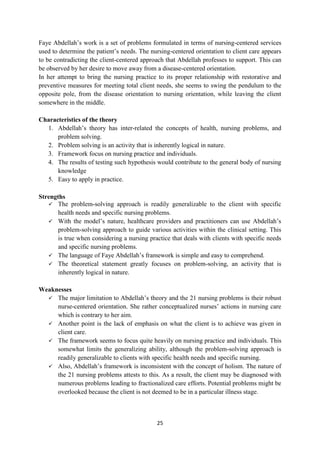
  • 32.
    32 JOHNSON’S BEHAVIORAL SUBSYSTEM Attachment or affiliative subsystem: ―social inclusion intimacy and the formation and attachment of a strong social bond.‖  Dependency subsystem: ―approval, attention or recognition and physical assistance‖  Ingestive subsystem: ―the emphasis is on the meaning and structures of the social events surrounding the occasion when the food is eaten‖  Eliminative subsystem: “human cultures have defined different socially acceptable behaviors for excretion of waste, but the existence of such a pattern remains different from culture to Culture.‖  Sexual subsystem:" both biological and social factor affect the behavior in the sexual subsystem‖  Aggressive subsystem: " it relates to the behaviors concerned with protection and self- preservation Johnson views aggressive subsystem as one that generates defensive response from the individual when life or territory is being threatened‖  Achievement subsystem: “provokesbehavior that attempt to control the environment intellectual, physical, creative, mechanical and social skills achievement are some of the areas that Johnson recognizes". REPRESENTATION OF JOHNSON'S MODEL
  • 33.
    33 THE FOUR MAJORCONCEPTS a) ―Human being‖ as having two major systems, the biological system and the behavioral system. It is role of the medicine to focus on biological system where as Nursling's focus is the behavioral system. b) ―Society‖ relates to the environment on which the individual exists. According to Johnson an individual‘s behavior is influenced by the events in the environment c) ―Health‖ is a purposeful adaptive response, physically mentally, emotionally, and socially to internal and external stimuli in order to maintain stability and comfort. d) ―Nursing‖ has a primary goal that is to foster equilibrium within the individual. Nursing is concerned with the organized and integrated whole, but that the major focus is on maintaining a balance in the Behavior system when illness occurs in an individual. NURSING PROCESS 1) ASSESSMENT Grubbs developed an assessment tool based on Johnson‘s seven subsystems plus a subsystem she labeled as restorative which focused on activities of daily living. An assessment based on behavioral model does not easily permit the nurse to gather detailed information about the biological systems:  Affiliation  Dependency  Sexuality  Aggression  Elimination  Ingestion  Achievement  Restorative 2) DIAGNOSIS Diagnosis tends to be general to the system than specific to the problem. Grubb has proposed 4 categories of nursing diagnosis derived from Johnson's behavioral system model: 1) Insufficiency 2) Discrepancy 3) Incompatibility 4) Dominance 3) PLANNING AND IMPLEMENTATION Implementation of the nursing care related to the diagnosis may be difficult because of lack of clients input in to the plan. the plan will focus on nurses actions to modify clients behavior, these plan than have a goal ,to bring about homeostasis in a subsystem, based on nursing assessment of the individuals drive, set behavior, repertoire, and observable behavior. The plan may include protection, nurturance or stimulation of the identified subsystem. 4) EVALUATION Evaluation is based on the attainment of a goal of balance in the identified subsystems. If the baseline data are available for an individual, the nurse may have goal for the individual to return to the baseline behavior. If the alterations in the behavior that are planned do occur, the
  • 34.
    34 nurse should beable to observe the return to the previous behavior patterns. Johnson's behavioral model with the nursing process is a nurse centered activity, with the nurse determining the client‘s needs and state behavior appropriate for that need. JOHNSON’S AND CHARACTERISTICS OF A THEORY 1) Interrelate concepts to create a different way of viewing a phenomenon - Concepts in Johnson's theory are interrelated. 2) Theories must be logical in nature- Johnson's theory is logical in nature. 3) Theories must be simple yet generalizable - The theory is simple. 4) Theories can be bases of hypothesis that can be tested - Research studies are conducted applying Jonhson's theory. 5) Theories contribute to and assist in increasing the body of knowledge within the discipline through the research implemented to validate them. 6) Theories can be utilized by practitioners to guide and improve their practice. 7) Theories must be consistent with other validated theories, laws and principles but will leave unanswered questions that need to be investigated. LIMITATION 1) Johnson does not clearly inter-relate her concepts of subsystems comprising the behavioural system model. 2) The definition of concept is so abstract that they are difficult to use. 3) It is difficult to test Johnson's model by development of hypothesis. 4) The focus on the behavioral system makes it difficult for nurses to work with physically impaired individual to use this theory. 5) The model is very individual oriented so the nurses working with the group have difficulty in its implementation. 6) The model is very individual oriented so the family of the client is only considered as an environment. 7) Johnson does not define the expected outcomes when one of the system is affected by the nursing implementation an implicit expectation is made that all human in all cultures will attain same outcome –homeostasis. 8) Johnson‘s behavioral system model is not flexible. SUMMARY Johnson‘s Behavioral system model is a model of nursing care that advocates the fostering of efficient and effective behavioral functioning in the patient to prevent illness. The patient is defined as behavioral system composed of 7 behavioral subsystems. Each subsystem composed of four structural characteristics i.e. drives, set, choices and observable behavior. Three functional requirement of each subsystem includes (1) Protection from noxious influences, (2) Provision for the nurturing environment, and (3) Stimulation for growth. Any imbalance in each system results in disequilibrium .it is nursing role to assist the client to return to the state of equilibrium.
  • 35.
    35 Martha E Rogers INTRODUCTION Theorist - Martha E Rogers  Born :May 12, 1914, Dallas, Texas, USA  Diploma : Knoxville General Hospital School of Nursing(1936)  Graduation in Public Health Nursing : George Peabody College, TN, 1937  MA :Teachers college, Columbia university, New York, 1945  MPH :Johns Hopkins University, Baltimore, MD, 1952  Doctorate in nursing :Johns Hopkins University, Baltimore, 1954  Fellowship: American academy of nursing  Position: Professor Emerita, Division of Nursing, New York University, Consultant, Speaker  Died : March 13 , 1994 PUBLICATIONS OF MARTHA ROGERS  Theoretical basis of nursing (Rogers 1970)  Nursing science and art :a prospective (Rogers 1988)  Nursing :science of unitary, irreducible, human beings update (Rogers 1990)  Vision of space based nursing (Rogers 1990) OVERVIEW OF ROGERIAN MODEL  Rogers‘s conceptual system provides a body of knowledge in nursing.  Rogers‘s model provides the way of viewing the unitary human being.  Humans are viewed as integral with the universe.  The unitary human being and the environment are one, not dichotomous  Nursing focus on people and the manifestations that emerge from the mutual human /environmental field process  Change of pattern and organization of the human field and the environmental field is propagated by waves  The manifestations of the field patterning that emerge are observable events  The identification of the pattern provide knowledge and understanding of human experience 5. SCIENCE OF UNITARY HUMAN BEINGS
  • 36.
    36  Basic characteristicswhich describes the life process of human: energy field, openness, pattern, and pan dimensionality  Basic concepts include unitary human being, environment, and homeodynamic principles CONCEPTS OF ROGERS MODEL 1) ENERGY FIELD  The energy field is the fundamental unit of both the living and nonliving  This energy field "provide a way to perceive people and environment as irreducible wholes"  The energy fields continuously vary in intensity, density, and extent. 2) OPENNESS  The human field and the environmental field are constantly exchanging their energy  There are no boundaries or barrier that inhibit energy flow between fields 3) PATTERN  Pattern is defined as the distinguishing characteristic of an energy field perceived as a single waves  "Pattern is an abstraction and it gives identity to the field" 4) PANDIMENSIONALITY  Pandimensionality is defined as "nonlinear domain without spatial or temporal attributes"  The parameters that human use in language to describe events is arbitrary.  The present is relative; there is no temporal ordering of lives. 5) HOMEODYNAMIC PRINCIPLES  The principles of homeodynamic postulates the way of perceiving unitary human beings  The fundamental unit of the living system is an energy field  Three principle of homeodynamics  Resonancy  Helicy  integrality 6) RESONANCE  Resonance is an ordered arrangement of rhythm characterizing both human field and environmental field that undergoes continuous dynamic metamorphosis in the human environmental process 7) HELICY  Helicy describes the unpredictable, but continuous, nonlinear evolution of energy fields as evidenced by non-repeatingr hythmicties  The principle of Helicy postulates an ordering of the humans evolutionary emergence 8) INTEGRALITY  The mutual, continuous relationship of the human energy field and the environmental field.  Changes occur by the continuous re-patterning of the human and environmental fields by resonance waves
  • 37.
    37  The fieldsare one and integrated but unique to each other. NURSING PARADIGMS 1) UNITARY HUMAN BEING (PERSON)  A unitary human being is an "irreducible, indivisible, pan dimensional (four- dimensional) energy field identified by pattern and manifesting characteristics that are specific to the whole and which cannot be predicted from knowledge of the parts" and "a unified whole having its own distinctive characteristics which cannot be perceived by looking at, describing, or summarizing the parts" 2) ENVIRONMENT  The environment is an "irreducible, pan dimensional energy field identified by pattern and integral with the human field"  The field coexist and are integral.  Manifestation emerges from this field and is perceived. 3) HEALTH  "an expression of the life process; they are the "characteristics and behavior emerging out of the mutual, simultaneous interaction of the human and environmental fields"  Health and illness are the part of the sane continuum.  The multiple events taking place along life's axis denote the extent to which man is achieving his maximum health potential and very in their expressions from greatest health to those conditions which are incompatible with the maintaining life process 4) NURSING Two dimensions Independent science of nursing 1. An organized body of knowledge which is specific to nursing is arrived at by scientific research and logical analysis 2. Art of nursing practice:  The creative use of science for the betterment of the human  The creative use of its knowledge is the art of its practice  Nursing exists to serve people.
  • 38.
    38  It isthe direct and overriding responsibility to the society  The safe practice of nursing depends on the nature and amount of scientific nursing knowledge the individual brings to practice- the imaginative, intellectual judgment with which such knowledge is made in service to the mankind. ROGERIAN THEORIES-GRAND THEORIES 1. THEORY OF PARANORMAL PHENOMENA This theory explains precognition, déjàvu, clairvoyance, telepathy, and therapeutic touch Clairvoyance is rational in a four dimensional human field in continuous mutual, simultaneous interaction with a four dimensional world; there is no linear time nor any separation of human and the environmental fields 2. THE THEORY OF ACCELERATING EVOLUTION Theory postulates that evolutionary change is speeding up and that the range of diversity of life process is widening. Higher wave frequencies are associated with accelerating human development 3. THEORY OF RHYTHMICITY Focus on the human field rhythms (these rhythms are different from the biological, psychological rhythm) Theory deals with the manifestations of the whole unitary man as changes in human sleep wake patterns, indices of human field motion, perception of time passing, and other rhythmic development THEORIES DERIVED FROM THE SCIENCE OF UNITARY HUMAN BEINGS  The perspective rhythm model (Patrick 1983)  Theory of health as expanding consciousness (Neuman, 1986)  Theory of creativity, actualization and empathy (Alligood 1991)  Theory of self-transcendence (Reed1997)  Power as knowing participation in change (Barrett 1998)
  • 39.
    39 APPLICATION OF MARTHAROGERS THEORY Case description: Mrs Geetha, a 70 years old female, was admitted to the Intensive Care Unit (ICU) in an unresponsive state and was diagnosed to have septicaemia. She was a known case of hypertension and diabetes mellitus for seven years. She had right sided hemiplegia due to a stroke a year ago. She was on regular treatment. On admission, she was treated in the ICU for three days and then shifted to the general medical ward. In the ICU she was drowsy, not able to verbalize her feelings. She stares blankly. Her face looked anxious. She was fed through nasogastric tube, Foley‘s catheter was draining urine, and bowel pattern was regular. A decubitus ulcer was present on the sacral region. She had restricted movements of the right side. After regaining her consciousness and when her condition was stable, she was shifted to medical ward. In the ward, she looks more relaxed and able to tolerate fluids orally. Mrs Geetha was a widow residing with her son. She said, ―For seven years my son is spending a lot on my treatment. My sickness has laid burden on him and his family.‖ Her son is very supportive and states, ―Our mother has brought us up with lot of difficulties, so we want to take care of her well.‖ He added, ―My mother is very religious and strong enough to face the problems of life.‖ Mrs Geetha was treated in the hospital for three weeks and then discharged. On discharge, she was able to tolerate soft diet. Foleys catheter was retained. Family members were taught about the care to be taken at home. They were referred to social workers. Mrs Geetha was able to sit with support in the bed, move her left limbs, but was dependent on others for all other activities of daily living. Application of Rogers‘ system model to Mrs Geetha explains that the pattern of her changed according to the changes in life. Initially she was healthy, independent, and active in her life. Once she was diagnosed with HTN, DM and later with hemiplegia, she had to change her life style and adjust with her illness. For the seven years she was moving towards maximum health, but she was not able to achieve it, her condition deteriorated, and she was hospitalized. Her pattern in the hospital had changed again, which was decided by others especially the health care professionals and her family members. During her hospitalization, the main concern of the nursing staff was to help her achieve maximum health. At the time of discharge, family support and rehabilitation was provided so that she is hale and hearty in future. She was using the resources from family, society, and the hospital for a better life in future. Based on the above concepts, nursing care was provided to Mrs Geetha using the nursing process. Nursing assessment based on Rogers’ system model Assessment Nursing Diagnosis Pattern Mrs Geetha is a right sided hemiplegic. She said, ―I cannot do anything of my own. I am dependent on others for everything.‖ She tolerates only fluid and soft diet and her intake is reduced. She has a deep bedsore over sacral 1) Self-care deficit related to immobility. 2) Impaired skin integrity related to prolonged bed rest. 3) Impaired social interaction
  • 40.
    40 region. Her patternis decided by others in the hospital. She said, ―I am not able to mix up with others due to my condition, I feel lonely.‖ Mrs Geetha‘s son stated, ―She is very religious and bold enough to face the problems of life, but now she has lost the confidence. She feels lonely and isolated.‖ Mrs Geetha strives hard to achieve the fullest health within her limits related to activity intolerance and inability to travel to usual social activities. 4) Interrupted family process related to financial crisis. 5) Anxiety related to prognosis of the disease. 6) Risk for care giver strain related to the chronic illness. 7) Knowledge deficit of the caregiver related to homecare management. 8) Risk for complications related to the chronic illness. Resonancy Mrs Geetha is on treatment. She complies with it. She states, ―If I do not take these medicines my condition may deteriorate further.‖ She further states, ―My illness has laid burden on my son.‖ But her son is very supportive. It is observed that sometimes she is pleasant, sometimes dull and withdrawn. When she was dull she said, ―I feel depressed and guilty of my illness. I do not know what will happen in the future?‖ Helicy In Mrs Geetha‘s present condition she is unidirectional in moving towards achieving health within her limits. She said, ―I accept my illness; I may be recovering by using all the resources available. I do not fear death.‖ Her son stated, ―We will support and care for our mother throughout her remaining life.‖ Integrality As Mrs Geetha is hemiplegic and ready for discharge, her family has to do some modifications at home. She has to get treatment for her HTN and DM also. Her son stated, ―I do not know how to take care of her at home and prevent any forth coming problems.‖ Nursing care plan for Mrs Geetha Sr. no. Nursing diagnosis Goal/ objective Planning Implementation Evaluation 1 Self-care deficit related to immobility To meet the self-care needs (activities of daily living [ADL]) -To assist the client in meeting ADL. -Provide constant encouragement -Provide family support. -Performed ADL which the client is not able to do -Assisted the client in washing, eating, grooming etc. -Provided constant Client is carrying out the activities within her limits. Family members are
  • 41.
    41 encouragement to Mrs Geetha. -Providedconstant reinforcement. -Taught the family members about care of the client and involved them in the care of the client. assisting and encouraging her 2 Impaired skin integrity related to prolonged bed rest Client maintains intact skin - To treat bed sore. -To relieve pressure on the bed sore. -Assist her in maintaining hygiene. -Educate the family members. -Performed bed sore dressing twice a day. -Provided high protein and Vitamin C rich diet and maintained good hydration. -Changed position every two hourly. -Given back care every two hourly -Provided comfort devices like pillows, air cushion, and water mattress. -Assisted her in maintaining good hygiene and kept her clean and dry. - Educated the family members regarding the care and further prevention of bed sores. Bed sore is getting healed. Family members understood the instructions given and they are implementing them. 3 Impaired social interaction related to activity intolerance and inability to travel to usual social To reduce client‘s social isolation -Assess social life of the family -Provide diversion therapy -Listen to clients‘ problems or complaints -Assessed the family communication pattern and social life. -Encouraged client and family to verbalize feeling -Provided diversion therapy -Encouraged family Client verbalized that she feels good. Family members verbalized that they will help the client to minimize her
  • 42.
    42 activities to provide entertainmentlike TV, newspaper etc. -Involved family members in the care of the client. -Encouraged relatives to visit the client often. -Counselled the family members regarding being good listeners of the client. social isolation. 4 Anxiety related to the prognosis of the disease To minimise the anxiety of the client and the family -Assess the anxiety level. -Assist them in verbalizing their feelings -Provide them with knowledge. -Involve the family in care of the client. -Assessed the anxiety of the client and family as they verbalized it. -Encouraged them to verbalize their feelings. -Educated them regarding the disease condition, treatment, prognosis and home care management. - Introduced them to other families with similar problems. -Provided diversion therapy -Involved the family in care of client. Client and family verbalized that their anxiety is reduced to some extent. 5 Knowledge deficit regarding home care manageme nt To provide adequate knowledge -Assess their knowledge. -Provide education. -Assess their ability after teaching. -Assessed the knowledge level of the client and family members. -Educated the client and family members about care of client at home. -Demonstrated various procedures that need to be Client and family verbalized that they got adequate knowledge regarding home care management.
  • 43.
    43 carried out athome and taken the return demonstration of the same. -Taught them regarding the necessary modifications to be done in the home setting. -Introduce them to other families, who have a similar client to care at home.
  • 44.
    44 INTRODUCTION  Born 1914in Baltimore, US  Earned her diploma at Providence Hospital – Washington, DC  1939 – BSN Ed., Catholic University of America  1945 – MSN Ed., Catholic University of America  She worked as a staff nurse, private duty nurse, nurse educator and administrator and nurse consultant.  Received honorary Doctor of Science degree in 1976.  Theory was first published in Nursing: Concepts of Practice in 1971, second in 1980, in 1995, and 2001. MAJOR ASSUMPTIONS  People should be self-reliant and responsible for their own care and others in their family needing care  People are distinct individuals  Nursing is a form of action – interaction between two or more persons  Successfully meeting universal and development self-care requisites is an important component of primary care prevention and ill health  A person‘s knowledge of potential health problems is necessary for promoting self-care behaviors  Self-care and dependent care are behaviors learned within a socio-cultural context DEFINITIONS OF DOMAIN CONCEPTS 1) Nursing is an art, a helping service, and a technology  Actions deliberately selected and performed by nurses to help individuals or groups under their care to maintain or change conditions in themselves or their environments  Encompasses the patient‘s perspective of health condition ,the physician‘s perspective , and the nursing perspective 6. DOROTHEA OREM'S SELF-CARE THEORY
  • 45.
    45  Goal ofnursing – to render the patient or members of his family capable of meeting the patient‘s self-care needs  To maintain a state of health  To regain normal or near normal state of health in the event of disease or injury  To stabilize ,control ,or minimize the effects of chronic poor health or disability 2) Health – health and healthy are terms used to describe living things …  It is when they are structurally and functionally whole or sound … wholeness or integrity. .includes that which makes a person human,…operating in conjunction with physiological and psychophysiological mechanisms and a material structure and in relation to and interacting with other human beings 3) Environment  environment components are enthronement factors, enthronement elements, conditions, and developed environment 4) Human being – has the capacity to reflect, symbolize and use symbols  Conceptualized as a total being with universal, developmental needs and capable of continuous self-care  A unity that can function biologically, symbolically and socially 5) Nursing client  A human being who has "health related /health derived limitations that render him incapable of continuous self-care or dependent care or limitations that result in ineffective / incomplete care.  A human being is the focus of nursing only when a self –care requisites exceeds self- care capabilities Nursing problem  deficits in universal, developmental, and health derived or health related conditions Nursing process  A system to determine (1)why a person is under care (2) a plan for care , (3) the implementation of care Nursing therapeutics  deliberate, systematic and purposeful action, OREM’S GENERAL THEORY OF NURSING Orem‘s general theory of nursing in three related parts:- a) Theory of self-care b) Theory of self-care deficit c) Theory of nursing system
  • 46.
    46 A. THEORY OFSELF CARE This theory Includes:  Self-care – practice of activities that individual initiates and perform on their own behalf in maintaining life ,health and well being  Self-care agency – is a human ability which is "the ability for engaging in self-care" - conditioned by age developmental state, life experience sociocultural orientation health and available resources  Therapeutic self-care demand – "totality of self-care actions to be performed for some duration in order to meet self-care requisites by using valid methods and related sets of operations and actions"  Self-care requisites - action directed towards provision of self-care. 3 categories of self-care requisites are-  Universal self-care requisites  Developmental self-care requisites  Health deviation self-care requisites 1. Universal self-care requisites  Associated with life processes and the maintenance of the integrity of human structure and functioning  Common to all , ADL  Identifies these requisites as:  Maintenance of sufficient intake of air,water, food  Provision of care associated with elimination process  Balance between activity and rest, between solitude and social interaction  Prevention of hazards to human life well-being and  Promotion of human functioning 2. Developmental self-care requisites  Associated with developmental processes/ derived from a condition or associated with an event E.g. adjusting to a new job, adjusting to body changes 3. Health deviation self-care  Required in conditions of illness, injury, or disease .these include:--  Seeking and securing appropriate medical assistance  Being aware of and attending to the effects and results of pathologic conditions  Effectively carrying out medically prescribed measures  Modifying self-concepts in accepting oneself as being in a particular state of health and in specific forms of health care  Learning to live with effects of pathologic conditions B. THEORY OF SELF CARE DEFICIT  Specifies when nursing is needed  Nursing is required when an adult (or in the case of a dependent, the parent) is incapable or limited in the provision of continuous effective self-care.  Orem identifies 5 methods of helping: 1. Acting for and doing for others
  • 47.
    47 2. Guiding others 3.Supporting another 4. Providing an environment promoting personal development in relation to meet future demands 5. Teaching another C. THEORY OF NURSING SYSTEMS  Describes how the patient‘s self-care needs will be met by the nurse, the patient, or both.  Identifies 3 classifications of nursing system to meet the self-care requisites of the patient:- 1. Wholly compensatory system 2. Partly compensatory system 3. Supportive – educative system  Design and elements of nursing system  Define scope of nursing, responsibility in health care situations  General and specific roles of nurses and patients  Reasons for nurses‘ relationship with patients and  Orem recognized that specialized technologies are usually developed by members of the health profession  A technology is systematized information about a process or a method for affecting some desired result through deliberate practical endeavour, with or without use of materials or instruments.
  • 48.
    48 CATEGORIES OF TECHNOLOGIES 1.SOCIAL OR INTERPERSONAL  Communication adjusted to age, health status  Maintaining interpersonal, intra group or inter group relations for coordination of efforts  Maintaining therapeutic relationship in light of psychosocial modes of functioning in health and disease  Giving human assistance adapted to human needs ,action abilities and limitations 2. REGULATORY TECHNOLOGIES  Maintaining and promoting life processes  Regulating psycho physiological modes of functioning in health and disease  Promoting human growth and development  Regulating position and movement in space OREM’S THEORY AND NURSING PROCESS  Nursing process presents a method to determine the self-care deficits and then to define the roles of person or nurse to meet the self-care demands.  The steps within the approach are considered to be the technical component of the nursing process.  Orem emphasizes that the technological component "must be coordinated with interpersonal and social processes within nursing situations. Nursing Process Orem’s Nursing Process  Assessment  Diagnosis and prescription; determine why nursing is needed. analyze and interpret –make judgment regarding care  Design of a nursing system and plan for delivery of care  Production and management of nursing systems Step 1-collect data in six areas:- 1. The person‘s health status 2. The physician‘s perspective of the person‘s health status 3. The person‘s perspective of his or her health 4. The health goals within the context of life history ,life style, and health status 5. The person‘s requirements for self-care 6. The person‘s capacity to perform self-care
  • 49.
    49  Nursing diagnosis   Planswith scientific rationale Step 2  Nurse designs a system that is wholly or partly compensatory or supportive-educative.  The 2 actions are:- 1. Bringing out a good organization of the components of patients‘ therapeutic self-care demands 2. Selection of combination of ways of helping that will be effective and efficient in compensating for/ overcoming patient‘s self-care deficits  Implementation   evaluation Step 3  Nurse assists the patient or family in self-care matters to achieve identified and described health and health related results. collecting evidence in evaluating results achieved against results specified in the nursing system design  Actions are directed by etiology component of nursing diagnosis  evaluation OREM’S WORK AND THE CHARACTERISTICS OF A THEORY  Orem's theory interrelate concepts in such a way as to create a different way of looking at a particular phenomenon  Is logical in nature.  is relatively simple yet generalizable  is basis for hypothesis that can be tested  contribute to and assist in increasing the general body of knowledge within the discipline through the research implemented to validate them  can be used by the practitioners to guide and improve their practice  must be consistent with other validated theories ,laws and principles STRENGTHS  Provides a comprehensive base to nursing practice  It has utility for professional nursing in the areas of nursing practice nursing curricula ,nursing education administration ,and nursing research  Specifies when nursing is needed  Her self-care approach is contemporary with the concepts of health promotion and health maintenance LIMITATIONS  In general system theory a system is viewed as a single whole thing while Orem defines a system as a single whole, thing.  Health is often viewed as dynamic and ever changing.  The theory is illness oriented.
  • 50.
    50 APPLICATION OF OREM'SSELF-CARE DEFICIT THEORY OBJECTIVES 1. to assess the patient condition by the various methods explained by the nursing theory 2. to identify the needs of the patient 3. to demonstrate an effective communication and interaction with the patient. 4. to select a theory for the application according to the need of the patient 5. to apply the theory to solve the identified problems of the patient 6. to evaluate the extent to which the process was fruitful PATIENT PROFILE Areas Patient details Name Age Sex Education Occupation Marital status Religion Diagnosis Theory applied Mrs. X 56 years Female No formal education House hold Married Hindu Rheumatoid arthritis Orem‘s theory of self-care deficit. OREM’S THEORY OF SELF CARE DEFICIT  The self-care deficit theory proposed by Orem is a combination of three theories, i.e. theory of self-care, theory of self-care deficit and the theory of nursing systems.  In the theory of self-care, she explains self-care as the activities carried out by the individual to maintain their own health.  The self-care agency is the acquired ability to perform the self-care and this will be affected by the basic conditioning factors such as age, gender, health care system, family system etc.  Therapeutic self-care demand is the totality of the self-care measures required.  The self-care is carried out to fulfill the self-care requisites.  There are mainly 3 types of self-care requisites such as universal, developmental and health deviation self-care requisites.  Whenever there is an inadequacy of any of these self-care requisite, the person will be in need of self-care or will have a deficit in self-care.  The deficit is identified by the nurse through the thorough assessment of the patient.  Once the need is identified, the nurse has to select required nursing systems to provide care: wholly compensatory, partly compensatory or supportive and educative system.  The care will be provided according to the degree of deficit the patient is presenting with.
  • 51.
    51  Once thecare is provided, the nursing activities and the use of the nursing systems are to be evaluated to get an idea about whether the mutually planned goals are met or not.  Thus the theory could be successfully applied into the nursing practice. For Mrs. X came to the hospital with complaints of pain over all the joints, stiffness which is more in the morning and reduces by the activities. She has these complaints since 5 years and has taken treatment from local hospital. The symptoms were not reducing and came to --MC, Hospital for further management. Patient was able to do the ADL by herself but the way she performed and the posture she used was making her prone to develop the complications of the disease. She also was malnourished and was not having awareness about the deficiencies and effects. DATA COLLECTION ACCORDING TO OREM’S THEORY OF SELF CARE DEFICIT 1. BASIC CONDITIONING FACTORS Age 56 year Gender Female Health state Disability due to health condition, therapeutic self-care demand Development state Ego integrity vs despair Socio-cultural orientation No formal education, Indian, Hindu Health care system Institutional health care Family system Married, husband working Patterns of living At home with partner Environment Rural area, items for ADL not in easy reach, no special precautions to prevent injuries resources Husband, daughter, sister‘s son
  • 52.
    52 2. UNIVERSAL SELF-CAREREQUISITES Air Breaths without difficulty, no pallor cyanosis Water Fluid intake is sufficient. Edema present over ankles. Turgor normal for the age Food Hb – 9.6gm%, BMI = 14.Food intake is not adequate or the diet is not nutritious. Elimination Voids and eliminates bowel without difficulty. Activity/ rest Frequent rest is required due to pain. Pain not completely relieved, Activity level has come down. Deformity of the joint secondary to the disease process and use of the joints. Social interaction Communicates well with neighbors and calls the daughter by phone Need for medical care is communicated to the daughter. Prevention of hazards Need instruction on care of joints and prevention of falls. Need instruction on improvement of nutritional status. Prefer to walk bare foot. Promotion of normalcy Has good relation with daughter 3. DEVELOPMENTAL SELF-CARE REQUISITES Maintenance of developmental environment Able to feed self , Difficult to perform the dressing, toileting etc. Prevention/ management of the conditions threatening the normal development Feels that the problems are due to her own behaviours and discusses the problems with husband and daughter.
  • 53.
    53 4. HEALTH DEVIATIONSELF CARE REQUISITES Adherence to medical regimen Reports the problems to the physician when in the hospital. Cooperates with the medication, Not much aware about the use and side effects of medicines Awareness of potential problem associated with the regimen Not aware about the actual disease process. Not compliant with the diet and prevention of hazards. Not aware about the side effects of the medications Modification of self-image to incorporates changes in health status Has adapted to limitation in mobility. The adoption of new ways for activities leads to deformities and progression of the disease. Adjustment of lifestyle to accommodate changes in the health status and medical regimen. Adjusted with the deformities. Pain tolerance not achieved 5. MEDICAL PROBLEM AND PLAN Physician’s perspective of the condition: Diagnosed with rheumatoid arthritis and is on the following medications:  T. Valus SR OD  T. Pan 40 mg OD  T. Tramazac 50 mg OD  T. Recofix Forte BD  T. Shelcal BD  Syp. Heamup 2tsp TID Medical Diagnosis: Rheumatoid arthritis Medical Treatment: Medication and physical therapy.
  • 54.
    54 AREAS AND PRIORITYACCORDING TO OREM’S THEORY OF SELF-CARE DEFICIT: IMPORTANT FOR PRIORITIZING THE NURSING DIAGNOSIS. 1. Air 2. Water 3. Food 4. Elimination 5. Activity/ Rest 6. Solitude/ Interaction 7. Prevention of hazards 8. Promotion of normalcy 9. Maintain a developmental environment. 10. Prevent or manage the developmental threats 11. Maintenance of health status 12. Awareness and management of the disease process. 13. Adherence to the medical regimen 14. Awareness of potential problem. 15. modify self-image 16. Adjust life style to accommodate health status changes and MR DATA COLLECTION ACCORDING TO OREM’S THEORY OF SELF CARE DEFICIT 1. BASIC CONDITIONING FACTORS Age 56 year Gender Female Health state Disability due to health condition, therapeutic self-care demand Development state Ego integrity vs despair Sociocultural orientation No formal education, Indian, Hindu Health care system Institutional health care
  • 55.
    55 Family system Married,husband working Patterns of living At home with partner Environment Rural area, items for ADL not in easy reach, no special precautions to prevent injuries resources Husband, daughter, sister‘s son 2. UNIVERSAL SELF-CARE REQUISITES Air Breaths without difficulty, no pallor cyanosis Water Fluid intake is sufficient. Edema present over ankles. Turgor normal for the age Food Hb – 9.6gm%, BMI = 14.Food intake is not adequate or the diet is not nutritious. Elimination Voids and eliminates bowel without difficulty. Activity/ rest Frequent rest is required due to pain. Pain not completely relieved. Activity level has come down. Deformity of the joint secondary to the disease process and use of the joints. Social interaction Communicates well with neighbors and calls the daughter by phone Need for medical care is communicated to the daughter.
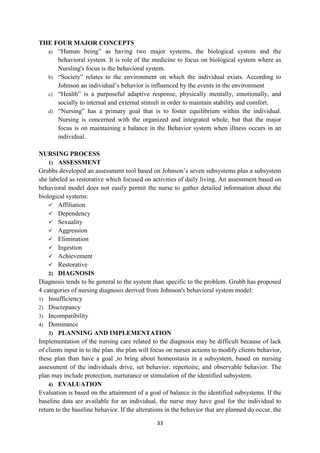
  • 56.
    56 Prevention of hazards Need instructionon care of joints and prevention of falls. Need instruction on improvement of nutritional status. Prefer to walk bare foot. Promotion of normalcy Has good relation with daughter 3. DEVELOPMENTAL SELF-CARE REQUISITES Maintenance of developmental environment Able to feed self , Difficult to perform the dressing, toileting etc Prevention/ management of the conditions threatening the normal development Feels that the problems are due to her own behaviours and discusses the problems with husband and daughter. 4. HEALTH DEVIATION SELF CARE REQUISITES Adherence to medical regimen Reports the problems to the physician when in the hospital. Cooperates with the medication, Not much aware about the use and side effects of medicines Awareness of potential problem associated with the regimen Not aware about the actual disease process. Not compliant with the diet and prevention of hazards. Not aware about the side effects of the medications Modification of self-image to incorporates changes in health status Has adapted to limitation in mobility. The adoption of new ways for activities leads to deformities and progression of the disease. Adjustment of lifestyle to accommodate changes in the health status and medical Adjusted with the deformities. Pain tolerance not achieved
  • 57.
    57 regimen. 5. MEDICAL PROBLEMAND PLAN Physician’s perspective of the condition: Diagnosed with rheumatoid arthritis and is on the following medications:  T. Valus SR OD  T. Pan 40 mg OD  T. Tramazac 50 mg OD  T. Recofix Forte BD  T. Shelcal BD  Syp. Heamup 2tsp TID Medical Diagnosis: Rheumatoid arthritis Medical Treatment: Medication and physical therapy. PRIORITY ACCORDING TO OREM’S THEORY OF SELF-CARE DEFICIT: IMPORTANT FOR PRIORITIZING THE NURSING DIAGNOSIS.  Air  Water  Food  Elimination  Activity/ Rest  Solitude/ Interaction  Prevention of hazards  Promotion of normalcy  Maintain a developmental environment.  Prevent or manage the developmental threats  Maintenance of health status  Awareness and management of the disease process.  Adherence to the medical regimen  Awareness of potential problem.  modify self-image  Adjust life style to accommodate health status changes and MR
  • 58.
    58 APPLYING THE OREM’STHEORY OF SELF-CARE DEFICIT, A NURSING CARE PLAN FOR MRS. X COULD BE PREPARED AS FOLLOWS … A. THERAPEUTIC SELF CARE DEMAND: DEFICIENT AREA: FOOD ADEQUACY OF SELF CARE AGENCY: INADEQUATE NURSING DIAGNOSIS- Inability to maintain the ideal nutrition related to inadequate intake and knowledge deficit a. Outcome:  Improved nutrition  Maintenance of a balanced diet with adequate iron supplementation. b. Nursing Goals and objectives Goal: to achieve optimal levels of nutrition. Objectives: Mrs. X will:  State the importance of maintaining a balanced diet.  List the food items rich in iron, that are available in the locality. c. Design of the nursing system: Supportive educative d. Method of helping:  guidance  support  Teaching  Providing developmental environment IMPLEMENTATION Mutually planned and identified the objectives and the patient were made to understand about the required changes in the behaviour to have the requisites met. EVALUATION  Mrs. X understood the importance of maintaining an optimum nutrition.  She told that she will select the iron rich diet for her food.  She listed the foods that are rich in iron and that are locally available.  The self-care deficit in terms of food will be decreased with the initiation of the nutritional intake.  The supportive educative system was useful for Mrs. X
  • 59.
    59 B. THERAPEUTIC SELFCARE DEMAND: DEFICIENT AREA: ACTIVITY ADEQUACY OF SELF CARE AGENCY: INADEQUATE NURSING DIAGNOSIS- Self-care deficit: dressing, toileting related to restricted joint movement, secondary to the inflammatory process in the joints. a. Outcome:  improved self-care  Maintain the ability to perform the toileting and dressing with modification as required. b. Nursing Goals and objectives Goal: to achieve optimal levels of ability for self-care. Objectives: Mrs. X will:  perform the dressing activities within limitations  utilize the alternative measures available for improving the toileting  perform the other activities of daily living with minimal assistance. c. Design of the nursing system: Partly compensatory d. Method of helping: 1. Guidance:  Assess the various hindering factors for self-care and how to tackle them. 2. Support:  Provide all the articles needed for self-care, near to the patient and ask the family members also to give the articles near to her.  Provide passive exercises and make to perform active exercises so as to promote the mobility of the joint.  Make the patient use commodes or stools to perform toileting and insist on avoidance of squatting position  Provide assistance whenever needed for the self-care activities  Provide encouragement and positive reinforcement for minor improvement in the activity level.  Initiate the pain relieving measures always before the patient go for any of the activities of daily living  Make the patient to use loose fitting clothes which will be easy to wear and remove. 3. Teaching:  Teach the family members the limitation in the activity level the patient has and the cooperation required 4. Promoting a developmental environment:  Teach the family and help them to practice how to help the patient according to her needs IMPLEMENTATION  Mutually planned and identified the objectives and the patient was made to understand about the required changes in the behaviour to have the requisites met.
  • 60.
    60 EVALUATION  Patient wasperforming some of the activities and she practiced toileting using a commode in the hospital.  She verbalized an improved comfort and self-care ability.  She performed the dressing activities with minimal assistance  Patient verbalized that she will perform the activities as instructed to get her ADL done.  The partly compensatory system was useful for Mrs. X C. THERAPEUTIC SELF CARE DEMAND: DEFICIENT AREA: PAIN CONTROL ADEQUACY OF SELF CARE AGENCY: INADEQUATE NURSING DIAGNOSIS- Ineffective pain control related to lack of utilization of pain relief measures a. Outcome:  improved pain self control  achieve and maintain a reduction in the pain. b. Nursing Goals and objectives Goal: to achieve reduction in the pain. Objectives: Mrs. X will:  describe the total plan of pharmacological and non pharmacological pain relief  demonstrate a reduction in the pain behaviours  verbalize a reduction in the pain scale score from 7 – 4 c. Design of the nursing system: supportive educative d. method of helping: Guidance:  Explore the past experience of pain and methods used to manage them.  Ask the client to report the intensity, location, severity, associated and aggravating factors. Support:  Provide rest to the joints and avoid excessive manipulations  provide hot and cold application to have better mobility.  Encourage exercises to the joints by immersing in the warm water.  Administer T. Ultracet and Tab Diclofecac as prescribed.  Provide diversion and psychological support to the patient Teaching:  Teach the non – pharmacological method to the patient once the pain is a little reduced. Providing the developmental environment:  Discuss with the patient the necessity to maintain a pain diary with all information regarding episodes of pain and refer to that periodically
  • 61.
    61  Enquire fromthe health team, the need for opioid analgesics or other analgesics and get a prescription for the patient. IMPLEMENTATION EVALUATION  Patient still has pain over the joints and she agreed that she will use the measures for pain relief that is told to her.  The pain scale score was 6 after the measures were provided to the patient.  She demonstrated slight reduction in the pain behaviours.  The supportive educative system was useful for Mrs. X D. THERAPEUTIC SELF CARE DEMAND: DEFICIENT AREA: PREVENTION OF HAZARDS. ADEQUACY OF SELF CARE AGENCY: INADEQUATE NURSING DIAGNOSIS  Potential for fall and fractures related to rheumatoid arthritis. OUTCOMES AND PLAN a. Outcome:  Absence of falls and injury to the patient b. Nursing Goals and objectives Goal: prevent the falls and injury and to maintain a good body mechanics. Objectives: Mrs. X will:  remain free from injury as evidenced by:  absence of signs and symptoms of fall or injury  Explaining the methods to prevent the injury. c. Design of the nursing system: supportive educative d. method of helping: Support  Never leave the client alone in the unit  Assess the patients gait, activities and the mental status for any confusion or disorientation  Encourage the patient to use supportive devices as required.  Provide a safe environment in the hospital by avoiding sharp objects or wooden objects on the way and slippery floor.  Involve the family members in providing and maintaining a safe environment in the home  Involve the family members to provide support to the patient whenever necessary  Plan a balanced diet for the patient with a mutual interaction IMPLEMENTATION EVALUATION  Patient remained free from injury as evidenced by absence of signs and symptoms.  Patient explained the various measures that they will take to prevent the injury.  The supportive educative system was useful for Mrs. X
  • 62.
    62 E. THERAPEUTIC SELFCARE DEMAND: DEFICIENT AREA: PREVENTION OF HAZARDS. ADEQUACY OF SELF CARE AGENCY: INADEQUATE NURSING DIAGNOSIS:  Potential for impaired skin integrity related to edema secondary to renal cysts. OUTCOMES AND PLAN: a. Outcome:  Maintenance of normal skin integrity. b. nursing Goals and objectives Goal: Maintain the skin integrity and take measures to prevent skin impairment. Objectives: Mrs. X will:  maintain a normal skin integrity  list the measures to prevent the loss of skin integrity  identify the measures to relieve edema. c. Design of the nursing system: supportive educative d. method of helping: Support:  Assess the skin regularly for any excoriation or loss of integrity or colour changes. Keep the skin clean always  Avoid stress or pressure over the area of edema by providing extra cushions or padding  Monitor the lab values as well as the patient for any signs and symptoms of renal failure.  Encourage the patient to use slippers while walking and that should not be tight fitting.  Assess the edema for its degree, pitting or non pitting and continue the assessment daily.  Provide a leg end elevated position or elevation of the leg on a pillow if no cardiac abnormalities are identified.  Explain the patient the need for taking care of the edematous parts  Explain the patient to report the symptoms like decreased urine output, palpitations, increased edema etc. to the health team IMPLEMENTATION EVALUATION  Patient remained free from impaired skin integrity  She listed the measures to prevent the loss of skin integrity  She identified the measures to relieve edema.  The supportive educative system was useful for Mrs. x
  • 63.
    63 F. THERAPEUTIC SELFCARE DEMAND: DEFICIENT AREA: AWARENESS OF THE DISEASE PROCESS AND MANAGEMENT ADEQUACY OF SELF CARE AGENCY: INADEQUATE NURSING DIAGNOSIS  Potential for complications related to rheumatoid arthritis secondary to knowledge deficit. OUTCOMES AND PLAN a. Outcome:  Absence of complications and improved awareness about the disease process. b. nursing Goals and objectives Goal: Improve the knowledge of the patient about the disease process and the complications. Objectives: Mrs. X will:  verbalize the various complication and their preventions  verbalize the changes occurring with the disease process and the treatment available  describe the actions and side effects of the medications which she is using c. Design of the nursing system: Supportive educative d. Methods of helping:  Guidance  Teaching  Promoting a developmental environment IMPLEMENTATION EVALUATION  Patient got adequate information regarding the disease  She verbalized what she understood about the disease and its management.  Patient has cleared her doubts regarding the medication actions and the side effect  The supportive educative system was useful for Mrs. X EVALUATION OF THE APPLICATION OF SELF CARE DEFICIT THEORY The theory of self-care deficit when applied could identify the self-care requisites of Mrs. X from various aspects. This was helpful to provide care in a comprehensive manner. Patient was very cooperative. the application of this theory revealed how well the supportive and educative and partly compensatory system could be used for solving the problems in a patient with rheumatoid arthritis.
  • 64.
    64 Introduction:  Imogene Kingwas born on Jan. 30 1923 in west point, Lowa.  She completed her basic nursing education in1945, when she received her diploma in nursing from St. John‘s hospital school of nursing, St Louis.  In 1948, she received her B.Sc in nursing education and in 1957, her M.Sc. in nursing from St. Louis University.  In 1961 she was awarded a doctorate in education from teachers college, Colombia University, New York City.  She held various positions in nursing education, administration and practice.  King began formulating her theory, while as an associated professor of nursing at Loyola University Chicago, where she developed a master‘s degree programmer in nursing, using a conceptual framework.  She was actively involved in the establishment of King International Nursing Group,  In 1971, she published towards a theory for nursing general concepts of human behavior, in which she proposed a conceptual framework for nursing rather than a theory.  In 1981, she published towards a theory for nursing; systems, concepts and process. 1. King proposes an open systems framework as a basis for her theory of goal attainment. 2. She links then concepts essential to understanding nursing as a major system within the health care system. 3. Her vision of the nursing process placed a strong emphasis on interpersonal processes.  King bases her theory on general system theory, the behavioral sciences and deductive and inductive reasoning. What was the impetus for king to write about nursing?  During the 20th century the rapidity of knowledge development in many areas had a great impact on the profession of nursing as on the rest of the society. 7. KING’S GOAL ATTENMENT THEORY
  • 65.
    65  In the1960s, as emerging professionals nurses were identifying the knowledge base specific to nursing practice and to an expanding role for nurses.  In 1964 king published a paper discussing problems and prospects for the development of nursing knowledge  In 1968 she first identified several concepts she later use in her conceptual system and continued to discuss the need for nursing knowledge base.  in this environment king (1971)sought to answer several questions.-  What are some of the social and educational changes in united states that have influence changes in nursing?  What basic elements are continuous throughout this change in nursing?  What is the scope of the practice of nursing and in what kind of settings do nurses perform their functions?  Are the current goals of nursing similar to those of the past half century?  What are the dimensions of practice that have given the field of nursing unifying focus overtime? In exploring the literature on systems analysis and general system theory, king (1971) develop additional questions:  What kind of decisions are nurses required to make in the course of their roles and responsibilities?  What kind of information is essential for them to make decisions?  What are the alternatives in nursing situations?  What alternative courses of actions do nurses have in making critical decisions about another individuals care recovery and health?  What skills do nurses now perform and what knowledge is essential for nurses to make decision about alternatives? Even though this questions post several decades ago they still provide food for thought. King towards a theory for nursing: ‗General concepts of human behavior‘ were published in1971 and a ‗theory for nursing: systems concept process‘ in 1981. These publications grew from kings thoughts about the vast amount of knowledge available to nurses and difficulty this present to the individual nurse in choosing the facts and concepts relevant to given to situation. In the preface to, ‗towards a theory for nursing‘, king clearly stated that she was proposing a conceptual framework for nursing and not a nursing theory. As she denoted in the title, her purpose was to help move toward theory for nursing. In contrast in the preface to a ‗theory for nursing‘ she indicates that she has expanded and builds on the original framework. In the second publication she again presents her system based conceptual framework and discuss the relationship of the concepts she identified as fundamental to comprehending nursing as a system in the health care systems. She also discussed concept of development and knowledge application in nursing and through explication of her theory of goal attainment, derived from the open system framework, showed one-way of constructing theory.
  • 66.
    66 King identified herwork as a conceptual system. The function of a conceptual system is to give support for arranging ideas or concepts into group that provides meaning. KINGS OPEN SYSTEM FRAMEWORK/ CONCEPTUAL SYSTEM: General information: I. Are based on the assumption, humans have open interaction with their environment. II. Consist of three interacting systems; personal, interpersonal and social. Purposes of the conceptual framework:  Name concepts necessary to nursing as a discipline.  Provide for the derivation of theories that are tested through research as part of the development of the scientific base for nursing knowledge.  Provide an organizing structure nursing curriculum  Lead to nursing practice, based in theory that supports quality care in all settings in which nursing occurs. Concept and knowledge may be similar across disciplines, but the way each profession uses them will differ.  The conceptual system includes goal, structure functions, recourses and decision making, which king says are essential elements.  Decision making occurs when chaises are made in resource allocation to support attaining system. In conceptual system health is the goal for nursing. Structure is represented by three open systems. 1. Functions are demonstrated in reciprocal relations of individuals in interaction and transactions. 2. Resource includes people, money goods and services for items needed to carry out specific activities. 3. Decision-making occurs when choices are made in resource allocation to support attaining system goal. Assumptions: 1. The assumptions that human beings are open system in constant interaction with their environment. 2. That nursing focus is human being interacting with their environment. 3. Nursing goals is to help individuals and groups to maintain health. CONCEPT AND KING’S CONCEPTUALSYSTEM FRAMEWORK OF KINGS GOAL ATTAINMENT THEORY:- Kings identifies the conceptual framework as an open system framework. Following are major Concepts and sub-concepts of Imogene King‘s Theory of Goal Attainment:
  • 67.
    67 1. Nursing- Nursingis a process of action, reaction, and interaction whereby nurse and client share information about their perceptions in the nursing situation. 2. Health- Health is a dynamic life experience of a human being, which implies continuous adjustment to stressors in the internal and external environment through optimum use of one‘s resources to achieve maximum potential for daily living. 3. Individual -Individuals are social beings who are rational and sentient. Humans communicate their thoughts, actions, customs, and beliefs through language. Persons exhibit common characteristics such as the ability to perceive, to think, to feel, to choose between alternative courses of action, to set goals, to select the means to achieve goals, and to make decisions. 4. Environment- Environment is the background for human interactions. It is both external to, and internal to, the individual. 5. Action - Action is defined as a sequence of behaviors involving mental and physical action. The sequence is first mental action to recognize the presenting conditions; then physical action to begin activities related to those conditions; and finally, mental action in an effort to exert control over the situation, combined with physical action seeking to achieve goals. 6. Reaction - Reaction is not specifically defined but might be considered to be included in the sequence of behaviors described in action. Imogene King used a ‗system‘ approach in the development of her dynamic interacting systems framework and in her subsequent Goal Attainment Theory. The conceptual framework is composed of three interacting systems: PERSONAL SYSTEM INTERPERSONAL SYSTEM SOCIAL SYSTEM Perception Interaction Power Growth and development Communication Decision making Space Transaction Status Self Role Authority Body image Stress Organisation Time
  • 68.
    68 PERSONAL SYSTEMS:- Individuals arepersonal systems. Each individual is an open, total, unique system in constant interaction with the environment. Interactions between and among personal systems are the focus of King‘s conceptual systeme.g.,Patients, family members, friends, other health care professionals, and nurses etc. The following concepts provide foundational knowledge that contributes to understanding individuals as personal systems: 1. Perception: ―A process of organizing, interpreting, and transforming information from sense data and memory‖. 2. Self: ―knowledge of self is a key to understanding human behaviour‖. Self is a dynamic individual, action-oriented open system. 3. Growth and development: ―The processes that take place in an individual‘s life that help the individual move from potential capacity for achievement to self-actualization‖. 4. Body image: ―An individual‘s perceptions of his/her own body and others reactions to his/her appearance‖. 5. Time: ―Duration and relation between the occurrence of one event and occurrence of another event‖. 6. Personal space: ―Existing in all directions and is the same everywhere‖. Defined by physical area known territory. INTERPERSONAL SYSTEMS:- Interpersonal systems are formed by the interactions of two or more individuals. King refers to two individuals as dyads, three as triads and four or more individuals as small group or large group. This shows how the nurse interrelates with a co-worker or patient, particularly in a nurse-patient relationship. Communication between the nurse and the client can be verbal or nonverbal. Collaboration between the Dyads (nurse-patient) is very important for the attainment of the goal. Concepts critical to understanding interactions between individuals are defined as follows: 1. Communication: intrapersonal, interpersonal, verbal and non-verbal modes of interaction that contribute to development of human relationships.
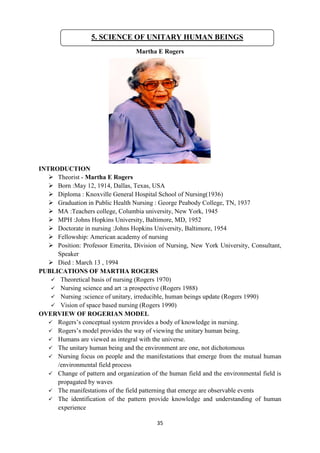
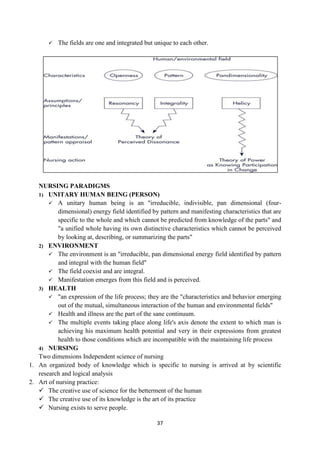
  • 69.
    69 2. Interaction: ―Actsof two or more persons in mutual presence‖. ―The process of interactions between two or more individuals represents a sequence of verbal and nonverbal behaviours that are goal-directed‖. 3. Role: ―Set of behaviours expected when occupying a position in a social system. 4. Stress: ―Dynamic state whereby a human exchange energy and information between the person and the environment for regulation and control of stressors‖. 5. Stressors: Events that produce stress. 6. Transaction: Transactions are defined as goal attainment involving the communication with the environment‖. SOCIAL SYSTEMS:- Social systems are composed of large groups with common interests or goals. This shows how the nurse interacts with co-workers, superiors, subordinates and the client environment in general. Interactions with social systems influence individuals throughout the life span. Concepts that are useful to understand interactions within social systems and between social and personal systems are defined as follows: 1. Organization: ―A system whose continuous activities are conducted to achieve goals‖. Refers to a group of people with similar interest, who have prescribed roles and positions and who use resources to achieve personal and organizational goals.  An organization is characterized by a structure that orders position and activities and includes formal and informal arrangements of people to gain both personal and organizational goals.  It has functions that describe the roles and positions of people, the activities to be performed.  It has goals or outcomes to be achieved.  It has resources.  King defined an organization as being made-up of individuals who have prescribed roles and positions and who make use of resources to meet goals- both personal and organizational. King proposed four parameters for organization:  The first are those values held by human being as the patterns of behavior and expectations, need and desired outcomes of the individuals in the system.  The second is the environment in which the system exists and that influenced the availability of resources, both materials and human.  The third is the humans in the system: family members, administration, staff and members.  The fourth involves the technology used to reach the goals of the organization. 2. Authority: it refers to the observable behavior of providing guidance and order and being responsible for actions; and technology to facilitate goal attainment. It is observable through the regularity, direction and responsibility for actions it provides; universal; necessary to formal organizations; reciprocal because it requires cooperation;
  • 70.
    70 resides in aholder who must be perceived as legitimate; situation; essential to goal achievement and associated with power. Assumptions on authority include, 1. It can be described by human beings and seen as legitimate 2. it can be held by professionals through their competence in using special skills and knowledge 3. It can exercised through group leadership by those with human relation skills King defined authority as an active, reciprocal process of transaction in which the actors experience, understanding and values influence the meaning, legitimacy and acceptance of those in organizational positions with authority. 3. Decision making: it results from developing and acting on perceived choices for goal attainment. It is characterized as necessary to provide order in an individuals or groups, living and working, universal, individual, personal, subjective, situational, continuous process and goal directed. It is a changing and orderly process through which choices related to goals are made among identified possible activities and individual and group actions are taken to move toward the goal 4. Power, which is situational, dynamic and goal- directed, is characterized by the ability to use resources for goal achievement; power is also a means by which one or more persons can influence others. 5. Status: it refers to the position occupied by a person in a group or the position occupied by a group in relation to other groups in an organization; it is accompanied by certain duties, privileges and obligations. It is defined as a concept in social system. It characterized as situational, position dependent and reversible. King defined status as the relationship of o0nes place in group to others in the group or of a group to other groups. GOAL ATTAINMENT THEORY: Theories may be derived from conceptual frameworks. King has derived a theory of goal attainment from the concepts and systems of her conceptual system. This theory focus on process to aid nurses in the nurse patient relationship, helping their patients meets the goals they have set for their health. General information: The major elements of theory are seen in the interpersonal systems in which two people who are usually strangers, come together in a health care organization to help and to be helped to maintain a state of health that permits functioning in role. The theory focus on king‘s belief ‗the practice of nursing is differentiated from that of other health professions by what nurses do with and for individuals‘. 1. According to king, each individual brings to interaction different set values, ideas, attitudes and perception to exchange.
  • 71.
    71 2. Individuals cometogether for a purpose; each person makes a judgment, takes mental or physical action and reacts to the other individuals and the situation. Interaction:  It is the observable verbal and nonverbal goal-directed behavior of two or more people in mutual presence and includes a perception and communication.  Each individual involved in interaction brings different ideas, attitudes and perceptions to the exchange.  It can be directly observable. Perception:  Perception is reality as seen by each individual  A person imports energy from the environment and transforms, process and stores it.  The individual, then exports this energy, as demonstrated by observable behaviors. Communication:  A person provides information directly the goals and the means to achieve it.  The other person receives this information and processes it. Transaction:  Two individuals mutually identify the goals and the means to achieve it.  They reach an agreement about; how to attain these goals and then set about to realize them.
  • 72.
    72 EG: Role:  Each personoccupies a position in a social system that has specific rules and obligations.  Roles can be congruent (resulting in transactions) or in conflict (resulting in stress). Decision-making:  The process of making choices from the many available, based upon facts and values, implementing the choice made and then evaluating the results in relation to goals achieved  It permits the lives of individuals and organization. KING’S THEORY AND THE FOUR CONCEPTS OF THE NURSING METAPARADIGM: 1. Person:  Person is a social, sentient, rational, reactive, perceiving, controlling, purposeful, action-oriented, time-oriented and spiritual being.  Has a right to self-knowledge, participation in decision that affects life and health and acceptance or rejection of health care.  Has three fundamental health needs; timely and useful health information, care that prevents illness and help when self-care demands cannot be met.  From these beliefs about human beings, she derived the assumptions that are specific to nurse-client interaction:  Perceptions of the nurse and client influence the interaction process.  Goals, needs, and values of the nurse and the client influence the interaction process.  Individuals have a right to knowledge about themselves  Individuals have a right to participate in decisions that influence their lives, their health, and community services  Individuals have a right to accept or reject care
  • 73.
    73  Goals ofhealth professionals and goals of recipients of health care may not be congruent Human being has three fundamental needs:  The need for health information that is usable at the time when it is needed  The need for care that seeks to prevent illness.  The need for care when human beings are unable to help themselves. King indicated that nurse have the opportunity to find out what health information the client has, how the client views his own health and what actions client takes for heath maintenance. 2. Environment and society:  Is not specifically defined by king, although, she used the terms internal environment and external environment in her open systems approach.  Environment is a function of balance between internal and external interactions, the external environment for a system is portion of world that exists outside of the system.  Could be interpreted from the general systems theory as an open system with permeable boundaries that allow the exchange of matter, energy and information. 3. Health:  Is described by king as a dynamic stare in the life cycle; illness is viewed as an interference in the continuum of the life cycle.  Implies continuous adjustment to stress in the internal and external environments, using personal resources to achieve optimal daily living. 4. Nursing:  Refers to observable nurse-client interaction, the focus of which is to help the individual maintain health and function in an appropriate role.  Is viewed as an interpersonal process of action, reaction, interaction and transaction; a nurse‘s perceptions and those of the client‘s influence the interaction.  Promotes, maintains and restores health and care for the sick, injured or dying client.  Is a service profession that meets a social need?  Entails planning, implementing and evaluating nursing care.  Encourages a nurse and a client to share information about their perceptions(if perceptions are accurate, then goals are attained, growth and development is enhanced, and effective nursing care results; additionally if a nurse and a client perceive congruent role expectations and performance, transactions occur if role conflict ensures, stress occurs).  Uses a goal oriented approach in which individuals within a social system interact; the nurse brings special knowledge and skills to the nursing process and the client brings self-knowledge and perceptions.  King discusses the goal, domain and function of the professional nurse.  Goal of nurse: to help individuals to maintain their health, so that they can function in their roles.
  • 74.
    74  Domain ofnurse: includes promoting, maintaining and restoring health and caring for the sick, injured and dying.  Function of professional nurse: to interpret information in nursing process to plan, implement and evaluate nursing care. THE FOLLOWING PROPOSITIONS MADE IN THE THEORY OF GOAL ATTAINMENT: 1. If perceptual interaction accuracy is present in nurse-patient interactions, transaction will occur. 2. If the nurse and patient make transaction, the goal or goals will be achieved. 3. If the goal or goals are achieved, satisfaction will occur. 4. If the goal or goals are achieved, effective nursing care will occur. 5. If transactions are made in nurse-patient interactions, growth and development will be enhanced. 6. If role expectations and role performance as perceived by the nurse and patient are congruent, transaction will occur. 7. If role conflict is experienced by either the nurse or the patient (or both), stress in the nurse-patient interaction will occur. 8. If a nurse with special knowledge communicates appropriate information to the patient, mutual goal-setting and goal achievement will occur. ELEMENTS FOUND IN KING’S GOAL ATTAINMENT THEORY:- Originated from the elements or concepts in her Interacting Systems Framework. But it focuses on the Interpersonal System and the interactions, communications and transactions between two individuals, the nurse and the patient. Interaction perception communication time personal space growth and development stress role transaction Interrelatedness of elements in every nursing situation
  • 75.
    75 The essence ofher theory is that the nurse and the patient come together, communicate, and make transactions – they set goals and work to achieve the goals they set. They each have a purpose, they perceive, judge, act and react upon each other. At the end of their communication, a goal will be set and with these transactions are made. King believed that the goal of nursing ―is to help individuals maintain their health so they can function in their roles‖, transactions occur to set goals related to the health of the patient. King states that the goal of a nurse is to help individuals to maintain their health so they can function in their roles. The domain of the nurse ―includes promoting, maintaining, and restoring health, and caring for the sick, injured and dying.‖ THEORY OF GOAL ATTAINMENT AND THE NURSING PROCESS: The three-dimensional nursing process based on King‘s theory. The nursing process is elaborated through the theory the theory of Goal Attainment.  King began to refer to nursing process discussed by the theory as an ‗interaction – transaction – process model‘.  The components of the nursing process, or transactional model, where identified as perception, judgement, action, reaction, disturbance, mutual goal setting, exploration of means to achieve the goal, agreement on means to achieved goal, transaction, and attainment of goal. Nursing Process as Method Nursing Process as Theory A system of interrelated actions system of interrelated concepts Assess Perception of nurse and client Communication of nurse and client Interaction of nurse and client Three- dimension nursing process based on King's theory Dimension 1 nursing process 1. assessment 2. diagnosis 3. planning 4. intervention 5. evaluation Dimension 2 1. conceptual focus, perception, communication 2. interaction, self, role, growth and development, coping, time, personal space. Dimension 3 1. human interaction 2. agreeing on means to attain goal 3. exploring means to achieve goal 4. mutual goal setting 5. disturbance reaction action
  • 76.
    76 Planning Decision makingabout goals Agree to means to attain goals Implement Transactions made Evaluate Goal attained (if not, why not?) The basic assumption of the theory of goal attainment are that nurse and clients communicate information, set goals mutually and then act to attain those goals is also basic assumption of the nursing process as a system of interrelated actions and identified concepts from her work that provide the theoretical basis for the nursing process as method. Assessment:  Assessment occurs during the interaction of the nurse and client, who are likely to meet as strangers. The nurse brings to this meetings special knowledge and skills, whereas the client brings knowledge of self and perceptions of problems that are concern. Assessment, interviewing and communication skills are needed by the nurse, as the ability to integrate knowledge of natural and behavioral science for application to a concrete situation.  In assessment the nurse needs to collect data about the client‘s level of growth and development and role socialization among other things.  The perception of the nurse is influenced by the cultural, socioeconomic background, age of nurse and diagnosis of the client etc. Nursing diagnosis: o After the nursing diagnosis is made, outcomes are identified and planning occurs. King indicated that goal attainment equates to outcome. o King said those concepts involved are decision making about goals and agreeing to means to attain goals. o King describes planning as setting goals and making decision about how to achieve goals. o This is part of transaction and again involves mutual exchange with client. o She specified that clients are requested to participate in decision-making about how goals are to be met. King assume that in nurse-client interaction, client have right to participate in decision about their care. Implementation: o Implementation occurs in the activities that seek to meet the goals. Implementation is a continuous of transaction in king‘s theory. She stated that the concept involved is the making of transactions.
  • 77.
    77 Evaluation:  King hasdeveloped a documentation system, known as the goal-oriented nursing record, to facilitate the implementation of the attainment of goals. She has also developed the goal attainment scale for use in measuring goal attainment. King stated that she has derived her theory of goal attainment from her open system of framework of personal, interpersonal and social system. Analysis: 1. The social systems portion of the open systems framework is less clearly connected to the theory of goal attainment than are the personal and interpersonal systems. 2. The citation of the individual being in a social system was not clearly explained considering that the social system encompasses other concepts and sub concepts in her theory. 3. The model presents interaction which is dyadic in nature which implies that its applicability cannot be adapted to unconscious individuals. 4. Multitude of views and definition is confusing for the reader. Because of multiple views on one concept such as what have been discussed in her concept of power blurs the point that the theorist is trying to relate to the readers. CHARACTERISTICS OF A THEORY: 1. Theories can inter-relate concept in such a way so as to create a different way of looking at a particular phenomenon. 2. Theory must be logical in nature. 3. Theories should be relatively simple yet generalizable. 4. Theory can be the basis for hypothesis that can be tested or for theory to be expanded. 5. Theories can be used by practitioners to guide and improve their practice. 6. Theories must be consistent with other validated theories, laws and principles but will leave upon unanswered question that need to be investigated. STRENGTHS:- 1. A major strong point of King‘s conceptual system and Theory of Goal Attainment is the ease with which it can be understood by nurses. 2. The theory of goal attainment also does describe a logical sequence of events. 3. For most parts, concepts are concretely defined and illustrated. 4. King‘s definitions are clear and are conceptually derived from research literature. Her Theory of Goal Attainment presents ten major concepts, and the concepts are easily understood and derived from research literature, which clearly establishes King‘s work as important for knowledge building in the discipline of nursing. 5. For the most part, concepts are clearly defined. Easily understood. 6. Although the presentation appears to be complex, King‘s theory of goal attainment is relatively simple. 7. King formulated assumptions that are testable hypotheses for research
  • 78.
    78 WEAKNESSES:- 1. Theory ofGoal Attainment has been criticized for having limited application in areas of nursing in which patients are unable to interact competently with the nurse. 2. Another limitation relates to the lack of development of application of the theory in providing nursing care to groups, families, or communities. LIMITATIONS: 1. She indicates that nurses are concerned about the health care of groups but concentrates her discussion on nursing as occurring in a dyadic relationship. 2. Kings theory presents nine major concepts, thus making theory complex. 3. King took learning and control as a sub-concept but does not define it. 4. King says that the nurse and client are strangers, yet she speaks of their working together for goal attainment and of the importance of health maintenance. 5. The major limitation in relations to this characteristic is the effort required of the reader to sift through the presentation of a conceptual framework and a theory with repeated definitions to find the basic concepts. 6. Another limitation relates to the lack of development of application of the theory in providing nursing care to groups, families, or communities. 7. It is not parsimonious, having numerous concepts, multiple assumptions, many statements, and many relationships on a number of levels. APPLICATIONS OF THE THEORY: Practice:  Knowledge of the concepts of goal attainment theory has been used in most specialty area in nursing practice.  Its relationship to practice is obvious because the profession of nursing primarily function through interactions with individuals and groups within environment.  King stated ‗nurses who have knowledge of concepts of this theory are able to perceive what is happening to patients and family members and are able to suggest approaches for coping with the situation.  King also developed a documentation system a Goal-oriented nursing record (GONR), to accompany the theory of goal attainment and record goals and outcomes. GONR is a method of collecting data, identifying problems and implementing and evaluating care that has been used effectively in patient‘s settings.  The theory and GONR are used in the practice as nurse have the ability to provide individualized plan of care while encouraging active participation from clients in the decision-making phase.  The major elements of GONR system are:  Database  Nursing diagnosis  Goal list  Nursing orders  Progress notes
  • 79.
    79  Flow sheets Discharge summery  Kings systems framework and theory have been implemented in a variety of national and international practice setting. Education:  Kings conceptual framework has been used at several universities for designing curriculum in nursing programs.  In 1980, brown and lee reported that king‘s concepts are useful in developing a framework for use in nursing education, organizing a body of knowledge for nurses clarifying nursing as a discipline. Research: 1. Many research projects have used king‘s work as a theoretical base. Some research projects have used concepts from kings system of framework like winker developed a systems view of health. 2. Other research projects have used king‘s framework as a theoretical base. 3. Middle range theories have also been developed using kings systems of framework. These include Frey‘s theory of families, children and chronic illness. 4. King‘s theory of goal attainment does describe a logical sequence of events.
  • 80.
    80 APPLICATIONS OF THETHEORY: Mr. XYZ is 77 years old, married, were admitted in Hospital on 19/11/2020 with a complaint of abdominal pain diagnosis of appendicitis was made, and underwent appendectomy. Has a history of hypertension since 12 years. On 24/11/2020 awaits for discharge. The first nursing process is nurse meeting the client. The nurse interacts and communicates with the client. Assessment is done by data collection about the client based on relevant concepts. The client‘s perception of the situation is as follows. Client says,‖ I have undergone surgery for appendectomy‖. ―The wound is healing, and I do not have any other issue.‖ ―I am hurting at surgical site.‖ ―I‘m on medicines for high blood pressure for the last 12 years from other hospital‖. Nurse perceptions of the situation are client underwent appendectomy operation on19/11/2020. Client has problems related to maintenance of health. Client is at risk of infection development. Client has pain at surgical site. Client may develop complications due to high blood pressure in future.  The other information nurse need to assist this client is by Communication of nurse and client Interaction of nurse and client to achieve health is as under. HISTORY: Identification details: Mr. XYZ is 77yrs married, male, studied up to graduation is doing business, a practices Hindu religion, got admitted in Hospital on 19/11/2020 with a diagnosis of appendectomy. PRESENT HISTORY OF ILLNESS: Pain at surgical site. PAST HEALTH HISTORY: Client has hypertension for 12 years. CLIENT‘S SOCIOECONOMIC STATUS: Low economic status, earning Rs 15000/- month. Client is non-vegetarian, non-smoker, and non-alcoholic. Client has knowledge of health care facilities. PHYSICAL EXAMINATION: revealed that client is alert, conscious, and oriented, slight heavy built, nourishment adequate, with BMI of 27; client vital signs are normal except BP 150/90 mmHg, and general head-to-foot examination reveals normal findings and abdominal surgical wound, which is healing. Subjective problems are pain at the surgical site. Review of relevant systems reveals following. GI system inspection reveals good wound healing. Auscultation reveals normal bowel sounds, palpation reveals pain at site of surgery, abdominal organs are normal, and percussion has no dull sound suggesting fluid collection or ascites. LABORATORY INVESTIGATIONS: FBS – 97 mg/dl, Na(130-143mEq/dl) – 139 mEq / dl, K+ (3.5-5 mg/dl) – 3.7 mEq / dl, Urea(8-35mg/dl)-31 mg / dl, Sr. Cr (0.6-1.6 mg/ dl)- 1.1 mg/ dl. Client has acute pain at surgical site. Client has risk for infection due to age and insufficient knowledge. Client is at risk of developing complications of high blood pressure. Client requires health maintenance education. Client requires pain management. Client understands to take care of his health risks and agrees to comply with these aspects. Based on the assessment done, i.e. Based on the clinical judgment of client‘s actual and potential health problems, the nursing diagnoses are formed.
  • 81.
    81 NURSING DIAGNOSIS: Innursing process, the data collection by assessment is used to derive nursing diagnosis According to King in process of this goal attainment; the problem is identified by the nurse, concerns and hindrances about who should be approached for help. 1. Acute pain related to surgical incision 2. Risk for infection related to surgical incision 4. Deficient knowledge regarding the treatment and home care 5. Ineffective health maintenance PLANNING: Post diagnosis, interventions planning, for problem solving done. In goal attainment, by setting the goal and making the decisions, and agreeing on the ways for achievement of goal, planning is presented. Transactions and participation of client‘s is encouraged in decision making on the means for goal achievement. Goal identification and achievement planning for goals, in the traditional nursing process, planning is harmonious with this step. Following goals are in best interest of the client. 1. The client will feel comfortable, as evidenced by a reduced pain, and be able to sleep and rest. 2. The client will have no infection as evidenced by normal vital signs. 4. Client will acquire sufficient knowledge about care at home and the treatment. 5. Client will attend to health problems promptly CLIENT’S GOALS: are to reduce pain, have faster healing, getting enough knowledge regarding health issues. Professional goals are matching with the client‘s goals. The priority goals are pain relief, being free of infection, improved knowledge of health issues, promptly attending to health issues, working with the nurses and doctors, improving knowledge, revealing necessary information about health issues are the client perceptions as the best means of goal achievement. The client‘s willingness to work towards the goal is important. Following are the goals required. Goal 1: Assess the pain characteristics, administer meds prescribed, response monitoring to drug regime, provide care in calm and efficient manner to provide reassurance to the client and reduce his anxiety, and according to client‘s requests provide a comfortable position. Goal 2: Monitor vital signs; administer antibiotics as advised, use aseptic techniques while changing dressing, kept the surgical wound site clean, report surgeon regarding early signs of infection. Goal 3: Measures of treatment and benefits should be explained to client in a language that patient understands. Nurse should explain and demonstrate the care at home, doubts must be clarified of the client as the client may present with some important matters. To reinforce teaching, the information should be repeated as necessary. Goal 4: Health education about restriction of lifting heavy weight (more than 20kg) for 6 months, further treatment as necessary, control of diet for his high blood pressure, measures of rehabilitation for better lifestyle promotion. Actual activities are involved in implementation of nursing process, to achieve the goals. The result of this step is transactions. Transactions takes place because other person perceives the circumstances, interprets these perceptions, and acting in response. Action-reactions lead to
  • 82.
    82 transactions which hasa common view and obligation. Implementation is reflected in this step of the traditional nursing process. EVALUATION involves finding out if the goals are met or not. As King describes, evaluation tells us about goal attainment and effective nursing care. My actions are helpful to the client acquire mutual specific goals. Short-term goals must be met before client is discharge from hospital. Long-term goals said to be met, because the client is motivated to continue care at home. All of the actions are working. Client‘s response to my actions is that he is satisfied with my actions. Client‘s age is a worrisome factor in achievement of goal regarding maintenance of health. CONCLUSION:- King contributed to the advancement of nursing knowledge through the development of her conceptual system and middle-range Theory of Goal Attainment. By focusing on the attainment of goals, or outcomes, by nurse-patient partnerships, King provided a conceptual system and middle-range theory that has demonstrated its usefulness to nurses. Nurses working in a variety of settings with patients from around the world continue to use King‘s work to improve the quality of patient care.
  • 83.
    83 INTRODUCTION  Theorist -Betty Neuman - born in 1924, in Lowel, Ohio.  BS in nursing in 1957; MS in Mental Health Public health consultation, from UCLA in 1966; Ph.D. in clinical psychology  Theory was publlished in:―A Model for Teaching Total Person Approach to Patient Problems‖ in Nursing Research - 1972.  "Conceptual Models for Nursing Practice", first edition in 1974, and second edition in 1980.  Betty Neuman‘s system model provides a comprehensive flexible holistic and system based perspective for nursing. DEVELOPMENT OF THE MODEL Neuman‘s model was influenced by:  The philosophy writer‘sdeChardin and Cornu (on wholeness in system).  Von Bertalanfy, and Lazlo on general system theory.  Selye on stress theory.  Lararus on stress and coping. BASIC ASSUMPTIONS 1. Each client system is unique, a composite of factors and characteristics within a given range of responses contained within a basic structure. 2. Many known, unknown, and universal stressors exist. Each differ in its potential for disturbing a client‘s usual stability level or normal LOD (Line of Defence). 3. The particular inter-relationships of client variables at any point in time can affect the degree to which a client is protected by the flexible LOD against possible reaction to stressors. 4. Each client/ client system has evolved a normal range of responses to the environment that is referred to as a normal LOD. The normal LOD can be used as a standard from which to measure health deviation. 8. BETTY NEUMAN'S SYSTEM MODEL
  • 84.
    84 5. When theflexible LOD is no longer capable of protecting the client/ client system against an environmental stressor, the stressor breaks through the normal LOD 6. The client whether in a state of wellness or illness, is a dynamic composite of the inter- relationships of the variables. Wellness is on a continuum of available energy to support the system in an optimal state of system stability. 7. Implicit within each client system are internal resistance factors known as LOR, which function to stabilize and realign the client to the usual wellness state. 8. Primary prevention relates to G.K. that is applied in client assessment and intervention, in identification and reduction of possible or actual risk factors. 9. Secondary prevention relates to symptomatology following a reaction to stressor, appropriate ranking of intervention priorities and treatment to reduce their noxious effects. 10. Tertiary prevention relates to adjustive processes taking place as reconstitution begins and maintenance factors move the back in circular manner toward primary prevention. 11. The client as a system is in dynamic, constant energy exchange with the environment. MAJOR CONCEPTS (NEUMAN, 2002)
  • 85.
    85 1. CONTENT  Thevariables of the person in interaction with the internal and external environment comprise the whole client system 2. BASIC STRUCTURE/CENTRAL CORE  The common client survival factors in unique individual characteristics representing basic system energy resources.  The basic structure, or central core, is made up of the basic survival factors which include: normal temp., range, genetic structure, response pattern,organ strength or weakness, ego structure.  Stability, or homeostasis, occurs when the amount of energy that is available exceeds that being used by the system.  A homeostatic body system is constantly in a dynamic process of input, output, feedback, and compensation, which leads to a state of balance. 3. DEGREE TO REACTION  The amount of system instability resulting from stressor invasion of the normal LOD. 4. ENTROPY  A process of energy depletion and disorganization moving the system toward illness or possible death. 5. FLEXIBLE LOD  A protective, accordion like mechanism that surrounds and protects the normal LOD from invasion by stressors. 6. NORMAL LOD  It represents what the client has become over time, or the usual state of wellness. It is considered dynamic because it can expand or contract over time. 7. LINE OF RESISTANCE-LOR  The series of concentric circles that surrounds the basic structure.  Protection factors activated when stressors have penetrated the normal LOD, causing a reaction symptomatology. E.g. mobilization of WBC and activation of immune system mechanism 8. INPUT- OUTPUT  The matter, energy, and information exchanged between client and environment that is entering or leaving the system at any point in time. 9. NEGENTROPY  A process of energy conservation that increase organization and complexity, moving the system toward stability or a higher degree of wellness. 10. OPEN SYSTEM  A system in which there is continuous flow of input and process, output and feedback. It is a system of organized complexity where all elements are in interaction. 11. PREVENTION AS INTERVENTION  Interventions modes for nursing action and determinants for entry of both client and nurse in to health care system. 12. RECONSTITUTION  The return and maintenance of system stability, following treatment for stressor reaction, which may result in a higher or lower level of wellness.
  • 86.
    86 13. STABILITY  Astate of balance of harmony requiring energy exchanges as the client adequately copes with stressors to retain, attain, or maintain an optimal level of health thus preserving system integrity. 14. STRESSORS  Environmental factors, intra (emotion, feeling), inter (role expectation), and extra personal (job or finance pressure) in nature, that have potential for disrupting system stability.  A stressor is any phenomenon that might penetrate both the F and N LOD, resulting either a positive or negative outcome. 15. WELLNESS/ILLNESS  Wellness is the condition in which all system parts and subparts are in harmony with the whole system of the client.  Illness is a state of insufficiency with disrupting needs unsatisfied (Neuman, 2002). 16. PREVENTION  The primary nursing intervention.  Focuses on keeping stressors and the stress response from having a detrimental effect on the body. PRIMARY PREVENTION  Occurs before the system reacts to a stressor.  Strengthens the person (primary the flexible LOD) to enable him to better deal with stressors  Includes health promotion and maintenance of wellness. SECONDARY PREVENTION  Occurs after the system reacts to a stressor and is provided in terms of existing system.  Focuses on preventing damage to the central core by strengthening the internal lines of resistance and/or removing the stressor. TERTIARY PREVENTION  Occurs after the system has been treated through secondary prevention strategies.  Offers support to the client and attempts to add energy to the system or reduce energy needed in order to facilitate reconstitution. FOUR NURSING PARADIGMS PERSON Human being is a total person as a client system and the person is a layered multidimensional being. Each layer consists of five person variable or subsystems:  Physiological - Refers of the physicochemical structure and function of the body.  Psychological - Refers to mental processes and emotions.  Socio-cultural - Refers to relationships and social/cultural expectations and activities.  Spiritual - Refers to the influence of spiritual beliefs.  Developmental - Refers to those processes related to development over the lifespan.
  • 87.
    87 ENVIRONMENT  "The totalityof the internal and external forces (intrapersonal, interpersonal and extra- personal stressors) which surround a person and with which they interact at any given time."  The internal environment exists within the client system.  The external environment exists outside the client system.  The created environment is an environment that is created and developed unconsciously by the client and is symbolic of system wholeness. HEALTH  Health is equated with wellness.  ―The condition in which all parts and subparts (variables) are in harmony with the whole of the client (Neuman, 1995)‖.  The client system moves toward illness and death when more energy is needed than is available. The client system moved toward wellness when more energy is available than is needed NURSING  A unique profession that is concerned with all of the variables which influence the response a person might have to a stressor.  Person is seen as a whole, and it is the task of nursing to address the whole person.  Neuman defines nursing as ―action which assist individuals, families and groups to maintain a maximum level of wellness, and the primary aim is stability of the patient/client system, through nursing interventions to reduce stressors.‘‘  The role of the nurse is seen in terms of degree of reaction to stressors, and the use of primary, secondary and tertiary interventions. NEUMAN'S MODEL & CHRACTERISTICS 1. interrelated concepts 2. Logically consistent. 3. logical sequence 4. Fairly simple and straightforward in approach. 5. easily identifiable definitions 6. provided guidelines for nursing education and practice 7. applicable in the practice CONCLUSION  Betty Neuman‘s system model provides a comprehensive flexible holistic and system based perspective for nursing.  Neuman's model focuses on the response of the client system to actual or potential environmental stressors and the use of primary, secondary and tertiary nursing prevention intervention for retention, attainment, and maintenance of optimal client system wellness.
  • 88.
    88 APPLICATION OF BETTYNEUMAN'S SYSTEM MODEL ASSESSMENT PATIENT PROFILE 1. Name- Mr. AM 2. Age- 66 years 3. Sex-Male 4. Marital status-married 5. Referral source- Referred from Medical College STRESSORS AS PERCEIVED BY CLIENT (Information collected from the patient and his wife)  Major stress area, or areas of health concern  Patient was suffering from severe abdominal pain, nausea, vomiting, yellowish discolorations of eye, palm, and urine, reduced appetite and gross weight loss (8 kg within 4 months)  Patient is been diagnosed to have Periampullary carcinoma one week back.  Patient underwent operative procedure i.e. WHIPPLE‘S PROCEDURE- Pancreato duodenectomy on 27/3/08.  Psychologically disturbed about his disease condition- anticipating it as a life threatening condition. Patient is in depressive mood and does not interacting.  Patient is disturbed by the thoughts that he became a burden to his children with so many serious illnesses which made them to stay with him at hospital.  Patient has pitting type of edema over the ankle region, and it is more during the evening and will not be relieved by elevation of the affected extremities.  He had developed BPH few months back (2008 January) and underwent surgery TURP on January 17. Still he has mild difficulty in initiating the stream of urine.  Patient is a known case of Diabetes since last 28 years and for the last 4 years he is on Inj. H.Insulin (4U-0-0). It is adding up his distress regarding his health. Life style patterns  patient is a retired school teacher  cares for wife and other family members  living with his son and his family  active in church  participates in community group meeting i.e. local politics  has a supportive spouse and family  taking mixed diet  no habits of smoking or drinking  spends leisure time by reading newspaper, watching TV, spending time with family members and relatives
  • 89.
    89 Have you experienceda similar problem?  The fatigue is similar to that of previous hospitalization (after the surgery of the BPH)  Severity of pain was somewhat similar in the previous time of surgery i.e. TURP.  Was psychologically disturbed during the previous surgery i.e. TURP.  What helped then- family members psychological support helped him to overcome the crisis situation Anticipation of the future  Concerns about the healthy and speedy recovery.  Anticipation of changes in the lifestyle and food habits  Anticipating about the demands of modified life style  Anticipating the needs of future follow up What doing to help himself?  Talking to his friends and relatives  Reading the religious materials i.e. reading the Bible  Instillation of positive thoughts i.e. planning about the activities to be resume after discharge, spending time with grandchildren, going to the church, return back to the social interactions etc.  Avoiding the negative thoughts i.e. diverts the attentions from the pain or difficulties, try to eliminate the disturbing thoughts about the disease and surgery etc  Trying to accept the reality What is expected of others?  Family members visiting the patient and spending some time with him will help to a great extent to relieve his tension.  Convey a warm and accepting behaviour towards him.  Family members will help him to meet his own personal needs as much as possible.  Involve the patient also in taking decisions about his own care, treatment, follow up etc STRESSORS AS PERCEIVED BY THE CARE GIVER. Major stress areas  Persistent fatigue  Massive weight loss i.e.( 8 kg of body weight within 4 months)  History of BPH and its surgery  Persistence of urinary symptoms (difficulty in initiating the stream of urine) and edema of the lower extremities  Persistent disease- chronic hypertensive since last 28 years  Depressive ideations and negative thoughts  Present circumstances differing from the usual pattern of living  Hospitalization  acute pain ( before the surgery patient had pain because of the underlying pathology and after the surgery pain is present at the surgical site)
  • 90.
    90  nausea andvomiting which was present before the surgery and is still persisting after the surgery also  anticipatory anxiety concerns the recovery and prognosis of the disease  negative thoughts that he has become a burden to his children  Anticipatory anxiety concerning the restrictions after the surgery and the life style modifications which are to be followed. Clients past experience with the similar situations  Patient verbalized that the severity of pain, nausea, fatigue etc was similar to that of patient‘s previous surgery. Counter checked with the family members that what they observed.  Psychologically disturbed previously also before the surgery. (collected from the patient and counter checked with the relatives)  Client perceived that the present disease condition is much more severe than the previous condition. He thinks it is a serious form of cancer and the recovery is very poor. So patient is psychologically depressed. Future anticipations  Client is capable of handling the situation- will need support and encouragement to do so.  He has the plans to go back home and to resume the activities which he was doing prior to the hospitalization.  He also planned in his mind about the future follow up ie continuation of chemotherapy What client can do to help himself?  Patient is using his own coping strategies to adjust to the situations.  He is spending time to read religious books and also spends time in talking with others  He is trying to clarify his own doubts in an attempt to eliminate doubts and to instill hope.  He sets his major goal i.e. a healthy and speedy recovery.  Client's expectations of family, friends and caregivers  he sees the health care providers as a source pf information.  He tries to consider them as a significant members who can help to overcome the stress  He seeks both psychological and physical support from the care givers, friends and family members  He sees the family members as helping hands and feels relaxed when they are with him. Evaluation/ summary of impressions-  There is no apparent discrepancies identified between patient‘s perception and the care givers perceptions.
  • 91.
    91 INTRAPERSONAL FACTORS 1. Physicalexamination and investigations  Height- 162 cm  Weight – 42 kg  TPR- 37o C, 74 b/m, 14 breaths per min  BP- 130/78 mm of Hg  Eye- vision is normal, on examination the appearance of eye is normal. Conjunctiva is pale in appearance. Pupils reacting to the light.  Ear- appearance of ears normal. No wax deposition. Pinna is normal in appearance and hearing ability is also normal.  Respiratory system- respiratory rate is normal, no abnormal sounds on auscultation. Respiratory rate is 16 breaths per min.  Cardiovascular system- heart rate is 76 per min. on auscultation no abnormalities detected. Edema is present over the left ankle which is non pitting in nature.  GIT- patient has the complaints of reduced appetite, nausea; vomiting etc. food intake is very less. Mouth- on examination is normal. Bowel sounds are reduced. Abdomen could not be palpated because of the presence of the surgical incision. Bowel habits are not regular after the hospitalization  Extremities- range of motion of the extremities are normal. Edema is present over the left ankle which is none pitting in nature. Because of weakness and fatigue he is not able to walk without support  Integumentary system- extremities are mild yellowish in color. No cyanosis. Capillary refill is normal.  Genitor urinary system- patient has difficulty in initiating the urine stream. No complaints of painful micturation or difficulty in passing urine.  Self acre activities- perform some of his activities, for getting up from the bed he needs some other person‘s support. To walk also he needs a support. He do his personal care activities with the support from the others  Immunizations- it is been told that he has taken the immunizations at the specific periods itself and he also had taken hepatitis immunization around 8 years back  Sleep –. He told that sleep is reduced because of the pain and other difficulties. Sleep is reduced after the hospitalization because of the noisy environment.  Diet and nutrition- patient is taking mixed diet, but the food intake is less when compared to previous food intake because of the nausea and vomiting. Usually he takes food three times a day.  Habits- patient does not have the habit of drinking or smoking.  Other complaints- patient has the complaints of pain fatigue, loss of appetite, dizziness, difficulty in urination, etc... 2. Psycho- socio cultural  Anxious about his condition  Depressive mood  Patient is a retired teacher and he is Christian by religion.  Studied up to BA  Married and has 4 children(2sons and 2 daughters)
  • 92.
    92  Congenial homeenvironment and good relationship with wife and children  Is active in the social activities at his native place and also actively involves in the religious activities too.  Good and congenial relationship with the neighbors  Has some good and close friend at his place and he actively interact with them. They also very supportive to him  Good social support system is present from the family as well as from the neighborhood 3. Developmental factors  Patient confidently says that he had been worked for 32 years as a teacher and he was a very good teacher for students and was a good coworker for the friends.  He told that he could manage the official and house hold activities very well  He was very active after the retirement and once he go back also he will resume the activities 4. Spiritual belief system  Patient is Christian by religion  He believes in got and used to go to church and also an active member in the religious activities.  He has a personal Bible and he used to read it min of 2 times a day and also whenever he is worried or tensed he used to pray or read Bible.  He has a good social support system present which helps him to keep his mind active. INTERPERSONAL FACTORS  has supportive family and friends  good social interaction with others  good social support system is present  active in the agricultural works at home after the retirement  Active in the religious activities.  Good interpersonal relationship with wife and the children  Good social adjustment present EXTRAPERSONAL FACTORS  All the health care facilities are present at his place  All communication facilities, travel and transport facilities etc are present at his own place.  His house at a village which is not much far from the city and the facilities are available at the place.  Financially they are stable and are able to meet the treatment expenses. SUMMARY Physiological- thin body built pallor of extremities, yellowish discoloration of the mucus membrane and sclera of eye. Nausea, vomiting, reduced appetite, reduced urinary output. Diagnosed to have periampullary carcinoma.
  • 93.
    93 Psycho socio culturalfactors- patient is anxious about his condition. Depressive mood. Not interacting much with others. Good support system is present. Developmental –no developmental abnormalities. Appropriate to the age. Spiritual- patient‘s belief system has a positive contribution to his recovery and adjustment. CLINICAL FEATURES  Pain abdomen since 4 days  Discoloration of urine  Complaints of vomiting  Fatigue  Reduced appetite  on and off fever  Yellowish discoloration of eye, palms and nails  Complaints of weight loss  Edema over the left leg INVESTIGATIONS VALUES Hemoglobin(13-19g/dl) 6.9 HCT (40-50%) 21.9 WBC (4000-11000 cells/cumm) 12200 Neutrophil (40-75%) 77.2 Lymphocyte (25-45%) 10.5 Monocyte (2-10%) 4.5 Eosinophil (0-10%) 2.6 Basophil (0-2%) .2 Platelet (150000-400000 cells/cumm) 345000 ESR (0-10mm/hr) 86 RBS (60-150 mg/dl) 148 Pus C/S _ USG USG shows mild diffuse cell growth at the Ampulla of Vater which suggests peri ampullary carcinoma of Grade I without metastasis and gross spread.
  • 94.
    94 Urea (8-35mg/dl) 28 Creatinine(0.6-1.6 mg/dl) 1.8 Sodium (130-143 mEq/L) 136 Potassium (3.5-5 mEq/L) 4 PT (patient)(11.4-15.6 sec) 12.3 APTT- patient (24- 32.4 sec) 26.4 Blood group A+ HIV Negative HCV Negative HBsAg Negative Urine Protein (negative) Negative Urine WBC (0-5 cells/hpf) Nil RBC (nil ) Nil Initial Treatment Post-operative period (immediate post op) Patient got admitted to ---- Medical college for 3 days and the symptoms not relieved. So they asked for discharge and came to ---this hospital. There he was treated with:  Inj Tramazac IV SOS  IV fluids – DNS Treatment at this hospital... Pre operative period  Tab Clovipas 75 mg 0-1-0  Tab Monotrate 1-0-1  Tab Metalor XL 1-0-0  Inj H Insulin S/C 6-0-6U  Inj Tramazac 50 mg IV Q8H  Inj Emset 4 mg Q8H  Inj Pethedine 1mg SOS  Inj Phenargan SOS  Inj Pantodac 40 mg IV OD  Inj Clexane 0.3 ml S/C OD  Inj Vorth P 40 mg IM Q12H  Inj calcium Gluconate 10 ml over 10 min  IV fluids – DNS Late post op period after 3 days of surgery)  Inj H Insulin S/C 6-0-6U  Tab Pantodac 40 mg 1-0-0  Cap beneficiale 0-1-0  Tab Clovipas 75 mg 0-1-0  Tab Monotrate 1-0-1  Tab Metalor XL 1-0-0
  • 95.
    95  Tab Pantodac40 mg 1-0-0  Cap beneficiale 0-1-0  Syp Aristozyme 1-1-1  K bind I sachet TID Surgical management  Patient underwent Whipple‘s procedure (pancreato duodenectomy) OTHER INSTRUCTIONS  Incentive spirometry  Steam inhalation  Eearly ambulation  Diabetic diet NURSING PROCESS I. NURSING DIAGNOSIS  Acute pain related to the presence of surgical wound on abdomen secondary to periampullary carcinoma Desired Outcome/goal: Patient will get relief from pain as evidenced by a reduction in the pain scale score and verbalization.
  • 96.
    96 NURSING ACTIONS Primary preventionSecondary prevention Tertiary prevention  Assess severity of pain by using a pain scale  Check the surgical site for any signs of infection or complications  Support the areas with extra pillow to allow the normal alignment and to prevent strain  Handle the area gently. Avoid unnecessary handling as this will affect the healing process  lean the area around the incision and do surgical dressing at the site of incision to prevent any form of infections  Provide non-pharmacological measures for pain relief such as diversional activity which diverts the patients mind.  Administer the pain medications as per the prescription by the pain clinics to relieve the severity of pain.  Keep the patient‘s body clean in order to avoid infection   Teach the patient about the relaxation techniques and make him to do it  Encourage the patient to divert his mind from pain and to engage in pleasurable activities like taking with others  Do not allow the patient to do strenuous activities. And explain to the patient why those activities are contraindicated.  Involve the patient in making decisions about his own care and provide a positive psychological support  Provide the primary preventive care whenever necessary.  Educate the client about the importance of cleanliness and encourage him to maintain good personal hygiene.  Involve the family members in the care of patient  Encourage relatives to be with the client in order provide a psychological well- being to patient.  Educate the family members about the pain management measures.  Provide the primary and secondary preventive measures to the client whenever necessary.   Evaluation – patient verbalized that the pain got reduced and the pain scale score also was zero. His facial expression also reveals that he got relief from pain. II. NURSING DIAGNOSIS Activity intolerance related to fatigue secondary to pain at the surgery site, and dietary restrictions Outcome/ goals: Client will develop appropriate levels of activity free from excess fatigue, as evidenced by normal vital signs & verbalized understanding of the benefits of gradual increase in activity & exercise.
  • 97.
    97 Nursing actions Primary preventionSecondary prevention Tertiary prevention  Adequately oxygenate the client  Instruct the client to avoid the activities which causes extreme fatigue  Provide the necessary articles near the patient‘s bed side.  Assist the patient in early ambulation  Monitor client‘s response to the activities in order to reduce discomforts.  Provide nutritious diet to the client.  Avoid psychological distress to the client. Tell the family members to be with him.  Schedule rest periods because it helps to alleviate fatigue  Instruct the client to avoid the activities which causes extreme fatigue.  Advice the client to perform exercises to strengthen the extremities& promote activities  Tell the client to avoid the activities such as straining at stool etc.  Teach the client about the importance of early ambulation and assist the patient in early ambulation  Teach the mobility exercises appropriate for the patient to improve the circulation  Encourage the client to do the mobility exercises  Tell the family members to provide nutritious diet in a frequent intervals  Teach the patient and the family about the importance of psychological wellbeing in recovery.  Provide the primary and secondary level care if necessary. Evaluation – patient verbalized that his activity level improved. He is able to do some of his activities with assistance. Fatigue relieved and patient looks much more active and interactive. NURSING DIAGNOSIS-III Impaired physical mobility related to presence of dressing, pain at the site of surgical incision Outcomes/goals: Patient will have improved physical mobility as evidenced by walking with minimum support and doing the activities in limit. Nursing actions
  • 98.
    98 Primary prevention Secondaryprevention Tertiary prevention  Provide active and passive exercises to all the extremities to improve the muscle tone and strength.  Make the patient to perform the breathing exercises which will strengthen the respiratory muscle.  Massage the upper and lower extremities which help to improve the circulation.  Provide articles near to the patient and encourage doing activities within limits which promote a feeling of wellbeing.  Provide positive reinforcement for even a small improvement to increase the frequency of the desired activity.  Teach the mobility exercises appropriate for the patient to improve the circulation and to prevent contractures  Mobilize the patient and encourage him to do so whenever possible  Motivate the client to involve in his own care activities  Provide primary preventive measures whenever necessary  Educate and re-educate the client and family about the patients care and recovery  Support the patient, and family towards the attainment of the goals  Coordinate the care activities with the family members and other disciplines like physiotherapy.  Teach the importance of psychological wellbeing which influence indirectly the physical recovery  Provide primary preventive measures whenever necessary CONCLUSION The Neuman‘s system model when applied in nursing practice helped in identifying the interpersonal, intrapersonal and extra personal stressors of Mr. AM from various aspects. This was helpful to provide care in a comprehensive manner. The application of this theory revealed how well the primary, secondary and tertiary prevention interventions could be used for solving the problems in the client.
  • 99.
    99 INTRODUCTION  Sr.Callista Roy-nurse theorist, writer, lecturer, researcher and teacher  Professor and Nurse Theorist at the Boston College of Nursing in Chestnut Hill  Born at Los Angeles on October 14, 1939.  Bachelor of Arts with a major in nursing - Mount St. Mary's College, Los Angeles in 1963.  Master's degree program in paediatric nursing - University of California, Los Angeles in 1966.  Master‘s and PhD in Sociology in 1973 and 1977.  Worked with Dorothy E. Johnson  Worked as f faculty of Mount St. Mary's College in 1966.  Organized course content according to a view of person and family as adaptive systems.  RAM as a basis of curriculum at Mount St. Mary‘s College  1970-The model was implemented in Mount St. Mary‘s school  1971- She was made chair of the nursing department at the college. ASSUMPTIONS (ROY 1989; ROY AND ANDREWS 1991) EXPLICIT ASSUMPTIONS  The person is a bio-psycho-social being.  The person is in constant interaction with a changing environment.  To cope with a changing world, person uses both innate and acquired mechanisms which are biological, psychological and social in origin.  Health and illness are inevitable dimensions of the person‘s life.  To respond positively to environmental changes, the person must adapt.  The person‘s adaptation is a function of the stimulus he is exposed to and his adaptation level  The person‘s adaptation level is such that it comprises a zone indicating the range of stimulation that will lead to a positive response. 9. ROY'S ADAPTATION MODEL
  • 100.
    100  The personhas 4 modes of adaptation: physiologic needs, self- concept, role function and inter-dependence.  "Nursing accepts the humanistic approach of valuing other persons‘ opinions, and viewpoints" Interpersonal relations are an integral part of nursing  There is a dynamic objective for existence with ultimate goal of achieving dignity and integrity. IMPLICIT ASSUMPTIONS 1) A person can be reduced to parts for study and care. 2) Nursing is based on causality. 3) Patient‘s values and opinions are to be considered and respected. 4) A state of adaptation frees an individual‘s energy to respond to other stimuli. MAJOR CONCEPTS 1) Adaptation -- goal of nursing 2) Person -- adaptive system 3) Environment -- stimuli 4) Health -- outcome of adaptation 5) Nursing- promoting adaptation and health 1. ADAPTATION  Responding positively to environmental changes.  The process and outcome of individuals and groups who use conscious awareness, self- reflection and choice to create human and environmental integration 2. PERSON  Bio-psycho-social being in constant interaction with a changing environment  Uses innate and acquired mechanisms to adapt  An adaptive system described as a whole comprised of parts  Functions as a unity for some purpose  Includes people as individuals or in groups-families, organizations, communities, and society as a whole. 3. ENVIRONMENT  Focal - internal or external and immediately confronting the person  Contextual- all stimuli present in the situation that contribute to effect of focal stimulus  Residual-a factor whose effects in the current situation are unclear  All conditions, circumstances, and influences surrounding and affecting the development and behavior of persons and groups with particular consideration of mutuality of person and earth resources, including focal, contextual and residual stimuli 4. HEALTH  Inevitable dimension of person's life
  • 101.
    101  Represented bya health-illness continuum  A state and a process of being and becoming integrated and whole 5. NURSING  To promote adaptation in the four adaptive modes  To promote adaptation for individuals and groups in the four adaptive modes, thus contributing to health, quality of life, and dying with dignity by assessing behaviors and factors that influence adaptive abilities and by intervening to enhance environmental interactions SUBSYSTEMS  Cognator subsystem — A major coping process involving 4 cognitive-emotive channels: perceptual and information processing, learning, judgment and emotion.  Regulator subsystem — a basic type of adaptive process that responds automatically through neural, chemical, and endocrine coping channels FOUR ADAPTIVE MODES 1. Physiologic Needs 2. Self-Concept 3. Role Function 4. Interdependence THEORY DEVELOPMENT PHILOSOPHICAL ASSUMPTIONS 1. Persons have mutual relationships with the world and God 2. Human meaning is rooted in an omega point convergence of the universe 3. God is intimately revealed in the diversity of creation and is the common destiny of creation 4. Persons use human creative abilities of awareness, enlightenment, and faith 5. Persons are accountable for the processes of deriving, sustaining, and transforming the universe ADAPTATION AND GROUPS Includes relating persons, partners, families, organizations, communities, nations, and society as a whole A. Persons 1. Physiologic 2. Self-Concept 3. Role Function 4. Interdependence B. Groups 1. Physical 2. Group Identity 3. Role Function
  • 102.
    102 4. Interdependence ROLE FUNCTIONMODE  Underlying Need of Social integrity  The need to know who one is in relation to others so that one can act  The need for role clarity of all participants in group ADAPTATION LEVEL  A zone within which stimulation will lead to a positive or adaptive response  Adaptive mode processes described on three levels: 1. Integrated 2. Compensatory 3. Compromised INTEGRATED LIFE PROCESSES  Adaptation level where the structures and functions of the life processes work to meet needs  Examples of Integrated Adaptation-  Stable process of breathing and ventilation  Effective processes for moral-ethical-spiritual growth COMPENSATORY PROCESSES  Adaptation level where the cognator and regulator are activated by a challenge to the life processes  Compensatory Adaptation Examples:  Grieving as a growth process, higher levels of adaptation and transcendence
  • 103.
    103  Role transition,growth in a new role COMPROMISED PROCESSES  Adaptation level resulting from inadequate integrated and compensatory life processes  Adaptation problem  Compromised Adaptation Examples  Hypoxia  Unresolved Loss  Stigma  Abusive Relationships THE NURSING PROCESS  RAM offers guidelines to nurse in developing the nursing process.  The elements : 1. First level assessment 2. Second level assessment 3. Diagnosis 4. Goal setting 5. Intervention 6. evaluation USEFULNESS OF ADAPTATION MODEL  Scientific knowledge for practice  Clinical assessment and intervention  Research variables  To guide nursing practice  To organize nursing education  Curricular frame work for various nursing colleges CHARACTERISTICS OF THE THEORY 1. interrelated 2. logical in nature 3. relatively simple yet generalizable 4. can be the basis for the hypotheses that can be tested 5. contribute to and assist in increasing the general body of knowledge of a discipline 6. can be utilized by the practitioners to guide and improve their practice 7. consistent with other validated theories, laws and principles 8. Testable SUMMARY
  • 104.
    104 5 elements oftheory are person, goal of nursing, nursing activities, health and environment. Persons are viewed as living adaptive systems whose behaviours may be classified as adaptive responses or ineffective responses. These behaviors are derived from regulator and cognator mechanisms. These mechanisms work within 4 adaptive modes. The goal of nursing is to promote adaptive responses in relation to 4 adaptive modes, using information about person‘s adaptation level, and various stimuli. Nursing activities involve manipulation of these stimuli to promote adaptive responses. Health is a process of becoming integrated and able to meet goals of survival, growth, reproduction, and mastery. The environment consists of person‘s internal and external stimuli.
  • 105.
    105 APPLICATION OF ROY'SADAPTATION MODEL (RAM) INTRODUCTION  Roy's Adaptation Model (RAM) was developed by Sr.Callista Roy.  RAM is one of the widely applied nursing models in nursing practice, education and research.  Nursing is the science and practice that expands adaptive abilities and enhances person and environment transformation  Nursing goals are to promote adaptation for individuals and groups in the four adaptive modes, thus contributing to health, quality of life, and dying with dignity.  This is done by assessing behavior and factors that influence adaptive abilities and by intervening to expand those abilities and to enhance environmental interactions.  Mr.NR who was suffering with diabetes mellitus for past 10 years. He developed a diabetic foot ulcer and had to undergo amputation. He was admitted in __ Hospital. Mr. NR was selected for application of RAM in providing nursing care. NURSING PROCESS  According to RAM, nursing process is a problem solving approach for gathering data, identifying the capacities and needs of the human adaptive system, selecting and implementing approaches for nursing care, and evaluation the outcome of care provided. ASSESSMENT OF BEHAVIOR  the first step of the nursing process which involves gathering data about the behavior of the person as an adaptive system in each of the adaptive modes. ASSESSMENT OF STIMULI  The second step of the nursing process which involves the identification of internal and external stimuli that are influencing the person‘s adaptive behaviors.  Stimuli are classified as: 1. Focal- those most immediately confronting the person, 2. Contextual-all other stimuli present that are affecting the situation and 3. Residual- those stimuli whose effect on the situation are unclear. NURSING DIAGNOSIS  step three of the nursing process which involves the formulation of statements that interpret data about the adaptation status of the person, including the behavior and most relevant stimuli GOAL SETTING  the forth step of the nursing process which involves the establishment of clear statements of the behavioral outcomes for nursing care. INTERVENTION  the fifth step of the nursing process which involves the determination of how best to assist the person in attaining the established goals
  • 106.
    106 EVALUATION  The sixthand final step of the nursing process which involves judging the effectiveness of the nursing intervention in relation to the behavior after the nursing intervention in comparison with the goal established. DEMOGRAPHIC DATA Name Age Sex IP number Education Occupation Marital status Religion Informants Date of admission Mr. NR 53 years Male ----- Degree Bank clerk Married Hindu Patient and Wife 21/01/08 FIRST LEVEL ASSESSMENT PHYSIOLOGIC-PHYSICAL MODE Oxygenation  Stable process of ventilation and stable process of gas exchange. RR= 18Bpm.  Chest normal in shape. Chest expansion normal on either side.  Apex beat felt on left 5th inter-costal space mid-clavicular line.  Air entry equal bilaterally. No ronchi or crepitus. NVBS. S1& S2 heard.  No abnormal heart sounds.  Delayed capillary refill+. JVP0.  Apex beat felt- normal rhythm, depth and rate.  Dorsalis pedis pulsation of affected limp is not palpable.  All other pulsations are normal in rate, depth, tension with regular rhythm.  Cardiac dullness heard over 3rd ICS near to sternum to left 5ht ICS mid clavicular line.  S1& S2 heard.  No abnormal heart sounds. BP- Normotensive. .  Peripheral pulses felt-Normal rate and rhythm, no clubbing or cyanosis. Nutrition  He is on diabetic diet (1500kcal). Non vegetarian.  Recently his Weight reduced markedly (10 kg/ 6 month).  He has stable digestive process.  He has complaints of anorexia and not taking adequate food.  No abdominal distension. Soft on palpation. No tenderness.  No visible peristaltic movements.
  • 107.
    107  Bowel soundsheard.  Percussion revealed dullness over hepatic area.  Oral mucosa is normal. No difficulty to swallow food Elimination:  No signs of infections, no pain during micturation or defecation.  Normal bladder pattern. Using urinal for micturation.  Stool is hard and he complaints of constipation. Activity and rest  Taking adequate rest.  Sleep pattern disturbed at night due unfamiliar surroundings.  Not following any peculiar relaxation measure.  Like movies and reading. No regular pattern of exercise.  Walking from home to office during morning and evening.  Now, activity reduced due to amputated wound. Mobility impaired.  Walking with crutches.  Pain from joints present. No paralysis.  ROM is limited in the left leg due to wound.  No contractures present. No swelling over the joints.  Patient need assistance for doing the activities. Protection  Left lower fore foot is amputated.  Black discoloration present over the area.  No redness, discharge or other signs of infection.  Nomothermic.  Wound healing better now.  Walking with the use of left leg is not possible.  Using crutches.  Pain form knee and hip joint present while walking.  Dorsalis pedis pulsation, not present over the left leg. Right leg is normal in length and size.  Several papules present over the foot.  All peripheral pulses are present with normal rate, rhythm and depth over right leg. Senses  No pain sensation from the wound site. Relatively, reduced touch and pain sensation in the lower periphery; because of neuropathy. Using spectacle for reading. Gustatory, olfaction, and auditory senses are normal. Fluids and electrolytes  Drinks approximately 2000ml of water. Stable intake output ratio. Serum electrolyte values are with in normal limit. No signs of acidosis or alkalosis. Blood glucose elevated.
  • 108.
    108 Neurological function  Heis conscious and oriented.  He is anxious about the disease condition.  Like to go home as early as possible.  Showing signs of stress.  Touch and pain sensation decreased in lower extremity. Thinking and memory is intact. Endocrine function  He is on insulin. No signs and symptoms of endocrine disorders, except elevated blood sugar value. No enlarged glands. SELF CONCEPT MODE Physical self  He is anxious about changes in body image, but accepting treatment and coping with the situation. He deprived of sexual activity after amputation.  Belongs to a Nuclear family. 5 members. Stays along with wife and three children. Good relationship with the neighbours. Good interaction with the friends. Moderately active in local social activities Personal self  Self-esteem disturbed because of financial burden and hospitalization. He believes in god and worshiping Hindu culture. ROLE PERFORMANCE MODE  He was the earning member in the family. His role shift is not compensated. His son doesn‘t have any work. His role clarity is not achieved. INTERDEPENDENCE MODE  He has good relationship with the neighbours. Good interaction with the friend‘s relatives. But he believes, no one is capable of helping him at this moment. He says ―all are under financial constrains‖. He was moderately active in local social activities SECOND LEVEL ASSESSMENT FOCAL STIMULUS  Non-healing wound after amputation of great and second toe of left leg- 4 week. A wound first found on the junction between first and second toe-4 month back. The wound was non- healing and gradually increased in size with pus collected over the area.  He first consulted in a local hospital. From there, they referred to ---- medical college; where he was admitted for 1 month and 4 days. During hospital stay great and second toe amputated. But surgical wound turned to non- healing with pus and black colour. So the physician suggested for below knee amputation. That made them to come to ---Hospital, ---. He underwent a plastic surgery 3 week before.
  • 109.
    109 CONTEXTUAL STIMULI  Knowncase DM for past 10 years. Was on oral hypoglycemic agent for initial 2 years, but switched to insulin and using it for 8 years now. Not wearing foot wear in house and premises. RESIDUAL STIMULI  He had TB attack 10 year back, and took complete course of treatment. Previously, he admitted in ---Hospital for leg pain about 4 year back. . Mother‘s brother had DM. Mother had history of PTB. He is a graduate in humanities, no special knowledge on health matters. CONCLUSION Mr.NR who was suffering with diabetes mellitus for past 10 years. Diabetic foot ulcer and recent amputation made his life more stressful. Nursing care of this patient based on Roy's adaptation model provided had a dramatic change in his condition. Wound started healing and he planned to discharge on 25th April. He studied how to use crutches and mobilized at least twice in a day. Patient‘s anxiety reduced to a great extends by proper explanation and reassurance. He gained good knowledge on various aspect of diabetic foot ulcer for the future self-care activities.
  • 110.
    110 NURSING CARE PLAN ASSESSMENT OF BEHAVIOUR ASSESS MENT OF STIMULI NURSIN G DIAGNO SISGOAL INTERVENT ION EVALUATION Ineffective protection and sense in physical- physiological mode (No pain sensation from the wound site.) Focal stimuli: Non- healing wound after amputation of great and second toe of left leg- 4 week 1. Impaired skin integrity related to fragility of the skin secondary to vascular insufficie ncy Long-term objective: 1. amputated area will be completely healed by 20/5/08 2.Skin will remain intact with no ongoing ulcerations. Short-Term Objective: i. Size of wound decreases to 1x1 cm within 24/4/08. ii. No signs of infection over the wound within 1-wk iii. Normal WBC values within 1-wk iv. Presence of healthy granular tissues in the wound site - Maintain the wound area clean as contamination affects the healing process. - Follow sterile technique while providing cares to prevent infection and delay in healing. - Perform wound dressing with Betadine which promote healing and growth of new tissue. - Do not move the affected area frequently as it affects the granulation tissue formation. - Monitor Short term goal: Met: size of wound decreased to less than 1x1 cms. WBC values became normal on 24/4/08 Long term goal: Partially Met: skin partially intact with no ulcerations. Continue plan Reassess goal and interventions Unmet: not achieved complete healing of amputated area. Continue plan Reassess goal and interventions
  • 111.
    111 within 1-wk forsigns and symptoms of infection or delay in healing. - Administer the antibiotics and vitamin C supplementati on which will promote the healing process. Impaired activity in physical- physiological mode Focal stimuli: During hospital stay great and second toe amputated. But surgical wound turned to non- healing with pus and black colour. 2. Impaired physical mobility related to amputatio n of the left forefoot and presence of unhealed wound Long term Objective: Patient will attain maximum possible physical mobility with in 6 months. Short term objective: i. Correct use of crutches with in 22/4/08 ii. walking with minimum support- 22/4/08 iii. He - Assess the level of restriction of movement - Provide active and passive exercises to all the extremities to improve the muscle tone and strength. - Make the patient to perform the ROM exercises to lower extremities which will strengthen the muscle. - Massage the upper and lower extremities Short term goal: Met: used crutches correctly on 22/4/08. he is self motivated in doing minor excesses Partially Met: walking with minimum support. Long term goal: Unmet: not attained maximum possible physical mobility- Continue plan Reassess goal and interventions
  • 112.
    112 will be self motivatedin activities- 20/4/08. which help to improve the circulation. - Provide articles near to the patient and encourage performing activities within limits which promote a feeling of well being. - Provide positive reinforcement for even a small improvement to increase the frequency of the desired activity. - Measures for pain relief should be taken before the activities are initiated as pain can hinder with the activity. Alteration in Physical self in Self-concept mode (He is anxious about changes in Contextua l stimuli: Known case DM for past 10 years and on 3. Anxiety related to hospital admission and unknown Long term Objective: The client will remain free from - Allow and encourage the client and family to ask questions. Bring up common Short term goal: Met: demonstrated appropriate range effective coping with treatment He is able to rest
  • 113.
    113 body image) Change inRole performance mode. (He was the earning member in the family. His role shift is not compensate) treatment with insulin for 8 years. Residual stimuli: no special knowledge in health matters Outcome of the disease and financial constraint s. anxiety Short term objective: i. demonstratin g appropriate range effective coping in the treatment ii. Being able to rest and iii. Asking fewer questions concerns. - Allow the client and family to verbalize anxiety. - Stress that frequent assessment are routine and do not necessarily imply a deteriorating condition. - Repeat information as necessary because of the reduced attention span of the client and family - Provide comfortable quiet environment for the client and family quietly. Long term goal: Unmet: client not completely remained free from anxiety due to financial constrains- Continue plan Reassess goal and interventions Contextual stimuli: Known case DM for past 10 years and on treatment with insulin for 8 years. 4. deficient knowledg e regarding the foot care, wound care, diabetic diet, and need of Long term Objective: Patient will acquire adequate knowledge regarding the t foot care, wound care, diabetic diet, and need of - Explain the treatment measures to the patient and their benefits in a simple understandabl e language. - Explain about the home care. Include the Short term goal: Met: Verbalization and demonstration of foot care. Strictly following diabetic diet plan Unmet: Demonstration of
  • 114.
    114 Residual stimuli: no special knowledge in health matters followup care. follow up care and practice in their day to day life. Short term objective: i. Verbalizatio n and demonstratio n of foot care. ii. Strictly following diabetic diet plan iii. Demonstrati on of wound care. points like care of wounds, nutrition, activity etc. Clear the doubts of the patient as the patient may present with some matters of importance. - Repeat the information whenever necessary to reinforce learning. wound care. Long term goal: Unmet: not completely acquired and practiced the required knowledge. Continue plan Reassess goal and interventions
  • 115.
    115 INTRODUCTION  Theorist -Jean Watson was born in West Virginia, US  Educated: BSN, University of Colorado, 1964, MS, University of Colorado, 1966, PhD, University of Colorado, 1973  Distinguished Professor of Nursing and Chair in Caring Science at the University of Colorado Health Sciences Centre.  Fellow of the American Academy of Nursing.  Dean of Nursing at the University Health Sciences Centre and President of the National League for Nursing  Undergraduate and graduate degrees in nursing and psychiatric-mental health nursing and PhD in educational psychology and counselling.  Six (6) Honorary Doctoral Degrees.  Research has been in the area of human caring and loss.  In 1988, her theory was published in ―nursing: human science and human care‖. THE SEVEN ASSUMPTIONS 1. Caring can be effectively demonstrated and practiced only interpersonally. 2. Caring consists of curative factors that result in the satisfaction of certain human needs. 3. Effective caring promotes health and individual or family growth. 4. Caring responses accept person not only as he or she is now but as what he or she may become. 5. A caring environment is one that offers the development of potential while allowing the person to choose the best action for himself or herself at a given point in time. 6. Caring is more ―health genic‖ than is curing. A science of caring is complementary to the science of curing. 7. The practice of caring is central to nursing. 10. JEAN WATSON'S PHILOSOPHY OF NURSING
  • 116.
    116 THE TEN PRIMARYCARATIVE FACTORS 1. The formation of a humanistic- altruistic system of values. 2. The installation of faith-hope. 3. The cultivation of sensitivity to one‘s self and to others. 4. The development of a helping-trust relationship 5. The promotion and acceptance of the expression of positive and negative feelings. 6. The systematic use of the scientific problem-solving method for decision making 7. The promotion of interpersonal teaching-learning. 8. The provision for a supportive, protective and /or corrective mental, physical, socio-cultural and spiritual environment. 9. Assistance with the gratification of human needs. 10. The allowance for existential-phenomenological forces. The first three carative factors form the ―philosophical foundation‖ for the science of caring. The remaining seven curative factors spring from the foundation laid by these first three. 1. THE FORMATION OF A HUMANISTIC- ALTRUISTIC SYSTEM OF VALUES  Begins developmentally at an early age with values shared with the parents.  Mediated through one‘s own life experiences, the learning one gains and exposure to the humanities.
  • 117.
    117  Is perceivedas necessary to the nurse‘s own maturation which then promotes altruistic behavior towards others. 2. FAITH-HOPE  Is essential to both the carative and the curative processes.  When modern science has nothing further to offer the person, the nurse can continue to use faith-hope to provide a sense of well-being through beliefs which are meaningful to the individual. 3. CULTIVATION OF SENSITIVITY TO ONE’S SELF AND TO OTHERS  Explores the need of the nurse to begin to feel an emotion as it presents itself.  Development of one‘s own feeling is needed to interact genuinely and sensitively with others.  Striving to become sensitive, makes the nurse more authentic, which encourages self-growth and self-actualization, in both the nurse and those with whom the nurse interacts.  The nurses promote health and higher level functioning only when they form person to person relationship. 4. ESTABLISHING A HELPING-TRUST RELATIONSHIP  Strongest tool is the mode of communication, which establishes rapport and caring.  Characteristics needed to in the helping-trust relationship are:  Congruence  Empathy  Warmth  Communication includes verbal, nonverbal and listening in a manner which connotes empathetic understanding. 5. THE EXPRESSION OF FEELINGS, BOTH POSITIVE AND NEGATIVE  ―Feelings alter thoughts and behavior, and they need to be considered and allowed for in a caring relationship‖.  Awareness of the feelings helps to understand the behavior it engenders. 6. THE SYSTEMATIC USE OF THE SCIENTIFIC PROBLEM-SOLVING METHOD FOR DECISION MAKING  The scientific problem- solving method is the only method that allows for control and prediction, and that permits self-correction.  The science of caring should not be always neutral and objective. 7. PROMOTION OF INTERPERSONAL TEACHING-LEARNING  The caring nurse must focus on the learning process as much as the teaching process.  Understanding the person‘s perception of the situation assist the nurse to prepare a cognitive plan. 8. PROVISION FOR A SUPPORTIVE, PROTECTIVE AND /OR CORRECTIVE MENTAL, PHYSICAL, SOCIO-CULTURAL AND SPIRITUAL ENVIRONMENT
  • 118.
    118  Watson dividesthese into external and internal variables, which the nurse manipulates in order to provide support and protection for the person‘s mental and physical well-being.  The external and internal environments are interdependent.  Nurse must provide comfort, privacy and safety as a part of this carative factor. 9. ASSISTANCE WITH THE GRATIFICATION OF HUMAN NEEDS  It is based on a hierarchy of need similar to that of the Maslow‘s.  Each need is equally important for quality nursing care and the promotion of optimal health.  All the needs deserve to be attended to and valued. Watson’s ordering of needs  Lower order needs (biophysical needs)  The need for food and fluid  The need for elimination  The need for ventilation  Lower order needs (psychophysical needs)  The need for activity-inactivity  The need for sexuality  Higher order needs (psychosocial needs)  The need for achievement  The need for affiliation 1. Higher order need (intrapersonal-interpersonal need)  The need for self-actualization 10. ALLOWANCE FOR EXISTENTIAL-PHENOMENOLOGICAL FORCES  Phenomenology is a way of understanding people from the way things appear to them, from their frame of reference.  Existential psychology is the study of human existence using phenomenological analysis.  This factor helps the nurse to reconcile and mediate the incongruity of viewing the person holistically while at the same time attending to the hierarchical ordering of needs.  Thus the nurse assists the person to find the strength or courage to confront life or death. WATSON’S THEORY AND THE FOUR MAJOR CONCEPTS 1. HUMAN BEING Human being refers to a valued person in and of him or herself to be cared for, respected, nurtured, understood and assisted; in general a philosophical view of a person as a fully functional integrated self. He, human is viewed as greater than and different from, the sum of his or her parts‖. 2. HEALTH Watson adds the following three elements to WHO definition of health: A high level of overall physical, mental and social functioning A general adaptive-maintenance level of daily functioning The absence of illness (or the presence of efforts that leads its absence) 3. ENVIRONMENT/SOCIETY According to Watson, caring (and nursing) has existed in every society.
  • 119.
    119 A caring attitudeis not transmitted from generation to generation. It is transmitted by the culture of the profession as a unique way of coping with it environment. 4. NURSING Nursing is concerned with promoting health, preventing illness, caring for the sick and restoring health‖. It focuses on health promotion and treatment of disease. She believes that holistic health care is central to the practice of caring in nursing. She defines nursing as “A human science of persons and human health-illness experiences that are mediated by professional, personal, scientific, aesthetic and ethical human transactions‖. WATSON’S THEORY AND NURSING PROCESS  Nursing process contains the same steps as the scientific research process. They both try to solve a problem. Both provide a framework for decision making. 1. ASSESSMENT  Involves observation, identification and review of the problem; use of applicable knowledge in literature.  Also includes conceptual knowledge for the formulation and conceptualization of framework.  Includes the formulation of hypothesis; defining variables that will be examined in solving the problem. 2. PLAN  It helps to determine how variables would be examined or measured; includes a conceptual approach or design for problem solving. It determines what data would be collected and how on whom. 3. INTERVENTION  It is the direct action and implementation of the plan.  It includes the collection of the data. 4. EVALUATION  Analysis of the data as well as the examination of the effects of interventions based on the data.  Includes the interpretation of the results, the degree to which positive outcome has occurred and whether the result can be generalized.  It may also generate additional hypothesis or may even lead to the generation of a nursing theory. WATSON’S THEORY AND THE CHARACTERISTIC OF A THEORY 1. Logical in nature. 2. Relatively simple 3. Generalizable 4. Based on phenomenological studies that generally ask questions rather than state hypotheses. 5. Can be used to guide and improve practice. 6. Supported by the theoretical work of numerous humanists, philosophers, developmentalists and psychologists.
  • 120.
    120 STRENGTHS  This theoryplaces client in the context of the family, the community and the culture.  It places the client as the focus of practice rather than the technology. LIMITATIONS  Biophysical needs of the individual are given less important.  The ten caratiive factors primarily delineate the psychosocial needs of the person.  Needs further research to apply in practice. CONCLUSION  Watson provides many useful concepts for the practice of nursing.  She ties together many theories commonly used in nursing education.  The detailed descriptions of the carative factors can give guidance to those who wish to employ them in practice or research.
  • 121.
    121 INTRODUCTION  Ida JeanOrlando - born in 1926.  Wrote about the nursing process.  Nursing diploma - New York Medical College  BS in public health nursing - St. John's University, NY,  MA in mental health nursing - Columbia University, New York.  Associate Professor at Yale School of Nursing and Director of the Graduate Program in Mental Health Psychiatric Nursing.  Project investigator of a National Institute of Mental Health grant entitled: Integration of Mental Health Concepts in a Basic Nursing Curriculum.  published in her 1961 book, The Dynamic Nurse-Patient Relationship and revised 1972 book: The Discipline and Teaching of Nursing Processes  A board member of Harvard Community Health Plan. MAJOR DIMENSIONS  The role of the nurse is to find out and meet the patient's immediate need for help.  The patient's presenting behavior may be a plea for help; however, the help needed may not be what it appears to be.  Therefore, nurses need to use their perception, thoughts about the perception, or the feeling engendered from their thoughts to explore with patients the meaning of their behavior.  This process helps nurse find out the nature of the distress and what help the patient needs. CONCEPTS  Function of professional nursing - organizing principle  Presenting behavior - problematic situation  Immediate reaction - internal response  Nursing process discipline – investigation  Improvement - resolution 11. ORLANDO'S NURSING PROCESS THEORY
  • 122.
    122 FUNCTION OF PROFESSIONALNURSING - ORGANIZING PRINCIPLE "Nursing is responsive to individuals who suffer or anticipate a sense of helplessness, it is focused on the process of care in an immediate experience, it is concerned with providing direct assistance to individuals in whatever setting they are found for the purpose of avoiding, relieving, diminishing or curing the individual‘s sense of helplessness." - Orlando PRESENTING BEHAVIOR - PROBLEMATIC SITUATION  To find out the immediate need for help the nurse must first recognize the situation as problematic  The presenting behavior of the patient, regardless of the form in which it appears, may represent a plea for help  The presenting behavior of the patient, the stimulus, causes an automatic internal response in the nurse, and the nurses behavior causes a response in the patient IMMEDIATE REACTION - INTERNAL RESPONSE  Person perceives with any one of his five sense organs an object or objects  The perceptions stimulate automatic thought  Each thought stimulates an automatic feeling  Then the person acts  The first three items taken together are defined as the person‘s immediate reaction NURSING PROCESS DISCIPLINE – INVESTIGATION  Any observation shared and explored with the patient is immediately useful in ascertaining and meeting his need or finding out that he is not in need at that time  The nurse does not assume that any aspect of her reaction to the patient is correct, helpful or appropriate until she checks the validity of it in exploration with the patient  The nurse initiates a process of exploration to ascertain how the patient is affected by what she says or does.  When the nurse does not explore with the patient her reaction it seems reasonably certain that clear communication between them stops IMPROVEMENT - RESOLUTION  It is not the nurse‘s activity that is evaluated but rather its result: whether the activity serves to help the patient communicates her or his need for help and how it is met.  In each contact the nurse repeats a process of learning how to help the individual patient. ASSUMPTIONS 1. When patients cannot cope with their needs without help, they become distressed with feelings of helplessness 2. Patients are unique and individual in their responses 3. Nursing offers mothering and nursing analogous to an adult mothering and nurturing of a child 4. Nursing deals with people, environment and health
  • 123.
    123 5. Patient needhelp in communicating needs, they are uncomfortable and ambivalent about dependency needs 6. Human beings are able to be secretive or explicit about their needs, perceptions, thoughts and feelings 7. The nurse – patient situation is dynamic, actions and reactions are influenced by both nurse and patient 8. Human beings attach meanings to situations and actions that are not apparent to others 9. Nurses are concerned with needs that patients cannot meet on their own DOMAIN CONCEPTS Nursing – is responsive to individuals who suffer or anticipate a sense of helplessness Process of care in an immediate experience- for avoiding, relieving, diminishing or curing the individual‘s sense of helplessness. Finding out meeting the patients immediate need for help 1. Goal of nursing – increased sense of well-being, increase in ability, adequacy in better care of self and improvement in patients behavior 2. Health – sense of adequacy or well-being. Fulfilled needs. Sense of comfort 3. Environment – not defined directly but implicitly in the immediate context for a patient 4. Human being – developmental beings with needs, individuals have their own subjective perceptions and feelings that may not be observable directly 5. Nursing client – patients who are under medical care and who cannot deal with their needs or who cannot carry out medical treatment alone 6. Nursing problem – distress due to unmet needs due to physical limitations, adverse reactions to the setting or experiences which prevent the patient from communicating his needs 7. Nursing process – the interaction of 1)the behavior of the patient, 2) the reaction of the nurse and 3)the nursing actions which are assigned for the patients benefit 8. Nurse – patient relations – central in theory and not differentiated from nursing therapeutics or nursing process 9. Nursing therapeutics – Direct function: initiates a process of helping the patient express the specific meaning of his behavior in order to ascertain his distress and helps the patient explore the distress in order to ascertain the help he requires so that his distress may be relieved. 10. Indirect function – calling for help of others , whatever help the patient may require for his need to be met 11. Nursing therapeutics - Disciplined and professional activities – automatic activities plus matching of verbal and nonverbal responses, validation of perceptions, matching of thoughts and feelings with action 12. Automatic activities – perception by five senses, automatic thoughts, automatic feeling, action CHARACTERISTICS OF THE THEORY 1. Orlando's theory has interrelate concepts 2. Orlando's theory has a logical nature 3. Orlando's theory is simple and applicable in the daily practice. 4. Orlando's theory contributes to the professional knowledge.
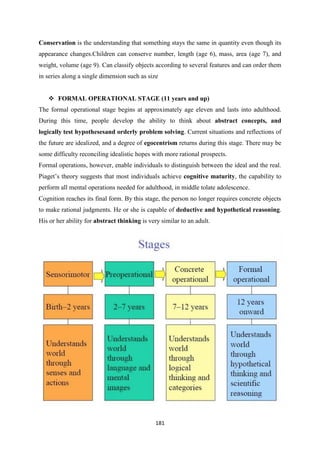
  • 124.
    124 5. Orlando's theoryis applicable in clinical practice STRENGTHS  Use of her theory assures that patient will be treated as individuals and that they will have active and constant input into their own care  Prevents inaccurate diagnosis or ineffective plans because the nurse has to constantly explore her reactions with the patient  Assertion of nursing‘s independence as a profession and her belief that this independence must be based on a sound theoretical frame work  Guides the nurse to evaluate her care in terms of objectively observable patient outcome NURSING PROCESS  Assessment  Diagnosis  Planning  Implementation  Evaluation CONCLUSION TO THEORY Orlando's Deliberative Nursing Process Theory focuses on the interaction between the nurse and patient, perception validation, and the use of the nursing process to produce positive outcomes or patient improvement. Orlando's key focus was to define the function of nursing. Orlando's theory remains one the of the most effective practice theories available. The use of her theory keeps the nurse's focus on the patient. The strength of the theory is that it is clear, concise, and easy to use. While providing the overall framework for nursing, the use of her theory does not exclude nurses from using other theories while caring for the patient.
  • 125.
    125 INTRODUCTION  Madeleine Leiningeris considered as the founder of the theory of transcultural nursing.  Her theory has now developed as a discipline in nursing.  Evolution of her theory can be understood from her books:  Culture Care Diversity and Universality (1991)  Transcultural Nursing (1995)  Transcultural Nursing (2002)  Transcultural nursing theory is also known as Culture Care theory.  Theoretical framework is depicted in her model called the Sunrise Model (1997). ABOUT THE THEORIST  One of the first nursing theorist and transcultural global nursing consultant.  MSN - Catholic University in Washington DC.  PhD in anthropology - University of Washington.  She developed the concept of transcultural nursing and the ethno-nursing research model.  For more details: http://en.wikipedia.org/wiki/Madeleine_Leininger DEFINITIONS TRANSCULTURAL NURSING Transcultural nursing is a comparative study of cultures to understand similarities (culture universal) and difference (culture-specific) across human groups (Leininger, 1991). CULTURE  Set of values, beliefs and traditions, that are held by a specific group of people and handed down from generation to generation.  Culture is also beliefs, habits, likes, dislikes, customs and rituals learn from one‘s family.  Culture is the learned, shared and transmitted values, beliefs, norms and life way practices of a particular group that guide thinking, decisions, and actions in patterned ways.  Culture is learned by each generation through both formal and informal life experiences.  Language is primary through means of transmitting culture.  The practices of particular culture often arise because of the group's social and physical environment.  Culture practice and beliefs are adapted over time but they mainly remain constant as long as they satisfy needs. 12. TRANSCULTURAL NURSING
  • 126.
    126 RELIGION  It isa set of belief in a divine or super human power (or powers) to be obeyed and worshipped as the creator and ruler of the universe. ETHNIC  Refers to a group of people who share a common and distinctive culture and who are members of a specific group. ETHNICITY  A consciousness of belonging to a group. CULTURAL IDENTIFY  the sense of being part of an ethnic group or culture CULTURE-UNIVERSALS
  • 127.
    127  Commonalities ofvalues, norms of behavior, and life patterns that are similar among different cultures. CULTURE-SPECIFIES  Values, beliefs, and patterns of behavior that tend to be unique to a designate culture. MATERIAL CULTURE  refers to objects (dress, art, religious arti1acts) NON-MATERIAL CULTURE  Refers to beliefs customs, languages, and social institutions. SUBCULTURE  Composed of people who have a distinct identity but are related to a larger cultural group. BICULTURAL  A person who crosses two cultures, lifestyles, and sets of values. DIVERSITY  Refers to the fact or state of being different. Diversity can occur between cultures and within a cultural group. ACCULTURATION  People of a minority group tend to assume the attitudes, values, beliefs, find practices of the dominant society resulting in a blended cultural pattern. CULTURAL SHOCK  The state of being disoriented or unable to respond to a different cultural environment because of its sudden strangeness, unfamiliarity, and incompatibility to the stranger's perceptions and expectations at is differentiated from others by symbolic markers (cultures, biology, territory, religion). ETHNIC GROUPS  Share a common social and cultural heritage that is passed on to successive generations., ETHNIC IDENTITY  Refers to a subjective perspective of the person's heritage and to a sense of belonging to a group that is distinguishable from other groups. RACE  The classification of people according to shared biologic characteristics, genetic markers, or features. Not all people of the same race have the same culture. CULTURAL AWARENESS  It is an in-depth self-examination of one's own background, recognizing biases and prejudices and assumptions about other people. CULTURALLY CONGRUENT CARE  Care that fits the people's valued life patterns and set of meanings -which is generated from the people themselves, rather than based on predetermined criteria. CULTURALLY COMPETENT CARE  Is the ability of the practitioner to bridge cultural gaps in caring, work with cultural differences and enable clients and families to achieve meaningful and supportive caring. NURSING DECISIONS
  • 128.
    128 Leininger (1991) identifiedthree nursing decision and action modes to achieve culturally congruent care. 1. Cultural preservation or maintenance. 2. Cultural care accommodation or negotiation. 3. Cultural care repatterning or restructuring. MAJOR CONCEPTS [LEININGER (1991)]  Illness and wellness are shaped by a various factors including perception and coping skills, as well as the social level of the patient.  Cultural competence is an important component of nursing.  Culture influences all spheres of human life. It defines health, illness, and the search for relief from disease or distress.  Religious and Cultural knowledge is an important ingredient in health care.  The health concepts held by many cultural groups may result in people choosing not to seek modern medical treatment procedures.  Health care provider need to be flexible in the design of programs, policies, and services to meet the needs and concerns of the culturally diverse population, groups that are likely to be encountered.  Most cases of lay illness have multiple causalities and may require several different approaches to diagnosis, treatment, and cure including folk and Western medical interventions.  The use of traditional or alternate models of health care delivery is widely varied and may come into conflict with Western models of health care practice.  Culture guides behavior into acceptable ways for the people in a specific group as such culture originates and develops within the social structure through inter personal interactions.  For a nurse to successfully provide care for a client of a different cultural or ethnic to background, effective intercultural communication must take place. APPLICATION TO NURSING  To develop understanding, respect and appreciation for the individuality and diversity of patients beliefs, values, spirituality and culture regarding illness, its meaning, cause, treatment, and outcome.  To encourage in developing and maintaining a program of physical, emotional and spiritual self-care introduce therapies such as ayurveda and pancha karma. HEALTH PRACTICES IN DIFFERENT CULTURES USE OF PROTECTIVE OBJECTS  Protective objects can be worn or carried or hung in the home- charms worn on a string or chain around the neck, wrist, or waist to protect the wearer from the evil eye or evil spirits. USE OF SUBSTANCES.  It is believed that certain food substances can be ingested to prevent illness.  E.g. eating raw garlic or onion to prevent illness or wear them on the body or hang them in the home.
  • 129.
    129 RELIGIOUS PRACTICES  Burningof candles, rituals of redemption etc. TRADITIONAL REMEDIES  The use of folk or traditional medicine is seen among people from all walks of life and cultural ethnic back ground. HEALERS  Within a given community, specific people are known to have the power to heal. IMMIGRATION  Immigrant groups have their own cultural attitudes ranging beliefs and practices regarding these areas. GENDER ROLES  In many cultures, the male is dominant figure and often they take decisions related to health practices and treatment. In some other cultures females are dominant.  In some cultures, women are discriminated in providing proper treatment for illness. BELIEFS ABOUT MENTAL HEALTH  Mental illnesses are caused by a lack of harmony of emotions or by evil spirits.  Problems in this life are most likely related to transgressions committed in a past life. ECONOMIC FACTORS  Factors such as unemployment, underemployment, homelessness, lack of health insurance poverty prevent people from entering the health care system. TIME ORIENTATION  It is varies for different cultures groups. PERSONAL SPACE  Respect the client's personal space when performing nursing procedures.  The nurse should also welcome visiting members of the family and extended family. NURSING PROCESS AND ROLE OF NURSE  Determine the client's cultural heritage and language skills.  Determine if any of his health beliefs relate to the cause of the illness or to the problem.  Collect information that any home remedies the person is taking to treat the symptoms.  Nurses should evaluate their attitudes toward ethnic nursing care.  Self-evaluation helps the nurse to become more comfortable when providing care to clients from diverse backgrounds  Understand the influence of culture, race &ethnicity on the development of social emotional relationship, child rearing practices & attitude toward health.  Collect information about the socioeconomic status of the family and its influence on their health promotion and wellness  Identify the religious practices of the family and their influence on health promotion belief in families.  Understanding of the general characteristics of the major ethnic groups, but always individualize care.  The nursing diagnosis for clients should include potential problems in their interaction with the health care system and problems involving the effects of culture.
  • 130.
    130  The planningand implementation of nursing interventions should be adapted as much as possible to the client's cultural background.  Evaluation should include the nurse's self-evaluation of attitudes and emotions toward providing nursing care to clients from diverse sociocultural backgrounds.  Self-evaluation by the nurse is crucial as he or she increases skills for interaction. . CONCLUSION  Nurses need to be aware of and sensitive to the cultural needs of clients.  The practice of nursing today demands that the nurse identify and meet the cultural needs of diverse groups, understand the social and cultural reality of the client, family, and community, develop expertise to implement culturally acceptable strategies to provide nursing care, and identify and use resources acceptable to the client (Andrews & Boyle, 2002).
  • 131.
    131 MARGARET NEWMAN ―Health isthe expansion of consciousness.‖ - Newman, 1983 INTRODUCTION  The theory of health as expanding consciousness stems from Rogers' theory of unitary human beings.  The theory of health as expanding consciousness was stimulated by concern for those for whom health as the absence of disease or disability is not possible, (Newman, 2010).  The theory has progressed to include the health of all persons regardless of the presence or absence of disease, (Newman, 2010).  The theory asserts that every person in every situation, no matter how disordered and hopeless it may seem, is part of the universal process of expanding consciousness – a process of becoming more of oneself, of finding greater meaning in life, and of reaching new dimensions of connectedness with other people and the world, (Newman, 2010). BACHGROUND OF THE THEORIST  Born on October 10, 1933.  Bachelor‘s degree - University of Tennessee in 1962  Master‘s degree - University of California in 1964  Doctorate - New York University in 1971  She has worked in - University of Tennessee, New York University, Pennsylvania State University, University of Minnesotat, University of Minnesota 14. HEALTH AS EXPANDING CONSCIOUSNESS
  • 132.
    132 ASSUMPTIONS 1. Health encompassesconditions heretofore described as illness, or, in medical terms, pathology 2. These pathological conditions can be considered a manifestation of the total pattern of the individual 3. The pattern of the individual that eventually manifests itself as pathology is primary and exists prior to structural or functional changes 4. Removal of the pathology in itself will not change the pattern of the individual. 5. If becoming ill is the only way an individual's pattern can manifest itself, then that is health for that person 6. Health is an expansion of consciousness. DESCRIPTION OF THE THEORY  ―The theory of health as expanding consciousness (HEC) was stimulated by concern for those for whom health as the absence of disease or disability is not possible. Nurses often relate to such people: people facing the uncertainty, debilitation, loss and eventual death associated with chronic illness. The theory has progressed to include the health of all persons regardless of the presence or absence of disease. The theory asserts that every person in every situation, no matter how disordered and hopeless it may seem, is part of the universal process of expanding consciousness – a process of becoming more of oneself, of finding greater meaning in life, and of reaching new dimensions of connectedness with other people and the world‖ (Newman, 2010).  Humans are open to the whole energy system of the universe and constantly interacting with the energy. With this process of interaction humans are evolving their individual pattern of whole.  According to Newman understanding the pattern is essential. The expanding consciousness is the pattern recognition.  The manifestation of disease depends on the pattern of individual so the pathology of the diseases exists before the symptoms appear so removal of disease symptoms does not change the individual structure.  Newman also redefines nursing according to her nursing is the process of recognizing the individual in relation to environment and it is the process of understanding of consciousness.  The nurse helps to understand people to use the power within to develop the higher level of consciousness.  Thus it helps to realize the disease process, its recovery and prevention.  Newman also explains the interrelatedness of time, space and movement.  Time and space are the temporal pattern of the individual, both have complementary relationship.  Humans are constantly changing through time and space and it shows unique pattern of reality.
  • 133.
    133 NURSING PARADIGMS HEALTH  ―Healthand illness are synthesized as health - the fusion on one state of being (disease) with its opposite (non-disease) results in what can be regarded as health‖. NURSING  Nursing is ―caring in the human health experience‖.  Nursing is seen as a partnership between the nurse and client, with both grow in the ―sense of higher levels of consciousness‖ HUMAN  ―The human is unitary, that is cannot be divided into parts, and is inseparable from the larger unitary field‖  ―Persons as individuals, and human beings as a species are identified by their patterns of consciousness‖…  ―The person does not possess consciousness-the person is consciousness‖.  Persons are ―centers of consciousness‖ within an overall pattern of expanding consciousness‖ ENVIRONMENT  Environment is described as a ―universe of open systems‖ STRENGTHS  Can be applied in any setting  ―Generates caring interventions‖ WEAKNESSES  Abstract  Multi-dimensional  Qualitative  Little discussion on environment CRITIQUE CLARITY  Semantic clarity is evident in the definitions, descriptions, and dimensions of the concepts of the theory. SIMPLICITY  The deeper meaning of the theory of health as expending consciousness is complex.  The theory as a whole must be understood, not just the isolated concepts. GENERALITY  The theory has been applied in several different cultures  It is applicable across the spectrum of nursing care situations. EMPIRICAL PRECISION  Quantitative methods are inadequate in capturing the dynamic, changing nature of this theory. DERIVABLE CONSEQUENCES  Newman's theory provides an evolving guide for all health-related disciplines.
  • 134.
    134 CONCLUSION Newman's theory canbe conceptualized as  A grand theory of nursing  Humans cannot be divided into parts  Health is central to the theory and is seen ―and is seen as a process of developing awareness of self and the environment‖  ―Consciousness is a manifestation of an evolving pattern of person-environment interaction‖
  • 135.
    135 KATHARINE KOLCABA INTRODUCTION  Thecomfort theory is a nursing theory that was first developed in the 1990s by Katharine Kolcaba.  Comfort Theory is &September 9, 2013earch.  Kolcaba's theory has the potential to place comfort once again in the forefront of healthcare. BACKGROUND OF THE THEORIST  Born as Katharine Arnold on December 8th 1944, in Cleveland, Ohio  Diploma in nursing from St. Luke's Hospital School of Nursing in 1965  Graduated from the Frances Payne Bolton School of Nursing, Case Western Reserve University in 1987  Graduated with PhD in nursing and received certificate of authority clinical nursing specialist in 1997  Specialized in Gerontology, End of Life and Long Term Care Interventions, Comfort Studies, Instrument Development, Nursing Theory, Nursing Research  Currently an associate professor of nursing at the University of Akron College of Nursing  Published Comfort Theory and Practice: a Vision for Holistic Health Care and Research CONCEPTS AND DEFINITIONS (KOLCABA, 2010)  Kolcaba described comfort as existing in 3 forms: relief, ease, and transcendence.  Also, Kolcaba described 4 contexts in which patient comfort can occur: physical, psycho-spiritual, environmental, and sociocultural.  If specific comfort needs of a patient are met, for example, the relief of postoperative pain by administering prescribed analgesia, the individual experiences comfort in the relief sense. 15. COMFORT THEORY
  • 136.
    136  If thepatient is in a comfortable state of contentment, the person experiences comfort in the ease sense, for example, how one might feel after having issues that are causing anxiety addressed.  Lastly, transcendence is described as the state of comfort in which patients are able to rise above their challenges.  Health Care Needs are those identified by the patient/family in a particular practice setting.  Intervening Variables are those factors that are not likely to change and over which providers have little control (such as prognosis, financial situation, extent of social support, etc).  Comfort is an immediate desirable outcome of nursing care, according to Comfort Theory  Health Seeking Behavior (HSBs):  Institutional Integrity - the values, financial stability, and wholeness of health care organizations at local, regional, state, and national levels.  Best Policies are protocols and procedures developed by an institution for overall use after collecting evidence. DEVELOPMENT OF THE THEORY  Kolcaba conducted a concept analysis of comfort that examined literature from several disciplines including nursing, medicine, psychology, psychiatry, ergonomics, and English  First, three types of comfort (relief, ease, transcendence) and four contexts of holistic human experience in differing aspects of therapeutic contexts were introduced. (Kolcaba KY &Kolcaba RJ, 1991)  A taxonomic structure was developed to guide for assessment, measurement, and evaluation of patient comfort. ( Kolcaba, 1991)  Comfort as a product of holistic nursing art. (Kolcaba K, 1995)  A broader theory for comfort was introduced (Kolcaba KY,(1994).  The theory has undergone refinement and tested for its applicability. DESCRIPTION OF THE THEORY NURSING  Nursing is described as the process of assessing the patient's comfort needs, developing and implementing appropriate nursing interventions, and evaluating patient comfort following nursing interventions.  Intentional assessment of comfort needs, the design of comfort measures to address those needs, and the reassessment of comfort levels after implementation.  Assessment may be either objective, such as in the observation of wound healing, or subjective, such as by asking if the patient is comfortable.
  • 137.
    137 HEALTH  Health isconsidered to be optimal functioning, as defined by the patient, group, family or community PERSON/PATIENT  Patients can be considered as individuals, families, institutions, or communities in need of health care. ENVIRONMENT  Any aspect of the patient, family, or institutional surroundings that can be manipulated by a nurse(s), or loved one(s) to enhance comfort. CONCLUSION Holistic comfort is defined as the immediate experience of being strengthened through having the needs for relief, ease, and transcendence met in four contexts of experience (physical, psychospiritual, social, and environmental) (Kolcaba, 2010) The theoretical structure of Kolcaba's comfort theory has real potential to direct the work and thinking of all healthcare providers within one institution. (March A & McCormack D, 2009).
  • 138.
    138 Hildegard. E. Peplau INTRODUCTION Theorist -Hildegard. E. Peplau  Born in Reading, Pennsylvania [1909], USA  Diploma program in Pottstown, Pennsylvania in 1931.  BA in interpersonal psychology - Bennington College in 1943.  MA in psychiatric nursing from Colombia University New York in 1947.  EdD in curriculum development in 1953.  Professor emeritus from Rutgers university  Started first post baccalaureate program in nursing  Published Interpersonal Relations in Nursing in 1952  1968 :interpersonal techniques-the crux of psychiatric nursing  Worked as executive director and president of ANA.  Worked with W.H.O, NIMH and Nurse Corps.  Died in 1999.  Theory of interpersonal relations is a middle range descriptive classification theory.  The theory was influenced by Harry Stack Sullivan's theory of inter personal relations (1953).  The theorist was also influenced by Percival Symonds, Abraham Maslow's and Neal Elger Miller.  Peplau's theory is also refered as psychodynamic nursing, which is the understanding of one‘s own behavior. 16. PEPLAU'S THEORY OF INTERPERSONAL RELATIONS
  • 139.
    139 MAJOR CONCEPTS  Thetheory explains the purpose of nursing is to help others identify their felt difficulties.  Nurses should apply principles of human relations to the problems that arise at all levels of experience.  Peplau's theory explains the phases of interpersonal process, roles in nursing situations and methods for studying nursing as an interpersonal process.  Nursing is therapeutic in that it is a healing art, assisting an individual who is sick or in need of health care.  Nursing is an interpersonal process because it involves interaction between two or more individuals with a common goal.  The attainment of goal is achieved through the use of a series of steps following a series of pattern.  The nurse and patient work together so both become mature and knowledgeable in the process. DEFINITIONS  Person: A developing organism that tries to reduce anxiety caused by needs.  Environment: Existing forces outside the organism and in the context of culture Health: A word symbol that implies forwardmovement of personality and other ongoing human processes in the direction of creative, constructive, productive, personal and community living.  Nursing: A significant therapeutic interpersonal process. It functions cooperatively with other human process that make health possible for individuals in communities. 
  • 140.
    140 ROLES OF NURSE Stranger: receives the client in the same way one meets a stranger in other life situations provides an accepting climate that builds trust.  Teacher: who imparts knowledge in reference to a need or interest  Resource Person : one who provides a specific needed information that aids in the understanding of a problem or new situation  Counsellors : helps to understand and integrate the meaning of current life circumstances ,provides guidance and encouragement to make changes  Surrogate: helps to clarify domains of dependence interdependence and independence and acts on clients behalf as an advocate.  Leader : helps client assume maximum responsibility for meeting treatment goals in a mutually satisfying way Additional Roles include: 1. Technical expert 2. Consultant 3. Health teacher 4. Tutor 5. Socializing agent 6. Safety agent 7. Manager of environment 8. Mediator 9. Administrator 10. Recorder observer 11. Researcher PHASES OF INTERPERSONAL RELATIONSHIP Identified four sequential phases in the interpersonal relationship:
  • 141.
    141 ORIENTATION PHASE  Problemdefining phase  Starts when client meets nurse as stranger  Defining problem and deciding type of service needed  Client seeks assistance ,conveys needs ,asks questions, shares preconceptions and expectations of past experiences  Nurse responds, explains roles to client, helps to identify problems and to use available resources and services IDENTIFICATION PHASE  Selection of appropriate professional assistance  Patient begins to have a feeling of belonging and a capability of dealing with the problem which decreases the feeling of helplessness and hopelessness EXPLOITATION PHASE  Use of professional assistance for problem solving alternatives  Advantages of services are used is based on the needs and interests of the patients  Individual feels as an integral part of the helping environment  They may make minor requests or attention getting techniques  The principles of interview techniques must be used in order to explore, understand and adequately deal with the underlying problem  Patient may fluctuates on independence  Nurse must be aware about the various phases of communication  Nurse aids the patient in exploiting all avenues of help and progress is made towards the final step RESOLUTION PHASE  Termination of professional relationship  The patients‘ needs have already been met by the collaborative effect of patient and nurse  Now they need to terminate their therapeutic relationship and dissolve the links between them.  Sometimes may be difficult for both as psychological dependence persists  Patient drifts away and breaks bond with nurse and healthier emotional balance is demonstrated and both becomes mature individuals INTERPERSONAL THEORY AND NURSING PROCESS  Both are sequential and focus on therapeutic relationship  Both use problem solving techniques for the nurse and patient to collaborate on, with the end purpose of meeting the patients‘ needs  Both use observation communication and recording as basic tools utilized by nursing
  • 142.
    142 Assessment  Data collectionand analysis [continuous]  May not be a felt need  Orientation  Non continuous data collection  Felt need  Define needs Nursing diagnosis Planning  Mutually set goals Identification  Interdependent goal setting  Implementation  Plans initiated towards achievement of mutually set goals  May be accomplished by patient , nurse or family Exploitation  Patient actively seeking and drawing help  Patient initiated   Evaluation  Based on mutually expected behaviors  May led to termination and initiation of new plans Resolution  Occurs after other phases are completed successfully  Leads to termination a relationship PEPLAU’S WORK AND CHARACTERISTICS OF A THEORY  Interrelation of concepts  Four phases interrelate the different components of each phase.  Applicability  The nurse patient interaction can apply to the concepts of human being, health, environment and nursing.  Theories must be logical in nature -  This theory provides a logical systematic way of viewing nursing situations  Key concepts such as anxiety, tension, goals, and frustration are indicated with explicit relationships among them and progressive phases  Generalizability  This theory provides simplicity in regard to the natural progression of the NP relationship.  Theories can be the bases for hypothesis that can be tested  Peplau's theory has generated testable hypotheses.  Theories can be utilized by practitioners to guide and improve their practice.  Peplau‘s anxiety continuum is still used in anxiety patients  Theories must be consistent with other validated theories, laws, and principles but will leave open unanswered questions that need to be investigated.  Peplau's theory is consistent with various theories
  • 143.
    143 LIMITATIONS  Personal spaceconsiderations and community social service resources are considered less.  Health promotion and maintenance were less emphasized  Cannot be used in a patient who doesn‘t have a felt need eg. With drawn patients, unconscious patients  Some areas are not specific enough to generate hypothesis PEPLAU’S THEORY APPLICATION NURSING PROCESS: The nursing process for Mrs. JL based on Peplau‘s theory is as follows:  Mrs. JL  27 years  Diagnosis: Inter vertebral disc prolapse Assessment (Orientation phase) Nursing diagnosis Planning (Identification phase) Implementation (Exploitation phase) Evaluation (Resolution phase) Mrs. JL is on pelvic traction and she is restricted to bed. The need for bed rest and restriction was discussed. Impaired physical mobility related to the presence of pelvic traction. Goal setting was done along with patient Patient will have improved physical mobility as evidenced by participating in self-care within the limits. Provide active and passive exercises to all the extremities to improve the muscle tone and strength. Make the patient to perform the breathing exercises Carried out plans mutually agreed upon. Provided active and passive exercises to all the extremities Made the patient to perform breathing exercises Massaged the upper and lower extremities Provided article within the reach of the patient Provided positive reinforcement to Mrs. JL was free to express problems regarding difficulty in mobilizing. She expressed satisfaction when able to move without difficulty.
  • 144.
    144 which will strengthen the respiratory muscle. Massagethe upper and lower extremities which help to improve the circulation. Provide articles near to the patient and encourage doing activities within limits. Provide positive reinforcement for even a small improvement to increase the frequency of the desired activity. the patient
  • 145.
    145 Assessment (Orientation phase) Nursing diagnosis Planning (Identification phase) Implementation (Exploitation phase) Evaluation (Resolution phase) Mrs. JL expresses pain inthe low back region. Regarding pain, discussion was made to assess the severity and the type and duration of pain. Also the measures to reduce pain were discussed. Pain related to the degenerativ e changes in the lumbar region. Goal setting was done along with patient Mrs. JL will have reduction in pain as evidenced by her verbalisation of reduction in pain responses. Provide non- pharmacologic al measures for pain relief such as diversional activity which diverts the patients mind. Give the client a neutral position Always use back support while turning the patient that reduces the strain on the back. Support the areas with extra pillow to allow the Carried out plans mutually agreed upon. Provided non pharmacologica l measures like diversion, massaging, and pelvic traction. Provided supine position to the client Supported the back during position change Used pillows to support the back. Administered Tab. Hifenac P and Cap. Myoril 4mg as prescribed. Given pelvic traction and explained the need for traction Mrs. JL was free to express problems of pain. Expressed that she got slight relief from pain.
  • 146.
    146 normal alignment and to prevent strain. Administer analgesicsas prescribed by the physician. Provide pelvic traction to the patient Assessment (Orientation phase) Nursing diagnosis Planning (Identification phase) Implementation (Exploitation phase) Evaluation (Resolution phase) Mrs. JL expresses that she need assistance to get down from bed. Regarding self care discussion was done and discussed regarding the measures to solve the problems. Self care deficit related to the presence of pelvic traction. Goal setting was done along with patient Client will achieve and maintain self care activities with assistance of caregiver or within her limits. Keep all the articles within the reach of the patient. Provide a call bell to the patient to call Carried out plans mutually agreed upon. Kept the articles within t he reach of the client Frequently visited the patient and enquired for any needs Assisted the client in doing her self care activities Removed the Mrs. JL was free to express problems of self care. She used to call for the needs and all her needs were met appropriately She achieved and maintained self care activities within her limits
  • 147.
    147 in any emergency Frequently visit thepatient and enquire for any needs. Assist the patient in doing her self care activities. Remove the weight of the traction as needed by the patient. weight as and when needed. Assessment (Orientation phase) Nursing diagnosis Planning (Identification phase) Implementation (Exploitation phase) Evaluation (Resolution phase) Mrs. JL is enquiring about the disease condition, its outcome and need for surgery Discussed with the client regarding the disease process and Anxiety related to hospital admission as evidenced by verbalisation and client & family appearing withdrawn Goal setting was done along with patient Client will have reduced feeling of anxiety as evidenced by asking fewer questions Teach the family and client Carried out plans mutually agreed upon. Taught the family regarding the disease process in simple Kannada Allowed the client and family members to ask questions Mrs. JL was free to express problems of self care. She asked her doubts regarding the illness and the diagnostic procedures She verbalized that her anxiety has reduced to some extent.
  • 148.
    148 the findings in theclient regarding the disease process. Explain in simple understandable language of the client. Allow and encourage the client and family to ask questions. Allow the client and family to verbalize anxiety. Stress that frequent assessment are routine and do not necessarily imply a deteriorating condition. Allow the family members to visit the client frequently She and her husband expressed their anxiety Allowed the family members to frequently visit the client
  • 149.
    149 Assessment (Orientation phase) Nursing diagnosis Planning (Identification phase) Implementation (Exploitation phase) Evaluation (Resolution phase) Mrs. JLis enquiring about the disease condition, its outcome and need for surgery Discussed with the client regarding the disease process and the need for follow up Deficient knowledge related to the treatment measures to be continued even after the discharge. Goal setting was done along with patient Patient will acquire adequate knowledge regarding the treatment and home care. Explain the treatment measures to the patient and their benefits Explain to the client the signs of aggravation of illness Use simple and understandable terms Clarify all the doubts of the patient of importance. Repeat the information whenever necessary to reinforce Carried out plans mutually agreed upon. Explained treatment measures and the need for follow up Explained regarding the signs of aggravation of disease Used simple and understandable terms for explaining Clarified her doubts Repeated the information Mrs. JL was free to express problems of self care. She expressed acquisition of knowledge regarding the disease and the signs of aggravation of illness
  • 150.
    150 learning. SUMMARY 1. ORIENTATION PHASE Client is initially reluctant to talk due to pain.  Client is expressing that while standing she is having much pain.  Client expressed without movement and supine position gave her relief from pain. 2. IDENTIFICATION  The client participates and interdependent with the nurse  Expresses the need for measure to get relief from pain  Expresses need for improving the mobility  Expresses need to know more about prognosis, discharge and home care and follow up. 3. EXPLOITATION  Client explains that she gets relief of pain when lying down supine.  Cooperates and participates actively in performing exercises.  Client mobilizes changes position and cooperates during position changes. 4. RESOLUTION  Client expressed that pain has reduced a lot and she is able to tolerate it now  She has agreed upon to continue the exercises at home  She also expressed that she would come for regular follow up after discharge. EVALUATION OF THE THEORY OF INTERPERSONAL RELATIONS  With the help of the theory of interpersonal relations, the client's needs could be assessed.  It helped her to achieve them within her limits. This theory application helped in providing comprehensive care to the client.
  • 151.
    151 INTRODUCTION  The HealthBelief Model (HBM) is one of the first theories of health behavior.  It was developed in the 1950s by a group of U.S. Public Health Service social psychologists who wanted to explain why so few people were participating in programs to prevent and detect disease.  HBM is a good model for addressing problem behaviors that evoke health concerns (e.g., high-risk sexual behavior and the possibility of contracting HIV)  The health belief model proposes that a person's health-related behavior depends on the person's perception of four critical areas: 1. the severity of a potential illness, 2. the person's susceptibility to that illness, 3. the benefits of taking a preventive action, and 4. The barriers to taking that action.  HBM is a popular model applied in nursing, especially in issues focusing on patient compliance and preventive health care practices.  The model postulates that health-seeking behaviour is influenced by a person‘s perception of a threat posed by a health problem and the value associated with actions aimed at reducing the threat.  HBM addresses the relationship between a person‘s beliefs and behaviors. It provides a way to understanding and predicting how clients will behave in relation to their health and how they will comply with health care therapies. THE MAJOR CONCEPTS AND DEFINITIONS OF THE HEALTH PROMOTION MODEL There are six major concepts in HBM: 1. Perceived Susceptibility: refers to a person‘s perception that a health problem is personally relevant or that a diagnosis of illness is accurate. 2. Perceived severity: even when one recognizes personal susceptibility, action will not occur unless the individual perceives the severity to be high enough to have serious organic or social complications. 3. Perceived benefits: refers to the patient‘s belief that a given treatment will cure the illness or help to prevent it. 4. Perceived Costs: refers to the complexity, duration, and accessibility and accessibility of the treatment. 5. Motivation: includes the desire to comply with a treatment and the belief that people should do what. 6. Modifying factors: include personality variables, patient satisfaction, and socio-demographic factors. 16. HEALTH BELIEF MODEL (HBM)
  • 152.
    152 CRITICISMS OF HBM Is health behaviour that rational?  Its emphasis on the individual (HBM ignores social and economic factors)  The absence of a role for emotional factors such as fear and denial.  Alternative factors may predict health behaviour, such as outcome expectancy (whether the person feels they will be healthier as a result of their behaviour) and self-efficacy (the person‘s belief in their ability to carry out preventative behaviour) (Seydel et al. 1990; Schwarzer 1992.
  • 153.
    153 INTRODUCTION  The healthpromotion model (HPM) proposed by Nola J Pender (1982; revised, 1996) was designed to be a ―complementary counterpart to models of health protection.‖  It defines health as a positive dynamic state not merely the absence of disease. Health promotion is directed at increasing a client‘s level of wellbeing.  The health promotion model describes the multi-dimensional nature of persons as they interact within their environment to pursue health. ABOUT THE THEORIST  Nola J. Pender, PhD, RN, FAAN - former professor of nursing at the University of Michigan THE MODEL FOCUSES ON FOLLOWING THREE AREAS:  Individual characteristics and experiences  Behavior-specific cognitions and affect  Behavioral outcomes The health promotion model notes that each person has unique personal characteristics and experiences that affect subsequent actions. The set of variables for behavioral specific knowledge and affect have important motivational significance. These variables can be modified through nursing actions. Health promoting behavior is the desired behavioral outcome and is the end point in the HPM. Health promoting behaviors should result in improved health, enhanced functional ability and better quality of life at all stages of development. The final behavioral demand is also influenced by the immediate competing demand and preferences, which can derail an intended health promoting actions. 17. HEALTH PROMOTION MODEL
  • 154.
    154 ASSUMPTIONS OF THEHEALTH PROMOTION MODEL The HPM is based on the following assumptions, which reflect both nursing and behavioral science perspectives:  Individuals seek to actively regulate their own behavior.  Individuals in all their biopsychosocial complexity interact with the environment, progressively transforming the environment and being transformed over time.  Health professionals constitute a part of the interpersonal environment, which exerts influence on persons throughout their life span.  Self-initiated reconfiguration of person-environment interactive patterns is essential to behavior chang THEORETICAL PROPOSITIONS OF THE HEALTH PROMOTION MODEL Theoretical statements derived from the model provide a basis for investigative work on health behaviors. The HPM is based on the following theoretical propositions: 1. Prior behavior and inherited and acquired characteristics influence beliefs, affect, and enactment of health-promoting behavior. 2. Persons commit to engaging in behaviors from which they anticipate deriving personally valued benefits. 3. Perceived barriers can constrain commitment to action, a mediator of behavior as well as actual behavior. 4. Perceived competence or self-efficacy to execute a given behavior increases the likelihood of commitment to action and actual performance of the behavior. 5. Greater perceived self-efficacy results in fewer perceived barriers to a specific health behavior. 6. Positive affect toward a behavior results in greater perceived self-efficacy, which can in turn, result in increased positive affect. 7. When positive emotions or affect are associated with a behavior, the probability of commitment and action is increased. 8. Persons are more likely to commit to and engage in health-promoting behaviors when significant others model the behavior, expect the behavior to occur, and provide assistance and support to enable the behavior. 9. Families, peers, and health care providers are important sources of interpersonal influence that can increase or decrease commitment to and engagement in health-promoting behavior. 10. Situational influences in the external environment can increase or decrease commitment to or participation in health-promoting behavior. 11. The greater the commitments to a specific plan of action, the more likely health-promoting behaviors are to be maintained over time. 12. Commitment to a plan of action is less likely to result in the desired behavior when competing demands over which persons have little control require immediate attention. 13. Commitment to a plan of action is less likely to result in the desired behavior when other actions are more attractive and thus preferred over the target behavior. 13. Persons can modify cognitions, affect, and the interpersonal and physical environment to create incentives for health actions.
  • 155.
    155 THE MAJOR CONCEPTSAND DEFINITIONS OF THE HEALTH PROMOTION MODEL  Individual Characteristics and Experience  Prior related behaviour  Frequency of the similar behaviour in the past. Direct and indirect effects on the likelihood of engaging in health promoting behaviors. PERSONAL FACTORS Personal factors categorized as biological, psychological and socio-cultural. These factors are predictive of a given behavior and shaped by the nature of the target behaviour being considered. PERSONAL BIOLOGICAL FACTORS  Include variable such as age gender body mass index pubertal status, aerobic capacity, strength, agility, or balance.
  • 156.
    156 PERSONAL PSYCHOLOGICAL FACTORS Include variables such as self-esteem self-motivation personal competence perceived health status and definition of health. PERSONAL SOCIO-CULTURAL FACTORS  Include variables such as race ethnicity, acculturation, education and socioeconomic status.  Behavioural Specific Cognition and Affect PERCEIVED BENEFITS OF ACTION  Anticipated positive outcomes that will occur from health behaviour. PERCEIVED BARRIERS TO ACTION  Anticipated, imagined or real blocks and personal costs of understanding a given behaviour PERCEIVED SELF EFFICACY Judgment of personal capability to organise and execute a health-promoting behaviour. Perceived self-efficacy influences perceived barriers to action so higher efficacy result in lowered perceptions of barriers to the performance of the behavior. ACTIVITY RELATED AFFECT Subjective positive or negative feeling that occur before, during and following behavior based on the stimulus properties of the behaviour itself. Activity-related affect influences perceived self-efficacy, which means the more positive the subjective feeling, the greater the feeling of efficacy. In turn, increased feelings of efficacy can generate further positive affect. INTERPERSONAL INFLUENCES Cognition concerning behaviours, beliefs, or attitudes of the others. Interpersonal influences include: norms (expectations of significant others), social support (instrumental and emotional encouragement) and modelling (vicarious learning through observing others engaged in a particular behaviour). Primary sources of interpersonal influences are families, peers, and healthcare providers. SITUATIONAL INFLUENCES Personal perceptions and cognitions of any given situation or context that can facilitate or impede behaviour. Include perceptions of options available, demand characteristics and aesthetic features of the environment in which given health promoting is proposed to take place. Situational influences may have direct or indirect influences on health behaviour.
  • 157.
    157 BEHAVIOURAL OUTCOME COMMITMENT TOPLAN OF ACTION The concept of intention and identification of a planned strategy leads to implementation of health behaviour. IMMEDIATE COMPETING DEMANDS AND PREFERENCES Competing demands are those alternative behaviour over which individuals have low control because there are environmental contingencies such as work or family care responsibilities. Competing preferences are alternative behaviour over which individuals exert relatively high control, such as choice of ice cream or apple for a snack HEALTH PROMOTING BEHAVIOUR Endpoint or action outcome directed toward attaining positive health outcome such as optimal well-being, personal fulfilment, and productive living.
  • 158.
    158 INTRODUCTION  Proposed byAbraham Maslow in his 1943 paper A Theory of Human Motivation.  Maslow‘s Hierarchy of Needs is a motivational theory that argues that while people aim to meet basic needs, they seek to meet successively higher needs in the form of a hierarchy.  Maslow's theoryhas been applied in nursing to guide the prioritization of patient care needs  It is often represented as a pyramid with five levels of needs. MASLOW’S HIERARCHY OF NEEDS Maslow‘s hierarchy of needs is a based on the theory that one level of needs must be met before moving on to the next step.  Self-actualization – e.g. morality, creativity, problem solving.  Esteem – e.g. confidence, self-esteem, achievement, respect.  Belongingness – e.g. love, friendship, intimacy, family.  Safety – e.g. security of environment, employment, resources, health, property.  Physiological – e.g. air, food, water, sex, sleep, other factors towards homeostasis. 18. MASLOW'S THEORY OF NEEDS
  • 159.
    159 ASSUMPTIONS  Maslow‘s theorymaintains that a person does not feel a higher need until the needs of the current level have been satisfied. B AND D NEEDS DEFICIENCY OR DEPRIVATION NEEDS The first four levels are considered deficiency or deprivation needs (―D-needs‖) in that their lack of satisfaction causes a deficiency that motivates people to meet these needs GROWTH NEEDS OR B-NEEDS OR BEING NEEDS  The needs Maslow believed to be higher, healthier, and more likely to emerge in self- actualizing people were being needs, or B-needs.  Growth needs are the highest level, which is self-actualization, or the self-fulfilment.  Maslow suggested that only two percent of the people in the world achieve self-actualization. E.g. Abraham Lincoln, Thomas Jefferson, Albert Einstein, Eleanor Roosevelt.  Self-actualized people were reality and problem centred.  They enjoyed being by themselves, and having deeper relationships with a few people instead of more shallow relations with many people.  They tended to be spontaneous and simple. APPLICATION IN NURSING  Maslow's hierarchy of needs is a useful organizational framework that can be applied to the various nursing models for assessment of a patient‘s strengths, limitations, and need for nursing interventions. (Smeltzer SC, Bare BG, 2004)
  • 160.
    160 INTRODUCTION  Psychoanalytic theorywas developed by Sigmund Freud (1856-1939).  Psychoanalytic theory revolutionized the understanding of mental life and human behavior.  Freud's theories helped in understanding early development of sexuality and mental functioning in the infant and adult psychological illnesses. Sigmund Freud  Freud was born in Austria on 6th May 1856 and spent most of his childhood and adult life in Vienna (Sigmund Freud Biography, 2017).  He entered medical school and trained to become a neurologist, earning a medical degree in 1881 at the UniversityofVienna.Carried out research in cerebral palsy, aphasia,hysteria, obsessional illness, and microscopic neuro-anatomy at Vienna Hospital. He was appointed as university lecturer in neuropathology in 1885 and become professor in 1902.  The founder of psychoanalysis, a clinical method for treating psychopathology through dialogue between a patient and a psychoanalyst.(Simply meant 'relating to the analysis of the human psyche'.)  Freud (1961), who has been called the father of psychiatry,is credited as the first to identify development bystages. He considered the first 5 years of a child‘s life tobe the most important, because he believed that an individual‘sbasic character had been formed by the age of 5.  S. Freud believed that every personality is different than other and respond to situation differently. Also may repress their emotions (internal conflict)  Freud proposed that the human psyche could be divided into three parts: Id, ego and super-ego. Freud discussed this model in the 1920.  1961 identified stages in personality development.  Freud's psychoanalytic system came to dominate the field from early in the twentieth century, forming the basis for many later variants. While these systems have adopted different theories and techniques, all have followed Freud by attempting to achieve psychic and behavioural change through having patients talk about their difficulties.  These sessions helps person to bring those unconscious emotions(internal conflict) to conscious awareness which gives a lot to think about personality and events those shapes or fines our personality Important books:  Studies on Hysteria (1895)  The Interpretation of Dreams (1900)  The Psychopathology of Everyday Life (1901)  Three Essays on the Theory of Sexuality (1905)  Jokes and Their Relation to the Unconscious (1905)  Totem and Taboo (1913)  On Narcissism (1914) PSYCHOANALYTIC THEORY
  • 161.
    161  Introduction toPsychoanalysis (1917)  Beyond the Pleasure Principle (1920)  The Future of an Illusion (1927)  Civilization and Its Discontents (1930)  Moses and Monotheism (1939)  Also published many case histories,autobiographical papers, He was the founder of Wednesday psychological foundation which is established in 1902.  S Freud died in London on September 26, 1939. Background of the theory:  Freud‘s interest in neurology caused him to specialize in the treatment of nervous disorders. To improve his technical skills, Freud studied for a year with the famous French psychiatrist, Jean Charcot, who was using hypnotics;Freud was not impresses by its efficacy.  Freud first began his studies on psychoanalysis in collaboration with Dr. Josef Breuer, especially when it came to the study on Anna O, who was subject to both physical and psychological disturbances, such as not being able to drink out of fear.  Breuer and Freud both found that hypnosis was a great help in discovering more about Anna O. and her treatment. The research and ideas behind the study on Anna O. were highly referenced in Freud's lectures on the origin and development of psychoanalysis.These observations led Freud to theorize that the problems faced by hysterical patients could be associated with painful childhood experiences that could not be recalled. The influence of these lost memories shaped the feelings, thoughts and behaviors of patients. These studies contributed to the development of the psychoanalytic theory.  Freud felt that sexual conflicts were the cause of hysteria. Then he worked to form the foundation of psychoanalytic theory, which culminated, ―The interpretation of dreams (1990)‖. Freud emphasized sexuality as a strong force in behaviour he developed a body of concepts around which personality has grown.  He postulated that people can be understood only if we know that their inner thoughts, feelings and recognize that they are shaped by past experiences.  He viewed man as a complex organism functioning with a degree of awareness, many faceted being in which the components of id, ego and super ego exists. Psychoanalytic theory includes: 1. Structural Theory 2. Libido (Drive) Theory 3. Topographical Theory of mind 4. Theory of Narcissism
  • 162.
    162 STRUCTURAL (TRIPARTITE) THEORY Freudpostulated that personality is made up of three coexistent parts (id, ego, and superego) work together to create complex human behaviors.Behavior is influenced by three levels of consciousness (conscious, preconscious, unconscious).Behavior is the product of interaction among these coexistent parts and rarely does one system operate to the exclusion of the other two. 1. Id:  First to develop  Reservoir (source) of psychic energy  Completely unconscious  Contains all drives  Ruled by pleasure principle  No awareness of reality 2. Ego:  Second structure to develop  Operates on reality principle  Mediates conflict among id, ego, and superego  Provides reality testing  Monitors quality of interpersonal relations  Provides synthesis and coordination  Carries out primary autonomous functions  Defends against anxiety 3. Superego  Third structure to develop  Self-criticism based on moral values  Self-punishment  Self-praise based on ego ideal  Most functions are unconscious  It works in a system of ―rewards and punishments‖, the superego is composedof two major components: the ego-ideal and the conscience. 
  • 163.
    163  Ego ideal:Includes the rules and standards for good behaviors. These behaviors include those which are approved of by parental and other authority figures. Obeying these rules leads to feelings of pride, value and accomplishment.When a child is rewarded for good behavior the self-esteem is enhanced and the behavior becomes part of ego ideal, internalized as a part of child‘s value system.   The conscienceincludes information about things that are viewed as bad by parents and society. These behaviors are often forbidden and lead to bad consequences, punishments or feelings of guilt and remorse. Conflict is the main concept of structural theory. LIBIDO THEORY  Libido theory assumes that biological ―needs‖ (drives) fuel behavior.  The aim of behavior is to gratify the drive.  Drives are either sexual or aggressive in nature.  The libido theory explains that the sexual instinct plays an etiological role in the neuroses and that sexual stimulation exerts a predominant force (which is called libido) on mental activity throughout life.  The discharge of libido is experienced as pleasure. TOPOGRAPHICAL THEORY Topographical theory explains three regions of mental functioning or systems of the mind exist as defined by their relationship to conscious thought.  Conscious mind Outermost layer of mind, the individual was aware of thoughts and feeling at that moment.It is the smallest of the three categories.The memories that remain within an individual‘s awareness.Events and experiences which are easily remembered or retrieved are conscious mind preconscio us mind unconsciou s
  • 164.
    164 considerate to bewithin one‘s conscious awareness. It is the rational and logical structure of the personality under the control of ego,the rational and logical structure of the personality. Examples include telephonenumbers, birthdays of self and significant others,the dates of special holidays, and what one had forlunch today.  Preconscious mind It includes all memories which has forgotten or not in present awareness but readily be recalledinto consciousness. Examples include telephone numbers or addressesonce known but little used and feelings associatedwith significant life events that may have occurred atsome time in the past. It enhances awareness by helping to suppress unpleasant or non-essential memories from consciousness. It is partially under the control of the super ego. Mental events those are easily accessible to consciousness, even though they are not in one‘s mind at that moment, when attention fluctuates a constant interchange occurs between conscious and preconscious mind.  Unconsciousness All memories that one is unable to bring to conscious awareness. It is the largestof the three topographical levels. Unconscious materialconsists of unpleasant or nonessential memories thathave been repressed and can be retrieved only throughtherapy, hypnosis, or with certain substances that alterawareness and have the capacity to restructurerepressed memories. Unconscious material may alsoemerge in dreams and in seemingly incomprehensiblebehavior. PSYCHOSEXUAL THEORY According to the famous psychoanalyst Sigmund Freud, children go through a series of psychosexual stages that lead to the development of the adult personality. The psychosexual energy, or libido, was described as the driving force behind behaviour. Each stage of development is marked by conflicts that can help build growth or stifle development, depending upon how they are resolved. If these psychosexual stages are completed successfully, a healthy personality is the result. If certain issues are not resolved at the appropriate stage, fixations can occur. A fixation is a persistent focus on an earlier psychosexual stage. Until this conflict is resolved, the individual will remain "stuck" in this stage.
  • 165.
    165 AGE STAGE LIBIDO/ PLEASURE CENTER MORALDEVELOPMENT TASKS birth to 18 month Oral Mouth Feeding Relief from anxiety through oral gratification of needs. 18 months to 3 years Anal Anus Toilet training Learning independence and control, with focus on the excretory function. 3 to 6 years Phallic Genital Sex differenti ation Identification with the parents of same sex; development of sexual identity; focus on genital organ. 6 to 12 years Latency - Socialism, skill Sexuality repressed focus on relationship with same sex peers. 13 to 20 years Genital Genital Sexual maturity Libido reawakened as genital organs towards heterogenous satisfactory relationship.  Oral stage: birth -18 months (ID devt.)  Up to 6 months behaviour is directed towards id for immediate gratification of needs.  The source of pleasure was derived from the mouth. The behaviours include sucking, chewing, biting, swallowing.  The infant feels a sense of attachmentand is unable to differentiate the self from theperson who is providing the mothering. This includesfeelings such as anxiety. Because of this lack of differentiation,a pervasive feeling of anxiety on the part of themother may be passed on to her infant, leaving the childvulnerable to similar feelings of insecurity. -Oral stage -birth -18 months -immediate gratiication of needs -Anal stage -18 months - 3 years -gaining independe nce and control -Phallic stage -3-6 years -oedipus complex -Latency stage -6- 12 years -group activities -socialization -Genital stage -13-20 years -sexual stage
  • 166.
    166  The infantfeels a sense of attachment and develops trust with caring person. Ego starts to develop at 4-6 months of age.  A sense of security and ability to trust others are derived from gratification of fulfilling basic needs at this stage.  In the later part of oral phase the child may feel aggressive in response to the frustration of weaning, biting is a symbol of oral-sadistic stge.  When the child is loved and taken care of, discomfort will reduce and trust will develop.  Fixation: Forceful/ Underfeed- orally passive- trusting and dependence Overfeed- orally aggressive- aggressive and dominating Problem: smoking drinking, nail biting, overeating, oral sex, kissing  Anal stage 18 months - 3 years (EGO devt.)  The major tasks are gaining independence and control specific focus on anal function.  The child learns to regulate elimination process through toilet training may have effects on the formation of specific traits and values.  When toilet training is strict and rigid, the child may choose to retain faeces and suffers with constipation.  If toilet training is having permissiveness, positive (praised and encouraged) and acceptable, the child may develop importance and desirability to faeces production. The child may become extrovert, productive, control behaviour, able to take own decision, share things to other and altruistic.  Fixation: toilet training – Too harsh- anal retentive- tidiness, rigid, mean, stubbornness, stinginess, miserliness, obsessive. Too lax- anal expulsive- untidy, generosity, disorganised, messiness, cruelty to others, destructiveness,. Problem: conflict as per demand of outside world.  Phallic stage 3-6 years (SUPEREGO devt.)  The focus of energy shifts to the genitalarea. Discovery of differences between gendersresults in a heightened interest in the sexuality of self andothers. This interest may be manifested in sexual self-exploratoryor group-exploratory play.  Freud proposedthat the development of the Oedipus complex (males) orElectra complex (females) occurred during this stage ofdevelopment.  He described this as the child‘s unconsciousdesire to eliminate the parent of the same sex andto possess the parent of the opposite sex for him- or herself.  Guilty feelings result with the emergence of the super ego during these years because of constitutional anatomical differences between the sexes, the nature of the problems faced by both sexes will differ.
  • 167.
    167  Resolution ofthis internalconflict occurs when the child develops a strong identificationwith the parent of the same sex and that parent‘sattitudes, beliefs, and value systems are subsumed by thechild.  The child expresses fantasies during masturbation for pleasure.  However, personality develops out of the relationship between biological needs and environmental possibilities for fulfilment. Thus personality is sex differentiated due to difference of genital organs.  Fixation: if abnormal family setup (conflict) -sexual anxiety, inadequacy, inferiority envy, self-centred, sexual dysfunction, unable to form mature relation, self pleasure.  Latency stage (6-12 years)  Sexual drive is channelized into socially appropriate goals like development of social interpersonal relationships, acquisition of knowledge and new skills, engage in academic, hobby and socialization activities.  During the elementary school years, the focus changesfrom egocentrism to more interest in group activities,learning, and socialization with peers.  Sexuality is notabsent during this period but remains dormant and imperceptibleto others. The preference is for same-sex relationships,feel and fit comfortable, even rejecting members of the opposite sex.  Fixation at latency phase leads to neurotic disorders.  Genital stage (13-20 years)  In the genital stage, the maturing of the genital organsresults in a reawakening of the libidinal drive towards opposite sex.  Adolescent is less ego centric, has love relations may be tender and altruistic; the maturity of genital organs results libidinal drive, focus is on relationship with members of opposite sex and preparation for selecting mate.  Sexual maturity evolves from self-gratification to behaviours deemed acceptable by societal norms, setting down in loving one to one relationship with another. So well- adjusted, mature, able to love and be loved, heterosexual pleasure  Inter personal relationships are based on genuine pleasures derived from the interaction. Freud hypothesized that an individual must successfully complete each stage to become a psychologically healthy adult with a fully formed ego and superego. Otherwise, individuals may become stuck or ―fixated‖ in a particular stage, causing emotional and behavioral problems in adulthood (McLeod, 2013). CRITICS OF PSYCHOANALYTIC THEORY Advantages  The theory emphasizes the importance of childhood experiences.  It initiated and addressed the importance of the unconscious, sexual and aggressive drives that make up the majority of all human beings' personalities.
  • 168.
    168  The approachalso explains defense mechanisms and why every individual reacts differently to similar situations. Limits  Some claim that the theory is lacking in empirical data and too focused on pathology.  lengthy treatment, with rather global goals, raising concerns about cost-effectiveness;  Some claim that this theory lacks consideration of culture and its influence on personality.  Loose relationship between theories of psychopathology (in turn poorly supported by empirical data), theories of technique, and technique as actually carried out in clinical practice;  Shortage of reliable procedures for evaluating ongoing clinical progress. RELEVANCE TO NURSING PRACTICE:  Knowledge of the personality can assist nurses who work in the mental health setting.  Being able to recognize behaviour associated with id, the ego, the superego, will assist in the developmental level.  Understanding the use of ego defence mechanisms is important in making determination about maladaptive behaviours; in planning care for client to assist in creating changes or helping clients accept themselves as unique individuals.
  • 169.
    169 Erik H. Erikson INTRODUCTION Erik Erikson was a psychoanalyst who developed the theory of psychosocial development.  He was born on June 15, 1902 in Karlsruhe Germany.  His classic work "Childhood and Society" set forth his theory of the life cycle.  Young Man Luther, Identity: Youth and Crisis, and Gandhi's Truth are his other influencial works.  He believed that the achievements and failures of earlier stages influence later stages, whereas later stages modify and transform earlier ones.  Erikson's conceptualization of psychosocial development based its model the epigenetic principle of organismic growth in utero.  Erikson views psychosocial growth occurs in phases. EIGHT STAGES OF THE LIFE CYCLE  Erikson explains 8 developmental stages in which physical, cognitive, instinctual, and sexual changes combine to trigger an internal crisis whose resolution results in either psychosocial regression or growth and the development of specific virtues. Erikson defined virtue as "inherent strength". 21. THEORY OF PSYCHOSOCIAL DEVELOPMENT
  • 170.
    170 Age Stage RelationshipMajor developmental task Infancy Infant- Birth to 18 months Trust vs. Mistrust Mother Hope To develop a basic trust in the mothering figure and be able to generalize to other. Early childhood 18 months – 2 years Autonomy vs. Shame and Doubt Parents Will power To gain some self-control and independence with the environment. Late childhood 3 years -5 years Initiative vs. Guilt Family Purpose and direction To develop sense of purpose and the ability to initiate and direct own activities. School age 5 years -13 years Industry vs. Inferiority School, teacher, friends, neighbors Competence To achieve a sense of self- confidence by learning, competing, performing successfully. Adolescence 13 years -21 years Ego Identity vs. Role confusion Peer, group, influences Fidelity To integrate the tasks mastered in the previous stages in to a secure sense of self. Young adulthood 21 years -39 years Intimacy vs. Isolation Lovers, friend, work connection Love To form an intense, lasting relationship or a commitment to another person, cause, institution or creative efforts. Adulthood 40 years -65 years Generatively vs. Stagnation Children and community Care To achieve the life goals established for one, while also considering the welfare of future generations. Old age 65 years and above Ego Integrity vs. Despair Society and world Wisdom To review one‘s life and derive meaning from both positive and negative events, while achieving a positive sense of self-worth.
  • 171.
    171 TRUST VERSUS MISTRUST(BIRTH TO ABOUT 18 MONTHS)  The infant is taking the world in through the mouth, eyes, ears, and sense of touch.  A baby whose mother is able to anticipate and respond to its needs in a consistent and timely manner despite its oral aggression will learn to tolerate the inevitable moments of frustration and deprivation  A person who, as a result of severe disturbances in the earliest dyadic relationships, fails to develop a basic sense of trust or the virtue of hope may be predisposed as an adult to the profound withdrawal and regression characteristic of schizophrenia (Newton DS, Newton PM, 1998). AUTONOMY VERSUS SHAME AND DOUBT (ABOUT 18 MONTHS TO ABOUT 3 YEARS)  "This stage, therefore, becomes decisive for the ratio between loving good will and hateful self-insistence, between cooperation and willfulness, and between self-expression and compulsive self-restraint or meek compliance." - Erikson  This oral-sensory stage of infancy, marked by the potential development of basic trust aiming toward the achievement of a sense of hope.  Here, the child will develop an appropriate sense of autonomy, otherwise doubt and shame will undermine free will.  An individual who becomes fixated at the transition between the developments of hope and autonomous will, with its residue of mistrust and doubt, may develop paranoic fears of persecution.
  • 172.
    172  Other disturbancesof improper transition of this stage results in perfectionism, inflexibility, stinginess and ruminative and ritualistic behavior of obsessive-compulsive personality disorder. INITIATIVE VERSUS GUILT (ABOUT 3 YEARS TO ABOUT 5 YEARS)  Here, the child‘s task is to develop a sense of initiative as opposed to further shame or guilt.  The lasting achievement of this stage is a sense of purpose.  The child's increasing mastery of locomotor and language skills expands its participation in the outside world and stimulates omnipotent fantasies of wider exploration and conquest  During this period the primary feature involves the child regularly interacting with other children at school. Central to this stage is play, as it provides children with the opportunity to explore their interpersonal skills through initiating activities.  Children begin to plan activities, make up games, and initiate activities with others. If given this opportunity, children develop a sense of initiative and feel secure in their ability to lead others and make decisions.  Conversely, if this tendency is squelched, either through criticism or control, children develop a sense of guilt. They may feel like a nuisance to others and so will remain followers, lacking in self-initiative.  INDUSTRY VERSUS INFERIORITY (ABOUT 5 YEARS TO ABOUT 13 YEARS) Children are at the stage where they will be learning to read and write, to do sums, to do things on their own. Teachers begin to take an important role in the child‘s life as they teach the child specific skills. It is at this stage that the child‘s peer group will gain greater significance and will become a major source of the child‘s self-esteem. The child now feels the need to win approval by demonstrating specific competencies that are valued by society and begin to develop a sense of pride in their accomplishments and achievement. If children are encouraged and reinforced for their initiative, they begin to feel industrious (competent) and feel confident in their ability to achieve goals. If this initiative is not encouraged and if it is restricted by parents or teacher, then the child begins to feel inferior, doubting his own abilities, narrow virtuosity and therefore may not reach his or her potential. IDENTITY VERSUS ROLE CONFUSION (ABOUT 13 YEARS TO ABOUT 21 YEARS)
  • 173.
    173  At puberty,the fifth stage, the task of adolescence is to navigate there ―identity crisis‖ as each individual struggles with a degree of ―identity confusion.‖  During this stage, adolescents search for a sense of self and personal identity, through an intense exploration of personal values, beliefs, and goals. The adolescent mind is essentially a mind or moratorium, a psychosocial stage between childhood and adulthood and between the morality learned by the child and the ethnic to be developed by the adult.  This is a major stage of development where the child has to learn the roles he will occupy as an adult. It is during this stage that the adolescent will re-examine his identity and try to find out exactly who he or she is. Erikson suggests that two identities are involved: the sexual and the occupational.  Failure to establish a sense of identity within society ("I don‘t know what I want to be when I grow up") can lead to role confusion. Role confusion involves the individual not being sure about themselves or their place in society and may have fantasy.  The lasting outcome of this stage can be a capacity for fidelity. INTIMACY VERSUS ISOLATION (ABOUT 21 YEARS TO ABOUT 40 YEARS)  Young adulthood, at the stage of geniality or sixth stage, is marked by the crisis of intimacy versus isolation. After getting married, both enter early family life. An adolescent starts earning his daily living, after involving himself in some profession. Here person is ready to establish social, sexual and intimate relationship with other. A person establishes close relationship with his brother- sister, parents, and other relatives.  Successful completion of this stage can result in happy relationships and a sense of commitment, safety, and care within a relationship.  Avoiding intimacy, fearing commitment and relationships can lead to isolation, loneliness, and sometimes depression.  Success in this stage will lead to the virtue of Love. GENERATIVITY VERSUS STAGNATION (ABOUT 40 YEARS TO ABOUT 60 YEARS)  "Generativity is primarily the concern for establishing and guiding the next generation."- Erikson  Care is the virtue that corresponding to this stage.  People experience a need to create or nurture things that will outlast them, often having mentees or creating positive changes that will benefit other people. Person give back to society through raising our children, being productive at work, and becoming involved in community activities and organizations. Through generatively he develops a sense of being a part of the bigger picture. During middle age, primary
  • 174.
    174 developmental task isone of contributing to society and helping to guide future generation. When person makes contribution during this period, perhaps by raising the family or working towards betterment of society, a sense of generatively results.  Success leads to feelings of usefulness and accomplishment.  While a person who is self centered, or unwilling to help society (failure) results in shallow involvement in the world. By failing to find a way to contribute, person become stagnant (dissatisfaction), and feels unproductive. These individuals may feel disconnected or uninvolved with their community and with society as a whole.  This failure of generativity can lead to profound personal stagnation, masked by a variety of escapisms, such as alcohol and drug abuse, and sexual and other infidelities. Mid-life crisis may occur. INTEGRITY VERSUS DESPAIR (ABOUT 60 YEARS TO DEATH)  "The acceptance of one's one and only life cycle and of the people who have become significant to it as something that had to be and that, by necessity, permitted of no substitutions." As person grows older (65+ yrs) and become senior citizens, he tends to slow down his productivity and explore life as a retired person. It is during this time that he contemplates his accomplishments and can develop integrity if he sees him selves as leading a successful life without regret. Integrity means feeling of peace with oneself and world. Erikson described ego integrity as the acceptance of one‘s one and only life cycle as something that had to be and later as a sense of coherence and wholeness. Erik Erikson believed if person see his life as unproductive, feel guilt about his past, or feel that he did not accomplish his life goals, he become dissatisfied with life and develop despair, often leading to depression and hopelessness.  Success in this stage will lead to the virtue of Wisdom and renunciation. When the attempt to attain integrity has failed, the individual may become deeply disgusted with the external world, and contemptuous of persons as well as institutions. NURSING IMPLICATIONS  Application of Erikson's stages of psychosocial development helps in analysing patient's symptomatic behavior in the context of traumatic past experiences and struggles with current developmental tasks.  When patients' resolutions of previous psychosocial stages have been so faulty as to seriously compromise their adult development, they have the opportunity to rework early development through the relationship with the therapist. (Newton DS, Newton PM, 1998).
  • 175.
    175  "The objectof psychotherapy is not to head off future conflict but to assist the patient in emerging from each crisis "with an increased sense of inner unity, with an increase of good judgment, and an increase in the capacity `to do well' according to his own standards and to the standards of those who are significant to him."
  • 176.
    176 INTRODUCTION  Jean Piaget(1952-1980) was a Swiss developmental psychologist.  He developed one of the most comprehensive theories of cognitive development.  He explained genetic epistemology, a concept which refers to "study of developmental changes in the process of knowing and in the organization of knowledge." Background of theory Jean Piaget had a biological background and became cognitive theorist by observing his own 3 children. He presumed that every child born to this world acquires knowledge of environment through exploring, discovering and constructing stimulus through his own activities. He also found that their thinking is systematically changing from one point of development to other.Piaget (1936) was the first psychologist to make a systematic study of cognitive development. His contributions include a stage theory of child cognitive development, detailed observational studies of cognition in children, and a series of simple but ingenious tests to reveal different cognitive abilities. He is known as father of child psychology. Piaget's Theory Differs From Others In Several Ways: ▪ It is concerned with children, rather than all learners. ▪ It focuses on development, rather than learning, so it does not address learning of information or specific behaviors. 22. PIAGET'S COGNITIVE DEVELOPMENT THEORY
  • 177.
    177 ▪ It proposesdiscrete stages of development, marked by qualitative differences, rather than a gradual increase in number and complexity of behaviors, concepts, ideas, etc. The goal of the theory is to explain the mechanisms and processes by which the infant, and then the child, develops into an individual who can reason and think using hypotheses. To Piaget, cognitive development was a progressive reorganization of mental processes as a result of biological maturation and environmental experience. Children construct an understanding of the world around them, then experience discrepancies between what they already know and what they discover in their environment. COGNITIVE PROCESS There are three basic components to Piaget's cognitive theory 1. Schemas: (building blocks of knowledge). 2. Adaptation processes that enable the transition from one stage to another (equilibrium, assimilation, accommodation and organization). 3. Stages of Cognitive Development: o Sensory-motor, o preoperational, o concrete operational, o Formal operational.
  • 178.
    178 1. SCHEMA- aterm used by Piaget to describe the models, or mental structures, that we create to represent, organizes, and interprets our experiences. 2. ORGANIZATION- the process by which children combine existing schemes into new and more complex intellectual structures. 3. ADAPTATION - an inborn tendency to adjust to the demands of the environment through assimilation and accommodation. 4. ASSIMILATION- The process of interpreting new experiences by incorporating them into existing schemes. 5. ACCOMMODATION- the process of modifying existing schemes in order to incorporate or adapt to new experiences. 6. DEVELOPMENT- Changes occurring throughout the lifespan that are orderly and adaptive. PIAGET’S STAGES OF COGNITIVE DEVELOPMENT Piaget proposed four stages of cognitive development (universal) which reflect the increasingly sophisticated and abstract level of thought. They always occur in same order and each builds on what is learned in previous stage. They are: 1. Sensory-motor stage (birth to age 2) 2. Pre-operational stage (from age 2 to age 7) 3. Concrete operational stage (from age 7 to age 11) 4. Formal operational stage (age 11+ - adolescence and adulthood). Each child goes through the stages in the same order, and child development is determined by biological maturation and interaction with the environment. Although no stage can be missed
  • 179.
    179 out, there areindividual differences in the rate at which children progress through stages, and some individuals may never attain the later stages. Piaget did not claim that a particular stage was reached at a certain age - although descriptions of the stages often include an indication of the age at which the average child would reach each stage.  SENSORY-MOTOR STAGE (Birth-2 yrs) The intelligence is demonstrated through motor activities without use of symbols.  At the beginning of his or her life, the child is concerned only with satisfying basic needs and comforts. The self is not differentiated from the external environment. As the sense of differentiation occurs, with increasing mobility and awareness, the mental system is expanded. The child develops a greater understanding regarding objects within the external environment and their effects upon him or her. Knowledge is gained regarding the ability to manipulate objects and experiences within the environment. Babies progress from relying on innate reflexes to goal-directed, intentional activity.  Babies focus their attention less on their own body and basic needs, such as hunger, and more toward their environmental surroundings.  Babies begin to develop object permanence, which is the understanding that an object or person still exists, even if it goes out of their field of vision.  Babies develop the ability to mentally represent their own actions in their minds. The sense of object permanence—the notion that an objectwill continue to exist when it is no longer present to thesenses—is initiated at 7 month of age (memory). It requires the ability to form a mental representation (i.e., a schema) of the object. Physical development (mobility) allows child to begin developing new intellectual abilities. Some symbolic (language) abilities are developed.  PREOPERATIONAL STAGE (2-7 years) The child is not yet able to conceptualize abstractly and needs concrete physical situations. Objects are classified in simple ways, especially by important features. This stage is characterized by children not yet having the ability to use logical reasoning (i.e., perform logical operations) but instead rely on other forms of reasoning that may lead to faulty conclusions;
  • 180.
    180 Piaget believed thatpreoperational thought is characterized by egocentrism. Personal experiences are thought to be universal, and the child is unable to accept the differing viewpoints of others. During this stage, young children can think about things symbolically. This is the ability to make one thing - a word or an object - stand for something other than itself. Memory and imagination are developed, but thinking in non logical, non reversible manner. Language development progresses, as does the ability to attribute special meaning to symbolic gestures (e.g., bringing a story book to mother is a symbolic invitation to have a story read). Reality is often given to inanimate objects. Object permanence culminates in the ability to conjure up mental representations of objects or people.  CONCRETE OPERATIONAL STAGE (7-11 years) Piaget considered the concrete stage a major turning point in the child's cognitive development because it marks the beginning of logical or operational thought. (Operational thinking means reversible mental action) As physical experience accumulates, accommodation is increased. The child begins to think abstractly and conceptualize, creating logical structures that explain his or her physical experiences. The ability to apply logic to thinking begins in this stage; however, ―concreteness‖ still predominates. An understanding of the concepts of reversibility and spatiality is developed. For example, the child recognizes that changing the shape of objects does not necessarily change the amount, weight, volume, or the ability of the object to return to its original form. Another achievement of this stage is the ability to classify objects by any of their several characteristics. For example, he or she can classify all poodles as dogs but recognizes that all dogs are not poodles. The concept of a lawful self is developed at this stage as the child becomes more socialized and rule conscious. Egocentrism decreases, the ability to cooperate in interactions with other children increases, and understanding and acceptance of established rules grow.
  • 181.
    181 Conservation is theunderstanding that something stays the same in quantity even though its appearance changes.Children can conserve number, length (age 6), mass, area (age 7), and weight, volume (age 9). Can classify objects according to several features and can order them in series along a single dimension such as size  FORMAL OPERATIONAL STAGE (11 years and up) The formal operational stage begins at approximately age eleven and lasts into adulthood. During this time, people develop the ability to think about abstract concepts, and logically test hypothesesand orderly problem solving. Current situations and reflections of the future are idealized, and a degree of egocentrism returns during this stage. There may be some difficulty reconciling idealistic hopes with more rational prospects. Formal operations, however, enable individuals to distinguish between the ideal and the real. Piaget‘s theory suggests that most individuals achieve cognitive maturity, the capability to perform all mental operations needed for adulthood, in middle tolate adolescence. Cognition reaches its final form. By this stage, the person no longer requires concrete objects to make rational judgments. He or she is capable of deductive and hypothetical reasoning. His or her ability for abstract thinking is very similar to an adult.
  • 182.
    182 EDUCATIONAL IMPLICATIONS Piaget (1952)did not explicitly relate his theory to education, although later researchers have explained how features of Piaget's theory can be applied to teaching and learning. Piaget has been extremely influential in developing educational policy and teaching practice. For example, a review of primary education by the UK government in 1966 was based strongly on Piaget‘s theory. The result of this review led to the publication of the Plowden report (1967). Discovery learning – the idea that children learn best through doing and actively exploring - was seen as central to the transformation of the primary school curriculum. CRITICAL EVALUATION Support  The influence of Piaget‘s ideas in developmental psychology has been enormous. He changed how people viewed the child‘s world and their methods of studying children. He was an inspiration to many who came after and took up his ideas. Piaget's ideas have generated a huge amount of research which has increased understanding of cognitive development.  His ideas have been of practical use in understanding and communicating with children, particularly in the field of education (re: Discovery Learning). Developed instructional strategies, supportive environment and social skills, Many educational program believed that child should be thought at the level they are mentally prepared.  Shows that children think differently to adults.  Backs up model by mentioning different types of thinking e.g. egocentric thinking  Shows four main stages of cognitive development, with valid explanations  Mentions the notion that children go through a series of intellectual development (or schemas, as he referred to them as)  Uses key terms to back up what he says in his model
  • 183.
    183  Education hasbeen modified and made more effective and enjoyable by Piaget's discoveries and views. Criticisms  Doesn't take into account a child's upbringing  Doesn't consider that children learn at different rates.  Doesn't take learning disabilities into consideration  Based on a small number of children. He used his own children for the study  His theory lacks scientific control  The subject's were not studied across the entire lifespan  He may have underestimated a child's capabilities  His theory does not discern between competency and performance  Theory does not account for the influence of motivation and emotion  The study included stages of development that were too broad.  Piaget describes the children's development but never fully explains it  There was no account for adult development in the theory  Cognitive development does not continue throughout the adulthood  A child in the study may have been completely competent but could not perform the task well due to motivational or emotional circumstances  The most criticized aspect of Piaget's theory is that formal operational thought can be achieved as early as 11 years of age  Piaget's lack of clear operationally defined variables. In order to replicate his observations and objectively measure how one variable leads to changes in another, researchers need to have very specific definitions of each variable. CONCLUSION Piaget made important contributions to our understanding of normal intellectual development. Piagian theories provide a fundamental starting point for understanding childhood cognitive development.
  • 184.
    184 NURSING THEORY QUIZ-1 1. Self-care deficit theory was proposed by: A. Virginia Henderson B. Betty Neuman C. Imogene King D. Dorothea Orem 2. Which theory defines nursing as the science and practice that expands adaptive abilities and enhances person and environment transformation? A. Goal attainment theory B. Henderson's definition of nursing C. Roy's adaptation model D. Faye Glen Abdelah's theory 3. Typology of twenty one nursing problems was explained by: A. Imogene King B. Virginia Henderson‘s C. Faye G.Abedellah D. Lydia E. Hall 4. "Nursing is therapeutic interpersonal process". This definition was stated by: A. Hildegard Peplau B. Jean Watson C. Faye Glen Abdelah D. M. Rogers 5. Which of the following statements is related to Florence Nightingale? A. Nursing is therapeutic interpersonal process. B. The role of nursing is to facilitate "the body‘s reparative processes" by manipulating client‘s environment. C. Nursing is the science and practice that expands adaptive abilities and enhances person and environment transformation D. Nursing care becomes necessary when client is unable to fulfill biological, psychological, developmental, or social needs. 6. Which of the following is NOT a concept related to Roy's Adaptation Model? A. Focal Stimuli B. Cognator Subsystem C. Role function D. Flexible line of defence
  • 185.
    185 7. According toRoy's adapatation theory, which subsystem responds through four cognitive responds through four cognitive-emotive channels (perceptual and information processing, learning, judgment, and emotion)? A. Regulator Subsystem B. Cognator Subsystem C. Physiologic Mode D. Self Concept-Group Identity Mode 8. The "humanistic science of nursing" was explained by: A. Rogers (1970) B. Ida Orlando (1960) C. Nightingale (1860) D. Neuman (1972) 9. Imogene King's "goal attainment theory" is a type of: A. Need theories B. Interaction theories C. Outcome theories D. Humanistic theories 10. Which of the following theory has used "General Systems Theory" as a framework for its development? A. Florence Nightingale's Environment Theory B. Hildegard E. Peplau's Psychodynamic Nursing Theory C. Martha E.Roger‘s: Science of Unitary Human Beings D. Neuman's model 11. Transcultural Model of Nursing was proposed by: A. Joyce Travelbee B. Rosemarie Rizzo Parse C. Madeleine Leininger D. Ida Jean Orlando 12. According to Neuman Systems Model, the increase in energy that occurs in relation to the degree of reaction to the stressor is termed as: A. Reconstitution B. Lines of resistance C. Primary prevention D. Secondary Prevention 13. Which is NOT a concept explained in Dorothy Johnson's Behavioral Systems Model? A. Affiliation B. Dependency C. Achievement
  • 186.
    186 D. Energy fields 14.According to Rogers' theory "continuous and mutual interaction between man and environment' is termed as: A. Pattern B. Integrality C. Resonancy D. Helicy 15. Watson's carative factors include all the following, EXCEPT: A. Forming humanistic-altruistic value system B. Instilling faith-hope C. Cultivating sensitivity to self and others D. Strengthening flexible lines of defence Answer Key 1. D 2. C 3. C 4. A 5.B 6.D 7.B 8. A 9. B 10. D 11. C 12.A 13. D 14. B 15. D
  • 187.
    187 NURSING THEORY QUIZ-2 1.Which is NOT a concept related to Faye Abdellah's theory? A. Susternal Care Needs B. The twenty-one Nursing Problems C. Restorative Care Needs D. Therapeutic Self-care Demands 2. Statements that explain the relationship between the concepts in a theory: A. Propositions B. Assumptions C. Predictions D. Process 3. ―Social inclusion, intimacy and the formation and attachment of a strong social bond‖ are explained in which subsystem of Jhonson's model - A. Dependency subsystem B. Attachment or affiliative subsystem C. Achievement subsystem D. Aggressive subsystem 4. The major concepts of Health Belief Model includes all, EXCEPT; A. Perceived Susceptibility B. Perceived severity C. Perceived benefits D. Perceived interaction 5. The sequential phases of interpersonal relationship in Peplau's theory include all, EXCEPT: A. Orientation B. Identification C. Restoration D. Exploitation 6. The principles of conservation of energy, structural integrity, personal integrity and social integrity were explained by: A. Lydia Hall B. Myra Estrine Levine C. Betty Neuman D. Hildegard Peplau 7. Who explained about "Care, Cure and Core as three independent but interconnected circles of the nursing model"? A. Patricia Benner
  • 188.
    188 B. Rosemary RizzoParse C. Lydia Hall D. Jean Watson 8. Meaning, Rhythmicity, Cotranscendence are the three major concepts of: A. Transcultural Nursing Theory B. Unitary Human Being Theory C. Self-care Deficit Theory D. Human Becoming Theory 9. " Caring consists of carative factors that result in the satisfaction of certain human needs". This explanation was stated by: A. Sister Calista Roy, B. Jean Watson C. Dorothea Orem D. Florence Nightingale 10. The term which refers the "irreducible, pan dimensional energy field identified by pattern and integral with the human field" is: A. Unitary Human Being B. Environment C. Health D. Nursing Answer key 1. D 2. A 3. B 4. D 5. C 6. B 7. C 8. D 9. B 10. B
  • 189.
    189 NURSING THEORY QUIZ-3 1.Which of the following nursing theory is based on the general systems framework? A. Fay Abdellah- Topology of 21 Nursing Problems B. Virginia Henderson -The Nature of Nursing C. Hildegard Peplau -Interpersonal Relations Model D. Imogene King's Theory of Nursing 2. Concept related to Betty Neuman‘s System Model of Nursing is: A. Pattern B. Rhythmicity C. Dependency D. Open system 3. According to Roy's Adaptation Model, the adaptive modes includes all the following, EXCEPT: A. Physiologic Needs B. Self-Concept C. Role Function D. Interdependence E. Achievement 4. Which theory states "Nursing is a helping profession"? A. Hildegard Peplau's Interpersonal Theory B. Abdellah‘s 21 Nursing Problems C. Theory of Goal Attainment D. Roy's Adaptation Model 5. Which of the following in NOT a concept related to personal system in Imogene King's Theory? A. Perception B. Self C. Body image D. Organization 6. Which nursing theory states that 'nursing is the interpersonal process of action, reaction, interaction and transaction"? A. Roy's adaptation model B. Self-care deficit theory C. Imogene King's theory D. Roger's unitary human beings 7. All the following are concepts related to Levin's Conservation Principles, EXCEPT: A. Historicity
  • 190.
    190 B. Specificity C. Helicy D.Redundancy 8. "The practice of activities that individual initiates and perform on their own behalf in maintaining life, health and well-being" is: A. Self-care agency B. Self care C. Therapeutic self-care demand D. Nursing systems 9. When applying Roy's Adaptation Model in caring a patient, the type of stimuli which needs to be assessed as per are all the following, EXCEPT; A. Focal Stimulus B. Contextual Stimulus C. Perceptual Stimulus D. Residual Stimulus 10. Each subsystem in Johnson's Behavioural System model is composed of four structural characteristics, except: A. Drives B. Set C. Choices D. Observable behavior E. Demands Answer key 1.D 2. D 3. E 4. B 5. D 6. C 7. C 8.B 9. C 10. E
  • 191.
    191 REFERENCE 1. Nightingale, F.Notes on nursing: What it is and what it is not. 1860. 2. Works by Florence Nightingale at Project Gutenberg 3. Selanders LC. The power of environmental adaptation: Florence Nightingale's original theory for nursing practice. .J Holist Nurs. 2010 Mar; 28(1):81-8 4. George B. Julia , Nursing Theories- The base for professional Nursing Practice , 3rd ed. Norwalk, Appleton & Lange. 5. Wills M.Evelyn, McEwen Melanie (2002). Theoretical Basis for Nursing Philadelphia. Lippincott Williams& wilkins. 6. Meleis Ibrahim Afaf (1997) , Theoretical Nursing : Development & Progress 3rd ed. Philadelphia, Lippincott. 7. Taylor Carol,Lillis Carol (2001)The Art & Science Of Nursing Care 4th ed. Philadelphia, Lippincott. 8. Potter A Patricia, Perry G Anne (1992) Fundamentals Of Nursing –Concepts Process & Practice 3rd ed. London Mosby Year Book. 9. Orem, D.E. (1991). Nursing: Concepts of practice (4th ed.). St. Louis, MO: Mosby- Year Book Inc. 10. Taylor, S.G. (2006). Dorthea E. Orem: Self-care deficit theory of nursing. In A.M. 11. Tomey, A. & Alligood, M. (2002). Significance of theory for nursing as a discipline and profession. Nursing Theorists and their work. Mosby, St. Louis, Missouri, United States of America. 12. Whelan, E. G. (1984). Analysis and application of Dorothea Orem‘s Self-care Practuce Model. Retrieved October 31, 2006. 13. Alligood M R, Tomey A M. Nursing Theory: Utilization &Application .3rd ed. Missouri: Elsevier Mosby Publications; 2002. 14. Tomey AM, Alligood. MR. Nursing theorists and their work. (5th ed.). Mosby, Philadelphia, 2002 15. Timber BK. Fundamental skills and concepts in Patient Care, 7th edition, LWW, NY. 16. Vandemark L.M. Awareness of self & expanding consciousness: using Nursing theories to prepare nurse –therapists Ment Health Nurs. 2006 Jul; 27(6) : 605-15 17. Reed PG, The force of nursing theory guided- practice. Nurs Sci Q. 2006 Jul;19(3):225 18. Delaune SC,. Ladner PK, Fundamental of nursing, standard and practice, 2nd edition, Thomson, NY, 2002 19. currentnursing.com/nursing_theory/ 20. article.sciencepublishinggroup.com/html/10.11648.j.ejcbs.20160206.17.html 21. fayeabdellah.blogspot.com/p/application-to-nursing-practice.html 22. ejournal.manipal.edu/mjnhs/docs/Volume%204_Issue%201/Fulltext/10%20Priya%20 Aranha.pdf