© 2009 The McGraw-Hill Companies, Inc. All rights reserved
The Endocrine System
PowerPoint® presentation to accompany:
Medical Assisting
Third Edition
Booth, Whicker, Wyman, Pugh, Thompson
34-2
© 2009 The McGraw-Hill Companies, Inc. All rights reserved
Learning Outcomes
34.1 Define the term endocrine glands.
34.2 Describe the general functions of the endocrine
system.
34.3 Define the term hormone.
34.4 Explain the difference in hormone control by
positive and negative feedback loops.
34-3
© 2009 The McGraw-Hill Companies, Inc. All rights reserved
Learning Outcomes (cont.)
34.5 Describe the locations of the hypothalamus,
pituitary gland, pineal body, thyroid gland,
parathyroid glands, adrenal glands, pancreas,
thymus, and gonads.
34.6 List the hormones released by the pituitary gland
and give the functions of each.
34.7 List the hormones released by the thyroid gland
and parathyroid glands and give the functions of
each.
34-4
© 2009 The McGraw-Hill Companies, Inc. All rights reserved
Learning Outcomes (cont.)
34.8 List the hormones released by the adrenal glands
and give the functions of each.
34.9 List the names of the endocrine cells of the
pancreas, the hormones released by them, and the
function of each hormone.
34.10 List the hormones released by the pineal body,
thymus, and gonads, and give the functions of
each.
34-5
© 2009 The McGraw-Hill Companies, Inc. All rights reserved
Learning Outcomes (cont.)
34.11 Name the hormones produced by the kidneys and
heart, listing which organ produces the hormone,
and the hormone’s function.
34.12 Describe stressors and their effect on the body.
34.13 Describe the causes, signs and symptoms, and
treatment of various endocrine disorders.
34-6
© 2009 The McGraw-Hill Companies, Inc. All rights reserved
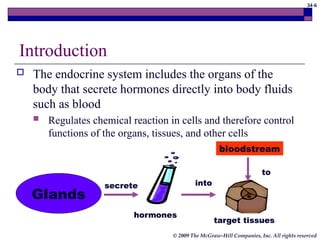
target tissues
Introduction
 The endocrine system includes the organs of the
body that secrete hormones directly into body fluids
such as blood
 Regulates chemical reaction in cells and therefore control
functions of the organs, tissues, and other cells
Glands
secrete
hormones
into
bloodstream
to
34-7
© 2009 The McGraw-Hill Companies, Inc. All rights reserved
Hormones
 Endocrine glands
 Ductless
 Release hormones
 Directly into target tissues
 Into bloodstream to be carried to target tissues
 Hormones – chemicals secreted by a cell that
affect the functions of other cells
34-8
© 2009 The McGraw-Hill Companies, Inc. All rights reserved
Hormones (cont.)
 Many are derived from steroids that easily
cross the cell membrane
 Examples of steroid hormones
 Estrogen
 Progesterone
 Testosterone
 Cortisol
hormones
34-9
© 2009 The McGraw-Hill Companies, Inc. All rights reserved
Hormones (cont.)
 Nonsteroidal hormones
 Made of amino acids or
proteins and cannot cross
the cell membrane easily
 Bind to receptors on the
surface of the cells
 G-protein – activated by the
hormone-receptor complex
 Activates enzymes inside
cell
 Prostaglandins
 Local, or tissue, hormones
 Derived from lipid molecules
 Do not travel in the
bloodstream
 Target tissues are located
close by
 Produced by organs such as
 Kidneys
 Heart
 Stomach
 Uterus
 Brain
34-10
© 2009 The McGraw-Hill Companies, Inc. All rights reserved
Negative and Positive
Feedback Loops
 Control hormone levels
 Negative feedback loop
 Hormone release stops in response to decrease in
stimulus
 Stimulus (eating) raises blood glucose levels
 Pancreas releases insulin in response to elevated blood
glucose
 Blood glucose decreases as it is used by the body or
stored in the liver
 Insulin release stops as blood glucose levels normalize
34-11
© 2009 The McGraw-Hill Companies, Inc. All rights reserved
Negative and Positive
Feedback Loops (cont.)
 Positive feedback loop
 As long as stimulus is present, action of hormone
continues
 Infant nursing at mother’s breast  stimulates
hypothalamus  stimulates posterior pituitary
 Oxytocin released  stimulates milk production and
ejection from mammary glands
 Milk release continues as long as infant continues to
nurse
34-12
© 2009 The McGraw-Hill Companies, Inc. All rights reserved
Apply Your Knowledge
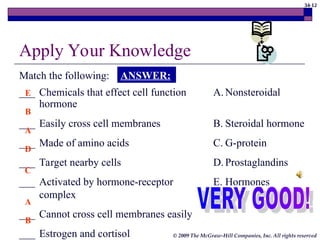
Match the following:
___ Chemicals that effect cell function A.Nonsteroidal
hormone
___ Easily cross cell membranes B. Steroidal hormone
___ Made of amino acids C. G-protein
___ Target nearby cells D.Prostaglandins
___ Activated by hormone-receptor E. Hormones
complex
___ Cannot cross cell membranes easily
___ Estrogen and cortisol
B
A
D
C
A
B
E
ANSWER:
34-13
© 2009 The McGraw-Hill Companies, Inc. All rights reserved
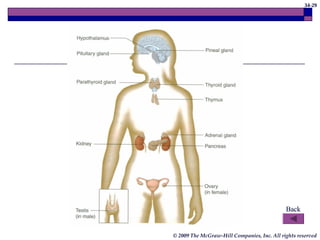
Hypothalamus
 Hormones
 Oxytocin
 Antidiuretic hormone (ADH)
 Hormones transported to the posterior
pituitary for storage
 Directs posterior pituitary to release hormones
Glands
34-14
© 2009 The McGraw-Hill Companies, Inc. All rights reserved
 Controlled by the hypothalamus
 Located at the base of the brain
 Protected by a bony structure called the sella turcica
 The optic chiasm is located just above the pituitary gland
 Carries visual information to the brain for interpretation
 Two lobes
 Anterior lobe
 Posterior lobe
Pituitary Gland
Glands
34-15
© 2009 The McGraw-Hill Companies, Inc. All rights reserved
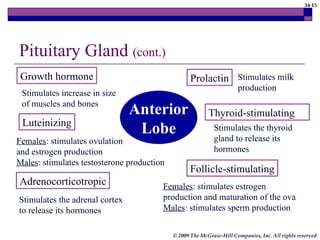
Anterior
Lobe
Growth hormone Prolactin
Adrenocorticotropic
Thyroid-stimulating
Follicle-stimulating
Luteinizing
Stimulates milk
production
Stimulates the adrenal cortex
to release its hormones
Stimulates the thyroid
gland to release its
hormones
Females: stimulates estrogen
production and maturation of the ova
Males: stimulates sperm production
Females: stimulates ovulation
and estrogen production
Males: stimulates testosterone production
Pituitary Gland (cont.)
Stimulates increase in size
of muscles and bones
34-16
© 2009 The McGraw-Hill Companies, Inc. All rights reserved
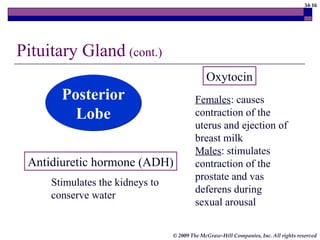
Posterior
Lobe
Antidiuretic hormone (ADH)
Oxytocin
Stimulates the kidneys to
conserve water
Females: causes
contraction of the
uterus and ejection of
breast milk
Males: stimulates
contraction of the
prostate and vas
deferens during
sexual arousal
Pituitary Gland (cont.)
34-17
© 2009 The McGraw-Hill Companies, Inc. All rights reserved
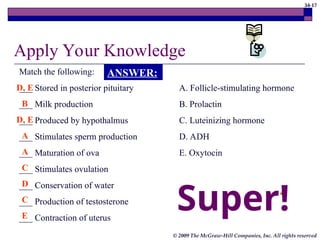
Apply Your Knowledge
Match the following:
___ Stored in posterior pituitary A. Follicle-stimulating hormone
___ Milk production B. Prolactin
___ Produced by hypothalmus C. Luteinizing hormone
___ Stimulates sperm production D. ADH
___ Maturation of ova E. Oxytocin
___ Stimulates ovulation
___ Conservation of water
___ Production of testosterone
___ Contraction of uterus
E
D
B
D, E
C
A
A
C
D, E
ANSWER:
Super!
34-18
© 2009 The McGraw-Hill Companies, Inc. All rights reserved
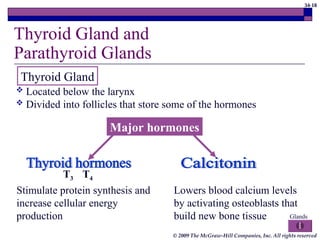
T3 T4
Thyroid Gland and
Parathyroid Glands
Thyroid Gland
 Located below the larynx
 Divided into follicles that store some of the hormones
Major hormones
Stimulate protein synthesis and
increase cellular energy
production
Lowers blood calcium levels
by activating osteoblasts that
build new bone tissue Glands
34-19
© 2009 The McGraw-Hill Companies, Inc. All rights reserved
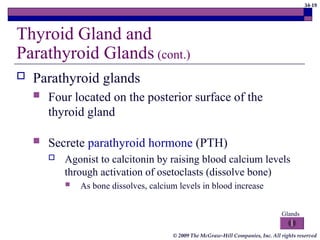
Thyroid Gland and
Parathyroid Glands (cont.)
 Parathyroid glands
 Four located on the posterior surface of the
thyroid gland
 Secrete parathyroid hormone (PTH)
 Agonist to calcitonin by raising blood calcium levels
through activation of osetoclasts (dissolve bone)
 As bone dissolves, calcium levels in blood increase
Glands
34-20
© 2009 The McGraw-Hill Companies, Inc. All rights reserved
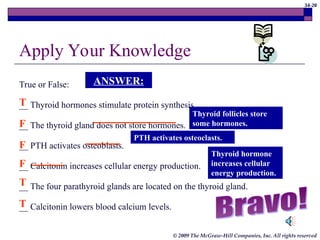
Apply Your Knowledge
True or False:
__ Thyroid hormones stimulate protein synthesis.
__ The thyroid gland does not store hormones.
__ PTH activates osteoblasts.
__ Calcitonin increases cellular energy production.
__ The four parathyroid glands are located on the thyroid gland.
__ Calcitonin lowers blood calcium levels.
F
F
F
T
T
T
ANSWER:
PTH activates osteoclasts.
Thyroid hormone
increases cellular
energy production.
Thyroid follicles store
some hormones.
34-21
© 2009 The McGraw-Hill Companies, Inc. All rights reserved
Adrenal Glands
 Located on top of each kidney
 Divided into the adrenal medulla and adrenal cortex
 Adrenal medulla
 Central portion
 Hormones
 Epinephrine
 Norepinephrine
 Same effects as sympathetic nervous system
Glands
34-22
© 2009 The McGraw-Hill Companies, Inc. All rights reserved
Adrenal Glands (cont.)
 Adrenal cortex
 Outermost portion
 Secretes many hormones, but main ones are
 Aldosterone
 Stimulates body to retain sodium and water
 Important in maintaining BP
 Cortisol
 Released when stressed
 Decreases protein synthesis, resulting in slowed tissue repair
 Decreases inflammation
34-23
© 2009 The McGraw-Hill Companies, Inc. All rights reserved
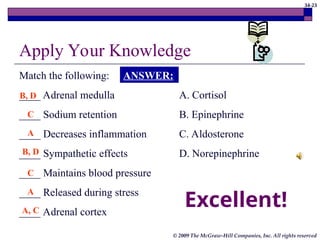
Apply Your Knowledge
Match the following:
____ Adrenal medulla A. Cortisol
____ Sodium retention B. Epinephrine
____ Decreases inflammation C. Aldosterone
____ Sympathetic effects D. Norepinephrine
____ Maintains blood pressure
____ Released during stress
____ Adrenal cortex
A, C
B, D
A
C
A
C
B, D
ANSWER:
Excellent!
34-24
© 2009 The McGraw-Hill Companies, Inc. All rights reserved
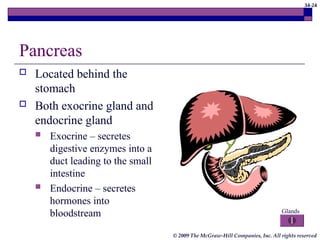
Pancreas
 Located behind the
stomach
 Both exocrine gland and
endocrine gland
 Exocrine – secretes
digestive enzymes into a
duct leading to the small
intestine
 Endocrine – secretes
hormones into
bloodstream Glands
34-25
© 2009 The McGraw-Hill Companies, Inc. All rights reserved
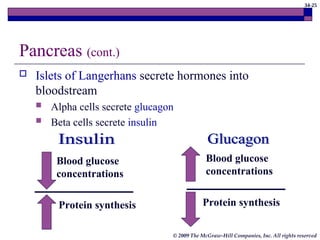
Pancreas (cont.)
 Islets of Langerhans secrete hormones into
bloodstream
 Alpha cells secrete glucagon
 Beta cells secrete insulin
Blood glucose
concentrations
Protein synthesis
Blood glucose
concentrations
Protein synthesis
34-26
© 2009 The McGraw-Hill Companies, Inc. All rights reserved
Apply Your Knowledge
What are the effects of insulin and glucagon?
ANSWER: Insulin decreases blood glucose concentration
and increases protein synthesis.
Glucagon does just the opposite. It increases blood
glucose and decreases protein synthesis.
Yippee
!
34-27
© 2009 The McGraw-Hill Companies, Inc. All rights reserved
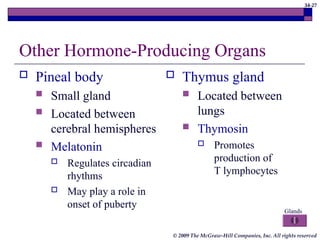
Other Hormone-Producing Organs
 Pineal body
 Small gland
 Located between
cerebral hemispheres
 Melatonin
 Regulates circadian
rhythms
 May play a role in
onset of puberty
 Thymus gland
 Located between
lungs
 Thymosin
 Promotes
production of
T lymphocytes
Glands
34-28
© 2009 The McGraw-Hill Companies, Inc. All rights reserved
Other Hormone-Producing
Organs (cont.)
 The gonads
 Ovaries
 Estrogen
 Progesterone
 Testes
 Testosterone
 Stomach
 Gastrin
 Small intestine
 Secretin
 Cholecystokinin
 Heart
 Atrial natriuretic
peptide – regulates BP
 Kidneys
 Erythropoietin –
stimulates blood cell
production Glands
34-29
© 2009 The McGraw-Hill Companies, Inc. All rights reserved
Back
Back
34-30
© 2009 The McGraw-Hill Companies, Inc. All rights reserved
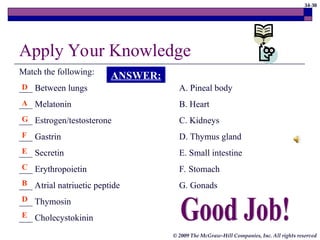
Apply Your Knowledge
Match the following:
___ Between lungs A. Pineal body
___ Melatonin B. Heart
___ Estrogen/testosterone C. Kidneys
___ Gastrin D. Thymus gland
___ Secretin E. Small intestine
___ Erythropoietin F. Stomach
___ Atrial natriuetic peptide G. Gonads
___ Thymosin
___ Cholecystokinin
C
E
F
G
A
E
D
B
D
ANSWER:
34-31
© 2009 The McGraw-Hill Companies, Inc. All rights reserved
The Stress Response
 Stressor
 Any stimulus that
produces stress
 Types
 Physical factors
 Psychological
factors
 Positive stimuli
34-32
© 2009 The McGraw-Hill Companies, Inc. All rights reserved
The Stress Response (cont.)
 Physiologic response to stress caused by
hormone release
 General stress syndrome
 Increased heart rate, respiratory rate, and BP
 Increase in glucose and fatty acids in blood, which
leads to weight loss
 Increase in cortisol if stress prolonged
 Decreased body repair
 Susceptibility to illness
34-33
© 2009 The McGraw-Hill Companies, Inc. All rights reserved
Apply Your Knowledge
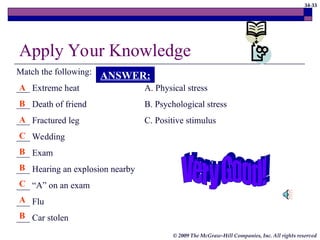
Match the following:
___ Extreme heat A. Physical stress
___ Death of friend B. Psychological stress
___ Fractured leg C. Positive stimulus
___ Wedding
___ Exam
___ Hearing an explosion nearby
___ “A” on an exam
___ Flu
___ Car stolen
B
B
B
A
A
C
B
C
A
ANSWER:
34-34
© 2009 The McGraw-Hill Companies, Inc. All rights reserved
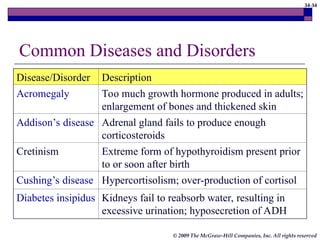
Common Diseases and Disorders
Disease/Disorder Description
Acromegaly Too much growth hormone produced in adults;
enlargement of bones and thickened skin
Addison’s disease Adrenal gland fails to produce enough
corticosteroids
Cretinism Extreme form of hypothyroidism present prior
to or soon after birth
Cushing’s disease Hypercortisolism; over-production of cortisol
Diabetes insipidus Kidneys fail to reabsorb water, resulting in
excessive urination; hyposecretion of ADH
34-35
© 2009 The McGraw-Hill Companies, Inc. All rights reserved
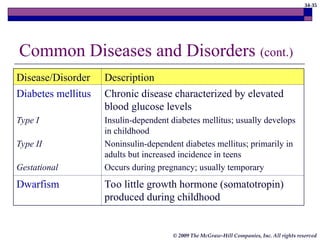
Common Diseases and Disorders (cont.)
Disease/Disorder Description
Diabetes mellitus
Type I
Type II
Gestational
Chronic disease characterized by elevated
blood glucose levels
Insulin-dependent diabetes mellitus; usually develops
in childhood
Noninsulin-dependent diabetes mellitus; primarily in
adults but increased incidence in teens
Occurs during pregnancy; usually temporary
Dwarfism Too little growth hormone (somatotropin)
produced during childhood
34-36
© 2009 The McGraw-Hill Companies, Inc. All rights reserved
Common Diseases and Disorders (cont.)
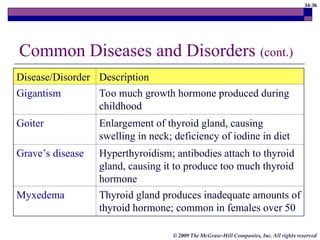
Disease/Disorder Description
Gigantism Too much growth hormone produced during
childhood
Goiter Enlargement of thyroid gland, causing
swelling in neck; deficiency of iodine in diet
Grave’s disease Hyperthyroidism; antibodies attach to thyroid
gland, causing it to produce too much thyroid
hormone
Myxedema Thyroid gland produces inadequate amounts of
thyroid hormone; common in females over 50
34-37
© 2009 The McGraw-Hill Companies, Inc. All rights reserved
Apply Your Knowledge
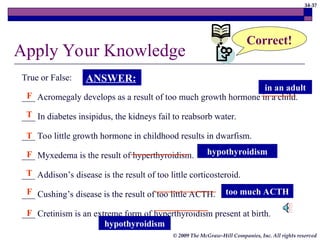
True or False:
___ Acromegaly develops as a result of too much growth hormone in a child.
___ In diabetes insipidus, the kidneys fail to reabsorb water.
___ Too little growth hormone in childhood results in dwarfism.
___ Myxedema is the result of hyperthyroidism.
___ Addison’s disease is the result of too little corticosteroid.
___ Cushing’s disease is the result of too little ACTH.
___ Cretinism is an extreme form of hyperthyroidism present at birth.
F
T
T
T
F
F
ANSWER:
F
hypothyroidism
too much ACTH
hypothyroidism
in an adult
Correct!
34-38
© 2009 The McGraw-Hill Companies, Inc. All rights reserved
In Summary
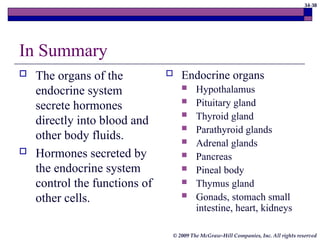
 The organs of the
endocrine system
secrete hormones
directly into blood and
other body fluids.
 Hormones secreted by
the endocrine system
control the functions of
other cells.
 Endocrine organs
 Hypothalamus
 Pituitary gland
 Thyroid gland
 Parathyroid glands
 Adrenal glands
 Pancreas
 Pineal body
 Thymus gland
 Gonads, stomach small
intestine, heart, kidneys
34-39
© 2009 The McGraw-Hill Companies, Inc. All rights reserved
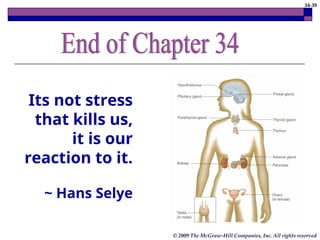
Its not stress
that kills us,
it is our
reaction to it.
~ Hans Selye

nursing care for Endocrine_System disorder .ppt

  • 1.
    © 2009 TheMcGraw-Hill Companies, Inc. All rights reserved The Endocrine System The Endocrine System PowerPoint® presentation to accompany: Medical Assisting Third Edition Booth, Whicker, Wyman, Pugh, Thompson
  • 2.
    34-2 © 2009 TheMcGraw-Hill Companies, Inc. All rights reserved Learning Outcomes 34.1 Define the term endocrine glands. 34.2 Describe the general functions of the endocrine system. 34.3 Define the term hormone. 34.4 Explain the difference in hormone control by positive and negative feedback loops.
  • 3.
    34-3 © 2009 TheMcGraw-Hill Companies, Inc. All rights reserved Learning Outcomes (cont.) 34.5 Describe the locations of the hypothalamus, pituitary gland, pineal body, thyroid gland, parathyroid glands, adrenal glands, pancreas, thymus, and gonads. 34.6 List the hormones released by the pituitary gland and give the functions of each. 34.7 List the hormones released by the thyroid gland and parathyroid glands and give the functions of each.
  • 4.
    34-4 © 2009 TheMcGraw-Hill Companies, Inc. All rights reserved Learning Outcomes (cont.) 34.8 List the hormones released by the adrenal glands and give the functions of each. 34.9 List the names of the endocrine cells of the pancreas, the hormones released by them, and the function of each hormone. 34.10 List the hormones released by the pineal body, thymus, and gonads, and give the functions of each.
  • 5.
    34-5 © 2009 TheMcGraw-Hill Companies, Inc. All rights reserved Learning Outcomes (cont.) 34.11 Name the hormones produced by the kidneys and heart, listing which organ produces the hormone, and the hormone’s function. 34.12 Describe stressors and their effect on the body. 34.13 Describe the causes, signs and symptoms, and treatment of various endocrine disorders.
  • 6.
    34-6 © 2009 TheMcGraw-Hill Companies, Inc. All rights reserved target tissues Introduction  The endocrine system includes the organs of the body that secrete hormones directly into body fluids such as blood  Regulates chemical reaction in cells and therefore control functions of the organs, tissues, and other cells Glands secrete hormones into bloodstream to
  • 7.
    34-7 © 2009 TheMcGraw-Hill Companies, Inc. All rights reserved Hormones  Endocrine glands  Ductless  Release hormones  Directly into target tissues  Into bloodstream to be carried to target tissues  Hormones – chemicals secreted by a cell that affect the functions of other cells
  • 8.
    34-8 © 2009 TheMcGraw-Hill Companies, Inc. All rights reserved Hormones (cont.)  Many are derived from steroids that easily cross the cell membrane  Examples of steroid hormones  Estrogen  Progesterone  Testosterone  Cortisol hormones
  • 9.
    34-9 © 2009 TheMcGraw-Hill Companies, Inc. All rights reserved Hormones (cont.)  Nonsteroidal hormones  Made of amino acids or proteins and cannot cross the cell membrane easily  Bind to receptors on the surface of the cells  G-protein – activated by the hormone-receptor complex  Activates enzymes inside cell  Prostaglandins  Local, or tissue, hormones  Derived from lipid molecules  Do not travel in the bloodstream  Target tissues are located close by  Produced by organs such as  Kidneys  Heart  Stomach  Uterus  Brain
  • 10.
    34-10 © 2009 TheMcGraw-Hill Companies, Inc. All rights reserved Negative and Positive Feedback Loops  Control hormone levels  Negative feedback loop  Hormone release stops in response to decrease in stimulus  Stimulus (eating) raises blood glucose levels  Pancreas releases insulin in response to elevated blood glucose  Blood glucose decreases as it is used by the body or stored in the liver  Insulin release stops as blood glucose levels normalize
  • 11.
    34-11 © 2009 TheMcGraw-Hill Companies, Inc. All rights reserved Negative and Positive Feedback Loops (cont.)  Positive feedback loop  As long as stimulus is present, action of hormone continues  Infant nursing at mother’s breast  stimulates hypothalamus  stimulates posterior pituitary  Oxytocin released  stimulates milk production and ejection from mammary glands  Milk release continues as long as infant continues to nurse
  • 12.
    34-12 © 2009 TheMcGraw-Hill Companies, Inc. All rights reserved Apply Your Knowledge Match the following: ___ Chemicals that effect cell function A.Nonsteroidal hormone ___ Easily cross cell membranes B. Steroidal hormone ___ Made of amino acids C. G-protein ___ Target nearby cells D.Prostaglandins ___ Activated by hormone-receptor E. Hormones complex ___ Cannot cross cell membranes easily ___ Estrogen and cortisol B A D C A B E ANSWER:
  • 13.
    34-13 © 2009 TheMcGraw-Hill Companies, Inc. All rights reserved Hypothalamus  Hormones  Oxytocin  Antidiuretic hormone (ADH)  Hormones transported to the posterior pituitary for storage  Directs posterior pituitary to release hormones Glands
  • 14.
    34-14 © 2009 TheMcGraw-Hill Companies, Inc. All rights reserved  Controlled by the hypothalamus  Located at the base of the brain  Protected by a bony structure called the sella turcica  The optic chiasm is located just above the pituitary gland  Carries visual information to the brain for interpretation  Two lobes  Anterior lobe  Posterior lobe Pituitary Gland Glands
  • 15.
    34-15 © 2009 TheMcGraw-Hill Companies, Inc. All rights reserved Anterior Lobe Growth hormone Prolactin Adrenocorticotropic Thyroid-stimulating Follicle-stimulating Luteinizing Stimulates milk production Stimulates the adrenal cortex to release its hormones Stimulates the thyroid gland to release its hormones Females: stimulates estrogen production and maturation of the ova Males: stimulates sperm production Females: stimulates ovulation and estrogen production Males: stimulates testosterone production Pituitary Gland (cont.) Stimulates increase in size of muscles and bones
  • 16.
    34-16 © 2009 TheMcGraw-Hill Companies, Inc. All rights reserved Posterior Lobe Antidiuretic hormone (ADH) Oxytocin Stimulates the kidneys to conserve water Females: causes contraction of the uterus and ejection of breast milk Males: stimulates contraction of the prostate and vas deferens during sexual arousal Pituitary Gland (cont.)
  • 17.
    34-17 © 2009 TheMcGraw-Hill Companies, Inc. All rights reserved Apply Your Knowledge Match the following: ___ Stored in posterior pituitary A. Follicle-stimulating hormone ___ Milk production B. Prolactin ___ Produced by hypothalmus C. Luteinizing hormone ___ Stimulates sperm production D. ADH ___ Maturation of ova E. Oxytocin ___ Stimulates ovulation ___ Conservation of water ___ Production of testosterone ___ Contraction of uterus E D B D, E C A A C D, E ANSWER: Super!
  • 18.
    34-18 © 2009 TheMcGraw-Hill Companies, Inc. All rights reserved T3 T4 Thyroid Gland and Parathyroid Glands Thyroid Gland  Located below the larynx  Divided into follicles that store some of the hormones Major hormones Stimulate protein synthesis and increase cellular energy production Lowers blood calcium levels by activating osteoblasts that build new bone tissue Glands
  • 19.
    34-19 © 2009 TheMcGraw-Hill Companies, Inc. All rights reserved Thyroid Gland and Parathyroid Glands (cont.)  Parathyroid glands  Four located on the posterior surface of the thyroid gland  Secrete parathyroid hormone (PTH)  Agonist to calcitonin by raising blood calcium levels through activation of osetoclasts (dissolve bone)  As bone dissolves, calcium levels in blood increase Glands
  • 20.
    34-20 © 2009 TheMcGraw-Hill Companies, Inc. All rights reserved Apply Your Knowledge True or False: __ Thyroid hormones stimulate protein synthesis. __ The thyroid gland does not store hormones. __ PTH activates osteoblasts. __ Calcitonin increases cellular energy production. __ The four parathyroid glands are located on the thyroid gland. __ Calcitonin lowers blood calcium levels. F F F T T T ANSWER: PTH activates osteoclasts. Thyroid hormone increases cellular energy production. Thyroid follicles store some hormones.
  • 21.
    34-21 © 2009 TheMcGraw-Hill Companies, Inc. All rights reserved Adrenal Glands  Located on top of each kidney  Divided into the adrenal medulla and adrenal cortex  Adrenal medulla  Central portion  Hormones  Epinephrine  Norepinephrine  Same effects as sympathetic nervous system Glands
  • 22.
    34-22 © 2009 TheMcGraw-Hill Companies, Inc. All rights reserved Adrenal Glands (cont.)  Adrenal cortex  Outermost portion  Secretes many hormones, but main ones are  Aldosterone  Stimulates body to retain sodium and water  Important in maintaining BP  Cortisol  Released when stressed  Decreases protein synthesis, resulting in slowed tissue repair  Decreases inflammation
  • 23.
    34-23 © 2009 TheMcGraw-Hill Companies, Inc. All rights reserved Apply Your Knowledge Match the following: ____ Adrenal medulla A. Cortisol ____ Sodium retention B. Epinephrine ____ Decreases inflammation C. Aldosterone ____ Sympathetic effects D. Norepinephrine ____ Maintains blood pressure ____ Released during stress ____ Adrenal cortex A, C B, D A C A C B, D ANSWER: Excellent!
  • 24.
    34-24 © 2009 TheMcGraw-Hill Companies, Inc. All rights reserved Pancreas  Located behind the stomach  Both exocrine gland and endocrine gland  Exocrine – secretes digestive enzymes into a duct leading to the small intestine  Endocrine – secretes hormones into bloodstream Glands
  • 25.
    34-25 © 2009 TheMcGraw-Hill Companies, Inc. All rights reserved Pancreas (cont.)  Islets of Langerhans secrete hormones into bloodstream  Alpha cells secrete glucagon  Beta cells secrete insulin Blood glucose concentrations Protein synthesis Blood glucose concentrations Protein synthesis
  • 26.
    34-26 © 2009 TheMcGraw-Hill Companies, Inc. All rights reserved Apply Your Knowledge What are the effects of insulin and glucagon? ANSWER: Insulin decreases blood glucose concentration and increases protein synthesis. Glucagon does just the opposite. It increases blood glucose and decreases protein synthesis. Yippee !
  • 27.
    34-27 © 2009 TheMcGraw-Hill Companies, Inc. All rights reserved Other Hormone-Producing Organs  Pineal body  Small gland  Located between cerebral hemispheres  Melatonin  Regulates circadian rhythms  May play a role in onset of puberty  Thymus gland  Located between lungs  Thymosin  Promotes production of T lymphocytes Glands
  • 28.
    34-28 © 2009 TheMcGraw-Hill Companies, Inc. All rights reserved Other Hormone-Producing Organs (cont.)  The gonads  Ovaries  Estrogen  Progesterone  Testes  Testosterone  Stomach  Gastrin  Small intestine  Secretin  Cholecystokinin  Heart  Atrial natriuretic peptide – regulates BP  Kidneys  Erythropoietin – stimulates blood cell production Glands
  • 29.
    34-29 © 2009 TheMcGraw-Hill Companies, Inc. All rights reserved Back Back
  • 30.
    34-30 © 2009 TheMcGraw-Hill Companies, Inc. All rights reserved Apply Your Knowledge Match the following: ___ Between lungs A. Pineal body ___ Melatonin B. Heart ___ Estrogen/testosterone C. Kidneys ___ Gastrin D. Thymus gland ___ Secretin E. Small intestine ___ Erythropoietin F. Stomach ___ Atrial natriuetic peptide G. Gonads ___ Thymosin ___ Cholecystokinin C E F G A E D B D ANSWER:
  • 31.
    34-31 © 2009 TheMcGraw-Hill Companies, Inc. All rights reserved The Stress Response  Stressor  Any stimulus that produces stress  Types  Physical factors  Psychological factors  Positive stimuli
  • 32.
    34-32 © 2009 TheMcGraw-Hill Companies, Inc. All rights reserved The Stress Response (cont.)  Physiologic response to stress caused by hormone release  General stress syndrome  Increased heart rate, respiratory rate, and BP  Increase in glucose and fatty acids in blood, which leads to weight loss  Increase in cortisol if stress prolonged  Decreased body repair  Susceptibility to illness
  • 33.
    34-33 © 2009 TheMcGraw-Hill Companies, Inc. All rights reserved Apply Your Knowledge Match the following: ___ Extreme heat A. Physical stress ___ Death of friend B. Psychological stress ___ Fractured leg C. Positive stimulus ___ Wedding ___ Exam ___ Hearing an explosion nearby ___ “A” on an exam ___ Flu ___ Car stolen B B B A A C B C A ANSWER:
  • 34.
    34-34 © 2009 TheMcGraw-Hill Companies, Inc. All rights reserved Common Diseases and Disorders Disease/Disorder Description Acromegaly Too much growth hormone produced in adults; enlargement of bones and thickened skin Addison’s disease Adrenal gland fails to produce enough corticosteroids Cretinism Extreme form of hypothyroidism present prior to or soon after birth Cushing’s disease Hypercortisolism; over-production of cortisol Diabetes insipidus Kidneys fail to reabsorb water, resulting in excessive urination; hyposecretion of ADH
  • 35.
    34-35 © 2009 TheMcGraw-Hill Companies, Inc. All rights reserved Common Diseases and Disorders (cont.) Disease/Disorder Description Diabetes mellitus Type I Type II Gestational Chronic disease characterized by elevated blood glucose levels Insulin-dependent diabetes mellitus; usually develops in childhood Noninsulin-dependent diabetes mellitus; primarily in adults but increased incidence in teens Occurs during pregnancy; usually temporary Dwarfism Too little growth hormone (somatotropin) produced during childhood
  • 36.
    34-36 © 2009 TheMcGraw-Hill Companies, Inc. All rights reserved Common Diseases and Disorders (cont.) Disease/Disorder Description Gigantism Too much growth hormone produced during childhood Goiter Enlargement of thyroid gland, causing swelling in neck; deficiency of iodine in diet Grave’s disease Hyperthyroidism; antibodies attach to thyroid gland, causing it to produce too much thyroid hormone Myxedema Thyroid gland produces inadequate amounts of thyroid hormone; common in females over 50
  • 37.
    34-37 © 2009 TheMcGraw-Hill Companies, Inc. All rights reserved Apply Your Knowledge True or False: ___ Acromegaly develops as a result of too much growth hormone in a child. ___ In diabetes insipidus, the kidneys fail to reabsorb water. ___ Too little growth hormone in childhood results in dwarfism. ___ Myxedema is the result of hyperthyroidism. ___ Addison’s disease is the result of too little corticosteroid. ___ Cushing’s disease is the result of too little ACTH. ___ Cretinism is an extreme form of hyperthyroidism present at birth. F T T T F F ANSWER: F hypothyroidism too much ACTH hypothyroidism in an adult Correct!
  • 38.
    34-38 © 2009 TheMcGraw-Hill Companies, Inc. All rights reserved In Summary  The organs of the endocrine system secrete hormones directly into blood and other body fluids.  Hormones secreted by the endocrine system control the functions of other cells.  Endocrine organs  Hypothalamus  Pituitary gland  Thyroid gland  Parathyroid glands  Adrenal glands  Pancreas  Pineal body  Thymus gland  Gonads, stomach small intestine, heart, kidneys
  • 39.
    34-39 © 2009 TheMcGraw-Hill Companies, Inc. All rights reserved Its not stress that kills us, it is our reaction to it. ~ Hans Selye