The document presents a hybrid algorithm combining artificial bee colony (ABC) and complex generalized Hebbian (CGHA) neural network techniques for estimating the number of sources in smart antennas, utilizing Bayesian Information Criterion (BIC). This approach eliminates the need for covariance matrix computations, enhancing estimation accuracy while reducing training time and improving convergence speed. Simulation results demonstrate that the proposed method effectively estimates the correct number of sources even under varied signal conditions, outperforming traditional non-optimized systems.
![International Journal of Electrical and Computer Engineering (IJECE)
Vol. 12, No. 6, December 2022, pp. 6210~6217
ISSN: 2088-8708, DOI: 10.11591/ijece.v12i6.pp6210-6217 6210
Journal homepage: http://ijece.iaescore.com
Number of sources estimation using a hybrid algorithm for
smart antenna
Mohammed Hussein Miry1
, Atheer A. Sabri1
, Ali Hussien Mary2
1
Department of Communication Engineering, University of Technology-Iraq, Baghdad, Iraq
2
Department of Mechatronics Engineering, Al-Khwarizmy College, University of Baghdad, Baghdad, Iraq
Article Info ABSTRACT
Article history:
Received Sep 25, 2021
Revised Jun 11, 2022
Accepted Jul 7, 2022
The number of sources estimation is one of the vital key technologies in
smart antenna. The current paper adopts a new system that employs a hybrid
algorithm of artificial bee colony (ABC) and complex generalized Hebbian
(CGHA) neural network to Bayesian information criterion (BIC) technique,
aiming to enhance the accuracy of number of sources estimation. The
advantage of the new system is that no need to compute the covariance
matrix, since its principal eigenvalues are computed using the CGHA neural
network for the received signals. Moreover, the proposed system can
optimize the training condition of the CGHA neural network, therefore it can
overcome the random selection of initial weights and learning rate, which
evades network oscillation and trapping into local solution. Simulation
results of the offered system show good responses through reducing the
required time to train the CGHA neural network, fast converge speed,
effectiveness, in addition to achieving the correct number of sources.
Keywords:
Artificial bee colony
Bayesian information criterion
Complex generalized Hebbian
neural
Smart antenna
This is an open access article under the CC BY-SA license.
Corresponding Author:
Mohammed Hussein Miry
Department of Communication Engineering, University of Technology-Iraq
Baghdad, Iraq
Email: Mohammed.H.Miry@uotechnology.edu.iq
1. INTRODUCTION
Smart antenna techniques have taken a lot of effort during recent decades; they present one of the
most important techniques that support the coming fifth-generation (5G) of wireless communication [1]–[4].
However, number of signal sources estimations is an important issue in these techniques. A public method
for estimating the number of sources that imposing on multiple sensors is Bayesian information criterion
(BIC) [5]–[8], this method needs covariance matrix calculation, the calculation operation costs significant
time during estimation number of sources. On the other hand, complex generalized Hebbian (CGHA) neural
network [9], [10] is commonly used for signal processing. Furthermore, it used as dimensional reduction,
CGHA network projects the input data from the original p-dimensional vector space to q-dimensional output
space, where typically 𝑞 < 𝑝 dimensionality reduction is performed; the output vector retains most of the
essential information that is resident in the input vector. Moreover, it could be used to extract the eigenvalues
and its corresponding eigenvectors form the covariance matrix. However, CGHA neural network has to lack
in a condition of initial connections weights determining, leading to difficulty in specifying the initial global
point, accordingly, probability of acquiring the optimal global solutions is lesser. In this context, artificial bee
colony (ABC) algorithm has proven its efficiency and accuracy in optimization with only a few control
parameters as compared with other common optimization techniques [11]–[13]. In light of this, depending on
ABC optimization and CGHA network, a new system is suggested in the present paper to estimate the number
of sources using BIC without need computing their covariance matrix.](https://image.slidesharecdn.com/v51157076567328591emr11jun2225sep21kk-221026061918-47d56a21/85/Number-of-sources-estimation-using-a-hybrid-algorithm-for-smart-antenna-1-320.jpg)
![International Journal of Electrical and Computer Engineering (IJECE)
Vol. 12, No. 6, December 2022, pp. 6210~6217
ISSN: 2088-8708, DOI: 10.11591/ijece.v12i6.pp6210-6217 6210
Journal homepage: http://ijece.iaescore.com
Number of sources estimation using a hybrid algorithm for
smart antenna
Mohammed Hussein Miry1
, Atheer A. Sabri1
, Ali Hussien Mary2
1
Department of Communication Engineering, University of Technology-Iraq, Baghdad, Iraq
2
Department of Mechatronics Engineering, Al-Khwarizmy College, University of Baghdad, Baghdad, Iraq
Article Info ABSTRACT
Article history:
Received Sep 25, 2021
Revised Jun 11, 2022
Accepted Jul 7, 2022
The number of sources estimation is one of the vital key technologies in
smart antenna. The current paper adopts a new system that employs a hybrid
algorithm of artificial bee colony (ABC) and complex generalized Hebbian
(CGHA) neural network to Bayesian information criterion (BIC) technique,
aiming to enhance the accuracy of number of sources estimation. The
advantage of the new system is that no need to compute the covariance
matrix, since its principal eigenvalues are computed using the CGHA neural
network for the received signals. Moreover, the proposed system can
optimize the training condition of the CGHA neural network, therefore it can
overcome the random selection of initial weights and learning rate, which
evades network oscillation and trapping into local solution. Simulation
results of the offered system show good responses through reducing the
required time to train the CGHA neural network, fast converge speed,
effectiveness, in addition to achieving the correct number of sources.
Keywords:
Artificial bee colony
Bayesian information criterion
Complex generalized Hebbian
neural
Smart antenna
This is an open access article under the CC BY-SA license.
Corresponding Author:
Mohammed Hussein Miry
Department of Communication Engineering, University of Technology-Iraq
Baghdad, Iraq
Email: Mohammed.H.Miry@uotechnology.edu.iq
1. INTRODUCTION
Smart antenna techniques have taken a lot of effort during recent decades; they present one of the
most important techniques that support the coming fifth-generation (5G) of wireless communication [1]–[4].
However, number of signal sources estimations is an important issue in these techniques. A public method
for estimating the number of sources that imposing on multiple sensors is Bayesian information criterion
(BIC) [5]–[8], this method needs covariance matrix calculation, the calculation operation costs significant
time during estimation number of sources. On the other hand, complex generalized Hebbian (CGHA) neural
network [9], [10] is commonly used for signal processing. Furthermore, it used as dimensional reduction,
CGHA network projects the input data from the original p-dimensional vector space to q-dimensional output
space, where typically 𝑞 < 𝑝 dimensionality reduction is performed; the output vector retains most of the
essential information that is resident in the input vector. Moreover, it could be used to extract the eigenvalues
and its corresponding eigenvectors form the covariance matrix. However, CGHA neural network has to lack
in a condition of initial connections weights determining, leading to difficulty in specifying the initial global
point, accordingly, probability of acquiring the optimal global solutions is lesser. In this context, artificial bee
colony (ABC) algorithm has proven its efficiency and accuracy in optimization with only a few control
parameters as compared with other common optimization techniques [11]–[13]. In light of this, depending on
ABC optimization and CGHA network, a new system is suggested in the present paper to estimate the number
of sources using BIC without need computing their covariance matrix.](https://image.slidesharecdn.com/v51157076567328591emr11jun2225sep21kk-221026061918-47d56a21/75/Number-of-sources-estimation-using-a-hybrid-algorithm-for-smart-antenna-1-2048.jpg)
![Int J Elec & Comp Eng ISSN: 2088-8708
Number of sources estimation using a hybrid algorithm for smart antenna (Mohammed Hussein Miry)
6211
2. BIC PRINCIPLE
The array model assumes with m antennas, each antenna gathering n received samples from k
sources. These samples are arranged in a matrix 𝑆 ∈ 𝐶𝑘×𝑛
. Let 𝐻 ∈ 𝐶𝑚×𝑘
is the channel matrix
accompanied by the elements {ℎ𝑖𝑗} , where 𝑖 = 1, 2, . . . , 𝑚 and 𝑗 = 1, 2, . . . , 𝑘 , that represent the channel
gains concerning j-th
source and i-th
sensor. Lastly, assume 𝑉 ∈ 𝐶𝑚×𝑛
is the matrix of the additive Gaussian
noise. Then the matrix of the received samples will be [14], [15]:
𝑋 = 𝐻𝑆 + 𝑉 (1)
it can suppose that (k ≤ 𝑚). Then covariance matrices of data vector (X) is [16]–[18].
𝑅 = 𝐸[𝑋𝑋†
] (2)
In practice, the accurate covariance matrices cannot be gotten due to the finite snapshots data, only the
estimation 𝑅
∧
of real R can obtained according to (3).
𝑅
̂ =
1
𝑛
𝑋 𝑋†
= ∑ 𝜆
̂𝑖
𝑚
𝑖=1 𝑢
̂𝑖𝑢
̂𝑖
𝐻
(3)
Where † means complex conjugate and transpose, 𝜆
̂𝑖, 𝑖 = 1, . . . , 𝑚 are the eigenvalues and 𝑢
̂𝑖, 𝑖 =
1, . . . . , 𝑚 are the corresponding eigenvectors. The eigenvalues are sorted descendant as: 𝜆
̂1 ≥ 𝜆
̂2 ≥. . . . ≥
𝜆
̂𝑘 ≥ 𝜆
̂𝑘+1 =. . . . . . = 𝜆
̂𝑚, where 𝜆
̂1, 𝜆
̂2, . . . . . . , 𝜆
̂𝑘 are the eigenvalues corresponding to the sources, and
𝜆
̂𝑘+1, . . . . . . , 𝜆
̂𝑚, are the eigenvalues corresponding to the noise [19], [20].
The BIC method uses the previously statistical derivations if the estimated eigenvalues are given, in
order to detect number of sources. BIC estimation function can be shown [21], [22]:
𝐵𝐼𝐶(𝑖) = −2𝑛(𝑚 − 𝑖)𝑙𝑜𝑔 (
∏ 𝜆𝑗
1
𝑚−𝑖
𝑚
𝑗=1+𝑖
1
𝑚 − 𝑖
∑ 𝜆𝑗
𝑚
𝑗=𝑖+1
) + [𝑖(2𝑚 − 𝑖) + 1]𝑙𝑜𝑔𝑛 𝑓𝑜𝑟 𝑖
= 0,1, 2, … , 𝑚 − 1 (4)
where 𝜆𝑗 denote the eigenvalues of 𝑅
̂. The number of sources is the value of i, which minimizes the cost
function in (4).
3. CGHA NEURAL NETWORK
The complex generalized Hebbian algorithm (CGHA) is a way that applied in extracting the rest of
the eigenvectors. The model has q dimensional output vector:
𝑌 = [𝑦1 , . . . , 𝑦𝑞]
and 𝑚 dimensional input vector.
𝑋 = [𝑥1 , . . . . , 𝑥𝑚]
There is only feed forward connection between input and output which is a linear function of the input
(consider) the feed forward network shown in Figure 1. For the n-th
complex vector 𝑋(𝑛) that offered to
CGHA network, the complex output value 𝑦𝑖(𝑛) of neuron (j) is obtained by [10].
𝑦𝑗(𝑛) = ∑ 𝑤𝑗𝑖
∗
(𝑛)𝑥𝑖(𝑛) 𝑗 = 1,2, … … , 𝑞
𝑚
𝑖=1 (5)
Where 𝑤𝑗𝑖(𝑛) denotes the complex weight of the synapse which joins the (i-th
) input node to the (j-th
) output
neuron at iteration (n) and “*” represent the complex conjugate operator. The initial value of synapse weight
can be arbitrarily set.
The synapse weight vector 𝑤𝑗𝑖(𝑛) is updated according to [23].](https://image.slidesharecdn.com/v51157076567328591emr11jun2225sep21kk-221026061918-47d56a21/85/Number-of-sources-estimation-using-a-hybrid-algorithm-for-smart-antenna-2-320.jpg)
![ ISSN: 2088-8708
Int J Elec & Comp Eng, Vol. 12, No. 6, December 2022: 6210-6217
6212
𝑤𝑗𝑖(𝑛 + 1) = 𝑤𝑗𝑖(𝑛) + ∆𝑤𝑗𝑖(𝑛)
= 𝑤𝑗𝑖(𝑛) + 𝜂𝑐𝑜𝑛𝑗[𝑦𝑖(𝑛)]. [𝑥𝑖(𝑛)𝑦𝑖(𝑛)𝑤𝑗𝑖(𝑛) − ∑ 𝑤ℎ𝑖(𝑛)𝑦ℎ(𝑛)]
𝑗
ℎ=1
𝑖 = 1,2, … . , 𝑚 𝑎𝑛𝑑 𝑗 = 1,2, … . , 𝑞 (6)
Where 𝜂 is the learning rate parameter. The components of Y vector are usually ordered according to
decreasing variance. The vectors 𝑊1, … … , 𝑊
𝑞 present the first 𝑞 eigenvectors of the covariance matrix 𝑅𝑥𝑥,
such that 𝑊1 = [𝑤11, … , 𝑤1𝑚]𝑇
corresponds to the largest eigenvalue (𝜆1) of 𝑅𝑥𝑥, 𝑊2 = [𝑤21, … , 𝑤2𝑚]𝑇
corresponds to next-largest eigenvalue (𝜆2) and 𝑊
𝑞 = [𝑤𝑞1, … , 𝑤𝑞𝑚]𝑇
corresponds to the smallest eigenvalue
(𝜆𝑞). Output vector Y elements are uncorrelated and their variance is equal to covariance matrix 𝑅𝑥𝑥
eigenvalues. Whereas eigenvectors that related to the largest eigenvalues represent the principal eigenvectors.
While Y vector elements represent the principal components.
Figure 1. The CGHA neural network architecture
4. ARTIFICIAL BEE COLONY OPTIMIZATION
ABC optimization [24]–[26] represents one of the warmest swarm intelligent based schemes, which
is introduced to simulate the foraging behavior of honey bee colonies. The construction of ABC optimization
procedure is generally encompassing three collections of artificial bees; which are employed, onlooker, and
scout bees. Each individual employed bee is linked to a food source (possible solution) in the population, and
shares its location information besides the fitness cost with onlooker bees for further treatment; which will
responsible to determine the most suitable solution in related to the process of probability selection. When
the given solution does not get better for a predefined number of attempts (limit parameter value), the
solution is abandoned and its relative employed bee transmutes into a scout bee. In more particulars:
- Initialization phase: In this phase, a random population of solutions for initialization is generated.
Afterward, the fitness functions for these initial solutions are evaluated.
- Employed bee phase: Neighborhood search around previous solutions to find new solutions.
Subsequently, a greedy selection between them, depending on their fitness evaluation values is
performed.
- Onlooker bee phase: After probability calculation for each solution according to its fitness value,
onlooker bees choose the solution that has the maximum probability assessment. Afterward, likewise the
mechanisms of solution amendment and greedy selection are performed to keep the better solutions.
- Scout bee phase: The solution that has not been improved after the limit value of endeavors is abandoned,
and its corresponding employee becomes a scout that generates a new random solution. The optimal
output is acquired from the best obtained solution after repeating the above three phases for a
predetermined maximum number of cycles.](https://image.slidesharecdn.com/v51157076567328591emr11jun2225sep21kk-221026061918-47d56a21/85/Number-of-sources-estimation-using-a-hybrid-algorithm-for-smart-antenna-3-320.jpg)
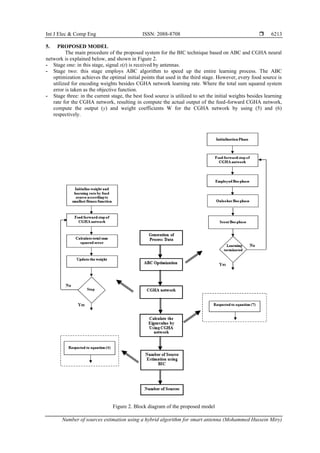
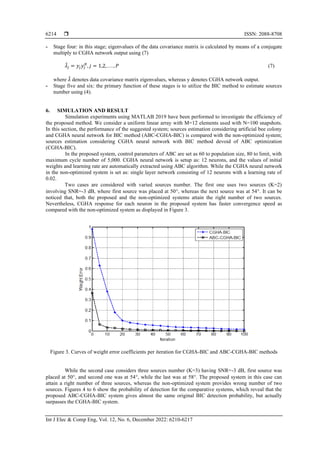
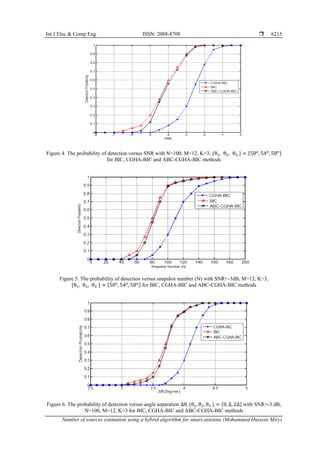
![ ISSN: 2088-8708
Int J Elec & Comp Eng, Vol. 12, No. 6, December 2022: 6210-6217
6216
7. CONCLUSION
The current work introduces a hybrid scheme to support the number of sources determining in smart
antenna through carrying out BIC to the outcome of CGHA neural network that based on artificial bee colony
optimization. The proposed scheme implies optimization to solve the dilemmas of the random initial weights
specifying besides determining the training condition of the CGHA neural network, which frequently causes
network training oscillations. Furthermore, the proposed scheme is able to catch an accurate number of
sources estimation, taking the principal components that computed directly from the input signals by using
CGHA neural network rather than computing them from the covariance matrix, accordingly, determining the
covariance matrix is not required. Simulation results of the proposed scheme verify its effectiveness through
diminishing the required time to train the neural network, fast converge speed, with almost the same
anticipation possibility as compared to the original BIC method.
REFERENCES
[1] M. Ikram, R. Hussain, and M. S. Sharawi, “4G/5G antenna system with dual function planar connected array,” IET Microwaves,
Antennas and Propagation, vol. 11, no. 12, pp. 1760–1764, Sep. 2017, doi: 10.1049/iet-map.2017.0148.
[2] T. G. Shivapanchakshari and H. S. Aravinda, “CL-SA-OFDM: Cross-layer and smart antenna based ofdm system performance
enhancement,” International Journal of Electrical and Computer Engineering (IJECE), vol. 10, no. 5, pp. 4663–4670, Oct. 2020,
doi: 10.11591/ijece.v10i5.pp4663-4670.
[3] S. Almorabeti, H. Terchoune, M. Rifi, H. Tizyi, and S. Smihily, “Smart antenna design alimented by a 4x4 butler matrix,”
Telecommunication Computing Electronics and Control (TELKOMNIKA), vol. 19, no. 4, pp. 1342–1348, Aug. 2021, doi:
10.12928/telkomnika.v19i4.18788.
[4] R. Hussain, A. T. Alreshaid, S. K. Podilchak, and M. S. Sharawi, “Compact 4G MIMO antenna integrated with a 5G array for
current and future mobile handsets,” IET Microwaves, Antennas and Propagation, vol. 11, no. 2, pp. 271–279, Jan. 2017, doi:
10.1049/iet-map.2016.0738.
[5] M. J. Bayarri, J. O. Berger, W. Jang, S. Ray, L. R. Pericchi, and I. Visser, “Prior-based Bayesian information criterion,” Statistical
Theory and Related Fields, vol. 3, no. 1, pp. 2–13, Jan. 2019, doi: 10.1080/24754269.2019.1582126.
[6] J. J. Dziak, D. L. Coffman, S. T. Lanza, R. Li, and L. S. Jermiin, “Sensitivity and specificity of information criteria,” Briefings in
Bioinformatics, vol. 21, no. 2, pp. 553–565, Mar. 2020, doi: 10.1093/bib/bbz016.
[7] J. Heo, J. Y. Lee, and W. Kim, “Bayesian information criterion accounting for the number of covariance parameters in mixed
effects models,” Communications for Statistical Applications and Methods, vol. 27, no. 3, pp. 300–311, May 2020, doi:
10.29220/CSAM.2020.27.3.301.
[8] M. Drton and M. Plummer, “A Bayesian information criterion for singular models,” Journal of the Royal Statistical Society:
Series B (Statistical Methodology), vol. 79, no. 2, pp. 323–380, Mar. 2017, doi: 10.1111/rssb.12187.
[9] J. Qiu, H. Wang, J. Lu, B. Zhang, and K.-L. Du, “Neural network implementations for PCA and its extensions,” ISRN Artificial
Intelligence, vol. 2012, pp. 1–19, Jul. 2012, doi: 10.5402/2012/847305.
[10] M. C. F. De Castro, F. C. C. De Castro, J. N. Amaral, and P. R. G. Franco, “A complex valued Hebbian learning algorithm,” in
1998 IEEE International Joint Conference on Neural Networks Proceedings. IEEE World Congress on Computational
Intelligence (Cat. No.98CH36227), 1998, vol. 2, pp. 1235–1238, doi: 10.1109/IJCNN.1998.685950.
[11] B. Nozohour-leilabady and B. Fazelabdolabadi, “On the application of artificial bee colony (ABC) algorithm for optimization of
well placements in fractured reservoirs; efficiency comparison with the particle swarm optimization (PSO) methodology,”
Petroleum, vol. 2, no. 1, pp. 79–89, Mar. 2016, doi: 10.1016/j.petlm.2015.11.004.
[12] M. Konar and A. Bagis, “Performance comparison of particle swarm optimization, differential evolution and artificial bee colony
algorithms for fuzzy modelling of nonlinear systems,” Elektronika ir Elektrotechnika, vol. 22, no. 5, Oct. 2016, doi:
10.5755/j01.eie.22.5.16336.
[13] W. Alomoush, A. Alrosan, A. Almomani, K. Alissa, O. A. Khashan, and A. Al-nawasrah, “Spatial information of fuzzy clustering
based mean best artificial bee colony algorithm for phantom brain image segmentation,” International Journal of Electrical and
Computer Engineering (IJECE), vol. 11, no. 5, pp. 4050–4058, Oct. 2021, doi: 10.11591/ijece.v11i5.pp4050-4058.
[14] R. Hu, J. Tong, J. Xi, Q. Guo, and Y. Yu, “Channel covariance matrix estimation via dimension reduction for hybrid MIMO
MmWave communication systems,” Sensors, vol. 19, no. 15, Jul. 2019, doi: 10.3390/s19153368.
[15] D. Guimarães and R. de Souza, “Simple and efficient algorithm for improving the MDL estimator of the number of sources,”
Sensors, vol. 14, no. 10, pp. 19477–19492, Oct. 2014, doi: 10.3390/s141019477.
[16] Y. Lu, C. Tao, and L. Liu, “Correlation investigation for uniform circular array based on measured massive MIMO,”
International Journal of Pattern Recognition and Artificial Intelligence, vol. 33, no. 9, Art. no. 1958010, Aug. 2019, doi:
10.1142/S0218001419580102.
[17] Z. Dong, J. Hu, B. Du, and Y. He, “Improvement of source number estimation method for single channel signal,” Plos One, vol.
11, no. 10, Oct. 2016, doi: 10.1371/journal.pone.0164654.
[18] W. Cheng, Z. Zhang, H. Cao, Z. He, and G. Zhu, “A comparative study of information-based source number estimation methods
and experimental validations on mechanical systems,” Sensors, vol. 14, no. 5, pp. 7625–7646, Apr. 2014, doi:
10.3390/s140507625.
[19] Y. Zhang, D. Wang, H. Xu, F. Mei, and J. You, “An underdetermined source number estimation method for non-circular targets
based on sparse array,” IEEE Access, vol. 7, pp. 77944–77950, 2019, doi: 10.1109/ACCESS.2019.2922382.
[20] M. D. Collins and J. F. Lingevitch, “Multi-valued eigen-processing for isolating multiple sources with a rectangular array,” IEEE
Access, vol. 9, pp. 8990–8996, 2021, doi: 10.1109/ACCESS.2021.3049777.
[21] A. Mehrjou, R. Hosseini, and B. Nadjar Araabi, “Improved Bayesian information criterion for mixture model selection,” Pattern
Recognition Letters, vol. 69, pp. 22–27, Jan. 2016, doi: 10.1016/j.patrec.2015.10.004.
[22] Z. Lu and A. M. Zoubir, “Generalized Bayesian information criterion for source enumeration in array processing,” IEEE
Transactions on Signal Processing, vol. 61, no. 6, pp. 1470–1480, Mar. 2013, doi: 10.1109/TSP.2012.2232661.
[23] Y. Zhang and Y. Ma, “CGHA for principal component extraction in the complex domain,” IEEE Transactions on Neural
Networks, vol. 8, no. 5, pp. 1031–1036, Sep. 1997, doi: 10.1109/72.623205.](https://image.slidesharecdn.com/v51157076567328591emr11jun2225sep21kk-221026061918-47d56a21/85/Number-of-sources-estimation-using-a-hybrid-algorithm-for-smart-antenna-7-320.jpg)
![Int J Elec & Comp Eng ISSN: 2088-8708
Number of sources estimation using a hybrid algorithm for smart antenna (Mohammed Hussein Miry)
6217
[24] T. O. Fahad and A. A. Ali, “Multiobjective optimized routing protocol for VANETs,” Advances in Fuzzy Systems, vol. 2018,
pp. 1–10, Dec. 2018, doi: 10.1155/2018/7210253.
[25] L. O. Mogaka, G. N. Nyakoe, and M. J. Saulo, “Islanded microgrid congestion control by load prioritization and shedding using
ABC algorithm,” International Journal of Electrical and Computer Engineering (IJECE), vol. 10, no. 5, pp. 4552–4561, Oct.
2020, doi: 10.11591/ijece.v10i5.pp4552-4561.
[26] A. Kumar, D. Kumar, and S. K. Jarial, “A review on artificial bee colony algorithms and their applications to data clustering,”
Cybernetics and Information Technologies, vol. 17, no. 3, pp. 3–28, Sep. 2017, doi: 10.1515/cait-2017-0027.
BIOGRAPHIES OF AUTHORS
Mohammed Hussein Miry received his bachelor and master degree in
communication engineering from the University of Technology (UOT), Iraq and Ph.D. from
the Department of Electrical Engineering at the Basra University, Iraq. He is working as an
associative professor in Department of Communication Engineering at University of
Technology- Iraq. His main fields of interests are smart antenna, adaptive filter, digital signal
processing, communication system, and microwave engineering. He can be contacted at email:
Mohammed.H.Miry@uotechnology.edu.iq.
Atheer A. Sabri was born in Baghdad, Iraq in 1975. He received his B.Sc. degree
in 1997 from Al-Nahrain University, while the M.Sc. and Ph.D. degrees in 2000 and 2006
respectively from University of Technology- Iraq. Since 2013, He has been Assistant
Professor at the University of Technology. Also, from 2015 he worked as deputy head of
communication Engineering Department at the University of Technology. He can be contacted
at email: Atheer.A.Sabri@uotechnology.edu.iq.
Ali Hussien Mary was born in Baghdad in 1976. He graduated from the
electrical engineering department in University of Baghdad, Iraq, in 1998. He got the MSc
degree in electrical engineering/computer and control division from University of Baghdad
Iraq in 2001. He received a Ph.D. degree in control engineering from Gaziantep University
Turkey in 2017. He published many papers in different journals. Research interests are robust
control, nonlinear systems and robotics control. He can be contacted at email:
alimary76@kecbu.uobaghdad.edu.iq.](https://image.slidesharecdn.com/v51157076567328591emr11jun2225sep21kk-221026061918-47d56a21/85/Number-of-sources-estimation-using-a-hybrid-algorithm-for-smart-antenna-8-320.jpg)


