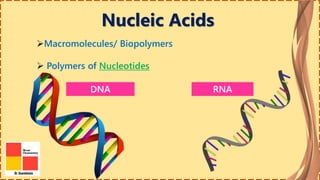
Nucleic Acids
Macromolecules/ Biopolymers
 Polymers of Nucleotides
RNADNA
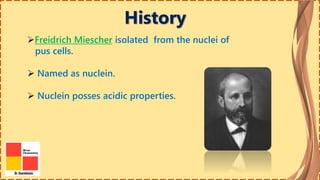
History
Freidrich Miescher isolated from the nuclei of
pus cells.
 Named as nuclein.
 Nuclein posses acidic properties.
Role of Nucleotides
Building blocks of nucleic acids (DNA, RNA).
 Energy currency in cellular metabolism (ATP).
Structural components of many enzymes
cofactor. (NAD, FMN, FAD)
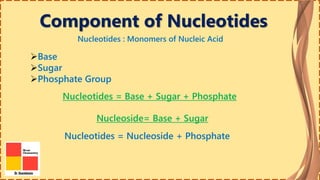
Component of Nucleotides
Base
Sugar
Phosphate Group
Nucleotides = Base + Sugar + Phosphate
Nucleoside= Base + Sugar
Nucleotides = Nucleoside + Phosphate
Nucleotides : Monomers of Nucleic Acid
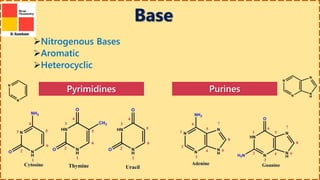
Base
Nitrogenous Bases
Aromatic
Heterocyclic
Pyrimidines Purines
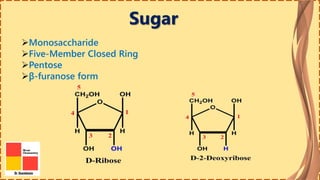
Sugar
Monosaccharide
Five-Member Closed Ring
Pentose
β-furanose form
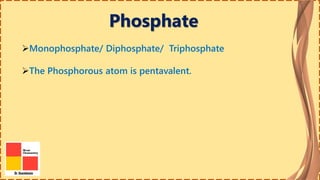
Phosphate
Monophosphate/ Diphosphate/ Triphosphate
The Phosphorous atom is pentavalent.
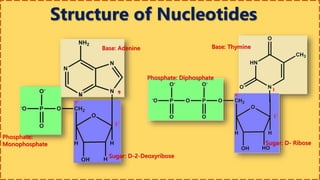
Structure of Nucleotides
Base: Adenine Base: Thymine
Sugar: D- Ribose
Sugar: D-2-Deoxyribose
Phosphate:
Monophosphate
Phosphate: Diphosphate
Binding in Nucleotides
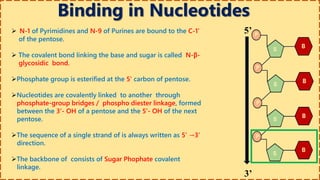
 N-1 of Pyrimidines and N-9 of Purines are bound to the C-1’
of the pentose.
 The covalent bond linking the base and sugar is called N-β-
glycosidic bond.
Phosphate group is esterified at the 5' carbon of pentose.
Nucleotides are covalently linked to another through
phosphate-group bridges / phospho diester linkage, formed
between the 3'- OH of a pentose and the 5'- OH of the next
pentose.
The sequence of a single strand of is always written as 5’ →3’
direction.
The backbone of consists of Sugar Phophate covalent
linkage.
5’
3’
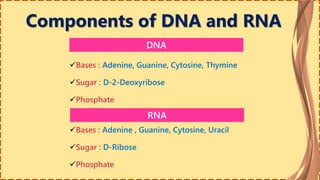
Components of DNA and RNA
RNA
DNA
Bases : Adenine, Guanine, Cytosine, Thymine
Sugar : D-2-Deoxyribose
Phosphate
Bases : Adenine , Guanine, Cytosine, Uracil
Sugar : D-Ribose
Phosphate
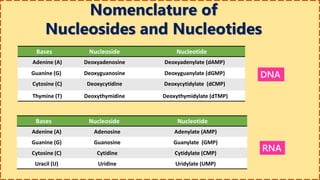
Nomenclature of
Nucleosides and Nucleotides
Bases Nucleoside Nucleotide
Adenine (A) Adenosine Adenylate (AMP)
Guanine (G) Guanosine Guanylate (GMP)
Cytosine (C) Cytidine Cytidylate (CMP)
Uracil (U) Uridine Uridylate (UMP)
Bases Nucleoside Nucleotide
Adenine (A) Deoxyadenosine Deoxyadenylate (dAMP)
Guanine (G) Deoxyguanosine Deoxyguanylate (dGMP)
Cytosine (C) Deoxycytidine Deoxycytidylate (dCMP)
Thymine (T) Deoxythymidine Deoxythymidylate (dTMP)
RNA
DNA
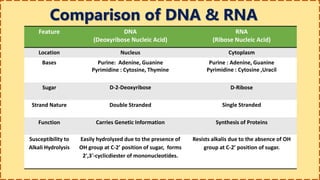
Comparison of DNA & RNA
Feature DNA
(Deoxyribose Nucleic Acid)
RNA
(Ribose Nucleic Acid)
Location Nucleus Cytoplasm
Bases Purine: Adenine, Guanine
Pyrimidine : Cytosine, Thymine
Purine : Adenine, Guanine
Pyrimidine : Cytosine ,Uracil
Sugar D-2-Deoxyribose D-Ribose
Strand Nature Double Stranded Single Stranded
Function Carries Genetic Information Synthesis of Proteins
Susceptibility to
Alkali Hydrolysis
Easily hydrolyzed due to the presence of
OH group at C-2’ position of sugar, forms
2',3'-cyclicdiester of mononucleotides.
Resists alkalis due to the absence of OH
group at C-2’ position of sugar.
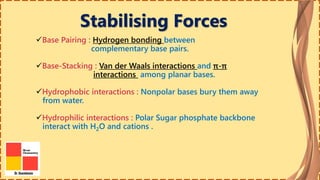
Stabilising Forces
Base Pairing : Hydrogen bonding between
complementary base pairs.
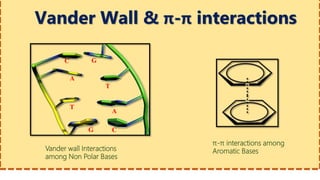
Base-Stacking : Van der Waals interactions and π-π
interactions among planar bases.
Hydrophobic interactions : Nonpolar bases bury them away
from water.
Hydrophilic interactions : Polar Sugar phosphate backbone
interact with H2O and cations .
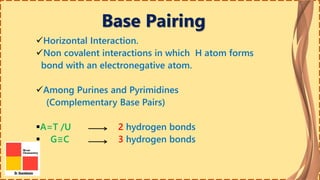
Base Pairing
Horizontal Interaction.
Non covalent interactions in which H atom forms
bond with an electronegative atom.
Among Purines and Pyrimidines
(Complementary Base Pairs)
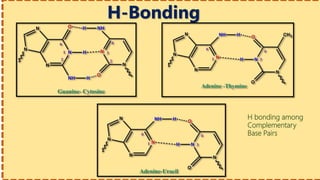
A=T /U 2 hydrogen bonds
 G≡C 3 hydrogen bonds
H-Bonding
H bonding among
Complementary
Base Pairs
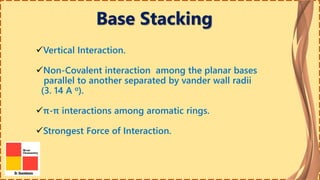
Base Stacking
Vertical Interaction.
Non-Covalent interaction among the planar bases
parallel to another separated by vander wall radii
(3. 14 A o).
π-π interactions among aromatic rings.
Strongest Force of Interaction.
Vander Wall & π-π interactions
A
A
G
T
T
C
C G
π-π interactions among
Aromatic BasesVander wall Interactions
among Non Polar Bases
Find us on YouTube:
https://www.youtube.com/channel/UC0eJg8aXyLqwGOnOxQNvSSw

Nucleic acids & Nucleotides

  • 2.
  • 3.
    History Freidrich Miescher isolatedfrom the nuclei of pus cells.  Named as nuclein.  Nuclein posses acidic properties.
  • 4.
    Role of Nucleotides Buildingblocks of nucleic acids (DNA, RNA).  Energy currency in cellular metabolism (ATP). Structural components of many enzymes cofactor. (NAD, FMN, FAD)
  • 5.
    Component of Nucleotides Base Sugar PhosphateGroup Nucleotides = Base + Sugar + Phosphate Nucleoside= Base + Sugar Nucleotides = Nucleoside + Phosphate Nucleotides : Monomers of Nucleic Acid
  • 6.
  • 7.
  • 8.
  • 9.
    Structure of Nucleotides Base:Adenine Base: Thymine Sugar: D- Ribose Sugar: D-2-Deoxyribose Phosphate: Monophosphate Phosphate: Diphosphate
  • 10.
    Binding in Nucleotides N-1 of Pyrimidines and N-9 of Purines are bound to the C-1’ of the pentose.  The covalent bond linking the base and sugar is called N-β- glycosidic bond. Phosphate group is esterified at the 5' carbon of pentose. Nucleotides are covalently linked to another through phosphate-group bridges / phospho diester linkage, formed between the 3'- OH of a pentose and the 5'- OH of the next pentose. The sequence of a single strand of is always written as 5’ →3’ direction. The backbone of consists of Sugar Phophate covalent linkage. 5’ 3’
  • 11.
    Components of DNAand RNA RNA DNA Bases : Adenine, Guanine, Cytosine, Thymine Sugar : D-2-Deoxyribose Phosphate Bases : Adenine , Guanine, Cytosine, Uracil Sugar : D-Ribose Phosphate
  • 12.
    Nomenclature of Nucleosides andNucleotides Bases Nucleoside Nucleotide Adenine (A) Adenosine Adenylate (AMP) Guanine (G) Guanosine Guanylate (GMP) Cytosine (C) Cytidine Cytidylate (CMP) Uracil (U) Uridine Uridylate (UMP) Bases Nucleoside Nucleotide Adenine (A) Deoxyadenosine Deoxyadenylate (dAMP) Guanine (G) Deoxyguanosine Deoxyguanylate (dGMP) Cytosine (C) Deoxycytidine Deoxycytidylate (dCMP) Thymine (T) Deoxythymidine Deoxythymidylate (dTMP) RNA DNA
  • 13.
    Comparison of DNA& RNA Feature DNA (Deoxyribose Nucleic Acid) RNA (Ribose Nucleic Acid) Location Nucleus Cytoplasm Bases Purine: Adenine, Guanine Pyrimidine : Cytosine, Thymine Purine : Adenine, Guanine Pyrimidine : Cytosine ,Uracil Sugar D-2-Deoxyribose D-Ribose Strand Nature Double Stranded Single Stranded Function Carries Genetic Information Synthesis of Proteins Susceptibility to Alkali Hydrolysis Easily hydrolyzed due to the presence of OH group at C-2’ position of sugar, forms 2',3'-cyclicdiester of mononucleotides. Resists alkalis due to the absence of OH group at C-2’ position of sugar.
  • 14.
    Stabilising Forces Base Pairing: Hydrogen bonding between complementary base pairs. Base-Stacking : Van der Waals interactions and π-π interactions among planar bases. Hydrophobic interactions : Nonpolar bases bury them away from water. Hydrophilic interactions : Polar Sugar phosphate backbone interact with H2O and cations .
  • 15.
    Base Pairing Horizontal Interaction. Noncovalent interactions in which H atom forms bond with an electronegative atom. Among Purines and Pyrimidines (Complementary Base Pairs) A=T /U 2 hydrogen bonds  G≡C 3 hydrogen bonds
  • 16.
  • 17.
    Base Stacking Vertical Interaction. Non-Covalentinteraction among the planar bases parallel to another separated by vander wall radii (3. 14 A o). π-π interactions among aromatic rings. Strongest Force of Interaction.
  • 18.
    Vander Wall &π-π interactions A A G T T C C G π-π interactions among Aromatic BasesVander wall Interactions among Non Polar Bases
  • 19.
    Find us onYouTube: https://www.youtube.com/channel/UC0eJg8aXyLqwGOnOxQNvSSw